Lesson 16 Mary had a little lamb玛丽有一头小羔羊
1.Mary and her husband Dimitri lived in the tiny village of
Perachora in southern Greece. One of Mary's prize⑴possessions⑵
Perachora in southern Greece. One of Mary s prize
possessions
was a little white lamb⑶which her husband had given her.
玛丽与丈夫迪米特里住在希腊南部
个叫波拉考拉的小村庄里
玛丽与丈夫迪米特里住在希腊南部一个叫波拉考拉的小村庄里。
玛丽最珍贵的财产之一就是丈夫送给她的一只白色小羔羊。
prize
n. 奖品
i
诺贝尔奖
prize
The Nobel Prize 诺贝尔奖
adj. 珍贵的(precious)
prize possession=my most precious possession
拥有
具有
支
(不用于进行时)
possess
vt. 拥有;具有;支配(不用于进行时)
be possessed of sth.
具有(某种品质或特征)
p
be possessed with/by 被…控制
财产
着迷
possession n. 财产,着迷
possession n.
[C,常用复数]所有物;财产
[U]具有;拥有
in possession of sth
占有(或拥有)某物
in possession of sth.
占有(或拥有)某物
in the possession of sb.
为某人所有
占有
拥有
占领
take possession of
占有;拥有;占领
come into possession of
继承……
get possession of 拿到;占有
辨析:possess/have/own
区别
possess
指拥有某物,或权利、能力、特征、品质等
have
表示“拥有”时无原因或理由可言,也不表明
拥有者和被拥有者之间的关系
own
多指所属关系,强调所有权,不管所属物是否
在物主手里。
1
(重庆卷)
【例1】
Before the war broke out, many people _____ in safe places
possessions they could not take with them.
p
y
A. threw away
B. put away
C
i
C. gave away
D. carried away
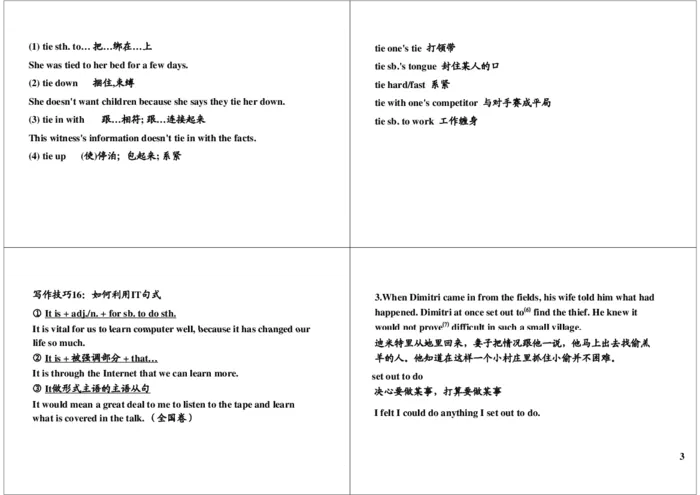
sheep 绵羊
mutton 羊肉
sheep 绵羊
mutton 羊肉
lamb 小羔羊
goat 山羊
2 She kept it tied to⑷a tree in a field during the day and went to
2.She kept it tied to
a tree in a field during the day and went to
fetch it every evening. One evening, however, the lamb was missing.
The rope had been cut so it was obvious⑸that the lamb had been
The rope had been cut, so it was obvious⑸that the lamb had been
stolen.
白天,玛丽把羔羊拴在地里的一颗树上,每天晚上把它牵回家。
可是,一天晚上,那只小羔羊失踪了。绳子被人割断,很明显小
羔羊是被人偷走了。
tie
n. 关系;领带,绳子;平局;束缚,限制
vt. (用线、绳等)系;打结;连接;与…成平局
vi 打结
系上;平局;被用带(或绳子等)系住
vi. 打结,系上;平局;被用带(或绳子等)系住
2
(1) tie sth. to… 把…绑在…上
She was tied to her bed for a few days.
(2) tie down
捆住束缚
(2) tie down 捆住,束缚
She doesn't want children because she says they tie her down.
(3) tie in with 跟…相符; 跟…连接起来
This witness's information doesn't tie in with the facts
This witness s information doesn t tie in with the facts.
(4) tie up (使)停泊;包起来; 系紧
tie one's tie 打领带
tie sb.'s tongue 封住某人的口
tie hard/fast 系紧
tie hard/fast 系紧
tie with one's competitor 与对手赛成平局
tie sb. to work 工作缠身
写作技巧16:如何利用IT句式
①It is + adj./n. + for sb. to do sth.
It is vital for us to learn computer well because it has changed our
It is vital for us to learn computer well, because it has changed our
life so much.
②It is + 被强调部分+ that
②It is + 被强调部分+ that…
It is through the Internet that we can learn more.
③
做形式主
的主
句
③It做形式主语的主语从句
It would mean a great deal to me to listen to the tape and learn
what is covered in the talk. (全国卷)
3.When Dimitri came in from the fields, his wife told him what had
happened. Dimitri at once set out to⑹find the thief. He knew it
would not prove⑺difficult in such a small village.
p
g
迪米特里从地里回来,妻子把情况跟他一说,他马上出去找偷羔
羊的人
他知道在这样一个小村庄里抓住小偷并不困难
羊的人。他知道在这样一个小村庄里抓住小偷并不困难。
set out to do
决心要做某事,打算要做某事
I felt I could do anything I set out to do
I felt I could do anything I set out to do.
3
set的短语
set up 建立,设立
例: In remember of the battle, we set up a museum.
①
例
,
p
set off 动身,出发;引爆,引发
例: The next morning, we set off.
②
例: The next morning, we set off.
set out to do sth. 开始着手做某事
set about doing sth 开始着手做某事
③
set about doing sth.开始着手做某事
set back 推迟
set free
释放
④
set free 释放
set aside 留出,不顾
【例2】(2012全国卷II,12)
We _____ to paint the whole house but finished only the front part
that day.y
A. set about B. set up
C
t
t
D
t d
C. set out D. set down
prove v. 证明
proof n. 证据;证明
proven adj 被证明的,已证实的
proven adj. 被证明的,已证实的
prove yourself to sb. 展现;展示(自己的才能)
prove yourself sth./ to be sth. 向人证明(自己)是
4.After telling several of his friends about the theft⑻, Dimitri
found out that his neighbour, Aleko, had suddenly acquired⑼a
new lamb.
把失窃的事告诉几个朋友后,迪米特里发出他的邻居阿列科家
突然多了一只小羔羊
突然多了
只小羔羊。
偷盗行为(th
ti
f t
li
)
theft
n. 偷盗行为(the action of stealing)
thief n. 小偷(复数:thieves)
acquire 获得;取得;学到
(1) acquire a taste for sth.开始喜欢某物
I've never really acquired a taste for wine
I ve never really acquired a taste for wine.
我从来没有真正喜欢过酒。
(2) acquire a (good) knowledge of
得到…的知识
Yao Ming acquired a (good) knowledge of English by
Yao Ming acquired a (good) knowledge of English by
careful study.
通过认真学习姚明掌握了英语
通过认真学习姚明掌握了英语。
4
(3) acquire the habit of doing sth. 养成做某事的习惯
We want people to acquire the habit of using public transport
instead of their cars.
我们希望人们养成使用公共交通而不是私家车的习惯。
【例3】(天津卷)
Lucy has
all of the goals she set for herself in
Lucy has ______ all of the goals she set for herself in
high school and is ready for new challenges at university.
A
i
d
B fi i h d
A. acquired
B. finished
C. concluded
D. achieved
5.Dimitri immediately went to Aleko's house and angrily accused⑽
him of stealing the lamb. He told him he had better⑾return it or
he would call the police.
p
迪米特里立刻去了阿列科家,气呼呼地指责他偷了羔羊,告诉他
最好把羊交还
否则就去叫警察
最好把羊交还,否则就去叫警察。
指责
控告
accuse
v. 指责;控告
accuse sb. of (doing) sth. 控告/ 指责某人(做了)某事
(
g)
控告指责某
(
)某事
The other driver accused Wilson of driving dangerously.
建议表达法
1.
Why not do sth.? =Why don’t you do sth.?
2
How about doing sth ?
2.
How about doing sth.?
3.
Would you please do sth.?
4.
If I were you, I would do sth..
5.
Let’s do sth., shall we?
,
6.
You’d better do sth.
7
Y
h
ld/
d
d
h
7.
You should/are supposed to do sth.
6.Aleko denied taking it and led Dimitri into his backyard. It was
true that he had just bought a lamb, he explained, but his lamb
was black.
阿列科不承认,并把迪米特里领进院子。不错,他的确刚买了一
只羔羊
阿列科解释说
但他的羔羊是黑色的
只羔羊,阿列科解释说,但他的羔羊是黑色的。
5
导致
造成
果
lead to
(1)导致,造成(结果)
例:Too much work and too little rest often lead to illness.
(2)通向,通往
例: The path leads to the village
例: The path leads to the village.
lead sb. to do sth. 使得某人做某事
导致
造成
result in 导致,造成
result from由......造成
bring about导致,造成
【例4】(2003上海)
【例4】(2003上海)
The discovery of new evidence led to ______.
A. the thief having caught
B
catch the thief
B. catch the thief
C. the thief being caught
D. the thief to be caught
+ 动名词做宾语
考虑建议盼原谅,承认推迟没得想。
避免错过继续练,否认完成停欣赏,
避免错过继续练,否认完成停欣赏,
禁止想象才冒险,不禁介意准逃亡。
consider suggest look forward to excuse/pardon;
consider, suggest, look forward to, excuse/pardon;
admit, delay/put off, forbid, consider;
avoid miss keep/keep on practise;
avoid, miss, keep/keep on, practise;
deny, finish, stop, enjoy/appreciate;
f
bid i
i
i k
forbid, imagine, risk;
can/’t help, mind, allow/permit, escape
7 Ashamed of⑿having acted so rashly Dimitri
7. Ashamed of
having acted so rashly, Dimitri
apologized⒀to Aleko for having accused him.
迪米特里为自己的鲁莽而感到不好意思
向阿列科道
迪米特里为自己的鲁莽而感到不好意思,向阿列科道
了歉,说是错怪了他。
6
ashamed
(1) ashamed adj. 羞耻的;惭愧的
(2) shame n. 遗憾的事;羞愧
(3) h
f l
dj 可耻的
不道德的
(3) shameful adj. 可耻的;不道德的
(4) 同义词:embarrassed、mortified、humiliated
( )
反义词:proud
be ashamed of... 为……感到惭愧
be ashamed of sb. for... 为某人做某事感到羞愧
be ashamed to do sth. 以做……为耻;羞于做……
be ashamed for sb.
替某人感到羞耻
be ashamed for sb. 替某人感到羞耻
It’s a shame that... 真惭愧,真遗憾
apologize
vi. 道歉
apologize
apology n. 道歉认错
apologize to sb for (doing/not doing) sth
apologize to sb. for (doing/not doing) sth.
因(做/没做)某事向某人道歉
8.While they were talking it began to rain and Dimitri stayed in
Aleko's house until⒁the rain stopped.
就在他俩说话的时候,天下起了雨,迪米特里便呆在阿列科家
就在他俩说话的时候,天下起了雨,迪米特里便呆在阿列科家
里避雨,一直等到雨停为止。
till, until, not…until
until引导时间状语从句
till, until, not…until
肯定句:延续性动词
否定句:非延续性动词
例: I will stay here until/till the rain stops.
y
p
I won’t leave until/till the rain stops.
9.When he went outside half an hour later, he was astonished⒂to
find that the little black lamb was almost white. Its wool, which had
been dyed⒃black, had been washed clean by the rain!
y
,
y
半小时后,当他从屋里出来时,他惊奇地发现小黑羔羊全身几乎
都变成白色
原来羊毛上染的黑色被雨水冲掉了!
都变成白色。原来羊毛上染的黑色被雨水冲掉了!
(1)
使惊讶
astonish
(1) vt. 使惊讶
He tried his best to astonish me.
(2) be astonished at
b
i
d t
be surprised at
7
dye
v. 染色(dyes, dyed, dyeing)
dye sth +adj 把
染成
dye sth. +adj. 把…染成…
She dyed the dress blue.
Sunset dyed the sky red.
斐斐点睛
1.
prize
2
i
8. accuse
9 l
d
2.
possession
3.
lamb
9. lead
10. ashamed
4.
tie to
5
prove
11. apologize
12 astonish
5.
prove
6.
theft
12. astonish
13. dye
7.
acquire
14. set out to do sth.
1.
辨析:possess/have/own
2.
建议表达法
3.
加动名词做宾语
4
until引导时间状语从句
4.
until引导时间状语从句
5.
写作技巧16:如何利用IT句式
8