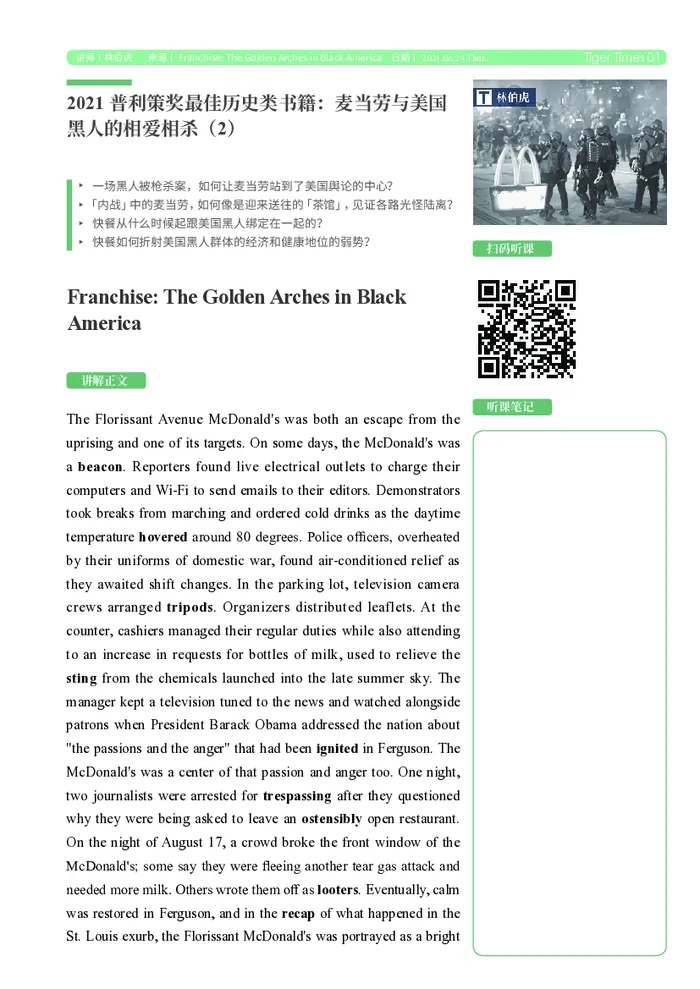
The Florissant Avenue McDonald's was both an escape from the
uprising and one of its targets. On some days, the McDonald's was
a beacon. Reporters found live electrical outlets to charge their
computers and Wi-Fi to send emails to their editors. Demonstrators
took breaks from marching and ordered cold drinks as the daytime
temperature hovered around 80 degrees. Police officers, overheated
by their uniforms of domestic war, found air-conditioned relief as
they awaited shift changes. In the parking lot, television camera
crews arranged tripods. Organizers distributed leaflets. At the
counter, cashiers managed their regular duties while also attending
to an increase in requests for bottles of milk, used to relieve the
sting from the chemicals launched into the late summer sky. The
manager kept a television tuned to the news and watched alongside
patrons when President Barack Obama addressed the nation about
"the passions and the anger" that had been ignited in Ferguson. The
McDonald's was a center of that passion and anger too. One night,
two journalists were arrested for trespassing after they questioned
why they were being asked to leave an ostensibly open restaurant.
On the night of August 17, a crowd broke the front window of the
McDonald's; some say they were fleeing another tear gas attack and
needed more milk. Others wrote them off as looters. Eventually, calm
was restored in Ferguson, and in the recap of what happened in the
St. Louis exurb, the Florissant McDonald's was portrayed as a bright
Tiger Times 01
讲师丨林伯虎       来源丨Franchise: The Golden Arches in Black America    日期丨2021.06.24 Thur.
扫码听课
听课笔记
讲解正文
2021 普利策奖最佳历史类书籍:麦当劳与美国
黑人的相爱相杀(2)
▶     一场黑人被枪杀案,如何让麦当劳站到了美国舆论的中心?
▶    「内战」中的麦当劳,如何像是迎来送往的「茶馆」,见证各路光怪陆离?
▶     快餐从什么时候起跟美国黑人绑定在一起的?
▶     快餐如何折射美国黑人群体的经济和健康地位的弱势?
Franchise: The Golden Arches in Black
America
spot and an anchor for the community.
The Ferguson moment was not the first time that McDonald's
played a major role in a racial crisis. In fact, the Florissant Avenue
McDonald's—as a franchise location owned and operated by an
African American businessman—is the descendant of a somewhat
bizarre but incredibly powerful marriage between a fast-food
behemoth and the fight for civil rights. After the assassination of
Martin Luther King Jr. in 1968 and the ensuing urban upheavals, the
movement for racial justice pivoted its focus toward black business
ownership. Hamburger, fried chicken, and taco chains eagerly met
the gaze of those interested in using business development as a
strategy to quell unrest, and introduced fast-food franchising to inner-
city black communities. This book tells the hidden history of the
intertwined relationship between the struggle for civil rights and the
expansion of the fast-food industry.
The United States is the birthplace of some of the world's most
successful fast-food brands, as well as the home of its most
enthusiastic eaters. On any given day, an estimated one-third of
all American adults is eating something at a fast-food restaurant.
Millions of people start their mornings with paper-wrapped English
muffin breakfast sandwiches, order burritos hastily secured in foil for
lunch, and end their evenings with extravalue dinners consumed in
cars. People of all ages and backgrounds enjoy fast food, but it does
not mean the same thing to all people. For African Americans, the
history of the development of the fastfood industry and its presence
in their communities reveals the complicated ways that race is lived
in America. Racism constrains choices and limits opportunities, from
how much you earn to how long you live. Race also informs where
you can sit comfortably and what foods are available to you. Even
after segregation was legally dissolved by the Civil Rights Act of
1964, African Americans were still left with a low ceiling hovering
over their social and economic mobility. The restrictions that emerge
because of race and class would place African Americans in a close
relationship with an industry built on the idea that food could be
delivered cheaply, uniformly, and without consideration of a person's
Tiger Times
02
social station. Fast food is a prism for understanding race, shifts in
the movement for civil rights, the dissemination of black culture, and
racial capitalism—the deep connections between the development of
modern capitalism and racist subjugation and oppression—since the
1960s. Before fast food became a quotidian fixture of American life
in shopping malls, schools, airports, and rest stops, it was an object
of curiosity, fascination, and even hope for many black communities.
Today, fast-food restaurants are hyperconcentrated in the places that
are the poorest and most racially segregated. Due to its saturation
in black America, fast food is often identified as the culprit among
the research on high rates of obesity, diabetes, and hypertension
among blacks. Since the early 2000s, studies have focused on the
relationship between access to healthy foods and the nutrition color
line. Researchers have warned that a black child born in the year 2000
has a 53% chance of developing type 2 diabetes; the likelihood of a
white child developing the potentially fatal disease is less than 30%.
In 2015, nearly 75% of African-American adults and 33% of black
adolescents were considered overweight or obese. Blacks were 1.4
times more likely than their white counterparts to be obese. Economic
inequality exacerbates health inequality, and poor and working-
class black families often lack access to quality preventative health
care. In the year that Ferguson entered the national consciousness,
the average white family had the equivalent of one month's income
in liquid savings, while a black family could rely on only five days of
pay.
Tiger Times
03
Tiger Times
04
beacon /ˈbiːkən/ n. 信标灯,灯塔
 ○ a light that is put somewhere to warn or guide people,
ships, vehicles, or aircraft
 ○ e.g. She was a beacon of hope in troubled times. 在动荡的
年代,她是人们的希望之灯。
hover /ˈhɒvə/ v.(在某一水平附近)徘徊
 ○ if a level, price etc. hovers around a certain amount, it
stays close to that amount, only changing slightly up or down
 ○ e.g. Inflation is hovering at three percent. 通货膨胀率在
3% 左右徘徊。
tripod /ˈtraɪpɒd/ n.(照相机等的)三脚架
 ○ a support with three legs, used for a piece of equipment,
camera etc.
sting /stɪŋ/ n.(眼睛、皮肤等的)灼痛,刺痛
 ○ a sharp pain in your eyes or skin, caused by being hit, by
smoke etc.
 ○ e.g. She felt the sting of tears in her eyes. 她感到眼泪刺
痛了她的眼睛。
ignite /ɪɡˈnaɪt/ v. 激起
 ○ to start a dangerous situation, angry argument etc.
 ○ e.g. The proposed restrictions have ignited a storm of
protest. 拟议中的限制规定激起了抗议的浪潮。
trespass /ˈtrespəs/ v. 擅自进入,侵入(他人土地或建筑物)
 ○ to go onto someone's private land without their permission
 ○ e.g. She was arrested for trespassing on government
property. 她因非法侵入政府财产而被捕。
ostensibly /ɒˈstensəbli/ adv. 表面上地
 ○ if something is ostensibly true, people say that it is true but
it is not really true
 ○ e.g. She stayed behind at the office, ostensibly to work. 她
留在办公室,表面上是为了工作。
looter /'lu:tə/ n. 掠夺者,强夺者
 ○ a person who steals things from shops or buildings after a
riot, fire, etc.
 ○ e.g. Hundreds of looters and rioters taunted police. 数百名
抢劫者和骚乱者嘲笑警察。
recap /ˈriːkæp/ n. 概括
 ○ the act of repeating or giving a summary of what has
already been said, decided, etc.
 ○ e.g. Each report starts with a recap of how we did versus
our projections. 每一份报道都以一个概要开头,讲述和预
期相比我们的表现如何。
anchor /ˈæŋkə/ n. 给以安全感的人(或物);精神支柱
 ○ someone or something that provides a feeling of support
and safety
 ○ e.g. She was my anchor when things were difficult for me.
我身处困境时,她就是我的精神支柱。
descendant /dɪˈsendənt/ n. 子孙,后代
 ○ someone who is related to a person who lived a long time
词汇
ago, or to a family, group of people etc. that existed in the
past
 ○ e.g. He has no descendants. 他没有后代。
upheaval /ʌpˈhiːvəl/ n. 激变;动荡;剧变
 ○ a very big change that often causes problems
 ○ e.g. Moving house is a major upheaval. 搬家是一场重大
的剧变。
quell /kwel/ v.(尤指通过武力)制止,平息;镇压
 ○ to end a situation in which people are behaving violently
or protesting, especially by using force
 ○ e.g. Police used live ammunition to quell the disturbances.
警方使用实弹平息骚乱。
hastily /ˈheɪstəli/ adv. 匆忙地;仓促地
 ○ quickly, perhaps too quickly
 ○ e.g. a hastily arranged news conference 仓促安排的新闻
发布会
dissemination /dɪˌseməˈneɪʃən/ n. 传播;散布
 ○ the act of spreading information or knowledge so that it
reaches many people
 ○ e.g. the dissemination of information 信息的传播
subjugation /ˌsʌbdʒəˈɡeɪʃən/ n. 征服
 ○ the act of defeating sb./sth. ; complete control over sb./sth.
 ○ e.g. They are bravely resisting subjugation by their more
powerful neighbours. 他们在勇敢地抵抗比他们强大的邻国
的征服。
quotidian /kwəʊˈtɪdiən/ adj. 平常的,普通的;日常的
 ○ ordinary, and happening every day
 ○ e.g. Television has become part of our quotidian existence.
电视已成为我们日常生活的一部分。
saturation /ˌsætʃəˈreɪʃən/ n. 浸透
 ○ the degree to which something is absorbed into something
else, expressed as a percentage of the greatest possible
culprit /ˈkʌlprɪt/ n. 问题的起因;罪魁祸首
 ○ the reason for a particular problem or difficulty
 ○ e.g. High production costs are the main culprit. 高生产成
本是主要原因。
exacerbate /ɪɡˈzæsəbeɪt/ v. 使恶化;使加重;使加剧
 ○ to make a bad situation worse
 ○ e.g. The recession has exacerbated this problem. 经济衰退
加剧了这个问题。
Tiger Times
05
今日习题
1. 根据英文释义写出文中出现的对应词
______: a great change, especially causing or involving much difficulty, activity, or trouble
______: a fact or situation that is the reason for something bad happening
2. 一词多义
Which of the following underlined word is closest in meaning to the one in the sentence "Demonstrators
took breaks from marching and ordered cold drinks as the daytime temperature hovered around 80
degrees."  ____
A. A hawk hovered in the sky, waiting to swoop down on its prey.
B. The dollar has been hovering around the 110 yen level.
C. I noticed several reporters hovering around outside the courtroom.
D. When you hover the cursor over the image, the title of the image appears.
3. 翻译:根据给定中文回译英文
位于弗洛里森特大道(Florissant Avenue)的麦当劳既是抗议的喘息之地,也是起义的目标之一。
在某些日子里,麦当劳就像一座灯塔。
_____________________________________________________________________________________
_________________________________________________________________
习题答案
1. upheaval; culprit
2. B
3. The Florissant Avenue McDonald's was both an escape from the uprising and one of its targets.
On some days, the McDonald's was a beacon.
编辑丨焰妮