选择性必修
第四册
英语
第四册
选择性必修
普
通
高
中
教
科
书
英语
·北京·
人民教育出版社 课程教材研究所
英语课程教材研究开发中心
圣
智
学
习
集
团
(中国)
(美国)
编著
ENGLISH
普通高中教科书 英语 选择性必修 第四册
(中国)
人民教育出版社 课程教材研究所
英语课程教材研究开发中心 编著
(美国)圣
智
学
习
集
团
出 版
(北京市海淀区中关村南大街17 号院1 号楼 邮编:100081)
网 址 http://www.pep.com.cn
版权所有·未经许可不得采用任何方式擅自复制或使用本产品任何部分·违者必究
如发现内容质量问题,请登录中小学教材意见反馈平台:jcyjfk.pep.com.cn
主 编:刘道义 郑旺全
副 主 编:吴 欣 张献臣
编写人员: Patrick Wallace Tim Gibbs Simon McCue Jacqueline Eu
陆锡钦 辜翔宇 生 平 常 贞
责任编辑:陆锡钦 辜翔宇 马小洁
美术编辑:胡白珂
《普通高中教科书 英语》是为了适应新时代的发展需要,依据《普通高中英语课程标
准(2017年版)》的精神,充分征求广大师生的反馈意见,在《普通高中课程标准实验教科
书 英语》的基础上精心修订而成。此次教材修订的主要目的是:全面落实立德树人根本任
务,培育社会主义核心价值观,弘扬中华优秀文化,充分体现英语课程工具性和人文性的统
一,发展学生的语言能力、文化意识、思维品质和学习能力等英语学科核心素养,充分体现
英语学科特殊的育人价值,培养具有中国情怀、国际视野和跨文化沟通能力的社会主义建设
者和接班人。
修订后的教材主要具有以下特点:
注重思想引领 教材融入了社会主义核心价值观的基本内容和要求,注重培养学生良好
的政治素质、道德品质和健全人格,弘扬中华优秀文化,增强文化自信,引导学生形成正确
的世界观、人生观和价值观。
反映时代要求 教材充分反映当代社会发展新变化、科技进步新成果,展示新时代中国
特色社会主义新成就,将先进的教育思想和理念融入教材之中,同时紧密结合学生的学习和
生活实际,关注信息化环境下学生的发展需求。
强调语言实践 教材以英语学习活动观为指导,以主题为引领,以语篇为依托,通过板
块式设计将语言知识与听、说、读、看、写等技能有机整合,强调学习过程和学习策略,突
出活动目标,让学生用语言做事情,在实践中培养语言运用能力和创新思维。
突出文化意识 教材通过展示多姿多彩的中外文化来培养学生对中华文化的认同和传承,
加深对人类优秀文化的学习和鉴赏;通过让学生分析中外文化异同,发展其多元思维和批判
性思维,增强学生跨文化理解和跨文化沟通能力,构建人类命运共同体意识。
激发学习动机 教材以真实性、趣味性、规范性和经典性作为内容选编原则,主题覆盖
面广,语篇题材和体裁丰富,活动呈现形式多样,版式设计生动活泼且富有美感,力求激发
学生的学习兴趣和动机,引发他们积极思考、主动参与语言实践活动,提升英语学习效率。
满足不同需求 教材编排内容和活动设计既充分考虑学生的共同基础,又兼顾学生不同
的能力水平和学习需求,提供了拓展性的教学内容,为教师灵活使用教材进行教学提供了便
利,也切实促进学生的个性发展。
本套教材为高中英语教学提供了丰富的教学资源。希望教材能够帮助同学们打下坚实的
语言基础,提高英语水平,获得全面发展;同时也希望老师们能够充分利用教材,在实践中
不断完善教学,取得良好的教学效果。
前 言
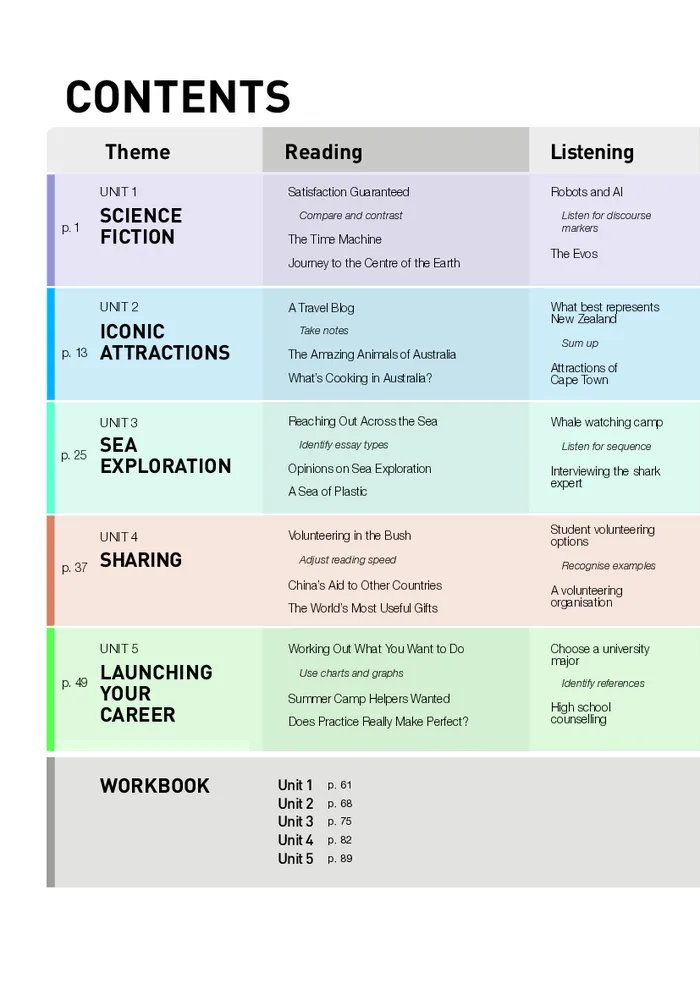
CONTENTS
Reading
Listening
Unit 1 p. 61
Unit 2 p. 68
Unit 3 p. 75
Unit 4 p. 82
Unit 5 p. 89
Satisfaction Guaranteed
Compare and contrast
The Time Machine
Journey to the Centre of the Earth
A Travel Blog
Take notes
The Amazing Animals of Australia
What’s Cooking in Australia?
Volunteering in the Bush
Adjust reading speed
China’s Aid to Other Countries
The World’s Most Useful Gifts
Working Out What You Want to Do
Use charts and graphs
Summer Camp Helpers Wanted
Does Practice Really Make Perfect?
Reaching Out Across the Sea
Identify essay types
Opinions on Sea Exploration
A Sea of Plastic
Robots and AI
Listen for discourse
markers
The Evos
What best represents
New Zealand
Sum up
Attractions of
Cape Town
Whale watching camp
Listen for sequence
Interviewing the shark
expert
Student volunteering
options
Recognise examples
A volunteering
organisation
Choose a university
major
Identify references
High school
counselling
p. 1
p. 13
p. 25
p. 37
p. 49
Theme
WORKBOOK
UNIT 1
SCIENCE
FICTION
UNIT 2
ICONIC
ATTRACTIONS
UNIT 3
SEA
EXPLORATION
UNIT 4
SHARING
UNIT 5
LAUNCHING
YOUR
CAREER
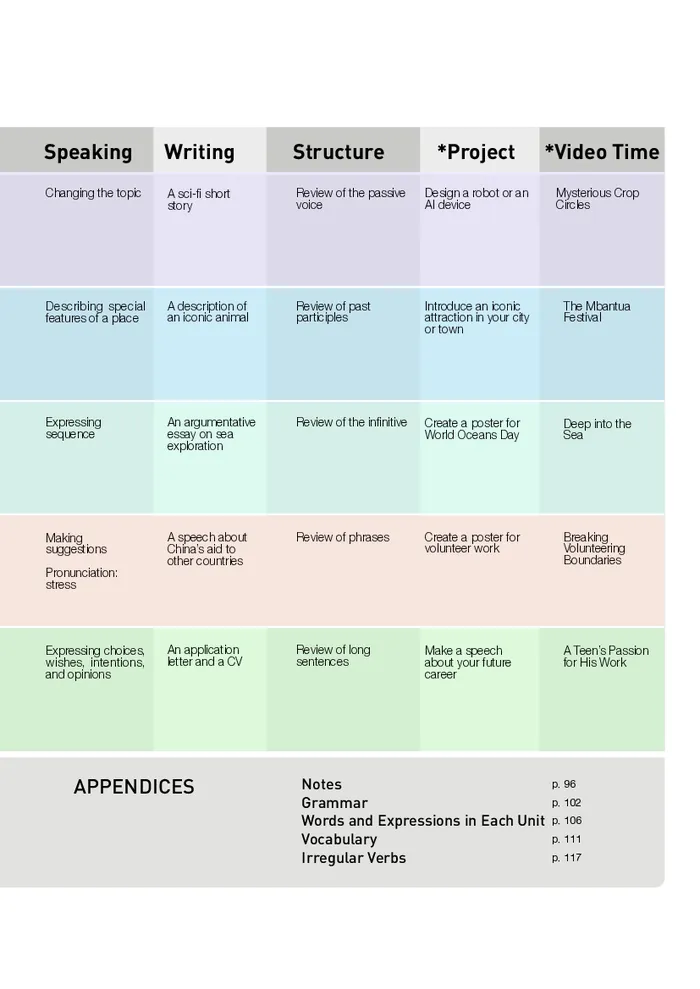
Speaking
Writing
Structure
APPENDICES
Notes
p. 96
Grammar
p. 102
Words and Expressions in Each Unit p. 106
Vocabulary
p. 111
Irregular Verbs
p. 117
Review of the passive
voice
Review of past
participles
Review of long
sentences
Review of phrases
Review of the infinitive
*Project
Design a robot or an
AI device
Introduce an iconic
attraction in your city
or town
Create a poster for
World Oceans Day
Create a poster for
volunteer work
Make a speech
about your future
career
*Video Time
Mysterious Crop
Circles
The Mbantua
Festival
Deep into the
Sea
Breaking
Volunteering
Boundaries
A Teen’s Passion
for His Work
A sci-fi short
story
A description of
an iconic animal
An argumentative
essay on sea
exploration
A speech about
China’s aid to
other countries
An application
letter and a CV
Changing the topic
Describing special
features of a place
Expressing
sequence
Making
suggestions
Pronunciation:
stress
Expressing choices,
wishes, intentions,
and opinions
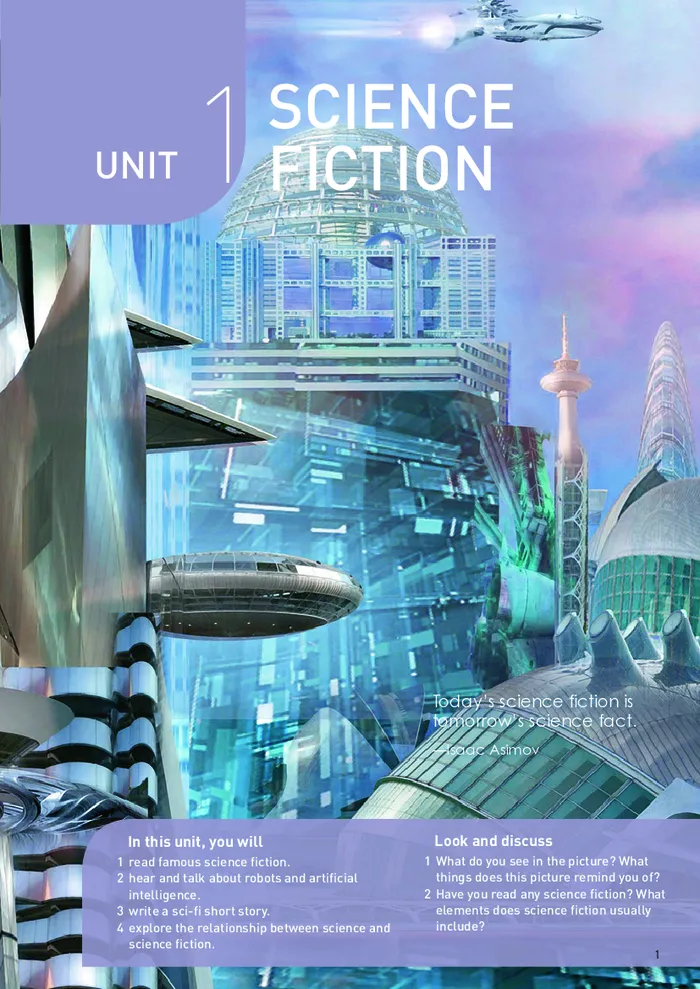
Today’s science fiction is
tomorrow’s science fact.
—Isaac Asimov
In this unit, you will
1 read famous science fiction.
2 hear and talk about robots and artificial
intelligence.
3 write a sci-fi short story.
4 explore the relationship between science and
science fiction.
Look and discuss
1 What do you see in the picture? What
things does this picture remind you of?
2 Have you read any science fiction? What
elements does science fiction usually
include?
SCIENCE
FICTION
UNIT 1
1
Explore the relationship between humans and robots
Reading and Thinking
1 How do robots already help humans in their lives today? What do you think a
domestic robot could do for a family in the future?
2 Read the story below, which was originally written by famous science
fiction writer Isaac Asimov. Take notes on who these people are and their
relationships to each other.
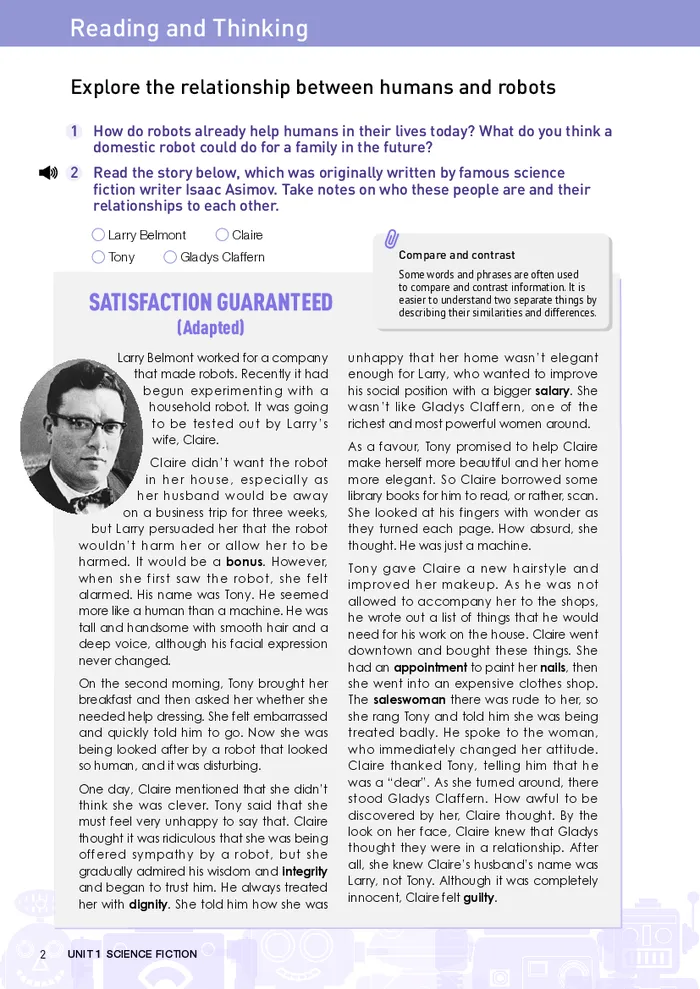
SATISFACTION GUARANTEED
(Adapted)
Larry Belmont worked for a company
that made robots. Recently it had
begun experimenting with a
household robot. It was going
to be tested out by Larry’s
wife, Claire.
Claire didn’t want the robot
in her house, especially as
her husband would be away
on a business trip for three weeks,
but Larry persuaded her that the robot
wouldn’t harm her or allow her to be
harmed. It would be a bonus. However,
when she first saw the robot, she felt
alarmed. His name was Tony. He seemed
more like a human than a machine. He was
tall and handsome with smooth hair and a
deep voice, although his facial expression
never changed.
On the second morning, Tony brought her
breakfast and then asked her whether she
needed help dressing. She felt embarrassed
and quickly told him to go. Now she was
being looked after by a robot that looked
so human, and it was disturbing.
One day, Claire mentioned that she didn’t
think she was clever. Tony said that she
must feel very unhappy to say that. Claire
thought it was ridiculous that she was being
offered sympathy by a robot, but she
gradually admired his wisdom and integrity
and began to trust him. He always treated
her with dignity. She told him how she was
unhappy that her home wasn’t elegant
enough for Larry, who wanted to improve
his social position with a bigger salary. She
wasn’t like Gladys Claffern, one of the
richest and most powerful women around.
As a favour, Tony promised to help Claire
make herself more beautiful and her home
more elegant. So Claire borrowed some
library books for him to read, or rather, scan.
She looked at his fingers with wonder as
they turned each page. How absurd, she
thought. He was just a machine.
Tony gave Claire a new hairstyle and
improved her makeup. As he was not
allowed to accompany her to the shops,
he wrote out a list of things that he would
need for his work on the house. Claire went
downtown and bought these things. She
had an appointment to paint her nails, then
she went into an expensive clothes shop.
The saleswoman there was rude to her, so
she rang Tony and told him she was being
treated badly. He spoke to the woman,
who immediately changed her attitude.
Claire thanked Tony, telling him that he
was a “dear”. As she turned around, there
stood Gladys Claffern. How awful to be
discovered by her, Claire thought. By the
look on her face, Claire knew that Gladys
thought they were in a relationship. After
all, she knew Claire’s husband’s name was
Larry, not Tony. Although it was completely
innocent, Claire felt guilty.
Larry Belmont
Claire
Tony
Gladys Claffern
2
UNIT 1 SCIENCE FICTION
Compare and contrast
Some words and phrases are often used
to compare and contrast information. It is
easier to understand two separate things by
describing their similarities and differences.
When Claire got home, she wept. Gladys
was everything Claire wished to be. Tony
told her she was being sensitive and was
just as good as Gladys. He suggested that
she invite Gladys and her friends to the
house the night before he was to leave
and Larry was to return. By that time, Tony
expected that the house, which was being
completely transformed, would be ready.
Tony worked steadily on the improvements.
Claire tried to help by working on a light
suspended from the ceiling, but she fell off
the ladder. Even though Tony had been in
the next room, he managed to catch her in
time. As he held her, she felt the warmth of
his body. She screamed, pushed him away,
and ran to her room.
The night of the party arrived. The clock
struck eight. The guests would be arriving
soon, so Claire dismissed Tony for the rest of
the night. At that moment, Tony took her in
his arms, bringing his face close to hers. She
heard him declare that he did not want
to leave her the next day, and that he felt
more than just the desire to please her. Then
the front door bell rang.
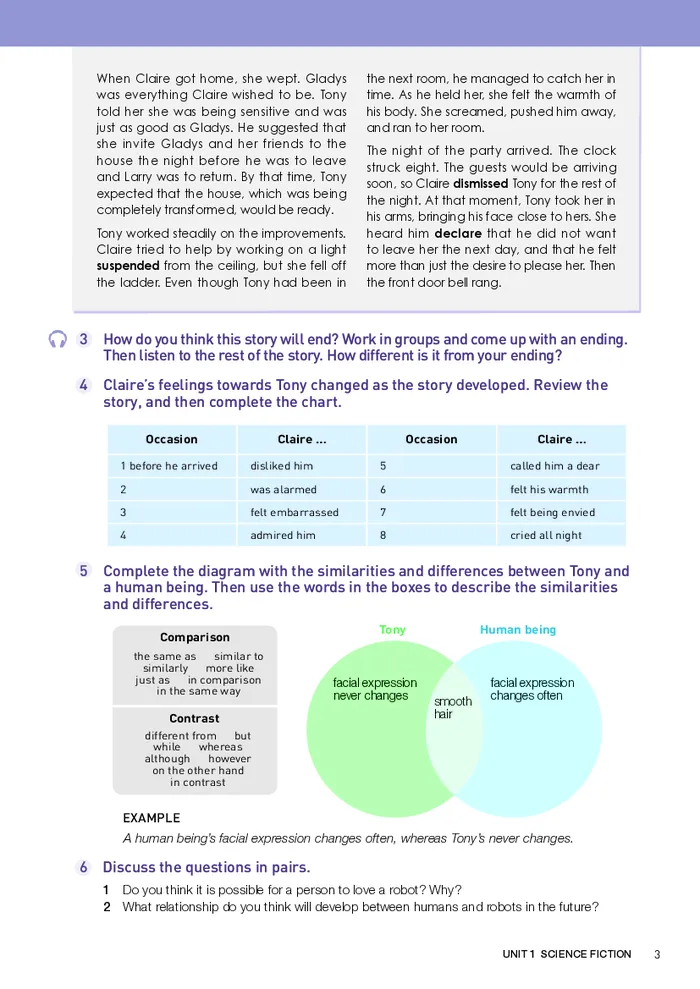
5 Complete the diagram with the similarities and differences between Tony and
a human being. Then use the words in the boxes to describe the similarities
and differences.
4 Claire’s feelings towards Tony changed as the story developed. Review the
story, and then complete the chart.
6 Discuss the questions in pairs.
1 Do you think it is possible for a person to love a robot? Why?
2 What relationship do you think will develop between humans and robots in the future?
3 How do you think this story will end? Work in groups and come up with an ending.
Then listen to the rest of the story. How different is it from your ending?
A human being’s facial expression changes often, whereas Tony’s never changes.
EXAMPLE
UNIT 1 SCIENCE FICTION
3
Occasion
Claire …
Occasion
Claire …
1 before he arrived
disliked him
5
called him a dear
2
was alarmed
6
felt his warmth
3
felt embarrassed
7
felt being envied
4
admired him
8
cried all night
Comparison
Contrast
the same as similar to
similarly more like
just as in comparison
in the same way
different from but
while whereas
although however
on the other hand
in contrast
Tony
Human being
facial expression
changes often
facial expression
never changes
smooth
hair
Learning About Language
Build up your vocabulary
1 Replace the underlined parts with words of similar meanings from the text.
Rewrite the sentences if necessary.
2 Match each word with the proper definition below.
3 Complete the passage using the correct forms of the words in the box. Then
in pairs share your opinion on AI development.
It would not be surprising if we found it difficult to distinguish between reality and
in the future. For example, robots first appeared in sci-fi novels, but now robot soldiers have
already been
in war. Robot experts have also built robots that can see, talk, and
do other things like humans. Although a robot that looks
a human than a machine
could make many people a bit uncomfortable, we have to admit that it is a
possibility. Sophia, currently said to be the most advanced AI robot in the world, is a great
example. She has been interviewed many times, appeared on the covers of magazines,
and become the first non-human in the world to be given citizenship by a country. When it
comes to games, 2017 became a year in which AI defeated humans in so many games that
AI researchers say that it will not be long before AI can win at almost everything. So have we
lost the
of being the most intelligent creature? Maybe in the future, as AI becomes
even more
, it will become a major threat to humans. However, some people
this fear. They believe if AI can handle tasks like calculating and driving for us, we
will have more time for creating, thinking, and “being human”.
fascinating test out dismiss science fiction more like dignity intelligent
1 We believe he is a man of absolute honesty, and trust his words completely.
2 Henry told me that he was in a hurry as he had arranged to see the dentist at 10:00 a.m.
3 Rumours are like sharp knives, cutting one’s self-respect into pieces. We should be aware
of this and not spread unkind news around.
4 Because of the holiday, the students were allowed to go home early.
5 Whoever is charged with a crime should be presumed innocent until proven otherwise.
4
UNIT 1 SCIENCE FICTION
1 income
A money that someone is paid regularly, usually monthly, by the
organisation he or she is working for
B money given for work done, goods received, etc.
C money paid for work or services, typically on a daily or weekly basis
D extra amount of money added to somebody’s wages as a reward for
hard work or good performance
E money received from work, investments and so on
F money paid to a professional person or organisation for advice or
services
G money paid for a journey on public transport, such as the bus, train,
or taxi
H money saved for a special purpose
2 fee
3 fare
4 payment
5 salary
6 bonus
7 saving
8 wage
Review useful structures
1 Scan the reading text and underline all the verbs in the passive voice. Then
discuss with a partner why the passive voice is used.
2 Complete the sentences with appropriate forms of the verbs in brackets.
Then try to translate these sentences into Chinese.
3 Read the introduction to a science fiction novel and complete the passage
using the correct forms of the words in the box.
explore translate discover regard represent
set up recruit write get caught up connect
1 What is done cannot
. (undo)
2 Janet
chairwoman of the student union last month. (elect)
3 Two hundred grammes of flour should
to the cake mix. (add)
4 A 3,000-seat venue
for the circus performance in November. (build)
5 Working efficiency
since this new software was adopted. (improve)
6 Only one piece of carry-on luggage
for each economy class passenger. (allow)
7 It is a great honour for me to
to address this international AI conference. (invite)
8 When I entered the room, I found that the salesman’s salary
at the meeting.
(discuss)
9 With exams being adapted into Braille, a blind senior high school student scored 630
points out of 650 in the College Entrance Examination. He is expected to
to a
top university. (admit)
Science fiction
by many people as a mirror through which our future can be freely
imagined and
. The Three-Body Problem,
by Chinese writer Liu Cixin,
is one of those astonishing predictions about the future. The work was first published in a
Chinese sci-fi magazine in 2006 and printed as a three-volume book in 2008. When the first
volume
into English by Chinese-American author Ken Liu, it attracted attention
around the world, becoming the first Asian winner of the Hugo Award for Best Novel. The
book
many themes such as space exploration, alien contact, AI, and the future of
humans.
The Three-Body Problem begins with the stories of two unrelated people, Ye Wenjie and Wang
Miao. Ye
to join a secret project in a remote area of China, which
to contact alien life forms. In the other story, set 20 years later, Wang Miao
in a popular online game called “Three Body”, in which people live on an unknown planet
with three suns. But Wang discovers it is more than a game—it uncovers a great danger
threatening human existence. How are these two people’s stories
? And how will
their behaviour change Earth’s future and the civilisations of other planets? Answers to all these
questions are waiting to
when you go on reading.
5
Using Language
1 Look at the pictures and discuss the questions in pairs.
2 Listen to an interview and put these statements in the correct order.
3 Listen to the interview again and
write down the discourse markers
that you hear. Make a note of how
each discourse marker is used in
the interview. Then compare your
answers with a partner.
Voice your opinions on robots and AI
1 What jobs are these robots doing? What are the pros and cons of robots doing these jobs?
2 What kinds of robots or AI developments do you hope for?
1
The host introduces the guest, a sci-fi expert.
The expert has robots in his home.
As robots become more intelligent, they may also become more dangerous.
The host mentions Asimov’s Three Laws of Robotics.
The expert says robots will have occupations such as teaching and nursing.
The line between humans and robots will be more blurred in the future.
The host asks about benefits and problems.
The host asks if there are robots in the expert’s home.
In sci-fi stories, robots often become superior and take over.
Listen for discourse markers
Discourse markers are used to
organise a text by marking sequence,
contrast, opinion, purpose, and so
on. Listening for discourse markers
can help you understand a text more
easily. For example, first, however,
above all, in order to, etc.
6
UNIT 1 SCIENCE FICTION
Listening and Speaking
4 In groups, discuss what the expert thinks of the questions and exchange your
own views. You may use the following expressions to help you.
Oh, by the way, … Oh, I remember, … I nearly forgot! …
What I meant to tell/ask you is …
…, but (perhaps) that’s beside the point.
That reminds me of …
The next item on the agenda is …
I think we ought to move on to …
On the one hand … On the other hand …
Oh, there was something I meant to tell you.
Could I change the subject?
Changing the topic
EXAMPLE
A: Oh, by the way, I saw a programme about robot doctors last night. It was very interesting.
Do you think robots will do more of these important jobs in the future?
B: Certainly. They will probably do most of our labour for us.
C: Maybe, but that’s beside the point. In my opinion, robots are dangerous! They are much
stronger than we are and may be superior to us in the future.
…
1 What do you know about robot technology? What can robots do?
2 What benefits do you think robots or AI will bring? Do you think they will cause problems as
well?
3 Do you know anything about Isaac Asimov and his famous Three Laws of Robotics? What
do you think of these laws?
A ROBOT MAY NOT INJURE A
HUMAN BEING, OR, THROUGH
INACTION, ALLOW A HUMAN
BEING TO COME TO HARM.
LAW 1
LAW 2
LAW 3
A ROBOT MUST OBEY THE ORDERS
GIVEN IT BY HUMAN BEINGS EXCEPT
WHERE SUCH ORDERS WOULD
CONFLICT WITH THE FIRST LAW.
A ROBOT MUST PROTECT ITS OWN
EXISTENCE AS LONG AS SUCH
PROTECTION DOES NOT CONFLICT
WITH THE FIRST OR SECOND LAW.
THREE LAWS OF ROBOTICS
7
Write a sci-fi short story
1 In groups, discuss what you would do if you could time travel.
2 The Time Machine was written in 1895 by famous science fiction writer H.G.
Wells. Read an extract from this story, and find out how many times the Time
Traveller started the machine.
Using Language
8
UNIT 1 SCIENCE FICTION
THE TIME MACHINE (Adapted)
It was at ten o’clock today that the first of all Time Machines
began its career. I gave it a last check, and sat myself in the
leather seat. I pushed the starting lever on the main panel
forwards an inch then immediately backwards again. Looking
around, I saw my laboratory exactly as before. Had anything
happened? I thought my mind had tricked me. Then I saw the
clock. A moment before, it was a minute or so past ten; now it was
nearly half past three!
I drew a breath, gripped the lever and pushed it forwards. The laboratory went hazy
around me. My niece came in to fetch something, maybe her handkerchief, apparently
without seeing me. It probably took her a minute, but to me she moved like a rocket! I
pushed the lever further. Night came as if a lamp was being turned out, and in another
moment came the day. Tomorrow night came, then skipped to day, again and again,
faster and faster still.
It is hard to explain the strange and unpleasant feeling of time travelling. It felt like I was
being driven fast on a winding road. As my pace grew faster, the walls of the laboratory
fell away, and I was left in the open air. The sun and moon looked as if they were being
thrown across the sky, but soon there was division between night and day. Around me
I saw trees growing like puffs of smoke; they grew, spread, and died in moments. I saw
huge buildings rise up, then
disappear like in a dream.
The whole surface of the
earth was being changed,
melting and flowing before
my eyes. I calculated that I
was being pushed through
time at hundreds of years a
minute.
I had a strong urge to look
at the random things that
were being flashed before
my eyes! I had thought
about the risk of stopping
UNIT 1 SCIENCE FICTION
9
3 Read the text again and answer the questions.
5 Imagine and write your own story about a time machine you will invent, and your
journey through time. Use the story and the guide below to help you.
6 Exchange your draft with a partner and
revise the draft using your partner’s
comments.
7 Share your story with the rest of the class.
4 Work in groups. Discuss what might happen next in the story. Use the following
questions to help you and make brief notes. Then present your story to the class.
1 How does the Time Traveller first know he has travelled through time?
2 How does the Time Traveller feel when travelling through time? What rhetorical devices
does the writer use to describe his feelings?
3 Why is the Time Traveller worried about stopping the machine?
4 Where does the Time Machine arrive when the man finally stops it?
1 Think about what your machine will look like. Is it a vehicle or
a machine?
2 How does your time machine work? What do you have to
do to make it work?
3 What period in time do you want to travel to? Think about
interesting things and people you would like to see there.
4 Imagine what it might feel like to travel through time. Think
of words to describe this and make your story as vivid as
possible.
5 Include rhetorical devices in your story, like metaphors, similes,
overstatements, etc.
• What date do you think it is when the Time Traveller finally stops?
• What do you think is different about that time from the time he left?
• Who or what do you think the Time Traveller will meet?
• What adventures do you think he will have in the future?
• Do you think he will ever return to his own time?
the Time Machine many times. So long as I travelled at maximum speed, it didn’t
matter. But if I stopped and the same space was being occupied by something
else, we would be forced together and explode like a bomb! Like an impatient
fool, I pulled the lever backwards hard. With a sudden jolt, the Time Machine was
flipped on its side, and I was thrown through the air.
I was stunned for a moment, and then heard the sound of thunder. I was sitting in
the rain in some mud next to the machine. “A fine welcome,” I said, “for a man
who has travelled thousands of years to be here!”
1 Complete the following sentences using the correct forms of the words in
the box.
2 Read and complete the following sentences with appropriate forms of the
words in brackets. Then think about why the passive voice is used in these
sentences.
What interesting things about science fiction did you learn in this unit?
What new vocabulary and structures did you learn in this unit? How well can you
use them?
Do you think comparing and contrasting, and listening for discourse markers were
useful strategies for you to understand the texts?
What problems did you have with this unit? How did you solve them?
Overall, I thought this unit was
inspiring
useful
so-so
difficult.
REFLECTING
fetch superior to calculate have an urge to
suspend dismiss explode pace
Assessing Your Progress
10
UNIT 1 SCIENCE FICTION
1 Batteries are not allowed by airlines in checked luggage, as they might
due to
overheating.
2 The new generation of smartphones is greatly
older version.
3 Since I don’t have much time, I need to
how long it will take me to do the
task.
4 Ordered by its master, the AI dog
the book from the bookshelf.
5 I was so pleased to hear the bell ring and our teacher announce, “Class is
.”
6 The company has to
the space exploration project due to financial problems.
7 City people are experiencing increasing psychological pressure as a result of a faster
of life and rising competition.
8 At one time or another, each of us probably
break the routine of daily life and
try something new.
1 Mobile phones must
during the concert. (switch off)
2 When I came here at this time last year, the conference hall
. (build)
3 Topics like life in the future, AI development, and aliens
in sci-fi. (often find)
4 Do you know which country
by Italy, Austria, Germany, and France? (border)
5 Continuous research
on smart schools, smart homes, and smart cities.
(conduct)
6 It should
that the result of your examinations will not
. (note;
publicise)
7 It
that more species will become extinct if we continue to destroy the
ecosystem. (assume)
8 All members of the audience should
smartly, and the wearing of slippers
in the concert hall. (dress; not allow)
1 In groups, do some research about robots or AI devices in sci-fi films and
novels, and write a list of as many robot characters or AI devices as you can
think of. Use the Internet to help you.
2 Make a table like the one below and fill in the parts for different robot
characters and AI devices on your list.
3 Create your own robot character or AI device. Consider the following
questions and make notes.
4 Prepare your design for submission to a science fair using the following
guidelines.
* Project: Design a robot or an AI device
the Star Wars movies Wall·E Big Hero Six
the Transformers movies Pacific Rim the Foundation Series
UNIT 1 SCIENCE FICTION
11
1 What is your robot or AI device called? Why?
2 What does it look like? Why?
3 What can your robot or AI device do? Why and how?
4 Does it have a personality or specific function? If so, what is it like?
5 What makes your robot or AI device unique?
• Design a poster or slide presentation showing your creation, including a name, title, and
pictures of your robot or AI device.
• Write a description of the robot or AI device.
• Make a presentation using your poster or slides.
Movie/Novel
Name
Characteristic
Function/
Ability
Unique quality
Star Wars
R2-D2
Brave, funny,
mischievous
Co-pilot, hack
computers
He speaks in beeps and
whistles
BEFORE YOU WATCH
Look at the photos from the video and discuss the questions in groups.
1 What do you think these patterns represent?
2 Who or what do you think made these patterns and how?
WHILE YOU WATCH
Answer these questions.
1 Who do some people think the circles are made by?
2 Why did Mr Presley decide to find out more about the circles?
3 Where were other types of circles found?
4 Why do Matthew and his team like making crop circles?
5 What does Matthew think some people use the crop circles for?
AFTER YOU WATCH
Discuss the following questions in groups.
1 Do you believe crop circles are all made by humans or by aliens? What do you think the
crop circles represent?
2 What kind of crop circle would you create? Discuss and decide on its appearance and
meaning. Draw it on a large sheet of paper. Then present it to the rest of the class.
Mysterious Crop Circles
This video examines a strange phenomenon that
has taken place in the English countryside for many
decades. From time to time, crop circle patterns
have appeared, with people debating for years their
possible causes and meanings.
* Video Time
12
UNIT 1 SCIENCE FICTION
Whatever makes an impression
on the heart seems lovely in
the eye.
—Saadi
In this unit, you will
1 read about iconic attractions in different places.
2 hear and talk about what best represents a place.
3 write a description of an iconic animal.
4 learn more about iconic attractions in a city or
town.
Look and discuss
1 What do you know about the place in the
photo?
2 What are your impressions of this place?
3 Do you know of any other iconic
attractions in the world?
ICONIC
ATTRACTIONS
UNIT 2
13
Reading and Thinking
dim sim
14
UNIT 2 ICONIC ATTRACTIONS
Experience the iconic features of Australia
1 Work in groups and discuss the questions.
2 Skim the text. Match the blog entries to the subheadings. Write the blog
entry numbers in the blanks. Two are extra.
1 What is the first thing you think of when you think about Australia?
2 What is your impression of Australia based on your experience and/or what you have seen
in the media?
The foundation of Australia
First impressions
Reflections on multiculturalism
Preparing to travel
Political divisions
Aborigines and the didgeridoo
25 Sep
Next week I’m travelling to Australia to visit a friend there over the school holidays. I
plan to keep this blog to record my experiences and what I learn. I have already done
some research on the country. Located to the south of the equator, below many other
countries on the globe, it’s often informally referred to as “down under”.
I have also read about some iconic sites, such as the Sydney Opera House and the
Great Ocean Road, and animals like the cute koalas and kangaroos. I can’t wait to see
all of them! However, as I major in social studies, I’m more interested in meeting people
in Australia and experiencing their culture, food, and way of life.
1 Oct
I’m here in Sydney! Since I arrived, my friend has brought me to my first open-air
barbecue and has also shared many different but yummy meals with me, so my first
impressions of Australia have been all about food! A lot
of typical Australian food, such as the Sunday roast, is
originally British. Bakeries, fast-food joints, butcher shops,
cafes, and restaurants everywhere provide some of the
premier food experiences in the world. The influence of
Asian cultures, on the other hand, led to the introduction
of bean curd and Asian herbs, along with Australian
versions of foods like the Chinese-inspired dim sim.
3 Oct
My friend and I have arrived in Katherine, a town in Australia’s Northern Territory. We’re
here to learn about the life and customs of the Aborigines, who are native to Australia.
The Aboriginal population might be small, but its influence is still visible. For example,
“Bondi” in “Bondi Beach” is an Aboriginal word meaning “water breaking over rocks”.
To survive in this vast land on the ocean, the Aborigines had to be in close contact
with nature. This shows in their music, too, which celebrates the natural world and the
UNIT 2 ICONIC ATTRACTIONS
15
5 Work in groups. Discuss what iconic Chinese attractions you would like to
introduce to a foreigner and explain why.
4 Did you find your notes helpful? Discuss how your notes can be improved.
Take notes
When you read a passage,
sometimes it helps to take
notes so that you can better
remember and understand
what you have learnt. When
you take notes, it is good to
write down the important
facts just using key words
and ignore many of the small
words. You can also use
abbreviations, such as “Aus” for
“Australia” and “N” for “north”,
and use symbols such as “&”
for “and”.
3 Read the text again and take notes. Then use your
notes to answer the following questions.
1 What does “down under” mean?
2 How has Australian cuisine been influenced by different
cultures? Give two examples.
3 What is the main theme reflected in Aboriginal music and
why?
4 What are the writer’s first and biggest impressions of
Australia? Why?
spiritual world around them. Most of their
musical instruments are really just sticks
found on the ground, among which
there is an amazing instrument called the
didgeridoo.
The didgeridoo is made from a tree
branch which is hollow. To play the
didgeridoo, you put your mouth on
one end and blow while vibrating your lips. Unlike a horn, there are no finger holes.
The didgeridoo player has to change the shape of his mouth in order to change pitch.
A skilled player can play for a long time without stopping to breathe. He does this by
continually breathing in through his nose while breathing out through his mouth and into
the didgeridoo. I tried to learn how to play it, but after trying for hours, I was convinced that
I could never make a musical sound with this instrument!
6 Oct
It’s almost time for me to say goodbye to Australia. I’ve enjoyed my time here very much.
After being here for a while, my biggest impression is the complicated mix of peoples and
cultures that make up the nation. Although the main cultural influence since 1788 has been
Western culture, minority cultures have also played a part in shaping the unique Australian
culture, with many of the new cultural influences contributed by immigrants. It is said that
now nearly half of all Australian citizens were either born overseas or have parents who
were born overseas.
Personally speaking, what I like most about Australia is the people themselves. They have a
straightforward and free-and-easy attitude towards life, and their friendliness and warmth
made me feel at home wherever I went.
After experiencing Australia, I have to say that I agree with the
tourism slogan: “There’s nothing like Australia.”
Learning About Language
Build up your vocabulary
1 Write down the word that matches each definition. Make a sentence with
each word.
2 Read the following pairs of sentences and find out which underlined word
has the same meaning as the one used in the reading text.
3 Read an advertisement on Thailand’s iconic attractions. Fill in the blanks
using the correct forms of the words in brackets.
1
an imaginary line around the earth at an equal distance from the North
and South Poles
2
an outdoor meal with food cooked on a metal frame over a fire
3
a plant that is used to improve the taste of food, or to make medicine
4
someone who owns or works in a shop that sells meat
5
the establishing of a new institution or organisation
1 A The partners agreed to make a joint effort to meet the project deadlines.
B There are many burger joints in Bondi Beach, one of Australia’s most famous tourist spots.
2 A The premier of the Australian government is called the Prime Minister.
B The Sydney Opera House is a performing arts centre in Sydney. It is one of the 20th
century’s premier buildings.
3 A Australian English is particularly different from other types of English in its pronunciation,
so it is rather straightforward to recognise an Australian accent.
B Many Australians have a straightforward approach to life.
4 A A minority of frogs in the forest are poisonous, and locals extract the poison to use on the
tips of their arrows.
B Ethnic minority groups in China are often entitled to special funds from the government to
help protect their cultural heritage.
Thailand is a premier holiday destination, attracting tourists from all over the world. Consisting of
77 provinces that
(stretch) all the way down to Malaysia in the south, the country
has a lot to offer and is a great getaway. A major attraction of Thailand is its amazing selection
of islands, each with long sandy beaches and clear blue water. Visitors to the beaches can enjoy
many activities,
(include) diving, kayaking, and rock climbing. Finding the islands
is not
(complicate), and there are a variety of islands to suit all tastes. Be careful,
however, not to go to popular islands during peak season, unless you want to
(wrestle) with other tourists! Many tourists also enjoy visiting Chiang Mai to see the beautiful
elephants, the national animal and proud
(iconic) of Thailand. Unfortunately,
elephants are
(endanger) in Thailand, but special parks have been set up to
protect their safety and freedom. Visitors can see these
(amaze) creatures in their
natural domain, and also sponsor an elephant to preserve its health and liberty.
16
UNIT 2 ICONIC ATTRACTIONS
Review useful structures
1 Work in groups and read the text again to find as many examples of past
participles as possible. Then discuss whether each past participle functions
as an attribute, adverbial, predicative, or object complement.
2 Fill in the blanks with the help of the beginning letters. Then rewrite the
sentences without using past participles and recognise the difference.
3 Below is a passage about the history of the Eiffel Tower before it was
considered an iconic attraction. The text contains quite a few verb form
mistakes. Correct the mistakes on your own. Then compare your corrections
with a partner.
1 D
as “the home of golf”, Scotland is a perfect destination for a relaxing holiday.
2 Cuba is just south of America, s
from it only by the Straits of Florida. It is a
country k
for its exciting music and dancing.
3 With many parts of the world not m
yet, researchers have begun a project that
involves travelling around the world and taking sample photographs.
4 I
by the first European settlers to Australia, the Sunday roast is now considered
typical Australian food.
5 E
to the freezing weather, many brave tourists and scientists still choose to
visit Antarctica.
6 I
by Chinese culture, many capital cities now have Chinatowns which are in
themselves popular tourist attractions.
The Eiffel Tower is the most famous landmark in France, and one of the
most visiting monuments in the world. But it wasn’t always so popular.
In fact, in 1886, just after its construction was first propose, many were
strongly against it. At that time, it would have been the tallest building in
the world, and many claim it would destroy the skyline of Paris, or perhaps
even destroy some historic landmarks. The chief engineer, Gustave Eiffel,
replied say that such a large monument was necessary to symbolise the
great efforts of the French people as well as the great advancements in
modern engineering, industry, and science. The next year, Eiffel gains
approval and the tower was built in time to celebrate the 1889 World Fair
in Paris. If you look carefully at the tower, you can still see the names of the
72 scientists, engineers, and mathematicians who help in its construction.
Originally, the tower was planned to be taken down after 20 years, but it
proved to be too useful as a communications tower, not to mention a giant
advertisement board, before finally becomes the iconic attraction that we
all know today.
EXAMPLE
Located to the south of the equator, below many other countries on the globe, it is often
informally referred to as “down under”. (located/adverbial)
UNIT 2 ICONIC ATTRACTIONS
17
Using Language
1 What do you know about New Zealand? Do some research to find out more about
the following. Which attracts you the most?
2 Listen to a radio programme called Amazing New Zealand. Three speakers
are talking about what they believe to best represent New Zealand. Match the
speakers with their jobs and their choices.
3 Listen again and take notes. List the reasons given by the speakers why these
three things best represent New Zealand.
Discuss what best represents a place
the geothermal parks:
the New Zealand experience:
the Bay of Islands:
Dave Edmonds
writer of the Fantastic Life blog
the geothermal parks
Felicity James
business journalist
the New Zealand experience
Jane Smith
editor of World Nature magazine
the Bay of Islands
18
UNIT 2 ICONIC ATTRACTIONS
1 the Bay of Islands
3 a kiwi bird
2 the haka
6 manuka honey
4 a geyser
7 bungee jumping
8 a flock of sheep
5 a sulphuric pool
Describe an iconic animal
Listening and Speaking
4 How do the speakers sum up their opinions?
Complete their sentences with the words you hear.
5 In groups, discuss what best represents China. Brainstorm the following topics
and take notes.
6 Choose one place to give a presentation on. Use the expressions below to help you.
It’s a leading …
It’s home to/of …
It’s famous/well-known for …
It has/features …
It’s a
centre.
It’s the centre of …
You can visit/see/enjoy …
Some of its attractions include …
It’s one of the top/best … in the world.
… allows people to …
It’s celebrated around the world for …
When people talk about the
same subject for a long time,
they often end by stating the
main point of their talk. Such
summaries often begin with
phrases such as In summary,
To sum up, All in all, In short,
and so on.
Sum up
Describing special features of a place
1
, the Bay of Islands is really what best
represents New Zealand.
2
, the places that best represent New
Zealand are the geothermal parks.
3
, I would like to suggest that tourists not
just visit iconic places in New Zealand—they should
experience its culture.
• the cultural centre
• the economic centre
• the centre(s) of various cuisines
• the music centre
• the best place to see nature
• the best place to experience history
• the most diverse region
• the place with the best quality of life
UNIT 2 ICONIC ATTRACTIONS
19
1 Read the text and then answer the questions on page 21.
Our topic today is “Creatures Unique to Australia”, with questions answered by wildlife
expert, Dr Jim Smith.
Australia has lots of unique animals,
but which animal is a symbol of the country?
It has to be the kangaroo, as it has a wide distribution
throughout the country. It’s a tough animal that has
to survive in a difficult environment. Also, it cannot
walk backwards, so it is always moving forwards. This
expresses the strength and resolve of the Australians
as individuals and as a nation. Baby kangaroos weigh
only two grammes at birth. They then find their way
THE AMAZING ANIMALS OF AUSTRALIA
Using Language
20
UNIT 2 ICONIC ATTRACTIONS
into their mother’s pouch—a kind of pocket—to stay safe and warm. They sleep and drink
milk in that temporary, protected environment until they are about seven or eight months
old. After this phase, they go out to try their legs. After they learn to jump, they gradually
spend less time with their mother and learn to be independent. Kangaroos may look cute,
but encounters with them don’t always end so well. Kangaroos can hit and kick very hard, so
please folks, if you see some kangaroos, remember they’re not for petting!
Koalas are cute, and we see so many pictures of people
holding them. But in many places in Australia, it is against the
law to even touch them. Can you clarify that?
They are really quite cute, but the truth is, koalas are very
sensitive creatures who can easily panic because of even
small changes in their environment. They spend quite
a lot of time eating, sleeping, and hanging onto tree
trunks, so interaction with humans can cause them a lot
of stress. Because of this, the government began to make
laws against touching koalas, in the interest of animal
protection, as well as public safety. So, if you see one in
the wild, you shouldn’t approach it to pick it up or even
touch it. If you want to hold a koala, you have to go to
certain licensed zoos where animal experts make sure that
the koalas selected for each session are in a good state
for human contact and that they are handled for only a
limited time and on a limited frequency of occasions.
So, we’ve talked about some cute animals.
What about animals which aren’t so cute?
My favourite is a little creature called the Tasmanian devil.
If you are out camping in Tasmania and come across one,
the experience might scare you! Tasmanian devils hunt
at night, so you won’t usually see them, but you may hear
their loud cries when they are fighting or eating. The noise
they make could wake the dead. Frightening! They are
about the size of small dogs and look like rather large
black rats. They also have a terrible smell! Their diet is
mostly dead animals. Fortunately, despite their name, they
are generally not violent towards people.
2 Read the text again. How does the writer describe these animals? Find at least
three rhetorical devices the writer uses to arouse the readers’ interest.
4 Exchange your draft with a partner. See whether the writer does a good job of
describing the animal. Take your draft back and revise it using your partner’s
comments.
5 Present your description to the rest of your class.
3 Write a description of an iconic animal in China.
1 When do baby kangaroos begin to spend less time with their mothers?
2 Why shouldn’t you try to pet a wild kangaroo?
3 What do koalas spend most of their time doing?
4 Why has the government made it against the law to handle koalas?
5 What two things about Tasmanian devils can bother people most?
6 What do Tasmanian devils like to eat?
7 What makes the way duck-billed platypuses give birth so different from other mammals?
8 What is the unique way used by duck-billed platypuses to find food?
1 In groups, brainstorm a list of four iconic animals.
2 Do some research and make notes. For example:
• where they live
• what they eat
• what they look like
• how they are different from other animals
• how they interact with people
• any other unusual or interesting facts about them
3 Using your notes, write a description of one of these animals. Remember to use some
rhetorical devices to make your writing vivid and interesting.
UNIT 2 ICONIC ATTRACTIONS
21
Not at all. While it may lay eggs in a nest like a bird, it’s
really a primitive mammal, with a unique biology. Its eggs
hatch after about ten days, and then the baby platypus
nurses from its mother like all other mammals. Its nose
looks like a duck’s bill, and it has feet like a duck’s so it
can dive under the water, but it’s covered in hair. Do you
know what’s really strange about a platypus? The platypus
doesn’t use its senses of sight or smell to find food. It has
a capacity to find food in the water by using electrical
sensors in its bill. There are only a small handful of animals
in the world that can do that!
Australia also has some animals that many people
have never heard of, for example, the duck-billed
platypus. Is that some kind of bird?
1 Complete the sentences using the correct forms of the words in the box.
2 Fill in the blanks using the appropriate forms of the verbs in brackets. Then
reorder these sentences to make a passage. Find out the link between the
Grand Bazaar and the Silk Road.
Assessing Your Progress
Which iconic attractions in this unit have you heard about before? Which are new to
you? Which impressed you the most?
Do you think you are becoming more confident in dealing with longer reading and
listening passages by learning to take notes?
What do you think you are supposed to share when asked to describe a place you
know well?
What rhetorical devices did you learn to use in your writing?
Overall, I thought this unit was
interesting
useful
so-so
difficult.
REFLECTING
distribution violence frequency herb hatch capacity
1 The iconic Beijing National Stadium, also known as the “Bird’s Nest”, has a
of 80,000.
2 Special tiger reserves with fences have greatly improved the
of the wild
tiger population across India, and local police are now entitled to give longer prison
sentences to hunters.
3 The
of the boat trips between the islands falls greatly in bad weather when
stormy waves make such journeys especially difficult.
4 The largest native bird of Australia is the emu. Male emus are good fathers—after their
babies are
, they take care of them until they are nine months old.
5
are an essential component of traditional Chinese medicine.
6
tornado storms have been known to cause severe damage in America’s
famous “Tornado Alley” area.
A
(construct) as part of a larger political plan, the market was established
to improve the city’s overall economy and prosperity.
B By the 17th century, the two markets and their surrounding areas had joined
together to create a giant market that became an important part of the Silk Road,
(link) Europe to Asia.
C As for the future,
(inspire) by its own history, the Grand Bazaar ( 大巴
扎集市) is still growing, with many shops opening nearby, offering cheaper prices that
attract even the locals.
D Today, the Grand Bazaar is extremely iconic,
(mix) Turkey’s glorious
trade history with its special brand of modern cultural tourism.
E At first, the Grand Bazaar
(sell) mostly textiles, but it soon expanded
into selling books, jewellery, furniture, food, and a lot more.
F The market that was originally built was quite small in comparison to today’s Grand
Bazaar. Some years later, another market
(open) nearby.
G The Grand Bazaar in Istanbul, Turkey, has a long history
(date) back to
1455.
22
UNIT 2 ICONIC ATTRACTIONS
• foods
• buildings
• celebrities
• festivals
• scenic views
• culture
Apart from these, what other kinds of things can you think of?
EXAMPLE
DUJIANGYAN
Originally constructed around 256 BCE by the State of Qin as an irrigation and flood
control system, Dujiangyan is a remarkable example of ancient engineering skill and
is still in use today. During the Warring States period, people who lived along the
banks of the Min River were troubled by annual flooding. Qin governor and irrigation
engineer Li Bing investigated the problem thoroughly. He led a team to construct a
levee to redirect a portion of the river’s flow. Then they cut a channel through Mount
Yulei to discharge the excess water. After the system was finished, no more floods
occurred. What’s more, it made Sichuan one of the most productive agricultural
regions in China because the redirected water from the Min River could be used for
irrigation. If you visit Dujiangyan, you will see an unusual construction that resembles
a fish’s mouth. This famous attraction, Yuzui, together with two other important parts,
namely, Feishayan and Baopingkou, was scientifically designed to control the water
flow throughout the year. Recognised as a UNESCO heritage site, Dujiangyan has
irrigated farms while preventing floods for over 2,000 years.
UNIT 2 ICONIC ATTRACTIONS
23
* Project: Introduce an iconic attraction in your city or town
1 In groups, brainstorm the kinds of things that people would most like to
experience when they travel to a new place. Examples include:
2 Do some research and come up with three iconic attractions that may best
represent your city or town. Think about what people can experience there.
4 Each of you should write about one attraction from the list and explain why it is
worth visiting.
3 In groups, compare your lists. Discuss which attractions are the most impressive
and representative, and come up with a final list of the top three.
5 Give a presentation in class to introduce the city or town. You could even include a
video of the attraction.
BEFORE YOU WATCH
Match the following things.
1
Aborigines
A
“Alice”
2
an Aboriginal group in Alice Springs
B
good tucker
3
good food
C
billy cans
4
what the women are carrying on their heads in the race
D
indigenous groups
5
what a tourist decides to name her animal sculpture
E
non-indigenous people
6
white people
F
the Aranda people
WHILE YOU WATCH
1 Check your answers in Before You Watch.
2 Circle the best words to complete the sentences below.
1 Independent/Indigenous groups from across Australia’s desert centre have come to
share with one another on the sacred/secret grounds of the Aranda people in Alice
Springs.
2 They might be using billy cans instead of wooden bones/bowls but the activities are
helping keep alive traditions which might otherwise be skipping/slipping.
3 It’s presenting an alternative picture of a national history/story which can look very
apparent/different for black and white Australians.
4 That’s what we are trying to do with this festival—bring non-indigenous people to us,
hear/share our culture with them, and our history, in the hope that they feel like that part
of the nation’s history is part of their own dignity/identity.
5 As night falls in the small object/pocket in the heart of Australia, people have been
brought closer together, at least for a few days/in a few ways.
AFTER YOU WATCH
Discuss the following questions in pairs.
1
Why do you think this festival is important to Aborigines? What about non-indigenous
people?
2
What interested you most in the video? Why?
3
What opportunities do you have to experience and learn about different cultures in China?
* Video Time
The Mbantua Festival
Mbantua means “awakening the desert”. The
Mbantua Festival brings together hundreds
of Aboriginal performers from across central
Australia to celebrate their ceremonies,
culture, and music through theatre, events,
workshops, art, and film screenings.
24
UNIT 2 ICONIC ATTRACTIONS
3
UNIT
They (oceans) provide a
breeding ground for life,
connect the world and
promote development.
—Xi Jinping
In this unit, you will
1 read about sea exploration in the past and now.
2 hear and talk about protecting life in the sea.
3 write an argumentative essay about sea exploration.
4 appreciate the sea through poetry.
Look and discuss
1 What do you think of when you see the photo?
2 What sea animals and plants do you know?
3 What words would you use to describe the
sea?
SEA
EXPLORATION
25
Reading and Thinking
1
Do you know any stories about sea voyages? Share your story with a partner.
2 Look at the title and skim the text. Decide what
type of essay it is.
Learn about sea exploration
26
REACHING OUT ACROSS THE SEA
Trade and curiosity have often formed the foundation of
mankind’s greatest achievements. To complete the great
map of the world was a strong passion for the people of early
civilisations. Marco Polo’s tales inspired European explorers to
search for sea routes from west to east. However, merchants
and explorers from the East set sail from east to west many years before Columbus first did.
In ancient times, silk from China found its way overland to India, the Middle East, and
Rome, along what became known as the Silk Road. A trading route across the sea was also
extended along the coasts of the Indian Ocean, centred around Ceylon (now Sri Lanka).
Here, merchants from China and many other places met to negotiate trade deals, which
also led to more awareness of each other’s cultures. Over the centuries, further trading
allowed more exploration of the regions to the west of China, as recorded in Du Huan’s
Record of My Travels in the eighth century.
Later, the Ming Dynasty further developed relations with these regions. Between 1405 and
1433, seven large fleets sailed west on voyages of trade and exploration. These fleets were
a sight to behold and were in a league of their own at that time. Under the command of
Zheng He, they set sail from the South China Sea across the Indian Ocean to the mouth
of the Red Sea, and then to the east coast of Africa. African royal families sent gifts such
as giraffes as gestures of friendship in return for gold, silk, and spices. Although China
withdrew from further expeditions after
1433, these land and sea routes remained
active channels between other cultures for
centuries.
To reach out across the sea remains a
strong desire today. The ancient sea routes
travelled by Zheng He are being revisited
with the 21st Century Maritime Silk Road,
which is part of the Belt and Road Initiative.
Identify essay types
There are four major types of
essay: narrative, descriptive,
expository, and argumentative.
A narrative essay is a story with
a beginning, middle, and end.
A descriptive essay describes
a subject and lists interesting
details. An expository essay
is factual, giving information
on a subject. Finally, an
argumentative essay aims to
convince the reader.
3 Read the text again. Write down the main idea of each paragraph.
4 Scan the text and fill in the table with the correct names.
5 In groups, discuss the following questions. Make notes under two columns:
Facts and Opinions.
Name
Description
The name of the trade route between China and the West
Its kings sent gifts such as giraffes to China
An area currently being explored for scientific reasons
A destination of silk and a major European capital
The modern country name for Ceylon
The historical period when China expanded maritime exploration to other regions
The author of Record of My Travels
The commander of the seven fleets
The person who wrote stories that inspired European explorers
• Which countries reached out across the sea in the past and why?
• What benefits and problems did those countries get from doing this?
• What effects did reaching out across the sea in the past have on the world?
• What do you think is the significance of the Belt and Road Initiative?
UNIT 3 SEA EXPLORATION
27
The aim of this initiative is to encourage cooperation and trade across the historic Silk
Road areas, and strengthen the bonds between China and the rest of the world. Trading
has grown greatly in recent years, and will continue to do so in years to come. China has
invested billions in systems and services along these routes, which will help to greatly
develop the whole area for the benefit of future trade and cultural exchange.
China has also joined its friends across the sea on other important projects. Although the
ancient sea routes of Zheng He have been travelled many times, there are still many other
places left to explore. In recent years, China has joined other nations on several expeditions
to explore the Arctic. From a scientific point of view, there is an urgent need to study the
Arctic in order to understand climate change and its effects.
Hundreds of years on, and with the latest technology in hand, the need to trade and the desire
to enhance relationships will drive China to reach out across the sea far into the future.
Learning About Language
1 Write down the word that matches each definition. Then find the sentences
containing these words in the text.
Choose the appropriate words from above to complete the following sentences.
Build up your vocabulary
1
an imaginary story or an exciting description of an event
2
related to the king or queen of a country
3
to reach an agreement by discussion
4
to stop taking part in an activity
5
to make something longer or larger
6
a connection between people
7
a level of quality, ability, etc.
8
a deep passage of water used as a route for ships
1 Their common experience created a strong
between them.
2 As a major figure in British politics, Churchill was in a
of his own.
3 The deadline has been
by two days.
4 I’m reading a book about folk
and ancient legends.
2 Complete the sentences with the correct forms of the phrases in the box.
a sight to behold in hand withdraw from in return
1 Henry Norman Bethune devoted his life and profession to helping people without
expecting anything
.
2 Last summer we visited an island in the Indian Ocean, whose rocky coastline and long
golden beaches were
.
3 The tennis player
several tournaments due to injury.
4 With lots of food and drink
, they set off for their picnic.
3 Complete the passage below with the correct forms of the words in the box.
find one’s way boredom reach out across the sea
set sail form the foundation tale motivate
In 1519, Ferdinand Magellan, a Portuguese adventurer, made the first voyage around the
world. On 14 June 2008, nearly 500 years later, a 16-year-old American boy, Zac Sunderland,
on a similar journey. After 13 months, he returned with a new world record: the
youngest person ever to sail around the world.
Zac grew up on a boat and learnt how to sail when he was four, which
of his
success. As a child, Zac read a book about Robin Lee Graham who had sailed around the
world alone as a teenager in 1965. Zac was greatly inspired by Graham’s
. After
his 16th birthday, Zac started making plans for his journey. Using his own money, Zac bought a
boat and set off.
is often a mixture of danger and
. Zac had to
through heavy storms and get by on little sleep on his journey. It was boring to stay on a boat
all day, so Zac read lots of books! He also emailed his family using his laptop, telling them
about his experiences around the world.
When the journey ended, Zac’s adventure received widespread media coverage. At his press
conference, he talked about how passion and courage made his dream come true. In his
opinion, there’s so much that people can achieve with the right
and ambition.
Just go for it!
28
UNIT 3 SEA EXPLORATION
2 Join the words to make sentences using infinitives. Then decide the function of
each infinitive.
3 Read the beginning of The Little Mermaid and use the proper forms of the
verbs in brackets to fill in the blanks. What do you think happens next?
1 Find all the sentences containing infinitives in the reading passage. Then mark
their functions.
1 As the subject (S)
2 As the predicative (P)
3 As the object (O)
4 As the object complement (OC)
5 As the attributive (Attr)
6 As the adverbial (Ad)
Review useful structures
Far out in the ocean, where the water is as clear as glass, lives the Sea King. The ocean
is too deep
(measure). We may imagine there is nothing except yellow sand
under the sea, but actually it is not rare
(see) the most unique flowers and
plants
(dance) in the fast-moving water. In the deepest spot of all stands the
Sea King’s castle, which has walls of coral and a roof
(form) of beautiful shells.
The mother of the king, a wise woman who is proud
(be) born into the royal
family, takes care of his six daughters. Among the six sea-princesses, the youngest is
the prettiest. Although she has delicate skin like a rose-leaf and eyes as blue as the
deepest sea, she has no feet but a fish tail just like her sisters. The most common way for
the princesses
(play) all day
long is
(swim) in the halls of
the castle or among the flowers growing
out of the walls, feeding and touching
the fish
(swim) up to their
hands through the windows. They seem
(not worry) about anything,
except for the youngest, who …
EXAMPLE
It is fun / visit an aquarium / in summer
It is fun to visit an aquarium in summer. ( S )
1 He / encouraged me / participate in the surfing competition
2 The storm / seems / be getting closer
3 Magellan / was the first person / sail around the world
4 The UN peacekeeping force / aims / maintain peace and prevent armed conflicts
5 The crowd / stood / applaud / scientists / for their important ocean research work
6 It is a good idea / tax / plastic bottles / so that people use them less
7 The Jiaolong manned submersible / is said / be able / reach 7 km underwater
8 It remains / be seen / whether or not his capsule can work
UNIT 3 SEA EXPLORATION
29
Using Language
Get to know about whales and other sea animals
1 Read the poster below and discuss the questions.
2 Listen to the head researcher talking to the
campers at the end of the day. What three things
were the campers asked to do?
3 Listen to Luke’s part of the conversation again. Number the following sentences in
the correct order. Then work out what they have done at the camp.
1 What aspect of the camp would you like best?
2 Do you think it is important to carry out research on whales and other sea creatures?
1
2
3
WHALE
WATCHING
CAMP
After that, we gave the group of whales a name, and each member a number.
They will be added to the directory so we can identify them in the future.
Most whales have slightly different fins and marks, which can help us to tell them
apart.
Meanwhile, we also noted their location, so we can track their movements and plot
their migration path.
Then we took pictures of their fins.
Finally, we contacted other whale research groups around the world to share the
information with them.
1
First, we followed a group of whales with the boat.
Later, we created a database of their fins and locations.
Do not miss this opportunity to learn all about these
amazing animals and see them at close range on their
annual migration south to the Antarctic.
Come to our whale watching camp and learn more
about these intelligent creatures! Listen to whales
singing, watch them leaping out of the water, and
observe them with our special video cameras. And to
help us with important research, you can even become
a member of our team.
Listen for sequence
When people talk about a series
of actions or events happening
in sequence of time, they often
use certain words and phrases,
such as first, next, then, after that,
later, and finally.
30
UNIT 3 SEA EXPLORATION
5 Some of the students could not make it to the camp. Imagine you were there. Tell
your partner about what happened, using the expressions in the box below. Your
partner can also ask questions to find out more about what happened.
6 Watch the video Protecting Biodiversity, and then discuss what other sea
animals you would like to see. Talk with your partner and make a plan for a trip to
see the animals. Your plan should include activities you would like to do.
EXAMPLE
A: Today we learnt about whales and whale research. First, we found some information and
facts about whales. We used the library and the Internet.
B: What did you do after that?
…
First(ly), … Second(ly), … Third(ly), … First of all, ...
Then/After that/Afterwards/Next/Later on …
In the end/At last, ...
At that time …
It began when ... Meanwhile ... Later ... Finally ...
Expressing sequence
4 Listen to the conversation again and answer the questions.
1 How many species of whales are there?
2 What is the criterion to divide the main types of whales?
3 What do whales use sounds for?
4 Why do the campers take pictures of the whales’ fins?
5 Why do they contact other research groups?
31
Using Language
Express your opinions on sea exploration
Text 1
When people talk of exploring the sea
more, they usually mean exploiting it. Sea
exploration has caused many problems
and will continue to cause more.
More exploration means more
pollution. The Deepwater Horizon
spilled over 200 million gallons of oil
into the sea in 2010. Plastic pollution
is also bad, killing many birds and fish,
and has even been found in our tap
water.
Mining for resources is very
damaging, especially in the Arctic.
Because of climate change, there is
less ice now, which means we can
look for more fossil fuels further north.
But if we burn these, the ice will melt
more and this negative cycle will
continue. Climate change is warning
us that something is very wrong.
Overfishing is another problem.
Whales and dolphins are also
hunted for their meat or for so-
called research. Although this was
banned in 1982, some countries are
still “murdering” these intelligent
creatures without mercy.
The sea is home to life, not human
beings’ possessions. It is huge, but it
is more sensitive than we think. If we
do not protect it, future generations
will not forgive us.
Text 2
To truly understand our planet, we
must explore the oceans which
cover most of it. Opponents may
be concerned, but sea exploration
is important for our future. For
example, scientific research ships
can help address important issues
such as climate change. We need
to understand what is happening to
our planet so that we can take action.
Therefore, more research is necessary.
Understanding more about the sea
will also help us manage its resources
better. Logging new species will
improve our understanding of life on
the earth. It may help us discover new
medicines, as well as new sources of
food and energy. Accessing the deep
ocean may also help us to predict
events such as earthquakes.
The population of the world is
growing and we need new resources
for future development. There are
probably vast amounts of resources
under the sea and ice, not just oil and
gas but also valuable minerals.
Of course, there are still environmental
risks. However, these should be
balanced with economic needs.
Hopefully, as technology improves, we
may have more options for managing
this balance.
1 Read the two texts below and find the arguments and evidence in them.
32
2 Look at the two charts below and decide which one supports which text.
3 In groups, discuss the following questions and take notes.
4 Based on your note, write an argumentative essay on sea exploration, expressing
your opinions with supporting facts.
Point
What point do you want to make?
Evidence
What facts and examples can you find to support your point? How
reliable are the sources?
Explanation
Explain how the facts support your opinion and show other opinions to
be incorrect.
Link
Connect this point to the next point, or back to the main point of the
essay or paragraph.
1 The following questions may help you.
• What is the purpose of sea exploration?
• How does sea exploration help us to protect the sea?
• How does sea exploration cause damage to the sea?
• Is there a good balance between protection and exploitation?
2 Use the PEEL method to help structure your argument.
3 Write your draft and exchange it with a partner.
4 Get your feedback and revise your draft.
1 What is your opinion about sea exploration? Do you agree with one argument more than
the other?
2 Has your opinion changed after reading the two texts? Why or why not?
3 Are there any other aspects of sea exploration not mentioned that you think are important?
Decline in oil spills
1970-1979
90
80
45
36
18
50
70
30
10
0
80
40
60
20
1980-1989
1990-1999
2000-2009
Number of oil spills (over 7 tons)
Global trends in the state of world marine
fish stocks
90
100
50
70
30
10
0
80
40
60
20
Percentage
1974
1984
1994
2004
1979
1989
1999
2009
2013
Overfished
Underfished
Fully fished
UNIT 3 SEA EXPLORATION
33
Assessing Your Progress
1 Complete the sentences with the correct forms of the words in the box.
2 Complete the passage below with the proper forms of the verbs in brackets.
What do you think happened to the son?
applaud directory opponent murder log
REFLECTING
What did you learn about the sea from this unit?
Which aspect about the sea would you like to learn more about?
What different genres of text did you read in this unit?
Did you have problems in studying this unit? If yes, how did you solve them?
Overall, I thought this unit was
interesting
useful
so-so
difficult.
1 After finishing his workout, he updated his fitness
.
2 In the final match, his
will be stronger and more experienced.
3 In a classical music concert, the audience
politely at the end of the performance.
4 I couldn’t find your name in the telephone
.
5 A $5 million reward has been announced for information leading to the arrest of those
responsible for the
.
Have you ever seen a seal? It has a round belly with a thick skin
(keep) itself
warm. Its big eyes seem
(be) those of an innocent child. When you look into its
eyes, you may feel closely
(connect) to it.
Actually, people in ancient times did believe seals and human beings
(be) the
same. As legend has it, an old couple by the sea once heard a baby
(cry). They
hurried to the water, only
(find) a baby seal there. They took it back home, fed
it, and raised it as their son. Gradually, the baby seal grew up,
(look) just like a
human being. The old couple allowed him
(go) anywhere except near the sea.
The son loved his parents so much that he promised
(not swim).
One day, the father went
(fish) out at sea, when the weather suddenly
changed. The ship struggled on the stormy sea,
(roll) with each heavy
wave. His wife watched the horrible scene,
(cry) hopelessly. All of
a sudden, the son jumped into the wild sea
(save) his father. He
swam as fast as lightning, just like a seal! Finally, the father was pushed
to the shore alive, but this old couple never saw their son again.
34
UNIT 3 SEA EXPLORATION
6 Put everything together to complete your poster. Then give a short
presentation to the class.
1 Pick a theme you want the day to be about.
overfishing
wonders of the sea
tourism
biodiversity
pollution
beautiful beaches
coral reefs
deep-sea exploration
Surf the Internet for stories about the sea to inspire you. You can pick a serious issue, or you
can focus on a theme to show people how amazing the sea is.
2 Research your theme.
Find out as much about your theme as you can. Use the Internet and your school library.
3 Come up with a short slogan for your theme.
Choose a short, catchy title. You can also think of ways to promote your theme on social
media.
4 Brainstorm ideas for the design of your poster and what to include.
What do you want it to look like? What design would be most effective? What information do
you want to include? What images do you want to use?
* Project: Create a poster for World Oceans Day
World Oceans Day takes place on 8 June every year. It is now celebrated in over
100 countries with hundreds of special events broadcast across the globe. The day
is marked in a variety of ways, including the launching of new campaigns and
initiatives, and holding special events, all working to advance ocean conservation
and education.
Young people are an important part of the project. World Oceans Day provides them
with a platform where they can express their concerns and share their ideas.
Each year, World Oceans Day has a theme for the campaigns and events on that
day. For example, in 2016 and 2017 the themes were “Healthy oceans, healthy
planet” and “Our oceans, our future”, respectively.
5 Create an event that will take place on the day.
Give a time and date for the event, and some details of what will happen.
Beach/river cleanup activity
Zoo/aquarium tour
Art/photography competition
A play about the sea
Film festival
Presentations by sea scientists
Sustainable seafood lunch
Interviews with scientists, explorers, etc.
WORLD OCEANS DAY
UNIT 3 SEA EXPLORATION
35
* Video Time
Deep into the Sea
This video is about Kexue, China’s most
sophisticated research vessel, which is
designed to conduct a wide range of tasks.
Based on Kexue, China has taken the lead
in building a world-class platform for marine
research.
BEFORE YOU WATCH
Look at the pictures from the video below. What do you think these people
are doing?
WHILE YOU WATCH
1 Check your answers in Before You Watch.
2 Circle the best words to complete the sentences below.
1 The sea covers over/under two-thirds of our planet.
2 Kexue is regarded as a moving laboratory/factory on the sea.
3 The IOCAS is the Institute/Initiative of Oceanology, Chinese Academy of Sciences/
Scientists.
4 The Faxian vehicle has surveyed more than 3,000/400 sites and has collected
3/3,000 tons of geological samples.
3 Answer the following questions.
1 When was Kexue first put into operation?
2 What is the function of Faxian?
3 What did IOCAS conduct research on the Western Pacific Ocean System for?
4 Why is marine science important for China today?
AFTER YOU WATCH
Discuss the following questions in pairs.
1
Human beings have explored less than 5% of the world’s oceans. Why do you think
we have explored so little of the oceans so far?
2
What do you think is the difference between Zheng He’s voyage 600 years ago and
China’s sea exploration today?
1
3
4
5
6
2
36
UNIT 3 SEA EXPLORATION
As you grow older, you
will discover that you
have two hands, one for
helping yourself, the other
for helping others.
—Sam Levenson
In this unit, you will
1 read about volunteering in Papua New Guinea.
2 hear and talk about types of volunteering and
organisations.
3 give a speech about China’s aid to other
countries.
4 learn about volunteers at home and abroad.
Look and discuss
1 What do you think is happening in the photo?
2 Think about the things you do to help other
people. Write them down and share with your
partner.
3 Share your experiences as a volunteer, if you
have any.
SHARING
UNIT 4
37
Help the needy
Reading and Thinking
1 A young Australian, Jo, worked for
two years as a volunteer teacher in
Papua New Guinea. What challenges
do you think she might have faced?
2 Read the blog entries by Jo. As you
read, underline the parts of the text
you read slowly. Then compare your
reading pace with a partner.
When reading a passage, adjust your speed to
get the most out of it. If the material is easy or
familiar, you can read through it quickly. If it is
difficult or contains useful details, read it a bit
slower and try to understand more.
Adjust reading speed
38
UNIT 4 SHARING
VOLUNTEERING IN THE BUSH
8 March
I just got a parcel from home! It took about two weeks to arrive, and it was a bit damaged, but it was so
nice to get some sweets and jam from home; I’ve been dying to have some of my favourite sweets, and it’s
always nice to get mail!
So I’ve been here in the jungle for about a month now. My secondary
school is a bush school. The classrooms are made of bamboo, with
clay floors and roofs of grass. It takes me only a few minutes to walk
to school down a dusty track covered in weeds. When I reach the
school grounds, I’m greeted by a chorus of “good morning” from the
boys. Unlike students in our country, these boys do not wear cotton
uniforms, and many of them also have to walk a long way, sometimes
for up to two hours, just to get to school.
There’s no electricity, running water or even textbooks, not to mention
laptops, tablets, or other modern devices! All the students have are pencils, rubbers, and paper. I’m still
trying to adapt to these conditions. I’ve had to become much more imaginative in my teaching. Science is
my most challenging subject as my students have no concept of doing experiments. There is no equipment,
and since there isn’t even a washroom, if I need water I have to carry it from my house in a basin! It’s
important not to be too rigid about rules here, too. The other day I was showing the boys a chemistry
experiment when, before I knew it, the mixture was bubbling out of the test tube spilling everywhere! The
class became a circus as the boys, who had never come across anything like this before, started jumping
out of the windows. Sometimes I wonder how relevant chemistry is to these students—few will ever become
chemists—and most will be going back to their villages after Year 8 anyway. To be honest, I doubt whether I’m
making any difference to these boys’ lives at all.
17 April
Last weekend I made my first visit to a remote village, home to one of our students, Tombe. Another teacher
and I walked for two and a half hours to get there—first, up a mountain from where we had fantastic views,
and then down a shaded path to the valley below. When we arrived at the village, Tombe’s mother, Kiak,
saw us coming and started crying “ieee ieee”. We shook hands with all the villagers. Everyone seemed to be
related to Tombe.
Tombe’s father, Mukap, a man with a strong jaw and a wrinkled forehead, led us to his house, a low, round
3 Answer the following questions.
5 In groups, discuss these questions.
4 Analyse Jo’s impressions of the school and the village.
Positive aspect
Negative aspect
The students value education
No running water or electricity
1 What do you think “the bush” means?
2 What has been Jo’s most challenging subject to teach? Why?
3 What did Jo notice about the homes in the village she visited?
4 What did Jo notice after the meal?
5 What is Jo’s general impression of the place and people there?
1 Jo felt it was a privilege to have spent a day with Tombe’s family. If you were Jo, how do
you think you would have felt? Why?
2 What are the differences between the school you go to and the one described in the
passage?
3 Would you like to become a volunteer teacher? Why or why not?
UNIT 4 SHARING
39
bamboo hut with no windows, with a door just big enough
to get through, and with grass sticking out of the roof—this
shows it is a man’s house. Such housing is dark inside so
it took time for our eyes to adjust. Fresh grass had been
laid on the floor and there was a platform for Jenny and
me to sleep on. There was a fireplace in the centre of the
hut. The only possessions I could see were one broom, a
few saucers, a kettle, cups, pans, and a couple of jars.
Mukap built a fire outside and laid stones on it to heat. He
then placed the hot stones in an empty oil drum with kau
kau (sweet potato), ripe corn, and greens. He then covered the vegetables with banana leaves and left them
to steam. It smelled delicious. We ate inside the hut sitting round the fire. I loved listening to the family talking
softly to each other in their language, even though I could not participate much in the conversation. Luckily,
Tombe interpreted for us.
Later, I noticed a can standing upside down on the grill over the fire. After a while, Tombe threw it out of the
doorway. Tombe told me that the can was heated to dry out the leftover food. His family believes that leftovers
attract bad spirits in the night, so any leftover food is dried up in a can and the can is then thrown out of the hut.
We left the village the next morning after many goodbyes and firm handshakes. My muscles were aching
and my knees shaking as we dragged ourselves down the mountain towards home. That evening I fell
happily into bed. It was such a privilege to have spent a day with Tombe’s family.
Learning About Language
Build up your vocabulary
1 Complete the word puzzle with words from the blog entries. Can you find the
hidden message?
2 Xu Yuan is a volunteer in Ghana. What does she think of the country and
experience? Complete the passage with the words below.
3 Divide the following words into groups. Explain how you have grouped them.
Then add more words to the groups.
4 Imagine you are going to donate three things to poor children in the
countryside. What will you donate and why?
lack secondary housing right drag kettle
jam laptop knee bacon textbook tablet paper rubber jaw wrinkle forehead
saucer kettle pan jar grill corn cup leftover pencil muscle sweets
A L
J M
K L E
C O N
T L T
B B
C R U
A C R
S R M
P R L
F O E D
C C S
S C D
O S I N
Hidden message:
Xu Yuan, a 52-year-old Chinese volunteer in Ghana, was interviewed on a TV programme.
According to Xu, the
conditions in Ghana are not that bad. However, she admitted
that she once had a memorable experience plugging holes in her roof in order to keep the
rain out. Xu said, “Actually, I don’t really care about my living conditions. The only thing that
has made me uncomfortable has been the
of hot water.” She regrets not bringing a
to Ghana to boil the water she needs. Some of the medicine she has brought with
her works better with hot water. But any discomfort is
to helping the needy, she
believes. Xu enjoys her volunteer experience and considers it a good opportunity to
herself out of her comfort zone and to explore the world. “One of my dreams is to work in
Africa and continue to help the disabled after I resign from my job. I think everyone deserves
the
to be happy,” she said.
40
UNIT 4 SHARING
Review useful structures
1 Identify the phrases in the following sentences and state their functions.
Mark noun phrases as NP, verb phrases VP, adverbial phrases AdvP,
adjective phrases AdjP, and prepositional phrases PrepP.
2 Complete the passage with the phrases below in their proper forms.
3 Imagine you are an editor of a volunteer website. Add phrases to the
following advertisement to make it more exciting.
beautiful modern road a chorus of dusty track straight towards
a large amount of investment with dangerous disease
EXAMPLE
My secondary school is a bush school.
NP (subject) NP (predicative)
1 I’ve been dying to have some of my favourite sweets, and it’s always nice to get mail!
2 More importantly, she was my best friend.
3 Tombe’s father, Mukap, a man with a strong jaw and a wrinkled forehead, led us to his
house.
4 He then placed the hot stones in an empty oil drum with kau kau (sweet potato), ripe corn,
and greens.
5 Later, I noticed a can standing upside down on the grill over the fire.
6 My muscles were aching and my knees shaking as we dragged ourselves down the
mountain towards home.
China has offered
to many countries in its Belt and Road Initiative. In the Congo,
many
have been transformed into
since then. Trains run
Europe
from China, and to China from Europe, bringing new jobs and opportunities to both ends.
Chinese healthcare workers have also been sent to provide aid to places
. Despite all
the difficulties involved in this project, these efforts have been greeted with
support
from the locals.
Improving Health in Guinea
In order to ease suffering in Guinea, volunteers are needed to provide
healthcare information. As a volunteer, you will be responsible for organising
lectures, preparing posters, and visiting schools and families. There is no
doubt that these activities will leave you with unforgettable memories. The
programme will last for one year or more, depending on your performance.
You need to be over 18 and able to communicate in English. You don’t need
to have overseas experience, but you should be friendly and outgoing.
If you are interested in volunteering, please speak to our
representative online.
UNIT 4 SHARING
41
Using Language
1 Have you or someone you know ever worked as a volunteer? Tell your partner
about the experience.
2 Listen to the conversation and complete
the table below.
3 Listen to the conversation again and then answer the following questions.
4 Think about the following questions and write down your ideas.
5 In groups, talk about ways to help others.
Meet student volunteers
An example is a thing, person, or situation
that helps explain or illustrate what one is
talking about. An example is nearly always
introduced by words such as like, such as,
for example, for instance, to illustrate, and to
demonstrate.
Recognise examples
1
Why does Tony want to join the meeting for student volunteers?
2
What is the objective of the meeting today?
3
What kind of volunteer work did the students do last year?
4
What kind of volunteer work does Tony’s entire school do every year?
5
Who suggests going to the children’s hospital for this year’s volunteer project?
1
Do you think students doing volunteer work is of any use? Why or why not?
2
In your opinion, which is better, giving people things, time, or money? Why do you think so?
1
What kinds of help do you think people need? How do you think volunteers could help?
Student
suggestions for
volunteer project
donations for
helping to
spending time with
Volunteer
activities at
Tony’s school
raise
serve
go to
Final decision for
volunteer project
Place
What are the needs?
How could volunteers help?
Neighbourhood
School
City/Town
Country
42
UNIT 4 SHARING
Listening and Speaking
2
What kinds of skills and qualities could you offer as a volunteer?
3
Discuss where and how you can help.
• Where would it be possible for you and your classmates to volunteer?
• What kind of volunteer work could you and your classmates do, based on your group’s
skills and qualities?
Skill
Quality
We might try ...
Couldn’t you/we ...?
Perhaps we could ...
May I suggest that ...?
Would you consider ...?
My advice would be to ...
Wouldn’t it be better if ...?
If I may suggest an idea, ...
It might be a good idea to ...
I’d like to suggest/recommend that ...
How does the idea of ... appeal to you?
Making suggestions
Pronunciation
Jessie: Hi, Susan! Did you see the animal shelter advertisement? I think it’d be great for
our volunteering project!
Susan: Hello, Jessie. Yes, I did see it. I’d love to help out in a shelter. Think of all those
cute, little animals!
Jessie: Exactly, and it would also look great on our CVs. But maybe it’s too good to be
true …
Susan: Yeah, what if we have to clean out the smelly cages? I’d hate that!
Jessie: Well, we can ask for gloves. How about you clean the outside of the cages, and I’ll
clean the inside?
Susan: Thanks, Jessie, you’re a true friend! Anyway, we should check the timing. Did the
ad say Saturday afternoons? I’m usually busy on Saturday afternoons.
Jessie: No, it said on Sundays, and in the mornings. So let’s not just talk about it—let’s
do it! It’s so exciting—do you like cats best, or dogs?
Susan: Oh, hey wait, Jessie, do you think it matters that I’m allergic to cats? And what if
there are snakes?
1 Read the conversation below. Decide which type of stress the words in bold
show: 1) strong emotion; 2) emphasis of important information; 3) correction
of a mistake; 4) contrast or comparison.
2 Listen to the conversation and then practise it with a partner.
UNIT 4 SHARING
43
1 Zhan Bingbing took part in an English
speech contest. Read the speech
transcript and answer the questions
on page 45.
Hello! My name is Zhan Bingbing.
Lately, all of us have seen Chinese people on
TV in far-off places in the world, helping other
countries to develop. We see Chinese workers building roads in the Congo, a port in Pakistan,
railways in Panama, and an airport in Sri Lanka. And we see Chinese miners, oil workers,
agricultural experts, mechanics, and doctors working in nearly every corner of the world. And
some people may ask, “Is it worth it? Why help people overseas when China has many areas that
are still in need of development?”
I had the same questions myself. But for me, it was much more personal. You see, my mother is
a medical doctor, and for the last two years, she has been working as a volunteer consultant in
Tanzania, Africa, as a part of a medical team sent by the Chinese government.
To be honest, when my mother first left for Africa, I was upset. My mother cooked me dinner every
night, and she took good care of me. But more importantly, she was my best friend. We talked
together, we spent our leisure time together, and except for school and work, we were never
apart. So I was unhappy about her leaving without even asking for my input.
But then I began to hear about the work she was doing in Tanzania, a country that has many
health problems, and now I am singing a different tune. Many dangerous diseases which are rare
in China are quite commonly contracted in Tanzania. And, while the country is quite beautiful and
has much natural wealth, many of the people are quite poor and live without things we take for
granted, such as electricity, running water, cars and good transport systems, and supermarkets.
One project that my mother worked on was helping to build a cardiac hospital. Prior to this, if a
Tanzanian had a heart condition and needed surgery, they would have to go abroad. Since this
was quite expensive, many people went without medical treatment and some even died. Now, not
only are Tanzanians helped by the hospital, but people in neighbouring countries are helped as
well. It has made a big difference to their lives. My mother also does a circuit of the rural villages
to provide medical treatment, help those with disabilities, and provide consultation and training
for local doctors. In addition, her team has given patients a new malaria treatment invented in
China, and this has saved many lives.
Today, I want to relay to you that I’m proud of the work my mother has done, and I am now
supportive of it. Is her work worth it? Yes, to the lives of the people she is helping, it is worth it.
Make a speech about China’s aid to other countries
Using Language
44
UNIT 4 SHARING
4 Exchange your draft with a partner and revise the draft using your partner’s
comments.
5 Present your speech and listen to your classmates’ speeches. As a class, vote on the
best one.
1
What are some examples of the work that Chinese people do to help others overseas?
2
Why was Bingbing upset when her mother went to Tanzania?
3
What are some of the problems people face in Tanzania?
4
What are two things that Bingbing’s mother is helping with?
5
Why is this work worth it?
1
What is the key rhetorical question used in this speech?
2
What is the answer to this rhetorical question?
3
What does the speaker use to get her message across?
a case study
a hypothetical example
a joke
a personal story
an analysis of the history and causes of the issue
facts and data
4
How did Bingbing’s feelings about the topic change, and what caused this change?
5
How does the speech end?
1
In groups, brainstorm a list of possible causes that you could talk about.
2
In pairs, go over the list and discuss these points:
• Which, if any, of the causes do you have a personal connection with?
• What personal story could you tell in relation to that cause?
• How did that affect your opinions on the issue?
• What rhetorical question could you use to begin your speech?
• What is the answer to that rhetorical question?
• What action do you want people to take as a result of your speech?
3
Using what you have discussed, write a short speech.
2 Study the features of the speech to answer the questions below.
3 Write a speech about China’s aid to other countries.
But by any criteria this work is worth it to us as well, because it shows that we are global citizens
interested in world stability, and that we feel responsible for others and are ready to build a
community with a shared future for mankind. Everyone deserves a fair chance in life. When I think
of all the things that we as Chinese citizens can be most proud of, helping others comes at the top
of this list. Now that I understand how important my mother’s work is, I’ve decided to become a
volunteer myself to help people in other lands. In the future, I pray that you will do the same.
Thank you!
UNIT 4 SHARING
45
1 Complete a news report using the correct forms of the words in the box. Then
make a news headline for it.
2 Expand the following sentences by adding different phrases. Try to make these
sentences more vivid.
Assessing Your Progress
What kind of volunteer work have you heard about before? What kind of volunteer
work in this unit impressed you the most?
What story can you tell about China’s contribution to the development of the
world?
What do you think you can contribute to the cause of building a shared future for
mankind?
What can you do to improve your public speaking skills?
Overall, I thought this unit was
interesting
useful
so-so
difficult.
REFLECTING
contract disability tune input share mechanic stability criterion consultation
Many of us have worked as volunteers before. Some have experience as
, repairing
and maintaining machines. Others are experienced medical workers who have volunteered
to help those with
. This summer, one Chinese volunteer, Liu Fei, will serve as a
management
for AIDS projects in an African country. Liu has never been there, and
his impression of the country is that it is developing rapidly, but suffers from much
and violence. Many people there have
AIDS. Liu will work with a local organisation
engaging in AIDS prevention. Liu’s path to Africa was long and bumpy. Although he had met
the
for the volunteer application, his family was opposed to his choice at first. It
took Liu some time to explain the importance of building a
future for mankind.
Ultimately, his family decided to sing the same
as Liu and respected his right to
choose his own path. Liu is looking forward to sharing his knowledge and skills with needy
communities. He hopes his
can make a difference in distant Africa.
1
The chemist is doing an experiment.
2
A rat is chasing a cat.
3
A train is crossing a bridge.
4
Susan placed the cup on the saucer and swallowed the capsule.
5
I drag myself off the bed.
6
A tree shades the farmer.
7
The president is relaying his ambition to the audience.
46
UNIT 4 SHARING
1 Study the posters below.
2 In groups, decide on the volunteer work that you would like to do. Discuss the
following questions.
3 Create a poster to explain more about your volunteer work, and then present it to
the class.
4 Take a class vote on the best three posters.
• In what way could you help others?
• How could others participate in your activities?
• What business could you set up to help others?
*Project: Create a poster for volunteer work
Who are we?
People’s Shoes is a company committed to
creating a better world.
What do we do?
For every pair of shoes you buy, we donate
a pair of shoes to someone in need. We also
provide surgery and medical treatment to
people with eye problems, and water systems
to countries with unsafe drinking water.
Where do we work?
We work in 70 countries around the world.
How can you help?
You can buy our products, so we can give to
others.
Who are we?
We are an organisation whose goal is to help
people abroad through exchange with China.
What do we do?
Business or organisation employees from
China and another country trade places for
a period of time. This helps people in both
countries to learn from each other’s expertise,
and to broaden their cultural understanding.
Where do we work?
We work in Asia, Latin America, and Africa.
How can you help?
You can suggest an exchange that you want
to take part in. We will help to arrange and
pay for it.
CHINA
EXCHANGE
PEOPLE’S SHOES
UNIT 4 SHARING
47
BEFORE YOU WATCH
What kinds of things do you think Most donates to others? Tick the boxes
below.
clothes
computers
food
medicine
money
time
toilet paper
toys
WHILE YOU WATCH
1 Check your answers in Before You Watch.
2 Answer these questions.
1 How far is the Roma Community Centre from Budapest?
2 How many families will be helped by their donations to the Roma Community Centre?
3 How many members does Most currently have?
4 What three things do they plan to do at the refugee centre in Austria?
3 Complete the quotes with words you hear in the video.
1 Domonkos Sera: We feel a lot better if we know that we’re not just
we have in Budapest but also
somewhere else in the country.
2 Mark Takats: We feel it’s kind of an obligation to ... to help those
but
that we were.
3 Laci Siroki: It’s good to see youngsters from Budapest that feel an obligation to do
something in this country, to
, and
.
4 Jihan: I would like to be involved also in most of the activities they do
,
like going to different
just to help poor people.
AFTER YOU WATCH
Discuss the following questions in groups.
1
What motivates these young people to help others?
2
How do you think their own lives are changed by helping others?
3
In the video, they are helping the Roma and people at a refugee centre. Are there people like this
in your city or town who need help? What can you do to help them?
Breaking Volunteering Boundaries
This video is about Most, a charity run by
young people in Budapest, Hungary, a country
in Eastern Europe. One group this charity helps
is the Roma. The Roma (often called “Gypsies”)
are an ethnic group in Europe that is poor and
often discriminated against.
* Video Time
48
UNIT 4 SHARING
The future depends on
what you do today.
— Mahatma Gandhi
LAUNCHING
YOUR CAREER
UNIT 5
In this unit, you will
1 read about how to know yourself better
through self-assessment.
2 hear and talk about going to university and
deciding on a major.
3 write a letter of application and a CV.
4 learn about how to make the most of the last
summer break of high school.
Look and discuss
1 How would you interpret the picture?
2 What would you like to be in the future?
What careers interest you?
3 What factors will you take into consideration
when you plan your career?
49
Get a head start on your future career
Reading and Thinking
1 Before you read, discuss these questions in groups.
1 What are some of the ways that can help people decide which career is appropriate for them?
2 Is it essential that teenagers decide on a career before they become adults? Why?
Charts and graphs are a great way to
convey a wide range of information in a
limited space. To understand them, first
read the title and then the labels on the
edges of the chart (often called the x-axis,
y-axis, and the key/legend).
Use charts and graphs
2 Skim the text and find the main advice given to readers.
As an adult, one of the first questions you are asked
when meeting someone new is, “What do you do?”
This is because your career is a very important part
of who you are. The career you have defines your
life, and so taking time to think about it is an essential
exercise for young people.
The best time to start thinking about possible careers
is while you are still at school, before you make any
choices about your further education. This, however, is not always easy. Some people know
what they want to do from a young age, but many others just have a few ideas bouncing
around in their heads.
One of the most effective ways to get some insight on a possible career path is to complete a
“career aptitude test”. The results of the test will tell you about your strengths and interests, and
some tests also suggest careers that you may be suited to. Having this information will provide
you with a better chance of finding a job you like. There are many free tests online, so give one
a try. Getting a head start in considering your future career may help you for the rest of your life.
You don’t want to look back in years to come and say, “I wish I had thought more about what I
really wanted to do.”
There are many different
kinds of career aptitude
tests. Some ask questions
about your personal interests
and attitudes. Others focus
more on asking you to
rate different kinds of work
scenarios, like working as
a librarian or a lawyer. Of
course, while completing
these sorts of tests, it is very
important to be honest—and
don’t worry—there are no
right or wrong answers.
One popular test asks the
participants to grade their
preferences for a variety of
work tasks. Their answers are
then analysed and divided up between six different types of work personalities. The participant
is then given a chart showing their score for each type of work personality. The top three scores
WORKING OUT WHAT YOU WANT TO DO
50
UNIT 5 LAUNCHING YOUR CAREER
are used to make a code that
indicates the participant’s overall
work personality. This code is then
used to generate a list of career
suggestions.
The career suggestions are also
based on your education and
experience level, but you can
look at higher-level careers as
well, which is very useful for high
school students. For example, you
could look at the basic careers
to see what work you might like
now, and then look at the more advanced careers so you know what you may like to aim for in
the future. This is a great tool to help plan your career and let you know what targets you need
to reach to get there.
In conclusion, career aptitude tests are clearly a very useful tool. However, it is important to
remember that they are only meant for guidance. The secret to a good career is finding
something that you are passionate about. So try a few tests online and start thinking about your
future career right now!
3 Read the text again and answer these questions.
5 Work in groups. Discuss these questions.
4 Look at these jobs and then decide on which work personality type they most
closely relate to. Add more jobs to each category.
1
What is one of the most effective ways of helping you see which careers may be right for
you?
2
What is very important when you are completing the test?
3
According to the participant’s work personality code, what careers would you recommend?
4
Do you agree with the text when it says “The secret to a good career is finding something
that you are passionate about”? Give your reasons.
1
Would you like to take a career aptitude test? Why or why not?
2
What could be some problems with this sort of test? What other things could you do to
help you decide on possible future careers?
engineer mechanic dentist biologist surgeon astronomer actor director
detective graphic designer photographer nurse teacher waitress
restaurant manager estate agent accountant police spy librarian secretary
Realistic
Investigative
Artistic
Social
Enterprising
Conventional
R : Hands on, active, technical
I : Observant, intellectual
A : Creative, imaginative,
original
S : Helpful, people-oriented,
responsible
E : Persuasive, confident
C : Organised, detail-oriented
Your test results are below. Your work personality code is A-I-R.
Work personality types
UNIT 5 LAUNCHING YOUR CAREER
51
Learning About Language
Build up your vocabulary
1 Complete these sentences with words from the reading text. Then write down
your own dream career and give reasons.
2 Complete the sentences with the correct forms of the words you have learnt
in this unit. Circle the part of speech. Then think of more words that can be
used in both noun and verb forms.
3 Use the words in the box to complete the following excerpt from a student’s speech.
commit bounce around rather than come to the conclusion
define in common radium had a great influence on
Probably everyone dreams of having a great career, but first let’s
what this
means. When thinking about what makes a career great, many ideas may
in your head, such as the desire for money, power, or fame. Different people might have
different opinions about this, but wouldn’t it be kind of greedy to focus on money and fame
on something more meaningful? Please close your eyes and think of someone
professional and successful. It could be a famous entrepreneur, a great leader, a scientist or an
artist, or a teacher who
you. My choice would be Marie Curie, who discovered
. For me, she is great not just because she was world-famous, but because she
made great contributions to mankind. Being a female scientist was much less common in her
time, but in spite of this she devoted her life to her career. So I
that if you want
a great career, you need to
yourself to something meaningful. I believe all great
careers have this
.
1
The first time I observed the process of water being split into oxygen and
, I
was deeply attracted by the charm of chemistry. So I want to become a chemist in the future.
2
My aunt developed
cancer three years ago. Seeing her suffering makes
me want to become a doctor to protect people from such diseases.
3
I want to become a
because I think fairness and justice is of great
importance to society, and I hope I can make some contribution in that respect.
4
I have always been passionate about books, so I want to be a
. By
providing a comfortable reading environment and good books, I hope more people can enjoy
reading.
5
I always feel amazed when I see my grandfather’s huge medicine chest with countless small
that store many herbs. Now I am studying Chinese medicine and I hope I
can be an expert in this field, too.
1
Hearing the news that he had made the school team, David joyfully
(n., v.) the
ball against the wall.
2
The old basketball looked very used and had lost its
(n., v.).
3
The zoologists set up
(n., v.) cameras in the panda reserve.
4
There was a huge debate about whether the reporter should be accused of
(n., v.)
on the star couple.
52
UNIT 5 LAUNCHING YOUR CAREER
Review useful structures
1 Find the following types of sentences in the reading text.
2 Change these short sentences into long sentences. Pay attention to the
connectors you need to use.
3 Complete the sentences using what, which, that, who, and how. Then put the
sentences into the correct order to make a complete passage.
4 Read the two profiles below. Write a paragraph about one of them or any other
person you admire. Try to make the sentences work together effectively.
1 Career guidance ought to be included at high school. The school should also offer a work
experience programme.
2 Dreaming of becoming somebody great is easy. Working to achieve your dream can be
quite hard.
3 You never know where you’ll be working in the future. Learn as much as possible. Study a
foreign language. It is wise to do these things for the sake of your future.
4 Social occupations require communicating with people. This often involves helping or
providing service to other people.
5 AI is developing rapidly. Lawyers, teachers, librarians, drivers, and receptionists may find
their jobs replaced by AI in the future. Many people believe this to be true.
A compound sentence B complex sentence C compound-complex sentence
Advice on Making a Career Plan
A The plan will require you to focus on
you want to do and
to achieve it.
B A career plan makes you think about your future, including
careers interest you most and
skills and trainings you will need to
succeed.
C Of course, the CV should be tailored to match the careers in your plan,
will leave you well prepared to make the most of all opportunities
become available to you.
D Finally, for useful information on
to decide on careers and
to put in your CV, find some websites
specialise in career advice
or go to someone
can help.
E Along with your career plan, you should also think about a CV,
is essential for showing your potential employers your skills and
experiences.
F These two things are
you should start thinking about right now,
as they will safeguard your future,
is important to everyone.
Karl Marx; 1818 –1883; born in Germany, died in London; studied law and philosophy; philosopher
and thinker, economist, historian, sociologist, revolutionary socialist; creator of Marxism, founder of
international communism, co-writer of The Communist Manifesto
Zhong Yang; 1964 –2017; botanist, professor at Fudan University; dedicated his life to research on
seeds; travelled to places which no other botanists had ever been to; spent years in remote and
primitive areas searching for and collecting seeds
1
UNIT 5 LAUNCHING YOUR CAREER
53
Using Language
1 Look at the pictures below. Discuss in pairs which university major each picture
might show.
2 Listen to the conversation and tick the chart according to what is needed to get
into a good university in each country.
3 Listen to the conversation again, and take notes on what each student would like
to study and why.
Choose a university major
Bio-medical engineering
Computer game design
Cybersecurity
Data science
Public health
Robotics
Requirement
China
UK
USA
Get a good grade
Pass the entrance exam
Write an essay
Student
Chosen major
Reason
Liu Ming
Susan
Olivia
1
4
5
6
2
3
54
UNIT 5 LAUNCHING YOUR CAREER
Listening and Speaking
Expressing choices, wishes, intentions, and opinions
I’d choose … because …
I plan/hope/wish to …
If possible, I’d really like to …
My goal/dream is to …
I’m not sure if that suits you, because …
I’ve always wanted to …
I think that is really difficult because …
I think you are really suited to that because …
That’s a good choice, but I think you should …
Are you sure that’s a good choice? Have you thought about …?
I’m not sure what I want to study yet, but right now I’m thinking about … because …
5 Work in groups. Discuss these questions.
6 In pairs, tell each other about the major(s) you would like to choose. Use the
expressions below to help you.
4 Listen again and answer the questions below.
When we speak, we often refer to
someone else’s opinion or what
we have heard, read, or been told.
When expressing this in speech,
we use phrases such as I heard/
read that …, according to …, I was
told that …, etc.
Identify references
1 What did Liu Ming say about cybersecurity and data
science?
2 What did Susan say she was told?
3 What did Olivia say they need to do to get into good
universities?
1 Do you agree with Olivia’s parents when they say that a person’s career might depend on
what university they get into? Why or why not?
2 Do you agree that there is no point studying something that you like but you are not very
good at? Give your reasons.
1 Read the texts and then answer the questions below.
1 What are these three different texts about? What type of texts are they?
2 What kind of person is required for the job?
3 What experience does the applicant have with foreign languages? How has the applicant
displayed her knowledge of Chinese culture?
Apply for a summer job
UNIT 5 LAUNCHING YOUR CAREER
55
Are you an active and outgoing person? Are you passionate about
Chinese culture? Would you like to meet and help young people from
other countries?
The Frog & Fox Summer Camp Council is looking for enthusiastic high
school students to join our team as camp helpers at our summer
camp next year! Our camp is located in a beautiful area near a quiet
canal, where you will sleep in tents under the stars.
We are building a team of keen young people to help us attend to
hundreds of students from all over the world. You will be required
to supervise and/or help out in a variety of tasks
1 and recreational
activities
2.
SUMMER
CAMP
HELPERS
WANTED!
Successful applicants will ideally have the following:
• a good level of English;
• good organisational and teamwork skills;
• a passion for Chinese and international culture;
• experience with animals;
• a friendly, welcoming attitude, and good handwriting!
Send your CV and cover letter to: receptionist@FAFSC.com (FYI: Applications can also
be made on paper or disk.)
1 Keep the parking area clean, guide new guests to the reception area, etc.
2 Camel rides, barbecue & fry, calligraphy, purse sewing, knitting with wool, etc.
Dear Sir/Madam,
I would like to apply for the position of camp helper. Please find my CV attached.
I believe I would be a valuable addition to your team. My English is at an intermediate level,
and I have travelled to several English-speaking countries. I have also helped to organise a
three-day tour of my city for visiting exchange students.
I have experience in working with animals, and I have also volunteered at a local library to
help organise the children’s section. I am a team player and I enjoy working with others. I have
been captain of my school table tennis team for two years, so I know how to lead and decide
on priorities.
With my proficiency in Chinese calligraphy, I could also conduct classes for your visitors to
help them learn more about this beautiful aspect of Chinese culture.
The prospect of welcoming exchange students to our country is very exciting, and I am keen
to use my skills to give them a warm welcome and an experience they will always remember.
I look forward to hearing from you as soon as possible.
Yours faithfully,
Kelly Xu
Using Language
56
UNIT 5 LAUNCHING YOUR CAREER
2 Find the details of these requirements in the job advertisement, and report your
findings to the class.
3 How does the applicant respond to each of the job requirements? Do you think
she is a good match for the job? Why?
4 Think of a job you like. Write an application letter and a CV. Try to include the
following points.
5 In pairs, read your partner’s application letter and CV. Use the checklist to help
him/her improve them.
6 Take back your letter and CV and revise them.
Did your partner explain clearly how his/her skills/experience/personality relate to
the job?
Did your partner list anything special about himself/herself?
If you were the employer, would you hire your partner? If not, why?
• Personality and attitude
• Language skills
• Experience and skills
• Your skills
• Your experience
• Your personality
• What the job means to you
• What special things you can offer or bring to the job
16 Xinhua Road
Hangzhou
Mobile: 1XX 6616 5555
Email: kellyxu888@exmail.cn
RELEVANT EXPERIENCE
2019–Present
Plan and teach after-school classical calligraphy classes
• Design classroom activities, provide feedback
2018–2019
Worked during holidays at local pet shop
• Cleaned cages, checked and changed flea collars, helped customers
2017
Visited UK on high school exchange programme
• Experienced British culture, demonstrated Chinese culture
2016
Volunteered at local library
• Assisted librarians in organising children’s library section
Helped organise city tour for visiting students from Canada
• Helped manage tour finances and receipts
EDUCATION
09.2018–Present Hangzhou XXX Senior High School
09.2015–07.2018 Hangzhou XXX Junior High School
SKILLS & QUALIFICATIONS
PETS 3 English qualification
Certificate in Chinese Calligraphy
INTERESTS & ACTIVITIES
Chinese calligraphy
Classical literature
Table tennis
Amateur photography
Detective novels
Programming
Kelly Xu
UNIT 5 LAUNCHING YOUR CAREER
57
Assessing Your Progress
How can you use the information from this unit in your life?
What other information related to this unit’s topic would you like to learn about?
What parts of this unit were the most interesting? Why?
What difficulties did you or your classmates have in studying this unit? How did
you overcome them? What advice or help did you give each other?
Overall, I thought this unit was
interesting
useful
so-so
difficult.
REFLECTING
1 Use the correct forms of the words in the box to complete the following sentences.
Then match the sentences with the possible jobs on the right.
2 The following is a draft of a guide for high school students. Try to improve it and
use long sentences where you think they are required.
1 Tom enjoys spending time with middle school students, and he
is really interested in
.
2 Jane broke her
during a competition last week and
needed a few months’ rest.
3 John prevents uninvited visitors from entering a business
.
4 In order to turn the desert into green land that is able to produce
crops, Dr Zhang designed a 50 km
.
5 Simon needs to submit his article about the
meeting
before midnight tonight.
6 Jackson’s
fish is popular with the restaurant’s regular
customers.
estate geometry wrist fry canal council
cook
maths teacher
reporter/journalist
athlete
security guard
engineer
High school may be the most important experience in your life. You are becoming a
young adult. You are old enough to take on more responsibilities and make very important
choices. Some of these choices could greatly affect your life. Try your best to study hard. It
doesn’t matter whether you will go to a university or college. It doesn’t matter whether you
will go to a vocational school or start work. You have to work hard. It doesn’t matter what
dreams you have for your future. Dreams will not make themselves come true. You need
to try your best and prepare. A wise choice is to prepare yourself with a good education.
You need to make sure your time and energy are not wasted. Remember, the knowledge
you acquire and the diligent attitude you develop in high school will be invaluable in the
real world. Time flies like an arrow! Working hard right now will prepare you well for your life
in the future.
Make High School Count!
58
UNIT 5 LAUNCHING YOUR CAREER
1 Think about six careers and write them in the order of their importance. Then in
groups, report to the others and explain why.
2 Think about three careers that interest you most. Complete the chart below and
then introduce your careers to your group.
3 Choose one career from above and prepare an outline of a speech about how you
plan to reach that career goal. Start by completing the mind map below.
4 Use your outline to write a speech. Add some pictures to help illustrate your
writing. Use the following expressions to help you.
5 Read your speeches within the group and vote for the best one. Then have the
winner make the speech to the class.
Skills
Education
& Qualifications
Goals
Short term
Long term
Career
Why the career is important
1
2
3
4
5
6
The career that interests me
Why I would like this career
1
2
3
*Project: Make a speech about your future career
My chosen/dream career is …
This career is important to me because …
For this career, I need/must …
I am suited to this career because …
Right now, I do not have …, but I plan to … My short-term/long-term goal is …
I may face some challenges, like …
If I …, then I will …
The Career l’d like to have is
Hobbies
Challenges
UNIT 5 LAUNCHING YOUR CAREER
59
BEFORE YOU WATCH
Look at the pictures from the video below. In groups, use the following words and
any other words you can think of to describe what is happening in the photos.
WHILE YOU WATCH
1 Check your responses to BEFORE YOU WATCH.
2 Decide if the following statements are true (T) or false (F).
1 The tent and long grass stop the birds from seeing Mateusz.
T
F
2 The Natural History Museum in New York recognised his talent with the
award Best Young Wildlife Photographer.
T
F
3 He took his award-winning photograph of oyster catchers on a beach
in London.
T
F
4 Mateusz takes up to 1,000 photographs in each session.
T
F
5 His parents buy meat for him because he gets hungry while taking
photographs.
T
F
AFTER YOU WATCH
Discuss the following questions in groups.
1 Mateusz loves wildlife photography. Which is your favourite type of photography and why?
2 Why do you think Mateusz has been so successful at such a young age? List three
reasons. How could you apply these to yourself to achieve your own goals and dreams?
A Teen’s Passion for His Work
Photography is a popular hobby today, and has
become easier as technology has improved.
However, it takes a great deal of patience and hard
work to become a successful photographer. This
video shows how passion and enthusiasm helped
a young man succeed in bringing his work to an
international audience.
* Video Time
grass camera hide wait well-disguised edit a photograph
give a presentation smart clothes fame
60
UNIT 5 LAUNCHING YOUR CAREER
UNIT 1 SCIENCE FICTION
3 三个班级被随机挑选出来参加了翻转课堂的实
验。(at random, flipped classroom)
4 这种7.9 英寸迷你版的平板电脑一上市就受到了年
轻人的喜爱。(inch, version)
4 Complete the passage using the
correct forms of the words in the
box. Do you believe Hawking’s
predictions?
pros and cons take over
on a scientific basis
have an urge to superior
conflict with backwards
Time travel, alien invasions, and artificial
intelligence have always been popular themes in
science fiction. However, these were never the
exclusive domains of sci-fi writers. Some
scientists also
explore these
themes
. Take time travel as
an example. Many fascinating stories based on
time travel go either
or
forwards in time. However, the former is not
really an option. World-famous scientist Stephen
Hawking once explained that travelling into the
past would
the basic rule that
cause comes before effect. But it would be
possible to travel into the future in a vastly
spaceship approaching the
speed of light. In addition to the question of time
travel, Hawking also expressed his opinions on
alien invasions and AI development. When
many scientists and scholars were still arguing
about the
of alien existence
and AI development, Hawking said he believed
aliens would invade Earth, and that humans
would eventually
by AI and
robots.
Using Words and Expressions
UNIT 1
WORKBOOK
SCIENCE FICTION
2 Complete the passage with the
words below to learn about bias-free
language.
Like humans, language tends to carry biases,
which can lead to discrimination. Academic
writing needs to be objective and scientific:
neither gender should be preferred. Historically,
writing has reflected a bias towards males such
as the words
and postman.
Now, writers are more careful. Many words that
included man have been replaced. For example,
police officer is used instead of
,
instead of chairman, salesperson
instead of
, humankind instead
of
and postal worker instead
of
. The title Ms is used for
women instead of Miss or Mrs, since it does
not show whether a woman is married or not.
3 Translate these sentences into
English using the words and
phrases in brackets.
1 最高时速350 公里的高铁使北京和上海之间的
旅行时间从15 小时缩短到了四个半小时左右。
(maximum, high-speed railway)
2 她从皮夹克的口袋里掏出一块手绢擦了擦眼睛。
(leather, handkerchief)
chairman policeman chairperson
mankind postman salesman
1 Change the forms of the words
below. Then list more pairs of words
that have the same word formation.
n.
adj.
innocence
confidence
wisdom
freedom
flour
health
mud
fog
superiority
inferiority
creation
decoration
61
WORKBOOK
Using Structures
1 Make sentences with the words
in brackets. Pay attention to the
voices of the verbs.
EXAMPLE
I can’t find my wallet anywhere. (steal)
→ It must have been stolen.
1 I didn’t go to the party last night. (invite)
→I
.
2 Li Fei’s parents sent him to stay with his
grandparents because they had to work in a
big city far away. (bring up, grandparents)
→Li Fei
.
3 That guy has been walking behind us for a
while. (we, follow) →
I think
.
4 My mother always tells me what I should do.
(don’t like, tell) →
I
.
5 We can’t work in the office next month.
(redecorate) →
Our office
.
2 Complete the announcements with
the correct forms of the verbs in
the box. Then read them aloud.
Ladies and gentlemen, welcome onboard
Flight SP432 from Beijing to Hong Kong.
We are currently third in line for take-off and
to be in the air in about ten
minutes. At this time, your portable electronic
devices must
“flight mode”
or
until an announcement
upon arrival. Smoking
throughout the flight. Thank
you for your cooperation. Enjoy your flight!
…
prohibit expect set to make sure
fasten make stow switch off
Ladies and gentlemen, as we start our
descent, please
your seats
and tray tables are in their full upright position.
Make sure your seat belts
(securely) and all carry-on luggage
underneath the seats in front of you or in the
overhead bins. Thank you!
3 Complete the following passage
using the Chinese prompts in
brackets to help you.
Dune is a science fiction novel by Frank Herbert.
It won the Nebula Award in 1965 and shared the
Hugo Award in 1966. It
( 通
常被认为是) one of the best sci-fi novels ever. As
the novel opens, each planet
( 正受统治) by a Great House. An emperor has
control of a planet called Arrakis, where “spice”
( 可被开采). This “spice”
( 想要得到) by every planet
because it gives people amazing abilities. As the
emperor fears that he
( 会被挑
战) by Leto, the ruler of the Atreides House, he
plots a war between Atreides and another house.
In the end, Paul, Leto’s son, defeats all enemies
with the help of a planet called Fremen.
It
( 被认为) that Dune reflects
our own world. Like the Houses fighting
for “spice”, humans also fight for energy and
resources. Conflicts and problems of this kind
must
( 得到解决) if we are to
have a prosperous and harmonious civilisation.
4 List some environmental problems
and their causes. Then write down
solutions to each problem.
EXAMPLE
Many animals and plants are endangered
due to loss of habitat. To solve the problem,
some measures must be taken to protect them.
Cutting down trees without permission should
not be allowed. Forests should be well looked
after …
62
UNIT 1 SCIENCE FICTION
Reading, Listening, and Acting
1 Before listening to a TV show called The Evos, read the following introduction
and then discuss the questions in pairs.
3 Listen to the episode again and write down the words and phrases that have
the following meanings and functions.
1 mentioning something they almost didn’t remember to say
2 wanting to talk about something different quickly
3 saying the same thing in a different way than before
4 talking about the most important point
5 adding another point to something already said
4 In groups, act out a scene from The Evos using the instructions below.
1 Discuss what happens next in the scene. Use the following questions to help you make a
script. The scene only needs to be a few minutes long.
• What happens to the characters after they meet Dr Evo?
• Do the men in black also have powers?
• How do the characters use their powers?
2 Decide who will play each character. Choose a narrator to help the audience understand
what is happening.
• Dr Evo • Seb • Arnie • Laura • Narrator
• Men in black suits • Any other new characters you want to add
3 Rehearse a few times. Then act out the scene in front of the class.
1 Where do you think the meteors came from?
2 Why do you think the friends fell asleep?
Previously on The Evos: A breaking news report tells of seven meteors hitting each of the seven
continents, as revealed by a scientist called Dr Evo. Meanwhile, three friends, Seb, Arnie, and
Laura are cycling through woods near their homes. After seeing a flash of light, they follow it.
They discover a hole with a strange glowing rock inside. The news on Seb’s radio is talking
about the meteors, so they realise this must be one of them. Seb says they should take a closer
look. As he gets closer, he suddenly falls asleep, and as the others go to help him, they also
fall asleep. They awake at dusk to the sounds of men searching for the meteor. They escape
and agree to see each other at school the following day, as well as promising not to tell anyone.
Some men, dressed in black protective suits, take the meteor away …
2 Now listen to the start of the new episode and match the abilities to the character.
Seb
Laura
Arnie
Dr Evo
can move things with his/her mind
can stop time
can move from one place to another
can make himself/herself disappear
63
WORKBOOK
1 Look at the picture. What do you think is inside the cave? Do some research about
our planet to find the answers to the following questions.
• How old is the earth?
• What is the structure of the earth?
• How deep is the earth’s crust?
• What is at the centre of the earth?
• What is the deepest cave ever found?
2 Read part of a story about an amazing journey to the centre of the earth by famous
writer Jules Verne. Underline the words that describe the unusual environment
the explorers discover. What natural environments does it remind you of?
Reading and Writing
JOURNEY TO THE CENTRE OF THE EARTH
At first I could hardly see anything. After so long descending deep into the earth
through dark, narrow caves, my eyes were not used to the light. But when I could
focus again, I stood amazed.
“It’s a … sea!” I cried.
“Yes,” my uncle replied, “and I shall give it my name, as it was discovered by me!”
A vast lake or even an ocean, spread far beyond where the eye could see. The shore
was lined with shining sand, and was being softly lapped by waves. It was covered with small
shells which were once inhabited by the first living beings. Around this sea stood a huge rock wall
that was being worn away by the endless action of the waves.
I could see far over this great sea because it was being lit up by a strange light. Not sunlight, of
course, as we were deep below the surface. No; with its bright, clear whiteness, the light must have
been electric. Under the “sky”, if it could be called so, being made of rock, were also vast clouds.
They were being illuminated by this light, but the light gave no heat, so the place felt rather gloomy.
Here we were, shut up inside a cave of a size that could not be estimated. It must have been
several miles high.
Human words cannot describe the discoveries of those who have been deep into the earth. My
imagination was powerless before such wonders. I felt like I was on some distant planet, and was
both amazed and rather scared. However, I was energised by the breezy salty air supplying more
oxygen to my lungs. After many days in much narrower spaces, it was a great relief.
“Ready to walk a little now?” asked my uncle.
“Yes, certainly.”
“Well, let us follow the shore then,” he said, and we began to explore.
64
UNIT 1 SCIENCE FICTION
Soon in front of us appeared a tall, dense forest, composed of trees formed
like umbrellas. “Mushrooms!” said my uncle. And he was right! There were
mushrooms in their thousands, and each at least thirty feet high.
“Wonderful!” cried my uncle. “A botanist never had such a feast as this! Now
look under your feet.”
“Oh yes!” I exclaimed.
I hadn’t noticed the many bones, which were being crushed under our feet as
we walked. Suddenly I thought, if once these monsters lived here, might some
still roam through these gloomy forests? I anxiously surveyed the landscape, but
we were the only living creatures in this subterranean world. Thankfully!
Eventually we returned to the cave we had entered from, and I fell asleep with
strange thoughts. Where did this underground sea end? Where did it lead to?
3 Read the text again and answer the questions below.
1 Why could the narrator not see anything at first?
2 Why was the light in the cave strange?
3 Why was the narrator unable to describe what he saw in human words?
4 Why was the narrator scared by the bones?
4 What can you remember of the story? Note down as many things as you can
recall, and then retell the story using your notes.
5 Write a summary of the text in your own words.
6 Imagine you are a reporter. Write a newspaper article reporting on the journey to
the centre of the earth.
1 Find the most interesting things worth reporting from the extract.
2 Imagine what happens before and later in the journey and how you want the story to
end. Take notes of your ideas.
3 Decide whether to include:
• Facts about the earth, for example, its size, age, composition, etc.
• Pictures of what the underground world looks like.
4 Think of an interesting headline to get the readers’ attention.
5 Write your article. Use language similar to what journalists use. Look at other news
reports and articles to help you.
65
WORKBOOK
Science fiction is one of the most popular
genres of film. Showing us everything from
alien worlds to intelligent robots and time
travel, sci-fi films are extraordinary. But how
much of this science fiction is also scientific
fact? Many sci-fi films are based on fiction: novels, short stories, or comics, which first came from
someone’s imagination and were often influenced by earlier sci-fi works. However, some films try to make
the science they show as realistic and accurate as possible.
The film Interstellar was a box-office success and was praised for how space travel and other
scientific aspects of the plot were represented. The story takes place in the near future when living
conditions on Earth threaten the survival of humanity. A brave team of astronauts and scientists
begin a dangerous mission to find a new planet for humans to live on. Director Christopher Nolan
wanted the film to be as realistic as possible. “Why simply imagine things that might happen in
space or on an interstellar journey? Why not actually look at the real science there?” he said. To
make sure as much of the film as possible was grounded in real science, Nolan and his team
were helped from the start by physicist Kip Thorne, an expert on Albert Einstein’s theories. Thorne
provided the correct mathematics for the special effects team to generate the fantastic computer
simulations that are seen in the film.
In the real world, the search for other habitable planets has been underway for many years. Space
telescopes can identify planets orbiting stars by small changes in the stars’ light as the planets
*Expanding Your World
SCIENCE FICTION OR
SCIENCE FACT?
66
UNIT 1 SCIENCE FICTION
pass by. These searches have discovered countless planets. The next challenge is to find one that
is neither too hot nor too cold, where there is water necessary for life forms to develop. Then the
problem is how we would get there. As these stars and planets are many light years away, it would
take hundreds or thousands of years to reach them. Creating a spaceship that could travel at
the speed of light would be one option, but in the film, Earth does not have that much time and a
quicker route must be found. Thus the problem to be overcome is time itself.
Again, real science provided an answer, which was then brought to the screen in the film. As
Einstein famously described, time and space are not two separate things, but exist like a fabric that
our universe is made of, called “space-time”. Objects such as planets and stars bend this fabric,
creating the force we know as gravity. When this force is very large, space-time is bent a great deal,
making it possible for a short cut, known as a “wormhole”, to appear. This would allow one to pass
from one point in the universe to another without having to cross the space in between, therefore
making the journey much quicker. Wormholes are often used in sci-fi stories, appearing as simple
holes to pass through, but what would one actually look like? Science tells us it would actually look
like a sphere, through which we could see through to the other side, and so this is how it appears
in the film.
In the film, such a “wormhole” mysteriously appears near
Saturn. Several astronauts have already been through, with
some reporting back on promising planets they have found.
The team travels through it to another galaxy in the hope
of finding a new home. However, as hours pass on these
distant planets, many years pass on Earth. This is also a
realistic depiction of what such interstellar travel would be
like, as described by Einstein’s theory of relativity. Time
moves differently depending on where you are and whether
you are still or moving.
Of course, sometimes real science has to be ignored to make sure that a film, which is only a few
hours long, is entertaining and that viewers understand what they see. We cannot know exactly
what interstellar travel looks like, but science can give us a good idea. Often, there is a fine line
between science fiction and fact, which is always changing as science and technology progress.
Things that were only being dreamed of years ago are now part of our everyday lives, such as the
Internet, mobile phones, and soon even space travel itself. This is what continues to make sci-fi so
exciting and popular, inspiring generation after generation to imagine our future existence.
67
WORKBOOK
3 Paraphrase the following sentences
using the correct forms of the words
in brackets.
1 I have qualifications to work as a surgeon in
Sydney. (license)
2 Only a small group of people supported the
new law. (minority)
3 Brazil’s “Big Zero” stadium, located on the
equator, holds 10,000 people. (seating
capacity)
4 The local government has paid for the
expenses for his university studies. (sponsor)
5 A new session has begun to discuss an
increase in the crimes that hurt people in
popular tourist areas. (violence)
4 Use the correct forms of the words
to complete the passage about
Californians’ love for sport.
1 Choose an adjective and a noun
to make a phrase. Complete each
sentence with the correct phrase.
1 You don’t have to say that much. Just give
me a
.
2 This medicine cannot help you get rid of
the disease permanently, but it can give you
from the pain.
3 The experiment is now in its
and is expected to be completed
next week.
4 Don’t be afraid of failure. It can lay a
for your future success.
5 There is a risk that the
of wealth and the absence of opportunities
may lead to a less stable society.
6 Developing students’ critical thinking
ability can help them deal with problems in
uncertain and
.
2 Replace the underlined parts with
the correct forms of the words from
the unit.
1 Mr Smith is strict, but always honest about
his feelings and fair.
2 I find the legal system to be extremely
complex.
3 The two men were arrested again only a
week after they were released from jail.
4 Life, freedom, and the pursuit of happiness
are essential to all human beings.
5 In order to save time, John bought a hamburger
for lunch at a fast-food restaurant.
Using Words and Expressions
UNIT 2
foundation
answer
relief
situations
distribution
phase
straightforward
complicated
solid
final
unequal
temporary
Sport is an important part of the culture
in California. Because of the good climate,
Californians can spend a lot of time outdoors,
so many people play a sport of some kind. The
larger towns and cities have many facilities
for their
, such as football
fields, swimming pools, and
courses. And for those who like walking,
climbing, surfing, and
, there
are the mountains and some of the world’s
beaches. Californians also
enjoy watching sport, so lots of people go to
live sporting events
. The
excitement and party atmosphere of live sport
can make people
forget all
their problems and relax.
golf premier temporary
dive frequency citizen
68
UNIT 2 ICONIC ATTRACTIONS
1 Complete the sentences using the
-ed forms of the verbs below, and
then state the functions of the -ed
forms.
1 I was
to see so many
new inventions in the AI session at the
science and technology expo.
2 The room,
to the rest of
the house by a long passage, was completely
empty.
3
in the sun, the wet carpet
soon dried off and looked brand new again.
4 Even though some of her classmates study
long hours, she is generally able to maintain
a
lifestyle.
5 Never touch an electric wire when it is
.
6
by the Chinese
government in 2013, the Belt and
Road Initiative has strongly supported
the economic development of many
participating countries.
2 Complete the sentences with the
words in the left box and the -ed
forms of the verbs in the right box.
myself my time
her paintings
your bedroom
the play sausage
their car
burn tidy
perform throw
take up display
start
EXAMPLE
Lisa was the leading actress! We saw the
play performed on stage yesterday evening.
1 The husband was careless enough to leave
the car lights on overnight, and in the
morning his wife couldn’t get
.
2 My cousin dreams of becoming a painter
and wants
in a
gallery.
Using Structures
3 I felt
forwards
when the bus suddenly stopped.
4 To be frank, I won’t have
with useless discussion.
5 I cannot bear the smell of
on the barbecue.
6 A: Timmy, you’d better have
before I get home from
work. It’s in a mess.
B: Sure, Mum.
3 Below is an introduction to
Australian Aboriginal rock art, but
it contains quite a few verb form
mistakes. Correct the mistakes.
Australian Aboriginal rock art is among the most
highly prizing in the world, thanks to its age, detail,
freshness, and range of colour. Australia has 100,000
known rock art sites. In many areas it’s possible to
visit this rock art to accompany by an Aboriginal
person who can provide explanations and cultural
interpretations of each work’s complicated
meaning. Many samples of Aboriginal rock art
accurately dated back as far as 28,000 years. Some
sites are among the oldest in the world, estimating
to be 40,000 years old.
The rock art is also a record of Aboriginal life
many centuries ago. You can admire ancient
figures carry spears, boomerangs, bows and
arrows, frogs and other animals, a sailing ship,
and a female spirit with four arms.
balance astonish expose
connect leave introduce
69
WORKBOOK
Listening and Speaking
2 Listen to a tour guide’s introduction to some of the attractions of Cape Town.
Were your guesses correct? Tick the attractions that are mentioned in the
introduction, and describe them in your own words.
3 Listen again, and then answer the questions below.
1 Where is Cape Town located and how was it described?
2 How old is Table Mountain and what is its “tablecloth”?
3 How was diving with sharks described?
4 Why is Bo-Kaap so special?
5 What do the ducks do during the Duck Parade?
6 How has the African penguin population increased?
4 Discuss in groups how your local city compares to Cape Town.
• the location and geography
• the natural icons
• the historic places
• the animals
• the parks
• other
5 Give a presentation as a group. Each of you can focus on one aspect of your city.
Include photos if possible.
1 The following are photos from Cape Town in South Africa. In groups, describe
the photos and discuss what you think they are about.
A
B
C
D
E
F
70
UNIT 2 ICONIC ATTRACTIONS
1 Read the text and complete the sentences below.
1 Australian cuisine features a lot of
and
.
2 Kangaroo is both a popular
and Australia’s national
.
3 Each region of Australia has its own
using the seafood found in its
.
4 If you really want to see the kinds of seafood available, visit the
in Sydney
or go
.
5 Australians love to eat
and cook food on the
.
WHAT’S COOKING IN AUSTRALIA?
Reading and Writing
To fully appreciate Australian cuisine, you have
to consider the unique nature of its wildlife
and geography. For one thing, there are the
wide plains in the interior of the country, which
are home to millions of grazing animals. For
another, there is Australia’s long coastline,
which is next to all the riches of the sea. It
is no wonder then that much of Australian
cuisine centres around red meat and seafood.
One of the most popular red meats in Australia is also unique to the continent: kangaroo. This
may seem strange as the kangaroo is a national symbol of Australia. However, in recent years,
kangaroos have increased in number to around 45 million. These kangaroos wander onto the
roads and into cities, making trouble. Their increased numbers have also harmed plants and
other wildlife. As a consequence, the government is encouraging people to use these animals
as food, and kangaroo has become one of the most popular items on the Australian dinner
table.
As for seafood, many of the first Europeans who came to Australia loved the sea. Perhaps
this is one reason why so many Australians live near the coast. Since the coastline is so long,
each region has its own dishes that are related to the seafood found in its waters. The list of
seafood available at the local fish market is like a tour of the coast: salmon, prawns, oysters,
tuna, shark, crab, and many more. However, if you want to really take in the full experience,
you should go to the fish market in Sydney early in the morning and see the fish being
prepared for sale. Better yet, you can sign up to go deep-sea fishing.
But then, how is all this food cooked? Perhaps the favourite way of cooking food in
Australia is the barbecue, or “barbie”. Given the fine weather, Australians love to eat
71
WORKBOOK
outside. Casual friendliness is the key to such meals. It is a
time for friends and relatives to get together and have fun.
Even strangers passing through will be offered a seat, a cold
drink, and something off the grill. Often these barbecues
feature a “mixed grill”, which means cooking all kinds of meat,
seafood, and vegetables. So, at an Australian barbecue, you
don’t have to eat kangaroo—or even eat meat at all—if you
don’t want to.
Beyond this, what is Australian cooking? As Australia is a
diverse country with people from many nations, Australian
cooking now has flavours and cuisines from around the globe. No matter who you are and
no matter what cuisine interests you, you are always sure to find a warm welcome and a full
plate waiting for you in Australia.
PAVLOVA
By far the favourite dessert in Australia is the pavlova, which was named after the famous
Russian ballet dancer Anna Pavlova, who visited Australia in the 1920s.
Whisk the egg whites until they are stiff. Add the salt. Add the sugar a little at a time and continue
whisking until you have a meringue. Mix the flour, vinegar, and vanilla together. Add to the meringue.
Spread the meringue on a baking sheet. Put it into a heated oven and cook at 120˚C for 1 hour. Turn off
the oven. Leave the meringue in the oven until it is cool. Whip the cream. Cover the meringue with the
whipped cream. Top the whipped cream with your choice of chopped fresh fruit.
INGREDIENTS
4 egg whites
a little salt
1 cup sugar
2 teaspoons flour
2/3 teaspoon vinegar
2/3 teaspoon vanilla
2 cups cream
fresh fruit
2 Read the text again and answer the questions.
1 Why does Australian cuisine centre around red meat and seafood?
2 Why is the Australian government encouraging people to use kangaroos as food?
3 What is probably one reason why many Australians live by the coast?
4 Why do many Australians love barbecues so much?
5 What does the “casual friendliness” of an Australian barbecue mean?
3 Discuss the questions and take notes.
1 What kind of cuisine is typical in your hometown?
2 What geographic or historical reasons make that kind of cuisine popular?
3 What is the most popular dish in your hometown? How is it made?
4 Use your notes to write about the food from your hometown. Include a recipe like
the one below for your favourite dish.
72
UNIT 2 ICONIC ATTRACTIONS
THE KIWI
*Expanding Your World
The kiwi is a flightless New Zealand bird of which New Zealanders are very proud. This unusual
bird has become a national symbol of the country. New Zealanders themselves are also known all
over the world as “Kiwis”, a nickname they are very proud of. The bird has also lent its name to a
small, brown, and egg-shaped fruit, the kiwi fruit, though outside New Zealand, this fruit’s name is
often shortened to “kiwi”.
The Fruit
The kiwi fruit is actually native to China and was originally collected
from the wild for use in medicine. In the early 1900s, the fruit
spread from China to New Zealand, where farmers began to
grow them for sale. In the 1940s, the Americans and the British
stationed in New Zealand during the war discovered this amazing
fruit, and soon after that, the kiwi fruit began to be exported to the
UK and later to the US. It was when the fruit began to be sold in the US that it received the nickname
“kiwi fruit”, which was quickly shortened to “kiwi”.
The People
The nickname Kiwi used to refer to the country of New Zealand, but after the First World War, New
Zealanders began to be referred to (and to refer to themselves) by the nickname “Kiwis”. A large part
of the reason was that there were some New Zealand soldier units that put a picture of the kiwi (the
bird) on their badges. Today, the bird’s picture is used on many New Zealand products and is worn
on the sports clothes of many national sporting teams.
The Bird
The kiwi bird is nocturnal, waking up and coming out of its
nest on the ground to feed only at night. It is the only bird in
the world that has its nostrils at the end of its beak. All other
birds have them above their beaks, close to their face. The
female kiwi holds the world record for laying the largest egg
in proportion to its body size. Although the kiwi is only about
the size of a chicken, the female lays a single egg almost as
big as an ostrich egg. The name “kiwi” comes from the Maori
language and is an imitation of the loud cry the male kiwi
makes during the mating season.
Unfortunately, the kiwi is an endangered species. It is threatened by non-native animals, such as
cats and dogs, and by the loss of its habitat. Kiwis (the people) are doing their best to save the kiwi
(the bird) and there are many programmes in place for this purpose. It would, indeed, be sad if New
Zealand’s national symbol were to become extinct.
73
WORKBOOK
THE THORN BIRDS (Adapted)
Paddy and the boys loved it. Sometimes they spent days on end riding horses, miles away from
home and camping at night under a sky so vast and filled with stars.
The grey-brown land was full of life. Kangaroos in flocks of thousands streamed leaping through
the trees, taking fences with ease, lovely in their grace and freedom and numbers; emus built their
nests in the middle of the grassy plain and walked like giants about their territorial boundaries,
taking fright at anything strange and running fleeter than horses away from their dark-green,
football-sized eggs; termites built rusty towers like miniature skyscrapers; huge ants with a savage
bite poured in rivers down holes in the ground.
The bird life was so rich and varied there seemed
no end to new kinds, and they lived not in ones
and twos but in thousands upon thousands:
tiny green-and-yellow parakeets Fee used to call
lovebirds, but which the locals called budgerigars;
scarlet-and-blue smallish parrots called rosellas;
big pale-grey parrots with brilliant purplish-pink
breasts, underwings and heads, called galahs; and
the great pure white birds with cheeky yellow
combs called sulphur-crested cockatoos. The
strong brown kingfishers called kookaburras
laughed joyfully or dived for snakes, their favourite
food. They were almost human, all these birds, and completely without fear, sitting in hundreds in
the trees looking about with bright intelligent eyes, screaming, talking, laughing, imitating anything
that produced a sound.
Fearsome lizards five or six feet long pounded over the ground and leaped easily for high tree
branches, as at home off the earth as on it; they were goannas. And there were many other lizards,
smaller but some no less frightening, with swollen, bright-blue tongues. Of snakes the variety was
almost endless, and the Clearys learned that the biggest and most dangerous-looking were often
the least dangerous, while a little creature a foot long might be a death adder; carpet snakes, copper
snakes, tree snakes, red-bellied black snakes, brown snakes, lethal tiger snakes.
And insects! Grasshoppers, locusts, crickets, bees, flies of all sizes and sorts, cicadas, gnats, dragonflies,
giant moths and so many butterflies! The spiders were terrible, huge hairy things inches across, or
small but deadly black things hiding in the toilet; some lived in vast wheeling webs hanging between
trees, some rocked inside webs in the grass, others dived into little holes in the ground complete with
lids which shut after them.
This, thought the boys excitedly, was life.
Colleen McCullough
kookaburra
galah
74
UNIT 3 SEA EXPLORATION
1 Match the words with their meanings.
Then make a sentence with each word.
1 laptop
5 mercy
2 log
6 opponent
3 possession
7 coverage
4 profession
8 mixture
A a job that needs special training and a good
education
B the state of owning something
C a small computer that can be easily carried
D a kind attitude towards somebody you have
the ability to harm
E someone that you are playing against in a
competition
F to record information
G a combination of different things
H reporting in newspapers or on television
2 Complete the following sentences
with the words in the box.
mixture channel mercy
profession politics
1 Inspired by his teacher, Johnny has decided to
enter the teaching
.
2 Although her major was chemistry, Margaret
Thatcher chose
as her
career in the end.
3 Small boats on the sea are sometimes at the
of violent weather.
4 If you don’t like this TV programme, you can
change
.
5 This city is a
of ancient and
modern buildings.
Using Words and Expressions
UNIT 3
3 Study the examples and then fill in
the third column.
4 Translate the sentences into
English using the words in
brackets.
1 敞开心扉,原谅别人,你会更快乐!(forgive)
2 在比赛的大部分时间里,他们的对手都控制
住了球。(opponent, possession)
3 纳税是公民为社会做贡献的重要途径。(tax)
4 这两个人因为涉嫌抢劫被逮捕。(arrest)
5 今晚有高尔夫球锦标赛的现场直播。
(coverage, tournament)
Examples
Verbs
Nouns
expand
expansion
extend
comprehend
include
inclusion
persuade
provide
respond
response
applaud
defend
participate
participation
calculate
negotiate
permit
permission
submit
admit
impress
impression
possess
express
gather
gathering
paint
warn
encourage
encouragement
entitle
enjoy
approve
approval
refuse
arrive
SEA EXPLORATION
75
WORKBOOK
1 Complete the dialogues with the
correct forms of the words in
brackets.
1 A: Will your parents be back from their holiday
tomorrow?
B: No, they decided
(extend)
their trip.
2 A: Have you got the test result on the new
medicine?
B: Yes, it has proved
(be)
somewhat effective, but further testing
remains
(do).
3 A: Wow! I didn’t expect Pete
(be)
such a good swimmer!
B:
(spend) the past summer
practising almost every day, he is now
able
(swim) much faster
than before.
4 A: What happened? You were supposed
(be) in Beijing by now!
B: I overslept and rushed to the airport,
only
(find) that the check-in
counter had closed.
5 A: Which season do you like most?
B: Winter. Because the city looks very beautiful
when
(cover) with snow.
6 A: Who is considered
(be) the
father of the computer: Charles Babbage,
Alan Turing, John Vincent Atanasoff, or
John von Neumann?
B: Well, they are all believed
(make) important contributions to
computer science.
2 Tell the function of the infinitive in
each sentence. Then translate them
into Chinese.
1 To be or not to be, that is the question.
2 It is better to give than to take.
3 You’re never too old to learn.
4 To know everything is to know nothing.
5 To save time is to lengthen life.
Using Structures
3 Complete the news report below
with the appropriate forms of the
verbs in brackets. What else do you
know about Jiaolong?
Named after a mythical dragon, Jiaolong is China’s
first manned deep-sea research submersible. It
was developed by Chinese designers
(start) from 2002 and entered service in 2010,
(make) China the fifth country in the
world with deep-sea exploration technology.
In 2017, during a 138-day expedition that
(start) in February, the submersible’s mother ship,
Xiangyanghong 09 sailed nearly 34,000 km into the
South China Sea, the northwestern Indian Ocean,
and the northwestern Pacific Ocean. Jiaolong
conducted 30 dives
(make) scientific
investigations and
(collect) samples.
The submersible made five dives in the Mariana
Trench and the Yap Trench, both in the western
Pacific Ocean. These operations have enabled
scientists
(better understand)
geographical and biological conditions deep under
the oceans.
Afterwards, Jiaolong underwent maintenance
before
(start) its next adventure.
In 2019, Jiaolong had a new mother ship, which
(name) Deep Sea No. 1. Their grand
mission was intended
(strengthen)
China’s capacity in
(survey) deep-
sea environments and would increase the nation’s
influence in this field.
76
UNIT 3 SEA EXPLORATION
2 Listen to an interview with shark expert Carl, and number the information in
the correct order.
3 Listen to the interview again and answer the questions.
1 How many people are killed by sharks each year?
2 Why are so many sharks being killed?
3 How does the shark’s biology affect shark populations?
4 What does Carl think will happen if people don’t stop shark fishing?
5 How long have shark species been in existence?
4 How can humans further improve their relationships with life in the ocean?
Prepare a short speech and present it to the class.
1 Read the news reports about shark attacks. Then write the headlines for the
news reports.
Listening and Speaking
Shark populations grow at a slow rate.
A lot of sharks are killed because of modern fishing.
People should stop shark fishing.
Shark attacks get a lot of attention.
Shark populations are decreasing rapidly.
The endangered species need to be protected.
The chance of being bitten by a shark is actually very small.
Millions of sharks are killed each year.
A man is recovering at home after being attacked by a shark while standing in about
60 cm of water at sunset yesterday. He received cuts to his leg and foot. A hospital
spokesman said the injuries were not serious and the man was not admitted to hospital.
In Hawaii, a shark bit off the right arm of a 23-year-old surfer while she was on her
board in clear water. Sherry Wilson lost her right arm just below the shoulder. Daniel
Wilson said his daughter was resting in hospital.
A 31-year-old man was attacked by a 2-metre shark while snorkelling this morning.
He was bitten on the left side of his body and has been taken by air to hospital.
Man Lucky To Be Alive After Shallow-Water Shark Attack
Headline
Headline
Headline
News
report 1
News
report 2
News
report 3
77
WORKBOOK
1 Look at the title and the photo of the text. Then answer the questions below.
1 What objects can you see on the beach?
2 Where do you think they came from?
3 What words do you think might appear in the article?
2 Read the text and then answer the questions on page 79.
Reading and Writing
A SEA OF PLASTIC
Scientists visiting tiny Henderson Island in the South Pacific recently made an alarming
discovery. Although it is one of the most remote places on the earth and previously
untouched by humans, the island was covered in plastic waste. They calculated there were
38 million pieces of plastic, weighing almost 18 tons, with thousands of new pieces washing
up each day. “No country has a free pass—we found plastic from everywhere,” said one
scientist. “We all have a responsibility, and we have to sit up and pay attention. This is not an
issue to ignore. We need to do something now to protect the sea.”
Plastic waste in the sea has long been known about, but only now are we discovering the
true extent of the problem. Plastic takes hundreds of years to decompose, so all the plastic
ever produced still exists somewhere. Around 95% of plastics made are not recycled, and
large amounts enter the sea. Currents collect this waste in large circular systems called
“gyres”. One of the largest is in the Pacific Ocean, an area now known as the “Great Pacific
Garbage Patch”.
78
UNIT 3 SEA EXPLORATION
The problem gets worse as plastic breaks down into very small pieces, or “micro plastic”. This is
eaten by fish and leads to massive species loss. Humans also eat these fish, and micro plastic
has even been found in tap water around the world. The problem has spread too far to ignore.
The plastic on Henderson Island accounts for just 2 seconds’ worth of global annual plastic
production. That production will more than triple by 2050. Then there will be the same weight of
plastic in the sea as fish.
However, there are some young minds working to clean up and protect the sea for future
generations. While diving in Greece, young Boyan Slat noticed there was more plastic waste than
fish. He decided right then to dedicate his life to solving this problem. Previously the problem was
considered too big to solve; collecting the plastic with boats and nets would be expensive, would
harm sea life, and would take thousands of years! But, Boyan thought, why move through the
sea when the sea can move through you? To work with the currents and gyres would help collect
the waste. So he started The Ocean Cleanup project, which places very long floating barriers in
the Pacific. Currents then concentrate the waste naturally so it can be collected and recycled. He
hopes to reduce the patch by 50% in just five years.
“Many problems today are side effects of things people didn’t think about in the past,” he says.
“Sea plastic is a symbol of the negative effects of our lifestyle and technology. Our aim should be
to create a new lifestyle for this century. Protecting the sea from plastic is a good place to start!”
1 What alarming discovery did the scientists make?
2 What are “gyres”?
3 What is the “Great Pacific Garbage Patch”?
4 Why does “micro plastic” make things even worse?
5 How does The Ocean Cleanup project work?
3 Write an argumentative essay about sea protection.
1 Choose a topic from the box below. You can also choose your own topic.
protecting sea animals
preventing oil spills/petrol leaks
preserving sea resources reducing pollution
collecting sea waste
promoting better understanding of and respect for the sea
2 Before you write, consider and discuss these questions.
Why is it important to protect the sea? What facts support this?
What is the issue you want to highlight? Why is it happening?
What facts illustrate this issue?
Does everyone agree on the issue? What different opinions are there about it?
What solutions are there already for this issue? Do they work? Are they being used?
What solution do you think would work for this issue? Why? How would it work?
3 Include your opinions on the topic, and find facts to support and prove your point.
79
WORKBOOK
*Expanding Your World
SEA FEVER
John Masefield
I must go down to the seas again, to the lonely sea and the sky,
And all I ask is a tall ship and a star to steer her by;
And the wheel’s kick and the wind’s song and the white sail’s shaking,
And a grey mist on the sea’s face, and a grey dawn breaking.
I must go down to the seas again, for the call of the running tide
Is a wild call and a clear call that may not be denied;
And all I ask is a windy day with the white clouds flying,
And the flung spray and the blown spume, and the sea-gulls crying.
I must go down to the seas again, to the vagrant gypsy life,
To the gull’s way and the whale’s way, where the wind’s like a whetted knife;
And all I ask is a merry yarn from a laughing fellow-rover,
And quiet sleep and a sweet dream when the long trick’s over.
80
UNIT 3 SEA EXPLORATION
ON THE SEASHORE
Rabindranath Tagore
On the seashore of endless worlds children meet.
The infinite sky is motionless overhead
And the restless water is boisterous.
On the seashore of endless worlds
The children meet with shouts and dances.
They build their houses with sand,
And they play with empty shells.
With withered leaves they weave
Their boats and smilingly float them
On the vast deep.
Children have their play on the
Seashore of worlds.
They know not how to swim,
They know not how to cast nets.
Pearl-fishers dive for pearls,
Merchants sail in their ships,
While children gather pebbles
And scatter them again.
They seek not for hidden treasures,
They know not how to cast nets.
The sea surges up with laughter,
And pale gleams the smile of the sea-beach.
Death-dealing waves sing
Meaningless ballads to the children,
Even like a mother while rocking her baby’s cradle.
The sea plays with children,
And pale gleams the smile of the sea-beach.
On the seashore of endless worlds children meet.
Tempest roams in the pathless sky,
Ships are wrecked in the trackless water,
Death is abroad and children play.
On the seashore of endless worlds is the
Great meeting of children.
81
WORKBOOK
4 她在讨论中提供的专业知识非常有用,虽然
我们采取行动的时机还未到。(input, ripe)
5 这个老人拖着一个大包裹吃力地走着,盼望
能早点到家。(drag, parcel)
4 Complete the passage using the
correct forms of the words in the box.
Then give a title to it.
taste forehead until mechanic even
stability without uniform deserve rigid
About fifty years ago, I was just a high school
graduate when my neighbour introduced
me to my first job at a railway construction
site. I had never pictured myself putting on a
and being trained to be a
. Although it was a
job, it was much harder than I had expected,
and there were so many
rules
we had to follow. And the mosquitoes at night
were just terrible,
for a native
Tanzanian. I got a
of just how
hard life could be for construction workers,
when I had never given them a thought
before in my life. However, my misfortunes
brought a dear friend into my life: Liu Ming
from China. The man has a
as wide as mine, but his eyes and nose are
smaller. At one time I became seriously ill. He
took me to a Chinese clinic, where I received
free medical treatment. He stayed with me
I recovered. Over the years,
I have told my children and grandchildren that
China
our thanks for the
railway connecting us and Zambia, and that
Liu, they wouldn’t have their
father or grandfather around to tell them stories
of China.
1 Match the words with their
meanings. Then make a sentence
with each word.
1 chorus
2 ripe
3 secondary
A a wild plant growing where it is not wanted
B a dark and cool area under or behind
something
C something that is said by a group of people
at the same time
D a group of entertainers, sometimes with
trained animals
E less important than something else
F (of fruit or crops) fully grown and ready to
be eaten
2 Rewrite the sentences by replacing
the underlined words with the key
words from this unit.
1 Tinned food should be stored in an area
without sunlight.
2 The decision was reached after a discussion
with parents and teachers.
3 Teachers who are more flexible in their
teaching methods can inspire their students
to be more creative.
4 The young boy ran home, blocking the hole
at the bottom of his jug with his hand to
stop the water from pouring out.
3 Translate the following sentences into
English using the words in brackets.
1 如果你感染了该病毒,你应该马上咨询医生
是否需要服用这种胶囊。(consult)
2 每个人都有自己的音乐品味,那该用什么标准
来判断一首歌的曲调是否优美呢?(criteria,
tune)
3 他在巡回演讲中想要传达给观众的是,
分享是有价值的,而自私导致贫穷。(relay,
circuit)
Using Words and Expressions
UNIT 4
4 shade
5 weed
6 circus
82
UNIT 4 SHARING
Using Structures
1 Finish the story with the phrases in
the box. Then give a title to it.
ago, my wife and I
a gift catalogue for people
and invited each of our kids to choose something
that we could buy
. When
we handed the list to our nine-year-old daughter,
we expected her to choose a toilet or a sewing
machine or something similar. But instead, she
thought it through
and chose
“village development package”, which was worth
$5,000.
were surprised and ashamed, as our daughter’s
generosity really challenged our finances and
pushed the limits of our generosity
.
2 Underline the phrases in the
sentences below. Then delete
some of the phrases to make the
sentences shorter and see how the
meanings have changed.
1 Jenny was a bit nervous when she heard the
exciting news that she had been selected as
an overseas volunteer for the 2020 Tokyo
Olympics, since she had no concept of what
she would be needed to do.
2 Yesterday, the local police announced,
“Suspected of murdering seven people, two
men at large for almost forty years were
arrested on Monday at last.”
3 Walking down the dusty track, we
constantly came across elderly people with
wrinkled foreheads working in the fields
without batting an eye at the passers-by.
4 The Chinese soldiers, who are dressed in
neat green army uniforms, have been making
a great difference in war-stricken districts,
where life has been turned upside down.
3 Read the poem below and analyse
the use of phrases. How do these
phrases express feelings?
Both Jo and I up to in their names
as well A couple of years pulled out
pretty seriously in need
As I Grew Older
It was a long time ago.
I have almost forgotten my dream.
But it was there then,
In front of me,
Bright like a sun—
My dream.
And then the wall rose,
Rose slowly,
Slowly,
Between me and my dream.
Rose slowly, slowly,
Dimming,
Hiding,
The light of my dream.
Rose until it touched the sky—
The wall.
Shadow.
I am black.
I lie down in the shadow.
No longer the light of my dream before me,
Above me.
Only the thick wall.
Only the shadow.
My hands!
My dark hands!
Break through the wall!
Find my dream!
Help me to shatter this darkness,
To smash this night,
To break this shadow
Into a thousand lights of sun,
Into a thousand whirling dreams
Of sun!
by Langston Hughes
83
WORKBOOK
Listening and Speaking
1 Annie, a member of the Community Care Committee, is talking to students
about The Fred Hollows Foundation. Before you listen, look at the photos,
read the captions, and predict what the speech is about.
2 Listen to Annie’s speech. Take notes and complete the table below.
3 Listen again and fill in the blanks. Then write the correct letter next to each
part of the speech.
A conclusion B hook C problem D organisation’s work E solution
Did you know that
somebody in the world
? What is
worse is that
do not need to be blind at all.
Do you know what a “cataract” is? It’s when the lens of your eye
until
eventually you can’t see anything. That sounds terrible but the treatment
.
Cataracts can be removed and replaced by a special Perspex lens. This simple operation
and by the next day the patient
. Because blind people
, they cannot pay for the operation, so they have
of
seeing again.
An Australian eye doctor named Fred Hollows was determined to find a way to
of this operation. Today, more than
people have had their
eyesight restored, thanks to the work of the foundation.
Fred Hollows spent his life in
. He believed action was the
.
In my opinion, this is the best kind of volunteer work:
.
4 What problem would you like to solve? Imagine that you could set up a charity
to help with this problem. Prepare a presentation about your charity. Use the
organisation of the speech above to help you.
How things would look
if you had cataracts
Photo courtesy of The Fred
Hollows Foundation
Professor Fred Hollows
showing Vietnamese
doctors how to prepare
a patient for surgery
Photo courtesy of Michael
Amendolia
Year
Event
1985
1992
1993
1994
84
UNIT 4 SHARING
1 What do you think the title below is referring to? Read the text and find out if you
are right.
Reading and Writing
THE WORLD’S MOST USEFUL GIFTS
Are you looking for a special gift for a special person? Then this
is the site for you. The gift you choose here is not something for a
loved one to keep but a voluntary contribution in his or her name to
people who really need it.
First, choose a truly useful gift for some of the world’s poorest,
giving hope for a better future to a community in need. Then, when
you purchase the item, we will send you an attractive card for you
to send to that loved one. You can use the cards for any special
occasion: weddings, births, anniversaries, Christmas, etc.
HOME ABOUT ORDER CONTACT US
20 tree seedlings
$5
A loan to set up a women’s self-help group $8
3 months’ water supply for one person
$10
Training in vegetable farming
$15
Child vaccinations against 6 killer diseases $20
School books
$20
Basic adult education
$25
Basic health-care services
$30
One year of primary schooling
$35
A goat
$40
A supply toilet
$50
3 months’ water supply for a family
$65
A loan to set up a small business
$85
A sewing machine
$100
Nutritional supplements for a family
$130
Oxen for ploughing
$180
A set of books on health and medical care $200
Assistance for families headed by children $300
A community primary school
$500
A village tractor
$1,000
A well and water pump
$1,350
GIFTS COST (AUD)
85
WORKBOOK
GIFT
CATALOGUE
Help for schools
Help for students
• one student’s fees for one year
• one student’s books for one year
• one student’s supplies for one year
Help for teachers
Help for families
•
•
•
•
•
•
•
•
•
2 Read the text again and answer the questions.
1 Why might someone purchase a gift from this catalogue?
2 How might a women’s self-help group be useful?
3 Which gifts are related to education? How are they useful to the poor?
4 How many gifts are related to health and medical care?
5 Which gifts help to support families? How about a whole community?
3 Discuss the following questions in groups.
1 Is this a good way to provide help to the poor? Why or why not?
2 What other gifts can you think of that might be helpful to poor areas?
4 Think about what students, families, schools, and teachers may need in poor
areas. Create your gift catalogue.
1 Make a list of gifts that would be helpful. Use the mind map below to help you.
2 Write a short description for your gift catalogue.
3 Organise your list and create a nice advertisement for your catalogue.
Dear
,
To let you know that I am thinking of you on
this special day, I have purchased a gift from
the World’s Most Useful Gifts catalogue in your
name for some of the world’s poorest people.
This gift will train a small community in India,
Kenya, or Bangladesh in new agricultural
methods, and it will provide seeds and simple
agricultural equipment. Just 20% more produce
will mean the difference between sickness and
health, and between families going hungry and
families providing for themselves.
From,
86
UNIT 4 SHARING
FOR THE CHILDREN (Adapted)
Audrey Hepburn
Up until just over a year ago, before I was given the great privilege
of becoming a volunteer for UNICEF, I used to be overwhelmed by
a sense of desperation and helplessness when watching television
and reading about the indescribable misery of the developing
world’s children and their mothers. If I feel less helpless today,
it’s because I have seen what can be done and what is being
done by UNICEF, by all the other agencies, by the churches, by
governments and, most of all, by people themselves.
The effect of the monstrous burden of debt has made the poor
even poorer and has fallen most heavily on the neediest, and those
whom it has damaged the most are the mothers and children. We
must do more about the alarming state in which the children in
the developing world are only just surviving, especially when we
know that the finances needed are minimal compared to the global
expenditure of this world; when we know that less than half of one
percent of today’s world economy would be the total required to eradicate the worst aspects of
poverty and would meet basic human needs over the next 10 years. In other words, there is no
deficit in human resources. The deficit is in human will.
The question I’m most frequently asked is: “What do you really do for UNICEF?” Clearly, my task
is to inform, to create awareness of the needs of children. To fully understand the problems of the
state of the world’s children, it would be nice to be an expert on education, economics, politics,
religions, traditions, cultures … I’m none of these things, but I am a mother and will travel.
There is, unhappily, a need for greater advocacy for children—children haunted by malnutrition,
disease, and death, and you don’t have to be a financial whizz to look into so many little faces
with glazed, diseased eyes to know that this is the result of critical malnutrition, one of the worst
symptoms of which is vitamin A deficiency, that causes corneal lesions resulting in partial or total
blindness, followed by death within a few weeks. Every year, there are as many as 500,000 such
cases in countries like Indonesia, Bangladesh, India, the Philippines, and Ethiopia. Today there
are in fact two hundred million children at risk of going blind. Little wonder that I and many other
UNICEF volunteers travel the world to raise funds before it’s too late, but also to raise awareness
and to combat a different kind of darkness—a darkness people find themselves in through lack of
information on how easy it is to reach out and help these children. It costs eighty-four cents a year
to stop a child from going blind—the price of two vitamin A capsules.
I have known UNICEF for a long time. In fact, almost 45 years ago, I was one of the tens of
thousands of children in war-ravaged Europe to receive aid from UNICEF immediately after our
*Expanding Your World
87
WORKBOOK
liberation, a liberation that freed us from hunger, repression, and constant violence, and we were
reduced to near total poverty, as is the developing world today. It is poverty that is at the root of
all their suffering—not having the means to help themselves, and that is what UNICEF is all about:
helping people to help themselves, giving them the aid to develop, and thereby allowing them to
become self-reliant and live in dignity.
Unlike droughts, floods, or earthquakes, the tragedy of poverty cannot easily be captured by the
media and brought to the attention of the worldwide public. It is happening not in any one particular
place, but in slums and shanties and neglected rural communities across two continents. It is
happening not at any one particular time but over long years of increasing poverty, which have not
been featured in the nightly news but which have changed the lives of many millions of people.
UNICEF’s business is children, not the workings of the international economy. In its everyday work
in over 100 developing nations, UNICEF is brought up against the face of today’s international
economic problems which is not seen in the corridors of financial power, not reflected in the
statistics of debt service ratios, not seated at the conference tables of debt negotiations. It is in
the face of a child. It is the young child whose growing mind and body is susceptible to permanent
damage from even temporary deprivation. The human brain and body are formed within the first five
years of life and there is no second chance. It is the young child whose individual development today
and whose social contribution tomorrow are being shaped by the economics of now. It is the young
child who is paying the highest of all prices.
If we are meant to “love thy (your) neighbour as thyself”, then surely we should love these children
as our own. Children are our most vital resource, our hope for the future. Children cannot wait. They
are too fragile to wait for an economic crisis to pass. Their time is running out. We must help them
now not only to survive, but to hope and perhaps even to dream. Every child has a right to health, to
tenderness, and to life.
Thank you!
88
UNIT 5 LAUNCHING YOUR CAREER
UNIT 5
LAUNCHING YOUR CAREER
Then I found my new passion was to help
college graduates
society.
Now I want to be a career coach. I am still an
in this field, but I believe
I have a lot of experience and I think others
could benefit from it.
3 Translate the sentences into
English using the words and
phrases in brackets.
1 如果你毕业后想在金融领域工作,作为
学生,你的首要任务是获得相关的学历。
(finance industry, priority)
2 我支持我姐姐选择特殊教育专业,因为她很
有耐心、喜欢小孩,还总是愿意照顾别人的
需要。(attend to)
3 因为能够提供更好的职业发展机会,这家
公司每年都能收到几千份简历和求职信。
(application letter, CV)
4 在中国这样一个社会主义国家,共产党员
应始终把国家和人民的需要放在首位。
(socialist, communist, priority)
5 侦探通过追踪一张偶然留下的收据,最终破
获了案件。(detective, receipt)
4 Use an English dictionary or check
online to find more collocations
for the words below. Then make
sentences with the phrases.
1 Replace the underlined parts with
the correct forms of the key words
and phrases from the unit.
1 The report concluded that the new enterprise
should be started, and the decision was well
supported by all the meeting participants.
2 She finally got back her wallet with the help
of the policeman.
3 I missed the beginning of the concert
because I couldn’t find a place to park my car.
4 With a beautiful style of writing and fluent
English, she beat other applicants and got
the secretary job.
5 The shirt sewn by the famous tailor is almost
perfect except for the part around the neck.
2 Read and complete an account of a
person who has pursued different
career paths. How much do you
agree with his/her style of choosing a
career?
attend to fit into debt
amateur priority finance
resign apply for
I have never wondered what I should do when
deciding on a career choice. My top
is finding something that suits my passion.
I developed a strong interest in information
technology in high school, so I chose a related
university major and studied hard. After I
graduated, I worked in a(n)
company and was responsible for processing
repayments for about five
years. Then I wanted to try something new.
As travelling was also one of my passions,
I
a job that provided the
chance to travel around the world. However,
after two years of travelling and always having
endless business to
, I kind
of lost my passion. I decided to take a rest, so
I
from my job and worked
as a volunteer for an educational organisation.
Using Words and Expressions
Word Partnership
drawer
n.
open/pull out a drawer, go/look/
search through drawers,…
e.g.
I’ve been looking through my drawers
for my student card, but I can’t find it.
…
drawer collar debt fry
finance bounce priority security
89
WORKBOOK
Using Structures
1 Read the following sentences and
decide what kind of long sentences
they are, and then try to translate
them into Chinese.
1 Becoming a novelist is one of my dreams,
and I would also like to be a school
teacher.
2 The famous designer released her new line
on Wednesday, which will no doubt start
a new fashion trend this year.
3 June got accepted by her favourite
university, but she decided to postpone
her enrollment and applied to do
volunteer work in Africa for a year instead.
4 While waiting for the paint to dry, Angela
explained to the children what she was
trying to communicate in her painting,
and they all listened attentively with
admiring expressions on their faces.
5 I joined a music club a couple of months
ago and I have been listening to some
neoclassical music recently, which has
helped me develop a new respect for
classical music.
6 The teacher divided the students into
pairs, with John and Sarah ending up as
partners for a project, which Sarah wasn’t
happy about.
2 Read this information about a new
jet and rewrite the sentences using
long sentences. Then put them in
order to make a logical paragraph.
1 “It was a very smooth take-off,” Fu Song
told the reporter. “We are very proud to see
that it worked.” Fu is a Tsinghua University
engineer. He was involved in the project.
2 C919 is the first Chinese-built passenger
jet. It was designed to compete with major
jetliners.
3 The flight took off from Shanghai Pudong
International Airport and landed back again
80 minutes later. The successful flight was
greeted with an outpouring of patriotism
and pride.
4 The jet is the work of the Commercial
Aircraft Corporation of China (COMAC).
It’s a state-run company. It was founded in
2008.
5 The government celebrated the symbolic
flight as further evidence of China’s rise. It
was broadcast live on television.
Sentences in order: 2–
–
–
–5
3 Read the passage and match the
underlined parts with the meanings
below. Then write about a job that you
are interested in using the passage as
a model.
Being a reporter is something that interests
me. Reporters often work both indoors and
outdoors. Schools, government buildings,
factories, restaurants, and even community
streets are places where they show up
to do interviews with different sorts of
people. Reporters ought to be strong in
communication, as they need to get first-hand
information and opinions. Once reporters
obtain what they need, they start to write
their articles. Therefore, the ability to write
good articles is vital for reporters as well. The
working hours may not be regular, but the
challenges that go with the job really fascinate
me. I hope that I can major in journalism at
university next year.
A working place/usual work environment
B occupation name
C advantages and disadvantages
D related major
E work requirements
F qualifications/skills needed
G working time
90
UNIT 5 LAUNCHING YOUR CAREER
Listening and Speaking
1 What kind of questions do you think a high school student would ask a career
counsellor? Write a list of at least five questions you would ask.
2 Listen to a conversation between a high school student and a career
counsellor. Write down the answers to the following questions.
1
What is the student’s problem?
2
Do employers prefer students with specialised majors?
3
What does the counsellor say is most important?
4
What kind of work does the counsellor advise the student to find?
3 Listen to the conversation again and fill in the blanks with the correct
information.
4 In pairs, talk about the following issues. Give your opinions and explain how
any of the issues affect you.
The student’s name is
. The
counsellor’s name is
. The
student’s favourite subject is
because
.
The counsellor advised her to
that has a lot of
because that
way she can
. The counsellor
also said that
is not the most
important thing.
• Students needn’t worry about not knowing what their dream career is.
• Students needn’t choose specialised majors.
• There are many options for students who don’t go to university.
• Money is not as important as happiness at work.
• Whether your work can benefit people is important.
5 Briefly report your opinions to the class.
91
WORKBOOK
1 Read the title of the text. What do you think the text will talk about? What are your
opinions on the subject?
Reading and Writing
“Practice makes perfect” is a very popular expression. However, can we take this saying literally?
Many scientific studies have sought to either prove or disprove this idea. So does enough
practice literally lead to perfection, or at least to a level of expertise?
One popular theory is that if a person practises for at least 10,000 hours, they will reach
“perfection”—or, in other words, become an expert in their field. This theory was made famous
by Malcolm Gladwell in his 2008 best-selling book, Outliers: The Story of Success. He claimed
10,000 hours of practice to be “the magic number of greatness”. He gave the examples of the
music group The Beatles and Microsoft co-creator Bill Gates. Although they all seemed to have
lots of natural talent, they also clearly put in over 10,000 hours of practice before they became
successful.
However, Gladwell’s book has been said by many to be too simplistic and generalising.
Gladwell’s work was largely based on research done by Anders Ericsson, who argued that
Gladwell misinterpreted his research. Firstly, Ericsson stated that 10,000 hours was an average
figure. Some people, for example, needed far fewer than 10,000 hours, and others many more.
More importantly, Ericsson said that just practising a lot was not enough; the type and quality of
practice was also essential. He went on to explain the importance of “deliberate practice”, which
is when a person practises a specific part of a skill in depth rather than practising a skill as a
whole. Deliberate practice is said to be much more effective, albeit more tiring.
Despite the theories mentioned above, many other studies argue that practice alone is far
from enough. In fact, a more recent study from Princeton University stated that practice
only accounted for up to 26% of reaching an expert level. So what are the other factors that
contribute to people becoming experts?
DOES PRACTICE REALLY MAKE PERFECT?
92
UNIT 5 LAUNCHING YOUR CAREER
Many people say that natural talent has a large influence on becoming an expert. Another natural
factor is physical superiority, which is especially evident in sports. For instance, many baseball
players in America have amazing vision that allows them to see the ball much sooner than others
do. So no matter how much a “normal” person practises, it is very hard for them to be as good as
someone who has natural talent or physical superiority and who also practises.
And how about other factors that go into creating an expert? Many say IQ, personality, attitude, and
starting age are decisive factors, too. It is also important to note that becoming an expert doesn’t
equal instant success. Success also relies on social factors, environmental factors, and even just
being in the right place at the right time!
In conclusion, practice may not make perfect, but deliberate practice has been shown to lead to
significant improvement. Based on Ericsson’s research, here are some tips on how to practise
effectively: be motivated; make specific and realistic goals; work outside your comfort zone; be
consistent and persistent; ask for others’ opinions; and, of course, get plenty of rest! For those
wanting to become an expert in something, remember that being motivated is key—enjoy what you
do and follow your passions.
2 Read the text and answer these questions.
1 What is the rough idea of the 10,000 hours theory? What did Gladwell claim 10,000 hours
to be? What examples did Gladwell use and why?
2 Why did Ericsson disagree with Gladwell? What did he mean by “deliberate practice”?
3 What did a recent study from Princeton University show?
4 What are Ericsson’s tips on practising?
3 What factors can go into making someone an expert? Fill in the chart below with
the ideas from the text. You may also add other factors as necessary.
perfection/expert
practice
4 Think about the following questions and note down your answers.
1 Do you agree with the 10,000 hours theory? Why or why not?
2 How could you use Ericsson’s practice tips to help you become more suited to your
chosen career?
3 What are the factors needed to make someone an expert? List them in order of
importance.
4 What are some of the social and environmental factors that help in creating an expert?
5 What skill have you practised most? How did you practise it and what results did you see?
5 Use your notes to write an essay to express your opinion on what it takes to
become an expert.
93
WORKBOOK
After finishing high school and before going on to further education or the world of work, there will
be a break over the summer. Using this break wisely can be very beneficial. In fact, it could even
change your life. If used correctly, the break will give you some great experiences and help you think
about what you want to do with your life. So let’s take a look at some summer break options and
some tips on getting it right.
Working The world of work can feel more stressful than school, but it definitely has its rewards.
Many people work during their break to earn money, often for their further education. Others work
to get valuable work experience. Finding a temporary work placement in a company will gain you
some great experience, and you may even be able to return to the company in the future. There are
also some “fun” choices. For example, working at a summer camp is a popular way to earn a little
money, gain some experience, and make friends at the same time.
Volunteering Being a volunteer usually means doing important work in the service of others.
Volunteering is often quite challenging, but it’s an extremely rewarding experience to give something
back to society. Take teaching children in a remote village, for example. Helping the students
learn new things will give you a great sense of achievement. Try to volunteer in a field that you are
interested in, as this may help your future career and make future employers respect you more. But
be careful to check the details of any voluntary work that is away from home or overseas. Some
organisations provide you with free food and lodgings, but others do not, which means that you may
need to pay to be a volunteer!
Studying Yes, you could go back to school! Not necessarily the same school as before, but a
place where you could take a specialised course in something you’re really interested in. It’s a great
chance to get an extra qualification for your CV. Aside from that, it will give you a better insight into
the subject area and make you more experienced than others.
Travelling Travelling will build your confidence and broaden your horizons. Backpacking is a very
popular and cheap way for young people to travel. There are plenty of helpful websites and travel
guides. Most backpackers stay in international youth hostels—safe, cheap, and friendly places to
stay, which also usually offer food, ticket bookings, and tours.
It’s up to you where you travel, too. You can travel overseas or in your own country, either of which
will bring great experiences. But why is travel so important? For centuries, famous writers and
thinkers have written about the importance of travel. Travel leads to great stories, photos, and
*Expanding Your World
THE SUMMER BREAK THAT COULD
CHANGE YOUR LIFE
94
UNIT 5 LAUNCHING YOUR CAREER
friends. It also gives you a fresh perspective on where you are from. Although it does cost money,
it is a character-building experience that gives you time to think and develop, and you cannot put a
price on great memories.
TOP TIPS
It is very important to use the summer break effectively. The break should be seen as an extended
part of your education. You can learn about the world, adult life, and, most importantly, yourself. You
could also obtain some valuable work experience, and it could possibly lead to great changes in
your life. Good planning is key, so remember these tips:
• Be focused. An effective break should follow your interests or area of study. It will bring you
more satisfaction and help contribute to your future.
• Be organised. Before your break starts, do some research and make a plan. This in itself
develops important life skills. Take travel for example. You have to find out about the
destination, how to get there, where to stay, how much things will cost, and so on and so forth.
• Be smart. You don’t have to choose just one option. For example, perhaps you could find paid
or voluntary work that is away from home, which will also give you lots of travel experience.
• Be money-minded. Will you spend money or save it? Will you need to borrow money?
Budgeting, or controlling how you spend money, is an essential life skill to master.
• Be safe. If you’re going to be away from home, make sure you go to a reputable place. Always
let your parents know where you are. It’s best to travel with friends, too.
• Be happy! Although planning an effective summer break can be stressful, it is essential to
ensure that you have a safe and pleasant time! Remember that it’s important to do something
that interests you, as it will enable you to gain experience and have fun at the same time.
So start thinking and planning now, and make this summer break one that could change your life!
95
Appendices
Notes 注释
Unit 1
1 SATISFACTION GUARANTEED《包你满意》
《包你满意》是科幻作家艾萨克· 阿西莫夫(Isaac Asimov)的短篇科幻小说,首次刊载于美国科幻
杂志《惊人的故事》1951年4月期。
艾萨克· 阿西莫夫(1920 —1992),20世纪世界著名的科幻小说家之一。他是俄裔美国人,一生
著述多达四五百种。使他声名远扬的是他的科幻小说,特别是《基地》系列和《机器人》系列。
2 Tony told her she was being sensitive and was just as good as Gladys.托尼对克莱尔说,
她这样想有点敏感,其实她就像格拉迪丝一样好。
“be + being + 形容词”常用来表达被陈述对象行为反常(暂时的特点或表现)以及说话人的惊讶、
不满、责备等情绪。如:
Donald is being so quiet; I wonder what he is up to. 唐纳德竟这样安静,我不知道他在搞什么鬼。
Everyone thinks that our boss is being particularly generous. 我们所有人都觉得老板这次格外慷慨。
3 The guests would be arriving soon, so Claire dismissed Tony for the rest of the
night. 客人们很快就要到了,克莱尔让托尼结束了当晚的工作。
过去将来进行时由“主语 + would (should) + be + doing”构成,可以表示在过去某一时间之后即
将进行的动作,或表示在过去将来的某一时间正在发生的动作。主要用于宾语从句中,尤其多用于间接
引语中。如:
Tom hurried to tell us that the president would be arriving at any moment. 汤姆匆忙走来告诉大家,
主席随时会到。
George asked Betty what she would be doing at ten o’clock the next day. 乔治问贝蒂她第二天十点
会在干什么。
dismiss的意思是“把某人打发走;遣散;解散”,相当于send somebody away和allow somebody
to leave。如:
After the opening ceremony, the students were dismissed. 开幕式后学生就解散了。
For some unknown reason, Miss Zeng dismissed the class five minutes earlier than usual. 不知什么
原因,曾老师比平常提前了五分钟下课。
dismiss 还有“将……免职;解雇;开除”的意思。dismiss somebody (from a position) 相当于
remove somebody from a position。如:
The lawyer hoped to meet the workers who had been unfairly dismissed. 律师希望会见被无理解雇
的工人。
4 THREE LAWS OF ROBOTICS 机器人三定律
艾萨克· 阿西莫夫提出了“机器人三定律”。这三定律是:
一、机器人不能伤害人类,或因不作为(袖手旁观)使人类受到伤害;
二、机器人必须服从人类的命令,除非这些命令与第一定律相抵触;
三、在不违背第一、第二定律的前提下,机器人必须保护自己不受伤害。
阿西莫夫于1942年在短篇科幻小说中提出了“机器人三定律”,当时世界上还没有出现机器人。
“机器人三定律”对科幻创作产生了较大的影响,此后涌现出了一系列以机器人为题材的科幻小说。
5 THE TIME MACHINE《时间机器》
《时间机器》是英国作家赫伯特· 乔治· 威尔斯(Herbert George Wells)创作的中篇小说,首次出
Appendices
附录
96
Notes
版于1895年。该书讲述时间旅行者发明了一种机器,能够任意驰骋于过去和未来。小说被多次改编成
电影和电视剧,并衍生出许多漫画作品。《时间机器》也启发了一大批同类题材的科幻作品。
威尔斯(1866 —1946),英国作家,一生创作了许多部作品。其中,科幻小说《莫洛博士岛》《隐
身人》《星际战争》等影响较大。
6 Tomorrow night came, then skipped to day, again and again, faster and faster still.
第二天夜晚降临,接着又跃进到白天。如此反复,越来越快。
still用作副词,可修饰形容词和副词的比较级,表示程度,意为“更;愈”。如:
After careful revision, the report was better still. 经过细心修改,报告更好了。
Mark’s company is hoping to expand its market share in China still further. 马克的公司期望进一步扩
大在中国的市场份额。
Unit 2
1 Located to the south of the equator, below many other countries on the globe, it’s
often informally referred to as“down under”. (澳大利亚)位于赤道以南,并在地球上很多
国家的下方,它常被非正式地称为“down under”
。
文中down under的字面意思是“底下”,是澳大利亚的一个非正式的别称。down under还可以指
新西兰。在实际使用中,down under还可以用大写,即Down Under。
2 The influence of Asian cultures, on the other hand, led to the introduction of bean
curd and Asian herbs, along with Australian versions of foods like the Chinese-
inspired dim sim. 另一方面,受亚洲文化的影响,除了灵感源自中国的点心等澳大利亚版的食物以
外,还引入了豆腐和(用于调味的)亚洲药草。
在文中,dim sim特指灵感源自中国的、澳大利亚版的点心,通常有肉和蔬菜馅,类似于饺子,烹
饪方式主要是炸或蒸。如果拼写成dim sum,就是通常意义上的中式(尤指广式)点心或茶点。
3 Most of their musical instruments are really just sticks found on the ground, among
which there is an amazing instrument called the didgeridoo. 他们绝大多数的乐器其实就
是地上找到的树枝,其中就有一种令人惊叹的、叫作迪吉里杜管的乐器。
迪吉里杜管,又译作“狄洁里都号角”,是澳大利亚土著部落的传统乐器,也是世界上最古老的乐
器之一。它实际上是一根内部被白蚁蛀成空心的枝干。演奏者在使用该乐器时通过嘴唇的颤动和循环换
气的技巧,能够制造出独特的回响效果。迪吉里杜管已经成为土著人文化艺术的瑰宝,从某种意义上来
说,也已经成为澳大利亚文化的一个象征。
4 They sleep and drink milk in that temporary, protected environment until they are
about seven or eight months old.大约七八个月大之前,它们一直待在那个暂时受保护的环境里
睡觉和吃奶。
until用来表示在某个特定的时间之前,谓语的动作一直在延续。因此,until并不总是用于not ...
until ...的结构中。如果谓语动词是延续性动词,就直接用until引导时间状语;如果动词为瞬间动词,则
用not ... until ...。
【思考】 试比较下面两组句子,并将其译成汉语。
He waited until she had finished all her work.
He didn’t leave until she had finished all her work.
He kept knocking on the door until his wife let him in.
He didn’t stop knocking on the door until his wife let him in.
[
[
97
Appendices
5 The noise they make could wake the dead. 它们发出的声音可以吵醒死人。
wake the dead在这句话中是一种夸张的修辞手法,可以让读者对声音之大有更鲜明的印象。英语
中还有很多使用夸张手法的表达。如:
She wept oceans of tears. 她泪如泉涌。
The money was spent in the blink of an eye. 一眨眼的工夫,钱就花完了。
I have given my last ounce of strength to my work. 我对我的工作已竭尽全力了。
Look at the floor! Mountains of rubbish have been thrown there. 看看地板!扔的垃圾都堆成山了。
在上面的句子中,oceans of tears、in the blink of an eye、last ounce of strength、mountains of
rubbish都是夸张的表达方式,目的是使句子的表达更形象,更有感染力。
6 There are only a small handful of animals in the world that can do that! 世界上只有很
少的动物可以那样做!
handful 用来表示“一把(的量);用手抓起的数量;少数人(或物)”。如:
a handful of coins一把硬币 a handful of rice 一把米
City kids can probably see only a handful of stars. 城里的孩子可能只能看到很少的星星。
He published nothing except a handful of short stories. 除了为数不多的几篇短篇小说,他没发表过
什么东西。
There were only a handful of people present at yesterday’s meeting. 昨天的会议只有几个人出席。
Unit 3
1 In ancient times, silk from China found its way overland to India, the Middle East,
and Rome, along what became known as the Silk Road. 在古代,中国丝绸经由一条陆路运
到印度、中东和罗马,这条路就是有名的“丝绸之路”。
句中的what引导宾语从句,相当于along the road which became known as the “Silk Road” (what
等同于the road which)。如:
After what seemed a long time, the old man finally woke up. 许久之后,老人终于醒过来了。
2 Du Huan’s Record of My Travels 杜环的《经行记》
杜环,中国唐代旅行家。天宝十年(公元751年),他在怛罗斯城(今哈萨克斯坦塔拉兹城附近)
与大食(阿拉伯帝国)军作战时被俘。其后,他游历非洲,成为第一个到过非洲并有著作的中国人。公
元762年,杜环乘船回国,著有《经行记》,可惜已失传,只有杜佑的《通典》引用此书,有1,500余
字保留至今。《经行记》是记录八世纪中叶中外经济文化交流及西亚和中亚风土人情的珍贵资料。
3 These fleets were a sight to behold and were in a league of their own at that time.
这些船队在当时蔚为壮观,独领风骚。
behold 意为“目睹;看见”。a sight to behold 意思是“壮观的景象”。类似的表达还有a joy/
pleasure/wonder to behold。如:
The beauty of the mountain village is a pleasure to behold. 山村之美让人赏心悦目。
The Great Wall is a wonder to behold. 长城看上去令人惊叹。
be in a league of one’s own 的意思相当于be much better than the rest。如:
As a dancer, she’s always been in a league of her own. 作为舞者,她始终技压群芳。
When it comes to spoken English, I’m not in her league (= she is much better than me). 说到英语口
语,我远不如她。
【思考】 league表示“水平;等级”时,常见的搭配还有out of one’s league。你能猜出下面这句话
的意思吗?
This house costs too much and is way out of my league.
98
Notes
4 The ancient sea routes travelled by Zheng He are being revisited with the 21st
Century Maritime Silk Road, which is part of the Belt and Road Initiative. 随着作
为“一带一路”倡议组成部分的“21 世纪海上丝绸之路”的提出,郑和航行过的古代航道而今再度
受到关注。
revisit 在句中作“重提”解,也有“再访;重游”的意思。如:
This proposal is worth revisiting at a later date. 这个提案值得以后进一步探讨。
Hangzhou is a city which many people would like to revisit. 杭州是一个很多人愿意再次游览的城市。
Unit 4
1 There’s no electricity, running water or even textbooks, not to mention laptops,
tablets, or other modern devices! 那儿没有电,没有自来水,甚至没有课本,更别提笔记本电脑、
平板电脑或者别的现代化设备!
not to mention 意为“更不必说”。如:
There is not enough water, not to mention food. 水都不够,更不必说食物了。
He is not only intelligent, but also considerate, not to mention (that he is) very handsome. 他既聪明
又体贴人,更不用说他还很英俊。
2 It was such a privilege to have spent a day with Tombe’s family. 和汤贝一家人度过了一天,
真是荣幸。
这里的to have done 是动词不定式的完成时。动词不定式的完成时表示动作发生于谓语动词之
前。如:
He seemed to have been told the truth. 他看起来已经得知真相了。(to have been told表示被告诉
真相发生于动词seem之前,相当于It seemed that he had been told the truth.)
There is no need to have bought such a big house. 没有必要买那么大的房子。(to have bought 表
示房子已经买了)
I happened to have read that book before. 我碰巧以前读过那本书。(to have read表示之前就已经
读过那本书了)
3 But then I began to hear about the work she was doing in Tanzania, a country that
has many health problems, and now I am singing a different tune.但是之后我开始听到
她在坦桑尼亚的工作,那里有很多健康问题,(所以)现在我有了不同的看法。
sing a different tune 意为“对某事转变论调或改变看法”。tune是曲调的意思;sing a different tune
字面意思是“唱了一个不同的曲调”,用这个词组可以很形象地表达“对某事有了新的论调和看法”。
如:
They say they’re not worried about money, but once they see how much the new equipment will
cost, they’ll be singing a different tune. 他们说不担心钱的问题,但等他们看到新设备要花多少钱的时
候,就会改变说法了。
During the campaign, he promised to close the factories that caused heavy pollution. Now that he
has been elected governor, he is singing a different tune about them. 在竞选的时候,他承诺要关闭污染
严重的工厂。现在他已经当选为州长,就开始变卦了。
4 Many dangerous diseases which are rare in China are quite commonly contracted
in Tanzania. 很多在中国罕见的危险疾病在坦桑尼亚是很容易感染上的。
contract 在句中是“感染(疾病)”的意思。如:
He contracted the flu while he was travelling. 他在旅行的时候感染了流感。
The virus appears to be more easily contracted by humans when they are exposed to diseased
birds. 接触过患病禽类的人好像更容易感染上这种病毒。
99
Appendices
【思考】 你知道contract另一个常用的意思吗?你能看懂下面的句子吗?
Tony has just signed a three-year contract with a telephone company.
What are the legal consequences of breaking a contract?
5 Today, I want to relay to you that I’m proud of the work my mother has done, and I
am now supportive of it. 今天我想告诉你们的是,我为我妈妈所做的工作感到骄傲,我现在也非
常支持她的工作。
在句中relay ... to someone 表示“向某人传达……”之意。如:
Please relay the message to the others. 请把这条消息转给别人。
As soon as I am updated on what’s happened, I will relay it to you all. 一旦得知最新情况,我就会转
告你们所有人。
【思考】 你知道relay的另一个词性吗?在下面的句子中,relay是什么意思呢?
The final event of the meeting was the 4×400 metres relay.
Unit 5
1 This, however, is not always easy. Some people know what they want to do from a
young age, but many others just have a few ideas bouncing around in their heads.
然而,这并不总是那么容易。有些人年轻时就清楚自己想做什么,但更多的人往往是只有一些想法在脑
子里晃来晃去。
bouncing around in their heads在句中作定语,修饰名词ideas。
bounce 的本意是“弹起;反弹”,bounce around 可指“蹦来蹦去;弹来弹去”,在本句中引申为
“(想法在脑子里)晃来晃去”之意。如:
Some impractical ideas kept bouncing around in my head. 一些不切实际的想法在我的脑子里晃来
晃去。
When you start the game, you will find a ball bouncing around the screen. 当你开始玩游戏时,就会
看到一个球在屏幕上蹦来蹦去。
【思考】 bounce这个词在英语中非常形象,你能看懂下面的句子吗?
She bounced the little baby up and down on her knees.
No matter how many times he failed, he was always able to bounce back pretty quickly.
Hearing the doorbell ring, the boy bounced across the room to open the door.
2 career aptitude test 职业能力倾向测验
职业能力倾向测验是能力(倾向)测验的一种。它通过系统的测试过程和评分标准,对被测试者的
组织管理、社会交往、个性特点、职业倾向、发展潜能等多种素质进行综合评估。这种测验旨在发现被
测试者更感兴趣、更有潜力的学习或职业方向,为其在将来学习和工作上的选择提供参考。
3 You don’t want to look back in years to come and say,
“I wish I had thought more
about what I really wanted to do.”你也不希望多年之后回顾过去时才说:“我真希望当年能再
多想想自己真正想要做什么。”
in years to come 表示“多年之后;在未来的几年中”。动词不定式 to come 放在名词years之后作
定语,years to come是“接下来几年”的意思。如:
I was hopeful that in years to come, she’d consider this failure as a valuable experience that helped
her grow. 我希望多年之后,她会把这次失败当作帮助她成长的一次宝贵经历。
Some experts predict that housing prices will remain stable for years to come. 一些专家预测在未来
的几年中房价会保持平稳。
wish表示愿望,后面接宾语从句时,从句要用虚拟语气。从句的谓语动词可用过去时表示与现在事
100
Notes
实相反;也可用过去完成时,表示与过去事实相反;还可用would + do表示对未来的希望。如:
I wish I were a bit slimmer. 我希望我能再瘦一点儿。(“瘦一点儿”与现在事实相反,所以从句的谓
语动词用过去时。)
I wish I hadn’t eaten that much last night. 我希望我昨天晚上没吃那么多东西。(“没吃多”与过去事
实相反,所以从句动词用过去完成时。)
I wish you would stay longer. 我希望你会多待一会儿。(表示对未来的希望,所以使用了would +
do的结构。)
4 I would like to apply for the position of camp helper. Please find my CV attached. 我
想要申请营地助手这个职位。请参看附在后面的简历。
申请信或求职信(application letter),还可用cover letter 或covering letter来表示,这是因为求职
信往往放在简历的第一部分,是在求职时要和简历(CV)一起交给用人单位的重要文书。写申请信的
目的是为了让用人单位了解自己的能力并录用自己,所以申请信的内容要简明扼要,语言要真诚。
一般申请信的第一句话需要明确表明自己写信的目的,即明确自己想要申请的岗位。除了课文提供
的这种表达以外,还有以下常见的表达。如:
I wish to apply for the sales position advertised in the newspaper. 我希望申请(贵公司)刊登在报
纸广告上的销售职位。
I am ..., and I am writing this letter to apply for the position of research assistant working under you.
我是……,我写这封信是为了申请在您手下做一名研究助手。
【思考】 你能通过上网查找资料或者其他方式,了解申请信的主体部分和结尾部分应该包括哪些主
要内容吗?
5 I believe I would be a valuable addition to your team. 我相信,我将会成为你们团队中有价
值的一员。
addition 作名词,除了“加法”以外,还可以表示“增加的人(或物);添加物”等。如:
The child just learnt some simple addition and subtraction problems. 这个小孩刚学了一些简单的加
减法的题。
This is an excellent book and it will be a worthy addition to the series. 这是一本极好的书,对于整套
丛书来说是个有价值的添加。
An experienced secretary would be a useful addition to our staff. 一位有经验的秘书对于我们的员工
队伍是有用的新增力量。
101
Appendices
Grammar 语法
I The Passive Voice 被动语态
1 语态是动词的一种形式,用来说明主语和谓语动词之间的关系。英语动词有两种语态:主动语态和被动
语态。主动语态表示主语是动作的执行者,被动语态表示主语是动作的承受者。
2 使用被动语态的句子,谓语动词的形式是“be + 动词过去分词”。语义上主语为动作的承受者或对象,
主要用于需要强调动作承受者、不必要指出动作执行者的情况,或出于语篇衔接连贯的需要。一般来说,
只有及物动词才有被动语态。
3 在“be + 动词过去分词”结构中,助动词be 有时态、人称和数的变化,变化规则与系动词be 相同。
被动语态的时态、人称和数的形式变化列表(以push 为例)
时 态
一 般
完 成
进 行
现 在
I am pushed …
He/She/It is pushed …
We/You/They are pushed
…
He/She/It has been
pushed …
I/We/You/They have been
pushed …
I am being pushed …
He/She/It is being pushed
…
We/You/They are being
pushed …
过 去
I/He/She/It was pushed
…
We/You/They were
pushed …
I/You/He/She/It/We/They
had been pushed …
I/He/She/It was being
pushed …
We/You/They were being
pushed …
将 来
I/He/She/It/We/You/They
shall/will be pushed …
使用被动语态的过去进行时的句子,谓语由“was/were + being + 动词过去分词”构成,表达过去
某个时间正在进行的含有被动含义的动作、行为。如:
The last time I went back to my hometown, a big power station was being built there. 上次我回家
乡时,那里正在修建一个大电厂。
She was being looked after by a robot that looked so human, and it was disturbing. 她被一个看起
来很像人的机器人照顾着,这让她不安。
II The Past Participle 过去分词
1 动词的过去分词形式上由“动词原形 + ed”构成。部分动词的过去分词有特殊形式变化(参见附录不规
则动词表)。过去分词不能单独用作谓语,但可用于完成时态(have/had + 动词过去分词)和被动语态
(be + 动词过去分词)中构成谓语。
2 过去分词是非谓语动词(或称非限定动词)的一种。过去分词保留着动词的部分特性,有完成或被动含义,
可带状语构成过去分词短语。在句法功能上,过去分词(短语)与形容词或副词作用类似,在句子中可
充当定语、状语、宾补、表语等成分。
3 作定语用时,过去分词一般位于所修饰的名词之前,而过去分词短语通常位于所修饰的名词之后。如:
When the delayed flight takes off depends mainly on the weather. 延误的航班什么时候起飞,主要
102
看天气情况。
Can you tell the differences between spoken language and written language? 你能区分口语和书面
语的差别吗?
The players selected from the whole country are expected to bring us honour in this summer’s
games. 从全国选拔出来的运动员预计会在这次夏季比赛中给我们带来荣誉。
4 作状语用时,过去分词修饰谓语,说明动作发生的时间、原因、条件、方式等。分词作状语,用于句首
比在其他位置更为常见。如:
United we stand, divided we fall. 团结带来力量,分裂导致衰败。
Seen from the top of the Tiger Hill, the city of Suzhou was very beautiful. 从虎丘上俯瞰,苏州城
非常美。
Encouraged by her English teacher, Lisa soon caught up with her classmates. 在英语老师的鼓励
下,莉萨很快就赶上了其他同学。
Greatly shocked, Jeff couldn’t speak a word. 由于受到惊吓,杰夫一句话也说不出来。
5 作宾补用时,过去分词常用于使役动词have, get, make, keep 和感官动词see, watch, hear 等动词的宾
语后面,表达谓语动词引起的宾语的变化,或补充说明宾语的性状。如:
When speaking or writing to someone, do your best to make yourself understood. 说话或写文章时,
应该尽最大努力让别人明白自己的意思。
Owen got his nose hurt when he played football with his teammates. 跟队友踢球时,欧文被弄伤了
鼻子。
I heard the door pulled open. 我听见门被拉开了。
6 作表语用时,过去分词在be, become, get, feel, look, seem 等系动词之后,表示主语的特征或性状。如:
She is married. 她已结婚了。
The other children looked neglected. 其他孩子看起来被忽视了。
The quarrel the night before seemed forgotten. 前一天晚上的争吵似乎被忘掉了。
III The Infinitive 不定式
1 动词不定式的形式与功能
不定式是英语动词的非谓语形式之一,形式上由“to + 动词原形”构成。不定式仍保留着动词的部
分特性,可以带宾语和状语构成不定式短语,有时态和语态的变化。句法功能上,动词不定式(短语)
与名词、形容词或副词作用类似,在句子中可以充当主语、表语、宾语、定语、状语、宾补等成分。
(1) 作主语:
To see is to believe. 百闻不如一见。
It’s very important to master a foreign language. 掌握一门外语是很重要的。(it 作形式主语)
(2) 作表语:
The most important thing for a doctor is to heal the wounded and save the dying. 医生最重要的职
责是救死扶伤。
The aim of this initiative is to encourage cooperation and trade across the historic Silk Road
areas. 这一倡议旨在促进具有历史意义的丝绸之路周边地区的合作与贸易。
(3) 作宾语:
Would you like to watch a football game with me? 你愿意跟我去看足球赛吗?
He finds it very difficult to stand on one foot for a long time. 他发现长时间单足站立很困难。(it 作
形式宾语)
(4) 作定语(通常位于所修饰的词之后):
He is always the last one to leave the office. 他总是最后一个离开办公室。
We are very busy and we all have a lot of work to do on weekends. 我们都很忙,周末也有很多工作
要做。
There is an urgent need to study the Arctic in order to understand climate change and its effects. 为
了解气候变化及其影响,北极研究迫在眉睫。
103
Grammar
Appendices
(5) 作状语:
Many people rush to the new city to look for job opportunities. 很多人涌入这个新城市来寻找就业机
会。
A few years later he came home to find that his hometown had greatly changed. 几年后他回到家
乡发现那里发生了很大变化。
(6) 作宾补:
She often helps her mother (to) do some housework on weekends. 周末她经常帮妈妈做家务。
Miss Li advised us to read some English novels during the summer holiday. 李老师建议我们暑假
读些英语小说。
Marco Polo’s tales inspired European explorers to search for sea routes from west to east. 马可 · 波
罗的故事启发了欧洲探险家寻找由西方通往东方的海上航线。
说明:
某些动词后用不带to 的不定式构成复合宾语,但当整个句子变为被动结构时,不定式要加to。如:
The boss made the workers work long hours.
The workers were made to work long hours.
I saw you climb through the window.
You were seen to climb through the window.
2 动词不定式的时态和语态
(1) 不定式常见时态有三种:一般时(to do)、进行时(to be doing)、完成时(to have done)。在不
同的句子中,我们需要根据不定式动作时间与句子谓语时间的关系来选择不同时态。如:
When we arrived at the riverside, they seemed to be cooking something on the fire. 当我们到达河
边时,他们好像在用火烤东西吃。
I am sorry to have kept you waiting. 抱歉让你久等了。
She seems to have read the book before. 她好像以前读过这本书。
The Dutch may have been the first Europeans to have explored Australia. 荷兰人可能是最早到澳大
利亚探险的欧洲人。
(2) 当句子中的不定式与其所关联的名词在语义上有被动关系时,不定式用被动语态。如:
It was impossible for lost time to be made up.
Can you tell me which car is to be repaired?
I wish to be sent to work in the western region.
There were so many passengers who needed to be transferred.
It’s a great honour for me to be invited to Mary’s birthday party.
IV Phrases 短语
1 英语中的短语是有一定意义但不构成独立从句或句子的一组词。从形式结构角度划分,英语的短语可分
为名词短语、动词短语、形容词短语、副词短语、介词短语等。英语短语的句法功能通常与对应的单词
的句法功能类似,比如,名词短语与名词功能相似,在句子中主要充当主语、宾语;介词短语主要是充
当定语、状语、补语。例如:Most of the boys in my class like playing football. 在这个句子中,most of
the boys 是名词短语,in my class 是介词短语,like playing football 是动词短语。
2 短语动词(phrasal verbs)是一种固定的词组,一般由动词加介词或副词构成。常用的短语动词有以下
几类。
动词+ 副词。如:look out, take off, stay up
动词+ 介词。如:look into, attend to, appeal to
动词+ 副词+ 介词。如:get along with, catch up with, do away with
动词+ 名词+ 介词。如:take part in, take care of, pay attention to
[
[
104
V Long Sentences 长句
1 英语的长句子之所以长,是因为含有较多较长的修饰成分,或是包含多个并列句或从句。长句子的理解
与一般句子相似,主要包括句法结构、语义逻辑和语篇功能三方面。理解长句的基础是厘清句子的结构
层次,这需要学习者熟悉了解英语的基本句型,在此基础上抓住长句子的主干,即句子的主语和谓语,
然后再逐层梳理分析长句中其他成分的层次关系。如:
Some people know what they want to do from a young age, but many others just have a few ideas
bouncing around in their heads. 有的人年轻时就清楚自己想做什么,但更多的人往往是只有一些想法在
脑子里晃来晃去。
这是由转折连词but 连接的并列复合句,表达前后两种情况的对比。前半部分是“主谓宾状”结构,
其中含有what 引导的宾语从句;后半部分也是“主谓宾”结构,其中的bouncing around in their heads
作定语修饰ideas。
If you want to hold a koala, you have to go to certain licensed zoos where animal experts make
sure that the koalas selected for each session are in a good state for human contact and that they are
handled for only a limited time and on a limited frequency of occasions. 如果想抱抱考拉,你得去那些有
执照的动物园。那里的动物专家会确保挑选出来的考拉状态良好、适合与人接触,游客爱抚考拉的时长
和频率也有限制。
该句的主干是一个主谓状结构(you have to go to zoos),if 引导的是条件状语从句,where 后面直
到句尾是个很长的定语从句,修饰zoos。这个定语之所以长,是因为其中含有两个由that引导的宾语从句。
But by any criteria this work is worth it to us as well, because it shows that we are global citizens
interested in world stability, and that we feel responsible for others and are ready to build a community
with a shared future for mankind. 但以任何标准来看,这项工作对我们都是值得的;因为它表明,我们
是关注世界稳定的全球公民,我们对他人负有责任,我们为建立人类命运共同体做好了准备。
这个长句,第一层从because 分开,前面的主句为“主系表”结构,because 后面直到句尾是一个“主
谓宾”结构的原因状语从句,用来说明“这项工作很有意义”的理由。第二层,原因状语从句内部包含
两个由that 引导的宾语从句,作show 的宾语。第三层,两个that 引导的宾语从句是并列关系,也都是“主
系表”结构。
2 有些长句在语篇中与上下文存在较为紧密的衔接连贯关系,尤其是句中有指代词的时候,除了需要厘清
句子的结构层次和语义逻辑之外,有时还需要结合句子所在的上下文,分析明确长句中指代词的具体所
指。如:
Koalas spend quite a lot of time eating, sleeping, and hanging onto tree trunks, so interaction with
humans can cause them a lot of stress. Because of this, the government began to make laws against
touching koalas, in the interest of animal protection, as well as public safety. So, if you see one in the wild,
you shouldn’t approach it to pick it up or even touch it. 考拉的大量时间都用于吃、睡和抱着树干,与人
类的互动会给它们带来很大的压力。因此,政府已开始制定法律来限制人触摸考拉,这既是为了保护动
物也是为了公众安全。所以,如果你在野外看到考拉,不要为了抱它而接近它,甚至不要去触摸它。
这段文字由三个句子组成,第一句是个并列句,由so 连接,它与第二句话在语义上密切关联。准
确理解文中指代词的所指,有助于理解句意。第一句话中的them 指代koalas;第二句话中的 this 回指
第一句话所描述的情况;第三句话分别用one 和it 指代koala,与前两句话相衔接。整段文字简洁、语
义连贯。
105
Grammar
Appendices
Unit 1
fiction /fkn/ n. 小说;虚构的事
science fiction (informal sci–fi) (abbr. SF)
科幻小说(或影片等)
test out 检验;测试
bonus /bns/ n. 意外收获;奖金;红利
more like 更像是;更接近
ridiculous /rdkjls/ adj. 愚蠢的;荒谬的; 荒唐的
integrity /ntegrti/ n. 诚实正直;完整;完好
dignity /dgnti/ n. 庄重;庄严;尊严
salary /slri/ n. 薪水;薪金
absurd /bsd/ adj. 荒谬的;荒唐的
appointment /pntmnt/ n. 预约;约会;委任
nail /nel/ n. 指甲;趾甲;钉子
vt.(用钉子)钉牢;固定
saleswoman /selzwmn/ n. 女售货员;女推销员
guilty /glti/ adj. 内疚的;有罪的;有过失的
suspend /sspend/ vt. 悬;挂;暂停;暂缓
ladder /ld(r)/ n. 梯子;阶梯
dismiss /dsms/ vt. 让(某人)离开;解散;
解雇;消除
declare /dkle(r)/ vt. 表明;宣称;公布
whereas /werz/ conj. 然而;但是;尽管
rumour /rum(r)/ (US rumor)
n. 谣言;传闻
presume /przjum; NAmE -zum/
vt. & vi. 假设;假定
fare /fe(r)/ n. 车费;船费;飞机票价
weekly /wikli/ adj. 每周的 n. 周刊
on a … basis 根据;以……的方式(基准)
calculate /klkjulet/ vt. 计算;核算;预测
chairwoman /tewmn/
n. 女主席;女董事长;女委员长
gramme /grm/ (NAmE gram) n. 克(重量单位)
flour /fla(r)/ n. 面粉;(谷物磨成的)粉
venue /venju/ n. 活动场地(如音乐厅、会场等)
salesman /selzmn/ n. 售货员;推销员
alien /elin/ n. 外星人(生物);外国人
adj. 陌生的;外星的;外国的
pros and cons 事物的利与弊;支持与反对
blurred /bld/ adj. 模糊不清的;难以区分的
superior /supri(r); sju-/
adj. 更好的;占优势的;(在级别或重要性上)更高的
superior to 比……更好;更胜一筹
take over 占上风;取而代之;接管;接手
inaction /nkn/ n. 无行动;不采取措施
conflict with 与……冲突或抵触
labour /leb(r)/ (US labor) n. 劳动(者);体力劳动
vi. 奋斗;努力工作
leather /le(r)/ n. 皮革;[pl.] 皮衣;皮外套
lever /liv(r); NAmE levr/ n. 操纵杆;杠杆
panel /pnl/ n. 控制板;仪表盘;专家咨询组
inch /nt/ n. 英寸(长度单位,等于2.54 厘米)
backwards /bkwdz/ (NAmE backward)
adv. 向后;倒着;往回
grip /grp/ vt. & vi. 紧握;抓紧
hazy /hezi/ adj. 模糊的;朦胧的;困惑的
niece /nis/ n. 侄女;外甥女
fetch /fet/ vt.(去)拿来;(去)请来
handkerchief /hktf/ n. 手帕;纸巾
lamp /lmp/ n. 灯;台灯
turn out 关掉;熄灭;在场;使朝外;结果是
pace /pes/ n. 速度;步伐;节奏
vt. & vi. 确定速度;调整节奏
fall away (逐渐)减少;消失
division /dvn/ n. 分开;分隔;差异;除(法)
puff /pf/ n. (烟、气等的)一缕;少量;喘息
urge /d/ n. 强烈的欲望;冲动
vt. 催促;力劝;大力推荐
have an urge to 有强烈的欲望做某事
random /rndm/ adj. 随机的;不可思议的
maximum /mksmm/ adj. 最大极限的
n. 最大量;最大限度
Words and Expressions in Each Unit
各单元生词和习惯用语
注: 黑体部分为课标词和短语;白体部分为非课标词;专有名词在每单元词表后面单独列出。
106
explode /kspld/ vi. & vt. 爆炸;爆破
jolt /dlt/ n. 震动;摇晃;颠簸
vt. & vi.(使)震动;摇晃
flip /flp/ vt. & vi.(使)快速翻转;(用手指)轻抛
stun /stn/ vt. 使震惊; 使昏迷
mud /md/ n. 泥;泥浆
overstatement /vstetmnt/ n. 夸大;夸张
Isaac Asimov /azk zmf/ 艾萨克·阿西莫夫
Larry Belmont /lri belmnt/ 拉里·贝尔蒙特
Claire /kle(r)/ 克莱尔
Gladys Claffern /glds klfn/
格拉迪丝·克拉芬
Braille (also braille) /brel/
布拉耶盲文(凸点符号)
The Three-Body Problem 《三体》
Hugo /hjug/ Award 雨果奖
Unit 2
iconic /aknk/ adj. 符号的;图标的
foundation /fanden/ n. 创建;基础;地基
political /pltkl/ adj. 政治的
didgeridoo /ddridu/ n. 迪吉里杜管
located /lketd/ adj. 位于
equator /kwet(r)/ n. 赤道
barbecue /bbkju/ n. (abbr. BBQ)
户外烧烤;烤架
bakery /bekri/ n. 面包(糕饼)店;面包厂
joint /dnt/
n. 公共场所(尤指价格低廉的饮食和娱乐场所);
关节
adj. 联合的;共同的
butcher /bt(r)/ n. 肉贩;屠夫;刽子手
premier /premi(r); NAmE prmr/
adj. 最著名的;第一的;首要的
n. 总理;首相
herb /hb/ n. 药草;香草;草本
dim sim /dm sm/(特指澳大利亚的)点心
hollow /hl/ adj. 中空的;空心的
vibrate /vabret/ vt. & vi.(使)振动
horn /hn/ n.(乐器)号
pitch /pt/ n. 音高
straightforward /stretfwd/ adj. 坦率的;简单的
slogan /slgn/ n. 标语;口号
minister /mnst(r)/ n. 部长;大臣;外交使节
prime minister 首相;总理
frog /frg/ n. 蛙;青蛙
arrow /r/ n. 箭;箭头
entitle /ntatl/ vt. 给……命名(或题名);使享有权利
getaway /getwe/ n. 适合度假的地方
dive /dav/ vi. & n.(dived/dove, dived)
潜水;跳水;俯冲
kayaking /kak/ n. 划皮艇
peak season 高峰季节
freedom /fridm/ n. 自由;不受……影响的状态
domain /dmen; dmen/ n. 领域;领土;范围
sponsor /spns(r); NAmE spnsr/
vt. 倡议;赞助;主办
n.(法案等的)倡议者;赞助者
liberty /lbti/ n. 自由
golf /glf/ n. 高尔夫球运动
strait /stret/ n. 海峡
sample /smpl/ n. 样本;样品
monument /mnjumnt/
n. 纪念碑(或馆、堂、像等);历史遗迹
kiwi /kiwi/ n. 几维(新西兰鸟)
geyser /giz(r); gazr/ n. 间歇泉
sulphuric /slfjrk/ pool 硫黄池
manuka /mnuk/ honey 麦卢卡蜂蜜
bungee /bndi/ jumping 蹦极跳
a flock /flk/ of 一群(羊或鸟)
geothermal /diml/ park 地热公园
distribution /dstrbjun/ n. 分布;分配;分发
pouch /pat/ n. 育儿袋;小袋子;荷包
temporary /temprri/ adj. 暂时的;短暂的
phase /fez/ n. 阶段;时期
trunk /trk/ n. 树干
licensed /lasnst/ adj. 得到正式许可的
license /lasns/ vt. 批准;许可
n.(= licence)许可证;执照
session /sen/ n. 一场;一段时间;会议
frequency /frikwnsi/ n. 发生率;重复率;
(声波或电磁波振动的)频率
violent /valnt/ adj. 暴力的;猛烈的
violence /valns/ n. 暴力;暴行
nest /nest/ n. 巢穴;鸟窝;秘密窝点
mammal /mml/ n. 哺乳动物
biology /baldi/ n. 生理;生物学
hatch /ht/ vi. 孵出;破壳
vt. 使孵出;策划;(尤指)密谋
capacity /kpsti/ n. 能力;容量
a handful of 少数人(或物);一把(的量)
107
Words and Expressions in Each Unit
Appendices
fence /fens/ n. 栅栏;围栏
prison /przn/ n. 监狱;监禁
grand /grnd/ adj. 大;宏大的
Aborigine /brdni/ 澳大利亚土著
Sydney /sdni/ 悉尼(澳大利亚城市)
Bondi /bnda/ Beach 邦迪海滩
Chiang Mai /tima/ 清迈(泰国城市)
the Bay of Islands 岛屿湾
the haka /hk/ 哈卡舞(传统毛利伴歌战舞)
Edmonds /edmndz/ 埃德蒙兹
Felicity /flsti/ 费莉西蒂
Tasmanian /tzmenin/ devil
塔斯马尼亚恶魔;袋獾
Tasmania /tzmeni/ 塔斯马尼亚(澳大利亚州名)
duck-billed platypus /pltps/ 鸭嘴兽
Unit 3
tale /tel/ n. 故事;叙述
merchant /mtnt/ n. 商人;批发商
adj. 海上货运的
set sail 起航;开航
extend /kstend/ vt. 扩展;使伸长;延长
negotiate /ngiet/ vt. 商定;达成(协议)
vi. 谈判;磋商;协商
fleet /flit/ n. 舰队;机群;车队
behold /bhld/ vt. (beheld, beheld) 看;看见
league /lig/ n. 等级;水平;联合会;联赛
in a league of one’s own 独领风骚
royal /rl/ adj. 皇家的;王室的;高贵的
spice /spas/ n. (调味)香料
withdraw /wdr/ vi. & vt. (withdrew, withdrawn)
(使)撤回;撤离
withdraw from 退出;撤回
channel /tnl/ n. 航道;海峡;频道
maritime /mrtam/ adj. 海的;海运的;海事的
bond /bnd/ n. 纽带;关系
vt. & vi. 增强信任关系;使牢固结合
in hand 在手头;可供使用
politics /pltks / n. 政治;政治观点
profession /prfen/ n. 职业;行业
tournament /tnmnt/ n. 锦标赛;联赛
mixture /mkst(r)/ n. 混合;结合体;混合物
laptop /lptp/ n. 笔记本电脑;便携式电脑
coverage /kvrd/ n. 新闻报道;覆盖范围
press conference 记者招待会;新闻发布会
applaud /pld/ vt. & vi. 鼓掌
vt. 称赞;赞赏
tax /tks/ vt. 对……征税;使纳税
n. 税;税款
manned /mnd/ adj. 有人控制的;需人操纵的
submersible /sbmsbl/ n. 潜水器;可潜船
underwater /ndwt(r)/ adv. 在水下
adj. 水下的
capsule /kpsjul/ n. 胶囊;太空舱
coral /krl/ n. 珊瑚
migration /magren/ n. 迁移;迁徙;移居
directory /drektri/ n. 名录;电话号码簿;
(计算机文件或程序的)目录
meanwhile /minwal/
adv. 与此同时;(比较两方面)对比之下
exploit /ksplt/ vt. 开发;利用;剥削
gallon /gln/
n. 加仑(容积单位,1 英制加仑约等于4.5 升)
murder /md(r)/ vt. 谋杀;凶杀;毁坏
n. 谋杀;凶杀
mercy /msi/ n. 仁慈;宽恕;恩惠
possession /pzen/ n. [usually pl.] 个人财产;
拥有;控制
opponent /pnnt/ n. 反对者;对手;竞争者
log /lg; NAmE lg/ vt. 把……载入正式记录;记录
n. 正式记录;日志;原木
marine /mrin/ adj. 海的;海产的;海生的
arrest /rest/ n. 逮捕;拘留;中止
vt. 逮捕;拘留;阻止
Marco Polo /mk pl/ 马可·波罗
Columbus /klmbs/ 哥伦布
Ceylon /sln/ 锡兰(斯里兰卡的旧称)
Churchill /t:tl/ 丘吉尔
Ferdinand Magellan /fdnnd mgeln/
费迪南德·麦哲伦
Zac Sunderland /zk sndlnd/ 扎克·桑德兰
Robin Lee Graham /rbn li grem/
罗宾·李·格雷厄姆
Unit 4
parcel /psl/ n. 包裹
vt. 裹好;打包
108
jam /dm/ n. 果酱;堵塞
mail /mel/ n. 邮件;信件;邮政
vt. 邮寄;发电邮给
secondary /sekndri/ adj. 中学的;次要的
clay /kle/ n. 黏土;陶土
dust /dst/ n. 沙土;灰尘
vi. & vt. 擦灰
dusty /dsti/ adj. 布满灰尘的
weed /wid/ n. 杂草;野草
vt. & vi. 除杂草
chorus /krs/ n. 合唱曲;合唱团
vt. 合唱;齐声说
a chorus of 齐声;异口同声
cotton /ktn/ n. 棉布;棉花
uniform /junfm/ n. 校服;制服
adj. 一致的;统一的
not to mention 更不用说;且不说
tablet /tblt/ n. 平板电脑;便笺本;药片
rubber /rb(r)/ n. 橡皮;黑板擦;橡胶
washroom /wrum/ n. 洗手间;厕所
rigid /rdd/ adj. 死板的;固执的
bubble /bbl/ vi. 起泡;沸腾
tube /tjub/ n. 管子;管状物
circus /sks/ n. 马戏团
chemist /kemst/ n. 化学家;药剂师;药房
shade /ed/
vt. 给……遮挡(光线);加灯罩;把……涂暗
n. 阴凉处;灯罩;阴影部分
jaw /d/ n. 颌;下巴
wrinkle /rkl/ vt. & vi.(使脸上)起皱纹;皱起
n. 皱纹
forehead /fhed; frd/ n. 额;前额
hut /ht/ n. 简陋的小房子(或棚、舍)
housing /haz/ n. 住房;住宅
platform /pltfm/ n. 平台;站台;舞台
fireplace /faples/ n. 壁炉
saucer /ss(r)/ n. 茶碟;杯托
kettle /ketl/ n.(烧水用的)壶;水壶
pan /pn/ n. 平底锅;烤盘
jar /d(r)/ n. 罐子;坛子
ripe /rap/ adj. 成熟的;时机成熟的
grill /grl/ n. 烤架;烤肉餐馆
doorway /dwe/ n. 门口;出入口;门道
leftover /leftv(r)/ adj. 吃剩的;残留的
n. 吃剩的食物;遗留物
handshake /hndek/ n. 握手
drag /drg/ vt. 拖;拽
vt. & vi. 缓慢而费力地移动
privilege /prvld/ n. 优惠待遇;特权
plug /plg/ vt. 封堵;补足
n. 堵塞物;插头;插座
disabled /dsebld/ adj. 有残疾的;丧失能力的
resign /rzan/ vi. & vt. 辞职;辞去
deserve /dzv/ vt. 值得;应得;应受
lately /letli/ adv. 最近;不久前;近来
input /npt/ n. 情况;信息;投入;输入
vt. 输入
tune /tjun; NAmE tun/ n. 曲调;曲子
vt. 调音;调节;调频道
contract /kntrkt/ vt. 感染(疾病);与……订立合
同(或契约)
/kntrkt/ n. 合同;契约
grant /grnt; NAmE grnt/ vt. 同意;准许
n. 拨款
take (…) for granted 认为(……)是理所当然;
对(……)不予重视
cardiac /kdik/ adj. 心脏病的;心脏的
circuit /skt/ n. 巡回;环形线路
disability /dsblti/ n. 缺陷;障碍
consultation /knslten / n. 咨询;咨询会
relay /rile; rle/ vt. 转发;转播
n. 接力赛;接班的人
relay to 转达给……;转发给……
criterion /kratrin/ n. (pl. criteria /-ri/)
标准;准则;原则
stability /stblti/ n. 稳定(性);稳固(性)
pray /pre/ vi. & vt. 企盼;祈祷
pray that 但愿
hypothetical /hapetkl/ adj. 假设的;假定的
Papua New Guinea /ppu nju gni/
巴布亚新几内亚(国家名)
Ghana /gn/ 加纳(国家名)
Congo /kg/ 刚果(国家名)
Panama /pnm/ 巴拿马(国家名)
Unit 5
bounce /bans/ vi. & vt.(使)弹起;上下晃动
n. 弹性;弹跳;活力
bounce around 蹦来蹦去;弹来弹去
aptitude /pttjud/ n. 天资;天赋
109
Words and Expressions in Each Unit
Appendices
head start 起步前的优势
scenario /snri/ n. 设想;方案;预测
lawyer /lj(r)/ n. 律师
assemble /sembl/ vt. 组装;装配
vi. & vt. 收集;聚集;集合
drawer /dr(r)/ n. 抽屉
a chest of drawers 抽屉柜
breast /brest/ n. 乳房;胸部
hydrogen /hadrdn/ n. 氢;氢气
radium /redim/ n. 镭
wrist /rst/ n. 手腕;腕关节
bridegroom /bradgrum/ n. 新郎
geometry /dimtri/ n. 几何学;几何图形
debt /det/ n. 债务;欠款
categorise /ktgraz/
vt. 把……分类(加以归类)
profile /prfal/ n. 简介;概述;侧面轮廓
vt. 扼要介绍;概述;写简介
participant /ptspnt/ n. 参与者;参加者
code /kd/ n. 代码;密码
vt. 编码;把……译成密码
orient /rient/ vt. 使适应;使面对;确定方向
detective /dtektv/ n. 侦探;警探
graphic /grfk/ n. 图表;图形;图画
adj. 绘画的;图案的
estate /stet/ n. 庄园;住宅区;工业区
(real)estate agent 房地产经纪人
accountant /kantnt/ n. 会计;会计师
spy /spa/ n. 密探;间谍
vi. 从事间谍活动
vt. 突然看见;发现
justice /dsts/ n. 公平;公正;合理
accuse /kjuz/ vt. 控告;控诉;谴责
come to a conclusion 得出结论
greedy /gridi/ adj. 贪婪的;贪心的
entrepreneur /ntrprn(r)/ n. 创业者;企业家
receptionist /rsepnst/ n. 接待员
CV /sivi/ (NAmE résumé /rezjume; rezme/)
n. 履历;简历
socialist /slst/ adj. 社会主义的
n. 社会主义者
communist /kmjnst/ adj. 共产主义的
n. 共产主义者
dedicate /dedket/ vt. 把……奉献给
fox /fks/ n. 狐狸;狡猾的人
council /kansl/ n. 委员会;市政服务机构
canal /knl/ n. 运河;灌溉渠
supervise /supvaz/ vt. & vi. 主管;指导;监督
handwriting /hndrat/ n. 书法;书写;笔迹
disk (disc) /dsk/ n. 磁盘;盘
parking /pk/ n. 停车位;停车
camel /kml/ n. 骆驼
fry /fra/ n. 油煎的食物
vt. & vi. 油炸;油炒;油煎
purse /ps/ n. 钱包;皮夹子(尤指女用)
sew /s/ vi. & vt. (sewed, sewn/sewed)缝制;缝;
做针线活
knit /nt/ vt. & vi. 编织;针织;(使)紧密结合
n. 编织的衣服;针织衫
wool /wl/ n. 毛;毛线;毛料
intermediate /ntmidit/
adj. 中级的;中等的;中间的
priority /prarti/ n. 优先事项;首要的事;优先
proficiency /prfnsi/ n. 熟练;娴熟;精通
cage /ked/ n. 笼子
vt. 关在笼子里
collar /kl(r)/ n. (动物)颈圈;衣领
flea collar 灭蚤颈圈
finance /fanns; fanns/ n. 资金;财政;金融
vt. 提供资金
receipt /rsit/ n. 收据;接收
certificate /stfkt/ n. 合格证书;证明
employer /mpl(r)/ n. 雇主;老板
desert /dezt/ n. 沙漠;荒漠
acquire /kwa(r)/ vt. 获得;购得
Marie Curie /mri kjri/ 玛丽·居里(居里夫人)
The Communist Manifesto /mnfest/
《共产党宣言》
Olivia /lvi/ 奥利维娅
PETS (Public English Test System)
全国英语等级考试
110
A
a flock flk of 一群(羊或鸟)
(2)
a handful of 少数人(或物);一把(的量)
(2)
△Aborigine 澳大利亚土著
(2)
absurd adj. 荒谬的;荒唐的
(1)
accountant n. 会计;会计师
(5)
accuse vt. 控告;控诉;谴责
(5)
acquire /kwa(r)/ vt. 获得;购得
(5)
alien n. 外星人(生物);外国人
adj. 陌生的;外星的;外国的
(1)
applaud vt. & vi. 鼓掌
vt. 称赞;赞赏
(3)
appointment
n. 预约;约会;委任
(1)
aptitude n. 天资;天赋
(5)
arrest n. 逮捕;拘留;中止
vt. 逮捕;拘留;阻止
(3)
arrow n. 箭;箭头
(2)
assemble vt. 组装;装配
vi. & vt. 收集;聚集;集合
(5)
B
backwards /bkwdz/ (NAmE backward)
adv. 向后;倒着;往回
(1)
bakery n. 面包(糕饼)店;面包厂
(2)
barbecue n. (abbr. BBQ)
户外烧烤;烤架
(2)
behold vt. (beheld, beheld) 看;看见
(3)
biology n. 生理;生物学
(2)
blurred adj. 模糊不清的;难以区分的
(1)
bond n. 纽带;关系
vt. & vi. 增强信任关系;使牢固结合
(3)
△Bondi Beach 邦迪海滩
(2)
bonus n. 意外收获;奖金;红利
(1)
bounce vi. & vt.(使)弹起;上下晃动
n. 弹性;弹跳;活力
(5)
bounce around 蹦来蹦去;弹来弹去
(5)
△Braille (also braille)
布拉耶盲文(凸点符号)
(1)
breast n. 乳房;胸部
(5)
bridegroom n. 新郎
(5)
bubble vi. 起泡;沸腾
(4)
bungee /bndi/ jumping 蹦极跳
(2)
butcher n. 肉贩;屠夫;刽子手
(2)
C
cage n. 笼子
vt. 关在笼子里
(5)
calculate vt. 计算;核算;预测
(1)
camel n. 骆驼
(5)
canal n. 运河;灌溉渠
(5)
capacity n. 能力;容量
(2)
capsule n. 胶囊;太空舱
(3)
cardiac adj. 心脏病的;心脏的
(4)
categorise
vt. 把……分类(加以归类)
(5)
certificate /stfkt/ n. 合格证书;证明
(5)
△Ceylon 锡兰(斯里兰卡的旧称)
(3)
chairwoman
n. 女主席;女董事长;女委员长
(1)
△Chiang Mai /tima/ 清迈(泰国城市)
(2)
channel n. 航道;海峡;频道
(3)
chemist n. 化学家;药剂师;药房
(4)
chorus n. 合唱曲;合唱团
vt. 合唱;齐声说
(4)
a chorus of 齐声;异口同声
(4)
△Churchill 丘吉尔
(3)
circuit n. 巡回;环形线路
(4)
circus n. 马戏团
(4)
Vocabulary
词汇表
注:黑体部分为课标词和短语;白体部分为非课标词;带△符号的词汇为专有名词。
111
Vocabulary
Appendices
△Claire 克莱尔
(1)
clay n. 黏土;陶土
(4)
code n. 代码;密码
vt. 编码;把……译成密码
(5)
collar n. (动物)颈圈;衣领
(5)
flea collar 灭蚤颈圈
(5)
△Columbus 哥伦布
(3)
come to a conclusion 得出结论
(5)
communist adj. 共产主义的
n. 共产主义者
(5)
conflict with 与……冲突或抵触
(1)
△Congo 刚果(国家名)
(4)
consultation n. 咨询;咨询会
(4)
contract vt. 感染(疾病);与……订立
合同(或契约)
n. 合同;契约
(4)
coral /krl/ n. 珊瑚
(3)
cotton n. 棉布;棉花
(4)
council n. 委员会;市政服务机构
(5)
coverage n. 新闻报道;覆盖范围
(3)
criterion n. (pl. criteria /-ri/)
标准;准则;原则
(4)
CV /sivi/ (NAmE résumé /rezjume; rezme/)
n. 履历;简历
(5)
D
debt n. 债务;欠款
(5)
declare /dkle(r)/ vt. 表明;宣称;公布
(1)
dedicate /dedket/ vt. 把……奉献给
(5)
desert /dezt/ n. 沙漠;荒漠
(5)
deserve vt. 值得;应得;应受
(4)
detective n. 侦探;警探
(5)
didgeridoo /ddridu/ n. 迪吉里杜管
(2)
dignity n. 庄重;庄严;尊严
(1)
dim sim (特指澳大利亚的)点心
(2)
directory n. 名录;电话号码簿;
(计算机文件或程序的)目录
(3)
disability n. 缺陷;障碍
(4)
disabled adj. 有残疾的;丧失能力的
(4)
disk (disc) n. 磁盘;盘
(5)
dismiss vt. 让(某人)离开;解散;
解雇;消除
(1)
distribution n. 分布;分配;分发 (2)
dive vi. & n.(dived/dove, dived)
潜水;跳水;俯冲
(2)
division n. 分开;分隔;差异;除(法) (1)
domain ;
n. 领域;领土;范围
(2)
doorway n. 门口;出入口;门道
(4)
drag vt. 拖;拽
vt. & vi. 缓慢而费力地移动
(4)
drawer n. 抽屉
(5)
a chest of drawers 抽屉柜
(5)
△duck-billed platypus 鸭嘴兽
(2)
dust n. 沙土;灰尘
vi. & vt. 擦灰
(4)
dusty adj. 布满灰尘的
(4)
E
△Edmonds 埃德蒙兹
(2)
employer n. 雇主;老板
(5)
entitle
vt. 给……命名(或题名);使享有权利
(2)
entrepreneur
n. 创业者;企业家
(5)
equator n. 赤道
(2)
estate n. 庄园;住宅区;工业区
(5)
(real)estate agent 房地产经纪人
(5)
explode vi. & vt. 爆炸;爆破
(1)
exploit vt. 开发;利用;剥削
(3)
extend vt. 扩展;使伸长;延长
(3)
F
fall away (逐渐)减少;消失
(1)
fare /fe(r)/ n. 车费;船费;飞机票价
(1)
△Felicity 费莉西蒂
(2)
fence /fens/ n. 栅栏;围栏
(2)
△Ferdinand Magellan
费迪南德·麦哲伦
(3)
fetch vt.(去)拿来;(去)请来
(1)
fiction n. 小说;虚构的事
(1)
finance n. 资金;财政;金融
vt. 提供资金
(5)
fireplace n. 壁炉
(4)
fleet /flit/ n. 舰队;机群;车队
(3)
flip vt. & vi.(使)快速翻转;(用手指)轻抛 (1)
flour n. 面粉;(谷物磨成的)粉
(1)
forehead n. 额;前额
(4)
foundation n. 创建;基础;地基
(2)
fox n. 狐狸;狡猾的人
(5)
112
freedom n. 自由;不受……影响的状态 (2)
frequency n. 发生率;重复率;
(声波或电磁波振动的)频率
(2)
frog n. 蛙;青蛙
(2)
fry n. 油煎的食物
vt. & vi. 油炸;油炒;油煎
(5)
G
gallon n. 加仑
(容积单位,1 英制加仑约等于4.5 升)
(3)
geometry n. 几何学;几何图形
(5)
geothermal /diml/ park 地热公园
(2)
geyser /giz(r); gazr/ n. 间歇泉
(2)
getaway /getwe/ n. 适合度假的地方
(2)
△Ghana 加纳(国家名)
(4)
△Gladys Claffern
格拉迪丝·克拉芬
(1)
golf n. 高尔夫球运动
(2)
gramme /grm/ (NAmE gram)
n. 克(重量单位)
(1)
grand /grnd/ adj. 大;宏大的
(2)
grant NAmE vt. 同意;准许
n. 拨款
(4)
graphic n. 图表;图形;图画
adj. 绘画的;图案的
(5)
greedy adj. 贪婪的;贪心的
(5)
grill n. 烤架;烤肉餐馆
(4)
grip vt. & vi. 紧握;抓紧
(1)
guilty adj. 内疚的;有罪的;有过失的
(1)
H
handkerchief n. 手帕;纸巾
(1)
handshake n. 握手
(4)
handwriting n. 书法;书写;笔迹 (5)
hatch vi. 孵出;破壳
vt. 使孵出;策划;(尤指)密谋
(2)
hazy adj. 模糊的;朦胧的;困惑的
(1)
head start 起步前的优势
(5)
herb n. 药草;香草;草本
(2)
hollow /hl/ adj. 中空的;空心的
(2)
horn /hn/ n.(乐器)号
(2)
housing n. 住房;住宅
(4)
△Hugo /hjug/ Award 雨果奖
(1)
hut n. 简陋的小房子(或棚、舍)
(4)
hydrogen n. 氢;氢气
(5)
hypothetical adj. 假设的;假定的 (4)
I
iconic /aknk/ adj. 符号的;图标的
(2)
in hand 在手头;可供使用
(3)
inaction n. 无行动;不采取措施
(1)
inch n. 英寸(长度单位,等于2.54 厘米)
(1)
input n. 情况;信息;投入;输入
vt. 输入
(4)
integrity n. 诚实正直;完整;完好
(1)
intermediate i adj. 中级的;
中等的;中间的
(5)
△Isaac Asimov
艾萨克·阿西莫夫
(1)
J
jam n. 果酱;堵塞
(4)
△James Cook 詹姆斯·库克
(2)
jar n. 罐子;坛子
(4)
jaw n. 颌;下巴
(4)
joint /dnt/
n. 公共场所(尤指价格低廉的饮食和娱乐场所);
关节
adj. 联合的;共同的
(2)
jolt n. 震动;摇晃;颠簸
vt. & vi.(使)震动;摇晃
(1)
justice /dsts/ n. 公平;公正;合理
(5)
K
kayaking /kak/ n. 划皮艇
(2)
kettle n.(烧水用的)壶;水壶
(4)
kiwi /kiwi/ n. 几维(新西兰鸟)
(2)
knit vt. & vi. 编织;针织;(使)紧密结合
n. 编织的衣服;针织衫
(5)
L
labour (US labor) n. 劳动(者);体力劳动
vi. 奋斗;努力工作 (1)
ladder n. 梯子;阶梯
(1)
lamp n. 灯;台灯
(1)
laptop n. 笔记本电脑;便携式电脑
(3)
113
Vocabulary
Appendices
△Larry Belmont
拉里·贝尔蒙特
(1)
lately adv. 最近;不久前;近来
(4)
lawyer n. 律师
(5)
league n. 等级;水平;联合会;联赛
(3)
in a league of one’s own 独领风骚
(3)
leather n. 皮革;[pl.] 皮衣;皮外套
(1)
leftover adj. 吃剩的;残留的
n. 吃剩的食物;遗留物
(4)
lever NAmE n. 操纵杆;杠杆
(1)
liberty n. 自由
(2)
license vt. 批准;许可
n.(= licence)许可证;执照
(2)
licensed adj. 得到正式许可的
(2)
located adj. 位于
(2)
log NAmE vt. 把……载入正式记录;记录
n. 正式记录;日志;原木
(3)
M
mail n. 邮件;信件;邮政
vt. 邮寄;发电邮给
(4)
mammal n. 哺乳动物
(2)
manned adj. 有人控制的;需人操纵的
(3)
manuka /mnuk/ honey 麦卢卡蜂蜜
(2)
△Marco Polo 马可·波罗
(3)
△Marie Curie /mri kjri/
玛丽·居里(居里夫人)
(5)
marine adj. 海的;海产的;海生的
(3)
maritime adj. 海的;海运的;海事的 (3)
maximum adj. 最大极限的
n. 最大量;最大限度
(1)
meanwhile
adv. 与此同时;(比较两方面)对比之下
(3)
merchant n. 商人;批发商
adj. 海上货运的
(3)
mercy n. 仁慈;宽恕;恩惠
(3)
migration n. 迁移;迁徙;移居
(3)
minister n. 部长;大臣;外交使节 (2)
prime minister 首相;总理
(2)
mixture n. 混合;结合体;混合物
(3)
monument /mnjumnt/
n. 纪念碑(或馆、堂、像等);历史遗迹
(2)
more like 更像是;更接近
(1)
mud n. 泥;泥浆
(1)
murder vt. 谋杀;凶杀;毁坏
n. 谋杀;凶杀
(3)
N
nail n. 指甲;趾甲;钉子
vt.(用钉子)钉牢;固定
(1)
negotiate vt. 商定;达成(协议)
vi. 谈判;磋商;协商
(3)
nest /nest/ n. 巢穴;鸟窝;秘密窝点
(2)
niece n. 侄女;外甥女
(1)
not to mention 更不用说;且不说
(4)
O
△Olivia 奥利维娅
(5)
on a … basis 根据;以……的方式(基准)
(1)
opponent n. 反对者;对手;竞争者 (3)
orient vt. 使适应;使面对;确定方向
(5)
overstatement /vstetmnt/ n. 夸大;夸张 (1)
P
pace n. 速度;步伐;节奏
vt. & vi. 确定速度;调整节奏
(1)
pan n. 平底锅;烤盘
(4)
△Panama 巴拿马(国家名)
(4)
panel n. 控制板;仪表盘;专家咨询组
(1)
△Papua New Guinea
巴布亚新几内亚(国家名)
(4)
parcel n. 包裹
vt. 裹好;打包
(4)
parking n. 停车位;停车
(5)
participant n. 参与者;参加者
(5)
peak season 高峰季节
(2)
△PETS (Public English Test System)
全国英语等级考试
(5)
phase n. 阶段;时期
(2)
pitch /pt/ n. 音高
(2)
platform /pltfm/ n. 平台;站台;舞台
(4)
plug vt. 封堵;补足
n. 堵塞物;插头;插座
(4)
political adj. 政治的
(2)
politics n. 政治;政治观点
(3)
possession n. [usually pl.] 个人财产;
拥有;控制
(3)
114
pouch n. 育儿袋;小袋子;荷包
(2)
pray vi. & vt. 企盼;祈祷
(4)
pray that 但愿
(4)
premier NAmE
adj. 最著名的;第一的;首要的
n. 总理;首相
(2)
press conference 记者招待会;新闻发布会
(3)
presume NAmE
vt. & vi. 假设;假定
(1)
priority n. 优先事项;首要的事;优先 (5)
prison n. 监狱;监禁
(2)
privilege n. 优惠待遇;特权
(4)
profession n. 职业;行业
(3)
proficiency n. 熟练;娴熟;精通
(5)
profile n. 简介;概述;侧面轮廓
vt. 扼要介绍;概述;写简介
(5)
pros and cons 事物的利与弊;支持与反对
(1)
puff n. (烟、气等的)一缕;少量;喘息
(1)
purse n. 钱包;皮夹子(尤指女用)
(5)
R
radium n. 镭
(5)
random adj. 随机的;不可思议的
(1)
receipt n. 收据;接收
(5)
receptionist /rsepnst/ n. 接待员
(5)
relay vt. 转发;转播
n. 接力赛;接班的人
(4)
relay to 转达给……;转发给……
(4)
resign vi. & vt. 辞职;辞去
(4)
ridiculous adj. 愚蠢的;荒谬的;
荒唐的
(1)
rigid adj. 死板的;固执的
(4)
ripe adj. 成熟的;时机成熟的
(4)
△Robin Lee Graham
罗宾·李·格雷厄姆
(3)
royal adj. 皇家的;王室的;高贵的
(3)
rubber n. 橡皮;黑板擦;橡胶
(4)
rumour /rum(r)/ (US rumor)
n. 谣言;传闻
(1)
S
salary n. 薪水;薪金
(1)
salesman n. 售货员;推销员
(1)
saleswoman n. 女售货员;
女推销员
(1)
sample n. 样本;样品
(2)
saucer n. 茶碟;杯托
(4)
scenario n. 设想;方案;预测
(5)
science fiction (informal sci–fi)
(abbr. SF) 科幻小说(或影片等)
(1)
secondary adj. 中学的;次要的
(4)
session n. 一场;一段时间;会议
(2)
set sail 起航;开航
(3)
sew vi. & vt. (sewed, sewn/sewed)
缝制;缝;做针线活
(5)
shade
vt. 给……遮挡(光线);加灯罩;把……涂暗
n. 阴凉处;灯罩;阴影部分
(4)
slogan n. 标语;口号
(2)
socialist adj. 社会主义的
n. 社会主义者
(5)
spice /spas/ n. (调味)香料
(3)
sponsor NAmE
vt. 倡议;赞助;主办
n.(法案等的)倡议者;赞助者
(2)
spy n. 密探;间谍
vi. 从事间谍活动
vt. 突然看见;发现
(5)
stability n. 稳定(性);稳固(性)
(4)
straightforward //
adj. 坦率的;简单的
(2)
strait n. 海峡
(2)
stun vt. 使震惊; 使昏迷
(1)
submersible n. 潜水器;可潜船
(3)
sulphuric /slfjrk/ pool 硫黄池
(2)
superior
adj. 更好的;占优势的;(在级别或重要性上)更高的 (1)
superior to 比……更好;更胜一筹
(1)
supervise vt. & vi. 主管;指导;监督(5)
suspend vt. 悬;挂;暂停;暂缓
(1)
△Sydney 悉尼(澳大利亚城市)
(2)
T
tablet n. 平板电脑;便笺本;药片
(4)
take (…) for granted 认为(……)是理所当然;
对(……)不予重视
(4)
take over 占上风;取而代之;接管;接手
(1)
115
Vocabulary
Appendices
tale n. 故事;叙述
(3)
△Tasmania 塔斯马尼亚
(澳大利亚州名)
(2)
△Tasmanian devil
塔斯马尼亚恶魔; 袋獾
(2)
tax vt. 对……征税;使纳税
n. 税;税款
(3)
temporary adj. 暂时的;短暂的
(2)
test out 检验;测试
(1)
△the Bay of Islands 岛屿湾
(2)
△The Communist Manifesto
《共产党宣言》
(5)
△the haka /hk/ 哈卡舞(传统毛利伴歌战舞) (2)
△The Three-Body Problem 《三体》
(1)
tournament n. 锦标赛;联赛
(3)
trunk /trk/ n. 树干
(2)
tube n. 管子;管状物
(4)
tune NAmE n. 曲调;曲子
vt. 调音;调节;调频道
(4)
turn out 关掉;熄灭;在场;使朝外;结果是
(1)
U
underwater adv. 在水下
adj. 水下的
(3)
uniform n. 校服;制服
adj. 一致的;统一的
(4)
urge n. 强烈的欲望;冲动
vt. 催促;力劝;大力推荐
(1)
have an urge to 有强烈的欲望做某事
(1)
V
venue n. 活动场地(如音乐厅、会场等) (1)
vibrate /vabret/ vt. & vi.(使)振动
(2)
violence n. 暴力;暴行
(2)
violent adj. 暴力的;猛烈的
(2)
W
washroom n. 洗手间;厕所
(4)
weed n. 杂草;野草
vt. & vi. 除杂草
(4)
weekly adj. 每周的
n. 周刊
(1)
whereas conj. 然而;但是;尽管
(1)
withdraw vi. & vt. (withdrew, withdrawn)
(使)撤回;撤离
(3)
withdraw from 退出;撤回
(3)
wool n. 毛;毛线;毛料
(5)
wrinkle vt. & vi.(使脸上)起皱纹;皱起
n. 皱纹
(4)
wrist n. 手腕;腕关节
(5)
Z
△Zac Sunderland
扎克·桑德兰
(3)
116
Verb
Past tense
Past participle
arise
arose
arisen
be (am, is, are)
was, were
been
bear
bore
born, borne
beat
beat
beaten
become
became
become
begin
began
begun
behold
beheld
beheld
bend
bent
bent
bet
bet
bet
bite
bit
bitten
bleed
bled
bled
blow
blew
blown
break
broke
broken
bring
brought
brought
broadcast
broadcast
broadcast/
broadcasted
build
built
built
burn
burnt/burned
burnt/burned
buy
bought
bought
cast
cast
cast
catch
caught
caught
choose
chose
chosen
come
came
come
cost
cost
cost
cut
cut
cut
deal
dealt
dealt
dig
dug
dug
do (does)
did
done
draw
drew
drawn
dream
dreamt/
dreamed
dreamt/
dreamed
drink
drank
drunk
drive
drove
driven
Verb
Past tense
Past participle
dive
dived/dove
dived
eat
ate
eaten
fall
fell
fallen
feed
fed
fed
feel
felt
felt
fight
fought
fought
find
found
found
flee
fled
fled
fly
flew
flown
forget
forgot
forgotten
forgive
forgave
forgiven
freeze
froze
frozen
get
got
got/gotten
give
gave
given
go
went
gone
grow
grew
grown
hang ( 悬挂)
hung
hung
have (has)
had
had
hear
heard
heard
hide
hid
hidden
hit
hit
hit
hold
held
held
hurt
hurt
hurt
keep
kept
kept
know
knew
known
lay
laid
laid
lead
led
led
lean
leant/leaned
leant/leaned
leap
leapt/leaped
leapt/leaped
learn
learnt/learned
learnt/learned
leave
left
left
lend
lent
lent
let
let
let
Irregular Verbs 不规则动词
117
Irregular Verbs
Appendices
Verb
Past tense
Past participle
lie ( 躺)
lay
lain
light
lit/lighted
lit/lighted
lose
lost
lost
make
made
made
mean
meant
meant
meet
met
met
mistake
mistook
mistaken
output
output
output
overcome
overcame
overcome
oversleep
overslept
overslept
pay
paid
paid
put
put
put
quit
quit/quitted
quit/quitted
read /ri:d/
read /red/
read /red/
ride
rode
ridden
ring
rang
rung
rise
rose
risen
run
ran
run
say
said
said
see
saw
seen
seek
sought
sought
sell
sold
sold
send
sent
sent
set
set
set
sew
sewed
sewn/sewed
shake
shook
shaken
shine
shone
shone
shoot
shot
shot
show
showed
shown
shut
shut
shut
sing
sang
sung
sit
sat
sat
sleep
slept
slept
Verb
Past tense
Past participle
slide
slid
slid
smell
smelt/smelled
smelt/smelled
sow
sowed
sown/sowed
speak
spoke
spoken
speed
sped/speeded sped/speeded
spell
spelt/spelled
spelt/spelled
spend
spent
spent
spill
spilt/spilled
spilt/spilled
spread
spread
spread
stand
stood
stood
steal
stole
stolen
stick
stuck
stuck
strike
struck
struck/stricken
string
strung
strung
sweep
swept
swept
swell
swelled
swollen/swelled
swim
swam
swum
swing
swung
swung
take
took
taken
teach
taught
taught
tell
told
told
think
thought
thought
throw
threw
thrown
undergo
underwent
undergone
understand
understood
understood
upset
upset
upset
wake
woke
woken
wear
wore
worn
weep
wept
wept
win
won
won
withdraw
withdrew
withdrawn
write
wrote
written
118
后 记
本册教科书由人民教育出版社课程教材研究所英语课程教材研究开发中心与美国圣
智学习集团合作,依据教育部《普通高中英语课程标准(2017 年版)》编写。
本册教科书的编写,集中反映了我国十余年来普通高中课程改革的成果,吸取了
2004年版《普通高中课程标准实验教科书 英语》的编写经验,凝聚了参与课改实验的
教育专家、学科专家、教材编写专家、教研人员和一线教师,以及教材设计装帧专家的集
体智慧。本册教科书的执笔者还有Sarah H. Miller、Edward Yoshioka、Rayne Ngoi、马小洁、
游晓霞、陈力、熊金霞、马晓蕾、赖朝晖、邱玲、贵丽萍、沈玉荣、王焕蒲。为本册书绘
制插图的是王国栋。为本册书提供图片的还有Joanna Karmel。
我们感谢2004 年版《普通高中课程标准实验教科书 英语》的副主编龚亚夫和编写
人员Dodie Brooks、Maggie Aldhamland、Joanna Karmel等。我们感谢为本册书提供专业
支持的自然资源部国际合作司(海洋权益司)、中国科学院海洋研究所。我们感谢所有对
教科书的编写、出版、试教等提供过帮助与支持的同仁和社会各界朋友。
本册教科书出版之前,我们通过多种渠道与教科书选用作品(包括照片、画作)的作
者进行了联系,得到了他们的大力支持。对此,我们表示衷心的感谢!
本册教科书投入使用后,我们根据各方意见作了修订,真诚希望广大师生和家长继续
提出宝贵意见!
联系方式
电话:010-58758866
电子邮箱:jcfk@pep.com.cn
人民教育出版社 课程教材研究所
英语课程教材研究开发中心
谨向为本书提供照片的单位和人士致谢
新华社图片库(P37一张图);
东方IC(P44一张图);
Getty Images(P13 一张图,P71 一张图,P87 一张图,P88 一
张图);
Shutterstock (P14一张图,P64一张图);
iStock(P74两张图,P91一张图)。
YINGYU
PUTONG GAOZHONG JIAOKESHU
®
绿色印刷产品
绿色印刷产品