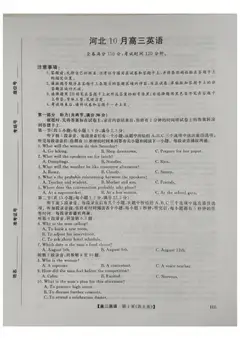
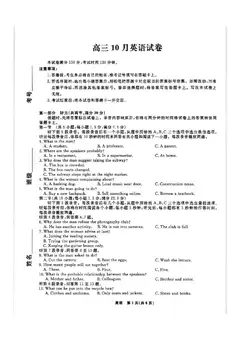
高三英语
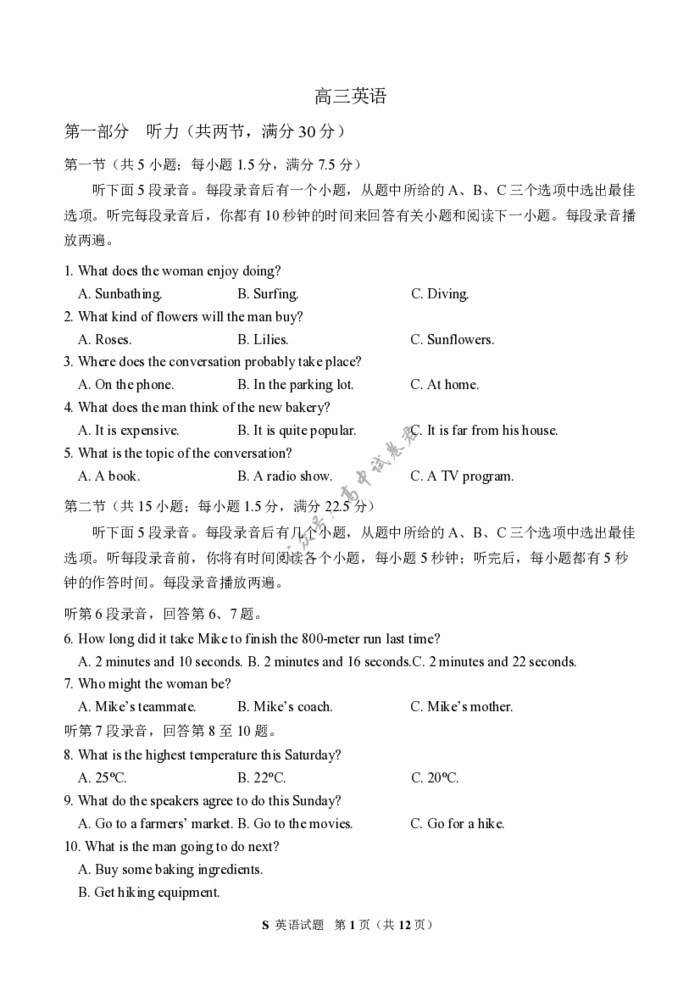
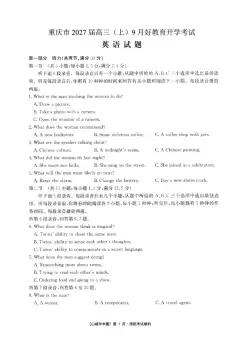
第一部分 听力(共两节,满分 30 分)
第一节(共 5 小题;每小题 1.5 分,满分 7.5 分)
听下面 5 段录音。每段录音后有一个小题,从题中所给的 A、B、C 三个选项中选出最佳
选项。听完每段录音后,你都有 10 秒钟的时间来回答有关小题和阅读下一小题。每段录音播
放两遍。
1. What does the woman enjoy doing?
A. Sunbathing.
B. Surfing.
C. Diving.
2. What kind of flowers will the man buy?
A. Roses.
B. Lilies.
C. Sunflowers.
3. Where does the conversation probably take place?
A. On the phone.
B. In the parking lot.
C. At home.
4. What does the man think of the new bakery?
A. It is expensive.
B. It is quite popular.
C. It is far from his house.
5. What is the topic of the conversation?
A. A book.
B. A radio show.
C. A TV program.
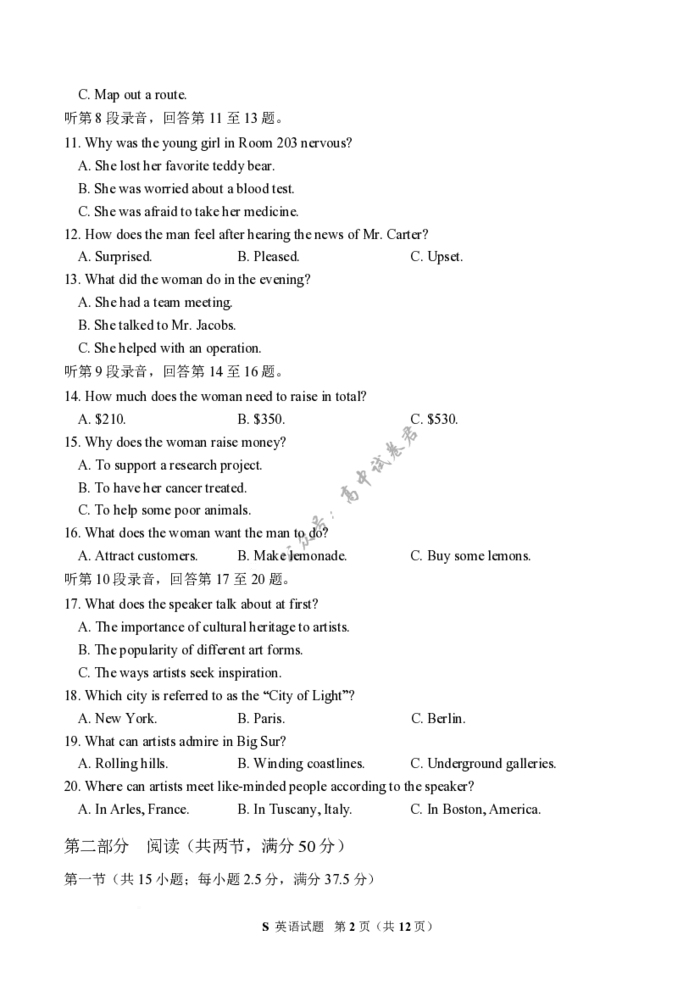
第二节(共 15 小题;每小题 1.5 分,满分 22.5 分)
听下面 5 段录音。每段录音后有几个小题,从题中所给的 A、B、C 三个选项中选出最佳
选项。听每段录音前,你将有时间阅读各个小题,每小题 5 秒钟;听完后,每小题都有 5 秒
钟的作答时间。每段录音播放两遍。
听第 6 段录音,回答第 6、7 题。
6. How long did it take Mike to finish the 800-meter run last time?
A. 2 minutes and 10 seconds. B. 2 minutes and 16 seconds.C. 2 minutes and 22 seconds.
7. Who might the woman be?
A. Mike’s teammate.
B. Mike’s coach.
C. Mike’s mother.
听第 7 段录音,回答第 8 至 10 题。
8. What is the highest temperature this Saturday?
A. 25°C.
B. 22°C.
C. 20°C.
9. What do the speakers agree to do this Sunday?
A. Go to a farmers’ market. B. Go to the movies.
C. Go for a hike.
10. What is the man going to do next?
A. Buy some baking ingredients.
B. Get hiking equipment.
S 英语试题 第 1 页(共 12 页)
公众号:高中试卷君
C. Map out a route.
听第 8 段录音,回答第 11 至 13 题。
11. Why was the young girl in Room 203 nervous?
A. She lost her favorite teddy bear.
B. She was worried about a blood test.
C. She was afraid to take her medicine.
12. How does the man feel after hearing the news of Mr. Carter?
A. Surprised.
B. Pleased.
C. Upset.
13. What did the woman do in the evening?
A. She had a team meeting.
B. She talked to Mr. Jacobs.
C. She helped with an operation.
听第 9 段录音,回答第 14 至 16 题。
14. How much does the woman need to raise in total?
A. $210.
B. $350.
C. $530.
15. Why does the woman raise money?
A. To support a research project.
B. To have her cancer treated.
C. To help some poor animals.
16. What does the woman want the man to do?
A. Attract customers.
B. Make lemonade.
C. Buy some lemons.
听第 10 段录音,回答第 17 至 20 题。
17. What does the speaker talk about at first?
A. The importance of cultural heritage to artists.
B. The popularity of different art forms.
C. The ways artists seek inspiration.
18. Which city is referred to as the “City of Light”?
A. New York.
B. Paris.
C. Berlin.
19. What can artists admire in Big Sur?
A. Rolling hills.
B. Winding coastlines.
C. Underground galleries.
20. Where can artists meet like-minded people according to the speaker?
A. In Arles, France.
B. In Tuscany, Italy.
C. In Boston, America.
第二部分 阅读(共两节,满分 50 分)
第一节(共 15 小题;每小题 2.5 分,满分 37.5 分)
S 英语试题 第 2 页(共 12 页)
公众号:高中试卷君
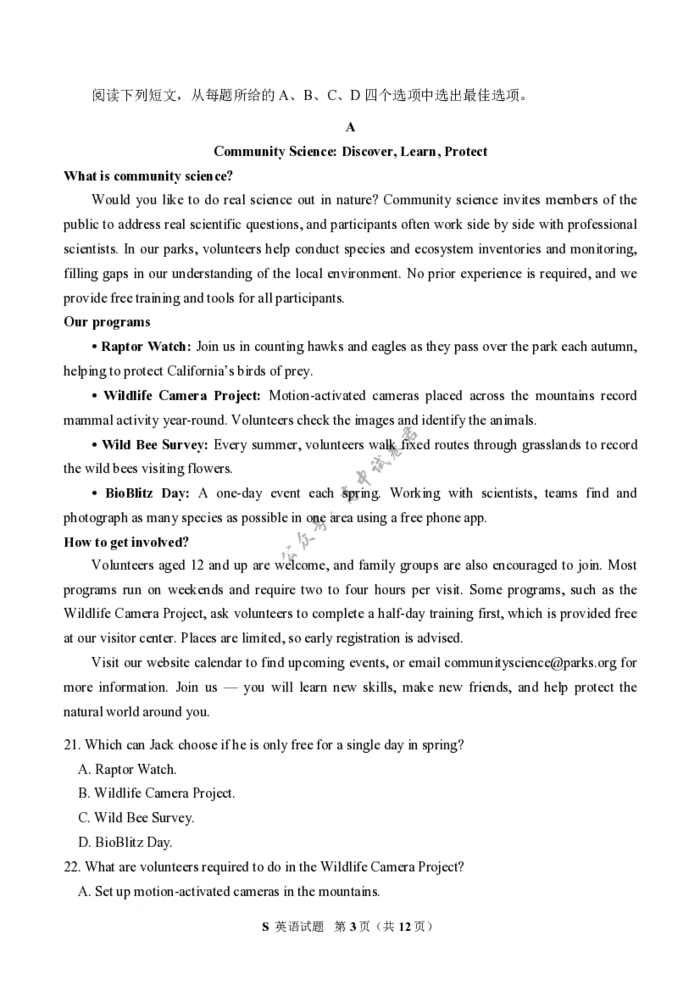
阅读下列短文,从每题所给的 A、B、C、D 四个选项中选出最佳选项。
A
Community Science: Discover, Learn, Protect
What is community science?
Would you like to do real science out in nature? Community science invites members of the
public to address real scientific questions, and participants often work side by side with professional
scientists. In our parks, volunteers help conduct species and ecosystem inventories and monitoring,
filling gaps in our understanding of the local environment. No prior experience is required, and we
provide free training and tools for all participants.
Our programs
• Raptor Watch: Join us in counting hawks and eagles as they pass over the park each autumn,
helping to protect California’s birds of prey.
• Wildlife Camera Project: Motion-activated cameras placed across the mountains record
mammal activity year-round. Volunteers check the images and identify the animals.
• Wild Bee Survey: Every summer, volunteers walk fixed routes through grasslands to record
the wild bees visiting flowers.
• BioBlitz Day: A one-day event each spring. Working with scientists, teams find and
photograph as many species as possible in one area using a free phone app.
How to get involved?

Volunteers aged 12 and up are welcome, and family groups are also encouraged to join. Most
programs run on weekends and require two to four hours per visit. Some programs, such as the
Wildlife Camera Project, ask volunteers to complete a half-day training first, which is provided free
at our visitor center. Places are limited, so early registration is advised.

Visit our website calendar to find upcoming events, or email communityscience@parks.org for
more information. Join us — you will learn new skills, make new friends, and help protect the
natural world around you.
21. Which can Jack choose if he is only free for a single day in spring?
A. Raptor Watch.
B. Wildlife Camera Project.
C. Wild Bee Survey.
D. BioBlitz Day.
22. What are volunteers required to do in the Wildlife Camera Project?
A. Set up motion-activated cameras in the mountains.
S 英语试题 第 3 页(共 12 页)
公众号:高中试卷君
B. Attend a half-day free training first.
C. Visit the park on weekdays for two hours.
D. Identify the animals together with scientists.
23. What is the main purpose of this text?
A. To encourage people to do science outdoors.
B. To explain how cameras monitor wild animals.
C. To advertise free weekend activities for teenagers.
D. To introduce several science programs in the parks.
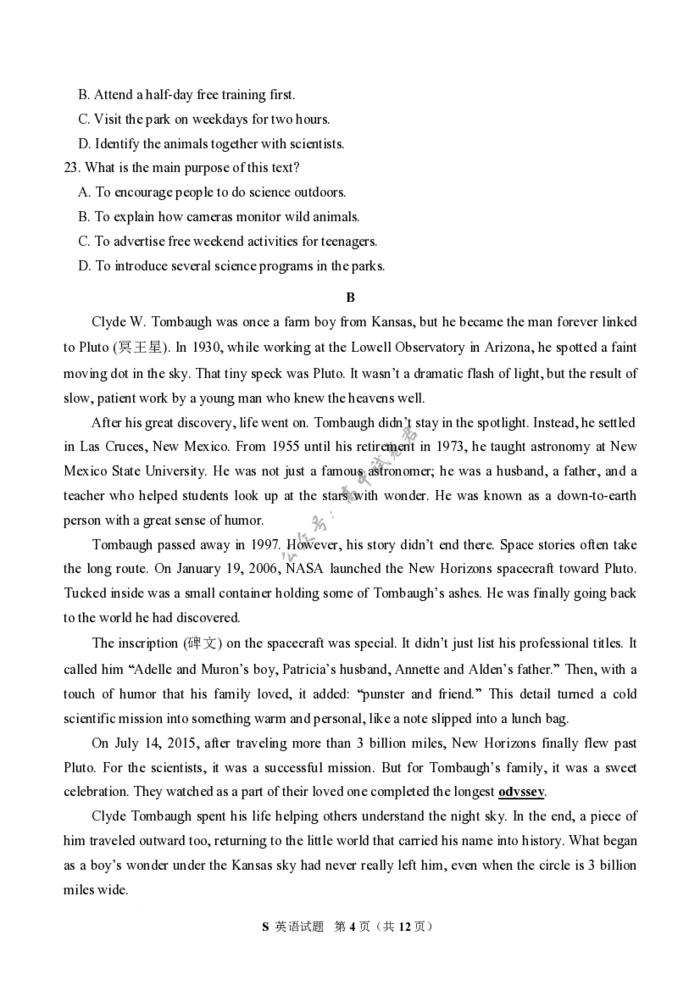
B
Clyde W. Tombaugh was once a farm boy from Kansas, but he became the man forever linked
to Pluto (冥王星). In 1930, while working at the Lowell Observatory in Arizona, he spotted a faint
moving dot in the sky. That tiny speck was Pluto. It wasn’t a dramatic flash of light, but the result of
slow, patient work by a young man who knew the heavens well.
After his great discovery, life went on. Tombaugh didn’t stay in the spotlight. Instead, he settled
in Las Cruces, New Mexico. From 1955 until his retirement in 1973, he taught astronomy at New
Mexico State University. He was not just a famous astronomer; he was a husband, a father, and a
teacher who helped students look up at the stars with wonder. He was known as a down-to-earth
person with a great sense of humor.
Tombaugh passed away in 1997. However, his story didn’t end there. Space stories often take
the long route. On January 19, 2006, NASA launched the New Horizons spacecraft toward Pluto.
Tucked inside was a small container holding some of Tombaugh’s ashes. He was finally going back
to the world he had discovered.
The inscription (碑文) on the spacecraft was special. It didn’t just list his professional titles. It
called him “Adelle and Muron’s boy, Patricia’s husband, Annette and Alden’s father.” Then, with a
touch of humor that his family loved, it added: “punster and friend.” This detail turned a cold
scientific mission into something warm and personal, like a note slipped into a lunch bag.
On July 14, 2015, after traveling more than 3 billion miles, New Horizons finally flew past
Pluto. For the scientists, it was a successful mission. But for Tombaugh’s family, it was a sweet
celebration. They watched as a part of their loved one completed the longest odyssey.
Clyde Tombaugh spent his life helping others understand the night sky. In the end, a piece of
him traveled outward too, returning to the little world that carried his name into history. What began
as a boy’s wonder under the Kansas sky had never really left him, even when the circle is 3 billion
miles wide.
S 英语试题 第 4 页(共 12 页)
公众号:高中试卷君
24. What can we learn about Tombaugh’s discovery of Pluto?
A. It was made almost during a sudden flash.
B. It was far from a single lucky moment.
C. It was the work of a team of scientists.
D. It was the result of a single observation.
25. What kind of person do you think of Tombaugh as?
A. A talented scientist who lived a lonely life.
B. A gifted man who stayed warm and modest.
C. A humorous teacher who demanded a lot.
D. A proud discoverer who valued his fame.
26. What does the underlined word “odyssey” in Paragraph 5 probably mean?
A. route
B. wait
C. delay
D. journey
27. What message does the text mainly convey?
A. Hard work always pays off in the end.
B. Family support is the key to success.
C. A lifelong passion can come full circle.
D. Science needs both patience and luck.
C
Elizabeth Schumann spent most of her life believing she had drawn a winning ticket. As a
concert pianist, she could reach a tenth on the keyboard, a span that puts her in rare company,
particularly among women. It was not until she sat down at a piano with narrower keys that a
different picture emerged. “I felt like I’d been wearing the wrong size shoes my entire life,” she said.
It turned out her impressive reach came from unusual flexibility — years of stretching to fit an
instrument that was never designed for her. As a teacher, she noticed the same pattern in her students.
Those who struggled most with tension and injury were often the ones constantly straining to cover
intervals the standard keyboard demanded of them. Research backs up what she was seeing:
smaller-handed pianists get injured more often.
Most people, including many pianists, have never thought to question the keyboard itself. Its
geometry is simply taken as given. The modern keyboard was standardized around 1880, when
renowned performers were generally European men with large hands, and mass production
demanded a single size. From this we inherited a one-size-fits-all, 6.5-inch-octave span. Before that,
buyers could choose a piano the way string players still choose theirs — based on sound and fit.
S 英语试题 第 5 页(共 12 页)
公众号:高中试卷君
The problem is larger than most pianists realize. A 2015 survey of 473 adult pianists found that
only about 13% of women have a hand span large enough to play repeated, fast octaves comfortably
on the standard keyboard, while 76% of men do. Schumann’s own study compared how pianists
performed on standard and narrower keyboards, measuring speed, force, accuracy and reach. The
experiment showed that the narrower keyboard helped most those who can comfortably reach only
an octave — those who were held back most by the standard design.
The findings could reshape not only how pianists train but how we think about any tool built to
a single standard. “The larger goal is not simply to build smaller keyboards,” Schumann said. “It is to
create the evidence needed to advocate for better design and more fair access to excellence.” If a
centuries-old instrument within the arts can be rethought, what else can?
28. Why did Schumann once consider herself lucky?
A. She could play pieces made for larger hands.
B. She had earned respect as a young pianist.
C. Her fingers stretched beyond most others’.
D. Her hands had stayed free of long strain.
29. Why did the instrument take its present form?
A. To reduce the cost of building a piano.
B. To suit the hands of well-known pianists.
C. To produce a louder tone in large halls.
D. To follow a size already used for strings.
30. What did Schumann’s study find?
A. A smaller design removes all risk of injury.
B. Speed counts for more than force in playing.
C. The gains are highest for those least suited.
D. Most pianists adapt well to the current design.
31. What can be inferred from the passage?
A. Small keyboards will replace the old kind.
B. Ways of training pianists demand no rethink.
C. Old instruments don’t need to be changed.
D. Accepted design standards deserve a review.
S 英语试题 第 6 页(共 12 页)
公众号:高中试卷君
D
How does your dinner affect the risk of 30,875 species of land-dwelling animals going extinct?
Dr Thomas Ball can tell you. Depending on what you are eating, he can work out the likelihood of
the global demise of every mammal, bird, amphibian and reptile over the next 100 years.
“Every time anyone eats anything, it has an impact on the other species we share the planet
with,” says Ball, a researcher at the University of Cambridge. “Raising the cattle for one kilo of beef
needs a huge amount of land, which displaces a lot of natural habitat. That has a much bigger impact
on species’ survival than growing a kilo of vegetable protein like beans.”
Ball is not just concerned with what we eat, but where it comes from. Many everyday favorites
like coffee and chocolate cannot be grown in Britain at all. They come from tropical regions, far
richer in biodiversity, where converting natural habitat to farmland impacts many more species. The
same crop grown in different places can also affect extinction risk differently: coffee from Costa
Rica, for example, might be ten times worse than coffee from Brazil.
Ball is part of a Cambridge-led team putting real numbers on these impacts. He is using the
“LIFE” metric, developed by the team to calculate how land-use changes, such as deforestation or
habitat restoration, affect the extinction risk of 30,875 species worldwide.
Dr Alison Eyres used it to produce two maps showing extinction risk in two scenarios. In the
first, all remaining natural habitat becomes farmland; in the second, all farmland is restored to nature.
Neither is likely, but the maps show where animals would suffer or benefit most — and it is not
evenly spread. Unlike other approaches, LIFE also considers species thought to be doing well.
Ball’s work is part of the UK Government’s toolkit for measuring the environmental impacts of
its consumption. “When it comes to producing food it’s not enough to focus on one country alone,”
says Dr Eyres. “I wouldn’t want to spoil anyone’s breakfast. But if beans did a little more of the
work on our plates, and coffee and chocolate took a step back, our fellow creatures would quietly
thank us.”
32. What can Ball calculate according to the passage?
A. The amount of land used to produce different foods.
B. The effect that our daily diet can have on species.
C. The number of species living in different regions.
D. The best countries for growing coffee and chocolate.
33. Why is the coffee example mentioned?
A. To show that a crop’s origin can change its impact.
B. To prove that growing coffee is bad for farmers’ income.
S 英语试题 第 7 页(共 12 页)
公众号:高中试卷君
C. To explain why crops grown in the tropics taste better.
D. To suggest that coffee should also be grown in Britain.
34. What does the LIFE metric make possible?
A. Predicting the weather in farming regions.
B. Comparing the yields of coffee varieties.
C. Assessing species that is not threatened.
D. Recording the number of mammals worldwide.
35. What does Dr Eyres imply in the passage?
A. British food production should be expanded.
B. Luxury crops should be banned from our tables.
C. A slight adjustment to our diet is required.
D. Farming methods matter more than what we eat.
第二节(共 5 小题;每小题 2.5 分,满分 12.5 分)
阅读下面短文,从短文后的选项中选出可以填入空白处的最佳选项。选项中有两项为多
余选项。
Visits to homeless shelters left Nicholas with one stubborn thought when he was a boy in
Cranston, Rhode Island. Kids needed to run, play, and walk into school in shoes that fit. Clothes
were forgiving — a shirt could be a little big and still work, and a jacket could wait for a growth
spurt. ___36___ Whatever a child put on their feet had to match the feet inside, and when it didn’t,
every step announced it.
A child grasps this at once. New sneakers are more than rubber and laces. ___37___ Something
in a fresh pair can make a child feel half an inch taller and, by recess, suspiciously faster.
So when Nicholas was 12, he turned the thought into action. He started Gotta Have Sole, a
nonprofit giving new footwear to children in shelters. ___38___ It was the word before “footwear”
that mattered most. Each pair began its life in that box: no older feet had ever been inside. Only
theirs would ever take the first step in it.
For a child in a shelter, so much may already feel like something on loan. A bed may be
unfamiliar, and belongings few — nothing that is really theirs. ___39___ Dignity, after all, does not
always arrive with a grand announcement; sometimes it comes wrapped in tissue paper, smelling
faintly of new rubber.
What began as one boy’s attention soon outgrew a middle-school project. CNN named Nicholas
a 2025 CNN Hero and reported that Gotta Have Sole had provided more than 10,000 pairs of shoes
to children in 21 states. By then, he was still a teenager. ___40___
S 英语试题 第 8 页(共 12 页)
公众号:高中试卷君
A. They carry the confidence that comes from having something meant for you.
B. In fact, his idea began as an ordinary school project about giving.
C. Shoes, by contrast, were far less forgiving, and could not be passed along.
D. Shoes made for their own feet are personal in the simplest way.
E. Many of the children there had never owned a new pair before.
F. That was because one detail mattered to him from the very start.
G. One child noticed what others walked past, and helped other children walk forward.
第三部分 语言运用(共两节,满分 30 分)
第一节(共 15 小题;每小题 1 分,满分 15 分)
阅读下面短文,从每题所给的 A、B、C、D 四个选项中选出最佳选项。
In Blue Earth, Minnesota, travelers often pulled off the highway hoping to meet a nonexistent
giant. They would ask, “where is the Jolly Green Giant?” With cameras ready, they only found
___41___ .
Every summer, Paul Hedberg, a local radio host, holding his microphone and recorder,
___42___ motorists who had left Interstate 90 (a major U.S. highway) and found their way into the
town, hoping to discover what had drawn them into the town.
The trouble was that visitors arrived with a perfectly reasonable expectation. The town had a
Green Giant canning plant (a food company) whose famous mascot (吉祥物) was the Jolly Green
Giant, so travelers ___43___ asked where they could take a picture with the Jolly Green Giant. And
Paul had to tell them there was no such ___44___ . It wasn’t heartbreaking, but it was a small
___45___ in a family vacation.
The same question kept coming up. Paul didn’t brush the questions aside. He ___46___ . He
heard what was ___47___ inside the questions: people wanted a reason to stop, smile, and say, “Well,
would you look at that.” In an effort to raise funds, Paul ___48___ with Green Giant company and
local businesses, ___49___ giving travelers what they had already been looking for. Not a brochure,
but a real ___50___ . A huge one. Eventually, the town put up a 55.5-foot fiberglass Jolly Green
Giant which stood proudly by the road and no one would miss it. The cost was about $43,000—a
large sum for a very ___51___ idea. But there was something wonderfully practical about the whole
thing: people kept asking for a giant, so the town ___52___ them a giant.
The ___53___ was simple and sweet. The disappointed tourists finally had “someone” to visit.
Blue Earth had turned a repeated “sorry” into a warm ___54___ . The statue now stands in Green
Giant Park, giving travelers a reason to ___55___ before the road pulls them onward.
S 英语试题 第 9 页(共 12 页)
公众号:高中试卷君
41. A. everything
B. something
C. anything
D. nothing
42. A. approached
B. interviewed
C. encountered
D. welcomed
43. A. naturally
B. hesitantly
C. urgently
D. indirectly
44. A. factory
B. picture
C. statue
D. town
45. A. surprise
B. tragedy
C. mistake
D. disappointment
46. A. listened
B. ignored
C. forgot
D. complained
47. A. written
B. spoken
C. hidden
D. conveyed
48. A. argued
B. identified
C. competed
D. cooperated
49. A. insisting on
B. succeeding in
C. dreaming of
D. objecting to
50. A. souvenir
B. landmark
C. plant
D. town
51. A. serious
B. cheerful
C. expensive
D. practical
52. A. sold
B. left
C. sent
D. built
53. A. handout
B. payoff
C. makeup
D. breakthrough
54. A. welcome
B. goodbye
C. apology
D. promise
55. A. escape
B. hide
C. stay
D. rush
第二节(共 10 小题;每小题 1.5 分,满分 15 分)
阅读下面短文,在空白处填入 1 个适当的单词或括号内单词的正确形式。
An exhibition at the Tianjin Museum recently offered a vivid glimpse into the rich cultural
exchanges between China and Italy centuries ago. With over 150 Italian artifacts ___56___ display,
the event demonstrated how Chinese silk and ___57___ (decorate) patterns found their way into
18th-century European courts.
Rather than simply showcasing royal splendor, the exhibition traced ___58___ Chinese art
influenced European tastes. A French court gown from Palace Madama was ___59___ highlight.
Combining Chinese silk and embroidery, it offered evidence of the popularity of “chinoiserie (中国
风 )” among European noblemen. Another exhibit, an ivory men’s robe ___60___ (craft) from
precious Chinese silk, ___61___ (far) proved this trend. Such oriental-style fabrics became highly
fashionable in European society in the second half of the 18th century.
The 18th century, which also ___62___ (witness) the Enlightenment in Europe, during which
thinkers challenged feudal autocracy (封 建 专 制 ), was an era ___63___ Chinese philosophical
thoughts emphasizing ___64___ (open) resonated with these new ideas. This interaction was evident
in the exhibition’s “East Meets West” section.
Attracting over 24,000 visitors, the exhibition successfully provided a window into the cultural
dialogue between the East and the West. As experts note, these treasures are not merely commercial
goods, but valuable records of mutual understanding, ___65___ (remind) us of the enduring power of
cross-cultural communication.
S 英语试题 第 10 页(共 12 页)
公众号:高中试卷君
第四部分 写作(共两节,满分 40 分)
第一节(满分 15 分)
你校英文报“My Senior Year”专栏向高三学生征稿。高三压力大、考试频繁、情绪易起伏,
你会选择以下哪句名言来激励自己度过高三这一年?
1. Slow and steady wins the race.
2. Some days you bloom. Some days you grow roots. Both matter.
请结合自己的真实感受和经历,说明你选择的理由。
注意:
(1)写作词数应为 80 左右;
(2)请按如下格式在答题卡的相应位置作答。
Words That Lift Me Up
第二节(满分 25 分)
阅读下面材料,根据其内容和所给段落开头语续写两段,使之构成一篇完整的短文。
I have never forgotten the sound of my father's voice as he knelt by my bed with his back bent,
his head craned low and his hands resting on his lap. It's his storytelling voice that I remember—a
voice that dropped a note or two but still managed to rise above the murmuring noise of the fans that
blew away the hot air in the room.
Growing up, I was always known as the kid with the fun father, the tall dad with the deep voice
and funny African accent. It was my father who brought my best friend, Chris, and me to car shows,
who took us to basketball games, coached our soccer team and, on occasion, took us fishing.
In my father's mind, where I was going came first above all else. For him, the purpose of the
present was to point the way to what lay next, so he and mom had sacrificed everything to come to
this country only hoping to bring me to where I was now.
But when I entered high school things began to change between my father and me. I suddenly
became known as the kid with the mean father: the father who rushed into high school parties,
stopping the flow of alcohol in order to pull his son out and take him home. "Not while I'm around,"
he always said every time I crossed the line. "Not while I'm here."
S 英语试题 第 11 页(共 12 页)
公众号:高中试卷君
In the middle of freshman year, Chris' father abandoned him and his mother. Just then both
Chris and I suddenly became bent on chasing being "cool", meaning skipping classes and staying out
late. Night after night, my father would drive out to bring us home, saying, "Not while I'm here."
One day Chris and I were dragged into the principal's office for skipping classes. My father
didn't say a word on the way out, only the anger visible on his face though — the first real anger I
had ever seen.
注意:
(1)续写词数应为 150 个左右;
(2)请按如下格式在答题卡的相应位置作答。
Para.1:On the drive home, my father pulled the car over, turned to me, and let the anger out.
Para.2:After my father drove around the deserted streets all night, we finally found Chris.
S 英语试题 第 12 页(共 12 页)
公众号:高中试卷君