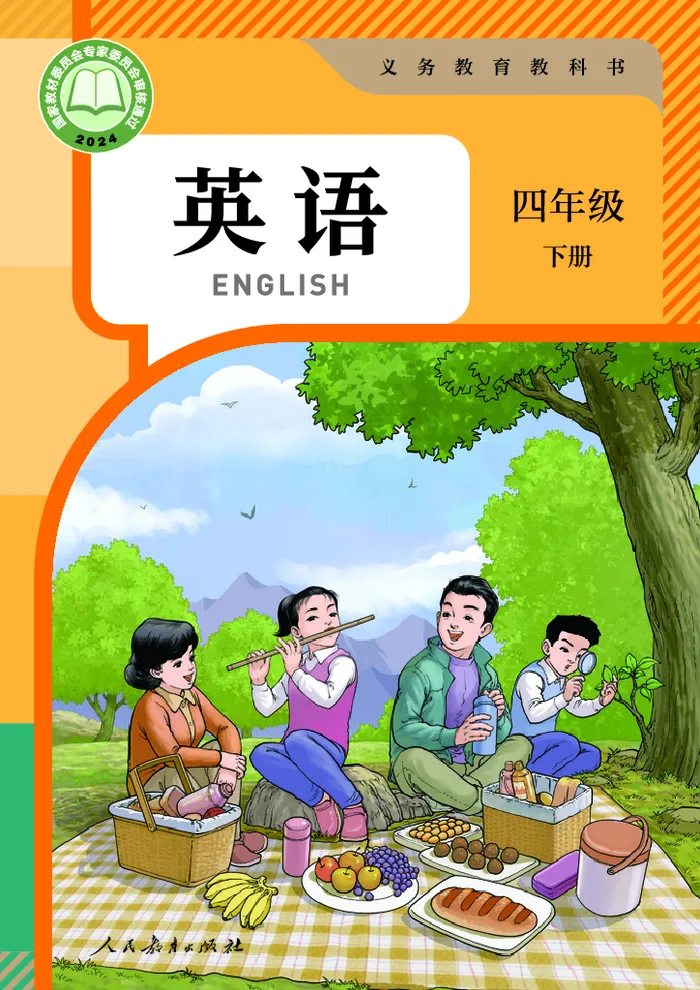
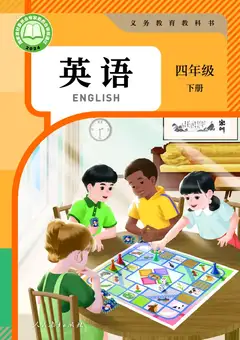
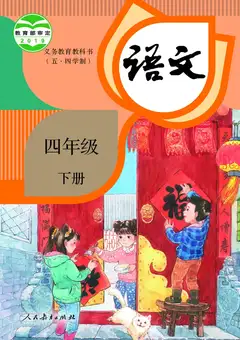
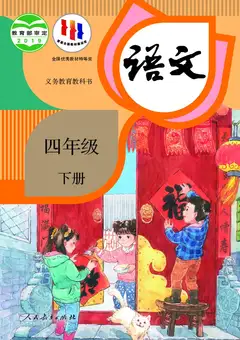
义 务 教 育 教 科 书
四年级
下册
·北 京·
义 务 教 育 教 科 书
(精通)
四年级
下册
人民教育出版社 课程教材研究所
编著
义务教育教科书 英语 四年级 下册
人民教育出版社 课程教材研究所 编著
出 版
(北京市海淀区中关村南大街17 号院1 号楼 邮编:100081)
网 址 http://www.pep.com.cn
版权所有·侵权必究
主 编:苗兴伟
副 主 编:陈 力
分册主编:陶明天
编写人员(以姓氏笔画为序):
于 冰 刘 畅 闫淑梅 严匡正
杨春玲 罗良功 章 宁
责任编辑:马 茜 王战旗
责任设计:王 喆 王晓晗
责任校对:王 晶
责任印制:
欢迎同学们继续跟随Miss Wu和小伙伴们一起学习英语!
本学期的英语课上,你们将继续享受英语学习的乐趣,学到更
多有用的知识,不断提高使用英语的能力。
学完这本书的六个单元,你们将能用英语做更多的事情,比如
谈论交通方式、喜欢的学科、一周学习安排和课外活动、周末和假
期活动安排、问路和指路等。在这个过程中,你们还会学到有关如
何选择科学的出行方式、如何安排学习和周末活动、如何为节日活
动做计划,以及如何为他人提供帮助的新知识。
学习过程中如果遇到困难,记得要多向老师请教、多和同学讨
论。只要坚持多听、多说、多读、多看、多思考,相信你们都能把
英语学好,能用英语做更多有趣的事情。
祝同学们的英语学习之旅充满快乐,收获越来越多!
致 同 学
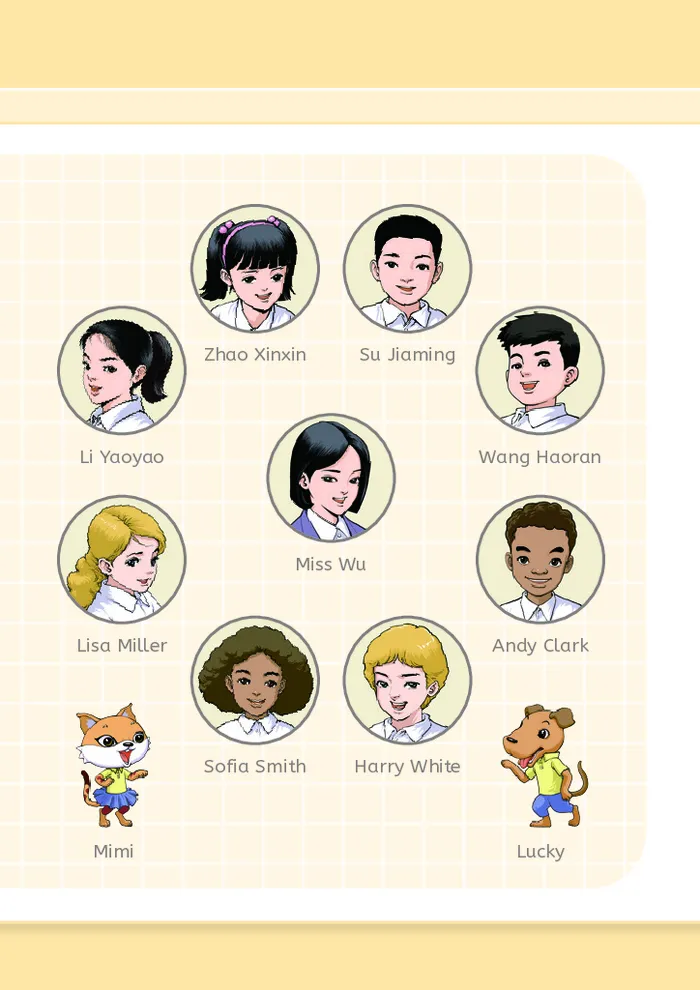
Lucky
Miss Wu
Su Jiaming
Zhao Xinxin
Li Yaoyao
Wang Haoran
Lisa Miller
Sofia Smith
Andy Clark
Harry White
Mimi
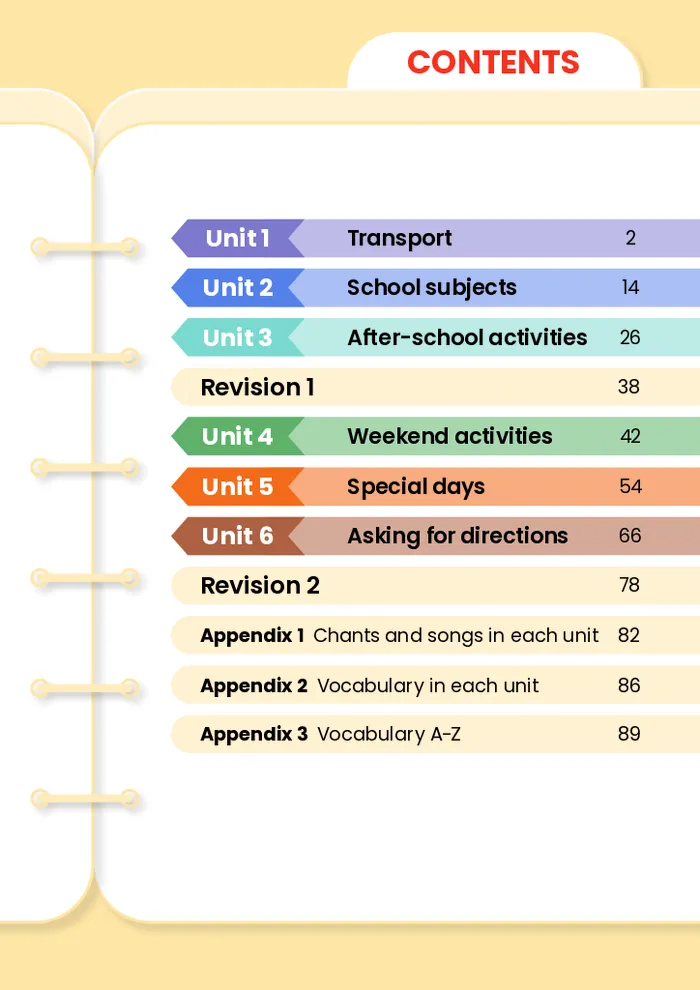
Unit 1
Transport
2
Unit 2
School subjects
14
Unit 3
After-school activities
26
38
Unit 4
Weekend activities
42
Unit 5
Special days
54
Unit 6
Asking for directions
66
Revision 2
Revision 1
78
82
Appendix 1 Chants and songs in each unit
86
Appendix 2 Vocabulary in each unit
89
Appendix 3 Vocabulary A-Z
CONTENTS
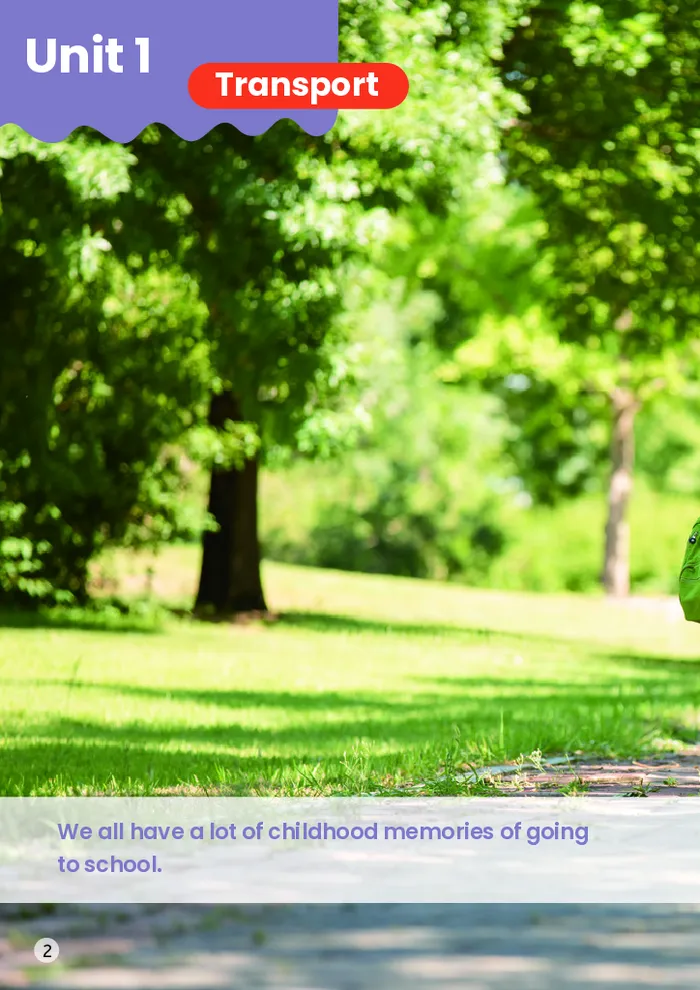
We all have a lot of childhood memories of going
to school.
Unit 1
Transport
2
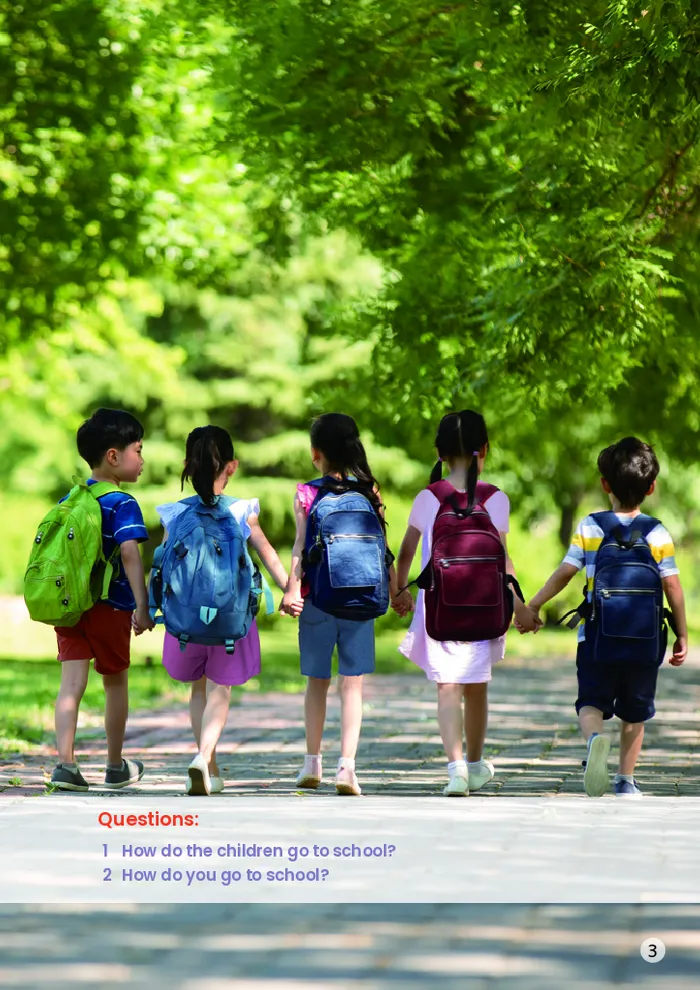
Questions:
1 How do the children go to school?
2 How do you go to school?
3
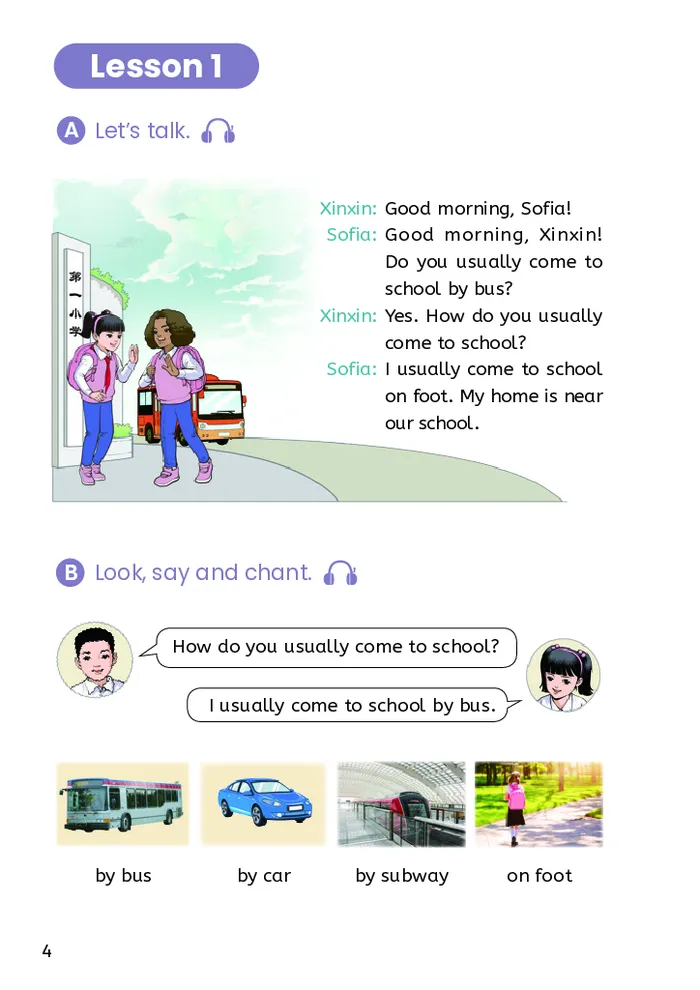
Lesson 1
Look, say and chant.
B
Xinxin: Good morning, Sofia!
Sofia: Good morning, Xinxin!
Do you usually come to
school by bus?
Xinxin: Yes. How do you usually
come to school?
Sofia: I usually come to school
on foot. My home is near
our school.
on foot
by car
by bus
by subway
How do you usually come to school?
I usually come to school by bus.
Let’s talk.
A
4
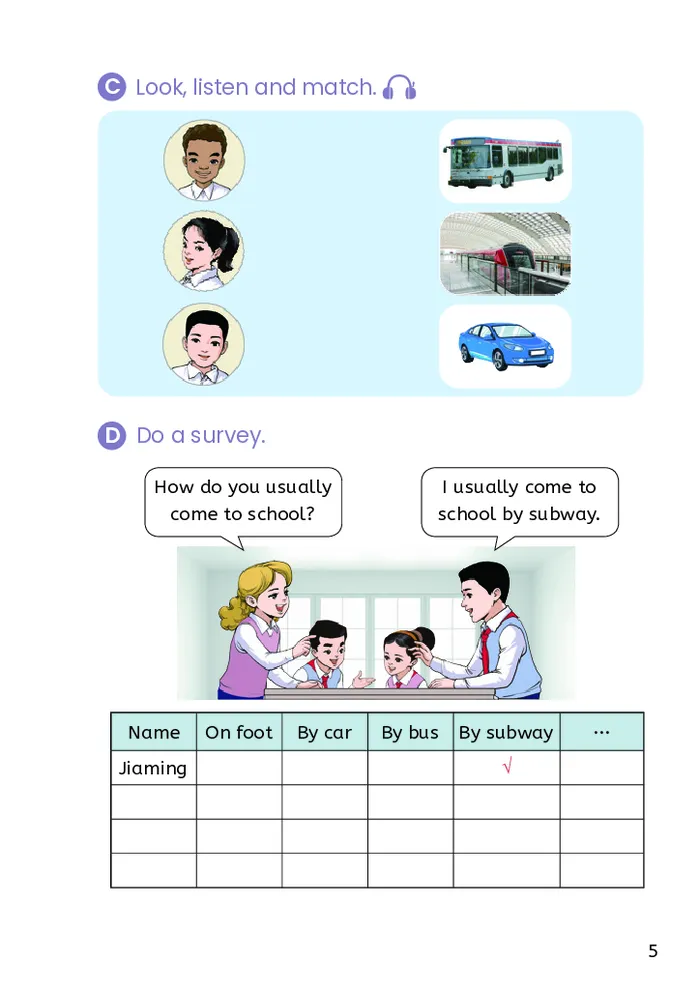
Do a survey.
D
Look, listen and match.
C
Name
On foot
By car
By bus
By subway
...
Jiaming
√
How do you usually
come to school?
I usually come to
school by subway.
5
Lesson 2
Look, say and sing.
B
Jiaming: Hi, Yaoyao! Do you have any travel plans during the
holiday?
Yaoyao: Yes. I’m going to Kunming to see my grandma and
grandpa. They live there.
Jiaming: How are you going there?
Yaoyao: I’m going there by train. How about you?
Jiaming: I’m going to Dalian with my parents.
We are going there by ship.
Yaoyao: That’s great!
by taxi
by train
by ship
by plane
A Let’s talk.
How are you going there?
I’m going there by taxi.
6
Let’s play.
C
D
Look, listen and tick.
How are you
going to Beijing?
I’m going
there by train.
1
3
2
4
7
1 How do your family members go to work?
Lesson 3
I am Li Yue. I usually go to school on foot. My mother
works in a bookshop nearby. She usually goes to work by
bike. My father works in a zoo. He has a long way to go
every day. He usually goes to work by subway. We like to
go to the park and the cinema at the weekend. We usually
go there by car. What is your favourite way to travel?
3 Read the text again and fill in the table.
Who
Where
How
I
school
on foot
My mother
My father
My family
2 Read the text and underline how people travel.
Read and write.
A
8
4 �How do you usually go to school? How do your parents
usually go to work? What is your favourite way to travel?
Write about it.
Let’s spell.
B
I usually go to school
.
My mother usually goes to work
.
My father usually goes to work
.
I like to travel
.
A: 'How are you 'going to the 'park?
B: I'm 'going 'there by 'car.
Listen and repeat.
C
bar
garden
farm
far
car
park
9
1 �Write some places you want to go to on a card.
My travel plan
2 Find your travel partner and make a travel plan.
3 Introduce your travel plan to your classmates.
Fun time
Where are you going
during the holiday?
Haoran and I are
going to Wuhan
during the holiday.… ...
I’m going to Wuhan.
How about you?
We are going
there by plane. …...
I’m going there ...
I’m going to
Wuhan too. How are
you going there?
Let’s do.
A
10
1 I can say:
by bus, by car, by subway, on foot, by taxi, by
train, by ship, by plane, usually, come, near,
our, travel, holiday, see, live, parent, we, work,
go to work
2 I can talk:
A: How do you usually come to school?
B: I usually come to school by bus.
A: How are you going there…?
B: I’m going there by taxi.
3 I can write about the way people travel.
4 I can spell words like bar and farm.
Self-check
In Venice, Italy, people can travel by
gondola. It’s a special kind of boat.
In Thailand, people can travel by
elephant.
In the deserts of Morocco, people can
travel by camel.
In snowy parts of Russia, people can
travel by sled.
Good to know.
B
11
Story time
Hey, boys and girls! How do
you usually come to school?
I usually come to school by school bus.
I can talk to my friends on the school bus. I like it.
I usually come to school by subway. My home is
far from school. There are a lot of cars on the roads,
and coming by car is slow. So I come by subway.
Yes, there are too many cars on the roads now.
I want to come to school by bike. But it is
not safe for me. So I have to come by car.
Let’s read.
A
12
I usually come to school on foot. I can listen to the
birds and smell the flowers. It makes me happy.
I usually come to school by bus. But
I want to live in school! I can sleep
more, and I will never be late.
Lily
Ma li
Owen
John
Ted
Let’s match.
B
Act out the story.
C
13
Unit 2
School subjects
Learning different subjects is seeing the
world in different ways.
14
Questions:
1 What school subjects can you see in the pictures?
2 What is your favourite subject?
15
Lesson 1
Let’s talk.
A
What subjects do you have tomorrow?
I have Chinese, maths, art and music.
IT
Chinese
music
English
maths
PE
art
science
Mum: Jiaming, what subjects do
you have tomorrow?
Jiaming: I have Chinese, English,
maths and art in the
morning. I have PE and
science in the afternoon.
Mum: Do you have all the
books in your schoolbag?
Jiaming: Yes, Mum.
Look, say and chant.
B
16
What subjects do you
have tomorrow?
I have ...
I have ... What subjects
do you have today?
Today
Chinese
Maths
English
Science
Art
Music
Tomorrow
Tomorrow
English
Chinese
Maths
IT
PE
Art
Today
Look, listen and tick.
C
Let’s play.
D
17
Lesson 2
What do you like doing in science class?
I like making models.
Luna: Hi, Sofia. How is your school life in China?
Sofia: It’s really fun.
Luna: What’s your favourite
subject?
Sofia: My favourite subject
is Chinese.
Luna: What do you like
doing in Chinese class?
Sofia: I like reading Chinese
poems.
Luna: Cool!
make models
study plants
play the flute
read poems
Let’s talk.
A
Look, say and sing.
B
18
What’s your
favourite subject?
What do you like doing
in science class?
My favourite subject
is science.
I like studying plants.
Look, listen and match.
C
Ask and answer.
D
19
Lesson 3
Dear Luna,
I’m writing to talk with you about my life in China.
I’m in Grade Four now. I like studying Chinese, art
and music. I like Chinese because I can learn many
beautiful poems. I like art because I like writing Chinese
characters with a brush. I like music because I can learn
how to play the flute.
My life in China is great! I hope you can come here
someday.
Love,
Sofia
3 Read the email again and fill in the blanks.
(1) This email is about
.
(2) �Sofia likes studying
,
and
.
(3) She thinks her life in China is
.
1 What is Sofia doing?
2 Read the email and underline all the subjects.
Read and write.
A
20
4 What subjects do you like? Write about them.
sport
skate
spring
ski
speak
skirt
I’m in Grade
now. I have
school subjects. I like studying
. My favourite
subject is
because
.
A: 'What do you 'like 'doing in 'spring?
B: I 'like 'skating and 'skiing.
Let’s spell.
B
Listen and repeat.
C
21
1 Do a survey.
A survey about favourite subjects
2 Count.
3 Make a report.
Fun time
Chinese: One, two, three ...
What’s your
favourite subject?
Six students’ favourite
subject is Chinese. ...
Name
Chinese English Maths
PE
Music Art
IT
Science
Haoran
√
Sofia
√
Jiaming
√
Andy
√
My favourite subject is PE.
Let’s do.
A
22
1 �I can say:
Chinese, maths, art, music, English, science, PE, IT,
make models, study plants, read poems, play the
flute, subject, dear, because, learn
2 I can talk:
A: What subjects do you have tomorrow?
B: I have Chinese, maths, art and music.
A: What do you like doing in science class?
B: I like making models.
3 I can write about school subjects.
4 I can spell words like speak and skate.
Self-check
School subjects can help us …
build a healthy body and mind.
communicate better with people.
understand the world better.
enjoy life better.
make our world better.
Good to know.
B
23
In music class, Tim listens
to beautiful music.
In maths class, Sam helps
Tim.
Story time
In IT class, Tim writes an email.
He is happy.
It’s Monday morning. It’s
time for school. But Tim
doesn’t want to get up.
Let’s read.
A
24
In English class, Tim and his
classmates play English games.
It’s Tuesday morning. Why does Tim want
to go to school so early this morning?
( ) Tim plays English games with his classmates.
( ) Tim wants to go to school early.
( ) Sam helps Tim with maths.
( ) Tim writes an email in IT class.
( ) Tim listens to beautiful music.
( ) Tim doesn’t want to get up.
Put the sentences in order.
B
Act out the story.
C
25
Good habits make us better.
Unit 3
After-school activities
26
Questions:
1 What are the children doing in the pictures?
2 What do you do after school?
27
Lesson 1
Lisa: What day is it today, Yaoyao?
Yaoyao: It’s Thursday.
Lisa: Not Wednesday?
Yaoyao: No.
Lisa: Oh no! I don’t have my
maths book and music
book with me.
Yaoyao: We can share my books.
Lisa: Thank you so much.
Yaoyao: That’s OK.
What day is it today?
It’s Monday.
Monday
Tuesday
Saturday
Sunday
Wednesday
Thursday
Friday
Let’s talk.
A
Look, say and chant.
B
28
What day is it?
It’s Saturday.
Monday!
Subject
Mon.
Tue.
Wed.
Thur.
Fri.
Look, listen and tick.
C
Let’s play.
D
29
Lesson 2
Lisa: What do you usually do
after school?
Yaoyao: I usually learn tennis
on Thursdays.
Lisa: Great! What else
do you do?
Yaoyao: I learn the guzheng
on Fridays. What
about you?
Lisa: I learn badminton
on Mondays.
What do you usually do after school?
I usually learn badminton on Tuesdays.
badminton
tennis
guzheng
piano
Beijing Opera
Let’s talk.
A
Look, say and sing.
B
30
What do you usually
do after school?
I usually learn badminton
on Tuesdays.
Name
Badminton
Tennis
Beijing Opera Guzheng
Piano
...
Andy
Tuesdays
Look, listen and match.
C
Do a survey.
D
31
1 What do you usually do after school?
Lesson 3
3 Read the text again and fill in the table.
Day
Activity
Mondays
learn the guzheng
2 Read the text and underline Xinxin’s activities.
I do many activities during the week. On
Mondays, I learn the guzheng. I love it! On Tuesdays
and Fridays, I learn Beijing Opera. It’s fun. On
Wednesdays, I learn painting. It makes me happy.
What do I do on Thursdays after school? I just play
on the playground with my friends. It’s a busy but
interesting week.
Read and write.
A
32
I do many activities during the week. On
Mondays, I
.
On
, I
.
On
, I
.
My week is busy, but I enjoy it.
4 Write about your week.
mail
rain
train
day
May
say
A: 'What do you 'usually 'do in 'May?
B: I 'usually 'play in the 'rain.
Let’s spell.
B
Listen and repeat.
C
33
1 Take photos of your after-school activities.
My after-school activities
2 Make slides with the photos.
3 Give a presentation to your class.
Fun time
Hi, I’m ... I do many activities
after school. On Mondays,
I learn kung fu. ...
Monday:
kung fu
Wednesday:
badminton
Friday:
guitar
Let’s do.
A
34
1 I can say:
Monday, Tuesday, Wednesday, Thursday, Friday,
Saturday, Sunday, badminton, tennis, piano, guzheng,
Beijing Opera, else, happy, playground, with, busy,
interesting
2 I can talk:
A: What day is it today?
B: It’s Monday.
A: What do you usually do after school?
B: I usually learn badminton on Tuesdays.
3 �I can talk and write about after-school activities.
4 I can spell words like mail and day.
Self-check
Paper cutting is very popular in China.
It has a history of at least 1,400 years.
Some ink, some paper and a brush are all
you need for Chinese calligraphy (书法).
You can write beautiful Chinese characters
after some practice.
Weiqi is a Chinese board game. The
rules of the game are very simple,
but it is hard to be a good player.
Good to know.
B
35
Story time
It’s Monday. Mike is new at school.
He has no friends. He is sad.
On Tuesday, Mike meets Haoran.
They play football together.
On Wednesday, Mike
meets Sofia. They
fly a kite together.
On Thursday, Mike meets Jiaming.
They make models together.
Let’s read.
A
36
On Friday, Mike meets Lisa.
They ride bikes together.
On Saturday, Mike meets
Harry. They swim together.
On Sunday, all the children go to
Mike’s birthday party. Mike is happy.
( ) Mike rides bikes with Lisa.
( ) Mike is new at school.
( ) Mike flies a kite with Sofia.
( ) Mike plays football with Haoran.
( ) Mike makes models with Jiaming.
( ) All the children go to Mike’s birthday party.
( ) Mike goes swimming with Harry.
Put the sentences in order.
B
Act out the story.
C
37
Look, point and say. Then play.
A
How do you
usually come
to school?
How are you
going there?
What subjects
do you have
tomorrow?
1
2
3
12
11
10
13
14
15
24
23
22
25
26
27
Revision 1
38
What do you like
doing in ... class?
What day
is it today?
What do you
usually do
after school?
4
5
6
9
8
7
16
17
18
21
20
19
28
2.3
39
Read, sort and write.
speak, bar, train, far, skirt, garden, say, park, sport, mail,
spring, skate, car, ski, day, hard, May, rain
ai
ay
sk
ar
sp
B Look, listen and match.
Let’s spell.
C
Ziyang
Sirui
Jiayi
40
D Read and write.
1 �Read the text and underline the activities. Then answer
the questions.
I’m Jack. I usually get up at 7:00. My school is not far,
so I go to school on foot after breakfast. Classes begin at
8:20. Today is Wednesday. We have Chinese, English and art
in the morning. We have PE and music in the afternoon. PE
is my favourite subject. I like playing football in PE class.
School finishes at 4:30. I learn Chinese calligraphy after
school. I can write Chinese characters quite well with a big
brush. Wednesday is a really busy day!
I usually get up at
. I have breakfast
at
. I go to school (on/by)
.
Classes begin at
. Today is
.
We have
in the
morning and
in the
afternoon. I
.
2 Write about one of your school days.
(1) When does Jack usually get up?
(2) How does he go to school?
(3) �What subjects does he have on Wednesday?
(4) What does he do after school on Wednesday?
41
42
Unit 4
Weekend activities
A weekend well spent will bring a week of content.
42
Questions:
What are the people doing?
What do you want to do this weekend?
1
2
43
Lesson 1
Let’s talk.
A
Haoran: Hi, Jiaming! Do you want to do some exercise?
Jiaming: OK! Let’s go running.
Haoran: What do you usually do at the weekend?
Jiaming: I usually help my mum cook on Saturdays,
and I visit my grandparents on Sundays.
Look, say and chant.
B
help cook
visit grandparents
do homework
do chores
do some exercise
What do you usually do at the weekend?
I usually do chores on Saturdays.
44
Look, listen and match.
Do a survey.
C
D
I usually visit my grandparents
on Saturdays, and I do some
exercise on Sundays.
Activity
Haoran
Saturdays Sundays Saturdays Sundays Saturdays Sundays
help cook
do some exercise
√
do chores
visit grandparents
√
do homework
What do you usually do
at the weekend, Haoran?
45
Lesson 2
go to the park
go to the cinema
have a picnic
go fishing
Look, say and sing.
B
A Let’s talk.
Yaoyao: The weekend is coming. What do you usually do at
the weekend?
Xinxin: I usually go to the cinema with my parents on
Saturdays. How about you?
Yaoyao: I often go to the park with
my friends on Sundays.
Xinxin: What can we do together
this Saturday?
Yaoyao: We can have a picnic in
the park together.
What can we do together this Saturday?
We can go to the cinema together.
46
C
Look, listen and match.
Let’s play.
D
What can we do together
this Saturday?
We can go to the cinema together.
We can go
to the park
together.
OK! Let’s go to
the park together.
We can go fishing together.
1
2
47
1 �What are they doing? Do you do these things at the
weekend?
Read and write.
A
2 �Read the text and underline Mike’s activities.
I’m Mike. I’m busy at the weekend. I often do chores. I
usually help cook on Saturdays. It is fun. Sometimes I go to
the cinema with my friends on Saturday evenings. I often
go fishing with my dad on Sunday mornings, and I visit
my grandparents on Sunday afternoons. We take a walk
together in the park. I enjoy my weekends.
Lesson 3
3 Read the text again and fill in the table.
Day
Activity
Saturdays
help cook
48
4 Write about your weekend.
Let’s spell.
B
Listen and repeat.
C
A: 'What can we 'do in the 'room?
B: We can 'read a 'book 'together.
zoo
food
room
book
cook
good
I’m busy at the weekend. I
.
I really enjoy my weekends.
49
1 �Write down some activities that you usually do at the
weekend.
My weekend plan
2 Find a partner.
3 Make a weekend-activity diagram and introduce it to the
class.
Let’s do.
A
What can we do together this Sunday?
I usually do my
homework on
Saturdays, and
I go to the park
on Sundays.
How about you?
What do you usually do at the weekend?
I usually do some chores on Saturdays,
and I go to the park on Sundays.
Fun time
Xinxin’s
weekend activities
Yaoyao’s
weekend activities
I usually do some chores
on Saturdays.
I usually go to the park
on Sundays.
We can go
to the park
together
this
Sunday.
I usually do my homework
on Saturdays.
I usually go to the park on
Sundays.
50
1 I can say:
do chores, do homework, do some exercise, help
cook, visit grandparents, go to the cinema, go
fishing, have a picnic, go to the park, weekend,
together, take a walk
2 I can talk:
A: What do you usually do at the weekend?
B: I usually do chores on Saturdays.
A: What can we do together this Saturday?
B: We can go to the cinema together.
3 I can write about my weekend activities.
4 I can spell words like food and book.
Self-check
Good to know.
B
Children do lots of different activities
at the weekend. Some children do
indoor rock climbing. It is tiring but
very interesting.
Some children go camping with
their family. They can see flowers,
trees, birds and stars.
Some children go to the old
people’s centre. They do some
cleaning, read books or play
music for the people there.
51
Story time
Bill always plays video games
at the weekend. When his
sister does her homework,
he plays video games.
Oh no!
Bill can’t play video
games, so he tries fishing
with his father. It is fun.
A Let’s read.
When his parents
do chores, he plays
video games.
When he visits his
grandparents, he
plays video games.
When Bill and his father
go fishing, he still plays
video games.
52
He talks with his
grandparents.
That is fun too.
Now Bill doesn’t play many video games
at the weekend. He has fun with his family.
( ) �When Bill visits his grandparents, he plays video
games.
( ) �When Bill’s parents do chores, Bill plays video games.
( ) �Bill can’t play video games, so he tries fishing with his
father. It is fun.
( ) �When Bill’s sister does her homework, Bill plays video
games.
( ) �When Bill and his father go fishing, he still plays video
games.
Put the sentences in order.
B
Act out the story.
C
53
The world is your playground when you are on a
special day.
Unit 5
Special days
54
Questions:
What special day is the picture about?
What other special days do you know? What do you usually do
on those special days?
1
2
55
Lesson 1
Look, say and chant.
B
Let’s talk.
A
I’m going to buy some flowers
for my mum on Mother’s Day.
buy some
flowers
buy a cup
write a letter
make a card
Yaoyao: Sofia, do you know this Sunday is Mother’s Day?
Sofia: Yes. We should do something for our mums.
Do you have any ideas?
Yaoyao: I’m going to make
a card for my mum.
What about you?
Sofia: I’m going to write
a thank-you letter
to my mum.
Yaoyao: Good idea!
56
Let's play.
C
D
Look, listen and match.
Mother’s Day is coming.
I’m going to buy a cup
for my mum.
Andy is going to buy a cup
for his mum. I’m going to buy
some flowers for my mum.
Andy is going to ... Lisa is
going to ... I’m going to ...
57
Lesson 2
B
act in a play
tell a story
sing a song
do some kung fu
What are you going to do
for the Children’s Day party?
I’m going to tell a story.
do some paper cutting
Look, say and sing.
A Let’s talk.
Lisa: Xinxin, what are you
going to do for the
Children’s Day party?
Xinxin: I’m going to sing a song.
What about you?
Lisa: Cool! I’m going to act
in a play.
Xinxin: What’s the play about?
Lisa: It’s a secret!
58
Do a survey.
C
D
Look, listen and match.
What are you going to do
for the Children’s Day party?
I’m going to
tell a story.
Name
Do some
paper cutting
Sing
a song
Do some
kung fu
Act
in a play
Tell
a story
…
Haoran
√
59
1 What are they doing?
Lesson 3
Read and write.
A
3 Read the text again and fill in the table.
Who
Activity
My parents, grandparents and I
have a big dinner
2 Read the text and underline the activities.
This Spring Festival, I’m going to have a big dinner with
my parents and grandparents. We are going to eat chicken,
fish, jiaozi, and so on. After dinner, we’re going to watch
the Spring Festival Gala on TV.
My parents and grandparents are all going to give me
lucky money. It is going to be a happy time for everyone!
60
4 �What are you going to do during this Spring Festival?
Write down your plan.
During this Spring Festival, I’m going to
.
cow
down
brown
blow
slow
snow
B
C
Let’s spell.
Listen and repeat.
A: 'What are you 'going to 'do?
B: I’m 'going to 'play in the 'snow.
61
1 Make a poster about your plan for a special day.
My plan for a special day
2 Introduce your poster to the class.
3 Make an art gallery with all the posters.
Fun time
Let’s do.
A
Children’s Day is coming. I’m
going to the science museum in
the morning. And I’m going to ...
62
1 I can say:
buy some flowers, make a card, buy a cup, write
a letter, tell a story, do some kung fu, do some
paper cutting, sing a song, act in a play, know,
Mother’s Day, Children’s Day, party, Spring Festival,
TV, lucky money Good idea!
2 I can talk:
A: What are you going to do for the Children’s
Day party?
B: I’m going to tell a story.
3 I can write about my plan for a special day.
4 I can spell words like brown and blow.
Self-check
Good to know.
B
Christmas Day is a holiday in most
Western countries. It is usually on
25 December. People usually put
Christmas trees in their houses.
Under the Christmas tree, people
often put gifts. Most people open
the gifts on Christmas Day or
Christmas Eve.
63
Story time
The villagers are scared
of the monster Nian.
They always hide in the
mountains before New
Year’s Day each year.
An old man comes to help
the villagers. He tells the
villagers to hide again. Then
he goes inside a house.
The old man puts some
red paper on the doors
and windows. At midnight,
Nian comes. But he is
scared by the red paper.
The old man lights
some firecrackers. Nian
is even more scared.
Then he runs away.
Let’s read.
A
64
The villagers come back. The old
man tells them, “Before New Year’s
Day, put up some red paper. And
light some firecrackers. Then Nian
will not come.”
The next New Year’s Day, the
villagers put up some red paper.
And they light some firecrackers.
Nian stays away. They are very
happy. So they do the same
each year.
( ) �The old man goes into a house. The villagers hide in the
mountains.
( ) The old man lights some firecrackers.
( ) �The old man puts some red paper on the doors and
windows.
( ) �Nian comes at midnight. He is scared by the red paper.
( ) Nian scares the villagers each year.
( ) �Nian becomes even more scared. Then he runs away.
( ) An old man comes to help the villagers.
Put the sentences in order.
B
Retell the story.
C
65
Unit 6
Asking for directions
Better to ask the way than to get lost.
66
Questions:
What can you see in the picture?
Do you know how to ask for directions?
1
2
67
Lesson 1
Let’s talk.
A
Mum: Shanghai is really fun.
Haoran: Yes. I want to buy some
gifts for my friends. Is there
a supermarket around here?
Mum: Let me have a look at the
map on my phone. Yes,
there is.
Haoran: Is it far?
Mum: It’s not very far. Let’s go
there on foot.
Look, say and chant.
B
supermarket
post office
restaurant
zoo
Is there a post office around here?
Yes, there is. / No, there isn’t.
68
Look, listen and tick.
C
1
3
2
4
Let’s play.
D
Is there a restaurant
around here?
No, there isn’t.
69
Lesson 2
A Let’s talk.
Haoran: Mum, I think we are lost. Let’s ask someone for
help.
Mum: OK.
Haoran: Excuse me, could you please
tell us the way to the
supermarket?
Man: Sure. Go straight, walk two
blocks and turn right. It’s
on your left. And it’s next
to a bookshop.
Haoran: Thank you so much!
Man: You’re welcome.
Look, say and sing.
B
Could you please tell me the way to the post office?
Go straight, walk two blocks and turn
left. It’s on your left.
turn right
next to
between
across from
turn left
go straight
70
C Look, listen and choose.
Let’s play.
D
Excuse me, could
you please tell me
the way to
the post office?
You’re welcome.
Walk one block and
turn right. It’s on
your right. And it’s
next to a restaurant.
Thank you!
A. post office
B. zoo
C. supermarket
D. restaurant
71
1 What are these places?
2 �Read the note and underline the route.
Lesson 3
Read and write.
A
3 Read the note again and draw the route on the map.
Yaoyao,
You need some pencils, erasers and notebooks. You can buy them
from the new shop. Here’s how to get there. Look at the map.
Turn right at the gate. Walk two blocks and turn left. Then go
straight. The shop is on your left. It’s next to a restaurant. Don’t
forget to take some money with you.
Mum
72
4 �Choose a place near your school. Write about how to
get there.
purple
turn
skirt
girl
bird
nurse
Let’s spell.
B
There is a(n) near my school. Let me
tell you how to get there. Turn
at our school gate.
.
Listen and repeat.
C
A: Is 'there a 'nurse around here?
B: 'Yes, the 'girl in 'purple is a 'nurse.
73
1 Prepare the following things.
A giving-directions game
2 Play a giving-directions game.
Fun time
Let’s do.
A
Where do you want to go?
I want to go to the cinema.
Go straight. Turn left ...
1
2
4
5
3
6
74
1 I can say:
post office, restaurant, supermarket, zoo, go
straight, turn left, turn right, across from, next
to, between, map, phone, far, very, think, ask
someone for help, shop, then
Excuse me.
2 I can talk:
A: Is there a post office around here?
B: Yes, there is. / No, there isn’t.
A: �Could you please tell me the way to the post
office?
B: Go straight, walk two blocks and turn left.
It’s on your left.
3 I can spell words like nurse and bird.
4 I can ask the way and give directions.
Self-check
Good to know.
B
Around 2,200 years ago, people
in China began to use the sinan
to find their way.
Now people use map apps on
phones to find their way. It is
a lot easier!
Later, people in China used the
zhinanzhen to find their way.
75
Story time
Sam passes by. Tim asks him the way,
“Excuse me, Sam, could you please tell
me the way to the bookshop?”
Sam tells him how to get there,
“Go straight. Turn right at a red
restaurant. The bookshop is on
the right.”
At the first crossroads, Tim sees a
red restaurant, so he turns right.
A Let’s read.
Tim wants to go to
the bookshop. But
he can’t find it.
76
1 Why can’t Tim find the bookshop?
2 Give directions to Tim so he can find the bookshop.
Tim sees Sam again. Sam
is surprised to see him.
He walks for a while, but he
can’t find the bookshop.
Look at the map and answer the questions.
B
Act out the story.
C
77
Look, point and say. Then play.
A
What do you
usually do at
the weekend?
What can we do
together this
Saturday/Sunday?
I’m going to ...
on Mother’s
Day.
Revision 2
1
2
3
12
11
10
13
14
15
24
23
22
25
26
78
What are you
going to do for
the Children’s
Day party?
Is there a/an ...
around here?
Could you
please tell me
the way to ...?
For squares 19-26, talk
about the places near
where you live.
4
5
6
9
8
7
16
17
18
21
20
19
79
B
Look, listen and choose.
Day
Saturday
Sunday
A
E
B
F
C
G
D
H
1
3
2
Let’s spell.
C
Read, sort and write.
book, cow, zoo, brown, bird, good, slow, food, nurse, down,
cook, purple, room, turn, blow, girl, snow, skirt
oo
oo
ow
ow
ur
ir
80
D Read and write.
1 �Read Sofia’s plan for the weekend and answer the
questions.
This is my plan for this weekend.
On Saturday morning, I am going to help Dad wash
his car. At noon, I am going to help him cook lunch. In
the afternoon, I am going to do my homework. Then I
am going to go shopping with Mum. We are going to
buy some tea and a cup.
On Sunday morning, I am going to give the tea and
the cup to Dad and say “Happy Father’s Day!” to him. In
the afternoon, we are going to visit my grandparents.
Mum and Dad are going to say “Happy Father’s Day!”
to their dads too.
2 �Write about your plan for the weekend.
(1) What is Sofia going to do on Saturday?
(2) What is Sofia going to do on Sunday?
(3) What are Sofia’s parents going to say to their dads?
This is my plan for this weekend.
On Saturday morning, I am going to
.
In the afternoon, .
On Sunday morning, .
In the afternoon, .
81
Unit 1
Lesson 1, B
How do you usually come to
school?
How do you usually come to
school?
By bus, by car or by subway?
I usually come to school by
subway.
How do you usually come to
school?
How do you usually come to
school?
By bus, by car or on foot?
I usually come to school on
foot.
Lesson 2, B
How are you going there?
I’m going there by taxi.
How are you going there?
I’m going there by train.
How are you going there?
I’m going there by ship.
How are you going there?
I’m going there by plane!.
Unit 2
Lesson 1, B
What subjects do you have
tomorrow?
I have Chinese, maths, art and
music.
What subjects do you have
tomorrow?
I have English, science, PE and
IT.
Lesson 2, B
What do you like doing in
science class?
I like making models.
I like studying plants.
Chants and songs in each unit
Appendix 1
82
What do you like doing in
Chinese class?
I like reading poems.
I like reading stories.
What do you like doing in
music class?
I like playing the flute.
I like singing songs.
Unit 3
Lesson 1, B
What day is it today?
It’s Monday.
What day is it today?
It’s Tuesday.
What day is it today?
It’s Wednesday.
What day is it today?
Thursday or Friday?
Saturday or Sunday?
It’s Sunday.
Lesson 2, B
Badminton, tennis and piano!
What do you do after school?
Guzheng and Beijing Opera.
What do you do after school?
I learn badminton on Mondays.
I learn tennis on Tuesdays.
I learn the piano on Wednesdays.
I learn the guzheng on
Thursdays,
And Beijing Opera on Fridays.
Unit 4
Lesson 1, B
What do you usually do at the
weekend?
What do you usually do at the
weekend?
I usually do chores on
Saturdays.
I usually do homework on Sundays.
What do you usually do at the
weekend?
What do you usually do at the
weekend?
I usually do some exercise on
Saturdays.
I usually help cook on
Sundays.
What do you usually do at the
weekend?
83
What do you usually do at the
weekend?
I usually visit my grandparents
at the weekend.
I usually have lots of fun at
the weekend.
Lesson 2, B
It’s sunny this Saturday.
What can we do together this
Saturday?
We can go to the cinema
together.
We can go fishing together.
It’s sunny this Sunday.
What can we do together this
Sunday?
We can have a picnic together.
We can go to the park together.
Unit 5
Lesson 1, B
Mother’s Day is coming.
Mother’s Day is coming.
I’m going to buy some flowers.
I’m going to buy some flowers,
For my dear mum!
Mother’s Day is coming.
Mother’s Day is coming.
I’m going to make a card.
I’m going to make a card,
For my dear mum!
Mother’s Day is coming.
Mother’s Day is coming.
I’m going to buy a cup.
I’m going to buy a cup,
For my dear mum!
Mother’s Day is coming.
Mother’s Day is coming.
I’m going to write a letter.
I’m going to write a letter,
To my dear mum!
Lesson 2, B
What are you going to do for
the Children’s Day party?
I’m going to tell a story.
I’m going to do some kung fu.
Ah ... Going to do some kung fu.
Do some kung fu.
84
What are you going to do for
the Children’s Day party?
I’m going to do some paper
cutting.
I’m going to sing a song.
Ah ... Going to sing a song.
Sing a song.
What are you going to do
for the Children’s Day party?
I’m going to act in a play.
I’m going to have lots of fun.
Ah ...… Going to have lots of fun.
Lots of fun.
Unit 6
Lesson 1, B
Is there a post office around
here?
Yes. Yes, there is.
Is there a restaurant around
here?
No. No, there isn’t.
Is there a supermarket around
here?
Yes. Yes, there is.
Is there a zoo around here?
No. No, there isn’t.
Lesson 2, B
Could you please tell me the
way to the post office?
Go straight, walk two blocks
and turn left.
It’s on your left.
Could you please tell me the
way to the supermarket?
Go straight, walk two blocks
and turn right.
It’s on your right.
Could you please tell me the
way to the restaurant?
Go straight, walk two blocks
and turn left.
It’s across from a school.
Could you please tell me the
way to the zoo?
Go straight, walk two blocks
and turn right.
It’s next to a park,
Between a cinema and the park.
85
Unit 1
*by (表示方式)
p. 4
*car 小汽车;轿车
p. 4
subway 地铁
p. 4
on foot 步行
p. 4
*taxi 出租汽车
p. 6
*train 火车
p. 6
*ship (大)船;舰
p. 6
*plane 飞机
p. 6
usually 通常
p. 4
*come 来
p. 4
*near 离……近
p. 4
*our 我们的
p. 4
*travel 长途行走;旅行 p. 6
*holiday 假期;假日;节日
p. 6
*see 看见;看望
p. 6
*live 住;居住
p. 6
*parent 父亲;母亲
p. 6
*we 我们
p. 6
*work 工作
p. 8
go to work 去上班
p. 8
Unit 2
*Chinese 中文;汉语
p. 16
*maths 数学
p. 16
*art 美术
p. 16
*English 英语
p. 16
*science 科学
p. 16
*PE 体育
p. 16
IT 信息技术
p. 16
model 模型
p. 18
*study 研究;学习
p. 18
*plant 植物
p. 18
poem 诗;韵文
p. 18
flute 长笛
p. 18
*subject 学科;科目;课程
p. 16
*dear 亲爱的
p. 20
*because 因为
p. 20
*learn 学习;学到
p. 20
Unit 3
Monday 星期一
p. 28
Tuesday 星期二
p. 28
Wednesday 星期三
p. 28
Vocabulary in each unit
注:加*的词为《义务教育英语课程标准(2022年版)》中的二级词;
黑体词要求理解、运用,白体词只要求在语境中理解。
Appendix 2
86
Thursday 星期四
p. 28
Friday 星期五
p. 28
Saturday 星期六
p. 28
Sunday 星期日;星期天
p. 28
badminton 羽毛球
p. 30
tennis 网球
p. 30
*piano 钢琴
p. 30
guzheng 古筝
p. 30
Beijing Opera 京剧
p. 30
else 其他的;别的
p. 30
*happy 愉快的;高兴的 p. 32
*playground (学校的)
* 操场;(公园里的)
* 游乐场 p. 32
*with 和;同
p. 32
*busy 忙碌的
p. 32
*interesting 有趣的
p. 32
*
Unit 4
*chore (家庭)日常杂务
p. 44
homework (学生的)
家庭作业
p. 44
*exercise 锻炼;运动
p. 44
*cook 烹饪;煮;烧
p. 44
*visit 探望;访问
p. 44
grandparent 爷爷;
奶奶;外公;外婆
p. 44
*have 进行(活动);举办
p. 46
picnic 野餐
p. 46
weekend 周末
p. 42
together 一起
p. 46
take a walk 散步
p. 48
Unit 5
*flower 花;花朵
p. 56
*card 卡片
p. 56
*cup 杯子
p. 56
*write 书写
p. 56
*letter 信
p. 56
*tell 讲述;说
p. 58
*sing 唱(歌);演唱
p. 58
*song 歌;歌曲
p. 58
*cut 切;削;剪;砍
p. 58
paper cutting 剪纸
p. 58
act 表演
p. 58
*play 戏剧
p. 58
*know 知道
p. 56
Mother’s Day 母亲节
p. 56
Children’s Day 儿童节 p. 58
*party 联欢会;派对
p. 58
Spring Festival 春节
p. 60
87
*TV 电视
p. 60
lucky money 压岁钱
p. 60
Good idea! 好主意!
p. 56
Unit 6
post office 邮局
p. 68
restaurant 饭店;餐厅 p. 68
*supermarket 超市
p. 68
*zoo 动物园
p. 68
straight 直地;笔直地 p. 70
*turn 转弯
p. 70
*left 左边;在左边;向左边
p. 70
*right 右边;在右边;
向右边
p. 70
across from 在……对面
p. 70
next to 紧邻;在……近旁
p. 70
*between 在……中间 p. 70
*map 地图
p. 68
*phone 电话
p. 68
*far 远
p. 68
*very 很;非常
p. 68
*think 认为
p. 70
ask someone for help
向某人寻求帮助
p. 70
*shop 商店;店铺
p. 72
*then 然后
p. 72
Excuse me. (用于礼貌
地引起某人的注意)
打扰一下(或劳驾)。 p. 70
88
A
across from 在……对面
p. 70
act 表演
p. 58
*art 美术
p. 16
ask someone for help
向某人寻求帮助
p. 70
B
badminton 羽毛球
p. 30
*because 因为
p. 20
Beijing Opera 京剧
p. 30
*between 在……中间 p. 70
*busy 忙碌的
p. 32
*by (表示方式)
p. 4
C
*car 小汽车;轿车
p. 4
*card 卡片
p. 56
Children’s Day 儿童节 p. 58
*Chinese 中文;汉语
p. 16
*chore (家庭)日常杂务
p. 44
*come 来
p. 4
*cook 烹饪;煮;烧
p. 44
*cup 杯子
p. 56
*cut 切;削;剪;砍
p. 58
D
*dear 亲爱的
p. 20
E
else 其他的;别的
p. 30
*English 英语
p. 16
Excuse me. (用于礼貌
地引起某人的注意)
打扰一下(或劳驾)。 p. 70
*exercise 锻炼;运动
p. 44
F
*far 远
p. 68
*flower 花;花朵
p. 56
flute 长笛
p. 18
Friday 星期五
p. 28
G
go to work 去上班
p. 8
Good idea! 好主意!
p. 56
Vocabulary A-Z
注:加*的词为《义务教育英语课程标准(2022年版)》中的二级词;
黑体词要求理解、运用,白体词只要求在语境中理解。
Appendix 3
89
grandparent 爷爷;
奶奶;外公;外婆 p. 44
guzheng 古筝
p. 30
H
*happy 愉快的;高兴的 p. 32
*have 进行(活动);举办
p. 46
*holiday 假期;假日;节日
p. 6
homework (学生的)
家庭作业
p. 44
I
*interesting 有趣的
p. 32
IT 信息技术
p. 16
K
*know 知道
p. 56
L
*learn 学习;学到
p. 20
*left 左边;在左边;向左边
p. 70
*letter 信
p. 56
*live 住;居住
p. 6
lucky money 压岁钱
p. 60
M
*map 地图
p. 68
*maths 数学
p. 16
model 模型
p. 18
Monday 星期一
p. 28
Mother’s Day 母亲节
p. 56
N
*near 离……近
p. 4
next to 紧邻;在……近旁
p. 70
O
on foot 步行
p. 4
*our 我们的
p. 4
P
paper cutting 剪纸
p. 58
*parent 父亲;母亲
p. 6
*party 联欢会;派对
p. 58
*PE 体育
p. 16
*phone 电话
p. 68
*piano 钢琴
p. 30
picnic 野餐
p. 46
*plane 飞机
p. 6
*plant 植物
p. 18
*play 戏剧
p. 58
90
*playground (学校的)
操场;(公园里的)
游乐场
p. 32
poem 诗;韵文
p. 18
post office 邮局
p. 68
R
restaurant 饭店;餐厅 p. 68
*right 右边;在右边;
向右边
p. 70
S
Saturday 星期六
p. 28
*science 科学
p. 16
*see 看见;看望
p. 6
*ship (大)船;舰
p. 6
*shop 商店;店铺
p. 72
*sing 唱(歌);演唱
p. 58
*song 歌;歌曲
p. 58
Spring Festival 春节
p. 60
straight 直地;笔直地 p. 70
*study 研究;学习
p. 18
*subject 学科;科目;课程
p. 16
subway 地铁
p. 4
Sunday 星期日;星期天
p. 28
*supermarket 超市
p. 68
T
take a walk 散步
p. 48
*taxi 出租汽车
p. 6
*tell 讲述;说
p. 58
tennis 网球
p. 30
*then 然后
p. 72
*think 认为
p. 70
Thursday 星期四
p. 28
together 一起
p. 46
*train 火车
p. 6
*travel 长途行走;旅行 p. 6
Tuesday 星期二
p. 28
*turn 转弯
p. 70
*TV 电视
p. 60
U
usually 通常
p. 4
V
*very 很;非常
p. 68
*visit 探望;访问
p. 44
W
*we 我们
p. 6
Wednesday 星期三
p. 28
91
weekend 周末
p. 42
*with 和;同
p. 32
*work 工作
p. 8
*write 书写
p. 56
Z
*zoo 动物园
p. 68
92
后 记
本套教科书由人民教育出版社课程教材研究所英语课程教材研究开发中心依据教
育部《义务教育英语课程标准(2022年版)》编写。
本套教科书总结了上一版《义务教育教科书 英语》的编写经验,凝聚了教育专
家、学科专家、教材编写人员、教研人员及一线教师的集体智慧。本套教科书封面设
计由中央美术学院设计团队完成,人民教育出版社设计部制作。本册教科书版式设计
和插图绘制为《讽刺与幽默》报社有限公司(人民日报漫画增刊)及林敏团队。参加
编写工作的还有白玉、安云、唐芳心和于佳名。我们感谢所有对教科书的编写、审读、
试教、出版等提供过帮助与支持的同仁和社会各界朋友。
本册教科书出版之前,我们通过多种渠道与教科书所选用作品的作者进行了联系,
得到了他们的大力支持。视觉中国图库为本册教科书提供了图片素材。对此,我们表
示衷心的感谢!
我们真诚地希望广大教师、学生及家长在使用本册教科书过程中提出宝贵的意见
和建议。我们将本着精益求精的态度,集思广益,不断修订,努力使教科书日趋完善。
联系方式
电 话:010-58758251,58758866
电子邮箱:jcfk@pep.com.cn
意见反馈平台:jcyjfk.pep.com.cn
人民教育出版社 课程教材研究所
绿色印刷产品
®
YINGYU
YIWU JIAOYU JIAOKESHU
四年级
下册
义务教育教科书