高三暑假第2讲课后作业答案
湖北武汉市2026届高中毕业生三月调研考试英语试卷(B篇)
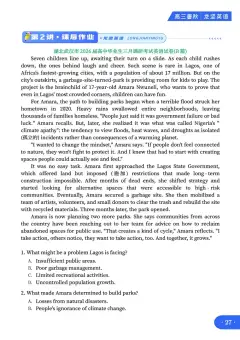
Seven children line up, awaiting their turn on a slide. As each child rushes down, the
ones behind laugh and cheer. Such scene is rare in Lagos, one of Africa's fastest-growing
cities, with a population of about 17 million. But on the city's outskirts, a garbage-site-
turned-park is providing room for kids to play. The project is the brainchild of 17-year-old
Amara Nwuneli, who wants to prove that even in Lagos' most crowded corners, children
can have fun.
For Amara, the path to building parks began when a terrible flood struck her
hometown in 2020. Heavy rains swallowed entire neighborhoods, leaving thousands of
families homeless. "People just said it was government failure or bad luck." Amara recalls.
But, later, she realized it was what was called Nigeria's "climate apathy": the tendency to
view floods, heat waves, and droughts as isolated ( 孤 立 的 ) incidents rather than
consequences of a warming planet.
"I wanted to change the mindset," Amara says. "If people don't feel connected to
nature, they won't fight to protect it. And I knew that had to start with creating spaces
people could actually see and feel."
It was no easy task. Amara first approached the Lagos State Government, which
offered land but imposed (施加) restrictions that made long-term construction impossible.
After months of dead ends, she shifted strategy and started looking for alternative spaces
that were accessible to high-risk communities. Eventually, Amara secured a garbage site.
She then mobilized a team of artists, volunteers, and small donors to clear the trash and
rebuild the site with recycled materials. Three months later, the park opened.
Amara is now planning two more parks. She says communities from across the
country have been reaching out to her team for advice on how to reclaim abandoned
spaces for public use. "That creates a kind of cycle," Amara reflects. "I take action, others
notice, they want to take action, too. And together, it grows."
1. What might be a problem Lagos is facing?
A.Insufficient public areas.
B.Poor garbage management.
C.Limited recreational activities.
D.Uncontrolled population growth.
2. What made Amara determined to build parks?
A.Losses from natural disasters.
B.People's ignorance of climate change.C.Disappointment in government failure.
D.Nigeria's inadequacy in public education.
3. What quality does Amara demonstrate when completing the project?
A.Integrity. B.Optimism. C.Flexibility. D.Confidence.
4. What does Amara want to convey in the last paragraph?
A.Small steps make a big difference.
B.Every cloud has a silver lining.
C.All roads lead to Rome.
D.It is never too late to act.
【答案】1. A 2. B 3. C 4. A
【解析】
【导语】本文是一篇新闻报道。讲述了 17岁的阿玛拉·努威利在尼日利亚拉各斯将垃圾场
改造成公园,以此改变人们对气候和自然的冷漠态度,并带动更多人行动起来的故事。
【1题详解】
细节理解题。根据第一段“Such scene is rare in Lagos, one of Africa’s fastest-growing cities,
with a population of about 17 million. But on the city’s outskirts, a garbage-site-turned-park is
providing room for kids to play. (这样的场景在拉各斯十分罕见,这座非洲增长最快的城市约
有1700万人口。但在城市郊区,一个由垃圾场改造而成的公园为孩子们提供了玩耍的空
间。)”可知,拉各斯面临的问题是公共活动区域不足。故选A。
【2题详解】
细节理解题。根据第二段“But, later, she realized it was what was called Nigeria’s ‘climate
apathy’: the tendency to view floods, heat waves, and droughts as isolated incidents rather than
consequences of a warming planet. (但是,后来,她意识到这就是所谓的尼日利亚‘气候冷
漠’:将洪水、热浪和干旱看作孤立事件,而不是地球变暖的后果。)”以及第三段“I
wanted to change the mindset. (我想要改变这种心态。)”可知,是人们对气候变化的无知和漠
视让阿玛拉决心建造公园。故选B。
【3题详解】
推理判断题。根据第四段“Amara first approached the Lagos State Government, which offered
land but imposed restrictions that made long-term construction impossible. After months of dead
ends, she shifted strategy and started looking for alternative spaces that were accessible to high-risk
communities. Eventually, Amara secured a garbage site. (阿玛拉首先向拉各斯州政府提出了申
请,该政府提供了土地,但附加了一些限制条件,使得长期建设变得不可能。经过数月的无果努力后,她改变了策略,开始寻找那些对高风险社区来说易于到达的替代场地。最终,阿
玛拉找到了一个垃圾处理场。)”可知,她在遇到困难时及时调整策略,体现出灵活变通的
品质。故选C。
【4题详解】
推理判断题。根据最后一段“‘I take action, others notice, they want to take action, too. And
together, it grows.’ (我采取行动,别人看到,他们也想行动。然后一起行动,影响就会扩
大。)”可知,阿玛拉想传达的是:小小的行动也能带来巨大改变。故选A。