前 言
亲爱的同学们:
欢迎和我们一起进入英语世界!
英语在世界上使用广泛,在日常生活中我们也经常会用到。你想了解这种语
言吗?你想知道讲英语国家的人有什么样的生活习惯,过什么样的节日吗?学习
英语,能让我们交到更多的朋友,学到更多的知识,得到更多的快乐!让我们和
书里的小伙伴们一起说、一起玩、一起唱,一起走进这个奇妙的英语世界吧!
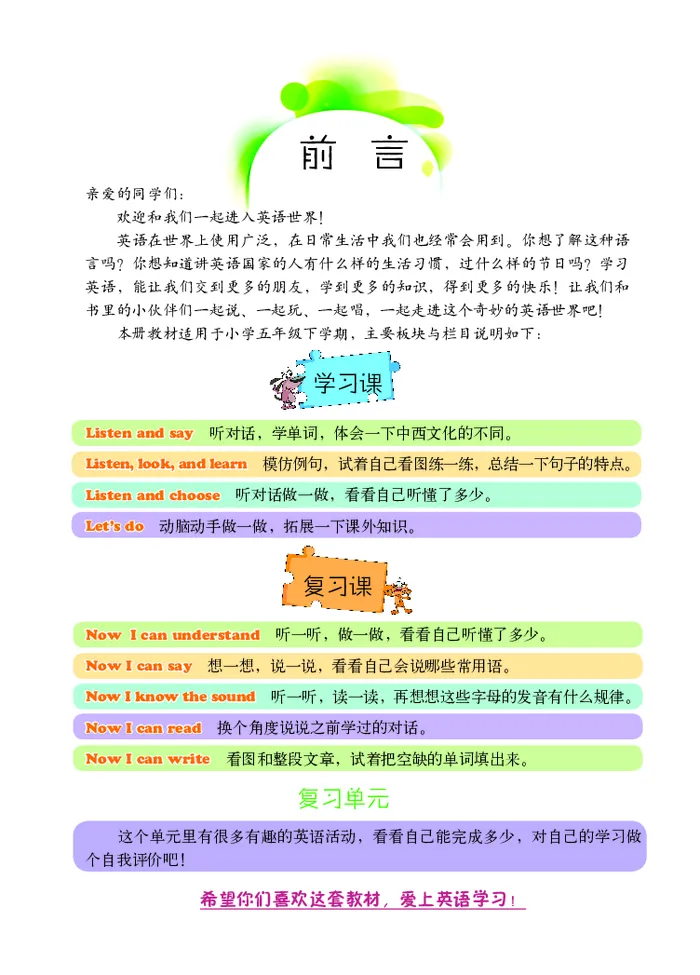
本册教材适用于小学五年级下学期,主要板块与栏目说明如下:
Listen and say 听对话,学单词,体会一下中西文化的不同。
Listen, look, and learn 模仿例句,试着自己看图练一练,总结一下句子的特点。
Listen and choose 听对话做一做,看看自己听懂了多少。
Let’s do 动脑动手做一做,拓展一下课外知识。
Now I can understand 听一听,做一做,看看自己听懂了多少。
Now I can say 想一想,说一说,看看自己会说哪些常用语。
Now I know the sound 听一听,读一读,再想想这些字母的发音有什么规律。
Now I can read 换个角度说说之前学过的对话。
Now I can write 看图和整段文章,试着把空缺的单词填出来。
这个单元里有很多有趣的英语活动,看看自己能完成多少,对自己的学习做
个自我评价吧!
希望你们喜欢这套教材,爱上英语学习!
复习单元
学习课
复习课
CONTENTS
UNIT ONE
WHAT ARE YOU DOING?
Lesson 1
2
Lesson 2
4
Lesson 3
6
Lesson 4
8
UNIT TWO
WHAT DO FLOWERS DO?
Lesson 5
10
Lesson 6
12
Lesson 7
14
Lesson 8
16
UNIT THREE
HOW DO SEEDS TRAVEL?
Lesson 9
18
Lesson 10
20
Lesson 11
22
Lesson 12
24
UNIT FOUR
REVISION
Lesson 13
26
Lesson 14
30
UNIT FIVE
WHO’S THAT BABY BOY?
Lesson 15
34
Lesson 16
36
Lesson 17
38
Lesson 18
40
STORY TIME
66
ENGLISH SONGS
78
WORD LIST (1)
84
WORD LIST (2)
86
UNIT SIX
WHAT WILL YOU DO IN THE FUTURE?
Lesson 19
42
Lesson 20
44
Lesson 21
46
Lesson 22
48
UNIT SEVEN ARE YOU GOING AWAY FOR THE HOLIDAY?
Lesson 23
50
Lesson 24
52
Lesson 25
54
Lesson 26
56
UNIT EIGHT
REVISION
Lesson 27
58
Lesson 28
62
1
L
e
s
s
o
n
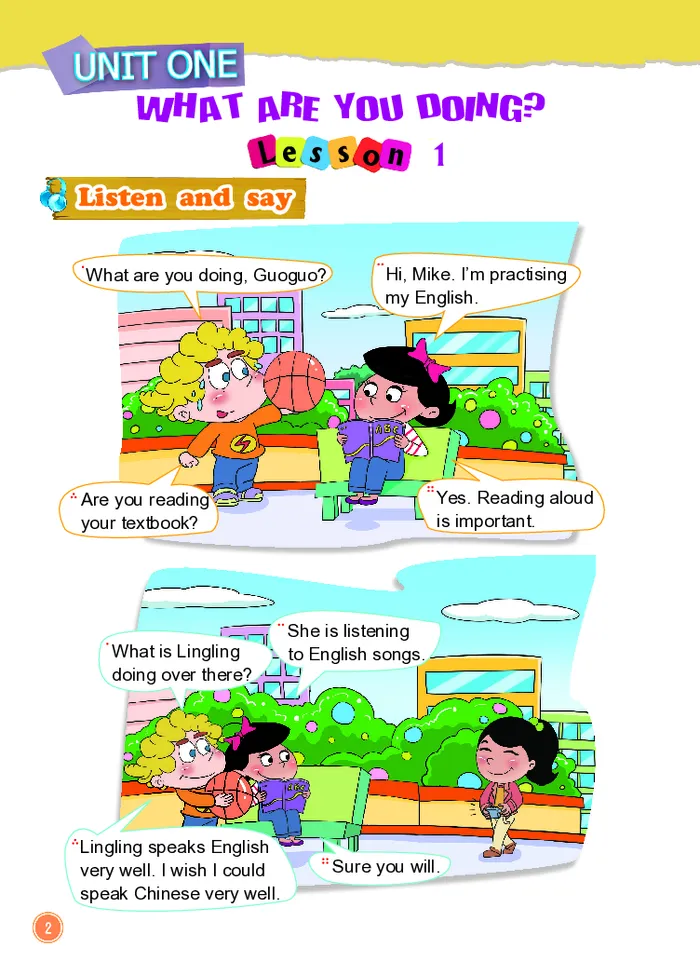
WHAT ARE YOU DOING?
Hi, Mike. I’m practising
my English.
What is Lingling
doing over there?
What are you doing, Guoguo?
She is listening
to English songs.
Are you reading
your textbook?
Sure you will.
Lingling speaks English
very well. I wish I could
speak Chinese very well.
UNIT ONE
Yes. Reading aloud
is important.
Listen and say
2
Act in pairs.
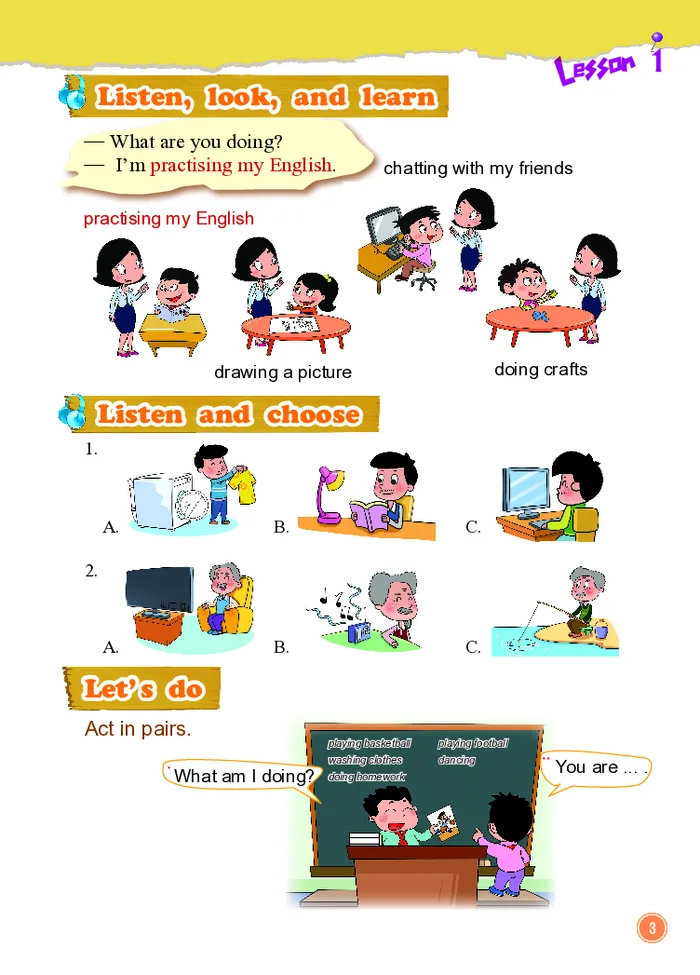
doing crafts
— What are you doing?
— I’m practising my English.
Let’ s do
drawing a picture
practising my English
chatting with my friends
1
Listen and choose
Listen, look, and learn
1.
2.
A.
B.
C.
A.
B.
C.
What am I doing?
You are ... .
playing basketball playing football
washing clothes
dancing
doing homework
3
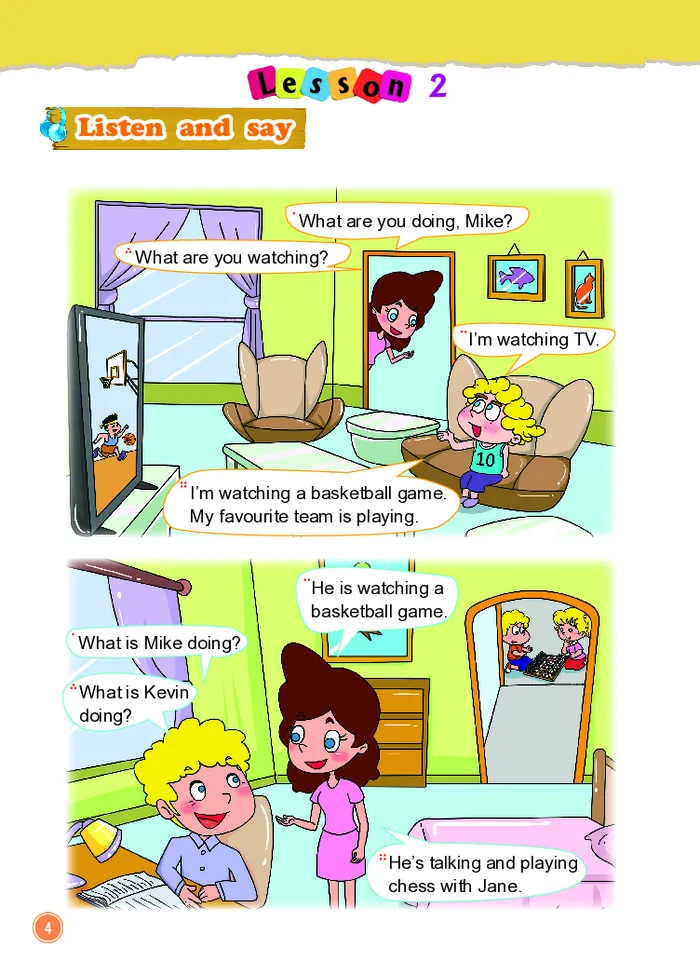
He is watching a
basketball game.
What is Kevin
doing?
What are you doing, Mike?
What are you watching?
What is Mike doing?
L
e
s
s
o
n
2
He’s talking and playing
chess with Jane.
Listen and say
I’m watching TV.
I’m watching a basketball game.
My favourite team is playing.
4
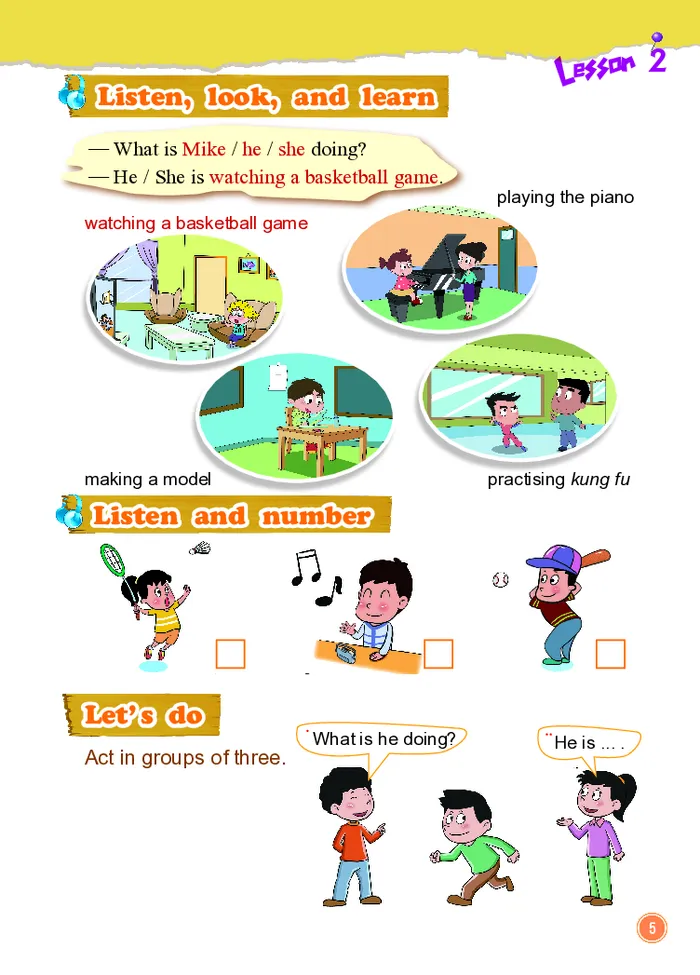
What is he doing?
He is ... .
— What is Mike / he / she doing?
— He / She is watching a basketball game.
Act in groups of three.
2
Let’ s do
practising kung fu
making a model
watching a basketball game
Listen and number
Listen, look, and learn
playing the piano
5
L
e
s
s
o
n
3
Listen and say
Lingling, would you like to
look at my family photos?
Sure. There are so many
people in this picture. What
are you doing?
We are having a birthday
party for my grandma.
These are my parents.
They are putting
candles on the cake.
What are
they doing?
You are having
a good time.
6
— What are they doing?
— They are putting candles on the cake.
dancing
fishing
putting candles
on the cake
playing hide-and-seek
3
Listen and number
Let’ s do
Act in pairs.
What are they doing?
They are ... .
Listen, look, and learn
7
— What is he / she doing?
— ... .
— What are they doing?
— ... .
L
e
s
s
o
n
4
Now I can say
Listen and match.
Now I know the sound
Now I can understand
The quiet queen is asking questions about the earthquake.
The square quartz watch says it’s a quarter to ten.
quiet quarter quartz queen question quick
square earthquake
Q
8
Now I can write
Guoguo is drawing a
of Mike.
Maomao is taking .
Yangyang is
a poem.
Lingling and Sara are
about
their pets.
They are
a good time.
4
Now I can read
reading
talking
photos
having
picture
Maomao asks Lingling to
look at the pictures of his
family. They are having a
birthday party for Maomao’s
grandma. His parents are
putting candles on the cake.
Mike is at home and he is watching
TV. His favourite basketball team is
playing. Kevin is talking and playing
chess with Jane. They are having a
good time.
Ask and answer.
What is Mike / Kevin doing?
Ask and answer.
What are the people in the picture doing?
9
WHAT DO FLOWERS DO?
They must have
different jobs.
Yes. Everything will
be green again.
They are the roots, the
stem, the leaves, the
flowers, and the seeds.
What’s the English for the
different parts of a plant?
Yes. Please follow me and
listen to the next part.
The leaves and the
grass will come out.
What will happen
in spring?
5
L
e
s
s
o
n
UNIT TWO
Listen and say
10
— What’s the English for the different parts of a plant?
— They are the roots, the stem, the leaves, the flowers,
and the seeds.
5
Let’ s do
Write the names of the different parts of a plant.
Listen, look, and learn
Listen and circle
the roots
the stem
the leaves
the flowers
the seeds
the screen
the keyboard
the mouse
clock
the face
the long hand
the short hand
computer
1. 2.
11
What do flowers do?
Roots hold the plant in the ground.
They carry food and
water to the leaves.
What do
stems do?
What about
the leaves?
They make seeds.
Little seeds grow up
to be plants.
They make food
for the plant.
L
e
s
s
o
n
6
Listen and say
12
— What do flowers do?
— They make seeds.
6
Listen, look, and learn
flowers
seeds
trunks
grow up to be
plants and trees
make seeds
hold the trees
above the ground
Listen and number
Let’ s do
Match and say.
make food for the
plant
grow up to be plants
make seeds
What do flowers do?
13
What do leaves need
to make food?
Plants make food
for themselves.
Nothing on the earth can
live without the sun.
You are right.
L
e
s
s
o
n
7
So leaves are like
little factories.
How wonderful!
They make food by
their own leaves.
Listen and say
They need sunlight,
air, and water.
14
— What do leaves need to make food?
— They need sunlight, air, and water.
( )+ ( )+ ( )+ … =
( )+ ( )+ ( )+ … =
( )+ ( )+ ( )+ … =
Brainstorming: What do we need?
sunlight, air, water
make food /
cook the dinner /
7
Listen and circle
potatoes, tomatoes,
eggs
hold the party /
candy, drinks, toys
Let’ s do
Listen, look, and learn
15
L
e
s
s
o
n
8
What do ... do?
They ... .
Now I can say
Listen and tick.
Now I know the sound
Now I can understand
A rabbit is running in the rain.
A girl is saying “Good morning” to a bird.
rabbit rain read ready red rice ride room run
borrow tomorrow
arm art
bird girl born morning nurse turn
mother worker driver
R
16
When spring comes, the leaves and
the grass will come out. Everything
will be green again. Green leaves are
like little factories. They make food
for their tree. They need sunlight, air,
and water to make food.
Each part of a plant has a different job.
Flowers make seeds. Little seeds grow up to
be plants. Leaves make food for the plant.
The stem carries food and water to leaves.
The roots hold the plant in the ground.
Read and answer.
What do the different parts of a plant do?
Tiantian: Hi, Meimei. What’s that?
Meimei: It’s a birthday gift. It’s a mini
_______.
Tiantian: What are you doing now?
Meimei: I am watering it. It’s my _______.
Tiantian: What _______ you do next?
Meimei: Please _______ me. I will take it
out and put it in the _______.
Tiantian: Oh, I see. _______ on the _______
can live _______ the sun.
Now I can write
8
Now I can read
Nothing job follow without plant will earth sun
17
How can we make use of trees?
I like trees, too.
Trees help us.
Yes. I enjoy walking
in a forest.
Do you like
trees?
HOW DO SEEDS TRAVEL?
9
L
e
s
s
o
n
UNIT THREE
Listen and say
We can also get
fruits from trees.
We can make
chairs and tables
with the wood.
We can build houses.
18
— How can we make use of trees?
— We can get fruits from trees.
Make a speech.
9
How can we make use of water?
the old jacket /
make a bag
newspapers /
make paper caps
Let’ s do
We can use water
in many ways.
...
Listen and number
Listen, look, and learn
trees /
get fruits from trees
19
Listen and say
These foods come from
different parts of plants.
Can you give me
an example?
Can you give me an
example of the food?
We get most of our
food from plants.
For example, peanuts, tomatoes,
potatoes, cabbages, and carrots.
Peanuts are seeds, and
potatoes are stems.
Oh, I see. Tomatoes
are fruits.
L
e
s
s
o
n
10
Where do we get
our food, Uncle?
20
sweet fruits
apples
peaches
watermelons
— Can you give me an example of the food?
— For example, peanuts, tomatoes, potatoes, cabbages, and carrots.
Can you give me an
example of ... ?
carrots
the food
Give examples.
10
Listen and circle
fast food
fruits
animals
sports
Let’ s do
hamburgers
sandwiches
hot dogs
1. 2. 3.
peanuts
tomatoes
cabbages
potatoes
carrots
Listen, look, and learn
21
Yes, and some nuts
are seeds, too.
Seeds travel in many ways.
Some travel with wind.
Dad, is corn a
kind of seeds?
Wheat and rice
are both seeds.
How do seeds
travel, Mum?
Some seeds travel in water,
and others travel with people
and animals.
What else are
seeds?
L
e
s
s
o
n
11
Listen and say
22
— How do seeds travel?
— Some seeds travel in water, and others travel with people and
animals.
11
Listen and choose
in water
Fruits
Stems
tomato
eggplant
Seeds
Leaves
cucumber
Roots
peas
celery
lettuce
cabbage
potato
sweet potato
carrot
Let’ s do
Group the vegetables.
1.
2.
3.
with people and animals
Listen, look, and learn
with wind
with birds
23
L
e
s
s
o
n
12
Now I know the sound
How do people travel?
Some ... , and others ... .
Now I can say
Listen and number.
Now I can understand
A short schoolboy is skating near the house.
A small fish is swimming in the sea.
sad
safe
salty
say
school skate
sky
slow
small
snow
speak
spring square
star
story
sweet swim
lesson dress basketball
house
choose visit
vase
use
Chinese
S
24
Mon: I went to the _______. I saw a lot of
_______ in front of a hut.
Tue: In today’s science class, Miss Li talked
about some _______ of plants.
Wed: Dad told me that _______ and _______
are _______ seeds.
Thur: Mum used _______ to make salad.
Fri: My little rabbit loves to eat _______.
Now I can write
12
Now I can read
forest
nuts
examples
wood
carrots
both
tomatoes
corn
Corn, wheat, and rice are all seeds. Some
nuts are seeds, too. Seeds travel in many
ways. Some travel with wind, some in
water, and others with people and animals.
We can get fruits from trees. But we
get most of our foods from plants.
Our foods come from different parts
of plants. Peanuts are seeds, potatoes
are stems, and tomatoes are fruits.
Read and choose.
We get most of our foods from______.
A. trees B. plants
Read and answer.
How do seeds travel?
25
REVISION
13
L
e
s
s
o
n
UNIT FOUR
Do you understand ?
Can you talk?
Mike and Baobao are playing table tennis.
...
play chess
play basketball
play baseball
Tick (√) or cross (×).
1
2
3
4
5
6
26
13
Eyes in the Dark
What has eyes but cannot see? It’s the potato. Did you guess right?
The little bumps on a potato’s skin are its “eyes”. An eye can grow
into a new potato plant. Do you want to try and grow your own?
Things you will need: a potato, some soil, and a flower pot.
Put the potato in a dark place.
Check it every day for small
bumps or “eyes”.
2. When you see the “eyes”,
cut them off the potato.
Fill the flower pot with
some soil and then put the
piece of potato on the soil
with the “eyes” facing up.
Cover the “eyes” with more soil.
Water it but don’t use too much
water. Watch every day for about
two weeks and see the changes.
1.
4.
3.
Can you do ?
Can you write ?
Mum is _____________________.
Dad is ______________________.
I am _______________________.
27
Facts About Trees
Trees are tall plants.
Trees can live for thousands of years.
Some trees can grow taller than 100 metres.
Trees produce oxygen (氧气) and reduce the amount of carbon
dioxide (二氧化碳) in the air.
The roots of a tree usually grow underground. They help keep
the tree stable and give it water and important nutrients (营养物).
Water and nutrients travel up the tree trunk, through the
branches and all the way out to the leaves.
We can tell the age of a tree by growth rings in the wood.
Planting trees can help protect the environment.
We can use wood from trees in a number of different ways, for
example, building a house and making furniture.
Can you read and write ?
What happened? You can write down the changes here.
Day __
Day __
Day __
Day __
Day __
Day __
Day __
28
13
Task 1
Tick (√) or cross (×).
( ) 1. Trees can only live for 100 years.
( ) 2. Water and nutrients travel down the tree trunk.
( ) 3. We can tell the age of a tree by its roots.
Task 2
Fill in the blanks.
1. Water travels up the tree ________, through the ________ and all
the way out to the ________.
2. We can ________ the age of a tree by ________ ________.
3. We can use wood from trees to ________ a house and
________ furniture.
Task 3
Find out the English names for trees and match them with pictures.
pine
palm
bamboo
willow
maple
29
Listen and number.
L
e
s
s
o
n
14
Can you talk?
How can we make use of ... ?
the river
the trees
the flowers
the land
Do you understand ?
30
14
How do leaves get water? You will say, “The stem of a plant
carries water from the roots to the leaves.” That’s right! The stem
is like a straw. Try the following experiment to see what happens.
Things you need:
1. two celery stems with leaves but without roots; about 0.2 metres long
2. two bottles or big glasses
3. red and blue colour
4. water
5. a piece of paper to write down the changes
Follow these steps:
1. Fill the bottles or glasses with water.
2. Put some red colour in one bottle and some
blue colour in the other bottle.
3. Put a celery stem in each bottle.
4. Check the stems every hour and write down
the changes.
Can you do ?
1. — How do students enjoy their weekends?
— ______ visit grandparents,
and _____ go to the parks.
Can you write ?
2. — How do people travel?
— Some , and others
.
3. — What do children like to eat?
— like to eat , and
like to eat .
31
What Are Materials?
Stone, metal, wood, paper, and cloth are materials. We use them
every day.
Can you read and write ?
Cloth is a soft material. There are
different kinds of cloth. We make cloth
from sheep’s wool, cotton, and silk.
We use cloth to make many things
such as T-shirts and jeans.
Paper is a soft material from plants. It is light
and very easy to bend and fold.
Wood is a material from trees.
Wood is a hard material, but it
is not as hard as stone or metal.
We can cut and shape wood with
metal tools.
We get metal from stone. Metals are
strong and difficult to break. They are
usually shiny. Metals are hard like stone,
but we can bend them and make them into different shapes.
Stone is a hard, heavy material. Most
stones sink to the bottom of water. We
get stone from the ground and from
mountains. Stone does not bend, but it
can be cut into shapes.
32
14
Task 1
Tick (√) or cross (×).
( ) 1. Most stones sink to the bottom of water.
( ) 2. We can cut wood into different shapes.
book
paper
Things
Materials
●�I can understand what people talk about in
each Listen and say.
●I can talk about what people are doing.
●�I know the names of the different parts of a plant.
●I can talk about how we make use of plants.
●�I know how to give examples.
Progress check
Task 2
Fill in the blanks.
1. We can use metal to make fences because
.
2. We can fold cloth because .
Task 3
Find the different materials in your daily life.
33
Yes, Sally and Jack. Sally is
seven years older than Jack is.
Here is a photo of
Tom’s family.
Wow! He has two
lovely kids.
L
e
s
s
o
n
15
WHO’S THAT BABY BOY?
He’s my cousin, Tom.
He’s the son of Aunt
Mary, my mother’s sister.
Who’s this man on
the horse?
He is. He’s eighteen
years older than I am.
He looks much
older than you.
UNIT FIVE
Listen and say
34
He is eighteen years older than I am.
Write and tell.
15
Listen and write
My age:
Age:
Age:
Age:
Age:
Let’ s do
(11)
(40)
( )
( )
( )
(60)
1.
2.
+ =
+ =
+ =
+ =
3.
My ... is ... years
older than I am.
Listen, look, and learn
18
6
29
35
Who’s that baby
boy?
Look, here is another
photo. The girl is Sally,
my niece.
Do you have
big cousins?
Yes, I do. My aunt’s daughter
will have a baby soon.
Is Meimei your cousin?
Yes. We were born
in the same year.
He’s Jack, my nephew.
L
e
s
s
o
n
16
He’s cute!
Listen and say
36
— Who’s that baby boy?
— He’s Jack, my nephew.
this little girl
that old lady
Xinxin, Lingling’s cousin
Mrs Li, my neighbour
grandpa
Can you tell who he is / she is / they are?
16
Listen and write
that man
Bob, one of Mike’s uncles
that baby boy
Jack, my nephew
B: He is your father.
A: He is my mother’s husband.
A: He is my aunt’s husband.
A: He is my cousin’s son.
A: They are my mother’s parents.
B: He is your _______.
B: He is your _______.
B: They are your _______.
Let’ s do
Ellen
David
Cindy
Frank
Mary
Jack
Listen, look, and learn
37
I have more cousins
than you.
I have four cousins. Two of
them are in high school.
How often do you
see your cousins?
Every Christmas.
Do you often see
your cousins?
Yes, we see each other
quite often. Because we
live in the same city.
Lucky you!
Yes. We often have
a big family reunion
on Christmas.
L
e
s
s
o
n
17
Listen and say
38
Draw your family tree
and talk about it.
— How often do you see your cousins?
— Every Christmas.
17
Listen and write
Let’ s do
Jane
Leo
Dongdong
Number of cousins
See each other
Listen, look, and learn
see your cousins
Christmas
have chess lessons
Friday
visit your grandparents
summer
39
L
e
s
s
o
n
18
Now I know the sound
Listen, match, and write.
Who’s ... ?
He / She is ... . He / She
is ... older than I am.
Now I can say
Now I can understand
Jim, _______ years older
Al, ______ years older
Bobby, _________ years older
Tim told Ted a story about the elephant and the tiger.
The taxi driver took a truck to the train station.
table
taxi
tiger
train
truck
turn
story
step
station
study
about
sweet
great
light
elephant
T
40
Dear Tom,
How is everything going?
How are your _______? Is your ________, my ________, Sally,
________ years old now? Your ________, my one-month old ________,
must be very ________. My parents and I ________ talk about you. We all
miss you.
Looking forward to hearing from you.
Yours,
Sara
Now I can write
18
Now I can read
nephew
seven
son
often
niece
daughter
lovely
kids
Yangyang has four cousins. Two of them are in high school. They
all live in the same city and often see each other. Sara has more
cousins. They usually have a big family
reunion every Christmas.
Tom is Sara’s cousin. He is eighteen years older than Sara. He
has two lovely children. His daughter is Sally,
Sara’s niece. His son is Jack, Sara’s nephew.
Read and write.
Sally is Sara’s _______.
Jack is Sara’s _______.
Read and choose.
Sara sees her cousins every _______.
A. summer
B. Christmas
41
What will you be in
the future, Mike?
WHAT WILL YOU DO IN THE
FUTURE?
19
L
e
s
s
o
n
UNIT SIX
I will be a pilot. I will fly
a plane or a spaceship.
Yes. I do.
I know you make
fantastic model
planes.
What will you be in the future?
I will be a professor.
You should study hard
to be a professor.
Yes, I think so.
Listen and say
42
19
a dentist
an artist
a barber
a pilot
Listen and choose
A. B.
C. D. E. F. G.
Talk and write about jobs.
Let’ s do
Name
Jack
Leo
Dongdong
Mingming
Parent’s job
Future job
My father is ... , and I will be ... , too.
My mother is ... , but I will be ... .
Listen, look, and learn
— What will you be in the future?
— I will be a pilot.
43
Listen and say
Wow! I don’t know how to
play baseball, but I really
want to learn.
What does your father
do, Yangyang?
This cap is a birthday
present from my father.
He plays baseball.
Will you be a football
player in the future?
I hope so. I’m practising
a lot now.
My father is a football coach.
L
e
s
s
o
n
20
Thank you so much!
OK. I’ll ask my
dad to teach you.
44
— Will you be a football player in the future?
— I hope so.
a football player
a basketball player
20
Find out what your classmates will be in the future.
Let’ s do
Name
Wang Dong
Future Job
He will be a doctor.
Listen and choose
Yes.
No.
Yes.
No.
Yes.
No.
Listen, look, and learn
an engineer
45
That’s true. You have
to exercise a lot.
I need to be strong
and fit to be a pilot.
I enjoy making model planes.
I want to be a pilot.
Sure I do. What do you
need to do to become
an engineer?
I need to study hard. I
should be good at maths
and drawing.
Do you enjoy making
things?
L
e
s
s
o
n
21
Yes, I do. I want
to be an engineer.
Listen and say
46
21
Listen and match
an engineer
a tailor
making clothes
making things
a writer
writing stories
a pianist
playing the piano
Tom
Jack
Sally
Share ideas.
Let’ s do
Listen, look, and learn
— Do you enjoy making things?
— Yes, I do. I want to be an engineer.
Things I enjoy
music
musician
Job I want to do
47
L
e
s
s
o
n
22
Now I know the sound
Will you be ... in the future?
I hope so.
Now I can say
Listen and number.
Now I can understand
The clever driver loves to drive the van.
Val’s favourite vase is very heavy.
vacation van
vase
very
visit
volleyball
eleven
every
clever
heavy
over
television
cave
five
drive
love
V
48
Mike enjoys making model planes. He will
be a pilot in the future. He will fly a plane or
a spaceship. Baobao wants to be a professor.
They should both study hard.
I want to be a ________ and I will fly a plane.
I want to be a football player. I ________
________ every day.
I want to be an ________. I will design the most
wonderful spaceship in the world.
We should all ________ hard.
Now I can write
22
Now I can read
Yangyang’s father is a football coach.
Yangyang wants to be a football player in the
future. Guoguo’s father plays baseball. He
will teach Yangyang how to play baseball.
study pilot exercise should engineer
Read and choose.
Guoguo’s father will teach Yangyang to play ______.
A. baseball
B. football
Read and answer.
What will Mike and Baobao be in the future?
49
It takes more than
ten hours by plane.
Are you going away for
the holiday, Lingling?
How long does it take to
get to New York?
So you’ll fly to
the U.S.A.
I’ll miss you. Have
a nice trip.
Yes. My mum and I are
going to New York. My
dad is working there.
ARE YOU GOING AWAY FOR THE
HOLIDAY?
UNIT SEVEN
23
L
e
s
s
o
n
Yes. I’m very excited.
Thank you. I’ll write
emails to you.
Listen and say
50
Find out how long it takes to go to ... . Write in the table.
— How long does it take to get to New York?
— It takes more than ten hours by plane.
5 hours
Xi’an
23
Listen and match
10 hours
Tianjin
20 minutes
your school
2 hours
New York
Let’ s do
From
Beijing
London
Paris
New York
Sydney
Washington
D.C.
Listen, look, and learn
51
I enjoy travelling by train.
It will be very exciting.
My parents and I are going to
Shanghai for the weekend.
Why don’t you take the plane
to Shanghai? It’s faster.
We’ll go by bullet train this time.
It takes about five hours.
But can you come back
for school on Monday?
Sure I can.
How will you go?
Listen and say
L
s
s
o
n
24
e
52
Show your cousin around your city.
— Why don’t you take the plane to Shanghai? It’s faster.
— I enjoy travelling by train.
24
Listen and match
Let’ s do
bus to the library, easier
taking the subway
taxi to the airport, more comfortable
walking
Places
Vehicles
Day 1
Day 2
Day 3
plane to Shanghai, faster
travelling by train
more comfortable
easier
faster
Listen, look, and learn
53
No. I’ll visit the famous
places here in Beijing.
Are you going away for
the summer vacation?
Sounds exciting.
I’m sure you’ll enjoy
the tours.
My father will take me
to Sanya this summer.
L
e
s
s
o
n
25
Thank you. I’ll take my
camera with me.
Listen and say
What is Sanya
famous for?
It’s famous for its sandy beaches.
We’ll go swimming in the sea.
54
25
Listen and choose
1.
2.
Write about what your
city is famous for ... .
Let’ s do
3.
Chengdu
Beijing
Hangzhou
sandy beaches
museums
Sanya
Beijing
Kunming
flowers
Suzhou
gardens
My city is famous for ... .
Listen, look, and learn
— What is Sanya famous for?
— It’s famous for its sandy beaches.
55
L
e
s
s
o
n
26
Now I know the sound
How long does it take
to get to ... ?
It takes more than ... .
Now I can say
Listen and number.
Now I can understand
William knows where to borrow some wires.
Mr White will draw a brown sweater for the winter.
water
winter
window
weather wire
world
sweater swim
subway
homework
brown
crowd
now
draw
strawberry
borrow
know
tomorrow
W
56
Lingling’s father is working in New York. Lingling and her
mother will visit him during the summer
holiday. It will take them more than ten
hours to fly from Beijing to New York.
Guoguo will miss her. Lingling will write
emails to Guoguo.
26
Now I can read
Sanya is famous for its sandy beaches.
Yangyang will go there for the summer. He will
go swimming in the sea every day. Sara will
not go away for the holiday. She wants to see
more of Beijing. She will visit many interesting
places. She will take photos.
Now I can write
Tingting will take a _______ with her and
send photos to her friends by _______. This
will be an _______trip.
Tingting is ________ about her trip to
Sanya. She will ________ the bright sunshine.
She can build houses on the sandy ________
and see the ________ coconut trees.
camera famous exciting beach email excited enjoy
Read and answer.
How long does it take to go from Beijing to New York by plane?
Read and answer.
Who will go to Sanya during the summer holiday?
57
Tick (√) or cross (×).
REVISION
27
L
e
s
s
o
n
UNIT EIGHT
Can you write ?
Do you understand ?
My mother is a /an _____________.
My father is a /an ______________.
I will be a /an ______________ in the future.
1
2
3
4
5
6
58
27
What are the most popular jobs?
Can you talk ?
Jobs
Number of students
Ranking
Can you do ?
This is a picture of my family.
...
My father is a driver, but I will be a football player.
...
older
... years old
the same age
cousin
niece
nephew
artist
doctor
tailor
59
Travelling in Hong Kong and Macao
At the mouth of Zhujiang River lie two beautiful cities of
China: Hong Kong and Macao. Let’s pay a visit there.
Hong Kong-Zhuhai-Macao Bridge
Hong Kong-Zhuhai-Macao Bridge is 55
kilometers long. It is the world’s longest
cross-sea bridge. It brings Hong Kong, Zhuhai,
and Macao closer to one another. Because of this bridge, it takes
less than an hour to go from Hong Kong to Macao by bus.
Hong Kong Palace Museum
Hong Kong Palace Museum is wide at the
top and narrow at the bottom. It is in the shape
of an ancient Chinese cup. The museum is
open to visitors every day except Tuesday.
Here we can enjoy Chinese art and culture.
A-Ma Temple
A-Ma temple is the oldest temple in Macao.
It has a history of more than 500 years. It
shows people’s respect to the Chinese sea
goddess Mazu. People sometimes set fireworks and perform lion
dances on weekends here. The temple is free to visit.
Macao Museum
At the Macao Museum, we can learn about
Macao’s long history and colourful culture. It
is open to the public from Tuesday to Sunday.
Can you read and write ?
60
27
Task 1
Tick (√) or cross (×).
( ) 1. Hong Kong is on the Zhujiang River.
( ) 2. The bridge puts Hong Kong and Shenzhen closer.
( ) 3. The Macao Museum is free to all visitors.
Task 2
Choose the right answer for each question.
1. �Which of the following buildings is in the shape of an ancient
Chinese cup?
A. Hong Kong Palace Museum.
B. A-Ma Temple.
C. Macao Museum.
2. Where may you see lion dance performances?
A.
B.
C.
3. Which of the following sets a new record in the world?
A.
B.
C.
Task 3
Write down the places you can visit in your city, how you can
get there and tell why you like them.
Place I visited
How I got there
Why I like it
61
Tick (√) or cross (×).
L
e
s
s
o
n
28
1. The brown dog is ________ than the
yellow one but ________ than the
white one. (big, small)
Can you write ?
2. The train is ________ than the bike but
________ than the plane. (slow, fast)
3. My grandma is ________ than my mother
but ________ than I am. (short, tall)
Do you understand ?
62
Tell how you go to the following places and talk about
the reasons.
28
Can you talk ?
— How long does it take to get to ... from ... ?
— It takes about ... .
Train Timetable
Train
From
Time
To
Time
N212
Chengde
13:30
Beijing
17:48
D133
Beijing
14:20
Zhengzhou
20:01
K615
Beijing
15:40
Datong
21:52
G158
Suzhou
17:30
Beijing
22:28
Flight Timetable
Flight
From
Time
To
Time
CA1831
Beijing
07:30
Shanghai
09:40
MU2035
Beijing
08:25
Kunming
11:55
CZ6752
Shanghai
13:15
Shenzhen
15:45
Can you do ?
By subway By bus By bike By taxi On foot Reasons
School
Zoo
Library
Supermarket
...
63
Can you read and write ?
Chen Hua is a writer. She writes
books for children. She works at a
newspaper office in Beijing. She
goes to work by car. She works
hard, and many children enjoy
reading her books.
Mary is a worker. She works in a food
factory in London. Mary doesn’t work
on Sunday. She usually gets up early.
After breakfast she often visits her friend,
Jane. Jane is a doctor. She is also free on
Sunday. In the afternoon they often go
shopping. They have a good time.
Zhi Ru is a diver. She works in an
aquarium (水族馆) in Japan. Look! She is
feeding (喂) fish in a huge fish tank (水
族箱). She is wearing a diving suit. She
feeds the fish every day.
Hu Ming is a teller. He works in a
bank. He enjoys maths and likes working
with numbers. He lives in Hong Kong,
and he goes to work by subway.
Betty, a policewoman, likes helping
people. She likes collecting stamps. She
often helps tourists find their way. She
goes to work by motorbike.
64
Task 1
Write down their jobs.
Chen Hua
Betty
Hu Ming
Zhi Ru
Mary
Jane
Task 2
Choose the right answer for each question.
1. Chen Hua writes books for .
A. parents
B. teachers
C. children
2. How does Betty go to work?
A. By car.
B. By motorbike.
C. By subway.
3. Where does Hu Ming live?
A. Hong Kong.
B. London.
C. Beijing.
4. What do Jane and Mary often do on Sunday afternoon?
A. Go swimming. B. Go fishing.
C. Go shopping.
●�I can understand what people talk about in
each Listen and say.
●�I know how to talk about age.
●�I can talk about my family members.
●�I can talk about what I will be in the future.
●�I can talk about how people travel.
●�I can talk about some famous places.
Progress check
28
65
STORY TIME
It is night in the woods. Most animals go to sleep at night, but
some animals are just waking up.
I go for a walk in the woods with Dad. Look at the moon. It is
very bright. The moonlight will help us see the animals.
Listen to the “Hoot, Hoot” of an owl. Look! There it is! The owl
is up in that tree. The owl’s yellow eyes shine in the moonlight.
Now look up at the sky. Bats are flying here and there. They
wake up at night and look for bugs to eat.
Where can we find the owl?
A. It is up in a tree.
B. It is flying in the sky.
Choose the correct answer.
STORY 1-1
66
STORY TIME
Answer the question.
What are the fox and the deer doing in the woods?
Look! A red fox is hiding in the woods. It jumps out of a bush
and runs away.
A big raccoon (浣熊) is in that tree. The raccoon has black fur
around its eyes. That fur looks like a mask.
We hear a crunching (嘎吱的) sound. What animal is hiding from
us? Look! There is a deer behind the trees. The deer runs off into
the woods.
We love to walk in the woods at night. But now it is time to go
home. It is time for us to go to sleep!
STORY 1-2
67
STORY TIME
Do you see the diatom ( 藻)? It’s
one of the smallest plants in the
world. A drop of water may have
about 500 of them.
They’re so small that you can see
them only through a microscope
( 显微镜). They live in water and
that is their home.
Tick (√) or cross (×).
( ) 1. The diatom is the smallest plant in the world.
( ) 2. You can see them with your eyes.
( ) 3. Their home is in the water.
STORY 2
68
STORY TIME
The redwood tree is one
of the largest plants in the
world. It can grow very tall,
about 85 metres.
Tick (√) or cross (×).
It can live a very
long life. Some
redwood trees are
2 000 years old.
It has cones ( 松塔). That’s the
fruit, just as an apple is the fruit
of an apple tree.
( ) 1. The redwood tree can grow as tall as 85 metres.
( ) 2. The redwood tree can live to be 200 years old.
( ) 3. The fruit of a redwood tree is like an apple.
STORY 3
69
STORY TIME
Choose the correct statement.
A. All plants need water.
B. Big trees don’t need water.
I’m thirsty. I’m
so thirsty.
Eat this carrot and
you will feel better.
No, no. That’s
not for me.
The little tree is tired
and thirsty. It is crying.
The little rabbit comes over.
The little tree wants
to drink some water.
Why don’t you
feel thirsty?
My roots are deep in the
ground. I can get enough
water from there.
I will come to water the little
tree every day because the
little tree cannot get enough
water from the ground yet.
STORY 4
70
STORY TIME
Answer the question.
Why does Frank enjoy fishing?
My cousin Frank enjoys fishing and spends most of his time by
the river.
He enjoys being in the fresh air and on his own. There is no one
to trouble him, and the time passes happily for him.
Unfortunately, he is not a very good fisherman. He never catches
anything big enough to eat.
However, he does not like to admit this to his wife, Jenny. If she
knows he is wasting his time, she may try to stop him from going
fishing.
STORY 5-1
71
STORY TIME
I’ll have three trouts, please.
I suggest you take a nice
salmon instead.
Oh, why?
Your wife came in an hour ago and
said, “When Frank comes in, make
sure he ‘catches’ a salmon.”
On the way home Frank always visits the local fish shop and
buys something. When he gets home, he tells Jenny that he caught
a good fish. They then have it for dinner.
One evening, Frank fails again to catch any fish, and he stops at
the fish shop as usual on his way home.
Answer the question.
Why should Frank get a salmon instead of trouts?
STORY 5-2
72
STORY TIME
( ) 1. Trash in the river cannot make animals sick.
( ) 2. You should put your trash in a trash bag.
Is your home by the sea or far away? If it is far away, you can
still help save the whales.
Do you have lakes or rivers near you? Some people throw trash
in them. Waves can take that trash to the sea. That same trash can
make whales sick. If a whale eats it, it gets ill. Trash can make
fish and turtles sick, too. It also pollutes (污染) the water.
Take your trash with you. Put it in a trash bag. In that way, you
can help keep the whales, fish, and turtles safe, and the water clean.
Tick (√) or cross (×).
STORY 6
73
STORY TIME
I don’t like it very much.
I’m sure it will always be
fast or slow.
Look! Dad gave me a shoelace.
I can’t see the shoes, but I’m
sure they are here somewhere.
Choose the correct statement.
A. The happy boy is sure his dad will buy him a gold watch.
B. The happy boy is sure his new shoes are somewhere around
him.
Mr Hoffman has twin (双胞胎) sons. Everything is almost the
same about the twins except one thing: one son always thinks that
good things will happen, but the other always feels sad about the
future.
On their sixteenth birthday, Mr Hoffman gives them different
presents. He wants to help them see life in the right way.
The sad boy looks at his present. It is a beautiful gold watch.
The happy boy looks at his present.
He is really pleased.
STORY 7
74
STORY TIME
When Sima Guang was a little boy, he was once playing a ball
with his friends in the courtyard.
A boy suddenly kicked the ball into a large vat. The vat was full
of water.
All the children ran to the vat. They talked about how to take the
ball out.
One boy stepped on another boy’s shoulders to reach the ball.
Suddenly he slipped, and fell
into the vat.
The children were scared
and didn’t know what to do.
Then Sima Guang had an
idea. He picked up a large
stone and broke the vat with
it. The water flowed out.
The boy was saved.
The story tells us that we need to stay calm (冷静) and use our
heads in times of danger.
Choose the correct answer.
How did Sima Guang save the boy in the vat?
A. He stepped on another boy’s shoulders and pulled the boy out.
B. He broke the vat with a large stone and let the water out.
STORY 8
75
STORY TIME
I live in a river. I don’t live
with my parents. But I have a
lot of brothers and sisters.
When I am young, I don’t
look like my parents. I have
no legs but I have a long tail.
So I look like a fish. Then
my tail becomes shorter and
shorter. Now I have four legs
and a very short tail.
I will have no tail at all and
then I’ll be like my parents.
I will jump out of the water.
I’ll live on the land and in the
water, too. I will eat a lot of
insects (昆虫). Who am I?
Answer the question.
What do I look like when I am young?
STORY 9
76
STORY TIME
Tick (√) or cross (×).
( ) 1. A lot of people know how to make different kinds of potato
dishes.
( ) 2. The French people eat French fries with ketchup.
Without potatoes life would not be the same for many people.
Potatoes are the main food for people in Europe and America. They
are just like the rice and noodles we eat at each meal. People from
different countries make different kinds of potato dishes.
Germans eat potato salad, and Americans have baked (烤)
potatoes. And, of course, the French people invented French
fries. Now people eat a lot of French fries all over the world.
The British people eat them with salt and vinegar (醋), the French
people eat them with salt and pepper (胡椒), and Americans eat
them with ketchup (番茄酱).
STORY 10
77
WE ARE ONE BIG FAMILY
ENGLISH SONGS
78
SEPTEMBER IN THE RAIN
ENGLISH SONGS
79
LEMON TREE
ENGLISH SONGS
80
OLD FOLKS AT HOME
ENGLISH SONGS
81
WHATEVER WILL BE,
WILL BE
ENGLISH SONGS
82
OVER THE SUMMER SEA
ENGLISH SONGS
83
Lesson 1
practise
练习
read
读,阅读
textbook 教科书,课本
Lesson 2
TV
电视
talk
谈话,交谈
chess
国际象棋
Lesson 3
photo
相片,照片
picture
照片;图片
have
有;享受
Lesson 5
will (过去式would)
将,愿意
different 不同的
job
工作
follow
跟随
listen
听
Lesson 6
plant
植物
up
向上
carry
搬运;携带
Lesson 7
nothing
没有一样;没有东西
earth
地球
without
没有,无
sun
太阳;阳光
their
他们的;她们的;
它们的
Lesson 9
forest
森林
make use of
使用;利用
wood
木头;木材
Lesson 10
example
实例,例子
tomato
西红柿
carrot
胡萝卜
Lesson 11
corn
玉米
nut
坚果
else
别的;其他的
both
都
travel
旅行
Lesson 15
son
儿子
sister
姐姐;妹妹
eighteen
十八
lovely
可爱的
kid
小孩
seven
七
Lesson 16
niece
外甥女;侄女
WORD LIST (1)
84
nephew
外甥;侄子
daughter
女儿
Lesson 17
lucky
幸运的
often
经常
same
同一的,相同的
Lesson 19
pilot
飞行员
should
应该,可以
study
学习,读书
Lesson 20
cap
帽子
birthday
生日
teach
讲,讲授
Lesson 21
engineer
工程师
exercise
锻炼;练习
build
建筑,建造
Lesson 23
excited
激动的,兴奋的
hour
小时
email
电子邮件
Lesson 24
enjoy
享受……乐趣
exciting
使人激动的
Lesson 25
famous
著名的,出名的
its
它的
beach
海滩
sea
海洋
camera
照相机
注:不加*的单词为《义务教育英语课程标
准(2011年版)》列出的二级词汇
85
WORD LIST (2)
B
beach(25) birthday(20) both(11)
build(21)
C
camera(25) cap(20) carrot(10)
carry(6) chess(2) corn(11)
D
daughter (16) different(5)
E
earth(7) eighteen(15) else(11)
email(23) engineer(21)
enjoy(24) example(10)
excited(23) exciting(24)
exercise(21)
F
famous(25) follow(5) forest(9)
H
have(3) hour(23)
I
its(25)
J
job(5)
K
kid(15)
L
listen(5) lovely(15) lucky(17)
make use of(9)
N
nephew(16) niece(16) nothing(7)
nut(11)
O
often(17)
P
photo(3) picture(3) pilot(19)
plant(6) practise(1)
R
read(1)
S
same(17) sea(25) seven(15)
should(19) sister(15) son(15)
study(19) sun(7)
T
talk(2) teach (20) textbook(1)
their(7) tomato(10) travel(11)
TV(2)
U
up(6)
will(5) without(7) wood(9)
M
W
86