大学英语四级考试绝密押题试卷(
四)
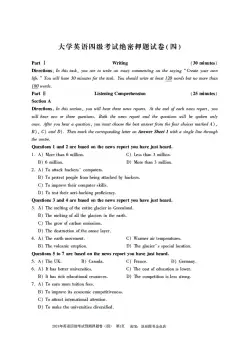
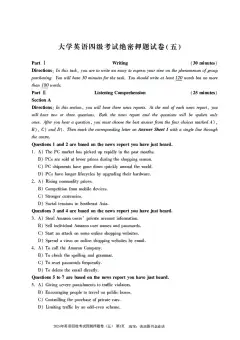
Part Ⅰ Writing (30
minutes) Directions: In this task, you are to write an essay
commenting on the saying “ Create your own life. ” You will have 30
minutes for the task. You should write at least 120 words but no more
than 180 words.
Part Ⅱ Listening Comprehension (25
minutes) Section A
Directions: In this section, you will hear three news reports. At
the end of each news report, you will hear two or three questions.
Both the news report and the questions will be spoken only once. After
you hear a question, you must choose the best answer from the four choices
marked A),
B), C) and D). Then mark the corresponding letter on Answer Sheet 1 with
a single line through the centre.
Questions 1 and 2 are based on the news report you have just heard.
1. A) More than 6 million. C) Less than 3
million.
B) 6 million. D) More than 3 million.
2. A) To attack hackers’ computers.
B) To protect people from being attacked by hackers.
C) To improve their computer skills.
D) To test their anti-hacking proficiency.
Questions 3 and 4 are based on the news report you have just heard.
3. A) The melting of the entire glacier in Greenland.
B) The melting of all the glaciers in the earth.
C) The grow of carbon emissions.
D) The destruction of the ozone layer.
4. A) The earth movement. C) Warmer air temperatures.
B) The volcanic eruption. D) The glacier’ s special location.
Questions 5 to 7 are based on the news report you have just heard.
5. A) The UK. B) Canada. C) France. D) Germany.
6. A) It has better universities. C) The cost of education is lower.
B) It has rich educational resources. D) The competition is less
strong.
7. A) To earn more tuition fees.
B) To improve its economic competitiveness.
C) To attract international attention.
D) To make the universities diversified.
2024年英语四级考试预测押题卷(四 第1页 淘宝:谈辰图书企业店Section B
Directions: In this section, you will hear two long conversations. At
the end of each conversation, you will hear four questions. Both the
conversation and the questions will be spoken only once. After you hear a
question, you must choose the best answer from the four choices marked A),
B), C) and
D). Then mark the corresponding letter on Answer Sheet 1 with a single line
through the centre.
Questions 8 to 11 are based on the conversation you have just heard.
8. A) Disappointed.B) Pleased. C) Surprised. D) Hopeful.
9. A) They have no books left.
B) They have a lot of books left.
C) They have two books left in this store.
D) They have two books left in another store.
10. A) Provide more details about the book.
B) Sign a contract with the woman.
C) Make a phone call to another store.
D) Pay the reservation fee.
11. A) Write down the book’ s information.
B) Go to the next block.
C) Fill in the customer card.
D) Get back the reservation fee.
Questions 12 to 15 are based on the conversation you have just heard.
12. A) He used to do business with the woman.
B) He used to be a colleague of the woman’ s.
C) He used to work out with the woman.
D) He used to be a doctor with the woman.
13. A) She failed her business. C) She was fired by her company.
B) She loved to be a doctor. D) She felt tired and lonely.
14. A) Help the clients re-evaluate their lives.
B) Help the clients make more money.
C) Help the clients succeed in life.
D) Help the clients keep healthy.
15. A) To ask for professional advice.
B) To talk about their old days.
C) To visit their coach Alexandra.
D) To invite the woman to his company.
Section C
Directions: In this section, you will hear three passages. At the end of
each passage, you will hear three or four questions. Both the passage and the
questions will be spoken only once. After you hear a
2024年英语四级考试预测押题卷(四 第2页 淘宝:谈辰图书企业店question, you must choose the best answer from the four choices marked A), B),
C) and D). Then mark the corresponding letter on Answer Sheet 1 with a
single line through the centre.
Questions 16 to 18 are based on the passage you have just heard.
16. A) The widespread use of color in clothes.
B) The widespread use of color in boxes and cans.
C) The widespread use of color in commerce and art.
D) The widespread use of black and white photographs.
17. A) It made the mass production of color possible.
B) It enabled Americans to see colors.
C) It made colors more expensive to get.
D) It helped to produce more colors.
18. A) Frenchmen brought it there.
B) English immigrants brought it there.
C) German immigrants brought it there.
D) Americans invented it themselves.
Questions 19 to 21 are based on the passage you have just heard.
19. A) It has to do with a tallying system.
B) Sheep is a kind of lovely animal.
C) It is useful for people to get good sleep.
D) The reason is not clear to us.
20. A) The subjects can easily fall asleep by counting sheep.
B) The subjects can’ t fall asleep when given no instructions.
C) The subjects can easily fall asleep when imagining a soothing scene.
D) The subjects can’ t fall asleep when imagining a relaxing scene.
21. A) Think about unpleasant images before
sleep.
B) Picture things they have done before
sleep.
C) Imagine worries and noises before sleep.
D) Imagine soothing images before sleep.
Questions 22 to 25 are based on the passage you have just heard.
22. A) It is the hottest month of the year.
B) It is the most beautiful season of the year.
C) The temperature has reached a new high this month.
D) There is a lot of rain this month.
23. A) Both global warming and below-average rainfall.
B) Both below-average rainfall and natural climate variability.
C) Global warming as well as natural climate variability.
D) Natural climate variability and geographical conditions.
2024年英语四级考试预测押题卷(四 第3页 淘宝:谈辰图书企业店24. A) High food yields. C) More starving people.
B) High food prices. D) More refugees.
25. A) The hurricane. C) The water crisis.
B) The food crisis. D) The annual bushfire.
Part Ⅲ Reading Comprehension (40
minutes) Section A
Directions: In this section, there is a passage with ten blanks. You
are required to select one word for each blank from a list of choices given
in a word bank following the passage. Read the passage through carefully
before making your choices. Each choice in the bank is identified by a
letter. Please mark the corresponding letter for each item on Answer Sheet 2
with a single line through the centre. You may not use any of the words in
the bank more than once.
Researchers have identified 1. 4 million animal species so far—and millions
remain to be discovered, named, and scientifically described. So how much
would it actually cost to 26 every animal on Earth? A pair of
Brazilian scientists has crunched( 大 量 运 算 ) the numbers and 27 up with an
answer: $263 billion.
That’ s way more than the $5 billion that famed Harvard University
biologist Edward O. Wilson estimated back in 2000—and that was for
every species on Earth, not just animals. But even
$263 billion would be a 28 price to pay to understand the creatures that 29
such essentials as agriculture, fisheries, new drugs, and energy sources,
says ornithologist( 鸟类学家) Joel Cracraft of the American Museum of
Natural History in New York City. “ Literally, the world economy runs
on biodiversity,” he says. “People don’t understand really, deeply how much we
depend on biodiversity. ”
Most biologists agree that with extinction rates 30 and climate
change looming, the 31 to document the planet’ s biodiversity—or
biota( 生物区) is urgent, 32 considering the essential role these
life forms play in crop pollination, clean air, and other aspects of human
3 3 . “ We are losing species by extinction faster than we are describing
new species according to some estimates,” says biologist Antonio Marques,
who 34 the new paper with Fernando Carbayo, both at the University of
St. Paulo in Brazil. “ We have to know the biota to preserve and conserve the
biota,” he says.
Besides the money, another huge 35 to a complete understanding of
the animal kingdom is a global shortage of taxonomists( 分类学家), experts
say.
A) attempt I) exactly
B) cheaper J) identify
C) classify K) obstacle
D) coauthored L) small
E) come M) soaring
F) effort N) well-being
G) enable O) yet
2024年英语四级考试预测押题卷(四 第4页 淘宝:谈辰图书企业店H) especially
2024年英语四级考试预测押题卷(四 第5页 淘宝:谈辰图书企业店Section B
Directions: In this section, you are going to read a passage with ten
statements attached to it. Each statement contains information given in one
of the paragraphs. Identify the paragraph from which the information is
derived. You may choose a paragraph more than once. Each paragraph is
marked with a letter. Answer the questions by marking the corresponding
letter on Answer Sheet 2.
The Gulf Between College Students and Librarians
A) Students rarely ask librarians for help, even when they need it. This
is one of the sobering( 令人警 醒 的 ) truths the librarians have
learned over the course of a two-year, five-campus ethnographic( 人
种学的) study examining how students view and use their campus libraries. The
idea of a librarian as an academic expert who is available to talk about
assignments and hold their hands through the research process is, in
fact, foreign to most students. Those who even have the word “
librarian” in their vocabularies often think library staff are only good for
pointing to different sections of the stacks.
B) The ERIAL( Ethnographic Research in Illinois Academic Libraries)
project contains a series of studies conducted at Illinois Wesleyan, DePaul
University, and Northeastern Illinois University, and the University of
Illinois’ s Chicago and Springfield campuses. Instead of relying on
surveys, the libraries included two anthropologists( 人类学家) , along with
their own staff members, to collect data using open-ended interviews and
direct observation, among other methods. The goal was to generate data
that, rather than being statistically significant yet shallow, would provide
deep, subjective accounts of what students, librarians and professors think of
the library and each other at those five institutions.
C) The most alarming finding in the ERIAL studies was perhaps the most
predictable: when it comes to finding and evaluating sources in the
Internet age, students are extremely Internet- dependent. Only 7 out
of 30 students whom anthropologists observed at Illinois Wesleyan “ conducted
what a librarian might consider a reasonably well-executed search,” wrote Duke
and Andrew Asher, an anthropology professor at Bucknell University, who led
the project.
D) Throughout the interviews, students mentioned Google 115 times—
more than twice as many times as any other database. The prevalence of
Google in student research is well-documented, but the Illinois researchers
found something they did not expect: students were not very
good at using Google. They were basically clueless about the logic underlying
how the search engine organizes and displays its results. Consequently, the
students did not know how to build a search that would return good
sources. “ I think it really exploded this myth of the ‘ digital native’,”
Asher said. “ Just because you’ ve grown up searching things in Google
doesn’ t mean you know how to use Google as a good research tool. ”
2024年英语四级考试预测押题卷(四 第6页 淘宝:谈辰图书企业店E) Even when students turned to more scholarly resources, it did
not necessarily solve the problem. Many seemed confused about where in the
constellation( 一系列) of library databases they
2024年英语四级考试预测押题卷(四 第7页 淘宝:谈辰图书企业店should turn to locate sources for their particular research topic. Half wound
up misusing databases a librarian “ would most likely never recommend for their
topic”. For example, “ students regularly used JSTOR, the second-most
frequently mentioned database in student interviews, to try to find
current research on a topic, not realizing that JSTOR does not provide
access to the most recently published articles. ” Unsurprisingly,
students using this method got either too many search results or too
few. Frequently, students would be so discouraged that they would change
their research topic to something that requires a simple search.
F) “ Many students described experiences of anxiety and confusion when looking
for resources—an observation that seems to be widespread among students at the
five institutions involved in this study,” Duke and Asher wrote. There was
just one problem, Duke and Asher noted, “ Students showed an almost
complete lack of interest in seeking assistance from librarians during the search
process. ” Of all the students they observed—many of whom struggled to find
good sources, to the point of despair—not one asked a librarian for help.
G) In a separate study of students at DePaul, Illinois-Chicago,
and Northeastern Illinois, other ERIAL researchers deduced several possible
reasons for this. The most basic was that students were just as unaware of the
extent of their own information illiteracy as everyone else. Some others
overestimated their ability or knowledge. Another possible reason was that
students seek help from sources they know and trust, and they do not know
librarians. Many do not even know what the librarians are there for.
Other students imagined librarians to have more research-oriented knowledge of
the library but still thought of them as glorified ushers.
H) However, the researchers did not place the blame solely on students.
Librarians and professors are also partially to blame for the gulf that has
opened between students and the library employees who are supposed to help
them, the ERIAL researchers say. Instead of librarians, whose relationship to
any given student is typically ill-defined, students seeking help often
turn to a more logical source, the person who gave them the assignment
—and who, ultimately, will be grading their work. Because librarians
hold little sway with students, they can do only so much to reshape
students’ habits. They need professors ’ help. Unfortunately, faculty
may have low expectations for librarians, and consequently students
may not be connected to librarians or see why working with librarians may be
helpful. On the other hand, librarians tend to overestimate the research
skills of some of their students, which can result in interactions that leave
students feeling intimidated and alienated( 疏远的). Some professors make
similar assumptions, and fail to require that their students visit with
a librarian before carrying on research projects. And both professors and
librarians are liable to project an idealistic view of the research process
onto students who often are not willing or able to fulfill it.
I) By financial necessity, many of today ’ s students have
2024年英语四级考试预测押题卷(四 第8页 淘宝:谈辰图书企业店limited time to devote to their research. Showing students the pool
and then shoving them into the deep end is more likely to foster
2024年英语四级考试预测押题卷(四 第9页 淘宝:谈辰图书企业店despair than self-reliance. Now more than ever, academic librarians should
seek to “ save time for the reader”. Before they can do that, of
course, they will have to actually get students to ask for help. “
That means understanding why students are not asking for help and knowing what
kind of help they need,” say the librarians.
J) “ This study has changed, profoundly, how I see my role at the
university and my understanding of who our students are,” says Lynda Duke,
an academic librarian at Illinois Wesleyan. “ It’ s been life-changing,
truly. ”
36. None of the students observed in the ERIAL project asked a librarian
for help when searching sources, even when they were in despair.
37. The librarians learned from a two-year, five-campus ethnographic
study that students rarely turn to librarians for help.
38. The most important reason why students did not ask librarians for help was
that they did not realize their own information illiteracy.
39. Open-ended interviews and direct observation were used in the ERIAL
project to make a deep and subjective report.
40. Besides students, librarians and professors are also responsible for
the gap between students and library employees.
41. Students rely heavily on the Internet to find sources.
42. Professors fail to connect students to librarians, because they
have low expectations for librarians.
43. It surprised Illinois researchers that students were not good at using
Google.
44. Before librarians can realize the goal of “ saving time for the
reader”, they first should get students to ask for help.
45. Due to the absence of the newest articles, the frequently used
database JSTOR does not necessarily help students solve their
problems.
Section C
Directions: There are 2 passages in this section. Each passage is
followed by some questions or unfinished statements. For each of them
there are four choices marked A), B), C) and D). You should
decide on the best choice and mark the corresponding letter on Answer
Sheet 2 with a single line through the centre.
Passage One
Questions 46 to 50 are based on the following passage.
As a volunteer, John Apollos is losing weight—the old-fashioned way—by
eating less. Apollos has lowered his daily caloric intake 25% over the past
eight months. The fat, not surprisingly, has melted away. But that’ s not
the real reason Apollos and the other participants in the program are
eating only
2024年英语四级考试预测押题卷(四 第10页 淘宝:谈辰图书企业three-quarters of what they used to. The researchers are trying to determine
whether restricting food intake can slow the ageing process and extend our life
span. “ I feel better and lighter and healthier,” says Apollos. “ But if
it could help you live longer, that would be pretty amazing. ”
The idea is counterintuitive: If we eat to live, how can starving
ourselves add years to our lives? Yet decades of calorie-restriction
studies involving organisms ranging from microscopic yeast to rats have shown
just that. Last July a long-term study led by researchers at the
University of Wisconsin, found that calorie restriction seemed to extend the
lives of humanlike rhesus monkeys( 恒河猴) as well. The hungry primates fell
victim to diabetes, heart and brain disease and cancer much less frequently
than their well-fed counterparts did.
Scientists have suspected that calorie restriction could extend the life
span of animals since at least 1935, when researchers at Cornell University
noticed that severely food-restricted lab rats lived twice as long as normal
ones and were healthier. Other investigators began exploring the idea and
learned that the secret is not merely a matter of body weight.
One theory is that a state of slight hunger acts as a mild but constant
stressor that makes an organism stronger and more resistant to the ills of
ageing. Taking in fewer calories also slows metabolism( 新陈代谢), and some
data indicate that humans with a slower metabolism live longer. But even if
these theories are correct, simply defining the mechanism is not the
same as identifying the molecular pathways behind it. If researchers
could determine those pathways, they might be able to pharmacologically
mimic( 模 仿 ) the effect of calorie restriction. That could be the ultimate
benefit of the calorie study. “ Calorie restriction is pretty much the only thing
out there that we know will not just prevent disease but also extend maximal
life span,” says Dr. Marc Hellerstein, a nutritionist at the
University of California.
46. The purpose of keeping diet for John Apollos and other participants is
to .
A) lose weight in order to keep slim
B) prove how long people can survive if they lack food
C) prove if eating less food can extend life span and keep young
D) just keep a good mood and live a healthier life
47. What’ s the meaning of “ counterintuitive”( Line 1, Para. 2)?
A) Unconventional. C) Comprehensible.
B) Incorrect. D) Meaningless.
48. What does the research on rhesus monkeys
imply?
A) The less people eat, the shorter they
will live.
B) Calorie restriction can help people suffer fewer diseases.
2024年英语四级考试预测押题卷(四 第11页 淘宝:谈辰图书企业C) People who often feel hungry can live longer.
D) Humans depend on calories to stay alive.
2024年英语四级考试预测押题卷(四 第12页 淘宝:谈辰图书企业49. From Dr. Marc Hellerstein’ s words, we can infer that
.
A) people who are thin can survive longer than those who
aren’ t
B) effective calorie restriction makes us healthier and
live longer
C) keeping diet cannot help people keep fit or live longer
D) a state of hunger is beneficial for our health
50. What is the main idea of this passage?
A) People should be thin in order to live longer.
B) Keeping calorie restriction effectively makes one live longer.
C) Eating too much is really harmful to our health.
D) People should form a good diet habit in daily life.
Passage Two
Questions 51 to 55 are based on the following passage.
If you sit all day at an office and worry about its effect on your weight
and health, take a few breaks.
That’ s the advice from a new study that finds that people who sit
for extended periods of time without taking short breaks are at higher risk
for heart disease than those who take more frequent timeouts to stand up and
walk around.
The cardiovascular( 心脏血管的) risk that stems from remaining sedentary
for prolonged periods of time ( at the office, for example) manifests
itself in the form of larger waists, higher blood pressure, increased
body inflammation and lower levels of “ good” cholesterol ( 胆固醇), the
authors noted. What’ s more, the negative impact of such lengthy bouts(
一阵) of inactivity seems to apply even to those who routinely go to the
gym.
“ These findings are not surprising,” said Dr. Murray A. Mittleman,
director of the cardiovascular epidemiology research unit at Beth Israel
Deaconess Medical Center and an associate professor in the department of
epidemiology at the Harvard School of Public Health in Boston.
“ In fact, the Surgeon General report recommends that individuals
should accumulate activity incrementally throughout the day,” noted
Mittleman, who was not a member of the Australian research team. “ And this is
really consistent with that. ”
The team, led by Genevieve N. Healy, of the Cancer Prevention Research
Center in the School of Population Health at the University of Queensland in
Herston, Australia, reported their findings in the Jan. 12 online edition
of the European Heart Journal.
“ Even if you exercise for 30 to 60 minutes a day, what you do for the rest
of the day may also be important for your cardiovascular health,” Healy
explained. “ This research suggests that even small changes to a person ’
s activity levels ( as little as standing up regularly ) might help to lower
cardiovascular risk. These changes can be readily incorporated
into the person’ s day-to-day life ( including the work environment).
2024年英语四级考试预测押题卷(四 第13页 淘宝:谈辰图书企业Stand up, move more, move often, could be used as a slogan to help get
this message across. ”
2024年英语四级考试预测押题卷(四 第14页 淘宝:谈辰图书企业51. What is the advice from a new study according to the passage?
A) Those who sit for a long time without breaks are at higher risk for
heart disease.
B) Those who have frequent short breaks are at higher risk for heart
disease.
C) Those who sit all day long and worry about their health should take
short rests.
D) Those who sit all day long and take short breaks don’ t need to worry
about their health.
52. What causes the cardiovascular risk?
A) Keeping calm for a long time.
B) Keeping angry for a long time.
C) Keeping sad for a long time.
D) Keeping still for a long time.
53. What is Mittleman’ s attitude towards the recommendation from the Surgeon
General report?
A) He thinks the recommendation agrees with these findings.
B) He thinks the recommendation is opposed to these findings.
C) He thinks individuals should add exercises incrementally throughout
the day.
D) He thinks people should accept the recommendation.
54. What did the team of the Cancer Prevention Research Center do?
A) The team issued a report written by Healy.
B) The team found their report online.
C) The team issued their study online.
D) The team made an online journal.
55. What do we learn from the last paragraph?
A) What people do for the rest of the day may be unimportant for their
health.
B) People should exercise more often to lower cardiovascular risk.
C) Small changes to a person’ s work environment might help to lower
cardiovascular risk.
D) People should exercise for a long time every day to keep healthy.
Part Ⅳ Translation (30
minutes) Directions: For this part, you are allowed 30 minutes to
translate a passage from Chinese into English. You should write your
answer on Answer Sheet 2.
游泳运动是男女老少都喜欢的体育项目之一。 国内外研究一致认为,古代游泳产生于居住在
江、河、湖、海一带的古代人。 他们为了生存,必须要在水中捕捉水鸟和鱼类作食物,通过观察和模
仿鱼类、青蛙等动物在水中游动的动作,逐渐学会了游泳。 自古至今,无论是为了捕猎、逃避猛兽或
是遇上海难( shipwreck) 时能够自救,游泳都是一门重要的求生技能。
2024年英语四级考试预测押题卷(四 第15页 淘宝:谈辰图书企业