 夜雨聆风
夜雨聆风


LangChain 源码剖析-工具类详解(BaseTool)
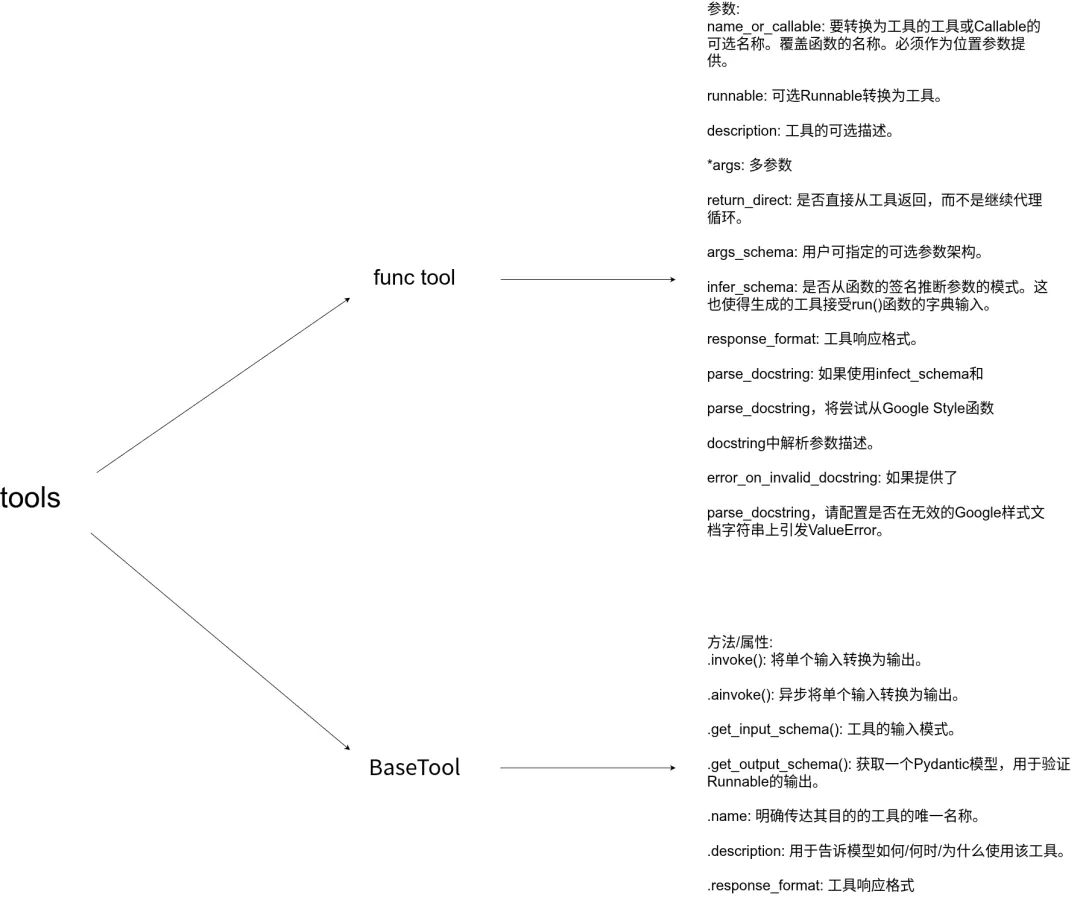
– 许多人工智能应用程序通过自然语言与用户交互。然而,一些用例要求模型使用结构化输入直接与外部系统(如API、数据库或文件系统)交互。
– 工具是代理调用以执行操作的组件。它们通过定义良好的输入和输出与世界互动,扩展了模型功能。
– 工具封装了一个可调用函数及其输入模式。这些可以传递给兼容的聊天模型,允许模型决定是否调用工具以及使用什么参数。在这些场景中,工具调用使模型能够生成符合指定输入模式的请求。
创建工具
基本工具定义
– 创建工具最简单的方法是使用@tool装饰器。默认情况下,函数的docstring成为工具的描述,帮助模型理解何时使用它:
from langchain.tools import tool@tooldef search_database(query: str, limit: int = 10) -> str:"""Search the customer database for records matching the query.Args:query: Search terms to look forlimit: Maximum number of results to return"""return f"Found {limit} results for '{query}'"
自定义工具名称
– 默认情况下,工具名称来自函数名称。当您需要更具描述性的内容时,请覆盖它:
@tool("web_search") # Custom namedef search(query: str) -> str:"""Search the web for information."""return f"Results for: {query}"print(search.name) # web_search
自定义工具描述
– 覆盖自动生成的工具描述,以获得更清晰的模型指导:
@tool("calculator", description="Performs arithmetic calculations. Use this for any math problems.")def calc(expression: str) -> str:"""Evaluate mathematical expressions."""return str(eval(expression))
高级模式定义
– 使用Pydantic模型定义复杂的输入:
from pydantic import BaseModel, Fieldfrom typing import Literalclass WeatherInput(BaseModel):"""Input for weather queries."""location: str = Field(description="City name or coordinates")units: Literal["celsius", "fahrenheit"] = Field(default="celsius",description="Temperature unit preference")include_forecast: bool = Field(default=False,description="Include 5-day forecast")@tool(args_schema=WeatherInput)def get_weather(location: str, units: str = "celsius", include_forecast: bool = False) -> str:"""Get current weather and optional forecast."""temp = 22 if units == "celsius" else 72result = f"Current weather in {location}: {temp} degrees {units[0].upper()}"if include_forecast:result += "\nNext 5 days: Sunny"return result
– 使用JSON模式定义复杂的输入:
weather_schema = {"type": "object","properties": {"location": {"type": "string"},"units": {"type": "string"},"include_forecast": {"type": "boolean"}},"required": ["location", "units", "include_forecast"]}@tool(args_schema=weather_schema)def get_weather(location: str, units: str = "celsius", include_forecast: bool = False) -> str:"""Get current weather and optional forecast."""temp = 22 if units == "celsius" else 72result = f"Current weather in {location}: {temp} degrees {units[0].upper()}"if include_forecast:result += "\nNext 5 days: Sunny"return result
访问上下文
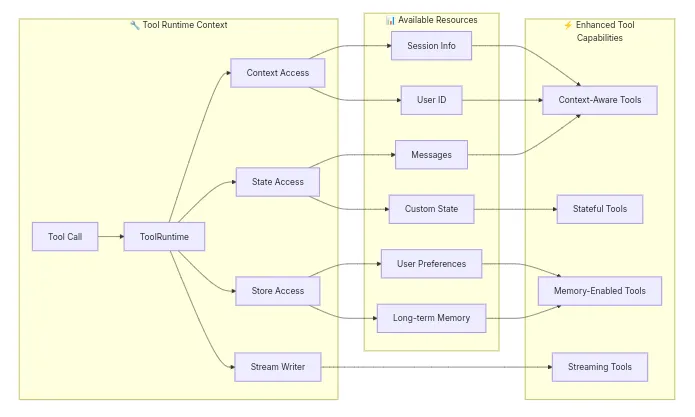
– 工具可以通过ToolRuntime参数访问运行时信息,该参数提供:
– State: 在执行过程中流动的可变数据(例如,消息、计数器、自定义字段)
– Context: 不可变的配置,如用户ID、会话详细信息或特定于应用程序的配置
– Store: 跨对话的持久长期记忆
– Stream Writer: 在工具执行时流式传输自定义更新
– Config: 运行Config以执行
– Tool Call ID: 当前工具调用的ID
ToolRuntime
– 使用ToolRuntime访问单个参数中的所有运行时信息。只需将runtime:ToolRuntime添加到您的工具签名中,它就会自动注入,而不会暴露给LLM。
访问状态(Accessing state)
– 工具可以使用ToolRuntime访问当前图形状态:
from langchain.tools import tool, ToolRuntime# Access the current conversation state@tooldef summarize_conversation(runtime: ToolRuntime) -> str:"""Summarize the conversation so far."""messages = runtime.state["messages"]human_msgs = sum(1 for m in messages if m.__class__.__name__ == "HumanMessage")ai_msgs = sum(1 for m in messages if m.__class__.__name__ == "AIMessage")tool_msgs = sum(1 for m in messages if m.__class__.__name__ == "ToolMessage")return f"Conversation has {human_msgs} user messages, {ai_msgs} AI responses, and {tool_msgs} tool results"# Access custom state fields@tooldef get_user_preference(pref_name: str,runtime: ToolRuntime # ToolRuntime parameter is not visible to the model) -> str:"""Get a user preference value."""preferences = runtime.state.get("user_preferences", {})return preferences.get(pref_name, "Not set")
更新状态(Updating state)
– 使用命令更新代理的状态或控制图的执行流
from langgraph.types import Commandfrom langchain.messages import RemoveMessagefrom langgraph.graph.message import REMOVE_ALL_MESSAGESfrom langchain.tools import tool, ToolRuntime# Update the conversation history by removing all messages@tooldef clear_conversation() -> Command:"""Clear the conversation history."""return Command(update={"messages": [RemoveMessage(id=REMOVE_ALL_MESSAGES)],})# Update the user_name in the agent state@tooldef update_user_name(new_name: str,runtime: ToolRuntime) -> Command:"""Update the user's name."""return Command(update={"user_name": new_name})
上下文(Context)
– 工具可以通过ToolRuntime访问运行时上下文(runtime.context)
from dataclasses import dataclassfrom langchain_openai import ChatOpenAIfrom langchain.agents import create_agentfrom langchain.tools import tool, ToolRuntimeUSER_DATABASE = {"user123": {"name": "Alice Johnson","account_type": "Premium","balance": 5000,"email": "alice@example.com"},"user456": {"name": "Bob Smith","account_type": "Standard","balance": 1200,"email": "bob@example.com"}}@dataclassclass UserContext:user_id: str@tooldef get_account_info(runtime: ToolRuntime[UserContext]) -> str:"""Get the current user's account information."""user_id = runtime.context.user_idif user_id in USER_DATABASE:user = USER_DATABASE[user_id]return f"Account holder: {user['name']}\nType: {user['account_type']}\nBalance: ${user['balance']}"return "User not found"model = ChatOpenAI(model="gpt-4o")agent = create_agent(model,tools=[get_account_info],context_schema=UserContext,system_prompt="You are a financial assistant.")result = agent.invoke({"messages": [{"role": "user", "content": "What's my current balance?"}]},context=UserContext(user_id="user123"))
内存/存储(Memory)
– 工具可以通过ToolRuntime访问和更新存储(runtime.store):
from typing import Anyfrom langgraph.store.memory import InMemoryStorefrom langchain.agents import create_agentfrom langchain.tools import tool, ToolRuntime# Access memory@tooldef get_user_info(user_id: str, runtime: ToolRuntime) -> str:"""Look up user info."""store = runtime.storeuser_info = store.get(("users",), user_id)return str(user_info.value) if user_info else "Unknown user"# Update memory@tooldef save_user_info(user_id: str, user_info: dict[str, Any], runtime: ToolRuntime) -> str:"""Save user info."""store = runtime.storestore.put(("users",), user_id, user_info)return "Successfully saved user info."store = InMemoryStore()agent = create_agent(model,tools=[get_user_info, save_user_info],store=store)# First session: save user infoagent.invoke({"messages": [{"role": "user", "content": "Save the following user: userid: abc123, name: Foo, age: 25, email: foo@langchain.dev"}]})# Second session: get user infoagent.invoke({"messages": [{"role": "user", "content": "Get user info for user with id 'abc123'"}]})# Here is the user info for user with ID "abc123":# - Name: Foo# - Age: 25# - Email: foo@langchain.dev
流式编写器(Stream Writer)
– 使用runtime.Stream_writer在工具执行时流式传输自定义更新。这对于向用户提供有关工具正在做什么的实时反馈非常有用。
from langchain.tools import tool, ToolRuntime@tooldef get_weather(city: str, runtime: ToolRuntime) -> str:"""Get weather for a given city."""writer = runtime.stream_writer# Stream custom updates as the tool executeswriter(f"Looking up data for city: {city}")writer(f"Acquired data for city: {city}")return f"It's always sunny in {city}!"