 夜雨聆风
夜雨聆风


【中英双语】AI原生网络:智能网络如何重塑基础设施
|
AI原生网络:智能网络如何重塑基础设施 AI-Native Networking: How Intelligent Networks Are Reshaping Infrastructure |
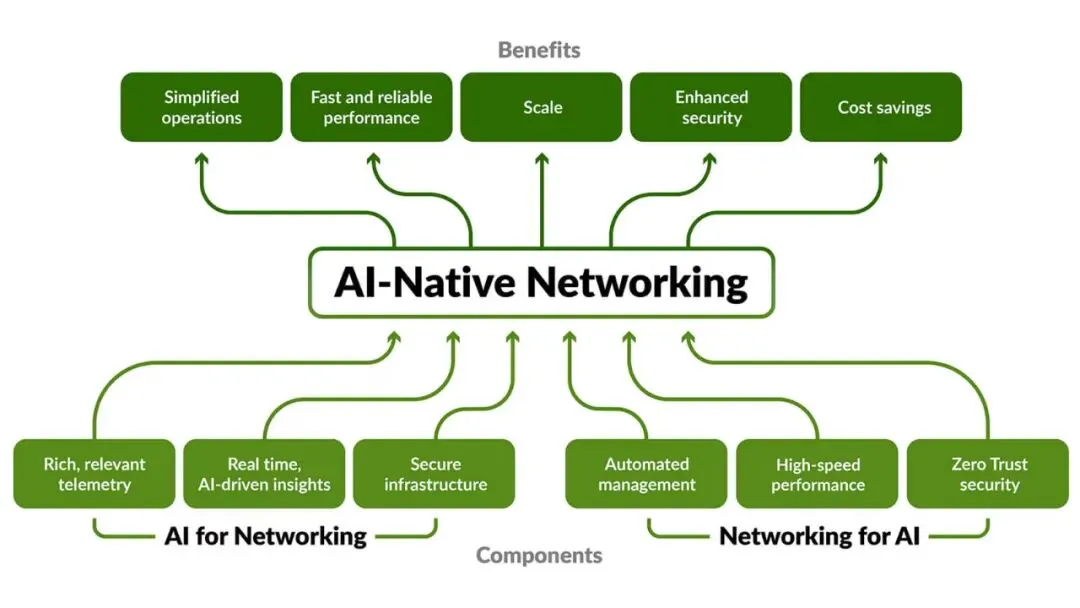
🔬 Tech Spotlight 技术聚焦
AI-Native Networking represents a fundamental shift in how network infrastructure is designed, deployed, and managed. Unlike traditional networks that rely on static configurations and manual interventions, AI-native networks embed machine learning capabilities directly into the network fabric, enabling self-healing, self-optimizing, and self-protecting behaviors at scale.
AI原生网络代表了网络基础设施设计、部署和管理方式的根本性转变。传统网络依赖静态配置和人工干预,而AI原生网络则将机器学习能力直接嵌入网络架构中,实现大规模的自愈、自优化和自保护行为。
At the core of this paradigm are Intent-Based Networking (IBN) systems that translate high-level business intents into network configurations automatically. These systems continuously monitor the network state, detect anomalies in real time, and autonomously adjust policies without human intervention. According to Gartner, by 2025, more than 50% of network teams will use intent-based networking systems—up from less than 10% in 2020.
这一范式的核心是基于意图的网络(IBN)系统,它能将高级业务意图自动转换为网络配置。这些系统持续监控网络状态,实时检测异常,并在无需人工干预的情况下自主调整策略。根据Gartner的预测,到2025年,超过50%的网络团队将使用基于意图的网络系统——而2020年这一比例还不到10%。
Modern AI-native networks leverage distributed AI models deployed across network edges, data centers, and cloud environments. These models share insights through federated learning, ensuring that each node benefits from collective intelligence while maintaining data sovereignty. This architecture dramatically reduces latency for decision-making and enhances resilience against localized failures.
现代AI原生网络利用分布在网络边缘、数据中心和云环境中的分布式AI模型。这些模型通过联邦学习共享洞察,确保每个节点都能从集体智能中受益,同时保持数据主权。这种架构大幅降低了决策延迟,并增强了对局部故障的抵御能力。
🔍In-Depth Analysis 深度解析
The architectural foundation of AI-native networking rests on three pillars: data plane intelligence, control plane automation, and management plane analytics. Data plane intelligence embeds lightweight inference engines into switches and routers, enabling microsecond-level traffic classification and prioritization. This allows critical applications—like autonomous vehicle coordination or industrial IoT—to receive guaranteed bandwidth with sub-millisecond jitter.
AI原生网络的架构基础建立在三大支柱之上:数据平面智能、控制平面自动化和管理平面分析。数据平面智能将轻量级推理引擎嵌入交换机和路由器中,实现微秒级的流量分类和优先级调度。这使得关键应用(如自动驾驶车辆协调或工业物联网)能够获得有保障的带宽,且抖动低于1毫秒。
Control plane automation has been revolutionized by Software-Defined Networking (SDN) enhanced with reinforcement learning agents. These agents learn optimal routing strategies through millions of simulated scenarios, discovering paths that human engineers might never consider. In production deployments at major cloud providers, reinforcement learning-based routing has demonstrated 15-40% throughput improvements over traditional protocols like OSPF and BGP in highly dynamic traffic environments.
控制平面自动化因增强学习代理增强的软件定义网络(SDN)而发生了革命性变化。这些代理通过数百万个模拟场景学习最优路由策略,发现人类工程师可能从未考虑过的路径。在主要云提供商的实际部署中,基于强化学习的路由在高动态流量环境中展示了比OSPF和BGP等传统协议高出15-40%的吞吐量提升。
On the management plane, Large Language Models (LLMs) are being integrated into Network Operations Centers (NOCs) as conversational interfaces. Engineers can now query network health, request configuration changes, and diagnose issues using natural language. Behind the scenes, retrieval-augmented generation (RAG) pipelines cross-reference live telemetry data with historical incident databases to produce contextually accurate recommendations. This human-AI collaboration model is redefining the role of network engineers from manual operators to strategic architects.
在管理平面上,大语言模型(LLM)正被集成到网络运维中心(NOC)中作为会话接口。工程师现在可以使用自然语言查询网络健康状况、请求配置变更并诊断问题。在幕后,检索增强生成(RAG)管道将实时遥测数据与历史事件数据库进行交叉引用,从而产生上下文准确的建议。这种人机协作模式正在重新定义网络工程师的角色——从人工操作员转变为战略架构师。
💼Workplace Application 职场应用
For IT professionals, AI-native networking offers tangible career evolution opportunities. Network engineers who upskill in AI/ML fundamentals, data engineering, and Python scripting are finding themselves at the intersection of networking and data science—a space where demand far outstrips supply. Certifications such as Cisco’s AI Enterprise Network Architecture and Juniper’s Apstra AI-NativeFabric are quickly becoming resume differentiators in competitive hiring markets.
对于IT专业人员来说,AI原生网络提供了切实的职业发展机会。在AI/ML基础、数据工程和Python脚本编写方面提升技能的网络工程师发现,自己正处于网络与数据科学的交汇处——一个需求远大于供应的领域。Cisco的AI企业网络架构和Juniper的Apstra AI-NativeFabric等认证,正在竞争激烈的招聘市场中迅速成为简历的差异化亮点。
In enterprise environments, AI-native networks enable a new category of proactive security operations. Traditional perimeter-based security is being replaced by Zero Trust Architecture powered by continuous AI-driven risk assessment. Every access request—regardless of whether it originates from inside or outside the corporate network—is evaluated against behavioral profiles, device posture, and real-time threat intelligence. This shifts security from a reactive, incident-response model to a preventive, intelligence-driven paradigm.
在企业环境中,AI原生网络为积极主动的安全运营开辟了新的类别。传统的基于边界的安全措施正在被由持续AI驱动风险评估支撑的零信任架构所取代。每一次访问请求——无论来源于企业内部还是外部——都会根据行为画像、设备态势和实时威胁情报进行评估。这将安全性从被动的事件响应模式转变为预防性的情报驱动模式。
Remote and hybrid work scenarios benefit significantly from AI-native network optimization. Intelligent WAN solutions with embedded AI can automatically prioritize collaboration tools like video conferencing, VoIP, and real-time document co-editing based on usage patterns and individual user behavior. This ensures a consistently high-quality experience regardless of geographic location, effectively eliminating the ‘network quality lottery’ that has plagued distributed teams for years.
远程和混合办公场景从AI原生网络优化中获益匪浅。嵌入AI的智能广域网解决方案能够根据使用模式和个体用户行为,自动优先处理视频会议、VoIP和实时文档协作等协作工具。这确保了无论地理位置如何,用户都能获得始终如一的高质量体验,有效消除了困扰分布式团队多年的”网络质量抽奖”问题。
📚 Vocabulary Hub 词汇加油站
Network Architecture & Protocols
网络架构与协议
| Word/Phrase | 中文 | Definition |
|---|---|---|
| Intent-Based Networking (IBN) | 基于意图的网络 | A network management approach where administrators define high-level business outcomes, and the system automatically configures and maintains the network to achieve them. |
| Software-Defined Networking (SDN) | 软件定义网络 | An architecture that separates the network control plane from the forwarding plane, enabling centralized network management and programmability. |
| BGP (Border Gateway Protocol) | 边界网关协议 | The core routing protocol of the internet, used to exchange routing information between autonomous systems. |
| OSPF (Open Shortest Path First) | 开放最短路径优先 | A link-state interior gateway protocol that calculates the shortest path for routing within a single autonomous system. |
AI & Machine Learning in Networking
网络中的AI与机器学习
| Word/Phrase | 中文 | Definition |
|---|---|---|
| Reinforcement Learning (RL) | 强化学习 | A machine learning paradigm where agents learn optimal decision-making strategies by maximizing cumulative rewards through trial and error in an environment. |
| Federated Learning | 联邦学习 | A distributed machine learning approach where models are trained across multiple decentralized edge devices without exchanging raw data. |
| Retrieval-Augmented Generation (RAG) | 检索增强生成 | An AI architecture that combines information retrieval from external knowledge bases with LLM text generation to improve factual accuracy. |
| LLM (Large Language Model) | 大语言模型 | A deep learning model trained on massive text corpora that can understand and generate human language with high fluency. |
Security & Enterprise Architecture
安全与企业架构
| Word/Phrase | 中文 | Definition |
|---|---|---|
| Zero Trust Architecture (ZTA) | 零信任架构 | A security model that requires strict identity verification for every person and device attempting to access resources, regardless of network location. |
| Behavioral Profiling | 行为画像 | The process of establishing a baseline of typical user or device behavior to detect deviations that may indicate security threats. |
| Network Operations Center (NOC) | 网络运维中心 | A centralized facility where IT teams monitor, manage, and maintain enterprise network infrastructure around the clock. |
| Intelligent WAN (SD-WAN) | 智能广域网 | A software-defined approach to wide area networking that uses AI to intelligently route traffic across multiple connection types. |
Performance & Infrastructure
性能与基础设施
| Word/Phrase | 中文 | Definition |
|---|---|---|
| Latency | 延迟 | The time delay between a request and its response, critical for real-time applications; measured in milliseconds or microseconds. |
| Jitter | 抖动 | The variation in packet arrival times, which degrades quality in real-time streaming and communication applications. |
| Throughput | 吞吐量 | The amount of data successfully transmitted through a network in a given time period, typically measured in Gbps or Tbps. |
| Edge Computing | 边缘计算 | A distributed computing paradigm that processes data near its source (at the network edge) to reduce latency and bandwidth usage. |
感谢阅读!对您有帮助的话,点亮👍🏻❤️,关注公众号,转发给需要的朋友~ 原创转载请联系授权。