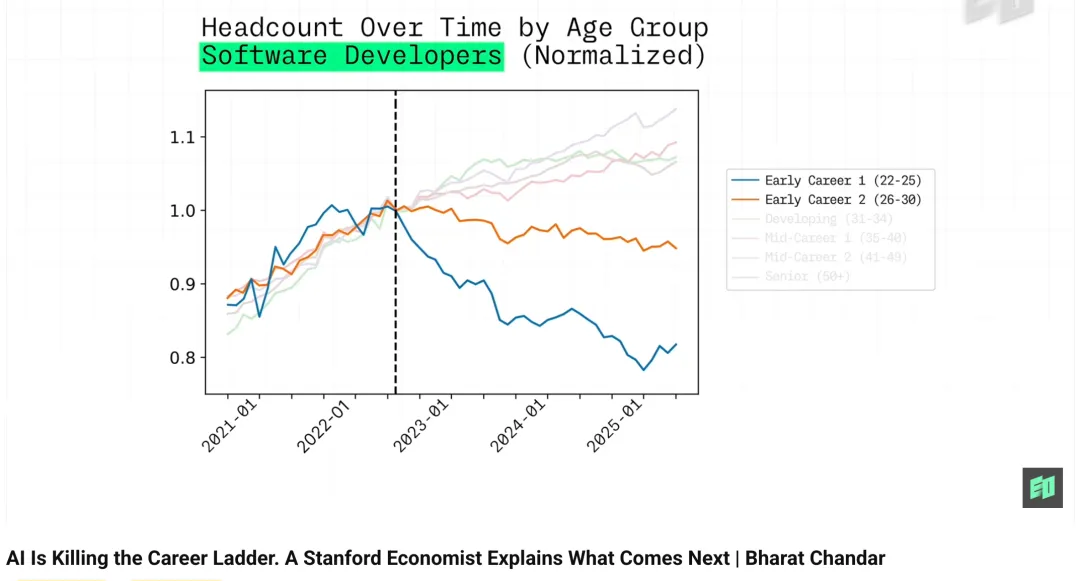
Chandar提出的愿景是用"职业网格"替代"职业阶梯"。传统的职业阶梯,是线性的、单向的——你在一个领域从底层开始,一级一级往上爬,每一步都依赖上一步积累的经验。这个结构,在技术变革加速的时代,风险极高。某个岗位一旦被AI接管,整条阶梯就可能失去意义。职业网格是不同的结构:多向可移动,横向跨界,纵向晋升,甚至斜向切入新领域。这种灵活性的前提,是职业转换的成本足够低——而AI若真正释放其学习辅助的潜力,职业间的知识迁移将变得前所未有的顺畅。当某个岗位在经济中的重要性上升,人们能够更快完成职业过渡,整个劳动力市场的韧性就会大幅提升。Chandar的研究给出的不是一个悲观叙事,而是一张需要重新定向的地图。年轻人的就业数据是早期信号,企业的激励错配是结构问题,AI的学习潜力是尚未兑现的资产。方向已经清晰:不是怎么对抗AI,而是怎么先一步站到能指挥AI的那个位置上。你所在的行业或岗位,目前更像是在被AI扩展,还是被AI压缩?以下是中英完整访谈来源:Stanford Digital Economy Lab嘉宾:Bharat Chandar(斯坦福数字经济实验室经济学家)时长:15分41秒编译:硅谷大脑 · Silicon Valley Brain00:00We're seeing that the jobs that are more exposed to AI, the young workers in those jobs are seeing 16% slower employment growth. So that's pretty large. The structural change in AI capabilities that are impacting the labor market, that's not going to be a temporary change. If we really unlock AI's capabilities for helping people learn, it could be much easier to switch between different professions. So I'm really hopeful that we end up somewhere closer to a career lattice that works for workers as opposed to a career ladder where there's much more risk about this technological change.我们观察到,在那些高度暴露于AI的岗位上,年轻员工的就业增速放缓了16%——这个数字相当显著。影响劳动力市场的AI能力结构性转变,不会只是一次暂时的波动。如果我们真正释放AI在辅助学习方面的潜力,职业间的跨界转换将变得容易得多。我非常期待,最终我们能走向一种"职业网格"——对劳动者更友好的结构——而不是停留在充满技术变革风险的传统"职业阶梯"之上。I'm Barat Chandra. I'm an economist at the Stanford Digital Economy Lab and I study how AI is impacting work. I would say over the past year and a half or so, I do feel like one of the most important questions in labor economics today is about AI's impact on the labor market. Once I really started using the tools more and understood their capabilities, that became the focus of my research agenda because it felt like one of the most important questions impacting society potentially in the future.我是Barat Chandra,斯坦福数字经济实验室的经济学家,专注研究AI对工作的影响。过去一年半左右,我愈发感受到:AI对劳动力市场的冲击,已经成为当今劳动经济学中最核心的议题之一。当我真正深入使用这些工具、理解了它们的能力边界之后,这一方向就成为我研究议程的核心——因为它很可能是未来影响整个社会最重要的问题之一。I released a study with my collaborators Eric Bolson and Ryu Chen. We studied how jobs were changing in jobs that were more exposed to AI versus less exposed to AI, and we were tracking millions of workers across the United States using data from a payroll company called ADP. One of the key findings there is that overall we were not seeing major differences in employment changes for jobs that were more and less exposed to AI. However, when we focus on young workers, we do see more of a divergence there where the jobs that are more exposed to AI, such as software development, customer service, more administrative roles, we were seeing employment declines and jobs that were less exposed to AI, we were still seeing some continued growth and employment. And for more experienced workers as well, we were still seeing employment growth that was pretty much on trend.我与合作者Eric Bolson和Ryu Chen共同发布了一项研究。我们利用美国薪酬管理公司ADP的数据,追踪了全美数百万名劳动者,对比分析高AI暴露岗位与低AI暴露岗位的就业变化。核心发现之一是:从整体来看,两类岗位在就业变化上并无显著差异。然而,当我们聚焦年轻劳动者群体时,分化就明显出现了——软件开发、客户服务、行政类等高AI暴露岗位的年轻员工,就业出现下滑;而低AI暴露岗位仍保持一定增长。对于经验丰富的员工而言,就业增长则基本维持在正常轨道上。03:00We're seeing that the jobs that are more exposed to AI, the young workers in those jobs are seeing 16% slower employment growth. A lot of people just starting off in their careers and they're finding it a hard time in doing that. And the reason we chose the canaries and the coal mine title is I think consistent with that view. We want to be tracking these outcomes because we think they could be indicative of potentially future transformative impacts of AI. How much of this is being driven by AI and how is that going to change going forward? We can't be sure whether this is just temporary change in the economy or if it's a structural change being driven by AI.高AI暴露岗位上的年轻员工,就业增速放缓了16%。大量刚刚踏入职场的年轻人,正在经历入门的艰难。我们之所以以"煤矿里的金丝雀"为标题,正是呼应了这一判断——我们需要持续追踪这些数据,因为它们可能预示着AI未来更深层的变革性影响。这场变化究竟有多少是AI驱动的?未来又将如何演变?我们目前尚无法断定,这只是经济层面的暂时波动,还是AI主导的结构性转变。Now, we did test some of the most plausible alternatives that we could think of. So, that includes interest rate changes. Jobs that are more exposed to interest rate changes are actually less exposed to AI. One way to think about that is things like transportation and construction are very exposed to interest rate changes, but they're really not very exposed to AI. So, that's one key thing and that makes me think that it's probably not interest rate changes that are driving our results. Other things that we tested include tech over hiring. So, we can take out the tech sector, we get similar results. Take out computer jobs. We tested some of these different alternatives and we were still getting this very similar results. So, if it's a structural change in AI capabilities that are impacting the labor market, that's not going to be a temporary change. That's potentially going to be a long run change.我们也对其他可能的解释进行了检验。利率变化是其中之一——有趣的是,对利率敏感的岗位(如交通、建筑业)恰恰对AI暴露程度较低,这在逻辑上形成了区分,使我倾向于排除利率因素的干扰。我们还检验了科技行业超额招聘的影响——即使剔除科技部门、排除计算机类岗位,结论依然相似。综合来看,如果这确实是AI能力提升带来的结构性转变,那它就不会是短期现象,而是一场可能延续数十年的长期变化。If you think about what young workers are doing when they're entering the workforce, a lot of it is implementation, doing things that rely on the book knowledge that they learned while they were at school. Whereas the things that they don't have as much experience with and ability to do is relying on the tacit knowledge or the sort of experience that you can only get by doing things on the job, also more social interaction and more strategic thinking. Tacit knowledge I think of as things that rely on a lot of hyper local context or strategic thinking or social interaction or things that you only build via experience on the job. So those are the types of things that are maybe not written down as much in a book. For young workers, it's more directly overlapping with the AI capabilities. And those could be the sort of situations where more experienced workers might have a relative advantage compared to AI and also compared to young workers.如果你仔细想想年轻人进入职场时承担的工作性质,会发现大量都是"执行层"的任务——依赖学校里学到的书本知识。而他们相对缺乏的,是那种只有在岗位上积累才能获得的"隐性知识"——依赖高度情境化的判断、战略思考和社交互动。隐性知识,是那些很难被写进书本里的东西:超本地化的情境判断、复杂的人际互动、通过实际操练才能磨练出来的经验感知。正因如此,年轻员工的工作内容与AI的能力范围高度重叠;而经验丰富的员工,在这场竞争中反而拥有相对优势。06:00When it comes to training young workers, it's totally right that firms will want to hire young people if they want to have a middle management or more experienced staff going forward. Now the issue here is even though that they have some incentive to do that so that they have workers in the future, they might not have enough incentive to do that. So they might not hire as much young people as they should from a social perspective and they might not train them as much as they should. And the reason that's the case is because those young people don't have to stay at the company forever. They can just go leave to another company. So it's true that they will still want to hire some of them, but they might not want to hire as many as would be beneficial to society. And it's just kind of this mismatch between what is the incentive of the individual private company versus what is the incentive of society as a whole.谈到年轻劳动力的培养,企业当然有动机雇佣年轻人——毕竟这是积累未来中层管理者和资深员工的必要路径。但问题在于,这种动机可能远远不够充分。企业招聘和培训年轻人的意愿,可能低于社会层面所需的水平——因为年轻员工并不会永远留在同一家公司,随时可以跳槽离开。于是,一个结构性的激励错配就此形成:对个体企业而言理性的决策,对整个社会而言却可能是不足的投入。Now the more optimistic take that I could give here is that if AI really is as capable of helping people learn and as a tool for education maybe could speed up the process at which that happens. That could also require a lot of changes in the way that we organize our education system potentially universities or even at a lower level than that to help people learn faster and better. There are three things that I think AI is going to be much less capable of doing certainly in the short to medium term. One physical tasks unless we see a big advance in robotics. Number two is strategic thinking and guiding what needs to be done. And number three is social interaction.当然,也有更乐观的一面:如果AI真的能成为强大的学习辅助工具,或许能大幅压缩人才培养所需的时间。但这也可能要求我们从根本上重新设计教育体系的组织方式——从大学层面,乃至更基础的教育阶段,都需要作出系统性调整。在AI短期到中期内难以替代的能力上,我认为有三类:一是体力劳动(除非机器人技术出现重大突破);二是战略思考与决策指导;三是社交互动。I think the strategic thinking is increasingly important and it's going to be even more important going forward potentially because it does seem like in the future a lot of work might look like guiding AI agents to do implementation while you're telling them and guiding them on what needs to be done. And so that sort of strategic thinking, expressing what it is that needs to be done or what I want to be produced, I think that's going to be a pretty key skill and that's kind of the role of what a manager does within a company. So that sort of managerial work and strategic guidance could potentially be a quite important skill going forward. When I think about young workers, how can they develop those sorts of skills? Building and using the tools as much as possible and getting used to that sort of mode of work. The faster that that can happen, the better that they might be in terms of adjusting to labor market disruptions or these technological changes.战略思维的重要性正在日益凸显,未来可能更甚。未来的工作形态,很可能是"人类指挥、AI执行"的协作模式——你负责告诉AI代理要做什么、目标是什么,由AI来完成具体实施。在这种模式下,能够清晰表达需求、定义目标的能力,正是管理者的核心职能。对年轻人来说,应对这一趋势的最佳路径是:尽可能多地使用AI工具、在实践中建立对这种工作方式的熟悉感。适应得越快,在劳动力市场的结构性动荡中,就越能占据有利位置。09:00I do think it's very helpful to compare AI to some of these historical changes. So for example, the industrial revolution. I think one comparison between AI and that period that was a case where it was actually the most skilled workers who faced more risk from the industrial revolution. So one case that comes to mind is the Luddites who were these kind of skilled textile workers and the new inventions that came about during the industrial revolution actually led a lot of them to lose their work and those were kind of the more skilled workers in society. Something that you might be seeing that's kind of similar here is that it's more of the knowledge workers in more educated roles that might be facing greater AI exposure.将AI与历史上的重大技术变革进行对比,是一个很有启发性的视角。以工业革命为例:那个时代,受到冲击最大的恰恰是技术工人——例如"卢德派",他们是当时纺织业的熟练技工,却被工业革命催生的新机器剥夺了工作。今天的场景似乎有几分相似:在AI时代最先感受到压力的,正是那些受过高等教育、从事知识性工作的群体。If we think about things like electricity or the IT revolution, so basically over the course of the 20th century, a lot of those were actually kind of the opposite where it was kind of this middle skill or low-skilled work that tended to be more exposed to that technology. Whereas the most skilled, the highest educated people benefited a lot more from the development of this new technology. So we still have to see going forward, is AI going to look more like the first case or the second case? I do think there's something worth bearing in mind here. So one way that AI might be different than past historical episodes is just the rate of capabilities improvement. Even today it's much more capable of doing different tasks than it was 3 years ago and I do think there's this question about as new work gets created there's new demand for existing work. Are those going to be done by humans or are the AI capabilities going to advance fast enough that AI is also going to be doing that kind of work?相比之下,电气化革命和20世纪的IT革命呈现了截然不同的规律——中低技能岗位受到的冲击更大,而高学历、高技能人才反而从技术进步中获益最多。那么,AI最终会更像工业革命,还是更像IT革命?这个问题目前仍无定论。但有一点值得特别关注:AI与历史上任何技术变革的关键区别,可能在于能力提升的速度本身。仅仅三年前,今天的AI还是不可想象的。当新的工作类型不断涌现时,问题的关键在于:这些工作会由人类来承担,还是AI的能力进化速度足够快,以至于连新创造出的工作也会被AI接管?There's been a lot of discussion about how we can use AI to augment workers and make them better off as opposed to potentially just substituting them from the workforce and automating all everything that they're doing. Where I was going with this essay is just trying to suggest one concrete solution that I think could potentially augment workers quite a bit. It using AI as a tool for helping people learn. I think an example of a person who's augmenting themselves with AI right now. An example of that would be a startup founder with a really lean team that's able to do a lot more tasks because they have access to the AI. All of the different functions that previously they wouldn't have had any idea how to do. Now they can do it themselves because they have access to these AI tools. I think that's a very good example in fact of augmentation.关于如何用AI"增强"而非"替代"劳动者,业界已有大量讨论。我在这篇文章中想提出的,是一个具体的路径:将AI作为学习工具来使用。最直观的例子,是今天那些拥有精简团队的创业者——他们借助AI工具,能够独立承担过去完全不具备能力的职能,从产品到运营到法务,全方位扩展了自己的能力边界。这正是"增强"最真实的样本:不是被替代,而是能力半径的大幅延伸。12:00Whether you're more automated or augmented really depends on what are the tasks that you're focusing on. Are you increasing the scope of tasks that you can do or are your tasks getting shrunk by the introduction of this technology? The reason that I think that this could be wonderful in terms of augmentation is that when we think about technology that benefits workers, often it is increasing the set of tasks that they're able to do. In contrast, things that automate work that substitute for workers, those are things that take away some of the tasks that workers have to do and now they have to do fewer things. I think the goal is to try to find ways to augment workers to make them more capable of doing things. And one of the best ways that we know historically for doing that is by educating them. With education, workers are able to do a lot more than they could do before.你最终处于"被增强"还是"被替代"的位置,很大程度上取决于你所聚焦的任务性质。问题的核心是:AI的引入,是在扩展你的能力边界,还是在压缩你的工作空间?历史上,对劳动者真正有益的技术进步,往往是通过扩展他们能做的事情的范围来实现的;而纯粹的自动化替代,则是在不断蚕食劳动者原本掌握的任务。增强劳动者能力的最有效方式,历史已经给出了答案:教育。通过教育,劳动者所能驾驭的工作领域会大幅拓展。And I think we have an opportunity right now for one of the biggest changes in learning capabilities that we've had in 100 years if not longer. And that's in using the AI tools for personalized learning. For me, using AI for augmentation, there's a couple branches to that. And something that increasingly I'm using it for is actually for math. There are areas where I might need to write down a model or prove something. And it's really, really good at that. The way that that's augmenting is that it's easier to check if something is correct than it is to necessarily write it from scratch. And so I also potentially view that as a significant way of augmenting my work.我认为,我们正站在一个历史性的节点上——这可能是过去一百年乃至更长时间以来,人类学习能力最大规模提升的窗口期。核心在于:利用AI实现个性化学习。就我个人而言,AI对工作的增强体现在多个层面。越来越多地,我将其用于数学推导——在需要构建模型或完成证明时,AI的表现相当出色。它在这里的增强价值,在于"验证"往往比"从零生成"容易得多;AI给出草稿,我来审查和修正,整体效率大幅提升。Now, on the other hand, things that I don't do with AI, I personally don't really use it for writing. And the reason I don't use it for writing is that writing helps me think and it helps me understand a problem really well when I do it myself. It's not that I don't trust the AI tools to do the writing. It's more that I would get way less value out of the writing if I didn't do it myself and understood what it was that I was talking about. I think in deciding what we want to delegate and what we want to preserve as human, I think a lot of that depends on what it is that humans want and some of that is about values like what is right, what is wrong. Some of that is also just expressing our preferences. So what do we want to build? What would make us better off? What are the things that we would actually want to use AI for for implementation? That's something that we have to express to the AI.另一方面,我个人并不用AI来写作。原因很简单:写作本身是一种思维过程,自己动笔,才能真正深入理解问题。这不是对AI能力的不信任,而是一旦把写作交给AI,我从这个过程中获得的认知价值会大幅损失。在决定哪些事情可以委托给AI、哪些应该保留为人类来做的问题上,核心在于:我们真正想要什么?哪些事关价值判断,哪些只是偏好表达?我们想构建什么、想实现什么——这些方向性的问题,必须由人来回答,然后传达给AI。15:00I think those sorts of tasks, it's not obvious to me how that's going to be automated, you know, in the short to medium term at least because some of that both it depends on also our reflection. We need to think through what it is that we want. Sometimes we learn about what it is that we want as we reflect on it and as we think more about it. And so that guidance about what it is that we should build, what it is that we should implement, that I view as at least in the short to medium term being more characteristically human than AI. And I view the AI is more on the implementation side.这类"方向性定义"的工作,至少在短期到中期内,我并不认为会被轻易自动化。原因之一是:它依赖于我们自身的反思——我们究竟想要什么,有时只有在不断思考和审视的过程中,才能逐渐明晰。因此,"定义应该建什么、应该实现什么"这一层面的工作,我认为在可见的未来,仍将是更具人类特质的领域;而AI的角色,则更多集中在执行和实施层面。Imagine that AI really reduces the benefits of learning something new. An interesting thing about this is that that's a world where potentially inequality is much lower in the labor market. If the barriers to getting at the top of a field or getting the highest quality output in a given occupation or something, if that barrier becomes much lower because AI can do a lot of the hardest tasks, then that's actually a world where potentially inequality is lower because the difference between people who know a lot in school and are very capable could be not that different from people who don't try that hard in school. It's kind of interesting because there's this potentially trade-off between inequality and investments in learning.设想一下:如果AI大幅降低了学习新知识的门槛,会带来什么?一个有趣的推论是:劳动力市场的不平等程度可能因此降低。当进入某个领域顶端的壁垒大幅下降——因为AI能够完成最困难的任务——那么,曾经在学校里学得很多的人与学得不多的人之间的差距,可能会大幅收窄。这揭示了一个潜在的权衡:降低不平等,与削弱学习投资的激励,可能是同一枚硬币的两面。On the other hand, if AI really increases the benefits of this sort of strategic thinking, even these social skills, etc., that could actually increase the benefits of trying really hard in school because if I can develop the strategic thinking skills, then I'll be really valuable in the labor market. I would encourage young people, students to use the AI tools as much as they can, build with them and really focus on developing that kind of strategic thinking. How do you best make use of these tools? Where are the areas where they're not as good and what are areas in which you as a human can add a lot of value?另一方面,如果AI反过来放大了战略思维和社交能力的价值,那么在学校努力培养这些能力的回报反而会更高,因为这类技能在未来的劳动力市场中将更加稀缺和珍贵。我对年轻人的建议是:尽可能多地使用和构建AI工具,同时把核心精力放在培养战略性思维上。真正值得思考的问题是:如何最好地利用这些工具?它们的能力边界在哪里?作为人类,你又能在哪些地方创造AI难以替代的价值?I think there are some very complicated ways of thinking about how AI might affect thinking going forward. There are some newer interventions that are happening here, education style modes with AI usage to make people focus on the critical thinking skills as opposed to just offloading the task. So there are different sort of platforms. I know Khan Academy for example has one where you can use the AI tool but it's not going to give you the answer. It's going to help you think through how to get to the answer as opposed to just giving it to you off the bat. I do think that we could imagine a world in the future where if we really unlock AI's capabilities for helping people learn, it could be much easier to switch between different professions based on how demand for those jobs is evolving over time.AI究竟会如何影响人类的思维方式,是一个相当复杂的议题。目前已出现一些新型的教育干预模式——设计目标是让人聚焦于批判性思维,而非简单地将任务外包给AI。Khan Academy是一个典型案例:它允许学生使用AI工具,但AI不会直接给出答案,而是引导你自己思考如何抵达答案。展望未来,我真正期待的是:当AI的学习辅助潜力得到充分释放,职业间的跨界流动将变得前所未有的顺畅——人们能够更迅速地响应市场需求的变化,转换职业赛道。So I'm really hopeful that we end up somewhere closer to a career lattice that works for workers as opposed to a career ladder where there's much more risk about this technological change. And if some job becomes much more important in the economy, if we can find a way to help people transition faster, that could really unlock a lot of potential.我真正期待的未来,是一个"职业网格"的世界——劳动者能够灵活地在不同方向上移动,而不是被锁定在一条充满技术变革风险的单向"职业阶梯"上。当某些岗位在经济中的重要性显著提升,如果我们能帮助人们更快完成职业过渡,那将释放出巨大的人力资本潜力。硅谷大脑编译 · Silicon Valley Brain
 夜雨聆风
夜雨聆风