 夜雨聆风
夜雨聆风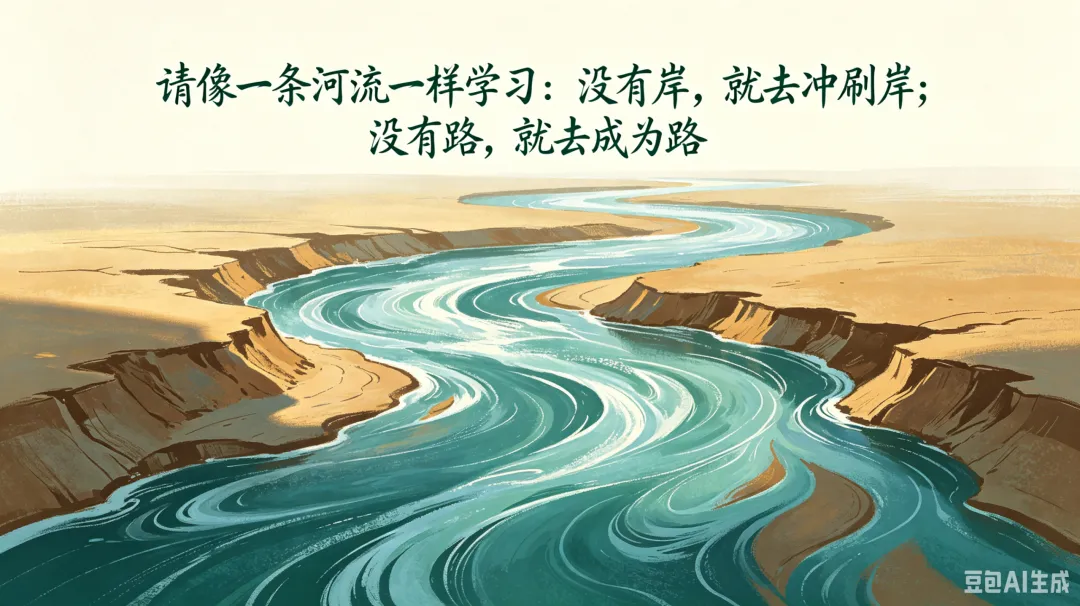
The Essence of Learning: Becoming a River in the Age of AI and the Complexity of Life
引言:我们为何要重新追问“学习”?
Introduction: Why Must We Ask Again “What Is Learning”?
今天,一个孩子需要花费二十年被培养成“优秀的人”——记忆公式、刷题考试、服从规则。讽刺的是,当他终于毕业,世界却告诉他:“现在,请学会不要被AI替代。”
我们花了二十年把孩子变成机器,然后又用余生教他们如何做人。这就是当下关于学习的最大悖论。
Today, a child spends two decades being trained into an “excellent person” — memorizing formulas, drilling test papers, obeying rules. Ironically, upon graduation, the world tells him: “Now, please learn not to be replaced by AI.”
We spend twenty years turning children into machines, and then the rest of their lives teaching them how to be human. This is the great paradox of learning in our time.
一、学习的本质:从“适应”到“觉醒”
I. The Essence of Learning: From Adaptation to Awakening
生物学的答案是:学习是为了适应环境变化。但人类的适应不止于生存——它是一场内在的演化。真正的学习,不是往大脑里塞东西,而是 “去自动化” :在应该习惯的地方停下来质疑,在所有人点头的时候说“真的吗?”。
Biologically, learning is about adapting to environmental change. But human adaptation goes beyond survival — it is an inner evolution. True learning is not stuffing the brain but de-automatizing: stopping where habit would take over, questioning when everyone nods.
学习的本质可以用六个词概括:思考、辨别、否定、批判、认知、觉醒。
· 思考:选择不思考什么,并意识到自己在思考。
· 辨别:在多重的“真”中选择相信并践行哪一个。
· 否定:对看似合理的选项说“不,因为它让我异化”。
· 批判:审视自我和系统,而非只攻击他人。
· 认知:在AI提供的模型之上,建立属于自己的意义坐标。
· 觉醒:清醒地选择何时使用工具、何时拒绝、何时超越。
The essence of learning can be captured in six words: to think, to discern, to negate, to critique, to cognize, to awaken.
· To think means choosing what not to think about, and being aware that you are thinking.
· To discern means choosing which truth among many to believe and act upon.
· To negate means saying “no” to a seemingly rational option because it dehumanizes you.
· To critique means examining yourself and the system, not just attacking others.
· To cognize means building your own map of meaning on top of the model given by AI.
· To awaken means consciously deciding when to use a tool, when to refuse it, and when to transcend it.
二、AI时代:学习重心的根本位移
II. The Age of AI: A Fundamental Shift in the Center of Gravity
AI能比我们更快地记忆、计算、分类甚至生成逻辑文本。于是,学习的基线被重置:
· 知识:知道“什么”不再重要,知道“哪个问题值得问”才重要。
· 技能:执行操作不再稀缺,定义“什么问题值得解决”才重要。
· 初级思维:AI能模仿归纳与类比,对思维本身的反思与批判才成为人的领地。
AI can memorize, calculate, classify, and even generate logical text faster than we can. Hence, the baseline of learning has been reset:
· Knowledge: Knowing “what” is no longer important; knowing “which question is worth asking” is.
· Skill: Executing operations is no longer scarce; defining “which problem is worth solving” is.
· Basic thinking: AI can mimic induction and analogy. Reflection and critique of thinking itself becomes the human domain.
AI时代的学习本质公式变为:
学习 = 设定元问题 + 建构意义 + 守护主体性
即:在AI能回答无数问题之前,你先问“我们该问什么?”;
在AI给出信息之后,你赋予它价值、情感与目的;
在整个过程中,始终坚持“我是目的,工具是手段”。
The formula for the essence of learning in the AI age becomes:
Learning = Setting Meta-questions + Constructing Meaning + Guarding Subjectivity
That is: before AI answers countless questions, you ask “What should we ask?”;
after AI gives information, you endow it with value, emotion, and purpose;
throughout, you insist that “I am the end, the tool is only a means.”
三、古圣先贤的永恒回响
III. The Eternal Echoes of the Ancients
东西方大师从未离开——他们只是在等待我们陷入技术迷雾时,重新开口。
The great masters of East and West never left — they were merely waiting for us to get lost in the fog of technology, and then speak again.
东方智慧:
· 孔子:“古之学者为己,今之学者为人。” 学习不是表演,而是完善自己的生命。
· 王阳明:“知是行之始,行是知之成。” 学习是在事上磨练良知,而非背诵概念。
· 《大学》:“大学之道,在明明德。” 学习是擦亮本有的光明德性。
Eastern Wisdom:
· Confucius: “In ancient times, men learned for themselves; nowadays, men learn for others.” Learning is not a performance but the cultivation of your own life.
· Wang Yangming: “Knowledge is the beginning of action; action is the completion of knowledge.” Learning is refining your moral intuition through practical affairs, not reciting concepts.
· The Great Learning: “The Way of great learning lies in illuminating the bright virtue.” Learning is polishing the inherent luminous virtue within you.
西方智慧:
· 苏格拉底:“我唯一知道的是我一无所知。” 学习始于承认无知,而非提供答案。
· 柏拉图:“学习即回忆。” 你早已知道真善美的原型,学习是把它们从朦胧带到清晰。
· 亚里士多德:学习的终极目的是幸福(Eudaimonia)——灵魂合乎逻各斯的现实活动。
· 康德:“要有勇气运用你自己的理性!” 学习是拒绝一切他律,坚持自律。
· 杜威:学习即经验的重组——教育就是生活本身,而非生活的准备。
· 弗莱雷:学习是意识的觉醒,是对现实进行批判性解读的对话。
Western Wisdom:
· Socrates: “I know that I know nothing.” Learning begins with admitting ignorance, not providing answers.
· Plato: “Learning is recollection.” You already know the forms of truth, goodness, and beauty; learning brings them from obscurity to clarity.
· Aristotle: The ultimate purpose of learning is Eudaimonia — the soul’s activity in accordance with reason.
· Kant: “Dare to use your own reason!” Learning is refusing all heteronomy and insisting on autonomy.
· Dewey: Learning is the reconstruction of experience — education is life itself, not preparation for life.
· Freire: Learning is the awakening of consciousness, a dialogue that critically interprets reality.
这些先贤告诉我们同一件事:学习不是填充,而是诞生。你无法从外界获得“成为人”的资格,你只能通过一遍遍的质疑、选择、负责,把那个真正的自己生出来。
These sages tell us the same thing: Learning is not filling, but giving birth. You cannot obtain the qualification “to be human” from the outside; you can only give birth to your true self through repeated questioning, choosing, and taking responsibility.
四、复杂世界与人生成长:学习是一条河流
IV. The Complex World and Life’s Growth: Learning Is a River
我们以为世界像钟表——拆得开、修得好。但真实世界像天气——无法精确预测,只能随时调整风帆。
We once thought the world was like a clock — disassemblable and repairable. But the real world is like the weather — unpredictable, and you can only adjust your sails constantly.
复杂世界的铁律:
1. 非线性:一分耕耘未必一分收获。
2. 不确定性:黑天鹅才是常态。
3. 适应性:最善变的生存,而非最强壮的。
4. 纠缠:你改变环境,环境再改变你。
The iron laws of a complex world:
1. Non-linearity: Hard work does not always pay off proportionally.
2. Uncertainty: Black swans are the norm.
3. Adaptability: The most flexible survive, not the strongest.
4. Entanglement: You change your environment, and it changes you back.
在这样的世界里,学习不再是建造一栋坚固的房子,而是 让自己成为一条河——没有固定形态,却能穿过任何地形,在流动中画出自己的路径。
In such a world, learning is no longer building a solid house. It is becoming a river — formless, yet able to cut through any terrain, drawing its own path as it flows.
人生成长的四个阶段:
· 入格(童年):相信并模仿既定的规则。
· 破格(青年):怀疑与反抗,杀死那个“听话的自己”。
· 试错(成年早期):选择并承担后果,学会与疼痛共存。
· 化格(中年以后):不被任何格子框住,却能自如进出任何格子。
The four stages of life growth:
· Entering the frame (childhood): Believing and imitating established rules.
· Breaking the frame (youth): Doubting and rebelling, killing the “obedient self”.
· Trial and error (early adulthood): Choosing and bearing consequences, learning to live with pain.
· Transcending the frame (midlife onward): Not confined by any frame, yet able to enter and exit any frame freely.
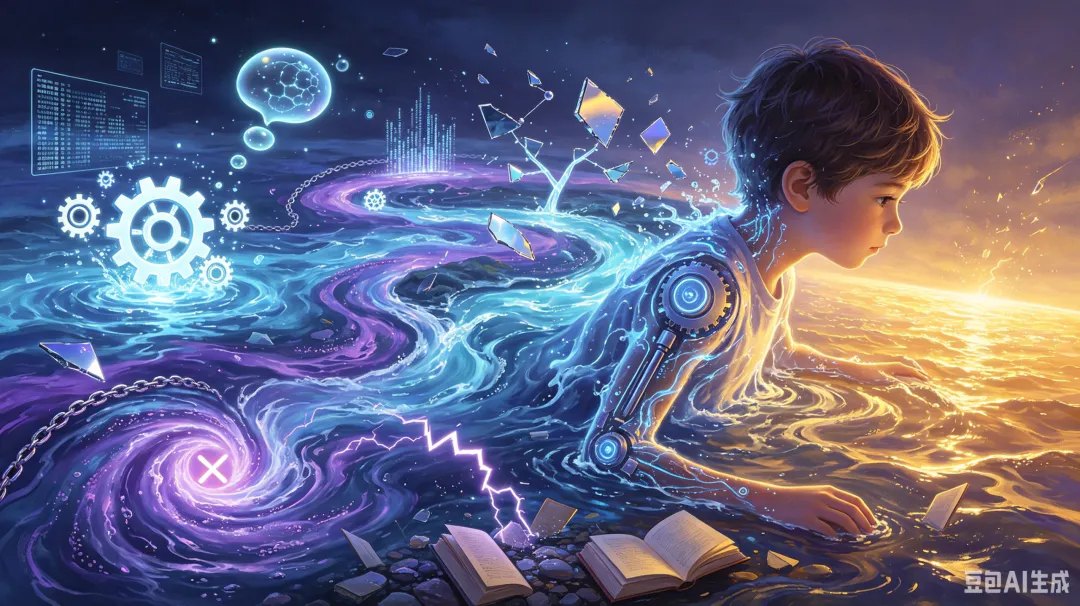
最深刻的隐喻是:你被抛入大海,没有地图。你一边游水,一边用漂来的木板编成救生筏。筏子会散,你会沉,但你学会了重新编织。这个不断破碎与重建的过程,就叫学习。
The deepest metaphor: You are thrown into the sea without a map. You swim, gather floating planks and ropes, and weave a life raft. The raft may break; you may sink. But you learn to weave again. That constant process of breaking and rebuilding is called learning.
五、学习的本质:终极公式与一条道路
V. The Essence of Learning: The Ultimate Formula and One Path
综合所有,我们可以给学习下一个综合性的定义:
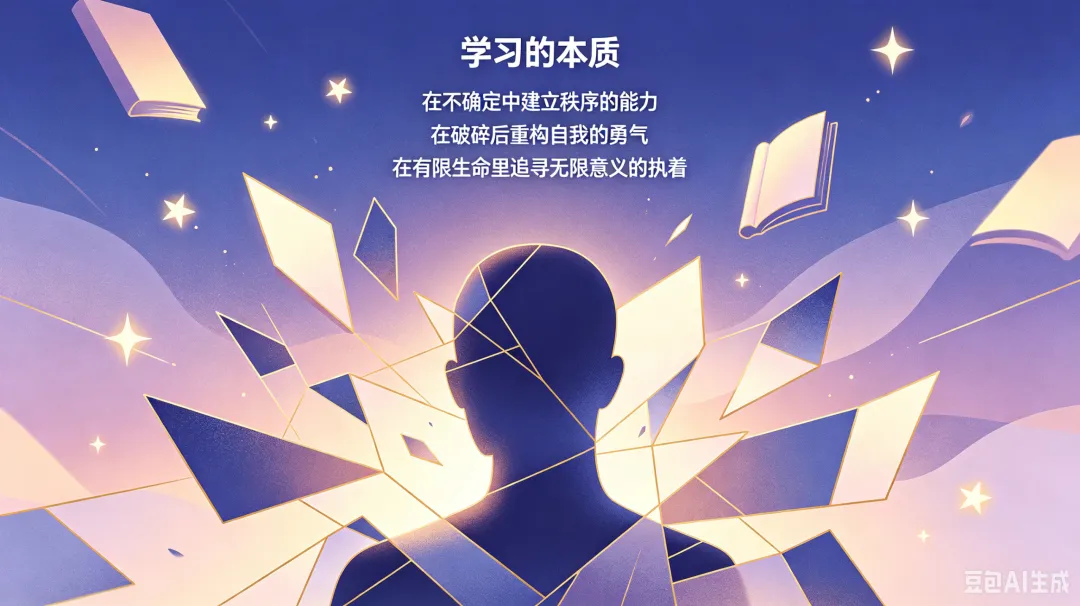
学习的本质 = 在不确定中建立秩序的能力 + 在破碎后重构自我的勇气 + 在有限生命里追寻无限意义的执着
Bringing everything together, we can offer a comprehensive definition:
The essence of learning = The ability to create order out of uncertainty + The courage to rebuild the self after it breaks + The perseverance to pursue infinite meaning within a finite life
· 建立秩序:不是预测未来,而是当变化发生时,快速找到新的抓手。
· 重构自我:不是不破碎,而是知道如何把碎片拼成更美的图案。
· 追寻意义:明知会死、世界不完美,依然选择向前——这个选择本身就是学习。
· Creating order: Not predicting the future, but quickly finding new footholds when change happens.
· Rebuilding the self: Not avoiding breaking, but knowing how to reassemble the fragments into a more beautiful pattern.
· Pursuing meaning: Even knowing you will die and the world is imperfect, you still choose to move forward — that choice itself is learning.
最后,三条给所有成长者的建议:
1. 学“没用的东西”——哲学、艺术、一首诗,它们是你救生筏上那根关键时刻救命的绳子。
2. 学“放弃”——辨别什么值得投入、什么需要止损,比任何技能都难。
3. 学“脆弱”——敢于承认不懂、不敢、不完美,因为真正的成长都发生在求助的瞬间。
Finally, three pieces of advice for all who are growing:
1. Learn “useless” things — philosophy, art, a poem. They are the unexpected rope on your raft that saves you in a critical moment.
2. Learn “to let go” — discerning what is worth your energy and what is not is harder than any skill.
3. Learn “vulnerability” — dare to admit you don’t know, can’t do it, or are imperfect. Because real growth always happens in the moment you ask for help.
结语:记得你是一个人
Conclusion: Remember You Are a Human
当你七八十岁回望一生,你学到的不是多少学位、多少技能,而是如何度过那几个最黑的夜晚,如何重新站起来,如何爱过一个不值得的人,如何选择善良而不是正确。
When you look back at seventy or eighty, what you will have learned is not how many degrees or skills you acquired, but how you survived the darkest nights, how you stood up again, how you loved someone who did not deserve it, and how you chose kindness over being right.
学习的本质,说到底,就是学着如何活着——而活着,就是一场不断学习如何死去(旧我)又重生(新我)的漫长仪式。
AI不会学习,因为它从不害怕;它不会困惑,不会后悔,不会在深夜为一道无解的题流泪。而你会。
The essence of learning, in the end, is learning how to live — and living is a long ritual of continuously learning how to die (the old self) and be reborn (the new self).
AI does not learn, because it is never afraid; it does not get confused, it does not regret, it does not weep over an unsolvable problem at night. But you do.
所以,请像一条河流一样学习:没有岸,就去冲刷岸;没有路,就去成为路。
So learn like a river: if there is no bank, carve one; if there is no path, become one.
感谢阅读。如果你愿意,可以把这个理解作为你明天学习的第一课——不是学得更快,而是学得更像一个人。
Thank you for reading. If you wish, take this understanding as the first lesson of your learning tomorrow — not to learn faster, but to learn more like a human.