LangChain 源码剖析-结构化输出详解(Structured output)
- 结构化输出允许代理以特定的、可预测的格式返回数据。您可以获得JSON对象、Pydantic模型或应用程序可以直接使用的数据类形式的结构化数据,而不是解析自然语言响应。
- LangChain的create_agent自动处理结构化输出。用户设置他们想要的结构化输出模式,当模型生成结构化数据时,它会被捕获、验证,并在代理状态的"structured_response"键中返回。
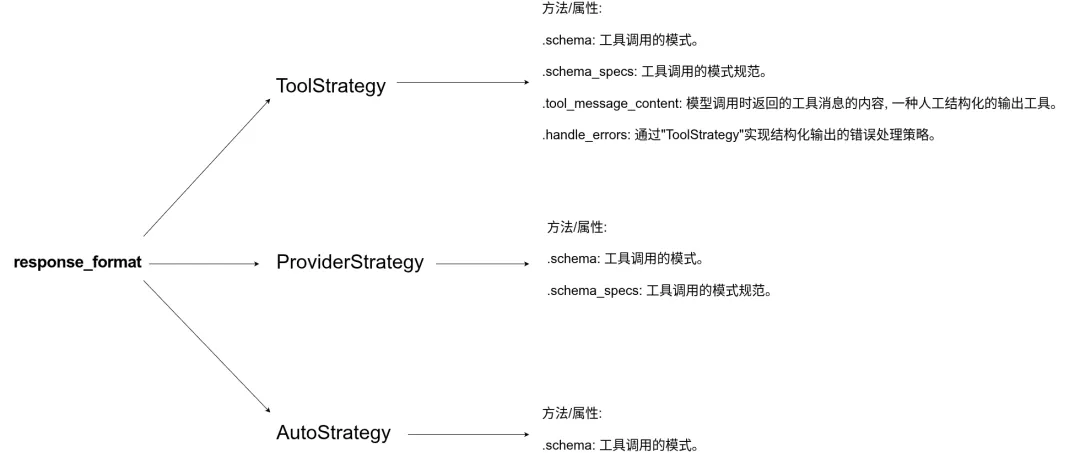
def create_agent( ... response_format: Union[ ToolStrategy[StructuredResponseT], ProviderStrategy[StructuredResponseT], type[StructuredResponseT], ]
响应格式(Response Format)
- 当直接提供模式类型时,LangChain会自动选择
供应商策略(ProviderStrategy[StructuredResponseT])
- 一些模型提供者通过其API原生支持结构化输出(例如OpenAI、Grok、Gemini)。这是最可靠的方法。
class ProviderStrategy(Generic[SchemaT]): schema: type[SchemaT]
ProviderStrategy: schema参数
- Pydantic模型:带字段验证的BaseModel子类
from pydantic import BaseModel, Fieldfrom langchain.agents import create_agentclass ContactInfo(BaseModel): """Contact information for a person.""" name: str = Field(description="The name of the person") email: str = Field(description="The email address of the person") phone: str = Field(description="The phone number of the person")agent = create_agent( model="gpt-5", response_format=ContactInfo # Auto-selects ProviderStrategy)result = agent.invoke({ "messages": [{"role": "user", "content": "Extract contact info from: John Doe, john@example.com, (555) 123-4567"}]})print(result["structured_response"])# ContactInfo(name='John Doe', email='john@example.com', phone='(555) 123-4567')
- Dataclasses:带有类型注释的Python数据类
from dataclasses import dataclassfrom langchain.agents import create_agent@dataclassclass ContactInfo: """Contact information for a person.""" name: str # The name of the person email: str # The email address of the person phone: str # The phone number of the personagent = create_agent( model="gpt-5", tools=tools, response_format=ContactInfo # Auto-selects ProviderStrategy)result = agent.invoke({ "messages": [{"role": "user", "content": "Extract contact info from: John Doe, john@example.com, (555) 123-4567"}]})result["structured_response"]# ContactInfo(name='John Doe', email='john@example.com', phone='(555) 123-4567')
from typing_extensions import TypedDictfrom langchain.agents import create_agentclass ContactInfo(TypedDict): """Contact information for a person.""" name: str # The name of the person email: str # The email address of the person phone: str # The phone number of the personagent = create_agent( model="gpt-5", tools=tools, response_format=ContactInfo # Auto-selects ProviderStrategy)result = agent.invoke({ "messages": [{"role": "user", "content": "Extract contact info from: John Doe, john@example.com, (555) 123-4567"}]})result["structured_response"]# {'name': 'John Doe', 'email': 'john@example.com', 'phone': '(555) 123-4567'}
- JSON Schema:具有JSON模式规范的字典
from langchain.agents import create_agentcontact_info_schema = { "type": "object", "description": "Contact information for a person.", "properties": { "name": {"type": "string", "description": "The name of the person"}, "email": {"type": "string", "description": "The email address of the person"}, "phone": {"type": "string", "description": "The phone number of the person"} }, "required": ["name", "email", "phone"]}agent = create_agent( model="gpt-5", tools=tools, response_format=ProviderStrategy(contact_info_schema))result = agent.invoke({ "messages": [{"role": "user", "content": "Extract contact info from: John Doe, john@example.com, (555) 123-4567"}]})result["structured_response"]# {'name': 'John Doe', 'email': 'john@example.com', 'phone': '(555) 123-4567'}
工具策略(ToolStrategy[StructuredResponseT])
- 对于不支持本机结构化输出的模型,LangChain使用工具调用来实现相同的结果。这适用于支持工具调用的所有模型,这是最现代的模型。
class ToolStrategy(Generic[SchemaT]): schema: type[SchemaT] tool_message_content: str | None handle_errors: Union[ bool, str, type[Exception], tuple[type[Exception], ...], Callable[[Exception], str], ]
ToolStrategy: schema参数
- Pydantic模型:带字段验证的BaseModel子类
from pydantic import BaseModel, Fieldfrom typing import Literalfrom langchain.agents import create_agentfrom langchain.agents.structured_output import ToolStrategyclass ProductReview(BaseModel): """Analysis of a product review.""" rating: int | None = Field(description="The rating of the product", ge=1, le=5) sentiment: Literal["positive", "negative"] = Field(description="The sentiment of the review") key_points: list[str] = Field(description="The key points of the review. Lowercase, 1-3 words each.")agent = create_agent( model="gpt-5", tools=tools, response_format=ToolStrategy(ProductReview))result = agent.invoke({ "messages": [{"role": "user", "content": "Analyze this review: 'Great product: 5 out of 5 stars. Fast shipping, but expensive'"}]})result["structured_response"]# ProductReview(rating=5, sentiment='positive', key_points=['fast shipping', 'expensive'])
- Dataclasses:带有类型注释的Python数据类
from dataclasses import dataclassfrom typing import Literalfrom langchain.agents import create_agentfrom langchain.agents.structured_output import ToolStrategy@dataclassclass ProductReview: """Analysis of a product review.""" rating: int | None # The rating of the product (1-5) sentiment: Literal["positive", "negative"] # The sentiment of the review key_points: list[str] # The key points of the reviewagent = create_agent( model="gpt-5", tools=tools, response_format=ToolStrategy(ProductReview))result = agent.invoke({ "messages": [{"role": "user", "content": "Analyze this review: 'Great product: 5 out of 5 stars. Fast shipping, but expensive'"}]})result["structured_response"]# ProductReview(rating=5, sentiment='positive', key_points=['fast shipping', 'expensive'])
from typing import Literalfrom typing_extensions import TypedDictfrom langchain.agents import create_agentfrom langchain.agents.structured_output import ToolStrategyclass ProductReview(TypedDict): """Analysis of a product review.""" rating: int | None # The rating of the product (1-5) sentiment: Literal["positive", "negative"] # The sentiment of the review key_points: list[str] # The key points of the reviewagent = create_agent( model="gpt-5", tools=tools, response_format=ToolStrategy(ProductReview))result = agent.invoke({ "messages": [{"role": "user", "content": "Analyze this review: 'Great product: 5 out of 5 stars. Fast shipping, but expensive'"}]})result["structured_response"]# {'rating': 5, 'sentiment': 'positive', 'key_points': ['fast shipping', 'expensive']}
- JSON Schema:具有JSON模式规范的字典
from langchain.agents import create_agentfrom langchain.agents.structured_output import ToolStrategyproduct_review_schema = { "type": "object", "description": "Analysis of a product review.", "properties": { "rating": { "type": ["integer", "null"], "description": "The rating of the product (1-5)", "minimum": 1, "maximum": 5 }, "sentiment": { "type": "string", "enum": ["positive", "negative"], "description": "The sentiment of the review" }, "key_points": { "type": "array", "items": {"type": "string"}, "description": "The key points of the review" } }, "required": ["sentiment", "key_points"]}agent = create_agent( model="gpt-5", tools=tools, response_format=ToolStrategy(product_review_schema))result = agent.invoke({ "messages": [{"role": "user", "content": "Analyze this review: 'Great product: 5 out of 5 stars. Fast shipping, but expensive'"}]})result["structured_response"]# {'rating': 5, 'sentiment': 'positive', 'key_points': ['fast shipping', 'expensive']}
- 联合类型:多种模式选项。模型将根据上下文选择最合适的模式。
from pydantic import BaseModel, Fieldfrom typing import Literal, Unionfrom langchain.agents import create_agentfrom langchain.agents.structured_output import ToolStrategyclass ProductReview(BaseModel): """Analysis of a product review.""" rating: int | None = Field(description="The rating of the product", ge=1, le=5) sentiment: Literal["positive", "negative"] = Field(description="The sentiment of the review") key_points: list[str] = Field(description="The key points of the review. Lowercase, 1-3 words each.")class CustomerComplaint(BaseModel): """A customer complaint about a product or service.""" issue_type: Literal["product", "service", "shipping", "billing"] = Field(description="The type of issue") severity: Literal["low", "medium", "high"] = Field(description="The severity of the complaint") description: str = Field(description="Brief description of the complaint")agent = create_agent( model="gpt-5", tools=tools, response_format=ToolStrategy(Union[ProductReview, CustomerComplaint]))result = agent.invoke({ "messages": [{"role": "user", "content": "Analyze this review: 'Great product: 5 out of 5 stars. Fast shipping, but expensive'"}]})result["structured_response"]# ProductReview(rating=5, sentiment='positive', key_points=['fast shipping', 'expensive'])
自定义工具消息内容(Custom tool message content)
- tool_message_content参数允许您自定义生成结构化输出时出现在对话历史记录中的消息:
from pydantic import BaseModel, Fieldfrom typing import Literalfrom langchain.agents import create_agentfrom langchain.agents.structured_output import ToolStrategyclass MeetingAction(BaseModel): """Action items extracted from a meeting transcript.""" task: str = Field(description="The specific task to be completed") assignee: str = Field(description="Person responsible for the task") priority: Literal["low", "medium", "high"] = Field(description="Priority level")agent = create_agent( model="gpt-5", tools=[], response_format=ToolStrategy( schema=MeetingAction, tool_message_content="Action item captured and added to meeting notes!" ))agent.invoke({ "messages": [{"role": "user", "content": "From our meeting: Sarah needs to update the project timeline as soon as possible"}]})
================================ Human Message =================================From our meeting: Sarah needs to update the project timeline as soon as possible================================== Ai Message ==================================Tool Calls: MeetingAction (call_1) Call ID: call_1 Args: task: Update the project timeline assignee: Sarah priority: high================================= Tool Message =================================Name: MeetingActionAction item captured and added to meeting notes!
- 如果没有tool_message_content,我们的最终ToolMessage将是:
================================= Tool Message =================================Name: MeetingActionReturning structured response: {'task': 'update the project timeline', 'assignee': 'Sarah', 'priority': 'high'}
异常处理(Error handling)
- 模型在通过工具调用生成结构化输出时可能会出错。LangChain提供了智能重试机制来自动处理这些错误。
多重结构化输出错误(Multiple structured outputs error)
- 当模型错误地调用多个结构化输出工具时,代理会在ToolMessage中提供错误反馈,并提示模型重试:
from pydantic import BaseModel, Fieldfrom typing import Unionfrom langchain.agents import create_agentfrom langchain.agents.structured_output import ToolStrategyclass ContactInfo(BaseModel): name: str = Field(description="Person's name") email: str = Field(description="Email address")class EventDetails(BaseModel): event_name: str = Field(description="Name of the event") date: str = Field(description="Event date")agent = create_agent( model="gpt-5", tools=[], response_format=ToolStrategy(Union[ContactInfo, EventDetails]) # Default: handle_errors=True)agent.invoke({ "messages": [{"role": "user", "content": "Extract info: John Doe (john@email.com) is organizing Tech Conference on March 15th"}]})
================================ Human Message =================================Extract info: John Doe (john@email.com) is organizing Tech Conference on March 15thNone================================== Ai Message ==================================Tool Calls: ContactInfo (call_1) Call ID: call_1 Args: name: John Doe email: john@email.com EventDetails (call_2) Call ID: call_2 Args: event_name: Tech Conference date: March 15th================================= Tool Message =================================Name: ContactInfoError: Model incorrectly returned multiple structured responses (ContactInfo, EventDetails) when only one is expected. Please fix your mistakes.================================= Tool Message =================================Name: EventDetailsError: Model incorrectly returned multiple structured responses (ContactInfo, EventDetails) when only one is expected. Please fix your mistakes.================================== Ai Message ==================================Tool Calls: ContactInfo (call_3) Call ID: call_3 Args: name: John Doe email: john@email.com================================= Tool Message =================================Name: ContactInfoReturning structured response: {'name': 'John Doe', 'email': 'john@email.com'}
架构验证错误(Schema validation error)
- 当结构化输出与预期模式不匹配时,代理会提供特定的错误反馈:
from pydantic import BaseModel, Fieldfrom langchain.agents import create_agentfrom langchain.agents.structured_output import ToolStrategyclass ProductRating(BaseModel): rating: int | None = Field(description="Rating from 1-5", ge=1, le=5) comment: str = Field(description="Review comment")agent = create_agent( model="gpt-5", tools=[], response_format=ToolStrategy(ProductRating), # Default: handle_errors=True system_prompt="You are a helpful assistant that parses product reviews. Do not make any field or value up.")agent.invoke({ "messages": [{"role": "user", "content": "Parse this: Amazing product, 10/10!"}]})
================================ Human Message =================================Parse this: Amazing product, 10/10!================================== Ai Message ==================================Tool Calls: ProductRating (call_1) Call ID: call_1 Args: rating: 10 comment: Amazing product================================= Tool Message =================================Name: ProductRatingError: Failed to parse structured output for tool 'ProductRating': 1 validation error for ProductRating.rating Input should be less than or equal to 5 [type=less_than_equal, input_value=10, input_type=int]. Please fix your mistakes.================================== Ai Message ==================================Tool Calls: ProductRating (call_2) Call ID: call_2 Args: rating: 5 comment: Amazing product================================= Tool Message =================================Name: ProductRatingReturning structured response: {'rating': 5, 'comment': 'Amazing product'}
错误处理策略
- 您可以使用handle_errors参数自定义错误的处理方式:
ToolStrategy( schema=ProductRating, handle_errors="Please provide a valid rating between 1-5 and include a comment.")
- 如果handle_errors是一个字符串,代理程序将始终提示模型使用固定的工具消息重试:
================================= Tool Message =================================Name: ProductRatingPlease provide a valid rating between 1-5 and include a comment.
ToolStrategy( schema=ProductRating, handle_errors=ValueError # Only retry on ValueError, raise others)
- 如果handle_errors是异常类型,则代理将仅在引发的异常是指定类型时重试(使用默认错误消息)。在所有其他情况下,将提出例外情况。
ToolStrategy( schema=ProductRating, handle_errors=(ValueError, TypeError) # Retry on ValueError and TypeError)
- 如果handle_errors是一个异常元组,则代理将仅在引发的异常是指定类型之一时重试(使用默认错误消息)。在所有其他情况下,将提出例外情况。
from langchain.agents.structured_output import StructuredOutputValidationErrorfrom langchain.agents.structured_output import MultipleStructuredOutputsErrordef custom_error_handler(error: Exception) -> str: if isinstance(error, StructuredOutputValidationError): return "There was an issue with the format. Try again. elif isinstance(error, MultipleStructuredOutputsError): return "Multiple structured outputs were returned. Pick the most relevant one." else: return f"Error: {str(error)}"agent = create_agent( model="gpt-5", tools=[], response_format=ToolStrategy( schema=Union[ContactInfo, EventDetails], handle_errors=custom_error_handler ) # Default: handle_errors=True)result = agent.invoke({ "messages": [{"role": "user", "content": "Extract info: John Doe (john@email.com) is organizing Tech Conference on March 15th"}]})for msg in result['messages']: # If message is actually a ToolMessage object (not a dict), check its class name if type(msg).__name__ == "ToolMessage": print(msg.content) # If message is a dictionary or you want a fallback elif isinstance(msg, dict) and msg.get('tool_call_id'): print(msg['content'])
- 在 StructuredOutputValidationError 响应:
================================= Tool Message =================================Name: ToolStrategyThere was an issue with the format. Try again.
- 在 MultipleStructuredOutputsError 响应:
================================= Tool Message =================================Name: ToolStrategyMultiple structured outputs were returned. Pick the most relevant one.
================================= Tool Message =================================Name: ToolStrategyError: <errormessage>
response_format = ToolStrategy( schema=ProductRating, handle_errors=False # All errors raised)
 夜雨聆风
夜雨聆风