 夜雨聆风
夜雨聆风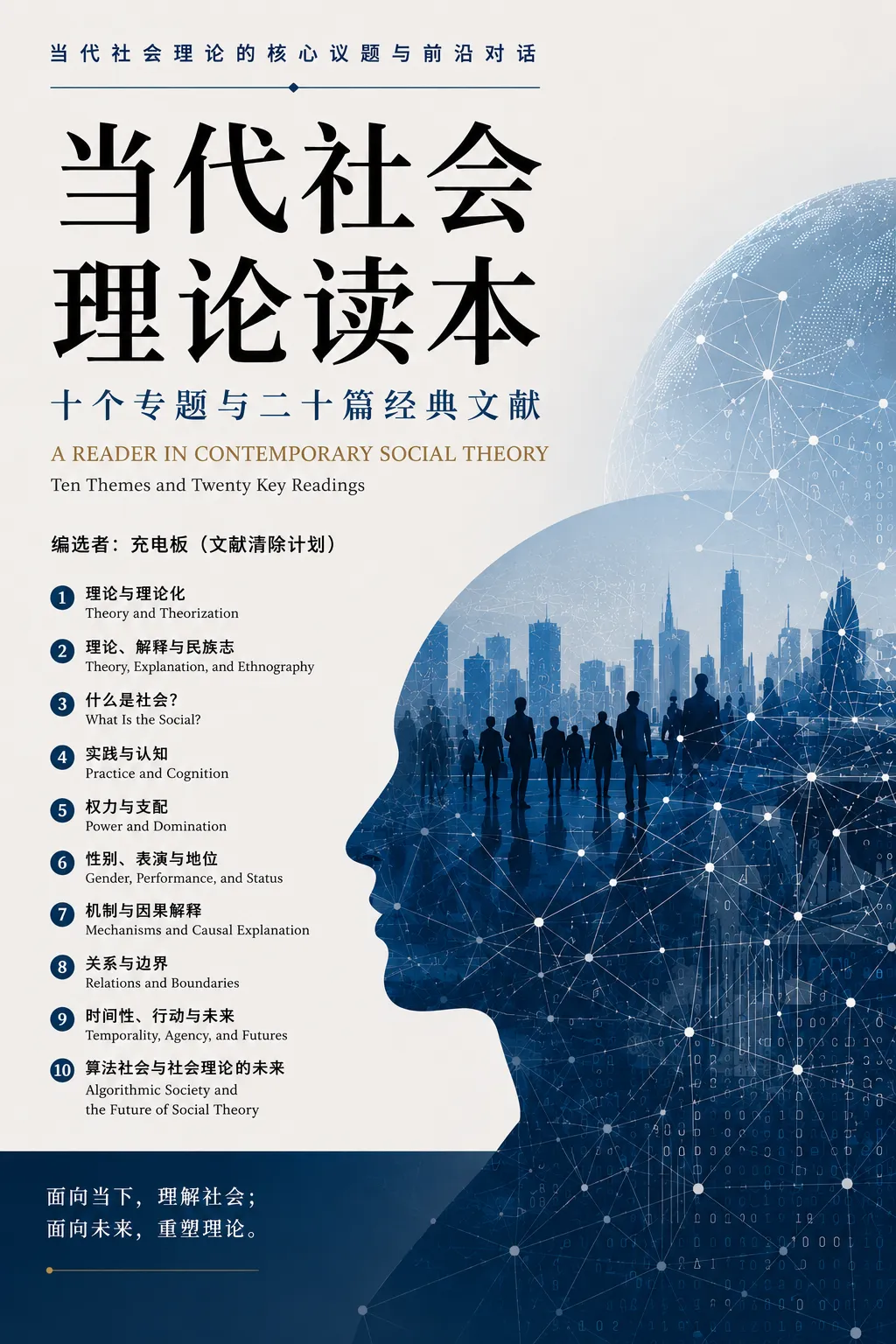
这个读本将以专题形式陆续推送,最终整理为一份非商业用途的PDF 读本,供学习交流与分享之用。编选这份读本的一个重要原因在于,许多具有代表性的当代社会理论文献至今尚无中文版。即便部分文献曾由公众号或其他平台译介,也往往只是节选、摘要或零散分享,难以为读者提供系统而完整的阅读体验。因此,我希望通过持续翻译和整理的方式,将这些重要文献以相对完整的形式呈现出来。
当然,这份读本本身也带有鲜明的选编视角。任何读本都不可能完全中立,而是体现编选者对于学科发展脉络和重要议题的理解,我自然也不例外。从这个意义上说,这份读本既反映了我个人的学术兴趣,也体现了我对当代社会理论发展方向的理解。另外,需要说明的是,这份读本并不试图构建一部包罗万象的“当代社会理论百科全书”。受个人时间和精力所限,本读本暂定围绕十个专题展开,每个专题选取两篇具有代表性和启发性的文献,共计二十篇阅读材料。这样的安排难免存在取舍,也意味着许多重要学者、理论传统和经典著作未能被纳入其中。对此,我更希望将这份读本理解为一个进入当代社会理论的起点,而非终点;一种可能的阅读路径,而非唯一正确的知识地图。
与传统以经典理论家为中心的理论课程不同,这份读本文献的选择主要遵循三个原则:一是问题导向而非人物导向;二是尽量选择篇幅适中且具有代表性的文本;三是优先纳入能够体现近二十年来社会理论新发展的研究成果。全书围绕理论化(theorizing)、社会解释(social explanation)、关系性(relationality)、实践与认知(practice and cognition)、权力与支配(power and domination)、时间性(temporality)以及人工智能与算法社会(algorithmic society)等议题展开。
读本首先从理论本身出发,探讨“什么是理论”以及社会科学中的理论建构过程;随后进入民族志与质性研究领域,讨论理论如何在经验研究中被生成、修正和发展。接着,读本进一步追问一个看似简单却极其基础的问题:当我们不断谈论“社会”时,究竟在指什么?社会这一概念本身具有怎样的本体论地位?
在此基础上,读本的主体部分将重点讨论实践理论、认知社会学、权力分析、性别表演、社会机制、关系社会学以及边界研究等当代社会理论的重要传统,考察这些理论如何重新理解行动、结构、身份与社会秩序之间的关系,以及它们如何为解释现实社会提供新的分析工具。
最后,读本将转向近年来迅速发展的理论议题,包括时间、期待与未来,以及人工智能、算法和数字技术对社会理论提出的新挑战。随着生成式人工智能和算法系统越来越深入地嵌入社会生活,许多经典理论问题——例如行动、意义、认知、权力与社会秩序——都正在被重新审视。社会理论也因此进入了一个新的发展阶段。
通过阅读这些具有代表性的理论著作与论文,我希望读者不仅能够了解当代社会理论的重要概念和主要脉络,更能够理解理论是如何被建构出来的,以及理论如何帮助我们认识和解释不断变化的社会世界。希望这份读本能够成为一座桥梁,让更多人接触到当代社会理论的重要成果,并在阅读、思考与讨论中不断发展自己的理论想象力!
专题一:理论与理论化(Theory and Theorizing)
Abend, Gabriel. 2008. “The Meaning of ‘Theory.’” Sociological Theory 26(2):173–199.
Swedberg, Richard. 2012. “Theorizing in Sociology and Social Science: Turning to the Context of Discovery.” Theory and Society 41(1):1–40.
专题二:理论、解释与民族志(Theory, Explanation, and Ethnography)
Lichterman, Paul, and Isaac Ariail Reed. 2015. “Theory and Contrastive Explanation in Ethnography.” Sociological Methods & Research 44(4):585–635.
Timmermans, Stefan, and Iddo Tavory. 2012. “Theory Construction in Qualitative Research: From Grounded Theory to Abductive Analysis.” Sociological Theory 30(3):167–186.
专题三:什么是社会?(What Is the Social?)
Latour, Bruno. 2005. Reassembling the Social: An Introduction to Actor-Network-Theory. Oxford: Oxford University Press. (Introduction)
White, Harrison C. 2008. Identity and Control: How Social Formations Emerge. 2nd ed. Princeton, NJ: Princeton University Press. (Chapter 1)
专题四:实践与认知(Practice and Cognition)
Lizardo, Omar. 2004. “The Cognitive Origins of Bourdieu’s Habitus.” Journal for the Theory of Social Behaviour 34(4):375–401.
Lizardo, Omar. 2017. “Improving Cultural Analysis: Considering Personal Culture in Its Declarative and Nondeclarative Modes.” American Sociological Review 82(1):88–115.
专题五:权力与支配(Power and Domination)
Wacquant, Loïc. 2013. “Symbolic Power and Group-Making: On Pierre Bourdieu’s Reframing of Class.” Journal of Classical Sociology 13(2):274–291.
Reed, Isaac Ariail. 2013. “Power: Relational, Discursive and Performative Dimensions.” Sociological Theory 31(3):193–218.
专题六:性别、述行性与地位(Gender, Performance, and Status)
Butler, Judith. 1988. “Performative Acts and Gender Constitution: An Essay in Phenomenology and Feminist Theory.” Theatre Journal 40(4):519–531.
Ridgeway, Cecilia L. 2009. “Framed Before We Know It: How Gender Shapes Social Relations.” Gender & Society 23(2):145–160.
专题七:机制与因果解释(Mechanisms and Causal Explanation)
Gerring, John. 2010. “Causal Mechanisms: Yes, But . . .” Comparative Political Studies 43(11):1499–1526.
Gross, Neil. 2009. “A Pragmatist Theory of Social Mechanisms.” American Sociological Review 74(3):358–379.
专题八:关系与边界(Relations and Boundaries)
Abbott, Andrew. 1995. “Things of Boundaries.” Social Research 62(4):857–882.
Desmond, Matthew. 2014. “Relational Ethnography.” Theory and Society 43(5):547–579.
专题九:时间性、行动与未来(Temporality, Agency, and Futures)
Emirbayer, Mustafa, and Ann Mische. 1998. “What Is Agency?” American Journal of Sociology 103(4):962–1023.
Tavory, Iddo, and Nina Eliasoph. 2013. “Coordinating Futures: Toward a Theory of Anticipation.” American Journal of Sociology 118(4):908–942.
专题十:算法社会与社会理论的未来(Algorithmic Society and the Future of Social Theory)
Fourcade, Marion, and Jenna Burrell. 2021. “The Society of Algorithms.” Annual Review of Sociology 47:213–237.
Esposito, Elena. 2022. Artificial Communication: How Algorithms Produce Social Intelligence. Cambridge, MA: MIT Press. (Introduction)