 夜雨聆风
夜雨聆风一、试卷总体定位
《2026年河北省初中学业水平考试英语试卷》严格遵循《义务教育英语课程标准(2022年版)》,以“立德树人”为核心,全面考查学生听、说、读、写、看的综合语言运用能力及核心素养。试卷结构成熟、稳定,语篇选材广泛且贴近学生生活且与时俱进,重在引导教学从“知识传授”向“能力培养”与“素养提升”转变。
二、各题型深度解析
第一部分:听力(满分30分)
命题方向: 本部分立足于真实生活场景,考查学生在不同听力任务中获取、理解与记录信息的能力。听力话题涵盖日常问候、购物、问路、节日文化、出行计划等,强调语言的实际交际功能。
第四部分:听短文填空——解析与答题策略
答题目标:本题要求考生在听短文的过程中,准确捕捉并填写5个关键信息词。
命题规律:所填单词多为实义词(名词、动词、形容词),且通常为课标核心词汇。
通用答题策略(“三步走”):
听前预测:利用播放指令和题目间隙,快速浏览表格或短文,预测每个空格的词性(如:专有名词、日期、地点、物品名称等),做到“心中有数”。
听中捕获:集中注意力,识别关键信息。当听到与预测相关的单词时,速记其发音及关键字母,不纠结于完整拼写,确保优先记录准确读音。
听后检查:利用最后检查时间,检查拼写(尤其关注首字母大写、名词单复数)、大小写及单词间的搭配是否合理。
核心素养指向:专注力、信息筛选与速记能力、词汇书写的准确性。
逐题分析
第一部分 听力
第一节 听句子,选择最佳答语(第1-5题)
1. A. Come on.
B. Enjoy yourself.
C. Nice to meet you, too.
2. A. Try again.
B. Sounds interesting.
C. OK, here you are.
3. A. Quite right.
B. My pleasure.
C. Well done.
4. A. I'm hungry.
B. Juice, please.
C. A large one.
5. A. With my sister.
B. Last week.
C. To exercise.
第1题答案:C。考查在见面问候场景中,对“Nice to meet you.”做出得体回应的能力,英语惯用表达为“Nice to meet you, too”。
第2题答案:C。考查在请求场景中,对“Bill,Could you please pass me the pen?”做出恰当应答的能力,需理解请求并同意配合。
第3题答案:A。考查在评价场景中,对“This dictionary is really helpful.”做出合理回应的能力,表达赞同观点。
第4题答案:B。考查在提供选择场景中,对“Would you like tea or juice?”做出明确选择表达的能力。
第5题答案:B。考查在时间询问场景中,对“When did the sports meeting take place?”做出准确时间回应的能力。
核心素养:语言能力、文化意识。
第二节 听对话和问题,选择正确答案(第6-18题)
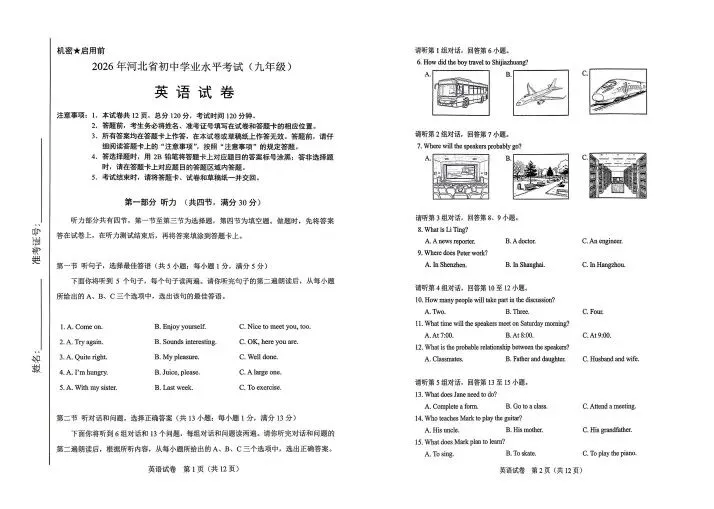
第6题答案:C。考查从对话中提取关键信息的细节理解能力,需准确捕捉出行方式(高铁)这一核心信息。
第7题答案:B。考查根据对话内容进行简单推理判断的能力,需结合对话语境推断说话人的去向(外出呼吸新鲜空气)。
第8题答案:A。考查识别对话中人物职业的能力,需从对话中提取信息判断李婷的职业为新闻记者 (news reporter)。
第9题答案:B。考查提取人物工作地点信息的能力,需准确找到Peter在上海工作的细节。
第10题答案:B。考查从对话中提取人物数量的能力,需识别参与讨论的人数(Tony、Mary、Tina共三人)。
第11题答案:C。考查捕捉具体时间信息的能力,需准确提取周六上午九点的会面时间。
第12题答案:A。考查推断人物关系的能力,需根据对话内容判断说话人之间的关系为同学。
第13题答案:A。考查提取关键任务信息的能力,需理解Jane需要完成填表这一核心信息。
第14题答案:C。考查识别人物责任归属的能力,需找到教授Mark弹吉他的人是他的祖父。
第15题答案:B。考查提取个人计划信息的能力,需识别Mark计划学习的是滑冰。
第16题答案:A。考查从对话中提取人物偏好的细节理解能力,需准确找出母亲喜欢的水果是香蕉。
第17题答案:C。考查识别提议者的能力,需判断谁建议购买月饼(Cindy)。
第18题答案:A。考查对话主旨概括能力,需综合整段对话内容判断谈话主题是购物清单。
核心素养:语言能力、思维品质、文化意识。
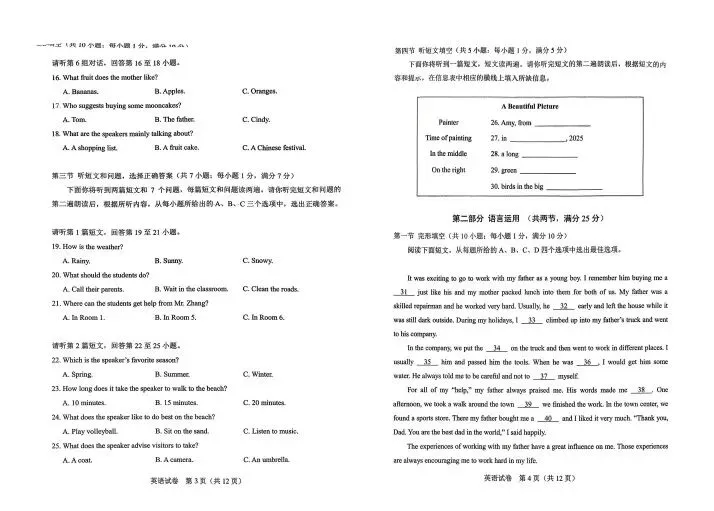
第三节 听短文和问题,选择正确答案(第19-25题)
19-21题
听力材料原文:
Boys and girls, attention please, school is finishing soon but it is still raining heavily outside.
For your safety, please wait in the classroom. We have told your parents to meet you in the classroom. The roads in the school are wet. Please walk slowly when you leave.
If your parents don't arrive on time, you can get help from Mr. Zhang in Room Five. That's all, thank you.
对应问题:
Question number 19: How is the weather?
Question number 20: What should the students do?
Question number 21: Where can the students get help from Mr. Zhang?
第19题答案:A。考查根据短文内容获取天气信息的能力,需从开头的描述中准确判断天气为下雨天。
第20题答案:B。考查理解学校通知中行为指令的能力,需准确理解因安全考虑要求学生在教室等候。
第21题答案:B。考查提取具体地点的细节理解能力,需准确找到张老师在五号房间提供帮助的信息。
22-25:
听力材料原文:
Hello everybody, welcome to my video. This is my hometown. I live near the sea. Summer is my favorite season. It is not too hot here in summer. The day is long so I have lots of time to do things I like. I go to the beach every weekend in summer. It only takes me 20 minutes to walk there. Usually I just sit on the sand and listen to music. But I like to play volleyball best on the beach.
If you have a chance, come to my hometown in summer. I‘m sure you will have a good time here. But I advise you to take an umbrella because the sunlight is a little strong at noon.
对应问题:
Question number 22: Which is the speaker’s favorite season?
Question number 23: How long does it take the speaker to walk to the beach?
Question number 24: What does the speaker like to do best on the beach?
Question number 25: What does the speaker advise visitors to take?第22题答案:B。考查识别说话人个人偏好的能力,需理解说话人最喜欢的季节是夏季。
第23题答案:C。考查提取具体数字信息的能力,需准确获取走路到海滩需要20分钟的信息。
第24题答案:A。考查识别个人活动中最喜欢的内容的能力,需理解说话人最喜欢在海滩上打排球。
第25题答案:C。考查提取建议信息的能力,需准确找出说话人建议游客携带的物品是雨伞。
第四节 听短文填空(第26-30题)
听力材料原文:
Dear friends, let's go on to enjoy the pictures by the students.
Look at the first one, the picture is beautiful. The painter Amy is from England. She is a student of our school. And she painted the picture in July 2025.
In the middle of the picture there is a long river. On the left the buildings are in different shapes. Can you see a school here? It is our school.
Look at the right of the picture, the grass is bright green. On the green grass, a cat is running after a butterfly.
。 There is a big tree beside the river. We can see some birds in the tree. I love the picture. It makes me happy every time I see it.
题目文本:一篇介绍学生画作的短文。
第26题答案:England。考查在听的过程中准确记录国籍信息并注意专有名词首字母大写的拼写能力。
第27题答案:July。考查准确记录月份信息并正确拼写的能力,需注意月份单词首字母大写。
第28题答案:river。考查捕捉画中自然景物信息的能力,需准确拼写常见名词。
第29题答案:grass。考查提取画中元素信息的能力,需注意结合语境确认单词形式(单数)。
第30题答案:tree。考查捕捉画中生物栖息地信息的能力,需准确拼写并注意可数名词的单数形式。
第二部分 语言运用
第一节 完形填空(第31-40题)
完形填空原文
It was exciting to go to work with my father as a young boy. I remember him buying me a 31 just like his and my mother packed lunch into them for both of us. My father was a skilled repairman and he worked very hard. Usually, he 32 early and left the house while it was still dark outside. During my holidays, I 33 climbed up into my father’s truck and went to his company.
In the company, we put the 34 on the truck and then went to work in different places. I usually 35 him and passed him the tools. When he was 36 , I would get him some water. He always told me to be careful and not to 37 myself.
For all of my “help,” my father always praised me. His words made me 38 . One afternoon, we took a walk around the town 39 we finished the work. In the town center, we found a sports store. Then my father bought me a 40 and I liked it very much. “Thank you, Dad. You are the best dad in the world,” I said happily.
The experiences of working with my father have a great influence on me. Those experiences are always encouraging me to work hard in my life.
语篇分析:本篇文章为一篇叙事性记叙文,以第一人称“我”的视角回忆童年时期跟随父亲去公司工作的经历。文章按照时间顺序展开,从清晨出发开始,依次描写了在公司装载工具、在不同地点工作中“我”帮助父亲拿工具、给口渴的父亲送水、父亲叮嘱注意安全以及表扬“我”的帮助,最后在完工后父子散步并去体育用品店购物的温馨场景。文章结尾升华主题,表达了这段经历对“我”人生产生的深远影响。文章语言朴实但情感真挚,展现了父子之间深厚的情感纽带以及劳动教育在家庭教育中的重要作用。
31.答案:C。考查名词词义辨析。要求考生根据“父亲为我和自己都准备了物品”这一场景,推断出父亲购买的物品是午餐盒。
32.答案:A。考查动词短语辨析。需要考生结合父亲的工作习惯和清晨天未亮的时间背景,推断出父亲每天早起的事实。
33.答案:D。考查副词辨析。要求考生理解在假期这一特殊场景中,能够和父亲一起出去的兴奋心理状态。
34.答案:B。考查名词辨析。需要考生根据“父亲是技术熟练的修理工”这一职业背景,推测在工作场景中装载的物品是工具。
35.答案:B。考查动词辨析。要求理解在具体工作场景中,“我”跟随父亲并为他递工具的行为。
36.答案:D。考查形容词辨析。需要从“我”为他拿水这一行为中逆向推导出父亲当时的生理状态是口渴。
37.答案:C。考查动词词义及固定搭配。理解父亲叮嘱的核心含义是注意安全,不要伤害到自己。
38.答案:A。考查形容词辨析。理解父亲的赞扬对“我”产生的情感影响是感到骄傲。
39.答案:B。考查连词辨析。理解完成工作和散步这两个动作之间的先后顺序关系,先完成工作再散步。
40.答案:C。考查名词辨析。结合体育用品店的场景和“我”非常喜欢的结果性描述,推断出购买的物品是篮球。
第二节 短文填空原文(共15小题;每小题1分,满分15分)
阅读下面短文,在空白处填入一个适当的单词或填入括号内单词的正确形式。
Last Sunday, I went to Handan Cizhou Kiln Site (邯郸磁州窑遗址) with my classmates. It was a bright day and we went there 41. ____ bus. On the bus, my best friend 42. ____ I sat next to each other. We 43. ____ (talk) and sang happily along the way.
A guide was waiting 44. ____ us when we arrived. He first took us to the museum 45. ____ (see) the unearthed ceramics (陶瓷制品). At the gate, we 46. ____ (tell) not to touch the ceramics. Then he shared several interesting 47. ____ (story) about ceramics with us. After that, the guide showed us around the museum. He said, “Cizhou ceramics often had pictures of many 48. ____ (flower) and daily activities on them. In ancient times, they were used not only by local people but also by people in some other Asian areas.”
An hour later, the guide brought us to a workshop. He 49. ____ (clear) explained how to make a cup. Then he pointed to a man and said, “Look! The man 50. ____ (make) a cup now. Please be quiet and watch 51. ____ (careful). Then you can have a try.” After the man finished, all of us tried 52. ____ (we) best to make cups by ourselves. I succeeded on my 53. ____ (six) try. I shouted happily, “My cup is much 54. ____ (big) than that one.”
The visit to Handan Cizhou Kiln Site is 55. ____ wonderful learning experience for me. I hope I’ll have more chances to learn about traditional Chinese culture.
语篇分析:本篇文章为一篇记叙文,按照时间顺序讲述了“我”和同学参观邯郸磁州窑遗址的经历。文章从出发开始,描述了乘坐公交的愉快旅途、到达后参观博物馆看到出土陶瓷制品、听导游讲解磁州窑瓷器的特征和用途、观看车间制陶过程以及亲自尝试制作水杯的经过。文章特别强调了对孩子的安全提醒(不得触摸陶瓷)和安全操作意识,最终以成功制作水杯为高潮,展现了传统手工艺的魅力和文化自信。文章语言平实,内容贴近生活,融入了河北地域文化元素,让考生在阅读中感受中华优秀传统文化的博大精深。
第41题 by(介词):考查固定搭配。
第42题 and(连词):考查表示并列关系的连词。
第43题 talked(动词):考查动词的过去时态变化。
第44题 for(介词):考查固定搭配。
第45题 to see(非谓语动词):考查不定式作目的状语。
第46题 were told(动词):考查被动语态的过去时态。
第47题 stories(名词):考查名词的复数变化。
第48题 flowers(名词):考查名词的复数变化。
第49题 clearly(副词):考查形容词变副词修饰动词。
第50题 is making(动词):考查现在进行时态。
第51题 carefully(副词):考查形容词变副词修饰动词。
第52题 our(代词):考查形容词性物主代词。
第53题 sixth(数词):考查基数词变序数词。
第54题 bigger(形容词):考查形容词比较级。
第55题 a(冠词):考查不定冠词表示泛指。
第三部分 阅读
第一节 阅读理解
A篇(第56-58题)A篇 Games for Kids
Last month, we introduced ball games suitable for kids. This month, another two screen-free games are strongly recommended.
Freeze Dance
Freeze Dance is one of the easiest games for kids — and maybe the most fun to play. Only a little bit of space and some music are needed. When the music starts, everyone dances. When the music stops, kids should stand still. The kids who are dancing out. No one can move again until the music starts.
Spider Web (蜘蛛网)
Spider Web is a great outdoor game. Ropes are necessary for kids to play the game. With the ropes, kids create a spider web pattern (式样) on the ground. Kids try to jump between the ropes, but they can’t touch the “spider web.” Anyone who jumps into every open space without touching the web wins.
▲ No running. No pushing other kids. Safety comes first.
阅读理解题目
56. What should kids do when the music stops in Freeze Dance?
A. Jump up.
B. Have a dance.
C. Stand still.
D. Create a web.
57. What is necessary for kids to play Spider Web?
A. Ropes.
B. Balls.
C. Music players.
D. Touch screens.
58. Where is this text most probably from?
A. A diary.
B. A magazine.
C. A history book.
D. A personal letter.
语篇分析:本篇文章为一篇应用文,属于杂志推荐类语篇。文章以清晰的结构介绍了两种适合儿童的无屏幕游戏(Freeze Dance和Spider Web)。文章采用图文结合的方式,分别说明了两种游戏的玩法和所需材料,并强调了游戏过程中的安全注意事项。语篇结构清晰,信息明确,主旨在于向读者推荐有益于儿童身心发展的户外活动,鼓励儿童远离电子产品。
第56题答案:C。考查细节理解能力。要求考生从说明性文本中准确定位Freeze Dance的具体游戏规则:音乐停止时,孩子们应该站立不动。
第57题答案:A。考查细节理解能力。需要考生识别出Spider Web游戏的核心必备物品是绳子。
第58题答案:B。考查文体出处推断能力。要求考生根据语篇特征和语言风格判断文章最可能来源于杂志。
B篇
Nina is a seventh-grade student. On January 1st of each year, she chooses to buy a book to read, instead of shopping for a dress as her new year gift. And then she reads lots of books through the year.
In fact, the girl thought reading was a waste of time before she met her teacher, Mr. White, in the fourth grade. Mr. White believed reading was great and he thought that students needed to read more.
With Mr. White’s help, Nina changed her idea about reading and found pleasure in books. In that year alone, the girl read over 100 books. She was chosen as Reading Star of the Year in her school and got a chance to interview her favorite writer at the school’s reading festival. And she began working as a volunteer in the community to help young readers enjoy the pleasure of reading.
Reading has become part of Nina’s life. Now Nina spends at least two hours reading books every day. She writes book reviews when she finishes reading each book. Sometimes, she reads interesting parts of a book again and again.
In her eyes, books are a treasure for human creativity and a form of human expression. Reading books is an act of discovering fresh views with each new book. She advises kids to make lifelong friends with books because reading helps learn more about human imagination and personal experiences from different cultures.
阅读题目
59. What do we know about Nina from paragraph 1?
A. She reads a lot.
B. She has wide interests.
C. She often goes shopping.
D. She likes January best.
60. Who helped Nina change her idea about reading?
A. A volunteer.
B. A teacher.
C. A famous writer.
D. A young reader.
61. What is paragraph 4 mainly about?
A. Nina’s daily plan.
B. Nina’s school life.
C. Nina’s favorite books.
D. Nina’s reading habits.
62. What does Nina advise kids to do?
A. Describe their experiences.
B. Design creative reading activities.
C. Express their own opinions.
D. Make lifelong friends with books.
语篇分析:本篇文章为一篇记叙文,讲述了学生Nina在老师Mr. White的帮助下,从最初认为阅读是浪费时间转变为热爱读书并取得显著成就的过程。文章以Nina的阅读经历为主线,详细描写了她从四年级遇见老师、首次一年内阅读百余本书、被评为年度“阅读之星”到成为社区志愿者帮助其他孩子享受阅读的成长历程。文章运用具体事例展现了教育的力量和教师对学生成长的深远影响,并通过Nina的经历向读者传递阅读的价值和意义,鼓励读者将书籍视为终生的朋友。
第59题答案:A。考查细节理解能力。要求考生从首段提取关于Nina的核心特征:她每年阅读大量书籍,是一个热爱阅读的孩子。
第60题答案:B。考查细节理解能力。需要考生识别出改变Nina对阅读看法的关键人物是她的老师Mr. White。
第61题答案:D。考查段落主旨归纳能力。要求考生准确概括第四段的核心内容,该段详细描述了Nina的日常阅读习惯。
第62题答案:D。考查细节理解能力。要求识别文章结尾处主人公向同龄人提出的核心建议:与书籍成为终身的朋友。
核心素养:语言能力、思维品质、文化意识。
C篇
A Chinese robot became the unexpected star in an international kite festival. At the beginning of the festival, the robot held the string of a kite flying in the sky and made up-and-down movements. The show lasted for 20 minutes and drew crowds of visitors to take photos.
The robot in the international festival is a good example of human-like robots. In recent years, human-like running robots have greatly improved and surprised the world. This year, a robot from a Chinese company broke the men’s record for the half-marathon. In another event, a robot, also from a Chinese company, came close to the men’s 100-meter world record.
Robots are not just for flying a kite or running in competitions. They are also helping on farms. Picking tomatoes is tiring work for humans. Now farming robots can help with it. The robots first get information about the tomatoes on their own. The information is about whether the tomatoes are ripe or not and whether there is any tomato hidden behind leaves. With the information, the robots can work out the most effective way to pick the fruit. When picking tomatoes, the robots must choose ripe tomatoes and leave unripe ones untouched.
There are many reasons for the rapid improvement of robots in recent years. The cost of building robots has fallen a lot. New computer chips allow machines to perform better. With the development of technology, robots are playing an increasingly important role in everyday life.
阅读题目
63. What did the robot do in the international kite festival?
A. It made kites.
B. It flew a kite.
C. It hosted a kite show.
D. It took photos of kites.
64. What did the two human-like running robots have in common?
A. Coming from Chinese companies.
B. Breaking the men’s running records.
C. Taking part in an international festival.
D. Winning first place in the half-marathon.
65. What is the first step for the robots to pick tomatoes?
A. Finding hidden leaves.
B. Learning farming methods.
C. Collecting information.
D. Taking away fallen tomatoes.
66. What does the text mainly talk about?
A. The future of robot industry.
B. An international kite festival.
C. The rapid development of robots.
D. A race between robots and humans.
语篇分析:本篇文章为一篇说明文,以中国机器人在国际风筝节上的出色表现为引子,全面介绍了中国机器人在各领域的快速发展和广泛应用。文章首先通过具体事件引出话题,给人留下深刻印象。接着通过马拉松和百米赛跑等赛事案例展示机器人惊人的运动能力。再扩展到农业领域的具体应用,以采摘番茄为例详细说明机器人工作的智能化和精确化。最后深入分析中国机器人产业蓬勃发展的原因,包括制造成本下降和技术提升等因素,展望了机器人技术在日常生活中日益重要的前景。文章逻辑层层递进,通过事实和数据支撑观点,展现了科技进步的力量和中国在机器人领域取得的显著成就。
第63题答案:B。考查细节理解能力。要求考生从具体事件描述中提取机器人完成的核心任务:在风筝节上放风筝。
第64题答案:A。考查细节理解能力。要求考生在两个并列案例中寻找共同特征:两个用于跑步行事的机器人均来自中国公司。
第65题答案:C。考查细节理解能力。要求考生对机器人采摘番茄的多步骤过程进行排序判断,第一步是获取番茄的信息。
第66题答案:C。考查主旨大意能力。要求考生对全文的核心内容进行整体概括,文章主要讨论机器人技术的快速发展。
核心素养:语言能力、思维品质、文化意识。
D篇
D篇
Scientists have studied animals’ feelings for hundreds of years. However, the past research mainly focused on animals’ negative feelings, such as expressions of pain and fear. This can help reduce animals’ suffering, but it doesn’t tell us what brings them happiness.
Now some scientists are working together to better understand animals’ joy. They are trying to measure joy in animals in a new study. The scientists define joy as a strong positive feeling which is caused by an event, such as seeing a friend or a favorite food. They have created a set of ways to measure the feeling in different animals. The scientists want to make sure that the final result is not from just guessing animals’ mind, but from scientific research.
Some signs of joy are connected with actions. For example, some scientists have noticed that chimpanzees make laugh-like sounds while they are playing. Other scientists have noticed that dolphins produce joyful sounds when happy things happen to them.
However, actions do not tell the whole story. Horses seem to be happily playing, but they may actually have the opposite feeling: they are downcast. So the scientists are also examining animals’ brain chemistry and studying their body temperature changes to help tell if the animals are truly happy.
Learning about joy in animals can improve the care of animals. And the new study about animals’ happiness can also help better understand humans’ happiness.
阅读题目
67. What does the new study about animals focus on?
A. Their fear.
B. Their happiness.
C. Their food.
D. Their friendship.
68. Why are chimpanzees and dolphins mentioned in paragraph 3?
A. To record the challenge of studying animals.
B. To explain the ways of making happy sounds.
C. To show the connection between joy and actions.
D. To tell the differences between two kinds of animals.
69. What does the underlined word “downcast” in paragraph 4 mean?
A. Sad.
B. Calm.
C. Moved.
D. Surprised.
70. What does the writer think of the new study?
A. It makes people get close to nature.
B. It improves animals’ daily behavior.
C. It encourages people to keep animals.
D. It benefits both animals and humans.
语篇分析:本篇文章为一篇说明文,介绍了科学家研究动物积极情感的新方法和研究成果。文章首先指出现有研究的局限性,揭示传统研究的重心在于动物的负面情绪,从而引出研究动物快乐的重要性。接着介绍科学家开展的新研究内容,包括对快乐的明确定义和测量方法的设计。然后通过具体案例,展示黑猩猩玩耍时的笑声和海豚快乐时的叫声等动物快乐的外在表现。同时指出仅靠观察行为不足以判断动物的真实感受,因此科学家还需要结合大脑化学物质和体温变化等客观指标进行综合判断。最后总结这项研究对改善动物照料和帮助理解人类自身快乐的双重意义。文章结构严谨、逻辑清晰、观点客观,体现了科学研究的严谨性和跨学科性。
第67题答案:B。考查细节理解能力。要求考生准确把握新研究的核心聚焦点与传统研究的不同,新研究关注的是动物的快乐。
第68题答案:C。考查推理判断能力。要求考生理解文中举出黑猩猩和海豚例子的论证目的,是为了证明快乐与行为之间存在联系。
第69题答案:A。考查词义猜测能力。要求考生根据上下文对比关系和语境线索,推断“downcast”一词的含义是沮丧的。
第70题答案:D。考查观点态度能力。要求考生理解作者对新研究价值和意义的整体评价,这项研究对动物和人类都有益处。
核心素养:语言能力、思维品质、学习能力。
第二节 阅读表达(共5小题;每小题2分,满分10分)
阅读下面短文,简略回答问题。
Packing for a family holiday often feels like a rush to remember necessary things like socks or medicine. However, for children, packing can be valuable because it helps them learn math in real life.
Counting is a basic math skill. Before they pack, children should first think about the activities in the holiday. Different activities require different things. Then they will count the days about the trip and how many things they will take. For example, if swimming is included, they may need to take swimming clothes. If the trip lasts seven days, they will consider how many clothes they need. In this process, they practice counting.
Sometimes, the suitcase is not big enough. After they fail to pack everything in, children quickly learn the importance of space. They might try folding their clothes in different ways to make them smaller. By trying again and again, children start to understand something like volume (容积).
More importantly, the questions from adults can guide children toward deep thinking. For example, when the mother sees her child put milk and clothes together, she may ask her child if it is OK to do so. The child has to consider whether it is proper to pack that way. If not, the child will think about what the proper way is. Deep thinking is what children need when they solve difficult math problems.
Learning math happens not only at a desk but also in other places. Therefore, when parents do housework, children should try to take part if possible.
回答题
71. Why can packing be valuable to children?
72. What should children first think about before they pack?
73. When do children quickly learn the importance of space according to paragraph 3?
74. What can guide children toward deep thinking when they pack?
75. What other daily activities can help children learn math? Give one example and explain.
语篇分析:本篇文章为一篇科普性说明文,以家庭度假打包行李为切入点,深入阐述日常生活中真实情境如何帮助孩子学习和运用数学知识。文章首先明确提出打包行李对孩子学习数学具有重要价值的观点。然后按照教育逻辑逐步展开:第一步通过出发前思考活动内容让孩子学会数数和计算数量;第二步通过空间限制让孩子理解体积概念和空间利用;第三步通过大人提问引导孩子进行深度思考,培养解决复杂问题的能力。文章最后拓展到其他日常活动,强调学习数学不仅发生在课桌前,还发生在生活的各个角落,鼓励孩子积极参与家务劳动以获取更多学习机会。语篇主题贴近生活,语言实用,体现了“在生活中学习、在真实情境中应用”的教育理念。
71-75 阅读表达参考答案
71. Because it helps them learn math in real life. / It helps them learn math in real life.
72. The activities in the holiday. / They first think about the activities in the holiday.
73. After they fail to pack everything in. / After they fail to pack the suitcase.
74. The questions from adults. / The adults’ questions.
75. Shopping. Children need to count how many things to buy. / Cooking. Children need to think about the size of the pot. / Going to school. Children need to consider the weather, time or traffic.
评分说明
1. 所写内容与参考答案一致,给满分;
2. 所写内容与参考答案不同,但符合题意,可给满分;
3. 所写内容如果出现语法、拼写或者大小写等错误,酌情减分。
第71题答案:Because it helps them learn math in real life.考查原因概括能力,要求考生用规范的句式准确表述打包行李的教育价值——帮助孩子在真实生活中学习数学。
第72题答案:The activities in the holiday.考查信息提取能力,要求考生从原文中准确提取打包前第一个步骤的核心内容——思考假期的活动安排。
第73题答案:After they fail to pack everything in.考查信息提取能力,要求考生理解在特定条件下(箱子装不下所有东西时)孩子学习到空间重要性的时机。
第74题答案:The questions from adults.考查信息提取能力,要求考生识别出引导孩子进行深度思考的关键因素是来自大人的提问。
第75题答案:开放题,如Shopping. Children need to count how many things to buy.考查开放性表达能力,要求考生在理解文章主旨的基础上,迁移思考其他日常活动中的数学应用,并给出合理解释,如购物时需要计算购买数量、金钱等。
第四部分 情景交际(满分10分)
补全对话(共5小题;每小题2分,满分10分)
根据下面的对话情景,在空白处填入一个适当的句子,使对话的意思连贯、完整。
(Bob meets Lin on their way home from school.)
Bob: Hello, Lin.
Lin: 76. ________ Is there anything new?
Bob: Nothing special. And you?
Lin: I took part in a Tang poem reading activity in the poem club.
Bob: 77. ________
Lin: I dressed up as Li Bai and read a poem by him.
Bob: Why did you read Li Bai’s poem?
Lin: 78. ________
Bob: You know, I also like reading Tang poems.
Lin: 79. ________ There will be a talk on Tang poems in the school hall this afternoon.
Bob: Who will give the talk?
Lin: Wang Jian, a famous poet. Would you like to go?
Bob: Sure, I’d love to. 80 ________
Lin: It will start at 3 o’clock. Let’s get there 10 minutes earlier.
Bob: OK. See you then.
配套参考答案(来自评分参考)
76. Hello, Bob. / Hi, Bob.
77. What did you do in the activity? / What did you do?
78. Because I really love his poems. / Because he is my favorite poet.
79. Great! / Oh, really? / Good news for you.
80. What time will the talk start? / What time shall we get there?
语篇分析:本段对话发生在校园放学途中,两位同学Bob和Lin相遇并交谈。Lin主动分享了自己参加唐诗阅读活动的经历,包括装扮成李白朗诵诗歌的细节,并由此引出两人对唐诗的共同爱好。对话最后,Lin热情邀请Bob参加在学校礼堂举办的唐诗讲座,Bob表示非常愿意参加并询问讲座的具体时间,两人约定提前十分钟到达。对话内容贴近学生校园生活,话题涉及中华优秀传统文化(唐诗),在真实的交际情境中全面考查学生的语言运用能力和文化意识。
第76题答案:Hello, Bob。考查在见面场景中得体回应问候的交际能力,需使用英语中常见的问候用语。
第77题答案:What did you do in the activity。考查根据上文内容提出合理追问的交际策略,需使用特殊疑问句获取对方活动的具体信息。
第78题答案:Because I really love his poems.考查用语言表达个人偏好和原因的能力,需使用Because结构说明喜欢李白诗歌的理由。
第79题答案:That sounds great.考查对他人讲述内容做出积极反馈的交际能力,需使用赞美或感叹的表达来体现热情。
第80题答案:What time will the talk start?考查在表达参与意愿后询问具体信息的交际能力,需使用特殊疑问句询问讲座的具体开始时间。
第五部分 写作——书面表达(第81题)
题目要求:假定你是冀方,上周你和家人一起去加拿大旅行,受到了好友Helen及其家人的热情接待。请你根据提示给Helen写一封邮件:(1)Express your thanks;(2)Recall the happy time with Helen's family:· attend a welcome party for your family · visit a library;(3)补充一点其他内容。词数80个左右。
书面表达参考范文
81. One possible version
Dear Helen,
I have just come back home with my parents. I’m writing to express my warmest thanks to you and your family.
I still remember the wonderful time with you. First, the welcome party for my family was so lively that I felt right at home. Also, it was a great experience to visit the library. I learned a lot about your culture there.
I hope you can visit China soon. I will show you around my hometown and introduce Chinese culture to you. Looking forward to hearing from you!
Yours,
Ji Fang
写作内容要点
1. 既定要点
(1) Express your thanks.
(2) Recall the happy time with Helen’s family:
• attend a welcome party for your family
• visit a library
2. 需自主补充内容参考
invite Helen’s family to China / tell her how you feel
评分原则
1. 本题满分15分,分五档给分;
2. 评分时,先根据短文内容要点初步确定所属档次,再依据该档次语言要求衡量、定档,最后给分;
3. 短文中出现真实人名、校名、地名,酌情扣分。
档次评分标准
1. 五档(13~15分)
较好完成全部写作任务;包含全部内容要点,围绕要点拓展发挥,内容充实、词汇丰富;句式多样,语句衔接流畅,表达清晰;书写规范,仅有极少量语言错误。
2. 四档(10~12分)
基本完成全部写作任务;覆盖所有要点,有拓展,内容较丰富,词数达标;语言结构、词汇满足写作要求,句子通顺,表达流畅;书写较规范,少量语法错误。
3. 三档(7~9分)
完成大部分写作任务;包含多数要点,略有拓展,内容不够详实,词汇偏少;句子通顺度一般,行文衔接弱;书写欠规范,语言错误较多。
4. 二档(4~6分)
仅完成少量写作任务;缺少多数内容要点,语句残缺、表意模糊,行文不连贯;大量语言错误。
5. 一档(0~3分)
未完成写作任务;仅零星出现个别相关词句,内容与题意几乎无关;语言不通顺,用词偏差大,错误繁多,难以读懂。
评分说明
相同错误不重复扣分。语言层面考点:考查应用文(电子邮件)的文体格式规范,包括称呼、正文结构、结尾敬语和签名的规范使用。
考查在讲述过去经历时需要运用一般过去时的语法规则,主语主要使用第一人称。
考查表达感谢的句型结构和描述具体活动的能力。
内容层面考点:考查审题能力,要求考生能够准确把握题目要求,确保覆盖所有指定要点。考查逻辑构建能力,要求考生合理安排邮件的结构层次,做到分段清晰、过渡自然。考查细节补充能力,要求考生在完成规定内容的基础上,能够进行合理、相关的拓展,使文章内容更加丰富充实。
书写层面考点:考查卷面的整洁度和书写的规范性,体现良好的学习习惯。
三、基于命题趋势的教学指导建议
夯实基础,系统构建:以课标词汇为核心,系统梳理词性转换、固定搭配、基本句型。通过“以句带词”的方式,在真实语境中学习词汇。
强化策略,提升效率:将阅读策略(如寻读、扫读、猜测、推断)和解题技巧系统化融入日常教学,帮助学生实现“会读、会析、会答”。
创设情境,注重运用:无论是听力、口语(补全对话)还是写作,都应置于真实、有意义的情境中。通过项目式学习、角色扮演等方式,将语言学习与解决问题相结合。
以读促写,读写融合:通过分析范文的结构、句式、逻辑,引导学生学习如何“搭建”文章,并用写作反馈阅读理解。
重视音标,打通节律:音标是英语学习的基石,应自初一起就强化音标教学,确保学生能准确发音、高效识记单词,为听口能力打下坚实基础。
声明:试题和答案来自网络,试卷分析为作者个人观点仅供参考。