 夜雨聆风
夜雨聆风
合作企业:上海合生纪生物科技有限公司
所属学院:华东师范大学亚欧商学院
专业年级:2024级本科班
团队成员:JARASOLARN PATHITA、陆熙雅、张靖欣、HNIN PWINT MIN THEIN、NGUYEN NGOC TIEN、PATTANASIN SUKHWAN
01
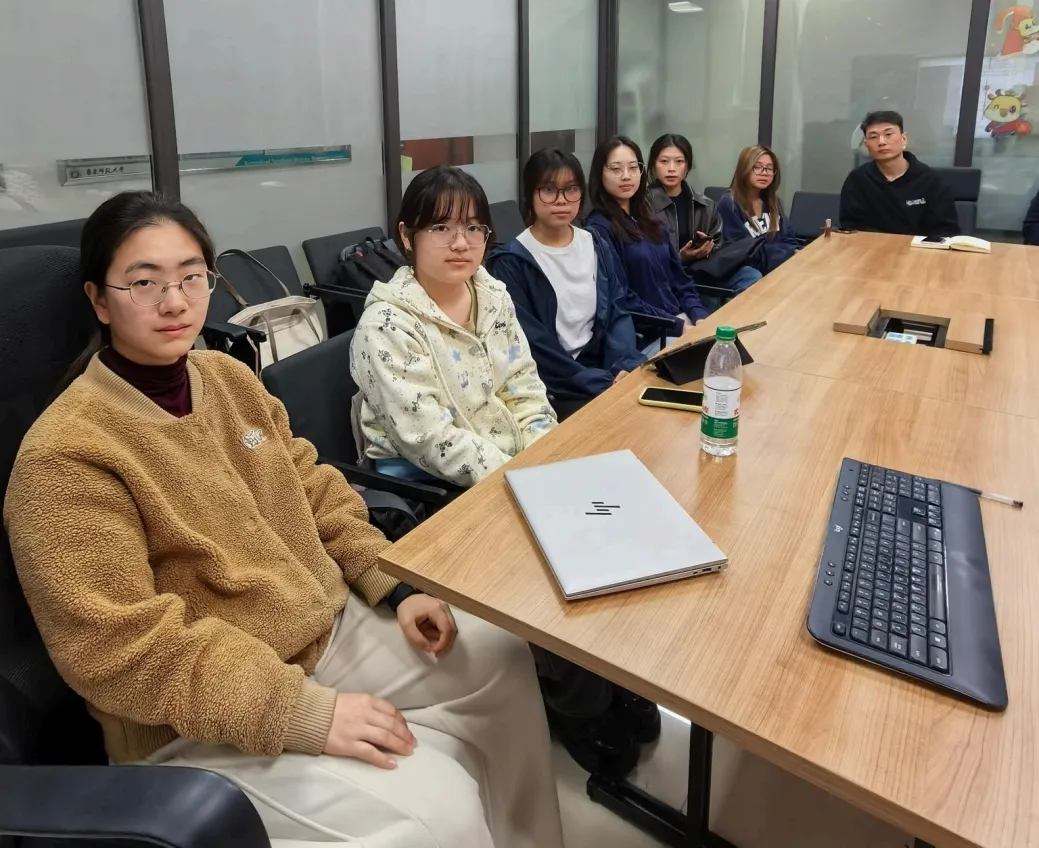
Meeting with Enterprises
Our ICP(In-Company Consulting Project)company was Shanghai SynBioEra Biotechnology Co., Ltd. (Heshengji), a biotechnology company incubated by East China Normal University (ECNU). During this ICP project, our team focused on the practical training of SciTech Business, exploring how biotechnology achievements can move from scientific innovation to market-oriented applications. The project connected technology commercialization, market research, and business strategy, helping us understand the key path of science and technology achievement transfer and transformation.
The product we worked on was a probiotic-based uric acid health support supplement approaching commercialization. From the perspective of technology achievement transfer and transformation, our task was not only to evaluate market opportunities, but also to explore how an innovative biotechnology product could achieve successful commercialization through customer validation, market positioning, and business model design.
02
Project Scope and Workflow
Our project was titled “Uric Acid Health Support Supplement: Thailand Market Feasibility & Entry Strategy”. Under the SciTech Business framework, the project aimed to support the transformation of scientific and technological achievements by evaluating market demand, commercialization feasibility, and international market entry strategies.
The main objective was to determine whether Thailand would be an attractive market for the product and, if so, how the company could successfully enter and localize the product for Thai consumers.
Our team conducted research across several areas, including Thailand’s market potential, consumer insights, competitor analysis, regulatory requirements, packaging localization, and market entry strategies.
We also conducted a consumer survey, collecting 95 responses, of which 77 passed our screening criteria and were used as valid samples. The research helped us understand consumer awareness of hyperuricemia, product preferences, price acceptance, and potential barriers to purchase.
Based on our findings, we developed recommendations covering target customers, positioning, regulatory compliance, packaging design, distribution channels, and go-to-market strategies. Our final recommendation focused on combining a distribution partnership, TCM clinic partnerships, and OEM production to achieve a relatively low-risk and controlled market entry.
03
How we over come challenges?
One of the biggest challenges was that we were working on a real product entering a foreign market, so we could not rely only on general business theories or assumptions. We needed to understand the specific needs of Thai consumers while also considering the company’s product characteristics and commercialization goals.
Another challenge was the gap between consumers’ existing perceptions of probiotics and the proposed product concept. From our research, we found that consumers commonly associated probiotics with digestive health, such as constipation and bloating, rather than uric acid management. At the same time, many consumers were highly dependent on hospitals and prescribed medication when dealing with high uric acid levels.
To address these challenges, we combined quantitative and qualitative research. We conducted a survey to understand broader consumer preferences and conducted interviews to explore deeper concerns and behaviors. We also analyzed competitors and reviewed regulatory requirements to ensure that our recommendations were realistic.
Through this process, we realized that the product should not simply be positioned as another probiotic supplement. Instead, it should build credibility as a science-based, long-term health management solution while complementing, rather than directly replacing, professional medical treatment.
04
Support and Guidance from Mentors
Our academic and corporate mentors helped us connect theoretical knowledge with real business challenges. They guided us in structuring the project, refining our research direction, and thinking critically about whether our recommendations were practical for the company.
Their guidance encouraged us to look beyond simply identifying market demand. We also needed to consider regulatory requirements, consumer trust, pricing, distribution, and the company’s ability to implement the strategy.
This support was particularly valuable because it helped us understand that a successful market entry strategy needs to balance consumer needs with the company’s resources and capabilities.
05
Courses that Helped Us
Several areas of knowledge from AEBS were particularly helpful throughout the project.
Business and marketing-related knowledge helped us conduct market analysis, segment consumers, identify target customers, and develop the product’s positioning. Research-related knowledge helped us design questionnaires, analyze consumer responses, and combine quantitative and qualitative findings.
We also applied strategic thinking when comparing different market entry options. For example, we evaluated distribution partnerships, TCM clinic partnerships, trial-size products, and OEM production based on factors such as cost, speed, risk, and level of control.
Overall, the ICP project allowed us to connect knowledge from different courses and apply it to a real business situation rather than analyzing each topic separately.
06
Personal Growth
Before and after the ICP project, we experienced a significant improvement in our capabilities. One member remarked:
The most significant improvement for me was my ability to conduct research and turn information into practical business recommendations.
Before the ICP project, I mainly viewed research as an academic process. Through this project, I learned that business research needs to answer specific strategic questions and eventually lead to actionable decisions.
One of the biggest challenges was transforming a technology-based product into a market-ready solution. As a SciTech Business practice project, we needed to balance scientific innovation with business realities. We could not rely only on general business theories; instead, we needed to understand the technology characteristics, consumer needs, regulatory environment, and commercialization pathway.
In terms of soft skills, teamwork and communication improved significantly. Since our team members came from different backgrounds, we needed to coordinate our work, discuss different opinions, and combine individual contributions into one coherent final recommendation.
The members also realized that there is still room for improvement. One of the members in the group mentioned that:
One area I would like to improve is my knowledge of regulatory requirements, especially for healthcare and dietary supplement products.
During the project, I realized that even a strong marketing strategy cannot be implemented if the product does not meet local regulatory requirements. Understanding regulations requires detailed knowledge and careful research, and this was an area where I realized I still have room to improve.
I would also like to strengthen my ability to work with larger datasets and conduct more advanced data analysis. In the future, I plan to improve these skills through further coursework, practical projects, and independent learning.
07
Difference between Real Project
and Classroom Cases
The biggest difference is the level of uncertainty and responsibility.
In classroom cases, the information is usually structured and provided to students. In a real corporate project, however, the information may be incomplete, inconsistent, or difficult to access. We had to decide what information was relevant, evaluate the reliability of different sources, and determine what additional research was necessary.
Another important difference is that a real company needs recommendations that can actually be implemented. It is not enough for a strategy to sound theoretically attractive. We needed to consider factors such as cost, regulatory requirements, consumer trust, market entry speed, and the company’s resources.
This experience taught me that real-world business problems rarely have one perfect answer. Instead, the goal is to develop the most practical solution based on available evidence and constraints.
08
Future Impacts
Some members believe that the ICP project will have an impact on their future studies and employment. Some members state as follows:
The ICP experience has given me a clearer understanding of how business knowledge can be applied in real-world situations.
Working on a project involving market research, consumer behavior, competitor analysis, regulatory considerations, and market entry strategy helped me understand that I am interested in work that combines research, strategy, and problem-solving.
The experience also gave me greater confidence in working on projects with international and cross-cultural dimensions. Since our project focused on bringing a product from China into Thailand, I had the opportunity to consider both the company’s perspective and the local market’s needs.
In the future, I believe this experience will help me when applying for internships and jobs related to business, marketing, consulting, or international business. It has also encouraged me to continue developing my analytical and strategic thinking skills.
09
Suggestions for Future Students
My biggest advice is to treat the ICP project as a real consulting project rather than just another university assignment.
Students should try to understand the company’s actual challenges before jumping to solutions. It is important to ask questions, conduct research, and be willing to change your initial assumptions when the evidence suggests otherwise.
I would also recommend paying attention to details. In our project, we initially focused heavily on market attractiveness and consumer demand, but we later realized that regulatory requirements, consumer trust, pricing, and market entry channels were equally important.
Finally, I would encourage future students to communicate closely with their teammates and mentors. A successful ICP project requires different perspectives and skills, and the final result is often stronger.
Authors | JARASOLARN PATHITA、陆熙雅
张靖欣、HNIN PWINT MIN THEIN
NGUYEN NGOC TIEN
PATTANASIN SUKHWAN、叶沛思
Review | Tingwei Jin、Nicole Sheng
Editor | Wenting Yang

⬇ 点击下方链接,阅读更多相关文章





长按二维码 关注亚欧更多资讯吧!
