夜雨聆风
夜雨聆风
有趣灵魂说

约会APP遍地开花,线下单身活动层出不穷,但越来越多的年轻人却不再约会、不再恋爱——42%的40岁以下单身者从未有过稳定关系,69%的人很少或从不约会。本文通过作者亲身参加高价“正念约会”活动的体验,以及对数十位单身男女和研究者的访谈,揭示了这场亲密关系危机背后的深层原因:性别对立加剧、经济焦虑蔓延、科技既连接又隔离,以及女性觉醒后男性却深陷角色迷茫。当爱情变得既被渴望又难以企及,我们还能找到新的联结方式吗?
译文为原创,仅供个人学习使用
The Atlantic |大西洋月刊
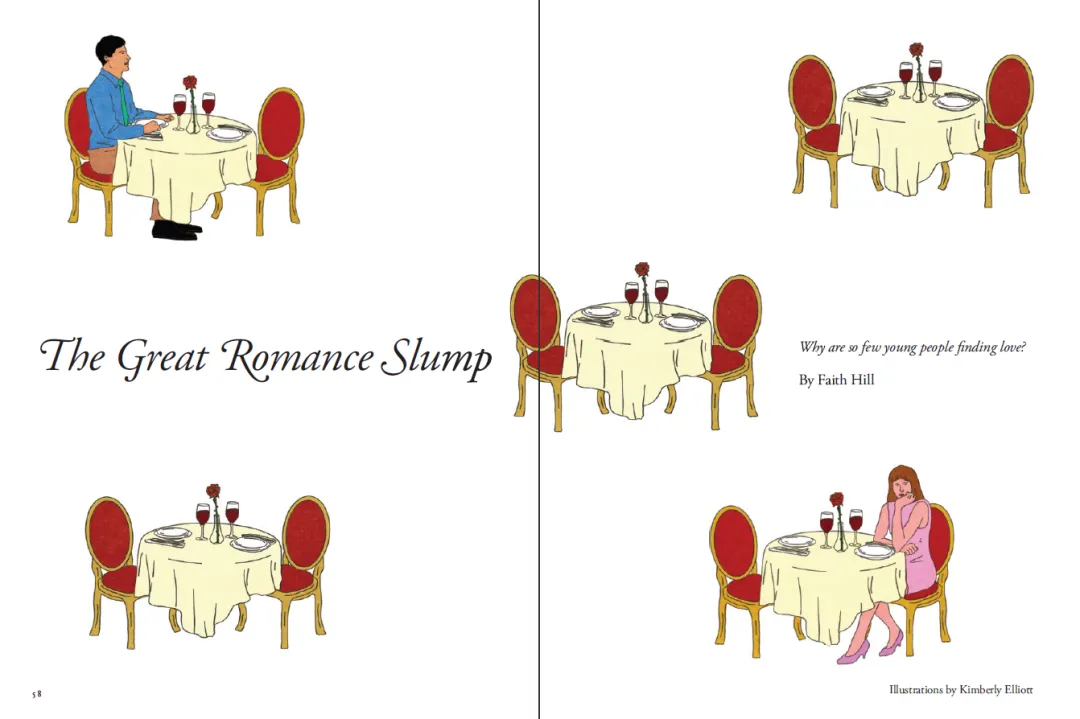
The Great Romance Slump
浪漫大萧条
Why are so few young people finding love?
为什么能找到爱情的年轻人如此之少?
By Faith Hill
与陌生人拥抱三分钟,大约进行到第90秒时,我开始觉得,孤独终老也许没那么糟。我来到曼哈顿一间烛光阁楼,参加一个名为“感觉”的正念单身活动——这个活动旨在提供与约会应用那种脱身体验截然相反的感受。参与者收起手机,结成对子,尝试一系列“躯体觉知”练习,包括凝视彼此的眼睛、拥抱,以及将手放在对方心脏的位置。
我们事先被告知,不适感是过程的一部分。一位引导员提醒我们,只要涉及同意和尊重,一点点不自在恰恰能为脆弱敞开大门。参加者花了100美元,来体验这场号称“更好相处”的课程——其理念源自荣格、佛陀,以及身体“无限的智慧”——因此大家都有动力去认同。而我们中的许多人,更多是出于境遇而非选择,早已是走出舒适区的老手。我们花了好多年时间,去结识陌生人,接受评判,拼命寻找话题,担心穿着,在办公室里用漱口水——却仍然没有找到我们想要的,或者想要的那个人。我们已准备好投入“工作”。
“感觉”在美国多个城市举办活动,它的存在本身就暗示我们正生活在一个浪漫选择极其丰富的时代。在纽约,我可以每晚都去参加一个约会活动。我可以使用婚介服务,或与约会教练交谈,或订阅那些试图复兴个人广告的新闻通讯。即使不住在大城市,我也有各种约会应用可选:不仅有Tinder和Hinge,还有无数其他平台——专为农民、游戏玩家、单亲父母、大麻爱好者,甚至无麸质饮食群体设计。我目前同时使用四个应用;写这篇文章时,其中一个应用里有317个消息线程和455个“喜欢”等待我去处理。
然而,尽管可能性如此丰富,我们却正在经历一场浪漫大萧条。“浪漫”这个词当然很宽泛。传统上,它体现在性的激情、长期伴侣的忠诚,或是求爱的仪式中——包括第一次约会那种充满希望的行为。但这些表现形式在美国都变得越来越不常见,尤其是在年轻人当中。
根据《金融时报》数据记者约翰·伯恩-默多克的分析,从1980年到2022年,25至34岁人群中结婚或同居的比例急剧下降——大学毕业生下降近10个百分点,无学位者下降超过20个百分点。拥有稳定伴侣的年轻人比例在缩小;2019年,皮尤研究中心调查显示,40岁以下的单身成年人中有42%从未有过稳定的恋爱关系。在2025年YouGov的民调中,69%的单身受访者表示他们“很少”或“从不”约会。人们的性生活也在减少。从2000年到2018年,25至34岁人群中表示过去一年没有性生活的人数比例几乎翻了一番。
这并不是说人们对爱情失去了兴趣。大多数单身年轻人表示他们想要终身伴侣。但由于种种原因,找到伴侣的人却更少了。艾莉·霍夫曼曾是一家数字媒体公司的首席执行官,2022年创办了“感觉”。她观察到,在寻找浪漫的人群中弥漫着一种“集体的‘这太糟了’”的情绪。她因此相应扩展了服务内容。在“感觉”的“二级”活动中(收费高达215美元),你可以与“处于相似认知阶段的人”配对。周末单身静修营的起价为1300美元;基于问卷和电话沟通的三次配对,加上三个月内的六次辅导课程,总共4750美元。在浪漫衰退期,有人放弃,有人加倍投入。
所以我就在这里,加倍投入,在一个陌生男人的怀里流汗。我的脖子疼。我不知道自己应该站得离他多近。(太近会失去呼吸的空间,太远则整个体验都会失败。)多年来,我一直和差不多同一群单身朋友待在同一个群聊里。我们把它命名为“孤独之心俱乐部”,它成了我们吐槽怪异约会、抱怨被“幽灵”般消失、分享抖音博主吐槽怪异约会和抱怨被消失的链接的避风港。我收到过太多次“感觉不到火花”之类的短信,以至于我开始只回复一个表情:😶。但在“感觉”活动中,我努力保持开放和乐观。我凝视过别人的眼睛三分钟,同时暗自琢磨自己眨眼的频率是否正常。我也曾被触动过——当手掌下感受到另一个人的心跳时,任何人都会有所感触。
但拥抱是最后一个环节,之后现实生活便恢复了。我们互相交谈,但那种亲密感已经消失。一个男人告诉我,他有很高的情商,也能看出我情商很高——然后他建议我们有朝一日一起去旅行,递给我他的名片,便走开了。我把电话号码给了几个人,其中一个人第二天早上就发来一张自己的照片,另一个人则给我发了太多短信(即使在我礼貌拒绝之后)以至于我不得不把他拉黑。和一个男生约会了一次,但我不感兴趣第二次。那种丰裕的感觉,再次化为乌有。
我并不是说人们需要浪漫才能感到满足。事实上,我并不认为伴侣关系天生比单身更好。作为社会,我们几十年来一直在朝这个方向前进:婚姻不再是社会和经济生存的前提,我们有了其他意义来源和社群,有许多不同的方式可以过上好生活。
然而,当我们真的走到这一步时,现实却并不那么令人振奋。如果曾经的梦想是更平等的伴侣关系——出于爱而非必要,出于自由而非传统——那么我们中很多人得到的却是根本没有伴侣,以及一种永远无法企及的感觉。特别是那些即将跨入40岁的人,尤其会感到一种迫近的失落。多伦多大学心理学家杰夫·麦克唐纳告诉我,对于没有伴侣的人来说,这个年龄段是最煎熬的。(他说:“就好像——每个人都得找条救生船。”)这是一个极度不确定的时期,人们试图弄清楚该优先考虑什么,如何规划未来,哪些梦想值得追求,哪些必须牺牲。对于想要生育自己孩子的女性来说,这也是时间所剩无几的时期。
我访谈过的一位39岁女性,在电影行业工作,她告诉我她感觉自己正站在“悬崖边缘”。她在权衡是否要孩子,知道时间不多了。她在“感觉”的周末活动中度过了一段愉快的时光,虽然没有形成持久的浪漫联结,却交到了朋友;她们在一个WhatsApp群里聊各自的约会高峰和低谷。她的生活很充实。但她仍然说:“这个世界在燃烧,我真的很想有人能和我一起面对这一切。”
我既为她,也为自己,希望如此。至少,我想理解为什么我们找不到想要的。于是我做了一件我擅长的事:去调查。我采访了数十位研究人员和全美各地的单身人士,忍受了一系列古怪但无果的约会活动,并且勇敢地让自己经历了几次真正的约会。我发现,浪漫大萧条是更广泛趋势的产物:日益恶化的性别关系、转型中的经济、社会进步的不均衡,以及既连接我们又孤立我们的技术。数百万个体的心碎,正在改写我们几个世纪以来一直讲述的爱情故事。
澄清一下:我并不怀念过去的方式。在人类历史的大部分时间里,浪漫都是偶然的。婚姻通常是一种实用安排:联合家族、整合资源的方式。工业时代,年轻人开始迁往城市工作,享受新获得的独立和闲暇;求爱从家庭客厅转移到了舞厅。但除了婚姻,女性仍然没有太多途径实现经济独立或获得性自由。我的曾祖母在20世纪初未婚先孕,这件事成为家族羞耻之源,从未被自由谈论,以至于我母亲在1950、60年代成长时,都能感受到它的阴影。
那正是婚姻的鼎盛时期,美国近90%的女性在25岁前结婚。即使第二波女权主义蓬勃发展,银行仍可能要求女性获得丈夫或男性亲属的许可,才能申请住房贷款或信用卡。1965年,避孕药合法化,但只针对已婚夫妇。几年后,我母亲当时正和男友同居,她戴上了一个假婚戒——一个从自动售货机里出来的塑料戒指——去医生那里要求开避孕药。
不过,从70年代开始,避孕和堕胎的普及开始减少“奉子成婚”的数量,更多女性进入大学和职场。对单身和酷儿关系的污名有所松动。曾经极具吸引力的核心家庭模式,失去了一些魅力。马里兰大学社会学家菲利普·N·科恩告诉我,婚姻的衰落也可以被称为选择的增加——尤其是对于女性。“50年代的家庭甚至无法在下一代身上自我复制,”他说。“他们甚至无法说服自己的孩子,这是安排人生的正确方式。所以它立刻失败了。”
我出生于1995年:在很多方面,这是一个幸运的时刻。在21世纪长大,我幻想的不是嫁给谁,而是选择怎样精彩的职业道路。(小学时我就印了名片,上面写着“心理学家:有问题?打电话给我!”并在操场上分发。)我祖母50多岁守寡后,她的朋友们——都是夫妻——就不再给她打电话了;因为和单身女性社交不合规矩。我母亲50多岁离婚时,没有被朋友抛弃,但她在一个满是已婚人士的社交圈里,始终意识到自己的单身身份。我现在31岁,我的社交圈里大多数人都是单身;不少人从未谈过恋爱。刚过去的情人节,我是和两个最好的朋友在墨西哥的海滩上度过的。
然而,对许多人来说,单身既极其正常,又完全不受欢迎。科恩说,即使是不快乐的单身状态,也是进步的标志;至少他们没有被迫与不想在一起的人结合。但这就像告诉一个蛀牙患者要感谢现代牙科一样:完全正确,但有点烦人。
在采访中,人们不断说他们知道应该为浪漫腾出时间,但那样的话,什么时候见朋友、旅行、锻炼或者在职场上进步呢?约会从来都伴随着一些艰辛,但过去人们通常在日常生活的场所——办公室、教堂、派对——找到爱情。人们不需要选择放弃什么。如今,现代生活的许多特点使人更难以在现实中自然地相遇。更多人宅在家里,远程工作,看流媒体,让人送餐上门;当我们大多数人已经习惯通过短信与那些已经“喜欢”我们的人调情时,接近陌生人就显得很冒险。于是我们依赖应用,同时又怨恨它们。约会变成了另一项需要挤时间做的事,“就像安排一场面试,”芝加哥29岁的公设辩护律师莎拉·博伊尔告诉我。“噢,让我把三周后和这个网上的陌生人约会的事记下来。”
换句话说,现代浪漫需要付出代价——精力、理智、金钱、时间——并非所有人都负担得起。2025年的一项研究(我觉得有义务提一下,研究题目叫《为爱挣够钱》)发现,收入越高的人,越有可能进入一段关系,或至少感觉自己已准备好进入一段关系。你可能会反驳说,伴侣结合实际上是精明的财务之举;的确,过去伴侣们通常先结婚,再合并资源,共同走向稳定。但当今社会学家表示,许多人将婚姻视为一种“顶点”——只有还清债务、找到稳定工作、或攒够钱买房生子后,才认为自己准备好了。加州大学伯克利分校社会学家克里斯汀·哈克内特说,过去50年里,工作保障和稳定工时越来越稀缺。这意味着传统里程碑更难达到,而把你的生计与另一个人捆绑在一起,更像是一种负担,而非优势。
此外,新冠疫情还引发了“大流行约会衰退”,斯坦福大学社会学家迈克尔·J·罗森菲尔德如是说。从2017年到2022年,美国单身成年人数量增加了约5%(超过1300万人),主要是因为年轻人见面的频率不如从前。深陷不确定性的美国人,已经不再相信旧的稳定来源——经济、婚姻、彼此——能带他们走向坚实地面。而信任缺失和不稳定对浪漫不利。
我与许多研究者讨论过数据与理论,但我想听听这到底给人什么感受——不仅仅是我的“孤独之心俱乐部”。于是我设计了一份非正式问卷,发给单身人士,询问他们如何对待约会(或不约会),对寻找伴侣有多坚定,这如何与其他生活目标协调,以及是否对找到爱情抱有希望。我收到了来自男性、女性和非二元性别者的回复,有酷儿也有异性恋,年龄从23岁到49岁,居住在俄克拉荷马城、亚特兰大、匹兹堡、俄亥俄州博林格林、俄勒冈州波特兰等地。我与不同种族和阶层背景的人交流过。我听到的是:他们中的很多人已经累了。
“约会就是不断打击我那点自信,”来自皇后区的42岁异性恋男性基思·考辛说。“这是低调的灵魂毁灭。”
“人们对承诺非常抗拒,而且这种情绪会传染,”新泽西州一位27岁的酷儿说。“独自一人、孤独却渴望,比冒着情感痛苦的风险更安全。我认为宠爱自己、善待自己,独自做些美好的事,比如带自己去约会、款待自己,效果更好。”
“我是看着迪士尼电影长大的那一代女孩,从出生就被灌输王子会来的观念,不幸的是,我仍然相信这一点,”一位26岁的洛杉矶女性写道,她成年后一直单身,尽管多年来一直努力约会。
另一位26岁的洛杉矶女性奥利维亚·梅迪纳说,2020年初,她对与一位大学同学萌芽的关系感到兴奋。然后她整个大四学年都不得不在线上度过。等到世界恢复相对正常时,她的优先级已经变了。“我基本上重新排列了重要事项的等级,”梅迪纳说。“约会排得很低,因为我已经太习惯把时间花在朋友和我喜欢做的事情上。”
当对浪漫的需求降低,而代价高昂时,有些人选择放弃。另一些人则等待一份足够梦幻的伴侣关系,来证明这一寻寻觅觅是值得的。人们一再解释,他们的生活并不缺少什么,他们只会为那个让他们心潮澎湃的人腾出空间。如此高的期望是一种巨大的历史性新事物。难点在于找到能满足它们的人。
波士顿大学人类学家乔安娜·戴维森曾住在几内亚比绍的一个村庄,她开始注意到一种特别破旧的房屋。她了解到,这些房子叫“孔戈马库”,是当地主要族群朱拉人的一种习俗——女性在丈夫去世、房屋被拆后住进这种房子。寡妇们要么借稻田种,要么讨饭吃。然而她发现,愿意再婚的人越来越少,孔戈马库的数量不断增长。“你坐着忍受丈夫的惩罚,”一位女性告诉她。“他死后,你为什么还要去受另一个男人的惩罚?”
当戴维森在华盛顿特区举行的美国人类学协会会议上讲述这些时,会场气氛充满了共鸣。满屋子的研究者都能从自己的田野调查中描绘出女性不满的深度。于是戴维森和休斯顿大学人类学家黛娜·汉纳福德发出征稿通知,最终汇集成了她们2022年出版的《退出:全球女性与婚姻的周旋》一书。她们的邮箱被来自富裕和贫穷国家的案例研究挤满了。
她们听说,在博茨瓦纳,许多孩子是由单身女性和她们亲属组成的网络抚养长大的(2024年博茨瓦纳全国250万人口中,只有约4500人结婚)。她们了解到韩国的女性,为照顾年迈家人而推迟结婚,然后环顾四周的男性,发现自己并不后悔。汉纳福德写到塞内加尔的女性,她们嫁给居住在海外的男性,或成为男性的第三、第四任妻子,希望既能避免单身带来的公众耻辱,又能逃避典型婚姻中实际、情感和性方面的付出。两位人类学家指出,全球十分之九的人生活在结婚率下降的国家。具体挑战因地而异,但全球各地的女性都已受够了。“贯穿本卷的,”戴维森和汉纳福德在序言中写道,“是普遍令人失望的男性似乎无处不在。”
不妨称之为供给问题。一些研究者认为,浪漫大萧条很大程度上是由“可婚男性”短缺造成的。但公平地说,对男性而言,旧的成功标准更难达到。在美国,稳定高薪的蓝领工作几乎已被摧毁,而大学学位几乎已成为经济稳定的先决条件,获得学位的男性却少于女性。25至54岁美国男性中,既不工作也不找工作的比例在过去70年里翻了四倍。能独自养家、或给伴侣带来安全感的人越来越少。更多受过大学教育的女性开始嫁给没有学位的男性,把其中高收入者挑走。这意味着没有学位的女性面临的选择更少——她们的结婚率也在骤降,尤其是在男性失业率和监禁率较高的地区。
与此同时,许多男性感到自己痛苦地不够格。这并不是说金钱是男性唯一能提供的;毕竟,现在需要养家糊口的女性少了。但研究者告诉我,女性如今比以往更看重的品质——敏感性、开放性、沟通能力(sensitivity, openness, communication skills)——通常并非男性从小被灌输的特质。尽管男性努力满足这些现代期望,旧标准也并未消失。男人应该为晚餐买单,同时也要平等对待女性;要主动调情,但绝不可怪异或咄咄逼人;要坚毅阳刚,同时又要善解人意、体贴周到。回应我调查的新泽西州46岁男性亚瑟说,他约会过的女性认为他“太好”了。其中一位解释说,与他分手是因为他身上的“爸爸气场”(“我不确定那是什么意思,”亚瑟告诉我,“但我猜不太性感。”)另一位说喜欢他温柔支持的态度,却也希望他更果断——在关系里“像男人”,亚瑟这样理解。他不知道如何同时表现出这两种特质。
我交谈过的其他男性觉得,浪漫的胜算对他们不利,尤其在约会应用上。他们感觉女性被匹配淹没,而他们则把“喜欢”发向虚空。“我觉得自己同时被400万女性拒绝,”来自皇后区的考辛告诉我。与我聊过的男性把男性描述成士气低落的傻瓜,而女性则是蓬勃发展的“女强人”——规则的制定者、赢家、奖品。是那些想要浪漫却并不需要浪漫的人。
但这种想法让女性听起来整体上要比实际强大和解放得多。女性大学入学率可能更高,但平均而言,在相同研究领域,她们的收入仍低于同等教育水平的男性。在典型已婚或同居的异性伴侣中,女性承担的家务仍远多于男性——即使女性是养家糊口的一方。
克里斯·斯维亚托奇是服务单身基督徒的牧师,她听到许多年轻女性因寻觅浪漫无果而心烦意乱,甚至失去希望。她们对她诉说:“我遇到很多27岁还住在家里的男生,他们是玩家,只对打游戏感兴趣。”艾莉·霍夫曼注意到,“感觉”活动中的年轻男性——尤其是Z世代男性——似乎“关系发展不足”,他们从小在屏幕前长大。他们渴望联结,但面对女性的期望时,会感到准备不足、不知所措。
我采访的女性似乎并不挑剔,而是悲观,对糟糕行为感到倦怠。一位女性曾飞去看一个男生,结果对方在她逗留的大部分时间都醉醺醺的,邻居叫她“骚货”时他也置之不理,然后在她回家不久就发短信说他们“永远不会长久在一起”。另一位女性喜欢上了一位同事,每周和他一起吃两到四次晚餐,结果发现他正正经经地另有所属。还有更多故事没有那么戏剧化:充满困惑和沉默失望,其中男性似乎无法表达甚至确定自己到底要什么。
我想,大多数女性都知道好男人是存在的。但我不怪她们对找到好男人的机会越来越悲观。过去半个世纪的女权进步遭遇了恶毒的反女性主义反弹。2025年一项涵盖30个国家的益普索民调显示,近60%的Z世代男性认为,他们的国家“在促进女性平等方面走得太远,以至于现在正在歧视男性”(美国也包括在内)。威斯康星大学麦迪逊分校社会学家杰西卡·卡拉尔科说,她的许多学生的兄弟都在看“男圈”网红安德鲁·泰特的视频,后者曾主张女性是丈夫的财产,并曾被指控强奸、攻击和人口贩卖(他否认这些指控)。如果他们在自己家人中看到这些,凭什么要去信任应用上的一个陌生人?
密歇根大学博士后汉娜·泰斯勒研究了影响单身人士是否重视浪漫伴侣关系的因素。在采访中,她发现大多数年轻男性参与者并没有详细考虑过,如果结婚生子,他们如何分担家务;他们并不真正期待做出牺牲。与此同时,年轻女性则在相应地权衡选择。有些人只有在其正平等的情况下才愿意进入伴侣关系。“我不想签约成为别人的看护者、母亲、女仆、性爱机器人、保姆、治疗师等等,”泰斯勒总结道。另一些女性则愿意接受这些,只要能拥有家庭。
44岁芝加哥人吉吉·盖尔正在考虑这类权衡。她看上去不像会追求传统安排的人。她拥有大学学历,拥有一家夜总会行业的营销公司,还与人合伙拥有一家咨询中心。但她厌倦了那些她全职工作并平摊账单的关系——而男人们却要她做饭、打扫,并充当“顾问”,如她所说,“给他们建议,重建他们的信心”。所以现在她决定尝试变得更“顺从”。她想要一个供养者,一个让她感到被照顾的人。首先,她得找到他——目前运气不佳。
盖尔的故事让我想起另一件事。曼哈顿治疗师凯莉·拉帕波特-扎肯说,她的许多单身女性来访者正在读《规则》——一本1995年出版的约会指南(即使在当时也显得过时)——因为约会类网红在推荐它。“不要用你的职业成就压过他,”该书建议,“尽量让他发光。”拉帕波特-扎肯觉得不安:所有这些聪明成功的来访者,等着男人来追求她们,努力表现得温柔无求——一切都是为了遵循一本老到警告女性不要给男人的座机打电话的书。但她理解为什么这样的指南有吸引力。她的许多来访者曾大胆追求自己想要的,结果却发现这反而把男性推开了。
我不断遇到同样疲惫的怀旧情绪:对相亲和浪漫偶遇、对稳定工作和性别规范的怀念。我采访的一些人公开表示希望有更多规则、更少选择。当现实对浪漫充满敌意,而未来又令人恐惧或不可知时,你能责怪人们回顾过去吗?
在“感觉”活动之后的几个月里,我又参加了布鲁克林和曼哈顿的其他五个约会活动。我遇到了无数饱经风霜的纽约单身圈老手——他们定期参加类似的活动,或者频繁光顾同一场。我和一位男士聊过,他说自己去过太多场,以至于给自己定了个规矩:每次间隔五个月,以免发疯。后来,当我向朋友讲述我的观察时,他说这让他想起自己找公寓时,总在参观时看到同样的人。
其中一个活动,在翠贝卡一家灯光昏暗的酒吧里,旁边就是房地产和土地使用专家的欢乐时光。参与者戴上了发光的彩色腕带。“紫色和紫色聊天!红色和黄色聊!”主持人喊道,然后她喂给我们破冰问题,比如“你的名人梦中情人是谁?”和“你理想中的约会是什么?”我去了两个活动——一个在金融区的异性恋场,和一个在布什维克的(穿着更时髦的)酷儿场——组织者用PowerPoint向观众推介他们单身的朋友。还有一个在威廉斯堡的活动,比我勇敢得多的人向全场推销自己。一位吉他手弹唱了她为自己写的歌;另一位表演了脱口秀,说她属于“美国丑”,意思是只有外国男人觉得她有吸引力。主持人开玩笑说,我们大家都太火辣了,根本不需要这种活动,所以一定是性格糟糕。
在那场自我展示活动上,我坐在一位男士旁边,他分享了一大串“雷点”(其中包括精灵短发和缺乏体能锻炼),然后自豪地说自己毫不武断。在布什维克一家餐厅式酒吧的速配之夜,我坐在指定卡座里,男人们轮流坐在对面。我和每人只有三分钟——但正如我在“感觉”中学到的,三分钟可能很漫长。当我委婉反驳一位男士关于浪漫大萧条的理论——“问题在于,女人之间谈论男人时,她们就会开始讨厌男人”——他转了话题:“你最喜欢的动物是什么?”
很难知道什么时候该从这个约会的旋转木马上下来。有些人把浪漫代价视为对自己未来的投资。在约会应用上,你可以一直投入,左滑右滑、发消息、约喝东西,再继续滑。潜在匹配的数量巨大,需要花费的时间也同样巨大,而且没有成功的保证。你尝试得越多,就越希望事情能成,也越来越不确定是否真能成。
另一些人则拒绝支付代价;他们删除应用,希望爱情会自己找上门。安特卫普大学社会学博士生玛戈·布拉克说,她不再问研究参与者是否“积极”寻找伴侣;更能引起共鸣的问题是,他们是否“愿意”接受一段关系。而许多人的确已平静接受没有伴侣的状态,她的同事埃莉丝·特·霍恩告诉我。
在这个类别中,有39岁的特雷热·桑德斯,她多年来经历了一段段认真的关系,期间全职工作、操持家务、照顾三个孩子。她总是似乎失去自我。当她决定结束这一切后,她需要的是“丈夫的钱”,但不要丈夫。于是她接受培训,成为一名从事交通基础设施的技术工程师(“很多混凝土和钢材”)。然后她用那份薪水实现了一个长期目标:购买一栋四单元房产,大部分出租。起初,没有伴侣,她很孤独。但她开始花时间在附近的建筑工会大厅,与UA Local 130的成员们亲近——几乎全是男性。“我穿着大毛衣、脏牛仔裤和靴子,头发总是乱糟糟,”她说,“我就这么自在地融入了。”她的女性朋友们对她如此珍贵,以至于从某种意义上说,她爱上了她们。她们互相请吃寿司晚餐,一起旅行。“我和我的朋友们有浪漫关系,”她说着,大笑起来:“而男人我只用来做爱。”
桑德斯说,在理想世界里,她不会单身。但这就是她的现实。我在其他采访中也听到类似的感受。亚瑟,那位未能摆脱“爸爸气场”说法的男士,决定专注于做个好人、好员工、好叔叔。他说,约会变得越来越难。经历了这么多拒绝后,向新的人敞开心扉就像是自找伤害。于是他与自己曾想象过的伴侣挥手告别。“就像失去了父母一样,”他说,“但也像其他任何事一样——你继续前行。”他一直在健身、学新语言,并花时间与八九十岁的亲戚相处。他想着——也盼着——自己正在变成一个更好的人。
“感觉”的创始人霍夫曼也曾经对自己未来有明确的愿景:灵魂伴侣、褐石联排别墅、两个孩子。“我全都规划好了,”她说,“然后并没有实现。”在三十多岁的后期,她意识到自己梦想的生活只是一个梦;她只能知道眼前有什么。她在Zoom上这么说时,开始列举身边的物品——一个橙子、一个水瓶——来表示她有多字面地理解这一点。她现在目标是“全然忠于现实”。“感觉”要求参与者一起活在当下,关注身体和呼吸。如果浪漫随之而来,那很好。但她常说,这些活动不仅仅关乎伴侣关系——更关乎联结、“具身体验”,以及“抒发情感”的机会。
霍夫曼承认,这种理念对于想要孩子的女性——尤其是三十五到四十出头的女性——很难推销。在“感觉”活动上,这个群体带着最明显的焦虑到来。她说,由于许多男性倾向于找比自己年轻的女性,这个年龄段的女性所面对的男性选择,只是“一部分中的一部分”,小得“令人痛苦”。在我的采访中,对孩子的渴望也是一条巨大的分界线。想要孩子的人往往压力最大。
现在我要坦白,我是属于“无法淡定”的那类人。寻觅了近十年后,大约两年前我在一场婚礼上遇到了一个人,他让浪漫变得出乎意料地容易。我们相距九小时的火车车程,但我逐渐习惯了美铁火车上的卡普里三明治。八个月后我们说了“我爱你”,相比我之前那些没完没了、缺乏沟通的“暧昧情事”,这感觉很复古。但他不想要孩子,而我基本确定自己想要。所以现在三十多岁的我,和他维持着异地开放式关系,同时又回到了旋转木马上:下班后直奔布鲁克林的酒吧,去见一个个陌生人,准备好度过又一个十分美好的夜晚,最终却毫无结果。
当然,人们没有伴侣也能要孩子。2024年,美国所有新生儿中有40%出生在未婚母亲家庭——是1960年比例的八倍。越来越多的男性决定成为单身父亲。巴蒂亚·诺维克是一名治疗师,服务对象包括面临生育挑战的人,她看到越来越多的单身客户来讨论卵子冷冻或试管婴儿;她听到太多关于他们恋爱生活(或缺乏恋爱生活)的故事,以至于她实际上成了约会教练。不过,独自育儿很少是首选方案。在没有同伴的情况下抚养孩子,困难、昂贵,有时还很孤独。
因此一些人正在寻找创造性的B计划。2011年,伊万·法托维奇创建了一个名为Modamily的网站,为那些想找伴侣(不一定是浪漫伴侣)共同生育孩子的人服务。法托维奇35岁时意识到这类服务可能有需求;他的女性朋友们开始担心生物钟,而她们的恋爱生活毫无进展。“也许和你一起生孩子的人,”他说,“并不是和你一起白头偕老的人。”据法托维奇说,Modamily现在拥有超过12万用户,并已促成了1000多名婴儿的出生。
通过法托维奇,我联系上了扎卡里·萨胡克和阿曼达·洛瑟,他们通过试管婴儿共同育有两个孩子,并考虑用冷冻胚胎要第三个。2019年他们在Modamily上相遇时,两人都单身且迫切想要孩子。洛瑟当时40岁,正准备自己生一个,但她觉得不妨试试这个网站。经过几个月的互相考察,谈论上帝、伦理和育儿方式后,他们决定可以很好地共同养育。他们都经历过一些痛苦的恋爱,认为这种方式可能更干脆——避免强烈的情感涌动和随之而来的失望。萨胡克希望达到我们许多人视为次优的情形:“我们会像一对幸福的离婚夫妇。”
在这个意义上,他们的梦想实现了。他们成了亲密的朋友。带着两个男孩,他们一起度假,一起过节,偶尔共进家庭晚餐。萨胡克感激洛瑟对孩子那么投入;洛瑟则很高兴能有共同抚养人,而且是一个如此温暖的人,从未让他们的处境感到尴尬。听他们讲述时,我开始想象自己也可能在Modamily上找到某人。
但随即,我带着一种失落感意识到,尽管萨胡克和洛瑟的安排不同寻常,他们仍然遵循着传统的性别角色。他们住在他位于得克萨斯州普赖斯的55英亩牧场上,但她和孩子们住在该地块的一辆活动房屋里。他经常出差工作,而她要在育儿和全职教学工作之间取得平衡。自从有了孩子后,他约会过,但她很少有时间。而且,尽管萨胡克约会的女性似乎对他们不同寻常的育儿安排感到着迷,洛瑟告诉我,她遇到的男人似乎感到威胁。“女性对积极参与孩子生活的男性确实有好感,”她说。但“一个带着两个小孩的女人,更像是负担而不是好处。”我感觉自己像冲开了一扇新门,却发现自己又站在同一个房间里。
我们生活在一个奇怪的过渡时代。女性获得了足够多的自主权可以外出工作,但许多人在家庭内部仍缺乏平等。男性本可以受益于一套新的性别规范,但美国文化很大程度上仍固守着旧规范。人们可以没有浪漫,但他们用什么来替代呢?人类学家黛娜·汉纳福德在目睹全球女性以不同方式“退出”后,担忧的是,美国单身人士被鼓励在职业成就、健康和自我实现——个体追求而非集体追求——中寻找意义。弗吉尼亚大学研究员万一风发现,在过去十年左右,未婚成年人的幸福感下降速度急剧加快——无论教育程度如何——远比已婚者更严重。从这个意义上说,单身正变得越发艰难,即使其污名在减弱。也许是因为信仰团体、公民组织和其他社群在美国生活中的作用不如从前。这些网络曾经能够缓冲孤立和经济动荡——这些现代生活的刺痛,使伴侣关系更加宝贵,却也让爱情更难寻觅。
人类学家乔安娜·戴维森告诉我,我们人性的一个特征,就是能够构想替代性的未来。但首先,我们必须正视当下。她和汉纳福德在《退出》中描述的女性,并非参与了一场有组织的反婚姻革命。她们中的大多数人仍然珍视浪漫;她们并非将单身体验为“明确的解放”,作者写道。她们只是在给定的约束中做出选择。从某种意义上说,这正是艾莉·霍夫曼的信条:“全然忠于现实”。然而,当足够多的人偏离传统——哪怕只是为了把自己的生活向前推进一点点——一场社会运动就开始了。
我不确定这场运动会把我们带向何方。但当我回想起第一次采访单身事工牧师克里斯·斯维亚托奇时,我感到了一丝希望。(“耶稣是单身,”她喜欢提醒会众。)她说,二十多岁时,她从一个男友跳到另一个男友;她负债累累,喝酒派对,试图填满“那口井”——她内心的空洞。她父母的教会里没有与她同龄的单身成员。但后来她了解到一个名为“SOLO”(单身人士为他者提供生命)的团体,正是在那里她找到了自己的意义感。现在她周游全国,教导教会领袖——大多是有孩子的已婚父亲——如何接纳那些日益增多的、填补教堂座位的单身人士。“我这样做,”她说,“因为我在各处都看到了自己的影子。”
然而,我觉得奇怪的是,尽管过着如此丰富充实的单身生活,她仍会敦促会众不要放弃浪漫。于是我追问这一矛盾。斯维亚托奇说,她仍然相信伴侣关系的美好。但她认为自己短期内不会找到,她满足于眼前的一切。她有时半开玩笑半认真地和单身朋友谈论,买些小房子,停在一个地方,建一个DIY退休村。每晚他们聚在火堆旁,做晚饭,聊聊一天的事。这是对现实的致敬,也是想象力的练习。我觉得这听起来还挺浪漫的。◾
向上滑动阅览
About 90 seconds into a three-minute hug with a stranger, I began to think that dying alone might not be so bad after all. I'd come to a candlelit loft in Manhattan for a “mindful singles event” called The Feels, which was designed to be the opposite of the disembodied experience of dating apps. Participants, phones tucked away, paired up and attempted a series of “somatic awareness” exercises, including staring into each other's eyes, hugging, and holding a hand over each other's heart.
We'd been warned that discomfort is part of the process. A facilitator had reminded us that, as long as consent and respect are involved, a little uneasiness opens the door to vulnerability. Having paid $100 for a process advertised as “better relating”—informed by Carl Jung and the Buddha and the body's “infinite wisdom”—participants were motivated to agree. And many of us, more by circumstance than by choice, were already experts in exiting our comfort zone. We'd spent years meeting strangers, opening ourselves to judgment, scrounging for conversation topics, worrying about our outfits, gargling mouthwash in the office—but we still hadn't found what, or whom, we wanted. We came ready to get to work.
The mere existence of The Feels, which hosts events in cities across the United States, suggests that we are living in a time of romantic plenty. In New York City, I could go to a dating event every night of the week. I could use a matchmaking service, or talk with a dating coach, or sign up for one of the many newsletters trying to bring back personal ads. Even if I didn't live in a major city, I'd have dating apps to choose from: not only Tinder and Hinge but a zillion others—platforms for farmers, gamers, single parents, cannabis enthusiasts, and members of the gluten-free community. I have four apps in my current rotation; as I write this, one of them has 317 message threads and 455 “likes” that I need to evaluate.
And yet, despite the bounty of possibility, we are living through a great romance slump. Romance is a broad term, of course. Traditionally, it manifests in the thrill of sex, the devotion of long-term partnership, or the ritual of courtship, including the act of hope that is a first date. But all of those manifestations are becoming less common in the U.S., especially among young people.
The proportion of 25-to-34-year-olds in marriages or cohabiting partnerships dropped steeply from 1980 to 2022—by almost 10 percentage points for college graduates and more than 20 percentage points for people without a degree, according to an analysis by the Financial Times data reporter John Burn-Murdoch. A shrinking share of young adults have a steady partner, and in 2019, 42 percent of single adults younger than 40 told Pew Research Center that they'd never been in a committed relationship. In a 2025 YouGov poll, 69 percent of single respondents said they “rarely” or “never” go on dates. And people are having less sex. From 2000 to 2018, the share of 25-to-34-year-olds who said they hadn't had sex in the previous year almost doubled.
It's not that people have lost interest in love. A majority of single young adults say they want lifelong partnership. But for a variety of reasons, fewer of them are finding it. Allie Hoffman, a former CEO of a digital-media company who launched The Feels in 2022, has observed “a collective this sucks” among romance seekers. She has expanded her offerings accordingly. At a “Level 2” Feels event, which costs up to $215, you can be paired with people “at a similar stage in their awareness journey.” A spot at a singles' weekend retreat starts at $1,300; three matches based on a questionnaire and a phone call, plus six coaching sessions over three months, total $4,750. In a romance recession, some people give up and some double down.
So here I was, doubling down, sweating in a strange man's arms. My neck hurt. I couldn't figure out how close to him I should stand. (Too near and you lose breathing room; too far and the whole enterprise falls apart.) For years I'd been in the same group chat with pretty much the same single friends. We'd labeled it the “Lonely Hearts Club,” and it became a sanctuary for dishing about weird dates, complaining about getting ghosted, sharing links to TikTokers dishing about weird dates and complaining about getting ghosted. I'd received variations of the same “I'm not feeling a spark” text so many times that I started replying with a single emoji: 😶. But at The Feels, I was trying to be open and optimistic. I'd stared into someone's eyes for three languid minutes, wondering if I was blinking a normal amount. I'd been moved, feeling another person's heartbeat beneath my palm, as anyone with a pulse would be.
The hug was the last round, though, and then real life resumed. We mingled, but the intimacy had disappeared. One man told me that he had high emotional intelligence and could tell that I did too—then he suggested that we travel together someday, handed me his business card, and walked away. I gave a few people my phone number, including one man who sent me a picture of his face the very next morning and another who texted me so much (even after a polite rebuff) that I had to block him. One date with another guy resulted, but I wasn't interested in a second. The perception of abundance had, once again, evaporated into nothing.
I don't mean to suggest that people need romance to be fulfilled. In truth, I don't believe that partnership is inherently better than singlehood. As a society, we've been moving toward this point for decades: where marriage is not a prerequisite for social and financial survival, where we have other sources of purpose and community, where there are many different ways to live a good life.
Yet now that we're here, the reality doesn't feel quite so triumphant. If the dream was more equal partnerships born from love rather than necessity, freedom rather than convention—what many of us got was no partnership at all, and a feeling that it was eternally out of reach. Those getting ever closer to 40, especially, tend to feel a particular sense of impending loss. Those are the years when the average unpartnered person struggles most with singlehood, Geoff MacDonald, a University of Toronto psychologist, told me. (“It's like—Everybody find a lifeboat,” he said.) It's a period of acute open-endedness, when people are trying to figure out what to prioritize, how to plan for the future, which dreams are worth pursuing and which have to be sacrificed. For women who want to have biological children, it's also when time is running out.
One 39-year-old I talked with, a woman who works in film, told me she felt like she was on a “precipice.” She was weighing having kids and knew the clock was ticking. She'd had a great time on a Feels weekend getaway, and although she hadn't formed a lasting romantic connection, she'd made friends; they chat in a WhatsApp group about their dating highs and lows. Her life is full. Still, she said, “the world is burning. I would really like to be able to go through that with someone.”
I wanted that for her, and for myself. Or, at least, I wanted to understand why we weren't finding what we wanted. So I did what I know how to do: I reported. I interviewed dozens of researchers and single people across the country, endured a series of curious but fruitless dating events, and bravely subjected myself to some actual dates. The romance slump, I found, is a product of broader trends: souring gender relations, a transformed economy, the unevenness of social progress, and technology that both connects and isolates us. Millions of individual heartaches are rewriting the love story we've told ourselves for centuries.
Just to be clear: I'm not nostalgic for how things used to be. For much of human history, romance was incidental. Marriage was typically a practical arrangement: a way to unite families and consolidate resources. In the Industrial Age, young people began relocating to cities for work and enjoyed newfound independence and leisure time; courtship moved from the family parlor to the dance hall. But women still didn't have many pathways, other than marriage, to financial independence or to sex. The fact that my great-grandmother got pregnant before she was married, at the beginning of the 20th century, was such a source of family shame, never freely discussed, that my mother felt its dark shadow when she was growing up in the 1950s and '60s.
That was the peak-marriage era, when almost 90 percent of women in the U.S. were married before they turned 25. Even as second-wave feminism boomed, banks could still require a woman to obtain permission from her husband or a male relative to get a home loan or apply for a credit card. In 1965, birth control was legalized, but only for married couples. A few years later, my mother, who was living with her boyfriend at the time, wore a fake wedding ring—a plastic one from a gumball machine—to her doctor appointment to request the pill.
Beginning in the '70s, though, wider access to contraception and abortion began to curb shotgun weddings, and more women entered college and the workforce. Stigmas around singlehood and queer relationships loosened. The nuclear-family model, once such a source of gravity, lost some of its pull. The decline of marriage could also be called the rise of choice—especially for women, Philip N. Cohen, a University of Maryland sociologist, told me. “The 1950s family could not even reproduce itself for one generation,” he said. “They couldn't even convince their children that this was the right way to arrange their lives. So it failed immediately.”
I came along in 1995: a lucky moment, in many ways. Growing up in the 21st century, I daydreamed not about whom I'd marry but about what fabulous career path I'd choose. (In elementary school I made business cards that said “psychologist: got a problem? CALL ME!” and distributed them on the playground.) When my grandmother was widowed in her 50s, her friends—all couples—stopped calling her; it wasn't proper for them to socialize with a single woman. When my mother got divorced in her 50s, she wasn't abandoned by her friends, but she was always aware of her single status in a social snow globe of married people. I'm 31 now, and most of the people in my circle are single; quite a few of them have never been in a relationship. I spent this past Valentine's Day on a beach in Mexico with two of my best friends.
And yet, for many people, singlehood is at once eminently normal and entirely unwanted. Even an unhappily single person, Cohen said, is a sign of progress; at least they haven't been forced to partner with someone they don't want to be with. But that's like telling someone with a cavity to be grateful for modern dentistry: completely correct and a little annoying.
In interviews, people kept saying they knew they ought to make time for romance, but then when would they see their friends or travel or exercise or get ahead at work? Dating has always entailed some hardship, but it used to be the norm to find love in everyday life—at the office, at church, at a party. People didn't need to choose what to step away from. Now many of the quirks of modern life have made meeting organically in person less likely. More people are tucked away at home, working remotely, streaming TV, and having food delivered to their door; approaching strangers feels fraught when so many of us are used to flirting via text with people who have already “liked” us. So we depend on the apps even as we resent them. Dating becomes another responsibility to squeeze in, “like you're scheduling a job interview,” Sarah Boyle, a 29-year-old public defender in Chicago, told me. “Oh, let me pencil in this date for three weeks from now with this stranger from the internet.”
Modern romance requires a toll, in other words, paid in energy, in sanity, in cash, in hours—and not everyone can afford it. One 2025 study—which, I feel obliged to report, is called “Making (Enough for) Love”—found that the higher someone's income, the more likely they were to enter into a relationship, or simply to feel ready for one. You might protest that coupling is actually a savvy financial move; indeed, it was once common for partners to marry first, then pool resources and work toward stability together. But sociologists today say that marriage is seen by many as a capstone—a trophy that people feel prepared for only after they've paid off debts, settled into a steady job, or saved enough to buy a house or have kids. Over the past 50 years, job security and stable hours have become scarcer, said Kristen Harknett, a UC Berkeley sociologist. That means traditional milestones are harder to reach—and tying your livelihood to someone else's can feel like a liability rather than an advantage.
On top of all this, COVID-19 triggered a “pandemic dating recession,” according to the Stanford sociologist Michael J. Rosenfeld. From 2017 to 2022, the number of single adults in the U.S. rose by about 5 percent (more than 13 million people), mostly because young people weren't meeting as frequently as before. Americans, mired in uncertainty, have lost faith that the old sources of stability—the economy, marriage, one another—will deliver them to solid ground. And mistrust and instability are bad for romance.
I talked with plenty of researchers about numbers and theories, but I wanted to hear how this really feels—and not just for my Lonely Hearts Club. So I created an informal survey to pass around to single people, asking how they approached dating (or didn't), how set they were on finding a partner, how that fit in with other life goals, and whether they were hopeful about finding love. I heard back from men, women, and nonbinary people, queer and straight, ages 23 to 49, living in places such as Oklahoma City; Atlanta; Pittsburgh; Bowling Green, Ohio; and Portland, Oregon. I talked with people from different race and class backgrounds. And what I heard was that a lot of them are tired.
Dating is “just a series of constant blows to whatever self‑confidence I had,” said Keith Causin, a 42-year-old straight man from Queens. “It's low-key soul destroying.”
“People are very commitment-resistant and it's contagious,” a queer 27-year-old from New Jersey said. “Being alone and lonely and wanting is safer than risking being put through emotional distress. I think romancing myself, treating myself kindly, doing nice things alone like taking myself on a date and treating myself, has yielded better results.”
“I'm a part of the generation of Disney girls who were groomed from birth that our Prince Charming was coming, and unfortunately, I still believe that,” wrote one 26-year-old woman in Los Angeles who'd been single her whole adult life, though she'd been diligently dating for years.
Olivia Medina, another 26-year-old in Los Angeles, said that, at the beginning of 2020, she'd been excited about a budding relationship with one of her college classmates. Then she had to spend her entire senior year online. By the time the world returned to relative normality, her priorities had shifted. “I had basically created a whole new hierarchy of what's important,” Medina said. “And dating was so low because I had gotten so used to just spending time with my friends and doing things that I like, for me.”
When the need for romance is low and the toll is steep, some give up. Others hold out for a partnership dreamy enough to justify the search. Again and again, people explained that their lives weren't lacking, and they would only carve out space in their days for someone who made them giddy. Having expectations this high is a magnificent historical novelty. The hard part is finding someone who can meet them.
Joanna Davidson, a Boston University anthropologist, was living in a village in Guinea-Bissau when she began to notice a particular kind of run-down house. Kungomaku, she learned, were the structures women moved into after their husbands died and their homes were torn down—a custom among the Jola ethnic group predominant in the region. The widows either borrowed rice paddies or begged for food. Yet fewer and fewer of them were willing to remarry, she determined, and the number of kungomaku kept growing. “You sit and suffer under the punishment of your husband,” one woman told her. “When he dies, why would you go get punished by another man?”
When Davidson relayed all of this at an American Anthropological Association conference in Washington, D.C., the air felt charged with recognition. A room full of researchers could chart, from their own fieldwork, the depth of women's dissatisfaction. So Davidson and Dinah Hannaford, a University of Houston anthropologist, sent out a call for contributions for what would become their 2022 book, *Opting Out: Women Messing With Marriage Around the World*. Their inboxes flooded with case studies from countries rich and poor.
In Botswana, they heard, many children are raised within networks of single women and their kin. (Only about 4,500 Botswanaans married in 2024, out of a population of 2.5 million.) They learned about women in South Korea who had delayed marriage to take care of aging family members—then realized, looking around at the men in their lives, that they had no regrets. Hannaford wrote about women in Senegal marrying men who live abroad, or becoming a man's third or fourth wife, in the hopes of evading both the public disgrace of singlehood and the practical, emotional, and sexual labor of a typical union. Nine out of 10 people worldwide, the anthropologists pointed out, live in a country with falling marriage rates. The specific challenges varied by location, but all over the globe, women were fed up. “Embedded throughout this volume,” Davidson and Hannaford wrote in their introduction, “is the seeming ubiquity of generally disappointing men.”
Call it a supply problem. Some researchers think that the great romance slump has been caused largely by a shortage of “marriageable men.” But, to be fair to men, the old standards of success have become harder to achieve. In the United States, steady, well-paying blue-collar jobs have been all but decimated, and fewer men than women are earning the college degrees that have become almost a prerequisite for financial stability. The percentage of 25-to-54-year-old American men who are neither working nor seeking employment quadrupled over the past 70 years. A vanishing portion can single-handedly support a family, or offer a partner any sense of security. More college-educated women have begun marrying men without a degree, picking off the high earners among them. This means that women without a degree are, in turn, left with fewer prospects—and their marriage rates are plummeting, especially in areas where men face higher rates of joblessness and incarceration.
Meanwhile, a lot of men are feeling painfully inadequate. It's not that money is the only thing a man can offer; after all, fewer women need a breadwinner now. But researchers told me that the qualities women now value more than ever—sensitivity, openness, communication skills—are not typically ingrained in men from childhood. And although men strive to meet those modern expectations, the old standards haven't disappeared. Men are supposed to pay for dinner but also treat women as equals; to initiate flirty banter but never be creepy or aggressive; to be sturdy and masculine but also empathetic and thoughtful. Arthur, a 46-year-old in New Jersey who responded to my survey, said that he's dated women who think he's too nice. One explained that she broke up with him because he has “dad energy.” (“I'm not 100 percent sure what that means,” Arthur told me, “but I'm guessing it's not very sexy.”) Another said she liked how sweet and supportive he was, yet also wanted him to be more decisive—to be “the man” in the relationship, as Arthur saw it. He wasn't sure how to exhibit both traits at once.
Other men I spoke with felt like the romantic odds were stacked against them, especially on dating apps. They had the sense that women were drowning in matches, while they were sending “likes” into the void. “I feel like I'm being rejected by 4 million women at once,” Causin, the man from Queens, told me. The guys I talked with described men as demoralized schmucks and women as thriving girlbosses—the rule-setters, the winners, and the prize. The ones who want romance but do not need it.
But that idea makes women sound a lot more powerful and liberated than they really are, as a whole. Women may be going to college at higher rates, but they still make less, on average, than men with a comparable education in the same field of study. In the typical married or cohabiting straight couple, women still do much more of the domestic labor—even when the woman is the breadwinner.
Kris Swiatocho, who ministers to single Christians, hears from many young women who are so exasperated by their search for romance that they are losing hope. They tell her versions of “I'm meeting a lot of guys who still live at home at 27. And they're gamers. And that's all they're interested in doing.” Allie Hoffman has noticed that many of the younger men at The Feels events seem “relationally underdeveloped”—particularly Gen Z men, who have grown up in front of screens. They want connection but, when confronted with women's expectations, they can feel underequipped and overwhelmed.
The women I interviewed didn't seem picky so much as pessimistic, and burned out on bad behavior. One had flown to visit a guy who was drunk for most of her stay, brushed off his neighbor calling her a “piece of ass,” and then, soon after she returned home, texted her that they were “never going to be together long-term.” Another woman had fallen for a co-worker with whom she was getting dinner two to four times a week—and who turned out to be seriously dating someone else. A lot of stories were less dramatic: tales of confusion and quiet disappointment, featuring men who couldn't seem to express or even decide what they wanted.
Most women, I think, know that good men are out there. But I don't blame them for growing cynical about the chances of finding one. The feminist progress of the past half century has been met with a virulent backlash of misogyny. Nearly 60 percent of Gen Z men say that their country has “gone so far in promoting women's equality that we are discriminating against men,” according to a 2025 Ipsos poll of 30 countries, including the United States. Jessica Calarco, a sociologist at the University of Wisconsin at Madison, said that many of her students' brothers watch videos of the manosphere influencer Andrew Tate, who has argued that women are the property of their husband, and who has been accused of rape, assault, and human trafficking (allegations he denies). If that's what they're seeing within their own family, why should they trust a stranger from an app?
Hannah Tessler, a postdoctoral fellow at the University of Michigan, has studied the factors that influence whether singles value romantic partnership. In interviews, she found that most young male participants hadn't considered in much detail how they'd split household labor if they married or had kids with a partner; they weren't really expecting to make sacrifices. Young women, meanwhile, were weighing their choices accordingly. Some wanted a partnership only if it was truly equal. “I don't want to sign up to be somebody else's, you know, caregiver, mom, maid, sex robot, nanny, therapist, etc.,” Tessler summarized. Other women were willing to do just that, if it meant they could have a family.
Gigi Gayle, a 44-year-old in Chicago, has been considering these sorts of trade-offs. She's not someone you'd expect to be looking for a more traditional arrangement. She's a college graduate who owns a marketing company in the nightclub industry and co-owns a counseling center. But she got tired of relationships in which she worked full-time and split the bills—and the men wanted her to cook, clean, and generally act like a “counselor,” as she put it, “giving them advice, building them back up.” So now, she's decided to try leaning into being “more submissive.” She wants a provider, someone who'll make her feel cared for. First, she'll have to find him—and she's not having any luck.
Gayle's story reminded me of something else I'd heard. Carrie Rappaport-Zaken, a Manhattan therapist, said that many of her single female clients have been reading *The Rules*, a dating guide that was published in 1995 (and was seen as retrograde even back then), because romance influencers are recommending it. “Don't overwhelm him with your career triumphs,” the book advises. “Try to let him shine.” Rappaport-Zaken finds it unnerving: all these smart, successful clients waiting for men to pursue them, trying to appear soft and undemanding—all in deference to a book so old that it warns women not to call a man's landline. But she understands why a blueprint like this is appealing. Plenty of her clients have tried going boldly after what they want, only to find that this turns men away.
I kept encountering the same weary nostalgia: for setups and meet-cutes, for steady jobs and gender norms. Some people I interviewed wished openly for more rules and fewer choices. When the present feels hostile to romance, and the future is frightening or unknowable, can you blame people for looking to the past?
In the months following The Feels, I attended five other dating events across Brooklyn and Manhattan. I met countless jaded veterans of the New York singles' circuit—who regularly showed up to similar affairs, or frequented the same one. I chatted with a man who said he'd been to so many that he'd had to institute a rule for himself: five months between each, so as not to lose his mind. Later, when I recounted my observations to a friend, he said it reminded him of when he'd been looking for an apartment and kept seeing the same people on tours.
One event, at a dimly lit Tribeca bar, was smushed next to a happy hour for real-estate and land-use experts. Attendees were given glowing colored wristbands. “Purple talk to purple! Red talk to yellow!” the emcee called out, and then she spoon-fed us icebreaker questions such as “Who is your celebrity crush?” and “What's your dream date?” I went to two events—a straight one in the Financial District and a (better-dressed) queer one in Bushwick—where presenters used PowerPoint to pitch their single friends to the crowd. At yet another, in Williamsburg, people much braver than me pitched themselves to the room. One guitarist crooned a song she'd written about herself; another did a stand-up routine about how she's “American ugly,” meaning only men from other countries find her attractive. The host joked that we were all too hot to need an event like this, so our personalities must be terrible.
At the self-presentation event, I sat with a man who shared a sprawling list of deal-breakers (pixie cuts and lack of physical fitness among them) and then proudly described himself as nonjudgmental. During a speed-dating night at a diner-like bar in Bushwick, I held court at my assigned booth while men rotated through the spot opposite me. I had only three minutes with each—but as I'd learned at The Feels, three minutes can last a long time. When I gently pushed back against one man's theory about the romance slump—“The problem is that when women talk to one another about men, they start to hate them”—he changed the subject: “What's your favorite animal?”
It's hard to know when to get off the dating merry-go-round. Some people view the romance toll as an investment in their future self. On dating apps, you can always keep putting in the work, swiping and messaging and grabbing drinks and swiping again. The volume of potential matches is enormous, and so is the amount of time required to investigate each one, with no guarantees of success. The more you try, the more you want things to work out, and the less sure you become that they will.
Others refuse to pay the toll; they delete the apps and hope love will find them. Margot Bracke, a doctoral student in sociology at the University of Antwerp, said she no longer asks study participants if they are “actively” looking for a partner; the question that resonates more is whether they are “open” to a relationship. And many have simply made peace with not being in one, her colleague Elise 't Hoen told me.
In this last category is Treasure Saunders, a 39-year-old who spent years in a string of serious relationships, during which she worked full-time, handled the housework, and took care of her three kids. She always seemed to lose her sense of self. When she decided she was done, she needed “husband money,” but without the husband. So she trained to become a technical engineer working on transportation infrastructure (“Lots of concrete and steel”). Then she used that salary to achieve a long-standing goal: purchasing a four-unit property, most of which she rents out. At first, without a partner, she was lonely. But she started spending time at a nearby union hall for construction tradespeople and getting close to her fellow UA Local 130 members—almost all men. “I have the big sweaters and the dirty jeans and the boots, and my hair is always a mess,” she said. “I kinda just settled right on in.” And her girlfriends are so precious to her that she is, in a certain way, in love with them. They take one another out to sushi dinners. They travel together. “I'm romantically involved with my friends,” she said, adding with a hoot of laughter: “And I use men for sex.”
In a perfect world, Saunders said, she wouldn't be single. But this is her reality. I heard similar sentiments in other interviews. Arthur, not beating the dad-energy allegations, has decided to focus on being a good guy, a good employee, and a good uncle. Dating kept getting harder and harder, he said. After so much rejection, opening up to new people feels like asking to get hurt. So he's said goodbye to the partner he'd once imagined. “It was like I lost a parent,” he told me. “But it's like anything else, you know—you move on.” He's been getting back in shape, learning new languages, and spending time with relatives in their 80s and 90s. He thinks—hopes—he's becoming a better person.
Hoffman, the Feels founder, also once had a specific vision for her future: a soul mate, a brownstone, two kids. “I had it all figured out,” she said, “and then it didn't happen.” In her late 30s, she realized that her dream life was just a dream; she could only know what was right in front of her. As she said this over Zoom, she started naming things around her—an orange, a water bottle—to indicate how literally she meant this. Her goal now is “total devotion to reality.” The Feels asks participants to be in the moment together, paying attention to their bodies and their breathing. If romance follows, great. But she's often said that the events aren't just about partnership—they're about connection, “embodiment,” the chance to “emote.”
Hoffman acknowledges that this philosophy is a tough sell for women who want kids—especially those in their late 30s to early 40s. At Feels events, that's the population that arrives with the most palpable anxiety. Because so many men date down in age, she said, women in that bracket are left with a “portion of the portion” of male prospects that is “excruciatingly small.” In my interviews, too, baby-longing was the great dividing line. The aspiring parents tended to feel most stressed.
I will confess, now, that I am among the ones with no chill. After searching for nearly a decade, I met someone at a wedding almost two years ago who made romance feel unexpectedly easy. We're a nine-hour train ride apart, but I grew accustomed to the Amtrak caprese sandwich. We said “I love you” eight months in, which felt positively retro compared with my previous interminable, communication-free situationships. But he doesn't want kids, and I'm pretty sure I do. So here I am in my 30s, in a long-distance open relationship with him and somehow also back on the merry-go-round: running straight from work to meet strangers in bars across Brooklyn, prepared for another perfectly nice evening that will ultimately lead nowhere.
Of course, people have kids without a partner all the time. In 2024, 40 percent of all babies in the U.S. were born to unmarried women—eight times the share in 1960. A growing number of men are deciding to become single dads. Batya Novick, a therapist who works with people facing reproductive challenges, is seeing more single clients who want to discuss egg freezing or IVF; she hears so much about their romantic lives, or lack thereof, that she's become a de facto dating coach. Solo parenting, though, is rarely Plan A. Raising a kid without a teammate is difficult, expensive, and sometimes lonely.
So some people are looking for creative Plan Bs. In 2011, Ivan Fatovic created a website called Modamily for people in search of a partner—not necessarily a romantic one—to have a child with. Fatovic was 35 when he realized that there might be demand for such a service; his female friends were starting to worry about their biological clocks, and their dating lives weren't going anywhere. “Maybe the person that you have children with,” he said, “is not the person that you grow old with.” Modamily now has more than 120,000 users, and it's led to more than 1,000 babies being born, according to Fatovic.
Through Fatovic, I got in touch with Zachary Sahuque and Amanda Lohse, who have two children together from IVF, and are considering using their frozen embryos for a third. When they met on Modamily in 2019, they were both single and antsy to have kids. Lohse was 40 and preparing to have a child on her own, but figured she'd give the site a shot. After vetting each other for a few months, talking about God and ethics and parenting styles, they decided they could work well as co-parents. They'd both been through some painful romantic experiences and thought this way might be cleaner—avoiding the great rush of feelings and the disappointment when they fade. Sahuque hoped for what many of us consider a second-best-case scenario: “We'll be like a happily divorced couple.”
In that sense, their dream came true. They've become close friends. With their two boys, they go on vacations, spend holidays together, and have the occasional family dinner. Sahuque is grateful for how dedicated Lohse is to the kids; Lohse is happy to have a co-parent at all, but especially someone so warm, who has never made their situation feel awkward. Listening to them, I started imagining that I, too, might find someone on Modamily.
But then I realized, with a sinking feeling, that as unconventional as Sahuque and Lohse's setup is, they still follow traditional gender roles. They reside on his 55-acre ranch in Price, Texas, but she and the kids live in a mobile home on the property. He travels constantly for work, and she balances child care and a full-time teaching job. He's dated since they had kids, but she rarely has the time. And although the women Sahuque has dated seem charmed by their unusual parenting arrangement, she told me, the men she's met seem threatened by it. “There's just something that draws women to men who are actively involved in their kids' lives,” she said. But “a woman with two little kids is more of a burden than a benefit.” I felt like I'd burst through a new door only to find myself in the same room.
We're living in a strange in‑between time. Women have gained enough agency to work outside the home, but many still lack equality within it. Men could benefit from a new set of gender norms, but much of American culture embraces the old ones. People can do without romance, but what are they replacing it with? The anthropologist Dinah Hannaford's concern, after seeing women around the globe “opt out” in different ways, is that single Americans are encouraged to find meaning in professional gain, wellness, and self‑actualization—individual pursuits rather than collective ones. In the past decade or so, happiness rates have declined precipitously for unmarried adults—regardless of education level—much more so than for those who are married, Yifeng Wan, a researcher at the University of Virginia, has found. In that sense, singlehood is getting harder, even as it's less stigmatized. Perhaps that's because faith groups, civic organizations, and other communities play a less central role in American life than they once did. These networks used to buffer against isolation and economic displacement—the thorns of modern life that make partnership more valuable yet love more difficult to find.
One of the things that makes us human, the anthropologist Joanna Davidson told me, is that we can envision alternative futures. But first, we must look frankly at the present. The women she and Hannaford featured in *Opting Out* weren't part of an orchestrated revolution against marriage. Most of them still valued romance; they didn't experience singlehood as “unequivocally liberating,” the authors wrote. They simply made choices within their given constraints. This was Allie Hoffman's credo, in a way: “total devotion to reality.” Yet when enough people veer from tradition—if only to inch their own life forward—a social movement begins.
I'm not sure where this one is leading us. But I feel hopeful when I think back to my first interview with Kris Swiatocho, the singles minister. (“Jesus was single,” she likes to remind congregants.) In her 20s, she said, she'd hopped from boyfriend to boyfriend; she was in debt, drinking and partying to try to fill “the well”—the empty place within her. Her parents' church didn't have any single members around her age. But then she learned about a group called Singles Offering Life to Others, or SOLO, and that's where she found her sense of purpose. Now she tours the country teaching church leaders, who are mostly married fathers, how to engage the growing number of single people they need to fill their pews. “I do this,” she said, “because I see me everywhere out there.”
I found it curious, though, that despite living such a rich, full life as a single person, she urges congregants not to give up on romance. So I asked about the discrepancy. Swiatocho still believes in the beauty of partnership, she said. But she doesn't think that she'll find it anytime soon, and she's content with what's in front of her. She talks with single friends sometimes—half joking, half serious—about buying tiny homes, parking them somewhere, and making a DIY retirement village. Each night they would gather around a firepit, cook dinner, and talk about their day. It's a tribute to reality and also an exercise in imagination. Sounds pretty romantic to me.