ARTICLE · 979863
AI数据中心闭环液冷:从GPU硅芯片到最终排热
AI数据中心闭环液冷:从GPU硅芯片到最终排热转发自Linkedlin。 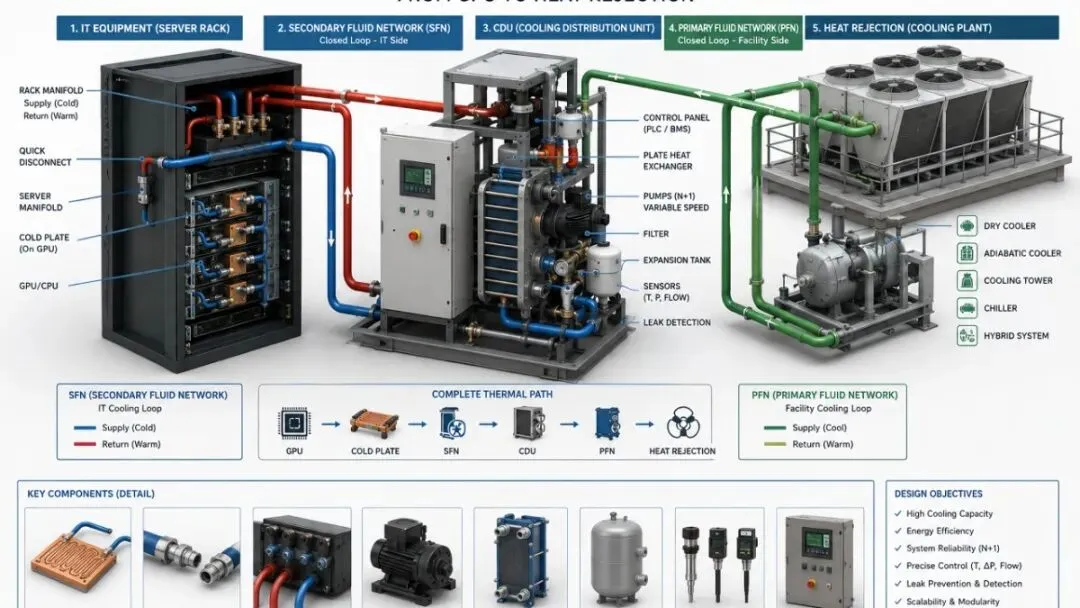
AI Data Center Closed‑Loop Liquid Cooling: From GPU Silicon to Final Heat Rejection 作者:Aung Tun,机械工程师 开篇总述 English As AI computing density increases, cooling is becoming one of the most important system‑level design challenges in modern data centers. 中文 随着AI算力密度不断提升,冷却已经成为现代数据中心最为关键的系统级设计难题之一。 English Traditional enterprise racks may operate at relatively moderate power densities, but GPU‑intensive AI infrastructure can move into the 100 kW, 150 kW, 200 kW and higher rack‑density range. 中文 传统企业机柜运行功率密度相对适中,但是以GPU为主的AI基础设施机柜功率密度可达100千瓦、150千瓦、200千瓦甚至更高。 English At these levels, cooling can no longer be treated simply as an HVAC problem. 中文 在该功率等级下,冷却不再仅仅被视作暖通空调问题。 English The thermal architecture must be designed as an integrated system connecting: GPU/CPU → TIM → Cold Plate → Server Manifold → Rack Manifold → Secondary Fluid Network → CDU → Primary Fluid Network → Cooling Plant → Outdoor Heat Rejection 中文 热架构必须作为一套完整集成系统进行设计,链路如下: 图形处理器/中央处理器 → 热界面材料 → 冷板 → 服务器集水歧管 → 机柜集水歧管 → 二次流体管网 → 冷却分配单元 → 一次流体管网 → 制冷站 → 室外排热 English Every component along this path affects temperature, flow, reliability, redundancy and ultimately GPU performance. 中文 这条回路上面的每一个部件都会影响温度、流量、可靠性、冗余,最终影响GPU运行性能。 本章重点词汇&美式音标 1. computing density /kəmˈpjuːtɪŋ ˈdensəti/ n. 算力密度 2. rack-density /ræk ˈdensəti/ n. 机柜功率密度 3. HVAC /ˌeɪtʃ viː ˈeɪ siː/ n. 暖通空调 4. thermal architecture /ˈθɜːrml ˈɑːrkɪtektʃər/ n. 热架构 5. component /kəmˈpoʊnənt/ n. 零部件 6. redundancy /rɪˈdʌndənsi/ n. 冗余 1. Heat Generation Starts Inside the GPU 1. 热量始于GPU芯片内部 English The cooling process begins at the silicon. 中文 冷却流程从硅晶片开始。 English Electrical power supplied to GPUs, CPUs, memory, networking components and power electronics ultimately becomes heat. 中文 供给GPU、CPU、内存、网络组件、电力电子器件的电能,最终都会转化成热量。 English For engineering purposes: IT electrical power ≈ IT heat load 中文 工程近似公式: IT设备电功率 ≈ IT设备热负荷 English A rack consuming approximately 120 kW therefore requires the cooling infrastructure to continuously remove approximately 120 kW of thermal energy. 中文 因此,一台功耗约120千瓦的机柜,冷却基础设施需要持续带走约120千瓦的热能。 English But the important issue is that AI heat loads are highly dynamic. 中文 但是一个关键问题:AI设备的热负荷具备高度动态变化特性。 English GPU utilization can change rapidly depending on: ‑ Training workload ‑ Inference workload ‑ Batch size ‑ Model architecture ‑ Power capping ‑ Workload scheduling ‑ GPU boost conditions ‑ Server configuration ‑ Network utilization 中文 GPU负载利用率会受以下因素快速变化: ‑ 训练负载 ‑ 推理负载 ‑ 批处理大小 ‑ 模型架构 ‑ 功率上限 ‑ 负载调度 ‑ GPU睿频工况 ‑ 服务器配置 ‑ 网络利用率 English Therefore, the cooling system must handle not only the maximum design heat load but also rapid changes in thermal demand. 中文 所以冷却系统不仅要满足最大设计热负荷,还必须应对热需求的快速波动。 English This is why modern liquid‑cooling systems require active control of: Temperature + Flow + Differential Pressure + Pump Speed 中文 这就是现代液冷系统需要主动调控以下参数的原因: 温度 + 流量 + 压差 + 水泵转速 本章重点词汇&美式音标 1. silicon /ˈsɪlɪkən/ n. 硅晶片 2. heat load /hiːt loʊd/ n. 热负荷 3. dynamic /daɪˈnæmɪk/ adj. 动态的 4. utilization /ˌjuːtələˈzeɪʃn/ n. 利用率 5. inference workload /ˈɪnfərəns ˈwɜːrkloʊd/ n. 推理负载 6. differential pressure /ˌdɪfəˈrenʃl ˈpreʃər/ n. 压差 2. GPU → Thermal Interface Material 2. GPU → 热界面材料 English The first thermal resistance exists between the semiconductor package and the cooling device. 中文 第一道热阻存在于半导体封装与冷却器件之间。 English The heat path can be simplified as: GPU Die → Package/Heat Spreader → TIM → Cold Plate 中文 热量传递路径可简化为: GPU裸芯片 → 封装/均热板 → 热界面材料 → 冷板 English The Thermal Interface Material, or TIM, fills microscopic air gaps between surfaces. 中文 热界面材料(TIM)用来填充接触面之间微小的空气缝隙。 English Without effective TIM contact, even an advanced cold plate can perform poorly because heat transfer from the processor into the cold plate becomes restricted. 中文 如果TIM接触效果不佳,即便高性能冷板散热效果也会变差,处理器向冷板的热量传递将受到阻碍。 English Important design considerations include: ‑ TIM thermal conductivity ‑ TIM thickness ‑ Compression pressure ‑ Surface flatness ‑ Contact resistance ‑ Pump‑out resistance ‑ Long‑term material degradation ‑ Thermal cycling performance 中文 关键设计考量项: ‑ 热界面材料导热系数 ‑ 热界面材料厚度 ‑ 压紧压力 ‑ 接触面平面度 ‑ 接触热阻 ‑ 抗挤出性能 ‑ 材料长期老化 ‑ 冷热循环性能 English The objective is simple: Minimize thermal resistance between the silicon and the coolant. 中文 设计目标很明确: 尽可能降低硅晶片与冷却液之间的热阻。 本章重点词汇&美式音标 1. TIM (Thermal Interface Material) /ˈθɜːrml ˈɪntərfeɪs məˈtɪriəl/ n. 热界面材料 2. thermal resistance /ˈθɜːrml rɪˈzɪstəns/ n. 热阻 3. thermal conductivity /ˈθɜːrml ˌkɑːndʌkˈtɪvəti/ n. 导热系数 4. coolant /ˈkuːlənt/ n. 冷却液 5. degradation /ˌdeɡrəˈdeɪʃn/ n. 老化、劣化 3. Cold Plate — Capturing Heat Directly at the Processor 3. 冷板 — 在处理器表面直接带走热量 English The cold plate is one of the most critical components in direct‑to‑chip liquid cooling. 中文 冷板是芯片级直冷液冷方案当中最核心部件之一。 English Instead of transferring processor heat into server air, coolant flows directly through a cold plate mounted on the GPU or CPU. 中文 冷却液不再先把处理器热量散发至服务器空气当中,而是直接流经安装在GPU或CPU上方的冷板。 English A typical cold plate includes: ‑ Copper or high‑conductivity base ‑ Internal microchannels or micro‑fin structures ‑ Coolant inlet ‑ Coolant outlet ‑ Sealing system ‑ Mechanical mounting structure 中文 一台标准冷板包含: ‑ 铜制或高导热基底 ‑ 内部微通道或微肋结构 ‑ 冷却液进水口 ‑ 冷却液出水口 ‑ 密封组件 ‑ 机械安装支架 English Inside the cold plate, thermal energy moves: Silicon → TIM → Copper Base → Microchannels → Liquid Coolant 中文 冷板内部热量传递路径: 硅晶片 → 热界面材料 → 铜基底 → 微通道 → 液态冷却液 English The internal channel geometry is extremely important. 中文 冷板内部流道几何结构至关重要。 English Smaller channels can improve heat‑transfer performance by increasing surface area and turbulence, but they also increase pressure drop. 中文 更小的流道可以增大换热面积、增强流体湍流,以此提升换热效率,但同时也会增大压降。 English That creates an engineering trade‑off: Higher heat‑transfer coefficient ↔ Higher hydraulic resistance 中文 由此带来工程取舍平衡: 更高换热系数 ⇋ 更高水力阻力 English The cold plate must therefore be optimized for both thermal performance and hydraulic efficiency. 中文 因此冷板必须同时优化散热性能与水力效率。 本章重点词汇&美式音标 1. cold plate /koʊld pleɪt/ n. 冷板 2. direct-to-chip /dəˈrekt tə tʃɪp/ adj. 芯片直冷的 3. microchannel /ˈmaɪkroʊˌtʃænl/ n. 微通道 4. turbulence /ˈtɜːrbjələns/ n. 湍流 5. pressure drop /ˈpreʃər drɑːp/ n. 压降 6. hydraulic resistance /haɪˈdrɔːlɪk rɪˈzɪstəns/ n. 水力阻力 7. heat-transfer coefficient /hiːt trænsˈfɜːr ˌkoʊɪˈfɪʃnt/ n. 换热系数 4. Server‑Level Liquid Distribution 4. 服务器层级液体分配 English The coolant leaving the cold plate flows through internal server piping. 中文 离开冷板的冷却液流经服务器内部管路。 English A GPU server may contain several cold plates serving: ‑ GPUs ‑ CPUs ‑ Memory components ‑ Voltage regulators ‑ Network processors ‑ Other high‑heat devices 中文 一台GPU服务器可能有多块冷板,分别给下面部件散热: ‑ 图形处理器 ‑ 中央处理器 ‑ 内存组件 ‑ 稳压模块 ‑ 网络处理器 ‑ 其余高发热量器件 English These components may be connected through parallel or series hydraulic arrangements. 中文 这些散热部件水路可采用并联或者串联布置。 English Parallel flow is often desirable because each device can receive relatively similar coolant inlet conditions. 中文 并联水路往往是优选方案,每一个设备进水工况基本保持一致。 English However, parallel circuits introduce another challenge: Flow balancing. 中文 但是并联回路带来另一个难题:流量平衡。 English If one cold plate has significantly lower hydraulic resistance than another, it may receive excessive flow while another receives insufficient flow. 中文 如果一块冷板水力阻力远小于另一块,就会出现一部分冷板流量过大、另一部分冷板流量不足。 English This means the system must be designed carefully around: ‑ Branch resistance ‑ Hose diameter ‑ Channel pressure drop ‑ Manifold geometry ‑ Quick‑disconnect pressure drop ‑ Flow balancing ‑ Temperature uniformity 中文 系统设计必须着重考虑以下参数: ‑ 支路阻力 ‑ 软管管径 ‑ 流道压降 ‑ 集水歧管几何结构 ‑ 快接头压降 ‑ 流量平衡 ‑ 温度均匀性 本章重点词汇&美式音标 1. parallel flow /ˈpærəlel floʊ/ n. 并联流路 2. series flow /ˈsɪriz floʊ/ n. 串联流路 3. flow balancing /floʊ ˈbælənsɪŋ/ n. 流量平衡 4. excessive /ɪkˈsesɪv/ adj. 过量的 5. insufficient /ˌɪnsəˈfɪʃnt/ adj. 不足的 6. uniformity /ˌjuːnɪˈfɔːrməti/ n. 均匀性 5. Non‑Spill Quick Disconnects 5. 无泄漏快速接头 English The server must eventually connect to the rack liquid distribution system. 中文 服务器水路最终需要和机柜液体分配系统相连。 English This connection commonly uses non‑spill quick disconnects. 中文 该连接普遍使用无泄漏快速接头。 English These connectors allow servers to be installed, removed or serviced without draining the entire rack cooling loop. 中文 使用该接头可以直接安装、拆除、检修服务器,而不需要排空整个机柜冷却回路。 English Important requirements include: ‑ Very low leakage ‑ Minimal coolant loss during disconnect ‑ Low pressure drop ‑ High cycle life ‑ Correct material compatibility ‑ Reliable sealing ‑ Mechanical robustness ‑ Serviceability 中文 关键性能要求: ‑ 极低泄漏量 ‑ 拔开接头时冷却液损耗极小 ‑ 低压降 ‑ 高插拔使用寿命 ‑ 材料兼容性合格 ‑ 密封可靠 ‑ 机械强度高 ‑ 易维护 English Quick disconnects appear simple, but they can become major hydraulic restrictions when hundreds or thousands are installed throughout an AI data center. 中文 快速接头看似简单,但是当AI数据中心有成百上千个接头时,接头会成为水路当中巨大的阻力。 English A small pressure loss at one connector becomes significant when multiplied across the entire cooling network. 中文 单个接头微小的压力损失,经过整个冷却管网叠加后,总压降就会变得很大。 本章重点词汇&美式音标 1. non-spill /nɑːn spɪl/ adj. 无泄漏的 2. quick disconnect /kwɪk ˌdɪskəˈnekt/ n. 快速接头 3. leakage /ˈliːkɪdʒ/ n. 泄漏 4. compatibility /kəmˌpætəˈbɪləti/ n. 兼容性 5. robustness /roʊˈbʌstnəs/ n. 稳固性、强度 6. Server Manifold 6. 服务器集水歧管 English The next level is the server manifold. 中文 下一级部件就是服务器集水歧管。 English The server manifold distributes coolant between multiple cold plates or server subsystems. 中文 服务器歧管负责向多块冷板、服务器子系统分配冷却液。 English Its engineering objective is to provide predictable and balanced coolant delivery. 中文 工程目标:输出稳定、流量均衡的冷却液。 English Key design parameters include: ‑ Flow rate ‑ Pressure drop ‑ Coolant velocity ‑ Temperature rise ‑ Material compatibility ‑ Internal cleanliness ‑ Leak integrity 中文 关键设计参数: ‑ 流量 ‑ 压降 ‑ 冷却液流速 ‑ 温升 ‑ 材料兼容性 ‑ 内部洁净度 ‑ 防泄漏密封性 English Poor manifold design can create maldistribution. 中文 歧管设计不良,会造成流量分配不均。 English For example: One GPU may receive excessive flow while another GPU receives insufficient flow. 中文 举例说明: 一块GPU冷却液流量过大,另一块GPU冷却液流量不足。 English The overall CDU may show acceptable total flow while an individual processor experiences thermal throttling. 中文 冷却分配单元(CDU)总流量显示正常,但个别处理器却出现降频过热。 English This demonstrates an important liquid‑cooling principle: Total system flow does not guarantee correct local cooling. 中文 这印证液冷一条重要原理: 系统总流量达标,并不代表各个局部点位冷却正常。 本章重点词汇&美式音标 1. manifold /ˈmænəfoʊld/ n. 集水歧管 2. flow rate /floʊ reɪt/ n. 流量 3. maldistribution /ˌmældɪstrɪˈbjuːʃn/ n. 流量分配不均 4. thermal throttling /ˈθɜːrml ˈθrɑːtlɪŋ/ n. 过热降频 7. Rack Manifold 7. 机柜集水歧管 English Multiple servers connect to the rack‑level manifold. 中文 多台服务器接入机柜层级的集水歧管。 English The rack manifold usually contains: ‑ Supply Header ‑ Return Header 中文 机柜歧管一般包含: ‑ 供水母管 ‑ 回水母管 English The supply header distributes cooled liquid to servers. 中文 供水母管把冷却后的液体分配至各个服务器。 English The return header collects heated liquid and sends it back toward the CDU. 中文 回水母管收集吸热升温后的液体,送回冷却分配单元CDU。 English A simplified flow path is: CDU Supply → Rack Supply Manifold → Server → Cold Plates → Rack Return Manifold → CDU Return 中文 简化水流路径: CDU供水 → 机柜供水歧管 → 服务器 → 冷板 → 机柜回水歧管 → CDU回水 English The rack manifold may include: ‑ Isolation valves ‑ Balancing valves ‑ Temperature sensors ‑ Pressure sensors ‑ Flow meters ‑ Drain ports ‑ Vent ports ‑ Leak‑detection sensors 中文 机柜歧管可附带组件: ‑ 隔断阀 ‑ 平衡阀 ‑ 温度传感器 ‑ 压力传感器 ‑ 流量计 ‑ 排水口 ‑ 排气口 ‑ 漏液检测传感器 English For very high‑density racks, manifold pressure drop becomes an important design parameter because the rack may require very high coolant flow rates. 中文 超高功率密度机柜场景,歧管压降成为一项重要设计参数,机柜需要超大冷却液流量。 本章重点词汇&美式音标 1. supply header /səˈplaɪ ˈhedər/ n. 供水母管 2. return header /rɪˈtɜːrn ˈhedər/ n. 回水母管 3. isolation valve /ˌaɪsəˈleɪʃn vælv/ n. 隔断阀 4. balancing valve /ˈbælənsɪŋ vælv/ n. 平衡阀 5. leak-detection /liːk dɪˈtekʃn/ n. 漏液检测 8. Understanding Flow Rate 8. 流量原理解析 English Liquid cooling performance fundamentally depends on three variables: ‑ Heat Load ‑ Coolant Flow ‑ Temperature Difference 中文 液冷散热效果本质上取决于3个变量: ‑ 热负荷 ‑ 冷却液流量 ‑ 温差 English The basic heat‑transfer equation is: Q = ṁ × Cp × ΔT Where: Q = heat transferred ṁ = coolant mass flow rate Cp = coolant specific heat ΔT = temperature increase between supply and return 中文 基础换热公式: Q = ṁ × Cp × ΔT 符号释义: Q = 换热量 ṁ = 冷却液质量流量 Cp = 冷却液比热容 ΔT = 供回水温差 English This equation is fundamental to CDU and rack design. 中文 该公式是CDU、机柜液冷设计的基础。 English For the same heat load: A smaller ΔT requires higher flow. A larger ΔT allows lower flow. 中文 相同热负荷条件下: 较小的温差,就需要更大流量。 较大的温差,则允许更小流量。 English For example, if a rack produces 150 kW of heat, the required coolant flow depends strongly on the allowable supply‑to‑return temperature rise. 中文 举例:一台机柜发热量150kW,所需冷却液流量很大程度取决于允许的供回水温升。 English Therefore, engineers must decide: Do we design for high flow and low ΔT? or Lower flow and higher ΔT? 中文 工程师需要做出取舍: 高流量、小温差方案? 或是 低流量、大温差方案? English That decision affects: ‑ Pump size ‑ Pipe diameter ‑ Pressure drop ‑ CDU capacity ‑ Heat‑exchanger sizing ‑ Energy consumption ‑ Control stability 中文 该选择会影响: ‑ 水泵选型大小 ‑ 管路管径 ‑ 压降 ‑ CDU容量 ‑ 换热器规格 ‑ 能耗 ‑ 控制系统稳定性 本章重点词汇&美式音标 1. mass flow rate /mæs floʊ reɪt/ n. 质量流量 2. specific heat /spəˈsɪfɪk hiːt/ n. 比热容 3. ΔT (temperature difference) /ˈtemprətʃər ˈdɪfrəns/ n. 温差 4. energy consumption /ˈenərdʒi kənˈsʌmpʃn/ n. 能耗 5. stability /stəˈbɪləti/ n. 稳定性 9. Secondary Fluid Network — SFN 9. 二次流体管网 SFN English The rack cooling loop is typically connected to the Secondary Fluid Network. 中文 机柜冷却回路一般接入二次流体管网。 English The SFN is the closed liquid loop serving IT equipment. 中文 二次流体管网是专门为IT设备供冷的闭环液体回路。 English Typical architecture: CDU → SFN Supply Header → Rack Manifold → Server → Cold Plates → SFN Return Header → CDU 中文 典型架构: CDU → 二次侧供水母管 → 机柜歧管 → 服务器 → 冷板 → 二次侧回水母管 → CDU English The SFN must provide extremely reliable coolant delivery because it directly interfaces with expensive IT hardware. 中文 二次流体管网冷却液输送必须高度可靠,它直接对接昂贵的IT硬件设备。 English Typical SFN design priorities include: ‑ Controlled supply temperature ‑ Stable flow ‑ Stable differential pressure ‑ Clean coolant ‑ Corrosion prevention ‑ Leak prevention ‑ Service isolation ‑ Redundancy configuration ‑ Monitoring 中文 二次流体管网优先设计目标: ‑ 供水温度可控 ‑ 流量稳定 ‑ 压差稳定 ‑ 冷却液洁净 ‑ 防腐 ‑ 防漏液 ‑ 检修隔离 ‑ 冗余配置 ‑ 监控 本章重点词汇&美式音标 1. SFN (Secondary Fluid Network) /ˈsekənderi ˈfluːɪd ˈnetwɜːrk/ n. 二次流体管网 2. closed loop /kloʊd luːp/ n. 闭环 3. corrosion prevention /kəˈroʊʒn prɪˈvenʃn/ n. 防腐 4. monitoring /ˈmɑːnɪtərɪŋ/ n. 监控 10. Secondary Supply Temperature 10. 二次侧供水温度 English One major control variable is coolant supply temperature. 中文 冷却液供水温度是一项核心调控参数。 English Higher coolant temperatures can provide important facility‑level advantages. 中文 冷却液供水温度更高,能够给园区层面带来诸多优势。 English They may increase the ability to use: ‑ Dry cooling ‑ Economization ‑ Free cooling ‑ Compressorless operation ‑ Reduced chiller operation 中文 可以更好启用以下节能模式: ‑ 干冷 ‑ 自然冷却节能模式 ‑ 免费自然冷却 ‑ 无压缩机运行 ‑ 冷水机组减少运行时长 English However, supply temperature cannot simply be increased without understanding chip‑level thermal limits. 中文 但是供水温度不能盲目调高,必须充分掌握芯片层面温度上限。 English The allowable supply temperature depends on: ‑ GPU thermal design ‑ Cold‑plate effectiveness ‑ Flow rate ‑ TIM resistance ‑ Server architecture ‑ Manufacturer specifications ‑ Required thermal margin 中文 允许供水温度取决于: ‑ GPU热设计规格 ‑ 冷板换热效率 ‑ 流量 ‑ 热界面材料热阻 ‑ 服务器架构 ‑ 厂家技术规格书 ‑ 所需温度安全余量 English The goal is to maximize cooling‑system efficiency without compromising processor reliability or performance. 中文 最终目标:最大化冷却系统能效,同时不能降低处理器可靠性与运行性能。 本章重点词汇&美式音标 1. dry cooling /draɪ ˈkuːlɪŋ/ n. 干冷 2. free cooling /friː ˈkuːlɪŋ/ n. 自然免费冷却 3. economization /ɪˌkɑːnəmaɪˈzeɪʃn/ n. 节能、自然冷却利用 4. thermal margin /ˈθɜːrml ˈmɑːrdʒɪn/ n. 温度安全余量 11. Coolant Return Temperature 11. 冷却液回水温度 English Coolant leaving the rack is warmer than the supply coolant. 中文 离开机柜的冷却液温度高于进水温度。 English The difference is: ΔT = Return Temperature − Supply Temperature 中文 温差计算公式: ΔT = 回水温度 − 供水温度 English Monitoring ΔT is extremely useful. 中文 监测供回水温差ΔT具备极高运维价值。 English Low ΔT may indicate: ‑ Excessive coolant flow ‑ Low IT utilization ‑ Bypass flow ‑ Poor balancing 中文 ΔT偏小,可能代表: ‑ 冷却液流量过大 ‑ IT设备负载低 ‑ 存在旁路流量 ‑ 流量平衡效果差 English High ΔT may indicate: ‑ High server load ‑ Low coolant flow ‑ Restricted flow path ‑ Pump limitation ‑ Filter blockage ‑ Valve restriction 中文 ΔT偏大,可能代表: ‑ 服务器高负载 ‑ 冷却液流量不足 ‑ 流道受阻 ‑ 水泵出力不足 ‑ 过滤器堵塞 ‑ 阀门开度受限 English Therefore, ΔT becomes both a performance metric and a diagnostic tool. 中文 所以温差ΔT既是性能指标,又是故障诊断工具。 本章重点词汇&美式音标 1. bypass flow /ˈbaɪpæs floʊ/ n. 旁路流量 2. blockage /ˈblɑːkɪdʒ/ n. 堵塞 3. diagnostic /ˌdaɪəɡˈnɑːstɪk/ adj. 诊断的 12. Differential Pressure 12. 压差 English Another critical control parameter is differential pressure. 中文 压差是另一项关键控制参数。 English The CDU pump must create enough pressure to overcome hydraulic resistance through: ‑ CDU piping ‑ Filters ‑ Heat exchanger ‑ Distribution piping ‑ Valves ‑ Quick disconnects ‑ Rack manifolds ‑ Server piping ‑ Cold plates 中文 CDU水泵输出压力,需要克服以下所有部件产生的水力阻力: ‑ CDU内部管路 ‑ 过滤器 ‑ 换热器 ‑ 分配管路 ‑ 阀门 ‑ 快速接头 ‑ 机柜歧管 ‑ 服务器管路 ‑ 冷板 English The total pressure drop determines the pump operating point. 中文 系统总压降决定水泵工作工况点。 English If pressure is too low: Some racks may not receive sufficient coolant. 中文 压力过低后果: 部分机柜冷却液供给不足。 English If pressure is unnecessarily high: Pump energy is wasted and components experience unnecessary hydraulic stress. 中文 压力过高后果: 水泵电能浪费,管路部件承受多余水力应力。 English Modern CDU controls therefore frequently regulate pump speed using differential pressure feedback. 中文 现代CDU控制系统通常依靠压差反馈信号,调节水泵转速。 本章重点词汇&美式音标 1. feedback /ˈfiːdbæk/ n. 反馈 2. operating point /ˈɑːpəreɪtɪŋ pɔɪnt/ n. 工况点 3. hydraulic stress /haɪˈdrɔːlɪk stres/ n. 水力应力 13. Variable‑Speed Pump Control 13. 变速水泵控制 English Modern CDUs typically use variable‑frequency‑drive or electronically controlled pumps. 中文 现代CDU一般配备变频驱动水泵或者电子调速水泵。 English Instead of running at 100 % speed continuously, pump speed changes with cooling demand. 中文 水泵不再一直全速运行,转速跟随冷却负荷需求变化。 English Conceptually: Low GPU Load → Lower Flow Requirement → Lower Pump Speed High GPU Load → Higher Flow Requirement → Higher Pump Speed 中文 调控逻辑: GPU低负载 → 所需流量降低 → 水泵低转速 GPU高负载 → 所需流量升高 → 水泵高转速 English This is important because pump power roughly follows the affinity laws. 中文 这点十分关键,水泵功率近似遵循水泵相似定律。 English Reducing pump speed can dramatically reduce pumping energy. 中文 降低水泵转速可以大幅减少水泵耗电。 English Therefore variable‑speed pumping improves: ‑ Energy efficiency ‑ Control stability ‑ Equipment life ‑ Acoustic performance ‑ System turndown capability 中文 变频水泵可优化以下指标: ‑ 能效 ‑ 控制系统稳定性 ‑ 设备使用寿命 ‑ 噪音表现 ‑ 系统负荷调节范围 本章重点词汇&美式音标 1. variable-frequency-drive /ˈveriəbl ˈfriːkwənsi draɪv/ n. 变频驱动 2. affinity laws /əˈfɪnəti lɔːz/ n. 水泵相似定律 3. dramatically /drəˈmætɪkli/ adv. 大幅地 4. turndown capability /ˈtɜːrndaʊn ˌkeɪpəˈbɪləti/ n. 负荷调节能力 14. N+1 Pump Redundancy 14. N+1水泵冗余 English AI infrastructure requires high availability. 中文 AI基础设施要求高可用性。 English A common CDU architecture uses multiple pumps 中文 常见CDU架构配置多台水泵 本章重点词汇&美式音标 1. availability /əˌveɪləˈbɪləti/ n. 可用性 2. architecture /ˈɑːrkɪtektʃər/ n. 架构 3. multiple /ˈmʌltɪpl/ adj. 多组的、复数的 English Example: Pump A — Operating Pump B — Operating / Assist Pump C — Standby This can provide N+1 redundancy. If one pump fails, another pump automatically starts or increases speed. The objective is to maintain coolant flow without interrupting GPU operation. A good CDU should detect: - Pump failure - Low flow - Low pressure - Motor faults - VFD faults - Abnormal vibration - Excessive temperature and execute an automatic failover sequence. 中文翻译 示例: A泵 — 运行 B泵 — 运行 / 辅助 C泵 — 备用 该配置可实现N+1冗余。 如果一台水泵故障,另一台水泵将自动启动或者升速。 目标是维持冷却液流量,不中断GPU设备运行。 一台性能优良的冷却分配单元(CDU)应当可以检测下列故障: ‑ 水泵故障 ‑ 低流量 ‑ 低压 ‑ 电机故障 ‑ 变频驱动故障 ‑ 异常振动 ‑ 超温 并且执行自动切换故障转移流程。 本章重点词汇&美式音标 1. pump /pʌmp/ n. 水泵 2. operating /ˈɑːpəreɪtɪŋ/ adj. 运行中的 3. standby /ˈstændbaɪ/ n. 备用,待机 4. redundancy /rɪˈdʌndənsi/ n. 冗余 5. automatically /ˌɔːtəˈmætɪkli/ adv. 自动地 6. objective /əbˈdʒektɪv/ n. 目标 7. interrupt /ˌɪntəˈrʌpt/ v. 中断 8. detect /dɪˈtekt/ v. 检测 9. motor /ˈmoʊtər/ n. 电机 10. VFD (Variable‑Frequency Drive) /ˈveriəbl ˈfriːkwənsi draɪv/ n. 变频驱动器 11. abnormal /æbˈnɔːrml/ adj. 异常的 12. vibration /vaɪˈbreɪʃn/ n. 振动 13. excessive /ɪkˈsesɪv/ adj. 过量的,过高的 14. execute /ˈeksɪkjuːt/ v. 执行 15. failover /ˈfeɪloʊvər/ n. 故障转移,自动切换 16. sequence /ˈsiːkwəns/ n. 流程,序列 17. CDU (Cooling Distribution Unit) /ˈkuːlɪŋ ˌdɪstrɪˈbjuːʃn ˈjuːnɪt/ n. 冷却分配单元 15. CDU — Cooling Distribution Unit English The CDU is the interface between the IT liquid loop and the facility cooling system. The simplest architecture is: SFN ↔ Heat Exchanger ↔ PFN The SFN serves servers. The PFN connects to the facility cooling plant. These two loops can remain hydraulically separated. That separation is important because the server coolant may require tighter cleanliness and material‑control requirements than the facility water loop. 中文翻译 CDU‑冷却分配单元,是IT侧液体回路与基础设施冷却系统之间的接口。 最简架构: 次级流体网络 ↔ 换热器 ↔ 一次流体网络 次级流体网络(SFN)为服务器供液。 一次流体网络(PFN)连接至园区冷站。 两条回路可实现水力隔离。 该隔离十分关键:服务器冷却液相比园区水回路,有着更为严苛的洁净度、材料管控要求。 重点词汇&美式音标 1. CDU(Cooling Distribution Unit) /ˈkuːlɪŋ ˌdɪstrɪˈbjuːʃn ˈjuːnɪt/ 冷却分配单元 2. interface /ˈɪntərfeɪs/ n.接口 3. hydraulic /haɪˈdrɔːlɪk/ adj.水力的,液压的 4. coolant /ˈkuːlənt/ n.冷却液 5. cleanliness /ˈklenlinəs/ n.洁净度 16. CDU Heat Exchanger English The heart of many CDUs is the plate heat exchanger. Warm SFN coolant enters one side. Cool PFN water enters the opposite side. Heat transfers across thin plates: SFN → Plate → PFN The two fluids normally do not mix. Important heat‑exchanger parameters include: ‑ Heat‑transfer capacity ‑ Approach temperature ‑ Pressure drop ‑ Fouling factor ‑ Plate material ‑ Design pressure ‑ Flow arrangement The smaller the temperature difference between the two loops, the larger or more effective the heat exchanger may need to be. 中文翻译 多数CDU的核心部件为板式换热器。 升温后的次级流体冷却液从一侧流入; 温度较低的一次流体水从另一侧流入。 热量穿过薄板完成传递: 次级流体网络→换热板→一次流体网络 两路流体正常工况下互不混合。 换热器关键参数包含: ‑换热容量 ‑端差(趋近温度) ‑压降 ‑污垢系数 ‑板材材质 ‑设计压力 ‑流道布置形式 两条回路之间温差越小,则换热器所需换热面积越大、换热效率要求越高。 重点词汇&美式音标 1. plate heat exchanger /pleɪt hiːt ɪksˈtʃeɪndʒər/ 板式换热器 2. parameter /pəˈræmətər/ n.参数 3. heat‑transfer capacity /hiːt trænsˈfɜːr kəˈpæsəti/ 换热容量 4. approach temperature /əˈproʊtʃ ˈtemprətʃər/ 趋近温度,端差 5. pressure drop /ˈpreʃər drɑːp/ 压降 6. fouling factor /ˈfaʊlɪŋ ˈfæktər/ 污垢系数 17. CDU Filtration English Cold plates often contain small flow passages. Particles, corrosion products or construction debris can potentially restrict those passages. Therefore filtration is critical. A CDU may include: ‑ Strainers ‑ Fine filters ‑ Differential‑pressure monitoring ‑ Sampling ports Filter differential pressure provides an indication of filter loading. As contamination increases: Filter ΔP increases. Maintenance can therefore be condition‑based rather than simply calendar‑based. 中文翻译 冷板内部流道通常十分狭小。 固体颗粒、腐蚀产物、施工残渣均有可能堵塞流道。 因此过滤系统至关重要。 CDU过滤组件一般包含: ‑粗滤网 ‑精密过滤器 ‑差压监测装置 ‑取样口 过滤器的压差数值,代表过滤器的脏堵负载程度。 随着污染物不断累积,过滤器压差ΔP升高。 运维检修可以采取状态检修模式,而不是单纯按照固定日历周期保养。 重点词汇&美式音标 1. filtration /fɪlˈtreɪʃn/ n.过滤 2. corrosion /kəˈroʊʒn/ n.腐蚀 3. debris /dəˈbriː/ n.残渣,杂物 4. strainer /ˈstreɪnər/ n.粗滤网 5. differential‑pressure /ˌdɪfəˈrenʃl ˈpreʃər/ n.差压 6. condition‑based maintenance /kənˈdɪʃn beɪst ˈmeɪntənəns/ 状态检修 18. Coolant Quality English Liquid cooling is also a chemistry‑management problem. Coolant parameters may include: 1. pH 2. Conductivity 3. Corrosion inhibitor concentration 4. Biological activity 5. Dissolved solids 6. Particle contamination 7. Material compatibility Incorrect coolant chemistry can lead to: 8. Corrosion 9. Seal damage 10. Deposits 11. Channel blockage 12. Reduced heat‑transfer performance Therefore coolant quality should be included in commissioning and ongoing maintenance programs. 中文翻译 液冷同时也是一项冷却液化学管控工作。 冷却液管控参数包含: 1.酸碱度pH 2.电导率 3.缓蚀剂浓度 4.微生物活性 5.溶解固体含量 6.颗粒污染物 7.材料相容性 冷却液化学指标异常,可引发: 1.管路腐蚀 2.密封件损坏 3.结垢沉积物 4.流道堵塞 5.换热性能衰减 因此冷却液水质管控必须纳入调试验收以及日常运维方案。 重点词汇&美式音标 1. conductivity /ˌkɑːndʌkˈtɪvəti/ n.电导率 2. inhibitor /ɪnˈhɪbɪtər/ n.抑制剂 3. dissolved solid /dɪˈzɑːlvd ˈsɑːlɪd/ 溶解固体 4. compatibility /kəmˌpætəˈbɪləti/ n.相容性 5. commissioning /kəˈmɪʃnɪŋ/ n.调试,投运 19. Expansion Tank and Pressure Management English Liquid expands as temperature increases. Closed‑loop systems therefore require a mechanism to absorb volume changes. This can include: 1. Expansion tanks 2. Pressure vessels 3. Air separators 4. Degassing systems Correct system pressure is important for: ‑ Preventing cavitation ‑ Maintaining pump suction conditions ‑ Preventing air ingress ‑ Maintaining stable flow 中文翻译 液体受热后体积膨胀。 闭式循环系统需要部件吸收水体体积变化,可选设备: 1.膨胀水箱 2.承压罐 3.空气分离器 4.脱气系统 系统压力控制的作用: ‑防止水泵气蚀 ‑保障水泵吸入口工况 ‑避免空气进入管路 ‑维持管路流量稳定 重点词汇&美式音标 1. expansion tank /ɪkˈspænʃn tæŋk/ 膨胀水箱 2. cavitation /ˌkævɪˈteɪʃn/ n.气蚀 3. suction /ˈsʌkʃn/ n.吸入端 4. degas /ˌdiːˈɡæs/ v.脱气 20. Leak Detection English Any liquid near IT electronics creates risk. Therefore leak detection is an essential part of liquid‑cooling architecture. Detection systems may monitor: 1. CDU cabinet 2. Rack manifold 3. Quick disconnects 4. Floor piping 5. Overhead piping 6. Drip trays 7. Server interfaces The system may automatically generate alarms or isolate portions of the network depending on the severity and design philosophy. 中文翻译 液体靠近IT电子设备即存在重大风险。 漏水检测是液冷架构不可或缺的一环。 监测点位一般覆盖: 1.CDU机柜 2.机架集管 3.快插接头 4.地板下管路 5.吊顶管路 6.接水盘 7.服务器接口 系统根据漏水严重程度和设计逻辑,可自动触发报警或者隔离部分供液管网。 重点词汇&美式音标 1. leak detection /liːk dɪˈtekʃn/ 漏水检测 2. manifold /ˈmænɪfoʊld/ n.集管,歧管 3. quick disconnect /kwɪk ˌdɪskəˈnekt/ 快插接头 4. drip tray /drɪp treɪ/ 接水盘 21. Primary Fluid Network — PFN English After the CDU transfers heat out of the SFN, the thermal energy enters the Primary Fluid Network. The PFN belongs to the facility cooling system. Typical architecture: CDU → PFN Return → Cooling Plant → PFN Supply → CDU The PFN may serve: 1. Multiple CDUs 2. Air handlers 3. Rear‑door heat exchangers 4. Other liquid‑cooling equipment The PFN is therefore the bridge between the data hall and the central cooling plant. 中文翻译 CDU将次级流体回路的热量交换出去之后,热量进入一次流体网络PFN。 一次流体网络属于园区基础设施冷却系统。 典型流向架构: CDU→一次流体回水→冷站→一次流体供水→CDU 一次流体网络可供给: 1.多台CDU设备 2.空气处理机组 3.后门换热器 4.其余液冷设备 一次流体网络就是机房大厅与中央冷站之间的热量传输桥梁。 重点词汇&美式音标 1. Primary Fluid Network /ˈpraɪmeri ˈfluːɪd ˈnetwɜːrk/ 一次流体网络(PFN) 2. return /rɪˈtɜːrn/ n.回水 3. supply /səˈplaɪ/ n.供水 4. air handler /er ˈhændlər/ 空气处理机组(AHU) 22. Facility Cooling Plant English The facility cooling plant must reject the thermal energy collected from thousands of servers. Possible technologies include: 1. Air‑cooled chillers 2. Water‑cooled chillers 3. Dry coolers 4. Cooling towers 5. Adiabatic coolers 6. Evaporative cooling 7. Hybrid systems The most efficient operating mode depends strongly on: 8. Outdoor dry‑bulb temperature 9. Outdoor wet‑bulb temperature 10. Required PFN supply temperature 11. Available water 12. Local climate 13. Electricity cost 14. Water cost 中文翻译 园区冷站负责带走成千上万台服务器收集产生的热量。 可选散热技术方案: 1.风冷冷水机组 2.水冷冷水机组 3.干冷器 4.冷却塔 5.绝热冷却器 6.蒸发冷却 7.混合冷却系统 最优运行工况取决于: 1.室外干球温度 2.室外湿球温度 3.一次流体供水温度要求 4.可用水资源 5.当地气候条件 6.电价 7.水价 重点词汇&美式音标 1. chiller /ˈtʃɪlər/ n.冷水机组 2. dry‑bulb temperature /draɪ bʌlb ˈtemprətʃər/ 干球温度 3. wet‑bulb temperature /wet bʌlb ˈtemprətʃər/ 湿球温度 4. adiabatic /ˌædiəˈbætɪk/ adj.绝热的 5. evaporative /ɪˈvæpəreɪtɪv/ adj.蒸发的 23. Free Cooling English One major advantage of warmer liquid‑cooling temperatures is the opportunity for greater economization. If outdoor conditions are favorable, heat can sometimes be rejected without operating traditional mechanical refrigeration compressors. Higher allowable facility‑water temperatures can significantly increase usable economizer hours. 中文翻译 液冷供水温度提高的一大优势,就是拥有更长时间利用自然冷却。 当室外环境条件适宜时,可以在不开启传统制冷压缩机的前提下,完成热量排放。 提高园区冷却水允许供水温度,能够大幅延长自然冷却的可用时长。 重点词汇&美式音标 1. free cooling /friː ˈkuːlɪŋ/ 自然冷却(免费冷却) 2. economizer /ɪˈkɑːnəmaɪzər/ n.自然冷却器,节能器 3. refrigeration compressor /rɪˌfrɪdʒəˈreɪʃn kəmˈpresər/ 制冷压缩机 24. Dry Cooler Operation English A dry cooler rejects heat directly from liquid to outdoor air. Fans move ambient air across finned heat exchangers. Architecture: Warm PFN Water → Dry Cooler → Outdoor Air Benefits include: ‑ Low water consumption ‑ Relatively simple operation ‑ Reduced water‑treatment requirements However, dry cooler effectiveness depends strongly on outdoor dry‑bulb temperature. 中文翻译 干冷器直接将液体热量排放至室外空气。 风机驱动环境空气掠过翅片式换热器。 流程:升温后的一次流体水→干冷器→室外空气 优势: ‑耗水量低 ‑运行逻辑简单 ‑水处理工作量少 缺点:干冷器散热效果高度依赖室外干球温度。 重点词汇&美式音标 1. dry cooler /draɪ ˈkuːlər/ n.干冷器 2. finned heat exchanger /fɪnd hiːt ɪksˈtʃeɪndʒər/ 翅片换热器 3. ambient air /ˈæmbiənt er/ 环境空气 25. Adiabatic Heat Rejection English Adiabatic coolers add evaporative assistance during hotter conditions. Water is evaporated into the incoming air stream. This lowers the entering air temperature before the air reaches the heat exchanger. This can extend economizer operation beyond what conventional dry cooling could support. The tradeoff becomes: Lower energy consumption versus higher water consumption. This is why PUE and WUE should be evaluated together. 中文翻译 绝热冷却器在高温工况下开启蒸发辅助散热。 水喷入进风气流完成蒸发, 空气到达换热器之前温度就已经下降。 绝热冷却相比传统干冷,可以延长自然冷却运行时长。 代价权衡:更低能耗,换取更高耗水量。 因此PUE能源使用效率和WUE水资源利用效率,需要综合评估。 重点词汇&美式音标 1. adiabatic cooler /ˌædiəˈbætɪk ˈkuːlər/ 绝热冷却器 2. evaporative assistance /ɪˈvæpəreɪtɪv əˈsɪstəns/ 蒸发辅助 3. tradeoff /ˈtreɪdɔːf/ n.权衡,取舍 4. PUE(Power Usage Effectiveness) /ˈpaʊər ˈjuːsɪdʒ ɪˈfektɪvnəs/ 电源使用效率 5. WUE(Water Usage Effectiveness) /ˈwɔːtər ˈjuːsɪdʒ ɪˈfektɪvnəs/ 水资源使用效率 26. Mechanical Chiller Operation English When ambient conditions cannot provide the required coolant temperature, mechanical refrigeration may be needed. The chiller removes heat through the refrigeration cycle. Traditional architecture: Evaporator → Compressor → Condenser → Expansion Device The compressor is usually one of the largest energy consumers in the cooling plant. Therefore one important objective in high‑temperature liquid‑cooling architecture is to reduce the number of hours when mechanical compression is required. 中文翻译 当室外环境无法达到冷却液温度要求时,就必须开启机械制冷。 冷水机组依靠制冷循环带走热量。 传统制冷循环:蒸发器→压缩机→冷凝器→膨胀阀 压缩机一般是冷站内能耗最高的设备。 所以高温液冷系统的核心目标之一,就是减少压缩机开启时长。 重点词汇&美式音标 1. evaporator /ɪˈvæpəreɪtər/ n.蒸发器 2. condenser /kənˈdensər/ n.冷凝器 3. expansion device /ɪkˈspænʃn dɪˈvaɪs/ 膨胀装置/膨胀阀 27. Compressorless Cooling Opportunity English This is where direct‑to‑chip liquid cooling becomes particularly interesting. If servers can operate with relatively warm cooling‑water temperatures, the cooling plant may be able to reject heat directly to ambient conditions during much of the year. The architecture becomes: GPU → Cold Plate → SFN → CDU → PFN → Dry/Adiabatic Cooler → Atmosphere The refrigeration compressor can remain off when environmental conditions allow. This can dramatically change data‑center thermal‑system efficiency. 中文翻译 芯片直冷技术在此处优势尤为突出。 若服务器可以接受温度较高的冷却水,冷站一年当中大部分时间可直接向环境散热,无需压缩机。 散热链路:GPU显卡→冷板→次级流体网络→CDU→一次流体网络→干冷器/绝热冷却器→大气 环境条件合适时,制冷压缩机可一直停机。 该模式能够极大提升数据中心冷却系统效率。 重点词汇&美式音标 1. direct‑to‑chip /dəˈrekt‑tə‑tʃɪp/ 芯片直冷 2. atmosphere /ˈætməsfɪr/ n.大气环境 3. dramatically /drəˈmætɪkli/ adv.大幅度地 28. Final Heat Rejection English Eventually, every watt consumed by IT equipment must leave the building. The complete thermal path becomes: Electrical Grid ↓ UPS / Power Distribution ↓ GPU Server ↓ Silicon Heat ↓ TIM ↓ Cold Plate ↓ Server Liquid Loop ↓ Rack Manifold ↓ SFN ↓ CDU ↓ Heat Exchanger ↓ PFN ↓ Outdoor Atmosphere This is the complete energy journey. The thermal system is therefore not merely cooling equipment. It is an energy transportation system. 中文翻译 IT设备消耗的每一份电能,最终产生的热量都必须排出建筑以外。 完整热量传递链路: 市电电网 ↓ UPS/配电系统 ↓ GPU服务器 ↓ 芯片硅体产热 ↓ 导热界面材料TIM ↓ 冷板 ↓ 服务器内部液冷回路 ↓ 机架集管 ↓ 次级流体网络 ↓ CDU冷却分配单元 ↓ 换热器 ↓ 一次流体网络 ↓ 室外大气 这就是完整的热量传输路径。 冷却系统并不仅仅是散热设备,本质上它是一套热量输送系统。 重点词汇&美式音标 1. thermal path /ˈθɜːrml pæθ/ 热通路,热量链路 2. TIM (Thermal Interface Material) /ˈθɜːrml ˈɪntərfeɪs məˈtɪriəl/ 导热界面材料 3. silicon /ˈsɪlɪkən/ n.硅 29. Controls Architecture English Modern AI cooling systems require continuous control. Typical sensors include: Temperature ‑ SFN supply ‑ SFN return ‑ PFN supply ‑ PFN return ‑ Rack inlet ‑ Rack outlet Pressure ‑ Pump suction ‑ Pump discharge ‑ Rack supply ‑ Rack return Flow ‑ CDU total flow ‑ Branch flow ‑ Rack flow Additional monitoring ‑ Pump status ‑ Valve position ‑ Filter differential pressure ‑ Leak detection ‑ Coolant conductivity ‑ Tank level These signals feed CDU controllers, BMS systems and sometimes DCIM platforms. 中文翻译 现代AI液冷冷却系统需要不间断控制调节。 常见传感器点位: 温度 ‑次级流体供水温度 ‑次级流体回水温度 ‑一次流体供水温度 ‑一次流体回水温度 ‑机架入口温度 ‑机架出口温度 压力 ‑水泵吸入端压力 ‑水泵出口压力 ‑机架供水压力 ‑机架回水压力 流量 ‑CDU总流量 ‑支路流量 ‑机架流量 额外监测项目 ‑水泵运行状态 ‑阀门开度位置 ‑过滤器压差 ‑漏水检测 ‑冷却液电导率 ‑膨胀水箱液位 以上监测信号上传至CDU控制器、楼宇管理系统BMS,部分接入数据中心基础设施管理DCIM平台。 重点词汇&美式音标 1. sensor /ˈsensər/ n.传感器 2. discharge /ˈdɪstʃɑːrdʒ/ n.出口,排出端 3. BMS(Building Management System) /ˈbɪldɪŋ ˈmænɪdʒmənt ˈsɪstəm/ 楼宇管理系统 4. DCIM(Data‑Center Infrastructure Management) /ˈɪnfrəstrʌktʃər ˈmænɪdʒmənt/ 数据中心基础设施管理平台 30. Dynamic Response to GPU Workloads English AI cooling systems must respond dynamically. Imagine an AI training cluster going from 40% to nearly full utilization. GPU power increases rapidly. Heat generation rises. Return coolant temperature begins to increase. The control system may respond by: 1. Detecting rising return temperature. 2. Increasing pump speed. 3. Increasing coolant flow. 4. Adjusting control valves. 5. Increasing PFN flow. 6. Increasing cooling‑plant capacity. 7. Staging additional cooling equipment if required. When GPU load falls, the sequence reverses. This requires coordinated control from chip‑level cooling all the way to the central plant. 中文翻译 AI液冷冷却系统必须具备动态响应负载的能力。 举例:AI训练集群负载从40%飙升接近满载, GPU功耗快速上升,产热量增加,冷却液回水温度升高。 控制系统响应步骤: 1.检测回水温度升高 2.提高水泵转速 3.增大冷却液流量 4.调节控制阀开度 5.提升一次流体网络流量 6.提高冷站制冷能力 7.按需投入额外冷却设备 GPU负载下降时,则反向执行以上流程。 该过程要求从芯片侧冷却一直到中央冷站,实现全链路协同控制。 重点词汇&美式音标 1. workload /ˈwɜːrkloʊd/ n.负载,工作量 2. dynamically /daɪˈnæmɪkli/ adv.动态地 3. utilization /ˌjuːtələˈzeɪʃn/ n.利用率 4. coordinated control /koʊˈɔːrdɪneɪtɪd kənˈtroʊl/ 协同控制 31. Failure Scenario — Pump Failure English Consider a CDU pump failure. The control sequence may be: Pump Fault Detected ↓ Alarm Generated ↓ Standby Pump Starts ↓ Pump Speed Ramps ↓ Differential Pressure Restored ↓ Rack Flow Confirmed ↓ Cooling Continues The transition must occur quickly enough that GPU temperatures remain within allowable limits. That is why redundancy and controls validation are critical. 中文翻译 故障场景‑‑‑水泵故障 CDU运行泵故障,控制流程: 检测到水泵故障 ↓ 系统触发报警 ↓ 备用泵自动启动 ↓ 备用泵转速逐步上升 ↓ 管路压差恢复正常 ↓ 机架流量确认正常 ↓ 冷却持续运行无中断 切换过程速度必须足够快,保证GPU温度始终处于允许范围之内。 因此设备冗余以及控制逻辑校验至关重要。 重点词汇&美式音标 1. standby pump /ˈstændbaɪ pʌmp/ 备用泵 2. ramp /ræmp/ v.斜坡上升,逐步升速 3. redundancy /rɪˈdʌndənsi/ n.冗余 4. validation /ˌvælɪˈdeɪʃn/ n.校验,验证 32. Failure Scenario — Blocked Filter English A filter may slowly accumulate contamination. The sequence may be: Filter Fouling ↓ Pressure Drop Increases ↓ Rack Differential Pressure Decreases ↓ Pump Speed Increases ↓ Filter ΔP Alarm Generated Without monitoring, pumps could compensate temporarily while the underlying restriction continues worsening. Good diagnostics identify the root cause before cooling capability becomes compromised. 中文翻译 故障场景‑‑‑过滤器堵塞 过滤器缓慢积攒污染物,流程演变: 过滤器脏堵 ↓ 过滤器压降升高 ↓ 机架供回水压差下降 ↓ 水泵转速升高补偿流量 ↓ 过滤器压差报警触发 若无监测系统,水泵短时间可以补偿流量,但堵塞会持续恶化。 完善的故障诊断系统,可以在冷却能力受损之前找到故障根本原因。 重点词汇&美式音标 1. fouling /ˈfaʊlɪŋ/ n.脏污,结垢 2. diagnose /ˌdaɪəɡˈnoʊs/ v.故障诊断 3. root cause /ruːt kɔːz/ 根本原因 33. Failure Scenario — Reduced Rack Flow English Suppose one rack requires 150 kW of cooling but receives insufficient coolant. Potential causes include: 1. Partially closed valve 2. Restricted quick disconnect 3. Air trapped in loop 4. Manifold imbalance 5. Cold‑plate restriction 6. Low system pressure The facility may still have plenty of total cooling capacity. 中文翻译 故障场景‑‑‑机架流量不足 假设某机架散热需求为150kW,但冷却液供给流量不足。 潜在故障原因: 1.阀门半关 2.快插接头流通受阻 3.回路内部窝存空气 4.集管水力不平衡 5.冷板流道堵塞受限 6.系统整体压力偏低 园区冷站总的制冷容量仍然充足。 重点词汇&美式音标 1. insufficient /ˌɪnsəˈfɪʃnt/ adj.不足的 2. trap /træp/ v.滞留,窝存 3. imbalance /ɪmˈbæləns/ n.水力不平衡 全文中英对照完整版(可直接复制)
Yet that specific rack can overheat.
然而,该特定机柜仍可能过热。
This demonstrates another important principle:
这印证了另一条重要原理:
Cooling capacity is not the same as cooling delivery.
制冷容量不等于冷量输送能力。
重点词汇
1. specific /spəˈsɪfɪk/ adj. 特定的
2. rack /ræk/ n. 机柜
3. overheat /ˌoʊvərˈhiːt/ v. 过热
4. demonstrate /ˈdemənstreɪt/ v. 证明;印证
5. principle /ˈprɪnsəpl/ n. 原理;原则
6. capacity /kəˈpæsəti/ n. 容量;能力
7. delivery /dɪˈlɪvəri/ n. 输送;供给
34. Verification and Validation
34. 验证与确认
Liquid‑cooling systems should be validated from component level through full facility operation.
液冷系统必须从部件级一直到整站全负荷运行完成验证。
Testing may include:
测试项目可包含:
Cold Plate 冷板
1. Thermal resistance 热阻
2. Flow vs pressure drop 流量‑压降特性
3. Leak integrity 泄漏密封性
4. Burst pressure 爆破压力
重点词汇
1. verification /ˌverɪfɪˈkeɪʃn/ n. 核对,验证
2. validation /ˌvæləˈdeɪʃn/ n. 确认;生效验收
3. liquid‑cooling /ˈlɪkwəd ˈkuːlɪŋ/ n. 液冷
4. component /kəmˈpoʊnənt/ n. 部件
5. thermal /ˈθɜːrml/ adj. 热的
6. resistance /rɪˈzɪstəns/ n. 阻力;电阻/热阻
7. flow /floʊ/ n. 流量
8. pressure drop /ˈpreʃər drɑːp/ n. 压降
9. leak /liːk/ n. 泄漏
10. integrity /ɪnˈteɡrəti/ n. 完整性;密封性
11. burst pressure /bɜːrst ˈpreʃər/ n. 爆破压力
Rack 机柜
1. Flow balance 流量平衡
2. Temperature uniformity 温度均匀性
3. Quick‑disconnect operation 快接头操作
4. Leak detection 泄漏检测
重点词汇
1. balance /ˈbæləns/ n. 平衡
2. temperature /ˈtemprətʃər/ n. 温度
3. uniformity /ˌjuːnɪˈfɔːrməti/ n. 均匀性
4. quick‑disconnect /kwɪk ˌdɪskəˈnekt/ n. 快速接头
5. detection /dɪˈtekʃn/ n. 检测
CDU(Cooling Distribution Unit)冷量分配单元
1. Thermal capacity 散热容量
2. Pump redundancy 水泵冗余
3. Heat‑exchanger performance 换热器性能
4. Control response 控制响应
5. Filtration 过滤性能
重点词汇
1. pump /pʌmp/ n. 水泵
2. redundancy /rɪˈdʌndənsi/ n. 冗余
3. heat‑exchanger /hiːt ɪksˈtʃeɪndʒər/ n. 换热器
4. performance /pərˈfɔːrməns/ n. 性能
5. response /rɪˈspɑːns/ n. 响应
6. filtration /fɪlˈtreɪʃn/ n. 过滤
PFN(Primary Fluid Network)一次流体管网
1. Design flow 设计流量
2. Pressure 压力
3. Water quality 水质
4. Isolation 隔离(断流)
重点词汇
1. primary /ˈpraɪmeri/ adj. 一次侧,初级
2. fluid /ˈfluːɪd/ n. 流体
3. design /dɪˈzaɪn/ n. 设计
4. quality /ˈkwɑːləti/ n. 质量
5. isolation /ˌaɪsəˈleɪʃn/ n. 隔离
Cooling Plant 制冷站
1. Full‑load capacity 满负荷容量
2. Part‑load efficiency 部分负荷效率
3. Free‑cooling transition 自然冷却切换
4. Chiller staging 冷水机组梯级投运
重点词汇
1. full‑load /fʊl loʊd/ n. 满负荷
2. part‑load /pɑːrt loʊd/ n. 部分负荷
3. efficiency /ɪˈfɪʃnsi/ n. 效率
4. free‑cooling /friː ˈkuːlɪŋ/ n. 自然冷却
5. transition /trænˈzɪʃn/ n. 转换,切换
6. chiller /ˈtʃɪlər/ n. 冷水机组
7. staging /ˈsteɪdʒɪŋ/ n. 分级、阶梯运行
Integrated System 集成系统
1. Loss of pump 水泵失电故障
2. Loss of CDU 冷分配单元故障
3. Loss of chiller 冷水机组故障
4. Power failure 断电
5. Sensor failure 传感器故障
6. Communication failure 通讯故障
This is where commissioning becomes critical.
调试验收在此环节至关重要。
重点词汇
1. integrated /ˈɪntɪɡreɪtɪd/ adj. 集成的
2. sensor /ˈsensər/ n. 传感器
3. communication /kəˌmjuːnɪˈkeɪʃn/ n. 通信
4. commissioning /kəˈmɪʃənɪŋ/ n. 调试,投产验收
5. critical /ˈkrɪtɪkl/ adj. 至关重要的
35. Why AI Changes Cooling Engineering
35. 人工智能为何改变制冷工程
Traditional data‑center cooling focused heavily on controlling room air.
传统数据中心冷却方案主要侧重于控制机房空气。
AI infrastructure shifts the engineering focus much closer to the processor.
AI算力基础设施,将工程重心转移至更靠近处理器的位置。
The design hierarchy becomes:
设计层级自上而下为:
Chip 芯片
↓
Server 服务器
↓
Rack 机柜
↓
CDU 冷量分配单元
↓
Data Hall 机房
↓
Cooling Plant 制冷站
↓
Utility Infrastructure 公辅基础设施
Each level influences the others.
每一层级都会相互影响。
Higher rack density can reduce the physical number of racks required, but the thermal concentration becomes much greater.
机柜功率密度提升,可以减少机柜配置数量,但热量聚集程度会大幅升高。
The cooling system must therefore provide:
因此冷却系统必须具备以下能力:
- Higher local heat‑removal capacity 更高的局部散热能力
- Faster transient response 更快的瞬态响应速度
- Better instrumentation 更完善的仪表监测
- More redundancy 更高冗余度
- Better hydraulic control 更优的水力控制
- Better coolant management 更好的冷却液管控
重点词汇
1. traditional /trəˈdɪʃənl/ adj. 传统的
2. infrastructure /ˈɪnfrəstrʌktʃər/ n. 基础设施
3. shift /ʃɪft/ v. 转移
4. processor /ˈprɑːsesər/ n. 处理器
5. hierarchy /ˈhaɪərɑːrki/ n. 层级
6. density /ˈdensəti/ n. 密度
7. concentration /ˌkɑːnsnˈtreɪʃn/ n. 聚集,集中度
8. transient /ˈtrænziənt/ adj. 瞬态的,瞬时的
9. instrumentation /ˌɪnstrəmenˈteɪʃn/ n. 仪表监测系统
10. hydraulic /haɪˈdrɔːlɪk/ adj. 水力的
11. coolant /ˈkuːlənt/ n. 冷却液
36. The Bigger Engineering Lesson
36. 工程层面的核心启示
The next generation of AI data centers cannot design power and cooling independently.
新一代AI数据中心,供电系统与冷却系统不能分开独立设计。
A 150 kW rack requires approximately 150 kW of electrical delivery.
一台150千瓦机柜,大约需要输送150千瓦电力。
That same rack also creates approximately 150 kW of heat that must be continuously removed.
该机柜同时产生约150千瓦热量,这些热量必须被持续带走。
Therefore:
由此可得:
Electrical Design = Thermal Design
电气设计 = 散热设计
At the facility scale, a large AI campus may require enormous electrical infrastructure and equally sophisticated thermal infrastructure.
在园区规模上,大型AI算力园区,需要超大供电基础设施以及同等复杂的散热基础设施。
That is why tomorrow's data‑center engineering teams must integrate:
正因如此,未来的数据中心工程团队,必须将以下专业集成一体:
Electrical + Mechanical + Controls + IT + Water + Reliability + Commissioning
电气 + 暖通机械 + 自控 + IT + 水系统 + 可靠性 + 调试验收
into one coordinated architecture.
形成一套协同统一的系统架构。
重点词汇
1. independently /ˌɪndɪˈpendəntli/ adv. 独立地
2. approximately /əˈprɑːksɪmətli/ adv. 大约
3. continuously /kənˈtɪnjuəsli/ adv. 持续不断地
4. enormous /ɪˈnɔːrməs/ adj. 巨大的
5. sophisticated /səˈfɪstɪkeɪtɪd/ adj. 复杂精密的
6. mechanical /məˈkænɪkl/ adj. 机械;暖通专业
7. reliability /rɪˌlaɪəˈbɪləti/ n. 可靠性
8. coordinated /koʊˈɔːrdɪneɪtɪd/ adj. 协同的
9. architecture /ˈɑːrkɪtektʃər/ n. 架构
Final Thought 结语
The real challenge in AI data‑center cooling is not simply generating enough cooling capacity.
AI数据中心冷却真正的挑战,并非简单产出足够冷量。
The challenge is moving heat reliably through every interface:
难点在于让热量可靠地穿过每一处传热界面:
Silicon → TIM → Cold Plate → Server → Rack → SFN → CDU → PFN → Cooling Plant → Atmosphere
硅芯片→导热界面材料→冷板→服务器→机柜→二次流体管网→冷分配单元→一次流体管网→制冷站→大气环境
while maintaining:
并且全程维持:
- Temperature 温度
- Flow 流量
- Pressure 压力
- Water Quality 水质
- Energy Efficiency 能效
- Redundancy and 冗余
- Continuous Availability 持续可用性
At 100‑200+ kW per rack, even a small hydraulic or thermal design problem can become a major infrastructure problem.
单机柜功率达到100‑200千瓦以上时,即便是微小的水力或散热设计缺陷,都有可能演变为重大基础设施故障。
重点词汇
1. reliably /rɪˈlaɪəbli/ adv. 可靠地
2. interface /ˈɪntərfeɪs/ n. 界面;接口
3. silicon /ˈsɪlɪkən/ n. 硅
4. atmosphere /ˈætməsfɪr/ n. 大气环境
5. availability /əˌveɪləˈbɪləti/ n. 可用性
The future of AI infrastructure will therefore depend not only on faster GPUs.
所以AI算力基础设施的未来,并不仅仅取决于速度更快的图形处理器。
It will depend equally on how intelligently we engineer the systems that power them and remove their heat.
同样取决于供电与散热系统的工程设计智慧。
Yet that specific rack can overheat.
然而,该特定机柜仍可能过热。
This demonstrates another important principle:
这印证了另一条重要原理:
Cooling capacity is not the same as cooling delivery.
制冷容量不等于冷量输送能力。
重点词汇
1. specific /spəˈsɪfɪk/ adj. 特定的
2. rack /ræk/ n. 机柜
3. overheat /ˌoʊvərˈhiːt/ v. 过热
4. demonstrate /ˈdemənstreɪt/ v. 证明;印证
5. principle /ˈprɪnsəpl/ n. 原理;原则
6. capacity /kəˈpæsəti/ n. 容量;能力
7. delivery /dɪˈlɪvəri/ n. 输送;供给
34. Verification and Validation
34. 验证与确认
Liquid‑cooling systems should be validated from component level through full facility operation.
液冷系统必须从部件级一直到整站全负荷运行完成验证。
Testing may include:
测试项目可包含:
Cold Plate 冷板
1. Thermal resistance 热阻
2. Flow vs pressure drop 流量‑压降特性
3. Leak integrity 泄漏密封性
4. Burst pressure 爆破压力
重点词汇
1. verification /ˌverɪfɪˈkeɪʃn/ n. 核对,验证
2. validation /ˌvæləˈdeɪʃn/ n. 确认;生效验收
3. liquid‑cooling /ˈlɪkwəd ˈkuːlɪŋ/ n. 液冷
4. component /kəmˈpoʊnənt/ n. 部件
5. thermal /ˈθɜːrml/ adj. 热的
6. resistance /rɪˈzɪstəns/ n. 阻力;电阻/热阻
7. flow /floʊ/ n. 流量
8. pressure drop /ˈpreʃər drɑːp/ n. 压降
9. leak /liːk/ n. 泄漏
10. integrity /ɪnˈteɡrəti/ n. 完整性;密封性
11. burst pressure /bɜːrst ˈpreʃər/ n. 爆破压力
Rack 机柜
1. Flow balance 流量平衡
2. Temperature uniformity 温度均匀性
3. Quick‑disconnect operation 快接头操作
4. Leak detection 泄漏检测
重点词汇
1. balance /ˈbæləns/ n. 平衡
2. temperature /ˈtemprətʃər/ n. 温度
3. uniformity /ˌjuːnɪˈfɔːrməti/ n. 均匀性
4. quick‑disconnect /kwɪk ˌdɪskəˈnekt/ n. 快速接头
5. detection /dɪˈtekʃn/ n. 检测
CDU(Cooling Distribution Unit)冷量分配单元
1. Thermal capacity 散热容量
2. Pump redundancy 水泵冗余
3. Heat‑exchanger performance 换热器性能
4. Control response 控制响应
5. Filtration 过滤性能
重点词汇
1. pump /pʌmp/ n. 水泵
2. redundancy /rɪˈdʌndənsi/ n. 冗余
3. heat‑exchanger /hiːt ɪksˈtʃeɪndʒər/ n. 换热器
4. performance /pərˈfɔːrməns/ n. 性能
5. response /rɪˈspɑːns/ n. 响应
6. filtration /fɪlˈtreɪʃn/ n. 过滤
PFN(Primary Fluid Network)一次流体管网
1. Design flow 设计流量
2. Pressure 压力
3. Water quality 水质
4. Isolation 隔离(断流)
重点词汇
1. primary /ˈpraɪmeri/ adj. 一次侧,初级
2. fluid /ˈfluːɪd/ n. 流体
3. design /dɪˈzaɪn/ n. 设计
4. quality /ˈkwɑːləti/ n. 质量
5. isolation /ˌaɪsəˈleɪʃn/ n. 隔离
Cooling Plant 制冷站
1. Full‑load capacity 满负荷容量
2. Part‑load efficiency 部分负荷效率
3. Free‑cooling transition 自然冷却切换
4. Chiller staging 冷水机组梯级投运
重点词汇
1. full‑load /fʊl loʊd/ n. 满负荷
2. part‑load /pɑːrt loʊd/ n. 部分负荷
3. efficiency /ɪˈfɪʃnsi/ n. 效率
4. free‑cooling /friː ˈkuːlɪŋ/ n. 自然冷却
5. transition /trænˈzɪʃn/ n. 转换,切换
6. chiller /ˈtʃɪlər/ n. 冷水机组
7. staging /ˈsteɪdʒɪŋ/ n. 分级、阶梯运行
Integrated System 集成系统
1. Loss of pump 水泵失电故障
2. Loss of CDU 冷分配单元故障
3. Loss of chiller 冷水机组故障
4. Power failure 断电
5. Sensor failure 传感器故障
6. Communication failure 通讯故障
This is where commissioning becomes critical.
调试验收在此环节至关重要。
重点词汇
1. integrated /ˈɪntɪɡreɪtɪd/ adj. 集成的
2. sensor /ˈsensər/ n. 传感器
3. communication /kəˌmjuːnɪˈkeɪʃn/ n. 通信
4. commissioning /kəˈmɪʃənɪŋ/ n. 调试,投产验收
5. critical /ˈkrɪtɪkl/ adj. 至关重要的
35. Why AI Changes Cooling Engineering
35. 人工智能为何改变制冷工程
Traditional data‑center cooling focused heavily on controlling room air.
传统数据中心冷却方案主要侧重于控制机房空气。
AI infrastructure shifts the engineering focus much closer to the processor.
AI算力基础设施,将工程重心转移至更靠近处理器的位置。
The design hierarchy becomes:
设计层级自上而下为:
Chip 芯片
↓
Server 服务器
↓
Rack 机柜
↓
CDU 冷量分配单元
↓
Data Hall 机房
↓
Cooling Plant 制冷站
↓
Utility Infrastructure 公辅基础设施
Each level influences the others.
每一层级都会相互影响。
Higher rack density can reduce the physical number of racks required, but the thermal concentration becomes much greater.
机柜功率密度提升,可以减少机柜配置数量,但热量聚集程度会大幅升高。
The cooling system must therefore provide:
因此冷却系统必须具备以下能力:
- Higher local heat‑removal capacity 更高的局部散热能力
- Faster transient response 更快的瞬态响应速度
- Better instrumentation 更完善的仪表监测
- More redundancy 更高冗余度
- Better hydraulic control 更优的水力控制
- Better coolant management 更好的冷却液管控
重点词汇
1. traditional /trəˈdɪʃənl/ adj. 传统的
2. infrastructure /ˈɪnfrəstrʌktʃər/ n. 基础设施
3. shift /ʃɪft/ v. 转移
4. processor /ˈprɑːsesər/ n. 处理器
5. hierarchy /ˈhaɪərɑːrki/ n. 层级
6. density /ˈdensəti/ n. 密度
7. concentration /ˌkɑːnsnˈtreɪʃn/ n. 聚集,集中度
8. transient /ˈtrænziənt/ adj. 瞬态的,瞬时的
9. instrumentation /ˌɪnstrəmenˈteɪʃn/ n. 仪表监测系统
10. hydraulic /haɪˈdrɔːlɪk/ adj. 水力的
11. coolant /ˈkuːlənt/ n. 冷却液
36. The Bigger Engineering Lesson
36. 工程层面的核心启示
The next generation of AI data centers cannot design power and cooling independently.
新一代AI数据中心,供电系统与冷却系统不能分开独立设计。
A 150 kW rack requires approximately 150 kW of electrical delivery.
一台150千瓦机柜,大约需要输送150千瓦电力。
That same rack also creates approximately 150 kW of heat that must be continuously removed.
该机柜同时产生约150千瓦热量,这些热量必须被持续带走。
Therefore:
由此可得:
Electrical Design = Thermal Design
电气设计 = 散热设计
At the facility scale, a large AI campus may require enormous electrical infrastructure and equally sophisticated thermal infrastructure.
在园区规模上,大型AI算力园区,需要超大供电基础设施以及同等复杂的散热基础设施。
That is why tomorrow's data‑center engineering teams must integrate:
正因如此,未来的数据中心工程团队,必须将以下专业集成一体:
Electrical + Mechanical + Controls + IT + Water + Reliability + Commissioning
电气 + 暖通机械 + 自控 + IT + 水系统 + 可靠性 + 调试验收
into one coordinated architecture.
形成一套协同统一的系统架构。
重点词汇
1. independently /ˌɪndɪˈpendəntli/ adv. 独立地
2. approximately /əˈprɑːksɪmətli/ adv. 大约
3. continuously /kənˈtɪnjuəsli/ adv. 持续不断地
4. enormous /ɪˈnɔːrməs/ adj. 巨大的
5. sophisticated /səˈfɪstɪkeɪtɪd/ adj. 复杂精密的
6. mechanical /məˈkænɪkl/ adj. 机械;暖通专业
7. reliability /rɪˌlaɪəˈbɪləti/ n. 可靠性
8. coordinated /koʊˈɔːrdɪneɪtɪd/ adj. 协同的
9. architecture /ˈɑːrkɪtektʃər/ n. 架构
Final Thought 结语
The real challenge in AI data‑center cooling is not simply generating enough cooling capacity.
AI数据中心冷却真正的挑战,并非简单产出足够冷量。
The challenge is moving heat reliably through every interface:
难点在于让热量可靠地穿过每一处传热界面:
Silicon → TIM → Cold Plate → Server → Rack → SFN → CDU → PFN → Cooling Plant → Atmosphere
硅芯片→导热界面材料→冷板→服务器→机柜→二次流体管网→冷分配单元→一次流体管网→制冷站→大气环境
while maintaining:
并且全程维持:
- Temperature 温度
- Flow 流量
- Pressure 压力
- Water Quality 水质
- Energy Efficiency 能效
- Redundancy and 冗余
- Continuous Availability 持续可用性
At 100‑200+ kW per rack, even a small hydraulic or thermal design problem can become a major infrastructure problem.
单机柜功率达到100‑200千瓦以上时,即便是微小的水力或散热设计缺陷,都有可能演变为重大基础设施故障。
重点词汇
1. reliably /rɪˈlaɪəbli/ adv. 可靠地
2. interface /ˈɪntərfeɪs/ n. 界面;接口
3. silicon /ˈsɪlɪkən/ n. 硅
4. atmosphere /ˈætməsfɪr/ n. 大气环境
5. availability /əˌveɪləˈbɪləti/ n. 可用性
The future of AI infrastructure will therefore depend not only on faster GPUs.
所以AI算力基础设施的未来,并不仅仅取决于速度更快的图形处理器。
It will depend equally on how intelligently we engineer the systems that power them and remove their heat.
同样取决于供电与散热系统的工程设计智慧。