ARTICLE · 993150
2027年高考英语第一轮复习——必修二 Unit 6 Lesson 1 A Medical Pioneer课本二次开发(对标真题阅读理解A)
【原创命题】
阅读下列短文,从每题所给的 A、B、C、D 四个选项中选出最佳选项。
A
In December 2015, at the age of 84, Tu Youyou walked slowly onto the stage in Stockholm to deliver her Nobel Prize lecture. She spoke not of personal glory, but of artemisinin — a drug she and her team had discovered in the 1970s. Hans Forssberg, a scientist on the Nobel Committee, noted that this discovery had led to the development of new drugs which have saved millions of lives. Tu, however, viewed the honour as recognition not just for herself, but for all scientists in China.
Born in Zhejiang Province in 1930, Tu studied medicine at Peking University Health Science Centre. After graduation, she joined the China Academy of Chinese Medical Sciences and later spent two and a half years studying traditional Chinese medicine under leading experts in the field. In 1969, she was chosen to set up a team to find a cure for malaria — a disease then killing more than one million people every year. Scientists across the world had tested over 240,000 chemicals without success. Tu turned to ancient Chinese medical texts and traditional recipes, applying modern research methods to test hundreds of herbs one by one.
The research work was extremely tough. Her team had limited staff, and the laboratory where they worked had poor air quality. After hundreds of failed experiments, they finally found a promising chemical. It worked well in animal tests, yet they needed to confirm whether it was safe for humans. Tu bravely volunteered to be the first human subject for the trial, and the test proved successful. Since then, artemisinin has become the world’s most effective drug for fighting malaria. In 2019, the BBC selected Tu as one of the most influential scientists of the 20th century, alongside Albert Einstein and Alan Mathison Turing. The BBC praised her courage amid tough conditions for scientific research in China, her ability to combine ancient wisdom with modern methods, and her contribution to bridging Eastern and Western medicine. Even in her later years, Tu keeps carrying out research. She believes that the wisdom behind both Chinese and Western medicine has great potential if fully integrated to drive future medical progress.
1.What did Tu Youyou regard her Nobel Prize as?
A.A personal reward for her lifelong efforts.
B.An honour for China’s whole scientific community.
C.A recognition of traditional Chinese medicine only.
D.Compensation for the hardships her team endured.
2.What difficulty did Tu Youyou’s research team meet?
A.Shortage of government funding.
B.Inadequate staff and poor laboratory conditions.
C.Trouble translating ancient medical texts.
D.Failure to carry out animal experiments on chemicals.
3.According to the text, what quality makes Tu Youyou an admirable medical pioneer?
A.Her capability to conduct research independently without a team.
B.Her readiness to risk her own safety for scientific research.
C.Her strong desire to win international awards.
D.Her refusal to adopt modern research approaches.
【参考答案与逐题解析】
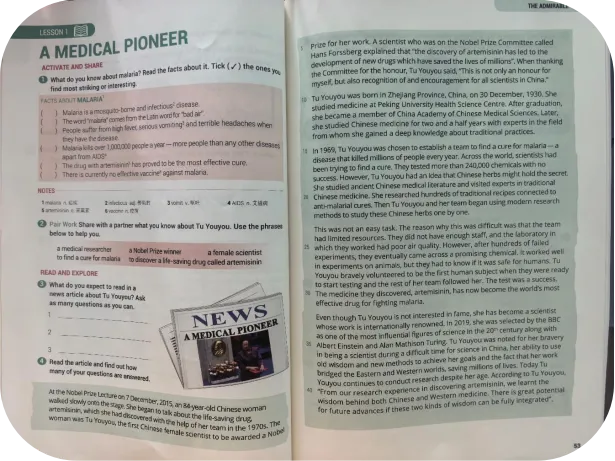
1.B。本题对接教材Lesson1板块1(Activate and Share屠呦呦基础认知)与板块2(Read and Explore新闻原文核心语句)。
文章首段直接对应教材原文:This is not only an honour for myself, but also recognition of and encouragement for all scientists in China,屠呦呦将这份荣誉视作对全体中国科研工作者的肯定。A项“个人付出的回报”与人物表态相悖;C项“仅认可传统中医药”表述片面,文本强调中西医融合;D项“补偿团队艰辛”属于文本未提及的无中生有信息。
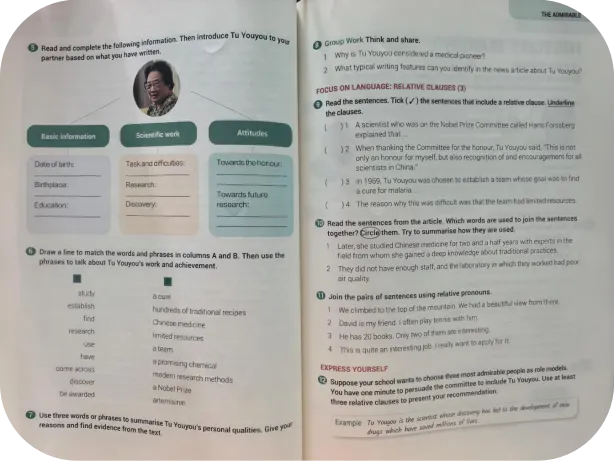
2.B。本题对接教材板块6(Read and complete的Task and difficulties信息归纳任务)。
文本明确交代团队两大现实困境:人手不足、实验室空气质量差,与教材原始素材the team had limited resources. They did not have enough staff, and the laboratory in which they worked had poor air quality完全对应。A项“缺少政府资金”原文没有支撑;C项“古籍翻译困难”属于曲解文本,古籍恰恰是屠呦呦研究的重要依托;D项“无法开展动物实验”与原文事实相反,该化合物已完成动物有效性测试。
3.B。本题对接教材板块7(核心短语与人物成就梳理)与板块8(Group Work研讨问题:Why is Tu Youyou considered a medical pioneer?)。文中Tu bravely volunteered to be the first human subject是支撑选项的核心证据,集中体现她为科研献身的可贵品质。A项“独立研究、不需要团队”和原文with the help of her team冲突;C项“一心争取国际奖项”与原文Tu Youyou is not interested in fame矛盾;D项“拒绝现代研究手段”和文本applying modern research methods直接反向。
【试题与教材、2025版课标融合深度分析】
第1题。人物观点态度理解(教材板块1、板块2融合)
命题溯源:素材起点为板块1 Activate and Share中屠呦呦核心身份词汇(a medical researcher, a Nobel Prize winner, discover a life-saving drug),深度挖掘板块2新闻语篇中人物直接引语承载的价值立场。
课标对标:落实2025版课标文化意识素养,引导学生读懂科学家集体主义价值观,落实立德树人导向,感悟中国科研工作者淡泊小我、心系集体的精神内核。
能力落点:抓取观点类信息,区分“个人荣誉”和“集体认可”的语义差异,识别同义转述,规避主观常识干扰。
第2题。事实细节归纳(教材板块6、板块7融合)
命题溯源:直接取材板块6表格任务Task and difficulties的信息提炼要求,结合板块7动词短语(have limited resources)搭建考点。教材本板块训练目标就是梳理科研任务、困难、成果等事实信息,本题将表格填空题转化为高考标准细节选择题。
课标对标:落实思维品质素养,训练学生定位事实信息、归纳并列信息的能力,渗透艰苦奋斗的科学精神与劳动精神。
能力落点:精准定位文本事实,辨析“原文信息”和“看似合理的常识干扰项”。
第3题。人物品质推断(教材板块5、板块8融合)
命题溯源:依托板块5任务——用3个短语概括屠呦呦品质并寻找文本证据;紧扣板块8 Group Work核心探究问题“屠呦呦为何被视作医学先驱”,要求学生依托文本证据提炼人物特质,而非依靠课外固有印象作答。
课标对标:落实思维品质中的证据意识与推理能力,要求学生依托原文事例推导人物品质,做到观点必有文本支撑,避免主观臆断。
能力落点:区分“事实成就”和“内在品质”,辨别反向干扰、偷换概念类选项。
【命题立意与选材说明】
立意:以本土科学家屠呦呦为语篇载体,在语言测评中渗透科学精神、文化自信,契合新高考“用英语讲好中国故事”的命题导向;题型、设问逻辑完全对标全国卷Ⅱ阅读A篇(人物介绍类记叙文,属于基础送分题型),重点测评信息定位、细节理解、简单推断等基础阅读能力。
选材:基于北师大版必修二Unit6 Lesson1原版课文改编,保留全部核心史实,压缩篇幅至262词,严格匹配全国卷ⅡA篇250–300词的常规词数区间;超纲词汇artemisinin、malaria均为本单元教材核心生词,符合“以教材为基础命题”的要求;句式复杂度适配高二学情,长难句比例贴合高考标准。
【命题技术指标】
1.词数:正文262词;生词率<3%
2.题型分布:观点态度题+事实细节题+推理判断题,覆盖A篇三大常规考点
3.干扰项范式:每题干扰项分别采用反向冲突、无中生有、片面曲解三类高考经典干扰设计
4.选项均衡:各选项词长相近,避免长短提示答案的命题瑕疵
5.语篇特征:人物新闻报道,和全国卷ⅡA篇常考的人物简介、短篇纪实文体一致
【分层备考指导】
模块1 教材文本→高考阅读的课堂训练路径
第一阶段教材深耕(基础夯实)
1.主题词汇搭建:梳理板块1疟疾主题词、板块7核心搭配(establish a team, find a cure, come across a promising chemical, discover artemisinin, be awarded the Nobel Prize),搭建本单元主题词块库。
2.文本结构拆解:沿用板块2预读设问策略,将原文划分为(获奖发言—成长与研究缘起—艰难攻关—后世评价与持续研究)四段式结构,训练预判主旨、定位信息的习惯。
3.信息结构化整理:完成板块6表格填空,分类整理基础信息、科研任务、困难、成果、人物态度,这一类结构化信息是高考细节题最主要的命题来源。
4.证据式品质归纳:落实板块5、8任务,形成品质—原文证据的对应思维(brave→volunteered as first human subject),规避脱离文本的主观评价。
第二阶段改编文本专项训练(过渡适配高考)
1.文本比对任务:对比教材原文和本次改编高考文本,学习命题时如何精简语句、保留核心信息、微调句式适配高考难度。
2.题型转化训练:自主把教材板块6的填空信息改出同类选择题,体会命题人如何把教材信息转化为考题。
3.干扰项辨析专项:识别四类典型陷阱(无中生有、曲解文意、反向矛盾、范围扩大/缩小)。
4.限时训练:5分钟内完成3道小题,匹配高考A篇标准用时。
模块2 全国卷Ⅱ阅读A篇考场通用策略
5.做题时序(5–6 分钟):
0–1min:预读题干,圈画定位词(专有名词、数字)和考点词(what, regard, difficulty, quality)
1–3min:题文同序定位,在原文标注答题证据句
3–5min:选项和原文逐词比对,优先排除明显错误项
5–6min:复核,重点检查是否凭课外常识答题、是否答非所问
【分题型答题技巧】
1.人物观点题:优先锁定直接引语、said/regard/view等观点标识词,答案多为原句同义转述
2.事实细节题:重点关注but/however等转折、并列句式,警惕“常识正确但原文未提及”的选项
3.品质推断题:必须依托具体事例证据,不能仅凭固有认知判断
4.应试提醒:A篇属于基础题,答案基本都能在原文直接找到支撑,无需深度引申;高考高频考查同义替换(insufficient=not enough; readiness to risk=bravely volunteered),需要日常积累。
模块3 分阶段备考规划
基础期(高二上):完成Lesson1全部板块任务,重点训练信息提取、词块积累,落实表格填空、口头复述人物事迹。
强化期(高二下):开展教材改编阅读训练,固化“定位—找证据—比对选项”的解题闭环,限时训练。
冲刺期(高三):回归教材原文本,切换命题人视角自主设计同类试题,吃透单元素材的可考角度。