2023 年上半年初中《英语》教师资格证笔试真题及答案解析
1.单选题
Which of the following two-syllable words has a different stress pattern from the others?
A. typhoon
B. balloon
C. shampoo
D. crayon
正确答案是: D
o
解析
本题主要考查单词重音。
题干意为:下列双音节词哪一个重音模式与其他不同?crayon 的音标为
/ˈkreɪən/,重音在第一个音节上,与其他三个均不同。D 项正确。
A 项:音标为/taɪˈfuːn/,重音在第二个音节。与题干不符,排除。
B 项:音标为/bəˈluːn/,重音在第二个音节。与题干不符,排除。
C 项:音标为/ʃæmˈpuː/,重音在第二个音节。与题干不符,排除。
故正确答案为D。
o
考点
语音
2.单选题
Which of the following is a short vowel in English?
A. /j/
B. /e/
C. /au/
D. /w/
正确答案是: B
o
解析
本题主要考查元音的分类。
题干意为:下列哪个是英语中的短元音?/e/为短元音,B 项正确。
A 项:/j/为辅音。与题干不符,排除。
C 项:/au/为双元音。与题干不符,排除。
D 项:/w/为辅音。与题干不符,排除。
故正确答案为B。
o
考点
语音
3.单选题
Mr. Smith is surprised to learn that Siamak has written ______ essays on Victorian novels in his
class.
A. the next
B. the other
C. the most
D. the more
正确答案是: C
o
解析
本题主要考查形容词最高级。
题干意为:史密斯先生很吃惊地得知,西亚马克是班上写维多利亚小说最多
的。根据语境可知,比较范围是在整个班级里面,故最高级符合题意。C 项
正确。
A 项:意为“下一个”。与题干不符,排除。
B 项:意为“另外一个”。与题干不符,排除。
D 项:意为“更多”。与题干不符,排除。
故正确答案为C。
o
考点
词汇
4.单选题
That prestigious university has made it clear to all applicants that nobody can be ______ for a
scholarship this quarter without a good internship.
A. eligible
B. legible
C. compliable
D. compliant
正确答案是: A
o
解析
本题主要考查形容词词义辨析。
题干意为:这所极具声望的大学向所有申请人明确表示,没有人可以在没有
良好的实习情况下获得本季度的奖学金。eligible 意为“有资格的”,A 项正
确。
B 项:意为“清楚的,易读的”。与题干不符,排除。
C 项:意为“依从的,屈从的”。与题干不符,排除。
D 项:意为“遵从的,依从的”。与题干不符,排除。
故正确答案为A。
o
考点
词汇
5.单选题
We are very sorry to announce that a couple of showrooms in thecastle are closed for___
___
A. permanently
B. curently
C. eventually
D. perpetually
正确答案是: A
o
解析
本题主要考查形容词词义辨析。
题干意为:我们非常遗憾地宣布城堡中的几个陈列室永久关闭。permanently
意为“永久地”, 指总是处于相同的情况和地位,可长期持续下去,永久不
变。,A 项正确。
B 项:意为“目前”。与题干不符,排除。
C 项:意为“最终”。与题干不符,排除。
D 项:意为“永久地,总是或经常”。 语气最强,指保持永久不变,没有中
断的行为,永无止境地持续下去。有时用于贬义,指令人厌烦之事。与题干
不符,排除。
故正确答案为A。
o
考点
英语学科知识
6.单选题
Would you like a cup of coffee ______ shall we get down to business right away?
A. or
B. and
C. then
D. otherwise
正确答案是: A
o
解析
本题主要考查连词词义辨析。
题干意为:你是想先喝杯咖啡还是我们现在直接开始谈正事呢?本题为选择
疑问句,用or 连接两种选择。A 项正确。
B 项:意为“和,又”,连接成分表示并列关系。与题干不符,排除。
C 项:意为“然后”。与题干不符,排除。
D 项:意为“否则”。与题干不符,排除。
故正确答案为A。
o
考点
词汇
7.单选题
Alex specializes in ______ medical science in this graduate school and plans to work as______
doctor upon graduation.
A. a; the
B. the; a
C. /; a
D. a; /
正确答案是: C
o
解析
本题主要考查冠词词义辨析。
题干意为:亚历克斯在这所研究生院专攻医学,他计划毕业后成为一名医
生。“specialize in sth.”意为“专门研究(或从事)……”,使用零冠词;“work
as a/an”意为“作为一名……”,doctor 为辅音音素开头,故使用a。C 项正确。
A、B、D 三项:均与题干不符,排除。
故正确答案为C。
o
考点
词汇
8.单选题
The reason why I want to give up the plan is ______ if I don't, my employer will be mad at me.
A. because
B. that
C. for
D. since
正确答案是: B
o
解析
本题主要考查表语从句的连接词。
题干意为:我想放弃这个计划的原因是如果我不放弃的话,我的老板会生我
的气。分析句子成分可知,“if I don't, my employer will be mad at me.”为表语
从句,且不缺成分和意思,故选择从属连词that,符合句型
“The reason...is that...”。B 项正确。
A、C、D 三项:均与题干不符,排除。
故正确答案为B。
o
考点
语法
9.单选题
Which of the following correctly describes the semantic features of the word “girl”?
A. [-Human-Male-Adult]
B. [+Human+Male-Adult]
C. [+Human-Male+Adult]
D. [+Human-Male-Adult]
正确答案是: D
o
解析
本题主要考查语义学。
题干意为:下列选项中哪一个准确地描述了“girl”这个单词的语义特征?“+”
符号表示具有该特征,“-”符号表示不具有该特征,根据单词“girl”意为“女孩”
可知,它的语义特征为“人类,非男性,非成人”。D 项正确。
A、B、C 三项:均与题干不符,排除。
故正确答案为D。
o
考点
语言学
10.单选题
What is the relationship between the two sentences “The stress is on documentary and rightly
so. Arty photographs are a bore.”
A. Phenomenon-reason
Phenomenon-reason
B. Problem-solution
C. Instrument-achievement
D. Cause-consequence
正确答案是: A
o
解析
本题考查语篇教学。
题干意为:下面这两个句子“重点理应在纪录片上”和“附庸风雅的照片使人厌
烦”之间是什么关系?A 项意为“现象-理由”,结合语境,前者为现象,后者
为产生这个现象的原因。A 项正确。
B 项:意为“问题-解决”。与题干不符,排除。
C 项:意为“工具-成就”。与题干不符,排除。
D 项:意为“原因-结果”。与题干不符,排除。
故正确答案为A。
o
考点
语言知识教学
11.单选题
“Like” and “bike”, “bat” and “pat”, “look” and “book” are examples of ________ used in teaching
pronunciation.
A. alliteration
B. rhythm
C. weak forms
D. minimal pairs
正确答案是: D
o
解析
本题考查语音教学的方法。题干意为:like 和bike,bat 和pat,look 和book
是在语音教学中使用的________例子。like 的发音为/laɪk/,bike 的发音为
/baɪk/;bat 的发音为/bæt/,pat 的发音为/pæt/;look 的发音为/lʊk/,book 的发
音为/bʊk/;根据三组单词的发音可知,每组单词只有在相同的位置上有一个
音不同,除此以外其他音都相同,这三组词属于最小对立体
(minimal pair),故D 项正确。
A 项:alliteration 意为:头韵;与题干不符,排除。
B 项:rhythm 意为:节奏,韵律;与题干不符,排除。
C 项:weak forms 意为:弱读;与题干不符,排除。
故正确答案为D。
o
考点
语言知识教学
12.单选题
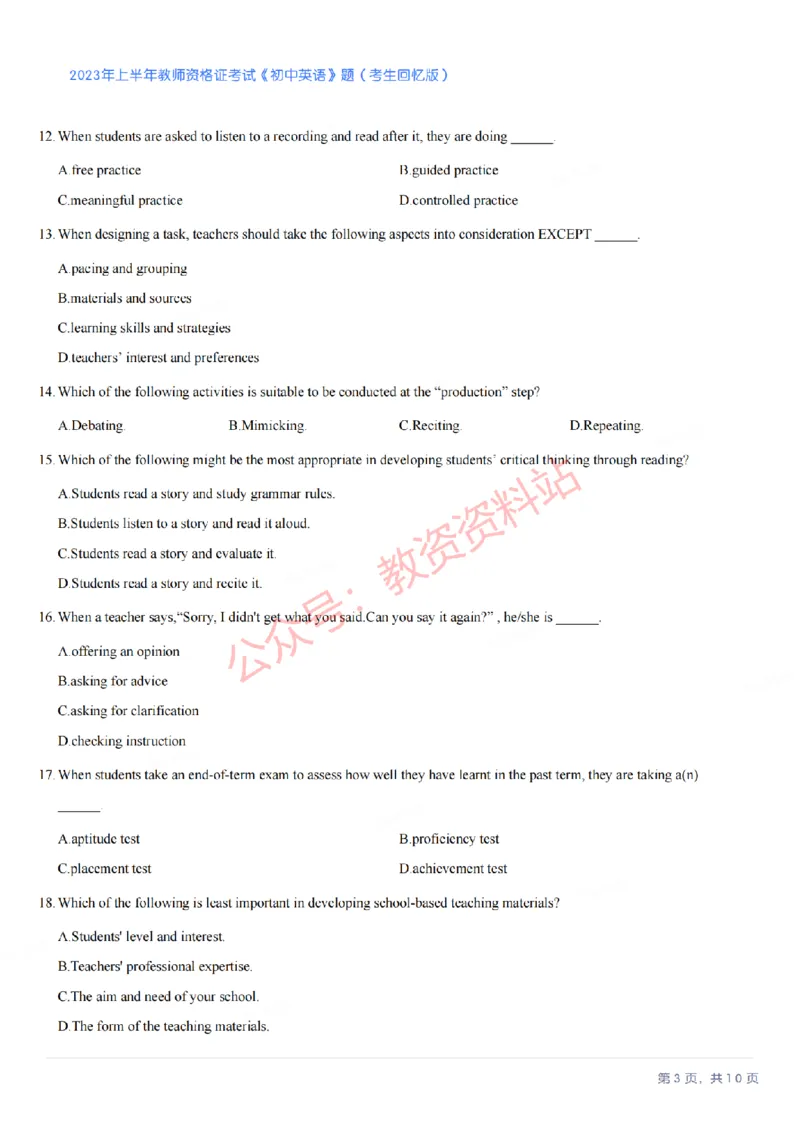
When students are asked to listen to a recording and read after it, they are doing ______.
A. free practice
B. guided practice
C. meaningful practice
D. controlled practice
正确答案是: D
o
解析
本题考查口语教学。题干意为:当学生被要求听录音并跟读时,他们正在做
________。题干中描述的教学活动“听录音并跟读”属于控制性活动
(controlled practice),即重视语言的形式和准确性。使学生关注语言的结构
或功能,以便他们能够准确地说出语言。常见的控制性活动有阅读、背通、
模仿、重复、复述、分角色朗读等。故D 项正确。
A 项:free practice 意为:自由操练;与题干不符,排除。
B 项:guided practice 意为:指导性操练;与题干不符,排除。
C 项:meaningful practice 意为:意义性操练;与题干不符,排除。
故正确答案为D。
o
考点
语言技能教学
13.单选题
When designing a task, teachers should take the following aspects into consideration EXCEPT
______.
A. pacing and grouping
B. materials and sources
C. learning skills and strategies
D. teachers’ interest and preferences
正确答案是: D
o
解析
本题考查教学活动的设计。题干意为:在设计任务时,老师应考虑以下内
容,除了________。当设计教学活动时,考虑的主体应是学生,而不应该是
老师的兴趣和偏好。D 项意为:老师的兴趣和偏好,故D 项与题干相符,当
选。
A 项:意为:节奏和分组;与题干不符,排除。
B 项:意为:材料和资源;与题干不符,排除。
C 项:意为:学习能力和策略;与题干不符,排除。
本题为选非题,故正确答案为D。
o
考点
教学设计
14.单选题
Which of the following activities is suitable to be conducted at the “production” step?
A. Debating.
B. Mimicking.
C. Reciting.
D. Repeating.
正确答案是: A
o
解析
本题考查教学模式。题干意为:下面哪一项活动适合用在产出环节。A 项意
为:辨论,考查学生对语言的运用,为开放性的练习,适合用在产出环节,
故A 项正确。
B 项:意为:模仿,适合用在新授或练习环节;与题干不符,排除。
C 项:意为:背诵,适合用在练习环节;与题干不符,排除。
D 项:意为:重复,适合用在新授或练习环节;与题干不符,排除。
故正确答案为A。
o
考点
语言知识教学
15.单选题
Which of the following might be the most appropriate in developing students’ critical thinking
through reading?
A. Students read a story and study grammar rules.
B. Students listen to a story and read it aloud.
C. Students read a story and evaluate it.
D. Students read a story and recite it.
正确答案是: C
o
解析
本题考查阅读教学。题干意为:下面哪一项更适合通过阅读锻炼学生的批判
性思维?C 项意为“学生读故事,并评价它”,其中“评价故事”涉及学生对故
事内容的思考,能够帮助培养学生的批判性思维。故C 项正确。
A 项:意为:学生读故事,并学习语法规则;与题干不符,排除。
B 项:意为:学生听故事,并大声读;与题干不符,排除。
D 项:意为:学生读故事,然后背诵;与题干不符,排除。
故正确答案为C。
o
考点
语言技能教学
16.单选题
When a teacher says,“Sorry, I didn't get what you said.Can you say it again?” , he/she is ______.
A. offering an opinion
B. asking for advice
C. asking for clarification
D. checking instruction
正确答案是: C
o
解析
本题主要考查课堂教学。
题干意为:当老师说:“对不起,我不明白你说的话。你能再说一遍吗?”,
他/她是______。根据语境可知,老师没有明白学生的意思,需要学生再次说
明/澄清自己的看法。C 项正确。
A 项:意为“发表意见”。与题干不符,排除。
B 项:意为“征求意见”。与题干不符,排除。
D 项:意为“检查指令”。与题干不符,排除。
故正确答案为C。
o
考点
教学反馈
教学提问
17.单选题
When students take an end-of-term exam to assess how well they have learnt in the past term,
they are taking a(n) ______.
A. aptitude test
B. proficiency test
C. placement test
D. achievement test
正确答案是: D
o
解析
本题主要考查语言测试类型。
题干意为:当学生参加期末考试以检验他们在上一学期学习的情况时,他们
是在参加______。D 项意为“成绩测试”,旨在了解一段时间内学生对所学内
容的掌握情况,以便对学生的学习成绩作出评定。测试的内容为该阶段所学
内容。例如,学校的期中考试、期末考试。D 项正确。
A 项:意为“潜能测试”,旨在预测学生学习某一新语言的能力倾向的测试,
能衡量学生在学习该语言时是否具有较强的学习能力。与题干不符,排除。
B 项:意为“水平测试”,旨在评价学生现有的语言水平能否达到胜任某一新
的学习任务或工作的程度。水平测试的区分度较高,能够区分不同水平的学
生。与题干不符,排除。
C 项:意为“分级测试”,是一种综合性的英语水平测试及心理测试项目,一
般用于分班测试,用来对学生的学习水平进行快速评估,为学生选择一个适
当的学习起点。与题干不符,排除。
故正确答案为D。
o
考点
教学评价
18.单选题
Which of the following is least important in developing school-based teaching materials?
A. Students' level and interest.
B. Teachers' professional expertise.
C. The aim and need of your school.
D. The form of the teaching materials.
正确答案是: D
o
解析
本题主要考查课程资源开发与利用。
题干意为:以下哪一项在开发校本教学资料时最不重要?积极开发与合理利
用课程资源是有效实施英语课程的重要保证。英语课程资源包括教材及有利
于学生学习和教师教学的其他教学材料、支持系统和教学环境,还包括人的
资源。教材是英语课程的核心资源。为了充分利用和有效开发教材资源,教
师应深入分析教材,准确把握教材设计理念和内容,熟悉教材编排特点。教
师要深入研读教材,在教学中根据学生的水平和教学需要,有效利用和开发
教材资源,激发学生的学习兴趣,开阔学生的视野,拓展学生的思维。学校
还可以适当选用或开发教材之外的优质教学资源,以补充教材的教学内容。
校本教材是以校为本的教材,是学校自己开发的校本课程所用的教学材料的
统称。 校本教材的编制以学校教师为主体。 结合以上内容可知,教学资源的
形式是最不重要的。D 项与题干相符,当选。
A 项:意为“学生的水平和兴趣”。与题干不符,排除。
B 项:意为“教师的专业知识”。与题干不符,排除。
C 项:意为“学校的目的和需要”。与题干不符,排除。
故正确答案为D。
o
考点
义务教育阶段课程标准
19.单选题
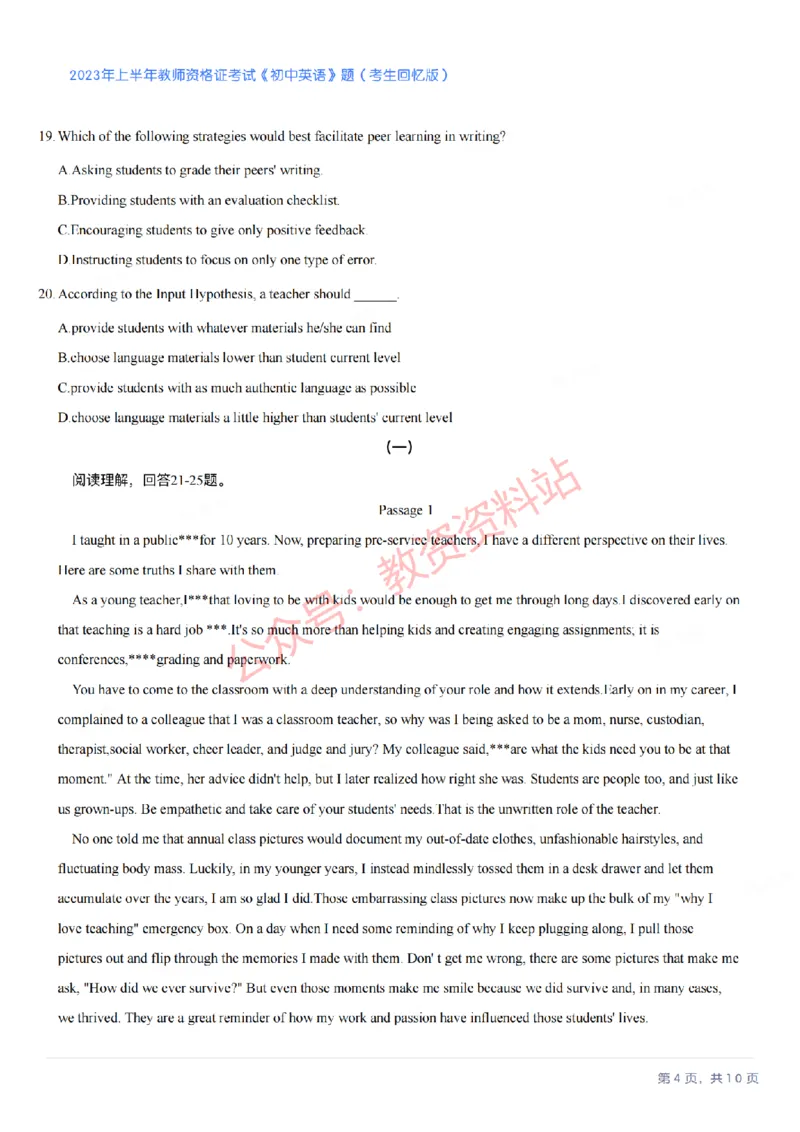
Which of the following strategies would best facilitate peer learning in writing?
A. Asking students to grade their peers' writing.
B. Providing students with an evaluation checklist.
C. Encouraging students to give only positive feedback.
D. Instructing students to focus on only one type of error.
正确答案是: A
o
解析
本题主要考查写作教学
题干意为:以下哪种策略最有利于促进学生写作时的同伴学习?A 项意为“要
求学生给同伴的作文打分”,在给同伴作文打分时,需要仔细分析同伴作文,
才能给出合理的分数。A 项正确。
B 项:意为“为学生提供一份评分表”。与题干不符,排除。
C 项:意为“鼓励学生只给予积极的反馈”。与题干不符,排除。
D 项:意为“指导学生只关注一种类型的错误”。与题干不符,排除。
故正确答案为A。
o
考点
语言技能教学
20.单选题
According to the Input Hypothesis, a teacher should ______.
A. provide students with whatever materials he/she can find
B. choose language materials lower than student current level
C. provide students with as much authentic language as possible
D. choose language materials a little higher than students' current level
正确答案是: D
o
解析
本题主要考查语言输入假说。
题干意为:根据语言输入假说,教师应该______。语言输入假说是克拉申语
言习得理论的核心部分,它指的是只有当习得者接触到可理解的语言输入,
即略高于他现有语言技能水平的第二语言输入,而且他又能把注意力集中于
对意义或对信息的理解而不是对形式的理解时,才能产生习得。D 项意为“选
择比学生当前水平稍高一点的语言材料”,D 项正确。
A 项:意为“为学生提供他/她能找到的任何材料”。与题干不符,排除。
B 项:意为“选择低于学生当前水平的语言材料”。与题干不符,排除。
C 项:意为“为学生提供尽可能多的真实的语言”。与题干不符,排除。
故正确答案为D。
o
考点
语言学
材料
阅读理解,回答21-25 题。
Passage 1
I taught in a public***for 10 years. Now, preparing pre-service teachers, I have a different
perspective on their lives. Here are some truths I share with them.
As a young teacher, I***that loving to be with kids would be enough to get me through
long days. I discovered early on that teaching is a hard job ***. It's so much more than
helping kids and creating engaging assignments; it is conferences,**grading and paperwork.
You have to come to the classroom with a deep understanding of your role and how it
extends. Early on in my career, I complained to a colleague that I was a classroom teacher,
so why was I being asked to be a mom, nurse, custodian, therapist, social worker, cheer
leader, and judge and jury? My colleague said,** are what the kids need you to be at
that moment." At the time, her advice didn't help, but I later realized how right she was.
Students are people too, and just like us grown-ups. Be empathetic and take care of your
students' needs. That is the unwritten role of the teacher.
No one told me that annual class pictures would document my out-of-date clothes,
unfashionable hairstyles, and fluctuating body mass. Luckily, in my younger years, I instead
mindlessly tossed them in a desk drawer and let them accumulate over the years, I am so
glad I did. Those embarrassing class pictures now make up the bulk of my "why I love
teaching" emergency box. On a day when I need some reminding of why I keep plugging
along, I pull those pictures out and flip through the memories I made with them. Don' t
get me wrong, there are some pictures that make me ask, "How did we ever survive?" But
even those moments make me smile because we did survive and, in many cases, we thrived.
They are a great reminder of how my work and passion have influenced those students' live
s.
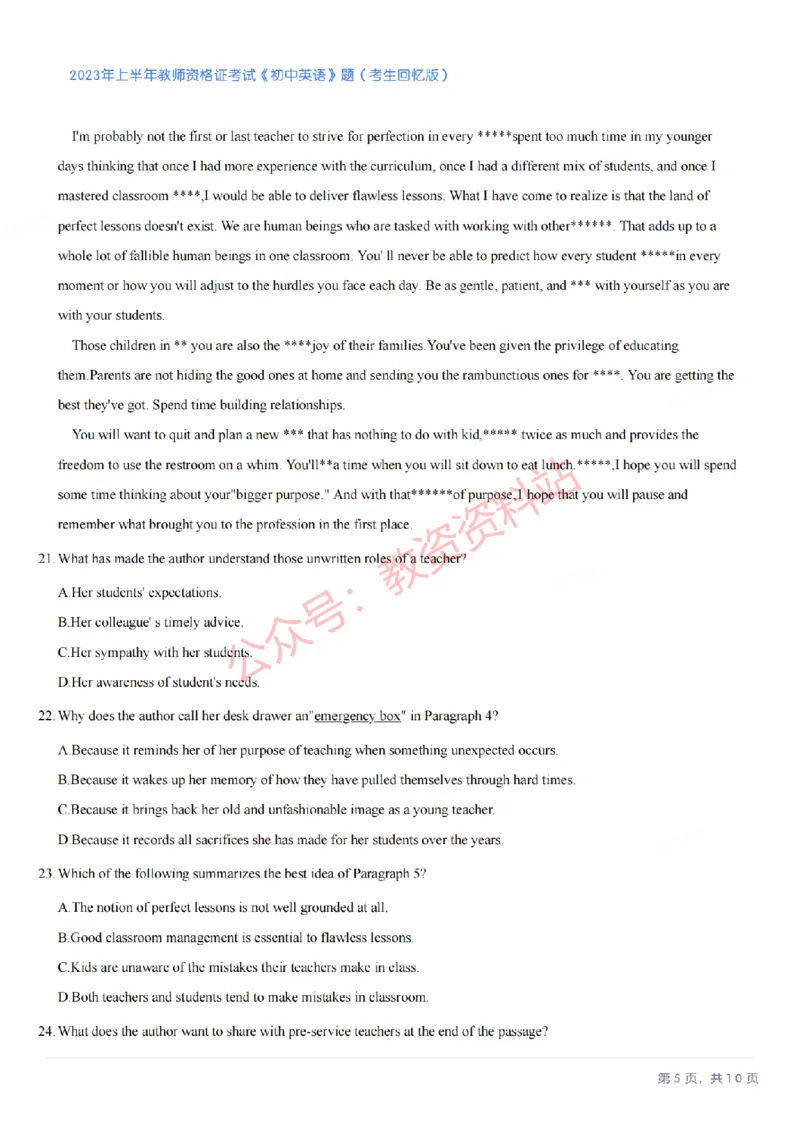
I'm probably not the first or last teacher to strive for perfection in every ***spent too much
time in my younger days thinking that once I had more experience with the curriculum,
once I had a different mix of students, and once I mastered classroom ****,I would be able
to deliver flawless lessons. What I have come to realize is that the land of perfect lessons
doesn't exist. We are human beings who are tasked with working with other******. That
adds up to a whole lot of fallible human beings in one classroom. You' ll never be able to
predict how every student ***in every moment or how you will adjust to the hurdles you
face each day. Be as gentle, patient, and *** with yourself as you are with your students.
Those children in **** you are also the ****joy of their families. You've been given the
privilege of educating them. Parents are not hiding the good ones at home and sending
you the rambunctious ones for ****. You are getting the best they've got. Spend time
building relationships.
You will want to quit and plan a new *** that has nothing to do with kid,**** twice as
much and provides the freedom to use the restroom on a whim. You'll**a time when you
will sit down to eat lunch.*****,I hope you will spend some time thinking about your
"bigger purpose." And with that****of purpose,1 hope that you will pause and remember
what brought you to the profession in the first place.
21.单选题
What has made the author understand those unwritten roles of a teacher?
A. Her students' expectations.
B. Her colleague' s timely advice.
C. Her sympathy with her students.
D. Her awareness of student's needs.
正确答案是: D
o
解析
本题主要考查细节理解。
题干意为:什么让作者理解了未被明文写出的教师角色?根据题干中的关键
词unwritten roles 可以定位到文章的第三段尾句。根据第三段第四、五、六句
“At the time, her advice didn't help, but I later realized how right she was. Students
are people too, and just like us grown-
ups. Be empathetic and take care of your students' needs.That is the unwritten role
of the teacher.”可知,同事给出了建议,但是作者并没有听进去。后来作者体
会到要对学生持有同理心,考虑学生的需求。D 项正确。
A 项:意为“学生的期望”。与题干不符,排除。
B 项:意为“同事的及时建议”。与题干不符,排除。
C 项:意为“同情学生”。与题干不符,排除。
故正确答案为D。
o
考点
阅读理解
22.单选题
Why does the author call her desk drawer an"emergency box" in Paragraph 4?
A. Because it reminds her of her purpose of teaching when something unexpected
occurs.
B. Because it wakes up her memory of how they have pulled themselves through
hard times.
C. Because it brings back her old and unfashionable image as a young teacher.
D. Because it records all sacrifices she has made for her students over the years.
正确答案是: A
o
解析
本题主要考查细节理解。
题干意为:为什么作者在第4 段中称她的书桌抽屉为“应急箱”?根据第四段
“Those embarrassing class pictures now make up the bulk of my "why I love teachi
ng" emergency box. On a day when I need some reminding of why I keep plugging
along, I pull those pictures out and flip through the memories I made with them.”
可知,当作者需要一些事情去提醒他为何要为生活努力的时候,便会拿出这
个箱子里的照片来回忆。A 项意为“当一些事与愿违或意想不到的事情发生
时,它会使她回想起教学的初衷”,符合题意,A 项正确。
B 项:意为“因为它唤起了当时他们如何度过艰难时光的回忆”。与题干不
符,排除。
C 项:意为“因为这让她想起了作为一名年轻教师的老气而又过时的形象”。
与题干不符,排除。
D 项:意为“因为它记录了她多年来为学生们所做的所有奉献和牺牲”。与题
干不符,排除。
故正确答案为A。
o
考点
阅读理解
23.单选题
Which of the following summarizes the best idea of Paragraph 5?
A. The notion of perfect lessons is not well grounded at all.
B. Good classroom management is essential to flawless lessons.
C. Kids are unaware of the mistakes their teachers make in class.
D. Both teachers and students tend to make mistakes in classroom.
正确答案是: A
o
解析
本题主要考查主旨大意。
题干意为:下面哪一项可以最好的概括第五段的主旨大意?文章第五段前半
部分阐述作者一开始总是想创造一个完美无暇的课堂,后半部分介绍自己发
现自己难以预料在上课的过程中学生的反应等。由此可知,完美的课堂现实
中很难存在。A 项意为“完美课堂的概念一点都不切实际”,符合题意,A 项
正确。
B 项:意为“好的班级管理对营造一个无暇的课堂至关重要”。与题干不符,
排除。
C 项:意为“学生意识不到他们老师的错误”。与题干不符,排除。
D 项:意为“师生都可能在课堂上犯错”。与题干不符,排除。
故正确答案为A。
o
考点
阅读理解
24.单选题
What does the author want to share with pre-service teachers at the end of the passage?
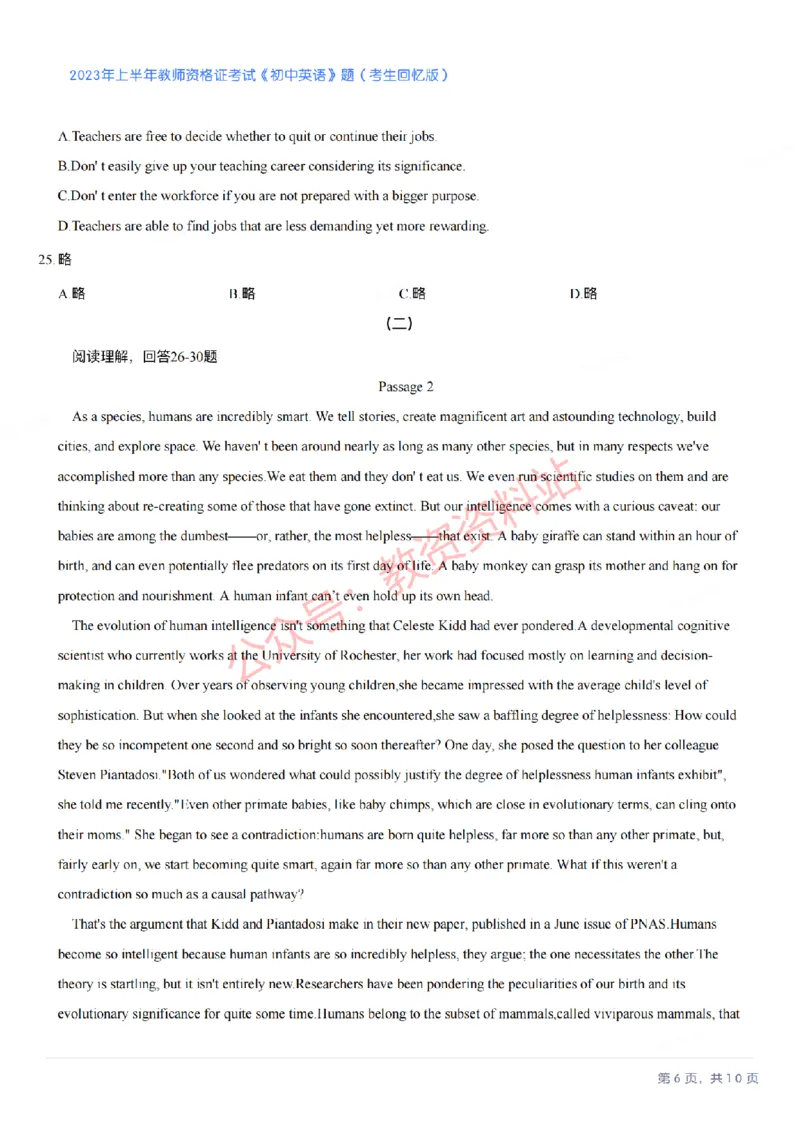
A. Teachers are free to decide whether to quit or continue their jobs.
B. Don' t easily give up your teaching career considering its significance.
C. Don' t enter the workforce if you are not prepared with a bigger purpose.
D. Teachers are able to find jobs that are less demanding yet more rewarding.
正确答案是: B
o
解析
本题主要考查主旨大意。
题干意为:在文章的最后,作者想和职前老师分享什么?根据文章最后一段
可知,作者说老师有权利辞职,但是辞职之前需要想清楚自己选择职业的深
远意义。B 项意为"考虑自己职业的重大意义,不要轻易放弃自己的职业生
涯”,符合题意,B 项正确。
A 项:意为“老师可以自由选择辞职或者继续坚持”。与题干不符,排除。
C 项:意为“如果没有远大理想的话,不要进入这个行业”。与题干不符,排
除。
D 项:意为“老师可以找到一个少劳多酬的工作”。与题干不符,排除。
故正确答案为B。
o
考点
阅读理解
25.单选题
略
A. 略
B. 略
C. 略
D. 略
正确答案是: A
o
解析
缺。
o
考点
阅读理解
材料
阅读理解,回答26-30 题
Passage 2
As a species, humans are incredibly smart. We tell stories, create magnificent art and astounding
technology, build cities, and explore space. We haven' t been around nearly as long as many
other species, but in many respects we've accomplished more than any species. We eat them and
they don' t eat us. We even run scientific studies on them and are thinking about re-creating
some of those that have gone extinct. But our intelligence comes with a curious caveat: our
babies are among the dumbest——or, rather, the most helpless——that exist. A baby giraffe can
stand within an hour of birth, and can even potentially flee predators on its first day of life. A
baby monkey can grasp its mother and hang on for protection and nourishment. A human infant
can’t even hold up its own head.
The evolution of human intelligence isn't something that Celeste Kidd had ever pondered.
A developmental cognitive scientist who currently works at the University of Rochester, her work
had focused mostly on learning and decision-making in children. Over years of observing young
children, she became impressed with the average child's level of sophistication. But when she
looked at the infants she encountered, she saw a baffling degree of helplessness: How could they
be so incompetent one second and so bright so soon thereafter?
One day, she posed the question to her colleague Steven Piantadosi. "Both of us wondered
what could possibly justify the degree of helplessness human infants exhibit", she told me
recently. "Even other primate babies, like baby chimps, which are close in evolutionary terms,
can cling onto their moms." She began to see a contradiction: humans are born quite helpless,
far more so than any other primate, but, fairly early on, we start becoming quite smart, again
far more so than any other primate. What if this weren't a contradiction so much as a causal
pathway?
That's the argument that Kidd and Piantadosi make in their new paper, published in a June
issue of PNAS. Humans become so intelligent because human infants are so incredibly
helpless, they argue; the one necessitates the other. The theory is startling, but it isn't entirely
new. Researchers have been pondering the peculiarities of our birth and its evolutionary
significance for quite some time. Humans belong to the subset of mammals, called viviparous
mammals, that give live birth to their young. This means that infants must grow to a mature
enough state inside the body to be born, but they can' t be so big that they are unable to
come out. This leads to a trade-off: the more intelligent an animal is, the larger its head
generally is, but the birth canal imposes an upper limit on just how large that head can be
before it gets stuck. The brain, therefore, must keep maturing, and the head must continue
growing, long after birth. The more intelligent an animal will eventually be, the more
relatively immature its brain is at birth.
Researchers have long known about this trade-off, and about the connection between brain
size and neural density and intelligence. For instance, Robin Dunbar found that the ratio
of neocortical volume to brain size can predict the social-group size in a number of specie
s, including bats, cetaceans, and primates. while Simon Reader has demonstrated links in
tool use and innovation to brain size in primates. Kidd and Piantadosi’s new idea is that
increased helplessness in newborns mandates increased intelligence in parents and that a
runaway selection dynamic can account for both. Natural selection favors humans with large
brains, because those humans tend to be smarter. This may create evolutionary incentives
for babies that are born at an even earlier developmental stage, which require more
intelligence to raise. This creates the dynamic: over time, helpless babies make parents more
intelligent, which makes babies more helpless, which makes their parents more intelligent,
and so on.
26.单选题
According to paragraph 1,which of the following is true?
A. Some species are smarter than human beings.
B. Extinct species have been re-created by scientists.
C. Babies of other species are smarter than human infants.
D. Fewer species are earlier inhabitants than human beings.
正确答案是: C
o
解析
本题主要考查细节理解。
题干意为:根据第1 段,以下哪一个是正确的?根据文章第一段
“A baby giraffe can stand within an hour of birth, and can even potentially flee pre
dators on its first day of life.A baby monkey can grasp its mother and hang on for p
rotection and nourishment.A human infant can’t even hold up its own head.”可
知,小长颈鹿在出生后一小时内就能站立,甚至在出生的第一天就有可能逃
离捕食者。一只小猴子可以抓住它的妈妈以获得保护和营养。人类婴儿连自
己的头都抬不起来。由此看出来,其他物种的幼儿比人类婴儿更加有智慧。
C 项正确。
A 项:意为“有些物种比人类更聪明”。与题干不符,排除。
B 项:意为“科学家们重新创造了已经灭绝的物种”。与题干不符,排除。
D 项:意为“先于人类存在的物种更加少”。与题干不符,排除。
故正确答案为C。
o
考点
阅读理解
27.单选题
What surprised Celeste Kidd regarding children' s brain maturation?
A. Infants' helplessness when they are born.
B. Children's high intelligence when they grow up.
C. Children's leap from helplessness to sophistication.
D. Children's incompetence in learning and decision-making.
正确答案是: C
o
解析
本题主要考查细节理解。
题干意为:是什么让塞莱斯特·基德对儿童大脑的成熟过程感到惊讶?根据定
位词Celeste Kidd 可以定位到文章的第二段,根据第二段第三、四句
“Over years of observing young children, she became impressed with the average c
hild's level of sophistication. But when she looked at the infants she encountered,sh
e saw a baffling degree of helplessness: How could they be so incompetent one sec
ond and so bright so soon thereafter? ”可知,在多年的观察中,她对孩子们表现
出的平均老成世故程度感到甚是惊讶。但她观察她接触的婴儿时,她发现他
们的弱小程度令人困惑:他们怎么会在前一秒表现得这么无能,而在下一秒
却又这么聪明?C 项“孩子们从无助到成熟的飞跃”符合题意,当选。
A 项:意为“婴儿出生时的弱小无助”。与题干不符,排除。
B 项:意为“孩子们长大后的高智商”。与题干不符,排除。
D 项:意为“孩子们在学习和决策方面的无能”。与题干不符,排除。
故正确答案为C。
o
考点
阅读理解
28.单选题
What can we infer form Paragraph 3 about brain development?
A. Babies' helplessness at birth is an indication of human intelligence
B. Other mammal brains are more mature than human brain at birth.
C. Only intelligent mammals give live birth to their babies.
D. All animal brains are equally immature at their birth.
正确答案是: A
o
解析
本题主要考查推理判断题。
题干意为:关于脑部发育,我们可以从第三段推断出什么?根据第三段最后
一句“The more intelligent an animal will eventually be, the more relatively
immature its brain is at birth.”可知,A 项“婴儿出生时的无助是人类智力的一种
表现”正确。
B 项:意为“其他哺乳动物的大脑在出生时就比人类的大脑更成熟”。与题干
不符,排除。
C 项:意为“只有聪明的哺乳动物才会繁衍后代”。与题干不符,排除。
D 项:意为“所有动物的大脑在出生时都同样不成熟”。与题干不符,排除。
故正确答案为A。
o
考点
阅读理解
29.单选题
What is the main idea author intends to convey?
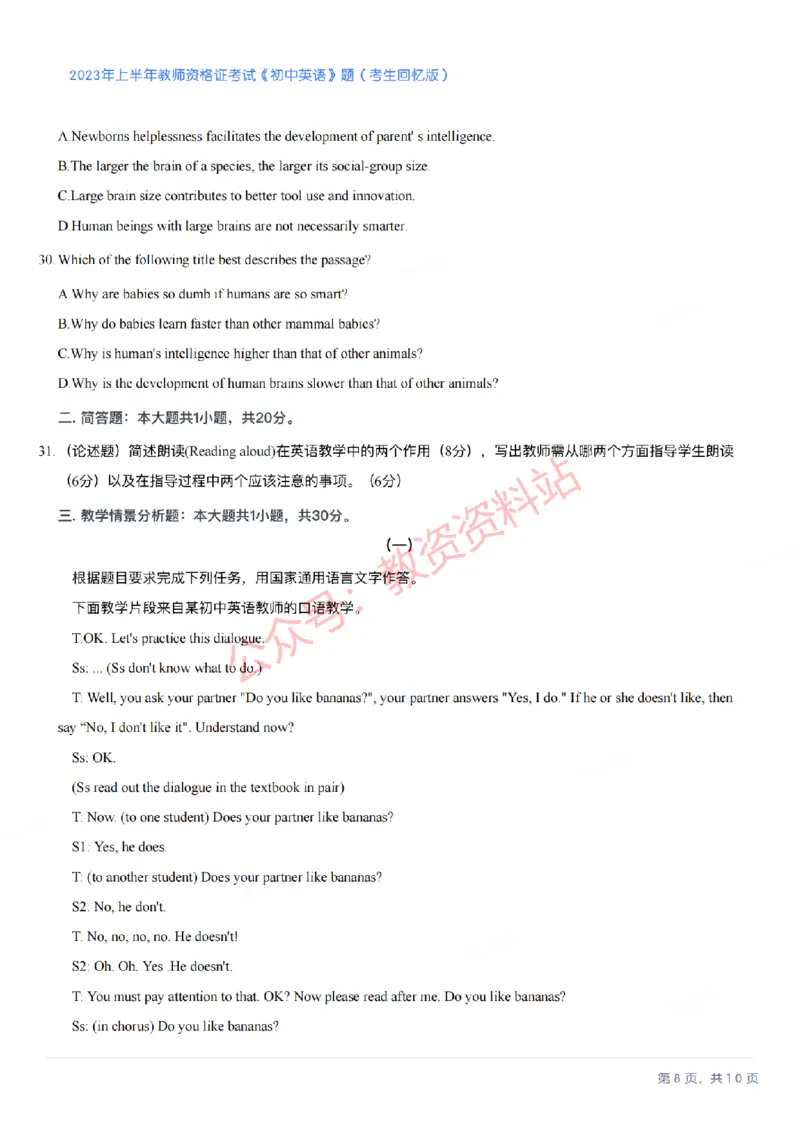
A. Newborns helplessness facilitates the development of parent' s intelligence.
B. The larger the brain of a species, the larger its social-group size.
C. Large brain size contributes to better tool use and innovation.
D. Human beings with large brains are not necessarily smarter.
正确答案是: A
o
解析
本题主要考查主旨。
题干意为:作者想要传达什么思想?A 项意为“新生儿的无能促进了成人的智
力发展”,文章第一、二段引出话题人类怎么会在前一秒表现得这么无能,而
在下一秒却又这么聪明,通过三段的分析论证,在第四段得出结论随着时间
推移,弱小的婴儿让父母更聪明,因而他们会变得更加弱小,成人就愈加强
大。A 项正确。
B 项:意为“一个物种的脑子越大,那么他的社群规模就越大”。与题干不
符,排除。
C 项:意为“脑子更大,有助于使用工具和创新”。与题干不符,排除。
D 项:意为“人脑子越大并不一定更加智慧”。与题干不符,排除。
故正确答案为A。
o
考点
阅读理解
30.单选题
Which of the following title best describes the passage?
A. Why are babies so dumb if humans are so smart?
B. Why do babies learn faster than other mammal babies?
C. Why is human's intelligence higher than that of other animals?
D. Why is the development of human brains slower than that of other animals?
正确答案是: A
o
解析
本题主要考查主旨题。
题干意为:下列哪一个是最佳标题?通篇文章介绍的是关于人类从小不如其
他物种,而随着一步步的证明,人类的智慧会随着年龄的增长而增长,其他
三项文章并没有提及,是干扰项。A 项意为“为什么婴儿如此愚蠢而成人却如
此聪慧”,A 项正确。
B 项:意为“为什么婴儿比其他的哺乳动物学习的更快”。与题干不符,排
除。
C 项:意为“为什么人类的智力比其他动物的高”。与题干不符,排除。
D 项:意为“为什么人脑的发育比其他动物的慢”。与题干不符,排除。
故正确答案为A。
o
考点
阅读理解
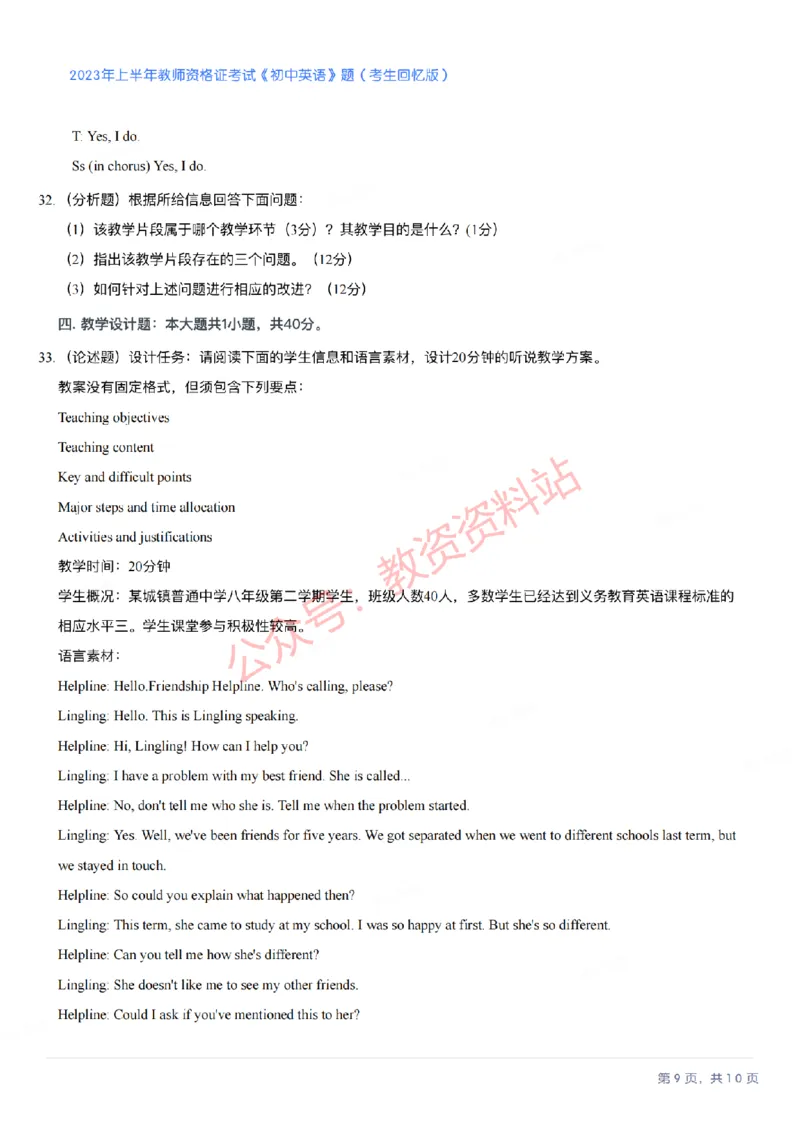
31.论述题
简述朗读(Reading aloud)在英语教学中的两个作用(8 分),写出教师需从哪两个方面指导
学生朗读(6 分)以及在指导过程中两个应该注意的事项。(6 分)
正确答案是:
(1)朗读在英语教学中的作用:
①朗读活动同时调动多种器官,从而加强对英语的理解和记忆。
我们学习英语的时候,进行朗读活动的同时,就调动了多个人体器官。在这一复
杂过程中,在整个朗读活动中完成了同一语言材料理解的两次处理,尤其是整个
过程中,发音器官的参与和对于声音的辨别和识记可以强化和巩固语言材料,也
就是深化了对于语言材料的处理,那么可以深刻地记忆语言材料和语言信息。
②朗读活动与语音听觉记忆的关系促进发展英语听力和阅读能力。
通过大量的朗读发声练习,从而习得词汇,短语和句子等方面内在的语音印象记
忆,形成语音与语义的结合,可以明显地促进发展学习者的英语听力和阅读能
力。
③朗读有助于英语口语能力的提高
通过数量足够且质量高的朗读训练,可以同时掌握英语音素的准确发音,并且准
确提高词汇的读音。而且大量的朗读练习活动为流利的口语交流提供了前提。
④朗读可以提高英语学习者的写作水平
朗读解决语音发音问题的同时,可以使学习者有效地学习和掌握文章的句法风格
技巧,写作是一种输出语言材料的过程,朗读是语言信息的输入,没有输入就没
有输出。朗读通过提高学习者英语语感的构建,从而影响着英语写作的产出。
(任选两点即可)
(2)教师需从以下两方面指导学生朗读:
①确定朗读任务:根据学生的不同层次,确定不同的朗读任务,有的放矢。由浅
到深,由易到难,让各个层次的学生都有任务可做。
②多鼓励和示范:因为有些学生比较内向,缺乏自信,在进行朗读训练时,常常
会产生一些思想障碍或心理障碍,不愿或不敢开声朗读英语。这时候老师应该多
示范,领读,听原声录音,多鼓励和表扬。让学生自信地开口朗读。
③创设情境:创设与课文匹配的情景,通过反复听录音、老师范读、学生范读等
形式,让学生揣摩文中人物的语气,找准词句的重读、弱读和连读,以及停顿
点,多听多模仿,在这一要求中特别强调让学生学会“有感情地朗读”。
④通过竞赛,提高朗读能力。语言运用是一种技能,而技能是通过反复实践养成
的,所以经常性地组织学生开展多样的朗读活动,是提高学生朗读水平的最有效
的途径。
(任选两点即可)
(3)教师在指导学生朗读过程中应该注意的事项:
①朗读教学目标要明确:在指导学生朗读时,更多情况下课堂朗读重形式,轻目
的,学生的朗读往往只停留在内容层面,无法读出文章感情和意图也很少能读出
意群、停顿或节奏感。因此教师应该培养学生从学习发音到能朗读,从正确朗读
到流畅朗读,明确不同阶段朗读教学的目标和内容。
②选择作品要适宜:要符合学生的年龄、性别、兴趣爱好等,能够引起他们的共
鸣和兴趣。同时,朗读材料的文学价值也应该是重要的选择标准。
③合理的评价:教师应该对学生进行合理的评价,既关注学生的技能表现,也重
视学生的情感表达,让学生能够在评价中获得成长和进步。
④指导的循序渐进:朗读指导要有层次,随着朗读遍数的增加,朗读要求要随之
提高。
(任选两点即可)
o
解析
同上。
o
考点
教学实施
材料
根据题目要求完成下列任务,用国家通用语言文字作答。
下面教学片段来自某初中英语教师的口语教学。
T:OK. Let's practice this dialogue.
Ss: ... (Ss don't know what to do.)
T: Well, you ask your partner "Do you like bananas?", your partner answers "Yes, I do."
If he or she doesn't like, then say “No, I don't like it". Understand now?
Ss: OK.
(Ss read out the dialogue in the textbook in pair)
T: Now. (to one student) Does your partner like bananas?
S1: Yes, he does.
T: (to another student) Does your partner like bananas?
S2: No, he don't.
T: No, no, no, no. He doesn't!
S2: Oh. Oh. Yes. He doesn't.
T: You must pay attention to that. OK? Now please read after me. Do you like bananas?
Ss: (in chorus) Do you like bananas?
T: Yes, I do.
Ss (in chorus) Yes, I do.
32.分析题
根据所给信息回答下面问题:
(1)该教学片段属于哪个教学环节(3 分)?其教学目的是什么?(1 分)
(2)指出该教学片段存在的三个问题。(12 分)
(3)如何针对上述问题进行相应的改进?(12 分)
正确答案是:
(1)该教学片段属于口语教学的操练环节,教学目的是加深学生对新句型
Do you like…?及其回答的理解和应用,锻炼其口语表达能力,促进学生练习巩
固所学知识。
(2)问题一:课堂指令不清晰,在操练前没有解释活动的内容、形式、要求等
具体要求,导致学生不知从何练起;
问题二:练习活动单一,在练习阶段仅进行了机械性的操练问答活动,让学生照
着书上的内容进行简单问答,不利于启发式教学和培养学生的学习兴趣;
问题三:纠错方式不太合理,学生出现错误时,教师采用直接纠错法,直接否定
学生并给出正确答案,容易打击学生的自尊心和自信心,不利于启发式教学;
问题四:教学评价单一,该活动过程中仅出现对学生错误的评价,而对于学生的
练习和师生问答均未给出相应的评价,未能发挥评价的积极作用,也不利于提高
学生学习的积极性。
(答出任意三点即可)
(3)改进建议:
问题一:教师在设计指令语的过程中,应该明确规范指令语的内容,以便让学生
清晰准确地了解指令语的目的,必要时可以进行示范。因此在操练开始时,教师
应该明确指出同桌二人一组,就新学的句型Do you like…?进行相互问答,并给
出练习的时限,这样学生可以清晰准确地了解学习内容,有效地进行练习。
问题二:新课讲授后,应通过游戏、情境创设等多种方式展开操练活动,可以设
置机械操练、意义练习和交际性练习等多层次练习活动,循序渐进、由浅入深地
强化所学内容,多角度地巩固新知,提高学生的语言运用能力;教师在设计指令
语的过程中,应该明确规范指令语的内容,以便让学生清晰准确地了解指令语的
目的,必要时可以进行示范。因此在操练开始时,教师应该明确指出同桌二人一
组,就新学的句型Do you like…?进行相互问答,并给出练习的时限,这样学生
可以清晰准确地了解学习内容,有效地进行练习。
问题三:学生出现错误时,教师应该遵循纠错的鼓励性、启发性和策略性原则,
比如该教师可以通过重述、强调、澄清等,启发学生自己发现错误并改正,教师
再给出正面的评价。这样既能防止学生产生过分的焦虑和挫折感,同时也保护了
学生的自尊心、自信心和积极性。
问题四:评价是及时监控教学过程和教学效果的重要手段,教师要正确处理二者
之间的关系,评价要服务教学、反馈教学、促进教学。该教师应注意在教学过程
中多给予学生多维度的评价,也可以让学生参与评价,从而推动课堂教学,提高
学习效果。
(答出任意三点即可,与第二问匹配)
o
解析
同上。
o
考点
教学实施
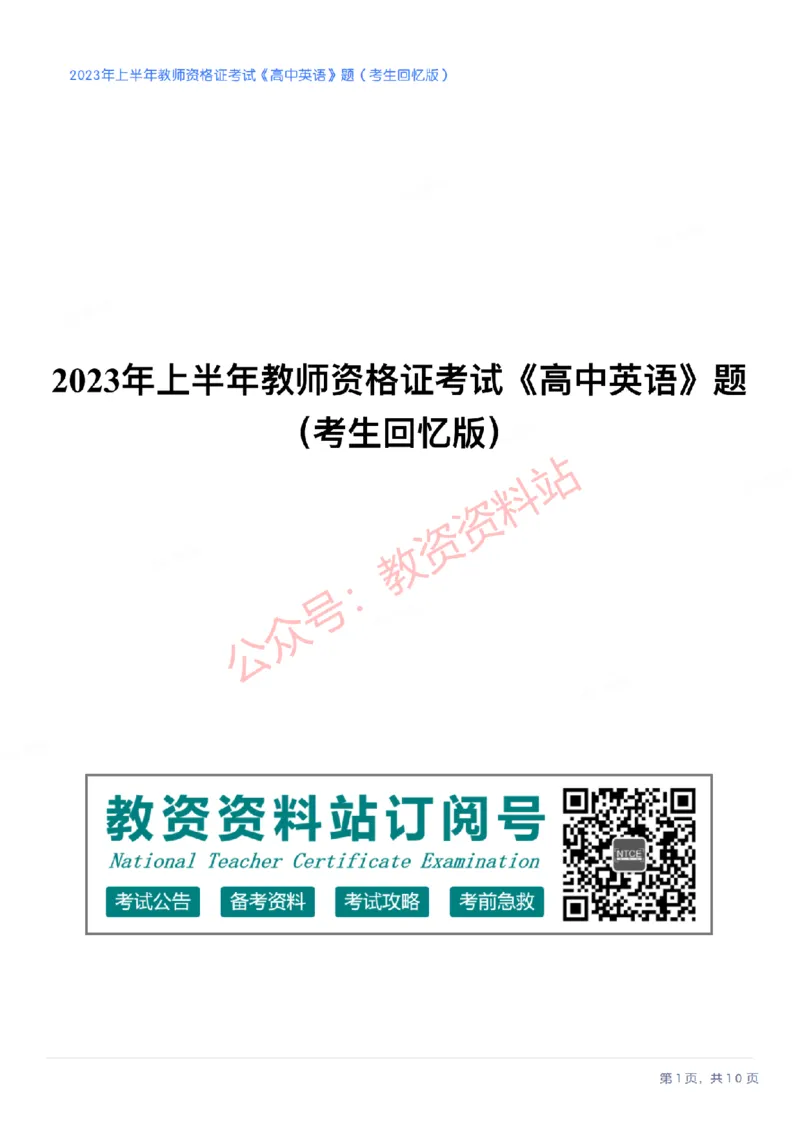
33.论述题
设计任务:请阅读下面的学生信息和语言素材,设计20 分钟的听说教学方案。
教案没有固定格式,但须包含下列要点:
Teaching objectives
Teaching content
Key and difficult points
Major steps and time allocation
Activities and justifications
教学时间:20 分钟
学生概况:某城镇普通中学八年级第二学期学生,班级人数40 人,多数学生已经达到义务
教育英语课程标准的相应水平三。学生课堂参与积极性较高。
语言素材:
Helpline: Hello. Friendship Helpline. Who's calling, please?
Lingling: Hello. This is Lingling speaking.
Helpline: Hi, Lingling! How can I help you?
Lingling: I have a problem with my best friend. She is called...
Helpline: No, don't tell me who she is. Tell me when the problem started.
Lingling: Yes. Well, we've been friends for five years. We got separated when we went to different
schools last term, but we stayed in touch.
Helpline: So could you explain what happened then?
Lingling: This term, she came to study at my school. I was so happy at first. But she's so different.
Helpline: Can you tell me how she's different?
Lingling: She doesn't like me to see my other friends.
Helpline: Could I ask if you've mentioned this to her?
Lingling: Yes, but she refused to listen.
Helpline: OK, do you know why she treats you like that?
Lingling: No. I don't know.
Helpline: Maybe she doesn't feel very sure of herself in her new school.
Lingling: Maybe.
Helpline: She probably feels lonely without you. I'm sure she regrets hurting you. So be patient with
her and explain to her that she can make friends with your other friends too. Try to introduce her to
them.
Lingling: I see. I'll encourage her to join in more. Thanks.
Helpline: No problem, Lingling. You're welcome.
正确答案是:
1.Teaching content
This is a listening lesson. It talks about a dialogue about how to get on well with best friends
and how to handle the barriers in the daily life to keep the good friendship. The dialogue
mainly introduces Lingling's problem with her best friend and the suggestions from Helpline
towards it.
2.Teaching objectives
①Language competence:
Students can understand the new words and phrases, such as “have a problem with, explain,
feel sure of and so on”.
Through listening, students will understand the main idea of the listening materials and be
able to use the target language to talk about some problems with one’s best friends.
②Cultural awareness:
Students can have correct values, positive emotional attitude and get along well with others
Students can learn to stay on good terms with their friends and understand the nature of
friendship.
③
Thinking quality: Students can sort out and summarize the information in the material.
④
Learning ability: Students will be willing to take part in the class activities and cooperate
with other group members.
3.Key and difficult points
①Key points
Help students know the meaning and usage of the new words and phrases.
Let students get the content of this lesson through listening.
②Difficult points
How to guide students to utilize the skills to extract information.
To improve the confidence of speaking English and help students realize the significance of
friendship.
4.Major steps
Step 1 Pre-listening (6 mins)
(1) New knowledge teaching
With the help of some pictures, the teacher will guide students to understand the meaning and
usage of the new words and phrases, including “have a problem with, explain, feel sure of
and so on”.
(2) Prediction
Before listening, the teacher will organize students to make a prediction. Some hints will be
provided to help them.
Hint 1: Words and phrases just referred to.
Hint 2: Some pictures in which students can see some problems that they may have with their
best friends.
【Justification】
The above activities can help students recognize the new words and phrases, remove the
barriers, and lay the foundation for the next step of “listening”.
Step 2 While-listening(10 mins)
(1)Extensive listening
Students will listen to the passage for the first time to check their predictions and conclude
the main idea of the passage.
(2)Intensive listening
Students should listen to the passage for the second time and do the following task:
True or False
Lingling’s friend doesn't feel very sure of herself in her new school.(T/F)
Lingling won’t be patient with her friend and explain to her that she can’t make friends with
Lingling’s other friends too.(T/F)
Helpline need to know Lingling’s friend’s name.(T/F)
(3) Listening and repeating
Students will listen to the passage for the third time and read after it. They should pay
attention to the pronunciation and intonation.
【Justification】
In the process of completing the listening tasks at different levels, students can not only
understand the content and certain details of the passage, but also improve their listening skill
s.
Step 3 Post-listening(4 mins)
Group discussion
Students will work in groups to discuss the following question: how do you get on well with
your best friends and how do you handle the barriers in the daily life to keep the good friends
hip? Several minutes will be given. When time's up, several students will be invited to share
their answers. Then the teacher will comment on students' performances.
【Justification】
Group activities will provide students with the opportunity to apply what they have learned to
the situation, improve their comprehensive language skills, and boost their confidence in
learning English and strengthen their sense of teamwork.
o
解析
同上。
o
考点
教学设计