2010 年天津市初中毕业生学业考试试卷
英 语
本试卷分为第Ⅰ卷(选择题)、第Ⅱ卷(非选择题)两部分。第Ⅰ卷第1页至第8页,第
Ⅱ卷第9页至第11页。试卷满分120分。考试时间100分钟。
答卷前,考生务必将自己的姓名、考生号、考点校、考场号、座位号填写在“答题卡”
上,并在规定位置粘贴考试用条形码。答题时,务必将答案涂写在“答题卡”上,答案答在
试卷上无效。考试结束后,将本试卷和“答题卡”一并交回。
祝各位考生考试顺利!
第Ⅰ卷
注意事项:
1.每题选出答案后,用2B铅笔把“答题卡”上对应题目的答案标号的信息点涂黑。
如需改动,用橡皮擦干净后,再选涂其他答案标号的信息点。
2.本卷共四大题,共75分。
一、听力理解(本大题共30小题,每小题1分,共30分)
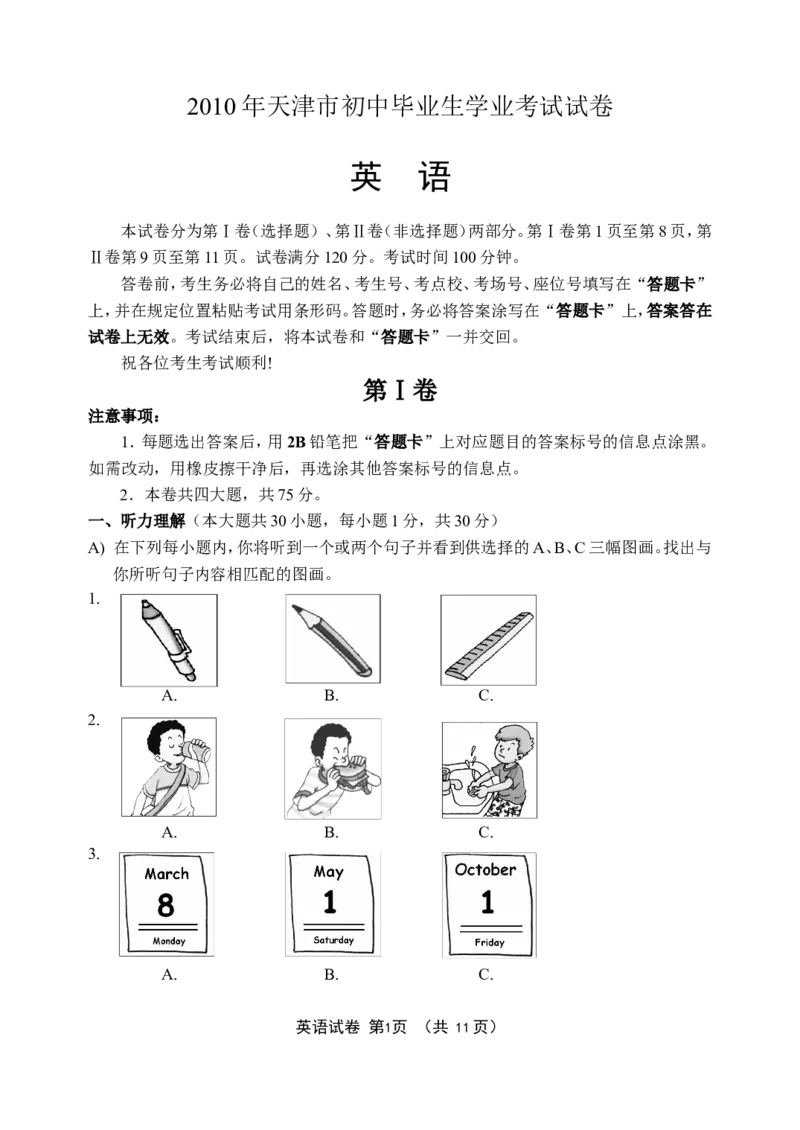
A) 在下列每小题内,你将听到一个或两个句子并看到供选择的A、B、C三幅图画。找出与
你所听句子内容相匹配的图画。
1.
A. B. C.
2.
A. B. C.
3.
A. B. C.
英语试卷 第1页 (共 11页)4.
A. B. C.
B) 在下列每小题内,你将听到一个问句并看到供选择的A、B、C三个答语。找出能回答你
所听到的那个问句的最佳选项。
5. A. At Guangming Cinema. B. About a hero.
C. At 7 o’clock.
6. A. Christmas. B. Dragon dance.
C. Spring Festival.
7. A. He is a policeman. B. He likes playing football.
C. He drives to work every day.
8. A. Two hours ago. B. About two hours.
C. After two hours.
9. A. I was ill. B. I was absent.
C. I got to school early.
10. A. There are five people in my family. B. There are over 200 people in
the hall.
C. There are 32 students in my class.
11. A. It is very interesting. B. It is $12.
C. It is by Mark Twain.
12. A. They are on the table. B. They are very cool.
C. I don’t wear glasses.
13. A. Yes, she is. B. No, she can’t.
C. Yes, she does.
14. A. A computer is more expensive. B. I have got a camera.
C. A computer is more useful, I think.
C) 下面你将听到十组对话,每组对话都有一个问题。根据对话内容,从每组所给的A、B、
C三个选项中找出能回答所提问题的最佳选项。
15. How does John go to school?
A. By bike. B. By bus. C. By taxi.
16. What’s Charlie’s problem?
A. He doesn’t like English. B. He finds the English homework difficult.
C. He can’t find his homework.
17. What are they talking about?
英语试卷 第2页 (共 11页)A. Subjects. B. Music. C. Schools.
18. How does Daming like the chocolate cookies?
A. He thinks they are delicious. B. He thinks they are too sweet.
C. He doesn’t like them.
19. Where is the woman going?
A. To a post office. B. To a hospital. C. To a
supermarket.
20. What’s the weather like?
A. It’s warm. B. It’s cool. C. It’s cold.
21. What is Susan doing?
A. Putting up the paper cuts. B. Helping her friend. C. Cleaning the
house.
22. Who are they talking about?
A. Chen Huan’s grandma. B. Chen Huan’s first English teacher.
C. Chen Huan’s first Chinese teacher.
23. Which country has Diana been to?
A. England. B. The United States. C. Australia.
24. Where are the two speakers now?
A. At a concert. B. At a cinema. C. At a party.
D) 听下面长对话或独白。每段长对话或独白后都有几个问题,从题中所给的A、B、C三个
选项中选出最佳选项。
听下面一段材料,回答第25至第27题。
25. What’s the date today?
A. June 19th. B. June 20th. C. June 21st.
26. What has the girl bought for her dad?
A. A black shirt. B. A blue shirt. C. A black cap.
27. What will Mike do for his dad?
A. Sing a song. B. Buy a cake. C. Make a cake.
听下面一段材料,回答第28至第30题。
28. What is Jack’s first class?
A. Maths. B. Science. C. English.
29. Why do those students laugh at Jack?
A. Because he doesn’t like science.
B. Because he gives a wrong answer.
C. Because he doesn’t do his homework.
英语试卷 第3页 (共 11页)30. What does Jack think of Alice?
A. Friendly. B. Naughty. C. Afraid.
二、单项填空(本大题共15小题,每小题1分,共15分)
从下列每小题所给的A、B、C和D四个选项中,选出可以填入空白处的最佳选项。
31. If you work hard, you’ll get good ______.
A. grades B. notes C. lessons D. answers
32. ______ Browns were having dinner when the telephone rang.
A. A B. An C. The D. /
33. Shen Xue and Zhao Hongbo won the gold medal for China so we’re proud ______
them.
A. in B. on C. of D. for
34. I could look after ______ when I was six.
A. herself B. myself C. yourself D. himself
35. The plane will ______ from Beijing Capital Airport and land in London.
A. take up B. take out
C. take away D. take off
36. I was so tired that I could ______ walk any farther.
A. nearly B. hardly C. really D. suddenly
37. Because of Project Hope, ______ children have better lives.
A. thousand B. thousands
C. thousand of D. thousands of
38. We will have a field trip this afternoon. The news makes everyone ______.
A. excited B. frightened C. happily D. luckily
39. —Shall we raise some money for the children of Yushu, Qinghai Province?
—______.
A. I see B. It’s a pleasure
C. I don’t believe it D. That’s a good idea
40. Liu Xiang ______ by his coach to train regularly.
A. advised B. advises
C. was advised D. be advised
41. We won’t start the meeting ______ our teacher arrives.
A. though B. until C. while D. or
42. He wanted to know ______ the English party.
A. when will we have B. when we will have
英语试卷 第4页 (共 11页)C. when would we have D. when we would have
43. —Would you like to go and see Avatar with me tonight?
— Thank you very much, but I ______ it already.
A. see B. will see C. have seen D. am seeing
44. —Can I wear any clothes I like to school?
—No, you can’t. You ______ wear a uniform.
A. might B. must C. will D. would
45. Jamie is a young cook ______ wants to improve school dinners.
A. who B. whose C. whom D. which
三、完形填空(本大题共10小题,每小题1分,共10分)
阅读下面短文,掌握其大意,然后从各题所给的A、B、C和D四个选项中选出最佳选
项。
Many students have hobbies, such as reading, painting, growing vegetables in their
gardens, and looking after animals. Some hobbies are relaxing and 46 are creative.
Hobbies can develop your interests and help you learn new skills.
David Smith is a student, and his hobby is writing. 47 the summer of 2000,
he spent four weeks on a summer camp. As well as the usual activities, such as
sailing, climbing and mountain biking, there was a writing workshop with a
professional 48 . “She asked us to imagine that we were in a story. Then we
wrote about our 4 9 at the camp.”
In senior high school David wrote a story about teenage life, and it 50 as a
book in 2003. Many teenagers love his book, and as a result, David has become a
51 young writer.
David has been very lucky 52 his hobby has brought him enjoyment and
success, but he is 53 interested in many other things. “I like playing volleyball,
too,” says David. “I spend some of my free time playing volleyball for my school
team. 5 4 I’ll write more books in the future, but I’m not sure.”
It’s sometimes difficult 55 that we shouldn’t spend all our time on our
favourite hobby. There are many other interesting things to do in life, and we should
try to do something new or different.
46. A. other B. others C. the other D. another
47. A. During B. At C. For D. On
48. A. manager B. doctor C. singer D. writer
49. A. experiences B. examples C. excuses D. experiments
50. A. took out B. tried out C. came out D. went out
英语试卷 第5页 (共 11页)51. A. successful B. normal C. polite D. lonely
52. A. or B. but C. because D. though
53. A. too B. also C. only D. either
54. A. Usually B. Immediately C. Maybe D. Once
55. A. remember B. remembers C. remembered D. to remember
四、阅读理解(本大题共10小题,每小题2分,共20分)
阅读下面的短文,从每小题所给的A、B、C和D选项中选出一个最佳选项。
A
Do you learn from your mistakes? I
hope so. But have you ever made the same
mistake twice? I have. Sometimes I make the
same mistake three or four times!
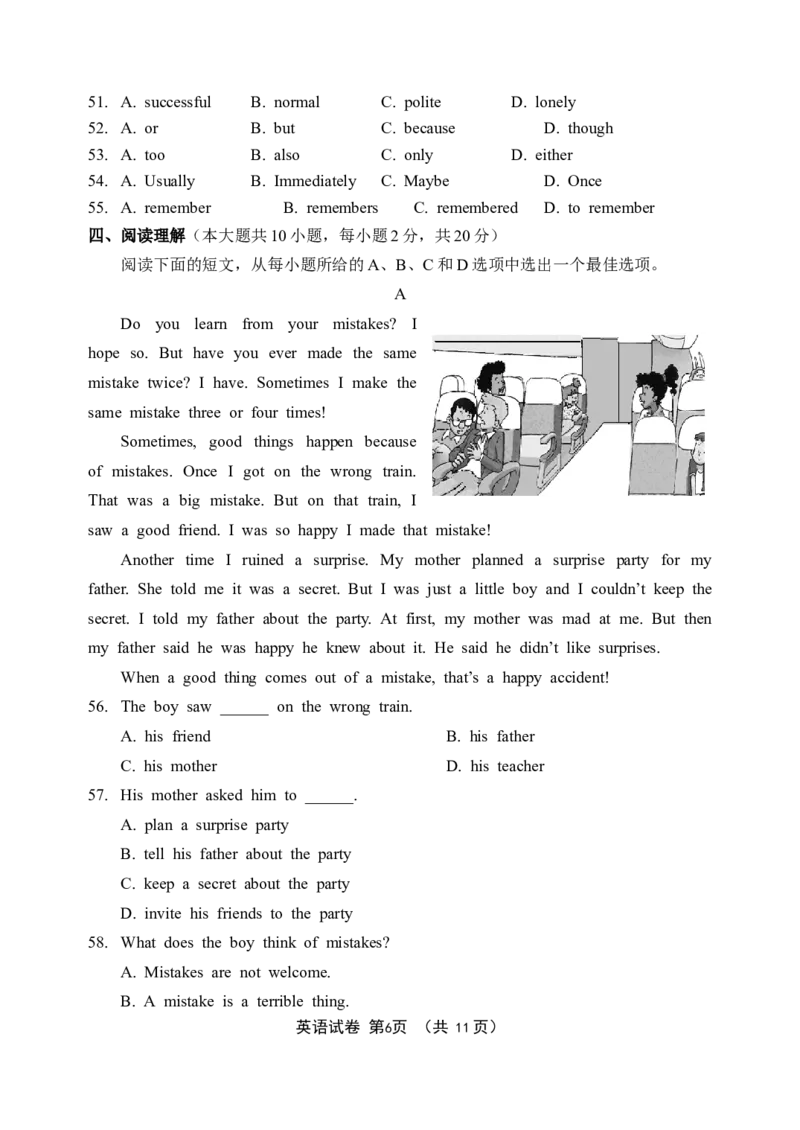
Sometimes, good things happen because
of mistakes. Once I got on the wrong train.
That was a big mistake. But on that train, I
saw a good friend. I was so happy I made that mistake!
Another time I ruined a surprise. My mother planned a surprise party for my
father. She told me it was a secret. But I was just a little boy and I couldn’t keep the
secret. I told my father about the party. At first, my mother was mad at me. But then
my father said he was happy he knew about it. He said he didn’t like surprises.
When a good thing comes out of a mistake, that’s a happy accident!
56. The boy saw ______ on the wrong train.
A. his friend B. his father
C. his mother D. his teacher
57. His mother asked him to ______.
A. plan a surprise party
B. tell his father about the party
C. keep a secret about the party
D. invite his friends to the party
58. What does the boy think of mistakes?
A. Mistakes are not welcome.
B. A mistake is a terrible thing.
英语试卷 第6页 (共 11页)C. All mistakes mean happy accidents.
D. Sometimes a mistake can be a good thing.
B
The panda is one of the animals most in danger. There are about 1,000 pandas
living in nature reserves today. Zoos and research centres look after about 160 pandas.
Scientists are studying how they live and more baby pandas are born in the zoos.
Pandas live in the forests and mountains of Southwest China. They mainly live on
bamboo, and each panda needs to eat a lot of bamboo every day. The area of bamboo
is becoming smaller for many different reasons, so pandas have less and less land to
live on. Pandas don’t have many babies, and baby pandas often die. The situation is
becoming very serious.
Our government is working hard to save pandas. There are more than 30 nature
reserves to protect pandas but these are not enough. The government has made a new
plan to help pandas. The nature reserves will be bigger and the bamboo will grow
better. Then the pandas will have enough food to eat and enough places to live in.
Pandas born in the zoos may go back to live in the nature reserves.
Most people love pandas. The panda is one of the best-known animals in the
world. It is the symbol for the World Wide Fund for Nature. The WWF works to
protect all animals in danger, so the panda has become the symbol of all animals in
danger. There is still a long way to go to save the panda. Think of other animals in
danger such as tigers, whales, turtles and elephants — we need to save the panda, and
we need to save them, too.
59. There are about ______ pandas living in nature reserves today.
A. 30 B. 160 C. 300 D. 1,000
60. Paragraph 2 is mainly about ______.
A. why pandas are in danger
B. why baby pandas often die
C. how to protect all animals
D. how to plant more bamboo
61. The government is trying ______ to help the pandas.
A. to build more zoos
B. to send more scientists
英语试卷 第7页 (共 11页)C. to make bigger nature reserves
D. to ask the WWF to work in China
62. ______ is the symbol for the World Wide Fund for Nature.
A. The tiger B. The panda
C. The elephant D. The whale
C
Ron loved basketball. One afternoon on his way to a basketball game, he was
walking and dreaming about playing college basketball the following year. As Ron was
walking to the game, a car hit him so hard that he was thrown three feet into the air.
Ron woke up in a hospital room. When he learned that both his legs were
broken, he realized his college basketball dreams were over. Ron did what the doctors
told him, but his progress was slow. When he left the hospital, Ron was sent to a
health centre for physical treatment.
A week after he arrived there, he met Sunny. Sunny was a coach. His legs were
paralysed(瘫痪的) from a skiing accident. Even though he couldn’t move his legs,
Sunny coached a basketball team called the Suns. Everyone on the team played from a
wheelchair. Sunny invited Ron to join the game. Ron played badly, but for the first
time since the accident, he stopped feeling sorry for himself.
After becoming a part of the Suns, Ron improved quickly. Basketball was like
medicine for him. And whenever Ron became depressed or angry, Sunny was there to
encourage him and help him. The day before Ron left the centre, he had dinner with
Sunny. He asked Sunny how he managed to be so generous and cheerful, even with
his paralysis.
Sunny smiled and said, “It’s really quite simple. When you keep your face to the
sun, the shadows (阴影) fall behind.”
63. What happened to Ron on his way to a basketball game?
A. A car hit him.
B. He met his coach.
C. His doctor called him.
D. He fell down and cut his foot.
64. The underlined word “depressed” means ______ in Chinese.
A. 懒惰的 B. 好奇的 C. 沮丧的 D. 激动的
65. What is the most important thing we can learn from the story?
英语试卷 第8页 (共 11页)A. Basketball can teach people about life.
B. Keep smiling when you face difficulties.
C. Life is more difficult for the paralysed.
D. Skiing is more dangerous than basketball.
英语试卷 第9页 (共 11页)2010 年天津市初中毕业生学业考试试卷
英 语
第Ⅱ卷
注意事项:
1.用黑色墨水的钢笔或签字笔将答案写在“答题卡”上。
2.本卷共五大题,共45分。
五、完成句子(本大题共5小题,每小题2分,共10分)
根据所给中文意思完成句子,每空限填一词。
66. 这所房子两年前属于我姑姑。
This house ______ ______ my aunt two years ago.
67. 这些巧克力都是手工制作的。
These chocolates are all made ______ ______.
68. 我九岁时去小电台求过职。
I ______ ______ a job at small stations at the age of nine.
69. 那时他在努力算出这道数学题。
He was trying hard to ______ ______ this maths problem at that time.
70. 史密斯先生说话很慢以便学生们能够听清楚。
Mr Smith speaks slowly ______ ______ the students can hear him clearly.
六、补全对话(本大题共5小题,每小题1分,共5分)
根据对话内容,在每小题的空白处填入适当的话语,使对话意思完整。
(A reporter is interviewing a foreign visitor at the Shanghai Expo.)
Reporter: Excuse me, I’m a reporter from a student magazine. 7 1 ?
Visitor: Sure, please.
Reporter: 7 2 ?
Visitor: I’m from Germany.
Reporter: 7 3 ?
Visitor: I came here two days ago.
Reporter: 7 4 ?
Visitor: Yes, just a little. I began studying Chinese two months ago.
英语试卷 第10页 (共 11页)Reporter:How do you like the Shanghai Expo?
Visitor: I like it very much. The China pavilion (中国馆) impressed me most.
Reporter:Thank you for answering my questions. 7 5 .
Visitor: Thank you.
七、任务型阅读(本大题共5小题,每小题1分,共5分)
阅读短文,根据短文内容完成表格。
Louis Braille was born in Coupvray, France. He was a very smart child. Unluckily,
at the age of four, he became blind by accident. Louis began attending school in his
town when he was seven years old.
Three years later, Louis and his father traveled to Paris. There, he went to a
school for blind children. One day a French soldier, Charles Barbier, visited the school.
Barbier invented a system of night-reading. This system used small dots for the letters.
Soldiers used this system in time of war. Barbier thought this system could help the
blind to read.
Soon Braille discovered that there were some shortcomings (缺点) in Barbier’s
system, but it gave Louis a brilliant idea. He improved Barbier’s system. By the age
of fifteen, his new system was completed! Now he wanted blind schools to try his
system. Luck went against him again. The school refused to use his system. Louis died
in 1852 in Paris at age forty-three.
Two years after he died, the blind schools began to use his system. Today we call
this system Braille in honour of Louis Braille. His system is used for all languages,
and for maths, science, writing music, and computers for the blind.
Louis Braille
Time Place Events
in 7 6 in Coupvray was born
at the age of four became 7 7
at the age of seven in 7 8 started school
at the age of 7 9 in Paris studied in a school for blind
children
by the age of 15 completed his new system
in 1852 in Paris 8 0
英语试卷 第11页 (共 11页)八、综合填空(本大题共10小题,每小题1分,共10分)
根据短文内容及首字母提示,填写所缺单词,使短文意思完整。
Think about two people you know. How would you describe their personalities?
Are they the s 8 1 ? Of course not! Everyone is different. Even identical twins have
different personalities.
Some people are very outgoing (外向的) and friendly. They like to be w 82
other people all the time. Maybe they like to be the centre of attention. And some
people are quiet —maybe even s 83 . They can be friendly, too. But they like to
be alone or with just a f 8 4 friends.
Some people worry a lot. They may worry about many things, such as their jobs,
their families and anything that may happen in the future. H 85 , some people
don’t worry about anything! They n 86 mind what is going on next. These
people are very relaxed.
Some people are hard-working. They always do their b 87 . But some people
are lazy. They don’t care about d 88 things right or getting things done on time.
Hard-working people always get more chances than those lazy o 8 9 in life.
And don’t f 9 0 this: Everyone is different. That means you are special!
九、书面表达(本大题共15分)
假设你是某学生杂志社的编辑Diana,收到了读者Steve的一封来信,信中倾诉了他
目前的烦恼。请根据提示内容,给Steve写一封回信。
提示:
与人交流 课上参与小组讨论,表达自己的想法;课间和同学交谈
表达善意 主动问候同学;对同学友好;帮助同学
参加活动 积极参加班级活动(如:运动会、歌咏比赛等)
参考词汇: 小组讨论 group work 表达 express
要求:1.词数:80~100个。
2.开头和结尾已给出,不计入总词数。
3.要点齐全,行文连贯,可适当发挥。
Dear Diana,
I just came to a new school. And I can’t get on well with my new classmates…What should I do?
S t e v e
*****************************************************
英语试卷 第12页 (共 11页)
Dear Steve,
I’ve learned about your problems. I think____________________________________
Best
wishes,
Diana2010 年天津市初中毕业生学业考试
英语参考答案及评分标准
评分说明:
1.各题均按参考答案及评分标准评分。
2.若考生的非选择题答案与参考答案不完全相同但言之有理,可酌情评分,但不得超
过该题所分配的分数。
一、听力理解(本大题共30小题,每小题1分,共30分)
1~5 C B C A C 6~10 C A B A C 11~15 B A A C B
16~20 B B A B C 21~25 A B A C B 26~30 A C C B A
二、单项填空(本大题共15小题,每小题1分,共15分)
31~35 A C C B D 36~40 B D A D C 41~45 B D C B A
三、完形填空(本大题共10小题,每小题1分,共10分)
46~50 B A D A C 51~55 A C B C D
四、阅读理解(本大题共10小题,每小题2分,共20分)
56~60 A C D D A 61~65 C B A C B
五、完成句子(本大题共5小题,每小题2分,共10分)
66. belonged to 67. by hand 68. asked for 69. work out 70. so that
六、补全对话(本大题共5小题,每小题1分,共5分)
71. May I ask you some questions
72. Where are you from
73. When did you come to Shanghai
74. Can you speak Chinese
75. Enjoy yourself
七、任务型阅读(本大题共5小题,每小题1分,共5分)
英语试卷 第13页 (共 11页)76. 1809 77. blind 78. his town 79. ten 80. died
八、综合填空(本大题共10小题,每小题1分,共10分)
81. same 82. with 83. shy 84. few 85. However
86. never 87. best 88. doing 89. ones 90. forget
每空(横线上)只能填写一个英语单词,凡多填的(即使其中一个是正确的)一律不给
分。
九、书面表达(本大题共15分)
One possible version:
Dear Steve,
I’ve learned about your problems. I think you should be active in group work in class and be
brave enough to express your ideas. Try to talk with your classmates at break. If you want to
get on well with your classmates, don’t forget to say hello when you meet them. Being friendly
and helpful is also very important. You need to take part in all kinds of class activities, such as
sports meetings, football games and singing competitions. I’m sure you will soon be among
friends.
Best wishes,
Diana
各档次的给分范围和要求:
第五档:(13~15分)能写明全部或绝大部分内容要点;语言基本无误;行文连贯,
表达清楚。
第四档:(10~12分)能写明全部或大部分内容要点;语言有少量错误;行文基本连贯,表
达基本清楚。
第三档:(7~9分)能写明大部分内容要点;语言有较多错误;尚能达意。
第二档:(4~6分)只能写出少部分内容要点;语言错误很多,只有个别句子可读。
第一档:(0~3分)只能写出与所要求内容有关的一些单词。
英语试卷 第14页 (共 11页)