2 0 2 5 年 全 国 教 师 资 格
主讲老师 李婉君
粉笔教师教育 粉笔教师(四 )实 义 动词 -语 态
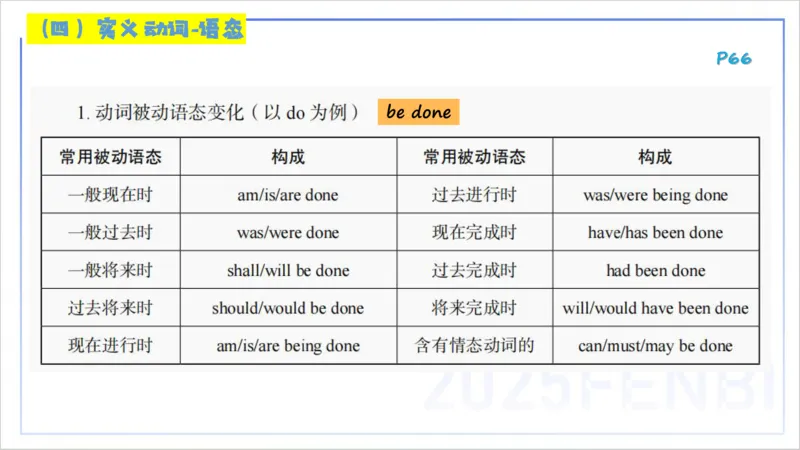
be done主 动表 示被动
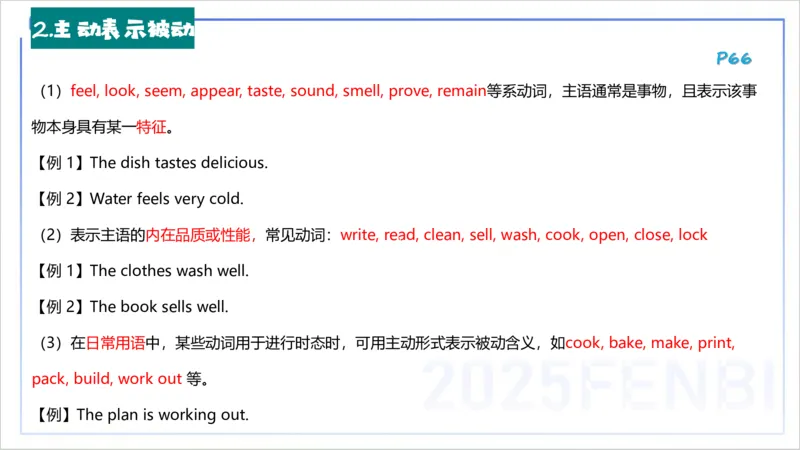
2.
(1)feel, look, seem, appear, taste, sound, smell, prove, remain等系动词,主语通常是事物,且表示该事
物本身具有某一特征。
【例 1】The dish tastes delicious.
【例 2】Water feels very cold.
(2)表示主语的内在品质或性能,常见动词:write, read, clean, sell, wash, cook, open, close, lock
1
【例 1】The clothes wash well.
【例 2】The book sells well.
(3)在日常用语中,某些动词用于进行时态时,可用主动形式表示被动含义,如cook, bake, make, print,
pack, build, work out 等。
【例】The plan is working out.主 动表 示被动
2.
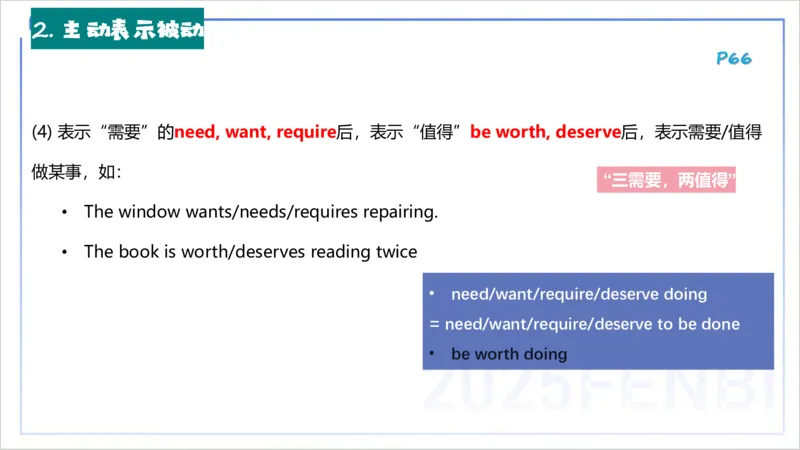
(4) 表示“需要”的need, want, require后,表示“值得”be worth, deserve后,表示需要/值得
做某事,如:
“三需要,两值得”
• The window wants/needs/requires repairing.
• The book is worth/deserves reading twice
• need/want/require/deserve doing
= need/want/require/deserve to be done
• be worth doing主 动表 示被动
2.
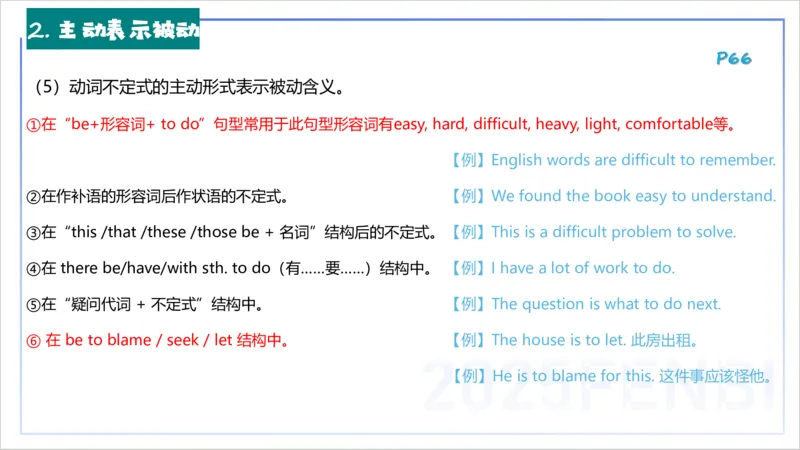
(5)动词不定式的主动形式表示被动含义。
①在“be+形容词+ to do”句型常用于此句型形容词有easy, hard, difficult, heavy, light, comfortable等。
【例】English words are difficult to remember.
②在作补语的形容词后作状语的不定式。 【例】We found the book easy to understand.
③在“this /that /these /those be + 名词”结构后的不定式。【例】This is a difficult problem to solve.
④在 there be/have/with sth. to do(有……要……)结构中。 【例】I have a lot of work to do.
⑤在“疑问代词 + 不定式”结构中。 【例】The question is what to do next.
⑥ 在 be to blame / seek / let 结构中。 【例】The house is to let. 此房出租。
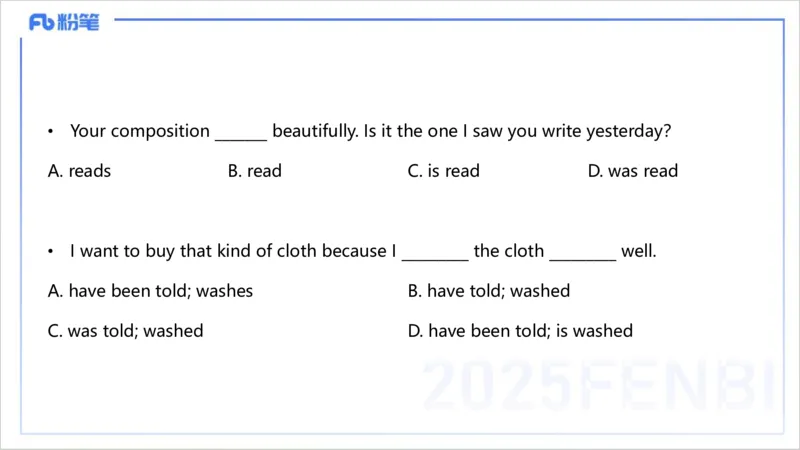
【例】He is to blame for this. 这件事应该怪他。• Your composition _______ beautifully. Is it the one I saw you write yesterday?
A. reads B. read C. is read D. was read
• I want to buy that kind of cloth because I _________ the cloth _________ well.
A. have been told; washes B. have told; washed
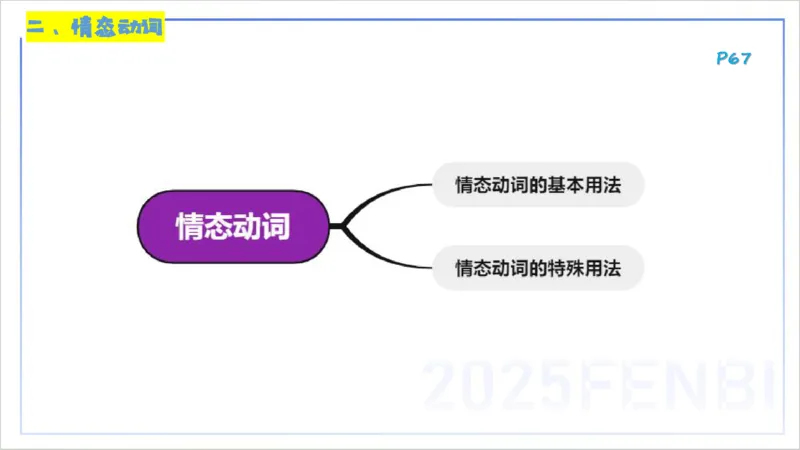
C. was told; washed D. have been told; is washed二 、情 态动词情 态动词 一 般 用 法
1.
1. can/could
(1)表示能力
• 现在的能力:can
• 过去的能力:could 【例1】I could read books when I was four.
【例2】He is able to finish his homework with the teacher’s help.
• 用于各种时态:be able to
(2) 表示许可
提问时:请求别人允许自己做某事时,二者都可用,意为“可以...”
回答时:给予别人许可时,只能用 can/can’t
【例】—Can/Could I go now?(表请求)
—Yes, you can.(表允许) /—No, you can’t.情 态动词 一 般 用 法
1.
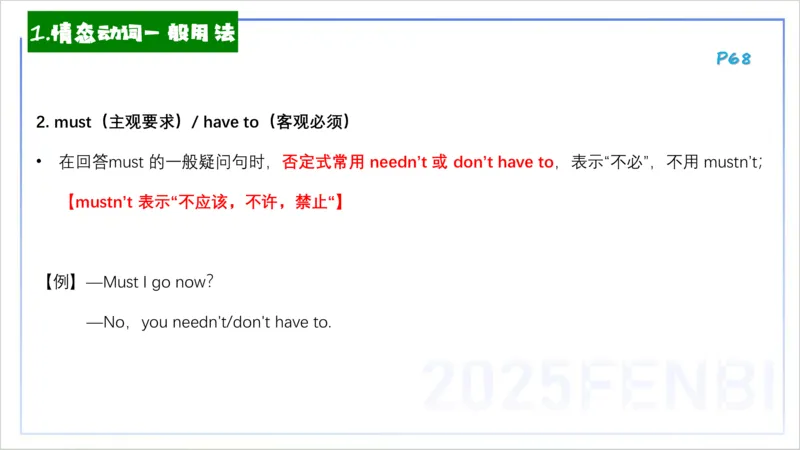
2. must(主观要求)/ have to(客观必须)
• 在回答must 的一般疑问句时,否定式常用 needn’t 或 don’t have to,表示“不必”,不用 mustn’t;
【mustn’t 表示“不应该,不许,禁止“】
【例】—Must I go now?
—No,you needn't/don't have to.情 态动词 一 般 用 法
1.
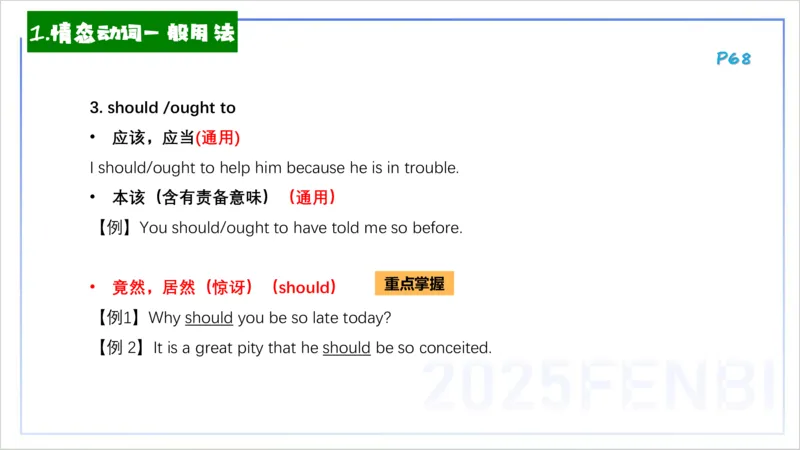
3. should /ought to
• 应该,应当(通用)
I should/ought to help him because he is in trouble.
• 本该(含有责备意味)(通用)
【例】You should/ought to have told me so before.
• 竟然,居然(惊讶)(should) 重点掌握
【例1】Why should you be so late today?
【例 2】It is a great pity that he should be so conceited.情 态动词 一 般 用 法
1.
4. may / might
表示“请求允许”二者均可,might 表示的语气较委婉
表示“给予允许”,用 may,不同意请求时用 can’t 或者 mustn’t
【例】—May/Might I sit here?
肯定回答:—Yes, you may/can; 口语中可以用 can 代替 may
否定回答:—No, you can’t/mustn’t.
Ø may 表示“祝愿”时
【例】May that day come soon.
【例】May you succeed in wining first prize in the game.情 态动词 一 般 用 法
1.
5. will / would
• 表示“意愿、请求”时,二者同义;不过,在问句中,would 表达的语气更加委婉
【例 1】 I will never do it again.
【例 2】Will you give her the letter?
【例 3】Would you please tell me your telephone number?
• would表示过去的某一种习惯(不涉及现在)
• 【例】When we worked at the same office, we would often have coffee together.情 态动词 一 般 用 法
1.
重点掌握
6. dare / need
ü 作情态动词: 常用于否定句和疑问句needn’t/daren’t do;Need/dare…do…?
ü 做实义动词: 可用于肯定句,否定句和疑问句。其形式为:
need(needs/needed) to do
dare(dares/dared) to do
don’t(doesn’t/didn’t) need to do
don’t(doesn’t/didn’t) dare to do
【T/F】I daren't go out alone at night.
【T/F】Dare you let out the news to the public?
【T/F】If he dares speak to me like that again, he will be sorry. 判断对错情 态动词 一 般 用 法
1.
重点掌握
6. dare / need
ü 不同点: 对一般疑问句的回答不同
—Dare...do...?
—Need...do...?
—Yes, ...dare.
—Yes,...must.
—No,...daren’t.
—No,...needn’t.
【例】— Need I come tomorrow?
— No, you needn't./—Yes, you must.• It was so noisy that we _______ hear ourselves speak.
A. couldn’t B. shouldn’t C. mustn’t D. needn’t
• --- May I leave before 4 o’clock in the afternoon?
--- No, you _____.
A. shouldn’t B. mustn’t
C. wouldn’t D. needn’t情 态动词 表 示推测
2.注意:
can 通常只用于否定句或疑问句,一般不用于肯定句
could 可以用于肯定、否定和疑问句中。
两者没有时间上的差别,只是could 比 can 更委婉,更不确定。
【例 1】Can/Could the story be true?
【例 2】The story can’t/couldn’t be true.
【例 3】The story could be true.
can有时也用于肯定句中表示推测,主要用于表示理论上的可能性
【例1】He can be very friendly at times.
【例2】As a human being, anyone can make a mistake.• Don’t play with the dog, Jack, for it _____ be dangerous at times.
A. shall B. should
C. can D. must情态动词表示推测,有时态上的区分
对现在或将来的推测:can/could/must/should/ought to/may/might+do
对过去推测:can/could/must/should/ought to/may/might+have done
推测正在进行的事情:must be doing
【例1】He should/ought to arrive at noon.
【例2】He must be talking with his friend.
【例3】She couldn’t/can’t have left so soon.• You ________ be Carol. You haven’t changed a bit after all these years.
A. must B. can
C. will D. shall情 态动词 特 殊用 法
3.
高频考点3 情态动词表虚拟
丝(should/shouldn’t)袜(would)奶(needn’t)茶(could)表虚拟• 【巩固提升】4. I can’t find my purse. I ________ it in the supermarket yesterday, but I’m
not sure.
A. should leave B. must have left
C. might leave D. could have left
• You have a big mouth, Tom. You______have told everybody the secret.
A. can't B. mustn't C. shouldn't D. mightn't三 、助动词
助动词一般本身没有独立的实际意义,不能单独作谓语,通常帮助实义动词并与实义动词一起
构成谓语,表示时态、语态、语气等,或构成陈述句、疑问句和否定句等。
• be (is, am, are, was, were, being, been)
• have (has, had, having)
• do (does, did)
• shall (should), will (would)四 、系 动词
(一)分类
了解即可
分类 系动词 例句
状态系动词 be • We are anxious about his safety.
keep, rest, remain, stay, lie, stand,
持续系动词 • This matter rests a mystery.
continue…
表像系动词 seem, appear, look… • It appears a true story.
感官系动词 feel, smell, sound, taste… • The cloth feels soft.
become, grow, turn, fall, get, go,
变化系动词 • As he grows older, he grows wiser.
come, run…
终止系动词 prove, turn out… • The examination turned out quite easy.(二)用法要点
1. 系动词后接形容词、副词作表语
(1)系动词后通常可接形容词作表语,一般不接副词。
【例】The soup tastes nicely.(错)
(2)有时系动词后也可接副词作表语,不过这仅限于 in, on, off, out, away, behind, up, down,
over, through, around, round, below, inside, outside 等少数副词小品词以及 here, there, upstairs,
downstairs 等少数表示地点或方位的副词。
【例 1】Mother wasn’t in last night.
【例 2】Mother is downstairs waiting for you.(二)用法要点
2. 系动词后接不定式作表语
(1)系动词 be 后根据情况可接不定式作表语。
【例】My dream is to be a scientist.
(2)seem, appear, prove, turn out, get, grow, come 等系动词后也可接不定式(尤其是to be)作表语。
【例】The weather turned out to be fine.
(3)sound, smell, feel, taste, become 等系动词后通常不接不定式。
【例】It sounds to be good.(错)
3. 系动词与被动语态
英语中所有的系动词都是不及物动词,所以所有系动词都不能用于被动语态。
His explanation sounds reasonable.(正)非 谓 语 动 词
Non-Predicate Verb什 么 是 非 谓 语 :
我喜欢你。
❤
I like you.
我喜欢打你。
I like hit you. (对吗 ? )
降级后→ I like hitting you.一 、非 谓 语 动词 的分 类 、意义 及 构成非 谓 语 的 基 本 形 式
to do : To be a teacher is my dream. 表将来
To be a teacher, I have to study hard. 表目的(有时表结果)
doing:developing country 表进行
He sat there, reading a newspaper. 表主动,进行
doing: Teaching is my job. 动名词
done: developed country 表完成
Told the fact, he was shocked. 表被动• -What a surprise to see you cooking! You never did that before.
-_____ that I’m grown-up, I want to help my parents do something.
A. Considering B. Considered C. To consider D. Being considered
• In addition to a healthy diet, you also need regular exercise __________ weight.
A. losing B. having lost
C. lost D. to lose时 态及 语 态变 化时 态变 化
to do
非谓语形式 时态
to do
to do to be doing
to have done
He pretended to be sleeping.
He was said to have finished his homework.时 态变 化
to do
形式 时态 被动语态
(要被做 为了被 )
to do to be done / ...
to be doing to be being done
to do
to have been done
to have done
(被做且动作发生在谓语前)
1. To be admitted by this school, students need to pass the exam.
The meeting is to be held tomorrow.
2. This machine was said to have been repaired.时 态变 化
doing
形式 时态 被动语态
一般态: (正在被做)
doing being done
doing
完成态:
having done having been done
主动且动作发生在谓语之前 (被动且动作发生在谓语之前)
( )
1. The building being built is a cinema.
2. Having been punished by the teacher, he felt upset.【巩固提升】1. Garbo plays the role of the queen, ________ in the love she has found with
Antonio.
A. rejoiced B. rejoicing C. being rejoiced D. to rejoice
【巩固提升】2. ________ of what happened in advance, she stood in the meeting room,
confused and awkward.
A. Not having been informed B. Not being informed
C. Having not been informed D. Have been not informed【巩固提升】3. If they win the final tonight, the team are going to tour around the city
________ by their enthusiastic supporters.
A. being cheered B. be cheered
C. to be cheered D. were形式 否定式
to do not to do
doing not doing
done not done
1.She told me not to go out lonely during night because it’s dangerous.
2. Not knowing this, he didn’t come.
3. Not having eaten anything, since the night before, I felt very hungry.形式 复合结构
否定式为:
doing sb.’s doing sb.’s not doing
• I don’t remember her telling me that story.
• I insist on his not going there.• _____ his homework made his father lost in temper.
A. The boy’s not having done B. The boy not having done
C. The boy’s having not done D. The boy having not done
• What worried the child most was ______ to visit his mother in the hospital.
A. his not allowing B. his not being allowed
C. his being not allowed D. having not been allowed