前 言
前 言
2000 年,外语教学与研究出版社依据国家《义务教育英语课程标准(实验稿)》组
织开发了本套教材。至今,本套教材已出版使用二十余年,得到了广大师生的一致好评。
2022 年,以马克思主义中国化时代化最新成果为指引,根据教育部《义务教育英语课程
标准(2022 年版)》的理念与要求,在充分考虑我国义务教育阶段英语教育实际学情和
教情的基础上,我们对本套教材进行了认真修订,重建了框架结构且进行了全新的内容
设计,确保在初中英语学科教育中全面贯彻党的教育方针,落实立德树人根本任务。
修订后的初中教材共6 册,每册均由6 个学习单元及附录组成,七年级上册增设了
小初衔接单元(Starter)。教材各学习单元均遵循认知发展过程编写,分为“理解—发
展—实践”三个环节,由5 个板块构成,分别为:背景激活(Starting out)、主题理解
(Understanding ideas)、思维拓展(Developing ideas)、主题实践(Presenting ideas)、
自我评价(Reflection)。附录包括Communication bank、Language notes、Words and
expressions 等板块。
修订后的教材的主要特色如下:
一、科学设计单元流程,整体设计单元内容,秉持在体验中学习、在实践中运用、
在迁移中创新的学习理念,切实落实学思结合、用创为本的英语学习活动观。
二、语篇题材多样、体裁丰富,语言地道鲜活、难度适中,符合学生的兴趣特点,
有助于提升学生的语篇意识、丰富学生的语言感知与学习体验。
三、活动设计紧密围绕主题,指向主题意义建构与产出,促使学生发现问题、分析
问题和解决问题。
四、坚持“教—学—评”一体化,围绕教材各环节的学习过程和成果,将评价贯穿
于英语课程教与学的全过程,彰显评价的促学和促教作用。
五、融通多元文化,促进文明互鉴。引导学生在增强国家认同的基础上,尊重世界
文化多样性,开展灵活、有效、坚守中国立场的跨文化沟通,提升文化自信。
学习英语没有捷径,需要持之以恒的努力。本套教材旨在帮助广大学生以开放的心
态接受新挑战,积极尝试,大胆实践。通过不断学习,提升核心素养,为继续学习英语
和终身发展打下坚实的基础。
Starter
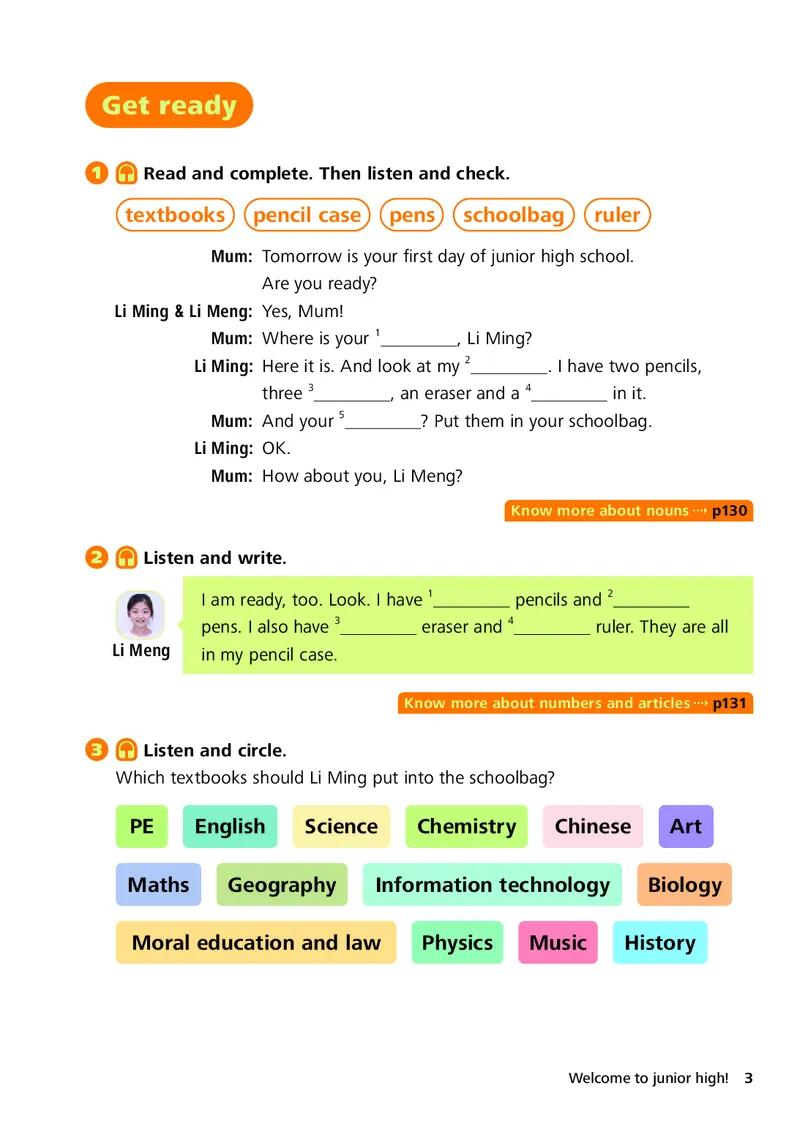
Get ready
Welcome to junior high! p2
nouns; numbers; articles; simple future tense
Unit
Understanding ideas
Reading
Grammar
1 p14
A new start
The first lesson
Learning to think:
Understanding a famous saying
Pronouns
2 p30
More than fun
Rock music meets the erhu
Learning to think: Judging the
writer’s feeling
there be
3 p46
Family ties
Silent love
Learning to think: Making
comments about a character
Possessive nouns
4 p62
Time to celebrate
An unusual Spring Festival
Learning to think: Exploring
differences
Adverbs of
frequency; simple
present tense
5 p78
Fantastic friends
Pigeon surprise
Learning to think:
Understanding people’s thoughts
and feelings
Present continuous
tense
6 p94
The power of plants
Within a plant
Learning to think: Paying
attention to a pun
Simple future tense
Appendices p110
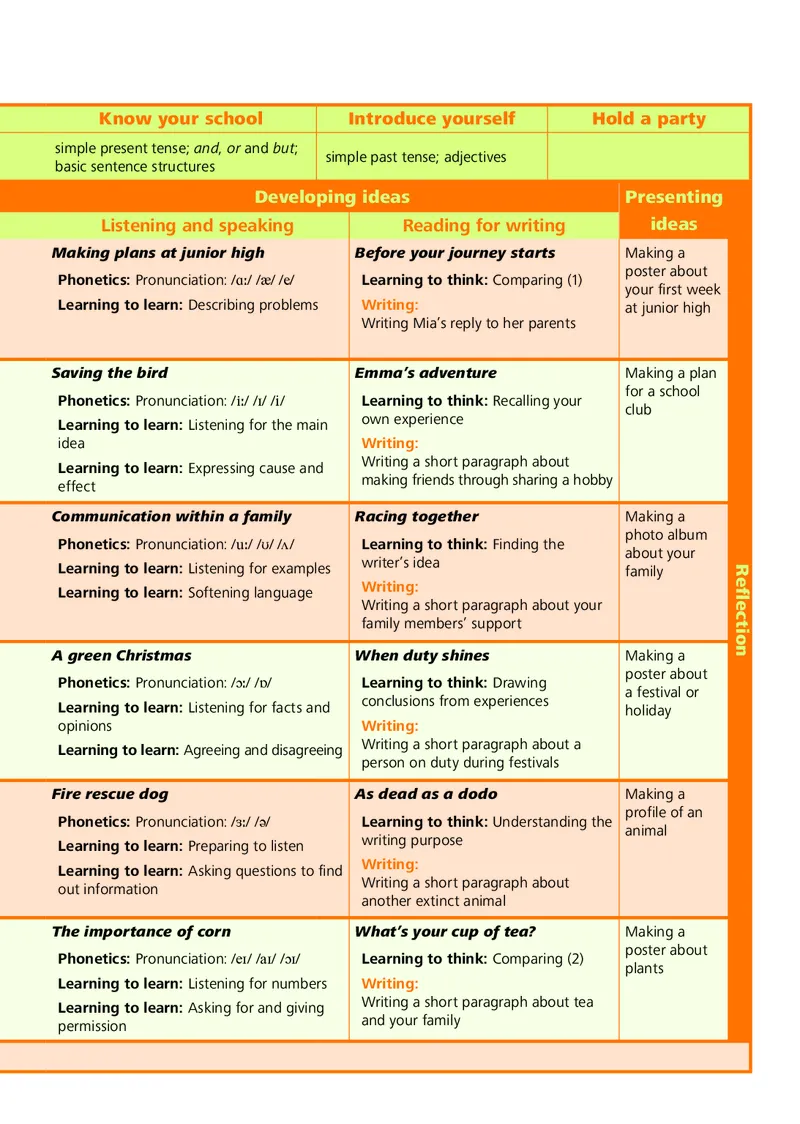
Scope and sequence
Scope and sequence
Starting out
Know your school
Introduce yourself
Hold a party
simple present tense; and, or and but;
basic sentence structures
simple past tense; adjectives
Developing ideas
Presenting
ideas
Listening and speaking
Reading for writing
Making plans at junior high
Phonetics: Pronunciation: /ɑː/ /æ/ /e/
Learning to learn: Describing problems
Before your journey starts
Learning to think: Comparing (1)
Writing:
Writing Mia’s reply to her parents
Making a
poster about
your first week
at junior high
Saving the bird
Phonetics: Pronunciation: /iː/ /ɪ/ /i/
Learning to learn: Listening for the main
idea
Learning to learn: Expressing cause and
effect
Emma’s adventure
Learning to think: Recalling your
own experience
Writing:
Writing a short paragraph about
making friends through sharing a hobby
Making a plan
for a school
club
Communication within a family
Phonetics: Pronunciation: /uː/ /ʊ/ /ʌ/
Learning to learn: Listening for examples
Learning to learn: Softening language
Racing together
Learning to think: Finding the
writer’s idea
Writing:
Writing a short paragraph about your
family members’ support
Making a
photo album
about your
family
A green Christmas
Phonetics: Pronunciation: /ɔː/ /ɒ/
Learning to learn: Listening for facts and
opinions
Learning to learn: Agreeing and disagreeing
When duty shines
Learning to think: Drawing
conclusions from experiences
Writing:
Writing a short paragraph about a
person on duty during festivals
Making a
poster about
a festival or
holiday
Fire rescue dog
Phonetics: Pronunciation: /ɜː/ /ə/
Learning to learn: Preparing to listen
Learning to learn: Asking questions to find
out information
As dead as a dodo
Learning to think: Understanding the
writing purpose
Writing:
Writing a short paragraph about
another extinct animal
Making a
profile of an
animal
The importance of corn
Phonetics: Pronunciation: /eɪ/ /aɪ/ /ɔɪ/
Learning to learn: Listening for numbers
Learning to learn: Asking for and giving
permission
What’s your cup of tea?
Learning to think: Comparing (2)
Writing:
Writing a short paragraph about tea
and your family
Making a
poster about
plants
Reflection
Starter Welcome to
Welcome to
junior high!
junior high!
Welcome to junior high! It’s a new stage of your study. You’ll go to a new school. You’ll
learn new subjects. You’ll also make new friends. Are you ready for all these? In this unit,
let’s get prepared! It will be fun!
2 Starter
Get ready
Read and complete. Then listen and check.
1
textbooks
pencil case
pens
schoolbag
ruler
I am ready, too. Look. I have
1
pencils and
2
pens. I also have
3
eraser and
4
ruler. They are all
in my pencil case.
Li Meng
Listen and write.
Which textbooks should Li Ming put into the schoolbag?
2
Listen and circle.
3
Know more about nouns ⇢ p130
Know more about numbers and articles ⇢ p131
Chinese
Maths
English
History
Geography
Biology
Art
Music
Physics
PE
Information technology
Chemistry
Science
Mum: Tomorrow is your first day of junior high school.
Are you ready?
Li Ming & Li Meng: Yes, Mum!
Mum: Where is your
1
, Li Ming?
Li Ming: Here it is. And look at my
2
. I have two pencils,
three
3
, an eraser and a
4
in it.
Mum: And your
5
? Put them in your schoolbag.
Li Ming: OK.
Mum: How about you, Li Meng?
Moral education and law
Welcome to junior high! 3
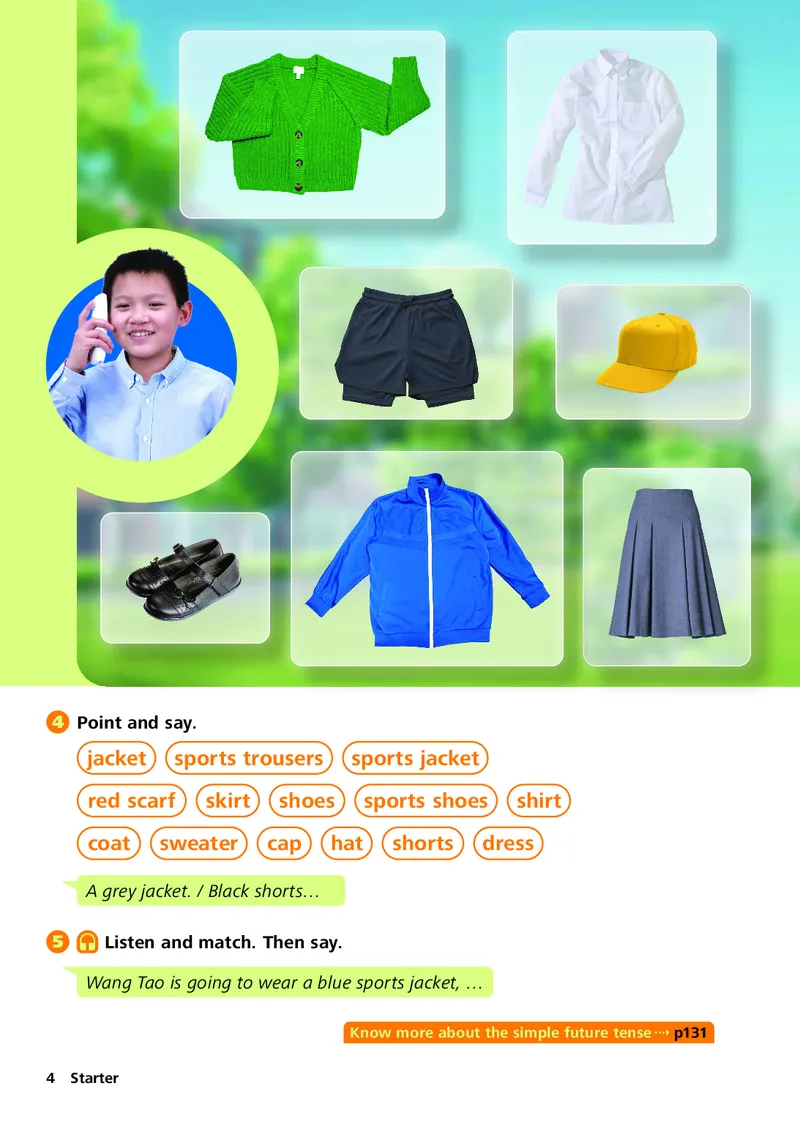
Point and say.
Listen and match. Then say.
4
5
A grey jacket. / Black shorts…
Wang Tao is going to wear a blue sports jacket, …
Know more about the simple future tense ⇢ p131
jacket
shirt
red scarf
sports trousers
sports shoes
sports jacket
skirt
shoes
sweater
coat
hat
cap
shorts
dress
4 Starter
Design a school uniform.
6
They’re going to wear…
What are they going to wear on
the first day of junior high?
Welcome to junior high! 5
Know your school
This is the teaching building.
It has three floors. All the
classrooms are in this building.
You’re
here.
Read the passage and match the places.
1
teaching building
dining hall
playground
Welcome
This is your new school. There are three
buildings and a playground. It’s not a very
big school, but it is beautiful. You will love it!
Today, some teachers and students will show
you around.
6 Starter
Read and tick the correct sentences. Then correct the wrong ones.
2
☐ 1 There are six floors in the teaching building.
☐ 2 There is a library in Building 2.
☐ 3 Students can play football in the playground.
☐ 4 The food in the dining hall is not good.
Building 2
Know more about the simple present tense ⇢ p132
This is our playground. We do
morning exercises and hold school
sports events here. After school,
we run or play football in it. It’s
my favourite place at school.
This is our dining hall.
It’s not big, but the food
is good.
This is Building 2. On the first floor, we have
science and computer labs. Music rooms, art rooms
and a dance hall are on the second floor. And
there’s also a library. It’s on the third floor.
Welcome to junior high! 7
Match and complete the sentences with and, or or but.
Circle the sentences with the same structure.
Talk about your new school.
Now find more sentences with and, or or but in the reading passage.
3
4
5
This is our new school.
My junior high years begin.
I love my new school!
1 The school library isn’t big
2 Our school is beautiful
3 After school, you can go home
a
you can join the science club.
b
it has got many books.
c
it has three teaching buildings.
I love my new school. There is a(n)…,
and / but… You can…, and / or…
Know more about and, or and but ⇢ p132
Know more about the basic sentence structures⇢ p133
That is my new teacher.
The school has five buildings.
The teachers come.
8 Starter
Introduce yourself
Look and answer the questions.
1
1 What can you see in the picture?
2 What is the passage about?
Read and check your answers.
2
Hello everyone! My name is Zhu Xiaomeng. Today
is my first day in junior high. A teacher showed me
around the school. I really like it. I love sports very
much. I like running, playing football and swimming.
This summer holiday, I went to Dalian with my
parents. We swam in the sea. I enjoyed it a lot. I’m
also a helpful girl. I like helping people with their
difficulties. I’m a bit nervous now, but I’m also excited
to meet new teachers and classmates. I want to make
friends with you all!
Welcome to junior high! 9
Complete the notes.
3
Know more about the simple past tense and adjectives ⇢ p134
What is the girl’s name?
Zhu Xiaomeng
What are her hobbies?
She
1
sports. She likes running,
2
and swimming.
Where did she go this summer holiday?
She
3
with her parents.
What did she do there?
She
4
in the sea.
How does she feel on the first day in junior high?
She is a bit
5
, but she is also
6
to meet new teachers
and classmates.
10 Starter
Talk in pairs.
Write about yourself.
Introduce yourself to the class.
4
5
6
Hello everyone. My name is
1
. Today is my first day in junior high.
I like
2
.
This summer holiday, I
3
.
I’m a(n)
4
.
I want to
5
.
Hello everyone. My name is…
She is a helpful girl, and…
What kind of girl is Zhu Xiaomeng?
Welcome to junior high! 11
Prepare a party.
Get ready.
1
2
What do you
What do you
need?
need?
food & drinks
fruit,
juice
activities
playing games,
singing songs
I’ll bring some flowers.
I’ll bring some fruit.
I’ll…
I’ll think of some
games.
decorations
flowers,
posters
Hold a party
12 Starter
Have the party.
A party game: Make a “wishing tree”.
Think about your wish.
Put it on the “wishing tree”.
Make a plan for your wish and
share it with the class.
Write it down.
3
1
2
3
4
To make more friends, I’m
going to join some after-school
clubs…
Wi
sh
in
g
tr
ee
Wi
sh
in
g
tr
ee
Make more
friends.
Learn to play
the piano.
Learn to dance.
Join a football club.
Have a pet.
Get better at
English.
I’m going to make
more friends.
Welcome to junior high! 13
Do you feel excited about starting junior high? In this unit, let’s explore junior high school
life. What important lessons will you learn? How can you make good plans? What should
you do at junior high? By the end of this unit, you will make a poster about your first week
at junior high.
After completing the unit, you will be able to:
use words and expressions in the unit to talk about your school life.
use pronouns to talk about your first lesson.
describe your understanding of junior high.
1
A new start
A new start
Unit
14 UNIT 1
How are they feeling?
Starting out
Guess and match the sentences
with the countries.
1
Read and complete the table.
2
What is junior
junior high
high school
school life
life like?
I know…
1 School starts at…
1 �How many students are
there in my class?
1 �I can talk to my teacher.
2
3
2
3
2
3
What I want to know…
How I can find out more…
Parents and students visit the
school.
1
New students give flowers to
their teachers.
3
Students get timetables and
start their lessons.
4
Students play games and do
team activities.
2
☐ Russia
☐ France
☐ Indonesia
☐ the USA
A new start 15
Complete the questionnaire.
1
2 Read the passage. What did the writer do in his first lesson?
Understanding ideas
➊ What was your first lesson at junior high?
➋ What did you do in that lesson?
➌ What do you think is important in learning the lesson?
☐ Chinese
☐ Geography
☐ Music
☐ Maths
☐ History
☐ Others:
☐ English
☐ Art
☐ Biology
☐ PE
The first lesson
The first lesson
16 UNIT 1
1 Our English teacher Ms Chen wrote the sentence
on the blackboard and said, “Please write this
down.”
2 We started to write. I wrote down the first word
and stopped.
3 “That’s not right. But is it OK to point out the
mistake? Is that polite, in the first lesson?”
Questions jumped into my mind.
4 “Why aren’t you writing, Wang Han?”
5 I looked up at Ms Chen. My eyes met hers. My
mouth felt dry.
6 But then I thought about the meaning of the
sentence. I put up my hand.
7 “Ms Chen, there’s a mistake,” I said. “That sentence
is from Confucius, not from Mencius.”
8 “Well done, Wang Han. In fact, this is my first
lesson for all of you. You are now in junior high
school. Learning will be more difficult. It’s
important to think more in your learning. Please
always remember this.”
9 That’s really an important lesson!
A new start 17
Complete the summary with the words and expressions from the passage.
3
4
Choose the main idea of the passage.
a We should learn from great thinkers.
b Teachers sometimes make mistakes.
c It’s important for students to think and learn.
• Ms Chen
1
a sentence on the blackboard.
But I found it was not
2
.
•
3
jumped into my mind. I didn’t know
what to do.
• Then I thought about the
4
of the
sentence. So I
5
my hand and pointed out
the mistake.
• Ms Chen told us: it’s important to
6
in
our learning.
Learning to learn
1 What is the meaning of the sentence from Confucius?
2 Do you know any famous sayings about learning?
Share with the class.
Think and share
Learning to think for question 1
Think about these questions: Who did Confucius say the
sentence to? Why did he say it? What do you think about
learning and thinking?
18 UNIT 1
Read the sentences from the reading passage and summarise the
grammar rules.
(a) I looked up at Ms Chen. My eyes met hers.
(b) In fact, this is my first lesson for all of you.
Now find more sentences with this grammar in the reading passage.
5
Circle the correct words.
1 Ms Wang is my / I Chinese teacher.
2 Jack’s teacher asked their / them to bring a family photo to school tomorrow.
3 When is we / our next English class?
4 Fang Wei is a new friend of mine / my at junior high.
6
Grammar rules ⇢ p136
Complete the diary with the correct pronouns.
7
Dear Diary,
I had a great lesson today.
The bell rang, and
1
English teacher came. “My name’s Pan
Ming. What’s
2
name?” He asked us to introduce ourselves.
“How about you first?”
3
looked up. My eyes met
4
.
I felt so nervous. And I gave a silly answer! “I’m fine, thank you, sir!”
My face turned red. But Mr Pan just looked at
5
with a smile and
said, “Oh, Fine is a great name!”
6
clever words made me
feel better. I’m so lucky to have a
teacher like him.
Until next time,
Fine
A new start 19
Work in pairs. Talk about your first lesson. Use the thinking map to
organise your ideas. Use the words and expressions from the reading
passage and the Useful expressions to help you.
8
• My first lesson at junior high was…
• Mr / Ms… was our… teacher.
• Mr / Ms… told us…
Useful expressions
Example
What was the lesson?
• It’s important to…
• That’s really a(n)… lesson!
What did I learn
from the lesson?
What happened
during the lesson?
My first lesson
My first lesson
Who was the teacher?
20 UNIT 1
Listen to the radio and choose the
main idea.
a Junior high is fun for new students.
b New junior high students face problems.
c There are many activities at junior high.
1
Developing ideas
The Students’ Union supports students at school. They hold all kinds of activities, such as
cultural festivals and sports meets. They also help students with their problems.
DID YOU
KNOW?
What do you think they are doing?
Pronunciation:
/ɑː/ are hard
/æ/ activity plan
/e/ welcome second
Phonetics in use
Practise more ⇢ p111
A new start 21
There are more subjects and more
3
.
There are also many
4
.
How can they make good use of their
5
?
2 Listen again and complete the poster.
The new
1
is beginning.
What are the new students’
2
?
We will hold a talk this
6
to help you.
Top question
Students’ Union talk
Come and
join us!
22 UNIT 1
Describing problems Sometimes, we need to describe
our problems to get help. We can first state our problem.
For example, It’s hard to plan my time. Then we can
provide more details. For example, There are so many tasks.
Learning to learn
There is a lot of
homework today. It’s hard to
decide what to do first.
It takes one month to
finish a book report. It’s hard to
finish it on time.
Problem 2
Listen to the conversation and complete the table.
3
Listen again. Then
talk about how Zhang
Wen describes his
problems.
4 Work in pairs. Choose a problem in planning your studies and give advice.
Problem 1
I have a problem. It’s hard to…
Can you give me some advice?
A
Sure. Here’s the first
piece of advice: …
B
But how about…?
A
That’s the second piece
of advice: …
B
Useful expressions ⇢ p112
Talk about what you have learnt about making good plans at junior
high in this section.
It’s
1
to plan my time.
There are
3
tasks.
A project may take weeks.
Every day,
2
your tasks and the
time for each task.
Do the most important things
4
.
Turn a big task into
5
ones.
Then you can
6
on them day
by day.
Li Lin’s advice
Zhang Wen’s problems
A new start 23
Look at the word and expressions and look up their meanings
in a dictionary.
1
Reading for writing
by yourself
problem
try your best
work hard
Read the passage and find out the meaning of the title.
2
Dad
Dad
Mum
Mia
Mia
Mia, do you remember your sixth birthday?
It’s a letter from Mum and me. We want to share some thoughts
with you.
Look at this. A new paper boat for you!
Of course, Dad. We made a paper boat together. Then we put
our little boat in the pool. It sailed away.
Oh, thank you!
Before your
journey starts
Before your
journey starts
24 UNIT 1
Dear Mia,
1 Time flies! You are now in junior high! Are you ready for your
new life?
2 Primary school was like a pool. It was small and safe. Dad and
Mum protected your boat from winds. But junior high is like
a river. It is wide and the water moves fast. You will face new
problems. We are still here to help. But sometimes you have
to sail your boat by yourself. Just try your best and work hard.
Remember this: no pain, no gain. You will go through storms
towards the sea.
3 We made this letter into a new paper boat. We hope it helps
you in the coming years!
With love,
Dad and Mum
A new start 25
Complete the thinking map with the words and expressions from the passage.
3
4 Answer the questions.
1 What do “a pool”, “a river” and “the sea” stand for?
2 What do you think Mia’s parents did to protect her boat from winds?
3 What do you think the “storms” are?
1 Do you agree with the description of primary school and junior high in the
letter? Why or why not?
2 Did your parents give you any advice about life at junior high? What was it?
Think and share
Learning to think for question 1 Think about these questions: How will you
describe primary school? How will you describe junior high? Are your descriptions
similar to those in the letter?
Why did Dad and Mum
write the letter?
What is Dad and
Mum’s advice?
What do Dad and
Mum hope?
Mia is now in
1
. Dad and Mum want
to share some
2
with her.
• Mia will face
3
.
• Mia should try her
4
and
5
to reach her goal.
Dad and Mum hope this letter
6
Mia
in the future.
26 UNIT 1
Write Mia’s reply to her parents.
Organise your reply with the chart.
1
5
Step
Step 2
Write your reply with the help of the chart.
Step 3
Step 4
Share your reply with the class.
Check. Did you: ☐ include all the ideas from Step 1?
☐ use the word and expressions from the reading passage?
☐ write about your feelings and experiences at junior high?
What am I going to do?
What is my problem?
Show thanks to Dad and Mum
How is life different at junior high?
A new start 27
Step 1
Step 2
Organise your ideas with the help of the following outline and make your poster.
You may use the following language tips or find useful expressions or sentences
from this unit.
Presenting ideas
Make a poster about your first week at junior high.
Work in groups. Talk about your first week at junior high. Think about the things
below. Take a group vote to decide what to put in your poster.
• studies
• activities
• problems
• feelings
Title of the poster
– My first week at junior high
Studies
– My favourite subjects are…
– My first lesson was…
– I learnt…
Activities
– … sing songs and read poems.
– … play games and do team
activities.
Problems
– Is it OK to…?
– It’s hard to…
Feelings
– Questions jumped into my mind.
– My mouth felt dry.
Remember!
Add pictures to your poster.
28 UNIT 1
We should learn
to
.
Step 3
Practise and present your poster to the class.
Step 4
Vote on the best three posters and the best three presentations.
Reflection
After completing this unit, I understand more about junior high school life.
I still need to improve:
2
1
3
We should think
more in learning.
We should try our best
and
.
To express my understanding, I can…
☐ use words and expressions in the unit to talk about my school life:
☐ use pronouns to talk about my first lesson.
☐ describe my understanding of junior high.
*1=excellent, 2=good, 3=not yet
Starting junior high school life
A new start 29
2
More than fun
More than fun
Unit
Have you got a hobby? Or more than one hobby? In this unit, let’s explore the benefits of
hobbies. How do hobbies make you feel? What knowledge can you get from a hobby?
How can you make friends through a hobby? By the end of this unit, you will make a plan
for a school club.
After completing the unit, you will be able to:
use words and expressions in the unit to talk about hobbies.
use there be to describe your hobby and the fun moments.
explain the benefits of hobbies.
30 UNIT 2
Starting out
What are these people’s hobbies?
Look at the picture and answer the questions.
2
Match these people to their hobbies. You may need to search online.
1
1 What hobbies do you know?
2 What do you think of them?
a
Lao She
b
Albert Einstein
c
Madam Curie
planting flowers
playing the violin
riding a bike
More than fun 31
Understanding ideas
Look at the two pictures on the
right. What does each picture show?
Use the words and expression to
help you.
1
rock music
fun
play
enjoy
erhu
instrument
a
b
Rock music
1 Rock music is coming out of my computer. As a
rock music lover, I play the electric guitar in the
school band. Sometimes I write songs and share
them online. There is so much fun in music.
2 Right at this moment, the sound of Grandpa’s erhu
cuts in. Yes, music is also my grandpa’s hobby. But
it’s a different kind of music. He likes playing the
erhu in the park with his friends. They sing Beijing
opera together. There are many fans of them.
3 An idea suddenly hits me: “Why don’t we put our
32 UNIT 2
2 Look at the title and the pictures. What is the passage about?
Now read the passage and check your answer.
music together? I can write a song for us.”
4 “Grandpa!” I rush into his room…
5 There is an art festival every autumn in my school.
I decide to take part in it with Grandpa this year.
After a week’s practice, we are on the stage. I
nod to Grandpa and we fire up our instruments.
Everybody moves with our music.
6 Grandpa gives me a big smile, and I smile back. It
feels great to enjoy our hobby together.
meets the erhu
More than fun 33
Complete the chart with the words and expressions from the passage.
3
4
Choose the best main idea of the passage.
a Grandpa and I have different hobbies.
b I write a new song for the school art festival.
c Grandpa and I put our music together and have great fun.
1 What does “An idea suddenly hits me” mean?
2 “Everybody moves with our music.” How do you think the listeners feel?
Think and share
Learning to think for question 2 Sometimes, the writer does not write about
the feeling directly. They describe actions to show the feeling.
We fire up our
6
in the school art festival.
It feels great to
7
our hobby together.
As a(n)
2
lover,
I play the electric guitar in
the school band. Sometimes
I
3
songs and
share them online.
Grandpa likes
4
the erhu in the park with his
friends. They
5
Beijing opera together.
There is so much
1
in music.
34 UNIT 2
Read the sentences from the reading passage and summarise the
grammar rules.
(a) There is so much fun in music.
(b) There are many fans of them.
Now find one more sentence with this structure in the reading passage.
5
Complete the blog using the correct form of there be.
7
For a long time, young people didn’t have much interest in traditional
arts. But these days,
1
lots of young traditional art lovers.
Li Bo won first prize in a Beijing opera
competition. “I didn’t know much about Beijing
opera until
2
a TV programme about
Beijing opera for children. From then on, I
started to sing.”
Wang Wei does paper-cutting. “
3
only a few young paper-cutters before. Now,
4
hundreds of us! With social media,
5
more chances to share the fun
online,” she said.
Describe the table using there be.
6
Grammar rules ⇢ p138
There are 45 students in my class. Last year, there were 15 students in the
reading group…
Hobby groups
Members
Reading group
15
18
Volleyball group
11
10
Skating group
9
7
Photography group
10
10
Back to tradition
Back to tradition
Last year
This year
More than fun 35
• What’s your hobby?
• I like…
• There is so much fun in…
• There are many…
• It feels great to…
Useful expressions
Work in pairs. Write about your hobby and a fun moment with it. Use
the words and expression from the reading passage and the Useful
expressions to help you. Then talk with your partner and take notes.
8
My partner’s name:
My hobby:
A fun moment:
His / Her hobby:
A fun moment:
Example
36 UNIT 2
Listen to the school news report and choose
the best title.
a There’s a new kind of bird at school
b A student helped a bird at school
c Students watched birds in the teaching building
1
Developing ideas
Many hobbies can give us knowledge. Take bird-watching for example. People watch wild
birds in nature, and get to know their names, looks and habits. Today, there are more and
more bird-watchers.
DID YOU
KNOW?
What is the girl doing?
Pronunciation:
/iː/ teaching
/ɪ/ it into
/i/ carefully
Phonetics in use
Practise more ⇢ p111
More than fun 37
2 Listen again and complete the timeline.
Listening for the main idea The main idea is the
most important information in a passage. In a news report,
the key information usually comes at the beginning.
Learning to learn
A brown bird flew into
the teaching building.
It fell on the ground, and could
not
1
again.
Many students tried to help but
they just
2
do anything.
Hu Nianzu
3
the bird carefully.
Then he held up the bird to the
4
.
The bird
5
off his
hands and flew away!
38 UNIT 2
Question 1
Question 2
Why couldn’t the bird fly?
How does Hu Nianzu’s hobby bring him
knowledge?
These kinds of birds have got weak
1
. They need to take off from
a
2
place.
Dad took me to the
3
to watch
birds every summer holiday. I also read
books about birds. This helped me find
4
birds. I made a poster for the
school’s nature
5
just last week.
Listen to the interview and complete the interviewer’s notes.
3
4 Work in pairs and discuss the knowledge from different hobbies.
Talk about what you have learnt about knowledge from hobbies in this
section.
Listen again. Then talk
about how Hu Nianzu
expresses cause and effect.
Expressing cause and effect A cause is a
reason, and an effect is a result. In a dialogue,
speakers often use expressions like because, so
and as a result to show cause and effect.
Learning to learn
Hu Nianzu’s answer:
Hu Nianzu’s answer:
Reading is a good hobby.
It can give us knowledge.
A
What knowledge can we
get from reading?
B
We can…
A
Useful expressions ⇢ p112
More than fun 39
Look at the pictures and answer the questions. Use the
words to help you.
Read the story. What is Emma’s adventure?
1
2
Reading for writing
1 What hobby do the pictures show?
2 What can you get from this hobby?
share
writing
joy
’s
Emma
1 Oliver was awake at midnight. Suddenly, a door appeared in
the wall. Oliver’s heart almost stopped. He walked over and
tapped on the door.
2 Emma shook her head and stopped writing. She was new at this
school. There were no old classmates here. She felt a bit lonely.
Emma likes writing magic stories. She wanted to make friends and
share the joy of writing.
3 She looked around the library. An idea hit her.
friend
story
idea
40 UNIT 2
e
ad
v
e
n
t
u
r
4 Hello! You found my notebook! Do you like the story? Please
write more!
5 Emma put the notebook on a shelf and left.
6 A week later, Emma’s notebook was still on the shelf in the library.
Nervously, she opened it. Her eyes opened wide. There were pages
of new writing by different people! And there was a note on the last
page.
7 “ How about starting a writing group? Let’s
meet here on Wednesday after lunch.”
8 Emma thought it was the best ending to
her story.
More than fun 41
Complete the notes with the words and expressions from the story.
3
What is Emma’s hobby?
So what did she do?
What did she want to do?
4 Answer the questions.
1 “Emma shook her head and stopped writing.” How did Emma feel?
2 “Her eyes opened wide.” How did Emma feel?
3 What other action words can you find in the reading passage? What feelings
do they show?
1 What was the best ending for Emma?
2 Do you think hobbies can help you make more friends? Why or why not?
Think and share
Learning to think for question 2 Your own experience may help you think. Do you
and your friends share the same hobby? How do you feel?
Emma likes writing
1
stories.
“Please write
4
!” Emma put the notebook on a
shelf and left.
She wanted to make
2
and share the
3
of writing.
What happened at last?
5
42 UNIT 2
Write a short paragraph about making friends through sharing a hobby.
Write your answers to these questions.
1
5
Step
Step 2
Organise your answers above into a short paragraph.
Step 3
Step 4
Share your paragraph with the class.
Check. Did you: ☐ describe the experience clearly?
☐ use the words from the reading passage?
☐ give your opinion on hobbies and friendship?
What is your hobby?
Who do you share it with?
What did you learn from the experience?
How did you become friends?
More than fun 43
Step 1
Step 2
Find classmates with the same hobby as yours and work as a group. Discuss the
plan for a new club for the hobby. Think about:
• the name of the club
• the benefits of your club
• what you will do
• where and when you will meet
Make a plan for a school club.
Organise your ideas with the help of the following outline and make your plan.
You may use the following language tips or find useful expressions or sentences
from this unit.
Presenting ideas
Stating the purpose of your club
Describing the benefits of this hobby
Concluding your plan, saying again the purpose of your club
– Let me introduce to you a new club at our school.
– The name of the club is… It’s about…
– There are… members of this club now. We want to make more friends!
– There are many benefits of this
hobby.
– First, it gives us knowledge
about…; second, it is really fun;
third, …
– You can make new friends here.
– Come and join us!
– Let’s share the fun / benefits of…
Introduction
Body
Conclusion
Explaining how your club works
– Let’s meet every… at… o’clock in…
– There will be activities like…
– We welcome new ideas about…
44 UNIT 2
Step 3
Practise and present your plan to the class.
Step 4
Vote on the best three school clubs and the best three presentations.
After completing this unit, I understand more about the benefits of
hobbies.
Reflection
1
To express my understanding, I can…
☐ use words and expressions in the unit to talk about hobbies:
☐ use there be to describe my hobby and the fun moments.
☐ explain the benefits of hobbies.
*1=excellent, 2=good, 3=not yet
I still need to improve:
Benefits of having hobbies
They bring us fun.
They give us
.
They help us
.
2
3
More than fun 45
3
Family ties
Family ties
Unit
Everyone comes from a family. In this unit, let’s explore the meaning of family. What were
some of your important family moments? How do you communicate with your family?
How do your family members support each other? By the end of this unit, you will make a
photo album about your family.
After completing the unit, you will be able to:
use words and expressions in the unit to talk about family.
use possessive nouns to describe your family moments.
describe the meaning of family.
46 UNIT 3
Starting out
What is your family like?
Look at the picture and answer the questions.
2
Look at the pictures and answer
the questions.
1
1 What does each person in your
family do?
2 What do you think the word
“family” stands for?
1 What is each family doing in the pictures?
2 What activities do you usually do with your family members?
d
a
b
c
Family ties 47
Understanding ideas
Look at the three pictures on the right and answer
the questions. Use the words to help you.
1
2 Read the film review. What is the father’s love like according to the writer?
1 Which picture reminds you of your father?
2 How can you describe your father and his love
for you?
1 Along a mountain road, a handsome young man walks fast. An
older man with a strict face follows him. This is from my favourite
film, Postmen in the Mountains. It’s a touching story about the love
between father and son.
2 For years, the father served as the postman for this area. He was
often absent from home and the son seldom saw him. But now the
son is taking over his father’s position. The father goes with him
on his first day of work. Along the way, they start to see into each
other’s hearts.
quietly
silent
love
home
care
heart
48 UNIT 3
3 For the first time, the son
carries his father across a
cold river. It brings back the
father’s memory of carrying
the son on his back. Tears
quietly run down his face.
4 This film shows a traditional
Chinese father. He is happy
about his son’s growth. But
he just hides his care in his heart. He doesn’t give hugs or kisses
to his son. His love may be silent. But like a mountain, it is
always there.
Family ties 49
Complete the notes with the
words from the passage.
3
4
Read and tick. What does the
film review include?
☐ The name of the film
☐ The characters in the film
☐ Who plays in the film
☐ A famous line
☐ A touching moment
☐ The ending of the story
Theme
It is about the
1
between father and son.
The story
The son is
2
over his father’s position as the postman. The
father goes with him on his first day of work. Along the way, they
start to see into each other’s
3
.
A touching moment
The son
4
his father across a cold river. It brings back the
5
memory of carrying the son on his back. Tears quietly
6
down the father’s face.
1 Choose three words to describe the
father and the son each, and give
your reasons.
2 Do you want to watch the film after
reading the review? Why or why not?
Think and share
Learning to think for question 1
To make comments about a character, always
look for what they do. Actions speak louder
than words.
50 UNIT 3
Read the sentences from the reading passage and summarise the
grammar rules.
(a) But now the son is taking over his father’s position.
(b) Along the way, they start to see into each other’s hearts.
Now find more sentences with this structure in the reading passage.
5
Complete the diary using the correct form of the words in brackets.
7
Look at the family tree and make sentences using possessive nouns.
6
Grammar rules ⇢ p139
The best
family photo
Tania is Catherine’s grandmother.
= married
Eric
Josh
Nick
Mary
Catherine
Jim
Tania
Dorothy
Tony
Sunday 22 Jan
Mum, my sister Zihan and me. We three
sat in front of
1
(Mum) computer. The photo came on the screen. Four
smiling faces.
Every year, we take a
2
(family) photo together during the Spring
Festival. But this
3
(year) photo was different. Dad is abroad, building a
high-speed railway. And we kept our family tradition alive with the help of social
media. It was
4
(Zihan) idea. We had an online meeting, and one, two,
three, cheese! I think it is our
5
(family) best photo. We are a family,
together or far away.
Family ties 51
• It was in / on / at…
• For years, my father / mother…
• Along the way, we…
• We enjoyed our time together.
• I still remember…
• … is / was happy.
Useful expressions
Example
Who was there?
Who was there?
What did you do?
What did you do?
How did you feel?
How did you feel?
Work in pairs. Write down a family moment and share it with your
partner. Use the words from the reading passage and the Useful
expressions to help you.
8
When was it?
When was it?
A family
A family
moment
moment
52 UNIT 3
Listen and choose. What is the speaker
talking about?
a “Problem parents” bring “problem children”.
b There are more and more “problem parents”.
c “Problem parents” need a good talk.
1
Developing ideas
“Harmony in a family makes everything successful.” It’s a famous Chinese saying. Who can
you turn to in order to solve problems in your family? Many countries offer family hotlines
to give advice about family relationships.
DID YOU
KNOW?
Who can you turn to in order to solve problems
in your family?
Pronunciation:
/uː/ cool school
/ʊ/ would good
/ʌ/ but up
Phonetics in use
Practise more ⇢ p111
Family ties 53
2 Listen again and complete the chart.
Some teenagers have
“problem parents”.
Tina and her mother
Problem
Feeling
Advice
Listening for examples In a conversation, speakers usually give
examples to support their ideas. They may use expressions like For
example, … and Here’s… when they give examples.
Learning to learn
Example
Tina’s mother is an actress at a
1
.
She dresses up as a
2
. It isn’t
cool for Tina. Her mother often goes to
3
her up in this dress.
not
4
Have a good
5
with her mother.
54 UNIT 3
Listen and complete the conversation.
3
4 Work in pairs. Role-play Mike and his father’s conversation.
Listen again. Then talk about how Tina and her mother soften
their language.
Softening language Some topics may hurt
people’s feelings easily. We can take a softer tone
and use expressions like I’m sorry, but... and It’s a bit
difficult to talk about... to soften our language.
Learning to learn
Useful expressions ⇢ p112
Sure, Mike. What is it?
Dad, have you got a minute?
A
B
I know you’re very busy, but…
A
Talk about what you have learnt about family communication in this
section.
Who: Mike and his father
Problem: The father is always
busy and does not spend much
time with Mike.
Tina
Mum
Can you change your clothes before you come?
That is too eye-catching.
I’m not a
3
girl anymore.
Everyone looks at you and
4
.
I hope you’re not
5
.
I don’t have
1
to change after work.
Don’t you
2
my queen’s dress?
I am
6
you told me this.
I will change my clothes before I pick you up.
Family ties 55
Look at the three pictures on the right and describe
them. Use the words and expression to help you.
1
Look at the title and the pictures. What is the story about?
Now read the story and check your answer.
2
Reading for writing
1 �John and Robert Taylor finished the
school bike race. They didn’t win,
but they smiled happily. To John
and Robert, some things are more
important than winning.
2 �John and Robert are brothers. They
are always close to each other. But
family
close to
love
smile
enjoy
important
Robert has a serious disease and
cannot move at all. He has to stay at
home every day and he often feels
lonely. He wanted to join the other
kids. He wanted to go out and play.
3 �John saw Robert’s sad face
and wanted to help.
Racing
56 UNIT 3
One day, he found a way out. He
put Robert in a trailer and pulled it
along with his bike. For the first time,
Robert felt like the other kids.
4 �Now, the brothers often take part
in bike races together. It is hard for
John to pull Robert’s trailer. But John
refuses to race without his brother.
They enjoy the time together. “We
are family,” John says.
5 �For the Taylor brothers, the result
doesn’t really matter. The love
between them powers their bike. And
love always wins.
together
Family ties 57
Complete the notes with the words and expressions from the story.
3
4 Answer the questions.
1 What does “They” refer to in “They didn’t win”?
2 What does “it” refer to in “He put Robert in a trailer and pulled it along with
his bike”?
3 What’s the meaning of “powers” in the last paragraph?
1 What really matters for the Taylor brothers?
2 Do you think the Taylor brothers win? Why or why not?
Think and share
Learning to think for question 1 Learn to read between lines. Sometimes the
writer doesn’t state the point directly. They use some details to show their idea.
Who is in the story?
John and Robert Taylor.
They are brothers and are always
1
each other.
What happened?
At first
Robert cannot move at all. He often feels
2
.
Then
John put Robert in a trailer and
3
it along with his
bike. For the
4
time, Robert felt like the other kids.
Now
They often take part in bike races. They enjoy
5
together.
What does the writer think of them?
The
6
powers their bike.
And love always wins.
58 UNIT 3
Write a short paragraph about your family members’ support.
When did your family members support each other? Think of a moment.
1
5
Step
Step 2
Step 3
Step 4
Check. Did you: ☐ describe your family members’ support?
☐ use the words and expression from the reading passage?
☐ write your comments?
Step 5
Share your paragraph with the class.
Complete the table.
Who were the family members?
What do you think of the family members?
What happened?
At first
Then
At last
Write your paragraph with the help of the table.
Family ties 59
Step 1
Step 2
Think about your family and look at your family photos. Decide on which photos
to use.
Make a photo album about your family.
Organise your ideas with the help of the following outline and create your family
photo album. Include at least three photos. You may use the following language
tips or find useful expressions or sentences from this unit.
Presenting ideas
• family activities
• family traditions
• loving moments
Description of the photo:
– This photo shows…
– … are in the photo.
– You can see…
– We are smiling happily.
How it helps to understand the meaning of family:
– This photo warms my heart.
– Now I know…
– To me, … is the language of love.
Importance of the photo:
– It was a very happy / sad / … moment.
– We are always close to each other.
– During the holiday, we…
– We shared our feelings with each other.
– For the first time, …
60 UNIT 3
Step 3
Practise and present your photo album to the class.
Step 4
Vote on the best photo album and the best presentation.
To express my understanding, I can…
☐ use words and expressions in the unit to talk about family:
☐ use possessive nouns to describe my family moments.
☐ describe the meaning of family.
*1=excellent, 2=good, 3=not yet
After completing this unit, I understand more about the meaning of family.
I still need to improve:
2
3
Secrets of a happy family
Love binds
family together.
is important.
We need to
.
Reflection
1
Family ties 61
Time to
Time to
celebrate
celebrate
4
Unit
Different countries have their own festivals and holidays. In this unit, let’s explore different
ways to celebrate. How do we follow traditions? What are some new ways to celebrate
festivals and holidays? Why can’t some people spend festivals and holidays with their loved
ones? By the end of this unit, you will make a poster about a festival or a holiday.
After completing the unit, you will be able to:
use words and expressions in the unit to talk about festivals and holidays.
use adverbs of frequency and the simple present tense to talk about ways to celebrate
festivals and holidays.
introduce different festivals and holidays as well as their culture.
62 UNIT 4
What is the festival in the picture?
2 Look at the picture and answer the questions.
1
1 What other festivals or holidays
around the world do you know?
2 Which one do you think is the
most special? Why?
Starting out
Look at the pictures and answer the questions.
1 What are the festivals in the pictures?
2 What do you know about these festivals?
a
b
c
Time to celebrate 63
Look at the picture on the right and answer the questions. Use the words
and expressions to help you.
1 What are the people doing?
2 What is on the table?
Read the passage. What did the writer do during the Spring Festival?
Understanding ideas
1 It was my first Spring Festival in the UK. I
wanted to treat my British friend, Emilia, to a
Chinese dinner. She is a nice girl. Sometimes,
she cooks for me.
2 However, I just couldn’t make it. I often
watched Grandma cook, but I never cooked
anything myself. It was midnight in China,
time for dumplings. But my whole family came
to my help on the phone. And I became a chef
in one hour! I even made some cucumber
flowers.
3 After Emilia hung balloons and lanterns in the
Spring Festival
dinner
family reunion
dish
An unusual
An unusual
2
1
64 UNIT 4
dining room, I put the last dish on the table.
“This is the lion’s head!”
4 “Are you joking? Isn’t that against the law?”
Emilia was shocked.
5 I laughed. “It’s a pork meatball. My family
always have it at the Spring Festival. Its round
shape stands for family reunions. Try it!”
Emilia cut a piece of it with her knife and put it
into her mouth. “I love it!” she said. The smell
of the dishes and our laughter filled the room.
I felt like I was back home.
Spring Festival
Spring Festival
Time to celebrate 65
Complete the chart with the words and expressions from the passage.
3
4
Choose the writer’s words after the meal.
1 What is unusual about the writer’s Spring Festival?
2 What is your family’s traditional dish for the Spring Festival? Can you cook it?
Think and share
Learning to think for question 1 What’s the common way of celebrating the
Spring Festival? How did the writer celebrate the Spring Festival?
a
I don’t like having the Spring Festival all by myself.
I miss my family so much.
b
c
The writer’s problem
The writer’s solution
The result
It was my first
1
in the UK. I wanted to cook
a
2
for Emilia. But I couldn’t do it.
At
3
in China, my
4
gave me
help on the phone. And I became a chef in an hour.
I showed the last
5
to Emilia. My family
always eat it at the Spring Festival. She was
6
at the name, but she liked the taste. We enjoyed the dinner
and laughed. I felt like I was
7
.
It’s really an unusual but happy Spring Festival.
66 UNIT 4
Read the sentences from the reading passage and summarise the
grammar rules.
(a) Sometimes, she cooks for me.
(b) I often watched Grandma cook, but I never cooked anything myself.
(c) My family always have it at the Spring Festival.
Complete the diagram with the words in the box. Then make a sentence
with each word.
5
6
Complete the blog post with always, often, sometimes, or never.
7
Hi there! Welcome to my blog about Chinese culture! Today, let’s get to know
the Dragon Boat Festival!
1
, people call it the Double Fifth Festival
in English, because it
2
takes place on the fifth day of the fifth lunar
month.
The best part of the festival is the dragon boat races. The riversides are
3
full of people.
Eating zongzi is a must during the festival. Zongzi in the north of China are
4
sweet. But those in the south are
5
salty. I
6
tried
a salty one, so this year I’ll be sure to try some! Which taste do you prefer?
Dragon boats and
zongzi
HOME
FEATURES
CHINESE CULTURE
0%
never
1
2
3
100%
My parents always stay up during the Spring Festival.
always often sometimes
Grammar rules ⇢ p139
Time to celebrate 67
Example
What festival
What festival
is it?
is it?
Work in pairs. Talk about your ways to celebrate a traditional festival. Use
the thinking map to organise your ideas. Use the words and expressions
from the reading passage and the Useful expressions to help you.
8
Who do you celebrate it with?
What activities do you do?
What food do you have?
How do you feel?
• How do you usually celebrate…?
• I often… But I never…
• Sometimes I…
• My family always… for…
• My favourite activities include…
• … is a must for…
Useful expressions
68 UNIT 4
Listen to the news and choose the topic.
a People shouldn’t celebrate Christmas.
b Christmas could bring waste and pollution.
c All festivals create environmental problems.
1
Developing ideas
In the West, people usually celebrate Christmas with their families. They put up a Christmas
tree at home, share a large meal together, and give each other gifts. Nowadays, there are
also some creative ways to celebrate Christmas.
DID YOU
KNOW?
What can you see in the picture?
Pronunciation:
/ɔː/ for more
/ɒ/ problem along
Phonetics in use
Practise more ⇢ p111
Time to celebrate 69
2 Listen again and complete the poster. Then write F (fact) or O (opinion)
in the boxes.
Listening for facts and opinions A fact is true
for everyone. An opinion is an idea about something.
When giving opinions, people often use facts to
support them.
Learning to learn
Act now for a green Christmas!
Act now for a green Christmas!
Advice:
We should
5
about new ways of celebrating.
Let’s have a “
6
Christmas” this year.
Did you know Christmas could bring…?
Pollution
People are
4
plastic Christmas
trees. They can create
pollution, too.
Paper waste
In the UK, people use
1
kilometres
of paper for gifts.
ACTION
NOW!
TAKE
Wood waste
People cut down
nearly
3
million trees to use as
Christmas trees.
Food waste
People
2
millions of turkeys
each year.
70 UNIT 4
Listen to the conversation and complete the ideas. Then match the
ideas to the people.
3
Work in pairs. Talk about different ways to celebrate a festival or holiday.
4
Listen again. Then talk about how the speakers agree and disagree.
Let’s not have a
1
on Christmas Day.
a
We could
3
a tree on the wall.
d
We won’t have a Christmas tree.
b
How about using the
4
in the living room?
e
Let’s make a tree from old
2
.
c
But we’ll wrap the gifts in old
5
.
f
Dad
Mum
Name of the festival / holiday:
How I usually celebrate it:
A different way to celebrate it:
Why:
How do you usually
celebrate…?
A
I usually… to celebrate…
B
Me too. But this year,
let’s…
A
What…? Why?
B
Useful expressions ⇢ p112
Agreeing and disagreeing We can agree using sentences like No problem and Great
idea. When we disagree with others, be polite and say I’m not sure about that or I don’t
agree.
Learning to learn
Talk about what you have learnt about new ways to celebrate festivals
or holidays.
Mark
Time to celebrate 71
When duty
1 For Chinese people, festivals usually mean a break from work and
happy family reunions. But for Leng Wenying, festivals only mean
more work.
2 As a doctor in the emergency room, Leng misses many family
meals with her loved ones. She is often much busier during
festivals. Sometimes she has to work without any breaks for 20
hours. This makes her tired and thirsty. “Festivals are a challenge
because our patients are often in a bad situation. We need to
stand by every minute,” says Leng.
72 UNIT 4
72 UNIT 4
Look at the three pictures below and answer the questions. Use the
words and expressions to help you.
1
Reading for writing
1 Who can you see in the pictures?
2 What are they doing?
3 How do you think they spend festivals?
patient
stand by
duty
miss
give up
work
doctor
nurse
shines
3 Leng’s duty means she has little time to be with
her family at festivals. But she never regrets her
decision to be an ER doctor. “I make the most of
every minute with my family. I’m very thankful for
their support,” she says.
4 Leng is only one of millions of medical workers in China. They
give up their family time to answer the call of duty. In the heart
of every patient, their hard work shines brighter than festive
fireworks.
Time to celebrate 73
Time to celebrate 73
Read the story and check your answers.
2
Complete the chart with the words and expressions from the passage.
3
1 What does the title mean?
2 What other jobs require people to work during festivals?
Think and Share
Learning to think for question 2 You can consider this question: What jobs provide
services to our society? Think about your own experiences and people around you.
Answer the questions.
1 What does “her loved ones” mean?
2 How does Leng feel after working “without any breaks for 20 hours”?
3 Why is their work brighter than fireworks?
4
a(n)
1
from work and happy family reunions
She never regrets
her decision to be
an ER doctor.
Festivals for most people
Festivals for Leng Wenying
• She is often much
2
during festivals.
• She needs to
3
every minute.
• She has
4
to be with her family at
festivals.
• She
5
every minute with her family.
• She is
6
for her family’s support.
She has more work.
74 UNIT 4
Write a short paragraph about a person on duty during festivals.
Choose a person to write about. Organise information with the table.
1
5
Step
Step 2
Write your paragraph with the help of the table.
Step 3
Check. Did you: ☐ introduce the person clearly?
☐ use the words and expressions from the reading passage?
☐ give your comments on the person?
Step 4
Share your paragraph with the class.
Name
Job
Duties
Festival
experiences
Your comments
Time to celebrate 75
Step 1
Step 2
Presenting ideas
Make a poster about a festival or holiday.
Work in groups. Search for information about festivals and holidays. They can be
from China or from another country. Take a group vote to decide on the festival or
holiday for your poster.
Organise your ideas with the help of the following outline and make your poster.
You may use the following language tips or find useful expressions or sentences
from this unit.
• name
• place
• time
• reasons to celebrate
• activities
Time
– It takes place in / on…
Reasons to celebrate
– … is a celebration for…
– … means a break from work.
– … means happy family reunions.
Place
– It’s a festival / holiday in…
Activities
– People wear…
– There is / are… in…
– My family always have… for…
Name of the festival or holiday
Poster title
Remember!
Make the title of your poster big and
colourful.
76 UNIT 4
Step 3
Practise and present your poster to the class.
Step 4
Vote on the best three posters and the best three presentations.
To express my understanding, I can…
☐ use words and expressions in the unit to talk about festivals and holidays:
☐ use adverbs of frequency and the simple present tense to talk about ways to
celebrate festivals and holidays.
☐ introduce different festivals and holidays as well as their culture.
*1=excellent, 2=good, 3=not yet
I still need to improve:
2
3
After completing this unit, I understand more about how to celebrate
festivals and holidays.
1
Reflection
How do we celebrate festivals and holidays?
Some follow traditions.
Some celebrate
in
.
Some celebrate by
their duty.
Time to celebrate 77
5
Fantastic friends
Fantastic friends
Unit
We share the earth with animals. In this unit, let’s explore our relationship with animals.
How are animals amazing? How do they help us? How do we protect them? By the end of
this unit, you will make a profile of an animal.
After completing the unit, you will be able to:
use words and expressions in the unit to describe our relationship with animals.
use the present continuous tense to talk about animal behaviours.
explain the need to protect our animal friends.
78 UNIT 5
An
ima
l quiz
Starting out
What can you see in the picture?
Look at the picture and answer the questions.
1
1 Which animal has the longest neck?
a monkey
b horse
c giraffe
2 Which animal can see things from the farthest away?
a eagle
b rabbit
c dog
3 Which animal can remember lots of information?
a cow
b mouse
c elephant
4 How many eyes does a bee have?
a two
b five
c twelve
5 The hummingbird can eat
its weight in 24 hours.
a half
b about twice
c more than 5 times
Do the quiz about animals.
2
1 Do you know The Classic of
Mountains and Seas?
2 What amazing animals are there
in this book?
Fantastic friends 79
Fantastic friends 79
山
海
经
We’re studying birds for Bird Week at school. Some lucky kids
got penguins. But I have to write about… pigeons!
21 Sep 2023
22 Sep 2023
I’m watching pigeons in the park now. They just knock
around – for the whole morning! They leave droppings here
and there. Pigeons are BORING and DIRTY!
A girl is feeding them. Argh! The birds are flying madly to her. They’re
SCARY!
Day 1
Day 2
Pigeon surprise
Henry’s View
Understanding ideas
Tick the words to describe pigeons.
1
☐ boring
☐ clever
☐ fast
☐ dirty
☐ scary
☐ amazing
2 Read the blogs and find out the words Henry used.
Follow
Day 2
Day 2
others:
80 UNIT 5
I’m doing some online research. Pigeons can recognise
themselves in mirrors. How surprising! Are they so clever? I’d
better go and watch them again…
I’m back at the park again. Oh! That pigeon is looking at itself in the water!
Maybe I was wrong about pigeons.
I’m reading in the library now. Oh, there are over 200 kinds of
pigeons. Some can fly several thousand kilometres and don’t
get lost. They can also fly at speeds of over 100 km per hour. That’s as fast
as my dad’s car!
Well, pigeons aren’t boring or scary. They are AMAZING – I just didn’t
know enough about them!
Day 5
Day 5
23 Sep 2023
24 Sep 2023
25 Sep 2023
Day 3
Day 4
Day 5
Day 4
Day 4
Fantastic friends 81
Complete the flow chart with the
words and expressions from the
passage.
3
4
Choose another suitable title and
give your reasons.
a Clever Pigeons
b Pigeons in the Park
c Amazing Pigeons
d People and Pigeons
• They can recognise themselves in mirrors.
• There are
4
kinds of pigeons.
• Some can fly a long way and don’t
5
.
• They can fly at speeds of over 100 km per hour.
Surprising
I just didn’t know enough about
them.
6
Henry’s change of views towards pigeons
1 How can you tell that Henry
didn’t like pigeons?
2 What other facts do you know
about pigeons?
Think and share
Learning to think for question 1
You can tell people’s thoughts and
feelings about animals from their words
and tones.
ar
• They knock around for the whole morning.
• They
2
here and there.
• A girl is feeding them. They
3
madly to her.
Boring,
1
& Scary
82 UNIT 5
Read the sentences from the reading passage and summarise the
grammar rules.
(a) We’re studying birds for Bird Week at school.
(b) I’m watching pigeons in the park now.
(c) That pigeon is looking at itself in the water!
Now find more sentences with these structures in the reading passage.
5
Complete the passage using the correct form of the verbs in brackets.
7
The new camera looks like a real beaver! We
put it by the river. Now we
1
(watch)
the beavers. Look! One beaver
2
(cut) a
tree with its teeth and the other two
3
(put) the sticks in the river. They want to create
a pond. But what’s it for? Oh, I see! They
4
(build) their home in it. The pond
will protect them from wolves, foxes, etc. This is
amazing!
Now the work is done! Two beavers
5
(swim) in the pond. The other one
6
(try) to catch fish. It’s such nice work. No
wonder beavers are called “nature’s engineers”!
Read and complete the sentences with the correct form of the words in
the box.
1 Look! The dolphin
a ship.
2 – The horse is sleeping.
– I can’t believe it. It
. Can it sleep like that?
3 Ssh! I
the cat in the tree.
6
Grammar rules ⇢ p144
stand watch follow
Fantastic friends 83
Find a video and do your own voice-over for it. Use the words from the
reading passage and the Useful expressions to help you.
8
What do you think of it?
Amazing animal
Amazing animal
What is it doing?
What animal is it?
What is special about it?
• It is a…
• It can…
• It eats…
• Look, it’s…
• It has long / big…
• … helps it…
• In my opinion, …
Useful expressions
Example
84 UNIT 5
Listen to the radio and choose
the correct title.
1
Developing ideas
Working animals are great helpers to humans. For example, camels carry heavy things
for people. Cats can help patients get better. Dogs and some kinds of horses help guide
blind people.
DID YOU
KNOW?
☐
☐
☐
Animal Stars
What animals do you know work
for people?
Pronunciation:
/ɜː/ work thirteen learn earthquake
/ə/ over after
Phonetics in use
Practise more ⇢ p111
a The world’s best dog
b Goodbye to a hero dog
c Training your dog
Fantastic friends 85
2 Listen again and complete the webpage for Bingjie.
Bingjie was a rescue
1
. He worked with the firemen and
used his good sense of
2
to find missing people. He
saved many lives. His most amazing rescue took place after the
2008 Wenchuan
3
. He helped to find
4
people.
He left us at the age of
5
. Bingjie was a
6
. May he rest in
peace!
IN MEMORY OF
About
Memories
Timeline
Bingjie February, 2007–October, 2021
Preparing to listen Quickly read information
on the book before listening. Think about the topic
and guess the answers. Remember, you don’t need
to understand everything on the first go.
Learning to learn
86 UNIT 5
Listen to the interview and complete the notes.
3
4 Work in pairs. Talk about another animal helper. Use the questions below
to organise your ideas.
Listen again. Then talk about how the host asked questions.
Interview with Ouyang Honghong
What happened during your first meeting with Bingjie?
I first met him in 2007. He
1
to me to say hello.
How did Bingjie work in Wenchuan?
He worked
2
. He got hurt, but he didn’t
3
.
On the
4
day, he found the first survivor.
What do you want to say to Bingjie?
I want to hug you again. I
5
you so much. You are
always my
6
.
Talk about what you have learnt about animal helpers in this section.
Asking questions to find out information Asking questions helps us
show our interests, get new information and understand ideas. Keep your
questions short and simple, and avoid stopping other speakers’ words.
Learning to learn
Can you think of another
animal helper?
A
Yes. … helps us…
B
Why can it do this?
A
Because it has… It can…
B
What animal is it?
What does the animal do to help people?
What is special about the animal?
What do you think of the animal?
Useful expressions ⇢ p113
Fantastic friends 87
Look at the pictures on the right
and answer the questions. Use the
words and expressions to help you.
Read the passage. What happened to dodos?
1
2
Reading for writing
1 Are you looking at me? Do you know me? I’m
a dodo! You may think I’m just a character
in Alice’s Adventures in Wonderland. Actually,
there used to be thousands of us – for real.
But now you can only see us in museums.
2 We lived on an island in the Indian Ocean.
In the happy old days, there was plenty
of food to eat. All the other animals were
friendly. What a peaceful and safe life!
As dead
1 Where can you see these animals now?
2 What happened to them?
3 What do you think are the reasons?
museum
cut down
animal
hunt
human
die out
a
b
As dead
88 UNIT 5
3 However, in 1598, humans arrived. They
cut down the trees and our lovely forest
was gone. They hunted us because we were
slow and couldn’t fly. What’s more, their
pigs, cats and dogs ate our eggs. As a result,
we soon died out.
4 So today we are standing in museums
around the world. When you see us, please
remember our sad story. The world is full
of fantastic animals. Please try your best to
help them. Make them as happy as a clam,
not as dead as a dodo.
as a dodo
c
d
e
as a dodo
Fantastic friends 89
Complete the display board with the words and expressions from
the passage.
3
Dodos lived on an
1
in the Indian
Ocean. There was plenty of
2
to eat
and all other
3
were friendly.
4 Answer the questions.
1 Why is the dodo “just a character” to
some readers?
2 What do “as happy as a clam” and “as
dead as a dodo” mean?
3 Why does the writer use the two
expressions at the end of the passage?
The sad story of dodos
Dodos soon
8
.
4
arrived in 1598. They
5
the trees and
6
dodos. Their pigs, cats
and dogs ate the dodos’
7
.
1 What is the purpose of the passage?
2 How do people’s actions influence
animals? Give an example.
Think and share
Learning to think for question 1
You may find the writing purpose from the
title, beginning or ending of the passage.
Usually, the writer wants the readers to
learn a lesson or take some action.
90 UNIT 5
Write a short paragraph about another extinct animal.
Do some research on an extinct animal. Use the chart to help you.
1
5
Step
Step 2
Organise the information and write a paragraph.
Step 3
General information
Message
What is the animal and where did it live?
What can you learn from its story?
What was the animal like?
Why did the animal die out?
What were the habits of the animal?
Step 4
Share your paragraph with the class.
Check. Did you: ☐ introduce the experience of the animal?
☐ use the words and expressions from the reading passage?
☐ give your opinion about protecting animals?
Fantastic friends 91
Step 1
Work in groups. Search for information about different animals. Take a group vote
to decide on the animal for your profile.
• Which animals are amazing?
• Which animals help humans?
Make a profile of an animal.
Presenting ideas
Step 2
Organise your ideas with the help of the following outline and make your profile.
You may use the following language tips or find useful expressions or sentences
from this unit.
Describing the topic and purpose of the profile
Giving some basic facts about the animal
Sharing your thoughts and opinions on the animal
– This profile is about…
– There are over… kinds of…
– It lives in / on…
– It grows to about… long / tall.
– We need to do whatever we can to help it.
– Maybe I was wrong about…
– It’s amazing. I need to learn more about it.
Introduction
Body
Conclusion
Explaining its special skills
• Which animals need our help?
– It can… That’s almost as… as…
– In this picture, it’s…
– Some… can fly / run…
– It has an amazing sense of…
Include some photos or drawings
to help readers understand your
profile better.
E x t r a
!
– It can help people with…
– It’s our best friend.
– People need to… to protect it.
Describing our relationship with it
92 UNIT 5
To express my understanding, I can…
☐ use words and expressions in the unit to describe our relationship with
animals:
☐ use the present continuous tense to talk about animal behaviours.
☐ explain the need to protect our animal friends.
*1=excellent, 2=good, 3=not yet
After completing this unit, I understand more about our relationship with
animals.
I still need to improve:
Step 3
Practise and present your profile to the class.
Step 4
Vote on the best three profiles and the best three presentations.
1
2
3
Reflection
Our relationship with animals
We need to learn
about animals.
Animals can
us.
We need to
animals.
Fantastic friends 93
The power of
The power of
plants
plants
6
Unit
Plants are everywhere around us. In this unit, let’s explore the amazing world of
plants. Why do we need plants? What are their uses? What do they mean to us?
By the end of this unit, you will make a poster about plants.
After completing the unit, you will be able to:
use words and expressions in the unit to describe plants.
use the simple future tense to talk about the benefits of plants.
describe the importance of plants.
94 UNIT 6
What is happening in the picture?
Look at the pictures and answer the questions.
1 What are the people doing?
2 What can plants do for us?
2
Look at the picture and answer the questions.
1
d
1 What facts about plants do
you know?
2 Do you think plants are
amazing? Why or why not?
Starting out
a
b
c
The power of plants 95
Look at the picture of a plant and
match the words to it.
1
Understanding ideas
Within a
sunlight
leaf
sugar
water
2
1
3
carbon dioxide
stem
root
4
oxygen
96 UNIT 6
1 It’s quarter past seven. Here’s Worker No. 55 in his green uniform.
He’s going to start work in the plant.
2 He works in Workshop 1001 in the Leaf. There are 20 to 100
workers in each workshop. They collect sunlight and CO2 during
the day. Now workers from the Root send up water. The water
will rise up to the Leaf through the Stem. Then workers in the
Leaf will mix water, CO2 and sunlight.
3 What are they going to produce? Most importantly (for them),
there will be sugar! It’s useful for the growth of the plant. Another
product will be oxygen, but the plant doesn’t need much of it.
It means a lot to animals and humans, though – they need it to
breathe!
4 The workers work hard. Soon it’s going to get dark. They will take
a rest.
5 There are millions of plants on earth. They give more than food
and oxygen. Without plants, the natural world would be very
different!
Read the passage and check your answers.
2
The power of plants 97
3 Choose another suitable title and
give your reasons.
a How to make sugar
b How plants work
c Why plants are great
d Going to the green workshop
Complete the texts with the words
and expressions from the passage.
4
3
, CO2 and sunlight will turn
into
4
and oxygen. Oxygen is
important to humans – they need
it to
5
.
Water from the root will
2
to the leaf
through the stem.
Sunlight and CO2
enter the
1
.
1 What does “plant” mean in the title?
2 In what other ways do plants help
the world?
Think and share
Learning to think for question 1
A pun is a word with more than one
meaning. It’s a clever way to make the
passage more interesting.
98 UNIT 6
Read the sentences from the reading passage and summarise the
grammar rules.
(a) He’s going to start work in the plant.
(b) They will take a rest.
Now find more sentences with these structures in the reading passage.
Complete the sentences with the simple future tense.
1 The sunflower seeds
grow into tall plants.
2 We
learn different parts of plants tomorrow.
3 The leaves
change into different colours in autumn.
5
Complete the guide’s words using the correct form of the words in
the boxes.
7
give
make
rain
walk
see
become
Welcome to the Great Bear Rainforest in Canada! We
1
through
the forest today. It’s sunny now, but please take a raincoat. I’m sure it
2
later. The trees in a rainforest can make their own rain.
How? Well, look up – way, way, up – and you
3
clouds at
the top of these trees. Water comes into the air from the leaves, and
4
clouds. It then rains on the forest. This
5
other
plants very happy.
These trees can live for thousands of years. They
6
animals
somewhere to live and food to eat…
Now we can see plants are so important. They influence the climate,
the animals, and the people.
6
Grammar rules ⇢ p146
The power of plants 99
• Without plants, … will / won’t…
• … mean a lot to…
• … is useful for…
• … need… to…
• … can make…
• … influence…
Useful expressions
Example
8 Work in pairs. Discuss your plan for Planting Day. Use the words from the
reading passage and the Useful expressions to help you.
Dear students,
Do you want to do something for our mother
nature? Join our Planting Day activity and plant
more trees!
Happy planting!
Best,
Wood Middle School
My plan for Planting Day
• The importance of plants
More plants will make:
the climate:
the animals:
the people:
• Things to do
I am going to
100 UNIT 6
Listen to the opening of the vlog and
choose the main idea.
a It explains the importance of corn in Mexico.
b It compares corn in different countries.
c It describes a famous Mexican corn dish.
1
Developing ideas
Pronunciation:
/eɪ/ amazing play
/aɪ/ size like
/ɔɪ/ toy boy
Phonetics in use
Rice, wheat and corn are the world’s top three food plants. People around the world eat
them in different ways. For example, rice noodles in East Asia, bread in Europe and tacos in
the Americas.
DID YOU
KNOW?
What plants can you see in the pictures?
How do you usually eat them?
Practise more ⇢ p111
The power of plants 101
2 Listen again and complete Jason’s notes for the vlog.
People started growing corn in Mexico
about
2
years ago!
The biggest ear of corn
was nearly
1
centimeters long.
Listening for numbers When listening for numbers, pay
attention to words and expressions like nearly, about, over, and
more / less than. They usually come before numbers.
Learning to learn
LIVE
Today, corn’s a big part of their
3
. There are over
4
corn dishes now!
Corn isn’t just food. It’s also part of
Mexican
5
.
102 UNIT 6
Listen to the conversation and complete the sentences.
3
Work in pairs. Act out a conversation about the uses of a plant.
4
Asking for and giving permission
Asking for permission helps us get
something in a polite way. We can use
the questions May I…? or Could / Can
I…? People can reply Certainly, Sure or
Go ahead.
Learning to learn
From corn
1
, we can make
foods such as tacos and
2
.
Using corn husks, we can make
traditional
5
.
Corn silk is used to make
3
. It is good for your
4
.
Listen again. Then talk about
how people ask for and give
permission.
Useful expressions ⇢ p113
Could you tell me…?
A
Of course.
B
Rose
Choose one of the plants and
think about three ways of using it.
Step 1
Have a conversation about its
uses. Try to ask for and give permission
in the conversation.
Step 2
Talk about what you have learnt about the different uses of plants in
this section.
Cotton
Bamboo
The power of plants 103
Look at the pictures and answer the questions. Use the words to help you.
Read the passage. Find out the importance of tea to the Chinese and
the Brits.
1
2
What is the most popular drink in the world after water? The answer is
tea. It is not only good for our health, but also a key part of many cultures.
What does tea mean to you?
Reading for writing
What’s your cup of tea?
Login
Search
1 What can you see in the pictures?
2 What do these pictures have in common?
drink
tea
culture
teahouse
home
104 UNIT 6
In Chengdu, we have as many teahouses as leaves in a cup of tea!
Grandpa used to take me to the teahouse. He and his friends drank tea
and shared their news. Now I study abroad. Most of my classmates prefer
coffee, but I will always choose green tea. It’s more than a drink for me. A
cup of warm tea always makes me feel like I’m back home.
It’s no secret that Brits love afternoon tea. But actually, we drink tea all
day. My husband can drink eight cups a day! When my kids were young, I
always made tea for them after school. Now they’re adults, but they come
back every weekend. We chat and relax in the yard with black tea and
biscuits. It’s our way of connecting.
Feng Tao
16 Feb 2023
Emma Jones
16 Feb 2023
10
8
21
25
The power of plants 105
4 Answer the questions.
1 What does “a key part” mean?
2 What does “as many teahouses as leaves in a cup of tea” say about teahouses?
3 What does the expression “it’s no secret” mean?
Complete the form with the words and expressions from the passage.
3
1 What kind of tea do they drink?
2 Who do they drink tea with?
3 Where do they drink tea?
Feng Tao
Emma Jones
1 What does the title mean?
2 What do the two stories have in common?
3 Do you agree that tea is “more than a drink”? Why or why not?
Think and share
Learning to think for question 2 To compare two stories with the same topic,
you need to find what’s similar and different. Look at the characters, events, and how
the characters feel.
4 What does tea mean to them?
106 UNIT 6
Write a short paragraph about tea and your family.
Write down some ideas below.
1
5
Step
Step 2
Write your paragraph using the information above.
What kind of tea do they like?
Where do they drink tea?
Who do they drink tea with?
Do they have any stories of drinking tea?
2
3
4
5
Who drinks tea in your family?
1
m
y f
amily
Tea a
nd
Step 3
Step 4
Share your paragraph with the class.
Check. Did you: ☐ include the main points in Step 1?
☐ use the words from the reading passage?
☐ explain the importance of tea to culture?
6
How does tea make them feel?
The power of plants 107
Step 1
Step 2
Presenting ideas
Make a poster about plants.
Work in groups. Search for information about different plants. Take a group vote
to decide on the plants and find photos of them for your poster.
Organise your ideas with the help of the following outline and make your poster.
You may use the following language tips or find useful expressions or sentences
from this unit.
Why are the plants important in
nature?
– Animals need them for food. For
example, …
– Plants influence…
– Without plants, the natural
world…
How can we make use of the
plants?
– We make… from…
– We use… for…
– … come from…
– Another product is…
– We need it to…
– It’s useful for…
What do the plants mean to
cultures?
– It means a lot to…
– … is a key part of…
– … is more than a plant for…
– The… of plants
– Powerful / Wonderful / … plants
Title of the poster
Remember!
Make sure others can read your
poster. Use colours to make it bright.
Photos of things
made from plants
108 UNIT 6
Step 3
Practise and present your poster to the class.
Step 4
Vote on the best three posters and the best three presentations.
To express my understanding, I can…
☐ use words and expressions in the unit to describe plants:
☐ use the simple future tense to talk about the benefits of plants.
☐ describe the importance of plants.
*1=excellent, 2=good, 3=not yet
I still need to improve:
2
3
After completing this unit, I understand more about the importance
of plants.
1
Reflection
Importance of plants
Plants are important
in the natural world.
Plants are
to people.
Plants mean a lot
to
.
The power of plants 109
Phonetics in use
Communication bank
Language notes
Guide to the language use
Words and expressions
Proper nouns
Names, Places, Others
Vocabulary
Pronunciation guide
Appendices
Appendices
Phonetics in use
Phonetics in use
Unit 1
Unit 2
Unit 3
Unit 4
Listen and repeat.
/ɑː/ start car star arm
/æ/ thank back sad map
/e/
friend twelve head bed
Listen and repeat.
/iː/ need week read teacher
/ɪ/
is window ship miss
/i/
hobby party sunny sorry
Listen and repeat.
/uː/ rule June soup afternoon
/ʊ/ push cook foot could
/ʌ/
mum cup understand fun
Listen and repeat.
/ɔː/ talk short call board
/ɒ/ because clock what watch
Unit 5
Unit 6
Listen and repeat.
/ɜː/ first dirty worse early
/ə/
better ever October doctor
Listen and repeat.
/eɪ/ make cake great taste
/aɪ/ buy try light high
/ɔɪ/ enjoy oil coin joy
Phonetics in use 111
Communication bank
Communication bank
Unit 1
• … is a problem for me.
• It makes me feel…
• What are some solutions for…?
• One way is to…
• Also, you can…
Useful expressions
Unit 2
• We can learn… because…
• As a result, …
• So…
Useful expressions
• I’d rather not.
• It’s a bit difficult to talk about. But…
• I feel… because…
• Yes, but now…
• I hope you’re not hurt.
• Thank you.
Useful expressions
Unit 3
• I think… is a new way to celebrate,
because…
• I agree. Another idea is to…
• That’s a(n)… idea!
• I’m not sure about that.
• I see it differently, because…
Useful expressions
Unit 4
112
• How does… do that?
• … is very touching.
• … acts as…
• … not only…, but also…
• … provide… with…
Useful expressions
Unit 5
• I am hoping to know…, may I?
• What about…?
• Could I know…?
• Yes, of course.
Useful expressions
Unit 6
Communication bank 113
Language notes
Unit 1
1. Learning without thinking is of no use.
学而不思则罔。
本句出自儒家经典著作《论语》,意在提醒人们要把学习和思考
结合起来,才能真正学到知识。《论语》由孔门弟子及再传弟子
汇集孔子言行而成。孔子(前551 — 前479)名丘,字仲尼,我
国春秋末期思想家、政治家、教育家,儒家创始人。相传弟子
有三千,贤者七十余。《诗》《书》《礼》《乐》《春秋》等典籍皆
经其整理编订。被后世尊称为“圣人”,立为“万世师表”。
2. Please write this down.
请把这句话抄下来。
write down意为“写下,(在纸上)记下”,表示把一些信息、
数据或事实写下来以便能记住。例如:
She wrote down his number on the paper. 她在纸上写下了他
的号码。
3. But is it OK to point out the mistake?
但是指出错误合适吗?
point out意为“指出,指明”。例如:
He points out my mistakes in the homework. 他指出了我作
业中的错误。
4. Mencius
孟子
孟子(约前372 — 前289)名轲,字子舆,战国时期思想家。孟
子是孔子之孙的再传弟子,被尊称为“亚圣”,后人常将其与孔
子并称为“孔孟”。所传《孟子》一书,既是研究其思想、生平
的重要资料,亦具较高文学价值。
5. In fact, this is my first lesson for all of you.
其实,这是我想给你们所有人上的第一堂课。
本句使用了双关的修辞手法。从字面意思来看,first lesson指
学生们在初中开学上的第一堂课。同时,first lesson也象征着
学生们在初中学习到的第一个重要道理:学习不仅仅是被动地
接受信息,还需要主动思考和质疑,在学习中,批判性思维和
114
独立思考是非常重要的。这个道理超越了简单的课堂知识,所
以称之为first lesson。
6. Primary school was like a pool. It was small and safe.
Dad and Mum protected your boat from winds.
小学就像一个水池,小而安全。爸爸和妈妈保护着你的小船,
使其免受风吹。
(1) pool通常指一个装满水的小池子,句中用来比喻小学。
wind被用来表示可能遇到的困难或挑战。
(2) protect… from…是固定搭配,意为“保护…… 避
免…… ”。例如:
We should protect the city from destruction. 我们应当保
护这座城市免受破坏。
7. But sometimes you have to sail your boat by yourself.
但有时候你必须独自驾驶你的小船。
by oneself意为“独自地”,通常用来描述一个人独立完成某件
事。例如:
She made the cake by herself. 她自己做了蛋糕。
8. You will go through storms towards the sea.
你将会穿过风暴,驶向大海。
句中through意为“穿过,经过”,表示与位置相关的概念,指
经过某一地区或从一组物体中穿过。例如:
We passed through France on our way to Italy. 我们去意大利
时途经法国。
9. With love
致以爱意的
(1) 本文中有一封书信,With love 是书信的落款,常常出现在
给亲人或亲密朋友的信件中。英文中其他常见的落款表达
包括 Yours sincerely(诚挚地),Best regards(谨致问候),
Kind regards(亲切的问候),Yours faithfully(忠诚地)等。
选用哪个主要取决于信件的正式程度以及收信人与发信人的
关系。
(2) 请注意,在书写时,落款的首字母需大写,末尾需使用逗号。
Language notes 115
Language notes
Unit 2
1. Right at this moment, the sound of Grandpa’s erhu
cuts in.
就在这时,爷爷的二胡声插了进来。
句中cut in意为“插嘴,打断别人说话”。例如:
She cut in when we were talking. 我们聊天时,她插了进来。
2. An idea suddenly hits me: “Why don’t we…”
我脑海中灵光一闪:
“何不…… ”
句中hit sb的用法是俚语,常用于描述某人突然想到某个主意、
发现某个事实或者突然理解了某个情况。其中hit指一种突然的
认识或理解,像一个想法突然“击中”脑海。例如:
The solution to the problem hit me in the middle of the
night. 我在半夜突然想到了问题的解决办法。
The truth hit her hard and she could not help but cry. 事情的
真相对她打击很大,她忍不住哭了起来。
3. I rush into his room…
我冲进他的房间……
rush into意为“冲进,迅速进入”。例如:
He rushed into the room to find his child. 他冲进房间去找他
的孩子。
4. I nod to Grandpa and we fire up our instruments.
我朝爷爷点点头,然后我们开始演奏乐器。
fire up在句中是比喻的用法,其中fire可理解为“点火,启动”,
fire up则理解为“开始或开始运作(机器、程序等)”。在句中
比喻我和爷爷开始演奏乐器,就像发动机开始运作起来一样。
例如:
Fire up the engine. We need to leave now. 启动引擎,我们现
在该离开了。
116
5. Suddenly, a door appeared in the wall.
突然,墙上出现了一道门。
appear意为“出现,呈现”,尤指突然或不可预见地出现。例如:
The sun appeared from behind the clouds. 太阳从云后面出
来 了。
She appeared in the doorway. 她出现在门口。
A ship appeared on the horizon. 一艘船出现在了地平线上。
6. Emma shook her head and stopped writing.
Emma 摇了摇头,停止了写作。
stop doing意为“停止做”。需要注意stop doing是“停止正在
进行的行为”,而stop to do则是指“停下正在做的事情去做另
一件事”。也就是说,stop to do中的行为是停止后要做的新行
为,而不是被停止的行为。例如:
I need to stop eating junk food. 我需要停止吃垃圾食品。
She stopped to tie her shoelaces. 她停下来系鞋带。
7. Emma likes writing magic stories.
Emma喜欢写奇幻故事。
like doing意为“喜欢做”。例如:
I like reading. 我喜欢阅读。
He likes playing football. 他喜欢踢足球。
Language notes 117
Language notes
Unit 3
1. For years, the father served as the postman for this
area.
多年来,父亲一直担任这个地区的邮递员。
句中serve意为“为…… 工作;供职;服役”,和as连用表示
“担任,扮演;起到…… 作用”。例如:
She has served as the president of the company for ten
years. 她担任公司总裁有十年了。
In the play, he served as the main character. 在这出戏中,他
担任主角。
This room can serve as a study. 这个房间可以用作书房。
2. He was often absent from home and the son seldom
saw him.
他经常不在家,儿子很少见到他。
be absent from…意为“缺席,不在…… ”。例如:
They are absent from the meeting. 他们缺席了会议。
He was absent from the class today due to illness. 由于生病,
他缺席了今天的课程。
3. Along the way, they start to see into each other’s
hearts.
一路上,他们开始理解彼此的内心。
along the way是固定短语,意为“在这一过程(经历)中;在
生活道路上”。例如:
We saw beautiful landscapes along the way to the
mountaintop. 在去山顶的路上,我们欣赏到了美丽的风景。
I also have had my share of heartbreak along the way. 这一
路走来我也有过心碎的经历。
118
4. It brings back the father’s memory of carrying the son
on his back.
这让父亲想起了以前背着儿子的情景。
句中bring back意为“使想起,使回忆起”。例如:
This song brings back a lot of memories from my high school
days. 这首歌让我回忆起了高中时代的许多事情。
5. His love may be silent. But like a mountain, it is always
there.
他的爱或许是沉默的,但却如山一般始终存在。
这个句子中父爱被比作高山。父爱如山一般静默和深沉,这个
比喻创造了一种强烈的视觉效果和深刻的感情色彩,使读者能
感受到父爱的深沉与强大。
6. To John and Robert, some things are more important
than winning.
对John和Robert来说,有些事情比获胜更重要。
be more important than意为“比…… 更重要”。例如:
Being happy is more important than having a lot of money.
快乐比拥有很多钱更重要。
Being safe is more important than being fast. 安全比速度快
更重要。
7. They are always close to each other.
他们一直亲密无间。
be close to sb意为“和某人亲近”。例如:
Lucy is close to her grandmother. Lucy和她的祖母关系很亲密。
That girl is close to her friends. 那个女孩和她的朋友们关系很好。
Language notes 119
Language notes
8. One day, he found a way out.
有一天,他想到了一个办法。
way out意为“出路,摆脱困境的办法”。例如:
I must find a way out! 我必须想个办法!
He could think of no way out. 他想不出任何办法。
9. It is hard for John to pull Robert’s trailer. But John
refuses to race without his brother.
对John来说,用拖车拉着Robert很辛苦。但是John决不肯不带
Robert就参加比赛。
it is hard to do sth意为“做…… 很辛苦”。例如:
It is hard to lift stones this size. 把这么大的石头举起来很费力。
It was hard to finish the marathon, but it felt good. 跑完马拉
松很辛苦,但感觉很棒。
refuse to do sth意为“拒绝做某事”。例如:
Steve refused to answer any questions. Steve拒绝回答任何
问 题。
Lei Feng never refused to lend a hand to people in need.
雷锋从来没有拒绝过向有困难的人伸出援手。
120
Unit 4
1. I wanted to treat my British friend, Emilia, to a Chinese
dinner.
我想请我的英国朋友Emilia吃一顿中式晚餐。
treat sb to sth意为“请客,款待,招待”。例如:
I treated myself to a new coat. 我犒劳自己一件新外套。
We treated her to lunch at the hotel. 我们请她在酒店吃午饭。
2. This is the lion’s head!
这是狮子头!
“狮子头”一般指“红烧狮子头”,是一道淮扬名菜,因其形状
犹如雄狮之首而得名。在中国文化中,圆形象征着圆满、团圆,
所以“狮子头”象征着家庭团聚,红火团圆。
3. Isn’t that against the law?
那难道不是违法的吗?
本句是反问句。文中Emilia想表达的实际上是一个肯定的观点,
她几乎确定那件事是违法的。但为了确认,使用了疑问的口吻。
这是反问句常见的用法,即表现形式像是一个问题,但实际上
是对某个观点的强烈声明或者确认。又如:
Who wouldn’t want a clean environment? 谁不想要个干净的
环境呢?
此外,反问句还经常用于抱怨。例如:
Can’t you see what’s happening? 你难道看不出发生了什么吗?
4. Its round shape stands for family reunions.
它圆圆的形状象征着阖家团圆。
stand for意为“代表,表示”。例如:
What does ATM stand for? ATM是什么意思?
WHO stands for World Health Organisation. WHO代表世界
卫生组织。
Language notes 121
Language notes
5. For Chinese people, festivals usually mean a break
from work and happy family reunions.
对于中国人来说,节日通常意味着放下工作,享受家庭团聚的欢
乐时光。
a break from…意为“暂时中断…… ”。句中break为名词,意
为“中断,暂停”。例如:
Let’s take a break from the training. 让我们暂停训练,休息一下。
She took a break from her work to go to hospital. 她暂时中
断工作,去了趟医院。
6. “… We need to stand by every minute,” says Leng.
冷文颖说:
“ …… 我们需要随时待命。”
stand by意为“准备行动”,表示需要准备好,并且能随时开始
做某事。例如:
We are standing by for your orders. 我们正在等待您的命令。
Doctors need to stand by to save people. 医生需要随时准备
救人。
7. But she never regrets her decision to be an ER doctor.
但她从未后悔过选择成为一名急诊医生。
regret sth / doing sth表示“后悔(做了某事),对…… 感到遗
憾”。例如:
I regret eating so much at the party last night. 我后悔昨晚在
派对上吃得太多了。
I regret taking such a big bag. 我后悔带了这么大的包。
8. I make the most of every minute with my family.
我充分利用和家人在一起的每一分钟。
make the most of sth意为“充分利用某事物”。例如:
We should make the most of this good weather and go to
the beach. 我们应该好好享受这个好天气,去海边玩。
She is making the most of her time by studying. 她正抓紧时
间学习。
122
9. “… I‘m very thankful for their support,” she says.
她说:
“ …… 我非常感谢他们的支持。”
be thankful for…意为“感激(感谢)…… ”。例如:
I’m really thankful for the love and support from my friends.
我非常感激朋友们对我的关爱和支持。
10. They give up their family time to answer the call of duty.
他们放弃了陪伴家人的时间,来响应职责的召唤。
(1) give up…表示“放弃……(尤指经常做的事情)”。例如:
She gave up driving her car and went to work by bike
instead. 她放弃了开车,而改为骑自行车去上班。
(2) 本句中call是名词,意为“召唤,要求”,表示一种请求或
命令。这个用法常见于文学作品或正式语境中,是一种具
有诗意的表达方式。例如:
He heard the call of the wild and decided to spend a
week in the mountains. 他听到了大自然的召唤,决定在
山里过一周。
Language notes 123
Language notes
Unit 5
1. They just knock around – for the whole morning!
它们就这样飞来飞去——飞了整整一上午!
(1) knock around意为“悠闲地度过”,常指在没有明确目标或
计划的情况下闲逛、消磨时光。例如:
Last Sunday, Jack knocked around town with his friends.
上周日,Jack和朋友们一起在城里闲逛。
(2) 句中破折号用于对前面的句子They just knock around进行
补充说明,增强强调的意味,表示耗费了大量时间。
2. They leave droppings here and there.
到处都是它们的粪便。
here and there意为“到处,各处”。例如:
There are flowers here and there in the city. 城市里到处都是花。
He left books here and there in the room. 他的书在房间里扔
得到处都是。
3. I’d better go and watch them again…
我最好再去观察一下它们……
had better意为“最好”(had可缩略为’d,与前一个单词连写),
用于提出建议。注意:had better后面一般跟动词原形。例如:
You’d better go now if you want to take the bus. 如果你想搭
公共汽车,最好现在就出发。
I’d better go and get ready. 我最好还是去准备一下。
4. Maybe I was wrong about pigeons.
也许我之前对鸽子的认识是错误的。
be wrong about…意为“搞错…… ”。例如:
I think I’m wrong about this situation. 我想我对这个局面的判
断是错的。
I was wrong about the new worker. He’s not from Germany.
我把那个新来的工人的情况搞错了,他不是从德国来的。
124
5. You may think I’m just a character in Alice’s
Adventures in Wonderland.
你可能认为我只是《爱丽丝漫游奇境记》中的一个角色。
《爱丽丝漫游奇境记》是一部经典儿童文学作品,讲述了主人公
Alice在她的梦境中跟随一只兔子来到一个奇异的世界,遇上了
各种奇特的生物,并进行了一系列冒险。渡渡鸟是故事中的一
个角色,但在现实中渡渡鸟已经灭绝。
6. Actually, there used to be thousands of us – for real.
实际上,我们曾经有成千上万只—真的。
(1) used to…意为“过去曾经…… ”,后跟动词原形,表示过
去的习惯或者常态,但是现在已经不存在。例如:
Jimmy used to live here. Jimmy曾经住在这里。(现在不住
在这里了)
(2) for real意为“真正地,确实地,认真地”,常用于口语,以
强调所描述的事情是真实的。例如:
This is not a joke. I am for real. 这不是开玩笑。我是认真的。
7. What a peaceful and safe life!
多么平静安稳的生活啊!
(1) 本句是what引导的感叹句,其基本的句子结构是What + a
/ an + 形容词 + 可数名词单数 + 主语 + 谓语!例如:
What a clever boy he is! 他是个多么聪明的男孩啊!
(2) 与how引导的感叹句相比,what引导的感叹句主要强调
名词,因此句型中what后面一般跟的是(a / an +)形容词
+名词;而how引导的感叹句主要强调程度,因此句型中
how后面一般跟的是形容词或副词。例如:
What a beautiful song you sing! 你唱的歌真好听!
What a lovely flower it is! 多美的一朵花啊!
How beautifully you sing! 你唱得多么好听呀!
How lovely the flower is! 这朵花真美啊!
Language notes 125
Language notes
8. What’s more, their pigs, cats and dogs ate our eggs.
而且,他们的猪、猫和狗吃掉了我们的蛋。
what’s more意为“而且,此外”,用于引出更多重要的信息。
常见于列举观点、论据或事实,而且下一个观点通常更为重要
或有更大的影响。例如:
She’s a hard worker and, what’s more, she’s very gifted. 她
非常努力,而且极其有才华。
The hotel has a very beautiful view by the sea. What’s more,
it’s very cheap. 这个酒店海景很美,而且价格非常便宜。
9. As a result, we soon died out.
因此,我们很快就灭绝了。
(1) as a result意为“因此”,表示后一句话是前一句话导致的
结果或者造成的影响。例如:
He hurt his leg. As a result, he didn’t take part in the
football match. 他伤了腿。因此,他没有参加这次足球
比 赛。
(2) die out意为“灭绝,消失”。例如:
This animal died out millions of years ago. 这种动物在几
百万年前就灭绝了。
10. Make them as happy as a clam, not as dead as a dodo.
让它们快乐如蛤蜊,而不是像渡渡鸟一样遭遇灭顶之灾。
(1) as happy as a clam是一个英文习语,省略了后面的at high
water(涨潮),意为“非常高兴的,相当满足的”。比喻像
涨潮时的蛤蜊一样快乐,因为海水退潮时蛤蜊很容易被捕
食,到了涨潮时则无须担心。
(2) as dead as a dodo也是一个英文习语,意为“彻底死亡;
已经失效;不再使用”,常用于表示一件事毫无意义。这个
习语的由来便是渡渡鸟的灭绝。
126
Unit 6
1. Within a plant
植物工厂内
(1) 本文主要展示了植物光合作用的过程:植物的绿叶里分布着
大量叶绿体,叶绿体是光合作用发生的地方,内部含有叶
绿素分子和酶,能利用二氧化碳和光能进行光合作用,合
成糖类等有机物质,并释放氧气。糖类等有机物质供植物
自身生长,氧气则通过叶子的气孔释放到空气中。
(2) 文中大量运用了比喻和拟人的修辞手法。标题中的plant既
代表真正的植物,也暗指一个充满活力和生机的工厂,使
用了比喻手法的同时也构成了双关。文中光合作用的发生
地— 叶绿体被比作了工厂的车间(workshop),承担光
合作用的叶绿素则被比作了车间内的工人(worker)。光合
作用的过程被描述成为工人工作的过程。
2. It means a lot to animals and humans, though – they
need it to breathe!
不过,它对动物和人类来说意义重大— 他们需要它来呼吸!
句中though用作副词,意为“可是,不过,然而”,用于为前面
的句子增加对比或转折性的信息,常常被用在句子末尾。例如:
It sounds like a lot of fun. Isn’t it very difficult though? 听上
去很有趣,可是这不是很困难吗?
I didn’t get the job. I learnt a lot, though. 我没有得到这个工
作,但是我学到了很多。
3. They will take a rest.
他们将要休息了。
take a rest意为“休息”。例如:
I’m going upstairs to take a rest. 我要上楼去休息了。
Language notes 127
Language notes
4. They give more than food and oxygen.
它们提供的不仅是食物和氧气。
句中more than意为“不仅仅,超过”,用来强调植物对自然界的
重要性。例如:
She is more than a friend to me. She is family. 对我来说,她
不仅仅是朋友,还是家人。
5. What’s your cup of tea?
你最喜欢的茶是什么?
one’s cup of tea多用于口语,意为“某人感兴趣的东西或对胃
口的事物”。标题中的cup of tea使用了双关的修辞手法,既可
以指一杯茶,也可以指感兴趣的生活方式和文化。例如:
Jazz isn’t my cup of tea. 我对爵士乐不感兴趣。
Reading novels is my cup of tea. 我喜欢看小说。
6. It is not only good for our health, but also a key part
of many cultures.
它不仅对我们的健康有益,也是许多文化中的重要部分。
not only… but also…意为“不仅…… 而且…… ”,是表达并
列关系的句型,用于强调两个或多个并列的信息或事实。例如:
Shakespeare was not only a writer but also an actor.
Shakespeare不仅是个作家,还是个演员。
She not only studies hard in class, but also reads many books
after class. 她不仅课上努力学习,课后还读很多书。
7. In Chengdu, we have as many teahouses as leaves in a
cup of tea!
成都的茶馆数量就如同一杯茶中的茶叶那么多!
as many as意为“和…… 一样多”。句中的as many teahouses
as leaves in a cup of tea是一种夸张的比喻,意在突出成都的
茶馆数量极多。类似的用法还有:
In the library, there are as many books as stars in the sky. 图
书馆里的书就像天上的星星那么多。
128
8. Most of my classmates prefer coffee, but I will always
choose green tea.
我的大多数同学都更喜欢喝咖啡,但我总会选择绿茶。
prefer意为“更喜欢,喜欢…… 多于…… ”,后面通常跟名词、
代词或动名词。prefer常与to搭配构成prefer A to B的结构,表
示“相比B,更喜欢A”。例如:
I prefer milk to coffee in the morning. 相比咖啡,我早上更喜
欢喝牛奶。
She prefers going to the library to staying at home. 相比待在
家里,她更喜欢去图书馆。
9. It’s no secret that Brits love afternoon tea.
众所周知,英国人喜欢下午茶。
it’s no secret that…是固定句型,意为“众所周知……,…… 不
是秘密”,强调某事物是公开的,毫无疑问的。例如:
It’s no secret that exercise is good for our health. 众所周知,
运动对我们的健康有益。
It’s no secret that we live in a digital age. 众所周知,我们生
活在一个数字时代。
Language notes 129
Guide to the language use
Starter
可数名词和不可数名词
1. 可数名词
可数名词是可以计数的单个的物体、人、想法等的名称。可数名词可以和
a / an 以及数字连用;它们有复数形式。
an orange 一个橘子
a boy 一个男孩
six oranges 六个橘子
three boys 三个男孩
大多数可数名词的复数形式变化可通过在其单数形式后加-s 或-es 实现。
规则
示例
一般情况下,名词后直接加-s
shops, desks, bags
以字母s, x, ch, sh结尾的名词,直接加-es
buses, boxes, watches, brushes
以辅音字母+y结尾的名词,变y为i,然后加-es
babies, cities, stories
以字母o结尾的名词,直接加-es或-s
tomatoes, heroes, radios, photos,
zoos, pianos
以字母f / fe结尾的名词,一般将f / fe变成ves
life – lives, knife – knives,
leaf – leaves
同时,还应注意一些不规则变化,如:man – men,woman – women,
foot – feet,tooth – teeth,child – children 等。
有些单词单复数同形,如:fish,deer,sheep,Chinese,Japanese 等。
2. 不可数名词
不可数名词是通常不能看成单个个体的材料、液体等的名称。不可数名词
通常不与a / an 连用,也不和数字连用,大部分是单数,没有复数形式。
water 水(不能说:a water, two waters)
wool 羊毛(不能说:a wool, two wools)
weather 天气(不能说:a weather, two weathers)
130
基数词和冠词
1. 基数词
基数词指表示数目的词。
基本的基数词有1 到10(one, two, three, four, five, six, seven, eight,
nine, ten),11 到19(eleven, twelve, thirteen, fourteen, fifteen,
sixteen, seventeen, eighteen, nineteen),20(twenty), 30(thirty),
40(forty), 50(fifty), 60(sixty), 70(seventy), 80(eighty),
90(ninety),100(a hundred)和1000(a thousand)。
2. 冠词
冠词不能单独使用,常用于名词的开头。冠词有两种:定冠词the 和不
定冠词a / an。表示双方都知道所指的内容,名词前用the。例如:
Did you see the movie? 你看那部电影了吗?
Take the books to the classroom. 把这些书带到教室。
表示其中一方不知道所指的内容,则单数可数名词前用a / an,复数名
词或不可数名词前用零冠词。例如:
I have a lovely cat. 我有一只可爱的猫。
She is afraid of tigers. 她害怕老虎。
一般将来时
will do sth 结构表示将来要发生的事,也可表示请求、允诺、同意等。
be going to do sth 结构表示打算做某事或即将发生某事。表示即将发
生的事情时,两个结构通常可以互换使用。例如:
He will / is going to visit his friend this weekend. 他这周末要去
拜访他的朋友。
It will / is going to be a sunny day tomorrow. 明天会是晴天。
Guide to the language use 131
Guide to the language use
一般现在时
一般现在时用于表示永久性的情况,或经常发生或一直(不只是现在)发
生的情况。例如:
The sun rises in the east. 太阳从东方升起。
He plays basketball two times a week. 他每周打两次篮球。
一般现在时的用法中,动词需要根据人称和名词单复数的形式进行变化。
当主语为名词单数或第三人称单数时,谓语动词需要相应变成单数形式。
例 如:
This small car runs very fast. 这辆小汽车跑得很快。
A good book is a good friend. 好书如挚友。
He cleans the room every day. 他每天都打扫房间。
It is a good idea. 这是个好主意。
单数第三人称动词形式变化规则如下:
规则
示例
一般情况下,动词后直接加-s
stands, looks, speaks
以字母s, x, z, ch, sh结尾的动词,直接加-es
guesses, fixes, buzzes, catches, finishes
以辅音字母+y结尾的动词,变y为i,然后
加-es
flies, tries, worries, copies
特殊变化
have – has, go – goes, do – does, be – is
连词(and, but, or)
连词是把分句连接成句的词。and, but和or常常被称为并列连词。这些连词
把语法上彼此独立的两个分句连接起来。
1. 句子的构成形式
句子的构成形式为:分句+ 并列连词 + 分句。例如:
I help him and he helps me. 我帮助他,他也帮助我。
132
2. 并列连词前后分句之间的关系
(1) 并列关系
例如:
My father works in a bank, and my mother is a teacher. 我的父
亲在银行工作,我的母亲是一位教师。
(2) 选择关系
例如:
The children can stay at home, or they can come with us to the
zoo. 孩子们可以呆在家里,也可以和我们一起去动物园。
(3) 转折关系
例如:
I usually drink coffee in the morning, but today I feel like
drinking tea. 我早上通常会喝咖啡,但是今天我想喝茶。
简单句的基本句型
接下来我们一起复习一下几种基本句型。请大家特别注意句子中动词的用法。
1. 主语 + 系动词 + 表语
主语
系动词
表语
These books
are
interesting.
He
is
smart.
2. 主语 + 谓语(不及物动词)
主语
谓语
The class
begins.
I
will try.
Guide to the language use 133
Guide to the language use
3. 主语 + 谓语(及物动词)+ 宾语
主语
谓语
宾语
I
want
a delicious cake.
My father
loves
music.
We
need
some flowers.
She
will write
a story.
一般过去时
一般过去时经常用来表示一个过去发生的动作(a)或存在的状态(b)。
例如:
a. He broke a glass last night. 他昨天晚上打碎了一个玻璃杯。
How did you get the job? 你是怎么获得这份工作的?
b. I spent all my childhood in Beijing. 我在北京度过了我的整个童年。
They loved each other for twenty years. 他们相爱了二十年。
1. 一般过去时的形式
肯定句
疑问句
否定句
I worked.
Did I work?
I did not work.
You worked.
Did you work?
You did not work.
He / She / It worked.
Did he / she / it work?
He / She / It did not work.
2. was 和were 的用法
was 用于第一、三人称单数(a),其他情况都用were(b)。例如:
a. I was a student. Now I am a teacher. 我过去是学生,现在是老师。
The train was ten minutes late. 火车晚点了十分钟。
134
b. We were both late for the meeting. 我们两个人开会都迟到了。
Most of them were fishermen. 他们大部分是渔民。
形容词的基本形式
形容词是词类的一种,主要用来描写或修饰名词或代词,表示人或事物的性
质、状态、特征或属性,常用作定语,也可作表语或补语。
一、形容词大体可以分为下面几类:
品质形容词
happy, healthy, quiet, angry, clean...
类属形容词
local, real, right, daily...
颜色形容词
black, blue, brown, green...
强调形容词
perfect, true, complete...
-ing形容词
amazing, exciting, interesting, boring...
-ed形容词
excited, interested, bored...
二、形容词的基本形式:
英文中表达比较时会用到形容词的比较级(表示“比较……”)和最高
级(表示“最……”),与之相对的形容词本身称为原级。例如:
原级
比较级
最高级
high 高的
higher 比较高的
highest 最高的
warm 暖和的
warmer 比较暖和的
warmest 最暖和的
cold 冷的
colder 比较冷的
coldest 最冷的
Guide to the language use 135
Guide to the language use
Unit 1
人称代词和物主代词
1. 人称代词
(1) 主格与宾格的区分
人称代词在句中作主语时用主格形式,作宾语和表语时一般用宾格
形式。例如:
They told us to get ready at once. 他们让我们马上准备好。
He bought very nice birthday presents for you and me. 他给
你和我买了非常好的生日礼物。
-Who is it? 是谁?
-It’s me. 是我。
另外,宾格代词(特别是 me)可以作主语。主格代词一般不单独
使用,也不用于带not的简短回答中,这些情况下往往用宾格代词。
例如:
-Who wants a ride on my bike? 谁想骑我的自行车?
-Me! / Not me! 我!/ 我不想!
(2) it 的用法
it 除用来指代人和事物外,还可以用来表示时间、天气、距离等。
例如:
It’s 12 o’clock now. 现在是 12 点。
It’s a fine day today. 今天天气不错。
It’s 20 km from here. (那儿)离这儿 20 公里。
(3) 人称代词的顺序
当多个人称代词并用时,英语中人称代词的排列顺序与汉语不同。
汉语中喜欢说“你、我、 他╱她”,而英语中通常要说 you, he /
she and I,复数人称代词的排列顺序是 we, you and they。
136
2. 物主代词
物主代词可以分为形容词性物主代词和名词性物主代词。它们有什么区
别呢?让我们来看一下。
(1) 形容词性物主代词起形容词的作用,用在名词前。例如:
Is this your football? 这是你的足球吗?
Are my crayons there too? 我的蜡笔也在那里吗?
(2) 名词性物主代词起名词的作用。为了避免重复使用名词,我们经常用
名词性物主代词来代替“形容词性物主代词 + 名词” 的形式。例如:
Look at the two pencils. The red one is yours (= your pencil)
and the blue one is mine (= my pencil). 看这两支铅笔。红的是
你的,蓝的是我的。
让我们再来看一些例句:
May I use your pen? Yours works better. 我可以用一下你的钢
笔吗?你的更好用。
Is this your book or mine? 这本书是你的还是我的?
最后让我们一起总结一下英语中的物主代词:
人称
物主代词
形容词性
名词性
第一人称
单数:我的
my
mine
复数:我们的
our
ours
第二人称
单数:你的
your
yours
复数:你们的
第三人称
单数
他的
his
his
她的
her
hers
它的
its
its
复数:他们的/她们的/它们的
their
theirs
Guide to the language use 137
Guide to the language use
Unit 2
there be 句型的用法
如果要表达“……地方有……”该用什么句型呢?一般应采用 there be
句 型。
试看下面的例子:
There is an apple on the desk. 桌子上有个苹果。
There are many students in the playground. 操场上有很多学生。
There is still some water in the cup. 杯子里还有一些水。
从以上句子可以看出,there be 句型的结构一般为“there is / are + 某物/
某人 + 地点”,表示某地方有某物,也可以表示某地方有某人。
如果要表达某地没有某物或某人,或者询问什么地方是否有某物或某人时,
就要用到 there be 句型的否定和疑问形式。在 there be 句型中,从句法
结构上讲 there 为主语,所以其疑问形式是将 be 提至 there 之前,构成 is
there / are there 的句式,而否定形式是在 be 后面加 not(可以缩写)。
肯定句
否定句
疑问句
回答
There is a
computer on the
desk.
There isn’t a
computer on the
desk.
Is there a
computer on the
desk?
Yes, there is.
No, there isn’t.
There is some
food on the table.
There isn’t any
food on the table.
Is there any food
on the table?
Yes, there is.
No, there isn’t.
There are some
students in the
playground.
There aren’t any
students in the
playground.
Are there any
students in the
playground?
Yes, there are.
No, there aren’t.
可以看出,there be 句型的变化形式与系动词 be 的变化形式相似,只是要
注意 be 的形式变化一般视其后面名词的单复数而定。
138
注意:there is / are 用于表示现在某个地方有某物或某人时,所表示的物或
人都是泛指,而非特指。例如:
There is some water in the bottle. 瓶子里有些水。
There are many students in the classroom. 教室里有很多学生。
Unit 3
名词的所有格
名词的所有格一般采用名词后加 ’s 的形式,如 a child’s dream, someone’s
bag;以-s结尾的复数名词的所有格直接加 ’ 即可,如 the boys’ schoolbags。
所有格表示的是所属关系,采用 ’s 结构的多为有生命的名词。如果是无生
命的名词,多采用“of + 名词”的结构表达。例如:
the window of the house 房子的窗户
the end of the year 年末
the gate of our school 我们学校的大门
注意,a friend of my father’s 与 my father’s friend 的含义不同,前者含
有“我父亲有不止一个朋友”的意思,而后者没有这一含义。
Unit 4
频度副词
在英文中用来表示动作频率的词被称为“频度副词”。常见的频度副词包括:
always, usually, often, sometimes, never等。这些频度副词所代表的频率大
小,可参考下图:
Guide to the language use 139
Guide to the language use
在句子中,频度副词一般位于系动词、助动词、情态动词之后,或行为动
词之前。
1) 在系动词之后。例如:
She is usually very busy. 她通常很忙。
2) 在助动词之后。例如:
I will never forget this holiday. 我永远不会忘记这个假期。
3) 在情态动词之后。例如:
You should always go to school on time. 你应该总是按时上学。
4) 在行为动词之前。例如:
We often go to the cinema. 我们经常去电影院看电影。
sometimes可放在句首、句中或句末,often也可放在句末。例如:
Sometimes she calls me. / She calls me sometimes. 她有时候给我打电话。
She calls me often. 她经常给我打电话。
如果句子中有两个助动词,频度副词通常放在第一个助动词后面。
例如:
We have never been given the chance to talk to him. 我们从未得到过与
他对话的机会。
频度副词的比较
always 总是
usually 通常
often 经常
sometimes 有时
never 从不
100%
80% — 90%
50% — 70%
20% — 40%
0%
140
一般现在时
1. be 动词的一般现在时
如果有人问你的年龄、身份或者现在的身体状况,你会怎么说呢?你
可以说:
I am 12 years old. 我 12 岁了。
I am a student. 我是一名学生。
I am very well. 我身体很好。
这几句谈论的都是现在的状态,可以用 be 动词的一般现在时表达。注
意系动词 be 的形式随主语的不同而有所变化。变化形式为:
I
am
He / She / It
is
We / You / They
are
be 动词的一般现在时否定句式的构成是在 be 后直接加 not (可以缩
写),其一般疑问句式是把 be 提至句首。其变化形式可以归纳如下:
肯定句
否定句
疑问句
I
I am Chinese.
I am not Chinese.
Am I Chinese?
He /
She /
It
He / She is an English
boy / girl.
It is cheap.
He / She is not (isn’t)
an English boy / girl.
It is not (isn’t) cheap.
Is he / she an English
boy / girl?
Is it cheap?
We /
You /
They
We are from America.
You are a good boy.
They are our friends.
We are not (aren’t)
from America.
You are not (aren’t) a
good boy.
They are not (aren’t)
our friends.
Are we from America?
Are you a good boy?
Are they our friends?
Guide to the language use 141
Guide to the language use
一般说来,在一般现在时的表达中,be 动词可以用于以下几种情况:
1) be + 形容词
I am very happy. 我很幸福。
He is very kind. 他人非常好。
The fruit is very fresh. 这水果很新鲜。
2) be + 名词
Mr Wang is our English teacher. 王先生是我们的英语老师。
They are our friends. 他们是我们的朋友。
He is a very clever boy. 他是个非常聪明的男孩。
3) be + 介词短语
The book is on the desk. 书在桌子上。
She is at home. 她现在在家。
Are they from America? 他们是美国人吗?
4) be + 副词
Class is over. 下课了。
We are off now. Thanks for the meal! 我们要走了。谢谢款待!
He is away to the office. 他走了,去办公室了。
2. 行为动词的一般现在时
请看下面几个与同学们日常生活相关的句子:
We go to school every day. 我们每天去上学。
We clean our classroom after class. 下课后我们打扫教室。
Sometimes we play football in the playground. 有时我们在操场
上踢足球。
这几个句子所谈论的都是平时经常发生的事情。表达这种经常性或习
惯性的动作,就要使用一般现在时。
如果表示的是现在的状态,也可以用一般现在时。例如:
I know him very well. 我和他很熟。
I like English very much. 我非常喜欢英语。
第一人称和第二人称的一般现在时的谓语动词没有形式的变化,否定
形式一般是在谓语动词前加do not(don’t)。例如:
We go to school from Monday to Friday. We do not (don’t) go
142
to school at the weekend.
我们周一到周五上学,周末不上学。
I don’t go to school on Sunday. I go to the park on Sunday. 我
周日不上学,去公园。
单数第三人称行为动词一般现在时的肯定形式是在谓语动词后加-s
或-es,否定形式是在动词前加 does not (doesn’t)。要注意单数第三
人称否定形式中谓语动词要还原为原形,试比较其肯定与否定形式中
行为动词形式的变化:
肯定:He gets up very early. 他起床很早。
否定:He doesn’t get up very early. 他起床不是很早。
如果要询问某人是否经常做某事,我们采用下列表达方式:
- Does he play the piano every day? 他每天都练钢琴吗?
- No, he doesn’t. 不,他不是。
- Does she go to school by bike? 她骑自行车上学吗?
- Yes, she does. 是的,她是。
- Does it eat meat? 它吃肉吗?
- No, it doesn’t. 不,它不吃。
从以上的例子可以看出,单数第三人称行为动词一般现在时的疑问形
式是在句首加助动词 does,后面的谓语动词用动词原形。
单数第三人称行为动词一般现在时的各种句式变化总结如下:
肯定句
否定句
疑问句
回答
He speaks good
English.
He does not
(doesn’t) speak
good English.
Does he speak
good English?
Yes, he does.
No, he doesn’t.
She lives in the
city.
She does not
(doesn’t) live in the
city.
Does she live in
the city?
Yes, she does.
No, she doesn’t.
The panda comes
from China.
The panda does
not (doesn’t) come
from China.
Does the panda
come from China?
Yes, it does.
No, it doesn’t.
Guide to the language use 143
Guide to the language use
综观以上句子,我们了解了如何询问某人是否经常做某事。那么,如果询
问如何做某事、在什么地方做某事等应如何表达呢?首先请看以下例句:
How do I write my homework on the computer? 我如何在电脑
上写作业?
Where do I write the name? 我在什么地方写名字?
When do you use a computer? 你什么时候使用电脑?
从上面的句子我们可以看出,在询问方式、地点或时间等时,把表示
方式、地点或时间等的疑问词置于句首,后面句子的结构顺序与一般
疑问句式的一致。
Unit 5
现在进行时
如果要表达现在正在做的事情该用什么句式呢?动词有没有什么变化?首
先让我们来看几个例子:
Tony is eating a delicious ice cream. Tony正在吃一个美味的冰激凌。
Daming is having lunch. 大明正在吃午饭。
We are playing football. 我们正在踢足球。
以上例子都用了现在进行时表示正在做的事情。可以看出,现在进行时采
用be + 动词-ing的形式。其中 be 的变化与上一单元学过的 be 随人称变
化而变化的规律一样,动词-ing形式的变化规律如下表所示:
规则
示例
一般情况下,动词后直接加-ing
working, buying, visiting, talking, saying
以字母e结尾的动词,去掉e,然后加-ing
taking, having, leaving, driving, writing,
making
以辅音字母 + 元音字母 + 辅音字母的重读
闭音节结尾的动词,如果末尾只有一个辅
音字母,双写这个辅音字母,然后加-ing
stopping, shopping, sitting, getting
特殊变化
lie - lying
144
既然在谓语部分用了 be,结合前面的例句我们不难得出:现在进行时的肯定
和否定形式构成与我们学过的 be 的相关句式构成是一样的,如下表所示:
肯定句
否定句
I am writing a letter.
I am not writing a letter.
He / She is listening to music.
He / She is not (isn’t) listening to music.
We are enjoying our trip.
We are not (aren’t) enjoying our trip.
They are talking to each other.
They are not (aren’t) talking to each
other.
如果要询问对方是否在做某事,或是询问对方在做什么,我们要采用现在
进行时的疑问句形式。根据现在进行时的构成特点,其一般疑问句采用如
下表达方式:
Is she doing her homework? 她在做作业吗?
Are you listening to music? 你(们)在听音乐吗?
Are they learning English? 他们在学习英语吗?
其回答方式也与含有动词 be 的疑问句式的回答一样,如下表所示:
疑问句
回答
Is she cleaning the house?
Yes, she is.
No, she isn’t.
Are you getting ready for the Spring Festival?
Yes, I am / we are.
No, I’m not / we aren’t.
Are they sweeping the floor?
Yes, they are.
No, they aren’t.
Are the boys making lanterns?
Yes, they are.
No, they aren’t.
Guide to the language use 145
Guide to the language use
如果要问对方在做什么,我们可以这样说:
What are you doing? 你(们)在做什么?
问其他人在做什么:
What are they doing? 他们在做什么?
What is he doing? 他在做什么?
Unit 6
一般将来时:be going to / will
1. be going to
如果想表达自己打算做某事、计划做某事或者有意做某事,可以用 be
going to do sth 的结构,例如:
I’m going to check my email this evening. 我打算今天晚上查看
电子邮件。
He is going to have a piano lesson this weekend. 他这个周末有
堂钢琴课。
They are going to have a picnic this weekend. 他们这个周末会去
野餐。
be going to 在句中一般用在其他动词之前。be going to的肯定、否定
和一般疑问句及其答句形式,参见下表:
肯定句
否定句
一般疑问句
回答
I am going to visit
the museum.
I am not going to
visit the museum.
Am I going to visit
the museum?
Yes, I am.
No, I’m not.
You are going
to the park
tomorrow.
You are not
going to the park
tomorrow.
Are you going
to the park
tomorrow?
Yes, you are.
No, you aren’t.
146
He / She is going
to buy some
clothes.
He / She is not
going to buy any
clothes.
Is he / she going
to buy any clothes?
Yes, he / she is.
No, he / she isn’t.
It is going to rain.
It is not going to
rain.
Is it going to rain?
Yes, it is.
No, it isn’t.
We are going to
have a picnic.
We are not going
to have a picnic.
Are we going to
have a picnic?
Yes, we are.
No, we aren’t.
They are going to
have a party.
They are not going
to have a party.
Are they going to
have a party?
Yes, they are.
No, they aren’t.
如果要询问某人在将来某一段时间打算做什么,一般要说:
What is he going to do this afternoon? 他今天下午要做什么?
What are you going to do this weekend? 你这个周末要做什么?
What are they going to do this evening? 他们今天晚上要做什么?
根据询问的具体情况,可以在句首加不同的疑问词,例如:
When is Helen going to visit her granddaughter in China? Helen
什么时候去中国看望她的孙女?
Where is he going to have his birthday party? 他要在哪里办生日
聚会?
如果表示计划到某地去,由于谓语动词 go 与 going 重复,一般可以只
说“be going to + 地点”,例如:
We are going to Hong Kong for a holiday. 我们要去香港度假。
They are going to China for a visit. 他们要出访中国。
2. will
如果我们想描述未来的事情或表达对将来的预测等,该采用什么方式
呢?我们可以用“will + 动词原形”来表达,例如:
There will be a robot in every family in the future. 将来每个家庭
都会有一个机器人。
Planes will be very large, so flying will be very cheap. 飞机将会
很大,所以坐飞机会很便宜。
Guide to the language use 147
Guide to the language use
It will probably be hot all year. 很可能一整年都很热。
从以上例句可以看出,will不随人称和主语的单复数变化而变化。如果
要表达“将来不会…… ”,就要用其否定形式,可以在 will 后直接加
not,构成 will not,或缩略为won’t。例如:
Students will study on the internet. They won’t use books. 学生
将在网上学习。他们将不使用书了。
The teachers won’t write on the blackboard with chalk. 老师将
不会再用粉笔在黑板上写字了。
如果询问将来的事,我们就要用其疑问句形式。一般疑问句是把 will 提
到句首,例如:
Will students go to school in the future? 将来学生还会上学吗?
Will there be robot teachers in school? 将来学校里会有机器人教
师吗?
Will people do all things on the internet? 人们会在互联网上做所
有事情吗?
下面我们将 will 的肯定、否定和一般疑问句及其答句形式总结如下:
肯定句
否定句
一般疑问句
回答
I will have many
presents.
I will not (won’t)
have many
presents.
Will I have many
presents?
Yes, I will.
No, I won’t.
You will write a
book.
You will not
(won’t) write a
book.
Will you write a
book?
Yes, you will.
No, you won’t.
He / She will do
exciting jobs.
He / She will not
(won’t) do exciting
jobs.
Will he / she do
exciting jobs?
Yes, he / she will.
No, he / she
won’t.
It will happen.
It will not (won’t)
happen.
Will it happen?
Yes, it will.
No, it won’t.
148
We will win.
We will not (won’t)
win.
Will we win?
Yes, we will.
No, we won’t.
They will do heavy
work.
They will not
(won’t) do heavy
work.
Will they do heavy
work?
Yes, they will.
No, they won’t.
There will be a
robot in every
family.
There will not
(won’t) be a robot
in every family.
Will there be a
robot in every
family?
Yes, there will.
No, there won’t.
will的特殊疑问句结构为“疑问词 + will + 主语 + 谓语(+ 宾语)”。
例如:
When will you come? 你什么时候来?
Where will they go for a trip? 他们会去哪里旅行?
Guide to the language use 149
Words and expressions
Starter
junior high 初级中学
2
ready /ˈredi/ adj. 准备好(做某事)的 3
textbook /ˈtekstbʊk/ n. 教科书,教材,
课本
3
eraser /ɪˈreɪzə/ n. 橡皮
3
history /ˈhɪstəri/ n. 历史
3
geography /dʒiˈɒɡrəfi/ n. 地理
3
biology /baɪˈɒlədʒi/ n. 生物
3
physics /ˈfɪzɪks/ n. 物理
3
information technology 信息技术
3
chemistry /ˈkeməstri/ n. 化学
3
jacket /ˈdʒækɪt/ n. 夹克,短上衣
4
red scarf 红领巾
4
hat /hæt/ n. 帽子
4
grey /ɡreɪ/ adj. 灰色的
4
uniform /ˈjuːnɪfɔːm/ n. 制服
5
teaching building 教学楼
6
dining hall 食堂
6
lab /læb/ n. 实验室
7
hold /həʊld/ v. 召开,举行;进行
7
event /ɪˈvent/ n. 活动
7
join /dʒɔɪn/ v. 参与,加入(某项活动) 8
club /klʌb/ n. 俱乐部
8
introduce /ˌɪntrəˈdjuːs/ v. 介绍
9
yourself /jɔːˈself/ pron. 你自己;
你们自己
9
everyone /ˈevriwʌn/ pron. 每个人,
人人
9
holiday /ˈhɒlədeɪ/ n. 假期,休假日
9
enjoy /ɪnˈdʒɔɪ/ v. 喜欢;
享受…… 的乐趣
9
nervous /ˈnɜːvəs/ adj. 神经紧张的;
焦虑不安的
9
classmate /ˈklɑːsmeɪt/ n. 同班同学
9
hobby /ˈhɒbi/ n. 业余爱好,嗜好
10
need /niːd/ v. 需要
12
activity /ækˈtɪvəti/ n. 活动
12
decoration /ˌdekəˈreɪʃən/ n. 装饰物
12
Unit 1
without /wɪðˈaʊt/ prep. 缺乏;没有
16
sentence /ˈsentəns/ n. 句子
17
start /stɑːt/ v. 开始(做某事)
17
point out 指出,指明
17
mistake /mɪˈsteɪk/ n. 错误
17
注:加粗词汇为义务教育英语课程标准三级词汇。
150
polite /pəˈlaɪt/ adj. 有礼貌的,客气的 17
mind /maɪnd/ n. 头脑;思想,思维
17
hers /hɜːz/ pron. 她的
17
dry /draɪ/ adj. 干的,干燥的
17
meaning /ˈmiːnɪŋ/ n. 意义;意思;
含义
17
fact /fækt/ n. 事实;真相
17
in fact 事实上
17
important /ɪmˈpɔːtənt/ adj. 重要的,
重大的
17
remember /rɪˈmembə/ v. 记住,记得 17
really /ˈrɪəli/ adv. 很,十分
17
problem /ˈprɒbləm/ n. 问题,难题;
困难
23
advice /ədˈvaɪs/ n. 意见,建议;
忠告,劝告
23
project /ˈprɒdʒekt/ n. (学校的)课题,
研究项目
23
task /tɑːsk/ n. 工作,任务
23
journey /ˈdʒɜːni/ n. 旅行,旅程;
历程,过程
24
of course 当然,自然
24
together /təˈɡeðə/ adv. 一起,共同,
一齐,一块儿
24
pool /puːl/ n. 水塘,水洼
24
sail /seɪl/ v. 起航
24
away /əˈweɪ/ adv. 朝另一方向
24
thought /θɔːt/ n. 意见,主意,观点 24
life /laɪf/ n. 生活
25
primary school 小学
25
protect /prəˈtekt/ v. 保护;防护
25
wind /wɪnd/ n. 风
25
wide /waɪd/ adj. 宽的,宽阔的
25
pain /peɪn/ n. (肉体上的)疼,痛,
疼痛
25
gain /ɡeɪn/ n. (尤指靠计划或努力
得到的)好处,利益,改进
25
through /θruː/ prep. 从一端至另一端,
穿过,通过
25
storm /stɔːm/ n. 暴风雨(雪)
25
hope /həʊp/ v. 希望,期望,指望
25
Unit 2
rock music 摇滚乐
32
electric /ɪˈlektrɪk/ adj. 用电的;电动的 32
guitar /ɡɪˈtɑː/ n. 吉他
32
band /bænd/ n. 乐队,乐团
32
fun /fʌn/ n. 乐趣
32
sound /saʊnd/ n. 声音
32
Words and expressions 151
Words and expressions
different /ˈdɪfərənt/ adj. 不同的,
不一样的
32
suddenly /ˈsʌdnli/ adv. 突然,
突如其来地
32
hit /hɪt/ v. 使(某人)突然意识到
32
check /tʃek/ v. 检查,核查
33
rush /rʌʃ/ v. 冲,奔
33
festival /ˈfestəvəl/ n. (电影、戏剧、
音乐等的)节,节庆,汇演
33
practice /ˈpræktɪs/ n. 练习
33
stage /steɪdʒ/ n. 舞台
33
nod /nɒd/ v. 点头
33
instrument /ˈɪnstrəmənt/ n. 乐器
33
everybody /ˈevribɒdi/ pron. 每个人,
人人
33
skate /skeɪt/ v. 滑冰,溜冰
35
volleyball /ˈvɒlibɔːl/ n. 排球(运动)
35
photography /fəˈtɒɡrəfi/ n. 摄影
35
tradition /trəˈdɪʃən/ n. 传统
35
paper-cutting 剪纸
35
social media 社交媒体,社会化媒体 35
knowledge /ˈnɒlɪdʒ/ n. 知识;学问;
认识
37
wild /waɪld/ adj. 野生的
37
nature /ˈneɪtʃə/ n. 大自然,自然界
37
adventure /ədˈventʃə/ n. 历险,奇遇 41
awake /əˈweɪk/ adj. 醒着的
40
midnight /ˈmɪdnaɪt/ n. 午夜
40
appear /əˈpɪə/ v. (尤指突然)出现,
呈现
40
heart /hɑːt/ n. 心(脏)
40
almost /ˈɔːlməʊst/ adv. 几乎,差不多 40
tap /tæp/ v. (用手指)轻拍,轻叩,
轻敲
40
shake /ʃeɪk/ v. 摇动
40
bit /bɪt/ adv. 有点儿,稍微
40
lonely /ˈləʊnli/ adj. 孤单的,寂寞的 40
magic /ˈmædʒɪk/ adj. 有魔力的,
神奇的
40
joy /dʒɔɪ/ n. 欢欣,愉快,喜悦
40
notebook /ˈnəʊtbʊk/ n. 笔记本
41
shelf /ʃelf/ n. 隔板,架子
41
leave /liːv/ v. 离开
41
page /peɪdʒ/ n. (书、报纸、
文件等的)页,面
41
ending /ˈendɪŋ/ n. (故事、电影、
活动等的)结局,结尾
41
Unit 3
silent /ˈsaɪlənt/ adj. 不作声的
48
along /əˈlɒŋ/ prep. 顺着;沿着
48
152
mountain /ˈmaʊntɪn/ n. 高山,山岳 48
road /rəʊd/ n. 路,道路,公路
48
handsome /ˈhænsəm/ adj. (男子)
英俊的,漂亮的
48
strict /strɪkt/ adj. 严格的,严厉的
48
follow /ˈfɒləʊ/ v. 跟着,跟随
48
postman /pəʊstmən/ n. 邮递员;
邮差
48
touching /ˈtʌtʃɪŋ/ adj. 感人的;
动人的
48
son /sʌn/ n. 儿子
48
serve /sɜːv/ v. 为…… 工作;供职
48
area /ˈeəriə/ n. (国家、市镇等的)
地区,区域
48
absent /ˈæbsənt/ adj. 不在的,缺席的 48
seldom /ˈseldəm/ adv. 很少,罕见,
不常
48
position /pəˈzɪʃən/ n. 职位,职务
48
each /iːtʃ/ pron. (两个或两个以上
物或人中的)每个,各
48
carry /ˈkæri/ v. 把(某物或某人)
带至(新的地点或位置)
49
across /əˈkrɒs/ prep. 横跨,跨越
49
memory /ˈmeməri/ n. 记忆,回忆
49
tear /tɪə/ n. 眼泪;泪水
49
growth /ɡrəʊθ/ n. (性格、智力或
情感的)发展,成长
49
hide /haɪd/ v. 把…… 藏起来,隐藏 49
care /keə/ n. 担心;忧虑
49
hug /hʌɡ/ n. 拥抱
49
kiss /kɪs/ n. 吻
49
reason /ˈriːzən/ n. 原因,理由
50
marry /ˈmæri/ v. 结婚;娶;嫁
51
harmony /ˈhɑːməni/ n. 融洽相处
53
solve /sɒlv/ v. 解决(问题)
53
relationship /rɪˈleɪʃənʃɪp/ n. (人或
团体之间的)关系
53
parent /ˈpeərənt/ n. 父,母
53
race /reɪs/ �v. 比赛
n. 赛车
56
finish /ˈfɪnɪʃ/ v. 完成,做完
56
serious /'sɪəriəs/ adj. 严重的
56
disease /dɪˈziːz/ n. 疾病,病
56
trailer /'treɪlə/ n. 拖车,挂车
57
pull /pʊl/ v. 拉;扯;拖
57
refuse /rɪˈfjuːz/ v. 拒绝,回绝
57
result /rɪˈzʌlt/ n. 结果,后果
57
matter /ˈmætə/ v. (尤指对某人自己或
对发生之事)重要,要紧,有关系 57
power /ˈpaʊə/ v. 给(车辆或机器)
提供动力
57
Words and expressions 153
Words and expressions
Unit 4
unusual /ʌnˈjuːʒuəl/ adj. 不平常的
64
treat /triːt/ v. 请客,款待,招待
64
myself /maɪˈself/ pron. 我本人,
我亲自,我自己
64
dumpling /ˈdʌmplɪŋ/ n. 水饺
64
whole /həʊl/ adj. 全部的,整个的
64
become /bɪˈkʌm/ v. 成为,变成
64
chef /ʃef/ n. 厨师
64
cucumber /ˈkjuːkʌmbə/ n. 黄瓜
64
hang /hæŋ/ v. 悬挂
64
balloon /bəˈluːn/ n. 气球
64
lantern /ˈlæntən/ n. 提灯;灯笼
64
dish /dɪʃ/ n. (烹制好的)菜肴,
一道菜
65
joke /dʒəʊk/ v. 说笑话;开玩笑
65
shocked /ʃɒkt/ adj. 震惊的
65
laugh /lɑːf/ v. 发出笑声,(大)笑
65
pork /pɔːk/ n. 猪肉
65
round /raʊnd/ adj. 圆形的,环形的
65
shape /ʃeɪp/ n. 形,形状,外形
65
reunion /riːˈjuːnjən/ n. 团圆,团聚
65
piece /piːs/ n. 片;块;段;截
65
knife /naɪf/ n. 刀
65
smell /smel/ n. 气味
65
laughter /ˈlɑːftə/ n. 笑;笑声
65
fill /fɪl/ v. (使)充满;装满
65
meal /miːl/ n. 一餐;饭
66
miss /mɪs/ v. 思念,想念,怀念
(某人);错过
66
taste /teɪst/ n. 味道,滋味
66
celebrate /ˈseləbreɪt/ v. 庆祝
66
culture /ˈkʌltʃə/ n. 文化
67
usually /ˈjuːʒuəli/ adv. 通常地;
惯常地
68
Christmas /ˈkrɪsməs/ n. 圣诞节
(期间)
69
waste /weɪst/ n. (金钱、技能等的)
浪费
69
pollution /pəˈluːʃən/ n. 污染
69
plastic /ˈplæstɪk/ adj. 塑料制的
70
duty /ˈdjuːti/ n. (道德或法律上的)
义务,责任
72
shine /ʃaɪn/ v. 发光,发亮
73
break /breɪk/ n. 中断,暂停
72
emergency /ɪˈmɜːdʒənsi/ n. 紧急情况,
不测事件
72
thirsty /ˈθɜːsti/ adj. 渴的,口渴的
72
challenge /ˈtʃæləndʒ/ n. 挑战,
具有挑战性的事物
72
patient /ˈpeɪʃənt/ n. 病人,患者
72
154
situation /ˌsɪtʃuˈeɪʃən/ n. 形势,情况,
状况,局面
72
regret /rɪˈɡret/ v. 后悔(做了某事);
对…… 感到遗憾
73
decision /dɪˈsɪʒən/ n. 决定,抉择
73
support /səˈpɔːt/ n. 支持
73
medical /ˈmedɪkəl/ adj. 医学的;
医疗的
73
bright /braɪt/ adv. 光明地;明亮地
73
festive /ˈfestɪv/ adj. 欢乐的,欢庆的 73
firework /ˈfaɪəwɜːk/ n. 烟火,烟花
73
Unit 5
view /vjuː/ n. 观点,意见
80
pigeon /ˈpɪdʒɪn/ n. 鸽子
80
surprise /səˈpraɪz/ n. 意想不到的事
80
knock around (在某处)悠闲地度过 80
droppings /ˈdrɒpɪŋz/ n. (兽或鸟的)
粪
80
boring /ˈbɔːrɪŋ/ adj. 无趣的,无聊的,
乏味的
80
feed /fiːd/ v. 喂养,饲养,
给…… 食物
80
madly /ˈmædli/ adv. 发狂地;
无法控制地
80
scary /ˈskeəri/ adj. 可怕的,骇人的,
恐怖的
80
research /ˈriːsɜːtʃ/ n. (对某一主题的)
研究,探索
81
recognise /ˈrekəɡnaɪz/ v. 认出;认识;
辨认出
81
themselves /ðəmˈselvz/ pron. 他们
自己;她们自己;它们自己
81
mirror /ˈmɪrə/ n. 镜子
81
itself /ɪtˈself/ pron. 自己,自身
81
maybe /ˈmeɪbi/ adv. 也许,大概,
可能(表示不肯定)
81
several /ˈsevərəl/ adj. 几个,数个,
一些
81
kilometre /ˈkɪləˌmiːtə/ n. 千米,公里 81
get lost 迷路
81
speed /spiːd/ n. 速度,速率
81
amazing /əˈmeɪzɪŋ/ adj. 惊人的;
了不起的
81
enough /ɪˈnʌf/ deter. 足够的,
充足的,充分的
81
change /tʃeɪndʒ/ n. 变化,改变
82
dolphin /ˈdɒlfɪn/ n. 海豚
83
beaver /ˈbiːvə/ n. 河狸,海狸
83
no wonder 难怪
83
Words and expressions 155
Words and expressions
engineer /ˌendʒəˈnɪə/ n. 工程师;
设计师
83
hero /ˈhɪərəʊ/ n. 英雄;偶像
85
rescue /ˈreskjuː/ n. 营救,救援
86
missing /ˈmɪsɪŋ/ adj. 找不到的
86
dead /ded/ adj. 死的,去世的
88
dodo /ˈdəʊdəʊ/ n. 渡渡鸟
89
as dead as a dodo 彻底死亡
88
museum /mjuːˈziəm/ n. 博物馆,
博物院
88
island /ˈaɪlənd/ n. 岛,岛屿
88
ocean /ˈəʊʃən/ n. 海洋,大海
88
plenty /ˈplenti/ pron. 丰富,充足,
众多,大量
88
friendly /ˈfrendli/ adj. 友好的,
友善的
88
peaceful /ˈpiːsfəl/ adj. 和平的,
非暴力的
88
arrive /əˈraɪv/ v. 到达,抵达
89
forest /ˈfɒrɪst/ n. 森林,林区
89
hunt /hʌnt/ v. 打猎;猎杀
89
soon /suːn/ adv. 不久,即刻,很快
89
die out 消失;绝迹,灭绝
89
full /fʊl/ adj. 满的;满是…… 的
89
fantastic /fænˈtæstɪk/ adj. 极好的,
吸引人的,有趣的
89
as happy as a clam 非常高兴的,
相当满足的
89
Unit 6
within /wɪðˈɪn/ prep. 在(建筑或
地区)里
96
quarter /ˈkwɔːtə/ n. 一刻钟,
十五分钟
97
workshop /ˈwɜːkʃɒp/ n. 车间,工场 97
leaf /liːf/ n. 叶,叶子
97
collect /kəˈlekt/ v. 收集,采集;
使集中
97
sunlight /ˈsʌnlaɪt/ n. 阳光
97
root /ruːt/ n. 根
97
send /send/ v. 送出,发出
97
rise /raɪz/ v. 升高,上升
97
stem /stem/ n. (植物的)茎,梗,柄 97
mix /mɪks/ v. (使)混合,拌和
97
produce /prəˈdjuːs/ v. (自然地)
生产,产生,出产
97
sugar /ˈʃʊɡə/ n. 糖
97
156
product /ˈprɒdʌkt/ n. (自然过程或
化学反应的)生成物
97
oxygen /ˈɒksɪdʒFn/ n. 氧
97
though /ðəʊ/ adv. 可是,不过,然而 97
breathe /briːð/ v. 呼吸
97
dark /dɑːk/ adj. 昏暗的;黑暗的
97
rest /rest/ n. 休息(时间)
97
natural /ˈnætʃərəl/ adj. 自然的,
天然的
97
enter /ˈentə/ v. 进入
98
sunflower /ˈsʌnˌflaʊə/ n. 向日葵
99
seed /siːd/ n. 种子,籽
99
grow /ɡrəʊ/ v. 生长
99
rainforest /ˈreɪnfɒrɪst/ n. (热带)雨林 99
influence /ˈɪnfluəns/ v. 影响,
对…… 起作用
99
climate /ˈklaɪmət/ n. 气候
99
corn silk 玉米须
103
rose /rəʊz/ n. 玫瑰;蔷薇
103
cotton /ˈkɒtn/ n. 棉花
103
bamboo /ˌbæmˈbuː/ n. 竹,竹子
103
popular /ˈpɒpjələ/ adj. 受大众
喜爱的,受欢迎的
104
health /helθ/ n. 健康(状况)
104
key /kiː/ adj. 至关重要的;
必不可少的;关键的
104
teahouse /ˈtiːhaʊs/ n. 茶馆,茶楼,
茶室
105
news /njuːz/ n. 消息
105
coffee /ˈkɒfi/ n. 咖啡
105
secret /ˈsiːkrɪt/ n. 秘密
105
husband /ˈhʌzbənd/ n. 丈夫
105
adult /ˈædʌlt/ n. 成人,成年人
105
weekend /ˌwiːkˈend/ n. 周末
105
chat /tʃæt/ v. 闲聊,闲谈,聊天
105
relax /rɪˈlæks/ v. 放松,休息
105
yard /jɑːd/ n. 庭院
105
biscuit /ˈbɪskɪt/ n. 饼干
105
connect /kəˈnekt/ v. 联结,连接
105
Words and expressions 157
Proper nouns
Names
Confucius /kənˈfjuːʃəs/ 孔子
17
Mencius /ˈmenʃiəs/ 孟子
17
Jack /dʒæk/ 杰克
19
Mia /ˈmiːə/ 米娅
24
Emma /ˈemə/ 埃玛
40
Oliver /ˈɒləvə/ 奥利弗
40
Eric /ˈerɪk/ 埃里克
51
Tania /ˈtænɪə/ 塔妮娅
51
Mary /ˈmeəri/ 玛丽
51
Jim /ˈdʒɪm/ 吉姆
39
Josh /ˈdʒɒʃ/ 乔希
51
Dorothy /ˈdɒrəθi/ 多萝西
51
Catherine /ˈkæθərɪn/ 凯瑟琳
51
Nick /nɪk/ 尼克
51
Tony /ˈtəʊni/ 托尼
51
Tina /ˈtiːnə/ 蒂娜
54
Mike /maɪk/ 迈克
55
John /dʒɒn/ 约翰
56
Robert /ˈrɒbət/ 罗伯特
56
Taylor /ˈteɪlə/ 泰勒
56
Emilia /əˈmiːliə/ 埃米莉亚
64
Mark /mɑːk/ 马克
71
Henry /ˈhenri/亨利
80
Alice /ˈælɪs/ 爱丽丝
88
Jason /ˈdʒeɪsən/ 贾森
102
Jones /dʒəunz/ 琼斯
103
158
Places
the Indian Ocean /ˈɪndiən ˈəʊʃən/ 印度洋
88
Canada /ˈkænədə/ 加拿大
99
Great Bear Rainforest 大熊雨林
87
Mexico /ˈmeksɪkəʊ/ 墨西哥
101
Others
moral education and law /ˈmɒrəl ˌedjʊˈkeɪʃən ənd lɔː/ 道德与法治
3
Beijing opera /ˈɒpərə/ 京剧
32
Dragon Boat Festival 端午节
67
dragon boat race 龙舟比赛
67
lunar /ˈluːnə/ month 太阴月;朔望月
67
Alice’s Adventures in Wonderland 《爱丽丝漫游奇境记》
88
Proper nouns 159
Vocabulary
A
absent /ˈæbsənt/ adj. 不在的,缺席的 48
across /əˈkrɒs/ prep. 横跨,跨越
49
activity /ækˈtɪvəti/ n. 活动
12
adult /ˈædʌlt/ n. 成人,成年人
105
adventure /ədˈventʃə/ n. 历险,奇遇 41
advice /ədˈvaɪs/ n. 意见,建议;
忠告,劝告
23
almost /ˈɔːlməʊst/ adv. 几乎,差不多 40
along /əˈlɒŋ/ prep. 顺着;沿着
48
amazing /əˈmeɪzɪŋ/ adj. 惊人的;
了不起的
81
appear /əˈpɪə/ v. (尤指突然)出现,
呈现
40
area /ˈeəriə/ n. (国家、市镇等的)
地区,区域
48
arrive /əˈraɪv/ v. 到达,抵达
89
as dead as a dodo 彻底死亡
88
as happy as a clam 非常高兴的,
相当满足的
89
awake /əˈweɪk/ adj. 醒着的
40
away /əˈweɪ/ adv. 朝另一方向
24
B
balloon /bəˈluːn/ n. 气球
64
bamboo /ˌbæmˈbuː/ n. 竹,竹子
103
band /bænd/ n. 乐队,乐团
32
beaver /ˈbiːvə/ n. 河狸,海狸
83
become /bɪˈkʌm/ v. 成为,变成
64
biology /baɪˈɒlədʒi/ n. 生物
3
biscuit /ˈbɪskɪt/ n. 饼干
105
bit /bɪt/ adv. 有点儿,稍微
40
boring /ˈbɔːrɪŋ/ adj. 无趣的,无聊的,
乏味的
80
break /breɪk/ n. 中断,暂停
72
breathe /briːð/ v. 呼吸
97
bright /braɪt/ adv. 光明地;明亮地
73
C
care /keə/ n. 担心;忧虑
49
carry /ˈkæri/ v. 把(某物或某人)
带至(新的地点或位置)
49
celebrate /ˈseləbreɪt/ v. 庆祝
66
challenge /ˈtʃæləndʒ/ n. 挑战,
具有挑战性的事物
72
160
change /tʃeɪndʒ/ n. 变化,改变
82
chat /tʃæt/ v. 闲聊,闲谈,聊天
105
check /tʃek/ v. 检查,核查
33
chef /ʃef/ n. 厨师
64
chemistry /ˈkeməstri/ n. 化学
3
Christmas /ˈkrɪsməs/ n. 圣诞节(期间)
69
classmate /ˈklɑːsmeɪt/ n. 同班同学
9
climate /ˈklaɪmət/ n. 气候
99
club /klʌb/ n. 俱乐部
8
coffee /ˈkɒfi/ n. 咖啡
105
collect /kəˈlekt/ v. 收集,采集;
使集中
97
connect /kəˈnekt/ v. 联结,连接
105
corn silk 玉米须
103
cotton /ˈkɒtn/ n. 棉花
103
cucumber /ˈkjuːkʌmbə/ n. 黄瓜
64
culture /ˈkʌltʃə/ n. 文化
67
D
dark /dɑːk/ adj. 昏暗的;黑暗的
97
dead /ded/ adj. 死的,去世的
88
decision /dɪˈsɪʒən/ n. 决定,抉择
73
decoration /ˌdekəˈreɪʃən/ n. 装饰物
12
die out 消失;绝迹,灭绝
89
different /ˈdɪfərənt/ adj. 不同的,
不一样的
32
dining hall 食堂
6
disease /dɪˈziːz/ n. 疾病,病
56
dish /dɪʃ/ n. (烹制好的)菜肴,
一道菜
65
dodo /ˈdəʊdəʊ/ n. 渡渡鸟
89
dolphin /ˈdɒlfɪn/ n. 海豚
83
droppings /ˈdrɒpɪŋz/ n. (兽或鸟的)
粪
80
dry /draɪ/ adj. 干的,干燥的
17
dumpling /ˈdʌmplɪŋ/ n. 水饺
64
duty /ˈdjuːti/ n. (道德或法律上的)
义务,责任
72
E
each /iːtʃ/ pron. (两个或两个以上
物或人中的)每个,各
48
electric /ɪˈlektrɪk/ adj. 用电的;电动的 32
emergency /ɪˈmɜːdʒənsi/ n. 紧急情况,
不测事件
72
ending /ˈendɪŋ/ n. (故事、电影、
活动等的)结局,结尾
41
Vocabulary 161
Vocabulary
engineer /ˌendʒəˈnɪə/ n. 工程师;
设计师
83
enjoy /ɪnˈdʒɔɪ/ v. 喜欢;
享受…… 的乐趣
9
enough /ɪˈnʌf/ deter. 足够的,
充足的,充分的
81
enter /ˈentə/ v. 进入
98
eraser /ɪˈreɪzə/ n. 橡皮
3
event /ɪˈvent/ n. 活动
7
everybody /ˈevribɒdi/ pron. 每个人,
人人
33
everyone /ˈevriwʌn/ pron. 每个人,
人人
9
F
fact /fækt/ n. 事实;真相
17
fantastic /fænˈtæstɪk/ adj. 极好的,
吸引人的,有趣的
89
feed /fiːd/ v. 喂养,饲养,
给…… 食物
80
festival /ˈfestəvəl/ n. (电影、戏剧、
音乐等的)节,节庆,汇演
33
festive /ˈfestɪv/ adj. 欢乐的,欢庆的 73
fill /fɪl/ v. (使)充满;装满
65
finish /ˈfɪnɪʃ/ v. 完成,做完
56
firework /ˈfaɪəwɜːk/ n. 烟火,烟花
73
follow /ˈfɒləʊ/ v. 跟着,跟随
48
forest /ˈfɒrɪst/ n. 森林,林区
89
friendly /ˈfrendli/ adj. 友好的,
友善的
88
full /fʊl/ adj. 满的;满是…… 的
89
fun /fʌn/ n. 乐趣
32
G
gain /ɡeɪn/ n. (尤指靠计划或努力
得到的)好处,利益,改进
25
geography /dʒiˈɒɡrəfi/ n. 地理
3
get lost 迷路
81
grey /ɡreɪ/ adj. 灰色的
4
grow /ɡrəʊ/ v. 生长
99
growth /ɡrəʊθ/ n. (性格、智力或
情感的)发展,成长
49
guitar /ɡɪˈtɑː/ n. 吉他
32
H
handsome /ˈhænsəm/ adj. (男子)
英俊的,漂亮的
48
hang /hæŋ/ v. 悬挂
64
harmony /ˈhɑːməni/ n. 融洽相处
53
162
hat /hæt/ n. 帽子
4
health /helθ/ n. 健康(状况)
104
heart /hɑːt/ n. 心(脏)
40
hero /ˈhɪərəʊ/ n. 英雄;偶像
85
hers /hɜːz/ pron. 她的
17
hide /haɪd/ v. 把…… 藏起来,隐藏 49
history /ˈhɪstəri/ n. 历史
3
hit /hɪt/ v. 使(某人)突然意识到
32
hobby /ˈhɒbi/ n. 业余爱好,嗜好
10
hold /həʊld/ v. 召开,举行;进行
7
holiday /ˈhɒlədeɪ/ n. 假期,休假日
9
hope /həʊp/ v. 希望,期望,指望
25
hug /hʌɡ/ n. 拥抱
49
hunt /hʌnt/ v. 打猎;猎杀
89
husband /ˈhʌzbənd/ n. 丈夫
105
I
important /ɪmˈpɔːtənt/ adj. 重要的,
重大的
17
in fact 事实上
17
influence /ˈɪnfluəns/ v. 影响,
对…… 起作用
99
information technology 信息技术
3
instrument /ˈɪnstrəmənt/ n. 乐器
33
introduce /ˌɪntrəˈdjuːs/ v. 介绍
9
island /ˈaɪlənd/ n. 岛,岛屿
88
itself /ɪtˈself/ pron. 自己,自身
81
J
jacket /ˈdʒækɪt/ n. 夹克,短上衣
4
join /dʒɔɪn/ v. 参与,加入(某项活动) 8
joke /dʒəʊk/ v. 说笑话;开玩笑
65
journey /ˈdʒɜːni/ n. 旅行,旅程;
历程,过程
24
joy /dʒɔɪ/ n. 欢欣,愉快,喜悦
40
junior high 初级中学
2
K
key /kiː/ adj. 至关重要的;
必不可少的;关键的
104
kilometre /ˈkɪləˌmiːtə/ n. 千米,公里 81
kiss /kɪs/ n. 吻
49
knife /naɪf/ n. 刀
65
knock around (在某处)悠闲地度过 80
knowledge /ˈnɒlɪdʒ/ n. 知识;学问;
认识
37
Vocabulary 163
Vocabulary
L
lab /læb/ n. 实验室
7
lantern /ˈlæntən/ n. 提灯;灯笼
64
laugh /lɑːf/ v. 发出笑声,(大)笑
65
laughter /ˈlɑːftə/ n. 笑;笑声
65
leave /liːv/ v. 离开
41
leaf /liːf/ n. 叶,叶子
97
life /laɪf/ n. 生活
25
lonely /ˈləʊnli/ adj. 孤单的,寂寞的 40
M
madly /ˈmædli/ adv. 发狂地;
无法控制地
80
magic /ˈmædʒɪk/ adj. 有魔力的,
神奇的
40
marry /ˈmæri/ v. 结婚;娶;嫁
51
matter /ˈmætə/ v. (尤指对某人自己或
对发生之事)重要,要紧,有关系 57
maybe /ˈmeɪbi/ adv. 也许,大概,
可能(表示不肯定)
81
meal /miːl/ n. 一餐;饭
66
meaning /ˈmiːnɪŋ/ n. 意义;意思;
含义
17
medical /ˈmedɪkəl/ adj. 医学的;
医疗的
73
memory /ˈmeməri/ n. 记忆,回忆
49
midnight /ˈmɪdnaɪt/ n. 午夜
40
mind /maɪnd/ n. 头脑;思想,思维
17
mirror /ˈmɪrə/ n. 镜子
81
miss /mɪs/ v. 思念,想念,怀念
(某人);错过
66
missing /ˈmɪsɪŋ/ adj. 找不到的
86
mistake /mɪˈsteɪk/ n. 错误
17
mix /mɪks/ v. (使)混合,拌和
97
mountain /ˈmaʊntɪn/ n. 高山,山岳 48
museum /mjuːˈziəm/ n. 博物馆,
博物院
88
myself /maɪˈself/ pron. 我本人,
我亲自,我自己
64
N
natural /ˈnætʃərəl/ adj. 自然的,
天然的
97
nature /ˈneɪtʃə/ n. 大自然,自然界
37
need /niːd/ v. 需要
12
nervous /ˈnɜːvəs/ adj. 神经紧张的;
焦虑不安的
9
news /njuːz/ n. 消息
105
no wonder 难怪
83
nod /nɒd/ v. 点头
33
notebook /ˈnəʊtbʊk/ n. 笔记本
41
164
O
ocean /ˈəʊʃən/ n. 海洋,大海
88
of course 当然,自然
24
oxygen /ˈɒksɪdʒFn/ n. 氧
97
P
page /peɪdʒ/ n. (书、报纸、
文件等的)页,面
41
pain /peɪn/ n. (肉体上的)疼,痛,
疼痛
25
paper-cutting 剪纸
35
parent /ˈpeərənt/ n. 父,母
53
patient /ˈpeɪʃənt/ n. 病人,患者
72
peaceful /ˈpiːsfəl/ adj. 和平的,
非暴力的
88
photography /fəˈtɒɡrəfi/ n. 摄影
35
physics /ˈfɪzɪks/ n. 物理
3
piece /piːs/ n. 片;块;段;截
65
pigeon /ˈpɪdʒɪn/ n. 鸽子
80
plastic /ˈplæstɪk/ adj. 塑料制的
70
plenty /ˈplenti/ pron. 丰富,充足,
众多,大量
88
point out 指出,指明
17
polite /pəˈlaɪt/ adj. 有礼貌的,客气的 17
pollution /pəˈluːʃən/ n. 污染
69
pool /puːl/ n. 水塘,水洼
24
popular /ˈpɒpjələ/ adj. 受大众
喜爱的,受欢迎的
104
pork /pɔːk/ n. 猪肉
65
position /pəˈzɪʃən/ n. 职位,职务
48
postman /pəʊstmən/ n. 邮递员;
邮差
48
power /ˈpaʊə/ v. 给(车辆或机器)
提供动力
57
practice /ˈpræktɪs/ n. 练习
33
primary school 小学
25
problem /ˈprɒbləm/ n. 问题,难题;
困难
23
produce /prəˈdjuːs/ v. (自然地)
生产,产生,出产
97
product /ˈprɒdʌkt/ n. (自然过程或
化学反应的)生成物
97
project /ˈprɒdʒekt/ n. (学校的)课题,
研究项目
23
protect /prəˈtekt/ v. 保护;防护
25
pull /pʊl/ v. 拉;扯;拖
57
Q
quarter /ˈkwɔːtə/ n. 一刻钟,
十五分钟
97
Vocabulary 165
Vocabulary
R
race /reɪs/ �v. 比赛
n. 赛车
56
rainforest /ˈreɪnfɒrɪst/ n. (热带)雨林 99
ready /ˈredi/ adj. 准备好(做某事)的 3
really /ˈrɪəli/ adv. 很,十分
17
reason /ˈriːzən/ n. 原因,理由
50
recognise /ˈrekəɡnaɪz/ v. 认出;认识;
辨认出
81
red scarf 红领巾
4
refuse /rɪˈfjuːz/ v. 拒绝,回绝
57
regret /rɪˈɡret/ v. 后悔(做了某事);
对…… 感到遗憾
73
relationship /rɪˈleɪʃənʃɪp/ n. (人或
团体之间的)关系
53
relax /rɪˈlæks/ v. 放松,休息
105
remember /rɪˈmembə/ v. 记住,记得 17
rescue /ˈreskjuː/ n. 营救,救援
86
research /ˈriːsɜːtʃ/ n. (对某一主题的)
研究,探索
81
rest /rest/ n. 休息(时间)
97
result /rɪˈzʌlt/ n. 结果,后果
57
reunion /riːˈjuːnjən/ n. 团圆,团聚
65
rise /raɪz/ v. 升高,上升
97
road /rəʊd/ n. 路,道路,公路
48
rock music 摇滚乐
32
root /ruːt/ n. 根
97
rose /rəʊz/ n. 玫瑰;蔷薇
103
round /raʊnd/ adj. 圆形的,环形的
65
rush /rʌʃ/ v. 冲,奔
33
S
sail /seɪl/ v. 起航
24
scary /ˈskeəri/ adj. 可怕的,骇人的,
恐怖的
80
secret /ˈsiːkrɪt/ n. 秘密
105
seed /siːd/ n. 种子,籽
99
seldom /ˈseldəm/ adv. 很少,罕见,
不常
48
send /send/ v. 送出,发出
97
sentence /ˈsentəns/ n. 句子
17
serious /'sɪəriəs/ adj. 严重的
56
serve /sɜːv/ v. 为…… 工作;供职
48
several /ˈsevərəl/ adj. 几个,数个,
一些
81
shake /ʃeɪk/ v. 摇动
40
shape /ʃeɪp/ n. 形,形状,外形
65
shelf /ʃelf/ n. 隔板,架子
41
shine /ʃaɪn/ v. 发光,发亮
73
shocked /ʃɒkt/ adj. 震惊的
65
silent /ˈsaɪlənt/ adj. 不作声的
48
166
situation /ˌsɪtʃuˈeɪʃən/ n. 形势,情况,
状况,局面
72
skate /skeɪt/ v. 滑冰,溜冰
35
smell /smel/ n. 气味
65
social media 社交媒体,社会化媒体 35
solve /sɒlv/ v. 解决(问题)
53
son /sʌn/ n. 儿子
48
soon /suːn/ adv. 不久,即刻,很快
89
sound /saʊnd/ n. 声音
32
speed /spiːd/ n. 速度,速率
81
stage /steɪdʒ/ n. 舞台
33
start /stɑːt/ v. 开始(做某事)
17
stem /stem/ n. (植物的)茎,梗,柄 97
storm /stɔːm/ n. 暴风雨(雪)
25
strict /strɪkt/ adj. 严格的,严厉的
48
suddenly /ˈsʌdnli/ adv. 突然,
突如其来地
32
sugar /ˈʃʊɡə/ n. 糖
97
sunflower /ˈsʌnˌflaʊə/ n. 向日葵
99
sunlight /ˈsʌnlaɪt/ n. 阳光
97
support /səˈpɔːt/ n. 支持
73
surprise /səˈpraɪz/ n. 意想不到的事
80
T
tap /tæp/ v. (用手指)轻拍,轻叩,
轻敲
40
task /tɑːsk/ n. 工作,任务
23
taste /teɪst/ n. 味道,滋味
66
teaching building 教学楼
6
teahouse /ˈtiːhaʊs/ n. 茶馆,茶楼,
茶室
105
tear /tɪə/ n. 眼泪;泪水
49
textbook /ˈtekstbʊk/ n. 教科书,教材,
课本
3
themselves /ðəmˈselvz/ pron. 他们
自己;她们自己;它们自己
81
thirsty /ˈθɜːsti/ adj. 渴的,口渴的
72
though /ðəʊ/ adv. 可是,不过,然而 97
thought /θɔːt/ n. 意见,主意,观点 24
through /θruː/ prep. 从一端至另一端,
穿过,通过
25
together /təˈɡeðə/ adv. 一起,共同,
一齐,一块儿
24
touching /ˈtʌtʃɪŋ/ adj. 感人的;
动人的
48
tradition /trəˈdɪʃən/ n. 传统
35
trailer /'treɪlə/ n. 拖车,挂车
57
treat /triːt/ v. 请客,款待,招待
64
U
uniform /ˈjuːnɪfɔːm/ n. 制服
5
unusual /ʌnˈjuːʒuəl/ adj. 不平常的
64
Vocabulary 167
Vocabulary
usually /ˈjuːʒuəli/ adv. 通常地;
惯常地
68
V
view /vjuː/ n. 观点,意见
80
volleyball /ˈvɒlibɔːl/ n. 排球(运动)
35
W
waste /weɪst/ n. (金钱、技能等的)
浪费
69
weekend /ˌwiːkˈend/ n. 周末
105
whole /həʊl/ adj. 全部的,整个的
64
wide /waɪd/ adj. 宽的,宽阔的
25
wild /waɪld/ adj. 野生的
37
wind /wɪnd/ n. 风
25
within /wɪðˈɪn/ prep. 在(建筑或
地区)里
96
without /wɪðˈaʊt/ prep. 缺乏;没有
16
workshop /ˈwɜːkʃɒp/ n. 车间,工场 97
Y
yard /jɑːd/ n. 庭院
105
yourself /jɔːˈself/ pron. 你自己;
你们自己
9
168
Pronunciation guide
Consonants
Symbol
Keyword
p
pen
b
back
t
ten
d
day
k
keyboard
ɡ
get
f
fat
v
visit
θ
thing
ð
then
s
soup
z
zoo
∫
shop
ʒ
usually
h
hot
t∫
chair
dʒ
job
m
some
n
sun
ŋ
spring
w
war
l
let
r
red
j
year
Vowels
Symbol
Keyword
short
ɪ
bit
e
desk
æ
cat
ɒ
dog
ʌ
but
ʊ
put
ə
about
i
happy
u
actual
long
iː
bean
ɑː
father
ɔː
four
uː
pool
ɜː
bird
diphthongs
eɪ
make
aɪ
lie
ɔɪ
boy
əʊ
home
aʊ
now
ɪə
idea
eə
chair
ʊə
tour
( I )
Pronunciation guide 169
170
/iː/
green
he
me
meet
/i/
busy
country
family
happy
/ɪ/
big
live
sit
trip
/e/
desk
let
pen
red
/æ/
at
bag
cat
lab
/ə/
about
across
teacher
mother
/ɜː/
bird
girl
shirt
thirty
/ʌ/
luck
much
mum
sun
/ɑ:/
card
farm
park
start
/ɒ/
box
dog
hot
job
/ɔː/
forty
important
morning
sport
/ʊ/
book
cook
football
good
/uː/
cool
food
room
tooth
/eɪ/
cake
date
game
name
/aɪ/
fine
like
nice
time
/ɔɪ/
boy
enjoy
join
/əʊ/
close
home
open
those
/aʊ/
brown
down
how
now
/ɪə/
dear
hear
near
year
/eə/
chair
share
their
where
/ʊə/
tour
usually
/p/
help
map
pen
put
/b/
bean
bear
bit
bus
/t/
cut
let
tall
tea
/d/
dad
desk
good
hand
( II )
Pronunciation guide
Pronunciation guide 171
/k/
back
chick
kilo
kind
/ɡ/
bag
egg
girl
green
/f/
leaf
family
father
friend
/v/
five
have
very
visit
/θ/
thank
thing
think
thirty
/ð/
brother
mother
that
then
/s/
sale
see
send
sit
/z/
eggs
is
labs
these
/∫/
fish
shall
she
wash
/ʒ/
usually
/h/
home
house
how
hurry
/r/
read
red
rice
run
/t∫/
chair
check
search
such
/dʒ/
January
job
join
juice
/tr/
travel
train
tree
trip
/dr/
draw
drink
drive
driver
/ts/
gets
lots
meets
parents
/dz/
cards
sends
weekends
words
/m/
home
make
meat
time
/n/
can
name
now
run
/ŋ/
coming
eating
standing
talking
/l/
call
leave
luck
wall
/w/
what
when
where
which
/j/
year
yes
you
your
后 记
后 记
在建设教育强国、推进义务教育优质均衡发展的时代背景下,外语教学与研究
出版社一直致力于用心打造培根铸魂、启智增慧的精品教材,以最高的标准和最严
格的要求推进教材编修工作。
在本套教材的修订过程中,为积极落实党的教育方针,发展学生核心素养,编
者团队、编辑团队和设计团队付出了巨大的努力。经过他们的系统规划和反复打
磨,修订后的教材呈现出全新的面貌。在此,我们向整个团队表示由衷的感谢,他
们的专业投入和辛勤付出是教材品质的坚实保障。
此次修订也得到了广大教研员和一线教师的持续关心和热情帮助。他们全面、
细致的意见和建议使教材的内容安排和版面设计更加科学合理,更加贴合一线教学
需求。我们向各位可敬的教研员和老师致以诚挚的谢意。
此次修订还得到了众多编审专家、社会各界人士及组织的大力支持。本册第五
单元的章首图片由黄池女士和肖戈先生授权使用,Developing ideas 板块的听力内
容与配图由南京市消防救援支队授权使用。他们的无私帮助保证了教材的语言真实
地道、内容鲜活多样。在此,我们一并向他们表示真诚的感谢。
教材是学生学习与教师教学的重要内容和手段,是落实学科课程标准的重要介
质。时代在前进,教材的建设也将持续发展。我们热切期待本套教材能得到业内专
家持续指正,在未来的实践中亦将广泛征求使用者的意见,使之更加完善,适应我
国初中英语教育的不断发展,为学生英语学习和终身发展打下良好基础,为培养学
生适应未来发展的正确价值观、必备品格和关键能力,引导学生明确人生发展方
向,成长为德智体美劳全面发展的社会主义建设者和接班人做出应有的贡献。
我们的联系方式是:
电 话:400 898 7008
电子邮箱:beed@fltrp.com
外语教学与研究出版社