绿 色 印 刷 产 品普通高中教科书
ENGLISH
第四册
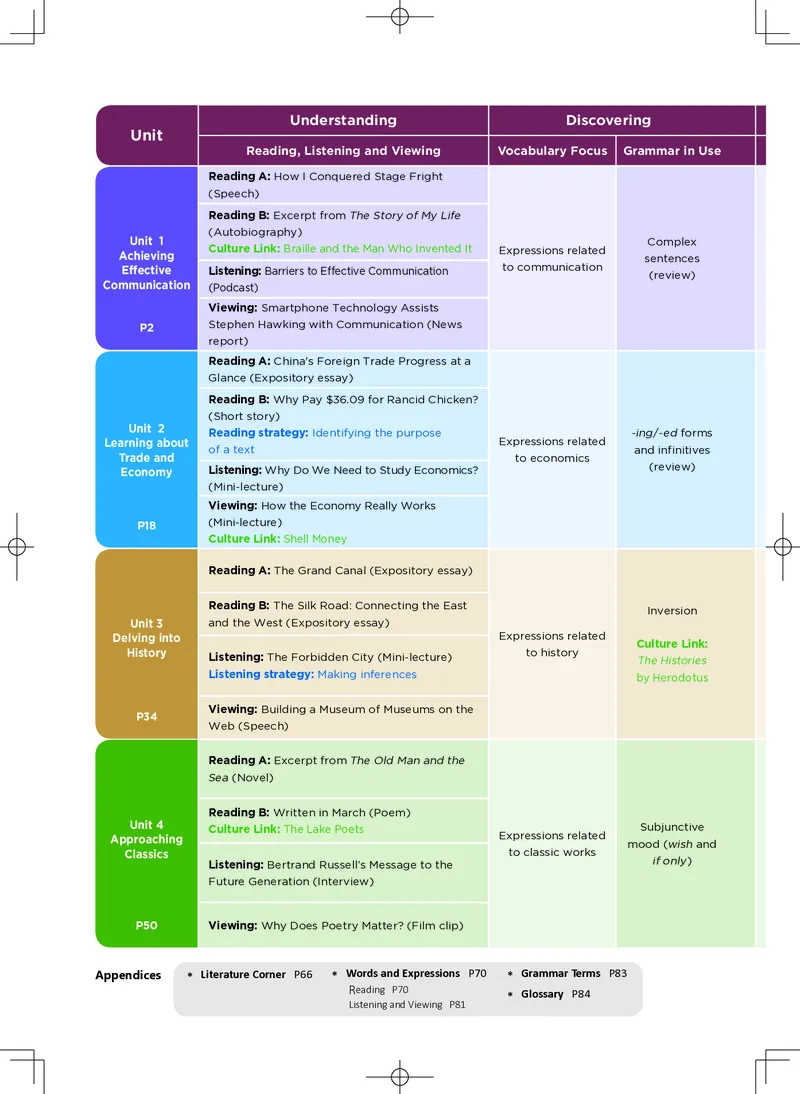
主编:束定芳Understanding Discovering Producing Extending
Unit
Reading, Listening and Viewing Vocabulary Focus Grammar in Use Speaking Writing Critical Thinking Further Exploration
Reading A: How I Conquered Stage Fright
(Speech)
Discussing
Reading B: Excerpt from The Story of My Life Writing a summary of a
technological solutions to Conducting a survey
(Autobiography) general-specific essay
Unit 1 Complex communication problems Generalising by about the impact
Culture Link: Braille and the Man Who Invented It Expressions related
Achieving sentences identifying common of social media
Effective Listening: Barriers to Effective Communication to communication Writing strategy:
(review) Speaking strategy: characteristics on interpersonal
Communication (Podcast) Summary writing 1 —
Compromising and communication
grasping main points
Viewing: Smartphone Technology Assists reaching an agreement
P2 Stephen Hawking with Communication (News
report)
Reading A: China's Foreign Trade Progress at a
Glance (Expository essay)
Reading B: Why Pay $36.09 for Rancid Chicken?
Writing a summary of a
(Short story)
Unit 2 problem-solution essay
Reading strategy: Identifying the purpose -ing/-ed forms Justifying decisions by
Learning about Expressions related
of a text and infinitives Making a budget plan exploring the underlying Playing a trading game
Trade and to economics Writing strategy:
Economy Listening: Why Do We Need to Study Economics? (review) Summary writing 2 — principles
(Mini-lecture)
paraphrasing
Viewing: How the Economy Really Works
(Mini-lecture)
P18
Culture Link: Shell Money
Reading A: The Grand Canal (Expository essay)
Reading B: The Silk Road: Connecting the East Writing a summary of a
Inversion
Unit 3 and the West (Expository essay) claim-counterclaim essay
Delving into Expressions related Introducing a museum Viewing matters from a Designing a brochure
Culture Link:
History to history as a tour guide Writing strategy: historical perspective about a historic site
Listening: The Forbidden City (Mini-lecture) The Histories
Summary writing 3 —
Listening strategy: Making inferences by Herodotus
proofreading
Viewing: Building a Museum of Museums on the
P34
Web (Speech)
Reading A: Excerpt from The Old Man and the
Sea (Novel)
Writing a continuation of
Reading B: Written in March (Poem) Recommending
a story
Unit 4 Culture Link: The Lake Poets Subjunctive Chinese classics
App roaching Expressions related Forming opinions based Recommending classic
mood (wish and
Classics to classic works Writing strategy: on existing views literary works
if only) Speaking strategy:
Listening: Bertrand Russell’s Message to the
Writing a continuation
Highlighting key points
Future Generation (Interview)
(narrative)
P50 Viewing: Why Does Poetry Matter? (Film clip)
Appendices * Literature Corner P66 * Words and Expressions P70 * Grammar Terms P83
Reading P70
* Glossary P84
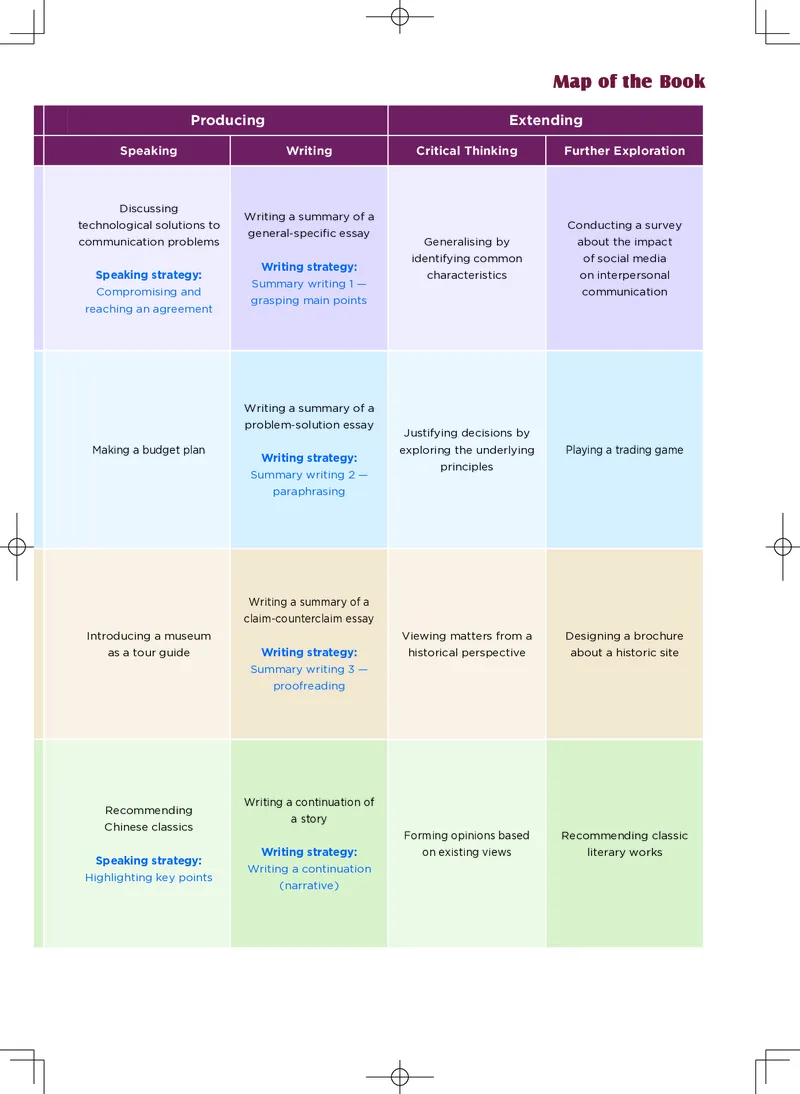
Listening and Viewing P81Map of the Book
Understanding Discovering Producing Extending
Reading, Listening and Viewing Vocabulary Focus Grammar in Use Speaking Writing Critical Thinking Further Exploration
Reading A: How I Conquered Stage Fright
(Speech)
Discussing
Reading B: Excerpt from The Story of My Life Writing a summary of a
technological solutions to Conducting a survey
(Autobiography) general-specific essay
Complex communication problems Generalising by about the impact
Culture Link: Braille and the Man Who Invented It Expressions related
sentences identifying common of social media
to communication Writing strategy:
Listening: Barriers to Effective Communication
(review) Speaking strategy: characteristics on interpersonal
Summary writing 1 —
(Podcast)
Compromising and communication
grasping main points
Viewing: Smartphone Technology Assists reaching an agreement
Stephen Hawking with Communication (News
report)
Reading A: China's Foreign Trade Progress at a
Glance (Expository essay)
Reading B: Why Pay $36.09 for Rancid Chicken?
Writing a summary of a
(Short story)
problem-solution essay
Reading strategy: Identifying the purpose -ing/-ed forms Justifying decisions by
Expressions related
of a text and infinitives Making a budget plan exploring the underlying Playing a trading game
to economics Writing strategy:
Listening: Why Do We Need to Study Economics? (review) principles
Summary writing 2 —
(Mini-lecture)
paraphrasing
Viewing: How the Economy Really Works
(Mini-lecture)
Culture Link: Shell Money
Reading A: The Grand Canal (Expository essay)
Reading B: The Silk Road: Connecting the East Writing a summary of a
Inversion
and the West (Expository essay) claim-counterclaim essay
Expressions related Introducing a museum Viewing matters from a Designing a brochure
Culture Link:
to history as a tour guide Writing strategy: historical perspective about a historic site
Listening: The Forbidden City (Mini-lecture) The Histories
Summary writing 3 —
Listening strategy: Making inferences by Herodotus
proofreading
Viewing: Building a Museum of Museums on the
Web (Speech)
Reading A: Excerpt from The Old Man and the
Sea (Novel)
Writing a continuation of
Reading B: Written in March (Poem) Recommending
a story
Culture Link: The Lake Poets Subjunctive Chinese classics
Expressions related Forming opinions based Recommending classic
mood (wish and
to classic works Writing strategy: on existing views literary works
if only) Speaking strategy:
Listening: Bertrand Russell’s Message to the
Writing a continuation
Highlighting key points
Future Generation (Interview)
(narrative)
Viewing: Why Does Poetry Matter? (Film clip)致同学们
亲爱的同学们:
经过小学和初中阶段的学习,大家已经掌握了一定的英语词汇、语法、语
用等知识,也具备了一定的英语应用能力。大家是否希望能够进一步学会使用
地道的英语来介绍中国文化和社会生活呢?是否想通过英语了解更多的世界文
化知识?是否希望通过英语获得更多的知识和技能,以便更好地去处理日常生
活中的压力、应对可能发生的自然灾害或选择健康的生活方式?
本教材为同学们精心准备了题材丰富、风格多样的学习材料和形式活泼、
寓教于乐的学习活动,让大家在学习英语的同时,领略博大精深的中华文化、
绚烂多彩的世界文化并拓展全球视野。
同学们,高中阶段英语学习的主要目的是全面提升语言综合使用能力。
同时,通过英语学习获取更多的百科知识和专业知识,提升跨文化交际意识和
能力,以及训练逻辑思维和批判性思维能力。
本教材每册由四个单元组成。每个单元围绕人与自我、人与社会或人与自
然相关的主题展开,形成一个交际和学习活动相结合的有机整体。每个单元包
括四大板块:理解(UNDERSTANDING)板块提供丰富的阅读、听力材料和视频
片段;发现(DISCOVERING)板块包括词汇和语法知识,帮助同学们发现、掌握
并学会使用规则,达到举一反三的效果;表达(PRODUCING)板块设计了听、说、
读、写结合的综合活动,以帮助同学们提升用英语完成相关交际任务的能力;
拓展(EXTENDING)板块包括思维训练(Critical Thinking)和项目探究(Further
Exploration)两个部分,前者旨在帮助同学们训练逻辑思维和批判性思维的能
力,后者指导同学们开展研究性学习、自主学习和合作学习。文化链接(Culture
Link)为灵活板块,主要介绍与单元主题相关的世界文化或中国文化小百科。同
学们还可以通过每单元结尾的自我评价(Self-assessment)板块检测自己的学习
成果,发现需要改进的地方并制定相应的学习计划。
同学们,掌握一门外语就意味着多一双看世界的眼睛,多一双听世界的耳朵,
多一个探索世界的工具。学习一门外语需要大量的操练和实践,需要持之以恒。
希望同学们在老师的指导下,把教材作为起跳板,充分调动你们已有的知识,
探索未知的领域,“跃”向更广阔的世界。
编者
2020 年 5 月
122 UNIT 11
Unit
Achieving
Effective
Communication
No pleasure has any savour for me without
communication.
— Michel de Montaigne
Getting Started
Look at the following means of
communication, arrange them in the
order according to the time they were
first put into use and then say something
about one of them.
telephone, Internet, smoke signal, fax,
Morse code, carrier pigeon, wireless radio,
mobile phone
3READING A
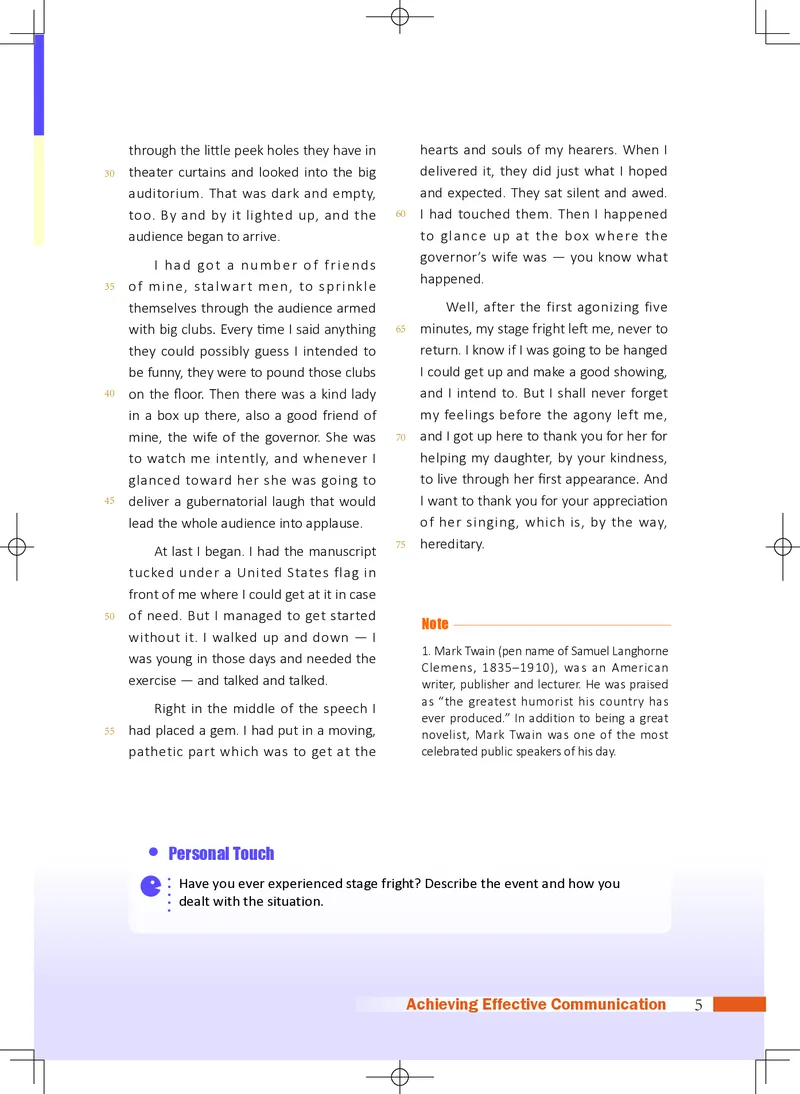
? On 5 October 1906, after a musical performance by his daughter,
Mark Twain1 addressed the audience on the subject of stage fright.
Read the text and find out what Mark Twain said about his first
public speech.
HOW I CONQUERED STAGE FRIGHT
My heart goes out in sympathy 15 forty-five minutes before the hour set
to anyone who is making his first for the lecture. My knees were shaking
appearance before an audience of so that I didn’t know whether I could
human beings. By a direct process of stand up. If there is an awful, horrible
5 memory I go back forty years, less one disease in the world, it is stage fright —
month — for I’m older than I look. 20 and seasickness. They are a pair. I had
stage fright then for the first and last
I recall the occasion of my first
time. I was only seasick once, too. It was
appearance. San Francisco knew me then
on a little ship on which there were two
only as a reporter, and I was to make my
hundred other passengers. I was — sick.
10 bow to San Francisco as a lecturer. I knew
25 I was so sick that there wasn’t any left for
that nothing short of compulsion would
those other two hundred passengers.
get me to the theater. So I bound myself
by a hard-and-fast contract so that I It was dark and lonely behind the
could not escape. I got to the theater scenes in that theater, and I peeked
44 UUNNIITT 11through the little peek holes they have in hearts and souls of my hearers. When I
30 theater curtains and looked into the big delivered it, they did just what I hoped
auditorium. That was dark and empty, and expected. They sat silent and awed.
too. By and by it lighted up, and the 60 I had touched them. Then I happened
audience began to arrive. to glance up at the box where the
governor’s wife was — you know what
I had got a number of friends
happened.
35 of mine, stalwart men, to sprinkle
themselves through the audience armed Well, after the first agonizing five
with big clubs. Every time I said anything 65 minutes, my stage fright left me, never to
they could possibly guess I intended to return. I know if I was going to be hanged
be funny, they were to pound those clubs I could get up and make a good showing,
40 on the floor. Then there was a kind lady and I intend to. But I shall never forget
in a box up there, also a good friend of my feelings before the agony left me,
mine, the wife of the governor. She was 70 and I got up here to thank you for her for
to watch me intently, and whenever I helping my daughter, by your kindness,
glanced toward her she was going to to live through her first appearance. And
45 deliver a gubernatorial laugh that would I want to thank you for your appreciation
lead the whole audience into applause. of her singing, which is, by the way,
75 hereditary.
At last I began. I had the manuscript
tucked under a United States flag in
front of me where I could get at it in case
50 of need. But I managed to get started
Note
without it. I walked up and down — I
1. Mark Twain (pen name of Samuel Langhorne
was young in those days and needed the
Clemens, 1835–1910), was an American
exercise — and talked and talked.
writer, publisher and lecturer. He was praised
as “the greatest humorist his country has
Right in the middle of the speech I
ever produced.” In addition to being a great
55 had placed a gem. I had put in a moving, novelist, Mark Twain was one of the most
pathetic part which was to get at the celebrated public speakers of his day.
Personal Touch
Have you ever experienced stage fright? Describe the event and how you
dealt with the situation.
AAcchhiieevviinngg EEffffeeccttiivvee CCoommmmuunniiccaattiioonn 55Digging In
Comprehension
I. Fill in the blanks to complete the outline of the speech.
Introduction
Mark Twain expresses his sympathy for those who make their
first appearance before an audience.
Body
• bound himself by a contract;
Mark Twain tells a story about
• 2 _______________________________;
his first public speech. In order
to 1 __________________, he • 3 _______________________________;
• 4 _______________________________.
Closing remarks
Mark Twain thanks the audience for helping his daughter
proceed with her performance.
II. Answer the questions.
1. What does Mark Twain’s description of the auditorium suggest?
2. What are the literal and contextual meanings of the word “gem” (line 55)?
3. What does Mark Twain mean by “And I want to thank you for your appreciation of her
singing, which is, by the way, hereditary” (lines 72–75)?
4. At what point did Mark Twain know he had captured the audience’s attention?
5. According to Mark Twain’s description of his stage fright experience, which parts of the
speech are the most difficult moments? How do you know?
III. Mark Twain is well known for his sense of humour. Fill in the bubbles with details
that show his humour in the speech.
He makes a joke
about his age.
“By a direct process of memory
I go back forty years, less one
month — for I’m older than I
look.” (line 4)
6 UNIT 1Vocabulary Focus
I. Key Vocabulary
Fill in the blanks with the appropriate forms of the given words and expressions
to complete the passage. Note that there are two options more than you need.
bind bow (be) armed with in case of manage
recall set intend live through nothing short of
by and by light up
Mark Twain experienced stage fright when he worked as a reporter in San
Francisco. He 1 __________ that delivering a speech was so horrible for him at that
time that he had to 2 __________ himself by a contract. On the day he made the
speech, he got to the theatre forty-five minutes before the hour 3 __________ for the
lecture. He peeked through the holes in the theatre curtains. His knees were shaking
while he was to make his 4 __________ to the audience. He had got a number of
friends 5 __________ big clubs to lead the applause. He had the manuscript hidden
under a flag in front of him where he could get at it 6 __________ need, although he
7 __________ to get started without it. In the middle of the speech, he delivered a
moving part 8 __________ to touch the audience, and they did what he had expected.
9 __________, his stage fright left him. Fortunately, Mark Twain 10 __________ his first
public speaking.
II. Topic-Related Expressions
Fill in the blanks with the appropriate forms of the given expressions to complete
the passage. Note that there are two options more than you need.
convey an idea catch one’s attention original idea
well-organised structure educational background deliver a speech
build trust in a natural way eye contact
cover any occasion communication skill engage the audience
Stephen E. Lucas says that the purpose of public speaking is not to self-
promote, but to change someone’s assumption, which explains why in his book
The Art of Speaking he doesn’t merely talk about the importance of original
ideas and a 1 ___________ to a successful speech, but also mentions effective
2 ______________. They are equally important in making an engaging speech.
“3 ___________ is not an entertaining activity,” Lucas said. “Rather than giving
performances, the speaker is expected to 4 __________ to the audience.” This is why
AAcchhiieevviinngg EEffffeeccttiivvee CCoommmmuunniiccaattiioonn 77it’s important to figure out the types of people in your audience,
who may be composed of individuals of different ages, genders or
5 ________________.
As public speaking 6 _________________, you
need to aim your speech at the audience to
7 __________. For instance, if you are asked to
speak to a group of young people in a special
centre, you might need to use simple, short
sentences. Remember to talk 8 __________ as if
you were talking to the youngsters living in your
neighbourhood. That would help the audience
9 __________ in you.
It’s also important to involve your audience
to make them feel like you are talking to them
one-to-one. Speakers do this with gestures,
intonations, 10 _________, and the like.
Grammar in Use
Complex sentences (review)
I. Rewrite each pair of the underlined sentences to form a complex sentence. An
example is given.
Distinguished guests, it’s a great joy for me to be here.
1 It’s not easy standing up here and talking. This is especially true when you
have people like me asking you questions. 2 But there is a reason for me to be here.
I’m going to share a few things with you.
First, personal experience is a good thing to draw upon. 3 Many of you have
spoken from personal experiences. Your speeches are very informative. Second,
your speeches need to be logically argued, too. 4 You need to be careful about the
expression “There are two sides of a coin.” It is not a very strong way of arguing.
When you talk about two sides of a coin, it’s almost like you’re not prepared to tell
us which one you think is right. Finally, be bold. Say what’s important, and don’t try
to fill out the time.
I applaud each of you for what you’ve done, and I wish you all the best.
8 UNIT 11 It’s not easy standing up here and talking, especially when you have people like me
asking you questions.
2 ____________________________________________________________________
3 ____________________________________________________________________
4 ____________________________________________________________________
Grammar Highlights
A complex sentence is one in which one or more subordinate clauses are
embedded. Subordinate clauses are often introduced by a subordinator
(or subordinating conjunction). For example:
• My heart goes out in sympathy to anyone who is making his first
appearance before an audience of human beings. (relative clause)
• I was so sick that there wasn’t any left for those other two hundred
passengers. (adverbial clause)
• They did just what I hoped and expected. (object clause)
II. Complete the passage by selecting a correct clause (A–G) from the box below.
Computer science has allowed us to create a more accessible world that helps people
with disabilities to engage with their surroundings more conveniently. Just consider
________________.
The Seeing AI, released this week, seems like a completely life-changing app for those
_______________. It’s a smartphone-based software ____________. Dave Heiner, one
of the developers, said that the Seeing AI started as a project at a recent hack contest,
______________. “They realised they can put those things together and finally try to give
vision to the people who are weak in sight. The Seeing AI allows you to hold your phone up
to a person and can tell you what that person looks like, what his or her age is, the colour
of his or her hair, ______________,” said Heiner.
The Seeing AI can read documents and recognise speech and images with very low
error rates, ____________. Cameron Roles, ______________, is excited about the new
apps to help vision-impaired people lead rich, full lives. “In my view, now is definitely the
most exciting time in human history to be blind,” said Roles.
A. who are vision-impaired
B. that can even be used to read out a child’s homework questions
C. how a new technology is beginning to make the lives of more than 350,000 vision-impaired
people in Australia much richer
D. whether he or she is wearing glasses, and whether he or she looks happy or sad
E. which means computers can recognise words in a conversation and provide real-time
translation
F. who has been blind since birth
G. where a group of people decided to build an app combining a smartphone and AI vision
technology
Achieving Effective Communication 9Listening, Viewing and Speaking
Barriers to Effective Communication (Podcast)
I. Describe the communication barriers you might encounter in the following situations:
1. when you are talking with your grandparents;
2. when you are speaking in front of an audience;
3. when you are giving directions to a foreigner travelling in your country.
II. Listen and note down the four types of barriers to communication.
III. Listen again. Match the pictures (1–6) and the strategies (A–G) with the
4
corresponding communication barrier types.
Communication barrier type Picture(s) Strategy (or Strategies)
In Shanghai dialect
In Cantonese
2
5
1 ???
3
Strategy list: 6
A. Doing breathing exercises
B. Turning to other people for help
C. Using devices such as hearing aids or eyeglasses
D. Using a reliable translation service, visual aids or gestures
E. Drawing on close guidance, proper training and determination
F. Developing an understanding of, and a deep respect for, the differences
G. Speaking slowly and carefully, and stopping every now and then to check
understanding
Smartphone Technology Assists Stephen Hawking with Communication (News report)
I. How does technology facilitate human communication? List some apps you can think of.
II. Watch the video and tick the true statement(s).
A. Stephen Hawking controlled his computer by moving only one muscle in his cheek.
B. Stephen Hawking still needed to rely on the mouse to control his computer.
C. Stephen Hawking’s computer was able to predict which character he might choose next.
D. With the latest upgrade, Stephen Hawking’s computer doubled his speech rate.
10 UNIT 1III. Watch again and fill in the blanks.
1. A UK start-up has developed a software programme that analyses what Hawking was last
writing, whether there were any (1) ________, and then tries to predict which character
he might choose next. To do that the start-up’s programme has to learn how Hawking
writes and speaks by (2) ________ dozens of his documents, some published, others not.
2. An infrared sensor detects when Hawking’s (3) ________ moves up, just the way our
smartphone can sense when it’s close to the face. Future versions of this technology are
aiming to take a bigger (4) ________ of movement into account.
3. A well-known American tech company is even trying to develop brain control interfaces.
With the market (5) ________ to reach 55 (6) ________ dollars in 2016, it represents the
next leap for assistive technologies.
Speaking Strategy Compromising and reaching an agreement
Discussing
During group discussions, you need to compromise with the other
technological solutions
group members and come up with one idea or plan that everyone
to communication
can agree on, even if some individuals disagree with some points.
problems
Your school is holding the 10th Science & Technology Week. This year’s theme is “Better
Technology, Better Communication.” The students’ union is calling for creative ideas to
address communication problems by making use of currently available technologies.
Work in groups to identify a problem. Discuss and decide on the most creative solution.
Step 1 Brainstorm and list occasions where communication often breaks down.
Step 2 Choose from the list a specific communication problem which you all agree
to deal with. Search for possible causes of the problem.
e.g. Problem: how can we help the blind do the shopping?
Step 3 Discuss how technology could help to solve the problem, and what is creative
about your solution.
EXAMPLE
A: Let’s start by taking a look at the communication problems the blind might
encounter in a supermarket. What do you have in mind?
B: I think reading labels is extremely tricky for them, especially when there is no
one around for them to turn to.
A: Right. Perhaps we can develop a smartphone app that connects to a call centre
with volunteers to help. Whenever a blind man needs help, he might simply use
the app to ask for help, and there will be a volunteer to answer his call and to
read out the labels for him.
B: Yes! And the blind man could use his phone camera to display the labels to the
volunteer by video chat.
A: ... Useful Expressions
Step 4 Reach an agreement on the most So, can we all agree on ... ?
creative solution and submit it to
Can you live with this?
the students’ union.
So, it sounds like we’ve decided ...
What do all our ideas have in common?
Achieving Effective Communication 11READING B
1
EXCERPT FROM THE STORY OF MY LIFE
The morning after my teacher
came she led me into her room and
gave me a doll. When I had played with
it a little while, Miss Sullivan slowly
5 spelled into my hand the word “d-o-
l-l.” I was at once interested in this
finger play and tried to copy it. When I
finally succeeded in making the letters
correctly I was filled with childish
10 pleasure and pride. Running downstairs
to my mother I held up my hand and
made the letters for doll. I did not know
that I was spelling a word or even that to one side of the room, and I had a
words existed; I was simply making my 40 sense of satisfaction that the cause of
15 fingers go in monkey-like imitation. In my anger was removed. She brought
the days that followed I learned to spell me my hat, and I knew I was going out
in this uncomprehending way a great into the warm sunshine. This thought,
many words, among them pin, hat, cup if a wordless feeling may be called a
and a few verbs like sit, stand and walk. 45 thought, made me hop and skip with
20 But my teacher had been with me pleasure.
several weeks before I understood that
We walked down the path to the
everything has a name.
well-house, attracted by the smell of
One day, while I was playing with the flowers with which it was covered.
my new doll, Miss Sullivan put my big 50 Someone was drawing water and my
25 rag doll into my lap also, spelled “d-o- teacher placed my hand under the tap.
l-l” and tried to make me understand As the cool stream flowed over one
that “d-o-l-l” applied to both. Earlier in hand she spelled into the other the
the day we had had a strong argument word water, first slowly, then rapidly.
over the words “m-u-g” and “w-a-t- 55 I stood still, my whole attention fixed
30 e-r.” Miss Sullivan had tried to impress upon the motions of her fingers.
it upon me that “m-u-g” is mug and Suddenly I felt a misty awareness as
that “w-a-t-e-r” is water, but I kept on of something forgotten — a thrill of
confusing the two. I became impatient returning thought; and somehow the
at her repeated attempts and, seizing 60 mystery of language was revealed to
35 the new doll, I threw it on the floor. me. I knew then that “w-a-t-e-r” meant
I felt a sense of happiness when the the wonderful cool something that was
parts of the broken doll fell at my feet. I flowing over my hand.
felt my teacher sweep the broken parts
1122 UUNNIITT 11I left the well-house eager to come to me. I learned a great many
65 learn. Everything had a name, and each new words that day. I do not remember
name gave birth to a new thought. As what they all were; but I do know that
we returned to the house every object mother, father, sister, teacher were
which I touched seemed to spring with 75 among them — words that were to
life. That was because I saw everything make the world blossom for me.
70 with the strange, new sight that had
Culture Link
Note
1. Helen Keller (1880– Braille and the Man Who Invented It
1968) was an American
Braille is a simplified version of alphabet made up of six
author and lecturer.
raised dots to form each individual letter, which can be read
She was the first deaf-
either with the fingers, by the vision-impaired, or with the
blind person to obtain a
eyes, by sighted people. It is a code by which many languages
Bachelor of Arts degree.
— such as English, Spanish, Arabic, Chinese, and dozens of
The story of Keller and her
others — may be written and read, and it has become the
teacher, Anne Sullivan,
most widely used system for blind people across the world.
was made famous because
of her autobiography, The The code system was named after the inventor, Louis Braille
(1809–1852), a French educator who lost his eyesight in early
Story of My Life.
childhood by accident.
Comprehension Plus
I. Match each paragraph in Column A with one corresponding main point in Column B. An
example is given.
Column A Column B
Helen felt stuck in learning and turned her
Paragraph 1: impatience into satisfaction gained from
paving the way for what damaging things.
is coming
Helen learned basically by imitating without
much thinking or comprehension.
Paragraph 2:
Helen was suddenly aware of the meaning
a twist in the story
of language that had remained secret to her.
Helen damaged her new doll out of
Paragraph 3: frustration because she kept confusing the
the turning point of the words mug and water.
story
Helen was immediately excited about the
spelling game and able to spell many words
in a couple of days.
Paragraph 4:
Helen was hungry for learning as the beauty
the end of the story
of the world was magically revealed to her.
AAcchhiieevviinngg EEffffeeccttiivvee CCoommmmuunniiccaattiioonn 1133II. Answer the questions.
1. What are the problems Helen Keller faces in her “still, dark world”? What basic things
does Helen not understand?
2. “Everything had a name, and each name gave birth to a new thought.” (lines 65–66)
What is your understanding of the statement?
3. Why are language learning and communicating more of a challenge for Helen than for
others?
Critical Thinking
Generalising by identifying
common characteristics
Barrier Strategy (or Strategies)
general specific specific general
• preparing a manu-
script in case of need
psychological drawing on personal
stage fright • trying to move a little
barrier resources
bit rather than to
stand still
physiological
barrier
language
barrier
cultural
barrier
II. W hich of the above communication barriers
do you encounter most frequently in daily
communication? Which strategies do you
find most helpful in dealing with these
communication barriers? Which strategy do
you want to try? Why?
14 UNIT 1Writing
W
riting a summary
general-specific essay
of a
A renowned speaker made a speech on how to keep the audience engaged during
a speech at your school today. Your friend was interested but unable to attend, so
you decide to write a summary of what you have heard to share with him/her. The
following is the script of the speech.
How to Keep Your Audience Engaged While Delivering a Speech
Distinguished guests, students, friends, it’s a great joy for me to be here.
As we have noticed, one of the biggest challenges in delivering a quality public
speech is keeping your audience engaged, especially if you’re nervous. Practicing
beforehand will help you feel more relaxed in front of a crowd, but there are a few
things you should bear in mind while you’re improving your skills:
Firstly, speak with passion. Remember that your audience is there because
they are interested in what you have to say. Appearing disengaged gives the
audience a signal that they don’t need to pay much attention. Plus, finding a
passion for your topic can help reduce your fear. As it is said, “One key way to
overcome anxiety is to become passionate about what you want to share with the
world.”
Secondly, moving around on stage when you change topics or approaching
the audience when you make a point or pose a question will give your
presentation energy. But just standing frozen or rigid like a board comes off as
awkward and creates a wall between you and the audience. So, make movements
intentionally as you illustrate points.
Thirdly, add some personality on to your presentation. Of course you want
to keep things professional, but letting the audience get to know a little about
your personality makes them more interested in what you’re saying. If you intend
to be kind of funny, put in some humour where appropriate. If you have a lot of
experience with the topic, include a personal story.
Lastly, be a presenter, not a salesman or a saleswoman. The point of your
presentation may very well be to sell something, but that doesn’t mean the
audience wants to listen to a straightforward sales speech. People see right
through a skillful salesman exterior, and if your speech comes off as pressuring
them into giving you money, they’ll become disengaged or resistant quickly. Build
your presentation around offering them something genuinely valuable, even if
they aren’t going to buy anything.
The above are my suggestions. Thank you for having me here, and I wish you
all the best.
AAcchhiieevviinngg EEffffeeccttiivvee CCoommmmuunniiccaattiioonn 1155Writing Strategy Summary writing 1 — grasping main points
To write a summary, you need to identify the main points in different textual patterns. The
main points of a text vary according to its textual pattern: for a general-specific text, the main
points involve a general statement and specific details; for a problem-solution text, the main
points include problems and solutions; for a claim-counterclaim text, the main points involve
a claim, a counterclaim and evidence.
Guided Writing
Step 1 Analyse the script to find its textual pattern and underline the general
statement and specific details.
Step 2 Write a summary of the essay in no more than 60 words.
General statement: _ _________________________________________________________
_____________________________________________________________________________
Detail 1: _ ____________________________________________________________________
_____________________________________________________________________________
Detail 2: _ ____________________________________________________________________
_____________________________________________________________________________
Detail 3: _ ____________________________________________________________________
_____________________________________________________________________________
Detail 4: _ ____________________________________________________________________
_____________________________________________________________________________
Step 3 Proofread your summary and email it to your friend.
Further Exploration
Conducting a survey about the impact of social media on
interpersonal communication
According to a survey, social media has dramatically changed the way teenagers interact
and communicate with other people. Do you feel the same way? Work in groups, conduct
a survey among your classmates and present your findings.
Step 1 Design a questionnaire with 6–8 questions, including items like one’s favourite
way to communicate and the frequency of using social media. The title of
the questionnaire can be “How social media is affecting our interpersonal
communication.”
16 UNIT 1EXAMPLE
1. What is your favourite way to communicate with others?
A. Social media apps. C. Phone calls.
B. Face-to-face chatting. D. Emails.
2. How often do you use your smartphone or tablet while spending
time with your family or friends?
A. Always. C. Sometimes.
B. Rarely. D. Never.
3. Do you think the presence of technology affects face-to-face
communication?
A. Not at all. C. Yes, absolutely.
B. It’s hard to say. D. To some extent.
Step 2 Conduct the survey in your class by email or other social media apps.
Step 3 Analyse the data collected and prepare an oral report on your survey findings.
Step 4 Present your findings in class.
Self-assessment
Look at the expected learning outcomes of this unit.
A. Interpreting the underlying messages and humours in a speech and sharing
ways to overcome stage fright
B. Discussing technological solutions to communication problems
C. Understanding how people with physiological difficulties can work through the
barriers and develop effective communication
D. Conducting a survey about the impact of social media on interpersonal
communication
E. Identifying common characteristics of communication barriers and make
generalisations
F. Reaching an agreement by negotiating and compromising
G. Writing a summary of a general-specific essay
Write a reflective note on the above items. You may include some or all of the
following points:
What you think you have done well and why
One strategy that really has helped your learning
One important thing you have learned about
What you need to improve in the future
What learning resources you find useful
Achieving Effective Communication 171188 UNIT 22
Unit
Learning about
Trade and
Economy
Economy has frequently nothing whatever to do
with the amount of money being spent, but with
the wisdom used in spending it.
— Henry Ford
Getting Started
Read the poem and discuss possible
answers to the questions at the end.
You’ve got a dollar. You deposit it in your savings
account. Now you’ve got a dollar and
the bank’s got a dollar.
The bank loans a dollar to Joe’s Construction.
Now you’ve got a dollar, the bank’s got a dollar,
and Joe’s got a dollar.
Joe buys a board from Hirohito Lumber.
Now Hirohito’s got a dollar too.
Where did you get your dollar?
How much money is there in the world?
Who’s got it?
Where is it?
What happened to all the trees?
19READING A
? The text below is a summary of the great progress China has
made in foreign trade. List some words and expressions that you
expect to find in the text.
CHINA’S FOREIGN TRADE
PROGRESS AT A GLANCE
Since its entry into the WTO promoting new industrialization, IT
(World Trade Organization), China has 20 (information technology) application,
sped up its reform and opening-up urbanization, and agricultural
process and economic growth. China’s modernization, created enormous
development is a forceful driver of opportunities for consumption and
5
global economic growth. investment, and created more jobs
In 2016, China’s GDP (Gross 25 for the world. According to a report
Domestic Product) accounted for released by the International Labor
14.8 percent of the world total, up Organization, “Effects of China on the
10 by 10.7 percentage points over 2001, Quantity and Quality of Jobs in Latin
calculated at exchange rates. Since America and the Caribbean,” China
2002, China’s contribution to global 30 created 1.8 million jobs for Latin
economic growth has approached America and the Caribbean region from
30 percent on average. The Chinese 1990 to 2016.
15 economy has become a major engine China’s rapid development has
for global economic recovery and made great contributions to the cause
growth. 35 of global poverty reduction. Over the
China has quickened its pace in past 40 years of reform and opening-
2200 UUNNIITT 22up, the Chinese people have emerged absorbed 20 percent of their exports.
from poverty to moderate prosperity. China’s services imports increased
According to current UN (United from $39.3 billion in 2001 to $467.6
40 Nations) standards, more than 700 billion in 2017, up by an annual average
million Chinese people have been lifted 75 of 16.7 percent, and accounting for
out of poverty, accounting for more nearly 10 percent of the world total.
than 70 percent of the global total Since 2013, China has been the world’s
over the same period. This represents second largest service importer,
45 the largest contribution to poverty making important contributions to
reduction in the world. 80 stimulating consumption, creating jobs
Since China’s entry into the WTO, and boosting economic growth in the
China’s foreign trade has maintained exporting countries. Taking tourism
sustained development, benefiting services as an example, China has been
50 more than 1.3 billion Chinese and other the world’s largest source of outbound
peoples across the world. 85 tourists for many years in a row. In
China has taken effective 2017, outbound tourist trips made by
measures to promote its foreign trade. Chinese citizens exceeded 130 million
According to WTO statistics, China’s person-times, generating $115.29
55 imports accounted for 10.2 percent of billion of overseas tourism spending.
the world’s total merchandise import 90 China’s innovation in trade models
in 2017, and its exports 12.8 percent, has also boosted world trade growth.
making China a major trade partner of Cross-border e-commerce and other
more than 120 countries and regions. new types and modes of foreign
60 China’s exports have provided high- trade have increased greatly in China,
quality and inexpensive products to 95 providing an ever-expanding market
businesses and people around the to its trading partners. In 2017, the
world. From 2001 to 2017, China’s value of imported and exported goods
imports increased by an annual average in cross-border e-commerce checked
65 of 13.5 percent, 6.9 percentage points and released by China Customs totaled
higher than the global average; and 100 ¥90.24 billion, up by 80.6 percent on a
China has become the world’s second yearly basis, of which imports stood
largest importer. Since 2009, China has at ¥56.59 billion, up by 120 percent
been the largest export market for the compared with the previous year.
70 LDCs (Least Developed Countries), and
Personal Touch
Can you give an example to show that you or your family has benefited from
China’s foreign trade progress in the past few years?
LLeeaarrnniinngg aabboouutt TTrraaddee aanndd EEccoonnoommyy 2211Digging In
Comprehension
I. Choose from the following items to complete the statements.
1. This text is most likely to be found in a(n)___________.
A. academic essay C. book review
B. government report D. magazine article
2. The description of the development of China’s foreign trade is well supported by
_______________.
A. quotations (e.g. direct quotes, paraphrases, summaries)
B. examples (e.g. illustrations of one’s points)
C. statistics (e.g. facts, figures)
D. stories (e.g. personal experiences)
II. Answer the questions.
1. According to the text, what policies has China adopted since its entry into the WTO?
2. What effect does the growth of the Chinese economy have on the problem of global
poverty?
3. What goods and services are imported and exported by China?
4. Can you find some verbs or expressions in the text that describe statistics? Give some
examples.
III. Read the text and find the sentences that suggest the importance of China’s foreign
trade progress to the world. Fill in the blanks in the bar chart and answer the question.
China has made great contributions to the global economic growth — its economy is
an integral part of the world’s economy. In the text, figures in various sectors indicate the
importance of China’s foreign trade and economy to the world. The bar chart below shows
China’s rough percentage of the world total in different sectors. Fill in the blanks based on
the information from the text.
According to the text and your own experience, in what ways has China made contributions
to its trading partners and the rest of the world?
22 UNIT 2Vocabulary Focus
I. Key Vocabulary
Write down the words based on their definitions. Choose the suitable words to
fill in the blanks in their appropriate forms.
___________ (v.) to make sth develop or become more active
___________ (v.) to produce or create sth
___________ (adj.) able to be used without being completely used up or
destroyed
___________ (v.) to help sth to happen or develop
___________ (adj.) connected with the trade, industry and development of wealth of
a country, an area or a society
___________ (n.) the speed at which sth happens
___________ (v.) to make sth increase, or become better or more successful
___________ (n.) the act of investing money in sth
___________ (adj.) extremely large
___________ (n.) one thousand million
The reason why the Belt and Road Initiative is gaining wider recognition is
that it has not only 1 _________ the progress of participating countries, but also
contributed to the recovery of the world economy after the global financial crisis.
The Belt and Road Initiative conforms to the UN 2 _________ development goals and
quickens the 3 _________ of collaboration among peoples and nations. During the
second Belt and Road Forum, cooperation agreements worth over $64 4 _________
were signed at a CEO conference. Participants at the forum said, the Belt and
Road Initiative creates a new model of international cooperation, with the aim of
5 _________ the economic development of the countries involved. China has shared
its development achievements with other Belt and Road participating countries as its
6 _________ demand for imports has 7 _________ many growth opportunities. China has
also increased its direct foreign 8 _________ in the participating countries, leading to
9 _________ growth in those countries. For instance, the Chinese-funded-and-built
Railway in Kenya 10 _________ the country’s economic growth by 1.5 percent. According
to a World Bank study, the Belt and Road Initiative will increase the GDP of East Asian
and Pacific developing countries by 2.6 percent to 3.9 percent on average.
II. Topic-Related Expressions
Fill in the blanks with the appropriate forms of the given expressions to complete
the sentences.
lift … out of poverty standard of living speed up
quicken the pace of account for boost economic growth
on average in a row
1. The government intends to improve its people’s __________.
LLeeaarrnniinngg Aaa bbGooluuimtt pTTrrsaaedd ieen taaonn Edd cEEoccnooonnmoommicsyy 2223332. Between 2001 and 2018, EU’s exports to China grew by 14.7 percent __________
each year.
3. China has __________ 700 million people __________ through more than 30
years of reform and opening-up.
4. Chinese delivery companies __________ transition to green packaging.
5. Brazil’s retail sales rise for six months __________ this year.
6. An improvement in confidence and political stability would __________ in Spain.
7. Ethiopia’s export revenue to China __________ about 8.25 percent of the
country’s total exports in 2017.
8. We should lay a firm foundation for the future development of our country and
______________ raising people’s quality of life.
Grammar in Use
-ing/-ed forms and infinitives (review)
I. Fill in the blanks with the appropriate forms of the words or phrases in brackets.
When you’re doing your degree, your main source of income may be a
student loan or, if you’re lucky, a grant or scholarship. But you may still need
to supplement your income by doing some kind of part-time work. Here
are some tips for 1 __________ (avoid) financial problems. Open a current
account at the campus bank — they have a team which specialises in
2 __________ (help) students with their financial matters. If you get into
debt, try to clear your debts as soon as possible. If things are difficult,
you may have to economise by, say, 3 __________ (cut down) on luxuries.
This is far better than 4 __________ (run up) huge debts. If you have a
credit-card debt, try to make a payment every month, however small.
Never exceed your 5 __________ (agree) credit limit. It’s a bad idea to
borrow heavily 6 __________ (repay) your debts. Always seek advice
from your bank about how 7 __________ (clear) outstanding debts and
8 __________ (pay) back loans. Never run up an overdraft if you can avoid
it. If you do need one, remember that most banks will offer students an
interest-free overdraft.
24 UNIT 2Grammar Highlights
Non-finite verbs cannot function as predicates and do not need to follow subject-
verb agreement. Their forms, meanings and functions are shown in the table:
Form Meaning Functions
typically expressing an subject, predicative, object, attributive,
(to) do
action to be taken complement, adverbial
typically expressing an subject, predicative, object, attributive,
-ing
action in progress complement, adverbial
typically expressing a
predicative, attributive, complement,
-ed completed action or a
adverbial
passive state
II. Fill in the blanks with the appropriate forms of the words in brackets.
1. In order to get one thing that we like, we usually have to give up another thing. Making
a decision requires __________ (trade) off one goal against another and __________
(compare) the costs and benefits of different courses of action. People __________ (make)
reasonable decisions take an action if and only if the extra benefit of the action is greater
than the extra cost. People’s behaviour may change when the costs or benefits change.
2. The China (Shanghai) Pilot Free Trade Zone (SHFTZ), ________ (found) in 2013, is located
in Pudong New Area and originally consisted of Waigaoqiao Free Trade Zone, Waigaoqiao
Free Trade Logistics Park, Yangshan Free Trade Port Area, and Pudong Airport Free Trade
Zone. In 2014, the State Council decided ________ (expand) SHFTZ by taking in Lujiazui
Financial Area, Jinqiao Development Subzone, and Zhangjiang High Tech Subzone,
________ (enlarge) the SHFTZ from 28.78 square kilometers to 120.72 square kilometers.
3. Kiddynomics: An Economics Curriculum for Young Learners is a set of lessons __________
(design) to introduce young children to the economic way of thinking. Informed decision-
making is a critical thinking skill that students can use throughout their school, personal,
and work lives. They should, therefore, understand basic principles of how the economy
operates. The best way __________ (ensure) students develop vital decision-making
skills is to begin economic education early and to build on that learning throughout their
education.
Learning about Trade and Economy 25Listening, Viewing and Speaking
Why Do We Need to Study Economics? (Mini-lecture)
I. Answer the question.
When you plan to take a trip to a foreign country, will you choose a cheap flight with
longer flight time or a more costly one with shorter flight time?
II. Listen and complete the table.
Economics is a • The initial concept learned in economics is scarcity.
study of how we • We have 1 ________ wants and 2 ________ resources.
deal with scarcity. • Economics makes us better 3 ________.
• An example of my wife choosing a flight among the three:
a Thursday night flight which was 5 $________;
a Friday night flight which was 6 $________;
Thinking like an
a Saturday morning flight which was 7 $________.
economist means
She worked in a restaurant from Monday through Friday,
seeing the
earning about 8 $________ a day.
4 ________.
Actually, the cheapest flight is 9 ________.
• Thinking like an economist has saved me 10 ________
and 11 ________.
III. Work in groups and discuss.
Why did the most expensive Saturday morning flight turn out to be the cheapest in fact?
Suggest similar examples from your daily life.
How the Economy Really Works (Mini-lecture)
I. Answer the question.
Do you agree that “Trade can make people better off”? Explain your view.
II. Watch the video and answer the
Culture Link
questions.
1. What do people use to buy what they Shell Money
want on the island?
The earliest recorded use of shells as
2. What are the jobs of the four people in currency was in China during the Shang
dynasty (1600 BCE–1046 BCE). The
the video?
particular shells used were cowrie shells,
3. How do all the people on the island
called bei in Chinese. The cowrie shells
become “rich” all of a sudden?
were an intelligent solution for “small
4. Is wealth found in money? Why or why money” because they were collected in
seas far in the south of China and only
not?
kings could afford them.
26 UNIT 2III. Watch the video again and describe how money, goods and services flow among
individuals in a society.
Making a budget plan
Suppose your class has raised a fund of 1,000 yuan for a spring outing. A budget plan
is needed to make the best use of the fund. Discuss with your classmates to decide
which items should be included in your budget by weighing up the costs and benefits
of each one.
Step 1 Work in groups. Brainstorm budget items for the spring outing.
Step 2 Rank the chosen items in order of importance. Then weigh up the costs and
benefits of each item to decide whether to buy it or not.
EXAMPLE
A: I think everyone should wear the same T-shirt during the outing. It’ll be easy
for us to find each other. What do you say?
B: I see your point, but T-shirts for everyone could be quite expensive.
A: So what do you suggest?
B: I think a flag held in the front can guide us to make sure no one gets lost.
Step 3 Each group presents its budget plan in class and explains how decisions were
reached. The whole class vote for the best budget plan.
Useful Expressions
Asking for opinions Giving opinions
Do you think that’s a good idea? As far as I am concerned, ... / As
How do you feel about that? far as I can tell, ...
So what do you suggest? From my point of view, ... / In my
Tell me what you think. view, ...
Well, what do you think of that? From my perspective / personal
Does anyone have an opinion on this? standpoint, ...
Does that sound good / OK / all right / I’d say ...
acceptable? It seems/sounds a bit ... to me.
What’s your take on this? In my experience, ...
If you ask me, ...
Learning about Trade and Economy 27READING B
WHY PAY $36.09 FOR
RANCID CHICKEN?
Not long ago, Trilby and I had late
lunch together in a restaurant. The food
was slow in coming, but we had so much
catching-up to do that we didn’t mind.
5 My chicken, when it arrived, didn’t As Trilby and I talked, our topic
look good but I took a bite. It tasted turned to what we might say when our
so awful that I had to spit it out into a check came. There seemed two good
napkin. Absolutely awful! I called the options. Option 1 was: “We don’t care for
waitress, who made a suitably horrified 40 any free dessert, thanks, but considering
10 expression, and then took the food away. what happened with the chicken, we’d
like you not to charge for it.” That would
The manager appeared and
set up an anchor for the manager to
apologized. She said the chefs were
compare with what she intended to offer
checking out the dish now, trying to
determine if perhaps the herbs or the 45 before making a decision. Option 2 was:
“We don’t care for any free dessert,
15 butter had caused the problem.
thanks, but considering what happened
“I don’t think so,” I told her. “I think
with the chicken, would you please ask
your chicken smells off.” The manager
the manager what you can do about the
did not want to admit that. She left and
check.” That would establish another
50
five minutes later, returned. “You’re
anchor. These two anchors would set up
20 right. The chicken was bad.” Victory!
different grounds for further negotiation:
But for whom? The manager apologized
the first one aimed at taking the chicken
again, and asked if I’d like a free dessert
off the check and the second one getting
or drink. “Well,” I said, “first of all let
55 a discount.
me try to find some food on your menu
Just then the waitress brought the
25 that doesn’t seem disgusting after that
check. It was for $31.09. Without any
chicken.”
hesitation I chose option 2: “Please see
Trilby and I then ate, fairly happily,
what the manager can do about the
though the unpleasant taste of the
60 check.”
chicken remained with me; in fact, it
The waitress replied, smiling, that
30 remains with me still. Trilby had had a
we had already been given the two
glass of wine before we ordered, and
glasses of wine for free. Nevertheless,
took another glass with her meal. I drank
the waitress, still smiling, duly took the
water. When the waitress cleared our
plates, she asked again if we wanted a free 65 check and headed toward the manager.
The manager came right over, also
35 dessert. “Just coffee,” we said instantly.
2288 UUNNIITT 22smiling. “Considering what happened 80 I was not the kind of person who would
with the chicken,” I said, “I wonder what make a scene. After all, I had been
you can do about the check.” friendly throughout our conversation,
never raising my voice. And she plainly
70 “We didn’t charge you for the
thought this behavior would continue.
wines,” she said, in a kindly voice.
85 And so, taking the risk, she said, “Yes”:
“Is that the best that you’re
as in Yes, that is the best that she was
prepared to offer me?” I said.
prepared to offer me. “All right,” I said,
She looked at me intently, still and she walked away. Having paid the
75 friendly. Here she was making a check, along with a $5 tip — no sense
calculation, preparing to take the sort 90 punishing the poor waitress, right? —
of slight risk that is both financial and I walked outside. The manager had bet
psychological, the sort of risk that each that I wouldn’t cause trouble, and she
of us takes every day. She guessed that was right.
Comprehension Plus
I. Finish the tasks based on information from the text.
Reading Strategy Identifying the purpose of a text
1. The author writes this essay to __________.
A. warn the readers that they might be served rancid chicken in a restaurant
B. persuade the readers to take action if they are treated unfairly by other people
C. inform the readers of an economic principle behind their decision-making
D. entertain the readers with a story about how to settle payment disagreements
2. Was it rational for the narrator to choose the second option? Why or why not?
3. What risk did the manager take? What enabled the manager to take the risk that was
financially and psychologically in her favour?
4. If you were the narrator, how would you negotiate with the manager?
II. Complete the table with information from the text and your inferences about
the narrator’s feelings.
What the restaurant offered What the narrator did How the narrator might feel
waited patiently while
food that was slow in coming fine with that
catching up with friend
• took a bite
• spat it out
• called the waitress
the manager’s first apology
and explanation
• ordered some other food fairly happy despite the
• ate the food unpleasant taste of the rancid
• drank water chicken
a free dessert
the check
only free wine instead of free
chicken
LLeeaarrnniinngg aabboouutt TTrraaddee aanndd EEccoonnoommyy 2299Critical Thinking
Justifying decisions by exploring
the underlying principles
I. Decision-making in everyday life is often based on some underlying economic
principles. Reflect on the decision-making practices discussed in this unit and fill in
the blanks with economic theories or principles that are useful in explaining how the
decisions are made. An example is given.
Paying for rancid chicken Choosing a cost-effective flight
_____a_n_c_h_o_r_in_g_ _th_e_o_r_y_____ _____________________
Not accepting shells in trading Ranking items in order of
when everyone has too importance when making
many shells a budget plan
_____________________ _____________________
II. Think of some important decisions on spending that your family has made and
choose a theory or principle you have learned in this unit to explain them.
?
30 UNIT 2Writing
W
riting a summary
problem-solution essay
of a
You are going to write a summary of an essay on economics. Read the essay
below and follow the steps on the next page.
Rational People Think at the Margin
Decisions in life are rarely black and
white but usually involve shades of gray.
At dinner time, the decision you face is
not between fasting and eating like a pig,
but whether to take that extra spoonful of
mashed potatoes. When exams roll around,
your decision is not between blowing
them off and studying 24 hours a day, but
whether to spend an extra hour reviewing
your notes instead of watching TV. Economists use the term “marginal changes” to
describe minor adjustments to an existing plan of action.
In many situations, people make the best decisions by thinking at the margin.
Margin means “edge,” so marginal changes are adjustments around the edges of
what you are doing. Suppose, for instance, that you ask a friend for advice about
how many years to stay in school. If he compares for you the lifestyle of a person
with a Ph.D. to that of a grade school dropout, you might complain that this
comparison is not helpful for your decision. You have some education already and
most likely are deciding whether to spend an extra year or two in school. To make
this decision, you need to know the additional benefits that an extra year in school
would offer (higher salaries throughout life and the sheer joy of learning) and the
additional costs that you would pay (tuition and the forgone salaries while you are in
school). By comparing these marginal benefits and marginal costs, you can evaluate
whether the extra year is worthwhile.
As this example shows, individuals and firms can make better decisions by
thinking at the margin. A rational decision-maker takes an action if and only if the
marginal benefit of the action exceeds the marginal cost.
LLeeaarrnniinngg aabboouutt TTrraaddee aanndd EEccoonnoommyy 3311Guided Writing
Step 1 Complete the table with information from the essay.
Rational People Think at the Margin
Problem
Solution
Evaluation
Step 2 Rewrite the information above in your own words by referring to the writing
strategy.
Writing Strategy Summary writing 2 — paraphrasing
When writing a summary, using a variety of synonyms and sentence patterns
can help you avoid repetition in your writing and deepen your understanding
of the original words. Resources, such as a thesaurus, can guide you in
finding a synonym or an alternative sentence pattern to express the same
idea in another way. For example:
“People make the best decisions by thinking at the margin.” can be paraphrased
as “Thinking at the margin helps people make the best decisions.”
Step 3 Write a summary of the essay in no more than 60 words.
_________________________________________________________________
_________________________________________________________________
_________________________________________________________________
_________________________________________________________________
_________________________________________________________________
Further Exploration
Playing a trading game
Take part in a trading game to better understand what trading is about. You may use
what you have learned in this unit to help you make decisions. Follow the steps.
Step 1 Divide the class into groups. Each group has ten cards with a total of 20
points, which serve as banknotes. There are five items on the market and
their prices are listed as follows:
32 UNIT 2Gold — 5 points per unit Smartphones — 4 points per unit
Oil — 3 points per unit Clothing — 2 points per unit
Food — 1 point per unit
Step 2 Conduct the first round of trading for five minutes. The objective is for each
group to get the most points by buying the above items from the market
and selling them to other groups. After ten minutes the world situation has
changed. Draw lots to decide on which item’s price may change. X in the
following statements stands for this item.
World situation: The world is running out of X, making X extremely rare
and much more expensive.
Outcome: The price of X increases by two points.
Step 3 C onduct the second round of trading for two more minutes. Then all the
groups count their total points.
Step 4 Reflect on what you have learned in the game by answering the following
questions and discuss the principles underlying the flow of goods and money.
• Did your group end the game richer or poorer than when you started?
• Was it easy or difficult to trade? Why?
• Which item was most popular? Which was least popular? Why?
Self-assessment
Look at the expected learning outcomes of this unit.
A. Understanding China’s achievements in foreign trade, and how trade and
economy are related to our daily lives
B. Making a budget plan by analysing costs and benefits of my decisions
C. Understanding how the economy works by playing a trading game
D. Justifying decisions by exploring the underlying principles
E. Identifying the purpose of a text
F. Writing a summary of a problem-solution essay
Write a reflective note on the above items. You may include some or all of the
following points:
What you think you have done well and why
One strategy that really has helped your learning
One important thing you have learned about
What you need to improve in the future
What learning resources you find useful
Learning about Trade and Economy 333344 UNIT 33
Unit
Delving into
History
Past experience, if not forgotten, is a guide for the
future.
— Chinese saying
Getting Started
Look at the picture and answer the
questions.
Why is the Great Wall considered one of the
greatest wonders in the world? Why do we
need to protect this historic site?
35Reading A
READING A
Reading A
? Do you know why the Grand Canal was built? What roles has
it played throughout the history of China? Read the text and
find out the answers.
THE GRAND CANAL
What are China’s greatest an enormous canal? To find out, we
infrastructural achievements? Probably must travel back to the year 486 BCE.
the most famous is the Great Wall. But It was then that the leader of the State
did you know that the Chinese also built 20 of Wu, which was located near present-
5 the longest canal in the world? Extending day Suzhou, realised he had to find new
around 1,800 km, the Grand Canal links ways of transporting goods and military
six provinces and cities, and connects five supplies to the northern areas of China.
river systems. It stretches from Beijing Instead of roads, he opted for a longer-
in the north to Hangzhou in the south 25 lasting alternative — a canal, or manmade
10 and so, not surprisingly, is also known channel based on natural waterways, to
by the names of the cities it connects — link the Yangtze and Huai rivers. It was
Beijing-Hangzhou Grand Canal. Listed this canal that laid the foundation for the
as a UNESCO World Heritage Site, it is future, longer Grand Canal.
the longest as well as the oldest canal or
30 Not until 1,000 years later did the
15 artificial river in the world.
work on the canal begin again. Emperor
But why would China build such Yang of the Sui dynasty had the old
3366 UUNNIITT 33waterways rebuilt and, in addition, Ming dynasty. Goods sent from the
connected to one another to form what 65 north included cotton, wool, coal, flour,
35 is today the Grand Canal. In the centuries precious stones, and dried meat.
that followed, the artificial waterway
At times, more than 120,000 soldiers
underwent reconstruction to speed its
and officers were needed to operate
flow. The course also changed for various
the almost 12,000 government barges
reasons, and the Grand Canal suffered
70 that annually travelled along this route.
40 damage as the result of wars.
Many port cities along the Grand Canal
Then in 1403 Yongle, the third — chief among them Suzhou — became
emperor of the Ming dynasty, decided thriving trade centres. Ferryboats, hotels,
to transfer his capital from Nanjing to restaurants, pawnshops and many
Beijing. Aware that he had to devise a 75 other businesses were opened to serve
45 plan to feed the vast numbers of people travellers. Not only did the Grand Canal
joining him on the move, he elected to allow for the growth of cities along its
transport grain from south to north via course, but it also proved a powerful
the waterway system. tool in promoting the economy within
80 the empire as well as cultural exchanges
To direct its restoration the emperor
between the north and the south.
50 appointed Chen Xuan, an expert on
hydraulic engineering, to oversee the With the coming of trains and the
improvements that would permit ships expansion of the railway system in the
to pass from one level to another along mid-1800s, the Grand Canal became less
the waterway. Never before had such an and less important to traders. These days
85
55 ambitious, large-scale canal project been only a few goods are transported along its
attempted. More than 47,000 men were waterways. However, the current South-
employed to maintain the Grand Canal, to-North Water Diversion Project proves
which soon became the economic lifeline that the Chinese government still sees the
of the empire. 90 Grand Canal as important to the welfare
of China. The aim of this project is to
60 Grain was not the only trade good
divert huge amounts of water every year
transported north. Salt was another,
from the Yangtze River to the country’s
as it had become one of the most
more arid regions.
reliable sources of income during the
Personal Touch
Have you heard any stories about the Grand Canal or other great
waterways? Share them with your classmates.
DDeellvviinngg iinnttoo HHiissttoorryy 3377Digging In
Comprehension
I. The following are four subheadings taken from the text. Can you put them back?
Match them with the corresponding paragraphs.
A. The Canal Today B. A Busy Waterway C. The Beginning D. A Major Change
Paragraphs 2-3: ________C__________
Paragraphs 4-5: __________________
Paragraphs 6-7: __________________
Paragraph 8: __________________
II. Complete the diagram with information about the Grand Canal according to the text.
Spring and linked _____ and to transport _____ and
Autumn period ______ _____
rebuilt and ________
Sui dynasty to _______ the flow
old waterways
to ______________ from
Ming dynasty restored one level to another; to
transport goods
to _________ from
today still in use
south to north
III. Answer the questions.
1. What is the Grand Canal also known as?
2. For what reason did the leader of the State of Wu build the canal?
3. In which period was the construction of the Grand Canal of the greatest significance in
your opinion? Why?
4. Why was the reconstruction of the Grand Canal in the Ming dynasty considered most
“ambitious” and “large-scale”?
5. How did the Grand Canal fulfil its economic and cultural functions throughout history?
6. What other functions do you think the Grand Canal can perform in the future?
38 UNIT 3Vocabulary Focus
I. Key Vocabulary
Fill in each blank with the appropriate form of a word from the text.
The difference between “a strait” and “a canal” is that the latter is an 1 ________
waterway, often connecting one body of water with another while the former is a narrow
channel of water connecting two larger bodies of water. Both have played important roles in
2 ________ the world economy and cultural exchanges.
The Turkish Straits are two internationally significant waterways in north-western
Turkey, which 3 ________ from the Eastern Mediterranean to Western Eurasia. The Strait
of Hormuz 4 ________ the Persian Gulf with the Arabian Sea. In April 1959 Iran altered the
legal status of the strait with the 5 ________ of its territorial sea.
The Panama Canal 6 ________ 80 kilometres from Panama City on the Pacific Ocean
to Colón on the Caribbean Sea. Sixty percent of American coast-to-coast trade 7 ________
on the channel for transportation. The Suez Canal offers watercraft a more direct route
between the North Atlantic and northern Indian oceans. Countries around it regard free
passage in the Suez Canal as a fundamental element of its 8 ________ and security.
Canals and straits have helped many countries lay a solid 9 ________ for economic
progress by shortening navigation time in transporting cargos between sea ports and
reducing transport expenses. Many of the world’s traded goods, and in particular oil, are
transported along these straits. If the straits were closed down, half of the world’s trading
vessels would be forced to use an 10 ________ route.
II. Topic-Related Expressions
Fill in the blanks with the appropriate forms of the given expressions to complete
the passage. Note that there are two options more than you need.
handle a crisis create a better future avoid mistakes
repeat the errors lead to failure shape the world
provide important references learn from the victories follow their example
exercise a powerful influence
Why is history important? History is the most valuable legacy passed down from our
ancestors that 1 __________ we live in today. It 2 __________, offers a sense of identity,
and gives us a clearer idea of our desires for the future. Ignoring history will 3 __________
to know how the world has become what we see today. History helps us understand the
world by studying previous examples. It helps us investigate and solve problems that we
face today by allowing us to 4 __________ from the past. Meanwhile, by 5 __________
previously won by people of integrity, we can work to make sure we 6 __________. What
we do today will be part of history in the future. We should always draw attention to
important historical phenomena and events that still 7 __________ on contemporary
societies, because learning about history will help us 8 __________ for the next generation.
DDeellvviinngg iinnttoo HHiissttoorryy 3399Grammar in Use
Inversion*
I. C ompare the sentences in each group below. Pay attention to the highlighted parts
and discuss how they differ from each other.
Group 1
A. Never before had such an ambitious, large-scale canal project been attempted.
B. Such an ambitious, large-scale canal project had never been attempted before.
Group 2
A. Not until 1,000 years later did the work on the canal begin again.
B. The work on the canal did not begin again until 1,000 years later.
Grammar Highlights
Inversion happens when the normal subject-verb word order is reversed. We use
inversion to change the focus of a sentence.
Types of inversion
Full inversion: The predicate is placed in front of the subject.
Full inversion often happens when an adverbial of direction or place is put at the
beginning of a sentence. For example:
• Here comes the train.
• Directly in front of us stood a magnificent old temple.
Partial inversion: Part of the predicate, the auxiliary or modal verb is placed in
front of the subject.
Partial inversion happens when
1. a negative word or phrase (e.g. seldom, hardly, never, rarely, on no account,
nowhere, not for a moment, no sooner) is put at the beginning of a sentence.
For example:
• Seldom have I seen anything more remarkable in this book about African
history.
• No sooner had the professor touched on the Battle of Waterloo than the bell rang.
2. “only + adverbial” (e.g. only after, only then) is put at the beginning of a
sentence. For example:
Only after understanding the background of the historical
event did the scholar make a comment on it.
3. “so” or “neither/nor” is used to say that the previous positive or
negative statement also applies to another person or group. For
example:
She watched the show entitled The Silk Road last night, and so did I.
* 该语法点将在选修阶段继续修习。
40 UNIT 3II. Complete the sentences with the appropriate forms of the words given in brackets.
1. Not until the coming of trains and the expansion of the railway system in the mid-1800s
____________ (the Grand Canal, lose its importance) to traders.
2. Seldom ____________ (historians, study) this part of the history of Africa.
3. Only in the years of the Yongle reign _____________ (the Grand Canal, undergo) major
structural improvements.
4. Here ____________ (the question, come): why do we study history?
5. She hasn’t watched the documentary about the American Civil War, nor ____________
(I, have).
III. R ewrite the underlined sentences using inversion to add emphasis.
History is the study of the past and our attempts to understand it. 1 It never fails to
be a pursuit in all human societies. History can be a tremendous story. 2 Each passing
generation can hardly avoid adding something new to our history while reinterpreting and
finding new things in those chapters already written. History gives us a sense of identity.
3 We can better understand who we are only by understanding where we have come from.
History provides a sense of context for our lives and our existence. It helps us understand
the way things are and foresee the ways that we might approach the future. History
teaches us what it means to be human, highlighting the great achievements and disastrous
errors of the human race. 4 History not only offers hints about how we can organise our
societies but urges us to manage them for the benefit and betterment of all those who live
in them as well.
Culture Link
The Histories by Herodotus
The Histories by Herodotus is considered the founding work of history in Western literature.
Written in 440 BCE in classical Greek, The Histories serves as a record of the ancient traditions,
politics, geography, and clashes of various cultures that were known in Western Asia, Northern
Africa and Greece at that time. It remains one of the West’s most important sources regarding
these affairs. Moreover, it established the genre and study of history in the Western world.
DDeellvviinngg iinnttoo HHiissttoorryy 4411Listening, Viewing and Speaking
The Forbidden City (Mini-lecture)
I. Answer the questions.
1. Why do you think the place is called “the Forbidden City”?
2. What other name(s) does it have?
II. Listen and fill in each of the blanks with no more than five words.
1406–1420 1420–1911 1987 2002–2021
under construction used as
after a model a living and
declared a under
under the working place for
______________ ______________
leadership of ______________ in
______________ the Ming and Qing
dynasties
History of the Forbidden City
Listening Strategy Making inferences
III. L isten again and answer the questions.
1. Why was the Forbidden City renamed later?
2. Why do you think we should protect historic sites like the Forbidden City?
42 UNIT 3Building a Museum of Museums on the Web (Speech)
I. Answer the questions.
Have you visited any world-famous museum online like the Forbidden City? What are
the advantages of establishing an online museum?
II. Watch the video about building an online museum and complete the sentences.
An online museum of museums
1. The online museum is comprised of ___________ museums across the world after 18
months’ work.
2. The team launched the museum project because ____________________________
_____________.
3. If you are interested in one of the museums available, you may _________ the name
of the museum.
4. Gigapixel technology enables visitors to have a clear look at a(n) ____________ and
learn from artworks.
III. Answer the questions.
Why is the Metropolitan Museum of Art one of the speaker’s favourites? What do you
think he has learned from the painting The Harvesters by Pieter Bruegel?
Introducing a museum as a tour guide
Work in groups. You are going to do a role-play of a museum tour, where some of you
are tour guides. To prepare, follow the steps below:
Step 1 Brainstorm and make a list of local, national or international museums you
have visited or heard about respectively. You may even invent your own
museum and give a name to it.
Step 2 Decide on a museum and come up with its relevant information, including its
name, location, notable collections, historical and cultural significance, and
technological features.
Step 3 Have one member play the role of tour guide and introduce the museum to
the class.
Step 4 The audience, in the role of visitors, raise questions after the presentation in
groups. The visitors may decide on the three most interesting features of the
museum that they would recommend to a friend.
Useful Expressions
It is located at ...
The museum
• houses/displays collections of paintings/sculptures/antiques ...
• focuses on art/science/history ...
• specialises in artworks from ...
• uses its collections to explain ...
• holds the world’s most valuable collection of items from ...
The exhibition is sponsored by ...
The collection contains ... objects.
Some objects in the collection provide glimpses into the history of ...
Thanks to the museum’s ...
Delving into History 43READING B
THE SILK ROAD:
CONNECTING THE EAST AND THE WEST
The Silk Road is not actually a road West. Most goods bought and sold
but many roads. The legendary Silk along the routes were quite expensive
Road is a web of routes that stretch as journeys were long, difficult and
across China and well beyond its 40 dangerous. Asian techniques and
5 borders. It links cities now called Xi’an crafts were also shared along the Silk
and Urumqi in China, and connects Road. Skills such as raising silkworms,
China to Europe, reaching all the way silk spinning, iron casting and channel
to Istanbul, Turkey (the gateway to digging were all introduced to the West
Europe) and Venice, Italy. 45 via the Silk Road. Furthermore, fine
10 Ferdinand Freiherr von Richthofen, art, architecture, music, dance and
a German geographer, created the theatrical performances were shared
term “Silk Road.” For him the term on these routes. Music and dance from
referred to routes where the booming Central Asia were extremely popular in
trade in silk products was carried out 50 China. Often featured were terracotta
15 along their entire length. Silk was the dancers, actors in masks and musical
main commodity traded from China groups. In agriculture, walnut, grape
and was a major reason that the trade and other plants were brought from
routes became so complex. Everyone the Western Regions to China. One
wanted it! During the Han dynasty, 55 of the most famous Europeans who
20 Emperor Wu sent Zhang Qian to the travelled on the Silk Road was Marco
Western Regions twice. Zhang Qian’s Polo of Venice, Italy. He brought home
missions to the Western Regions many treasures like silk, ivory and jade.
paved the way for later diplomatic But more importantly, he told about
and commercial exchanges between 60 his travels and introduced the East to
25 the Middle Kingdom and the western a large Western audience for the first
states. The routes eventually became a time.
two-way movement of economic trade, The routes were not restricted to
cultural values, scientific theories and land. Ships explored water routes from
achievements as well as a channel for 65 the Southeast China coast to the Indian
30 religious thought. The Silk Road also Ocean. They connected China and
became an efficient way to spread Europe. Modern scholars call them the
ideas — a kind of ancient version of Maritime Silk Road. Han sailboats left
the information superhighway. the coastal ports in Southeast China,
Besides silk, the Chinese also 70 sailed through the Strait of Malacca
35 traded teas, porcelain, gold, silver, in Southeast Asia and arrived at
cotton and lacquerware with the destinations as far away as the Indian
4444 UUNNIITT 33Peninsula. By land and by sea, ancient than material goods. The Silk Road
China built relationships between the connected the East and the West and
75 East and the West. brought about an invaluable exchange
For many centuries, the Silk Road of culture between the regions. The
was an ancient interconnected system 85 success of the Silk Road was both an
of trade routes where products were economic and cultural win for the
bought and sold. But the countries world.
80 along these routes gained much more
Comprehension Plus
I. Complete the mini-encyclopedia of the Silk Road.
The Silk Road originally referred to routes where the booming trade in silk
Name
products was carried out.
By (1) _______, it links cities now called Xi’an and Urumqi in China; it
connects China to Europe, reaching to Istanbul, Turkey
and Venice, Italy.
Routes
By (2) _______, it starts from the coastal ports in Southeast China,
through the Strait of Malacca, to the Indian Peninsula.
goods traded silk, teas, porcelain, gold, silver, cotton and
along the routes lacquerware
(3) _______ & raising silkworms, silk spinning, iron casting and
Trade & skills channel digging
exchange
(4) _______ fine art, architecture, music, dance, theatrical
performances
(5) _______ walnut, grape
• Zhang Qian paved the way for further diplomatic and commercial
(6) ______ exchanges between the East and the West.
• Marco Polo introduced the East to the Western audience for the first time.
II. A nswer the question.
Why does the author state “The success of the Silk Road was both an economic
and cultural win for the world” (lines 84–87)?
DDeellvviinngg iinnttoo HHiissttoorryy 4455Critical Thinking
Viewing matters from a historical
perspective
I. Reflect on what we’ve learned about historical heritage. Complete the table by
listing their functions at different times. Then predict: what functions might they
perform in the future?
Functions
Historical heritage
Past Present
The Grand Canal transport, military, trade, relocation of national resources /
cultural exchanges social welfare
The Silk Road
The Forbidden City
II. Think of a historical site in China. Design a programme to optimise its roles for
the present and for the future. For example, the South-to-North Water Diversion
Project illustrates the importance of the Grand Canal at present and in the near
future.
4466 UUNNIITT 33Writing
Writing summary
a of
claim-counterclaim essay
a
Read the blog below, which is about the preservation of historical buildings. Write a
summary to share with your classmates.
Should Historical Buildings in the City Be Reconstructed or Removed?
Renovating or even knocking down old buildings to make way for new ones
is viewed by some people as a sign of progress. Yet many people feel that old
buildings not only provide a link to our history but can also be a testament to
our culture. Thus, historical buildings with rich cultural heritage should not be
reconstructed or removed.
Some hold the idea that old buildings in the city should be rebuilt or torn
down. Old buildings, from their perspective, are outdated and have difficulty
blending in with modern architecture, such as skyscrapers. Reconstructing
or getting rid of those buildings are necessary for long-term urban planning.
Additionally, some believe historical buildings that are not renovated will gradually
lose their value. Only by turning those buildings into restaurants, boutique stores,
for example, can we help them to survive — in a new form.
By contrast, others support the idea that historical buildings should not be
significantly changed. Instead of being outdated, old buildings are attracting
people from different cultural backgrounds who appreciate differences in style,
material and cultural narratives. Cultural tourism is often a driving force of an
economy. People from all over the world will travel to historical sites to learn
more about them. Annually, about 15 million people visit the Forbidden City and
8 million visit the Louvre. Also, historical buildings are important because they
reflect culture, strengthen national identity and remind people of their heritage.
The Forbidden City is one such example. It is a large group of 90 palaces and many
other buildings dating from the 15th century, reminding Chinese people of their
history and culture.
Historical buildings should not be reconstructed or removed. If a building
holds comprehensive cultural and historical value to a society, it is our
responsibility to keep it, preserve it and protect it.
DDeellvviinngg iinnttoo HHiissttoorryy 4477Guided Writing
Step 1 Complete the outline of the essay.
Introduction: __________________________________________________
Claim: __________________________________________________
Evidence 1: _________________________________________
Body
Evidence 2: _________________________________________
Counterclaim: ____________________________________________
Evidence 1: _________________________________________
Evidence 2: _________________________________________
Conclusion: ____________________________________________________
Step 2 Put the main points together. Use your own words to express them in no
more than 60 words.
Step 3 Go over what you have written with the proofreading checklist given below.
Writing Strategy Summary writing 3 — proofreading
Proofreading is to examine a draft text carefully to find and correct possible
errors in structure, grammar or language.
Proofreading checklist
Item √ or ×
Do I follow the pattern of the essay?
Do I use synonyms to replace the key words of the original essay?
Do I change sentence structures of the original sentences?
Do I focus only on the most important points?
Do I keep the meaning of the original essay?
Do I have any spelling, punctuation or grammatical mistakes?
Step 4 Share your summary with your classmate(s) and ask for tips on how to
improve it.
Further Exploration
Designing a brochure about a historic site
Visit a historic site in a local area and design a tourist brochure.
Step 1 Work in groups. Visit a historic site and collect information about it.
e.g. history of the site, historical figures, events or legends associated with the site
48 UNIT 3Step 2 Take photos or find pictures of the site, and add information collected from
other sources.
e.g. activities held or to be held at the site
Step 3 Provide contact information and opening hours.
Step 4 Design the brochure in a way to attract readers’ attention.
Step 5 Print the brochure and put it on the bulletin board of the classroom.
EXAMPLE
Something for
everyone
Self-assessment
Look at the expected learning outcomes of this unit.
A. Understanding the history of China’s Grand Canal and the Silk Road, and how
technology can help people learn about history
B. Describing museums and the value of recording and preserving history
C. Learning about the founding work of history in Western literature
D. Designing a brochure about a historic site
E. Viewing matters from a historical perspective
F. Making inferences while listening
G. Writing a summary of a claim-counterclaim essay
Write a reflective note on the above items. You may include some or all of the
following points:
What you think you have done well and why
One strategy that really has helped your learning
One important thing you have learned about
What you need to improve in the future
What learning resources you find useful
Delving into History 49504
Unit
Approaching
Classics
How can the pool be so clear and cool?
For fresh water comes from its source.
— Zhu Xi
Getting Started
Answer the questions.
1. What classic work(s) have you read?
2. Would you recommend it/them to your
friends? Why or why not?
51Reading A
READING A
? The old man had gone out fishing for eighty-four days but came
home empty-handed. On the eighty-fifth day, he managed to hook
a big fish. After a three-day fight, he finally killed it and tied it
alongside his boat. However, sharks were coming to rob him of his
game1. Read the text and find out what happened after he killed
the first shark.
EXCERPT FROM
2
THE OLD MAN AND THE SEA
shivered, and then snapped. The shark
lay quietly for a little while on the surface
15 and the old man watched him. Then he
went down very slowly.
“He took about forty pounds,” the
old man said aloud. He took my harpoon
too and all the rope, he thought, and
20 now my fish bleeds again and there will
be others.
He did not like to look at the fish
anymore since he had been mutilated.
When the fish had been hit it was as
The shark swung over and the old
25 though he himself were hit.
man saw his eye was not alive and then
But I killed the shark that hit my
he swung over once again, wrapping
fish, he thought. And he was the biggest
himself in two loops of the rope. The
dentuso that I have ever seen.
5 old man knew that he was dead but the
shark would not accept it. Then, on his It was too good to last, he thought. I
back, with his tail lashing and his jaws 30 wish it had been a dream and that I had
clicking, the shark plowed over the water never hooked the fish and was alone in
as a speedboat does. The water was bed on the newspapers.
10 white where his tail beat it and three
“But man is not made for defeat,”
quarters of his body was clear above
he said. “A man can be destroyed but
the water when the rope came taut,
35 not defeated.” I am sorry that I killed the
52 UNIT 4fish though, he thought. Now the bad He knew quite well the pattern of
time is coming and I do not even have what could happen when he reached the
the harpoon. The dentuso is cruel and 65 inner part of the current. But there was
able and strong and intelligent. But I was nothing to be done now.
40 more intelligent than he was. Perhaps
“Yes there is,” he said aloud. “I can
not, he thought. Perhaps I was only
lash my knife to the butt of one of the
better armed.
oars.”
“Don’t think, old man,” he said
70 So he did that with the tiller under
aloud. “Sail on this course and take it
his arm and the sheet of the sail under
45 when it comes.”
his foot.
But I must think, he thought. Because
“Now,” he said. “I am still an old
it is all I have left. That and baseball. I
man. But I am not unarmed.”
wonder how the great DiMaggio3 would
75 The breeze was fresh now and he
have liked the way I hit him in the brain?
sailed on well. He watched only the
50 It was no great thing, he thought. Any
forward part of the fish and some of his
man could do it. But do you think my
hope returned.
hands were as great a handicap as the
bone spurs? I cannot know. I never had
Notes
anything wrong with my heel except the
1. “Game” refers to wild animals or birds that
55 time the sting ray stung it when I stepped
people hunt for sport or food.
on him when swimming and paralyzed
2. The Old Man and the Sea is a novel written
the lower leg and made the unbearable
by the American author Ernest Hemingway
pain. (1899–1961) in 1951. With his competence as a
narrator, he won the Nobel Prize in Literature in
“Think about something cheerful,
1954.
60 old man,” he said. “Every minute now
3. DiMaggio was the baseball star who suffered
you are closer to home. You sail lighter
from bone spur and had a difficult time in
for the loss of forty pounds.”
the matches, but he overcame the handicap
and resumed his previous state. As a big fan
of DiMaggio, the old man was searching for
inspiration and encouragement from DiMaggio’s
experiences.
Personal Touch
If you were the old man, what would you do when the shark took forty
pounds of flesh from the fish? Have you had similar experiences of
fighting hard for a goal?
Approaching Classics 53Digging In
Comprehension
I. Complete the outline of the text.
The shark took away forty pounds of the fish and
1 ___________________.
The problems
Paragraphs 1–2
The fish was bleeding and 2 ___________________.
to hold on
The internal
or
struggle
Paragraphs 3–11
to 3 _______
The solution
4 _____________________________________________
Paragraphs 12–14
II. Answer the questions according to the text.
1. What happened to the shark?
2. The word “fish” appears seven times in the text. What does it refer to, the shark or the
big fish the old man hooked?
3. What do you think “the shark” in the story symbolises? How do you understand “A man
can be destroyed but not defeated” (lines 34–35)?
4. “He knew quite well the pattern of what could happen when he reached the inner part
of the current.” (lines 63–65) What is “the pattern”?
III. Hemingway is well known for his brief writing style. Do you think the writing style
is also displayed in The Old Man and the Sea? Can you find some examples in the
text? How does the style contribute to the portrayal of the characters and the
effects of the writing as a whole?
54 UNIT 4Vocabulary Focus
I. Key Vocabulary
Fill in the blanks with the appropriate forms of the given words and expressions
to complete the book review. Note that there is one option you need twice, and
three more than you need.
defeat destroy sail (be) armed with bleed hit
unbearable intelligent current step on catch last
The Old Man and the Sea is Hemingway’s best novel. Time may show it to be
the best single piece of his and his contemporaries’. Until now, the victories and
1 ____________ of his men and women have been at the hands of each other, just to
prove to themselves or one another how tough they could be. But this time, he wrote
about pity; he wrote about something somewhere that made them all; he wrote about
the old man who was now handicapped, hardly 2 __________ any weapons and who had
3 __________ for three days with 4 __________ pain to catch a fish, with the charming
pose of decency and determination; he wrote about the fish that 5 __________ and
gave fresh scent, that had to be 6 __________ and then taken away; he wrote about the
sharks which robbed the old man of his fish and had to be killed. He made them all and
loved them all and pitied them all. This time in this novel, the old man knew his victory
over the big fish and the first invading shark was too good to 7 ____________. There
would be more sharks coming. However, the fisherman still chose to fight for his pride
and dignity because he believed he was more 8 __________ than the shark. He truly
believed that “A man can be 9 __________ but not 10 __________.”
II. Topic-Related Expressions
Fill in the blanks with the appropriate forms of the given expressions to complete
the passage. Note that there are two options more than you need.
rich in wisdom well-established reputation
touch every person’s life centre of civilisation
classic works subject of universal importance
the appreciation of beauty gracefulness and simplicity
the nature of things of high authority
The word “classic” is used in different senses. It may be used, for instance, to refer
to a work 1 __________ or of great historical importance in a particular field. So Darwin’s
Origin of Species could be described as a classic work of biology. The word is also used to
describe properties concerned with beauty or 2 __________, such as the style of a dress
or the line of a building. It typically suggests 3 __________. In the field of literature, writers
tend to use “classic” to refer to a literary work not only of superb quality, but also of
4 __________. Literature is 5 __________, offering the best that has been thought and
said. What makes a work of literature a “classic” is that it deals with 6 __________ and
can portray 7 __________, the structure of reality and the enduring timeless truths that
8 __________.
Approaching Classics 55Grammar in Use
Subjunctive Mood (wish and if only)*
I. R ead the following sentence from the text and answer the questions.
I wish it had been a dream and that I had never hooked the fish and was alone in
bed on the newspapers.
1. Was the old man’s experience at sea a dream?
2. Did the old man hook the fish?
3. What verb forms are used in the clauses after the word “wish”?
Grammar Highlights
We can use the verb wish or the phrase if only plus a clause to express wishes for
unlikely or impossible situations, or to express regret.
1. “Wish + past perfect” can be used to express regret people have about
something that happened or didn’t happen in the past. For example:
• I wish I hadn’t stayed up late reading Gone with the Wind last night. I’m so
tired now.
• He wished he had finished reading War and Peace before taking the literature quiz.
2. “Wish + simple past” is often used to express regret or to describe an “unreal”
situation that people would like at present. For example:
The English translation of Pablo Neruda’s poetry is really hard to understand.
How she wishes she knew Spanish and could read the poems in Spanish!
3. “Wish + would (could) do” can be used to express wishes or to
describe an action or event that is opposite to what it is now or will
be in the future. For example:
We wish Mr Keating in the film Dead Poets Society would give us a
lecture on poems one day.
4. “If only” can sometimes be used as an alternative to “I wish.”
For example:
I really admire Sherlock Holmes. If only I could work as his assistant!
II. Use the appropriate forms of the words given in brackets to complete the
conversations. Remember to put a proper subject before the verb when necessary.
The first has been done for you.
1. Cindy: What a fantastic story! You are such a talented writer!
Linda: Thank you. I know you sing quite well. I wish I had (have) your sweet voice.
* 该语法点将在选修阶段继续修习。
56 UNIT 42. Sally: Patty, what book were you reading in the library just now?
Patty: Oh, it was Thoreau’s Walden.
Sally: Wow, that’s really a classic book. I enjoyed reading it, too. How I wish
_________________ (can live) in Thoreau’s cabin and enjoy the simple life at
Walden Pond now!
3. Sun Lin: Hi, Li Jin! Did you attend our school’s Chinese Poetry Competition yesterday
evening?
Li Jin: You bet! It was really exciting! I enjoyed every minute of it.
Sun Lin: If only _________________ (attend) the competition, too! Who was
the winner?
Li Jin: Wang Fang from Class 4. How I wish Tian Lin from our class _____________
(come) out on top!
Sun Lin: She was definitely competitive. She’s quite good at “Feihualing.”
Li Jin: That’s true! But she failed to recite one line from Li Bai’s “Autumn Air.”
Sun Lin: Oh! What a pity!
4. Tom: Mum, where’s Dad? I’ve downloaded the film The Old Man and the Sea, so we
can watch it now.
Mum: He’s gone to his office. He has to help his clients solve some urgent problems.
Tom: If only _________________ (be not) so busy with his work today. I really enjoy
his company at weekends.
Mum: He also wishes ___________________ (can stay) at home today,
but he can’t. We need to understand that.
5. Michael: You look depressed, Susan. What’s happened?
Susan: I’ve won the first prize in the Creative Writing Contest held by the National
Young Writers Foundation. I wish _______________________ (be able to)
attend the awarding ceremony tomorrow, but they can’t.
Michael: How come?
Susan: My grandma has got flu, so my parents will have to spend some time with her
in the hospital tomorrow.
Michael: I’m sorry to hear that. Let’s pray for her health.
III. Work with a partner and choose one of the topics to talk about:
1. a poet or a novelist that you wish you could have as your writing teacher;
2. a classic book that you wish you had read when you were younger;
3. a classic film that you wish you had seen;
4. a literary prize that you wish you would win soon.
Approaching Classics 57Listening, Viewing and Speaking
Bertrand Russell’s Message to the Future Generation (Interview)
I. Answer the questions.
1. What do you know about Bertrand Russell?
2. Have you read or heard of any of his works?
II. Listen and answer the question.
What are Russell’s two main suggestions for the future generation?
III. Listen again and fulfil the tasks.
1. Complete the quotation with the missing words.
When you are studying any matter, ask yourself only what are the (1) _______________
and what is the (2) ______________ behind them.
2. Discuss this statement, and suggest what else might be fundamental for intellectual
development.
Why Does Poetry Matter? (Film clip)
I. You are going to see a film clip of a class taught by Mr Keating, a poetry teacher.
Answer the questions.
1. What makes Mr Keating’s class different from most classroom experiences?
2. How do the students’ facial expressions change as Mr Keating talks to them? Why do you
think they change in this way?
II. Watch the video again and complete the table. Think about how Mr Keating
explains the meaning of poetry to human beings.
Why poetry matters
poetry other fields of study
We read and write poetry because These (medicine, law, business
we are 1 ______ of the human race. and engineering) are 3_______
And the human race is filled with pursuits and necessary to
Comparison &
2 _______. 4 ________ life.
contrast
Poetry, beauty, 5 _______, love,
these are what we stay 6 _______
for.
Quotes What good amid the 7 ______ trains The answer is that you are here
(from “O Me! O of the faithless, of cities filled with — that life 9 ______ and that
Life!” by Walt the 8 _______? the 10 _______ play goes on
Whitman) and you may contribute a verse.
III. A nswer the question.
According to the video, how can comparisons and contrasts help to structure the speaker’s
idea that poetry matters for human beings?
58 UNIT 4Recommending Chinese classics
At school, you are going to celebrate World Reading Day on 23 April by sharing your
favourite Chinese classics with each other. Make recommendations about Chinese
classics.
Step 1 Find your favourite Chinese classic works.
Step 2 Think about the reasons why you choose the works. Put the main points
in an outline and order them in an appropriate way.
Step 3 Elaborate on their “intellectual” and “moral” values.
Step 4 Make an oral presentation to the class.
Speaking Strategy Highlighting key points
l Decide on your purpose of speech.
l Choose the main points that will fulfil the overall purpose of your speech.
l Put the main points in an outline and order them in an appropriate way, for
example chronological sequence, cause-effect, and problem-solution.
l Decide on what ideas and phrases need special emphasis — that they should
be spoken more loudly, softly, slowly, or rapidly than the other parts of the
speech.
Useful Expressions
Giving recommendations
I highly recommend ...
I find the ideas/information/messages in the book of ... inspiring/enlightening/
impressive ...
I have positive/negative comments about this book.
I’d like to suggest reading ...
I’d like to advise you to ...
Have you tried to ...?
Perhaps we could ...
Have you thought about ...?
I would be happy to give you more information about ...
Approaching Classics 59READING B
1
Written In March
The cock is crowing,
The stream is flowing,
The small birds twitter,
The lake doth glitter,
The green field sleeps in the sun;
5
The oldest and youngest
Are at work with the strongest;
The cattle are grazing,
Their heads never raising;
10 There are forty feeding like one!
Like an army defeated
The snow hath retreated,
And now doth fare ill
On the top of the bare hill;
15 The Ploughboy is whooping — anon — anon,
There's joy in the mountains;
There's life in the fountains;
Culture Link
Small clouds are sailing,
Blue sky prevailing;
The Lake Poets
20
The rain is over and gone! The Lake Poets were a group of English
poets who all lived in the Lake District
of England in the first half of the
Note
nineteenth century. As a group, they
1. “Written in March” is a poem written
followed no single school of thought
by the English Romantic poet William or literary practice then known. They
Wordsworth (1770–1850), who are considered part of the Romantic
became Britain’s Poet Laureate in Movement. The three main figures of
what has become known as the Lake
1843 and held the position for the
School were William Wordsworth,
rest of his life.
Samuel Taylor Coleridge, and Robert
Southey.
60 UNIT 4Comprehension Plus
I. Answer the questions.
1. Who are the people in the poem?
2. What is the meaning of “Blue sky prevailing” (line 19)?
3. What is the tone of the poem?
4. What kind of message(s) do you think the poet is trying to convey in the poem? Why
do you think it has become a classic? Can you think of any similar poems written by a
Chinese poet?
II. Complete the table with examples from the poem for different figures of
speech. An example is given.
Example from the
Figure of speech Example
poem
Simile: an expression including Roberto was white as a Like an army
the words “like” or “as” to sheet after he watched the defeated
compare one thing to another horror film.
Rhyme: a repetition of similar- Twinkle, twinkle little star,
sounding words, occurring at the How I wonder what you
end of lines in poems or songs are!
Alliteration: the appearance of Round the rocks runs the
the same sound or sounds at the river.
beginning of two or more words
that are next to or close to each
other
Personification: the description That kitchen knife will take
of an object or an idea as if it had a bite out of your hand if
human characteristics you don't handle it safely.
Onomatopoeia: the act of The clap of thunder went
creating or using words whose bang and scared my poor
pronunciation is close to the dog.
actual sound they represent
Approaching Classics 61Critical Thinking
Forming opinions based
on existing views
I. Russell and Keating offered some good views about life and poetry. Do you think
their views also apply to the reading of classics? Give examples from this unit or
elsewhere to support your ideas.
View about life and Does it apply to Example(s) from Example(s) from
poetry reading classics? this unit other classics
To pursue facts and
truth (Russell)
To spread love
(Russell)
To understand what
we live for (Keating)
To prove our
existence as human
beings (Keating)
II. What other values do you find in reading classics? Support your argument(s) with
examples.
62 UNIT 4Writing
Writing a
continuation of a story
Below is the beginning of a story. Imagine
how it might continue, and write the next
two paragraphs. Follow the steps on the
next page.
Shifting Gears
1 T ed pressed his nose against the store
window that stood between him and a blue
21-speed racer. He wanted that bike.
2 H e knew his father was out of work and his mother could hardly support
the family. But I only turn 13 once. Mum and Dad always promised me
something special when I became a teenager, he thought.
3 H e slowly walked back home; his parents were in the kitchen talking. As
he switched TV channels, he caught some of his parents’ conversation.
There were words like “overqualified” and “loan” and something about
unemployment checks. He turned the volume higher.
4 T he next morning, Ted’s father woke him. “Hey, Champ, Mum had to go to
work early, so I’ll be making your birthday breakfast. Do you want anything
special? Maybe something with wheels?” “Dad!” Ted was excited and
he bounded into the kitchen. There stood not the shiny racing bike but a
second-hand 10-speed. The metal had been shined up, and the frame was
freshly painted. He looked away, avoiding eye contact with his father. Dad
knows I wanted a new bike, he thought, not an old used one.
Approaching Classics 63Guided Writing
Step 1 Analyse the incomplete text and choose one plot element to match each
given part of the story.
Paragraphs 1–2: the beginning
Paragraph 3: ________________
Paragraph 4: ________________
Writing Strategy Writing a continuation (narrative)
A story usually has five plot elements: the beginning to introduce characters and the
setting, the rising action in which events happen and lead to the main problem or
conflict, the climax in which the main problem or conflict reaches the boiling point, the
falling action in which the characters work to solve the problem or conflict, and the
resolution where the main problem is resolved or worked out.
To continue a story, you need to analyse the incomplete text, figure out the existing
and missing elements of the plot, and then continue the story with the following tips
considered:
(1) every piece must contribute to the plot;
(2) the plot must contribute to the theme;
(3) the characters must change their attitudes, personalities, etc.;
(4) the causes and effects must arise from the characters’ motivation.
Step 2 Continue the story in 150–200 words.
Paragraph 5 (the falling action): “I know it’s not exactly what you wanted, but …”
______________________________________________________________
______________________________________________________________
______________________________________________________________
______________________________________________________________
______________________________________________________________
Paragraph 6 (the resolution): “Are you kidding, Dad?” Ted hugged his father.
_________________________________________
_________________________________________
_________________________________________
_________________________________________
_________________________________________
_________________________________________
Step 3 Read and discuss each other’s stories.
64 UNIT 4Further Exploration
Recommending classic literary works
Your school is going to hold an international culture festival. Each class is asked to
recommend 10 world literary masterpieces for the festival’s organising committee,
which will decide on a final list.
Step 1 Work in groups. Each group selects Title
a country and works out a list of Country
literary works from that country.
Author
Step 2 Consult teachers or specialists. G
T
e
im
nr
e
e
o f writing
or publication
Step 3 N G m r a o o r r r u e o p w t h m a d e n o m w 3 b n b e o y rs o o u k c s o r . l c le h c o t i c r e e s le t v o a n n o t ● ● ● R L S i T e t o e h a c r e s i a a o m r l n y e i s n v o f f a l o r u l r u e t o e r n e p c c i e c ommendation
● Other
information about those books,
including the author, time of
writing, genre, theme or topic, social
influence, and literary value.
Step 4 Fill in the recommendation cards with the information collected.
Step 5 Collect the cards and share them in class prior to submitting them to the
festival-organising committee.
Self-assessment
Look at the expected learning outcomes of this unit.
A. Understanding and analysing classics to figure out the values and cultural
messages
B. Recommending Chinese classics
C. Learning about the Lake Poets and developing awareness of cultural factors in
world classics
D. Fostering spiritual growth by introducing literary classics across cultures
E. Forming opinions based on existing views
F. Highlighting key points while making a presentation
G. Writing a continuation of a story according to basic plot elements
Write a reflective note on the above items. You may include some or all of the
following points:
What you think you have done well and why
One strategy that really has helped your learning
One important thing you have learned about
What you need to improve in the future
What learning resources you find useful
Approaching Classics 65L
iterature Corner
Shui Diao Ge Tou1
Su Shi2
On the Mid-Autumn Festival of the year Bingchen
I drank happily till dawn and wrote this in my cups
while thinking of Ziyou.
Bright moon, when was your birth?
Wine cup in hand, I ask the deep blue sky;
Not knowing what year it is tonight
In those celestial3 palaces on high.
I long to fly back on the wind,
Yet dread those crystal towers, those courts of jade,
Freezing to death among those icy heights!
Instead I rise to dance with my pale shadow;
Better off, after all, in the world of men.
66Rounding the red pavilion,
Stooping to look through gauze4 windows,
She shines on the sleepless.
The moon should know no sadness;
Why, then, is she always full when dear ones are parted?
For men, the grief of parting, joy of reunion,
Just as the moon wanes and waxes, is bright or dim;
Always some flaw — and so it has been since of old,
My one wish for you, then, is long life
And a share in this loveliness far, far away!
(Translated by Yang Xianyi and Gladys Yang)
Notes:
1. Ci poems are written into hundreds of tune literary name (hao) Dongpo Jushi, is also
patterns, each of which is strictly determined referred to as Su Dongpo. He was one of China’s
by the number of characters per line, the greatest poets and essayists as well as an
placement of rhymes, and the position of artist, calligrapher and statesman of the Song
tones. Originally the Ci poems were actually dynasty. Making significant efforts to loosen
sung to those tunes, but eventually the poetic conventions of form and content, Su Shi
tunes themselves were lost, and all that has became known as the founder of the Haofang
remained are the hundreds of Ci patterns (“heroic abandon”) School of writing.
(Cipai) with their variations.“Shui Diao Ge Tou” is 3. celestial: of the sky or of heaven
Cipai of this poem.
4. gauze: a type of light transparent cloth, usually
2. Su Shi (1037–1101), courtesy name (zi) Zizhan, made of cotton or silk
67L
iterature Corner
All the World’s a Stage1
William Shakespeare2
All the world’s a stage,
And all the men and women merely players;
They have their exits and their entrances,
And one man in his time3 plays many parts,
His acts being seven ages. At first the infant,
Mewling and puking in the nurse’s arms.
Then the whining school-boy, with his satchel
And shining morning face, creeping like snail
Unwillingly to school. And then the lover,
Sighing like furnace, with a woeful ballad
Made to his mistress’ eyebrow. Then a soldier,
Full of strange oaths, and bearded like the pard4,
Jealous in honour5, sudden and quick in quarrel,
Seeking the bubble reputation
Even in the cannon’s mouth6. And then the justice7,
In fair round belly with good capon lined,
With eyes severe and beard of formal cut,
Full of wise saws8 and modern instances.
68And so he plays his part. The sixth age shifts
Into the lean and slippered pantaloon9,
With spectacles on nose and pouch on side,
His youthful hose, well saved10, a world too wide
For his shrunk shank; and his big manly voice,
Turning again toward childish treble, pipes
And whistles in his sound. Last scene of all,
That ends this strange eventful history,
Is second childishness and mere oblivion,
Sans11 teeth, sans eyes, sans taste, sans everything.
Notes:
1. This famous monologue is from Shakespeare’s 4. pard: (old-fashioned) a large animal of the cat
comedy masterpiece, As You Like It. In this play, family such as a leopard
first performed in 1599, the character Jaques, 5. jealous in honour: taking great care of his
a sorrowful philosopher, gives a humorous and honour and his reputation as a good man
ironic account of the different stages of a man’s
6. even in the cannon’s mouth: even if it means
life.
standing in front of guns, i.e. going to war or
2. William Shakespeare (1564–1616), also referred getting into fights
to as “The Bard” or “The Bard of Avon,” was
7. justice: a judge in a court
an English poet, playwright and actor of the
8. wise saws: (old-fashioned) wise sayings or
Renaissance era. He is widely considered to
phrases
be the greatest dramatist and poet of all time.
His works, more than 30 plays and over 150 9. the lean and slippered pantaloon: (describing)
sonnets, have been translated into various a thin old man who stays inside
languages. He helped shape the English we 10. well saved: kept carefully
use today, introducing or popularising a huge
11. sans: (literary or humorous) without
number of words and well-known phrases.
3. time: a life or lifetime
69Words and Expressions
Reading
Unit 1
very bad or unpleasant; used to describe
sth that you do not like 极坏的;十分
讨厌的;可恶的
barrier /'b{rI@(r)/ n. a problem, rule
or situation that prevents sb from doing △ seasick /'si:"sIk/ adj. feeling ill/sick
sth, or that makes sth impossible 障碍; or wanting to vomit when you are
阻力 travelling on a boat or ship 晕船
△ conquer /'kɒŋk@/ v. to succeed in △ peek /pi:k/ v. to look at sth quickly
dealing with or controlling sth (成功 and secretly because you should not be
地)对付,克服,控制 looking at it 窥视;偷看
stage fright /steIdZ fraIt/ n. nervous
curtain /'k:tn/ n. a piece of thick,
heavy cloth that hangs in front of the
feelings felt by performers before they
appear in front of an audience 怯场(演 stage in the theatre(舞台上的)幕,
幕布,帷幕
员出场前的紧张不安)
a piece of cloth that is hung to cover a
sympathy /'sImp@TI/ n. the feeling of
window 窗帘
being sorry for someone who is in a
bad situation 同情 △ auditorium /"O:dI'tO:rI@m/ n.
(especially NAmE) a large building
appearance /@'pI@r@ns/ n. an act of
or room in which public meetings,
appearing in public, especially as a
concerts, etc. are held 礼堂;会堂
performer, politician, etc., or in court
公开露面;演出 the part of a theatre, concert hall, etc. in
which the audience sits (剧院、音乐
△ compulsion /k@m'plS@n/ n. (formal)
厅等的)听众席,观众席
strong pressure that makes sb do sth
that they do not want to do 强迫;强制 △ stalwart /'stO:lw@t/ adj. loyal and
able to be relied on, even in a difficult
△ bind /baInd/ n. to force sb to do sth
situation 忠诚的,诚实的
by making them promise to do it or by
making it their duty to do it 约束;迫使 physically strong 健壮的;强壮的
contract /'kɒntr{kt/ n. an official △ sprinkle /'sprIŋk@l/ v. to shake small
written agreement 合同;契约 pieces of sth or drops of a liquid on sth
撒;洒;把……撒(或洒)在……上
escape /I'skeIp/ v. to get away from an
unpleasant or dangerous situation(从 intend /In'tend/ v. to have a plan,
不愉快或危险处境中)逃脱,摆脱, result or purpose in your mind when
逃避 you do sth 打算;计划;想要
lecture /'lektS@(r)/ n. a talk that is △ intently /In'tentlI/ adv. with strong
given to a group of people to teach interest and attention 热切地,专注地
them about a particular subject, often deliver /dI'lIv@(r)/ v. to utter (an
as part of a university or college course exclamation, noise, etc.) 发出(感叹、
(通常指大学里的)演讲,讲座, 响声等)
讲课
△ gubernatorial /"gu:b@n@'tO:rI@l/ adj.
horrible /'hɒr@b@l/ adj. making you (formal) connected with the job of state
feel very shocked and frightened 令人 governor in the US(美国)州长的,
震惊的;恐怖的 州长职位的
【注:标注△的为《普通高中课程标准(2017年版)》词汇表中未作要求的词汇】
70applause /@'plO:z/ n. the noise made by △ imitation /"ImI'teISn/ n. the act of
a group of people clapping their hands copying sb/sth 模仿;效仿
and sometimes shouting to show their uncomprehending /"nkɒmprI'hendIŋ/
approval or enjoyment 鼓掌;喝彩 adj. (formal) (of a person) not
△ manuscript /'m{njUskrIpt/ n. a copy understanding a situation or what is
of a book, piece of music, etc. before it happening(人)不理解的;茫然的
has been printed 手稿;原稿 △ verb /v:b/ n. a word or group of
△ tuck /tk/ v. to put sth into a small words that expresses an action (such
space, especially to hide it or keep it as eat), an event (such as happen) or a
safe or comfortable 把……塞进狭窄 state (such as exist) 动词
的空间;把……藏入
△ rag /r{g/ n. a piece of old, often torn,
△ gem /dZem/ n. a person, place or thing cloth used especially for cleaning
that is especially good 美妙绝伦的事 things 破布;抹布
物;难能可贵的人;风景优美的地方
lap /l{p/ n. the top part of your legs
a precious stone that has been cut and that forms a flat surface when you are
polished and is used in jewellery(经 sitting down(坐着时的)大腿部
切割打磨的)宝石
apply /@'plaI/ v. to have an effect on or
moving /'mu:vIŋ/ adj. causing you to concern a particular person, group,
to have deep feelings of sadness or or situation 适用;有关
sympathy 动人的;令人感动的
△ mug /mg/ n. a tall cup for drinking
△ pathetic /p@'TetIk/ adj. making you from, usually with straight sides and a
feel pity or sadness 可怜的;可悲的; handle, used without a saucer 大杯,
令人怜惜的 马克杯
△ agony /'{g@nI/ n. extreme physical or impress /Im'pres/ v. to make sb
mental pain(精神或肉体的)极度痛苦 understand how important, serious, etc.
△ hereditary /h@'redItrI/ n. (especially sth is by emphasising it 使意识到(重
of illnesses ) given to a child by its 要性或严肃性等)
parents before it is born (尤指疾病) to have a great effect on sth, especially
遗传的;遗传性的 sb’s mind, imagination, etc. 使铭记;
给……留下深刻印象
nothing short of 可以说是;无异于; confuse /k@n'fju:z/ v. to think wrongly
近乎 that sb/sth is sb/sth else(将……)混
淆,混同
behind the scenes 在后台,在幕后
seize /si:z/ v. to take sb/sth in your hand
by and by 不久;很快
suddenly and using force 抓住;夺
get at 够得着某物
sweep /swi:p/ v. to remove sth from a
in case of 如果;假使
surface using a brush, your hand, etc.
live through sth 经历(灾难或其他困 扫去;清除
境)而幸存
satisfaction /"s{tIs'f{kS@n/ n. the
good feeling that you have when you
have achieved sth or when sth that you
wanted to happen does happen 满足;
满意
△ doll /dɒl/ n. a child's toy in the shape of
△ sunshine /'snSaIn/ n. the light and
a person, especially a baby or a child
heat of the sun 阳光;日光
玩偶;玩具娃娃
△ hop /hɒp/ v. (of a person) to move by
downstairs /"daUn'ste@z/ adv. on or
jumping on one foot(人)单脚跳行
to a floor or a house or building lower
skip /skIp/ v. to move forwards lightly
than the one you are on, especially the
and quickly making a little jump with
one at ground level 往楼下;在楼下
71each step 蹦蹦跳跳地走 eager /'i:g@(r)/ adj. very interested and
△ well-house /wel haUs/ n. a covered excited by sth that is going to happen
structure (as a house or room) built or about sth that you want to do 热切
around the top of a well 井房 的;渴望的;渴求的
△ tap /t{p/ n. a device for controlling the sight /saIt/ n. the ability to see 视力;
视觉
flow of water from a pipe into a bath/
bathtub or sink 水龙头;旋塞 △ blossom /'blɒs@m/ v. (of a tree or bush)
stream /stri:m/ n. a continuous flow of to produce blossom(树或灌木)开花
liquid or gas(液)流;(气)流
motion /'m@US@n/ n. the act or process play with 摆弄;玩弄
of moving or the way sth moves 运动; give birth (to sb/sth) 孕育
移动
misty /'mIstI/ adj. not clear or bright Sullivan /'sl@v@n/ 沙利文。文中指
模糊的;不明晰的 Annie Sullivan(1866-1936,美国女
△ thrill /TrIl/ n. a strong feeling of 教育家,又名Anne Sullivan Macy,
excitement or pleasure; an experience 曾在珀金斯盲人学校学习手语字母,
that gives you this feeling 震颤感;兴 因担任幼年盲聋哑的女作家H. Keller
奋感;兴奋;激动;令人兴奋的经历 的教师而闻名) (人名)
Unit 2
to sth in amount, level or quality (在
数额、水平或质量上)接近
reform /rI'fO:m/ n. change that is made to come near to sb/sth in distance or
to a social system, an organisation, etc. time (在距离或时间上)靠近,接近
in order to improve or correct it 改革; recovery /rI'kv@rI/ n. the process of
变革;改良;改善 improving or becoming stronger again
economic /"ek@'nɒmIk/ adj. 改善;回升;复苏
connected with the trade, industry and pace /peIs/ n. the speed at which sb/sth
development of wealth of a country, an walks, runs or moves (移动的)速度;
area or a society 经济的;经济上的; 步速
经济学的
△ industrialization/industralisation
calculate /'k{lkjUleIt/ v. to use /In"dstrI@laI'zeISn/ n. the process of
numbers to find out a total number, developing industries in a country or an
amount, distance, etc.计算;核算 area 工业化
exchange /Iks'tSeIndZ/ n. the process urbanization/urbanisation
of changing an amount of one currency /":b@naI'zeISn/ n. the process in
(= the money used in one country) for which towns, streets, factories, etc. are
an equal value of another 兑换;汇兑 built where there was once countryside
contribution /"kɒntrI'bju:Sn/ n. an 城市化
action or a service that helps to cause or agricultural /"{grI'kltS@r@l/ adj.
increase sth 贡献;促成作用 connected with the science or practice
a sum of money that is given to a of farming 农业的;务农的;农用的
person or an organisation in order to consumption /k@n'smpSn/ n. the act
help pay for sth捐款;捐资 of buying and using products 消费
approach /@'pr@UtS/ v. to come close investment /In'vestm@nt/ n. the act of
72investing money in sth 投资 stimulate /'stImjUleIt/ v. to make sth
release /rI'li:s/ v. to make sth available develop or become more active; to
to the public 公开;公布;发布 encourage sth 促进;激发;激励
effect /I'fekt/ n. a change that sb/sth boost /bu:st/ v. to make sth increase, or
causes in sb/sth else; a result 效应;影 become better or more successful使增
响;结果 长;使兴旺
region /'ri:dZ@n/ n. a large area of land, △ outbound /'aUtbaUnd/ adj. travelling
usually without exact limits or borders from a place rather than arriving in it
(通常界限不明的)地区,区域, 向外的;出港的;离开某地的
地方 △ exceed /Ik'si:d/ v. to be greater than a
△ poverty /'pɒv@tI/ n. the state of being particular number or amount 超过(数
poor 贫穷;贫困 目或数量)
emerge /I'm:dZ/ v. to survive a generate /'dZen@reIt/ v. to produce or
difficult situation or experience (从困 create sth 产生;引起
境或苦难经历中)幸存下来,摆脱 overseas /"@Uv@'si:z/ adj. connected
出来 with foreign countries, especially those
△ moderate /'mɒd@r@t/ adj. that is separated from your country by the sea
neither very good, large, hot, etc. nor or ocean 外国的;海外的
very bad, small, cold, etc. 适度的;中 innovation /"In@'veISn/ n. the
等的 introduction of new things, ideas or
represent /"reprI'zent/ v. to be sth 等 ways of doing sth (新事物、思想或
于;相当于;意味着 方法的)创造;创新;改革
sustain /s@'steIn/ v. to make sth e-commerce /'i: kɒm:s/ n. business
continue for some time without that is conducted on the Internet 电子
becoming less 使保持;使稳定持续 商务
statistic /st@'tIstIk/ n. a collection of mode /m@Ud/ n. a particular way of
information shown in numbers 统计数 doing sth; a particular type of sth
字;统计资料 方式;风格;样式
import /'ImpO:t/ n. a product or △ customs /'kst@mz/ n. the government
service that is brought into one country department that collects taxes on goods
from another进口;输入的产品(或 bought and sold and on goods brought
劳务) into the country, and that checks what
is brought in (政府部门)海关
△ merchandise /'m:tS@ndaIz/ n. goods
that are bought or sold; goods that are △ yearly /'jI@lI/ adj. happening once a
for sale in a shop/store 商品;货品 year or every year每年的;一年一次的
export /'ekspO:t/ n. a product that is previous /'pri:vI@s/ adj. immediately
sold to another country 出口产品;输 before the time you are talking about
出品 (时间上)稍前的
the selling and transporting of goods to
another country 出口;输出 speed up(使)加速
annual /'{nju@l/ adj. happening or account for(数量上、比例上)占
done once every year 每年的;一年一 on average 平均
次的;年度的
in a row 连续几次地
absorb /@b'sO:b/ v. to make sth smaller
WTO World Trade Organization /
become part of sth larger 使并入;吞
World Trade Organisation 世界贸易组
并;同化
织
billion /'bIlj@n/ n. 1 000 000 000; one
GDP Gross Domestic Product 国内生
thousand million 十亿
产总值
73IT Information Technology 信息技术 not very 一定地;相当地
International Labor Organization / wine /waIn/ n. an alcoholic drink
International Labour Organisation made from the juice of grapes that has
/"Int@'n{Sn@l 'leIb@(r) been left to ferment. There are many
"O:g@naI'zeISn/国际劳工组织 different kinds of wine. 葡萄酒
the Caribbean /D@ "k{rI'bI@n/ 加勒比 instantly /'Inst@ntlI/ adv. immediately
海地区(指加勒比海及其岛屿,包括 立刻,马上
西印度群岛及其周围海岸) △ considering /k@n'sId@rIŋ/ prep. used
UN United Nations 联合国 to show that you are thinking about a
particular fact, and are influenced by it,
LDC Least Developed Country 欠发达
when you make a statement about sth
国家
考虑到;就……而言;鉴于
establish /I'st{blIS/ v. to make people
accept a belief, claim, custom etc.
使……获得接受;使……得到认可
△ anchor /'{ŋk@/ n. a heavy metal object
△ rancid /'r{nsId/ adj. if food containing
that is attached to a rope or chain and
fat is rancid, it tastes or smells unpleasant
dropped over the side of a ship or boat
because it is no longer fresh (含油食品)
to keep it in one place 锚
变质的,变味的,哈喇的
△ duly /'dju:lI/ adv. in the correct or
absolutely /'{bs@lu:tlI/ adv. used with
expected manner 适当地;恰当地
adjectives or verbs that express strong
feelings or extreme qualities to mean
financial /fI'n{nSl/ adj. connected with
“extremely” 极其 money and finance 财政的;金融的
suitably /'su:t@blI/ adv. showing the
psychological /"saIk@'lɒdZIkl/ adj.
connected with a person’s mind and the
feelings, etc. that you would expect in a
particular situation 如你所料地;自然 way in which it works 心灵的;心理的;
精神上的
in a way that is right or appropriate for
a particular purpose or occasion 合适 scene /si:n/ n. a loud, angry argument,
地;适宜地;适当地 especially one that happens in public
and is embarrassing (尤指当众、有
horrified /'hɒrIfaId/ adj. extremely
失体面的)争吵,吵闹
shocked, disgusted or frightened 震惊
的;受到惊吓的 tip /tIp/ n. a small amount of extra
money that you give to sb, for example
apologize/apologise /@'pɒl@dZaIz/ v. to
sb who serves you in a restaurant 小费;
say that you are sorry for doing sth wrong
小账
or causing a problem 道歉;谢罪
herb /h:b/ n. a plant whose leaves,
flowers or seeds are used to flavour check out(经检查)得到证实,获
food, in medicines or for their pleasant 得证明
smell 药草;香草 first of all 首先;第一
butter /'bt@(r)/ n. a soft yellow food
made from cream, used in cooking and
Trilby /'trIlbI/ 特丽尔比(人名)
for spreading on bread 黄油;奶油
△ fairly /'fe@lI/ adv. to some extent but
74Unit 3
a television station 电视台
△ waterway /'wO:t@weI/ n. a river, canal,
canal /k@'n{l/ n. a long straight etc. along which boats can travel 水路;
passage dug in the ground and filled 航道
with water for boats and ships to travel foundation /faUn'deISn/ n. a layer
along; a smaller passage used for of bricks, concrete, etc. that forms the
carrying water to fields, crops, etc. 运 solid underground base of a building 地
河;灌溉渠 基;房基;基础
△ infrastructural /"Infr@'strktS@r@l/ △ undergo /"nd@'g@U/ v. to experience
adj. connected with the basic systems sth, especially a change or sth
and services that are necessary for unpleasant 经历,经受(变化、不快
a country or an organisation to run 的事等)
smoothly, for example buildings,
various /'ve@rI@s/ adj. several different
transport and water and power supplies
各种不同的;各种各样的
基础设施的,基础建设的
△ transfer /tr{ns'f:/ v. to move from
extend /Ik'stend/ v. to cover a
one place to another; to move sth/sb
particular area, distance or length of
from one place to another(使)转移,
time 涉及(范围);延伸(距离);
搬迁
延续(时间)
△ devise /dI'vaIz/ v. to invent sth new or
to make sth longer or larger 使伸长;
a new way of doing sth 设计;想出;
扩大;扩展
发明
link /lIŋk/ v. to make a physical or
feed /fi:d/ v. to provide food for a
electronic connection between one
family or group of people 养,养活(全
object, machine, place, etc. and another
家、一群人)
把(物体、机器、地方等)连接起来
elect /I'lekt/ v. to choose to do sth 选
province /'prɒvIns/ n. one of the areas
择,决定(做某事)
that some countries are divided into
to choose sb to do a particular job by
with its own local government 省份;
voting for them 选举;推选
(某些国家的)一级行政区
appoint /@'pOInt/ v. to choose sb for a
stretch /stretS/ v. to spread over an
job or position of responsibility 任命;
area of land 延伸;绵延
委任
to make sth longer, wider or looser,
△ hydraulic /haI'drɒlIk/ adj. (of water,
for example by pulling it; to become
oil, etc.) moved through pipes, etc.
longer, etc. in this way 拉长;拽宽;
under pressure(水、油等)(通过水
撑大;抻松
管等)液压的,水力的
goods /gUdz/ n. things that are
improvement /Im'pru:vm@nt/ n. a
produced to be sold 商品;货品
change in sth that makes it better; sth
opt /ɒpt/ v. to choose to take or not to
that is better than it was before 改进处;
take a particular course of action 选择;
改善的事物
挑选
the act of making sth better; the process
△ manmade /'m{nmeId/ adj. made by of sth becoming better 改善;改进
people; not natural 人造的;非天然的
permit /p@'mIt/ v. to make sth possible
channel /'tS{nl/ n. a deep passage of
允许;使有可能
water in a river or near the coast that
to allow sb to do sth or to allow sth to
can be used as route for ships 水道;
happen 允许;准许
航道
ambitious /{m'bIS@s/ adj. needing a
75lot of effort, money or time to succeed 列车等的)常规路线,固定线路
费力的;耗资的;耗时的
a way that you follow to get from one
determined to be successful, rich, place to another 路线;路途
powerful, etc. 有野心的;有雄心的 port /pO:t/ n. a place where ships
△ large-scale /"lɑ:dZ 'skeIl/ adj. load and unload goods or shelter from
involving many people or things, storms 港口;避风港
especially over a wide area 大规模的; a town or city with a harbour, especially
大批的;大范围的
one where ships load and unload goods
△ lifeline /'laIflaIn/ n. something that 港口城市;口岸城市
is very important for sb and that they chief /tSi:f/ adj. most important 最重
depend on 命脉;生命线 要的;首要的;主要的
a line or rope thrown to rescue sb who △ thrive /TraIv/ v. to become, and
is in difficulty in the water(水上救援 continue to be, successful, strong,
的)救生索 healthy, etc. 兴旺发达;繁荣;蓬勃发
△ empire /'empaI@/ n. a group of 展;旺盛;茁壮成长
countries or states that are controlled by △ ferryboat /'ferIb@Ut/ n. a boat that is
one ruler or government 帝国 used as a ferry 渡船
income /'Iŋkm/ n. the money that a △ pawnshop /'pO:nSɒp/ n. a
person, a region, a country, etc. earns pawnbroker’s shop/store 当铺
from work, from investing money, from
prove /pru:v/ linking verb if sb or sth
business, etc. 收入;收益;所得
proves difficult, helpful, a problem etc,
cotton /'kɒtn/ n. the cloth made from they are difficult, helpful, a problem,
the cotton plant 棉织物;棉布 etc 证明;证实
a plant grown in warm countries for the economy /I'kɒn@mI/ n. the relationship
soft white hairs around its seeds that between production, trade and the
are used to make cloth and thread 棉, supply of money in a particular country
棉花(植株) or region 经济;经济情况;经济结构
wool /wUl/ n. cloth made from animal’s expansion /Ik'sp{nSn/ n. an act of
wool, used for making clothes, etc. 毛 increasing or making sth increase in
料;毛织物 size, amount or importance 扩张;扩
the soft fine hair that covers the body 展;扩大;膨胀
of sheep, goats and some other animals aim /eIm/ n. the purpose of doing sth;
(羊等的)绒,毛 what sb is trying to achieve 目的;目标
flour /flaU@/ n. a fine white or brown △ divert /daI'v:t/ v. to make sb/sth change
powder made from grain, especially direction 使转向;使绕道;转移
wheat, and used in cooking for making
△ arid /'{rId/ adj. (of land or a climate)
bread, cakes, etc(. 尤指小麦的)面粉;
having little or no rain; very dry(土地
(谷物磨成的)粉
或气候)干旱的;干燥的
operate /'ɒp@reIt/ v. to use or control a
machine or make it work 操作;控制;
base on 以……为基础(或根据)
使运行
to work in a particular way 运转;工作
CE Common Era 公元(表示日期时
△ barge /bɑ:dZ/ n. a large boat with a flat
用法同 AD)
bottom, used for carrying goods and
people on canals and rivers 驳船(运 the Grand Canal /D@ gr{nd k@'n{l/
河、河流上运载客货的大型平底船) 大运河
route /ru:t/ n. a fixed way along which the South-to-North Water Diversion
a bus, train, etc. regularly travels or Project /D@ saUT tU nO:T 'wO:t@(r)
goods are regularly sent(公共汽车和 daI'v:Sn pr@'dZekSn/ 南水北调工程
76the Yangtz River /D@ 'jɑ:ŋtsI 'rIv@(r)/ or energy 效率高的;有功效的
长江
version /'v:Sn/ n. a form of sth that is
slightly different from an earlier form
or from other forms of the same thing
变体;变种;型式
△ superhighway /'su:p@"haIweI/ n. an
△ legendary /'ledZ@ndrI/ adj. very extensive electronic network such as
famous and talked about a lot by the Internet, used for the rapid transfer
people, especially in a way that shows of information such as sound, video and
admiration 非常著名的;享有盛名的 graphics in digital form 信息高速公路
web /web/ n. a complicated pattern △ porcelain /'pO:slIn/ n. a hard white
of things that are closely connected to shiny substance made by baking clay
each other 网状物;网络;错综复杂 and used for making delicate cups,
的事物
plates and decorative objects; objects
route /ru:t/ n. a way that you follow to that are made of this 瓷;瓷器
get from one place to another 路线; △ lacquerware /'l{k@we@/ n. articles
路途
that have a decorative lacquer coating,
△ gateway /'geItweI/ n. a place through viewed collectively 漆器
which you can go to reach another △ craft /krɑ:ft/ n. an activity involving a
larger place(通往其他地区的)门户 special skill at making things with your
△ boom /bu:m/ v. to have a period of hands 手艺;工艺
rapid growth; to become bigger, more △ silkworm /'sIlkw:m/ n. a caterpillar
successful, etc. 迅速发展;激增;繁 (= a small creature like a worm with
荣昌盛 legs) that produces silk thread 蚕
△ commodity /k@'mɒd@tI/ n. a product △ spin /spIn/ v. to make thread from
or a raw material that can be bought wool, cotton, silk, etc. by twisting it 纺
and sold 商品 (线);纺(纱)
complex /'kɒmpleks/ adj. made of to turn round and round quickly; to
many different things or parts that are make sth do this(使)快速旋转
connected 复杂的;难懂的;费解的 iron /'aI@n/ n. a hard strong metal that
△ pave /peIv/ v. to cover a surface with is used to make steel and is also found
flat stones or bricks(用砖石)铺(地) in small quantities in blood and food 铁
△ diplomatic /"dIpl@'m{tIk/ adj. cast /kɑ:st/ v. to shape hot liquid metal
connected with managing relations 浇筑,铸造
between countries 外交的;从事外交的 △ theatrical /TI'{trIkl/ adj. [only before
commercial /k@'m:Sl/ adj. connected noun] connected with the theatre 戏剧
with the buying and selling of goods 的;演剧的;剧场的
and services 贸易的;商业的 performance /p@'fO:m@ns/ n. the act of
kingdom /'kIŋd@m/ n. a country ruled performing a play, concert or some other
by a king or queen 王国 form of entertainment 表演;演出
two-way /'tu:'weI/ adj. moving in two △ feature /'fi:tS@(r)/ v. to include a
different directions; allowing sth to particular person or thing as a special
move in two different directions 双行 feature 以……为特色;是……的特
的;双向的 征
△ religious /rI'lIdZ@s/ adj. [only before △ terracotta /"ter@'kɒt@/ n. reddish-
noun] connected with religion or with a brown clay that has been baked but not
particular religion 宗教信仰的;宗教的 glazed, used for making pots, etc.(无
釉的)赤陶土,赤陶
efficient /I'fISnt/ adj. doing sth well and
thoroughly with no waste of time, money, agriculture /'{grI"kltS@(r)/ n. the
77science or practice of farming 农业; the Silk Road /D@ sIlk r@Ud/(中国
农学;农艺 古代的)丝绸之路(亦作the Silk
Route)
△ walnut /'wO:lnt/ n. the tree on which
walnuts grow 核桃树;胡桃树 Urumqi /u:'ru:mtSI/ 乌鲁木齐[中
△ ivory /'aIv@rI/ n. a hard yellowish-
国新疆维吾尔自治区城市](旧译
white substance like bone that forms Urumchi 或 Urumtsi)
the tusks (= long teeth) of elephants Istanbul /"Ist{n'bu:l/ 伊斯坦布尔[土
and some other animals 象牙 耳其西北部港市](旧称君士坦丁堡
△ jade /dZeId/ n. a hard stone that is
[Constantinople]; 伊斯坦布尔省省会)
usually green and is used in making Turkey /'t:kI/ 土耳其
jewellery and decorative objects 玉; Venice /'venIs/ 威尼斯 [意大利东北
翡翠;碧玉 部港市]
restrict /rI'strIkt/ v. to limit the size, Italy /'It@lI/ 意大利
amount or range of sth 限制,限定(数
Ferdinand Freiherr von Richthofen
量、范围等)
/'f:dIn@nd freI@ vɒn 'rISt"h@Uf@n/
△ maritime /'m{rItaIm/ adj. connected 李希特霍芬(1833-1905, 德国地理
with the sea or ships 海的;海运的 学家、地质学家,对地理学方法和地
coastal /'k@Ustl/ adj. of or near a coast 貌学研究有贡献,曾到中国和日本
沿海的;靠近海岸的 旅行[1868-1872],著有《中国 :旅
行成果和根据成果的研究》(人名)
strait /streIt/ n. a narrow passage of
water that connects two seas or large the Western Regions /D@ 'west@n
areas of water 海峡 'ri:dZ@nz/ 西域(汉时指现在玉门关
destination /"dest@'neISn/ n. a place to
以西的新疆和中亚、西亚等地区)
which sb/sth is going or being sent 目的 the Middle Kingdom /D@ 'mIdl 'kIŋd@m/
地;终点 [史]中国
△ peninsula /p@'nInsj@l@/ n. an area of Marco Polo /'mɑ:k@U 'p@ul@U/ 马可·波
land that is almost surrounded by water 罗(1254-1324,意大利旅行家,以其
but is joined to a larger piece of land 半 口述东方见闻经笔录成书的《马可·波
岛 罗行纪》[又名《东方见闻录》]著名,
曾在中国为元世祖忽必烈效劳达17
gain /geIn/ v. to obtain or win sth,
especially sth that you need or want 获 年[1275–1292])(人名)
得, 取得, 得到 the South China Sea /D@ saUT 'tSaIn@
material /m@'tI@rI@l/ n. connected si:/ 南海
with money, possessions, etc. rather the Indian Ocean /D@ 'IndI@n '@US@n/
than with the needs of the mind or spirit 印度洋
物质的,实际的(非精神需求的)
the Maritime Silk Road /D@ 'm{rItaIm
invaluable /In'v{lju@bl/ adj. sIlk r@Ud/ 海上丝绸之路
extremely useful 极有用的;极宝贵的 the Strait of Malacca /D@ streIt @v
m@'l{k@/ 马六甲海峡
carry out 完成 Southeast Asia /"saUT'i:st 'eIZ@/ 东南
pave the way (for sb/sth) (为……)铺 亚
平道路,创造条件
by land 走陆路
by sea 乘船
bring about 导致;引起
78Unit 4
gun and is used for catching large fish,
whales, etc. 渔猎标枪;鱼叉
shark /Sɑ:k/ n. a large fish that has bleed /bli:d/ v. to lose blood, especially
sharp teeth and a pointed fin on its back from a wound or an injury 流血;失血
鲨鱼 △ mutilate /'mju:tIleIt/ v. to damage sth
swing /swIŋ/ v. to move backwards very badly 严重损毁;毁坏
or forwards or from side to side while △ hook /hUk/ v. to fasten or hang sth on
hanging from a fixed point; to make sth sth else using a hook; to be fastened or
do this(使)摆动,摇摆,摇荡 hanging in this way(使)钩住,挂住
to move or make sth move with a wide
△ handicap /'h{ndIk{p/ n. (becoming
curved movement (使)弧线运动,
old-fashioned, sometimes offensive) a
转弯,转动
permanent physical or mental condition
wrap /r{p/ v. to put sth firmly around that makes it difficult or impossible to
sth/sb 用……缠绕(或围紧) use a particular part of your body or
△ loop /lu:p/ n. a shape like a curve or mind 残疾;生理缺陷
circle made by a line curving right △ spur /sp:/ n. (Medicine) a short
round and crossing itself环形;圆圈 pointed growth or process on a part of
△ lash /l{S/ v. to move or to move sth the body 骨刺,疣
quickly and violently from side to side △ heel /hi:l/ n. the back part of the foot
(使)迅猛摆动,甩动 below the ankle 足跟;脚后跟
to fasten sth tightly to sth else with
sting ray /stIŋ reI/ n. (大型扁宽海
ropes 捆绑;捆
鱼,尾长,有尖刺)
jaw /dZO:/ n. either of the two bones at
△ paralyze/paralyse /'p{r@laIz/ v. to
the bottom of the face that contain the
make sb unable to feel or move all or
teeth and move when you talk or eat 颌
part of their body 使麻痹;使瘫痪
click /klIk/ v. to make or cause sth to
△ unbearable /n'be@r@bl/ adj. too
make a short sharp sound(使)发出
painful, annoying or unpleasant to deal
咔哒声,咔哒(或咔嚓)响
with or accept 难耐的;无法接受的
△ plow /plaU/ v. (NAmE) (BrE plough)
pattern /'p{tn/ n. the regular way in
(of a ship or boat) to travel through (an
which sth happens or is done 模式;方式
area of water)(轮船、木船)穿过(水
inner /'In@(r)/ adj. inside; towards or
域),破浪前进
close to the centre of a place 里面的;
to break and turn over (earth) 耕(地)
接近中心的
△ speedboat /'spi:db@Ut/ n. a boat with a
current /'kr@nt/ n. the movement
motor that can travel very fast 快艇
of water in the sea or a river; the
△ taut /tO:t/ adj. stretched tightly 拉紧
movement of air in a particular
的;绷紧的
direction(海洋或江河的)水流,潮
△ shiver /'SIv@(r)/ v. (of a person ) to 流;气流
shake slightly because you are cold,
△ butt /bt/ n. the thick end of a weapon
frightened, excited, etc.(人)颤抖,
or tool(武器或工具的)粗大的一端
哆嗦(因寒冷、恐惧、激动等)
△ oar /O:/ n. a long pole with a flat blade
△ snap /sn{p/ v. to break sth suddenly
at one end that is used for rowing a boat
with a sharp noise; to be broken in this
船桨;桨
way(使咔嚓)断裂,绷断
△ tiller /'tIl@/ n. a bar that is used to turn
△ harpoon /hɑ:'pu:n/ n. a weapon like a
the rudder of a small boat in order to
spear that you can throw or fire from a
steer it(小船的)舵柄
79sheet /Si:t/ n. (technical) a rope or chain cattle /'k{tl/ n. cows and bulls that are
fastened to the lower corner of a sail to kept as farm animals for their milk or
hold it and to control the angle of the sail meat 牛
帆脚索;拉帆绳
△ graze /greIz/ v. (of cows, sheep, etc.)
to eat grass that is growing in a field
step on 踩 (牛、羊等)(在草地上)吃青草
△ hath /h{T/ v. (old use) the third-person
DiMaggio /dI'm{dZI@U/ 迪马乔。文 singular present of “have”( 旧时用法)
中指Joseph Paul DiMaggio(1914- have 的第三人称单数现在式
1999,美国 20 世纪40 年代最佳全能
△ fare /fe@(r)/ v. to be successful/
职业棒球运动员)(人名) unsuccessful in a particular situation 成
功(或不成功、更好等)
bare /be@(r)/ adj. (of trees or
countryside) not covered with leaves;
without plants or trees (树木或村野)
△ cock /kɒk/ n. an adult male chicken 公鸡 光秃秃的;(土地)荒芜的
△ crow /kr@U/ v. (of a cock/rooster) △ whoop /wu:p/ v. to shout loudly
to make repeated loud high sounds, because you are happy or excited (因
especially early in the morning (雄鸡) 高兴或激动)高喊,喊叫
(尤指在清晨)啼叫,打鸣
△ anon /@'nɒn/ adv. (old-fashioned or
△ twitter /'twIt@(r)/ v. (also tweet) when literary) soon 不久;很快
birds twitter, they make a series of short
joy /dZOI/ n. a feeling of great
high sounds(鸟)唧啾,吱喳,啁啾
happiness 高兴;愉快;喜悦
△ doth /dT/ v. (old use) the third-person
△ prevail /prI'veIl/ v. to exist or be very
singular present of “do” (旧时用法)
common at a particular time or in a
do的第三人称单数现在式
particular place 普遍存在;盛行
△ glitter /'glIt@(r)/ v. to shine brightly
with little flashes of light, like a
at work (on sth) 忙着(做某事)
diamond 闪亮;闪耀;光彩夺目
80Listening and Viewing
Unit 1 officially or publicly 宣布;宣告;公
布
visual /'vIZu@l/ adj. of or connected historic /hI'stɒrIk/ adj. important
with seeing or sight 视力的;视觉的 in history; likely to be thought of as
assist /@'sIst/ v. to help sb to do sth 帮 important at some time in the future 历
助;协助 史上著名(或重要)的;可名垂青
史的
rely /rI'laI/ v. to need or depend on sb/
sth 依赖;依靠 site /saIt/ n. a place where a building,
town, etc. was, is or will be located(建
△ upgrade /p'greId/ n. the act of
筑物、城镇等的)地点,位置,建
making a piece of machinery, computer
筑工地
system, etc. more powerful and efficient
(机器、计算机系统等)升级;提高; △ giga- /gIg@/ combining form (in nouns;
改进 used in units of measurement ) 10 9, or
1,000,000,000(构成名词,用于计量
△ start-up /stɑ:t p/ n. a company that
单位)十亿,吉(咖),千兆(十进制,
is just beginning to operate 新创公司;
等于 1,000,000,000)
初创企业
△ pixel /'pIksl/ n. any of the small
△ sensor /'sens@(r)/ n. a device that can
individual areas on a computer screen,
react to light, heat, pressure, etc. in
which together form the whole display
order to make a machine, etc. do sth or
像素(组成屏幕图像的最小独立元素)
show sth(探测光、热、压力等的)
传感器,敏感元件 △ artwork /'ɑ:tw:k/ n. a work of art,
especially one in a museum(尤指博
△ interface /'Int@feIs/ n. the way
物馆里的)艺术作品
a computer programme presents
information to a user or receives
information from a user, in particular the Forbidden City /D@ f@'bIdn 'sItI/
the layout of the screen and the menus 紫禁城(指北京市旧内城中央故宫
(人机)界面(尤指屏幕布局和选单) 城区,城内为明清两代的皇宫)
△ leap /li:p/ n. a sudden large change or the Metropolitan Museum of Art /D@
increase in sth 骤变;剧增;激增 "metr@'pɒl@t@n mju:'zI@m @v ɑ:t/(纽
assistive /@'sIstIv/ adj. providing aid
约)大都会博物馆(建于1870年)
or assistance, specifically designed or The Harvesters /D@ 'hɑ:vIst@z/ 《收
intended to assist disabled persons 辅 割者》(又译《收割庄稼》《收获》)
助的;协助性的 (画作名)
Pieter Bruegel /'pIt@r 'brɒIg@l/( 老)
彼得·勃鲁盖尔(1525?–1569,佛兰
Unit 2
德斯画家,善画农村景色,反映农民
生活和社会风俗,主要作品有《农民
flight /flaIt/ n. a plane making a
的婚礼》《盲人的寓言》等)(人名)
particular journey 航班飞机;班机
Unit 4
Unit 3
pursuit /p@'sju:t/ n. the act of looking
declare /dI'kle@(r)/ v. to say sth
for or trying to find sth 追求;寻找
81△ amid /@'mId/ prep. in the middle of or hear of 听说,得知(某人或某事)
during sth, especially sth that causes
excitement or fear 在……过程中;
Bertrand Russell /'b@:tr@nd 'rs@l/ 伯
在……中
特兰·罗素(1872-1970,英国哲学家、
faithless /'feITl@s/ adj. not loyal; that 数学家、逻辑学家,分析哲学主要创
you cannot rely on or trust 不忠诚的; 始人,世界和平运动倡导者,获1950
不可信任的;不可信赖的 年诺贝尔文学奖,主要著作有《数学
contribute /k@n'trIbju:t/ v. to 原理》 [与 A. N. Whitehead 合著]、
increase, improve or add to sth 增加; 《哲学问题》、《数理哲学导论》等)
增进;添加(到某物) (人名)
△ verse /v:s/ n. a group of lines that Keating /'ki:tIŋ/ 基廷(人名)
form a unit in a poem or song 诗节;
歌曲的段落
82Grammar Terms
Unit 1
complex sentence 复杂句
subordinator 从属连词
subordinating conjunction 从属连词
Unit 2
non-finite verb 非限定动词
subject-verb agreement 主谓一致
subject 主语
Unit 3
inversion 倒装
full inversion 全部倒装
partial inversion 局部倒装
modal verb 情态动词
positive statement 肯定陈述句
negative statement 否定陈述句
Unit 4
subjunctive mood 虚拟式
83Glossary
A
absolutely /'{bs@lu:tlI/ adv. 极其 2
agony /'{g@nI/ n.(精神或肉体的)极度痛苦 1
agricultural /"{grI'kltS@r@l/ adj. 农业的;务农的;农用的 2
agriculture /'{grI"kltS@(r)/ n. 农业;农学;农艺 3
aim /eIm/ n. 目的;目标 3
ambitious /{m'bIS@s/ adj. ①费力的;耗资的;耗时的 ②有野心的;有雄心的 3
amid /@'mId/ prep. 在……过程中;在……中 4
anchor /'{ŋk@/ n. 锚 2
annual /'{nju@l/ adj. 每年的;一年一次的;年度的 2
anon /@'nɒn/ adv. 不久;很快 4
apologize/apologise /@'pɒl@dZaIz/ v. 道歉;谢罪 2
appearance /@'pI@r@ns/ n. 公开露面;演出 1
applause /@'plO:z/ n. 鼓掌;喝彩 1
apply /@'plaI/ v. 适用;有关 1
appoint /@'pOInt/ v. 任命;委任 3
approach /@'pr@UtS/ v. ①(在数额、水平或质量上)接近 ②(在距离或时间上)靠近,
接近 2
arid /'{rId/ adj.(土地或气候)干旱的;干燥的 3
artwork /'ɑ:tw:k/ n.(尤指博物馆里的)艺术作品 3
assist /@'sIst/ v. 帮助;协助 1
assistive /@'sIstIv/ adj. 辅助的;协助性的 1
auditorium /"O:dI'tO:rI@m/ n.①礼堂;会堂 ②(剧院、音乐厅等的)听众席,观众席 1
B
bare /be@(r)/ adj. (树木或村野)光秃秃的;(土地)荒芜的 4
barge /bɑ:dZ/ n. 驳船(运河、河流上运载客货的大型平底船) 3
barrier /'b{rI@(r)/ n. 障碍;阻力 1
billion /'bIlj@n/ n. 十亿 2
bind /baInd/ n. 约束;迫使 1
bleed /bli:d/ v. 流血;失血 4
blossom /'blɒs@m/ v.(树或灌木)开花 1
boom /bu:m/ v. 迅速发展;激增;繁荣昌盛 3
boost /bu:st/ v. 使增长;使兴旺 2
butt /bt/ n.(武器或工具的)粗大的一端 4
butter /'bt@(r)/ n. 黄油;奶油 2
84C
calculate /'k{lkjUleIt/ v. 计算;核算 2
canal /k@'n{l/ n. 运河;灌溉渠 3
cast /kɑ:st/ v. 浇筑,铸造 3
cattle /'k{tl/ n. 牛 4
channel /'tS{nl/ n. ①水道;航道 ②电视台 3
chief /tSi:f/ adj. 最重要的;首要的;主要的 3
click /klIk/ v.(使)发出咔哒声,咔哒(或咔嚓)响 4
coastal /'k@Ustl/ adj. 沿海的;靠近海岸的 3
cock /kɒk/ n. 公鸡 4
commercial /k@'m:Sl/ adj. 贸易的;商业的 3
commodity /k@'mɒd@tI/ n. 商品 3
complex /'kɒmpleks/ adj. 复杂的;难懂的;费解的 3
compulsion /k@m'plS@n/ n. 强迫;强制 1
confuse /k@n'fju:z/ v.(将……)混淆,混同 1
conquer /'kɒŋk@/ v.(成功地)对付,克服,控制 1
considering /k@n'sId@rIŋ/ prep. 考虑到;就……而言;鉴于 2
consumption /k@n'smpSn/ n. 消费 2
contract /'kɒntr{kt/ n. 合同;契约 1
contribute /k@n'trIbju:t/ v. 增加;增进;添加(到某物) 4
contribution /"kɒntrI'bju:Sn/ n. 贡献;促成作用 2
cotton /'kɒtn/ n. ①棉织物;棉布 ②棉,棉花(植株) 3
craft /krɑ:ft/ n. 手艺;工艺 3
crow /kr@U/ v.(雄鸡)(尤指在清晨)啼叫,打鸣 4
current /'kr@nt/ n.(海洋或江河的)水流,潮流;气流 4
curtain /'k:tn/ n. ①(舞台上的)幕,幕布,帷幕 ②窗帘 1
customs /'kst@mz/ n.(政府部门)海关 2
D
declare /dI'kle@(r)/ v. 宣布;宣告;公布 3
deliver /dI'lIv@/ v. 发出(感叹、响声等) 1
destination /"dest@'neISn/ n. 目的地;终点 3
devise /dI'vaIz/ v. 设计;想出;发明 3
diplomatic /"dIpl@'m{tIk/ adj. 外交的;从事外交的 3
divert /daI'v:t/ v. 使转向;使绕道;转移 3
doll /dɒl/ n. 玩偶;玩具娃娃 1
doth /dT/ v.(旧时用法)do的第三人称单数现在式 4
downstairs /"daUn'ste@z/ adv. 往楼下;在楼下 1
duly /'dju:lI/ adv. 适当地;恰当地 2
E
eager /'i:g@(r)/ adj. 热切的;渴望的;渴求的 1
85e-commerce /'i: kɒm:s/ n. 电子商务 2
economy /I'kɒn@mI/ n. 经济;经济情况;经济结构 3
economic /"ek@'nɒmIk/ adj. 经济的;经济上的;经济学的 2
effect /I'fekt/ n. 效应;影响;结果 2
efficient /I'fISnt/ adj. 效率高的;有功效的 3
elect /I'lekt/ v. ①选择,决定(做某事) ②选举;推选 3
emerge /I'm:dZ/ v.(从困境或苦难经历中)幸存下来,摆脱出来 2
empire /'empaI@/ n. 帝国 3
escape /I'skeIp/ v.(从不愉快或危险处境中)逃脱,摆脱,逃避 1
establish /I'st{blIS/ v. 使……获得接受;使……得到认可 2
exceed /Ik'si:d/ v. 超过(数目或数量) 2
exchange /Iks'tSeIndZ/ n. 兑换;汇兑 2
expansion /Ik'sp{nSn/ n. 扩张;扩展;扩大;膨胀 3
export /'ekspO:t/ n. ①出口产品;输出品 ②出口;输出 2
extend /Ik'stend/ v. ①涉及(范围);延伸(距离);延续(时间) ②使伸长;扩大;
扩展 3
F
fairly /'fe@lI/ adv. 一定地;相当地 2
faithless /'feITl@s/ adj. 不忠诚的;不可信任的;不可信赖的 4
fare /fe@(r)/ v. 成功(或不成功、更好等) 4
feature /'fi:tS@(r)/ v. 以……为特色;是……的特征 3
feed /fi:d/ v. 养,养活(全家、一群人) 3
ferryboat /'ferIb@Ut/ n. 渡船 3
financial /fI'n{nSl/ adj. 财政的;金融的 2
flight /flaIt/ n. 航班飞机;班机 2
flour /flaU@/ n.(尤指小麦的)面粉;(谷物磨成的)粉 3
foundation /faUn'deISn/ n. 地基;房基;基础 3
G
gain /geIn/ v. 获得, 取得, 得到 3
gateway /'geItweI/ n.(通往其他地区的)门户 3
gem /dZem/ n. ①美妙绝伦的事物;难能可贵的人;风景优美的地方 ②(经切割打磨的)
宝石 1
generate /'dZen@reIt/ v. 产生;引起 2
giga- /gIg@/(构成名词,用于计量单位)十亿,吉(咖),千兆(十进制,等于
1,000,000,000) 3
glitter /'glIt@(r)/ v. 闪亮;闪耀;光彩夺目 4
goods /gUdz/ n. 商品;货品 3
graze /greIz/ v.(牛、羊等)(在草地上)吃青草 4
gubernatorial /"gu:b@n@'tO:rI@l/ adj.(美国)州长的,州长职位的 1
86H
handicap /'h{ndIk{p/ n. 残疾;生理缺陷 4
harpoon /hɑ:'pu:n/ n. 渔猎标枪;鱼叉 4
hath /h{T/ v.(旧时用法)have 的第三人称单数现在式 4
heel /hi:l/ n. 足跟;脚后跟 4
herb /h:b/ n. 药草;香草 2
hereditary /h@'redItrI/ n. (尤指疾病)遗传的;遗传性的 1
historic /hI'stɒrIk/ adj. 历史上著名(或重要)的;可名垂青史的 3
hook /hUk/ v.(使)钩住,挂住 4
hop /hɒp/ v.(人)单脚跳行 1
horrible /'hɒr@b@l/ adj. ①令人震惊的;恐怖的 ②极坏的;十分讨厌的;可恶的 1
horrified /'hɒrIfaId/ adj. 震惊的;受到惊吓的 2
hydraulic /haI'drɒlIk/ adj.(水、油等)(通过水管等)液压的,水力的 3
I
imitation /"ImI'teISn/ n. 模仿;效仿 1
import /'ImpO:t/ n.进口;输入的产品(或劳务) 2
impress /Im'pres/ v. ①使意识到(重要性或严肃性等) ②使铭记;给……留下深刻印
象 1
improvement /Im'pru:vm@nt/ n. ①改进处;改善的事物 ②改善;改进 3
income /'Iŋkm/ n. 收入;收益;所得 3
industrialization/industralisation /In"dstrI@laI'zeISn/ n. 工业化 2
infrastructural /"Infr@'strktS@r@l/ adj. 基础设施的,基础建设的 3
inner /'In@(r)/ adj. 里面的;接近中心的 4
innovation /"In@'veISn/ n.(新事物、思想或方法的)创造;创新;改革 2
instantly /'Inst@ntlI/ adv. 立刻,马上 2
intend /In'tend/ v. 打算;计划;想要 1
intently /In'tentlI/ adv. 热切地,专注地 1
interface /'Int@feIs/ n.(人机)界面(尤指屏幕布局和选单) 1
invaluable /In'v{lju@bl/ adj. 极有用的;极宝贵的 3
investment /In'vestm@nt/ n. 投资 2
iron /'aI@n/ n. 铁 3
ivory /'aIv@rI/ n. 象牙 3
J
jade /dZeId/ n. 玉;翡翠;碧玉 3
jaw /dZO:/ n. 颌 4
joy /dZOI/ n. 高兴;愉快;喜悦 4
K
kingdom /'kIŋd@m/ n. 王国 3
87L
lacquerware /'l{k@we@/ n. 漆器 3
lap /l{p/ n.(坐着时的)大腿部 1
large-scale /"lɑ:dZ 'skeIl/ adj. 大规模的;大批的;大范围的 3
lash /l{S/ v.①(使)迅猛摆动,甩动 ②捆绑;捆 4
leap /li:p/ n. 骤变;剧增;激增 1
lecture /'lektS@/ n.(通常指大学里的)演讲,讲座,讲课 1
legendary /'ledZ@ndrI/ adj. 非常著名的;享有盛名的 3
lifeline /'laIflaIn/ n. ①命脉;生命线 ②(水上救援的)救生索 3
link /lIŋk/ v. 把(物体、机器、地方等)连接起来 3
loop /lu:p/ n. 环形;圆圈 4
M
manmade /'m{nmeId/ adj. 人造的;非天然的 3
manuscript /'m{njUskrIpt/ n. 手稿;原稿 1
maritime /'m{rItaIm/ adj. 海的;海运的 3
material /m@'tI@rI@l/ n. 物质的,实际的(非精神需求的) 3
merchandise /'m:tS@ndaIz/ n. 商品;货品 2
misty /'mIstI/ adj. 模糊的;不明晰的 1
mode /m@Ud/ n. 方式;风格;样式 2
moderate /'mɒd@r@t/ adj. 适度的;中等的 2
motion /'m@US@n/ n. 运动;移动 1
moving /'mu:vIŋ/ adj. 动人的;令人感动的 1
mug /mg/ n. 大杯,马克杯 1
mutilate /'mju:tIleIt/ v. 严重损毁;毁坏 4
O
oar /O:/ n. 船桨;桨 4
operate /'ɒp@reIt/ v. ①操作;控制;使运行 ②运转;工作 3
opt /ɒpt/ v. 选择;挑选 3
outbound /'aUtbaUnd/ adj. 向外的;出港的;离开某地的 2
overseas /"@Uv@'si:z/ adj. 外国的;海外的 2
P
paralyze/paralyse /'p{r@laIz/ v. 使麻痹;使瘫痪 4
pathetic /p@'TetIk/ adj. 可怜的;可悲的;令人怜惜的 1
pattern /'p{tn/ n. 模式;方式 4
pave /peIv/ v.(用砖石)铺(地) 3
pawnshop /'pO:nSɒp/ n. 当铺 3
peek /pi:k/ v. 窥视;偷看 1
peninsula /p@'nInsj@l@/ n. 半岛 3
88performance /p@'fO:m@ns/ n. 表演;演出 3
permit /p@'mIt/ v. ①允许;使有可能 ②允许;准许 3
pixel /'pIksl/ n. 像素(组成屏幕图像的最小独立元素) 3
plow /plaU/ v. ①(轮船、木船)穿过(水域),破浪前进 ②耕(地) 4
porcelain /'pO:slIn/ n. 瓷;瓷器 3
port /pO:t/ n. ①港口;避风港 ②港口城市;口岸城市 3
poverty /'pɒv@tI/ n. 贫穷;贫困 2
prevail /prI'veIl/ v. 普遍存在;盛行 4
province /'prɒvIns/ n. 省份;(某些国家的)一级行政区 3
psychological /"saIk@'lɒdZIkl/ adj. 心灵的;心理的;精神上的 2
pursuit /p@'sju:t/ n. 追求;寻找 4
R
rag /r{g/ n. 破布;抹布 1
rancid /'r{nsId/ adj.(含油食品)变质的,变味的,哈喇的 2
recovery /rI'kv@rI/ n. 改善;回升;复苏 2
reform /rI'fO:m/ n. 改革;变革;改良;改善 2
region /'ri:dZ@n/ n.(通常界限不明的)地区,区域,地方 2
release /rI'li:s/ v. 公开;公布;发布 2
religious /rI'lIdZ@s/ adj. 宗教信仰的;宗教的 3
rely /rI'laI/ v. 依赖;依靠 1
represent /"reprI'zent/ v. 等于;相当于;意味着 2
restrict /rI'strIkt/ v. 限制,限定(数量、范围等) 3
route /ru:t/ n. 路线;路途 3
S
satisfaction /"s{tIs'f{kS@n/ n. 满足;满意 1
scene /si:n/ n.(尤指当众、有失体面的)争吵,吵闹 2
seasick /'si:"sIk/ adj. 晕船 1
seize /si:z/ v. 抓住;夺 1
sensor /'sens@(r)/ n.(探测光、热、压力等的)传感器,敏感元件 1
shark /Sɑ:k/ n. 鲨鱼 4
sheet /Si:t/ n. 帆脚索;拉帆绳 4
shiver /'SIv@(r)/ v.(人)颤抖,哆嗦(因寒冷、恐惧、激动等) 4
sight /saIt/ n. 视力;视觉 1
silkworm /'sIlkw:m/ n. 蚕 3
site /saIt/ n.(建筑物、城镇等的)地点,位置,建筑工地 3
skip /skIp/ v. 蹦蹦跳跳地走 1
snap /sn{p/ v.(使咔嚓)断裂,绷断 4
speedboat /'spi:db@Ut/ n. 快艇 4
spin /spIn/ v. ①纺(线);纺(纱) ②(使)快速旋转 3
sprinkle /'sprIŋk@l/ v. 撒;洒;把……撒(或洒)在……上 1
89spur /sp:/ n. 骨刺,疣 4
stage fright /steIdZ fraIt/ n. 怯场(演员出场前的紧张不安) 1
stalwart /'stO:lw@t/ adj. ①忠诚的,诚实的 ②健壮的;强壮的 1
start-up /stɑ:t p/ n. 新创公司;初创企业 1
statistic /st@'tIstIk/ n. 统计数字;统计资料 2
stimulate /'stImjUleIt/ v. 促进;激发;激励 2
sting ray /stIŋ reI/ n. (大型扁宽海鱼,尾长,有尖刺)4
strait /streIt/ n. 海峡 3
stream /stri:m/ n.(液)流;(气)流 1
stretch /stretS/ v. ①延伸;绵延 ②拉长;拽宽;撑大;抻松 3
suitably /'su:t@blI/ adv. ①如你所料地;自然 ②合适地;适宜地;适当地 2
sunshine /'snSaIn/ n. 阳光;日光 1
superhighway /'su:p@"haIweI/ n. 信息高速公路 3
sustain /s@'steIn/ v. 使保持;使稳定持续 2
sweep /swi:p/ v. 扫去;清除 1
swing /swIŋ/ v.①(使)摆动,摇摆,摇荡 ②(使)弧线运动,转弯,转动 4
sympathy /'sImp@TI/ n. 同情 1
T
tap /t{p/ n 水龙头;旋塞 1
taut /tO:t/ adj. 拉紧的;绷紧的 4
terracotta /"ter@'kɒt@/ n.(无釉的)赤陶土,赤陶 3
theatrical /TI'{trIkl/ adj. 戏剧的;演剧的;剧场的 3
thrill /TrIl/ n. 震颤感;兴奋感;兴奋;激动;令人兴奋的经历 1
thrive /TraIv/ v. 兴旺发达;繁荣;蓬勃发展;旺盛;茁壮成长 3
tiller /'tIl@/ n.(小船的)舵柄 4
tip /tIp/ n. 小费;小账 2
transfer /tr{ns'f:/ v.(使)转移,搬迁 3
tuck /tk/ v. 把……塞进狭窄的空间;把……藏入 1
twitter /'twIt@(r)/ v.(鸟)唧啾,吱喳,啁啾 4
two-way /'tu:'weI/ adj. 双行的;双向的 3
U
unbearable /n'be@r@bl/ adj. 难耐的;无法接受的 4
uncomprehending /"nkɒmprI'hendIŋ/ adj.(人)不理解的;茫然的 1
undergo /"nd@'g@U/ v. 经历,经受(变化、不快的事等) 3
upgrade /p'greId/ n.(机器、计算机系统等)升级;提高;改进 1
urbanization/urbanisation /":b@naI'zeISn/ n. 城市化 2
V
verb /v:b/ n. 动词 1
verse /v:s/ n. 诗节;歌曲的段落 4
90version /'v:Sn/ n. 变体;变种;型式 3
visual /'vIZu@l/ adj. 视力的;视觉的 1
W
walnut /'wO:lnt/ n. 核桃树;胡桃树 3
waterway /'wO:t@weI/ n. 水路;航道 3
web /web/ n. 网状物;网络;错综复杂的事物 3
well-house /welhaUs/ n. 井房 1
whoop /wu:p/ v.(因高兴或激动)高喊,喊叫 4
wine /waIn/ n. 葡萄酒 2
wool /wUl/ n. ①毛料;毛织物 ②(羊等的)绒,毛 3
wrap /r{p/ v. 用……缠绕(或围紧) 4
Y
yearly /'jI@lI/ adj. 每年的;一年一次的 2
91后记
本套教材根据教育部颁布的《普通高中英语课程标准(2017年版)》
编写并经国家教材委员会专家委员会审核通过。
本套教材编写过程中,我们得到了多方面的指导与支持。国内外多位
语言教学专家,如梅德明、刘正光、程晓堂、Rod Ellis、Brian Tomlinson
等教授对我们的教材编制方案、教材初稿和教材修订工作提出了宝贵的意
见和建议。
上海市英语特级教师何亚男老师、吴小英老师、汤青老师、陆跃勤
老师等对我们的编制方案、选材、活动设计、编写体例等提出了建设性的
建议和意见。教材编写过程中,我们还多次听取了上海市各区高中教研员
和优秀骨干教师的意见和建议。
此外,来自加拿大、德国、英国、美国等国家的多位外籍专家对本
套教材进行了审校,提出了许多有价值的修改意见。
上海市英语教育教学研究基地(上海高校 “立德树人” 人文社会科学
重点研究基地)、基地所在单位上海外国语大学以及上海外语教育出版社
对教材的编写提供了有力的支持。各册责任编辑全程参与了教材的编写工
作,付出了辛勤的劳动。
我们在此一并表示衷心的感谢。
热忱欢迎广大专家、教师和同学对教材的不足之处或发现的问题及
时向我们指出,以便我们尽快修订改正。
编者
2020年5月