


文档内容
上海教育出版社上海教育出版社
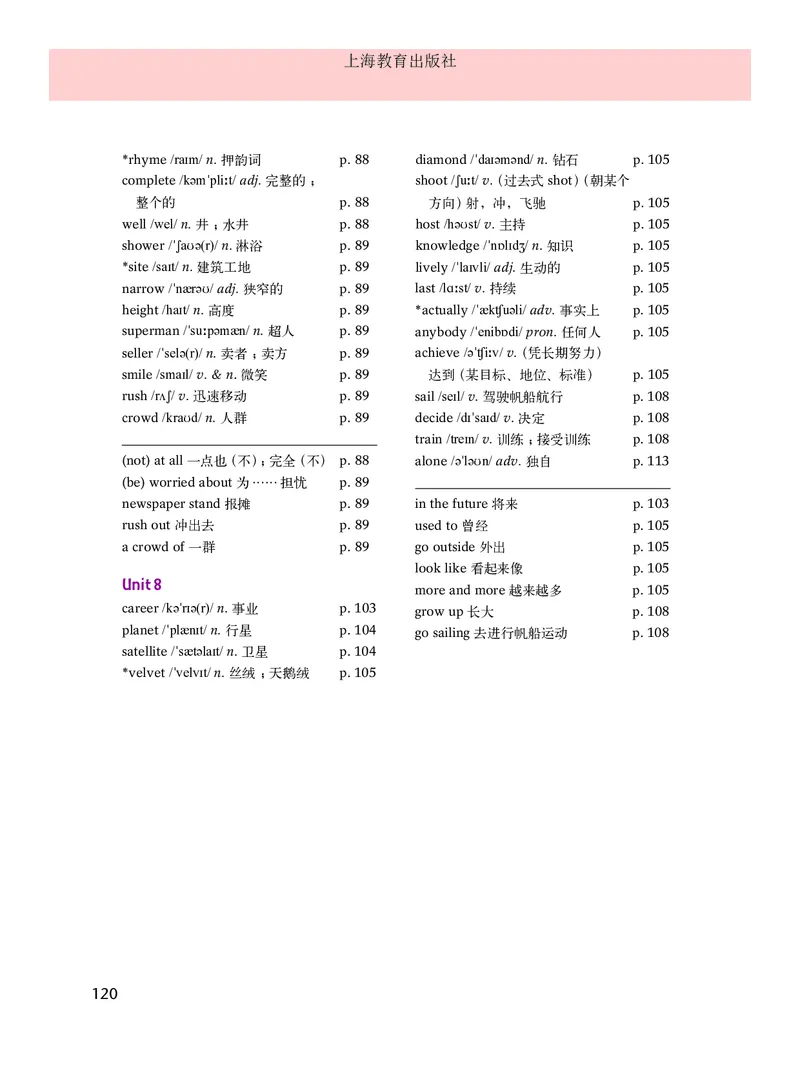
义务教育教科書
(cid:2037)(cid:4263)
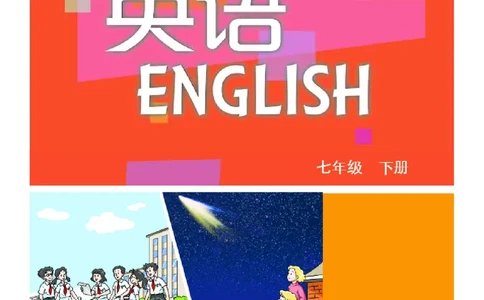
ENGLISH
七年級 下冊
上海教育出版社上海教育出版社
(cid:4855)(cid:257)(cid:257)(cid:1354)(cid:470)(cid:33)(cid:4711)(cid:1598)(cid:1252)(cid:257)(cid:3710)(cid:4623)(cid:4183)
(cid:4593) (cid:4949) (cid:4737)(cid:470)(cid:33)(cid:78) (cid:69)(cid:102)(cid:98)(cid:111)(cid:257)(cid:81) (cid:70)(cid:117)(cid:105)(cid:102)(cid:115)(cid:117)(cid:112)(cid:111)(cid:257)(cid:72) (cid:78)(cid:100)(cid:66)(cid:115)(cid:117)(cid:105)(cid:118)(cid:115)
(cid:1354)(cid:33) (cid:33) (cid:4737)(cid:470)(cid:33)(cid:2900)(cid:257)(cid:6480)(cid:257)(cid:4844)(cid:257)(cid:4767)(cid:257)(cid:4007)(cid:1619)(cid:1619)(cid:33) (cid:4844)(cid:257)(cid:3292)
(cid:4711)(cid:257)(cid:1651)(cid:257)(cid:4376)(cid:257)(cid:4377)(cid:257)(cid:4551)(cid:2212)(cid:4742)
(cid:3173)(cid:2500)(cid:1655)(cid:4305)(cid:1564)(cid:1266)(cid:3617)(cid:41)(cid:4816)(cid:2132)(cid:42)(cid:4534)(cid:4172)(cid:2053)(cid:3764)(cid:4488)(cid:4565)(cid:2462)(cid:1420)(cid:1354)(cid:4224)(cid:4031)(cid:4597)(cid:2295)
(cid:3593)(cid:2139)(cid:3672)(cid:2369)(cid:1564)(cid:1266)(cid:2083)(cid:1915)(cid:4534)(cid:4172)(cid:2053)(cid:3764)(cid:3988)(cid:4565)(cid:2462)(cid:4579)(cid:3950)书(cid:1908)(cid:2053)(cid:3764)(cid:4488)(cid:4565)(cid:2462)(cid:1420)(cid:1354)(cid:4224)(cid:4031)(cid:4597)(cid:2295)
(cid:4660)(cid:3498)(cid:1354)(cid:2337)(cid:470)(cid:33)(cid:2268)(cid:257)(cid:4360)(cid:257)(cid:4828)(cid:1482)(cid:3904)
©(cid:3593)(cid:2139)(cid:3688)(cid:4816)(cid:4205)(cid:4305)(cid:41)(cid:4541)(cid:1849)(cid:4596)(cid:42)(cid:2652)(cid:1522)(cid:1984)(cid:2027)(cid:4031)(cid:4597)(cid:2295)和(cid:3173)(cid:2500)(cid:1655)(cid:4305)(cid:1564)(cid:1266)(cid:3617)(cid:51)0(cid:50)(cid:52)
(cid:272)(cid:80)(cid:121)(cid:103)(cid:112)(cid:115)(cid:101)(cid:273)(cid:4026)(cid:3173)(cid:2500)(cid:1655)(cid:4305)(cid:1564)(cid:1266)(cid:3617)(cid:1702)(cid:4864)册(cid:3590)(cid:1364)(cid:259)
(cid:4036)(cid:2525)(cid:3593)(cid:2139)(cid:3688)(cid:4816)(cid:4205)(cid:4305)(cid:41)(cid:4541)(cid:1849)(cid:4596)(cid:42)(cid:2652)(cid:1522)(cid:1984)(cid:2027)(cid:4031)(cid:4597)(cid:2295)和(cid:3173)(cid:2500)(cid:1655)(cid:4305)(cid:1564)(cid:1266)(cid:3617)(cid:41)(cid:4816)(cid:2132)(cid:42)(cid:4534)(cid:4172)(cid:2053)(cid:3764)书(cid:3052)(cid:4281)(cid:2647)(cid:456)(cid:1411)(cid:1701)
(cid:4638)(cid:3498)(cid:2182)(cid:1722)(cid:3446)(cid:4444)(cid:3498)(cid:2182)(cid:4250)(cid:3669)(cid:258)(cid:3498)(cid:2182)(cid:3011)(cid:2491)(cid:258)(cid:3498)(cid:2182)(cid:4052)(cid:4916)(cid:1867)(cid:4487)(cid:258)(cid:1888)(cid:4806)(cid:2312)(cid:4872)(cid:4636)本书(cid:1702)(cid:4052)(cid:4916)(cid:258)(cid:3950)(cid:3276)(cid:2312)音(cid:3285)(cid:259)
(cid:2252)(cid:4499)(cid:2109)(cid:1655)(cid:3646)(cid:3636)(cid:2720)(cid:1737)(cid:2720)(cid:2151)(cid:4792)(cid:1564)(cid:2462)(cid:1420)(cid:1702)(cid:1462)(cid:1649)和(cid:1411)(cid:4929)(cid:456)(cid:3893)(cid:1564)(cid:1296)(cid:2125)(cid:4458)(cid:2415)(cid:259)(cid:1737)(cid:2246):0(cid:51)(cid:50)(cid:46)(cid:55)(cid:53)(cid:52)(cid:50)(cid:58)(cid:51)(cid:53)(cid:50)(cid:259)(cid:1737)(cid:4913)(cid:4528)(cid:4178):
(cid:107)(cid:100)(cid:107)(cid:122)(cid:65)(cid:116)(cid:102)(cid:113)(cid:105).(cid:100)(cid:112)(cid:110).(cid:100)(cid:111)(cid:259)(cid:3930)(cid:4320)(cid:1722)(cid:4791):(cid:3593)(cid:2139)(cid:3688)(cid:6031)(cid:4252)(cid:3446)(cid:2173)(cid:2528)(cid:2911)(cid:50)5(cid:58)(cid:3180)(cid:68)(cid:4951)(cid:259)(cid:4528)(cid:4768)(cid:1354)(cid:2963):(cid:51)0(cid:50)(cid:50)0(cid:50)(cid:259)
(cid:3635)(cid:3069)(cid:257)(cid:1216)(cid:4727)(cid:278)(cid:4816)(cid:2240)(cid:3495)(cid:3063)(cid:2060)和(cid:2132)(cid:4856)(cid:4949)(cid:3460)(cid:1862)(cid:279)(cid:1724)(cid:1854)(cid:3654)(cid:4085)(cid:3913)(cid:4534)(cid:2098)(cid:2112)定(cid:456)(cid:4066)(cid:3021)(cid:4441)(cid:2513)(cid:2825)(cid:4314)(cid:4724)(cid:4856)(cid:4949)(cid:3460)(cid:3495)(cid:4775)(cid:1970)(cid:1298)(cid:1552)(cid:259)
(cid:4856)(cid:4949)(cid:3460)(cid:3495)(cid:3523)(cid:4534)(cid:2098)(cid:4544)(cid:4775)(cid:1970)(cid:1298)(cid:1552)(cid:3674)(cid:4435)(cid:2647)(cid:2340)(cid:3657)(cid:4561)(cid:1564)(cid:1266)(cid:3617)(cid:2804)(cid:4131)(cid:259)
(cid:4461)(cid:4097)(cid:2462)(cid:4579)(cid:2462)(cid:2644)书
(cid:4488)(cid:33)(cid:4565)
(cid:3327)(cid:3150)(cid:2346) (cid:4144)册
(cid:266)(cid:266)(cid:266)(cid:266)(cid:266)(cid:266)(cid:266)(cid:266)(cid:266)(cid:266)(cid:266)(cid:266)(cid:266)(cid:266)(cid:266)(cid:266)(cid:266)(cid:266)(cid:266)(cid:266)(cid:266)(cid:266)(cid:266)(cid:266)(cid:266)(cid:266)(cid:266)(cid:266)(cid:266)
(cid:3593)(cid:2139)(cid:3672)(cid:2369)(cid:1564)(cid:1266)(cid:2083)(cid:1915)(cid:4534)(cid:4172)(cid:2053)(cid:3764)
(cid:1564)(cid:1266)(cid:1856)(cid:4252)
(cid:3593) (cid:2139) (cid:2462) (cid:4579) (cid:1564) (cid:1266) (cid:3617)
((cid:3593)(cid:2139)(cid:3688)(cid:6031)(cid:4252)(cid:3446)(cid:2173)(cid:2528)(cid:2911)(cid:50)5(cid:58)(cid:3180)(cid:68)(cid:4951) (cid:4528)(cid:4768)(cid:1354)(cid:2963):(cid:51)0(cid:50)(cid:50)0(cid:50))
(cid:2035)(cid:1722) (cid:2525)(cid:4200) (cid:3593)(cid:2139)(cid:4816)(cid:2240)(cid:4487)(cid:3736)(cid:4534)(cid:4172)(cid:2053)(cid:3764)(cid:4487)(cid:3736)
(cid:266)(cid:266)(cid:266)(cid:266)(cid:266)(cid:266)(cid:266)(cid:266)(cid:266)(cid:266)(cid:266)(cid:266)(cid:266)(cid:266)(cid:266)(cid:266)(cid:266)(cid:266)(cid:266)(cid:266)(cid:266)(cid:266)(cid:266)(cid:266)(cid:266)(cid:266)(cid:266)(cid:266)(cid:266)
(cid:2616)本 (cid:56)8(cid:56)(cid:289)(cid:50)0(cid:58)(cid:51) (cid:50)(cid:459)(cid:50)(cid:55) (cid:4487)(cid:4711) 8.5
(cid:51)0(cid:50)(cid:52)(cid:3150)(cid:50)(cid:4614)(cid:1724)(cid:50)(cid:1266) (cid:51)0(cid:51)(cid:51)(cid:3150)(cid:50)(cid:4614)(cid:1724)(cid:50)(cid:52)(cid:1618)(cid:4487)(cid:3736)
(cid:74)(cid:84)(cid:67)(cid:79) (cid:58)(cid:56)8(cid:457)(cid:56)(cid:457)5(cid:53)(cid:53)(cid:53)(cid:457)(cid:53)(cid:53)(cid:58)(cid:51)(cid:457)(cid:56)(cid:459)(cid:72)(cid:260)(cid:52)5(cid:53)(cid:50)
(cid:266)(cid:266)(cid:266)(cid:266)(cid:266)(cid:266)(cid:266)(cid:266)(cid:266)(cid:266)(cid:266)(cid:266)(cid:266)(cid:266)(cid:266)(cid:266)(cid:266)(cid:266)(cid:266)(cid:266)(cid:266)(cid:266)(cid:266)(cid:266)(cid:266)(cid:266)(cid:266)(cid:266)(cid:266)
定价:8.50 元(本书另配音带和练习册)
辽宁省物价局价格审查批准文号:辽价发[2018]30号
全国物价举报电话:12315
此书如有印、装质量问题,请向出版社调换。联系电话:021-64373213上海教育出版社
写写写在在在前前前面面面
(cid:3934)(cid:4305)(cid:3021)(cid:456)(cid:272)(cid:4224)(cid:4638)(cid:3374)(cid:3052)(cid:273)(cid:456)(cid:3679)(cid:4185)(cid:2018)(cid:3797)(cid:3143)(cid:3021)(cid:456)(cid:4949)(cid:4026)(cid:1354)(cid:4224)(cid:4737)(cid:456)(cid:4066)(cid:3021)(cid:4026)(cid:3143)(cid:3021)(cid:1563)(cid:4816)(cid:2473)
(cid:1806)(cid:1702)(cid:4488)(cid:4565)(cid:4305)习(cid:4890)(cid:1314)(cid:2837)(cid:4213)(cid:3658)(cid:3002):
(cid:3695)(cid:4150)(cid:456)(cid:4066)(cid:3021)(cid:4185)(cid:3182)(cid:2800)(cid:4026)(cid:3143)(cid:3021)(cid:1654)(cid:2616)(cid:4419)(cid:3586)(cid:1588)(cid:2237)(cid:456)(cid:4419)(cid:3586)(cid:3136)(cid:2626)(cid:2415)(cid:4568)(cid:3988)(cid:1925)(cid:2528)(cid:1702)(cid:1588)(cid:2237)(cid:259)
(cid:4638)(cid:3672)(cid:2489)(cid:4441)(cid:3479)(cid:1519)(cid:2837)(cid:1722)(cid:3440)(cid:1641)(cid:1702)(cid:2499)(cid:3904)(cid:456)(cid:4740)(cid:3586)(cid:1588)(cid:2237)(cid:2429)(cid:3679)(cid:3143)(cid:3021)(cid:3636)(cid:1642)(cid:258)(cid:1519)(cid:1482)(cid:1702)(cid:2319)本(cid:3913)(cid:2418)(cid:4782)
(cid:4419)(cid:259)(cid:3930)(cid:2135)(cid:3826)(cid:456)(cid:3143)(cid:3021)(cid:3136)(cid:2626)(cid:1695)(cid:1411)(cid:3934)(cid:2132)(cid:2374)(cid:258)(cid:3063)(cid:4931)(cid:2217)(cid:4824)(cid:1702)(cid:2790)(cid:3663)和(cid:3636)(cid:1775)(cid:1702)(cid:1683)(cid:3374)(cid:471)(cid:3934)(cid:3657)(cid:1996)
(cid:3700)(cid:1695)(cid:1588)(cid:3988)(cid:1812)(cid:4668)(cid:2525)(cid:2079)(cid:2747)(cid:4540)(cid:4767)(cid:4638)(cid:5842)(cid:3344)(cid:1702)(cid:1771)(cid:1883)(cid:4052)(cid:3069)(cid:1702)(cid:2696)(cid:3857)和(cid:4192)(cid:4011)(cid:259)(cid:4066)(cid:3021)(cid:4113)(cid:4013)(cid:3143)(cid:3021)(cid:2487)
(cid:1615)(cid:1848)(cid:4651)(cid:4651)(cid:3636)(cid:1519)(cid:4419)(cid:4822)(cid:2683)(cid:2109)(cid:1702)(cid:4305)习(cid:3431)(cid:2249)(cid:266)(cid:266)(cid:4638)(cid:1771)(cid:4103)(cid:1883)(cid:4052)(cid:2245)(cid:4816)(cid:2343)(cid:3453)(cid:2523)(cid:2240)(cid:456)(cid:1919)(cid:1975)(cid:4914)(cid:2350)(cid:456)
(cid:1948)(cid:4097)(cid:3672)(cid:2489)(cid:445)
(cid:2319)(cid:4544)(cid:4740)(cid:4387)(cid:4419)(cid:2034)(cid:3107)(cid:1364)(cid:456)(cid:4066)(cid:3021)(cid:1812)(cid:272)(cid:3921) (Listening)(cid:273)(cid:272)(cid:3755) (Speaking)(cid:273)(cid:272)(cid:1793)
(Reading)(cid:273)(cid:272)(cid:4224) (Writing)(cid:273)(cid:1415)(cid:1908)(cid:3823)(cid:4276)(cid:4402)(cid:1702)(cid:4636)(cid:3897)(cid:4948)(cid:2837)(cid:2639)(cid:2650)(cid:1702)(cid:6242)(cid:4299)(cid:259)(cid:4066)(cid:3021)(cid:4299)(cid:2837)(cid:2513)
(cid:2647)(cid:3136)(cid:1824)(cid:1702)(cid:3897)(cid:1419):(cid:2139)(cid:1298)(cid:258)(cid:2084)(cid:3674)(cid:258)(cid:3505)(cid:2363)(cid:258)(cid:1393)(cid:2651)(cid:456)(cid:4444)(cid:2616)(cid:2711)(cid:3143)(cid:3021)(cid:1702)(cid:4357)(cid:2489)(cid:471)(cid:4066)(cid:3021)(cid:4299)(cid:2837)(cid:2513)
(cid:2647)(cid:3136)(cid:1824)(cid:1702)(cid:3894)(cid:1420):(cid:3636)(cid:2308)(cid:1702)(cid:258)(cid:4052)(cid:4305)(cid:1702)(cid:258)(cid:4914)(cid:3479)(cid:1702)(cid:258)(cid:3431)(cid:1996)(cid:1702)(cid:258)(cid:3063)(cid:3789)(cid:1702)(cid:456)(cid:4444)(cid:1654)(cid:2616)(cid:3143)(cid:3021)(cid:1702)
(cid:3691)(cid:4408)(cid:259)(cid:4638)(cid:272)(cid:4565)(cid:1862) (Grammar)(cid:273)(cid:1415)(cid:1908)(cid:456)(cid:4066)(cid:3021)(cid:1411)(cid:3636)(cid:4504)(cid:1722)(cid:2436)(cid:2484)(cid:4565)(cid:1862)(cid:2112)(cid:4662)(cid:456)(cid:1848)(cid:3679)(cid:3930)(cid:2135)
(cid:3413)(cid:3406)(cid:1702)(cid:2308)(cid:1775)和(cid:4744)(cid:3661)(cid:1702)(cid:4565)(cid:2531)(cid:2720)(cid:4485)(cid:1694)(cid:3143)(cid:3021)(cid:4914)(cid:2597)(cid:2115)(cid:3117)(cid:4565)(cid:4350)(cid:2112)(cid:4662)(cid:1386)(cid:4623)(cid:4521)(cid:4544)(cid:4565)(cid:4350)(cid:3661)(cid:2413)
(cid:4816)(cid:456)(cid:4444)(cid:2870)(cid:2295)(cid:1662)(cid:3898)(cid:3389)(cid:2363)(cid:456)(cid:4444)(cid:3636)(cid:1775)(cid:4201)(cid:1571)(cid:2667)(cid:4659)(cid:259) (cid:3934)(cid:3657)(cid:456)(cid:4066)(cid:3021)(cid:4410)(cid:4521)(cid:4240)(cid:3618)(cid:2362)(cid:2837)(cid:3136)(cid:4534)(cid:4858)
(cid:3143)(cid:3021)(cid:4240)(cid:2870)(cid:3627)(cid:2295)(cid:258)(cid:2569)(cid:4419)(cid:1874)(cid:3545)(cid:1702)练习(cid:456)(cid:1386)(cid:3682)(cid:3657)(cid:2036)(cid:4558)(cid:3143)(cid:3021)(cid:2344)(cid:4305)(cid:2344)(cid:4521)(cid:1702)(cid:272)(cid:4305)习(cid:1447)(cid:2940)
(Strategy)(cid:273)和(cid:272)(cid:4205)(cid:2352)(cid:3399) (Top tip)(cid:273)(cid:269)(cid:269)(cid:3823)(cid:4534)(cid:1702)(cid:4419)(cid:3406)(cid:1788)(cid:4026)(cid:2837)(cid:2328)(cid:3344)(cid:3143)(cid:3021)(cid:2040)(cid:1824)(cid:1702)(cid:4305)
习(cid:3492)(cid:3431)和(cid:4247)(cid:3456)(cid:456)(cid:1386)(cid:1996)(cid:3700)(cid:1695)(cid:4488)(cid:4565)(cid:4565)(cid:4350)(cid:4305)习(cid:1702)(cid:4152)(cid:2308)(cid:258)(cid:2796)(cid:3897)和(cid:3624)(cid:2650)(cid:259)
(cid:4940)(cid:2219)(cid:4185)(cid:3755)(cid:456)(cid:1254)(cid:4638)(cid:3143)(cid:3021)(cid:3052)(cid:3374)(cid:1702)(cid:4740)(cid:3883)(cid:2652)本(cid:3679)(cid:4534)(cid:272)(cid:3624)(cid:1800)(cid:273)(cid:1702)(cid:456)(cid:3679)(cid:2525)(cid:1701)(cid:3344)(cid:272)(cid:3980)(cid:2594)(cid:273)(cid:1702)(cid:456)
(cid:272)(cid:1409)(cid:1546)(cid:4616)(cid:1793)(More practice)(cid:273)和(cid:272)(cid:2652)(cid:3894)(Project)(cid:273)(cid:3679)(cid:4026)(cid:3934)(cid:4305)(cid:3021)(cid:1702)(cid:3978)(cid:4699)(cid:4305)习(cid:4890)(cid:1314)(cid:1702)(cid:471)
(cid:272)(cid:4052)(cid:2245)(cid:2457)(Culture corner)(cid:273)(cid:1702)(cid:3988)(cid:4349)(cid:3679)(cid:4078)(cid:4172)(cid:1702)(cid:456)(cid:4929)(cid:4444)(cid:4485)(cid:2870)(cid:3143)(cid:3021)(cid:3457)(cid:4914)(cid:4855)(cid:3857)(cid:3821)(cid:4565)(cid:4350)(cid:4052)
(cid:2245)(cid:1309)(cid:2219)(cid:1702)(cid:3624)(cid:1511)(cid:2323)(cid:1743)(cid:259)
(cid:4922)(cid:4782)(cid:456)(cid:4066)(cid:3021)(cid:3216)(cid:4013)(cid:3143)(cid:3021)(cid:2523)(cid:3627)(cid:1295)(cid:2978)(cid:456)(cid:3762)(cid:4028)(cid:2323)(cid:2335)(cid:456)(cid:4704)(cid:4638)(cid:4488)(cid:4565)(cid:4565)(cid:4350)(cid:4305)习(cid:4740)(cid:3586)(cid:3930)(cid:4192)
(cid:3672)(cid:2489)(cid:1702)(cid:1588)(cid:2237)(cid:3374)(cid:272) (cid:4013)(cid:273)(cid:259)
(cid:4584)(cid:4865)(cid:3143)(cid:3021)(cid:4305)习(cid:4554)(cid:2682)(cid:456)(cid:4305)(cid:4534)(cid:1519)(cid:4211)(cid:445)
(cid:1563)(cid:4816)(cid:278)(cid:4488)(cid:4565)(cid:279)(cid:1354)(cid:4224)(cid:4935)
2012(cid:3150)1(cid:4614)上海教育出版社
(cid:3071)(cid:4231)
在教材编写的过程中,部分教师对此工作予以极大的帮助,特此感谢:
安凤岐 朱 成 娄炳坤 曹国玲
Tony Dale上海教育出版社
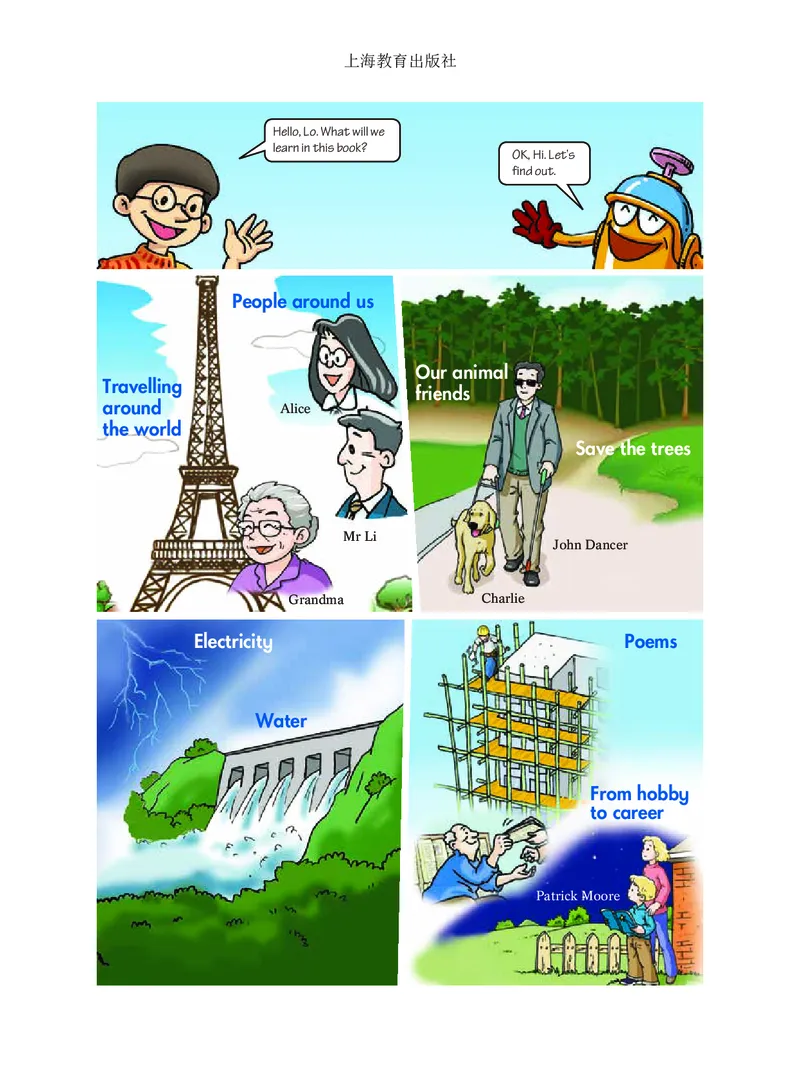
Hello, Lo. What will we
learn in this book?
OK, Hi. Let’s
find out.
People around us
Our animal
Travelling
friends
around Alice
the world
Save the trees
Mr Li
John Dancer
Grandma Charlie
Electricity Poems
Water
From hobby
to career
Patrick Moore上海教育出版社
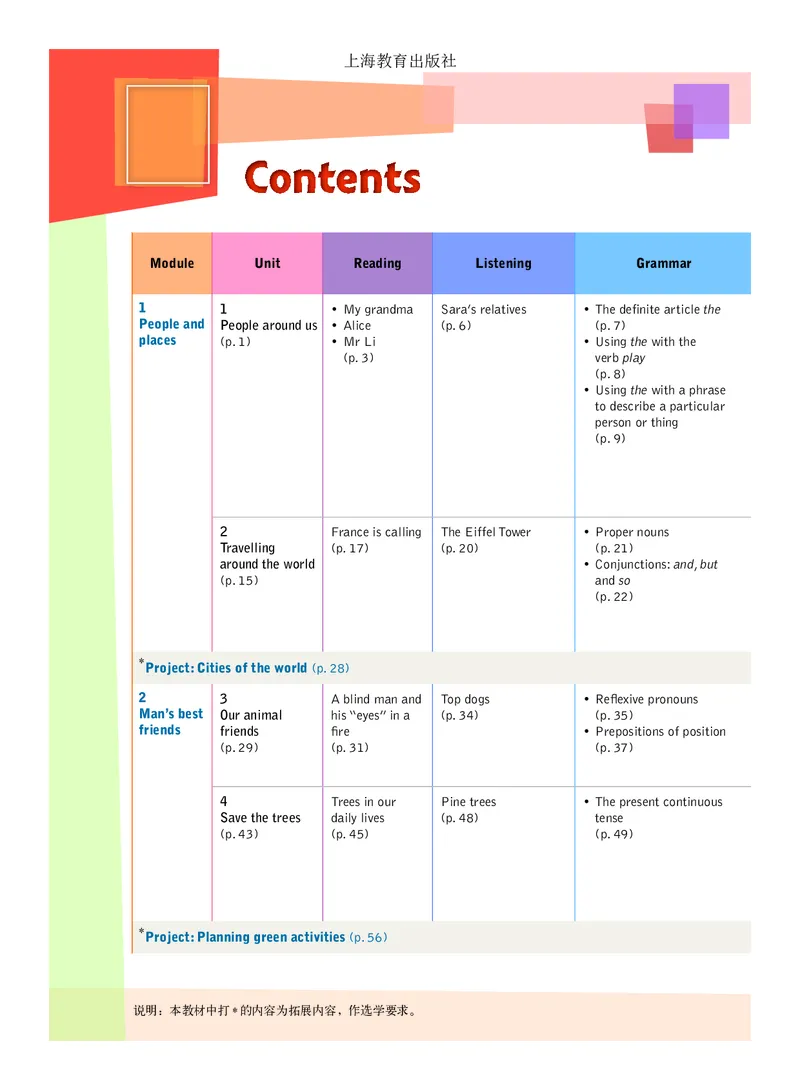
CCCooonnnttteeennntttsss
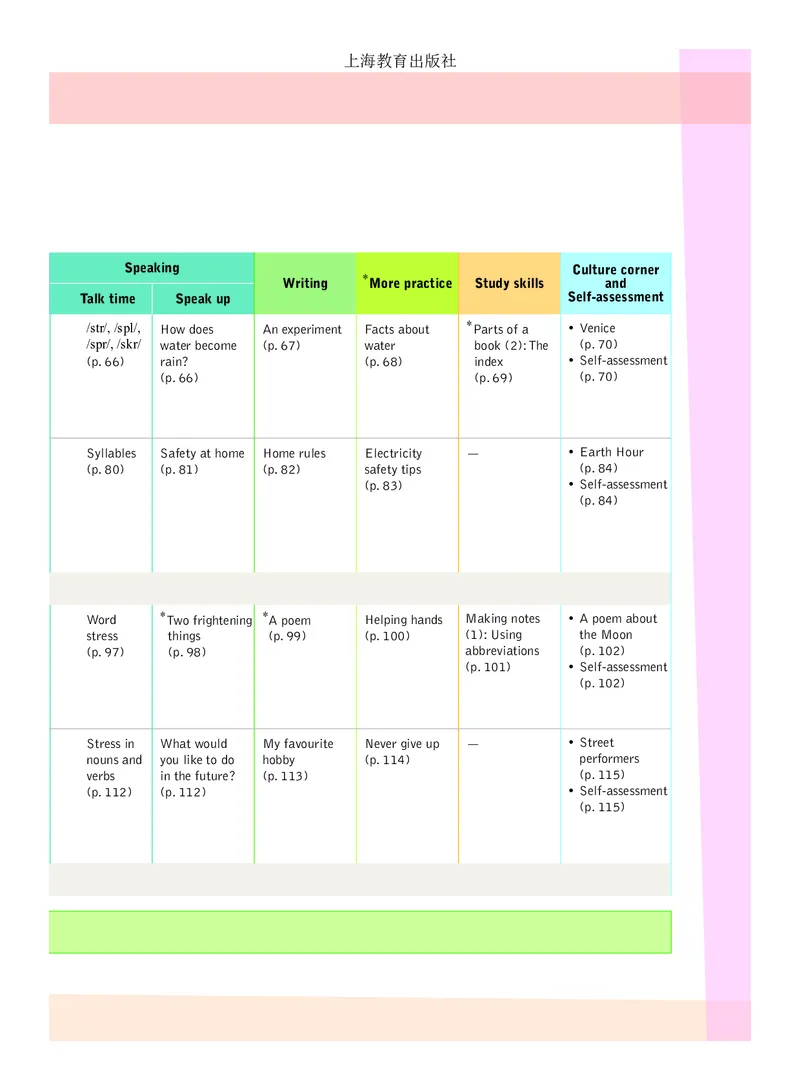
Speaking Culture corner
(cid:43)
Module Unit Reading Listening Grammar Writing More practice Study skills and
Talk time Speak up Self-assessment
(cid:43)
1 1 • (cid:46)y grandma Sara(cid:8)s relatives • (cid:53)he definite article the /IR/, /eR/, (cid:56)ho do you (cid:34) person (cid:42) love (cid:46)other(cid:8)s Day (cid:36)harts and • (cid:46)iddle names
People and People around us • (cid:34)lice (p. 6) (p. 7) /WR/ like(cid:32) (p. 11) (p. 12) graphs (cid:9)(cid:19)(cid:10)(cid:27) (p. 14)
places (p. 1) • (cid:46)r (cid:45)i • Using the with the (p. 10) (p. 10) Using line • Self(cid:14)assessment
(p. 3) verb play graphs and (p. 14)
(p. 8) bar charts
• Using the with a phrase (p. 13)
to describe a particular
person or thing
(p. 9)
2 (cid:39)rance is calling (cid:53)he (cid:38)iffel (cid:53)ower • (cid:49)roper nouns /T/, /dZ/, (cid:46)y holiday (cid:34) postcard (cid:53)he (cid:45)eaning — • Backpacking
Travelling (p. 17) (p. 20) (p. 21) /ts/, /dz/, plans (p. 25) (cid:53)ower of (cid:49)isa (p. 27)
around the world • (cid:36)onjunctions(cid:27) and, but /tr/, /dr/ (p. 24) (p. 26) • Self(cid:14)assessment
(p. 15) and so (p. 24) (p. 27)
(p. 22)
(cid:43)
Project: Cities of the world (p. 28)
2 3 (cid:34) blind man and (cid:53)op dogs • (cid:51)e(cid:110) e(cid:89)ive pronouns /bl/, /br/, (cid:41)elpful (cid:34) rescue story (cid:34) friendly Using reference • Dog laws
Man’s best Our animal his (cid:105)eyes(cid:119) in a (p. 34) (p. 35) /fl/, /fr/, animals (p. 39) dolphin books (cid:9)(cid:19)(cid:10)(cid:27) Using (p. 42)
friends friends (cid:109) re • (cid:49)repositions of position /Gl/, /Gr/, (p. 38) (p. 40) a dictionary (cid:9)(cid:42)(cid:10) • Self(cid:14)assessment
(p. 29) (p. 31) (p. 37) /kl/, /kr/ (p. 41) (p. 42)
(p. 38)
4 (cid:53)rees in our (cid:49)ine trees • (cid:53)he present continuous /sk/, /sp/, (cid:56)hy are trees (cid:53)ree (cid:49)lanting (cid:53)he (cid:34)ma(cid:91)on — • (cid:36)hinese tea
Save the trees daily lives (p. 48) tense /st/, /sl/, important(cid:32) Day rainforest (p. 55)
(p. 43) (p. 45) (p. 49) /sm/, /pl/, (p. 52) (p. 53) (p. 54) • Self(cid:14)assessment
/pr/, /kw/, (p. 55)
/tw/
(p. 52)
(cid:43)
Project: Planning green activities (p. 56)
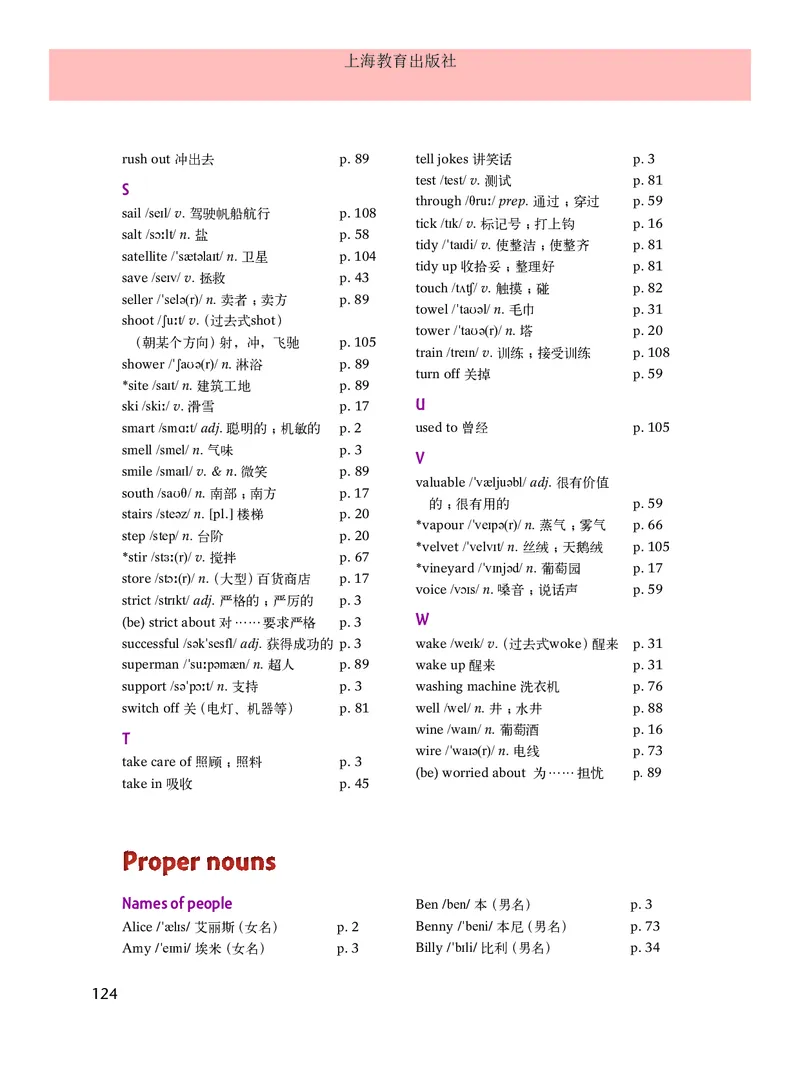
(cid:3755)(cid:3069):(cid:1320)教材中(cid:1654)(cid:454)的(cid:3134)(cid:3513)(cid:4026)(cid:3978)(cid:4699)(cid:3134)(cid:3513),作(cid:4299)(cid:4305)(cid:4402)(cid:3441)(cid:259)上海教育出版社
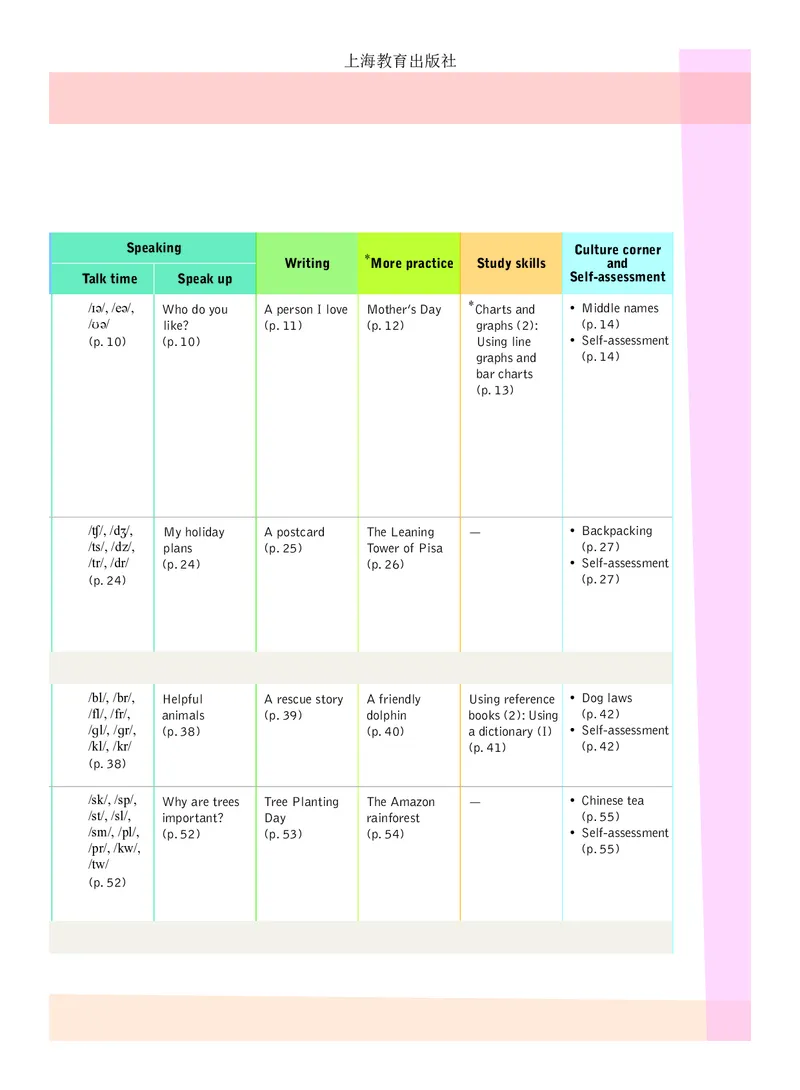
Speaking Culture corner
(cid:43)
Module Unit Reading Listening Grammar Writing More practice Study skills and
Talk time Speak up Self-assessment
(cid:43)
1 1 • (cid:46)y grandma Sara(cid:8)s relatives • (cid:53)he definite article the /IR/, /eR/, (cid:56)ho do you (cid:34) person (cid:42) love (cid:46)other(cid:8)s Day (cid:36)harts and • (cid:46)iddle names
People and People around us • (cid:34)lice (p. 6) (p. 7) /WR/ like(cid:32) (p. 11) (p. 12) graphs (cid:9)(cid:19)(cid:10)(cid:27) (p. 14)
places (p. 1) • (cid:46)r (cid:45)i • Using the with the (p. 10) (p. 10) Using line • Self(cid:14)assessment
(p. 3) verb play graphs and (p. 14)
(p. 8) bar charts
• Using the with a phrase (p. 13)
to describe a particular
person or thing
(p. 9)
2 (cid:39)rance is calling (cid:53)he (cid:38)iffel (cid:53)ower • (cid:49)roper nouns /T/, /dZ/, (cid:46)y holiday (cid:34) postcard (cid:53)he (cid:45)eaning — • Backpacking
Travelling (p. 17) (p. 20) (p. 21) /ts/, /dz/, plans (p. 25) (cid:53)ower of (cid:49)isa (p. 27)
around the world • (cid:36)onjunctions(cid:27) and, but /tr/, /dr/ (p. 24) (p. 26) • Self(cid:14)assessment
(p. 15) and so (p. 24) (p. 27)
(p. 22)
(cid:43)
Project: Cities of the world (p. 28)
2 3 (cid:34) blind man and (cid:53)op dogs • (cid:51)e(cid:110) e(cid:89)ive pronouns /bl/, /br/, (cid:41)elpful (cid:34) rescue story (cid:34) friendly Using reference • Dog laws
Man’s best Our animal his (cid:105)eyes(cid:119) in a (p. 34) (p. 35) /fl/, /fr/, animals (p. 39) dolphin books (cid:9)(cid:19)(cid:10)(cid:27) Using (p. 42)
friends friends (cid:109) re • (cid:49)repositions of position /Gl/, /Gr/, (p. 38) (p. 40) a dictionary (cid:9)(cid:42)(cid:10) • Self(cid:14)assessment
(p. 29) (p. 31) (p. 37) /kl/, /kr/ (p. 41) (p. 42)
(p. 38)
4 (cid:53)rees in our (cid:49)ine trees • (cid:53)he present continuous /sk/, /sp/, (cid:56)hy are trees (cid:53)ree (cid:49)lanting (cid:53)he (cid:34)ma(cid:91)on — • (cid:36)hinese tea
Save the trees daily lives (p. 48) tense /st/, /sl/, important(cid:32) Day rainforest (p. 55)
(p. 43) (p. 45) (p. 49) /sm/, /pl/, (p. 52) (p. 53) (p. 54) • Self(cid:14)assessment
/pr/, /kw/, (p. 55)
/tw/
(p. 52)
(cid:43)
Project: Planning green activities (p. 56)上海教育出版社
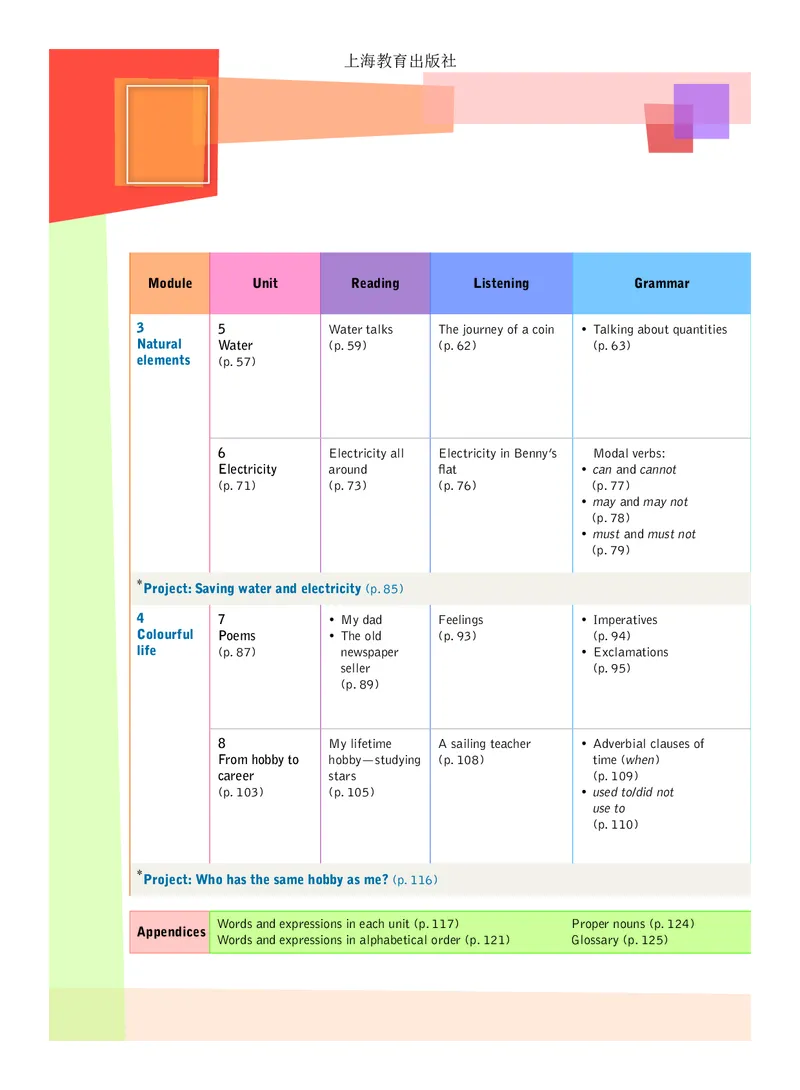
Speaking Culture corner
(cid:43)
Module Unit Reading Listening Grammar Writing More practice Study skills and
Talk time Speak up Self-assessment
(cid:43)
3 5 (cid:56)ater talks (cid:53)he journey of a coin • (cid:53)alking about (cid:82)uantities /str/, /spl/, (cid:41)ow does (cid:34)n e(cid:89)periment (cid:39)acts about (cid:49)arts of a • (cid:55)enice
Natural Water (p. 59) (p. 62) (p. 63) /spr/, /skr/ water become (p. 67) water book (cid:9)(cid:19)(cid:10)(cid:27) (cid:53)he (p. 70)
elements (p. 57) (p. 66) rain(cid:32) (p. 68) inde(cid:89) • Self(cid:14)assessment
(p. 66) (p. 69) (p. 70)
6 (cid:38)lectricity all (cid:38)lectricity in Benny(cid:8)s (cid:46)odal verbs(cid:27) Syllables Safety at home (cid:41)ome rules (cid:38)lectricity — • (cid:38)arth (cid:41)our
Electricity around (cid:110) at • can and cannot (p. 80) (p. 81) (p. 82) safety tips (p. 84)
(p. 71) (p. 73) (p. 76) (p. 77) (p. 83) • Self(cid:14)assessment
• may and may not (p. 84)
(p. 78)
• must and must not
(p. 79)
(cid:43)
Project: Saving water and electricity (p. 85)
(cid:43) (cid:43)
4 7 • (cid:46)y dad (cid:39)eelings • (cid:42)mperatives (cid:56)ord (cid:53)wo frightening (cid:34) poem (cid:41)elping hands (cid:46)aking notes • (cid:34) poem about
Colourful Poems • (cid:53)he old (p. 93) (p. 94) stress things (p. 99) (p. 100) (cid:9)(cid:18)(cid:10)(cid:27) Using the (cid:46)oon
life (p. 87) newspaper • (cid:38)(cid:89)clamations (p. 97) (p. 98) abbreviations (p. 102)
seller (p. 95) (p. 101) • Self(cid:14)assessment
(p. 89) (p. 102)
8 (cid:46)y lifetime (cid:34) sailing teacher • (cid:34)dverbial clauses of Stress in (cid:56)hat would (cid:46)y favourite (cid:47)ever give up — • Street
From hobby to hobby(cid:137)studying (p. 108) time (cid:9)when) nouns and you like to do hobby (p. 114) performers
career stars (p. 109) verbs in the future(cid:32) (p. 113) (p. 115)
(p. 103) (p. 105) • used to/did not (p. 112) (p. 112) • Self(cid:14)assessment
use to (p. 115)
(p. 110)
(cid:43)
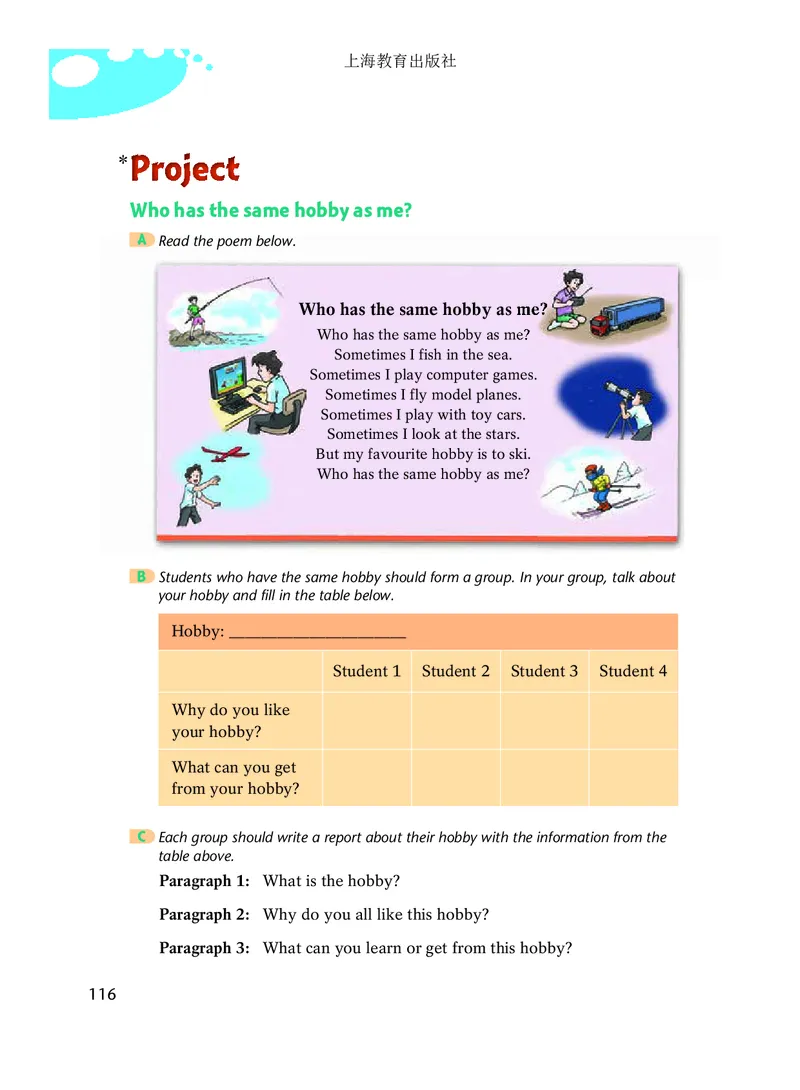
Project: Who has the same hobby as me? (p. 116)
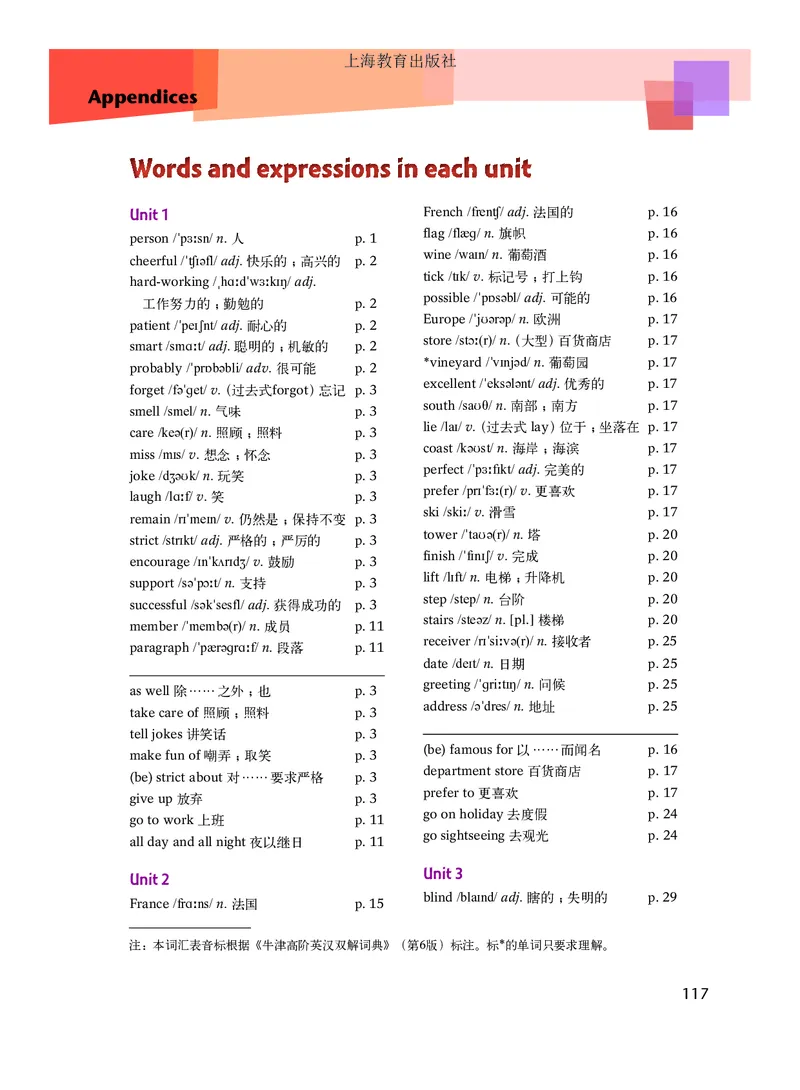
(cid:56)ords and e(cid:89)pressions in each unit (cid:9)p. (cid:18)(cid:18)(cid:24)(cid:10) (cid:49)roper nouns (cid:9)p. (cid:18)(cid:19)(cid:21)(cid:10)
Appendices
(cid:56)ords and e(cid:89)pressions in alphabetical order (cid:9)p. (cid:18)(cid:19)(cid:18)(cid:10) (cid:40)lossary (cid:9)p. (cid:18)(cid:19)(cid:22)(cid:10)上海教育出版社
Speaking Culture corner
(cid:43)
Module Unit Reading Listening Grammar Writing More practice Study skills and
Talk time Speak up Self-assessment
(cid:43)
3 5 (cid:56)ater talks (cid:53)he journey of a coin • (cid:53)alking about (cid:82)uantities /str/, /spl/, (cid:41)ow does (cid:34)n e(cid:89)periment (cid:39)acts about (cid:49)arts of a • (cid:55)enice
Natural Water (p. 59) (p. 62) (p. 63) /spr/, /skr/ water become (p. 67) water book (cid:9)(cid:19)(cid:10)(cid:27) (cid:53)he (p. 70)
elements (p. 57) (p. 66) rain(cid:32) (p. 68) inde(cid:89) • Self(cid:14)assessment
(p. 66) (p. 69) (p. 70)
6 (cid:38)lectricity all (cid:38)lectricity in Benny(cid:8)s (cid:46)odal verbs(cid:27) Syllables Safety at home (cid:41)ome rules (cid:38)lectricity — • (cid:38)arth (cid:41)our
Electricity around (cid:110) at • can and cannot (p. 80) (p. 81) (p. 82) safety tips (p. 84)
(p. 71) (p. 73) (p. 76) (p. 77) (p. 83) • Self(cid:14)assessment
• may and may not (p. 84)
(p. 78)
• must and must not
(p. 79)
(cid:43)
Project: Saving water and electricity (p. 85)
(cid:43) (cid:43)
4 7 • (cid:46)y dad (cid:39)eelings • (cid:42)mperatives (cid:56)ord (cid:53)wo frightening (cid:34) poem (cid:41)elping hands (cid:46)aking notes • (cid:34) poem about
Colourful Poems • (cid:53)he old (p. 93) (p. 94) stress things (p. 99) (p. 100) (cid:9)(cid:18)(cid:10)(cid:27) Using the (cid:46)oon
life (p. 87) newspaper • (cid:38)(cid:89)clamations (p. 97) (p. 98) abbreviations (p. 102)
seller (p. 95) (p. 101) • Self(cid:14)assessment
(p. 89) (p. 102)
8 (cid:46)y lifetime (cid:34) sailing teacher • (cid:34)dverbial clauses of Stress in (cid:56)hat would (cid:46)y favourite (cid:47)ever give up — • Street
From hobby to hobby(cid:137)studying (p. 108) time (cid:9)when) nouns and you like to do hobby (p. 114) performers
career stars (p. 109) verbs in the future(cid:32) (p. 113) (p. 115)
(p. 103) (p. 105) • used to/did not (p. 112) (p. 112) • Self(cid:14)assessment
use to (p. 115)
(p. 110)
(cid:43)
Project: Who has the same hobby as me? (p. 116)
(cid:56)ords and e(cid:89)pressions in each unit (cid:9)p. (cid:18)(cid:18)(cid:24)(cid:10) (cid:49)roper nouns (cid:9)p. (cid:18)(cid:19)(cid:21)(cid:10)
Appendices
(cid:56)ords and e(cid:89)pressions in alphabetical order (cid:9)p. (cid:18)(cid:19)(cid:18)(cid:10) (cid:40)lossary (cid:9)p. (cid:18)(cid:19)(cid:22)(cid:10)上海教育出版社上海教育出版社
Module 1 People and places
Unit
1
PPPeeeooopppllleee aaarrrooouuunnnddd uuusss
Getting ready
In this unit, you will learn how to describe people around you.
Reading
• Read three students’ articles about the people around them.
Listening
• Listen to a girl talking to her grandma about their relatives.
Grammar
• Learn how to use the definite article the.
Speaking
• Learn to say the /IR/, /eR/ and /WR/ sounds.
• Talk about the people you like.
Writing
• Write a short article about a person you love.
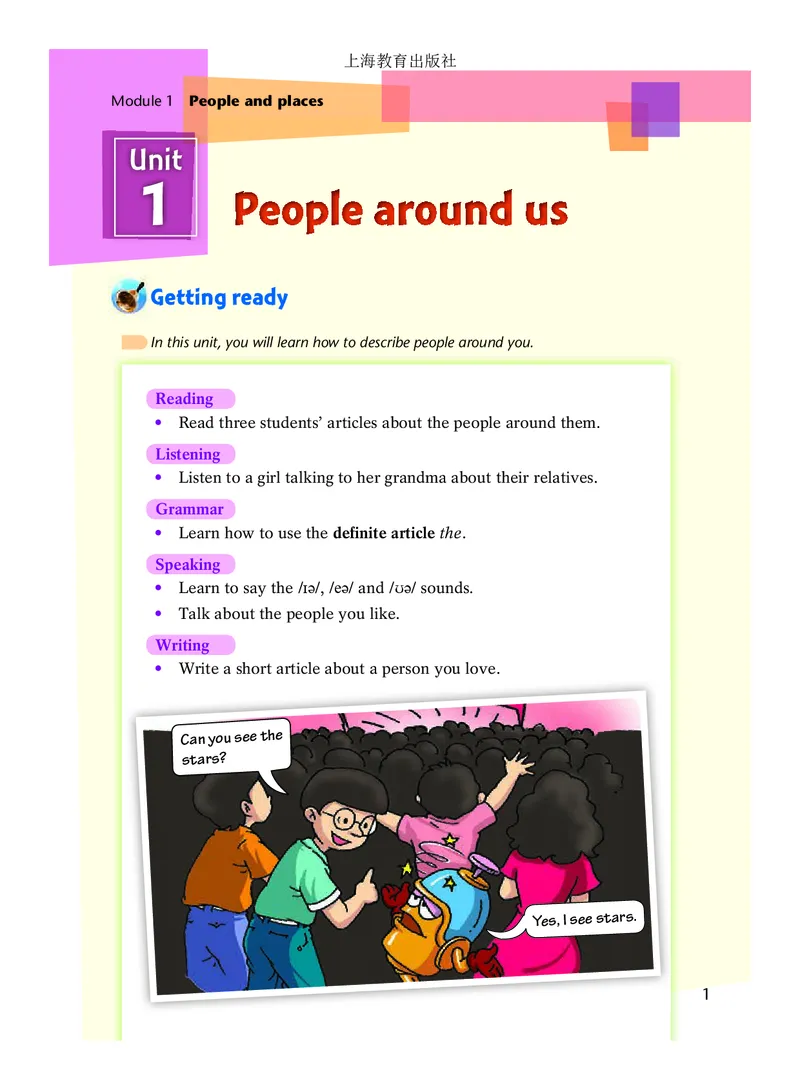
Can you see the
stars?
Yes, I see stars.
1上海教育出版社
Module 1
Reading
A What do you know about …?
A1 Do you know these words for describing people? Complete the sentences with the
correct words from the box.
cheerful hard-working patient smart
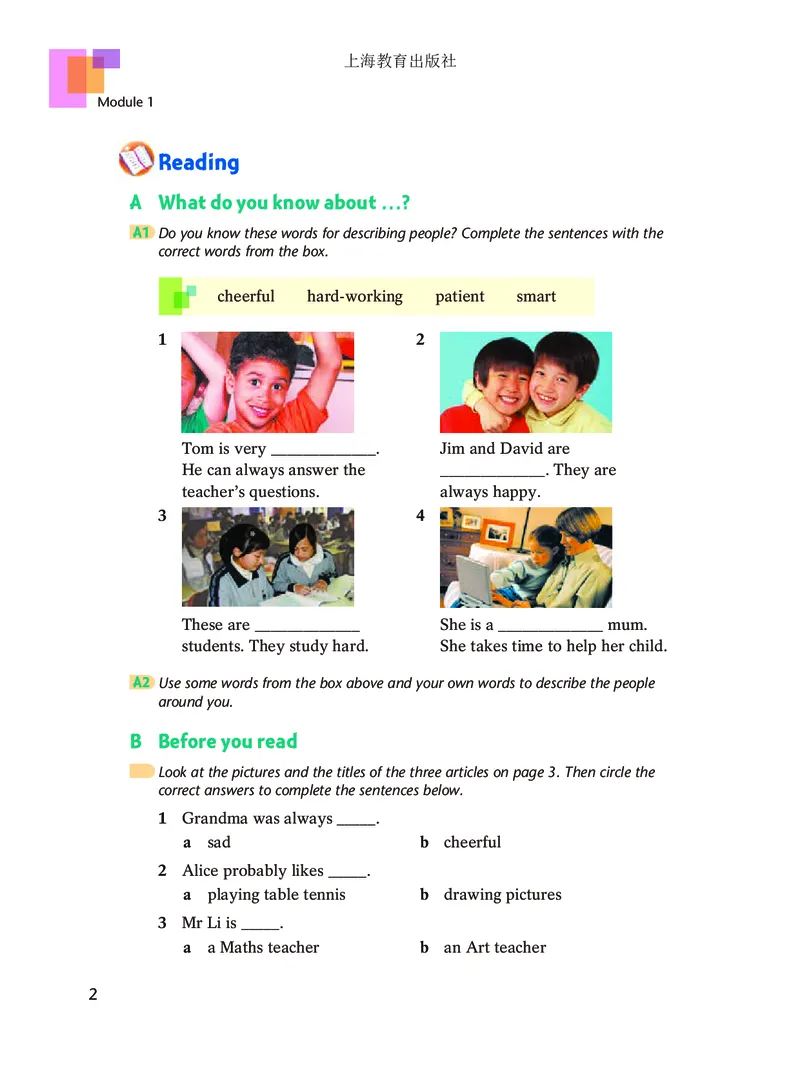
1 2
Tom is very _____________. Jim and David are
He can always answer the _____________. They are
teacher’s questions. always happy.
3 4
These are _____________ She is a _____________ mum.
students. They study hard. She takes time to help her child.
A2 Use some words from the box above and your own words to describe the people
around you.
B Before you read
Look at the pictures and the titles of the three articles on page 3. Then circle the
correct answers to complete the sentences below.
1 Grandma was always _____.
a sad b cheerful
2 Alice probably likes _____.
a playing table tennis b drawing pictures
3 Mr Li is _____.
a a Maths teacher b an Art teacher
2上海教育出版社
Unit 1
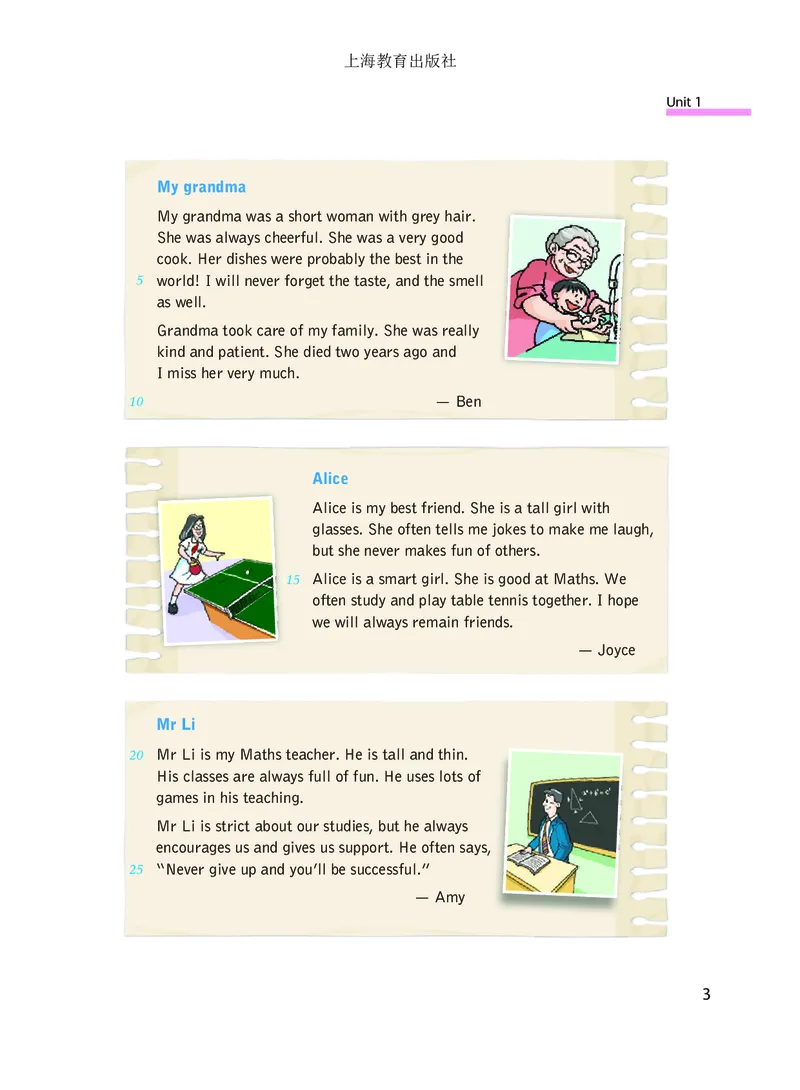
My grandma
My grandma was a short woman with grey hair.
She was always cheerful. She was a very good
cook. Her dishes were probably the best in the
5 world! I will never forget the taste, and the smell
as well.
Grandma took care of my family. She was really
kind and patient. She died two years ago and
I miss her very much.
10 — Ben
Alice
Alice is my best friend. She is a tall girl with
glasses. She often tells me jokes to make me laugh,
but she never makes fun of others.
15 Alice is a smart girl. She is good at Maths. We
often study and play table tennis together. I hope
we will always remain friends.
— Joyce
Mr Li
20 Mr Li is my Maths teacher. He is tall and thin.
His classes are always full of fun. He uses lots of
games in his teaching.
Mr Li is strict about our studies, but he always
eennccoouurraaggeess uuss aanndd ggiivveess uuss ssuuppppoorrtt.. HHee oofftteenn ssaayyss,,
25 “Never give up and you’ll be successful.”
— Amy
3上海教育出版社
Module 1
C Vocabulary
C1 The words in italics are from the three articles on page 3. Circle the correct answers
to complete these sentences.
1 Mandy is always cheerful. She is always ______.
a sad b happy
2 Sam forgot Jack’s address. He ______ Jack’s address.
a didn’t remember b didn’t write down
3 My mum takes care of my grandpa. She ______ him.
a looks after b lives with
4 Jason hopes that he and Mandy will remain good friends. Mandy also
hopes they will ______ good friends.
a find b still be
5 Leo’s parents always encourage him. They always ______ him ______.
a give … a lot of hope b make … feel sad
6 Tom often gives up easily. He usually ______ very soon after he starts.
a keeps trying to do something b stops trying to do something
C2 A school newspaper reporter interviewed Ben, Alice and Mr Li. Complete their
conversations with the words from the box.
forget gives up miss remain strict about successful
1 Reporter: Ben, do you still (_1)_________________ your grandma?
Ben: Yes. She was so kind. I’ll never ( _2)_________________ her.
2 Reporter: What do you think of Joyce, Alice?
Alice: She’s my best friend. She’s very friendly. I really like her.
I’m sure we’ll always _(3)_________________ friends.
3 Reporter: What do you think of Amy, Mr Li?
Mr Li: She’s _(4)_________________ her studies, so she’s always
_(5)_________________ in her exams. She never
_(6)_________________ when there are difficulties.
4上海教育出版社
Unit 1
D Comprehension
D1 Read the three articles on page 3 to find out about the three people below. Then
complete the table.
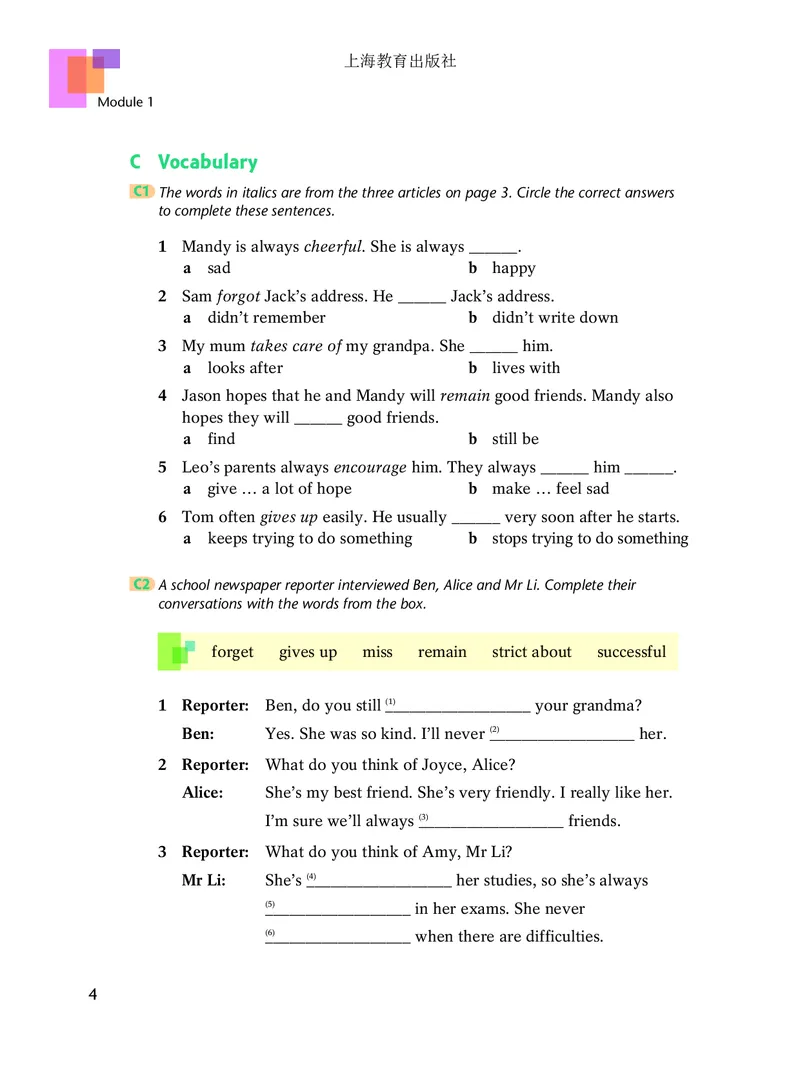
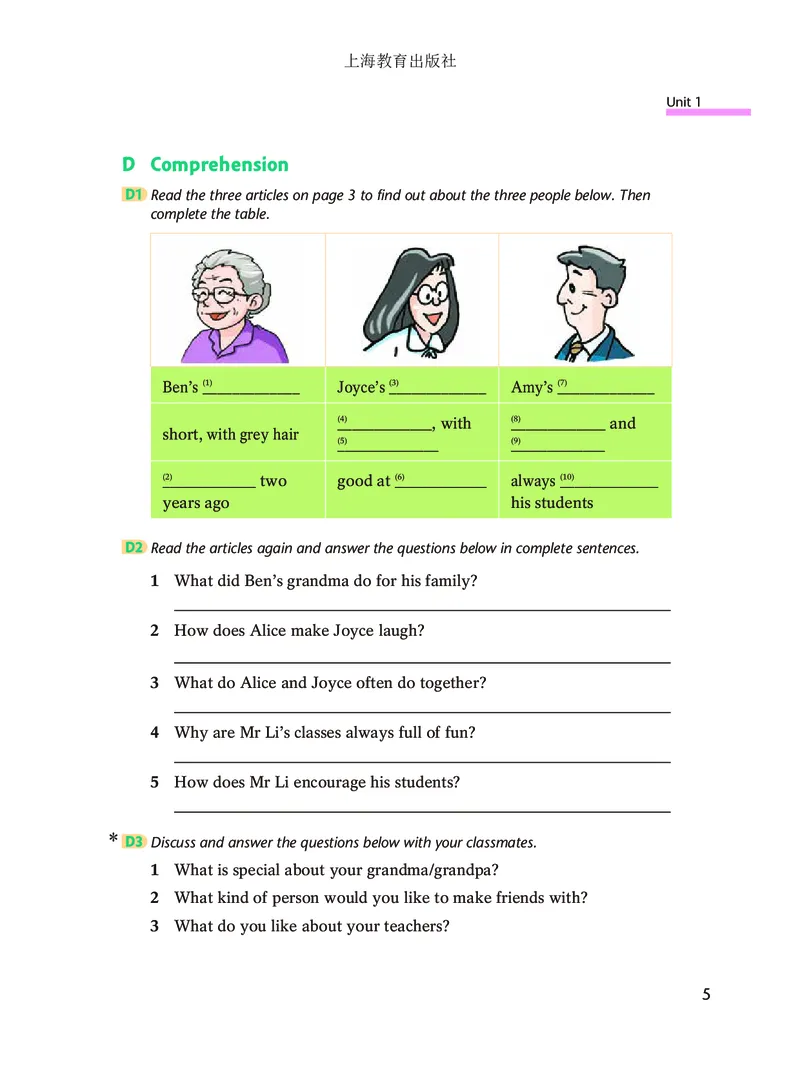
Mr Li
Ben’s (_1)____________ Joyce’s (_3)____________ Amy’s _(7)____________
_(4_) ___________, with (_8)____________ and
short, with grey hair
_(5)_____________ _(9_) ___________
_(2)____________ two good at _(6)___________ always (_10_)___________
years ago his students
D2 Read the articles again and answer the questions below in complete sentences.
1 What did Ben’s grandma do for his family?
2 How does Alice make Joyce laugh?
3 What do Alice and Joyce often do together?
4 Why are Mr Li’s classes always full of fun?
5 How does Mr Li encourage his students?
(cid:43)
D3 Discuss and answer the questions below with your classmates.
1 What is special about your grandma/grandpa?
2 What kind of person would you like to make friends with?
3 What do you like about your teachers?
5上海教育出版社
Module 1
Listening
Sara’s relatives
A Sara is phoning her grandma to ask about their relatives in Australia. Listen to their
conversation and take notes. Write one word or figure in each blank.
(cid:74)(cid:88)(cid:105)(cid:88)(cid:203)(cid:106)(cid:23)(cid:108)(cid:101)(cid:90)(cid:99)(cid:92)
•(cid:1) short but (_1)____________
•(cid:1) short, (_2)____________ hair
•(cid:1) wearing (_3)____________
•(cid:1) _(4)____________ years old
(cid:74)(cid:88)(cid:105)(cid:88)(cid:203)(cid:106)(cid:23)(cid:88)(cid:108)(cid:101)(cid:107)
•(cid:1) short, about (_5)___________ metres
•(cid:1) _(6)____________
•(cid:1) short, straight, _(7)____________ hair
•(cid:1) about _(8)____________ years old
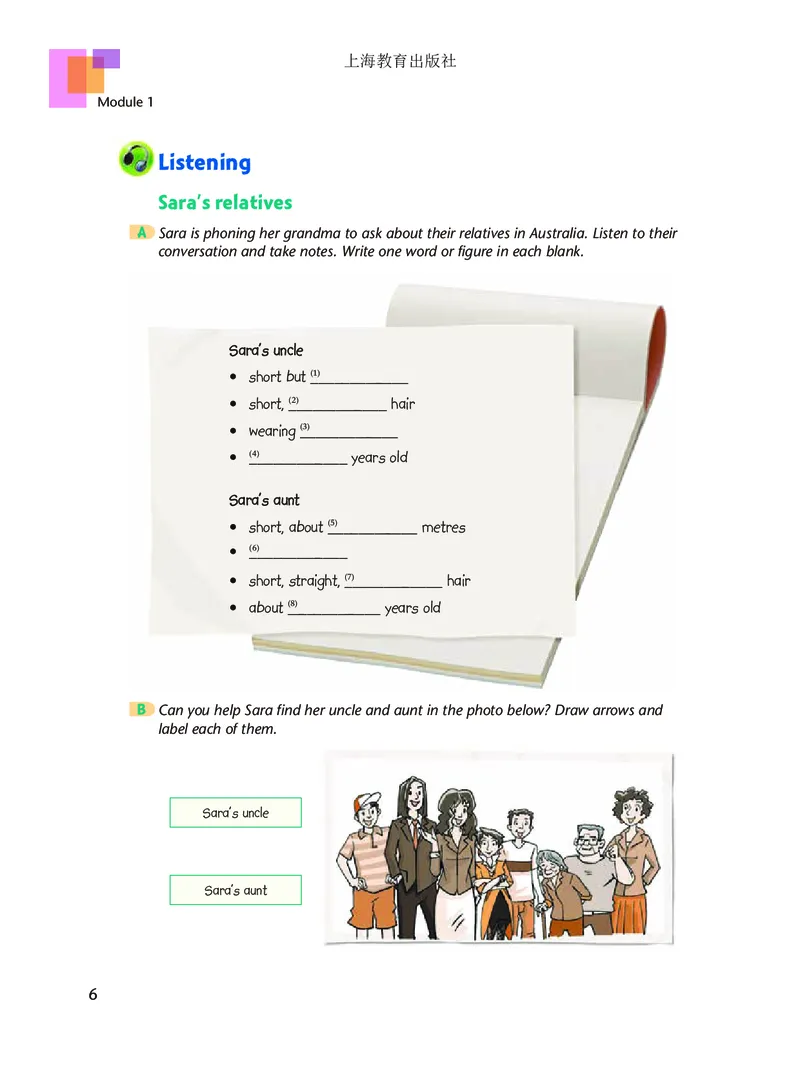
B Can you help Sara find her uncle and aunt in the photo below? Draw arrows and
label each of them.
Sara’s uncle
Sara’s aunt
6上海教育出版社
Unit 1
Grammar
A The definite article the
We often use a or an in front of a singular, countable noun when we
mention it for the first time. Then we use the before the noun when we
mention it again.
Sara found an interesting photo yesterday. The photo was of her grandpa.
We also use the to talk about something that is the only one of its kind.
The Sun is shining brightly.
There were lots of stars in the sky last night.
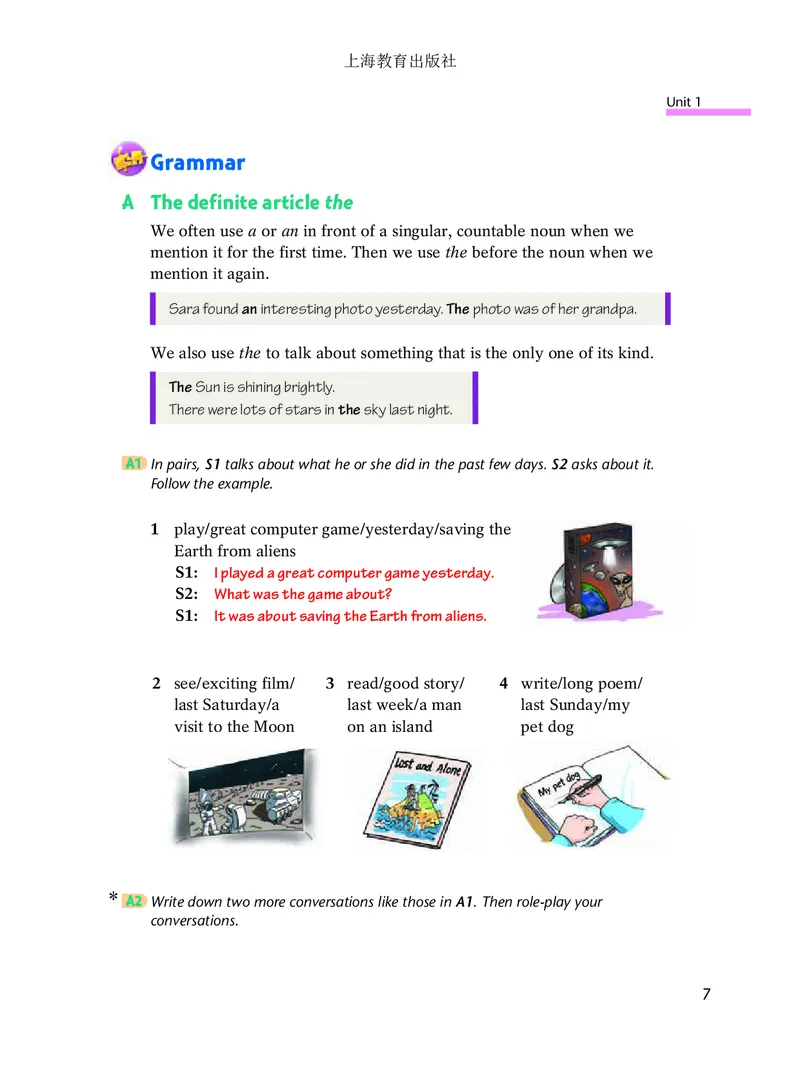
A1 In pairs, S1 talks about what he or she did in the past few days. S2 asks about it.
Follow the example.
1 play/great computer game/yesterday/saving the
Earth from aliens
S1: I played a great computer game yesterday.
S2: What was the game about?
S1: It was about saving the Earth from aliens.
2 see/exciting film/ 3 read/good story/ 4 write/long poem/
last Saturday/a last week/a man last Sunday/my
visit to the Moon on an island pet dog
(cid:43)
A2 Write down two more conversations like those in A1. Then role-play your
conversations.
7上海教育出版社
Module 1
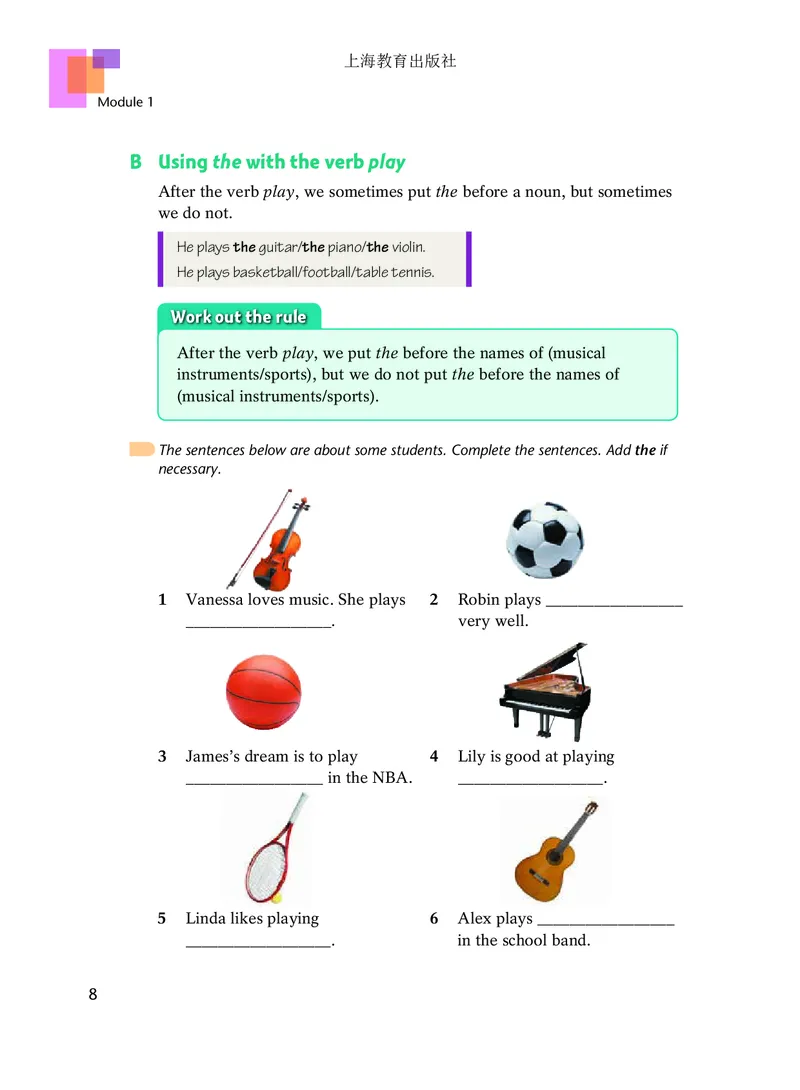
B Using the with the verb play
After the verb play, we sometimes put the before a noun, but sometimes
we do not.
He plays the guitar/the piano/the violin.
He plays basketball/football/table tennis.
Work out the rule
After the verb play, we put the before the names of (musical
instruments/sports), but we do not put the before the names of
(musical instruments/sports).
The sentences below are about some students. Complete the sentences. Add the if
necessary.
1 Vanessa loves music. She plays 2 Robin plays _________________
__________________. very well.
3 James’s dream is to play 4 Lily is good at playing
_________________ in the NBA. __________________.
5 Linda likes playing 6 Alex plays _________________
__________________. in the school band.
8上海教育出版社
Unit 1
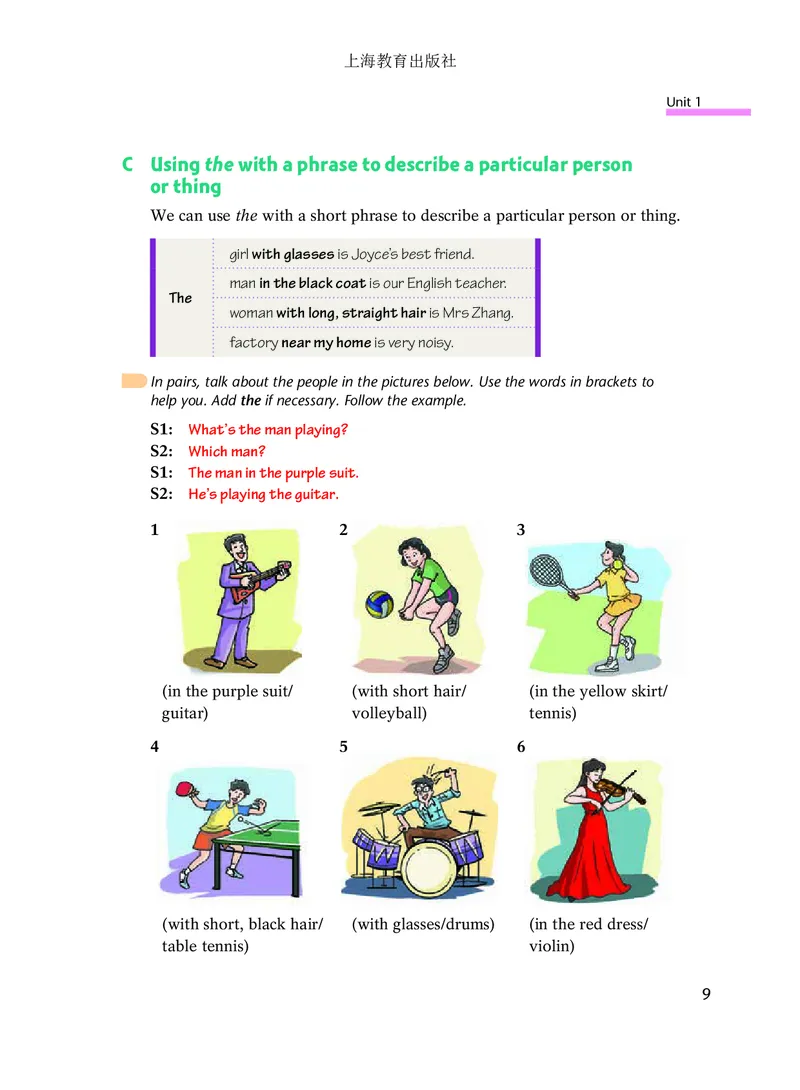
C Using the with a phrase to describe a particular person
or thing
We can use the with a short phrase to describe a particular person or thing.
girl with glasses is Joyce’s best friend.
man in the black coat is our English teacher.
The
woman with long, straight hair is Mrs Zhang.
factory near my home is very noisy.
In pairs, talk about the people in the pictures below. Use the words in brackets to
help you. Add the if necessary. Follow the example.
S1: What’s the man playing?
S2: Which man?
S1: The man in the purple suit.
S2: He’s playing the guitar.
1 2 3
(in the purple suit/ (with short hair/ (in the yellow skirt/
guitar) volleyball) tennis)
4 5 6
(with short, black hair/ (with glasses/drums) (in the red dress/
table tennis) violin)
9上海教育出版社
Module 1
Speaking
A Talk time
/eR/
/WR/
/IR/ /IR/ /eR/ /WR/
cchheeeerrful dear bear care cure poor
here idea hair there sure tour
A1 Listen carefully and circle the word you hear from each pair.
1 /TeR(r)/ /TIR(r)/ 3 /tWR(r)/ /teR(r)/ 5 /peR(r)/ /pWR(r)/
2 /beR(r)/ /bIR(r)/ 4 /kjWR(r)/ /keR(r)/ 6 /tIR(r)/ /tWR(r)/
A2 Read these sentences. Pay attention to the letters in bold.
1 Oh dear! I fear I didn’t hear your idea clearly.
2 Don’t you dare stare at the bear over there!
3 I’m sure we’ll find a cure for the poor tour guide.
4 A pair of rare bears put pears on the chair.
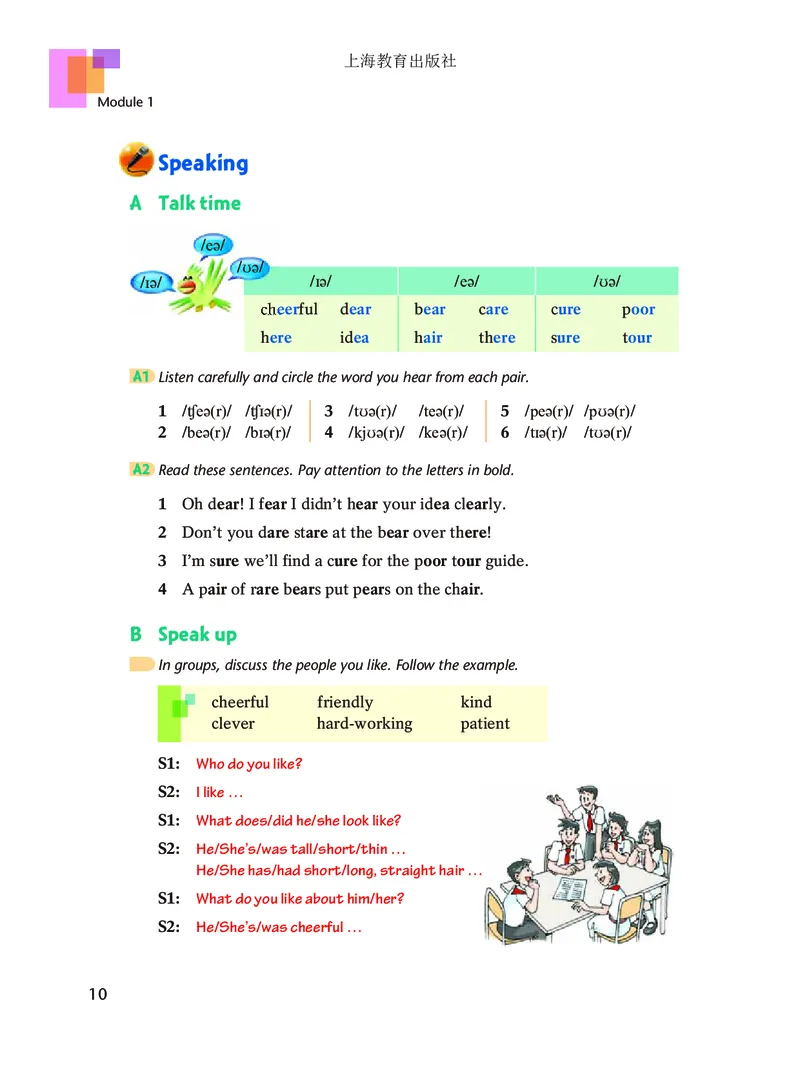
B Speak up
In groups, discuss the people you like. Follow the example.
cheerful friendly kind
clever hard-working patient
S1: Who do you like?
S2: I like …
S1: What does/did he/she look like?
S2: He/She’s/was tall/short/thin …
He/She has/had short/long, straight hair …
S1: What do you like about him/her?
S2: He/She’s/was cheerful …
10上海教育出版社
Unit 1
Writing
A person I love
A Who are you going to write about? Think about the following ideas.
•(cid:1) (cid:66)(cid:1)(cid:71)(cid:66)(cid:78)(cid:74)(cid:77)(cid:90)(cid:1)(cid:78)(cid:70)(cid:78)(cid:67)(cid:70)(cid:83)
•(cid:1) (cid:66)(cid:1)(cid:72)(cid:80)(cid:80)(cid:69)(cid:1)(cid:71)(cid:83)(cid:74)(cid:70)(cid:79)(cid:69)
•(cid:1) (cid:66)(cid:1)(cid:85)(cid:70)(cid:66)(cid:68)(cid:73)(cid:70)(cid:83)(cid:1)(cid:80)(cid:83)(cid:1)(cid:66)(cid:1)(cid:72)(cid:83)(cid:70)(cid:66)(cid:85)(cid:1)(cid:81)(cid:70)(cid:83)(cid:84)(cid:80)(cid:79)
B Write a short article about this person. Use the plan and the sample article below
to help you.
Who is this person?
Paragraph 1
What does/did he/she look like?
Paragraph 2 What does/did he/she do?
Paragraph 3 Why do you love him/her?
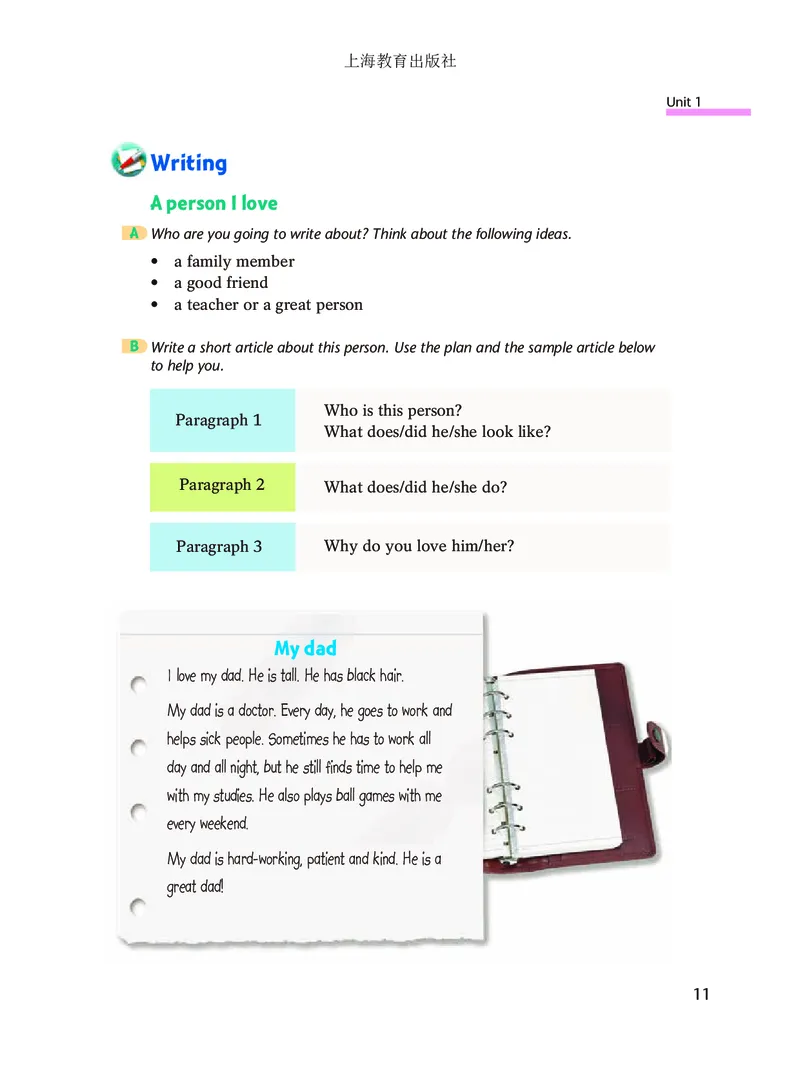
My dad
I love my dad. (cid:63)e is tall. (cid:63)e has black hair.
(cid:68)y dad is a doctor. (cid:60)very day, he goes to work and
hel(cid:103)s sick (cid:103)eo(cid:103)le. Sometimes he has to work all
day and all night, but he still finds time to hel(cid:103) me
with my studies. (cid:63)e also (cid:103)lays ball games with me
every weekend.
(cid:68)y dad is hard(cid:36)working, (cid:103)atient and kind. (cid:63)e is a
great dad(cid:24)
11上海教育出版社
Module 1
(cid:43)
More practice
A Read this online article about Mother’s Day. Then answer the questions below.
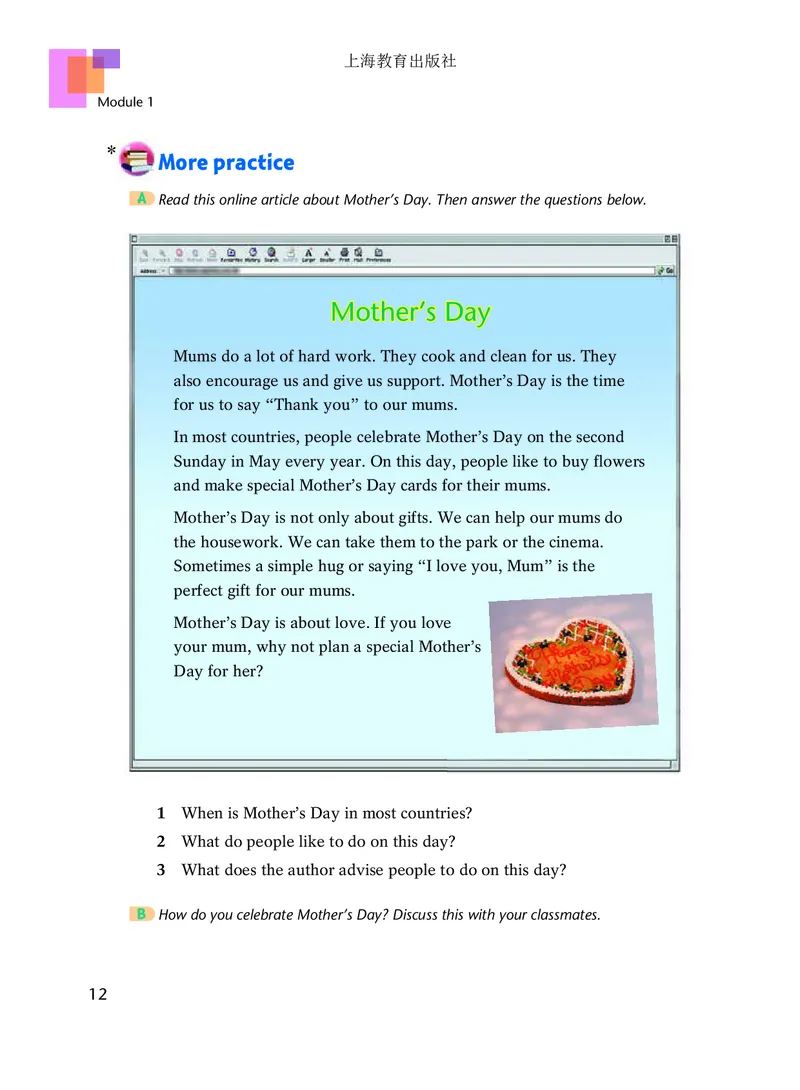
Mother’s Day
Mums do a lot of hard work. They cook and clean for us. They
also encourage us and give us support. Mother’s Day is the time
for us to say “Thank you” to our mums.
In most countries, people celebrate Mother’s Day on the second
Sunday in May every year. On this day, people like to buy flowers
and make special Mother’s Day cards for their mums.
Mother’s Day is not only about gifts. We can help our mums do
the housework. We can take them to the park or the cinema.
Sometimes a simple hug or saying “I love you, Mum” is the
perfect gift for our mums.
Mother’s Day is about love. If you love
your mum, why not plan a special Mother’s
Day for her?
1 When is Mother’s Day in most countries?
2 What do people like to do on this day?
3 What does the author advise people to do on this day?
B How do you celebrate Mother’s Day? Discuss this with your classmates.
12Unit 1
Study skills
(cid:43)
Charts and graphs (2): Using line graphs and bar charts
To show quantities and the change in numbers, we can use graphs and
charts, such as line graphs and bar charts.
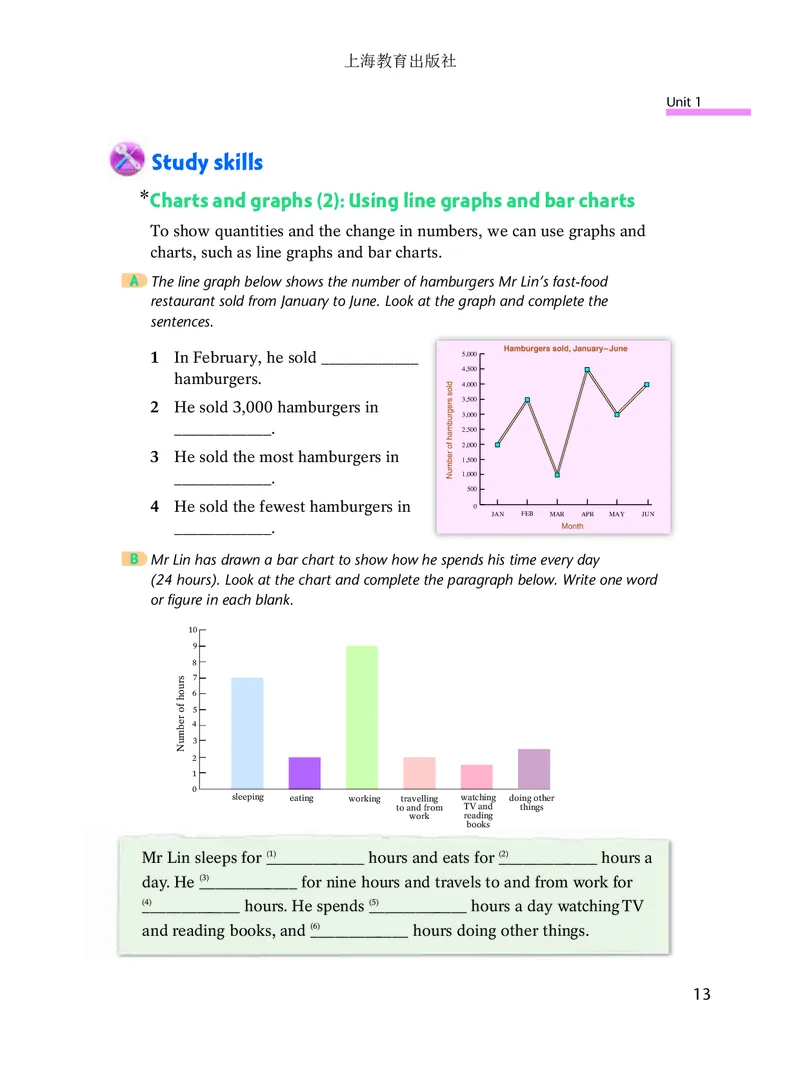
A The line graph below shows the number of hamburgers Mr Lin’s fast-food
restaurant sold from January to June. Look at the graph and complete the
sentences.
1 In February, he sold ____________ 5,000
4,500
hamburgers.
4,000
2 He sold 3,000 hamburgers in 3,500
3,000
____________.
2,500
2,000
3 He sold the most hamburgers in
1,500
____________. 1,000
500
4 He sold the fewest hamburgers in
0
JAN FEB MAR APR MAY JUN
____________.
B Mr Lin has drawn a bar chart to show how he spends his time every day
(24 hours). Look at the chart and complete the paragraph below. Write one word
or figure in each blank.
Mr Lin sleeps for (_1)____________ hours and eats for (_2)____________ hours a
day. He _(3)____________ for nine hours and travels to and from work for
(_4)____________ hours. He spends (_5)____________ hours a day watching TV
and reading books, and _(6)____________ hours doing other things.
13
sruoh
fo
rebmuN
上海教育出版社
Study skills
1100
9
8
7
6
5
4
3
2
1
0
sleeping eating working travelling watching doing other
to and from TV and things
work reading
books上海教育出版社
Module 1
Culture corner
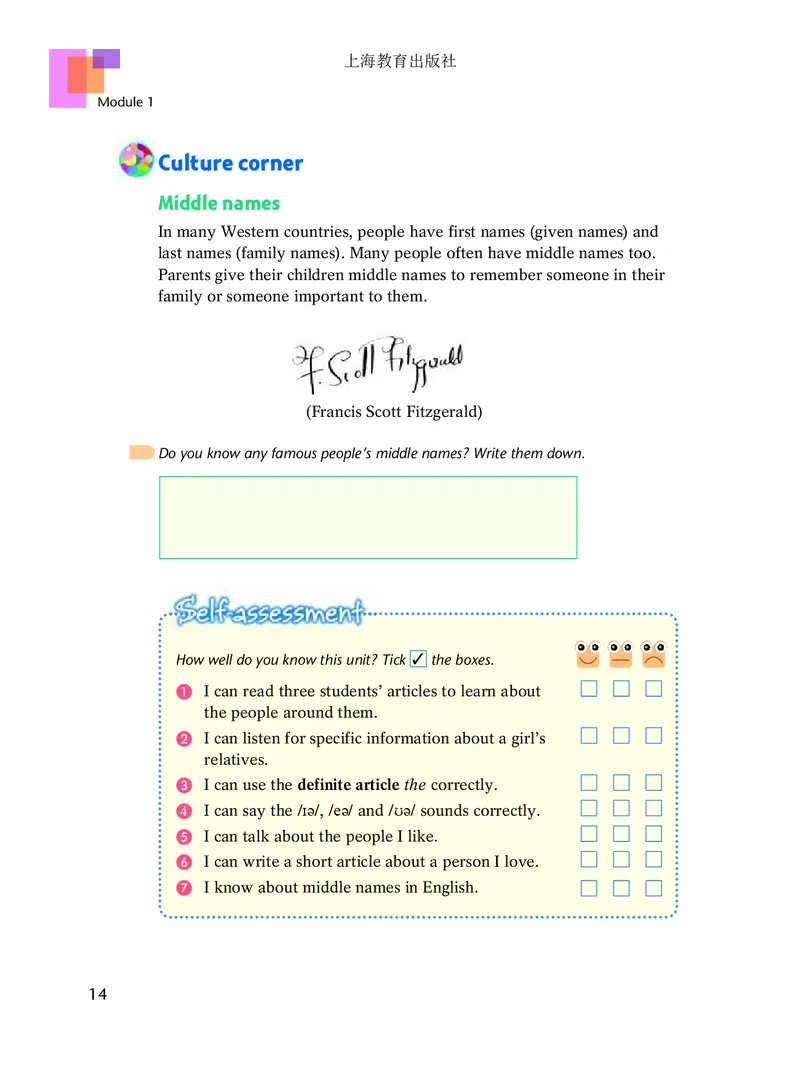
Middle names
In many Western countries, people have first names (given names) and
last names (family names). Many people often have middle names too.
Parents give their children middle names to remember someone in their
family or someone important to them.
(Francis Scott Fitzgerald)
Do you know any famous people’s middle names? Write them down.
How well do you know this unit? Tick ✓ the boxes.
❶ I can read three students’ articles to learn about
the people around them.
❷ I can listen for specific information about a girl’s
relatives.
❸ I can use the definite article the correctly.
❹ I can say the /IR/, /eR/ and /WR/ sounds correctly.
❺ I can talk about the people I like.
❻ I can write a short article about a person I love.
❼ I know about middle names in English.
14上海教育出版社
Module 1 People and places
Unit
2
TTTrrraaavvveeelllllliiinnnggg aaarrrooouuunnnddd
ttthhheee wwwooorrrlllddd
Getting ready
In this unit, you will learn about travel.
Reading
• Read an article about travelling in France.
Listening
• Listen to an introduction to the Eiffel Tower.
Grammar
• Learn how to use proper nouns.
• Learn how to use the conjunctions and, but and so.
Speaking
• Learn to say the /tS/, /dZ/, /ts/, /dz/, /tr/ and /dr/ sounds.
• Talk about your holiday plans.
Writing
•• WWrriittee aa ppoossttccaarrdd ttoo aa ffrriieenndd..
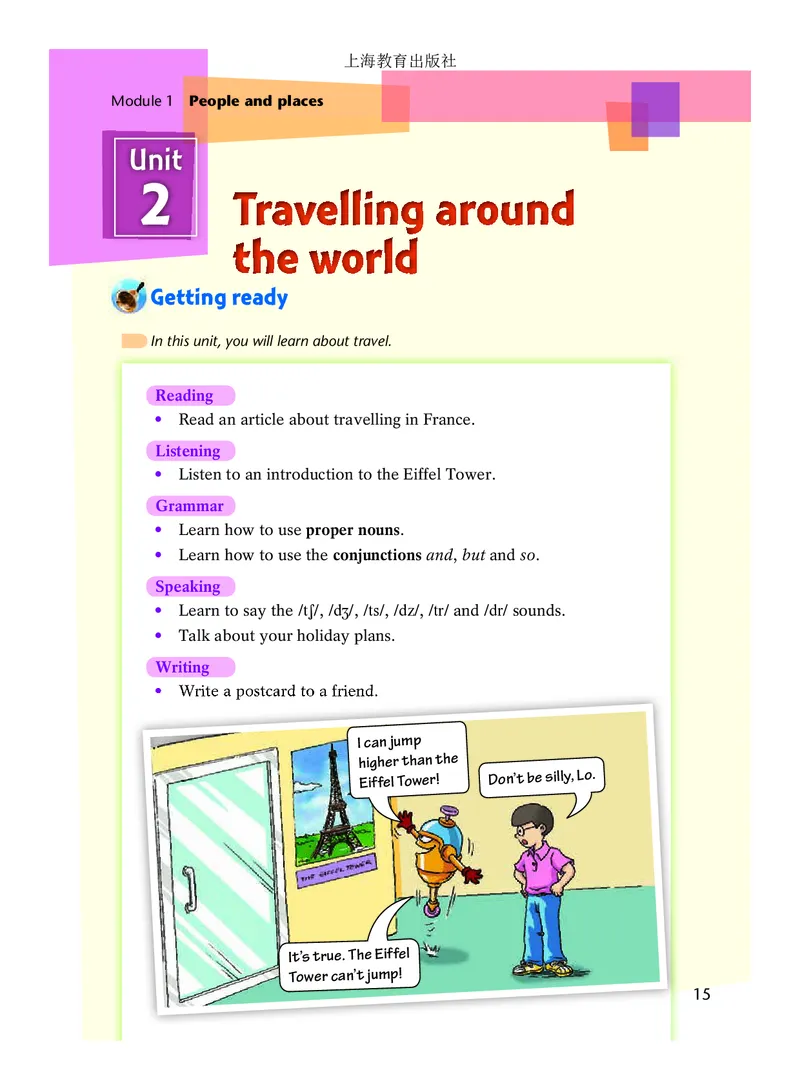
I can jump
higher than the
Eiffel Tower! Don’t be silly, Lo.
It’s true. The Eiffel
Tower can’t jump!
15上海教育出版社
Module 1
Reading
A What do you know about …?
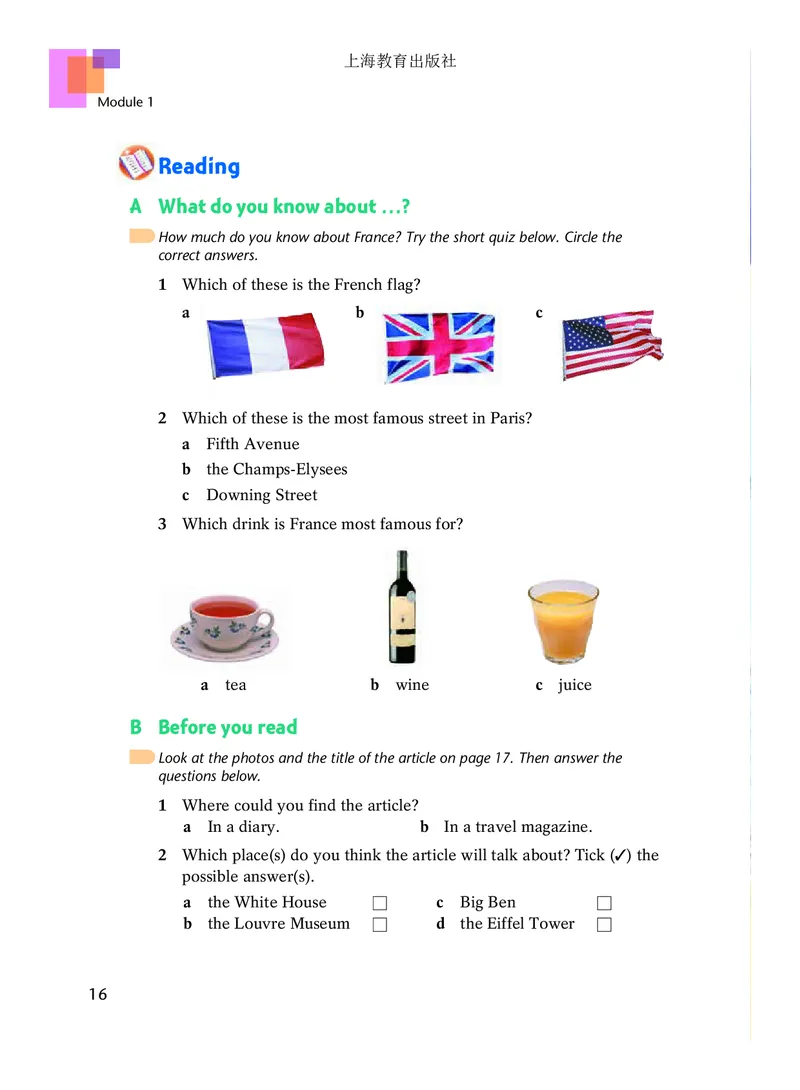
How much do you know about France? Try the short quiz below. Circle the
correct answers.
1 Which of these is the French flag?
a b c
2 Which of these is the most famous street in Paris?
a Fifth Avenue
b the Champs-Elysees
c Downing Street
3 Which drink is France most famous for?
a tea b wine c juice
B Before you read
Look at the photos and the title of the article on page 17. Then answer the
questions below.
1 Where could you find the article?
a In a diary. b In a travel magazine.
2 Which place(s) do you think the article will talk about? Tick (✓) the
possible answer(s).
a the White House c Big Ben
b the Louvre Museum d the Eiffel Tower
16上海教育出版社
Unit 2
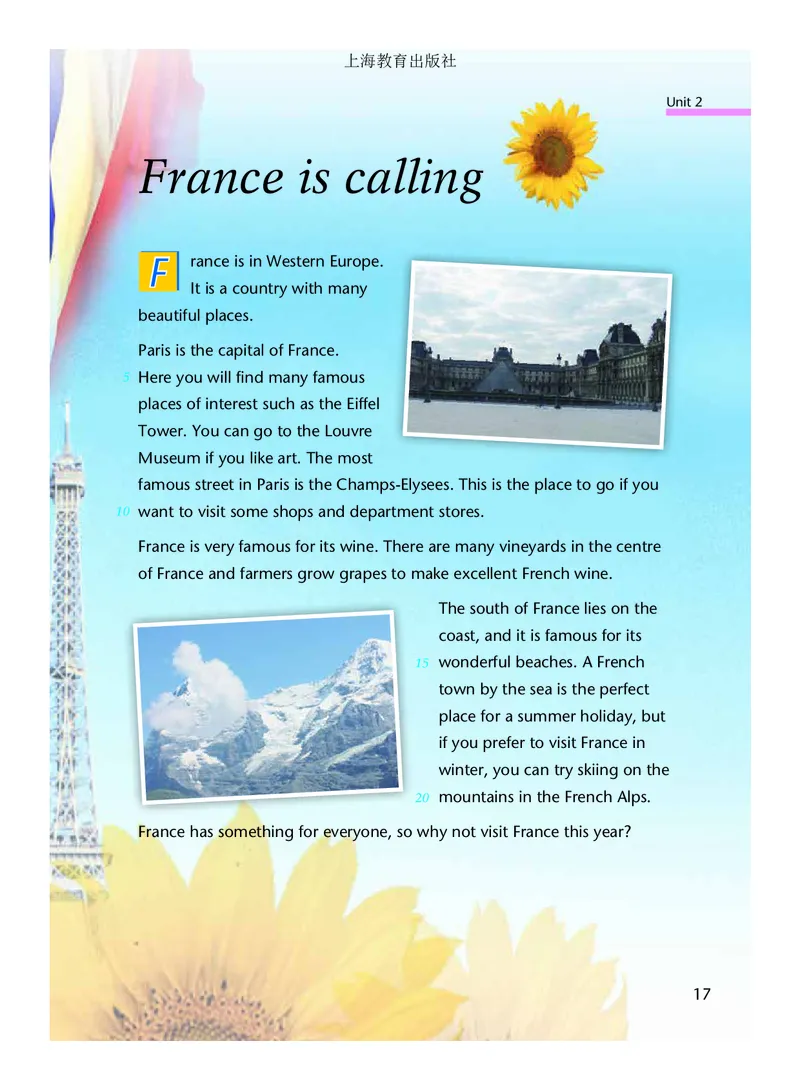
France is calling
F rance is in Western Europe.
It is a country with many
beautiful places.
Paris is the capital of France.
5 Here you will find many famous
places of interest such as the Eiffel
Tower. You can go to the Louvre
Museum if you like art. The most
famous street in Paris is the Champs-Elysees. This is the place to go if you
10 want to visit some shops and department stores.
France is very famous for its wine. There are many vineyards in the centre
of France and farmers grow grapes to make excellent French wine.
The south of France lies on the
coast, and it is famous for its
15 wonderful beaches. A French
town by the sea is the perfect
place for a summer holiday, but
if you prefer to visit France in
winter, you can try skiing on the
20 mountains in the French Alps.
France has something for everyone, so why not visit France this year?
17上海教育出版社
Module 1
C Vocabulary
C1 The words in italics are from the article on page 17. Circle the correct answers to
complete these sentences.
1 Anna had an excellent holiday this summer. Her holiday was _____.
a very good b very boring
2 Uncle John lives on the coast. His home is _____.
a far away from the sea b close to the sea
3 Bruce prefers to play football. He _____ playing football.
a likes ... less than other sports
b likes ... more than other sports
4 Kelly enjoys skiing in winter. She loves _____.
a moving over snow b playing in the snow
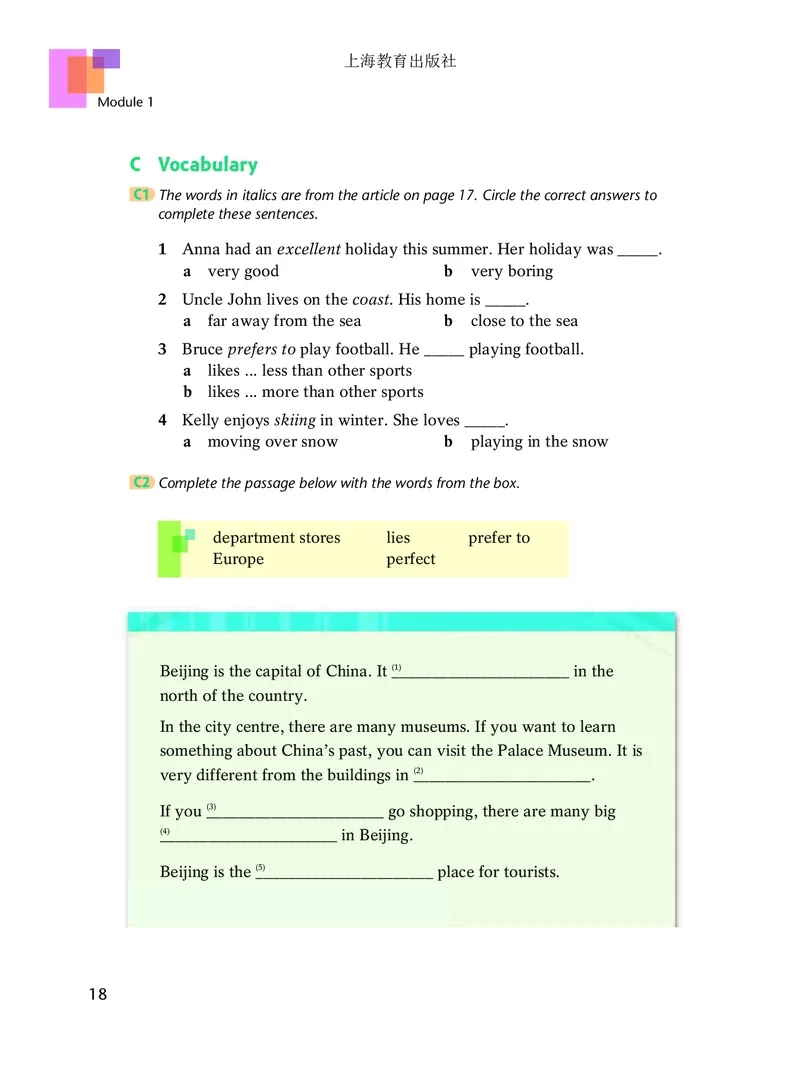
C2 Complete the passage below with the words from the box.
department stores lies prefer to
Europe perfect
Beijing is the capital of China. It (_1)_____________________ in the
north of the country.
In the city centre, there are many museums. If you want to learn
something about China’s past, you can visit the Palace Museum. It is
very different from the buildings in _(2)_____________________.
If you _(3)_____________________ go shopping, there are many big
_(4)_____________________ in Beijing.
Beijing is the (_5)_____________________ place for tourists.
18上海教育出版社
Unit 2
D Comprehension
D1 Find the sentences below in the article on page 17. What do the words in italics refer
to? Write the correct answers in the blanks.
1 Here you will find … (line 5) ______________
2 This is the place to go ... (line 9) ______________
3 …, and it is famous for its wonderful beaches.
(lines 14–15) ______________
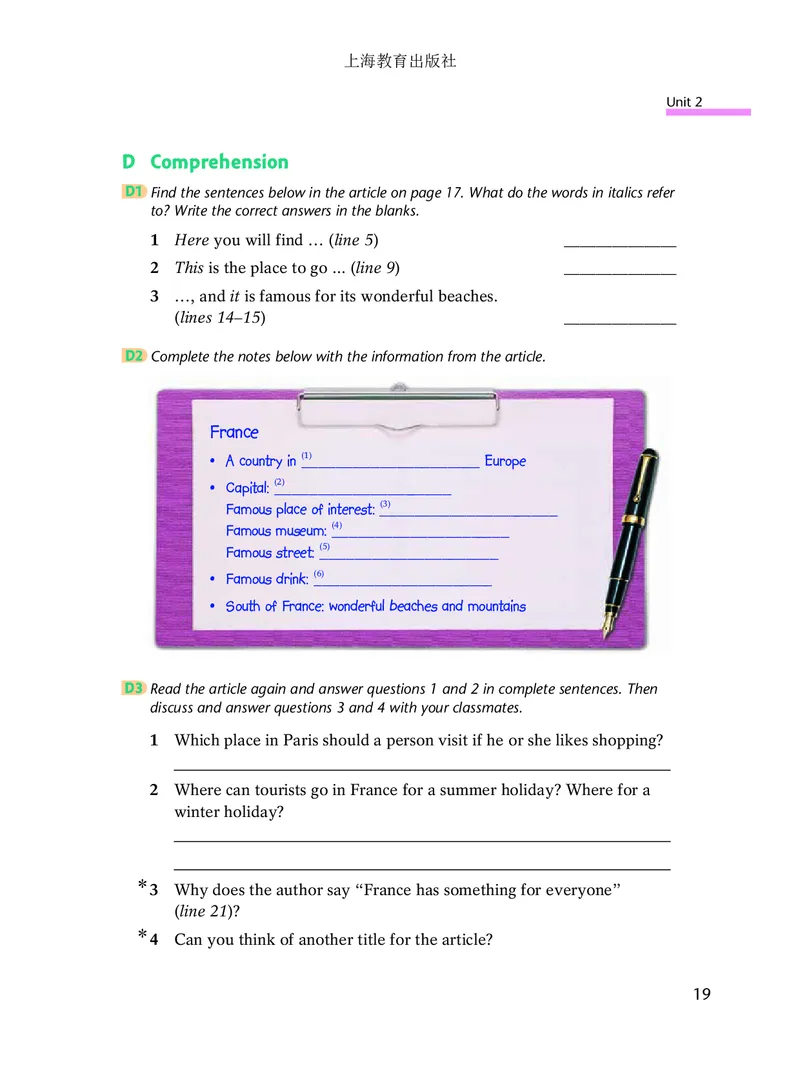
D2 Complete the notes below with the information from the article.
(cid:61)(cid:105)(cid:88)(cid:101)(cid:90)(cid:92)
(cid:155)(cid:23) A(cid:23)(cid:90)(cid:102)(cid:108)(cid:101)(cid:107)(cid:105)(cid:112)(cid:23)(cid:96)(cid:101)(cid:23)_(1)____________________ (cid:60)(cid:108)(cid:105)(cid:102)(cid:103)(cid:92)
(cid:155)(cid:23) C(cid:88)(cid:103)(cid:96)(cid:107)(cid:88)(cid:99)(cid:49)(cid:23)(_2)____________________(cid:23)
(cid:23) (cid:61)(cid:88)(cid:100)(cid:102)(cid:108)(cid:106)(cid:23)(cid:103)(cid:99)(cid:88)(cid:90)(cid:92)(cid:23)(cid:102)(cid:93)(cid:23)(cid:96)(cid:101)(cid:107)(cid:92)(cid:105)(cid:92)(cid:106)(cid:107)(cid:49)(cid:23)_(3)____________________
(cid:61)(cid:88)(cid:100)(cid:102)(cid:108)(cid:106)(cid:23)(cid:100)(cid:108)(cid:106)(cid:92)(cid:108)(cid:100)(cid:49)(cid:23)_(4)____________________
(cid:23) (cid:61)(cid:88)(cid:100)(cid:102)(cid:108)(cid:106)(cid:23)(cid:106)(cid:107)(cid:105)(cid:92)(cid:92)(cid:107)(cid:49)(cid:23)_(5)____________________
(cid:155)(cid:23) (cid:61)(cid:88)(cid:100)(cid:102)(cid:108)(cid:106)(cid:23)(cid:91)(cid:105)(cid:96)(cid:101)(cid:98)(cid:49)(cid:23)_(6)____________________
(cid:155)(cid:23) (cid:74)(cid:102)(cid:108)(cid:107)(cid:95)(cid:23)(cid:102)(cid:93)(cid:23)(cid:61)(cid:105)(cid:88)(cid:101)(cid:90)(cid:92)(cid:49)(cid:23)(cid:110)(cid:102)(cid:101)(cid:91)(cid:92)(cid:105)(cid:93)(cid:108)(cid:99)(cid:23)(cid:89)(cid:92)(cid:88)(cid:90)(cid:95)(cid:92)(cid:106)(cid:23)(cid:88)(cid:101)(cid:91)(cid:23)(cid:100)(cid:102)(cid:108)(cid:101)(cid:107)(cid:88)(cid:96)(cid:101)(cid:106)
D3 Read the article again and answer questions 1 and 2 in complete sentences. Then
discuss and answer questions 3 and 4 with your classmates.
1 Which place in Paris should a person visit if he or she likes shopping?
2 Where can tourists go in France for a summer holiday? Where for a
winter holiday?
(cid:43)
3 Why does the author say “France has something for everyone”
(line 21)?
(cid:43)
4 Can you think of another title for the article?
19上海教育出版社
Module 1
Listening
The Eiffel Tower
Listen to a radio programme about the Eiffel Tower and complete the notes below.
Write one word or figure in each blank.
(cid:75)(cid:95)(cid:92)(cid:23)(cid:60)(cid:96)(cid:93)(cid:93)(cid:92)(cid:99)(cid:23)(cid:75)(cid:102)(cid:110)(cid:92)(cid:105)
(cid:61)(cid:88)(cid:90)(cid:107)(cid:106)(cid:23)(cid:88)(cid:89)(cid:102)(cid:108)(cid:107)(cid:23)(cid:107)(cid:95)(cid:92)(cid:23)(cid:107)(cid:102)(cid:110)(cid:92)(cid:105)
(cid:155) (_1)_______________ metres tall
(cid:155) finished in (_2)_______________
(cid:155) (cid:103)ainted every (_3)_______________ years
(cid:155) almost (cid:46),(cid:39)(cid:39)(cid:39),(cid:39)(cid:39)(cid:39) (cid:103)eo(cid:103)le visit it every year
(cid:155) To get to the to(cid:103) of the tower, you can(cid:49)
(cid:198) take the lift
(cid:198) walk u(cid:103) more than (_4)_______________ ste(cid:103)s
(cid:64)(cid:101)(cid:107)(cid:92)(cid:105)(cid:92)(cid:106)(cid:107)(cid:96)(cid:101)(cid:94)(cid:23)(cid:107)(cid:95)(cid:96)(cid:101)(cid:94)(cid:106)(cid:23)(cid:88)(cid:89)(cid:102)(cid:108)(cid:107)(cid:23)(cid:107)(cid:95)(cid:92)(cid:23)(cid:107)(cid:102)(cid:110)(cid:92)(cid:105)
(cid:155) In (cid:40)(cid:48)(cid:43)(cid:47), a(cid:31)n(cid:32) _(5)_______________ walked u(cid:103) to the first
floor.
(cid:155) In (cid:40)(cid:48)(cid:47)(cid:42), two men went down the stairs on
_(6)_______________.
20上海教育出版社
Unit 2
Grammar
A Proper nouns
We use a proper noun to refer to the name of a particular person, place,
organization or time.
Names of people Sally Webb, Mrs Jacob, Xiao Ling
Names of places France, the Louvre Museum, the Beijing Railway
Station
Organizations the Red Cross, the United Nations, the World
Trade Organization
Days of the week Tuesday, Friday, Sunday
Months January, March, September
Holidays the Spring Festival, the Mid-Autumn Festival,
Christmas
Work out the rule
A proper noun starts with a (capital letter/small letter).
A1 Look at the two lists below. What is the difference between the nouns in list A and
list B? Can you think of some more examples?
A B
west the West
earth the Earth
main road 52 Main Road
great wall the Great Wall
21上海教育出版社
Module 1
A2 Read the passage below. Some of the nouns should begin with a capital letter.
Underline these nouns and write the correct nouns above them.
July
Last july, I went to beijing to visit uncle zhang. He took me to
many interesting places such as the great wall, the summer palace
and the palace museum. I learnt a lot about the ming and the qing
dynasties. We also visited the main stadium for the 2008 olympics.
We went shopping on wangfujing street. I had a wonderful time
in beijing and I plan to visit it again during the spring festival
next year.
B Conjunctions: and, but and so
We use the conjunctions and, but and so to link two sentences. They
show different relationships between the sentences.
There are many vineyards in the centre of France and farmers grow grapes
to make excellent French wine.
A French town by the sea is the perfect place for a summer holiday, but if
you prefer to visit France in winter, you can try skiing on the mountains in
the French Alps.
France has something for everyone, so why not visit France this year?
Work out the rule
•(cid:1)(cid:56)(cid:70)(cid:1)(cid:86)(cid:84)(cid:70)(cid:1)(cid:64)(cid:64)(cid:64)(cid:64)(cid:64)(cid:64)(cid:64)(cid:64)(cid:64)(cid:64)(cid:1)(cid:85)(cid:80)(cid:1)(cid:78)(cid:70)(cid:66)(cid:79)(cid:1)(cid:105)(cid:66)(cid:77)(cid:84)(cid:80)(cid:119)(cid:15)
•(cid:1)(cid:56)(cid:70)(cid:1)(cid:86)(cid:84)(cid:70)(cid:1)(cid:64)(cid:64)(cid:64)(cid:64)(cid:64)(cid:64)(cid:64)(cid:64)(cid:64)(cid:64)(cid:1)(cid:85)(cid:80)(cid:1)(cid:84)(cid:73)(cid:80)(cid:88)(cid:1)(cid:66)(cid:1)(cid:69)(cid:74)(cid:71)(cid:71)(cid:70)(cid:83)(cid:70)(cid:79)(cid:85)(cid:1)(cid:74)(cid:69)(cid:70)(cid:66)(cid:15)
•(cid:1)(cid:56)(cid:70)(cid:1)(cid:86)(cid:84)(cid:70)(cid:1)(cid:64)(cid:64)(cid:64)(cid:64)(cid:64)(cid:64)(cid:64)(cid:64)(cid:64)(cid:64)(cid:1)(cid:85)(cid:80)(cid:1)(cid:84)(cid:73)(cid:80)(cid:88)(cid:1)(cid:66)(cid:1)(cid:83)(cid:70)(cid:84)(cid:86)(cid:77)(cid:85)(cid:15)
22上海教育出版社
Unit 2
Mandy is writing an email to Natee, a boy from Thailand. Circle the correct words.
To: Natee
From: Mandy
Subject: Mandy from China
Hi Natee,
My name is Mandy. I found your email
address on an e-friend website, (1) (and/but)
I’d like to be friends with you.
I’m from Beijing, China, (2) (and/so) I’m
thirteen years old. My mum is a teacher,
(3) (and/so) my dad is a doctor. My
grandparents live in Chengdu. They come to
visit us every year, (4) (and/but) they always bring me a lot of
delicious Sichuan food!
I live far away from my school, (5) (but/so) I have to get up early
in the morning. I like Maths and English very much, (6) (but/so) I
don’t like Science. I want to be a teacher in the future, (7) (but/so)
I’m studying hard at school.
I’m interested in Thai culture, (8) (and/but) I love Thai food. I hope
to visit Thailand one day.
I hope we can be friends. Write to me soon (9) (and/but) tell me
about yourself.
Best wishes,
Mandy
23上海教育出版社
Module 1
Speaking
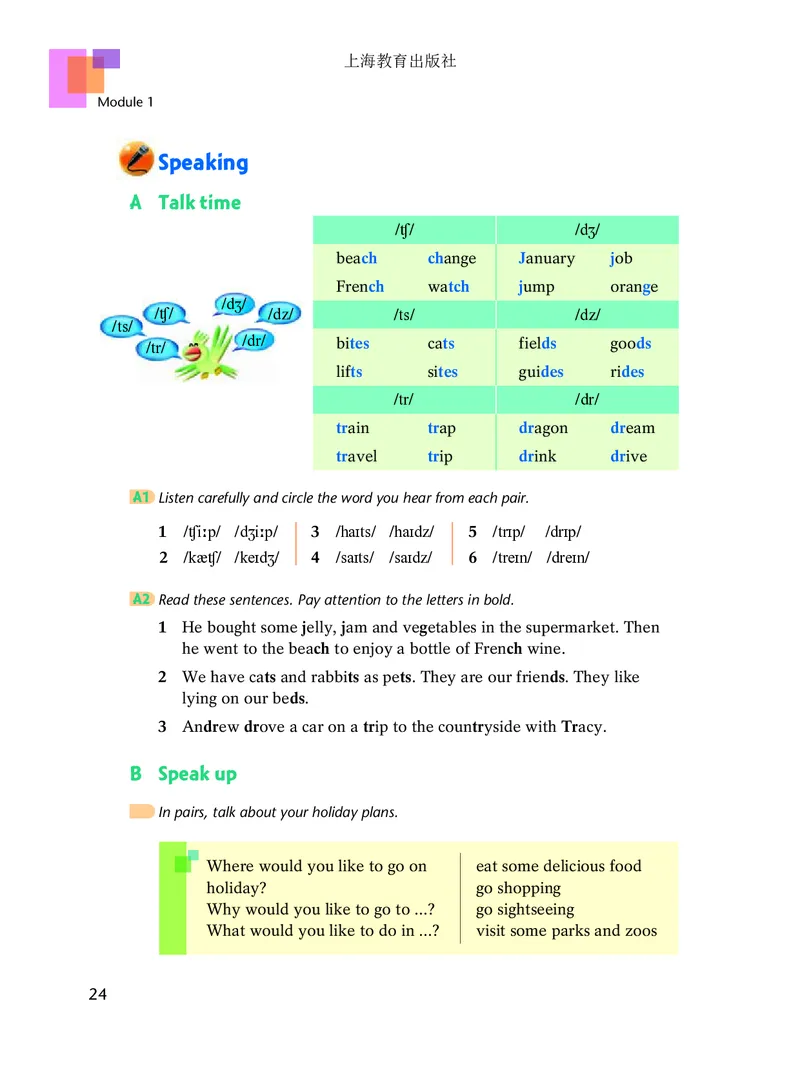
A Talk time
/T/ /dZ/
beach change January job
French watch jump orange
/dZ/
/T/ /dz/ /ts/ /dz/
/ts/
/dr/ bites cats fields goods
/tr/
lifts sites guides rides
/tr/ /dr/
train trap dragon dream
travel trip drink drive
A1 Listen carefully and circle the word you hear from each pair.
1 /Tip/ /dZip/ 3 /haIts/ /haIdz/ 5 /trIp/ /drIp/
2 /kCT/ /keIdZ/ 4 /saIts/ /saIdz/ 6 /treIn/ /dreIn/
A2 Read these sentences. Pay attention to the letters in bold.
1 He bought some jelly, jam and vegetables in the supermarket. Then
he went to the beach to enjoy a bottle of French wine.
2 We have cats and rabbits as pets. They are our friends. They like
lying on our beds.
3 Andrew drove a car on a trip to the countryside with Tracy.
B Speak up
In pairs, talk about your holiday plans.
Where would you like to go on eat some delicious food
holiday? go shopping
Why would you like to go to ...? go sightseeing
What would you like to do in ...? visit some parks and zoos
24上海教育出版社
Unit 2
Writing
A postcard
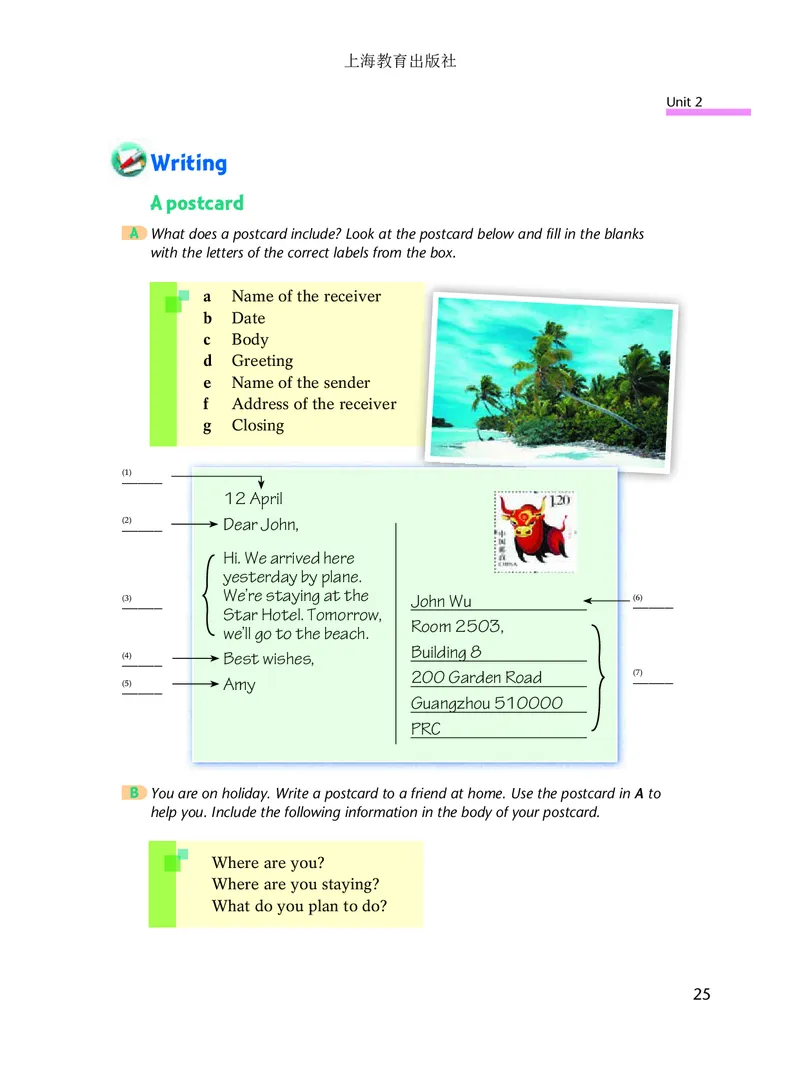
A What does a postcard include? Look at the postcard below and fill in the blanks
with the letters of the correct labels from the box.
a Name of the receiver
b Date
c Body
d Greeting
e Name of the sender
f Address of the receiver
g Closing
_(1)____
12 April
_(2)____ Dear John,
Hi. We arrived here
yesterday by plane.
We’re staying at the
_(3)____ John Wu _(6)____
Star Hotel. Tomorrow,
Room 2503,
we’ll go to the beach.
Building 8
_(4)____ Best wishes,
200 Garden Road (_7)____
_(5)____ Amy
Guangzhou 510000
PRC
B You are on holiday. Write a postcard to a friend at home. Use the postcard in A to
help you. Include the following information in the body of your postcard.
Where are you?
Where are you staying?
What do you plan to do?
25上海教育出版社
Module 1
(cid:43)
More practice
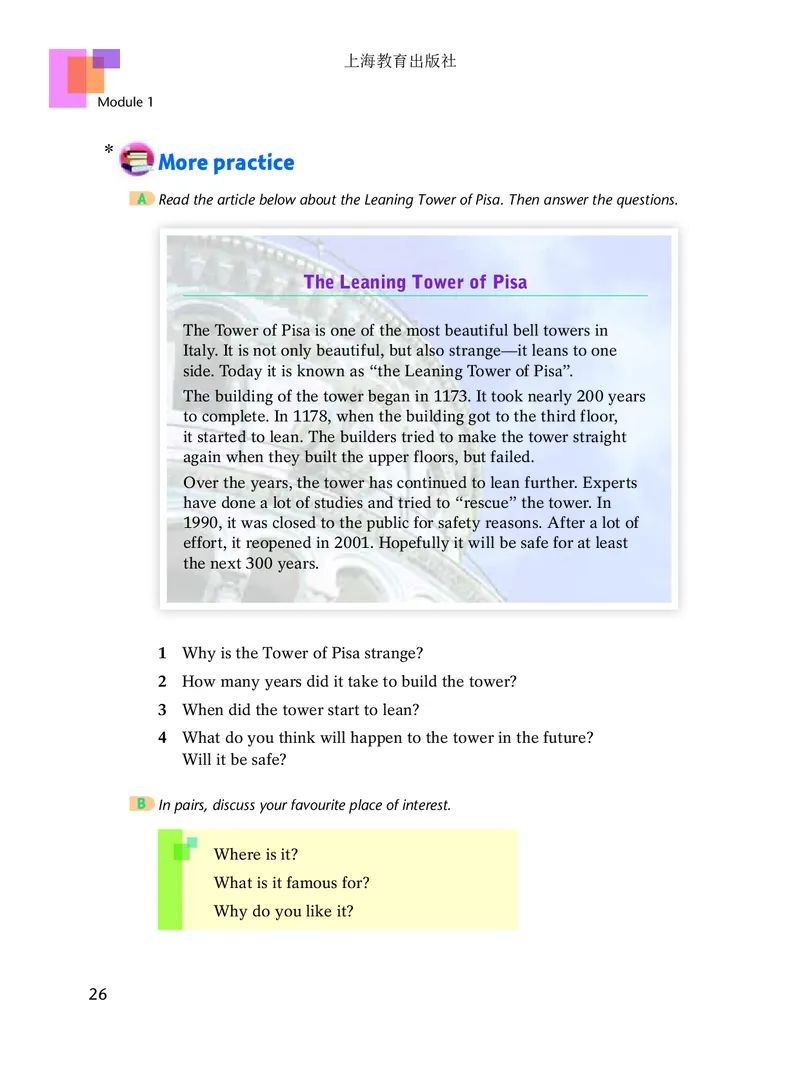
A Read the article below about the Leaning Tower of Pisa. Then answer the questions.
The Leaning Tower of Pisa
The Tower of Pisa is one of the most beautiful bell towers in
Italy. It is not only beautiful, but also strange—it leans to one
side. Today it is known as “the Leaning Tower of Pisa”.
The building of the tower began in 1173. It took nearly 200 years
to complete. In 1178, when the building got to the third floor,
it started to lean. The builders tried to make the tower straight
again when they built the upper floors, but failed.
Over the years, the tower has continued to lean further. Experts
have done a lot of studies and tried to “rescue” the tower. In
1990, it was closed to the public for safety reasons. After a lot of
effort, it reopened in 2001. Hopefully it will be safe for at least
the next 300 years.
1 Why is the Tower of Pisa strange?
2 How many years did it take to build the tower?
3 When did the tower start to lean?
4 What do you think will happen to the tower in the future?
Will it be safe?
B In pairs, discuss your favourite place of interest.
Where is it?
What is it famous for?
Why do you like it?
26上海教育出版社
Unit 2
Culture corner
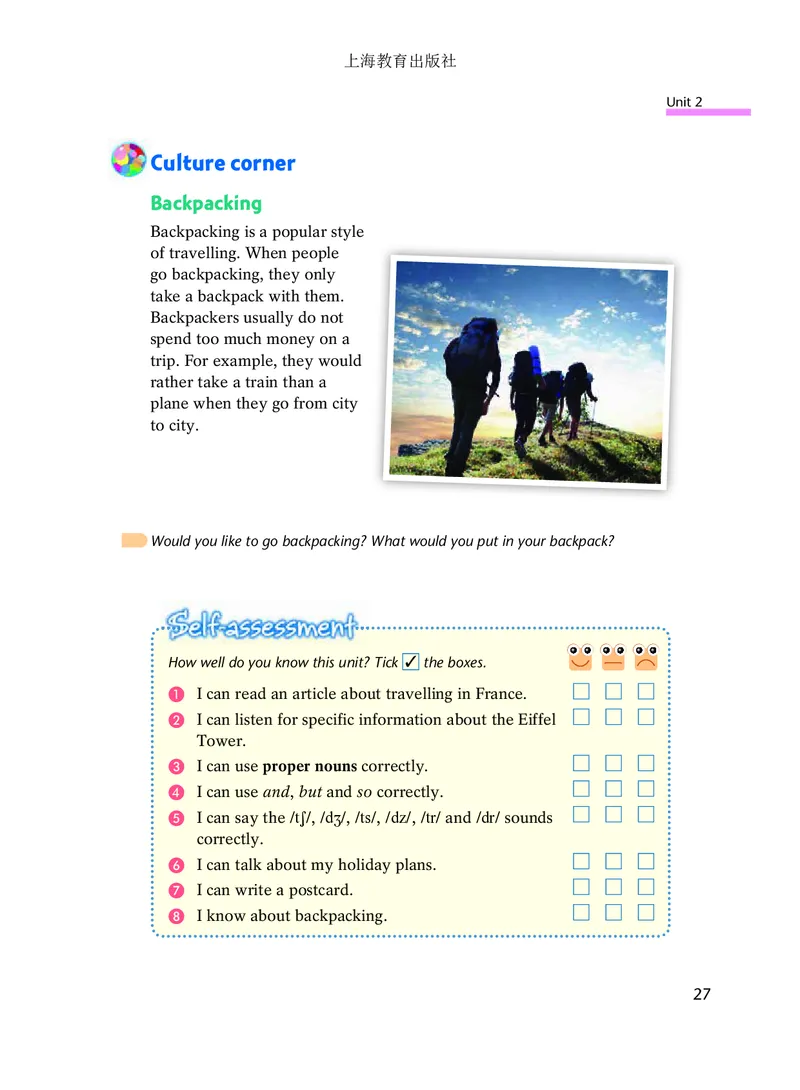
Backpacking
Backpacking is a popular style
of travelling. When people
go backpacking, they only
take a backpack with them.
Backpackers usually do not
spend too much money on a
trip. For example, they would
rather take a train than a
plane when they go from city
to city.
Would you like to go backpacking? What would you put in your backpack?
How well do you know this unit? Tick ✓ the boxes.
❶ I can read an article about travelling in France.
❷ I can listen for specific information about the Eiffel
Tower.
❸ I can use proper nouns correctly.
❹ I can use and, but and so correctly.
❺ I can say the /tS/, /dZ/, /ts/, /dz/, /tr/ and /dr/ sounds
correctly.
❻ I can talk about my holiday plans.
❼ I can write a postcard.
❽ I know about backpacking.
27上海教育出版社
(cid:43)
PPPrrrooojjjeeecccttt
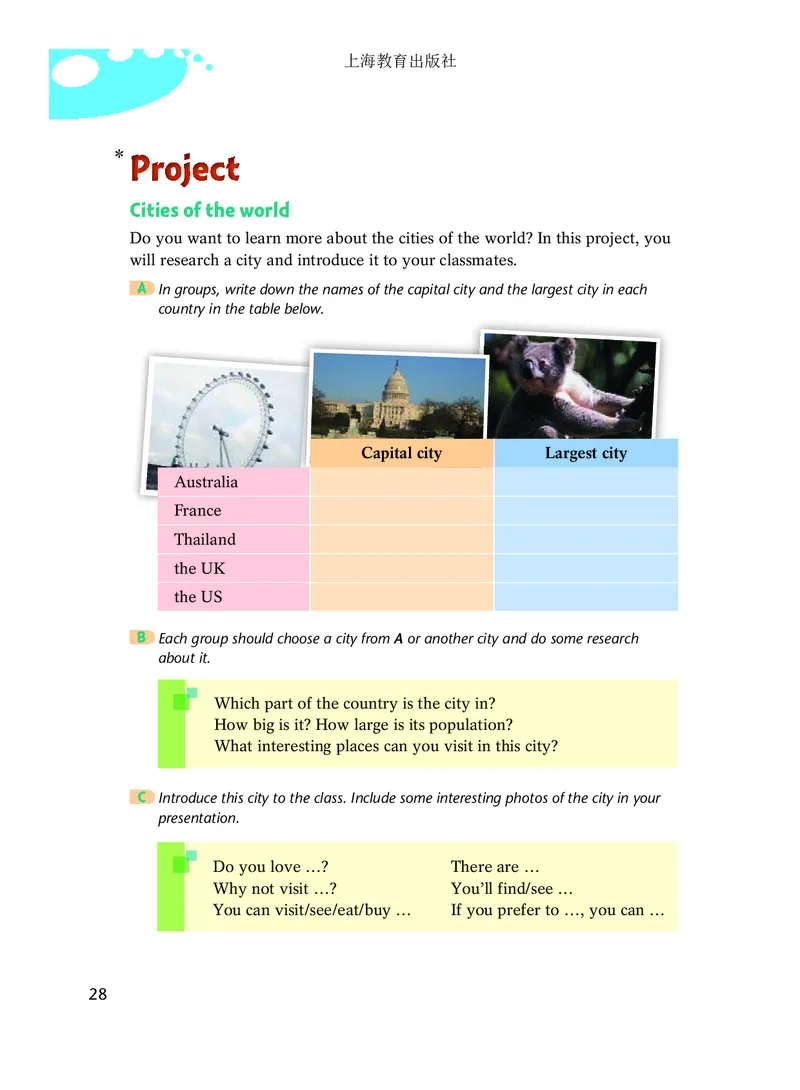
Cities of the world
Do you want to learn more about the cities of the world? In this project, you
will research a city and introduce it to your classmates.
A In groups, write down the names of the capital city and the largest city in each
country in the table below.
Capital city Largest city
Australia
France
Thailand
the UK
the US
B Each group should choose a city from A or another city and do some research
about it.
Which part of the country is the city in?
How big is it? How large is its population?
What interesting places can you visit in this city?
C Introduce this city to the class. Include some interesting photos of the city in your
presentation.
Do you love …? There are …
Why not visit …? You’ll find/see …
You can visit/see/eat/buy … If you prefer to …, you can …
28上海教育出版社
Module 2 Man’s best friends
Unit
3
OOOuuurrr aaannniiimmmaaalll fffrrriiieeennndddsss
Getting ready
In this unit, you will learn about our animal friends.
Reading
• Read an article about a blind man and his guide dog.
Listening
• Listen to a radio programme about dogs.
Grammar
• Learn how to use reflexive pronouns.
• Learn how to use prepositions of position.
Speaking
• Learn to say the /bl/, /br/, /fl/, /fr/, /Gl/, /Gr/, /kl/ and /kr/ sounds.
• Talk about a helpful animal.
Writing
•• CCoommpplleettee aa rreessccuuee ssttoorryy..
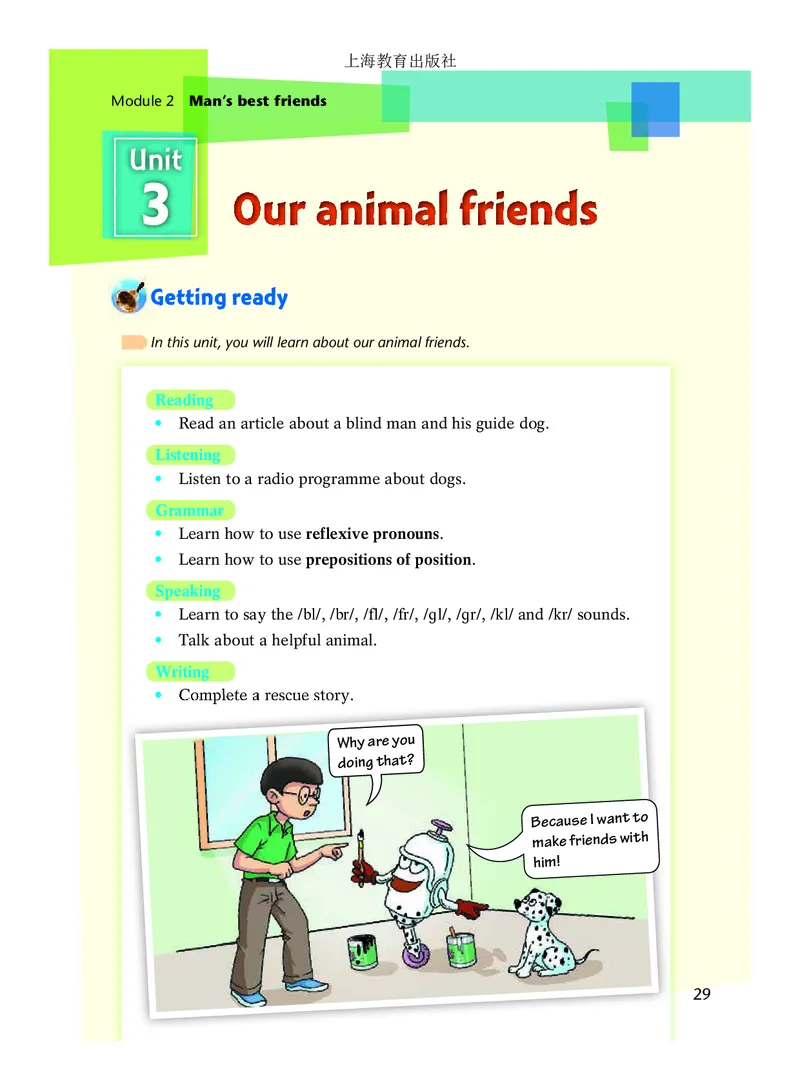
Why are you
doing that?
Because I want to
make friends with
him!
29上海教育出版社
Module 2
Reading
A What do you know about …?
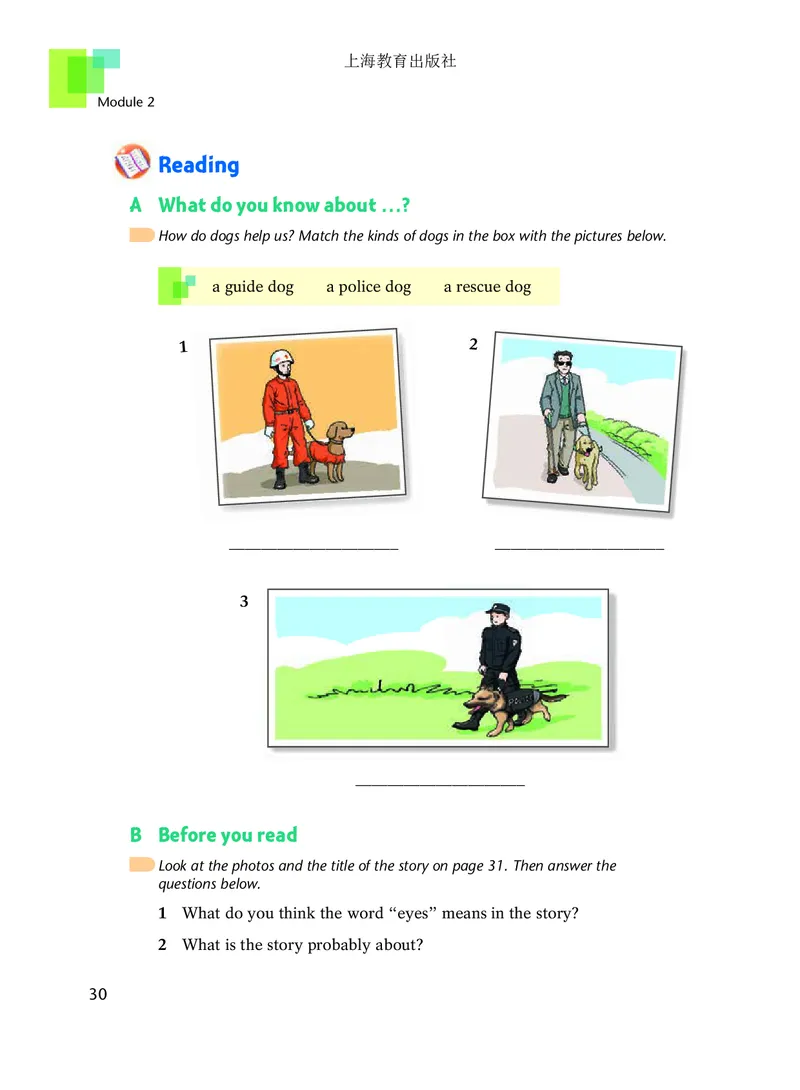
How do dogs help us? Match the kinds of dogs in the box with the pictures below.
a guide dog a police dog a rescue dog
1 2
_____________________ _____________________
3
_____________________
B Before you read
Look at the photos and the title of the story on page 31. Then answer the
questions below.
1 What do you think the word “eyes” means in the story?
2 What is the story probably about?
30上海教育出版社
Unit 3
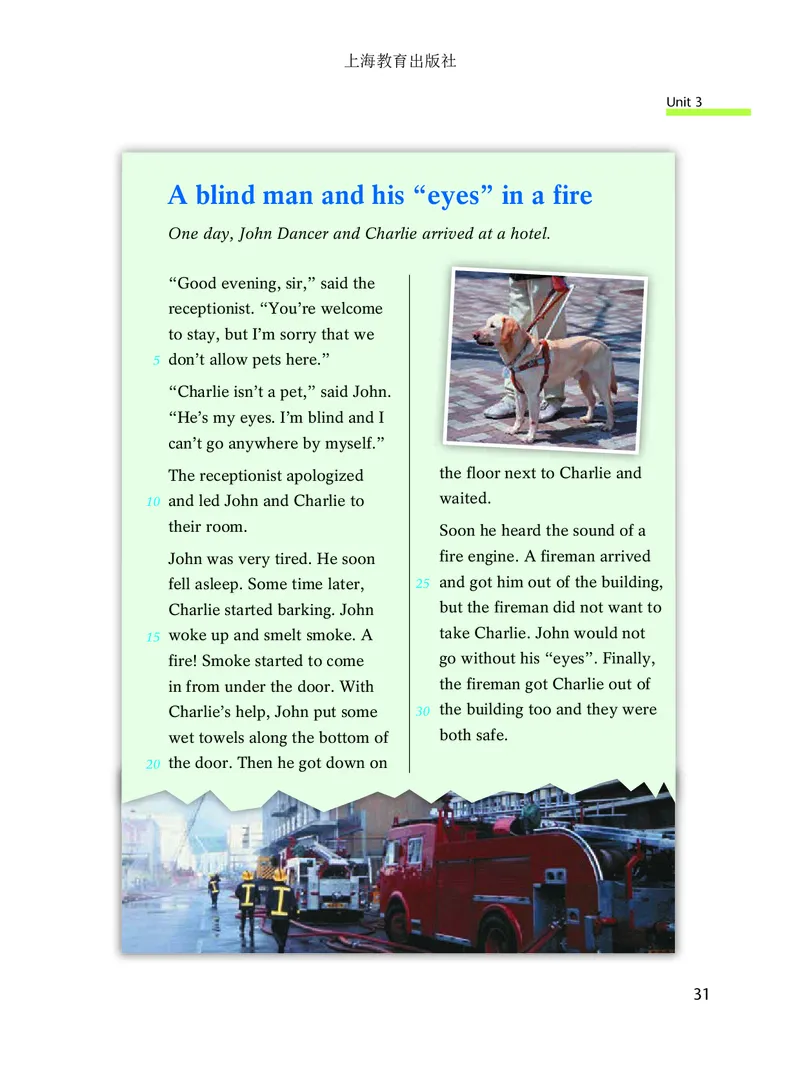
A blind man and his “eyes” in a fire
One day, John Dancer and Charlie arrived at a hotel.
“Good evening, sir,” said the
receptionist. “You’re welcome
to stay, but I’m sorry that we
5 don’t allow pets here.”
“Charlie isn’t a pet,” said John.
“He’s my eyes. I’m blind and I
can’t go anywhere by myself.”
The receptionist apologized the floor next to Charlie and
10 and led John and Charlie to waited.
their room.
Soon he heard the sound of a
John was very tired. He soon fire engine. A fireman arrived
fell asleep. Some time later, 25 and got him out of the building,
Charlie started barking. John but the fireman did not want to
15 woke up and smelt smoke. A take Charlie. John would not
fire! Smoke started to come go without his “eyes”. Finally,
in from under the door. With the fireman got Charlie out of
Charlie’s help, John put some 30 the building too and they were
wet towels along the bottom of both safe.
20 the door. Then he got down on
31上海教育出版社
Module 2
C Vocabulary
C1 The words in italics are from the story on page 31. Circle the correct answers to
complete these sentences.
1 A blind person is _____.
a not able to see b not able to hear
2 If I do something by myself, I do it _____.
a without help b with help
3 When you apologize to someone, you say “_____” to him or her.
a Thank you b Sorry
4 If a person leads you to a place, he or she _____ you there.
a takes b keeps
5 If someone wakes up, he or she _____.
a starts sleeping b stops sleeping
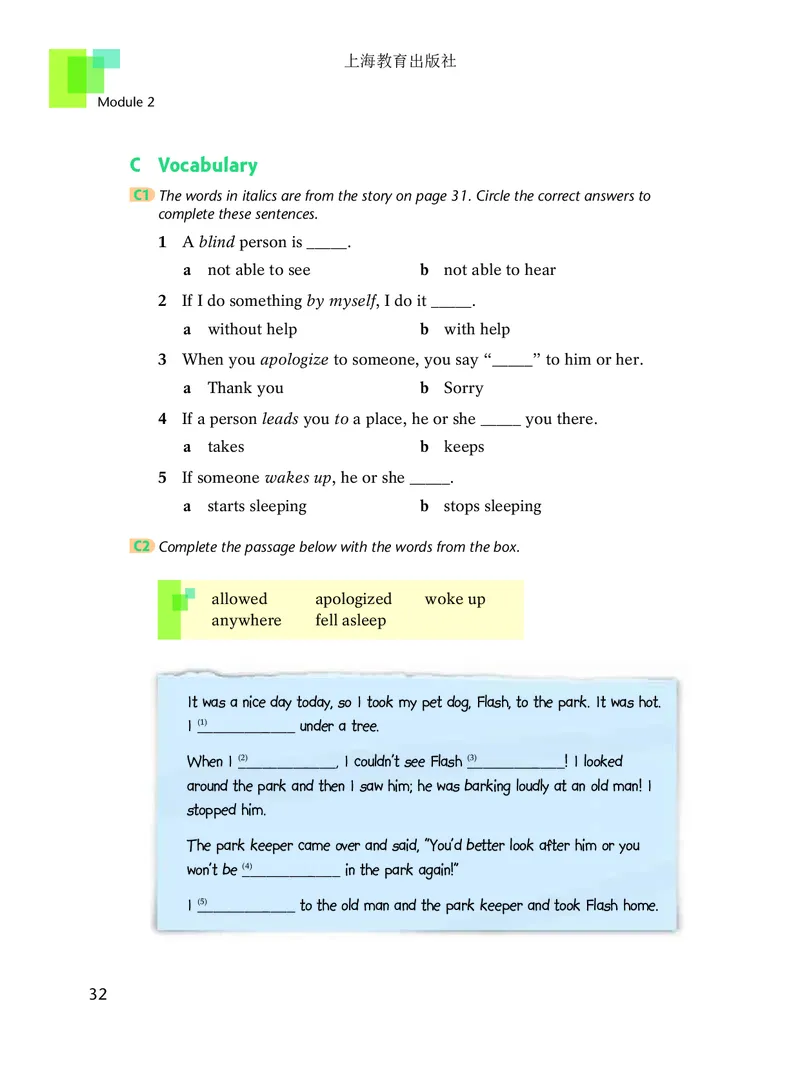
C2 Complete the passage below with the words from the box.
allowed apologized woke up
anywhere fell asleep
(cid:64)(cid:107)(cid:23)(cid:110)(cid:88)(cid:106)(cid:23)(cid:88)(cid:23)(cid:101)(cid:96)(cid:90)(cid:92)(cid:23)(cid:91)(cid:88)(cid:112)(cid:23)(cid:107)(cid:102)(cid:91)(cid:88)(cid:112)(cid:35)(cid:23)(cid:106)(cid:102)(cid:23)(cid:64)(cid:23)(cid:107)(cid:102)(cid:102)(cid:98)(cid:23)(cid:100)(cid:112)(cid:23)(cid:103)(cid:92)(cid:107)(cid:23)(cid:91)(cid:102)(cid:94)(cid:35)(cid:23)(cid:61)(cid:99)(cid:88)(cid:106)(cid:95)(cid:35)(cid:23)(cid:107)(cid:102)(cid:23)(cid:107)(cid:95)(cid:92)(cid:23)(cid:103)(cid:88)(cid:105)(cid:98)(cid:37)(cid:23)(cid:64)(cid:107)(cid:23)(cid:110)(cid:88)(cid:106)(cid:23)(cid:95)(cid:102)(cid:107)(cid:37)(cid:23)
(cid:64)(cid:23)_(1)____________(cid:23)(cid:108)(cid:101)(cid:91)(cid:92)(cid:105)(cid:23)(cid:88)(cid:23)(cid:107)(cid:105)(cid:92)(cid:92)(cid:37)
(cid:78)(cid:95)(cid:92)(cid:101)(cid:23)(cid:64)(cid:23)_(2)____________, (cid:64)(cid:23)(cid:90)(cid:102)(cid:108)(cid:99)(cid:91)(cid:101)(cid:203)(cid:107)(cid:23)(cid:106)(cid:92)(cid:92)(cid:23)(cid:61)(cid:99)(cid:88)(cid:106)(cid:95) _(3)____________(cid:24)(cid:23)(cid:64)(cid:23)(cid:99)(cid:102)(cid:102)(cid:98)(cid:92)(cid:91)(cid:23)
(cid:88)(cid:105)(cid:102)(cid:108)(cid:101)(cid:91)(cid:23)(cid:107)(cid:95)(cid:92)(cid:23)(cid:103)(cid:88)(cid:105)(cid:98)(cid:23)(cid:88)(cid:101)(cid:91)(cid:23)(cid:107)(cid:95)(cid:92)(cid:101)(cid:23)(cid:64)(cid:23)(cid:106)(cid:88)(cid:110)(cid:23)(cid:95)(cid:96)(cid:100)(cid:50)(cid:23)(cid:95)(cid:92)(cid:23)(cid:110)(cid:88)(cid:106)(cid:23)(cid:89)(cid:88)(cid:105)(cid:98)(cid:96)(cid:101)(cid:94)(cid:23)(cid:99)(cid:102)(cid:108)(cid:91)(cid:99)(cid:112)(cid:23)(cid:88)(cid:107)(cid:23)(cid:88)(cid:101)(cid:23)(cid:102)(cid:99)(cid:91)(cid:23)(cid:100)(cid:88)(cid:101)(cid:24)(cid:23)(cid:64)(cid:23)
(cid:106)(cid:107)(cid:102)(cid:103)(cid:103)(cid:92)(cid:91)(cid:23)(cid:95)(cid:96)(cid:100)(cid:37)
(cid:75)(cid:95)(cid:92)(cid:23)(cid:103)(cid:88)(cid:105)(cid:98)(cid:23)(cid:98)(cid:92)(cid:92)(cid:103)(cid:92)(cid:105)(cid:23)(cid:90)(cid:88)(cid:100)(cid:92)(cid:23)(cid:102)(cid:109)(cid:92)(cid:105)(cid:23)(cid:88)(cid:101)(cid:91)(cid:23)(cid:106)(cid:88)(cid:96)(cid:91)(cid:35)(cid:23)(cid:200)(cid:80)(cid:102)(cid:108)(cid:203)(cid:91)(cid:23)(cid:89)(cid:92)(cid:107)(cid:107)(cid:92)(cid:105)(cid:23)(cid:99)(cid:102)(cid:102)(cid:98)(cid:23)(cid:88)(cid:93)(cid:107)(cid:92)(cid:105)(cid:23)(cid:95)(cid:96)(cid:100)(cid:23)(cid:102)(cid:105)(cid:23)(cid:112)(cid:102)(cid:108)(cid:23)
(cid:110)(cid:102)(cid:101)(cid:203)(cid:107)(cid:23)(cid:89)(cid:92)(cid:23)_(4)____________(cid:23)(cid:96)(cid:101)(cid:23)(cid:107)(cid:95)(cid:92)(cid:23)(cid:103)(cid:88)(cid:105)(cid:98)(cid:23)(cid:88)(cid:94)(cid:88)(cid:96)(cid:101)(cid:24)(cid:201)
(cid:64)(cid:23)_(5)____________(cid:23)(cid:107)(cid:102)(cid:23)(cid:107)(cid:95)(cid:92)(cid:23)(cid:102)(cid:99)(cid:91)(cid:23)(cid:100)(cid:88)(cid:101)(cid:23)(cid:88)(cid:101)(cid:91)(cid:23)(cid:107)(cid:95)(cid:92)(cid:23)(cid:103)(cid:88)(cid:105)(cid:98)(cid:23)(cid:98)(cid:92)(cid:92)(cid:103)(cid:92)(cid:105)(cid:23)(cid:88)(cid:101)(cid:91)(cid:23)(cid:107)(cid:102)(cid:102)(cid:98)(cid:23)(cid:61)(cid:99)(cid:88)(cid:106)(cid:95)(cid:23)(cid:95)(cid:102)(cid:100)(cid:92)(cid:37)
32上海教育出版社
Unit 3
Collocations
Look at the sentences below. Which one do you think is right?
He is seeing television. He is watching television.
We often use certain words together and we call this collocation. For
example, we say “watch television”, not “see television”.
D Comprehension
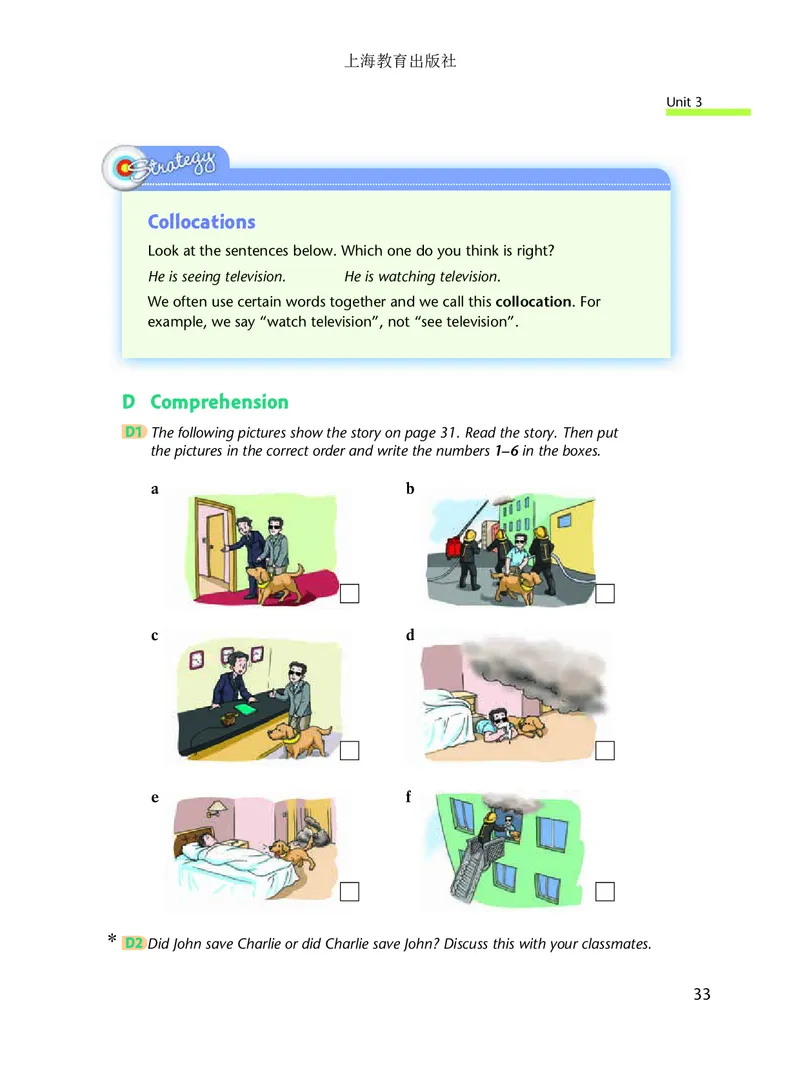
D1 The following pictures show the story on page 31. Read the story. Then put
the pictures in the correct order and write the numbers 1–6 in the boxes.
a b
c d
e f
(cid:43)
D2 Did John save Charlie or did Charlie save John? Discuss this with your classmates.
33上海教育出版社
Module 2
Listening
Top dogs
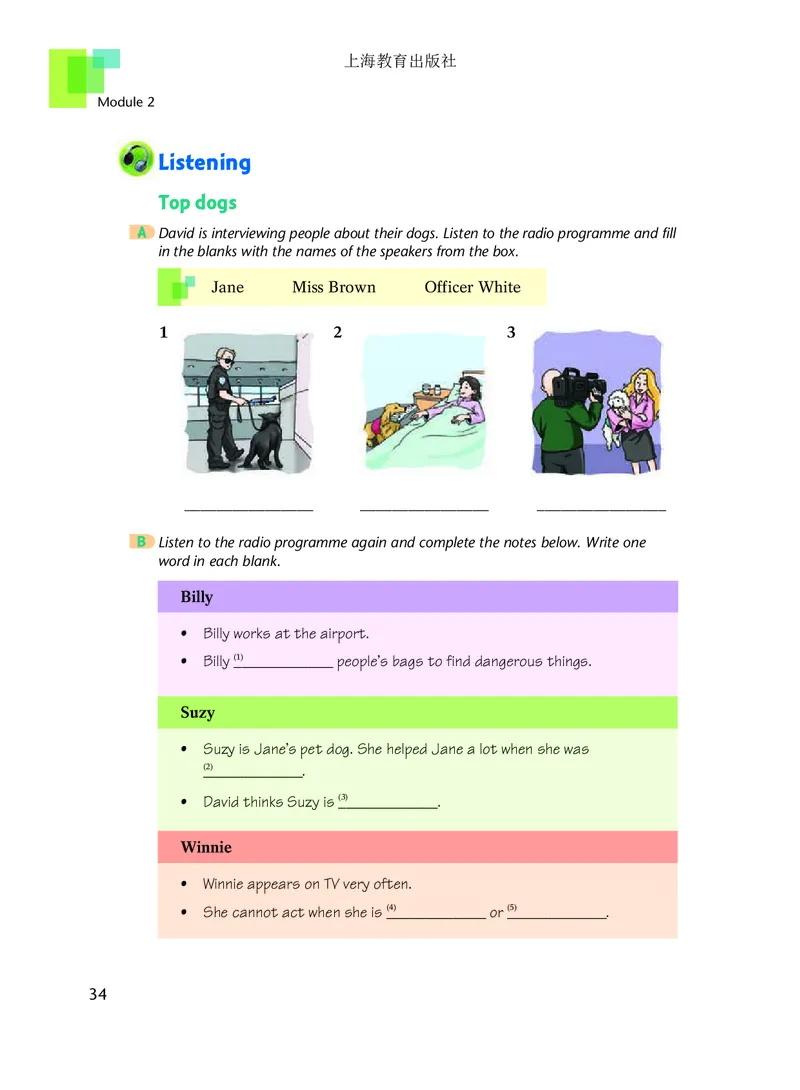
A David is interviewing people about their dogs. Listen to the radio programme and fill
in the blanks with the names of the speakers from the box.
Jane Miss Brown Officer White
1 2 3
________________ ________________ ________________
B Listen to the radio programme again and complete the notes below. Write one
word in each blank.
Billy
• (cid:34)illy works at the airport.
• (cid:34)illy (_1)____________ people(cid:7)s bags to find dangerous things.
Suzy
• (cid:51)u(cid:90)y is (cid:42)ane(cid:7)s pet dog. (cid:51)he helped (cid:42)ane a lot when she was
_(2)____________.
• (cid:36)a(cid:86)id thinks (cid:51)u(cid:90)y is (_3)____________.
Winnie
• Winnie appears on T(cid:54) (cid:86)ery often.
• (cid:51)he cannot act when she is (_4)____________ or (_5)____________.
34上海教育出版社
Unit 3
Grammar
A Reflexive pronouns
We use a reflexive pronoun as the object to refer back to the subject of
a sentence.
He blames himself for the mistake.
She made herself a cup of tea.
We should not think only of ourselves.
We can also use a reflexive pronoun to emphasize that someone does
something without help.
He did the homework himself.
We can clean the kitchen ourselves.
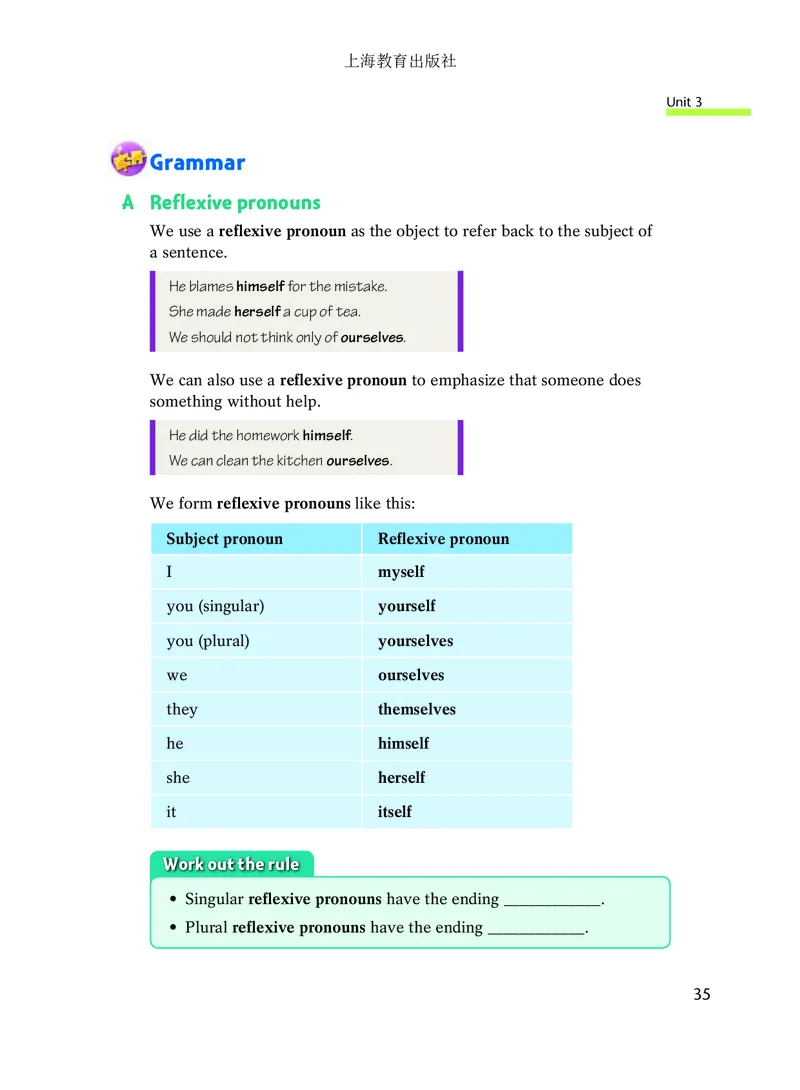
We form reflexive pronouns like this:
Subject pronoun Reflexive pronoun
I myself
you (singular) yourself
you (plural) yourselves
we ourselves
they themselves
he himself
she herself
it itself
Work out the rule
•(cid:1)(cid:52)(cid:74)(cid:79)(cid:72)(cid:86)(cid:77)(cid:66)(cid:83)(cid:1)reflexive pronouns have the ending ____________.
•(cid:1)(cid:49)(cid:77)(cid:86)(cid:83)(cid:66)(cid:77)(cid:1)reflexive pronouns have the ending ____________.
35上海教育出版社
Module 2
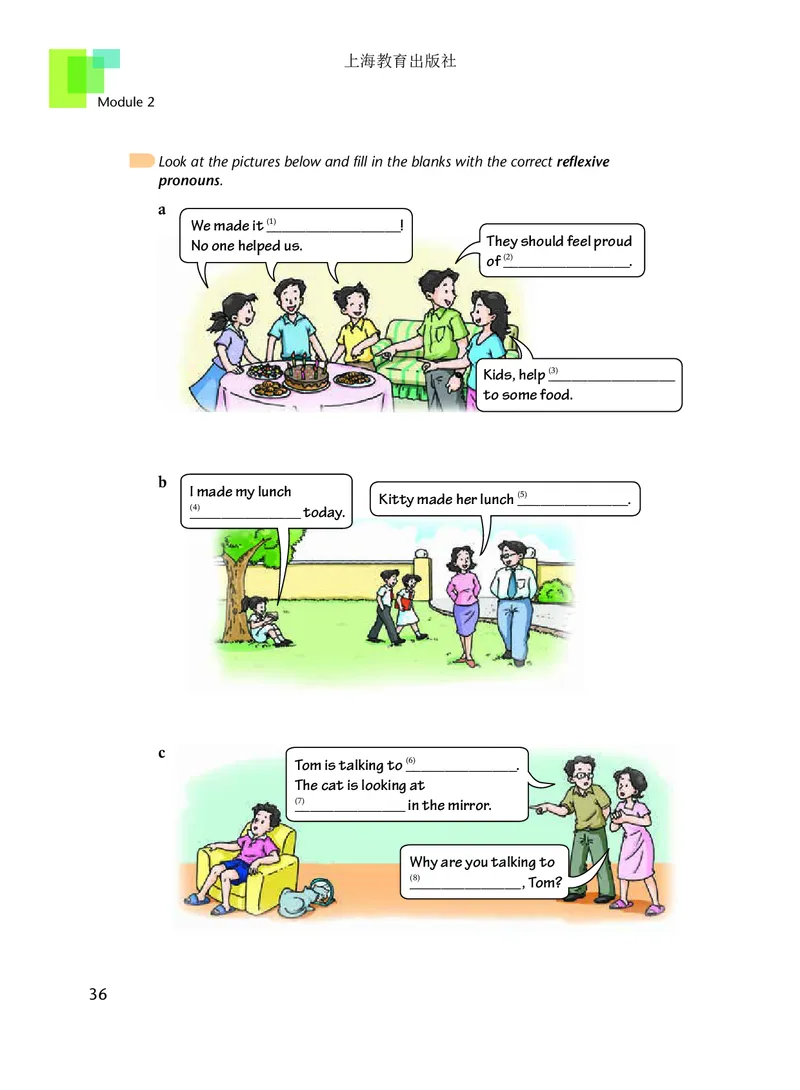
Look at the pictures below and fill in the blanks with the correct reflexive
pronouns.
a
We made it (_1)________________!
They should feel proud
No one helped us.
of _(2)_______________.
Kids, help (_3)_______________
to some food.
b
I made my lunch
Kitty made her lunch _(5)_____________.
_(4)_____________ today.
c
Tom is talking to _(6)_____________.
The cat is looking at
_(7)_____________ in the mirror.
Why are you talking to
_(8)_____________ , Tom?
36上海教育出版社
Unit 3
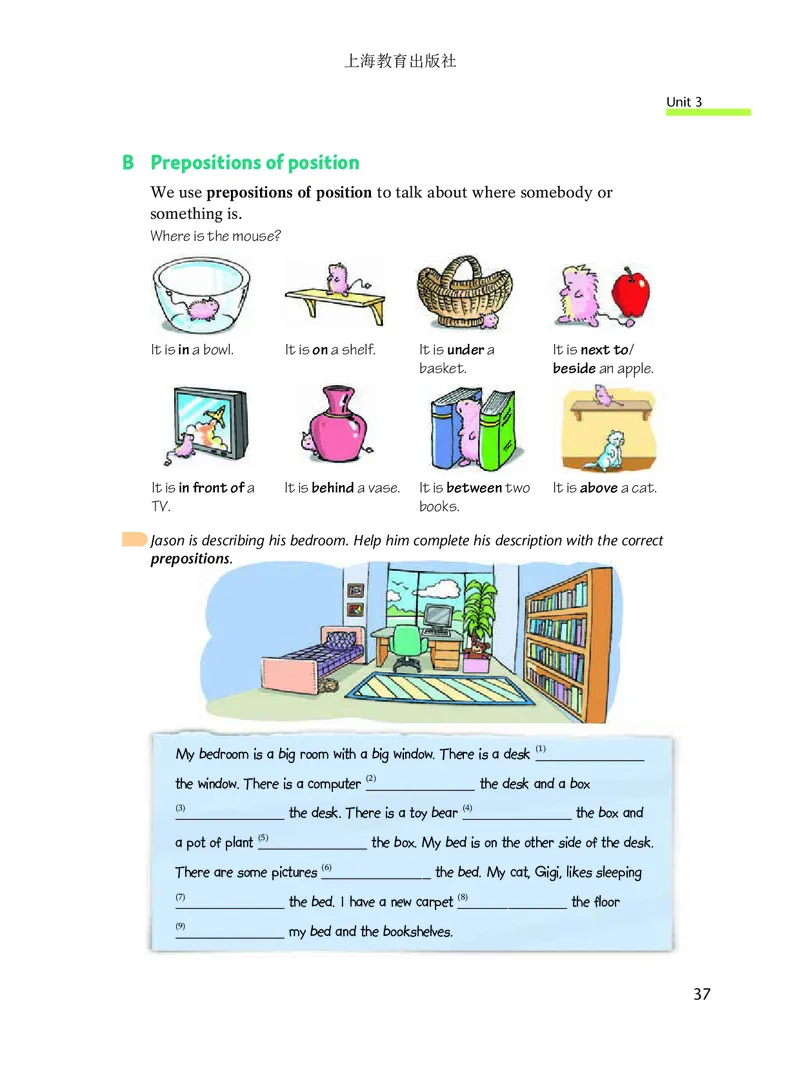
B Prepositions of position
We use prepositions of position to talk about where somebody or
something is.
Where is the mouse?
It is in a bowl. It is on a shelf. It is under a It is next to/
basket. beside an apple.
It is in front of a It is behind a vase. It is between two It is above a cat.
TV. books.
Jason is describing his bedroom. Help him complete his description with the correct
prepositions.
(cid:68)(cid:112)(cid:23)(cid:89)(cid:92)(cid:91)(cid:105)(cid:102)(cid:102)(cid:100)(cid:23)(cid:96)(cid:106)(cid:23)(cid:88)(cid:23)(cid:89)(cid:96)(cid:94)(cid:23)(cid:105)(cid:102)(cid:102)(cid:100)(cid:23)(cid:110)(cid:96)(cid:107)(cid:95)(cid:23)(cid:88)(cid:23)(cid:89)(cid:96)(cid:94)(cid:23)(cid:110)(cid:96)(cid:101)(cid:91)(cid:102)(cid:110)(cid:37)(cid:23)(cid:75)(cid:95)(cid:92)(cid:105)(cid:92)(cid:23)(cid:96)(cid:106)(cid:23)(cid:88)(cid:23)(cid:91)(cid:92)(cid:106)(cid:98)(cid:23)(_1)____________(cid:23)
(cid:107)(cid:95)(cid:92)(cid:23)(cid:110)(cid:96)(cid:101)(cid:91)(cid:102)(cid:110)(cid:37)(cid:23)(cid:75)(cid:95)(cid:92)(cid:105)(cid:92)(cid:23)(cid:96)(cid:106)(cid:23)(cid:88)(cid:23)(cid:90)(cid:102)(cid:100)(cid:103)(cid:108)(cid:107)(cid:92)(cid:105)(cid:23)_(2)____________(cid:23)(cid:107)(cid:95)(cid:92)(cid:23)(cid:91)(cid:92)(cid:106)(cid:98)(cid:23)(cid:88)(cid:101)(cid:91)(cid:23)(cid:88)(cid:23)(cid:89)(cid:102)(cid:111)(cid:23)
_(3)____________(cid:23)(cid:107)(cid:95)(cid:92)(cid:23)(cid:91)(cid:92)(cid:106)(cid:98)(cid:37)(cid:23)(cid:75)(cid:95)(cid:92)(cid:105)(cid:92)(cid:23)(cid:96)(cid:106)(cid:23)(cid:88)(cid:23)(cid:107)(cid:102)(cid:112)(cid:23)(cid:89)(cid:92)(cid:88)(cid:105)(cid:23)(_4)____________(cid:23)(cid:107)(cid:95)(cid:92)(cid:23)(cid:89)(cid:102)(cid:111)(cid:23)(cid:88)(cid:101)(cid:91)(cid:23)
(cid:88)(cid:23)(cid:103)(cid:102)(cid:107)(cid:23)(cid:102)(cid:93)(cid:23)(cid:103)(cid:99)(cid:88)(cid:101)(cid:107)(cid:23)_(5)____________(cid:23)(cid:107)(cid:95)(cid:92)(cid:23)(cid:89)(cid:102)(cid:111)(cid:37)(cid:23)(cid:68)(cid:112)(cid:23)(cid:89)(cid:92)(cid:91)(cid:23)(cid:96)(cid:106)(cid:23)(cid:102)(cid:101)(cid:23)(cid:107)(cid:95)(cid:92)(cid:23)(cid:102)(cid:107)(cid:95)(cid:92)(cid:105)(cid:23)(cid:106)(cid:96)(cid:91)(cid:92)(cid:23)(cid:102)(cid:93)(cid:23)(cid:107)(cid:95)(cid:92)(cid:23)(cid:91)(cid:92)(cid:106)(cid:98)(cid:37)(cid:23)
(cid:75)(cid:95)(cid:92)(cid:105)(cid:92)(cid:23)(cid:88)(cid:105)(cid:92)(cid:23)(cid:106)(cid:102)(cid:100)(cid:92)(cid:23)(cid:103)(cid:96)(cid:90)(cid:107)(cid:108)(cid:105)(cid:92)(cid:106)(cid:23)(_6)____________(cid:23)(cid:107)(cid:95)(cid:92)(cid:23)(cid:89)(cid:92)(cid:91)(cid:37)(cid:23)(cid:68)(cid:112)(cid:23)(cid:90)(cid:88)(cid:107)(cid:35)(cid:23)(cid:62)(cid:96)(cid:94)(cid:96)(cid:35)(cid:23)(cid:99)(cid:96)(cid:98)(cid:92)(cid:106)(cid:23)(cid:106)(cid:99)(cid:92)(cid:92)(cid:103)(cid:96)(cid:101)(cid:94)(cid:23)
_(7)____________(cid:23)(cid:107)(cid:95)(cid:92)(cid:23)(cid:89)(cid:92)(cid:91)(cid:37)(cid:23)(cid:64)(cid:23)(cid:95)(cid:88)(cid:109)(cid:92)(cid:23)(cid:88)(cid:23)(cid:101)(cid:92)(cid:110)(cid:23)(cid:90)(cid:88)(cid:105)(cid:103)(cid:92)(cid:107)(cid:23)(_8)____________(cid:23)(cid:107)(cid:95)(cid:92)(cid:23)(cid:93)(cid:99)(cid:102)(cid:102)(cid:105)(cid:23)
_(9)____________(cid:23)(cid:100)(cid:112)(cid:23)(cid:89)(cid:92)(cid:91)(cid:23)(cid:88)(cid:101)(cid:91)(cid:23)(cid:107)(cid:95)(cid:92)(cid:23)(cid:89)(cid:102)(cid:102)(cid:98)(cid:106)(cid:95)(cid:92)(cid:99)(cid:109)(cid:92)(cid:106)(cid:37)
37上海教育出版社
Module 2
Speaking
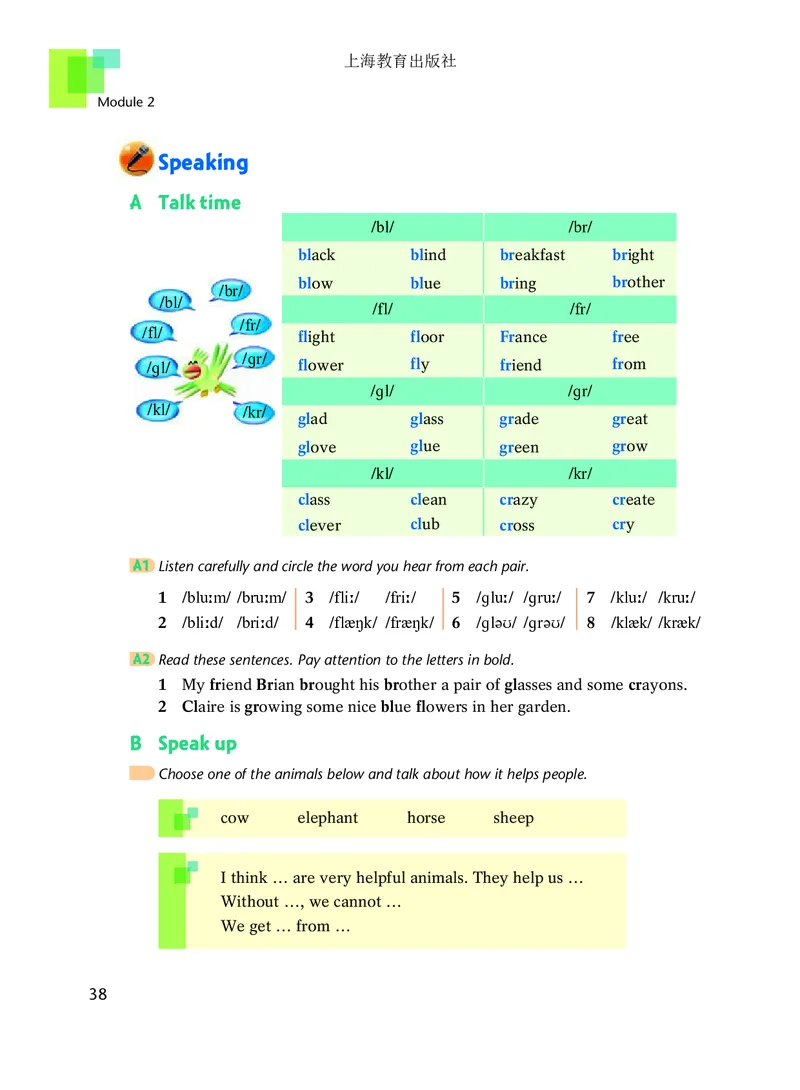
A Talk time
/bl/ /br/
black blind breakfast bright
blow blue bring brother
/br/
/bl/
/fl/ /fr/
/fr/
/fl/
flight floor France free
/Gr/
/Gl/ flower fly friend from
/Gl/ /Gr/
/kl/ /kr/
glad glass grade great
glove glue green grow
/kl/ /kr/
class clean crazy create
clever club cross cry
A1 Listen carefully and circle the word you hear from each pair.
1 /blum/ /brum/ 3 /fli/ /fri/ 5 /Glu/ /Gru/ 7 /klu/ /kru/
2 /blid/ /brid/ 4 /flCNk/ /frCNk/ 6 /GlRW/ /GrRW/ 8 /klCk/ /krCk/
A2 Read these sentences. Pay attention to the letters in bold.
1 My friend Brian brought his brother a pair of glasses and some crayons.
2 Claire is growing some nice blue flowers in her garden.
B Speak up
Choose one of the animals below and talk about how it helps people.
cow elephant horse sheep
I think … are very helpful animals. They help us …
Without …, we cannot …
We get … from …
38上海教育出版社
Unit 3
Writing
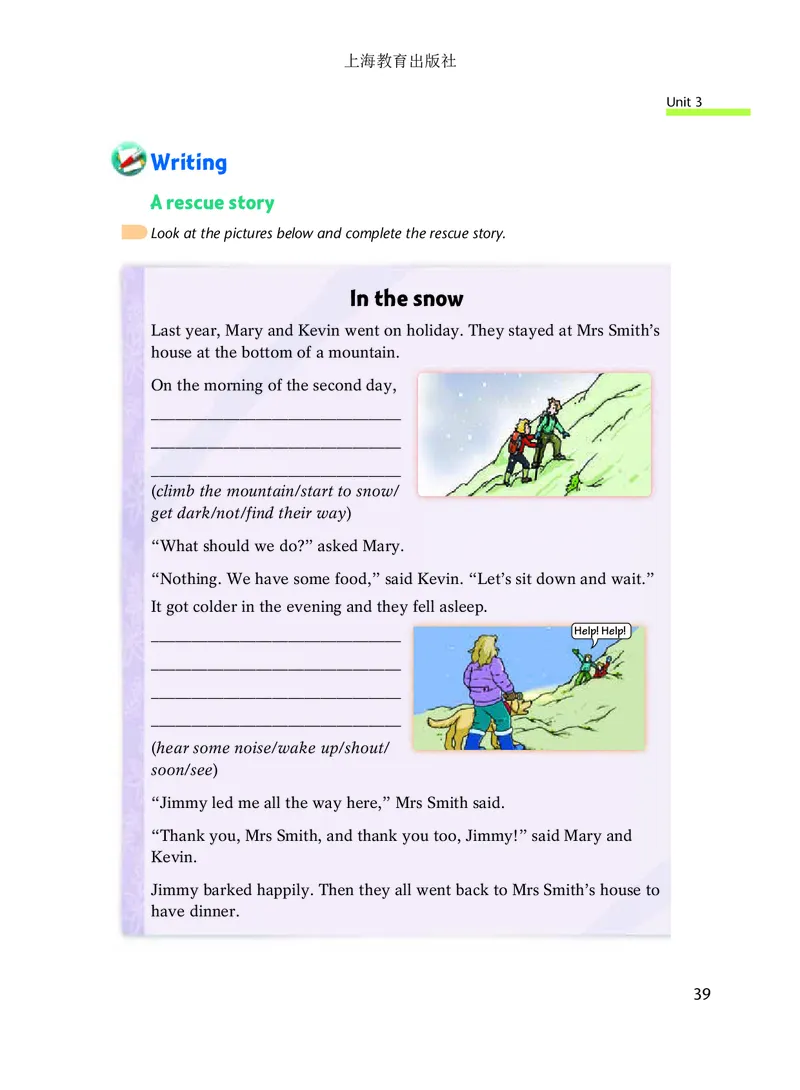
A rescue story
Look at the pictures below and complete the rescue story.
In the snow
Last year, Mary and Kevin went on holiday. They stayed at Mrs Smith’s
house at the bottom of a mountain.
On the morning of the second day,
_______________________________
_______________________________
_______________________________
(climb the mountain/start to snow/
get dark/not/find their way)
“What should we do?” asked Mary.
“Nothing. We have some food,” said Kevin. “Let’s sit down and wait.”
It got colder in the evening and they fell asleep.
_______________________________ Help! Help!
_______________________________
_______________________________
_______________________________
(hear some noise/wake up/shout/
soon/see)
“Jimmy led me all the way here,” Mrs Smith said.
“Thank you, Mrs Smith, and thank you too, Jimmy!” said Mary and
Kevin.
Jimmy barked happily. Then they all went back to Mrs Smith’s house to
have dinner.
39上海教育出版社
Module 2
(cid:43)
More practice
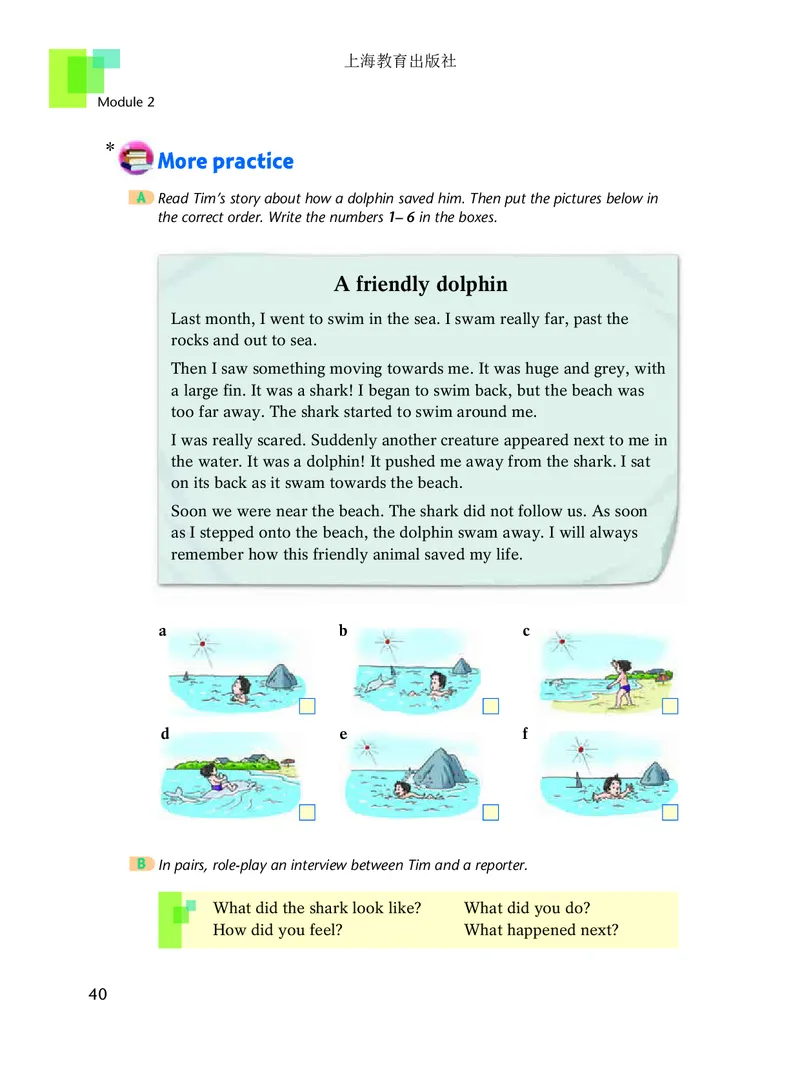
A Read Tim’s story about how a dolphin saved him. Then put the pictures below in
the correct order. Write the numbers 1–6 in the boxes.
A friendly dolphin
Last month, I went to swim in the sea. I swam really far, past the
rocks and out to sea.
Then I saw something moving towards me. It was huge and grey, with
a large fin. It was a shark! I began to swim back, but the beach was
too far away. The shark started to swim around me.
I was really scared. Suddenly another creature appeared next to me in
the water. It was a dolphin! It pushed me away from the shark. I sat
on its back as it swam towards the beach.
Soon we were near the beach. The shark did not follow us. As soon
as I stepped onto the beach, the dolphin swam away. I will always
remember how this friendly animal saved my life.
a b c
d e f
B In pairs, role-play an interview between Tim and a reporter.
What did the shark look like? What did you do?
How did you feel? What happened next?
40上海教育出版社
Unit 3
SSttuuddyy sskkiillllss
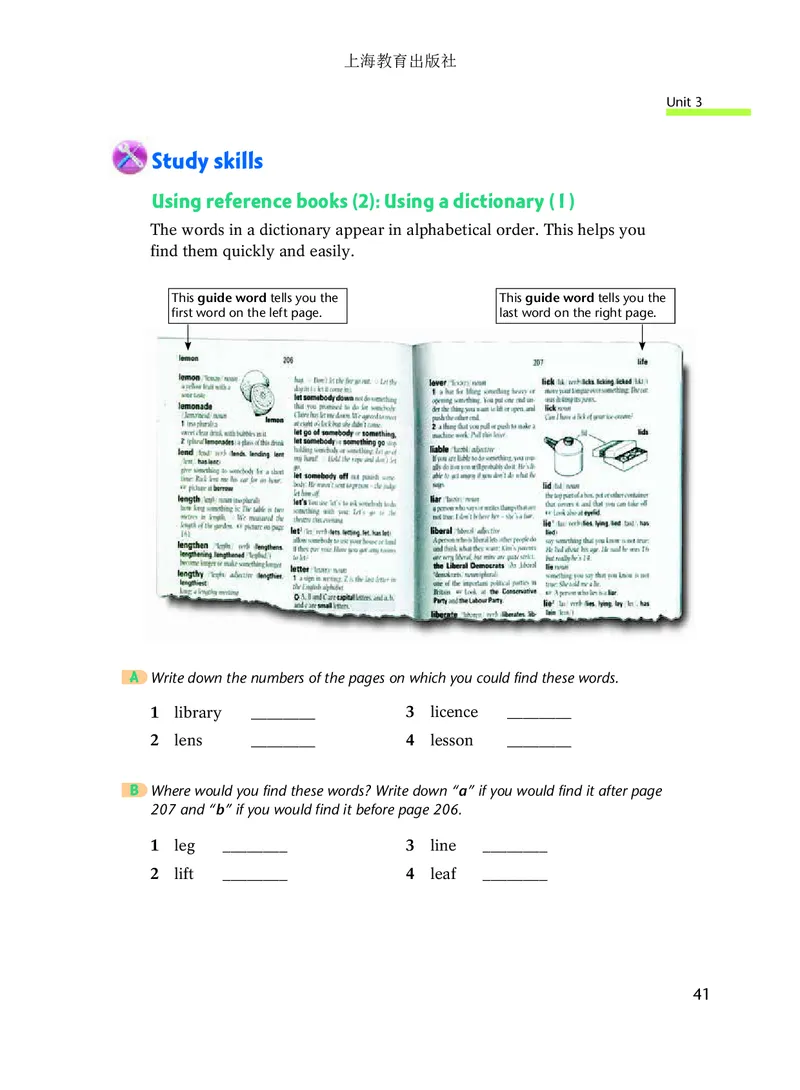
Using reference books (2): Using a dictionary ( I )
The words in a dictionary appear in alphabetical order. This helps you
find them quickly and easily.
This guide word tells you the This guide word tells you the
first word on the left page. last word on the right page.
A Write down the numbers of the pages on which you could find these words.
1 library ________ 3 licence ________
2 lens ________ 4 lesson ________
B Where would you find these words? Write down “a” if you would find it after page
207 and “b” if you would find it before page 206.
1 leg ________ 3 line ________
2 lift ________ 4 leaf ________
41上海教育出版社
Module 2
Culture corner
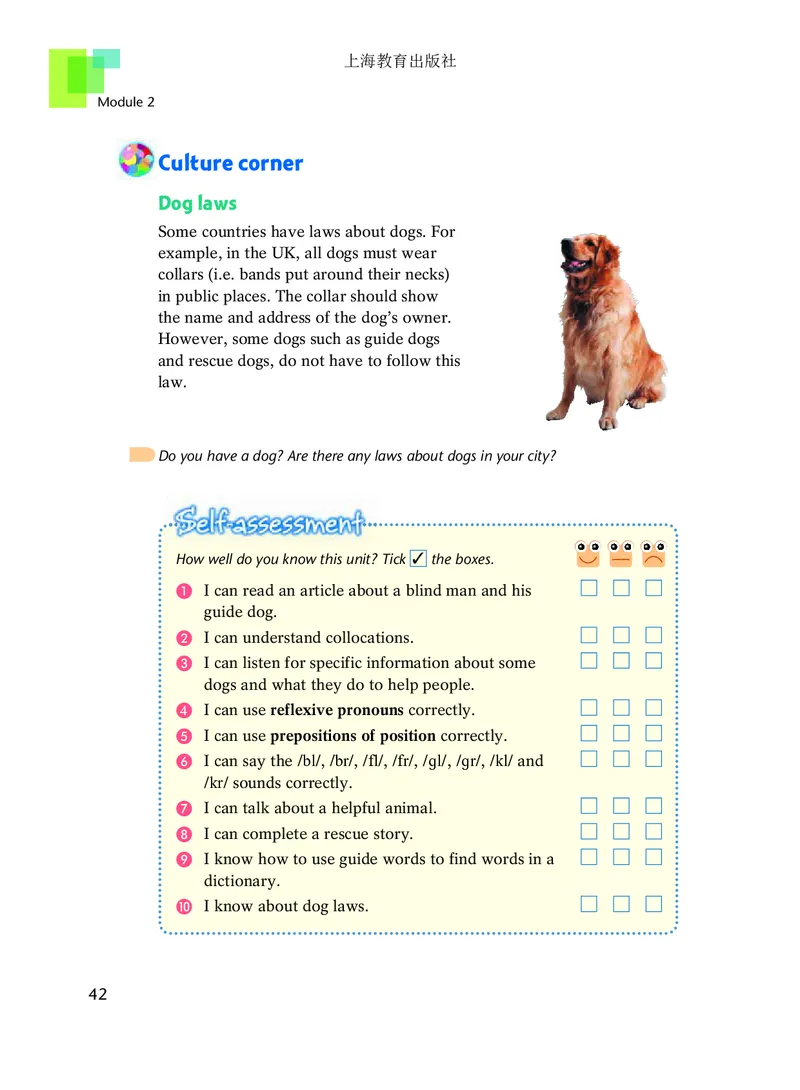
Dog laws
Some countries have laws about dogs. For
example, in the UK, all dogs must wear
collars (i.e. bands put around their necks)
in public places. The collar should show
the name and address of the dog’s owner.
However, some dogs such as guide dogs
and rescue dogs, do not have to follow this
law.
Do you have a dog? Are there any laws about dogs in your city?
How well do you know this unit? Tick ✓ the boxes.
❶ I can read an article about a blind man and his
guide dog.
❷ I can understand collocations.
❸ I can listen for specific information about some
dogs and what they do to help people.
❹ I can use reflexive pronouns correctly.
❺ I can use prepositions of position correctly.
❻ I can say the /bl/, /br/, /fl/, /fr/, /Gl/, /Gr/, /kl/ and
/kr/ sounds correctly.
❼ I can talk about a helpful animal.
❽ I can complete a rescue story.
(cid:29) I know how to use guide words to find words in a
dictionary.
(cid:30) I know about dog laws.
42上海教育出版社
Module 2 Man’s best friends
Unit
4
SSSaaavvveee ttthhheee tttrrreeeeeesss
Getting ready
In this unit, you will learn about trees and their importance in our lives.
Reading
• Read an interview about trees.
Listening
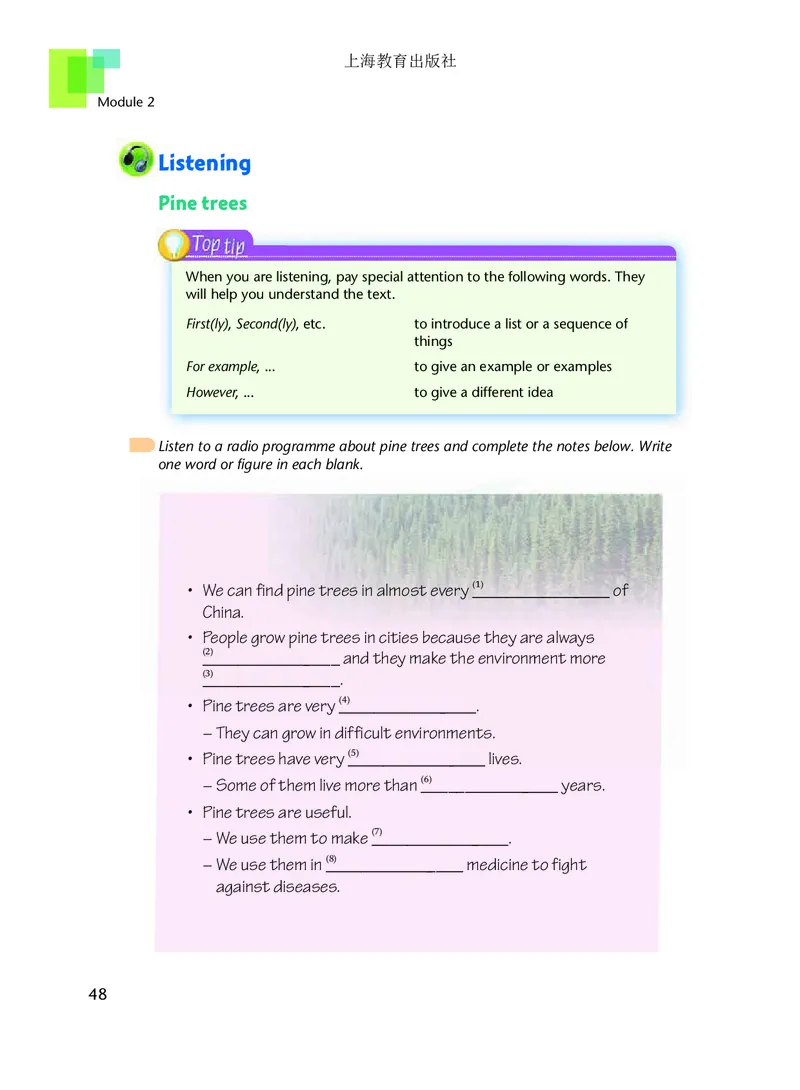
• Listen to a radio programme about pine trees.
Grammar
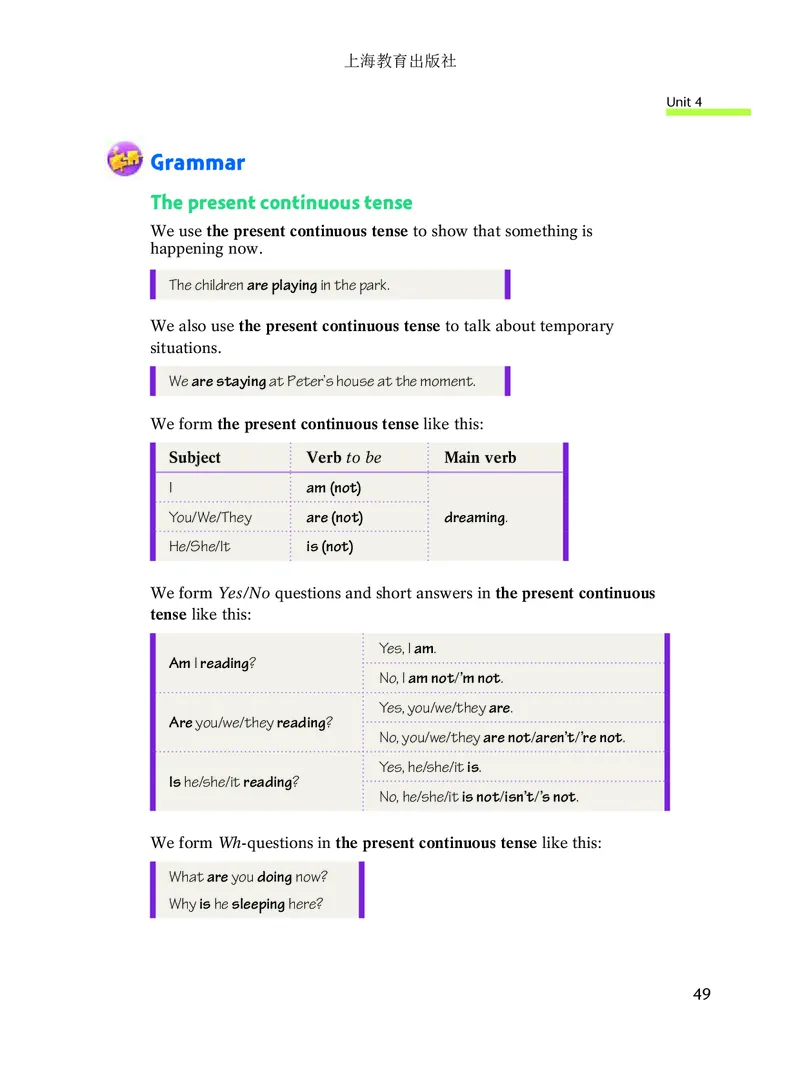
• Learn how to use the present continuous tense.
Speaking
• Learn to say the /sk/, /sp/, /st/, /sl/, /sm/, /pl/, /pr/, /kw/ and /tw/
sounds.
• Discuss the importance of trees.
Writing
• Describe some pictures.
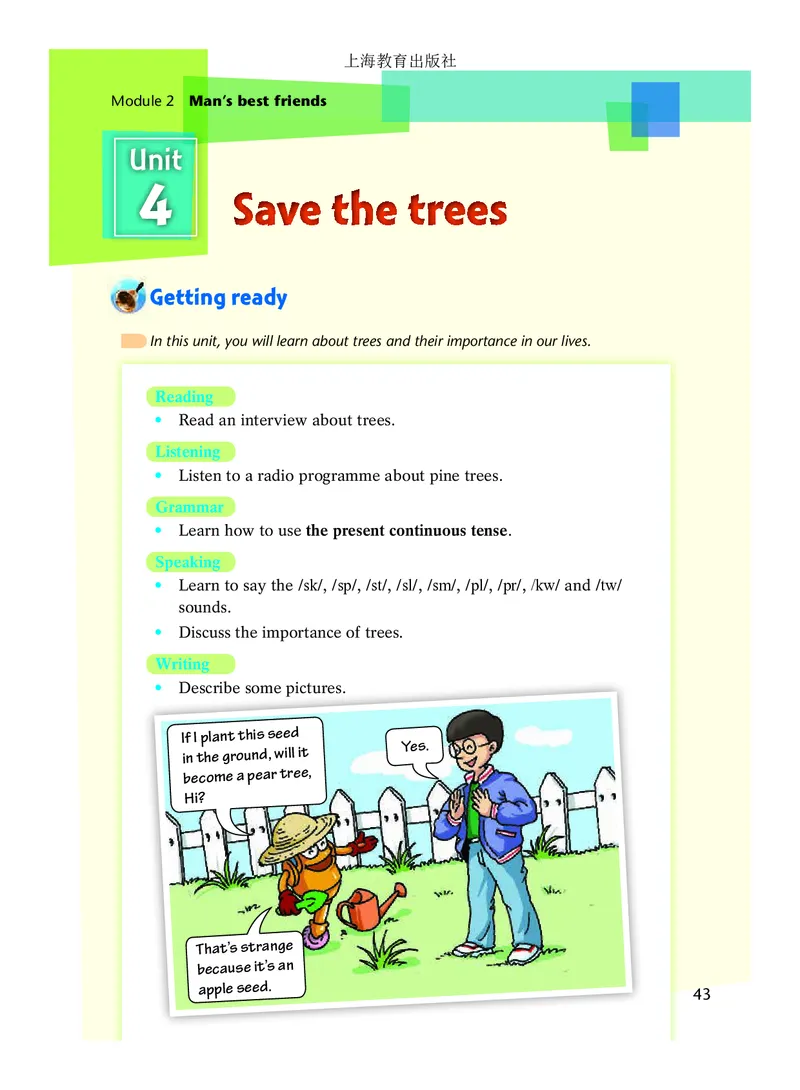
If I plant this seed
Yes.
in the ground, will it
become a pear tree,
Hi?
That’s strange
because it’s an
apple seed.
43上海教育出版社
Module 2
Reading
A What do you know about …?
How much do you know about trees? Try the short quiz below.
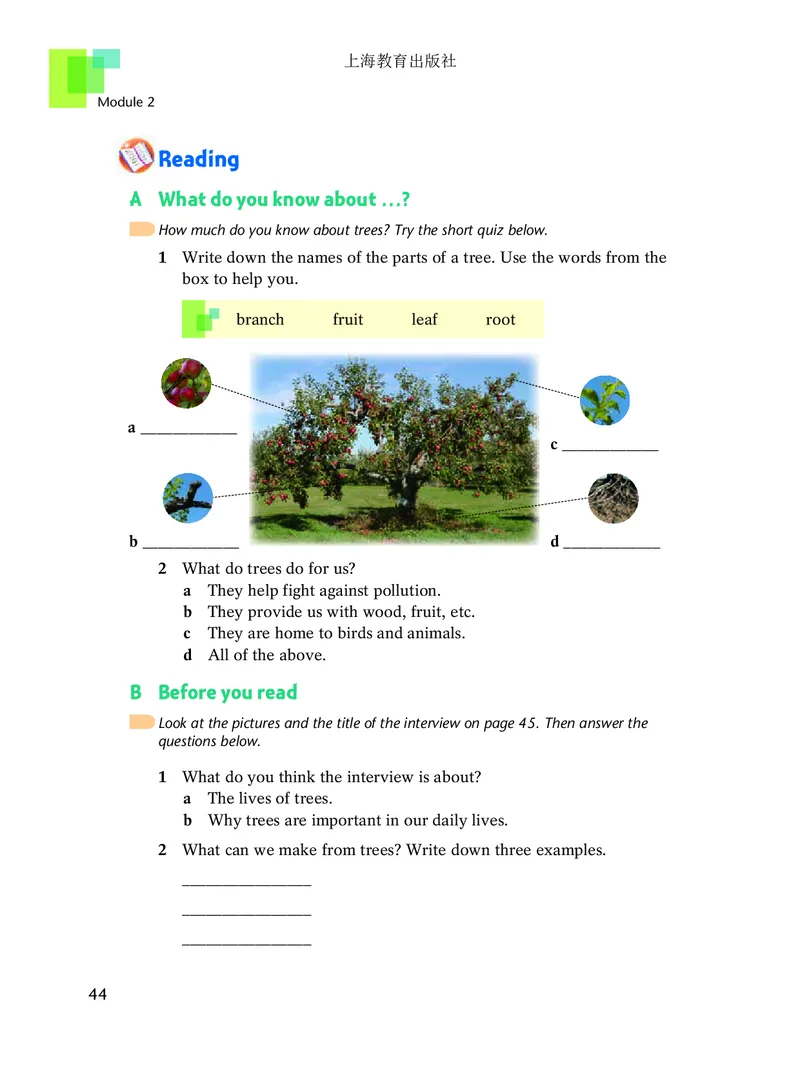
1 Write down the names of the parts of a tree. Use the words from the
box to help you.
branch fruit leaf root
a ____________
c ____________
b ____________ d ____________
2 What do trees do for us?
a They help fight against pollution.
b They provide us with wood, fruit, etc.
c They are home to birds and animals.
d All of the above.
B Before you read
Look at the pictures and the title of the interview on page 45. Then answer the
questions below.
1 What do you think the interview is about?
a The lives of trees.
b Why trees are important in our daily lives.
2 What can we make from trees? Write down three examples.
________________
________________
________________
44上海教育出版社
Unit 4
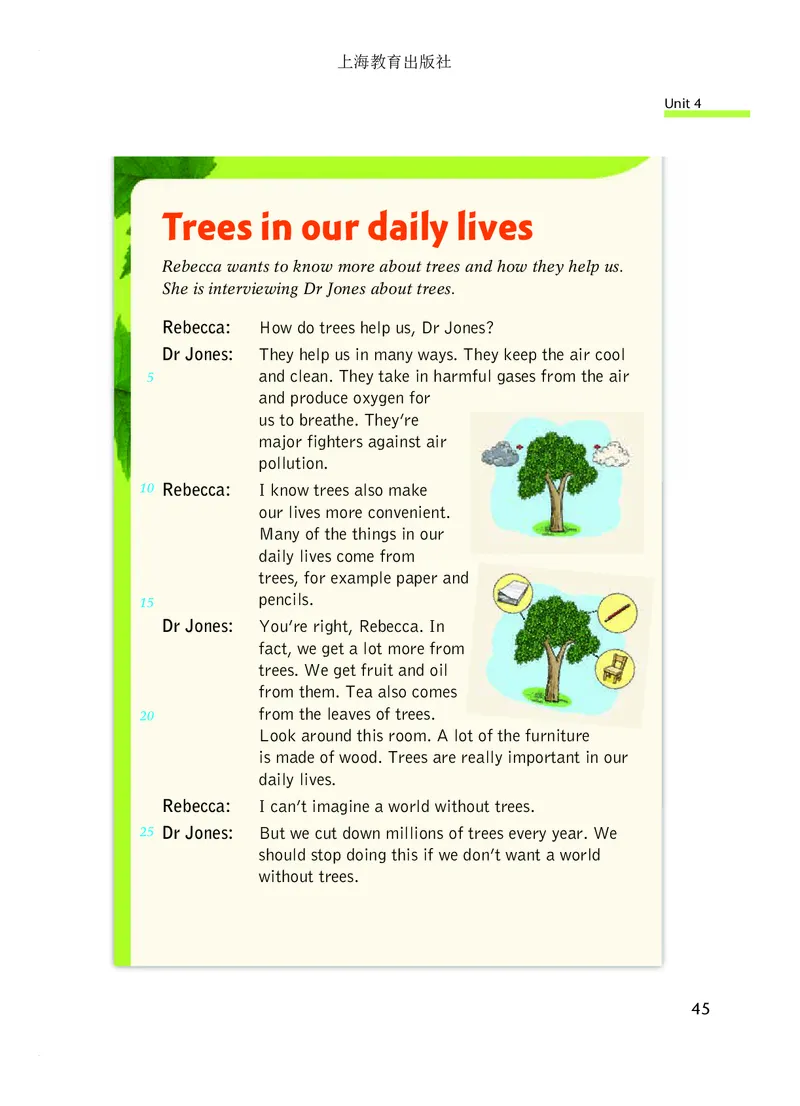
Trees in our daily lives
Rebecca wants to know more about trees and how they help us.
She is interviewing Dr Jones about trees.
Rebecca: How do trees help us, Dr Jones?
Dr Jones: They help us in many ways. They keep the air cool
5 and clean. They take in harmful gases from the air
and produce oxygen for
us to breathe. They’re
major fighters against air
pollution.
10 Rebecca: I know trees also make
our lives more convenient.
Many of the things in our
daily lives come from
trees, for example paper and
pencils.
15
Dr Jones: You’re right, Rebecca. In
fact, we get a lot more from
trees. We get fruit and oil
from them. Tea also comes
from the leaves of trees.
20
Look around this room. A lot of the furniture
is made of wood. Trees are really important in our
daily lives.
Rebecca: I can’t imagine a world without trees.
25 Dr Jones: But we cut down millions of trees every year. We
should stop doing this if we don’t want a world
without trees.
45上海教育出版社
Module 2
C Vocabulary
C1 The words in italics are from the article on page 45. Circle the correct answers to
complete these sentences.
1 Harmful gases are _____ people’s health.
a good for b bad for
2 Trees produce oxygen. They _____ oxygen.
a take b make
3 Air pollution is a major problem in the city. This problem is _____.
a big and important b not very important
4 Washing machines make our lives more convenient. With the help of
them, our lives become _____.
a easier b richer
5 When you imagine a picture, you have it _____.
a on paper b in your mind
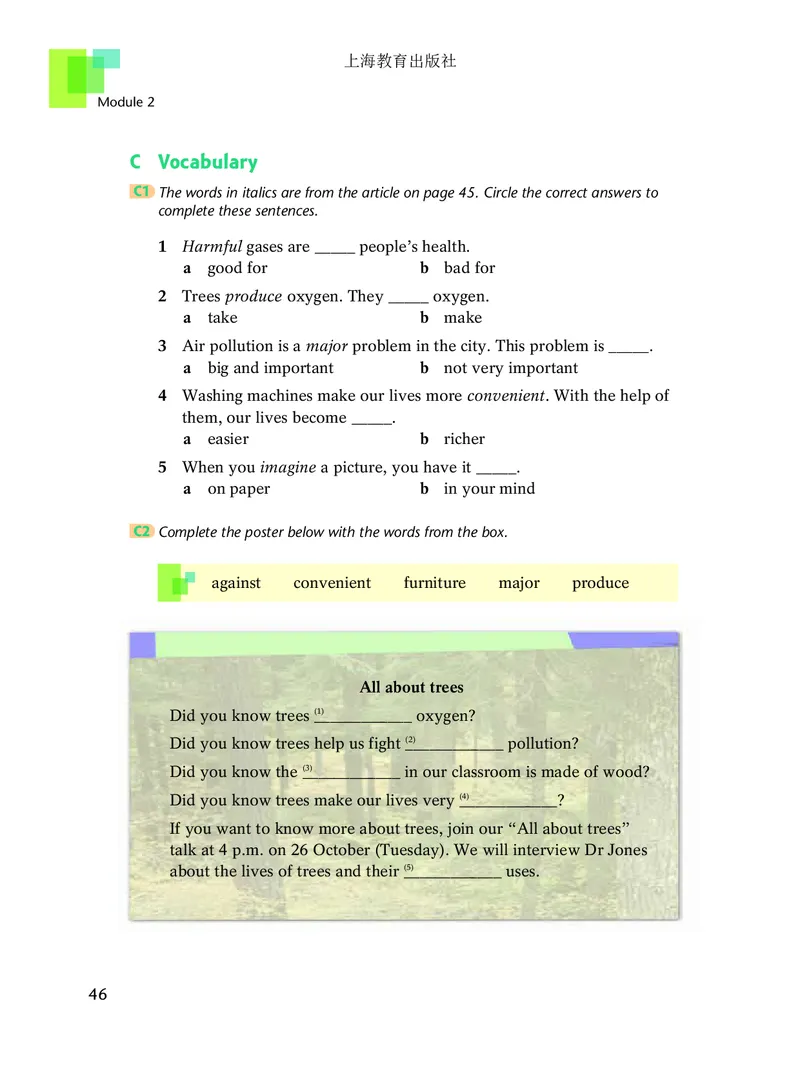
C2 Complete the poster below with the words from the box.
against convenient furniture major produce
All about trees
Did you know trees _(1)____________ oxygen?
Did you know trees help us fight (_2)____________ pollution?
Did you know the _(3)____________ in our classroom is made of wood?
Did you know trees make our lives very (_4)____________?
If you want to know more about trees, join our “All about trees”
talk at 4 p.m. on 26 October (Tuesday). We will interview Dr Jones
about the lives of trees and their (_5)____________ uses.
46上海教育出版社
Unit 4
Using suffixes to guess meanings
Look at these two sentences. Do you know the meanings of useful and
harmful?
Trees give us a lot of useful things.
Trees take in harmful gases from the air.
Useful and harmful both end in -ful. It is a suffix meaning “full of”.
D Comprehension
D1 Read the interview on page 45 and complete the notes below.
(cid:75)(cid:105)(cid:92)(cid:92)(cid:106)(cid:23)(cid:96)(cid:101)(cid:23)(cid:102)(cid:108)(cid:105)(cid:23)(cid:91)(cid:88)(cid:96)(cid:99)(cid:112)(cid:23)(cid:99)(cid:96)(cid:109)(cid:92)(cid:106)
(cid:75)(cid:105)(cid:92)(cid:92)(cid:106)(cid:23)(cid:88)(cid:105)(cid:92)(cid:23)(cid:100)(cid:88)(cid:97)(cid:102)(cid:105)(cid:23)(cid:93)(cid:96)(cid:94)(cid:95)(cid:107)(cid:92)(cid:105)(cid:106)(cid:23)(cid:88)(cid:94)(cid:88)(cid:96)(cid:101)(cid:106)(cid:107)(cid:23)_(1)__________________. (cid:75)(cid:95)(cid:92)(cid:112)(cid:49)
(cid:155) kee(cid:103) the air _(2)_________________________.
(cid:155) take in _(3)_________________________ from the air and
(cid:103)roduce o(cid:111)ygen.
(cid:75)(cid:105)(cid:92)(cid:92)(cid:106)(cid:23)(cid:100)(cid:88)(cid:98)(cid:92)(cid:23)(cid:102)(cid:108)(cid:105)(cid:23)(cid:99)(cid:96)(cid:109)(cid:92)(cid:106)(cid:23)_(4)_________________________.
(cid:155) (cid:68)any of the things (cid:31)e.g. (cid:103)a(cid:103)er and (cid:103)encils(cid:32) in our daily lives
_(5)_________________________.
(cid:155) We also get fruit, oil and tea from trees.
(cid:155) A lot of furniture is _(6)___________________________.
(cid:43)
D2 Why does Rebecca say “I can’t imagine a world without trees”? Discuss this with
your classmates.
47上海教育出版社
Module 2
Listening
Pine trees
When you are listening, pay special attention to the following words. They
will help you understand the text.
First(ly), Second(ly), etc. to introduce a list or a sequence of
things
For example, ... to give an example or examples
However, ... to give a different idea
Listen to a radio programme about pine trees and complete the notes below. Write
one word or figure in each blank.
• We can find pine trees in almost every (_1)_______________ of
(cid:36)hina.
• (cid:49)eople grow pine trees in cities because they are always
_(2)_______________ and they make the environment more
_(3)_______________.
• (cid:49)ine trees are very _(4)_______________.
(cid:166) They can grow in difficult environments.
• (cid:49)ine trees have very _(5)_______________ lives.
(cid:166) (cid:52)ome of them live more than (_6)_______________ years.
• (cid:49)ine trees are useful.
(cid:166) We use them to make _(7)_______________.
(cid:166) We use them in (_8)_______________ medicine to fight
against diseases.
48上海教育出版社
Unit 4
Grammar
The present continuous tense
We use the present continuous tense to show that something is
happening now.
The children are playing in the park.
We also use the present continuous tense to talk about temporary
situations.
We are staying at (cid:49)eter(cid:8)s house at the moment.
We form the present continuous tense like this:
Subject Verb to be Main verb
I am (not)
(cid:58)ou(cid:16)We(cid:16)They are (not) dreaming.
He(cid:16)(cid:52)he(cid:16)It is (not)
We form Yes/No questions and short answers in the present continuous
tense like this:
(cid:58)es, I am.
Am I reading?
No, I am not(cid:16)’m not.
(cid:58)es, you(cid:16)we(cid:16)they are.
Are you(cid:16)we(cid:16)they reading?
No, you(cid:16)we(cid:16)they are not(cid:16)aren’t(cid:16)’re not.
(cid:58)es, he(cid:16)she(cid:16)it is.
Is he(cid:16)she(cid:16)it reading?
No, he(cid:16)she(cid:16)it is not(cid:16)isn’t(cid:16)’s not.
We form Wh-questions in the present continuous tense like this:
What are you doing now?
Why is he sleeping here?
49上海教育出版社
Module 2
Work out the rule
We form the present continuous tense with the verb to be +
(the base form/the -ing form) of the main verb.
We form the -ing form of the main verb like this:
Main verb -ing form Example
Most verbs + ing feel (cid:171) feeling
Verbs ending in -e e + ing write (cid:171) writing
Verbs ending in -ie ie + ying die (cid:171) dying
Some verbs ending in a vowel Double the consonant run (cid:171) running
letter + a consonant letter letter + ing
A Katie is on holiday with her friends. She is telling Alex what everyone is doing. Look
at the picture below and complete the conversation with the verbs in brackets.
Grace Ivan
Carol
Ted
Jenny Henry
Katie
Laura
Jim
Katie: Hi, Alex. We (_1)____a_re_ _h_a_v_i_n_g_____ (have) fun at the beach.
Alex: What _(2)_____________ everyone ______________ (do)?
Katie: Ted _(3)_________________ (play) volleyball with Carol. Jenny
and Henry (_4)_________________ (play) badminton. Grace
_(5)_________________ (fish). Ivan (_6)_________________ (swim) in
the sea. Laura _(7)_________________ (sit) on the beach chair. She
_(8)_________________ (read) a book. Jim (_9)_________________ (make)
a sandcastle with his mother. And I (_10_)_______________ (talk) to
you on the phone, Alex.
50上海教育出版社
Unit 4
We do not usually use the verbs in the box below in the present
continuous tense. Instead, we use them in the simple present tense.
believe hear like prefer smell understand
hate know love see taste want
✓ I know the answer now. (cid:24) I am knowing the answer now.
✓ (cid:52)he likes this poem. (cid:24) (cid:52)he is liking this poem.
B Look at the pictures below and complete the conversations with the verbs
in brackets.
a Mum: The phone (_1)___________
(ring), Sam.
Sam: I (_2)___________ (know), but I’m
very busy. Could you answer
it, please?
b Mary: I _(3)___________ (think) about
what to wear to Jane’s
birthday party tonight. Can
you help me?
Ann: Sure. I (_4)___________ (prefer)
the long dress.
c Fred: That _(5)___________ (smell) very
nice. What (_6)___________ you
____________ (eat), Tom?
Tom: I _(7)___________ (eat) some
cake. (_8)___________ you
____________ (want) some?
51上海教育出版社
Module 2
Speaking
/sk/
/sp/
/st/
/sl/
A Talk time
/sm/
/pl/
/pr/
/kw/
/tw/
/sk/ /sp/ /st/
ask school crisp space first star
score sky special speed step stop
/sl/ /sm/
sleep slide slow small smile smoke
/pl/ /pr/
plane please reply practice present pretty
/kw/ /tw/
question quiet quit between twelve twenty
Read these sentences. Pay attention to the letters in bold.
1 Stanley is small and slim. He is a smart student, but he works slowly
when he is sleepy.
2 The queen likes playing sport. She likes skating a lot. She can skate at
a very high speed because she practises a lot.
3 They planned to have a quick meeting on the project for twenty
minutes, but the speaker did not stop speaking until twenty past
twelve.
B Speak up
In groups, discuss why trees are important.
Trees are good for …
We can make …
We also get …
52上海教育出版社
Unit 4
Writing
Tree Planting Day
It is Tree Planting Day. Some people are working
We use the present
near Rebecca’s home. Look at the pictures below
continuous tense
and describe them with the words in brackets. to describe what is
happening in photos or
pictures.
1 2
(two workers/dig/holes/ground) (two workers/carry/large
(another worker/plant/tree/in/ container) (another worker/
hole) plant/flowers/in/container)
3 4
(two workers/clean/area) (workers/leave/area) (people/
(another worker/water/plants) say/goodbye/workers)
53上海教育出版社
Module 2
(cid:43)
More practice
A Read the article below about the Amazon rainforest. Then complete the notes.
The Amazon rainforest
The Amazon rainforest in South America is the largest
rainforest in the world. It covers five and a half million
square kilometres of the Amazon Basin and spreads
across nine countries.
The Amazon rainforest is very important because it
is home to thousands of animals, birds and insects.
However, people are destroying the area by cutting
down many of the trees. This is called “deforestation”.
Many living things lose their homes because of
deforestation. As a result, the number of kinds
of animals, birds, insects and trees in the world is
decreasing.
We must do our best to protect the Amazon rainforest.
• The (cid:33)ma(cid:90)on rainforest is the (_1)________________ rainforest in the
world.
• It co(cid:86)ers (cid:21).(cid:21) million s(cid:81)uare kilometres of the (_2)_______________
_________________.
• It spreads across _(3)________________ countries.
• The rainforest is important because it is (_4)________________ to many
li(cid:86)ing things.
• The rainforest is in danger because of (_5)________________ (cid:8)the cutting
down of trees(cid:9).
B What else do you know about the Amazon rainforest? In groups, do some research
and discuss it.
54上海教育出版社
Unit 4
Culture corner
Chinese tea
TTeeaa iiss tthhee mmoosstt ppooppuullaarr ddrriinnkk iinn tthhee wwoorrlldd bbeessiiddeess
water. All tea comes from the tea plant. People
pick leaves from it to make tea.
The habit of drinking tea has a long history
in China. According to an old story, Chinese
Emperor Shennong discovered tea. Lu Yu, a
writer during the Tang Dynasty, wrote the first
book about tea.
There are several types of Chinese tea, such as
white tea, green tea and black tea.
Do you like drinking tea? What else do you know about tea?
How well do you know this unit? Tick ✓ the boxes.
❶ I can read an interview about trees.
❷ I know how to use suffixes to guess the meanings
of words.
❸ I can listen for specific information about pine
trees.
❹ I can use the present continuous tense correctly.
❺ I can say the /sk/, /sp/, /st/, /sl/, /sm/, /pl/, /pr/,
/kw/ and /tw/ sounds correctly.
❻ I can talk about the importance of trees.
❼ I can describe some pictures.
❽ I know about Chinese tea.
55上海教育出版社
(cid:43)
PPPrrrooojjjeeecccttt
Planning green activities
Do you want to improve your school environment? In this project, you will
write a plan for a green project.
A In groups, have a brainstorming meeting and write down your ideas for the green
project.
design an indoor garden or a roof garden
plant more trees and flowers
reduce, reuse, recycle
B Write a plan for your project. Use the outline below to help you.
____________________________ Title of the
(e.g. A mini-garden at school) project
How the
project will
(e.g. Plants help clean the air.) help protect/
improve
the school
environment
(e.g. Firstly, we will grow some plants in the area How you
will do the
next to the playground. Secondly, we will ask
project
students to … Finally, …)
Conclusion
(e.g. We believe that this project will help improve the
school environment …)
56上海教育出版社
Module 3 Natural elements
Unit
5
WWWaaattteeerrr
Getting ready
In this unit, you will learn about water and its importance in our lives.
Reading
• Read a story about a girl talking to a drop of water.
Listening
• Listen to a story about the journey of a coin.
Grammar
• Learn how to talk about quantities.
Speaking
• Learn to say the /str/, /spl/, /spr/ and /skr/ sounds.
• Talk about how water becomes rain.
Writing
• Write a short paragraph about an experiment.
Don’t use the pool
today, Lo. I didn’t put
any water in it.
57上海教育出版社
Module 3
Reading
A What do you know about …?
How much do you know about water? Try the short quiz below. Circle the
correct answers.
1 You can live without water for a few _____.
a hours b days c weeks
2 When you exercise, you need _____ water.
a more b less c no
3 Water covers about _____ of the Earth.
a one third b one half c two thirds
4 About _____ of the water on Earth is “fresh” or without salt.
a 3% b 10% c 20%
B Before you read
B1 Look at the picture below and put the following sentences in the correct order.
Write the numbers 1–5 in the boxes.
It runs into rivers.
It rises from the sea
to the sky.
It runs into the sea.
It falls as rain again.
Water falls from the 1
clouds as rain.
B2 Look at the picture and the title of the story on page 59. Who do you think is
talking to the girl?
58上海教育出版社
Unit 5
Water talks
Dora was in the bathroom. The tap was on.
“Turn that tap off,” said an angry voice. “You’re wasting water.”
Dora looked around, but there was no one there.
“Who are you?”
5 “I’m a drop of water. Do you know where I come from?”
“From the tap?” asked Dora.
“A few days ago, I was in a cloud,” said the drop of water. “Then
I dropped into a river and ran into a reservoir. Then it was time for
people to clean me.”
10 “Clean you?” Dora asked.
“Yes. I was dirty. They cleaned me and added some chemicals to me.
Then I travelled through the pipes under the streets and now I’m here.”
Dora asked, “So is this the end of your journey?”
“No. People will make me clean again. I’ll
15 go into a river and then into the sea again.”
“Again?”
“Yes. My journey starts there. Remember
not to waste or pollute me. I’m valuable.”
Dora turned the tap off and came out of
20 the bathroom.
59上海教育出版社
Module 3
C Vocabulary
C1 The words in italics are from the article on page 59. Circle the correct answers to
complete these sentences.
1 If you turn a tap off, the water _____ from the tap.
a stops running b starts running
2 The rain dropped. It _____ from the sky.
a fell down b disappeared
3 When you add some chemicals to water, you _____ the water.
a get some chemicals from
b put some chemicals in
4 If you had a good journey, you _____.
a had a wonderful party with your friends at home
b travelled happily from one place to another
5 Water is valuable. It is _____.
a very clean b useful and important
C2 Complete Dora’s diary below with the words from the box.
added … to journey valuable
dropped turn … off voice
(cid:40)(cid:41)(cid:23)(cid:65)(cid:108)(cid:99)(cid:112)
D(cid:92)(cid:88)(cid:105)(cid:23)D(cid:96)(cid:88)(cid:105)(cid:112)(cid:35)
(cid:64)(cid:23)(cid:107)(cid:88)(cid:99)(cid:98)(cid:92)(cid:91)(cid:23)(cid:107)(cid:102)(cid:23)(cid:88)(cid:23)(cid:91)(cid:105)(cid:102)(cid:103)(cid:23)(cid:102)(cid:93)(cid:23)(cid:110)(cid:88)(cid:107)(cid:92)(cid:105)(cid:23)(cid:107)(cid:102)(cid:91)(cid:88)(cid:112)(cid:37)(cid:23)(cid:64)(cid:107)(cid:23)(cid:110)(cid:88)(cid:106)(cid:23)(cid:105)(cid:92)(cid:88)(cid:99)(cid:99)(cid:112)(cid:23)(cid:96)(cid:101)(cid:107)(cid:92)(cid:105)(cid:92)(cid:106)(cid:107)(cid:96)(cid:101)(cid:94)(cid:37)
(cid:64)(cid:101)(cid:23)(cid:107)(cid:95)(cid:92)(cid:23)(cid:100)(cid:102)(cid:105)(cid:101)(cid:96)(cid:101)(cid:94)(cid:35)(cid:23)(cid:64)(cid:23)(cid:99)(cid:92)(cid:93)(cid:107)(cid:23)(cid:107)(cid:95)(cid:92)(cid:23)(cid:107)(cid:88)(cid:103)(cid:23)(cid:102)(cid:101)(cid:23)(cid:96)(cid:101)(cid:23)(cid:107)(cid:95)(cid:92)(cid:23)(cid:89)(cid:88)(cid:107)(cid:95)(cid:105)(cid:102)(cid:102)(cid:100)(cid:37)(cid:23)(cid:75)(cid:95)(cid:92)(cid:101)(cid:23)(cid:64)(cid:23)(cid:95)(cid:92)(cid:88)(cid:105)(cid:91)(cid:23)(cid:88)(cid:101)(cid:23)(cid:88)(cid:101)(cid:94)(cid:105)(cid:112)(cid:23)
_(1)__________(cid:37)(cid:23)(cid:64)(cid:107)(cid:23)(cid:107)(cid:102)(cid:99)(cid:91)(cid:23)(cid:100)(cid:92)(cid:23)(cid:107)(cid:102)(cid:23)(_2)__________(cid:23)(cid:107)(cid:95)(cid:92)(cid:23)(cid:107)(cid:88)(cid:103)(cid:23)_________(cid:37)(cid:23)
(cid:64)(cid:107)(cid:23)(cid:110)(cid:88)(cid:106)(cid:23)(cid:88)(cid:23)(cid:91)(cid:105)(cid:102)(cid:103)(cid:23)(cid:102)(cid:93)(cid:23)(cid:110)(cid:88)(cid:107)(cid:92)(cid:105)(cid:24)(cid:23)(cid:64)(cid:107)(cid:23)(cid:107)(cid:102)(cid:99)(cid:91)(cid:23)(cid:100)(cid:92)(cid:23)(cid:88)(cid:89)(cid:102)(cid:108)(cid:107)(cid:23)(cid:96)(cid:107)(cid:106)(cid:23)(_3)__________(cid:37)(cid:23)(cid:64)(cid:107)(cid:23)(_4)__________(cid:23)
(cid:93)(cid:105)(cid:102)(cid:100)(cid:23)(cid:88)(cid:23)(cid:90)(cid:99)(cid:102)(cid:108)(cid:91)(cid:23)(cid:96)(cid:101)(cid:107)(cid:102)(cid:23)(cid:88)(cid:23)(cid:105)(cid:96)(cid:109)(cid:92)(cid:105)(cid:37)(cid:23)(cid:78)(cid:92)(cid:23)(cid:90)(cid:102)(cid:108)(cid:99)(cid:91)(cid:23)(cid:101)(cid:102)(cid:107)(cid:23)(cid:91)(cid:105)(cid:96)(cid:101)(cid:98)(cid:23)(cid:107)(cid:95)(cid:96)(cid:106)(cid:23)(cid:110)(cid:88)(cid:107)(cid:92)(cid:105)(cid:23)(cid:89)(cid:92)(cid:90)(cid:88)(cid:108)(cid:106)(cid:92)(cid:23)(cid:96)(cid:107)(cid:23)(cid:110)(cid:88)(cid:106)(cid:23)(cid:91)(cid:96)(cid:105)(cid:107)(cid:112)(cid:35)(cid:23)(cid:106)(cid:102)(cid:23)
(cid:103)(cid:92)(cid:102)(cid:103)(cid:99)(cid:92)(cid:23)(cid:95)(cid:88)(cid:91)(cid:23)(cid:107)(cid:102)(cid:23)(cid:90)(cid:99)(cid:92)(cid:88)(cid:101)(cid:23)(cid:96)(cid:107)(cid:37)(cid:23)(cid:75)(cid:95)(cid:92)(cid:112)(cid:23)_(5)__________(cid:23)(cid:106)(cid:102)(cid:100)(cid:92)(cid:23)(cid:90)(cid:95)(cid:92)(cid:100)(cid:96)(cid:90)(cid:88)(cid:99)(cid:106)(cid:23)__________(cid:23)(cid:107)(cid:95)(cid:92)(cid:23)
(cid:110)(cid:88)(cid:107)(cid:92)(cid:105)(cid:23)(cid:107)(cid:102)(cid:23)(cid:100)(cid:88)(cid:98)(cid:92)(cid:23)(cid:96)(cid:107)(cid:23)(cid:90)(cid:99)(cid:92)(cid:88)(cid:101)(cid:37)(cid:23)(cid:75)(cid:95)(cid:92)(cid:101)(cid:23)(cid:96)(cid:107)(cid:23)(cid:107)(cid:105)(cid:88)(cid:109)(cid:92)(cid:99)(cid:99)(cid:92)(cid:91)(cid:23)(cid:107)(cid:102)(cid:23)(cid:100)(cid:112)(cid:23)(cid:95)(cid:102)(cid:100)(cid:92)(cid:37)
(cid:78)(cid:88)(cid:107)(cid:92)(cid:105)(cid:23)(cid:96)(cid:106)(cid:23)(cid:109)(cid:92)(cid:105)(cid:112)(cid:23)_(6)__________(cid:37)(cid:23)(cid:71)(cid:92)(cid:102)(cid:103)(cid:99)(cid:92)(cid:23)(cid:106)(cid:95)(cid:102)(cid:108)(cid:99)(cid:91)(cid:23)(cid:101)(cid:102)(cid:107)(cid:23)(cid:110)(cid:88)(cid:106)(cid:107)(cid:92)(cid:23)(cid:102)(cid:105)(cid:23)(cid:103)(cid:102)(cid:99)(cid:99)(cid:108)(cid:107)(cid:92)(cid:23)(cid:96)(cid:107)(cid:37)
60上海教育出版社
Unit 5
D Comprehension
D1 The map below shows the water’s journey. Read the story on page 59 and write
the names of the different places on the map with the words from the box.
_(1)__________
clouds
Dora’s
bathroom
pipes
(_2)__________
reservoir
_(3)__________
river
sea
(_4)__________
Clean the water here.
_(6)__________
_(5)_D_o_r_a_’s_ b_a_th_r_o_om__ Clean the water here.
D2 Read the story again and complete the answers to the questions below.
1 Why was the drop of water angry?
Because Dora _____w_a_s_ w__a_s_t_in_g_ w_a_t_e_r_____.
2 Why did people clean the water after it ran into a reservoir?
Because it ________________________.
3 Why would the drop of water go into the sea again?
Because its journey ________________________.
4 Why did the drop of water tell Dora not to waste or pollute it?
Because water ________________________.
(cid:43)
D3 Do you think water is valuable? Why? Discuss this with your classmates.
61上海教育出版社
Module 3
Listening
The journey of a coin
One day, Dora’s mother gave her a coin. It was a bit dirty, so Dora
washed it. Then it started talking to Dora.
A Listen to the coin’s story. Then put the pictures in the correct order. Write the
numbers 1–6 in the boxes.
a b c
d e f
B Dora wrote down the coin’s story in her diary. Listen to the story again and
complete Dora’s diary below. Write one word in each blank.
(cid:40)(cid:23)A(cid:108)(cid:94)(cid:108)(cid:106)(cid:107)
D(cid:92)(cid:88)(cid:105)(cid:23)D(cid:96)(cid:88)(cid:105)(cid:112)(cid:35)
(cid:75)(cid:102)(cid:91)(cid:88)(cid:112)(cid:23)(cid:64)(cid:23)(cid:107)(cid:88)(cid:99)(cid:98)(cid:92)(cid:91)(cid:23)(cid:107)(cid:102)(cid:23)(cid:88)(cid:23)(cid:90)(cid:102)(cid:96)(cid:101)(cid:37)(cid:23)(cid:78)(cid:95)(cid:92)(cid:101)(cid:23)(cid:96)(cid:107)(cid:23)(cid:110)(cid:88)(cid:106)(cid:23)(cid:100)(cid:88)(cid:91)(cid:92)(cid:35)(cid:23)(cid:96)(cid:107)(cid:23)(cid:110)(cid:88)(cid:106)(cid:23)(cid:101)(cid:96)(cid:90)(cid:92)(cid:23)(cid:88)(cid:101)(cid:91)(cid:23)(_1)_____________(cid:37)(cid:23)
(cid:71)(cid:92)(cid:102)(cid:103)(cid:99)(cid:92)(cid:23)_(2_) _____________(cid:23)(cid:107)(cid:95)(cid:92)(cid:23)(cid:90)(cid:102)(cid:96)(cid:101)(cid:23)(cid:107)(cid:102)(cid:23)(cid:88)(cid:23)(cid:89)(cid:88)(cid:101)(cid:98)(cid:37)(cid:23)(cid:64)(cid:107)(cid:23)(cid:106)(cid:107)(cid:88)(cid:112)(cid:92)(cid:91)(cid:23)(cid:107)(cid:95)(cid:92)(cid:105)(cid:92)(cid:23)(cid:93)(cid:102)(cid:105)(cid:23)(cid:88)(cid:23)(cid:93)(cid:92)(cid:110)(cid:23)
_(3_) _____________(cid:37)(cid:23)A(cid:23)(cid:103)(cid:92)(cid:105)(cid:106)(cid:102)(cid:101)(cid:23)(cid:88)(cid:107)(cid:23)(cid:107)(cid:95)(cid:92)(cid:23)(cid:89)(cid:88)(cid:101)(cid:98)(cid:23)(cid:94)(cid:88)(cid:109)(cid:92)(cid:23)(cid:107)(cid:95)(cid:92)(cid:23)(cid:90)(cid:102)(cid:96)(cid:101)(cid:23)(cid:107)(cid:102)(cid:23)(cid:88)(cid:23)(cid:100)(cid:88)(cid:101)(cid:37)(cid:23)(cid:68)(cid:112)(cid:23)(cid:100)(cid:102)(cid:107)(cid:95)(cid:92)(cid:105)(cid:23)
(cid:110)(cid:92)(cid:101)(cid:107)(cid:23)(cid:107)(cid:102)(cid:23)_(4_) _____________(cid:23)(cid:106)(cid:102)(cid:100)(cid:92)(cid:23)(cid:90)(cid:88)(cid:98)(cid:92)(cid:106)(cid:23)(cid:93)(cid:105)(cid:102)(cid:100)(cid:23)(cid:107)(cid:95)(cid:92)(cid:23)(cid:100)(cid:88)(cid:101)(cid:203)(cid:106)(cid:23)(cid:106)(cid:95)(cid:102)(cid:103)(cid:37)(cid:23)(cid:75)(cid:95)(cid:92)(cid:23)(cid:100)(cid:88)(cid:101)(cid:23)(cid:94)(cid:88)(cid:109)(cid:92)(cid:23)
(cid:107)(cid:95)(cid:92)(cid:23)(cid:90)(cid:102)(cid:96)(cid:101)(cid:23)(cid:107)(cid:102)(cid:23)(cid:95)(cid:92)(cid:105)(cid:23)(cid:88)(cid:106)(cid:23)(cid:103)(cid:88)(cid:105)(cid:107)(cid:23)(cid:102)(cid:93)(cid:23)(cid:95)(cid:92)(cid:105)(cid:23)(cid:90)(cid:95)(cid:88)(cid:101)(cid:94)(cid:92)(cid:37)(cid:23)(cid:74)(cid:95)(cid:92)(cid:23)_(5_) _____________ (cid:107)(cid:95)(cid:92)(cid:23)(cid:90)(cid:102)(cid:96)(cid:101)(cid:37)(cid:23)A(cid:23)
_(6_) _____________(cid:23)(cid:90)(cid:99)(cid:92)(cid:88)(cid:101)(cid:92)(cid:105)(cid:23)(cid:106)(cid:88)(cid:110)(cid:23)(cid:96)(cid:107)(cid:23)(cid:88)(cid:101)(cid:91)(cid:23)(_7_) _____________(cid:23)(cid:96)(cid:107)(cid:23)(cid:108)(cid:103)(cid:37)(cid:23)(cid:63)(cid:92)(cid:23)(cid:105)(cid:92)(cid:107)(cid:108)(cid:105)(cid:101)(cid:92)(cid:91)(cid:23)
(cid:96)(cid:107)(cid:23)(cid:107)(cid:102)(cid:23)(cid:100)(cid:112)(cid:23)(cid:100)(cid:102)(cid:107)(cid:95)(cid:92)(cid:105)(cid:37)(cid:23)(cid:74)(cid:95)(cid:92)(cid:23)(cid:94)(cid:88)(cid:109)(cid:92)(cid:23)(cid:96)(cid:107)(cid:23)(cid:107)(cid:102)(cid:23)(cid:100)(cid:92)(cid:23)(cid:88)(cid:106)(cid:23)(cid:103)(cid:102)(cid:90)(cid:98)(cid:92)(cid:107)(cid:23)(cid:100)(cid:102)(cid:101)(cid:92)(cid:112)(cid:37)(cid:23)(cid:64)(cid:23)_(8_) _____________(cid:23)(cid:107)(cid:95)(cid:92)(cid:23)
(cid:90)(cid:102)(cid:96)(cid:101)(cid:23)(cid:107)(cid:102)(cid:23)(cid:100)(cid:88)(cid:98)(cid:92)(cid:23)(cid:96)(cid:107)(cid:23)(cid:90)(cid:99)(cid:92)(cid:88)(cid:101)(cid:23)(cid:88)(cid:94)(cid:88)(cid:96)(cid:101)(cid:37)
62上海教育出版社
Unit 5
Grammar
Talking about quantities
We can use a lot of, a little, a few, (not) much, (not) many and no to talk
about quantities.
There is/’s a lot of/a little/not much/no water in this bottle.
There are a lot of/many/a few/not many/no bottles of water in the fridge.
We use how many and how much to ask about quantities.
How much water is there in this bottle?
How many bottles of water are there in the fridge?
Work out the rule
•(cid:1)(cid:56)(cid:70)(cid:1)(cid:86)(cid:84)(cid:70)(cid:1)how much, a little and (not) much with (countable/
uncountable) nouns.
•(cid:1)(cid:56)(cid:70)(cid:1)(cid:86)(cid:84)(cid:70)(cid:1)how many, a few and (not) many with (countable/
uncountable) nouns.
•(cid:1)(cid:56)(cid:70)(cid:1)(cid:86)(cid:84)(cid:70)(cid:1)a lot of and no with both countable and uncountable nouns.
Things to remember
We usually use much in negative sentences.
There is not much fresh water.
A Look at the pictures below and on page 64. Then complete the questions and
answers.
1
Q: Is there a lot of water in the
pool?
A: No, there’s (_1)______________
________________________.
63上海教育出版社
Module 3
2 157,500 L Q: Is there a lot of water in the
pool?
A: Yes, there’s (_2)_______________
_________________________.
Q: _(3)____________ water is there
in the pool?
A: There are 157,500 litres of
water in the pool.
3 Q: Are there many people in
the pool?
A: Yes, (_4)_____________________
_________________________.
Q: _(5)______________ people are
there in the pool?
A: There are 10 people in the
pool.
4 Q: Are there many people in
the pool?
A: _(6)____________________________
__________________________
Q: _(7)__________________________
__________________________
A: There are only two people in
the pool.
We can use too much, too many, too little, too few and (not) enough to
talk about quantities.
Quantities Examples
more than enough too much water too many oranges
not enough too little milk too few eggs
just right enough salt enough onions
64上海教育出版社
Unit 5
Work out the rule
•(cid:1)(cid:56)(cid:70)(cid:1)(cid:86)(cid:84)(cid:70)(cid:1)too many and too few with (countable/uncountable) nouns.
•(cid:1)(cid:56)(cid:70)(cid:1)(cid:86)(cid:84)(cid:70)(cid:1)too much and too little with (countable/uncountable) nouns.
•(cid:1)(cid:56)(cid:70)(cid:1)(cid:86)(cid:84)(cid:70)(cid:1)(not) enough with both countable and uncountable nouns.
B Dora and Jane want to cook orange beef. They are checking whether they have
enough ingredients. Complete their conversations.
Orange beef
enough
Ingredients
how many
450 g beef 15 ml orange juice
how much
3 oranges 12 g sugar
2 onions 10 ml cooking oil too little
too much
Dora: Do we have (_1)____________ beef,
Dora and Jane have:
Jane?
•(cid:1)(cid:80)(cid:83)(cid:66)(cid:79)(cid:72)(cid:70)(cid:1)(cid:75)(cid:86)(cid:74)(cid:68)(cid:70)(cid:1) (cid:19)(cid:17)(cid:1)(cid:78)(cid:77)
Jane: No, we don’t. We only have 200
•(cid:1)(cid:84)(cid:86)(cid:72)(cid:66)(cid:83)(cid:1) (cid:22)(cid:1)(cid:72)
grams.
•(cid:1)(cid:68)(cid:80)(cid:80)(cid:76)(cid:74)(cid:79)(cid:72)(cid:1)(cid:80)(cid:74)(cid:77)(cid:1) (cid:18)(cid:17)(cid:17)(cid:1)(cid:78)(cid:77)
Dora: We need to buy some more beef.
•(cid:1)(cid:80)(cid:79)(cid:74)(cid:80)(cid:79)(cid:84)(cid:1) (cid:17)
_(2)____________ onions do we have?
•(cid:1)(cid:67)(cid:70)(cid:70)(cid:71)(cid:1) (cid:19)(cid:17)(cid:17)(cid:1)(cid:72)
Jane: We don’t have any!
•(cid:1)(cid:80)(cid:83)(cid:66)(cid:79)(cid:72)(cid:70)(cid:84)(cid:1) (cid:18)
Dora: Let’s buy two onions then.
Dora: (_3)____________ cooking oil do we have?
Jane: We have 100 millilitres. That’s more than enough. We shouldn’t
add _(4)____________ cooking oil.
Dora: Do we need to buy any sugar?
Jane: Yes, we do. We only have five grams. The dish will be too sour if
we add (_5)____________ sugar. By the way, we have (_6)___________
orange juice.
Dora: Great! Let’s go to the supermarket now!
65上海教育出版社
Module 3
Speaking
A Talk time
/str/ /spl/
/spl/
/str/ strange street strong splash splendid split
/spr/ /skr/
/skr/
/spr/
spray spread spring scream screen script
A1 Listen carefully and circle the word you hear from each pair.
1 /streI/ /steI/ 3 /splIt/ /spIt/ 5 /skrim/ /strim/
2 /strIN/ /sprIN/ 4 /3splendR(r)/ /3spendR(r)/ 6 /strIpt/ /skrIpt /
A2 Read these sentences. Pay attention to the letters in bold.
1 The strawberry plant in the street looks strange, but the strawberries
are nice and sweet.
2 Heavy rain splattered on the roof and splashed against the windows
of the splendid house.
3 Sprinkle the seeds around. Spread them out. In spring, you will have
green sprouts.
4 The screenwriter screamed when she saw the script.
B Speak up
How does water become rain? In groups, talk about this process.
First, … Then, …
Next, … Finally, …
heats the water
becomes vapour
forms clouds
cools and forms small drops of water
rain falls
66上海教育出版社
Unit 5
Writing
An experiment
A What experiment is the boy doing? In groups, describe the pictures.
Add some salt to a glass of water.
Stir the water. (disappear, become part of)
Heat the water. (a white cloud, be made up of, small drops of,
continue)
Finally, ... (start to dry up)
B Write a short paragraph about this experiment. Use the information in A to help you.
(cid:61)(cid:96)(cid:105)(cid:106)(cid:107)(cid:35)(cid:23)(cid:88)(cid:91)(cid:91)(cid:23)(cid:106)(cid:102)(cid:100)(cid:92)(cid:23)(cid:106)(cid:88)(cid:99)(cid:107)(cid:23)(cid:107)(cid:102)(cid:23)(cid:88)(cid:23)(cid:94)(cid:99)(cid:88)(cid:106)(cid:106)(cid:23)(cid:102)(cid:93)(cid:23)(cid:110)(cid:88)(cid:107)(cid:92)(cid:105)(cid:37) ________________________
___________________________________________________
___________________________________________________
___________________________________________________
(cid:61)(cid:96)(cid:101)(cid:88)(cid:99)(cid:99)(cid:112)(cid:35)(cid:23)___________________________. (cid:75)(cid:95)(cid:92)(cid:23)(cid:106)(cid:88)(cid:99)(cid:107)(cid:23)(cid:107)(cid:108)(cid:105)(cid:101)(cid:106)(cid:23)(cid:96)(cid:101)(cid:107)(cid:102)(cid:23)(cid:90)(cid:105)(cid:112)(cid:106)(cid:107)(cid:88)(cid:99)(cid:106)(cid:37)
67上海教育出版社
Module 3
(cid:43)
More practice
A Read the online article about water. Then complete the notes below.
Facts about water
Here are some interesting facts about water:
• (cid:34)bout (cid:24)(cid:17)(cid:6) of the human body is water.
• (cid:48)ceans cover about (cid:24)(cid:22)(cid:6) of the (cid:38)arth, but ocean water is salty.
Therefore most of the water in the world is not drinkable.
• (cid:40)roundwater may be drinkable, but it is not easy to find
groundwater that is clean and safe to drink.
• (cid:42)f water drips from your tap every (cid:18)(cid:17) seconds, you will waste about
(cid:20)(cid:18)(cid:22) litres of water a year(cid:137)enough to fill two baths(cid:2)
• (cid:41)aving a bath uses about twice as much water as taking a shower.
(cid:41)aving a shower instead of a bath can save up to (cid:21)(cid:17)(cid:17) litres a week.
Some facts about water:
• Water makes up 70% of the (_1)______________ body.
• Most of the water in the world is not (_2)______________.
• It is not easy to find _(3)_______________ that is clean and safe to drink.
How can we save water?
• Fix a dripping _(4)______________.
• Take a _(5)_______________ instead of a (_6)_________________.
B In groups, discuss what else we can do to save water.
68上海教育出版社
Unit 5
SSttuuddyy sskkiillllss
(cid:43)
Parts of a book (2): The index
An index is like a contents page—they both help you find information in
a book quickly. The index usually comes at the end of the book.
Where can you learn about the following information? Look at the index below.
Write the correct key words and page numbers in the spaces.
1 how farmers use water ____A_g_r_i_c_u_lt_u_r_e_ ___ ( 6 6– 84 )
2 which kinds of water we can drink _________________ ( )
3 how people use sea water _________________ ( )
4 famous lakes in China _________________ ( )
5 how people treat dirty water _________________ ( )
6 water pollution _________________ ( )
Agriculture 66–84 Pollution 33
Cooking 31 Rivers 4
Diseases 25 Salt 55
Drinking water 6 Sea water 50
Fresh water 6 Shortages 88
Fish 42 Snow 27
Floods 40 Streams 3
Groundwater 12 Tap water 15
Ice 5 Treatment 36–39
Industry 85–99 Wastewater 31–35
Lakes 4 • From daily life 31
Measurements 2 • From factories 32, 98
Mineral water 6 • From hospitals 34, 96
Policy and laws 131–165 • From other sources 35
• African countries 132 Water cycle 15
• China 142 Weather 8–10
• European Union 148 • Clouds 8
• Russia 145 • Fog 8
• USA 160 • Rain 9
69上海教育出版社
Module 3
Culture corner
Venice
Venice is famous throughout
the world. People also call it the
“Floating City” and the “City of
Water” because the whole city
is on the water—there are over
117 small islands and over 400
bridges in this city. One of the
best ways to see the city is on a
gondola—a traditional boat.
What else do you know about Venice?
How well do you know this unit? Tick ✓ the boxes.
❶ I can read a story about a girl talking to a drop of
water.
❷ I can listen for the sequence of events in a story
about the journey of a coin.
❸ I can talk about quantities correctly.
❹ I can say the /str/, /spl/, /spr/ and /skr/ sounds
correctly.
❺ I can talk about how water becomes rain with my
classmates.
❻ I can write a short paragraph about an experiment.
❼ I know about Venice.
70上海教育出版社
Module 3 Natural elements
Unit
6
EEEllleeeccctttrrriiiccciiitttyyy
Getting ready
In this unit, you will learn about electricity.
Reading
• Read a story about electricity.
Listening
• Listen to a conversation about electricity in a flat.
Grammar
• Learn how to use the modal verbs can, may and must.
Speaking
• Learn to identify the syllables in English words.
• Talk about safety rules at home.
Writing
•• MMaakkee ssoommee hhoommee rruulleess..
I’m a robot. My energy
comes from electricity.
I’m a boy. My energy
comes from food.
71上海教育出版社
Module 3
Reading
A What do you know about …?
There are different ways of producing electricity. Write the correct words in
the blanks.
solar power water power wind power
1
3
2
______________
______________
______________
B Before you read
Look at the photos and the title of the story on page 73. Then answer the
questions below.
1 What did the girl buy?
2 What do you think the story may be about? Tick (✓) the possible
answers.
a Where electricity comes from.
b What electricity is like.
c What we use electricity for.
d How we can use electricity safely.
72上海教育出版社
Unit 6
Electricity all around
One evening, Daisy said, “I’m going to
buy a packet of sweets. Does anyone
want anything?”
Benny, Daisy’s brother, replied, “Can you
5 get me a packet of electricity?”
“Yes, I can,” said Daisy. Then she went out.
Benny laughed, “She can’t buy electricity
in packets like sweets! She’ll look foolish.”
Mum said, “You mustn’t say that, Benny!”
10 “What do you know about electricity, Benny?” Dad asked.
“Electricity gives us power. It flows through wires. It’s like water, in a
way,” said Benny.
“You’re right! Electricity comes into our flat through thin wires. These
are connected to cables under the street,” Dad added.
15 “What are the cables connected to?” asked Benny.
“They’re connected to a power station,” answered Dad.
A moment later, Daisy came back.
“May I have my packet of electricity?” Benny asked.
“Here you are!” said Daisy.
20 “But … these are batteries!” said Benny.
“Daisy’s right,” said Dad. “The chemicals
inside batteries produce electricity.”
Mum said, “Who looks foolish now, Benny?”
73上海教育出版社
Module 3
C Vocabulary
C1 The words in italics are from the story on page 73. Circle the correct answers to complete
these sentences.
1 If you reply to a question, you _____ it.
a ask b answer
2 A foolish person usually does _____ things.
a harmful b silly
3 When my computer is connected to the Internet, the Internet _____ my
computer and the other computers in the world together.
a joins b carries
4 If you ask someone to wait for a moment, you will come back in _____.
a a long time b a short time
5 Batteries provide toy cars with _____.
a electricity b heat
C2 Complete the passage below with the words from the box.
anyone connected to in a way power station wires
Electricity is like water, (_1)___________________. It flows from the
_(2)___________________ to our homes.
The lights, TVs and computers in our homes are (_3)______________________
the power station through _(4)____________________.
Electricity is very important to us. We need it at home, at work and in
schools. Could _(5)___________________ live in a world without electricity?
Compound nouns
Power station is a compound noun. We may guess the meaning of a compound
noun by looking at the two nouns. See more examples below:
bath + room = bathroom living + room = living room
74上海教育出版社
Unit 6
D Comprehension
D1 Find these sentences in the story on page 73. Then write the name of the person or
thing that each pronoun in italics refers to.
1 I’m going to buy a packet of sweets. (lines 1–2) _____D_a_is_y_____
2 Can you get me a packet of electricity? (lines 4–5) _____________
3 She’ll look foolish. (line 8) _____________
4 It’s like water, in a way. (lines 11–12) _____________
5 They’re connected to a power station. (line 16) _____________
D2 The picture below shows how electricity gets to Benny’s flat. Fill in the blanks with
the correct words from the box.
cable power station wire
_(3)_______________
_(1)_______
_(2)_______
(cid:43)
D3 Who looks foolish in the end? Why? Discuss this with your classmates.
75上海教育出版社
Module 3
Listening
Electricity in Benny’s flat
The electricity in Benny’s flat is not working. Listen to the conversation between
Benny’s father and mother. Circle ON or OFF below each photo.
1 2 3
lights computer washing machine
(ON OFF) (ON OFF) (ON OFF)
4 5 6
rice cooker fridge television
(ON OFF) (ON OFF) (ON OFF)
76上海教育出版社
Unit 6
Grammar
Modal verbs
A can and cannot
We use the modal verbs can and cannot (can’t) to say we are able or
unable to do something.
We can use electricity to do many things.
We cannot/can’t see electricity.
Can you think of an example?
Yes, I can./No, I cannot/can’t.
Hi and Lo are talking about themselves. What are they saying? Read their
conversation and then complete the statements below with can or cannot.
I can swim, dance, play football
and speak two languages. I
can’t cook, play the guitar or
ride a bicycle.
I can fly, dance, play chess
and speak ten languages. I
can’t paint or drive a car.
1 Hi __________ play football.
2 Lo __________ paint.
3 Hi __________ speak as many languages as Lo.
4 Both Hi and Lo __________ dance.
5 Lo __________ drive a car, but he __________ play chess.
6 Hi __________ swim, but he __________ play the guitar.
77上海教育出版社
Module 3
B may and may not
We use may and may not to ask for and give permission. In less formal
situations, some people like to use can and cannot (can’t) for the same
purpose.
May/Can I use your mobile phone?
Yes, you may/can.
No, you may not/can’t.
You may/can turn on the TV.
You may not/cannot play in the kitchen.
Daisy is not feeling well today. Benny is at home with her. Read their conversation
below. Fill in the blanks with may or can.
Benny: How are you feeling, Daisy?
Daisy: Not very well.
Benny: _(1)_________ I get you a chair?
Daisy: Yes, thanks.
Benny: I’m going out. (_2)_________ I borrow
your bicycle, Daisy?
Daisy: Yes, you may. Before you go to meet
your friends, can you come and see
the doctor with me?
Benny: Yes, I _(3)_________. _(4)_________ I carry
your bag for you?
Daisy: Yes, that’s very kind of you,
Benny. I’m ready to go. (_5)_________
you open the door for me?
Benny: Yes, I can.
Daisy: Thanks.
78上海教育出版社
Unit 6
C must and must not
We use must and must not/mustn’t to tell people what to do or what not
to do.
You must not/mustn’t do that, Benny!
We must always be careful with electricity.
They must not/mustn’t play near the heater.
Work out the rule
After modal verbs such as can, may and must, we use
(the base form/the -ing form/the -ed form) of a verb.
Daisy saw a doctor. The doctor told her what to do and what not to do. Help her
write down the doctor’s instructions.
drink more water go to bed early
eat cold food share cups with others
go out alone take the medicine on time
1 I must drink more water.
2
3
4 I must not .
5
6
79上海教育出版社
Module 3
Speaking
A Talk time
Syllables
English words are made up of different parts. These parts are called
syllables. All words have one or more syllables, e.g.
1 syllable 2 syllables 3 syllables 4 syllables 5 syllables
form coo-ker com-pu-ter su-per-mar-ket e-lec-tri-ci-ty
A syllable usually has a vowel sound. However, the consonant sounds in
bold in the following words are separate syllables too.
little middle pencil people table uncle
A1 Look at the syllables below. Combine them into words with hyphens (-).
pa-cket
2 syllables
3 syllables che-mi-cal
-ple
en- -gy -am-
-cal
ex- che- -cket pa-
-side
-er-
-mi- in- ca-
-ble
A2 Say these words. Then write the number of syllables in brackets.
1 newspaper ( 3 ) 5 candle ( )
2 hear ( ) 6 dangerous ( )
3 able ( ) 7 battery ( )
4 anyone ( ) 8 American ( )
80上海教育出版社
Unit 6
B Speak up
Johnny’s father is talking to Johnny about safety at home. Work in pairs. S1 is
Johnny. S2 is Dad. Follow the example.
cover the meat
lock the door
switch off the electricity
test the water
tidy up
______ change the bulb?
S1: May I change the bulb?
S2: No, you may not. You must switch off the electricity.
Then you may change the bulb.
1 2
______ put the meat in the fridge? ______ go to bed?
3 4
______ take a bath now? ______ go out now?
81上海教育出版社
Module 3
Writing
Home rules
A Johnny’s father is asking Johnny to make some rules for the family to follow. In
pairs, help Johnny make four rules.
close/windows/when/air conditioner/on
put/newspapers/near/heater
remember to take/keys/when/go out
touch/TV/wet hands
Home rules
We must: We must not:
1 close the windows when the air 1
conditioner is on;
2 2
B Add four more rules to the “Home rules” in A.
We must: We must not:
3 3
4 4
82上海教育出版社
Unit 6
(cid:43)
More practice
Read the article. Then complete the safety rules below.
Electricity safety tips
Electricity makes our lives easier. We use a lot of electrical appliances in our
homes every day. Here are three of them. How can we use them safely?
Rice cooker
• Keep the outside of the pot dry.
• Do not switch the rice cooker on if the pot is empty.
Washing machine
• Do not put your hand in the washing machine when it is on.
• Unplug it when you are not using it.
Microwave
• Do not turn it on when it is empty, because it might start a fire.
• Stand at least one metre away from the microwave when it is on.
• Before you put an object in a microwave, make sure it is microwave safe.
Rice cooker:
•(cid:1)(cid:58)(cid:80)(cid:86)(cid:1)(_1)_____________m__u_s_t_ k_e_e_p_ t_h_e_ o_u_t_s_i_d_e_ o_f_ t_h_e_ p_o_t_ _d_r_y_____________.
•(cid:1)(cid:58)(cid:80)(cid:86)(cid:1)_(2)_______________________________________ if the pot is empty.
Washing machine:
•(cid:1)(cid:58)(cid:80)(cid:86)(cid:1)_(3)____________________________________________ when it is on.
•(cid:1)(cid:58)(cid:80)(cid:86)(cid:1)_(4)_________________________________ when you are not using it.
Microwave:
•(cid:1)(cid:58)(cid:80)(cid:86)(cid:1)_(5)________________________________________ when it is empty.
•(cid:1)(cid:58)(cid:80)(cid:86)(cid:1)_(6)____________________________________________ when it is on.
•(cid:1)(cid:58)(cid:80)(cid:86)(cid:1)_(7)_________________________________________ in a microwave.
8833上海教育出版社
Module 3
Culture corner
Earth Hour
Earth Hour started in 2007 in
Sydney, Australia. In that year,
2.2 million people turned their
lights off for one hour. They
did this to show that they cared
about climate change. Since
then, people from all over the
world do the same on the last
Saturday of March every year.
More and more countries are
joining Earth Hour.
When will the next Earth Hour be? Will you take part in the next Earth Hour? Why?
How well do you know this unit? Tick ✓ the boxes.
❶ I can read a story about electricity.
❷ I can understand compound nouns.
❸ I can listen for information about electricity in
Benny’s flat.
❹ I can use the modal verbs can, may and must
correctly.
❺ I can identify the syllables in English words.
❻ I can talk about safety rules at home with my
classmate.
❼ I can make some home rules.
❽ I know about Earth Hour.
84PPPrrrooojjjeeecccttt
Saving water and electricity
Your class is going to make a poster about saving water and electricity.
Divide the class into two groups. One group will research the topic of water.
The other group will research the topic of electricity.
A Work on your own. Interview your parents to find out how much your family spent
on water/electricity last year. Complete the bar chart below. Follow the example.
300
250
200
150
100
50
0
Month
85
)nauy(
yticirtcele/retaw
no
tneps
yenoM
JAN FEB MAR APR MAY JUN JUL AUG SEP OCT NOV DEC
)nauy(
retaw
no
tneps
yenoM
上海教育出版社
(cid:43)
Month上海教育出版社
Module 3
B Look at your bar chart and then answer the questions below.
1 In which month(s) did your family spend the most on water/electricity?
Why?
2 In which month(s) did your family spend the least on water/electricity?
Why?
3 How much in total did your family spend on water/electricity last year?
C In groups, compare your bar charts. Then discuss the questions below.
1 Whose family spent the most on water/electricity last year? Why?
2 Whose family spent the least on water/electricity last year? Why?
3 What can we do to help our family spend less on water/electricity?
D In your group, brainstorm some rules for saving water/electricity at home.
Rules for saving water/electricity at home
Families must: Families must not:
E Work as a class to make a poster about saving water and electricity at home.
86
PB上海教育出版社
Module 4 Colourful life
Unit
7
PPPoooeeemmmsss
Getting ready
In this unit, you will learn some poems.
Reading
• Read two poems about ordinary people.
Listening
• Listen to four short poems about feelings.
Grammar
• Learn how to use imperatives to give orders or advice.
• Learn how to use exclamations to show strong feelings.
Speaking
• Learn about the different stress patterns of words.
• Read a poem aloud in a group.
Writing
•• CCoommpplleettee aa ppooeemm aabboouutt yyoouurr ccllaassss..
Let’s recite our
All right.
poem, Lo.
Lo: I sometimes wonder why
They didn’t call me Hi.
Hi: And I’d really like to know
Why they didn’t call me Lo.
87上海教育出版社
Module 4
Reading
A What do you know about …?
A1 The following is a quiz about poems.Tick (✓) the boxes to show your opinions.
Agree Disagree
1 We only use difficult words in poems.
2 All poems must have rhymes, e.g. cat/fat.
3 Poems are not only for children.
4 Poems can tell stories.
5 All poems use complete sentences.
6 We can write poems about our feelings and ideas.
A2 Some words at the ends of the lines in a poem have similar sounds. Read the poem
below and underline these words.
Water all around us
Water has no taste at all.
Water has no smell.
Water’s in the waterfall,
The tap,
And the well.
Water’s everywhere around us.
Water’s in the rain,
In the pond,
And in the sea again.
B Before you read
B1 Read the first poem on page 89 and underline the words with similar sounds (as
you did in A2).
B2 Read the two poems. Then discuss your answers to the quiz in A1.
88上海教育出版社
Unit 7
1 My dad
He comes home, has a shower,
And eats dinner, every day.
NNooww hhee’’ss ssiittttiinngg iinn hhiiss ffaavvoouurriittee cchhaaiirr
5 Too tired to laugh or play.
He reads his book or newspaper
To learn what’s new today.
Soon he’ll go to bed.
He’s a boring man, my dad.
10 Then I see him working,
On the building site.
He’s high up in the clouds
Higher than a kite.
HHee’’ss wwaallkkiinngg oonn aa nnaarrrrooww ppiieeccee ooff wwoooodd
15 Not worried about the height,
Not afraid, not afraid like me.
He’s a superman, my dad.
2 The old newspaper seller
He’s sitting at the newspaper stand They take their papers quickly,
20 Near the bus stop, And put down some money.
And he’s smiling. 30 But he’s a patient man,
And he’s still smiling.
The Sun is shining.
It’s very hot. A crowd of people,
But he’s smiling. All very busy, with tired faces,
And just one smile.
25 A bus stops, and the people rush out.
They’re hurrying to work. 35 Is there just one smile in this city?
They don’t have much time to smile. Or will you make it two?
Let’s make a million smiles!
89上海教育出版社
Module 4
C Vocabulary
C1 The words in italics are from the poems on page 89. Match the two halves of these
sentences to learn their meanings.
1 When you have a shower, a we mean a large group of
people.
2 When two large people try to b they get out very quickly.
walk through a narrow door,
3 If you are worried about c you wash your body while
something, standing.
4 When some people rush out d you are thinking about
from a bus, something and you feel unhappy
about it.
5 When we say “a crowd of e they cannot go through it at the
people”, same time.
C2 Look at the pictures. Complete the sentences below with the words from the box.
crowd heights shower smiles
1 2
I take a ____________ every day. There is a ____________ of
people at the train station.
3 4
If you are afraid of I buy my breakfast from this
_____________, you should not woman every day. She always
work on a building site. ____________ and says “Good
morning”.
90上海教育出版社
Unit 7
Rhymes in poems
Day and play both end in /eI/. We say that they rhyme. Site and kite
both end in /aIt/. They rhyme too. Rhymes often appear in poems.
D Comprehension
D1 David and Ann are discussing the two poems. Complete their conversation with the
information from the poems on page 89.
David: The first poem is interesting. The boy changed his idea about
(_1)_______________________ when he saw him working on the
building site.
Ann: That’s true. The boy thought his father was a
_(2)__________________________ at home, but he found out
that his father was (_3)________________________ at work.
David: I also like “The old newspaper seller”. It gives good advice to
people.
Ann: What advice does it give?
David: Everyone should _(4)_______________________.
Ann: I agree. It’s good for people to (_5)_______________ more often.
David: Yes, just like _(6)____________________________. He’s happy all
the time!
91上海教育出版社
Module 4
D2 Complete the following summaries of the poems. Write one word in each blank.
My dad
•(cid:1)(cid:41)(cid:80)(cid:88)(cid:1)(cid:78)(cid:66)(cid:79)(cid:90)(cid:1)(cid:87)(cid:70)(cid:83)(cid:84)(cid:70)(cid:84)(cid:1)(cid:69)(cid:80) (cid:70)(cid:84)(cid:1)(cid:85)(cid:73)(cid:74)(cid:84)(cid:1)(cid:81) (cid:80)(cid:70)(cid:78)(cid:1)(cid:73)(cid:66)(cid:87)(cid:70)(cid:32)(cid:1)(_1)___T_w_o_______.
•(cid:1)(cid:56)(cid:73)(cid:66)(cid:85)(cid:1)(cid:74)(cid:84)(cid:1)(cid:74)(cid:85)(cid:1)(cid:66)(cid:67)(cid:80)(cid:86)(cid:85)(cid:32)
Verse 1: The writer says that at _(2)____________ his father is
_(3)____________ because he does the same things
every evening.
Verse 2: T he writer sees his father at (_4)____________, high in the air,
and now he thinks that his dad is a _(5)____________.
•(cid:1)(cid:1)(cid:42)(cid:1)(cid:85)(cid:73)(cid:74)(cid:79)(cid:76)(cid:1)(cid:85)(cid:73)(cid:74)(cid:84)(cid:1)(cid:81)(cid:80)(cid:70)(cid:78)(cid:1)(cid:74)(cid:84)(cid:1)(_6)______________. (Use an adjective.)
The old newspaper seller
•(cid:1)(cid:41)(cid:80)(cid:88)(cid:1)(cid:78)(cid:66)(cid:79)(cid:90)(cid:1)(cid:87)(cid:70)(cid:83)(cid:84)(cid:70)(cid:84)(cid:1)(cid:69)(cid:80)(cid:70)(cid:84)(cid:1)(cid:85)(cid:73)(cid:74)(cid:84)(cid:1)(cid:81)(cid:80)(cid:70)(cid:78)(cid:1)(cid:73)(cid:66)(cid:87)(cid:70)(cid:32)(cid:1)(_7)_____________.
•(cid:1)(cid:56)(cid:73)(cid:66)(cid:85)(cid:1)(cid:74)(cid:84)(cid:1)(cid:74)(cid:85)(cid:1)(cid:66)(cid:67)(cid:80)(cid:86)(cid:85)(cid:32)
Verses 1 & 2: The writer tells us the man works at a newspaper
_(8)______________. It is a (_9)______________ day.
Verses 3–5: T he writer says that the people are (_10_)_____________ to
work. They look _(11_)_____________.
Verse 6: The writer wants everyone to (_12_)_____________ and be
happy.
•(cid:1)(cid:42)(cid:1)(cid:85)(cid:73)(cid:74)(cid:79)(cid:76)(cid:1)(cid:85)(cid:73)(cid:74)(cid:84)(cid:1)(cid:81)(cid:80)(cid:70)(cid:78)(cid:1)(cid:74)(cid:84)(cid:1)(_13_)_____________.
(cid:43)
D3 What do you think of the following lines? Discuss them with your classmates.
1 He’s a superman, my dad. 2 Let’s make a million smiles!
92上海教育出版社
Unit 7
Listening
Feelings
A Do you know the meanings of these words? Match the words with the faces below.
angry bored excited sad
1 2
______________ ______________
3 4
______________ ______________
B Listen to four short poems. How does the boy/girl feel in each of the poems?
Choose one of the four words from A for each poem.
1 ______________ 3 ______________
2 ______________ 4 ______________
93上海教育出版社
Module 4
Grammar
A Imperatives
We use imperatives to give orders or advice. There are positive and
negative imperatives.
Things to remember
Open the door, Daisy.
Don’t open the door, Daisy. We can use please in imperatives.
It is more polite.
Let’s make a million smiles!
Please turn off your phone.
Turn off your phone, please.
We need to add be before adjectives when we use them as imperatives.
Be quiet, girls.
Don’t be late again.
Work out the rule
•(cid:1)(cid:1)(cid:56)(cid:70)(cid:1)(cid:86)(cid:84)(cid:70)(cid:1)(cid:85)(cid:73)(cid:70)(cid:1)(cid:67)(cid:66)(cid:84)(cid:70)(cid:1)(cid:71)(cid:80)(cid:83)(cid:78)(cid:1)(cid:80)(cid:71)(cid:1)(cid:66)(cid:1)(cid:87)(cid:70)(cid:83)(cid:67)(cid:1)(cid:74)(cid:79)(cid:1)(cid:66)(cid:1)(cid:9)(cid:81)(cid:80)(cid:84)(cid:74)(cid:85)(cid:74)(cid:87)(cid:70)(cid:16)(cid:79)(cid:70)(cid:72)(cid:66)(cid:85)(cid:74)(cid:87)(cid:70)(cid:10)(cid:1)
imperative.
•(cid:1)(cid:1)(cid:42)(cid:79)(cid:1)(cid:66)(cid:1)(cid:9)(cid:81)(cid:80)(cid:84)(cid:74)(cid:85)(cid:74)(cid:87)(cid:70)(cid:16)(cid:79)(cid:70)(cid:72)(cid:66)(cid:85)(cid:74)(cid:87)(cid:70)(cid:10)(cid:1)imperative, we use don’t before the base
form of the verb.
Look at the picture. What will the teacher say? Make sentences with the words from
the box on page 95. Some of them must begin with Don’t.
94Unit 7
bring close eat sleep speak louder turn to
1 Bill is eating in class.
2 Rose left the door open on a
windy day.
3 Jane is answering a question in
a low voice.
4 James is sleeping at his desk.
5 Steven is looking at page 47.
He should look at page 74.
6 Mary brought her pet mouse
to school.
B Exclamations
Sometimes we use sentences with emphasis and strong feelings. These
sentences are called exclamations.
What + (a/an) + adjective + noun + subject + verb + !
How + adjective/adverb + subject + verb + !
What an interesting poem it is!
What beautiful flowers they are!
What bad weather it is!
How lucky we are!
How quickly the time passed!
How bright the stars are!
95
_
_
_
_
_
_
_
_
_
_
_
_
_
_
_
_
_
_
_
_
_
_
_
_
_
_
_
_
_
_
_
_
_
_
_
_
_
_
_
_
_
_
_
_
_
_
_
_
_
_
_
_
_
_
_
_
_
_
_
_
_
_
_
_
_
_
_
_
_
_
_
_
_
_
_
_
_
_
Don’t eat in class, Bill.
_
_
_
_
_
_
_
_
_
_
_
_
_
_
_
_
_
_
_
_
_
_
_
_
_
_
_
_
_
_
_
_
_
_
_
_
_
_
_
_
_
_
_
_
_
_
_
_
_
_
_
_
_
_
_
_
_
_
_
_
_
_
_
_
_
_
_
_
_
_
_
_
_
_
_
_
_
_
_
_
_
_
_
_
_
_
_
_
_
_
_
_
_
_
_
_
_
_
_
_
_
_
_
_
_
_
_
_
_
_
_
_
_
_
_
_
_
_
_
_
_
_
_
_
_
_
_
_
_
_
_
_
_
_
_
_
_
_
_
_
_
_
_
_
_
_
_
_
_
_
_
_
_
_
_
_
_
_
_
_
_
_
_
_
_
_
_
_
_
_
_
_
_
_
_
_
_
_
_
_
_
_
_
_
_
_
_
_
_
_
_
_
_
_
_
_
_
_
_
_
_
_
_
_
_
_
_
_
上海教育出版社
What beautiful flowers they are!上海教育出版社
Module 4
We can use a word or phrase as an exclamation, such as Oh no! or
Lovely! We can also use a word or phrase with what or how to show
strong feelings.
What an interesting poem! How lucky!
What beautiful flowers! How fast!
What bad weather! How bright!
Work out the rule
•(cid:1)(cid:1)(cid:56)(cid:70)(cid:1)(cid:80)(cid:71)(cid:85)(cid:70)(cid:79)(cid:1)(cid:67)(cid:70)(cid:72)(cid:74)(cid:79)(cid:1)(cid:66)(cid:79)(cid:1)exclamation with the word _______ or _______.
•(cid:1)(cid:56)(cid:70)(cid:1)(cid:80)(cid:71)(cid:85)(cid:70)(cid:79)(cid:1)(cid:86)(cid:84)(cid:70)(cid:1)(cid:105)(cid:64)(cid:64)(cid:64)(cid:64)(cid:64)(cid:64)(cid:64)(cid:119)(cid:1)(cid:66)(cid:85)(cid:1)(cid:85)(cid:73)(cid:70)(cid:1)(cid:70)(cid:79)(cid:69)(cid:1)(cid:80)(cid:71)(cid:1)(cid:66)(cid:79)(cid:1)exclamation.
B1 Rewrite the sentences below using exclamations with what or how.
1 You are wearing an old shirt.
2(cid:1) (cid:53)(cid:73)(cid:70)(cid:1)(cid:67)(cid:80)(cid:90)(cid:84)(cid:1)(cid:66)(cid:83)(cid:70)(cid:1)(cid:87)(cid:70)(cid:83)(cid:90)(cid:1)(cid:70)(cid:89)(cid:68)(cid:74)(cid:85)(cid:70)(cid:69)(cid:15)(cid:1)
3(cid:1) (cid:53)(cid:73)(cid:70)(cid:90)(cid:1)(cid:66)(cid:83)(cid:70)(cid:1)(cid:71)(cid:83)(cid:74)(cid:70)(cid:79)(cid:69)(cid:77)(cid:90)(cid:1)(cid:81)(cid:70)(cid:80)(cid:81)(cid:77)(cid:70)(cid:15)(cid:1)
4(cid:1) (cid:52)(cid:73)(cid:70)(cid:1)(cid:84)(cid:85)(cid:86)(cid:69)(cid:74)(cid:70)(cid:84)(cid:1)(cid:87)(cid:70)(cid:83)(cid:90)(cid:1)(cid:73)(cid:66)(cid:83)(cid:69)(cid:15)(cid:1)
B2 Lisa and Bob are talking about their friends. Complete their conversation with the
exclamations from the box.
(cid:48)(cid:73)(cid:1)(cid:79)(cid:80)(cid:2)(cid:1) (cid:1) (cid:1)(cid:41)(cid:80)(cid:88)(cid:1)(cid:88)(cid:80)(cid:79)(cid:69)(cid:70)(cid:83)(cid:71)(cid:86)(cid:77)(cid:2)(cid:1) (cid:1) (cid:1)(cid:56)(cid:73)(cid:66)(cid:85)(cid:1)(cid:66)(cid:1)(cid:77)(cid:80)(cid:87)(cid:70)(cid:77)(cid:90)(cid:1)(cid:67)(cid:66)(cid:67)(cid:90)(cid:2)
Lisa: Tom won first prize in the speech competition.
Bob: (_1)(cid:64)(cid:64)(cid:64)(cid:64)(cid:64)(cid:64)(cid:64)(cid:64)(cid:64)(cid:64)(cid:64)(cid:64)(cid:64)(cid:64)(cid:64)(cid:64)(cid:64)(cid:64)(cid:64)(cid:64)(cid:64)(cid:64)(cid:64)(cid:64)(cid:64)(cid:64)(cid:64)(cid:64)(cid:64)(cid:64)(cid:1)(cid:41)(cid:70)(cid:1)(cid:78)(cid:86)(cid:84)(cid:85)(cid:1)(cid:67)(cid:70)(cid:1)(cid:87)(cid:70)(cid:83)(cid:90)(cid:1)(cid:73)(cid:66)(cid:81)(cid:81)(cid:90)(cid:15)
Lisa:(cid:1) (cid:58)(cid:70)(cid:84)(cid:15)(cid:1)(cid:35)(cid:86)(cid:85)(cid:1)(cid:43)(cid:70)(cid:71)(cid:71)(cid:1)(cid:73)(cid:86)(cid:83)(cid:85)(cid:1)(cid:73)(cid:74)(cid:84)(cid:1)(cid:77)(cid:70)(cid:72)(cid:1)(cid:88)(cid:73)(cid:70)(cid:79)(cid:1)(cid:73)(cid:70)(cid:1)(cid:81)(cid:77)(cid:66)(cid:90)(cid:70)(cid:69)(cid:1)(cid:67)(cid:66)(cid:84)(cid:76)(cid:70)(cid:85)(cid:67)(cid:66)(cid:77)(cid:77)(cid:15)
Bob: _(2)______________________________ How is he feeling now?
Lisa:(cid:1) (cid:1)(cid:41)(cid:70)(cid:8)(cid:84)(cid:1)(cid:71)(cid:70)(cid:70)(cid:77)(cid:74)(cid:79)(cid:72)(cid:1)(cid:67)(cid:70)(cid:85)(cid:85)(cid:70)(cid:83)(cid:15)(cid:1)(cid:35)(cid:90)(cid:1)(cid:85)(cid:73)(cid:70)(cid:1)(cid:88)(cid:66)(cid:90)(cid:13)(cid:1)(cid:80)(cid:86)(cid:83)(cid:1)(cid:46)(cid:66)(cid:85)(cid:73)(cid:84)(cid:1)(cid:85)(cid:70)(cid:66)(cid:68)(cid:73)(cid:70)(cid:83)(cid:1)(cid:73)(cid:66)(cid:69)(cid:1)(cid:66)(cid:1)(cid:67)(cid:66)(cid:67)(cid:90)(cid:1)(cid:77)(cid:66)(cid:84)(cid:85)(cid:1)
(cid:78)(cid:80)(cid:79)(cid:85)(cid:73)(cid:15)(cid:1)(cid:45)(cid:80)(cid:80)(cid:76)(cid:2)(cid:1)(cid:41)(cid:70)(cid:83)(cid:70)(cid:8)(cid:84)(cid:1)(cid:66)(cid:1)(cid:81)(cid:74)(cid:68)(cid:85)(cid:86)(cid:83)(cid:70)(cid:15)
Bob: Wow! (_3)______________________________
96上海教育出版社
Unit 7
Speaking
A Talk time
Word stress
When we say words of more than one syllable, we stress one of the
syllables.
A1 Say these two-syllable words and stress the first syllable.
always building narrow over people
A2 Say these two-syllable words and stress the second syllable.
around begin cartoon myself today
When we say words of three or more syllables, we usually stress either
the first syllable or the second syllable.
A3 Say these three-syllable words and stress the first syllable.
basketball cinema difficult superman
A4 Say these three-syllable words and stress the second syllable.
delicious direction important October
Most words of three or more syllables have stress on the first or the
second syllable. However, some have the main stress on a later syllable.
A5 Say these words and stress the third syllable.
disagree engineer exclamation magazine
97上海教育出版社
Module 4
(cid:43)
B Speak up
Read this poem aloud in groups of six.
Two frightening things S4 Loud
Two frightening things are in a house. All 6 Loud
One’s a man, S4 + S5 Deep voices, quiet
One’s a mouse. S1 + S2 High voices
Squeak squeak! S3 Very high voice
I heard a noise! I know, I’m sure. S4 + S5 Quick
I’ve heard that noise three times before. S4 + S5 Slow
Boom boom. S6 Very deep voice, slow
What’s that? It’s coming near. S1 + S2 High voices, quick
I hope it doesn’t find me here. S1 + S2 High voices, slow, quiet
Squeak squeak! S3 Very high voice
That noise again. Oh, where’s my dad? S4 + S5 Deep voices
I know that noise is something bad! S4 + S5 Deep voices
Boom boom! S6 Very deep voice, slow
The monster’s here! This isn’t fun. S1 + S2 High voices, quiet
Now’s the time for me to RUN! S1 + S2 High voices, loud at the end
And then the mouse and the man meet, All Loud, slow
The mouse jumps on the man’s feet!
Eeeeeeeeeeeeee! S1–3 High voices, very loud
Aaaaaaaaaaaaah! S4 + S5 Deep voices, very loud
A mouse! S6 Deep voice, loud
A man! S3 High voice, loud
Two frightened things run from the house. All Quiet, slow
One’s a man, S4 + S5 Deep voices
One’s a mouse. S1 + S2 High voices
98上海教育出版社
Unit 7
Writing
(cid:43)
A poem
A You are going to write a poem about your class. Follow these two steps to complete
the poem.
1(cid:1) (cid:42)(cid:79)(cid:1)(cid:85)(cid:73)(cid:70)(cid:1)(cid:85)(cid:73)(cid:74)(cid:83)(cid:69)(cid:1)(cid:87)(cid:70)(cid:83)(cid:84)(cid:70)(cid:13)(cid:1)(cid:88)(cid:83)(cid:74)(cid:85)(cid:70)(cid:1)(cid:66)(cid:67)(cid:80)(cid:86)(cid:85)(cid:1)(cid:71)(cid:80)(cid:86)(cid:83)(cid:1)(cid:81)(cid:70)(cid:80)(cid:81)(cid:77)(cid:70)(cid:1)(cid:74)(cid:79)(cid:1)(cid:90)(cid:80)(cid:86)(cid:83)(cid:1)(cid:68)(cid:77)(cid:66)(cid:84)(cid:84)(cid:15)(cid:1)(cid:36)(cid:66)(cid:77)(cid:77)(cid:1)(cid:85)(cid:73)(cid:70)(cid:78)(cid:1)A,
B, C and D(cid:15)(cid:1)(cid:52)(cid:66)(cid:90)(cid:1)(cid:88)(cid:73)(cid:66)(cid:85)(cid:1)(cid:85)(cid:73)(cid:70)(cid:90)(cid:1)(cid:69)(cid:80)(cid:15)(cid:1)(cid:54)(cid:84)(cid:70)(cid:1)(cid:85)(cid:73)(cid:70)(cid:1)(cid:70)(cid:89)(cid:66)(cid:78)(cid:81)(cid:77)(cid:70)(cid:1)(cid:67)(cid:70)(cid:77)(cid:80)(cid:88)(cid:1)(cid:85)(cid:80)(cid:1)(cid:73)(cid:70)(cid:77)(cid:81)(cid:1)(cid:90)(cid:80)(cid:86)(cid:15)
A never says a word in class
And B often leaves his seat.
C likes to clean the blackboard
And D is always very neat.
2(cid:1) (cid:40)(cid:74)(cid:87)(cid:70)(cid:1)(cid:90)(cid:80)(cid:86)(cid:83)(cid:1)(cid:81)(cid:80)(cid:70)(cid:78)(cid:1)(cid:66)(cid:1)(cid:85)(cid:74)(cid:85)(cid:77)(cid:70)(cid:15)
___________
If you want to meet students
With good looks and brains,
Then come into our class
And we’ll tell you some names.
It’s the nicest class
Of all in the school.
The students are the cleverest
And they always follow the rules.
A _______
And B _______.
C _______
And D _______.
So come to our class,
Just knock on the door.
You’ll be very welcome,
But we go home at four.
B Read your poem to the class. They can try to guess who A, B, C and D are.
99上海教育出版社
Module 4
(cid:43)
More practice
Read the poem and answer the questions below.
Helping hands
The Sun comes up, I start my day.
I get my broom and Iʼm on my way.
I clean up things that people drop,
From dawn to dusk, I never stop.
II sswweeeepp tthhee ssttrreeeettss,, aanndd mmaakkee tthheemm cclleeaann,,
And help keep our city green.
Night is falling, the sky is dark.
The only sounds are dogs that bark.
We drive along the streets all night
To stop thieves and those who fight.
Itʼs a dangerous job, but weʼre brave.
We help keep our city safe.
1 Who are the people in the poem?
2 When do they usually start work?
3 What do they do for their work?
4 What do they think of their work?
5 What do you think of their work?
100上海教育出版社
Unit 7
SSttuuddyy sskkiillllss
Making notes (1): Using abbreviations
Sometimes we turn words into shorter forms, so we can write them more
quickly. We call these shorter forms abbreviations.
A Can you match the words with their abbreviations? Write the correct letter in
each box.
a CD b kg c PC d PRC e UN f WWW
1 2 3
the People’s Republic the United Nations compact disc
of China
4 5 6
personal computer World Wide Web kilogram
B Match the common abbreviations in column A with their meanings in column B.
Use your dictionary to help you.
A B
1 e.g. a and so on
2 etc. b the United States of America
3 hr(s) c number
4 i.e. d for example
5 No. e that is, in other words
6 cm f hour(s)
7 USA g centimetre
101上海教育出版社
Module 4
Culture corner
A poem about the Moon
Many people like writing poems to show their feelings. Li Bai, a Chinese
poet, was one of them. He wrote a famous poem about the Moon.
In the quiet of the night by Li Bai
The Moon, like white silver, shines
before my bed.
It looks like frost on the ground.
Lifting my head, I look at the Moon.
Lowering my head, I’m thinking of my
home town.
In groups, read the poem aloud together.
How well do you know this unit? Tick ✓ the boxes.
❶ I can read two poems about ordinary people.
❷ I know about rhymes in poems.
❸ I can listen for the feelings in four short poems.
❹ I can use imperatives to give orders or advice.
❺ I can use exclamations to show strong feelings.
❻ I can stress the correct syllables in words.
❼ I can use abbreviations.
❽ I know a Chinese poem in English.
102上海教育出版社
Module 4 Colourful life
Unit
8
FFFrrrooommm hhhooobbbbbbyyy tttooo cccaaarrreeeeeerrr
Getting ready
In this unit, you will learn about how some people’s hobbies became their careers.
Reading
• Read a man’s article about his lifetime hobby.
Listening
• Listen to a woman talking about how her hobby became her career.
Grammar
• Learn how to use adverbial clauses of time with the conjunction when.
• Learn how to use used to/did not use to.
Speaking
• Learn to stress some two-syllable words used as both nouns and verbs.
• Talk about what job to do in the future.
Writing
• Write a short article about your favourite hobby.
Reading is my hobby.
What about you, Lo?
My hobby is
drinking oil.
111000333上海教育出版社
Module 4
Reading
A What do you know about …?
A1 Do you enjoy studying the stars and planets? Use the words from the box to
complete the sentences below.
planet satellite star
1 2 3
The Sun is a The Earth is a The Moon is a
____________. ____________. ____________.
A2 Here are some hobbies. Are they indoor activities or outdoor activities? Tick (✓) I for
indoor ones and O for outdoor ones. You may tick both.
I O I O
1 watching films 6 playing table tennis
2 fishing 7 making models
3 playing the piano 8 going on picnics
4 reading 9 collecting stamps
5 riding a bike 10 flying kites
B Before you read
Look at the pictures and the title of the article on page 105. Then answer the
questions below.
1 What is Patrick Moore’s hobby?
2 What is probably his job now?
104上海教育出版社
Unit 8
My lifetime hobby—studying stars
by Patrick Moore
When I was eight, I got a book
about stars. That was the
beginning of my lifetime hobby.
I used to go outside with my
5 mum on clear nights and look
at the sky. It looked like black
velvet with a million diamonds
on it. In different seasons, we
saw different groups of stars. Sometimes we saw stars shooting
10 brightly across the sky. How beautiful they were!
Studying the stars was great
fun for me. Once I learnt a little
about them, I soon wanted to
find out more and more. Now
15 it is my career. I host a TV
programme called The Sky at
Night. I use my knowledge to
tell people about the stars in a
lively way. I am proud of my
20 TV programme—it has lasted
for more than 50 years!
Actually, you can turn your hobby into your career too. Anybody can
achieve their dreams. You just have to enjoy what you do!
105上海教育出版社
Module 4
C Vocabulary
C1 The words in italics are from the article on page 105. Match the two halves of
these sentences to learn their meanings.
1 If you decide to turn your a so he knows a lot about them.
hobby into a career,
2 He has a good knowledge of b you will do it as your future
stars and planets, job.
3 When a teacher teaches in a c if you work hard to do what
lively way, you want to.
4 If a game starts at 2 p.m. and d his or her class is interesting
it lasts for an hour, and exciting.
5 You can achieve your dreams e it finishes at 3 p.m.
C2 Complete the conversation below with the words from the box.
anybody knowledge lasted lively
Mike: I saw a star shooting across the sky last night.
Sarah: Really?
Mike: Well, I saw it on TV. There was a really great programme about
stars. It (_1)___________ for an hour.
Sarah: That sounds good. What did you learn?
Mike: I learnt that different groups of stars have different names, like
the Great Bear.
Sarah: Wow, that sounds interesting.
Mike: Yes. The programme was very (_2)___________. The host has a
good _(3)___________ of stars. (_4)___________ can learn about stars.
We just need to watch the night sky and enjoy ourselves.
106上海教育出版社
Unit 8
D Comprehension
D1 Read the article on page 105 and complete the sentences.
When I was eight, I (_1)____________________.
That was the beginning of my lifetime hobby.
I kept studying the stars because it (_2)________
_______________________________________.
Now (_3)____________________ is my career.
My advice: Anybody can (_4)_____________________________________.
_____________________________________________________________
D2 Find facts in the article to support these statements about Patrick Moore. Then
write the facts below.
1 Patrick Moore thinks the night sky is beautiful. (It looked like ...)
2 Patrick Moore and his mother spent many exciting moments looking
at the stars. (Sometimes we saw ...)
3 Many people like watching Patrick Moore’s TV programme. (I am
proud of ...)
(cid:43)
D3 In groups, discuss how Patrick Moore turned his hobby into his career.
107上海教育出版社
Module 4
Listening
A sailing teacher
A Listen to a woman talking about how her hobby became her career and complete
the notes below. Write one word in each blank.
• I grew up next to the (_1)___________. My dad took my sister and
me for trips on his (_2)___________. I loved the water. I spent all
my free time sailing.
• I got a job in a(n) _(3)___________. Every (_4)___________, I still
went sailing.
• One day, I decided to leave my job and make my (_5)___________
my career! I trained to be a sailing teacher. Now I love my
_(6)__________!
B Listen to the recording again and answer the following questions in short
sentences.
1 When did the woman’s dad take her for trips on the sea?
2 What happened when the woman got older?
3 How did the woman feel about her first job?
4 What does the woman teach people to do now?
108上海教育出版社
Unit 8
Grammar
A Adverbial clauses of time (when)
We can use the conjunction when to form an adverbial clause of time.
It links two clauses into one sentence.
When I was eight, I got a book about stars.
Things to remember
When the girl got older, she sailed the boat herself.
We can also use
before, after, while,
We can put an adverbial clause of time at the as soon as and until
to form adverbial
beginning or the end of a sentence.
clauses of time.
Adverbial clause of time Main clause
When we arrived, the sky went dark. The sky went dark when we arrived.
Main clause Adverbial clause of time
Work out the rule
When we use the conjunction when to link two clauses, we tell
people that the two actions happen at (the same time/different times).
Match the clauses in column A with those in column B to make complete sentences
with when. Then rewrite each sentence with the adverbial clause at the beginning.
A B
1 She always brings a present a he was ill.
2 He sits on the floor when b she goes shopping.
3 He stayed in bed c she visits her friends.
4 She takes a basket d he watches TV.
109上海教育出版社
Module 4
1 She always brings a present when she visits her friends.
When she visits her friends, she always brings a present.
2
3
4
B used to/did not use to
We use used to to talk about something we often did in the past. Its
negative form is did not use to/didn’t use to.
I used to go outside with my mum on clear nights and look at the sky.
When did her dad use to take them for trips on his boat?
I didn’t use to have much money.
Things to remember
Used to is a modal verb. Other examples of modal verbs are can, may
and must. Do not confuse used to with the main verb use.
He used to look at the stars every night, but now he does not.
He used his knowledge to tell people about the stars in a lively way.
Work out the rule
We use (the simple past tense/the base form) of the main verb after
used to.
110上海教育出版社
Unit 8
Look at the pictures of Mike at primary school and Mike now. What did he use to
do and what does he do now? Use the example below to help you.
1
go/Dongfeng Road
go/No. 5 Junior High School
Primary School
Mike used to go to Dongfeng Road Primary School.
Now he goes to No. 5 Junior High School.
2
go to bed/9 p.m. go to bed/10 p.m.
3
not enjoy/swimming go/swimming/every week
4
be shy enjoy/talk/people
111上海教育出版社
Module 4
Speaking
A Talk time
Stress in nouns and verbs
We can use some two-syllable words as both nouns and verbs. As nouns,
the stress is on the first syllable. As verbs, the stress is on the second
syllable.
A1 Say these nouns and verbs in pairs. Stress the underlined syllables.
Nouns: increase present progress project
Verbs: increase present progress project
A2 Read this conversation aloud. Underline the stressed syllable in each of the words
in italics.
Mary: Thanks for the book, Jack. It’s a nice present. It’ll be really
useful for my school project on stars.
Jack: I’m sure your understanding of the stars will increase. By the
way, how’s your project?
Mary: I’m making good progress. I’ll present it next week.
B Speak up
In pairs, talk about what job to do in the future. Follow the example.
learning English/English teacher
making model trains/train driver
playing with animals/zoo keeper
S1: What would you like to do in the future?
S2: I don’t know.
S1: Well, what do you enjoy doing in your free time?
S2: I like playing sport.
S1: Maybe you could become a PE teacher.
S2: That’s a good idea.
112上海教育出版社
Unit 8
Writing
My favourite hobby
A Think about your favourite hobby and answer the following questions.
1 What is your favourite hobby?
_____________________________________________________________
2 How often do you do it?
_____________________________________________________________
3 Where do you do it?
_____________________________________________________________
4 Do you do it alone or with a group of friends?
_____________________________________________________________
5 Why do you like it?
_____________________________________________________________
6 Would you like to make your hobby your future career?
_____________________________________________________________
B Write a short article about your hobby. Use the information from A to help you.
My favourite hobby
My favourite hobby is
I would like to make my hobby my future career.
113上海教育出版社
Module 4
(cid:43)
More practice
A Read this article about Jane Goodall and then answer the following questions.
Never give up
Jane was not very interested in animals when she
was a child. Then, one day, her father gave her a toy
chimpanzee. From that day on, she became really
interested in animals.
When she was a 16-year-old schoolgirl, Jane dreamt
of a career studying wild animals in Africa.
Jane’s mother said, “If you really want something, work hard and never
give up. Then you’ll find a way.”
Jane’s mother was right. When she was 26, Jane travelled from Britain
to the mountains of East Africa. She studied chimpanzees. She watched
the animals for a long time and they became her friends. Jane discovered
that these animals greet one another with a kiss or a hug, and make and
use tools—just like humans do.
Jane Goodall is now well known all over the world. She made her dreams
come true because she never gave up!
1 Was Jane always interested in animals?
2 How did Jane learn so much about the chimpanzees in East Africa?
3 How did Jane make her dreams come true?
B In pairs, discuss what you need to turn your hobby into a career.
114上海教育出版社
Unit 8
Culture corner
Street performers
Many people around the world like to
watch street performers. They do lots
of different things to entertain people.
Some play music and sing songs. Some
dress up in strange clothes, and others
perform tricks.
Are there any street performers in your city? What do you think of them?
How well do you know this unit? Tick ✓ the boxes.
❶ I can read a man’s article about his lifetime hobby.
❷ I can listen for specific information about how a
woman’s hobby became her career.
❸ I can use adverbial clauses of time with the
conjunction when correctly.
❹ I can use used to/did not use to correctly.
❺ I can stress some two-syllable words used as both
nouns and verbs correctly.
❻ I can talk about what job to do in the future with
my classmate.
❼ I can write a short article about my favourite
hobby.
❽ I know about street performers.
115上海教育出版社
(cid:43)PPPrrrooojjjeeecccttt
Who has the same hobby as me?
A Read the poem below.
WWhhoo hhaass tthhee ssaammee hhoobbbbyy aass mmee??
WWhhoo hhaass tthhee ssaammee hhoobbbbyy aass mmee??
Sometimes I fish in the sea.
Sometimes I play computer games.
Sometimes I fly model planes.
Sometimes I play with toy cars.
Sometimes I look at the stars.
But my favourite hobby is to ski.
Who has the same hobby as me?
B Students who have the same hobby should form a group. In your group, talk about
your hobby and fill in the table below.
Hobby: ______________________
Student 1 Student 2 Student 3 Student 4
Why do you like
your hobby?
What can you get
from your hobby?
C Each group should write a report about their hobby with the information from the
table above.
Paragraph 1: What is the hobby?
Paragraph 2: Why do you all like this hobby?
Paragraph 3: What can you learn or get from this hobby?
116上海教育出版社
Appendices
WWWooorrrdddsss aaannnddd eeexxxppprrreeessssssiiiooonnnsss iiinnn eeeaaaccchhh uuunnniiittt
Unit 1 French /frenT/ adj. (cid:1862)国的 p. 16
flag /flCG/ n. (cid:3340)(cid:4804) p. 16
person /3pFsn/ n. (cid:3495) p. 1
wine /waIn/ n. (cid:3311)(cid:3877)(cid:2550) p. 16
cheerful /3TIRfl/ adj. (cid:2682)(cid:2754)的(cid:471)(cid:2011)(cid:4247)的 p. 2
tick /tIk/ v. (cid:1364)(cid:2363)(cid:2173)(cid:471)(cid:1654)(cid:3593)(cid:2061) p. 16
hard-working /4hAd3wFkIN/ adj.
possible /3pBsRbl/ adj. (cid:2647)(cid:3136)的 p. 16
工作(cid:3182)(cid:2800)的(cid:471)(cid:3416)(cid:3049)的 p. 2
Europe /3jWRrRp/ n. (cid:3193)(cid:4830) p. 17
patient /3peISnt/ adj. (cid:3121)(cid:4240)的 p. 2
smart /smAt/ adj. (cid:1619)(cid:3069)的(cid:471)(cid:2320)(cid:3066)的 p. 2
store /stO(r)/ n.(cid:452) 大(cid:4249)(cid:453)(cid:1253)(cid:2315)(cid:3590)(cid:1740) p. 17
*vineyard /3vInjRd/ n. (cid:3311)(cid:3877)(cid:4596) p. 17
probably /3prBbRbli/ adv. (cid:2196)(cid:2647)(cid:3136) p. 2
excellent /3eksRlRnt/ adj. (cid:4523)(cid:4271)的 p. 17
forget /fR3Get/ v.(cid:452) 过(cid:3457)(cid:3669)forgot(cid:453)(cid:4014)(cid:2363) p. 3
south /saWP/ n. (cid:3123)部(cid:471)(cid:3123)(cid:1883) p. 17
smell /smel/ n. (cid:3352)(cid:4038) p. 3
lie /laI/ v.(cid:452) 过(cid:3457)(cid:3669) lay(cid:453)(cid:4043)(cid:4544)(cid:471)(cid:4950)(cid:2956)在 p. 17
care /keR(r)/ n. (cid:4727)(cid:2085)(cid:471)(cid:4727)(cid:2841) p. 3
coast /kRWst/ n. (cid:2139)(cid:1218)(cid:471)(cid:2139)(cid:1375) p. 17
miss /mIs/ v. (cid:4185)(cid:3154)(cid:471)(cid:2249)(cid:3154) p. 3
perfect /3pFfIkt/ adj. (cid:3996)(cid:3014)的 p. 17
joke /dZRWk/ n. (cid:3992)(cid:4210) p. 3
laugh /lAf/ v. (cid:4210) p. 3
prefer /prI3fF(r)/ v. (cid:2040)(cid:4128)(cid:2252) p. 17
ski /ski/ v. (cid:2242)(cid:4307) p. 17
remain /rI3meIn/ v. (cid:3504)(cid:3479)(cid:3679)(cid:471)(cid:1293)(cid:1532)(cid:1411)(cid:1358) p. 3
tower /3taWR(r)/ n. (cid:3828) p. 20
strict /strIkt/ adj. (cid:4345)(cid:2029)的(cid:471)(cid:4345)(cid:2787)的 p. 3
finish /3fInIS/ v. (cid:3996)成 p. 20
encourage /In3kVrIdZ/ v. (cid:2078)(cid:2788) p. 3
lift /lIft/ n. (cid:1737)(cid:3889)(cid:471)(cid:3639)(cid:2439)(cid:2320) p. 20
support /sR3pOt/ n. (cid:4775)(cid:1532) p. 3
step /step/ n. (cid:3836)(cid:2473) p. 20
successful /sRk3sesfl/ adj. (cid:2311)(cid:1701)成(cid:2048)的 p. 3
stairs /steRz/ n. (cid:57)(cid:77)(cid:73)(cid:12)(cid:59)(cid:0)(cid:2893)(cid:3889) p. 20
member /3membR(r)/ n. 成(cid:4597) p. 11
paragraph /3pCrRGrAf/ n. (cid:1806)(cid:2956) p. 11
receiver /rI3sivR(r)/ n. (cid:2469)(cid:3693)(cid:4737) p. 25
date /deIt/ n. (cid:3505)(cid:3322) p. 25
greeting /3GritIN/ n. (cid:4058)(cid:2218) p. 25
as well (cid:1571)(cid:269)(cid:269)(cid:4782)(cid:3988)(cid:471)(cid:4410) p. 3
address /R3dres/ n. (cid:1722)(cid:4791) p. 25
take care of (cid:4727)(cid:2085)(cid:471)(cid:4727)(cid:2841) p. 3
tell jokes (cid:2436)(cid:4210)(cid:2246) p. 3
(be) famous for 以(cid:269)(cid:269)(cid:1848)(cid:4053)(cid:3073) p. 16
make fun of (cid:1494)(cid:3180)(cid:471)(cid:3453)(cid:4210) p. 3
department store (cid:1253)(cid:2315)(cid:3590)(cid:1740) p. 17
(be) strict about 对(cid:269)(cid:269)(cid:4402)(cid:3441)(cid:4345)(cid:2029) p. 3
prefer to (cid:2040)(cid:4128)(cid:2252) p. 17
give up (cid:1891)(cid:3354) p. 3
go on holiday (cid:3457)(cid:1800)(cid:2381) p. 24
go to work (cid:3593)(cid:1260) p. 11
go sightseeing (cid:3457)(cid:2101)(cid:2108) p. 24
all day and all night (cid:4417)以(cid:2368)(cid:3505) p. 11
Unit 3
Unit 2
blind /blaInd/ adj. (cid:4135)的(cid:471)(cid:3647)(cid:3069)的 p. 29
France /frAns/ n. (cid:1862)国 p. 15
(cid:4864):(cid:1320)(cid:1614)(cid:2297)(cid:1367)(cid:4476)(cid:1364)(cid:2037)(cid:2573)(cid:278)(cid:3173)(cid:2500)(cid:2011)(cid:2473)(cid:4488)(cid:2162)(cid:3745)(cid:2484)(cid:1614)(cid:1734)(cid:279)(cid:452)(cid:1724)6(cid:1266)(cid:453)(cid:1364)(cid:4864)(cid:259)(cid:1364)*的(cid:1671)(cid:1614)(cid:4795)(cid:4402)(cid:3441)(cid:2777)(cid:2484)(cid:259)
117上海教育出版社
radio /3reIdiRW/ n. (cid:4078)(cid:4173)(cid:1737)(cid:2109)(cid:1389) p. 29 Unit 4
programme /3prRWGrCm/ n. (cid:2476)(cid:3107) p. 29
save /seIv/ v. (cid:4766)(cid:2552) p. 43
helpful /3helpfl/ adj. (cid:4534)(cid:4521)的(cid:471)(cid:4534)帮
pine /paIn/ n. (cid:3775)(cid:3727) p. 43
助的 p. 29
discuss /dI3skVs/ v. (cid:3882)(cid:2947) p. 43
*rescue /3reskju/ n. (cid:4496)(cid:2552) p. 29
branch /brAnT/ n. (cid:3727)(cid:4774) p. 44
mean /mi(cid:75)/ v.(cid:452) 过(cid:3457)(cid:3669) meant(cid:453)
*root /rut/ n. (cid:2037) p. 44
(cid:1367)(cid:3670)(cid:269)(cid:269)的(cid:4458)(cid:3762) p. 30
fight /faIt/ v.(cid:452) 过(cid:3457)(cid:3669) fought(cid:453)
*receptionist /rI3sepSRnIst/ n. (cid:2469)(cid:1665)(cid:4597) p. 31
(cid:4561)(cid:269)(cid:269)作(cid:1783)(cid:4763) p. 44
allow /R3laW/ v. (cid:4622)(cid:4281)(cid:2506)(cid:3527)(cid:452)(cid:2312)(cid:1564)(cid:3457)(cid:258)
against /R3Genst/ prep. (cid:1874)对 p. 44
(cid:3930)过(cid:453) p. 31 example /IG3zAmpl/ n. (cid:2793)(cid:4913) p. 44
pet /pet/ n. (cid:1550)(cid:4095) p. 31 harmful /3hAmfl/ adj. (cid:4534)(cid:2142)的 p. 45
anywhere /3eniweR(r)/ adv. (cid:3498)(cid:2182)(cid:1722)(cid:1883) p. 31
gas /GCs/ n. (cid:3352)(cid:3897) p. 45
apologize /R3pBlRdZaIz/ v. (cid:1698)(cid:3382) p. 31 produce /prR3djus/ v. (cid:1474)(cid:3636)(cid:471)(cid:3636)(cid:1474) p. 45
lead /lid/ v.(cid:452) 过(cid:3457)(cid:3669) led(cid:453)(cid:1660)(cid:2870) p. 31
oxygen /3BksIdZRn/ n. (cid:4383)(cid:3352) p. 45
bark /bAk/ v.(cid:452) (cid:2065)(cid:453)(cid:1899)(cid:2466) p. 31
major /3meIdZR(r)/ adj. (cid:4855)(cid:4402)的 p. 45
wake /weIk/ v.(cid:452) 过(cid:3457)(cid:3669) woke(cid:453) (cid:4253)(cid:2720) p. 31 convenient /kRn3viniRnt/ adj. (cid:1883)(cid:1357)的 p. 45
towel /3taWRl/ n. (cid:2993)(cid:2495) p. 31 furniture /3fFnITR(r)/ n. (cid:2374)(cid:2575) p. 45
bottom /3bBtRm/ n. (cid:1721)部 p. 31
imagine /I3mCdZIn/ v. (cid:4185)(cid:4191)(cid:471)(cid:3618)(cid:4185) p. 45
finally /3faInRli/ adv. (cid:4821)(cid:4544)(cid:471)(cid:4940)(cid:2219) p. 31 disease /dI3ziz/ n. (cid:2342)(cid:1385) p. 48
airport /3eRpOt/ n. (cid:2320)(cid:1479) p. 34
dig /dIG/ v.(cid:452) 过(cid:3457)(cid:3669)dug(cid:453)(cid:3980) p. 53
appear /R3pIR(r)/ v. (cid:1564)(cid:4164) p. 34
hole /hRWl/ n. (cid:1780) p. 53
act /Ckt/ v. (cid:1267)(cid:4359)(cid:452)(cid:4133)(cid:2583)(cid:258)(cid:1737)(cid:4502)中的
carry /3kCri/ v. (cid:1261)(cid:471)(cid:2630)(cid:471)(cid:1309) p. 53
(cid:2457)(cid:3557)(cid:453) p. 34
*container /kRn3teInR(r)/ n. (cid:3513)(cid:3351) p. 53
climb /klaIm/ v. (cid:3212)(cid:1705)(cid:471)(cid:3212)(cid:3202) p. 39
dark /dAk/ adj. (cid:2194)(cid:1217)的 p. 39
take in (cid:4108)(cid:3693) p. 45
nothing /3nVPIN/ pron. (cid:3009)(cid:4534)(cid:3658)(cid:3002)(cid:471)
come from (cid:2720)(cid:4914) p. 45
(cid:3009)(cid:4534)(cid:4419)(cid:2418)(cid:1771)(cid:4103) p. 39
for example (cid:2793)(cid:3523) p. 45
in fact(cid:452) (cid:1409)(cid:1546)(cid:4134)(cid:2476)(cid:453)(cid:3475)(cid:3406)(cid:1722)(cid:3755) p. 45
arrive at (cid:1695)(cid:1651) p. 31
look around (cid:2253)(cid:2085)(cid:3770)(cid:4828) p. 45
by oneself (cid:1792)(cid:4914) p. 31
(be) made of (cid:4527)(cid:269)(cid:269)(cid:4806)成 p. 45
lead (sb.) to (cid:1660)(cid:4899)(cid:452)(cid:3095)(cid:3495)(cid:453)(cid:1695)(cid:256)(cid:256) p. 31
millions of 大(cid:2825)的(cid:471)(cid:3733)以(cid:1253)(cid:4004)(cid:2362)的 p. 45
fall asleep (cid:3527)(cid:3749) p. 31
(be) good for 对(cid:269)(cid:269)(cid:4534)(cid:4521),(cid:4534)(cid:2171)(cid:1578) p. 52
wake up (cid:4253)(cid:2720) p. 31
get down (cid:1815)(cid:4144)(cid:471)(cid:3201)(cid:4144) p. 31 Unit 5
fire engine (cid:4201)(cid:1886)(cid:1499) p. 31
drop /drBp/ n. (cid:1712) p. 57
v. (cid:1750)(cid:4144)(cid:471)(cid:2956)(cid:4144) p. 59
journey /3dZFni/ n. (cid:2923)(cid:4252)(cid:471)(cid:2923)程 p. 57
118上海教育出版社
quantity /3kwBntRti/ n. (cid:3733)(cid:2825) p. 57 *identify /aI3dentIfaI/ v. (cid:3475)(cid:3499)(cid:471)(cid:3499)(cid:1564) p. 71
experiment /Ik3sperImRnt/ n. (cid:3661)(cid:4371)(cid:471) rule /rul/ n. (cid:2112)(cid:4662) p. 71
(cid:3692)(cid:4371) p. 57 anyone /3eniwVn/ pron. (cid:3498)(cid:2182)(cid:3495) p. 73
fresh /freS/ adj. (cid:1679)的(cid:471)(cid:4078)(cid:4344)的 p. 58 reply /rI3plaI/ v. (cid:2286)(cid:1652) p. 73
salt /sOlt/ n. (cid:4344) p. 58 foolish /3fulIS/ adj. (cid:4548)(cid:1604)的 p. 73
on /Bn/ adv.(cid:452) (cid:1367)(cid:3670)(cid:4441)(cid:2806)(cid:2469)(cid:258) wire /3waIR(r)/ n. (cid:1737)(cid:4173) p. 73
(cid:1578)(cid:4544)工作(cid:4882)(cid:3840)(cid:2312)(cid:3665)(cid:4521)中(cid:453) p. 59 connect /kR3nekt/ v.(cid:452) (cid:3665)(cid:453)(cid:2806)(cid:2469) p. 73
voice /vOIs/ n. (cid:3550)(cid:4476)(cid:471)(cid:3755)(cid:2246)(cid:3635) p. 59 *cable /3keIbl/ n. (cid:1737)(cid:2734) p. 73
*reservoir /3rezRvwA(r)/ n. (cid:3748)(cid:2672) p. 59 moment /3mRWmRnt/ n. (cid:3752)(cid:2392)(cid:471)(cid:3276)(cid:2650) p. 73
add /Cd/ v. (cid:4666)(cid:2375)(cid:471)(cid:3905)(cid:2375) p. 59 battery /3bCtRri/ n. (cid:1737)(cid:1534) p. 73
chemical /3kemIkl/ n. (cid:2245)(cid:4305)(cid:3287) p. 59 cooker /3kWkR(r)/ n. (cid:1566)(cid:4658)(cid:471)(cid:2903)(cid:2575) p. 76
through /Pru/ prep. (cid:3930)过(cid:471)(cid:1581)过 p. 59 fridge /frIdZ/ n. (cid:1379)(cid:4178) p. 76
pipe /paIp/ n. (cid:2102)(cid:1698) p. 59 *bulb /bVlb/ n. (cid:1737)(cid:1704)(cid:3231) p. 81
valuable /3vCljuRbl/ adj. (cid:1296)(cid:2125) lock /lBk/ v.(cid:452) (cid:4521)(cid:3822)(cid:453)(cid:3822)(cid:3593) p. 81
的(cid:471)(cid:2196)(cid:4534)(cid:4521)的 p. 59 test /test/ v. (cid:1450)(cid:3692) p. 81
bit /bIt/ n. (cid:4534)(cid:1733)(cid:471)(cid:4419)(cid:1733) p. 62 tidy /3taIdi/ v. (cid:3665)(cid:4765)(cid:2482)(cid:471)(cid:3665)(cid:4765)(cid:3339) p. 81
bank /bCNk/ n. (cid:4480)(cid:4252) p. 62 touch /tVT/ v. (cid:1577)(cid:3076)(cid:471)(cid:3256) p. 82
change /TeIndZ/ n. (cid:4724)(cid:2036)的(cid:2861)(cid:3372)(cid:471)(cid:4724)(cid:3945) p. 62
return /rI3tF:n/ v. (cid:2115)(cid:2255) p. 62 a packet of (cid:4419)(cid:1664) p. 73
*vapour /3veIpR(r)/ n. (cid:4758)(cid:3352)(cid:471)(cid:4093)(cid:3352) p. 66 in a way 在(cid:3095)(cid:4822)程(cid:1800)(cid:3593) p. 73
form /fOm/ v. (cid:4250)成(cid:471)(cid:2067)成 p. 66 (be) connected to (cid:2806)(cid:2469)(cid:1695) p. 73
*stir /stF(r)/ v. (cid:2451)(cid:1268) p. 67 power station (cid:1856)(cid:1737)(cid:4704) p. 73
continue /kRn3tInju/ v. (cid:2368)(cid:4292) p. 67 washing machine (cid:4130)(cid:4426)(cid:2320) p. 76
*crystal /3krIstl/ n. (cid:2483)(cid:2519)(cid:452)(cid:3897)(cid:453) p. 67 switch off (cid:2098)(cid:452)(cid:1737)(cid:1704)(cid:258)(cid:2320)(cid:3351)(cid:1706)(cid:453) p. 81
tidy up (cid:3693)(cid:3656)(cid:3977)(cid:471)(cid:4765)(cid:2777)(cid:2171) p. 81
turn off (cid:2098)(cid:1750) p. 59 air conditioner (cid:2659)(cid:1753) p. 82
add … to … (cid:1245)(cid:269)(cid:269)(cid:2375)(cid:3527)(cid:256)(cid:256) p. 59
Unit 7
a bit (cid:4534)(cid:1733)(cid:471)(cid:4419)(cid:1733) p. 62
part of (cid:269)(cid:269)的(cid:4419)部分 p. 62 poem /3pRWIm/ n. (cid:3651)(cid:2020) p. 87
pocket money(cid:452) (cid:1972)(cid:3100)(cid:2036)(cid:2138)(cid:4913)的(cid:453) ordinary /3Odnri/ adj. (cid:3317)(cid:3930)的(cid:471)(cid:3293)(cid:1872)的 p. 87
(cid:2861)(cid:2238)(cid:3372) p. 62 feeling /3filIN/ n. 感(cid:2597)(cid:471)(cid:3431)感 p. 87
(be) made up of (cid:4527)(cid:269)(cid:269)(cid:4935)成 p. 67 order /3OdR(r)/ n. (cid:3074)(cid:2872) p. 87
dry up (cid:1989)(cid:2188) p. 67 advice /Rd3vaIs/ n. (cid:2426)(cid:4465) p. 87
aloud /R3laWd/ adv. 大(cid:3635)(cid:1722)(cid:471)(cid:2011)(cid:3635)(cid:1722) p. 87
Unit 6 group /Gru(cid:77)/ n. (cid:4935)(cid:471)(cid:3478) p. 87
electricity /I4lek3trIsRti/ n. (cid:1737) p. 71 agree /R3Gri/ v. (cid:3934)(cid:4458) p. 88
conversation /4kBnvR3seISn/ n. (cid:3852)(cid:2246) p. 71 disagree /4dIsR3Gri/ v. (cid:1411)(cid:3934)(cid:4458) p. 88
119上海教育出版社
*rhyme /raIm/ n. (cid:4324)(cid:4627)(cid:1614) p. 88 diamond /3daIRmRnd/ n. (cid:4936)(cid:3655) p. 105
complete /kRm3plit/ adj. (cid:3996)(cid:4765)的(cid:471) shoot /Sut/ v.(cid:452) 过(cid:3457)(cid:3669) shot(cid:453)(cid:452)(cid:1493)(cid:3095)(cid:2034)
(cid:4765)(cid:2034)的 p. 88 (cid:1883)(cid:4192)(cid:453)(cid:3614),(cid:1547),(cid:1895)(cid:1537) p. 105
well /wel/ n. (cid:2526)(cid:471)(cid:3748)(cid:2526) p. 88 host /hRWst/ v. (cid:4855)(cid:1532) p. 105
shower /3SaWR(r)/ n. (cid:2854)(cid:4581) p. 89 knowledge /3nBlIdZ/ n. (cid:4778)(cid:3662) p. 105
*site /saIt/ n. (cid:2426)(cid:4862)工(cid:1722) p. 89 lively /3laIvli/ adj. (cid:3636)(cid:1775)的 p. 105
narrow /3nCrRW/ adj. (cid:4143)(cid:4687)的 p. 89 last /lAst/ v. (cid:1532)(cid:4292) p. 105
height /haIt/ n. (cid:2011)(cid:1800) p. 89 *actually /3CkTuRli/ adv. (cid:3674)(cid:3661)(cid:3593) p. 105
superman /3supRmCn/ n. (cid:1490)(cid:3495) p. 89 anybody /3enibBdi/ pron. (cid:3498)(cid:2182)(cid:3495) p. 105
seller /3selR(r)/ n. (cid:2972)(cid:4737)(cid:471)(cid:2972)(cid:1883) p. 89 achieve /R3Tiv/ v.(cid:452) (cid:3294)(cid:1482)(cid:3322)(cid:3182)(cid:2800)(cid:453)
smile /smaIl/ v. & n. (cid:4018)(cid:4210) p. 89 (cid:1651)(cid:1695)(cid:452)(cid:3095)(cid:3107)(cid:1364)(cid:258)(cid:1722)(cid:4043)(cid:258)(cid:1364)(cid:4890)(cid:453) p. 105
rush /rVS/ v. (cid:4322)(cid:3791)(cid:4430)(cid:1775) p. 89 sail /seIl/ v. (cid:2385)(cid:3667)(cid:1865)(cid:1584)(cid:2165)(cid:4252) p. 108
crowd /kraWd/ n. (cid:3495)(cid:3478) p. 89 decide /dI3saId/ v. (cid:2598)(cid:1768) p. 108
train /treIn/ v. (cid:4319)(cid:2817)(cid:471)(cid:2469)(cid:3700)(cid:4319)(cid:2817) p. 108
(not) at all (cid:4419)(cid:1733)(cid:4410)(cid:452)(cid:1411)(cid:453)(cid:471)(cid:3996)(cid:3463)(cid:452)(cid:1411)(cid:453) p. 88 alone /R3lRWn/ adv. (cid:1792)(cid:4914) p. 113
(be) worried about (cid:4026)(cid:269)(cid:269)(cid:1669)(cid:4525) p. 89
newspaper stand (cid:1298)(cid:3843) p. 89 in the future (cid:2429)(cid:2720) p. 103
rush out (cid:1547)(cid:1564)(cid:3457) p. 89 used to (cid:4668)(cid:2525) p. 105
a crowd of (cid:4419)(cid:3478) p. 89 go outside (cid:3988)(cid:1564) p. 105
look like (cid:2626)(cid:3344)(cid:2720)(cid:4191)(cid:256)(cid:256) p. 105
Unit 8
more and more (cid:4609)(cid:2720)(cid:4609)(cid:1824) p. 105
career /kR3rIR(r)/ n. (cid:3674)(cid:4413) p. 103 grow up (cid:1482)大 p. 108
planet /3plCnIt/ n. (cid:4252)(cid:4243) p. 104 go sailing (cid:3457)(cid:2506)(cid:4252)(cid:1865)(cid:1584)(cid:4623)(cid:1775) p. 108
satellite /3sCtRlaIt/ n. (cid:4048)(cid:4243) p. 104
*velvet /3velvIt/ n. (cid:3765)(cid:3514)(cid:471)(cid:3904)(cid:1836)(cid:3514) p. 105
120上海教育出版社
WWWooorrrdddsss aaannnddd eeexxxppprrreeessssssiiiooonnnsss iiinnn aaalllppphhhaaabbbeeetttiiicccaaalll ooorrrdddeeerrr
A bark /bAk/ v.(cid:452) (cid:2065)(cid:453)(cid:1899)(cid:2466) p. 31
a bit (cid:4534)(cid:1733)(cid:471)(cid:4419)(cid:1733) p. 62 battery /3bCtRri/ n. (cid:1737)(cid:1534) p. 73
a crowd of (cid:4419)(cid:3478) p. 89 bit /bIt/ n. (cid:4534)(cid:1733)(cid:471)(cid:4419)(cid:1733) p. 62
a packet of (cid:4419)(cid:1664) p. 73 blind /blaInd/ adj. (cid:4135)的(cid:471)(cid:3647)(cid:3069)的 p. 29
achieve /R3Tiv/ v.(cid:452) (cid:3294)(cid:1482)(cid:3322)(cid:3182)(cid:2800)(cid:453) bottom /3bBtRm/ n. (cid:1721)部 p. 31
(cid:1651)(cid:1695)(cid:452)(cid:3095)(cid:3107)(cid:1364)(cid:258)(cid:1722)(cid:4043)(cid:258)(cid:1364)(cid:4890)(cid:453) p. 105
branch /brAnT/ n. (cid:3727)(cid:4774) p. 44
act /Ckt/ v. (cid:1267)(cid:4359)(cid:452)(cid:4133)(cid:2583)(cid:258)(cid:1737)(cid:4502)中 *bulb /bVlb/ n. (cid:1737)(cid:1704)(cid:3231) p. 81
的(cid:2457)(cid:3557)(cid:453) p. 34 by oneself (cid:1792)(cid:4914) p. 31
*actually /3CkTuRli/ adv. (cid:3674)(cid:3661)(cid:3593) p. 105 C
add /Cd/ v. (cid:4666)(cid:2375)(cid:471)(cid:3905)(cid:2375) p. 59 *cable /3keIbl/ n. (cid:1737)(cid:2734) p. 73
add ... to ... (cid:1245)(cid:269)(cid:269)(cid:2375)(cid:3527)(cid:256)(cid:256) p. 59 care /keR(r)/ n. (cid:4727)(cid:2085)(cid:471)(cid:4727)(cid:2841) p. 3
address /R3dres/ n. (cid:1722)(cid:4791) p. 25 career /kR3rIR(r)/ n. (cid:3674)(cid:4413) p. 103
advice /Rd3vaIs/ n. (cid:2426)(cid:4465) p. 87 carry /3kCri/ v. (cid:1261)(cid:471)(cid:2630)(cid:471)(cid:1309) p. 53
against /R3Genst/ prep. (cid:1874)对 p. 44 change /TeIndZ/ n. (cid:4724)(cid:2036)的(cid:2861)(cid:3372)(cid:471)(cid:4724)(cid:3945) p. 62
agree /R3Gri/ v. (cid:3934)(cid:4458) p. 88 cheerful /3TIRfl/ adj. (cid:2682)(cid:2754)的(cid:471)(cid:2011)(cid:4247)的 p. 2
air conditioner (cid:2659)(cid:1753) p. 82 chemical /3kemIkl/ n. (cid:2245)(cid:4305)(cid:3287) p. 59
airport /3eRpOt/ n. (cid:2320)(cid:1479) p. 34 climb /klaIm/ v. (cid:3212)(cid:1705)(cid:471)(cid:3212)(cid:3202) p. 39
all day and all night (cid:4417)以(cid:2368)(cid:3505) p. 11 coast /kRWst/ n. (cid:2139)(cid:1218)(cid:471)(cid:2139)(cid:1375) p. 17
allow /R3laW/ v. (cid:4622)(cid:4281)(cid:2506)(cid:3527)(cid:452)(cid:2312)(cid:1564)(cid:3457)(cid:258) come from (cid:2720)(cid:4914) p. 45
(cid:3930)过(cid:453) p. 31 complete /kRm3plit/ adj. (cid:3996)(cid:4765)的(cid:471)
alone /R3lRWn/ adv. (cid:1792)(cid:4914) p. 113 (cid:4765)(cid:2034)的 p. 88
aloud /R3laWd/ adv. 大(cid:3635)(cid:1722)(cid:471) connect /kR3nekt/ v.(cid:452) (cid:3665)(cid:453)(cid:2806)(cid:2469) p. 73
(cid:2011)(cid:3635)(cid:1722) p. 87 (be) connected to (cid:2806)(cid:2469)(cid:1695) p. 73
anybody /3enibBdi/ pron. (cid:3498)(cid:2182)(cid:3495) p. 105 *container /kRn3teInR(r)/ n. (cid:3513)(cid:3351) p. 53
anyone /3eniwVn/ pron. (cid:3498)(cid:2182)(cid:3495) p. 73 continue /kRn3tInju/ v. (cid:2368)(cid:4292) p. 67
anywhere /3eniweR(r)/ adv. convenient /kRn3viniRnt/ adj. (cid:1883)(cid:1357)的 p. 45
(cid:3498)(cid:2182)(cid:1722)(cid:1883) p. 31 conversation /4kBnvR3seISn/ n. (cid:3852)(cid:2246) p. 71
apologize /R3pBlRdZaIz/ v. (cid:1698)(cid:3382) p. 31 cooker /3kWkR(r)/ n. (cid:1566)(cid:4658)(cid:471)(cid:2903)(cid:2575) p. 76
appear /R3pIR(r)/ v. (cid:1564)(cid:4164) p. 34 crowd /kraWd/ n. (cid:3495)(cid:3478) p. 89
arrive at (cid:1695)(cid:1651) p. 31 *crystal /3krIstl/ n. (cid:2483)(cid:2519)(cid:452)(cid:3897)(cid:453) p. 67
as well (cid:1571)(cid:269)(cid:269)(cid:4782)(cid:3988)(cid:471)(cid:4410) p. 3 D
(not) at all (cid:4419)(cid:1733)(cid:4410)(cid:452)(cid:1411)(cid:453)(cid:471)(cid:3996)(cid:3463)(cid:452)(cid:1411)(cid:453) p. 88
dark /dAk/ adj. (cid:2194)(cid:1217)的 p. 39
B date /deIt/ n. (cid:3505)(cid:3322) p. 25
decide /dI3saId/ v. (cid:2598)(cid:1768) p. 108
bank /bCNk/ n. (cid:4480)(cid:4252) p. 62
121上海教育出版社
department store (cid:1253)(cid:2315)(cid:3590)(cid:1740) p. 17 furniture /3fFnITR(r)/ n. (cid:2374)(cid:2575) p. 45
diamond /3daIRmRnd/ n. (cid:4936)(cid:3655) p. 105
G
dig /dIG/ v.(cid:452) 过(cid:3457)(cid:3669)dug(cid:453)(cid:3980) p. 53
gas /GCs/ n. (cid:3352)(cid:3897) p. 45
disagree /4dIsR3Gri/ v. (cid:1411)(cid:3934)(cid:4458) p. 88
get down (cid:1815)(cid:4144)(cid:471)(cid:3201)(cid:4144) p. 31
discuss /dI3skVs/ v. (cid:3882)(cid:2947) p. 43
give up (cid:1891)(cid:3354) p. 3
disease /dI3ziz/ n. (cid:2342)(cid:1385) p. 48
go on holiday (cid:3457)(cid:1800)(cid:2381) p. 24
drop /drBp/ n. (cid:1712) p. 57
go outside (cid:3988)(cid:1564) p. 105
v. (cid:1750)(cid:4144)(cid:471)(cid:2956)(cid:4144) p. 59
go sailing (cid:3457)(cid:2506)(cid:4252)(cid:1865)(cid:1584)(cid:4623)(cid:1775) p. 108
dry up (cid:1989)(cid:2188) p. 67
go sightseeing (cid:3457)(cid:2101)(cid:2108) p. 24
E
go to work (cid:3593)(cid:1260) p. 11
electricity /I4lek3trIsRti/ n. (cid:1737) p. 71 (be) good for 对(cid:269)(cid:269)(cid:4534)(cid:4521),(cid:4534)(cid:2171)(cid:1578) p. 52
encourage /In3kVrIdZ/ v. (cid:2078)(cid:2788) p. 3 greeting /3GritIN/ n. (cid:4058)(cid:2218) p. 25
Europe /3jWRrRp/ n. (cid:3193)(cid:4830) p. 17 group /Gru(cid:77)/ n. (cid:4935)(cid:471)(cid:3478) p. 87
example /IG3zAmpl/ n. (cid:2793)(cid:4913) p. 44 grow up (cid:1482)大 p. 108
excellent /3eksRlRnt/ adj. (cid:4523)(cid:4271)的 p. 17
H
experiment /Ik3sperImRnt/ n. (cid:3661)(cid:4371)(cid:471)
hard-working /4hAd3wFkIN/ adj.
(cid:3692)(cid:4371) p. 57
工作(cid:3182)(cid:2800)的(cid:471)(cid:3416)(cid:3049)的 p. 2
F
harmful /3hAmfl/ adj. (cid:4534)(cid:2142)的 p. 45
fall asleep (cid:3527)(cid:3749) p. 31 height /haIt/ n. (cid:2011)(cid:1800) p. 89
(be) famous for 以(cid:269)(cid:269)(cid:1848)(cid:4053)(cid:3073) p. 16 helpful /3helpfl/ adj. (cid:4534)(cid:4521)的(cid:471)
feeling /3filIN/ n. 感(cid:2597)(cid:471)(cid:3431)感 p. 87 (cid:4534)帮助的 p. 29
fight /faIt/ v.(cid:452) 过(cid:3457)(cid:3669) fought(cid:453) hole /hRWl/ n. (cid:1780) p. 53
(cid:4561)(cid:269)(cid:269)作(cid:1783)(cid:4763) p. 44 host /hRWst/ v. (cid:4855)(cid:1532) p. 105
finally /3faInRli/ adv. (cid:4821)(cid:4544)(cid:471)(cid:4940)(cid:2219) p. 31
I
finish /3fInIS/ v. (cid:3996)成 p. 20
*identify /aI3dentIfaI/ v. (cid:3475)(cid:3499)(cid:471)(cid:3499)(cid:1564) p. 71
fire engine (cid:4201)(cid:1886)(cid:1499) p. 31
imagine /I3mCdZIn/ v. (cid:4185)(cid:4191)(cid:471)(cid:3618)(cid:4185) p. 45
flag /flCG/ n. (cid:3340)(cid:4804) p. 16
in a way 在(cid:3095)(cid:4822)程(cid:1800)(cid:3593) p. 73
foolish /3fulIS/ adj. (cid:4548)(cid:1604)的 p. 73
in fact(cid:452) (cid:1409)(cid:1546)(cid:4134)(cid:2476)(cid:453)(cid:3475)(cid:3406)(cid:1722)(cid:3755) p. 45
for example (cid:2793)(cid:3523) p. 45
in the future (cid:2429)(cid:2720) p. 103
forget /fR3Get/ v.(cid:452) 过(cid:3457)(cid:3669) forgot(cid:453)
(cid:4014)(cid:2363) p. 3 J
form /fOm/ v. (cid:4250)成(cid:471)(cid:2067)成 p. 66 joke /dZRWk/ n. (cid:3992)(cid:4210) p. 3
France /frAns/ n. (cid:1862)国 p. 15 journey /3dZFni/ n. (cid:2923)(cid:4252)(cid:471)(cid:2923)程 p. 57
French /frenT/ adj. (cid:1862)国的 p. 16
K
fresh /freS/ adj. (cid:1679)的(cid:471)(cid:4078)(cid:4344)的 p. 58
knowledge /3nBlIdZ/ n. (cid:4778)(cid:3662) p. 105
fridge /frIdZ/ n. (cid:1379)(cid:4178) p. 76
122上海教育出版社
L P
last /lAst/ v. (cid:1532)(cid:4292) p. 105 paragraph /3pCrRGrAf/ n. (cid:1806)(cid:2956) p. 11
laugh /lAf/ v. (cid:4210) p. 3 part of (cid:269)(cid:269)的(cid:4419)部分 p. 62
lead /lid/ v.(cid:452) 过(cid:3457)(cid:3669)led(cid:453)(cid:1660)(cid:2870) p. 31 patient /3peISnt/ adj. (cid:3121)(cid:4240)的 p. 2
lead (sb.) to (cid:1660)(cid:4899)(cid:452)(cid:3095)(cid:3495)(cid:453)(cid:1695)(cid:256)(cid:256) p. 31 perfect /3pFfIkt/ adj. (cid:3996)(cid:3014)的 p. 17
lie /laI/ v.(cid:452) 过(cid:3457)(cid:3669)lay(cid:453)(cid:4043)(cid:4544)(cid:471) person /3pFsn/ n. (cid:3495) p. 1
(cid:4950)(cid:2956)在 p. 17 pet /pet/ n. (cid:1550)(cid:4095) p. 31
lift /lIft/ n. (cid:1737)(cid:3889)(cid:471)(cid:3639)(cid:2439)(cid:2320) p. 20 pine /paIn/ n. (cid:3775)(cid:3727) p. 43
lively /3laIvli/ adj. (cid:3636)(cid:1775)的 p. 105 pipe /paIp/ n. (cid:2102)(cid:1698) p. 59
lock /lBk/ v.(cid:452) (cid:4521)(cid:3822)(cid:453)(cid:3822)(cid:3593) p. 81 planet /3plCnIt/ n. (cid:4252)(cid:4243) p. 104
look around (cid:2253)(cid:2085)(cid:3770)(cid:4828) p. 45 pocket money(cid:452) (cid:1972)(cid:3100)(cid:2036)(cid:2138)(cid:4913)的(cid:453)
look like (cid:2626)(cid:3344)(cid:2720)(cid:4191)(cid:256)(cid:256) p. 105 (cid:2861)(cid:2238)(cid:3372) p. 62
poem /3pRWIm/ n. (cid:3651)(cid:2020) p. 87
M
possible /3pBsRbl/ adj. (cid:2647)(cid:3136)的 p. 16
(be) made of (cid:4527)(cid:269)(cid:269)(cid:4806)成 p. 45
power station (cid:1856)(cid:1737)(cid:4704) p. 73
(be) made up of (cid:4527)(cid:269)(cid:269)(cid:4935)成 p. 67
prefer /prI3fF(r)/ v. (cid:2040)(cid:4128)(cid:2252) p. 17
major /3meIdZR(r)/ adj. (cid:4855)(cid:4402)的 p. 45
prefer to (cid:2040)(cid:4128)(cid:2252) p. 17
make fun of (cid:1494)(cid:3180)(cid:471)(cid:3453)(cid:4210) p. 3
probably /3prBbRbli/ adv. (cid:2196)(cid:2647)(cid:3136) p. 2
mean /mi(cid:75)/ v.(cid:452) 过(cid:3457)(cid:3669) meant(cid:453)
produce /prR3djus/ v. (cid:1474)(cid:3636)(cid:471)(cid:3636)(cid:1474) p. 45
(cid:1367)(cid:3670)(cid:269)(cid:269)的(cid:4458)(cid:3762) p. 30
programme /3prRWGrCm/ n. (cid:2476)(cid:3107) p. 29
member /3membR(r)/ n. 成(cid:4597) p. 11
Q
millions of 大(cid:2825)的(cid:471)(cid:3733)以(cid:1253)(cid:4004)(cid:2362)的 p. 45
miss /mIs/ v. (cid:4185)(cid:3154)(cid:471)(cid:2249)(cid:3154) p. 3 quantity /3kwBntRti/ n. (cid:3733)(cid:2825) p. 57
moment /3mRWmRnt/ n. (cid:3752)(cid:2392)(cid:471)(cid:3276)(cid:2650) p. 73
R
more and more (cid:4609)(cid:2720)(cid:4609)(cid:1824) p. 105
radio /3reIdiRW/ n. (cid:4078)(cid:4173)(cid:1737)(cid:2109)(cid:1389) p. 29
N receiver /rI3sivR(r)/ n. (cid:2469)(cid:3693)(cid:4737) p. 25
narrow /3nCrRW/ adj. (cid:4143)(cid:4687)的 p. 89 *receptionist /rI3sepSRnIst/ n. (cid:2469)(cid:1665)(cid:4597) p. 31
newspaper stand (cid:1298)(cid:3843) p. 89 remain /rI3meIn/ v. (cid:3504)(cid:3479)(cid:3679)(cid:471)(cid:1293)(cid:1532)
nothing /3nVPIN/ pron. (cid:3009)(cid:4534)(cid:3658)(cid:3002)(cid:471) (cid:1411)(cid:1358) p. 3
(cid:3009)(cid:4534)(cid:4419)(cid:2418)(cid:1771)(cid:4103) p. 39 reply /rI3plaI/ v. (cid:2286)(cid:1652) p. 73
*rescue /3reskju/ n. (cid:4496)(cid:2552) p. 29
O
*reservoir /3rezRvwA(r)/ n. (cid:3748)(cid:2672) p. 59
on /Bn/ adv.(cid:452) (cid:1367)(cid:3670)(cid:4441)(cid:2806)(cid:2469)(cid:258)
return /rI3tF:n/ v. (cid:2115)(cid:2255) p. 62
(cid:1578)(cid:4544)工作(cid:4882)(cid:3840)(cid:2312)(cid:3665)(cid:4521)中(cid:453) p. 59
*rhyme /raIm/ n. (cid:4324)(cid:4627)(cid:1614) p. 88
order /3OdR(r)/ n. (cid:3074)(cid:2872) p. 87
*root /rut/ n. (cid:2037) p. 44
ordinary /3Odnri/ adj. (cid:3317)(cid:3930)的(cid:471)
rule /rul/ n. (cid:2112)(cid:4662) p. 71
(cid:3293)(cid:1872)的 p. 87
rush /rVS/ v. (cid:4322)(cid:3791)(cid:4430)(cid:1775) p. 89
oxygen /3BksIdZRn/ n. (cid:4383)(cid:3352) p. 45
123上海教育出版社
rush out (cid:1547)(cid:1564)(cid:3457) p. 89 tell jokes (cid:2436)(cid:4210)(cid:2246) p. 3
test /test/ v. (cid:1450)(cid:3692) p. 81
S
through /Pru/ prep. (cid:3930)过(cid:471)(cid:1581)过 p. 59
sail /seIl/ v. (cid:2385)(cid:3667)(cid:1865)(cid:1584)(cid:2165)(cid:4252) p. 108
tick /tIk/ v. (cid:1364)(cid:2363)(cid:2173)(cid:471)(cid:1654)(cid:3593)(cid:2061) p. 16
salt /sOlt/ n. (cid:4344) p. 58
tidy /3taIdi/ v. (cid:3665)(cid:4765)(cid:2482)(cid:471)(cid:3665)(cid:4765)(cid:3339) p. 81
satellite /3sCtRlaIt/ n. (cid:4048)(cid:4243) p. 104
tidy up (cid:3693)(cid:3656)(cid:3977)(cid:471)(cid:4765)(cid:2777)(cid:2171) p. 81
save /seIv/ v. (cid:4766)(cid:2552) p. 43
touch /tVT/ v. (cid:1577)(cid:3076)(cid:471)(cid:3256) p. 82
seller /3selR(r)/ n. (cid:2972)(cid:4737)(cid:471)(cid:2972)(cid:1883) p. 89
towel /3taWRl/ n. (cid:2993)(cid:2495) p. 31
shoot /Sut/ v.(cid:452) 过(cid:3457)(cid:3669)shot(cid:453)
tower /3taWR(r)/ n. (cid:3828) p. 20
(cid:452)(cid:1493)(cid:3095)(cid:2034)(cid:1883)(cid:4192)(cid:453)(cid:3614),(cid:1547),(cid:1895)(cid:1537) p. 105
train /treIn/ v. (cid:4319)(cid:2817)(cid:471)(cid:2469)(cid:3700)(cid:4319)(cid:2817) p. 108
shower /3SaWR(r)/ n. (cid:2854)(cid:4581) p. 89
turn off (cid:2098)(cid:1750) p. 59
*site /saIt/ n. (cid:2426)(cid:4862)工(cid:1722) p. 89
ski /ski/ v. (cid:2242)(cid:4307) p. 17 U
smart /smAt/ adj. (cid:1619)(cid:3069)的(cid:471)(cid:2320)(cid:3066)的 p. 2 used to (cid:4668)(cid:2525) p. 105
smell /smel/ n. (cid:3352)(cid:4038) p. 3
V
smile /smaIl/ v. & n. (cid:4018)(cid:4210) p. 89
valuable /3vCljuRbl/ adj. (cid:2196)(cid:4534)(cid:2383)(cid:4789)
south /saWP/ n. (cid:3123)部(cid:471)(cid:3123)(cid:1883) p. 17
的(cid:471)(cid:2196)(cid:4534)(cid:4521)的 p. 59
stairs /steRz/ n. (cid:57)(cid:77)(cid:73)(cid:12)(cid:59)(cid:0)(cid:2893)(cid:3889) p. 20
*vapour /3veIpR(r)/ n. (cid:4758)(cid:3352)(cid:471)(cid:4093)(cid:3352) p. 66
step /step/ n. (cid:3836)(cid:2473) p. 20
*velvet /3velvIt/ n. (cid:3765)(cid:3514)(cid:471)(cid:3904)(cid:1836)(cid:3514) p. 105
*stir /stF(r)/ v. (cid:2451)(cid:1268) p. 67
*vineyard /3vInjRd/ n. (cid:3311)(cid:3877)(cid:4596) p. 17
store /stO(r)/ n.(cid:452) 大(cid:4249)(cid:453)(cid:1253)(cid:2315)(cid:3590)(cid:1740) p. 17
voice /vOIs/ n. (cid:3550)(cid:4476)(cid:471)(cid:3755)(cid:2246)(cid:3635) p. 59
strict /strIkt/ adj. (cid:4345)(cid:2029)的(cid:471)(cid:4345)(cid:2787)的 p. 3
(be) strict about 对(cid:269)(cid:269)(cid:4402)(cid:3441)(cid:4345)(cid:2029) p. 3 W
successful /sRk3sesfl/ adj. (cid:2311)(cid:1701)成(cid:2048)的 p. 3 wake /weIk/ v.(cid:452) 过(cid:3457)(cid:3669)woke(cid:453) (cid:4253)(cid:2720) p. 31
superman /3supRmCn/ n. (cid:1490)(cid:3495) p. 89 wake up (cid:4253)(cid:2720) p. 31
support /sR3pOt/ n. (cid:4775)(cid:1532) p. 3 washing machine (cid:4130)(cid:4426)(cid:2320) p. 76
switch off (cid:2098)(cid:452)(cid:1737)(cid:1704)(cid:258)(cid:2320)(cid:3351)(cid:1706)(cid:453) p. 81 well /wel/ n. (cid:2526)(cid:471)(cid:3748)(cid:2526) p. 88
wine /waIn/ n. (cid:3311)(cid:3877)(cid:2550) p. 16
T
wire /3waIR(r)/ n. (cid:1737)(cid:4173) p. 73
take care of (cid:4727)(cid:2085)(cid:471)(cid:4727)(cid:2841) p. 3
(be) worried about (cid:4026)(cid:269)(cid:269)(cid:1669)(cid:4525) p. 89
take in (cid:4108)(cid:3693) p. 45
PPPrrrooopppeeerrr nnnooouuunnnsss
Names of people Ben /ben/ (cid:1320)(cid:452)(cid:3124)(cid:3073)(cid:453) p. 3
Alice /3ClIs/ (cid:1208)(cid:2786)(cid:3759)(cid:452)(cid:3184)(cid:3073)(cid:453) p. 2 Benny /3beni/ (cid:1320)(cid:3141)(cid:452)(cid:3124)(cid:3073)(cid:453) p. 73
Amy /3eImi/ (cid:1199)(cid:3037)(cid:452)(cid:3184)(cid:3073)(cid:453) p. 3 Billy /3bIli/ (cid:1330)(cid:2791)(cid:452)(cid:3124)(cid:3073)(cid:453) p. 34
124上海教育出版社
Brown /braWn/ (cid:1412)(cid:2742)((cid:4257)) p. 34 (cid:3866)(cid:3170)(cid:2472) p. 16
Charlie /3TAli/ (cid:1457)(cid:2791)((cid:3124)(cid:3073)) p. 31 Europe /3jWRrRp/ (cid:3193)(cid:4830) p. 17
Daisy /3deIzi/ (cid:1659)(cid:4103)((cid:3184)(cid:3073)) p. 73 Fifth Avenue /fIfP 3CvRnju/ (cid:1724)(cid:4085)
Dancer /3dAnsR(r)/ (cid:1670)(cid:3556)((cid:4257)) p. 31 (cid:1655)(cid:1698) p. 16
David /3deIvId/ (cid:1659)(cid:4028)((cid:3124)(cid:3073)) p. 2 France /frAns/ (cid:1862)(cid:2132) p. 15
Dora /3dOrR/ (cid:1824)(cid:2713)((cid:3184)(cid:3073)) p. 59 Paris /3pCrIs/ (cid:1241)(cid:2772)((cid:1862)(cid:2132)(cid:3695)(cid:1788)) p. 16
Jane /dZeIn/ (cid:2406)((cid:3184)(cid:3073)) p. 34 the Champs-Elysees /QR SAz eI3lizeI/
Jim /dZIm/ (cid:2334)(cid:3099)((cid:3124)(cid:3073)) p. 2 (cid:4177)(cid:6585)(cid:2786)(cid:3611)(cid:1655)(cid:1698) p. 16
Jimmy /3dZImi/ (cid:2334)(cid:3037)((cid:3124)(cid:3073)) p. 39 the Eiffel Tower /Qi 3aIfRl 3taWR(r)/
Johnny /3dZBni/ (cid:4608)(cid:2154)(cid:3141)((cid:3124)(cid:3073)) p. 81 (cid:1199)(cid:1892)(cid:1851)(cid:3918)(cid:3828) p. 15
Jones /dZRWnz/ (cid:3435)(cid:3759)((cid:4257)) p. 45 the French Alps /QR frenT Clps/
Joyce /dZOIs/ (cid:3397)(cid:4425)(cid:3759)((cid:3184)(cid:3073)) p. 3 (cid:1862)(cid:3724)(cid:1198)(cid:1851)(cid:1306)(cid:3759)(cid:3575)(cid:2974) p. 17
Kevin /3kevIn/ (cid:2619)(cid:4052)((cid:3124)(cid:3073)) p. 39 the Louvre Museum /QR 3luvr(R) mju3ziRm/
Patrick Moore /3pCtrIk mO(r)/ (cid:2900)(cid:1949)(cid:2054) p. 16
(cid:3203)(cid:3884)(cid:2779)(cid:2649)·(cid:3082)(cid:1851)((cid:4488)(cid:2132)(cid:2644)(cid:3317) the White House /QR waIt haWs/
(cid:4949)(cid:2374)(cid:258)(cid:4855)(cid:1532)(cid:3495)) p. 104 (cid:1251)(cid:2054) p. 16
Rebecca /rI3bekR/ (cid:2786)(cid:1310)(cid:2614)((cid:3184)(cid:3073)) p. 45
Others
Sara /3seRrR/ (cid:3540)(cid:2713)((cid:3184)(cid:3073)) p. 6
Smith /smIP/ (cid:3663)(cid:3042)(cid:3759)((cid:4257)) p. 39 The Sky at Night /QR skaI Rt naIt/
Suzy /3suzi/ (cid:3787)(cid:4103)((cid:3184)(cid:3073)) p. 34 (cid:278)(cid:4384)(cid:4013)(cid:4417)(cid:2659)(cid:279)((cid:4488)(cid:2132)(cid:2109)(cid:1389)(cid:2053)(cid:3764)(cid:1702)(cid:4419)
White /waIt/ (cid:2249)(cid:3884)((cid:4257)) p. 34 (cid:1687)(cid:4527)(cid:3203)(cid:3884)(cid:2779)(cid:2649)·(cid:3082)(cid:1851)(cid:4855)(cid:1532)(cid:1702)(cid:3904)(cid:4052)
Winnie /3wIni/ (cid:4016)(cid:3141)((cid:3184)(cid:3073)) p. 34 (cid:4778)(cid:3662)(cid:4131)(cid:2842)(cid:2644)(cid:3317)(cid:2476)(cid:3107)) p. 105
Names of places
Downing Street /3daWnIN strit/
GGGlllooossssssaaarrryyy
adverb (cid:1965)(cid:1614) p. 95 definite article 定(cid:2100)(cid:1614) p. 1
adverbial clause of time (cid:3657)(cid:2392)(cid:4882)(cid:4565) -ed form -ed(cid:4250)(cid:3669) p. 79
(cid:1623)(cid:2580) p. 103 exclamation (cid:1996)(cid:3858)(cid:2580) p. 87
capital letter (cid:1655)(cid:4224)(cid:4916)(cid:3100) p. 21 imperative (cid:3341)(cid:3665)(cid:2580) p. 87
clause (cid:1623)(cid:2580) p. 109 -ing form -ing(cid:4250)(cid:3669) p. 50
collocation 习(cid:2105)(cid:1650)配(cid:471)(cid:1650)配(cid:1614)(cid:4935) p. 33 negative (cid:1935)定(cid:1702) p. 94
compound noun (cid:1968)(cid:2183)(cid:3073)(cid:1614) p. 74 negative form (cid:1935)定(cid:4250)(cid:3669) p. 110
conjunction (cid:2806)(cid:1614) p. 15 negative sentence (cid:1935)定(cid:2580) p. 63
125上海教育出版社
object (cid:1376)(cid:4565) p. 35 small letter (cid:4205)写(cid:4916)(cid:3100) p. 21
phrase (cid:1804)(cid:4565) p. 9 stress (cid:4824)(cid:4476) p. 87
positive (cid:2653)(cid:1768)的 p. 94 subject (cid:4855)(cid:4565) p. 35
preposition of position (cid:1883)(cid:4043)(cid:2491)(cid:1614) p. 29 suffix (cid:2219)(cid:4888) p. 47
proper noun (cid:4870)(cid:4534)(cid:3073)(cid:1614) p. 15 syllable (cid:4476)(cid:2476) p. 71
reflexive pronoun (cid:1874)(cid:3623)(cid:1662)(cid:1614) p. 29 the present continuous tense
rhyme (cid:4324)(cid:4627)(cid:1614) p. 88 (cid:4164)在(cid:2506)(cid:4252)(cid:3657) p. 43
126责任编辑:黄 艳 周长天 义
务
教
育
义务教育教科书
教
科
書
七年级 下册
上海教育出版社
英
語
七
年
級
下
冊
上海教育出版社
上
海
教
育
出
定价:8.50 元 版
绿色印刷产品 (本书另配音带和练习册) 社
全国版7B课本(沈阳版).indd 1 2019/8/15 下午1:38