2025—2026 学年度上期高 2026 届半期考试
英语试卷
考试时间:120分钟 满分:150分
注意事项:
1. 答题前,考生务必将自己的姓名、准考证号填写在答题卡上。
2. 回答选择题时,选出每小题答案后,用铅笔把答题卡上对应题目的答案标号涂黑。如需改
动,用橡皮擦干净后,再选涂其它答案标号。回答非选择题时,将答案写在答题卡上,写在本试卷
上无效。
3. 考试结束后,只将答题卡交回。
第一部分 听力(共两节,满分30分)
做题时,先将答案标在试卷上。录音内容结束后,你将有两分钟的时间将试卷上的答案转涂
到答题卡上。
第一节(共5小题;每小题1.5分,满分7.5分)
听下面5段对话。每段对话后有一个小题,从题中所给的A、B、C三个选项中选出最佳选项,
并标在试卷的相应位置。听完每段对话后,你都有10秒钟的时间来回答有关小题和阅读下一小题。
每段对话仅读一遍。
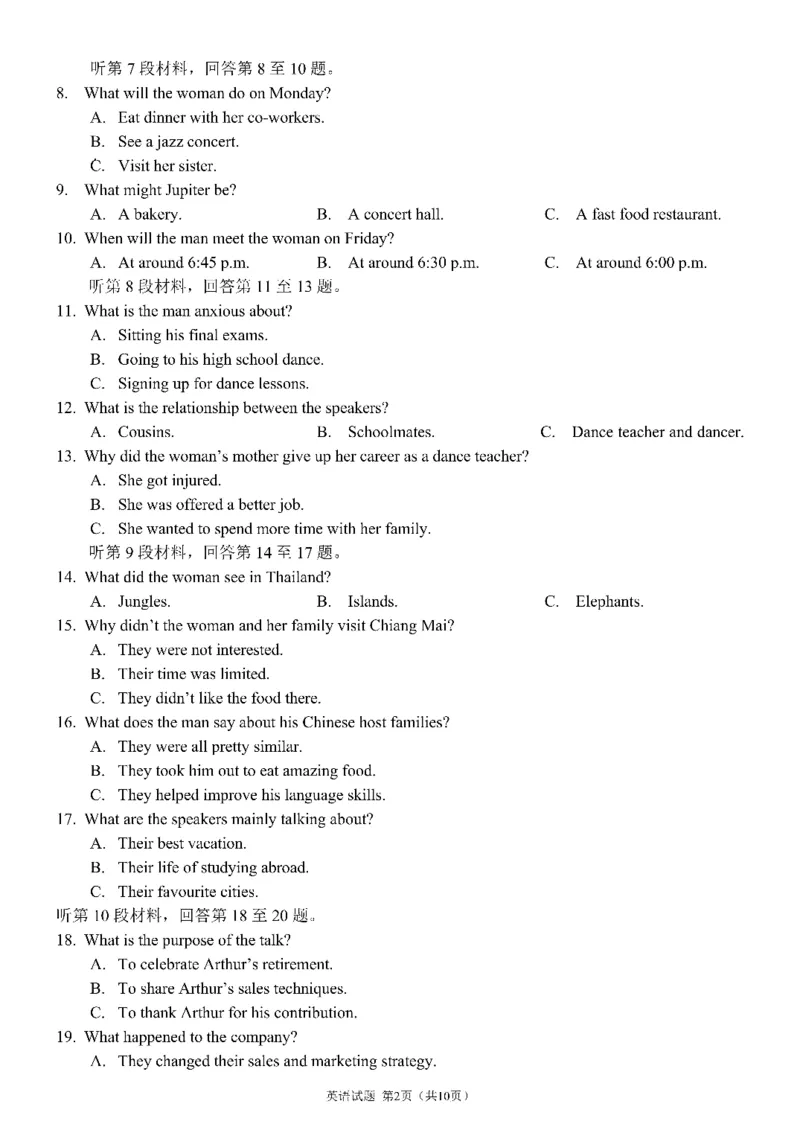
1. What will the man do at 1:00 in the afternoon?
A. Remind the woman to prepare dinner.
B. Have a meeting in the office.
C. Have lunch with Jack.
2. What will the man have?
A. Beef noodles. B. Chicken noodles. C. Mutton noodles.
3. What does the man invite the woman to do?
A. Meet with his brother.
B. Watch a sporting event.
C. Try out for the boxing team.
4. When did the woman eat a hamburger?
A. At breakfast time. B. At lunchtime. C. At dinner time.
5. What will the woman do next?
A. Email the man. B. Submit a file. C. Call a colleague.
第二节(共15小题;每小题1.5分,满分22.5分)
听下面5段对话或独白。每段对话或独白后有几个小题,从题中所给的A、B、C三个选项中
选出最佳选项,并标在试卷的相应位置。听每段对话或独白前,你将有时间阅读各个小题,每小题
5秒钟;听完后,各小题将给出5秒钟的作答时间。每段对话或独白读两遍。
听第6段材料,回答第6、7题。
6. Where does the conversation take place?
A. In a camera store. B. At a birthday party. C. In a photo studio.
7. How much will the woman pay?
A. $500. B. $800. C. $1000.
英语试题 第1页(共10页)B. They were beaten by their competitors.
C. They lost a lot of money.
20. Why is Arthur leaving the company?
A. He is retiring.
B. He is planning to study abroad.
C. He is moving somewhere else.
第二部分 阅读理解(共两节,满分50分)
第一节(共15小题;每小题2.5分,满分37.5分)
阅读下列短文,从每题所给的A、B、C和D四个选项中选出最佳选项。
A
VolunteerMatch helps you effect positive change. You get passionate and highly qualified volunteers
matched with the right cause at the right moment. Our software solution automates workflows and
repetitive tasks such as posting and reposting volunteer opportunities. It’s fast, easy-to-use and effective.
Join the largest volunteer network in three steps:
1. claim your organization
2. create a personal profile
3. add volunteer opportunities
Claim your organization and take advantage of our full suite of member benefits, designed to help
you save time and easily recruit (招募) and manage volunteers.
Pro Membership Benefits
Save time and repost opportunities with one click. Streamline your communication and automatically
send custom greetings, questionnaires and documents to potential volunteers.
• Refresh your opportunities with One Click Reposting
• Communicate easily with volunteer engagement tools
• Boost recruitment with access to exclusive marketing opportunities
• Grow your skillset with access to Pro resource library
• Showcase your opportunities on your website with embeddable code
• Store more photos to enhance your opportunities
What nonprofits are saying about VolunteerMatch
“It’s a portal for volunteers to connect with the nonprofits, and in a way, it’s its own search engine
specifically for volunteer opportunities.”
“When thinking about all the places we could post online to find interested volunteers,
VolunteerMatch was one place we absolutely wanted to have a presence.”
21. What can VolunteerMatch help do?
A. Create a personal profile. B. Select the working procedures.
C. Undertake repetitive tasks. D. Improve the qualification of volunteers.
22. What can Pro members of VolunteerMatch do?
A. Edit documents with one click. B. Start marketing events.
C. Store more volunteer photos. D. Interact easily with candidates.
23. Who is the passage intended for?
A. Nonprofit recruiters. B. Search engine engineers.
C. Enthusiastic volunteers. D. Workflow automation developers.
英语试题 第3页(共10页)B
Tired of the busy life in Las Vegas, Nevada for nearly ten years, my family and I decided to slow
things down. We wanted to lead an environmentally-friendly life. None of us felt this could be
accomplished where we were living and we all agreed that a move to the country would be great for
everyone.
Before long we set about looking for a home in Yucca, a very small town of less than 100 people,
where it is normal to record temperatures above 46℃ for days on end in summer and it is very wild with
practically no snowfall in winter.
When I called to inquire about the property, I was informed that there was no electricity available in
the area. What? No electricity? I almost denied the idea immediately. But what better way is there to go
green? After giving it a second thought, we decided to put in an offer and moved in on Thanksgiving Day.
When we first moved to the property, we did some remodeling and stayed in our motor home. We
were faced with real challenges at the time. But the frustrations just made us work harder. We slowly got
things fixed and moved into the house after 38 days.
While living here for the past four months has been a big adjustment, we benefit a lot from living off
grid. I think one of the most educational lessons is teaching my kids the importance of conservation. They
used to take power for granted. But now they realize the importance of power, together with water and gas.
We start taking quicker showers, doing only full loads of laundry, turning off the water while brushing our
teeth. And this has a chain effect. We are also trying to make other changes which include reducing the
amount of trash we generate by recycling, growing our own organic vegetables and re-purposing things
that we would have normally thrown.
Overall, going without electricity has been great for our family. I hope that once my kids move out of
the house, they will keep the habits that they have learned here.
24. Why did the family move to the small town?
A. To inspire the kids. B. To try a new lifestyle.
C. To cut living expenses. D. To escape pollution.
25. What can be learned about the small town?
A. It has an aging population. B. Water may be unavailable.
C. It has hot summer days. D. It lacks educational resources.
26. What does the underlined phrase “living off grid” in paragraph 5 probably mean?
A. Dealing with poverty. B. Dealing with garbage.
C. Living without pollution. D. Living without electricity.
27. What is the text mainly about?
A. A family switching to a simple life. B. A family helping the locals go green.
C. A family traveling around the country. D. A family teaching the kids hands-on skills.
英语试题 第4页(共10页)C
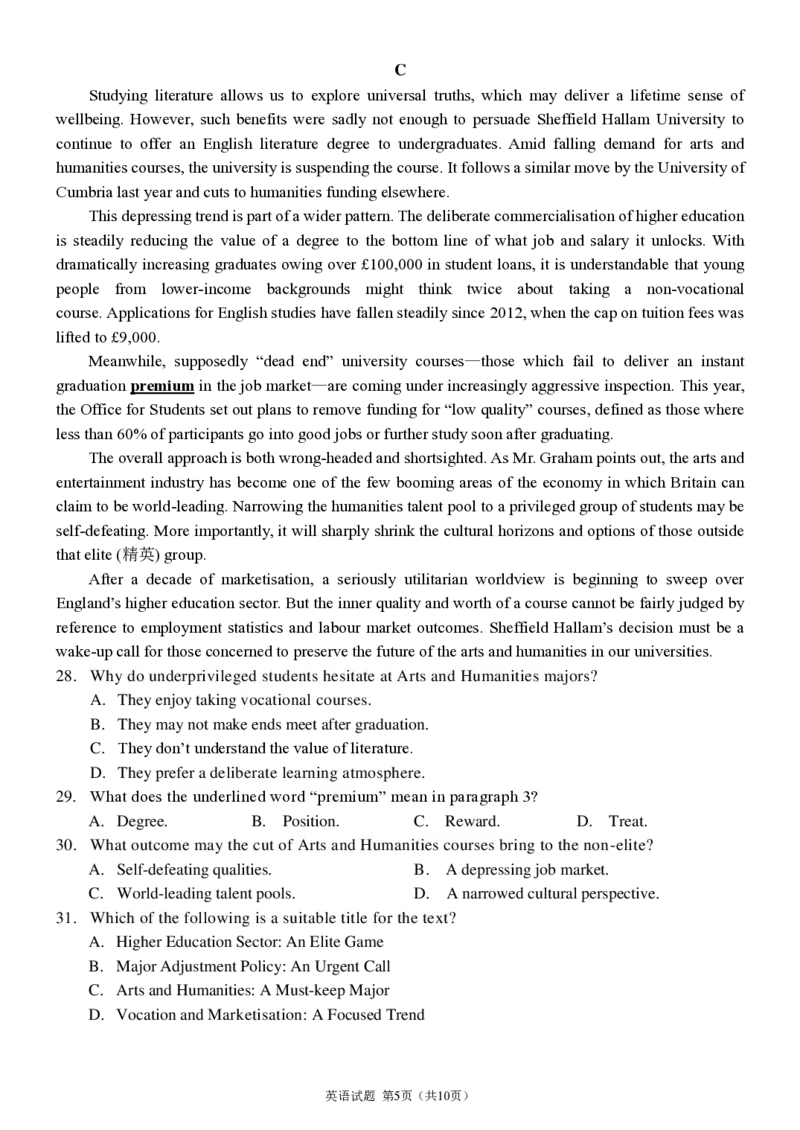
Studying literature allows us to explore universal truths, which may deliver a lifetime sense of
wellbeing. However, such benefits were sadly not enough to persuade Sheffield Hallam University to
continue to offer an English literature degree to undergraduates. Amid falling demand for arts and
humanities courses, the university is suspending the course. It follows a similar move by the University of
Cumbria last year and cuts to humanities funding elsewhere.
This depressing trend is part of a wider pattern. The deliberate commercialisation of higher education
is steadily reducing the value of a degree to the bottom line of what job and salary it unlocks. With
dramatically increasing graduates owing over £100,000 in student loans, it is understandable that young
people from lower-income backgrounds might think twice about taking a non-vocational
course. Applications for English studies have fallen steadily since 2012, when the cap on tuition fees was
lifted to £9,000.
Meanwhile, supposedly “dead end” university courses—those which fail to deliver an instant
graduation premium in the job market—are coming under increasingly aggressive inspection. This year,
the Office for Students set out plans to remove funding for “low quality” courses, defined as those where
less than 60% of participants go into good jobs or further study soon after graduating.
The overall approach is both wrong-headed and shortsighted. As Mr. Graham points out, the arts and
entertainment industry has become one of the few booming areas of the economy in which Britain can
claim to be world-leading. Narrowing the humanities talent pool to a privileged group of students may be
self-defeating. More importantly, it will sharply shrink the cultural horizons and options of those outside
that elite (精英) group.
After a decade of marketisation, a seriously utilitarian worldview is beginning to sweep over
England’s higher education sector. But the inner quality and worth of a course cannot be fairly judged by
reference to employment statistics and labour market outcomes. Sheffield Hallam’s decision must be a
wake-up call for those concerned to preserve the future of the arts and humanities in our universities.
28. Why do underprivileged students hesitate at Arts and Humanities majors?
A. They enjoy taking vocational courses.
B. They may not make ends meet after graduation.
C. They don’t understand the value of literature.
D. They prefer a deliberate learning atmosphere.
29. What does the underlined word “premium” mean in paragraph 3?
A. Degree. B. Position. C. Reward. D. Treat.
30. What outcome may the cut of Arts and Humanities courses bring to the non-elite?
A. Self-defeating qualities. B. A depressing job market.
C. World-leading talent pools. D. A narrowed cultural perspective.
31. Which of the following is a suitable title for the text?
A. Higher Education Sector: An Elite Game
B. Major Adjustment Policy: An Urgent Call
C. Arts and Humanities: A Must-keep Major
D. Vocation and Marketisation: A Focused Trend
英语试题 第5页(共10页)D
How do you quantify something as complex and personal as humour? University of Alberta
researchers have developed a mathematical method of doing just that and it might not be as personal as we
think.
The study originated from earlier research where test subjects with aphasia (失语症) were asked to
review letter strings and determine whether they were real words or not. Westbury, lead author of the new
study, began to notice a trend: participants would laugh when they heard some made-up non-words, like
snunkoople. Then how can a made-up word be funny?
Westbury assumed the answer lay in the word’s entropy, a mathematical measure of how ordered or
predictable it is. Non-words like finglam, with uncommon letter combinations, are low in entropy.
Westbury set out to determine whether it was possible to predict what words people would find funny,
using entropy as a yardstick. “Once you start thinking about humour in terms of probability, then you start
to understand how we find so many different things funny,” he said.
In his study, test subjects were asked to compare two non-words and choose. The option they
considered to be more humourous, and then they were shown a single non-word and rated how humourous
they found it in the range of 1 to 100.
“The results show that the bigger the difference in the entropy between the two words, the more likely
the subjects were to choose the way we expected them to,” says Westbury, noting that the most accurate
subject chose correctly up to 92 percent of the time.
This nearly universal response says a lot about the nature of humour and its role in human evolution.
“We think humour is personal. Actually, humour is an evolutionary message sending device. So if you
laugh, you let someone else know something is not dangerous,” says Westbury. “The study may not change
the game for stand-up comedians, but the findings may be useful in the business field. For example, people
might dislike buying a funnily-named medication for a serious illness, or it could go the other way around.”
32. What does the new study focus on?
A.The classification of humour levels. B.The measurement of humour perception.
C.The means of creating letter strings. D.The potential of humour in commercials.
33. What kind of word seems more humourous according to the study?
A.Non-words with high entropy. B.Non-words with abnormal origins.
C.Non-words with rare letter groupings. D.Non-words with handwritten letters.
34. Which of the following best describes test subjects’ task in Westbury’s study?
A.Contrast, select and grade. B.Inquire, pick and present.
C.Compare, design and report. D.Collect, document and evaluate.
35. What does the author want to tell us in the last paragraph?
A.Humour differs among individuals. B.Humour has its roots in word play.
C.Humour is a product of human evolution. D.Humour is absolutely personal and subjective.
英语试题 第6页(共10页)第二节(共5小题;每小题2.5分,满分12.5分)
阅读下面短文,从短文后的选项中选出可以填入空白处的最佳选项。选项中有两项多余选项。
I work at a community library. Many people are under the assumption that public libraries are no
longer needed because of the Internet. Nothing could be further from the truth. 36
A simple Internet search for “cats” produces approximately 2.98 billion results in less than one second.
It is a huge number! How do you even begin to sort through all of those results? We hear so much about
“false news”. 37 Librarians are there to help. They have been trained, through special classes and
workshops, to sort through all of the results and find credible sources. Author Neil Gaiman said, “Google
can bring you back 100, 000 answers. A librarian can bring you back the right one.”
38 It helps connect people with the resources they need to find a job, continue their education,
and learn new skills. It helps seniors find the resources they need to keep up with the “modern” world. It
helps new parents develop a love for literacy in their children and bond with them. It helps local artists and
craftsmen display their work. It helps students find the answers to those seemingly impossible homework
questions. It allows people to meet and exchange ideas.
Libraries are so much more than books and information. Yes, there are public computers, Internet
access, movies, music, programs and a thousand other things. 39 They are places where people feel
safe and welcomed. They are places where someone who has limited resources can freely access materials
and equipment that they wouldn’t otherwise be able to. They can, at times, be a harbour for someone who
needs a quiet place to work or study.
Some of the best memories of my childhood involve going to the local library and speaking with many
others in the neighbourhood, and they too have those same memories. They are presently making those
same memories with their children and their grandchildren. 40 I don’t see the Internet doing that.
A. We don’t know what sources to trust.
B. The public library helps people better their lives.
C. The importance of library staff comes to the surface.
D. However, libraries’ meaning and relevance goes even beyond that.
E. The public library brings people together to build a strong community.
F. In fact, it is because of the Internet that public libraries are needed now more than ever.
G. Every day children, students and adults use libraries to learn, grow and achieve their dreams.
第三部分 英语运用(共两节,满分30分)
第一节(共15小题;每小题1分,满分15分)
阅读下面短文,从每题所给的A、B、C、D四个选项中选出可以填入空白处的最佳选项。
On April 6, 1909, six men claimed their place as the first explorers to reach the North Pole.
Many had tried to reach the pole, but Peary’s team 41 them through clever planning. He also
gave 42 to Henson, an African American explorer with 43 skills. “The team needed his
knowledge of the Inuit, and Henson was fluent in their language. Also, he has shared all the physical
hardships of my Arctic work,” Peary said.
44 winds blew. “Freezing of the face is a(n) 45 occurrence,” Henson wrote. “We could
even lose fingers or toes. If anyone’s foot began to freeze, another man held the bare foot 46 his
stomach to warm it up. There was no other way to 47 the foot.”
英语试题 第7页(共10页)After four journeys to the Arctic, Peary learned how to 48 better for the trip. This time, he had
other teams go ahead and leave 49 along the way to provide for their final dash. They drove long
hours every day. “Forced 50 all the time,” Peary explained.
They were 51 because they came across no open water to 52 the team. They spent 30
hours at the pole before they began their 53 . They couldn’t stay longer as spring was coming and
the ice was about to melt. Henson set such a fast pace that Peary warned him not to work the dogs to death.
“I know,” Henson replied. “ 54 we have to hurry.”
They did it. They reached safety in 16 days and 55 their place in history.
41. A. employed B. helped C. chose D. beat
42. A. credit B. way C. place D. support
43. A. academic B. technical C. comprehensive D. communicative
44. A. Mild B. Fresh C. Refreshing D. Biting
45. A. dangerous B. ordinary C. temporary D. challenging
46. A. against B. towards C. on D. below
47. A. feel B. save C. lift D. hold
48. A. plan B. pack C. train D. budget
49. A. tips B. supplies C. footprints D. messages
50. A. duties B. requests C. marches D. measures
51. A. upset B. stuck C. tough D. lucky
52. A. freeze up B. hold up C. let down D. put down
53. A. work B. trip C. return D. race
54. A. But B. And C. Unless D. So
55. A. took B. found C. spotted D. secured
第二节(共10小题;每小题1.5分,满分15分)
阅读下面短文,在空白处填入1个适当的单词或括号内单词的正确形式。
There are few people in human history 56 last names alone are sufficient to bring to mind
kindness, goodness, wisdom, grace—Mandela, Gandhi, King, Lincoln. Add to that list Goodall. The other
four left us years ago. On Oct. 1, 2025, Jane Goodall—primatologist, zoologist, anthropologist and 57
(conserve)—joined them, dying at the age of 91.
Her death, while on a speaking tour, 58 (confirm) by the Jane Goodall Institute. The prose (散
文) of the announcement was a fitting reflection of the quiet and deliberate way Goodall lived
her 59 (remark) life—qualities that were essential 60 work that required hours, months, and
years in the jungles and clearings of Africa, most notably in the Gombe National Park in Tanzania. It was
1960 61 Goodall first arrived in Gombe, part of a group of three young naturalists.
Most of Dr. Goodall’s observations focused on several generations of 62 troop of 30 to 40
chimpanzees, the species 63 (genetic) closest to humans. Dr. Goodall was the first
scientist 64 (explain) to the world that chimpanzee mothers are capable of giving birth only once
every four and a half to six years. Since the 1970s, Dr. Goodall has continued to spend less time observing
chimpanzees and far more time 65 (seek) to protect them and their disappearing habitat. She
made it clear that she was opposed to capturing wild chimpanzees for display in zoos or for medical
research.
英语试题 第8页(共10页)第四部分 写作(共两节,满分40分)
第一节(满分15分)
假定你是李华,你的英国笔友 Chris 对你校刚结束的秋季运动会感兴趣,发邮件询问相关情
况。请你给他回一封邮件,内容包括:
1. 一件难忘的事;
2. 你的感受。
注意:1. 词数不少于80;
2. 可适当加入细节(不出现具体学校和学生姓名),以使行文连贯;
3. 邮件开头和结尾已给出,不计入总词数。
Dear Chris,
Yours,
Li Hua
第二节(满分25分)
阅读下面材料,根据其内容和所给段落开头语续写两段,使之构成一篇完整的短文。
Bloom by the Street
In a busy downtown area, there was a small flower shop squeezed between a bookstore and a café. It
wasn’t eye-catching—its wooden shelves were scratched, the wooden sign above the door had faded, but
it was filled with the soft fragrance of roses and sunflowers that floated to the sidewalk. The owner, Lila,
had taken over the shop from her aunt two years ago. Every morning, she arranged fresh flower bunches
and hung the “Open” sign, even though a heavy sadness weighed on her chest.
Lila’s shop had been struggling for months. Supermarkets sold cheap, pre-made flower packs, and
online flower delivery services offered same-day shipping. Only a few elderly regulars still came for her
hand-tied bunches. She’d spent her last money on a new cooler to keep flowers fresh last month, and with
the landlord asking for rent this week, she’d started hiding the “For Rent” ads she found in the newspaper.
One cloudy afternoon, as Lila stared at the half-empty shop, ready to close early, a little girl with
pigtails pushed the door open. Her name was Mia, and she’d passed the shop every day on her way to
school, drawn to the colorful sunflowers in the window. “ I want to buy a flower for my mom’s birthday,”
she said, holding out a crumpled five-dollar bill.
Lila knelt down, picked a small sunflower with bright yellow petals, and handed it to Mia. “This one
is perfect—it’s as warm as your smile, my last customer,” she said, refusing to take the money. Mia’s eyes
lit up. “Thank you! Mom will love it. I’ll come back with her tomorrow!” she said, running out with the
flower.
英语试题 第9页(共10页)Lila watched Mia’s small figure disappear around the corner. That night, instead of worrying about
rent, she thought about Mia’s excited face. Maybe her shop didn’t need fancy ads or cheap prices. Maybe
its magic was in bringing little joys to people’s days. For the first time in months, she felt a tiny spark of
hope.
注意:
1.续写词数应为150左右;
2.请按如下格式在答题卡的相应位置作答。
The next morning, Lila was arranging a bunch of sunflowers when the bell above the door rang.
A smile spread across Lila’s face as she stared at Mia and her mother.
英语试题 第10页(共10页)