曲靖市第一中学2026届高三年级适应性月考(三)
英 语 试 卷
注意事项:
1.答题前,考生务必用黑色碳素笔将自己的姓名、准考证号、考场号、座位号在答题卡上填写清楚。
2.每小题选出答案后,用2B铅笔把答题卡上对应题目的答案标号涂黑。如需改动,用橡皮擦干净后,再选涂
其他答案标号。在试题卷上作答无效。
3.考试结束后,请将本试卷和答题卡一并交回。满分150分,考试用时120分钟。
第一部分 听力 (共两节,满分30分)
注意,听力部分答题时,请先将答案标在试卷上。听力部分结束前,你将有两分钟的时间将答
案转涂到答题卡上。
第一节 (共5小题;每小题1.5分,满分7.5分)
听下面5段对话。每段对话后有一个小题,从题中所给的A、B、C三个选项中选出最佳选项。听
完每段对话后,你都有10秒钟的时间来回答有关小题和阅读下一小题。每段对话仅读一遍。
1.Whatare thespeakers doing?
A. Planninga journey. B. Waitingfor aplane. C.Booking a hotel room.
2.When didthemeeting start?
A. At 1: 30pm. B. At 2:00pm. C.At 3: 30pm.
3.Whereis John likely tobe now?
A. At home. B. At his office. C.At agym.
4.Whatdoes thewoman think ofJames's speech?
A. It is moving. B. It isinspiring. C.It is humorous.
5.Whatare thespeakers talkingabout?
A. Theweather. B. Thenews. C.The woman's clothes.
第二节 (共15小题; 每小题1.5分,满分22.5分)
听下面5段对话或独白。每段对话或独白后有几个小题,从题中所给的A、B、C三个选项中选出
最佳选项。听每段对话或独白前,你将有时间阅读各个小题,每小题5秒钟;听完后,各小题将给出
5秒钟的作答时间,每段对话或独白读两遍。
听下面一段对话,回答第6和第7题。
6.Wheredoes theconversationprobably take place?
A. In a classroom. B. In acafe. C.In an office.
7.Whatwill theman donextweek?
A. Visit afactory. B. Attend ajob interview. C.Graduate from university.
听下面一段对话,回答第8至第10题。
8.Whatactivity was thewoman dressed for today?
A. Rockclimbing. B. Swimming. C.Playing golf.
9.Whydoesn't Dylan want to go surfing?
A. It's dangerous. B. It's too hotoutside. C.He doesn't likethewind.
10.Whatdoes Dylan plan to dotomorrow?
A. Play video games. B. Have hishair cut. C.Make avideo.
听下面一段对话,回答第11至第13题。
11.Whatwill MrEvans doduring lunch?
A. Meet with themanagers.B. Talk with Valerie Dumonde. C.Discuss the Peterson account.
第1页共8页
{#{QQABTQCQogiIQJAAAAgCQQkSCAAYkBACAAgGRAAQoAABQAFABAA=}#}12.Whois thewoman?
A. Theman's wife. B. Theman's boss. C.The man's secretary.
13.Whatdoes thewoman imply about MrEvans?
A. He can go home now. B. Heusually works late. C.He needs to hurry to therestaurant.
听下面一段对话,回答第14至第17题。
14.Whydid Marisol start posting herfood forest onlineat first?
A. Tofill uphertime.
B. Todocument her daily life.
C. Toconnect with other gardeners.
15.Whydoes Marisol recommend beginners to start with herbs?
A. They need nocareat all.
B. They don't attract insects.
C. They are easy to grow well.
16.Whatis difficult for Marisol to grow?
A. Cabbage. B. Strawberries. C.Nuts.
17.Whatis Marisol's main advice for someonestarting afood forest?
A. Have avariety ofplants.
B. Growuseful plantsonly.
C. Planit thoughtfully.
听下面一段独白,回答第18至第20题。
18.Whyis Oxford University mentioned?
A. Todeclare itis thebest choice.
B. Toshow ithas summer programs.
C. Toencourage thestudents to studyhard.
19.Whichplanwill astudent choose ifheis interested in ships?
A. Outward Bound. B. Youth Leadership. C.Toronto Brigantine.
20.Whatdoes thespeaker mainly talk about?
A. Different travel routes. B. Studyand travel programs. C.Importance of studying abroad.
第二部分 阅读 (共两节,满分50分)
第一节 (共15小题;每小题2.5分,满分37.5分)
阅读下列短文,从每题所给的A、B、C、D四个选项中选出最佳选项。
A
Shared Mobility: Making Travel EasierforAll
Shared mobility services, such as carshares and bikeshares, have positive effects on the environment.
However, access to these services is not equal for everyone. Research shows that shared mobility services
are more commonly available in wealthier urban areas. Most users tend to be younger, wealthier, and
physically able. To build a sustainable transportation system, it is essential to make these services inclusive
forall people.
Some cities have introduced programs to support low-income residents. These programs help increase
the use of shared vehicles and reduce dependence on personal cars. Recently, about 70% of micromobility
programs in the US have taken measures to better serve disadvantaged groups, such as accepting cash
payments and offering non-smartphonebooking options.
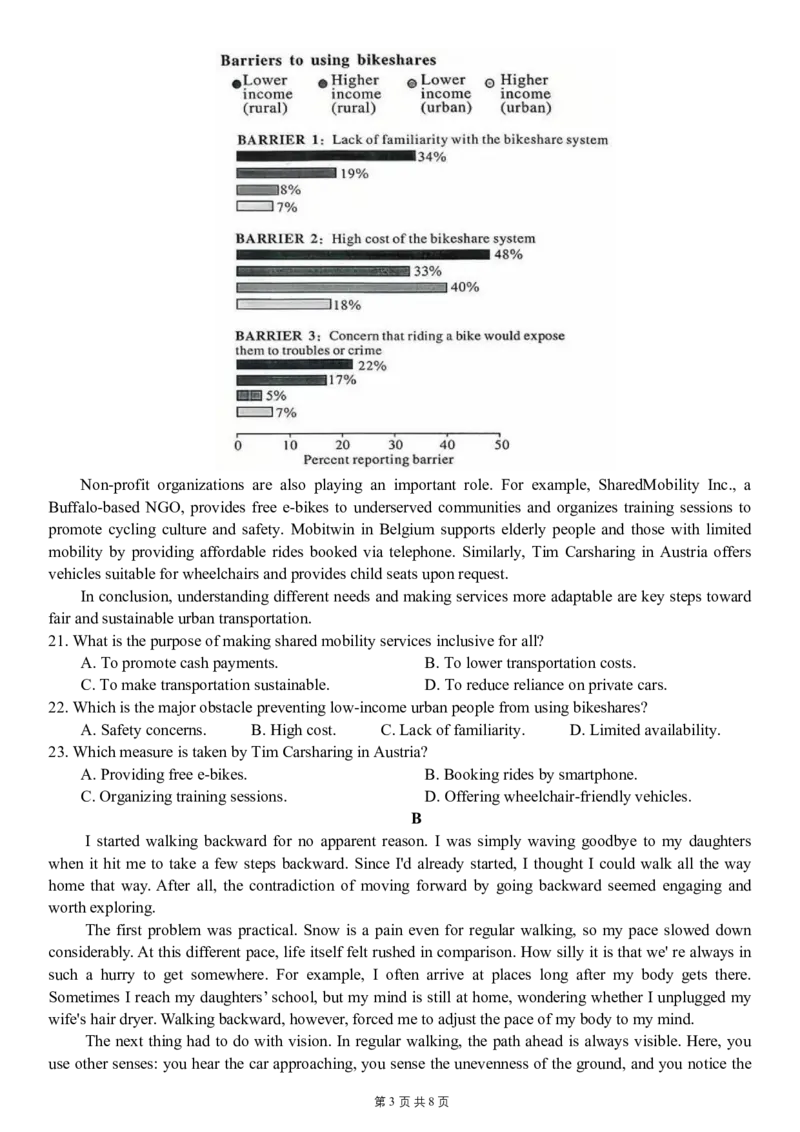
Still, many barriers remain. Surveys indicate that people in rural areas and those with lower incomes
encounter more obstacles when trying to use bikeshares. Cost, lack of familiarity, and limited availability
are common problems, as illustrated in theFigure.
第2页共8页
{#{QQABTQCQogiIQJAAAAgCQQkSCAAYkBACAAgGRAAQoAABQAFABAA=}#}Non-profit organizations are also playing an important role. For example, SharedMobility Inc., a
Buffalo-based NGO, provides free e-bikes to underserved communities and organizes training sessions to
promote cycling culture and safety. Mobitwin in Belgium supports elderly people and those with limited
mobility by providing affordable rides booked via telephone. Similarly, Tim Carsharing in Austria offers
vehicles suitablefor wheelchairs and provides child seats uponrequest.
In conclusion, understanding different needs and making services more adaptable are key steps toward
fair andsustainableurban transportation.
21.Whatis thepurpose ofmaking shared mobility services inclusivefor all?
A. Topromotecash payments. B. To lower transportation costs.
C. Tomake transportation sustainable. D. To reduce reliance onprivate cars.
22.Whichis themajorobstacle preventing low-incomeurban peoplefrom using bikeshares?
A. Safety concerns. B. High cost. C.Lack offamiliarity. D. Limited availability.
23.Whichmeasure istaken byTim Carsharing in Austria?
A. Providing free e-bikes. B. Booking rides bysmartphone.
C. Organizingtraining sessions. D. Offering wheelchair-friendly vehicles.
B
I started walking backward for no apparent reason. I was simply waving goodbye to my daughters
when it hit me to take a few steps backward. Since I'd already started, I thought I could walk all the way
home that way. After all, the contradiction of moving forward by going backward seemed engaging and
worth exploring.
The first problem was practical. Snow is a pain even for regular walking, so my pace slowed down
considerably.At this different pace, life itself felt rushed in comparison. How silly it is that we' re always in
such a hurry to get somewhere. For example, I often arrive at places long after my body gets there.
Sometimes I reach my daughters’school, but my mind is still at home, wondering whether I unplugged my
wife's hairdryer.Walkingbackward, however,forced meto adjust thepace of my bodytomy mind.
The next thing had to do with vision. In regular walking, the path ahead is always visible. Here, you
use other senses: you hear the car approaching, you sense the unevenness of the ground, and you notice the
第3页共8页
{#{QQABTQCQogiIQJAAAAgCQQkSCAAYkBACAAgGRAAQoAABQAFABAA=}#}change in the firmness of the snow. You activate an entire set of skills we usually don't use because of our
dependence on sight. This way, the familiar path I walked every day suddenly felt like a grand adventure, a
discovery Ihadn't anticipated.
Because of my addiction to foolish ideas, I decided to continue my backward walking for the rest of
the day. And I quickly realized something obvious: the path I enjoyed most was the one I had already
travelled. And it struck me that this was the right way to look at life: moving toward a destination without
ever forgetting where you've been, or how far you've come. Looking back is always good for self-value.
There's no way to look at yesterday and not feel better: for the illness that didn't kill you, or the happy
childhood days that stillmake you smile.
24.What interested theauthor in thefirst paragraph?
A. Finding anew route backhome.
B. Engaging himselfindeep thinking.
C. Movingforward ina different manner.
D. Seeing his daughters offevery morning.
25.What didthe authorrealizeontheway back home?
A.Weneed tostay focused at work.
B.Wedon't need tolivearushed life.
C.Weshould spend more timewithfamily.
D.Weshouldn't compare ourselves toothers.
26.Howdid theauthor overcome thevisionproblem?
A. He studieda set ofnew skills. B. Hedepended onhis memory.
C. Hefollowed hissense ofdirection. D. He madefull useof othersenses.
27.What message does theauthorseem todeliver inthelast paragraph?
A. Childhoodis thebest part inlife. B. It's inspiringtoreflect onthepast.
C. It's importantto find your self-value. D. One ought to learn to forgive himself.
C
Numerous industries produce larger quantities of wastewaters containing high concentrations of
organic substances and inorganic salts. Discharging these wastewaters to the environment is harmful to
ecosystem and human health. However, the high salt content in these wastewaters pose serious challenges
for existing treatment processes. Researchers at Rice University, in partnership with Guangdong University
of Technology, have developed a groundbreaking method for it—adopting dialysis (透析) technology
commonlyused in medicine.
The researchers selected commercial ultrafiltration membranes (超滤膜) which were designed to let
salt pass through while trapping organic substances. They set up a system where salty wastewater and fresh
water flowed inopposite directions oneither sideofaspecial membrane, without needing pumps. Dueto the
difference of salt concentrations between waste water and fresh water, salt naturally moves into the fresh
water while organic substances are kept back. To test this, they compared the amount of organic material
and salt in the waste water before and after treatment. The results showed the system could effectively
remove saltwithout using extraamounts offresh water.
Onesignificant advantage ofdialysis is itsresistance to fouling (积垢). Unlikepressure-driven systems,
dialysis experienced notably less buildup of organic materials on the membrane because it doesn’t rely on
extra pressure. “This could translate to lower energy consumption, less maintenance, and fewer membrane
replacements,” said Elimelech, aresearcher onthestudy.
Additionally, with suitable membranes, dialysis can be tailored to separate various organics, enabling
the selective recovery of valuable resources from the wastewater. In this way, dialysis creates opportunities
for transforming wastewater treatment plants into resource recovery factories, aligning the principles of a
第4页共8页
{#{QQABTQCQogiIQJAAAAgCQQkSCAAYkBACAAgGRAAQoAABQAFABAA=}#}recycling economy.
Overall, while dialysis alone doesn’t fully purify wastewater, it can transform the high-salinity organic
wastewater stream into a low-salinity organic wastewater stream that can be readily treated by conventional
methods, which revolutionizes thetreatment ofsome ofthemost challenging industrial wastewaters.
28.Whatis themajorchallenge faced bycurrent wastewater treatment?
A. Thelack ofsufficient treatment devices.
B. Thehigh salt percentage in wastewaters.
C. Thesubstantial volumes ofwastewaters.
D. Theconsiderable cost oftreatment processes.
29.Whatcan be learned about theprocess ofdialysing wastewaters?
A. Themembrane transformed salt intoorganics.
B. Theextrapressure contributed tosalt transport.
C. Theconcentration difference played thekey role.
D. Liquids onboth sides flowed in thesamedirection.
30.Whatdoes theunderlined word “aligning” inparagraph 4probably mean?
A. Matching. B. Establishing. C. Adjusting. D. Challenging.
31.Whichof thefollowing can beasuitabletitle?
A. Dialysis:A Pioneering Blessing for Medicine
B. Membranes: A ProtectiveScreen forFresh Water
C. Dialysis: ANew Pathway for Wastewater Treatment
D. High-SalinityWastewater: AThreat to theEnvironment.
D
The growing interaction between humans and artificial intelligence(AI) is shaping a new way of
thinking, known as System 0. This new cognitive(认知的) framework exists outside the human mind and
works as an external “thinking assistant”. System 0 works alongside the two established models of human
thought: System 1, which is fast, intuitive(直觉的), and automatic, and System 2, which is slower, more
analytical, and reflective.
Just as an external drive allows us to store data that are not present on the computer, and we can work
by connecting our drive to a PC wherever we are, AI, with its powerful processing and data-handling
capabilities, can represent an external circuit to the human brain capable of enhancing it. Hence the idea of
System 0,which isessentially a form of “external”thinking that relies onthecapabilities ofAI.
By managing enormous amounts of data, AI can process information and provide suggestions based on
complex algorithms( 算 法 ). However, unlike intuitive or analytical thinking, System 0 can perform
calculations, make predictions, and generate responses without truly “understanding” the content of the data
itworks with.
The integration of system 0 into human cognition raises some concerns. One of the most pressing ones
is the potential damage to our critical thinking and reasoning abilities. If we blindly trust the output of
system 0 without questioning it, we risk losing our ability to think independently, leading to a weaker
capacity for innovation and creativity. At the same time, it is important to acknowledge the potential
benefits of system 0 in increasing our cognitive capabilities and addressing complex challenges that may be
beyond thecapacity ofhuman intelligencealone.
Despite the polarized visions on the topic of the evolution of AI, we recommend that this revolutionary
system be the object of a deep, shared reflection on how we plan to integrate it into the future of human
thought. To ensure that AI remains a tool to enhance—rather thandecrease—our cognitiveautonomy, clear
boundaries mustbeestablished.
32. Whatis thepurpose ofparagraph1?
第5页共8页
{#{QQABTQCQogiIQJAAAAgCQQkSCAAYkBACAAgGRAAQoAABQAFABAA=}#}A. TostateAI’s influence ondaily life.
B. Tointroduce a newcognitivemodel.
C. Tocompare three thinkingsystems.
D. Todiscuss AI’s roleindecision-making.
33. Whichcan best describe the essence ofSystem 0?
A. Adeep meaning seeker.
B. An analytical thinking pioneer.
C. Asmart decision-maker.
D. An external cognitiveenhancer.
34. Whatis theauthor’s tonecarried in paragraph 4?
A. Pushy. B. Indifferent. C. Objective. D. Dismissive.
35. Whatwill thefollow-up paragraph mostprobably talk about?
A. Moral dilemmas inhuman-AI integration.
B. Possiblypromising prospects ofSystem 0.
C. Technical challenges in sharpening System 0.
D. Specific guidelines onusingSystem 0critically.
第二节 (共 5 小题;每小题2.5分,满分12.5分)
阅读下面短文,从短文后的选项中选出可以填入空白处的最佳选项。选项中有两项为多余选项 。
As a leadership consultant for many years, I’ve found many of the leaders I work with report feeling
frustrated as they face the continuous change and uncertainty in the growing challenges of their roles. 36
Throughout their careers, leaders are conditioned to come up with the final, correct answer. Given that
human’s brains tend to see uncertainty as a risk or threat, it’s physiologically normal to feel stress when
faced with unfamiliarsituations.
Sadly, in the world of leadership training, we often celebrate qualities like decisiveness, innovation,
and resilience . 37 Without it,even the mosttalented leaders struggle tosustain their success.
According to the psychological definition, frustration tolerance involves the capacity to bear discomfort,
regulate emotional responses, and maintain a forward mind set in the face of challenges. 38 It not only
allows leaders to stand the discomfort of building something meaningful without giving up but also helps
them stay groundedand purposeful, even when immediateresults aren’t what they hopedfor.
39 Leaders can train theirfrustration tolerance bypursuing goals outsideof leadership that don’t offer
instant rewards. Try going to the gym teaching discipline, patience, and the value of gradual progress. These
experiences build resilience and reinforce frustration tolerance as a transferable skill. 40 Leadership
and entrepreneurship are marathons, not sprints( 冲 刺 ). Honoring your energy ensures you’re better
equipped to handle frustration and maintain theresilience needed for long-term success.
A. They quit theirjobs out oftheblue.
B. Understandably, it’s easy for them to feel this way.
C. In leadership, itis theunsung hero oflong-term success.
D. One vitalskill---frustration tolerance---is often overlooked.
E. Leadership can’t bedefined bya one-size-fits-all approach.
F. Developing frustration tolerance isn’t easy, but it’s possible.
G. Also, remember to prioritizerest and create space torecharge.
第三部分 语言运用 (共两节,满分30分)
第一节 (共15小题;每小题1分,满分15分)
阅读下面短文,从每题所给的A、B、C、D四个选项中选出可以填入空白处的最佳选项。
I was a Northern newcomer toa Southern adult community.I knew no one and was feeling very out of
第6页共8页
{#{QQABTQCQogiIQJAAAAgCQQkSCAAYkBACAAgGRAAQoAABQAFABAA=}#}place and lonely.I 41 wanted tomake new friends.
One morning, cyclists 42 by — dark shorts, bright shirts, laughter floating like bells. Hesitant but
43 , I let my finger follow the headline on newspaper: “New Riders Welcome.” It is not like me to join
somethingwhere Iknownoone, butI 44 myself to attend an organizational meeting.
At the first meetup, I 45 my shyness and started a conversation with two cyclists. Days later,
twelve newcomers began our first eight-mile ride. We 46 through quiet neighborhood paths like a
wobbling centipede (摇晃的蜈蚣). Soon, we were pedaling three times a week, 47 increasing our
distance and speed. Stopping to 48 became our routine and we soon adopted our slogan, “We bike for
food.” As we sat chatting over cups of 49 coffee, strong friendship began to form. As time wore on,
many othershared interests emerged andwe began 50 them together.
Now, 51 with several members of the cycling club, I decided to attend a handful of their social
events. There, I met more folks. Out of these gatherings grew a small dinner group and again my circle
52 .Moreopportunities for gathering 53 when ourclub members planned afew overnight cyclings.
Adventuring beyond comfort taught me more than cycling — it was courage as the oil that keeps life’s
wheels rolling toward 54 and joy.Belonging begins where 55 ends.
41.A.casually B.desperately C.regularly D.slightly
42.A.walked B.inched C.slid D.streamed
43.A.amused B.fascinated C.committed D.concerned
44.A.trained B.reminded C.pushed D.warned
45.A.shook off B.held onto C.suffered from D.carried on
46.A.climbed B.dragged C.squeezed D.snaked
47.A.merely B.cautiously C.gradually D.leisurely
48.A.snack B.repair C.charge D.camp
49.A.burning B.smoking C.flowing D.steaming
50.A.ignoring B.exploring C.spreading D.protecting
51.A.honest B.comfortable C.anxious D.patient
52.A.expanded B.collapsed C.remained D.rolled
53.A.slipped B.delayed C.changed D.surfaced
54.A.freedom B.connection C.integrity D.kindness
55.A.tiredness B.embarrassment C.loneliness D.disappointment
第二节 (共10小题;每小题1.5分,满分15分)
阅读下面短文,在空白处填入1个适当的单词或括号内单词的正确形式。
Food plays a significant role in classic Chinese novels, with one of the most famous examples being
Cao Xueqin's Dream of the Red Chamber. In this 18th-century novel, food is a key part of the story,
revealingdetails aboutcharacters 56 advancing the plot. The book's most famous dish,a preparationof
eggplant called qiexiang(茄鲞),is a rich dish that requires 57 (day) to prepare involving steaming
eggplant ten times in soup made from old hens. The dish overwhelms the family's poor relatives, first with
envy, andlater,withterriblediscomfort in stomachs.
The novel provides ample 58 (inspire) to today's cooks. Food bloggers go viral with attempts
59 (recreate) the book's most famous dishes. "Red Chamber Banquets" pop up in theme restaurants
across China, and indeed worldwide, with the dishesplated in Michelinstyle.
While most foods 60 (serve) in the novel are made with high skill, they are made with only a
few simple seasonal ingredients.In China's culinary culture, humble ingredients 61 (prize)because
they are in season. A relative 62 brags(吹 嘘 )about enjoying food out of season is later revealed
第7页共8页
{#{QQABTQCQogiIQJAAAAgCQQkSCAAYkBACAAgGRAAQoAABQAFABAA=}#}tohaveadangerouslyviolenttemper.A"bad apple,"one mightsay.
Like all great literature, the enduring popularity of Dream of the Red Chamber comes from 63
(it)many layers of meaning. Readers canappreciate it 64 an engaging story. The same can also be
said about the food. When we read about it, we can admire the cooking art, mine 65 text for
historical clues,orseekdoublemeanings in every “bite”.
第四部分 写作 (共两节,满分40分)
第一节 (满分 15分)
假定你是李华,为纪念中国伟大的科学家,你校英语俱乐部打算征集相关活动的建议。请你给
俱乐部负责人Mary写一封邮件,内容包括:
1.你的建议; 2.说明理由。
注意:
1.词数80左右; 2.可以适当增加细节,以使行文连贯;
Dear Mary,
_______________________________________________________________________________________
Yours,
Li Hua
第二节 (满分25分)
阅读下面材料,根据其内容和所给段落开头语续写两段,使之构成一篇完整的短文。
I was incredibly proud of my school, the Maplewood Elementary. It connected me to my roots, as my
father and grandfather had all graduated from here.
So, when our teacher Mr. Dow announced a group project to create a brochure(小册子)about our
school for its 100th anniversary, I was thrilled. The best three brochures would be displayed in the school
library, which was a chance to showthenew students howwonderful ourschool was.
I was paired with two classmates: Jake, who loved photography, and Lily, who had a gift for writing.
Workingwith others could befun, right?But myenthusiasm quicklyfaded.
Our first meeting was a disaster. When we discussed which part of the school we should focus on, Jake
kept talking about cameras and photos. I turned to Lily, hoping for some support. But she simply shrugged
and said, “I'm not really into this. It sounds boring.” Jake nodded in agreement. The project seemed to be
harderthan I thought.
At our next meeting, I tried to lead the conversation back to the project. I shared some interesting facts
I had researched about the school. However, neither of them seemed interested. Jake had promised to gather
materials from the library, but instead he showed us photos taken on the weekend. Lily hadn't started her
part of theresearch either, claiming she had been toobusy. Ifelt likeIwas theonly onewho cared.
Back home, I decided to take matters into my own hands. I stayed uplate that night, trying to create the
brochure by myself. But no matter how hard I tried, the result was far from satisfactory. I was exhausted and
disheartened. My mom noticed I was upset. “You can't do this alone,” she gently reminded me. “Jake and
Lily have talents that can make thisproject shine. You justneed tofind away toget them involved.”
注意:
1.续写词数应为150左右;2.请按如下格式在答题卡的相应位置作答。
With onlythree days left, Iknew Ihad toact.__________________
On thefinal day, wepresented ourbrochure inclass.___________________
第8页共8页
{#{QQABTQCQogiIQJAAAAgCQQkSCAAYkBACAAgGRAAQoAABQAFABAA=}#}参考答案
第一部分听力(共两节,满分30分)
1-5ABCAC 6-10CAABA
11-15BCBBC 16-20ACBCB
第二部分阅读(共两节,满分50分)
第一节(共15小题;每小题2.5分,满分37.5分)
21-23CBD 24-27CBDB
28-31BCAC 32-35BDCD
第二节 (共 5 小题;每小题2.5分,满分12.5分)
36-40BDCFG
第三部分 语言运用(共两节, 满分30分)
第一节(共15小题;每小题1分,满分15分)
41-45BDBCA 46-50 DCADB 51-55 BADBC
第二节(共10小题;每小题1.5分,满分15分)
56.and 57. days 58.inspiration 59.torecreate 60.served
61.are prized 62. who/that 63.its 64.as 65.the
第四部分 写作 (共两节,满分40分)
第一节 (满分 15分)
Dear Mary,
I am writing to propose organizing a "Scientist Story Theater" where students would research, script,
and perform short plays about great Chinese scientistslikeYuan Longping andTuYouyou.
Thereasons liein its structured process, which ensures deep engagement and meaningful learning. First,
through in-depth research, participants will discover the true challenges these scientists faced---like Yuan
Longping's persistence through countless failed field experiments and common consumption. Then, in
scripting these stories, students must transform their research process into compelling narratives, which will
enable students to detail how Tu Youyou drew out artemisinin using household water containers despite
limited resources. Finally, by performing these plays, they internalize the scientists' spirit of perseverance
and make thesevalues resonate withthe audience.
This active approach ensures the scientists' legacy is not just remembered but truly understood and
carried forward.
Yours,
Li Hua
第二节
With only three days left, I knew I had to act. Afterbrainstorming some ideas, I invited Jake and Lily
to my house. Opening my grandfather's diary, I pointed at the faded photo of his class. “Your camera can
savethe momentfor thefuture,” Itold Jake, whoseeyes suddenly sparkled. ThenI suggested hephotograph
every corner of theschool like “timetravelers”Meanwhile, Lily was engaged in mygrandfather's love letter,
eager to bring hidden stories back to life. I was busy organizing layouts, combining historical accuracy with
creativity.The clock was ticking, but ourlaughter replaced earlier frustration. (94 词)
On the final day, we presented our brochure in class. We stood by the blackboard as everyone went
through the pages. They examined the brochure carefully, with their fingers tracing the photos, narratives
and timelines which connected three generations of graduates. Noticing surprise on every face, we couldn't
wait to hear Mr. Dow's announcement of the winner. “This work isn't just about the school anniversary,” he
Anally said, tapping the cover where our three names shone, “it's about how its spirit lives through
students' cooperation.” That afternoon in the library, seeing our brochure on display, we realized our
combined talents had created what none could alone. (100 词)
{#{QQABTQCQogiIQJAAAAgCQQkSCAAYkBACAAgGRAAQoAABQAFABAA=}#}