2 0 2 5 年 全 国 教 师 资 格
主讲老师 安凉
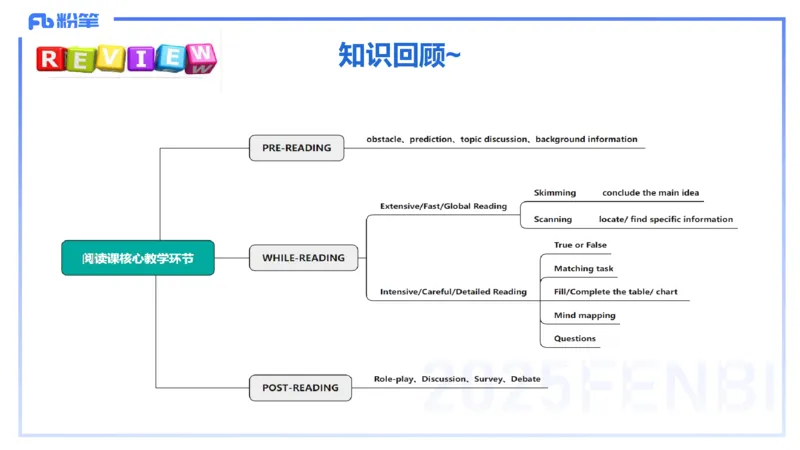
粉笔教师教育 粉笔教师知识回顾
~P206
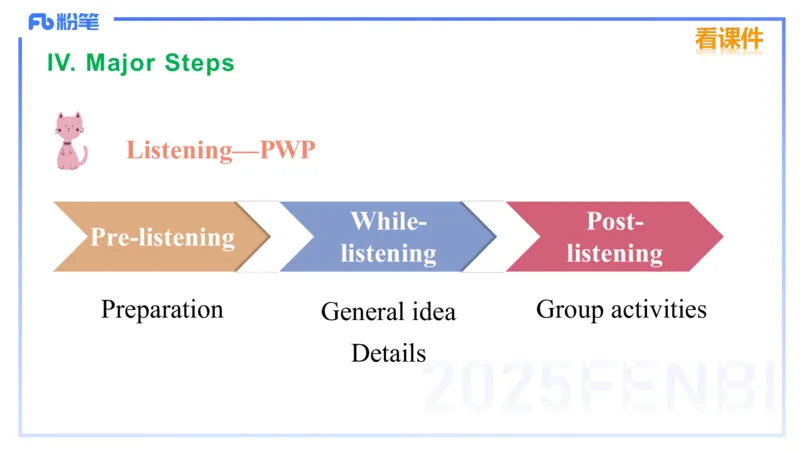
听力课/ 听说课——核心教学环节IV. Major Steps
Listening—PWP
While- Post-
Pre-listening
listening listening
Preparation General idea Group activities
DetailsIV. Major Steps
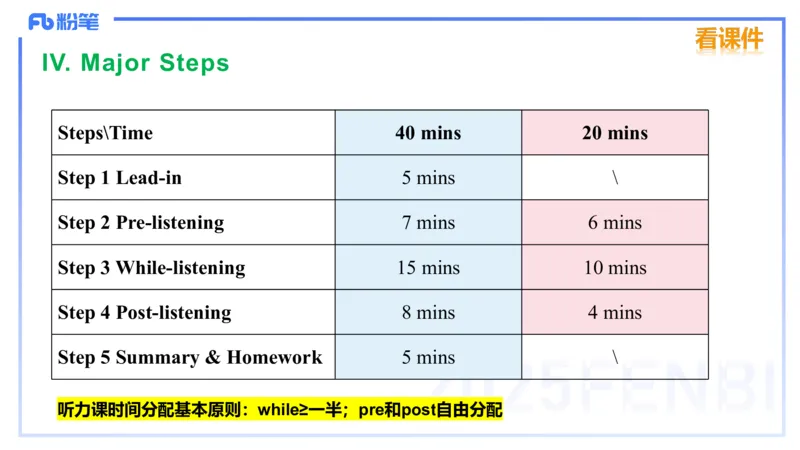
Steps\Time 40 mins 20 mins
Step 1 Lead-in 5 mins \
Step 2 Pre-listening 7 mins 6 mins
Step 3 While-listening 15 mins 10 mins
Step 4 Post-listening 8 mins 4 mins
Step 5 Summary & Homework 5 mins \
听力课时间分配基本原则:while≥一半;pre和post自由分配P206
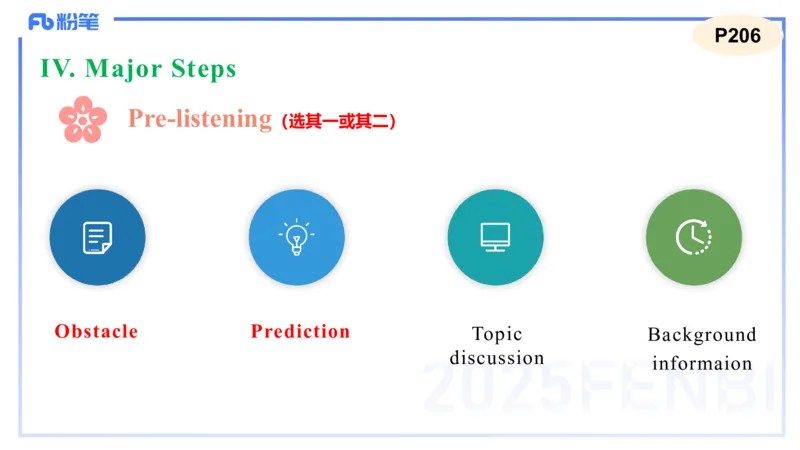
IV.● MIV. aMjaojorr SStetpes ps
Pre-listening
(选其一或其二)
Obstacle Prediction Topic Background
discussion
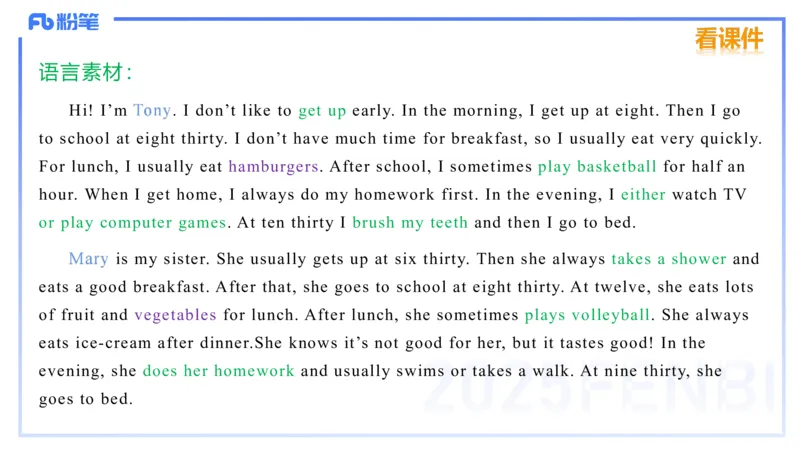
informaion语言素材:
Hi! I’m . I don’t like to get up early. In the morning, I get up at eight. Then I go
to school at eight thirty. I don’t have much time for breakfast, so I usually eat very quickly.
For lunch, I usually eat hamburgers. After school, I sometimes play basketball for half an
hour. When I get home, I always do my homework first. In the evening, I either watch TV
or play computer games. At ten thirty I brush my teeth and then I go to bed.
is my sister. She usually gets up at six thirty. Then she always takes a shower and
eats a good breakfast. After that, she goes to school at eight thirty. At twelve, she eats lots
of fruit and vegetables for lunch. After lunch, she sometimes plays volleyball. She always
eats ice-cream after dinner.She knows it’s not good for her, but it tastes good! In the
evening, she does her homework and usually swims or takes a walk. At nine thirty, she
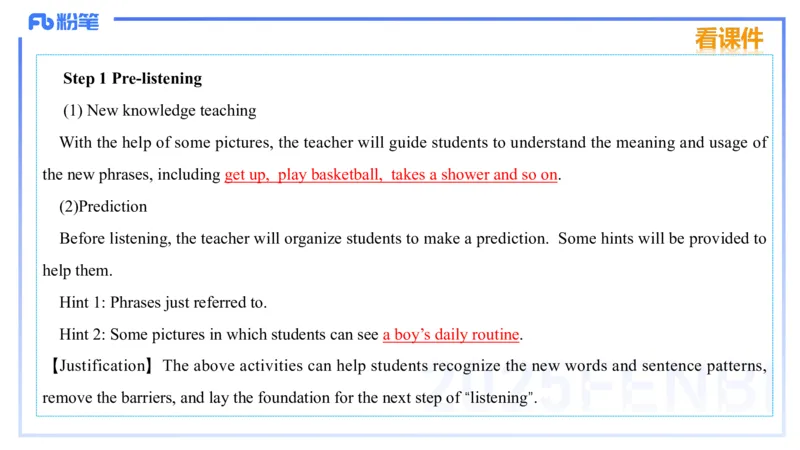
goes to bed.Step 1 Pre-listening
(1) New knowledge teaching
With the help of some pictures, the teacher will guide students to understand the meaning and usage of
the new phrases, including get up, play basketball, takes a shower and so on.
(2)Prediction
Before listening, the teacher will organize students to make a prediction. Some hints will be provided to
help them.
Hint 1: Phrases just referred to.
Hint 2: Some pictures in which students can see a boy’s daily routine.
【Justification】The above activities can help students recognize the new words and sentence patterns,
remove the barriers, and lay the foundation for the next step of “listening”.P206
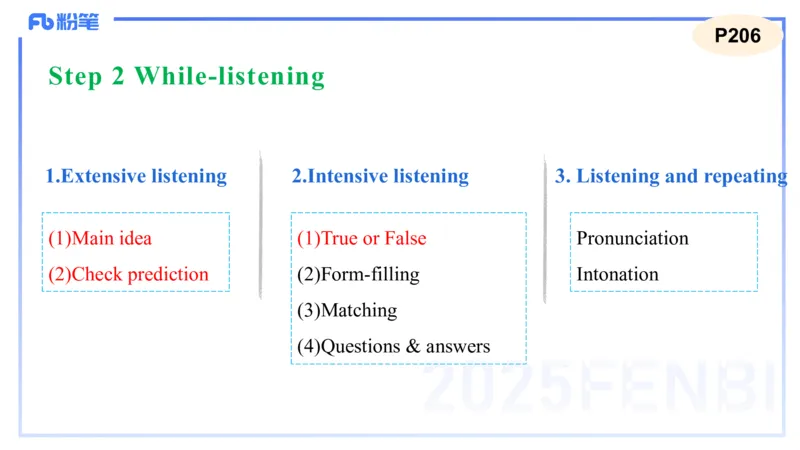
Step 2 While-listening
1.Extensive listening 2.Intensive listening 3. Listening and repeating
(1)Main idea (1)True or False Pronunciation
(2)Check prediction (2)Form-filling Intonation
(3)Matching
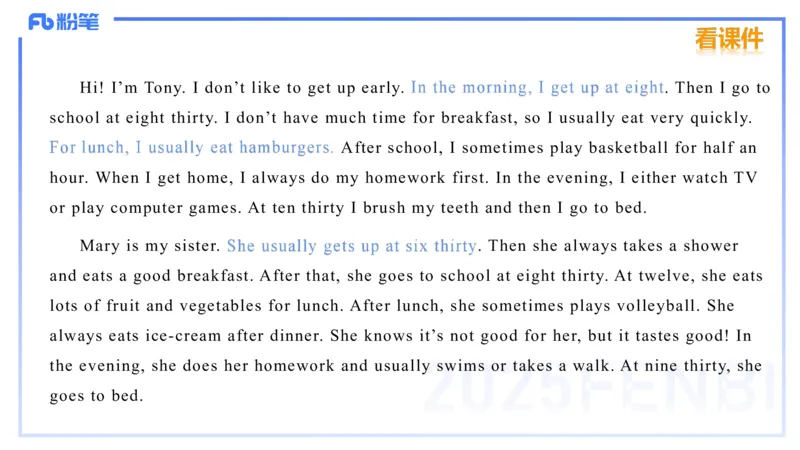
(4)Questions & answersHi! I’m Tony. I don’t like to get up early. . Then I go to
school at eight thirty. I don’t have much time for breakfast, so I usually eat very quickly.
After school, I sometimes play basketball for half an
hour. When I get home, I always do my homework first. In the evening, I either watch TV
or play computer games. At ten thirty I brush my teeth and then I go to bed.
Mary is my sister. . Then she always takes a shower
and eats a good breakfast. After that, she goes to school at eight thirty. At twelve, she eats
lots of fruit and vegetables for lunch. After lunch, she sometimes plays volleyball. She
always eats ice-cream after dinner. She knows it’s not good for her, but it tastes good! In
the evening, she does her homework and usually swims or takes a walk. At nine thirty, she
goes to bed.● Step 3 While-listening(10 mins)模板
Step 2 While-listening
(1)Extensive listening
Students will listen to the passage for the first time to check their predictions and conclude the main idea
of the passage.
(2)Intensive listening
Students should listen to the passage for the second time and do the following tasks:
①True or False ②Form-filling
Tony either watch TV or play computer games in the evening.(T/F) Tony Mary
get up
Mary eats hamburgers for lunch.(T/F)
breakfast
At nine thirty, Tony goes to bed.(T/F)
lunch
evening
go to bed(3) Listening and repeating
Students will listen to the passage for the third time and read after it. They should pay attention to the
pronunciation and intonation.
【Justification】In the process of completing the listening tasks at different levels, students can not only
understand the content and certain details of the passage, but also improve their listening skills.P207
IV.● IMV. Majajoorr S Steptseps
Post-listening(任选其一)
Role play
Discussion
Discuss the question Act out this dialogue
02 04
in group of four. with partners.
Survey Debate
01 03
Make a survey with Which idea do
group mates. you agree?Hi! I’m Tony. I don’t like to get up early. In the morning, I get up at eight. Then I go to
school at eight thirty. I don’t have much time for breakfast, so I usually eat very quickly.
For lunch, I usually eat hamburgers. After school, I sometimes play basketball for half an
hour. When I get home, I always do my homework first. In the evening, I either watch TV
or play computer games. At ten thirty I brush my teeth and then I go to bed.
Mary is my sister. She usually gets up at six thirty. Then she always takes a shower and
eats a good breakfast. After that, she goes to school at eight thirty. At twelve, she eats lots
of fruit and vegetables for lunch. After lunch, she sometimes plays volleyball. She always
eats ice-cream after dinner.She knows it’s not good for her, but it tastes good! In the
evening, she does her homework and usually swims or takes a walk. At nine thirty, she
goes to bed.Step 4 Post-listening
Group discussion
Students will work in groups to discuss the following question: “Who is healthier and why?” Several
minutes will be given. When time’s up, several students will be invited to share their answers/results. Then
the teacher will comment on students' performances.
【Justification】Group activities will provide students with the opportunity to apply what they have learned
to the situation, improve their comprehensive language skills, and boost their confidence in learning English
and strengthen their sense of teamwork.写作课/ 读写课——核心教学环节P207
Writing—PWP
Pre- While- Post-
writing writing writing
Drafting
1.What to write 1.Editing
2.How to write 2.Sharing & EvaluationIV. Major Steps
Steps\Time 40 mins 20 mins
Step 1 Lead-in 5 mins \
Step 2 Pre-writing 12 mins 8 mins
Step 3 While-writing 10 mins 7 mins
Step 4 Post-writing 8 mins 5 mins
Step 5 Summary & Homework 5 mins \P207
有范文:
IV. Major Steps
无范文:
Pre-writing
(结合教学内容选择)
Speaking/
Sample reading Outlining
Structure
Brainstorming
learningP207
实例展示:
Pre-writing
① Learning about the sample
The teacher will guide students to read the material to summarize the topic of it. Then students will answer
some questions about the material.
Q1: What happened after the man enlarged the hole on the pupa?
Q2: Why did struggle help the butterfly survive?
② Conceiving the writing material
Students will work in groups of four to talk about fables they know, and write down some ideas.
Representatives from each group will share their discussion results, including some useful phrases, sentences
and so on.P208
实例展示:
③ Structure learning
The teacher will guide students to summarize the basic structure of narration, and students should also pay
attention to the topic sentences, transitional words, logical relations and so on.
④ Outlining
The teacher will guide students to write an outline. Students will put the ideas they have just written down in
order.
(Justification: Through above activities, students will be prepared to write their own compositions. They will
know what to write and how to write it.)语言素材:
( )
1 Read the short essay and discuss
We can learn all we need on the Internet
I agree with this idea, especially on the subject of learning English. In my class,
there are 45 students, and our English lessons last for 50 minutes. That means that we
each have one minute of our teacher's time! Our English teacher is excellent, but she
can't help everyone in the class in 50 minutes.
It would be much better if we spend the time working on a computer. There are 45
computers in our school, so we could do that if we work independently, we can learn
much more. And we can learn about the subjects that we are interested in.
( )
2 Write a paragraph giving the opposite view.Step 1 Pre-writing
1. Learn about the sample.
(1) Read the material to summarize the topic and structure.
Then students will find the supporting ideas of “We can learn all we need on the Internet”.
① There are 45 students while our English lesson lasts for 50 minutes.
② We can learn much more if we work on a computer independently.
③ We can learn the subjects that we are interested in.
2.Conceive writing material.
Students will work in groups to talk about the opposite points, and write down some ideas.
3. Students will read the sample again to summarize the basic structure.
4. The teacher will guide students to write an outline.
(Justification:Through above activities, students will be prepared to write their own
composition. They will know how to write and what to write.)语言素材:
Writing:
①Think of someone famous that you admire a lot, for example, an artist, a musician or a writer.
②Write two or three paragraphs about his or her life. Below are some suggestions to help you.
③Write about:
Where he/she was born and where he/she lived as a child.
His/Her family.
How he/she became famous.
His/Her songs/music/painting/novels/poems...
To show he/she has been in...
Your opinion of his/her work. Explain why you like him/her.
What you think will happen to him/her.
Whether he/she will continue to be successful.Step 1 Pre-writing
1. Brainstorming
Students will be given several minutes to work in groups to talk about the famous person they admire and
write down some ideas. After that, representatives from each group will share their results, including some
useful phrases, sentences and so on. Each answer will get positive feedback.
2. Structure learning
The teacher will guide students to define the basic structure of the passage. Students should also pay
attention to the topic sentences, transitional words, logicalrelations and so on.
3. Outlining
Students will write an outline based on the above activities.
【Justification】Through the above activities, They can express their ideas and broaden the mind through
the communication. students will be prepared to write their own compositions.P208
While-writing
初稿(Drafting):布置写作任务,让学生开始实践。
实例展示:
Step 2 While-writing
Drafting
Students will write their own compositions, and the teacher will walk around to offer help and remind
students to pay attention to the spelling, grammar, punctuation and so on.
(Justification: Through the above two activities, students will finish their writing and their writing ability
will be improved.)P208
Post-writing
(1)修改(Editing):学生自己(self-editing)或与同桌之间(peer-editing)进行校对、修改
(2)分享评价(Sharing & Evaluation)
实例展示:
Step 3 Post-writing
① Ask students to go through their compositions to correct the mistakes in spelling and grammar,
then exchange their writing with deskmate and do peer-editing.
② Invite several students to show their writings to the class, and then evaluate them in detail and
point out the advantages and disadvantages.
(Justification: Self-evaluation and mutual evaluation can help students find their own shortcomings
in writing, which can also form a good learning atmosphere of mutual assistance.)P209
口语课——核心教学环节P209
口语课教学模式IV. Major steps
Steps\Time 40 mins 20 mins
Step 1 Lead-in 5 mins \
Step 2 Pre-speaking 12 mins 8 mins
Step 3 While-speaking 10 mins 7 mins
Step 4 Post-speaking 8 mins 5 mins
Step 5 Summary & Homework 5 mins \P209
Speaking—PWP
Pre- While- Post-
speaking speaking speaking
What to speak Sharing
Speaking Tasks
EvaluationP209
Pre-speaking
Reading/Listening: basic and Knowledge: words and sentences
detailed information语言素材:
Jack: Hey, John’s birthday dinner is next week. Let’s think about the food.
Tom: Sure. How about burgers, vegetable salad, and some fruit?
Bill: Sounds good. John likes hamburgers.
Jack: Oh, I don’t like salad.
Bill: But John likes salad, and it’s his birthday.
Jack: Yes, you’re right. What about the fruit?
Tom: I think John likes strawberries and apples.
Bill: OK. Let’s have strawberries and apples then.Step 1 Pre-speaking
(1) Listening to the conversation
Students will listen to the conversation to get the main idea, and then answer some questions/ fill in the
chart.
John Bill Jack
Does John like vegetable salad?
hamburger √
What doesn’t Jack like?
salad
What fruit does John like?
strawberry
(2) Learning expressions
The teacher will explain the meaning and usage of the new words such as “hamburgers” “vegetables”
“strawberries” and sentences including “John likes hamburgers.” “I don’t like salad.” .
(Justification: With those activities, students will be familiar with the situation, and accumulate many
expressions which can be used in this situation, making good preparations for the speaking activities.)P209
While-speaking
(活动按顺序进行)
Group acivities
Reading after the audio (discussion/ making a new dialogue/ survey)语言素材:
Jack: Hey, John’s birthday dinner is next week. Let’s think about the food.
Tom: Sure. How about burgers, vegetable salad, and some fruit?
Bill: Sounds good. John likes hamburgers.
Jack: Oh, I don’t like salad.
Bill: But John likes salad, and it’s his birthday.
Jack: Yes, you’re right. What about the fruit?
Tom: I think John likes strawberries and apples.
Bill: OK. Let’s have strawberries and apples then.Step 2 While-speaking
(1) Reading after the tape
The teacher will play the tape and lead students to read after it. Students should pay attention to the
pronunciation and intonation.
(2) Group discussion
Ask students to work in groups of four and have a discussion about the food they like. They should try to
use the words and sentence structures they have learned today.
(Justification: Students will have a deeper understanding of the topic and usage of the new knowledge,
and they can also have more opportunities to express themselves.)P209
Post-speaking
(活动按顺序进行)
Sharing EvaluationStep 3 Post-speaking
Sharing and evaluating
The teacher will invite some students to share their results with the whole class and guide other students
to evaluate their performance, and then the teacher will make a conclusion.
(Justification: Through these activities, students will improve their speaking skills. Besides, they will be
more willing to share their ideas in public and learn from each other.)P209
IV. Major Steps
Speaking—PPP
Presentation Practice Production
• Basic & detailed information • Make sentences/ Make a
• Group activites (discussion/
• Knowledge: words, sentences match
make a new dialogue/ survey)
• Read after the audio
• Displaying and evaluation语言素材:
Jack: Hey, John’s birthday dinner is next week. Let’s think about the food.
Tom: Sure. How about burgers, vegetable salad, and some fruit?
Bill: Sounds good. John likes hamburgers.
Jack: Oh, I don’t like salad.
Bill: But John likes salad, and it’s his birthday.
Jack: Yes, you’re right. What about the fruit?
Tom: I think John likes strawberries and apples.
Bill: OK. Let’s have strawberries and apples then.Step 1 Presentation
(1) Listening to the conversation
Students will listen to the conversation to get the main idea, and then answer some questions/ fill in the
chart.
John Bill Jack
Does John like vegetable salad?
hamburger √
What doesn’t Jack like?
salad
What fruit does John like?
strawberry
(2) Learning expressions
The teacher will explain the meaning and usage of the new words such as “hamburgers” “vegetables”
“strawberries” and sentences including “John likes hamburgers.” “I don’t like salad.”
(Justification: With those activities, students will be familiar with the situation, and accumulate many
expressions which can be used in this situation, making good preparations for the speaking activities.)Step 2 Practice
1.Invite students to do some exercises about the new knowledge, such as matching pictures with
correct words, making sentences and so on.
2.The teacher will play the audio and lead students to read after it. Students should pay attention to the
pronunciation and intonation.
(Justification: This activity can help students practice the sentence patterns and increase their interest in
learning English. Besides, their abilities of speaking can be improved.)Step 3 Production
Group discussion
Ask students to work in groups of four and have a discussion about the food they like by using the target
langusge. Several minutes will be given. When time is up, students need to share their results with the whole
class. The teacher should observe students’ performance, give them help and positive evaluations.
(Justification: Through the group work, students can gradually become proficient in using the sentence
patterns they have learned and apply them into daily life. In addition, their confidence of speaking and learning
English can be cultivated.)PWP PPP
Pre-speaking Presentation
1.Basic &detailed information 1.Basic&detailed information
2.Knowledge: words, sentences 2.Knowledge:words,sentences
While-speaking Speaking Practice
1.Read after the audio 1.Make sentences/ Make a match
2.Group activities (discussion/make 2.Read after the audio
a new dialogue/survey) Production
Post-speaking Group activities (discussion/make a
1.Displaying new dialogue/survey)
2.Evaluation (Displaying and evaluation)Q & A粉笔教师教育 粉笔教师