2024—2025—1 高一年级月考(1)
英 语 试 题
时间:120分钟 满分:120分
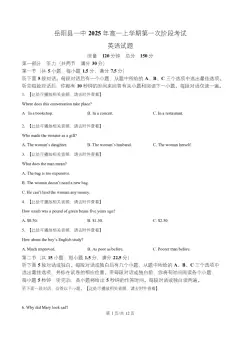
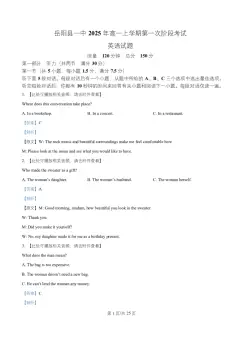
第一部分 听力(共两节,满分20分)
第一节 (共5小题;每小题1分,满分5分)
听下面5段对话。每段对话后有一个小题,从题中所给的 A、B、C三个选项中选出最佳选项
听完每段对话后,你都有10秒钟的时间来回答有关小题和阅读下一小题。每段对话仅读一遍。
例: How much is the shirt?
A. £ 19.15. B. £ 9.18. C. £ 9.15.
答案是C.
1. How will the speakers go home?
A. By car. B. By bus. C. By taxi.
2. At what hotel does the man advise the woman to stay?
A. A five-star one. B. A four-star one. C. A three-star one.
3. What will the woman probably do next?
A. Do her homework. B. Go to the cinema. C. Have dinner with the man.
4. What color dress will the woman wear for the party?
A. Black. B. White. C. Pink.
5. Where will the speakers meet?
A. In the library. B. In the town square. C. In the town hall.
第二节 (共15小题;每小题1分,满分15分)
听下面5段对话或独白。每段对话或独白后有几个小题,从题中所给的 A、B、C三个选项中
选出最佳选项。听每段对话或独白前,你将有时间阅读各个小题,每小题 5秒钟;听完后,各
小题将给出5秒钟的作答时间。每段对话或独白读两遍。
听第6段材料,回答第6、7题。
6. What does the woman ask the man to do on the weekend?
A. Do homework with her. B. Plant trees in the park. C. Go to a picnic.
7. What time can the man find the woman on Sunday?
A. At9:00 a. m. B At 11:00 a. m. C. At 4:00 p. m.
听第7段材料,回答第8、9题。
第1页/共12页
学科网(北京)股份有限公司8. Why does the man telephone the woman?
A. To book a train ticket.
B. To tell her the time of his arrival.
C. To wake her up in time.
9. Where is the man right now?
A. In his office. B. At the train station. C. On the train.
听第8段材料,回答第10至12题。
10. How long did the man stay in Spain?
A. For two days. B. For five days. C. For seven days.
11. What did the man with his family do in the forest?
A. They took some photos.
B. They saved a hurt bird.
C. They picked up some flowers.
12. What did the man buy for the woman?
A. A bottle of honey. B. A beautiful dress. C. A famous picture.
听第9段材料,回答第13至 16题。
13. What activity did the man like best during his camp?
A. Winning a guessing game. B. Going on a hike.
C. Riding a hot-air balloon.
14. Where did the man find the missing boy?
A. Beside the river. B. In the school. C. On the mountaintop.
15 How did the man feel about the camp?
A. Frightened. B. Tired. C. Excited.
16. What is the relationship between the speakers?
A. Classmates. B. Teacher and student. C. Mother and son.
听第10段材料,回答第17至20题。
17. What is the weather probably like?
A. Rainy. B. Sunny. C. Windy.
18. Where did Matt begin his journey?
A. In England. B. In California. C. In Hawaii.
19. How many hours was Matt’s longest flight?
A. Fourteen hours. B. Sixteen hours. C. Sixteen and a half hours.
第2页/共12页
学科网(北京)股份有限公司20. What does the speaker expect Matt to do?
A. Share his experiences. B. Answer the listeners’ questions. C. Plan another flight.
第二部分 阅读(共两节,满分40分)
第一节 (共15小题;每小题2分,满分30分)
阅读下列短文,从每题所给的A、B、C、D四个选项中选出最佳选项。
A
Four Online Art Classes
International Center of Photography
Cost: $20 per month or $220 per year
Class length: 3 to 5 hours
Registration: Open year-round
Standout feature: International Center of Photography is popular for photography classes that are suitable for
people at different skill levels and these classes are taught by experienced teachers.
The Ceramic (陶瓷) School
Cost: $30 per month or $300 per year
Class length: 1 to 2 hours
Registration: Open year-round
Standout feature: The Ceramic School offers many classes and live online events at a reasonable price and is
only centered on ceramics.
Craftsy
Cost: $10 per month or $90 per year
Class length: 1 to 2 hours
Registration: By semester (学期)
Standout feature: Craftsy stands out for offering many courses such as sewing, embroidery and knitting (缝纫、
刺绣和编织) that are suitable for all levels, from beginners to more experienced learners.
Skillshare
Cost: $15 per month or $150 per year
Class length: 1 to 3 hours
Registration: Open year-round
Standout feature: Providing classes for people at all skill levels at an affordable price, Skillshare is our top pick
for online painting lessons.
1. How much should you pay if you register for a six-month photography course?
第3页/共12页
学科网(北京)股份有限公司A. $60. B. $85. C. $100. D. $120.
2. In what way do the Ceramic School and Craftsy have in common?
A. Their classes are both for beginners. B. Their classes cost the same.
C. Their classes last for the same time. D. Their classes are both open year-round.
3. Which of the following classes is suitable for painting lovers?
A. Skillshare. B. Craftsy.
C. The Ceramic School. D. International Center of Photography.
B
Kevin Beard is my class instructor. Most weeks, I’d greet Kevin as he set up gloves, mats, and other equipment. So
I was shocked when I arrived one day to find him standing in front of the room telling a story, with tears on his
cheeks. I was worried something had gone terribly wrong in his life, but as I listened to him talk, I heard him use
words like “amazing” and “accomplishment.” I realized his tears were out of happiness... Just a few days earlier, he’d
received his GED (General Equivalency Diploma), at the age of 52.
Having dyslexia (阅读障碍), Kevin left school at a young age and then managed to support himself by taking
different jobs. In his mid-30s, Kevin finally found a job with some promise: working for a sheriff’s department (治
安部门). Amazingly, when he came clean with them about his education, they said they’d hi re him as long as he got
his GED. He agreed, and kind of excited about giving school another chance.
Kevin studied with a tutor, and he did it for more than ten years, learning and practicing and correcting his
mistakes, often late into the night. It was a huge challenge, something Kevin compares to “climbing a mountain.” In
fact, as Kevin took tests along the way, he did something interesting with each of his results. He posted them on his
bedroom wall so that he could watch his progress. “I needed to see myself moving forward, and I wanted to speak,”
he said.
Finally, he made it. “I can’t really describe what it’s like to finally achieve this,” he said. “I can hardly even
put it into words.” This might sound like a perfect ending. But for Kevin, it’s a new beginning. His next step is college.
“Now that I’ve accomplished my GED, I’m hungry for education,” he said.
4. Why did Kevin cry in the classroom?
A. He was worried about his future. B. He had reached one of his goals.
C. He was moved by a touching story. D. He had experienced something terrible.
5. What was the response of the sheriff’s department when they learned of Kevin’s education?
A. They gave him a part-time job. B. They refused him directly.
C. They considered his suitability for the job. D. They gave him hope.
第4页/共12页
学科网(北京)股份有限公司6. How did Kevin encourage himself to keep going to get his GED?
A. By taking time to do things that interest him. B. By reporting his test results to his tutor.
C. By writing himself encouraging words. D. By reminding himself of his progress.
7. What can we learn from Kevin’s story?
A. Nothing can stop a willing heart. B. The early bird catches the worm.
C. Always prepare for a rainy day. D. Grasp all, lose all.
C
Dog owners walked about 23 minutes longer each day than non-dog owners. In a new study, dog owners took
2, 760 additional steps-compared to people who didn’t have a dog at home. But here’s the real good news: That
extra exercise could help adults meet their recommended weekly totals for physical activity.
The research, published in BMC Public Health, focused on adults 65 and older, who tend to be less active
than younger people. The study included 43 dog owners and 43 non-dog owners, all of whom were monitored (监
控) continuously for three week-long periods. When they compared the two groups, the researchers found that dog
ownership was connected with a large, potentially health-improving effect.
Dog owners walked about 23 minutes longer each day than non-dog owners, 119 minutes against 96 minutes
on average. They also took an additional 2, 760 steps, and had eight fewer continuous periods of sitting down. Most
of that extra walking was done at proper pace, 100 or more steps a minute. Dog owners walked at this pace for 32
minutes a day, against just 11 minutes a day for non-dog owners.
The World Health Organization (WHO) suggests that adults get at least 150 minutes of physical activity a
week. This increased walking time alone could satisfy that requirement, say the researchers - so it makes sense that
87 percent of dog owners in the study met these guidelines, versus just 47 percent of non-dog owners.
Co-author Nancy Gee says that pet ownership may help older adults get more activity or keep their current
activity level for a longer period of time. “This could improve their chances of a better quality of life, improved
cognition (认知), and perhaps, even a long life, ” she said. Here at Health, we’ll add that caring for pets has been
shown to have plenty of other physical and mental health benefits as well.
8. What can we learn about the research?
A. It was targeted at old people.
B. It had an undesirable effect on dog owners.
C. It was sponsored (资助) by the BMC Public Heal.
D. It mainly considered the mental health of dog owners.
9. What does the author intend to do in paragraph 3?
第5页/共12页
学科网(北京)股份有限公司A. To show the guidelines of the research.
B. To present the results of the research.
C. To describe the process of doing the research.
D. To explain the reasons for conducting the research.
10. What does Nancy Gee think of owning a dog?
A. It will take a lot of time.
B. It will surely help people live a long life.
C. It enables older adults to live a healthy life.
D. It helps young adults to improve their quality of life.
11. What is the best title for the text?
A. Young people walk less today B. Animal lovers are healthier
C. Non-pet owners enjoy more pleasure D. Dog owners walk way more
D
“Merry Christmas from the Family”, a country song by Robert Earl Keen, tells the story of a festive get-together.
Many listeners will recognize the chaos (混乱) the singer describes; even more than that, they will definitely
understand his difficulty remembering how he is related to the various guests. “Fred and Rita drove from Harlingen,”
Mr. Keen sings, “Can’t remember how I’m kin(有亲属关系的) to them.”
That may have something to do with the English language. It is often joked that anyone around your age is a
“cousin” and anyone older is an “uncle” or “aunt”. English is rather bare in its words for family members. Other
languages pay far more attention to the details.
Take “brother” and “sister” for instance. Societies that value age-order highly often have different terms for
older brother, older sister, younger brother and younger sister. These are ge, jie, di and mei in Chinese or ani, ane,
ototo, imoto in Japanese.
Chinese even requires the speakers to remember whether a relative is older or younger than they are, whether
relatives of their parents are older or younger than they, and so on. There are many armchair theories about the
relationship between language and culture that do not hold up to careful examination. The East Asian languages’
focus on seniority (年长), however, is actually related to the importance Confucianism places on the virtue of
respecting your elders.
Actually, all languages can describe relationships in any amount of detail your listener would like. The focus
that some cultures put on labelling every possible relation with a different word does not mean that those who don’t
have those words will not pay attention to family networks. Every English-speaking family seems to have at least
第6页/共12页
学科网(北京)股份有限公司one member who can sort out all the relations and tell you that Henry Ford was a great-great-great uncle. But each
family also has members who couldn’t care less, waving a hand and saying “uncle” or “cousin”.
12. How does the author introduce the topic of the text?
A. By blaming a forgetful guest. B. By praising a country singer.
C. By describing a shared experience. D. By joining in a festive get-together.
13. Why does the author mention the examples of Chinese and Japanese?
A. To show Asian people’s respect for the elders. B. To compare them with English language.
C. To prove the influence of Confucianism. D. To make an introduction to East Asian languages.
14. What does “armchair theories” in paragraph 4 probably mean?
A. baseless beliefs. B. detailed descriptions.
C. opposite thoughts. D. logical explanations.
15. What does the author want to convey in the last paragraph?
A. Labelling every relation is no easy.
B. English speakers value family networks as well.
C. Some people enjoy sorting out relations.
D. General words for relatives suggest weaker family bond.
第二节 (共5小题;每小题2分,满分10分)
阅读下面短文,从短文后的选项中选出可以填入空白处的最佳选项。选项中有两项为多余选
项。
Things I Wish I’d Known in High School
Sometimes high school seems like a necessary evil, Now at the end of my college , I know there are still
more things I could have done to make my high school more beneficial.
___16___ Take a class that scares you during high school. The experience will definitely prepare you for
future academic challenges.
Don’t worry about your grades too much. Getting a B is not the end of the world. ___17___ I started
college with all A’s since seventh grade, and it was hard to deal with not being able to repeat that. I stayed away
from taking some harder courses I might have done well in because I was afraid of doing poorly. Now, I can fully
accept that if I try my best in at least one harder course and get a B+, that is still something to be proud of.
Find your own de-stress routine. Another essential skill to begin building in high school is how to manage
work and stress. Maybe you deal with stress by going for a run, or watching a silly movie. ___18___
Spend your summers wisely. Don't take on a full-time job the first summer you decide to work
第7页/共12页
学科网(北京)股份有限公司___19___
Do find something to do that will make the ten weeks worthwhile. Look for programs that take you to
interesting places, or a job that will give you insight into something you might be interested in.
Finally, remember to have fun. Your life does not depend on high school ___20___You will have plenty of
time to work hard in college and beyond. Be prepared, but don’t stress out too much about it. If you can make
your high school experience fun, you will have no problem doing the same for your life in college and beyond.
A. In fact, it’s kind of a good thing
B. Take full advantage of your brain
C. You do have to be active about making friends
D. Do your best, but leave time for fun with friends
E. Forty hours a week will be a huge shock and you’ll have plenty of time for that in the future.
F. Find out what relaxes you, and you will feel less stressed
G. They will be improved if you make great efforts.
第三部分 语言运用 (共四节,满分45分)
第一节 (共15小题;每小题1分,满分15分)
阅读下面短文,从短文后各题所给的A、B、C和D四个选项中,选出可以填入空白处的最
佳选项。
“Have you ever considered giving up during a race?” a runner asked me during the Geneva Marathon. We’d
____21____ and keeping going felt like walking through a marsh (沼泽). Even the attractive scenery along the way
wasn’t enough to ____22____ our spirits.
“I can’t think of a single race when I haven’t!” I answered ____23____. The runner beside me looked a little
relived. Encouraged, I went on to ____24____ a few of the weak moments I had overcome to persuade her to
____25____. My biggest ____26____ came during the first half of the 56-mile Marathon in South Africa, I told her.
Running it was a ____27____ dream, but when I found myself on a hill with painful blisters (水疱) between my
toes, I realized it was a(n)____28____ decision to wear no socks.
“If I give up now, I’ll ____29____ myself from six hours of pain,” I continued. In that moment, 1,000 km of
tiring ____30____ and the thousands of pounds I’d spent on flights and accommodation didn’t ____31____ at
all.____32____, someone at my running club had laughed at the idea of a slow runner like me entering the marathon
like this, and recalling (回忆起) this encouraged me to keep moving.
“I may not finish this race before the 12-hour ____33____, but I’m not going to give that man the chance to
say, I told you so”, I said. Soon afterwards, I buddied up with another ____34____, a six-hour chat ____35____ and
第8页/共12页
学科网(北京)股份有限公司we got each other to the finish with 17 minutes to spare.
21. A. gone away B. fallen behind C. taken off D. come back
22. A. lift B. break C. lower D. feel
23. A. confidently B. proudly C. honestly D. rudely
24. A. seize B. share C. make D. copy
25. A. stop B. rise C. continue D. quit
26. A. opportunity B. mistake C. practice D. challenge
27. A. lifelong B. forgotten C. distant D. disappointing
28. A. thoughtful B. unwise C. careful D. difficult
29. A. leave B. get C. save D. tell
30. A. consideration B. relaxation C. advice D. training
31. A. work B. matter C. appear D. exist
32. A. Luckily B. Surprisingly C. Sadly D. Undoubtedly
33. A. headline B. limit C. journey D. work
34. A. runner B. judge C. worker D. student
35. A. concluded B. interrupted C. failed D. followed
第二节 语法填空(共10小题,每小题1分,满分10分)
阅读下面短文,在空白处填入1个适当的单词或括号内单词的正确形式。
A Chinese video game became an instant success upon its recent release, ____36____ (impress) games around
the world. The game, Black Myth: Wukong, was inspired by the novel Journey to the West ____37____ mainly
describes a long journey to the Western Heaven to obtain Buddhist scriptures(经文). On the journey, the four brave
disciples(徒弟) protected their master ____38____ various monsters and disasters. The game’s production team
traveled across China and ____39____ (careful) scanned ancient buildings and relics.
It was not easy ____40____ (create) such a miraculous cultural work, due to the amount of time needed and
the requirement of money and human resources. However, the game is already a top seller on multiple platforms. The
success of the game shows that the ____41____ (attract) of traditional culture and the application of modern video
techniques is working wonders. Chinese legends not only help developers make quick bucks, ____42____ also
provide chances for cultural ____43____ (exchange) of youths across the world.
In fact, China ____44____ (encourage) high-level opening-up in the past years, exploring effective ways to
combine culture and technology, accelerating the development of new cultural formats, and helping create more high-
quality works such as Black Myth: Wukong. This means the future of China’s digital industry is
第9页/共12页
学科网(北京)股份有限公司_____45_____(promise).
第三节 单词拼写 (共10小题,每小题1分,满分10分) 71-75 题首字母已给出,需在答题卡
上写出完整的单词
46. We burned with ________(好奇心) over what was in the box.(根据汉语提示单词拼写)
47. I have just spent a wonderful holiday there and would ________ (推荐) it to anyone. (根据汉语提示单词拼
写)
48. Thanks to the_______(先进的) technology, we live in an age of bettered communication. (根据汉语提示单词
拼写)
.
49 Chinese has a large vocabulary with different usages so it’s not easy for a foreigner to speak as ________(流
利地) as a native speaker. (根据汉语提示单词拼写)
.
50 Thank you very much for considering my ________ (申请) and I look forward to hearing from you soon. (根
据汉语提示单词拼写)
51. He was so a________ (spend all your free time doing something because you are so interested in it) to observing
insects that he later chose to be a biologist.(根据首字母和英文提示单词拼写)
52. The guide f________ (to make the light shine brightly for a short time) a light into the cave before we walked
inside. (根据首字母和英文提示单词拼写)
53. I became a teacher because I p________ (to like something or someone better than another) books and people
to politics at that time. (根据首字母和英文提示单词拼写)
54. Outgoing people usually enjoy the c________ (the fact of being with somebody else and not alone) of other
people. (根据首字母和英文提示单词拼写)
55. Everyone’s fingerprints are u_________ (being the only one of its kind) . (根据英文提示单词拼写)
第四节 单项选择 (共10小题,每小题1分,满分10分)
56. What is the sentence pattern(句型)of the sentence “I had my first English class at senior high school.”?
A. S V O A B. S V O C. S V IO DO D. S V O C
57. Which of the sentences follows the same structure with “My brothers are all college students”?
A. The school adviser helped me choose suitable subjects.
B. Mr. Wang used to teach himself Japanese.
C. His goal is to look after homeless children.
D. He is looking for problems on his broken car.
58. In the sentence “When holiday comes, I feel a little confused, because I always want to do something new.” the
underlined part is a(n)________ phrase.
第10页/共12页
学科网(北京)股份有限公司A. noun B. adverb C. adjective D. preposition
59. The manager found the project ________.
A. success B. succeed C. successful D. successfully
60. ______ straight on and you’ll see a church. You won’t miss it.
A. Go B. Going C. If you go D. When going
61. —Would you mind my coming over and having a look at your new garden? My little son’s curious about those
roses you grow.
—________. You’re welcome.
A. Yes, I do B. Never mind C. Yes, please D. Not at all
62. He saw the scary movie with a ________ look on his face.
A. frightening B. frightened C. frightens D. frighten
.
63 Emergency line operators must always calm and make sure that they get all the information they need
to send help.
A. grow B. appear C. become D. stay
.
64 —How about having a party this weekend?
—That _______ me fine. I’m coming.
A. suits B. fits C. matches D. agrees
65. — If you like, I can do some shopping for you.
.
— That’s a very kind ________
A. offer B. service C. point D. style
第四部分 写作(满分15分)
66. 假设你是李华,在美国孔子学院的笔友 Peter对汉字书法非常感兴趣,写信向你咨询学习书法的建议。
请你用英语回信,内容包括:
1.写信目的;
2.学习书法的有效方法及好处;
3.你的祝愿。
注意:
1.词数100左右;
2.可以适当增加细节,以使行文连贯。
3.参考词汇:书法 calligraphy
____________________________________________________________________________________________
____________________________________________________________________________________________
第11页/共12页
学科网(北京)股份有限公司____________________________________________________________________________________________
____________________________________________________________________________________________
____________________________________________________________________________________________
第12页/共12页
学科网(北京)股份有限公司