内部资料
请勿外传
院
学
计
ACCA P3 关键模型汇总
会
计
汇编:詹也
浙江财经大学
审
2014 年
:
B
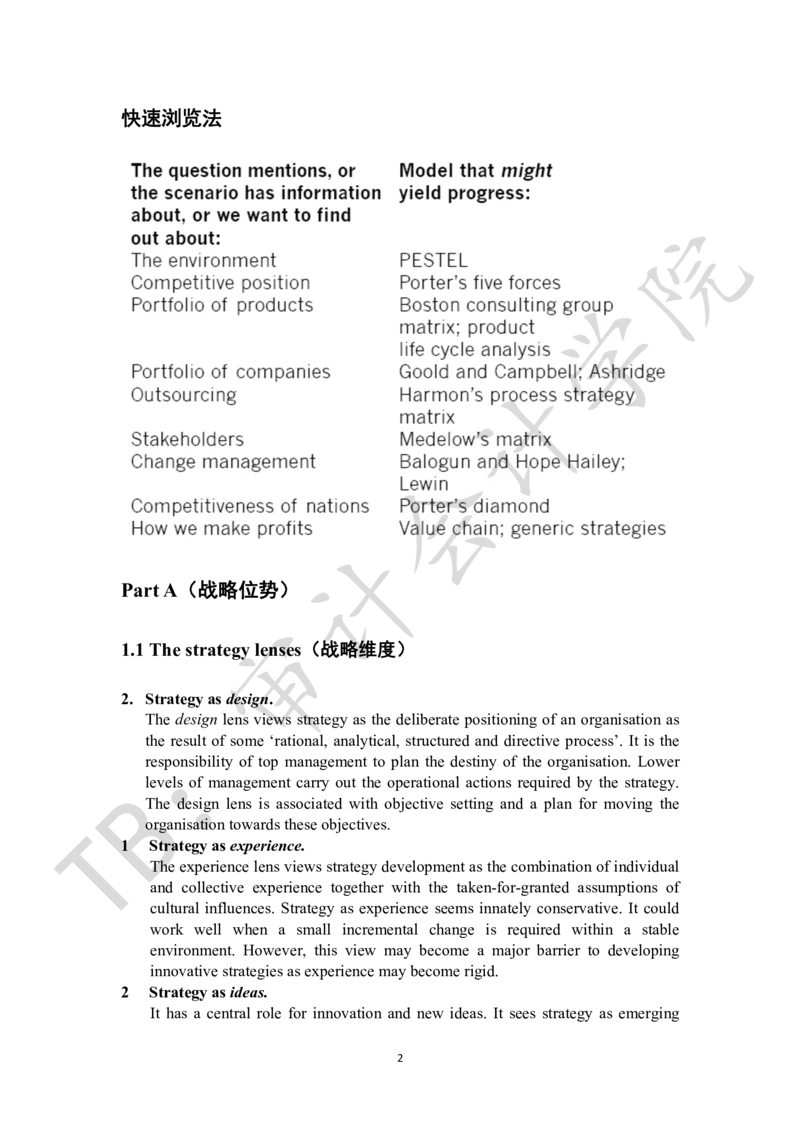
T快速浏览法
院
学
计
会
计
Part A(战略位势)
审
1.1 The strategy lenses(战略维度)
:2. Strategy as design.
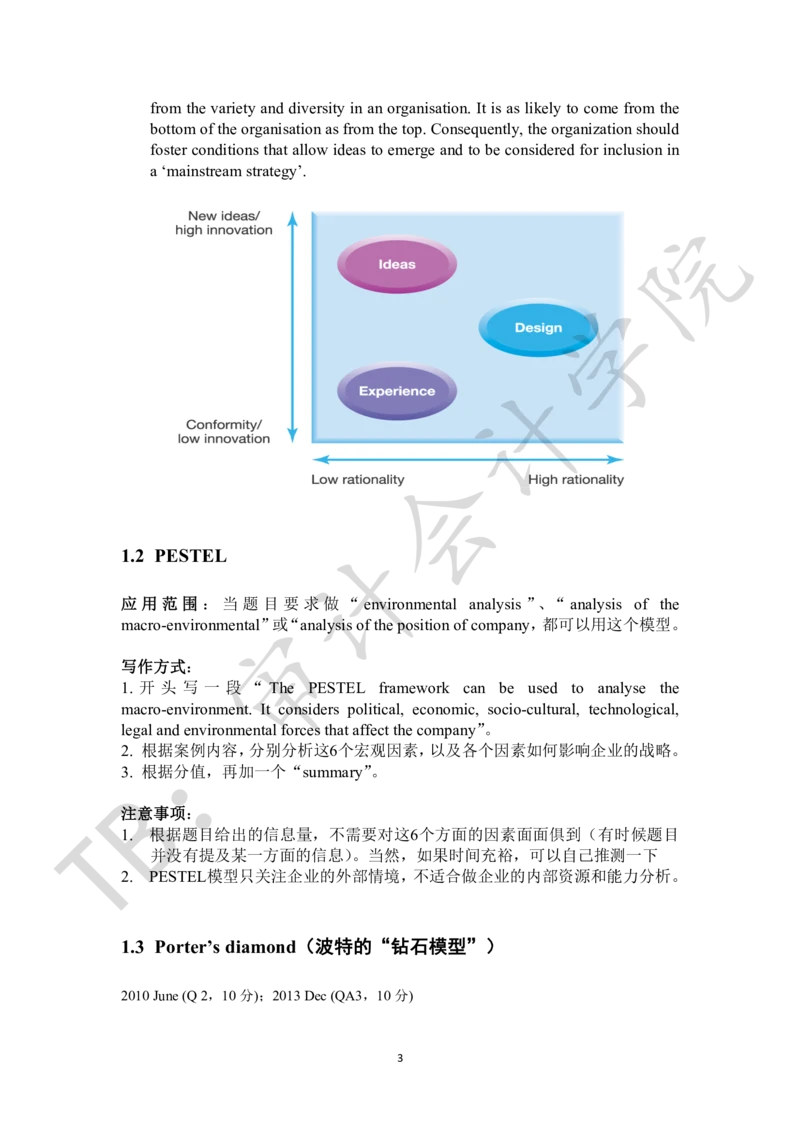
The design lens views strategy as the deliberate positioning of an organisation as
the result of some ‘rational, analytical, structured and directive process’. It is the
responsibility of top management to plan the destiny of the organisation. Lower
Blevels of management carry out the operational actions required by the strategy.
The design lens is associated with objective setting and a plan for moving the
Torganisation towards these objectives.
1 Strategy as experience.
The experience lens views strategy development as the combination of individual
and collective experience together with the taken-for-granted assumptions of
cultural influences. Strategy as experience seems innately conservative. It could
work well when a small incremental change is required within a stable
environment. However, this view may become a major barrier to developing
innovative strategies as experience may become rigid.
2 Strategy as ideas.
It has a central role for innovation and new ideas. It sees strategy as emerging
2from the variety and diversity in an organisation. It is as likely to come from the
bottom of the organisation as from the top. Consequently, the organization should
foster conditions that allow ideas to emerge and to be considered for inclusion in
a ‘mainstream strategy’.
院
学
计
会
计
1.2 PESTEL
应 用 范 围 : 当 题 目 要 求 做 “ environmental analysis ”、“ analysis of the
审
macro-environmental”或“analysis of the position of company,都可以用这个模型。
写作方式:
1. 开 头 写 一 段 “ The PESTEL framework can be used to analyse the
:
macro-environment. It considers political, economic, socio-cultural, technological,
legal and environmental forces that affect the company”。
2. 根据案例内容,分别分析这6个宏观因素,以及各个因素如何影响企业的战略。
3. 根据分值,再加一个“summary”。
B
注意事项:
T
1. 根据题目给出的信息量,不需要对这6个方面的因素面面俱到(有时候题目
并没有提及某一方面的信息)。当然,如果时间充裕,可以自己推测一下
2. PESTEL模型只关注企业的外部情境,不适合做企业的内部资源和能力分析。
1.3 Porter’s diamond(波特的“钻石模型”)
2010 June (Q 2,10分);2013 Dec (QA3,10分)
3院
学
计
应用范围:适合分析国家或产业的竞争优势。
会
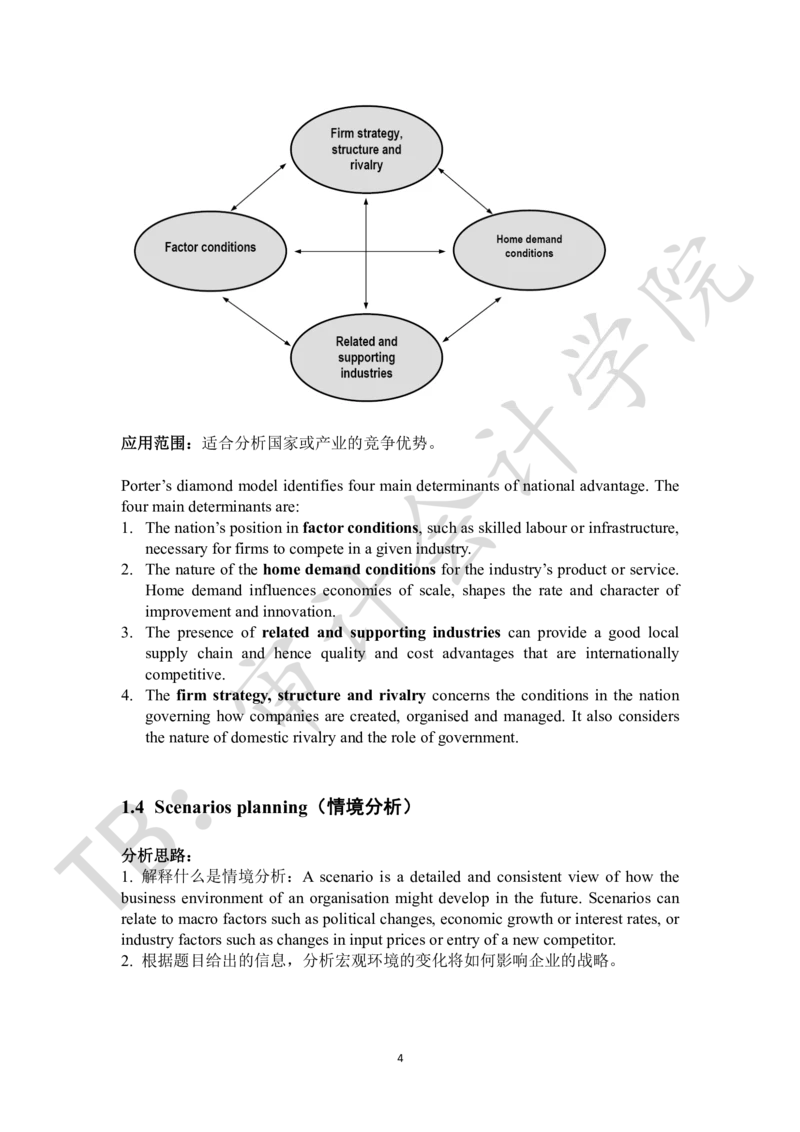
Porter’s diamond model identifies four main determinants of national advantage. The
four main determinants are:
1. The nation’s position in factor conditions, such as skilled labour or infrastructure,
计
necessary for firms to compete in a given industry.
2. The nature of the home demand conditions for the industry’s product or service.
Home demand influences economies of scale, shapes the rate and character of
improvement and innovation.
审
3. The presence of related and supporting industries can provide a good local
supply chain and hence quality and cost advantages that are internationally
competitive.
4. The firm strategy, structure and rivalry concerns the conditions in the nation
:
governing how companies are created, organised and managed. It also considers
the nature of domestic rivalry and the role of government.
B
1.4 Scenarios planning(情境分析)
T
分析思路:
1. 解释什么是情境分析:A scenario is a detailed and consistent view of how the
business environment of an organisation might develop in the future. Scenarios can
relate to macro factors such as political changes, economic growth or interest rates, or
industry factors such as changes in input prices or entry of a new competitor.
2. 根据题目给出的信息,分析宏观环境的变化将如何影响企业的战略。
41.5 5 Forces Model(波特的“5 力模型”)
应用范围:适合分析企业的竞争地位,经常配合PESTEL模型一起用(取决于分
值)。
院
The 5 Forces Model identifies four main determinants of market competition that the
firm faces.
1. Threat of new entrants. Barriers to entry will reduce competition by deterring
companies from joining an industry. 学
2. Threat of substitutes. The presence of substitutes will reduce profits because
customers can switch if prices rise
3. Bargaining power of buyers. Factors such as relative size and dependence will
affect the ability of buyers to drive down prices计.
4. Bargaining power of suppliers. similarly, if suppliers in an industry have strong
negotiating power, the price of inputs will be driven up and profits reduced
5. Competition and rivalry. Intense competition will reduce profits. This may result
会
from slow growing or declining markets, excess capacity, barriers to exit and other
factors
计
1.6 Forecasting method
linear regression:2011 Dec (Q4)
Time serie审s:Pilot 2011 (Q3,12分)
两者结合:2013 Dec (Q2a,15分)
1.6.1 linear regression
:
linear regression defines the equation of a straight line that ‘best’ fits the data by
minimising the squares of deviations of actual values from the mean. In least squares
analysis, one set of data is defined as the independent variable (x – in this case,
B
time) and the other set of data, sales, is defined as y – the dependent variable.
一般要求解释方程以及指标的意义,如:
T
(cid:122) The positive value of b suggests that the overall sales trend is upwards.
(cid:122) The correlation coefficient ‘r’ shows the strength of the statistical relationship
between the two variables. e.g. the value of r is 0.253, which suggests that the
two variables are weakly connected.
(cid:122) The coefficient of determination (r2) shows that xxx% of the variation in sales (y)
is due to the passage of time (x). Low coefficients of correlation (and
determination) are usual when data is widely scattered around the mean and/or
are related in a non-linear fashion.
注意:linear regression has little practical use when the data pattern is caused by large
5seasonal variations.
Time series analysis uses a moving average to define a trend.
1.7 Resource audit
院
应用范围:当题目要求分析“current strategic position from an internal perspective”,
用该模型。
学
分析思路:
3. 解释定义:Resource audits identify human, financial and material resources and
how they are deployed within a company.
4. 结合案例信息,分析企业的优势与劣势(类计似与SWOT分析)
注意:如果案例给了大量的财务数据,应做数据分析并结合起来分析(e.g. 2011
Dec. Q1)。
会
1.8 SWOT Analysis
计
应用范围:当题目要求分析企业的“strategic capability”、“evaluate the strengths and
weaknesses of xxx”、“current strategic position (from an internal perspective)”的时
候,用该模型。
审
分析思路:
1. 解释什么是SWOT分析:“SWOT analysis summarises the key issues from the
business environment and the strategic capability of an organisation that are most
:likely to impact on strategy development.
2. 根据题目给出的信息,分别分析该企业的“Strengths”(优势)、“Weakness”
(劣势)、“Opportunity”(机会)与“Threats”(威胁)。
B注意:要看清楚题目的问题。例如,SWOT分析中的“优势和劣势”是针对企业
内部因素,而“机会和威胁”是针对企业的外部环境,如果题目要求分析“strategic
Tposition”,需要全面的分析四个方面;如果题目要求分析“strategic capability”,
则可以只分析“优势和劣势”。此外,当题目只要求分析“strengths and weaknesses”
的时候,不需要分析机会与威胁。
1.9 Marketing mix(营销组合)
Marketing mix is a set of strategies that used to attract and retain customers, also
known as the 4Ps or, for service organisations, 7Ps. These are:
61. A product (or service) is anything that satisfies a need or want, including
design, features, quality and packaging.
2. Place deals with how the product is distributed. It concerns with channel and
logistics.
3. Promotion includes all marketing communications which let the public know
of the product or service, e.g. advertising, sales promotions, public re院lations
4. Price is the only one in the marketing mix which brings in revenue. It is
important to set an appropriate price with reference to factors such as cost,
competitors’ prices, perceived quality, firm strategy etc.
学
5. People carry the interaction between customers and staff in person or over the
telephone
6. Processes. Fast and efficient processes (e.g. booking a service) may be a
significant marketing advantages
计
7. Physical evidence. Because services are intangible, it is sometimes important
to provide evidence of ownership, e.g. a ticket to travel or certificate of
attainment for training.
会
注意:传统产业为4P,服务产业为7P。除非题目有特定的要求。
1.10 CSI & KPI(关键成功因素分析法 & 关键绩效指标)
计
分析思路:
1. (1)解释什么是CSI:Critical success factors (CSFs) are those product features
审
that are particularly valued by a group of customers and, therefore, where the
organization must excel to outperform competition. (2)结合案例分析哪些因素
是顾客最重视的要素(对企业而言就是关键的成功因素)。
2. (1)解释什么是KPI:CSFs are normally measured through key performance
:
indicators (KPIs). These are targets that the organisation has to achieve.(2)分析
哪些指标可以用来考核上述的关键成功因素(可结合“the balance scorecard”,
强调同时应用财务指标和非财务指标)。
B
1.11 Value chain(价值链)
T
1. Value chain is developed to analyze a firm’s activities – ways in which they
add value.
2. 具体内容根据题目提供的信息
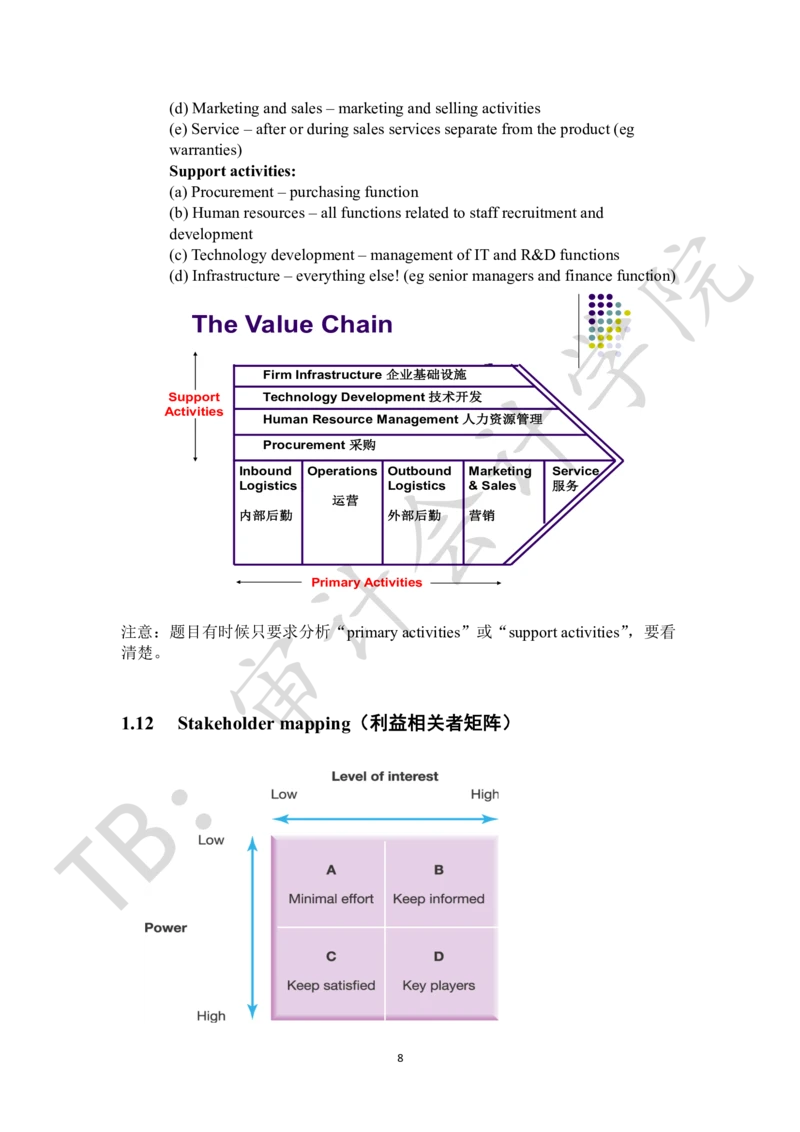
Primary activities:
(a) Inbound logistics – receiving, storing and handling stocks of raw materials
(b) Operations – processing raw materials into finished goods
(c) Outbound logistics – storing finished goods and distributing them to
customers
7(d) Marketing and sales – marketing and selling activities
(e) Service – after or during sales services separate from the product (eg
warranties)
Support activities:
(a) Procurement – purchasing function
(b) Human resources – all functions related to staff recruitment and 院
development
(c) Technology development – management of IT and R&D functions
(d) Infrastructure – everything else! (eg senior managers and finance function)
学
The Value Chain
Firm Infrastructure 企业基础设计施
Support Technology Development 技术开发
Activities
Human Resource Management 人力资源管理
Procurement 采购
会
Inbound Operations Outbound Marketing Service
Logistics Logistics & Sales 服务
运营
内部后勤 外部后勤 营销
计
Primary Activities
Primary Activities
审
注意:题目有时候只要求分析“primary activities”或“support activities”,要看
清楚。
:
1.12 Stakeholder mapping(利益相关者矩阵)
B
T
81. 解释什么是“stakeholder mapping”:An organization's stakeholder relationships
must be managed in accordance with their power and degree of interest. The
stakeholder mapping analysis classifies stakeholders into different groups and use
different strategies to manage relationship with them.
2. 根据题目,把利益相关者分为四类,并提出分别的战略。 院
(1) “high power and high interest”: actively manage these key players
(2) “high power and low interest”: keep these people satisfied
(3) “low power and high interest”: keeping them informed about progress of the
学
company
(4) “low power and low interest”: minimal effort should be put into managing
them, sometimes even ignore them.
计
1.13 Ethical stance(伦理立场)
会
计
审
:
Ethical stance is the extent to which an organization will exceed its minimum
obligation to stakeholders and society at large.
1. Short-term shareholder interest(短期股东利益): only accept a duty of
obedience to the demands of the law.
B
2. Long-term shareholder interest(长期股东利益): taker a wider view of ethical
responsibilities and thus enhance corporate image
T
3. Multiple stakeholder obligations(多方利益相关者义务): accept and balance
the expectations of different stakeholders, including shareholders, suppliers,
employers and customers etc.
4. Shaper of society(社会的标杆): largely the role of public sector organization
and charities.
91.14 Culture web(文化网络)
应用范围:当题目要求分析“the culture of xxx”或“assess the underlying
organisational cultural issues”时,应用该模型。
院
The cultural web is a representation of the taken-for-granted assumptions, or
paradigm, of an organisation.
1. Symbols(符号) such as logos, offices, cars, titles, language and terminology are
a shorthand representation of the nature of the organisation.学
2. Power structures(权力结构)represents the most powerful groupings within the
organization. These people have the greatest amount of influence on decisions,
operations, and the strategic direct of an organization.
3. Organisational structure(组织结构)reflec计ts power and shows important roles
and relationships.
4. Control systems(控制系统), measurements and reward systems emphasise what
is important to monitor in the organisation.
会
5. Routines and rituals(惯例与仪式)define the ‘way we do things around here’.
6. Stories(故事) are used by members of the organisation to tell people what is
important in the organization. They are usually concerned with success, disasters,
heroes, villains and mavericks.
计
Finally, the company paradigm(范式) summarises and reinforces the other elements
of the cultural web.
审
:
B
T
1.15 Corporate governance(组织治理)
Corporate governance is the conduct of the organization's senior effort. The board of
directors is the main governing body, others including an executive committee or the
10board of trustees (unusually for not-for-profit organizations). The board must decides
on a stewardship role and ensure that the organization’s activities is not directed to
management’s own ends rather than those of stakeholders.
院
2. Strategic choices(战略选择)
学
2.1 corporate rationales for adding value(母公司创造价值的三大
计
角色)
Portfolio managers, synergy managers and parental developers represent three
corporate rationales for value creation会 in a multi-business organization.
1. Portfolio managers seek to acquire under-performing or under-valued companies
and to improve their performance so that they can later be sold at a premium.
Portfolio managers manage businesses with a low cost centre and do not intervene
significantly in the r计unning of each business in the portfolio. The value-added
activities of a portfolio manager are usually restricted to investment, setting
expectations and standards and for monitoring performance.
2. Synergy managers pursue economies of scope through the shared use of
审
competences and resources. Developing strategic capabilities, achieving synergies
and transferring managerial capabilities are value-adding activities of a synergy
manager. This will require greater intervention in the operation of the SBUs.
3. Parental developers use the competencies of the parent to add value to
:
businesses in the portfolio. In this instance, the parent company is confident about
its resources and capabilities and wishes to use these to enhance the value of the
businesses in the portfolio. For parental developers, achieving synergies
between companies in the portfolio is not a priority. The focus is on providing the
B
companies in the portfolio with the competencies of the parent.
T
解题思路:
1. 解释三类母公司的角色和定位分别是什么。
2. 分析本案例中,母公司扮演了什么样的角色。
112.2 BCG Matrix(波士顿矩阵)
院
学
计
According to their position on the matrix, SBUs will be categorised as follows:
会
1. Stars offer good future returns so the parent needs to invest in and develop them.
Due to the industry life cycle, stars will become cash cows in time.
2. Cash cows do not need much investment so will generate cash income. Parents
can use this cash to invest in stars or simply provide a return to shareholders.
计
3. Question marks should be assessed to see whether they have the potential to
become stars. If so, the parent should invest in them, if not, they should be sold or
run down.
4. Dogs can tie up funds and provide a poor return. In general, they should be sold
审
off although may be retained if they are a useful niche business.
2.3 The public sector portfolio matrix(公共部门组合矩阵)
:
B
T
应用范围:Government or service agency
1. Public sector star is something that the system is doing well and should not
change. They are essential to the viability of the system.
2. Political hot boxes are services that the public want, or which are mandated, but
12for which there are not adequate resources or competences.
3. Golden fleeces are services that are done well but for which there is low demand.
They are potential targets for cost cutting.
4. Back drawer issues are unappreciated and hve low priority for funding. They are
obvious candidates for cuts. But if managers perceive them as essential, they
should attempt to increase support for them and move them into the po院litical hot
box category.
2.4 The General Electric Model(通用电气公司模型)
学
计
会
计
The GE Model is based on the enterprise’s competitive capacity and the market’s
审
attractiveness. This model attempts to match competence within the company to
conditions within the market place.
2.5 The Shell directional policy matrix(指导性政策矩阵)
:
B
T
The directional policy matrix model is based on the enterprise’s competitive capacity
13and the prospects for sector profitability. This model is deepens upon managerial
judgment rather than simple numerical scores.
2.6 The Ashridge portfolio Model
院
学
计
会
The Ashridge model assesses the benefit SBUs can derive from a corporate parent
playing the parental deve计loper role. The Ashridge model has two variables.
(1) 'Feel': The degree of fit between the parent's skills and resources, and the critical
success factors of the SBU. This measures how well the parent understands what the
SBU must do well to succeed. Low fit in this area means that the parent may
审
inadvertently damage the business.
(2) 'Benefit': the degree of fit between the parent’s skills and resources and the SBU
opportunities.
According to this model, the SBUs can be classified into 4 categories:
:
(1) Heartland businesses have opportunities to improve that the parent knows how
to address and are well understood
(2) Ballast businesses are well understood by the parent, however, the parent has no
real opportunities to add value. Ballast businesses can provide steady earnings but
B
can also be a distraction for management. If they cannot be moved into heartland
businesses, managers should consider divesting them.
T
(3) Value trap businesses present opportunities for parents to add value, perhaps by
exploiting synergies or transferable skills. However, the parents have a limited
understanding of what is critical for the SBU to succeed and so there is a high risk
that they will make decisions that reduce value. If they cannot be converted to
heartland businesses they should be divested.
(4) Alien businesses are poorly understood and offer no opportunities for adding
value. It is likely that value is being destroyed and they should be divested as soon
as possible
142.7 The strategy clock(战略钟模型)
院
学
计
会
计
The strategy clock suggests 8 approaches to creating value for the customer. A
customer will buy from the provider whose approach to price and perceived benefits
matches their own. Each strategy has its on critical success factor.
1. A no frills approach seeks to deliver the lowest possible price. It is most
审
appropriate where customers are price-sensitive, switching costs are low and there
is little opportunity to compete on product features.
2. A low price strategy seeks to provide a similar value of product or service to
competitors, but at a lower price. This is relatively easy for competitors to copy so
:
will only be sustainable if the company has a cost advantage over its competitors
for a given level of quality.
3. The hybrid approach attempts to simultaneously price lower than competitors
while delivering enhanced value to customers. This may be achieved by producing
B
higher volumes than competitors, or focusing very clearly on one aspect of added
value or a particular market segment.
T
4. Differentiation is a strategy aiming to provide services which are different or
unique in terms of value provided to customers. This may be based on factors
such as product quality, marketing or innovation. Differentiation allows customers
to earn a higher margin by charging higher prices, or gain market share by
offering more value at the same price as competitors.
5. Focused differentiation means providing high perceived value to justify charging
a significantly higher price than other products. This usually means targeting a
specific market segment.
(6), (7) & (8) which combine high price and low perceived value will most likely fail.
152.8 Porter’s generic strategies model
Porter developed 3 generic strategies for competitive advantages.
1. Cost leadership: being the lowest cost producer
2. Differentiation: making the product different from competitors’ product院s
3. Focus: specializing on a segment of the market
a) Cost-focus: provide goods and/or services at lower cost
b) Differentiation-focus: provide a differentiated product or service
学
2.9 The TOWS Matrix
计
会
计
TOWS analysis provides four potential strategic directions:
1. WT (weak审ness-threat) strategy aims to minimize weaknesses and threats.
2. WO (weakness-opportunity) strategy aims to minimise weaknesses and exploit
opportunities.
3. ST (strength-threat) strategy aims to use a firm’s strengths to deal with threats.
:
4. SO (strength-opportunity) use a firm’s strengths to exploit opportunities
identified.
2.10 The Ansoff’s Matrix
B
T
16This model attempts to determine which products should be sold in which markets.
1. Market Penetration means increasing market share of existing products via
promotions, price reductions, increasing usage etc. It represents a relatively low
risk strategy. Alternatively, a company may simply aim to maintain or even reduce
its position in a market.
2. Market Development means seeking new customers for existing pro院ducts, e.g.
exporting or selling via new distribution channels. Risk here is still reasonably
low.
3. Product Development is selling new products to existing customers
学
(“cross-selling”). This is slightly riskier as it may involve investment in new
products and its success may depend on the relationship a firm has with its
customers.
4. Diversification, selling new products to new customers, may offer significant
计
growth potential but it is risky as it may require significant investment and new
competencies.
会
2.11 Methods of development(发展模式)
2013 Dec.(QA1,18分)
计
Internal development takes place when strategies are developed by building on or
developing the organisation’s own capabilities. It is often termed organic growth. It is
suited for organization with risk-averse attitude and cautious culture. The organic
审
approach spreads cost and risk over time and growth is much easier to control and
manage. However, growth can be slow and restricted by the breadth of the
organisation’s capabilities.
:
Acquisition strategy is one where one organisation takes ownership of other existing
organisations in the target countries. It allows an organisation to enter a new product
or market area. However, acquisitions usually require considerable expenditure at
some point in time and evidence suggests that there is a high risk that they will not
B
deliver the returns that they promised. Furthermore, acquisitions also bring political
and cultural issues, and acquisitions often results from problems of cultural fit.
T
A strategic alliance takes place when two or more organisations share resources and
activities to pursue a particular strategy. This approach allow the organization to enter
into a marketplace without the large financial outlay of acquiring a local organisation.
Furthermore, it would avoid the cultural dislocation of either acquiring or merging
with another organisation. However, loss of control and difficult to trust alliance
partners are always challenges for alliance management.
A joint venture is an arrangement where a newly created organisation is jointly
owned by the parents.
172.12 Success criteria(战略成功标准)
2013 Dec.(QA2,18分)
应用范围:问某方案或目标收购对象的可行性/吸引力/成功可能性? 院
回答思路:1. 解释战略成功的三大标准:适宜性、可接受性、可行性(suitability,
acceptability and feasibility);2. 结合案例分析。
1. Suitability. Suitability is concerned with whether a proposed strategy addresses
the circumstances in which an organisation is operating - its学 strategic position.
如果是收购案例,评价 suitability 的标准是“an acquisition makes particular
sense if speed to market is vital”,可以结合案例资料从目标市场的competitors、
自身的capability(如economies of scale)、cultural problems等来分析。要说
明该项议案是否合乎企业的战略需求。 计
2. Acceptability. The acceptability of a proposed strategy is concerned with the
expected performance outcomes of a strategy in terms of return, risk and
stakeholder reactions.
会
有可能涉及财务指标计算,如gross profit margin, ROCE, gearing ratio等。
3. Feasibility. Feasibility is concerned with whether an organisation has the
resources and competences to deliver a strategy. E.g. financial feasibility
计
3. Strategic action(战略行为)
审
3.1 7 types of structure
:1. Functional
2. Multidivisional
3. Holding company
4. Matrix
B
5. Transnational
6. Team
T
7. Project
重点:分析每一种结构的优点和缺点。其中,最关键的三种结构是functional、
matrix和project。
3.2 Stereotypical configuration(六大组织结构模型)
An organisation’s configuration considers how the structure, processes and
relationships of an organisation work together. Henry Mintzberg has identified six
configuration stereotypes.
181. Simple/Entrepreneurial(简单结构)
Strategic apex is dominant. There is no formal structure and little planning.
Control is exercised by direct supervision. It can be very effective in small
entrepreneurial organisations where flexibility is important.
2. Machine bureaucracy(机械型组织)
Technostructure is dominant.. Control is by rules and procedures an院d work is
highly standardised. Likely to have a hierarchical structure. This may be
appropriate in a stable environment where the focus is on improving performance
rather than solving problems.
3. Professional bureaucracy(专业型组织) 学
Operating core is dominant. Processes are too complex to be standardised and so
control is exercised via training, individuals’ expertise and their professional ethos.
Common in professional firms and hospitals.
计
4. Divisionalised(分部型组织)
Middle line is dominant. The organisation is too large or complex to be managed
as one unit so is split into divisions. Control is exercised via performance
measures such as profit. Each division may well be configured as a machine
会
bureaucracy.
5. Adhocracy(创新型组织)
Support staff are dominant, as they are the only group providing continuity.
Innovation is critical and work tends to be project-based. Teams with a mix of
计
skills will form and disperse as required. There are few formal controls and work
is complex and ambiguous.
6. Missionary(使命型组织)
Missionary organisations have little structure or formal control but are held
审
together by a shared set of values, reinforced in a strong culture. May be effective
in start-up companies or campaigning groups
:
B
T
19院
学
计
会
计
3.3 Types 审of change(变革的种类)
:
B
T
Adaptation is change that can be accommodated within the current paradigm and can
be introduced incrementally in the organisation.
Reconstruction is change that may be rapid and create upheaval in the organization
but which does not fundamentally change the underlying paradigm.
Evolution is a change that does require a paradigm change but one that can be
introduced over time
Revolution is a change that requires rapid change associated with a change in
20paradigm.
3.4 The Context of Change(变革的情境因素)
院
学
计
会
计
分析思路:
1. 先总括:There is no ‘one right way’ to manage change. The success of any
planned change programme will depend upon an understanding of the context in
审
which the change will take place. Balogun and Hope Hailey have highlighted 8
important contextual features that need to be taken into account when designing
change programmes.
2. 根据题目提供的内容,就上述8方面阐述企业的情况
:
3. 总结:In summary, xxxx will be faced with ensuring that many of the contextual
requirements for successful change are put in place. 重点点评一下其中最关键
的几个因素。
B
T
214. Business Process Change(企业流程变革)
4.1 Harmon’s process-strategy matrix
院
学
计
1. Low strategic importance, low 会process complexity and dynamics. These are
relatively straightforward stable processes that must be done in the company, but
add little business value. These processes need to be automated and or outsourced
in the most efficient way possible. They are often called ‘commodity processes’
and are suitable for 计standard software package solutions and/or outsourcing to
organisations that specialise in that area.
2. Low strategic importance, high process complexity and dynamics. This
quadrant is for relatively complex processes that need to be done but do not add
审
significant value to the company’s products or services. They are not at the heart
of the company’s core competencies and should be outsourced.
3. High strategic importance, low process complexity and dynamics. These
processes tend to be relatively straightforward processes which have a significant
:
role on the organisation’s activities. They are central to what the business does.
The aim is to automate these, if possible, to gain cost reduction and improve
quality and efficiency.
4. High strategic importance, high process complexity and dynamics. These are
B
high value, complex processes which often include human judgment and expertise
and are often very difficult to automate. Firms should improve these processes
T
through improving performance of the people undertaking those processes.
224.2 Outsourcing(外包)
院
学
计
会
4.3 Standard software packages
Advantages: 计
(cid:122) Cheaper. development costs spread by vendor
(cid:122) Time savings. The software package is already available in the market,
therefore quicker than building a bespoke solution which would require
speci审fying requirements in detail
(cid:122) Quality guaranteed by vendor. The package is already implemented at a
number of sites therefore most faults will have been found and fixed.
(cid:122) Try before buy. Comprehensive package evaluation possible before purchase
:(cid:122) Documentation and training available
(cid:122) Maintenance and support available
Disadvantages:
(cid:122) Property rights reside with supplier(vendor), who controls development and
B
support
(cid:122) Supplier may go out of business
T
(cid:122) Competitive advantage cannot be achieved from package available to
competitors
(cid:122) Inadequate performance is quite likely
(cid:122) Changing requirements will not be catered for
235. Finance
5.1“Evaluate the cost-benefit analysis of XXX decision”
院
解题思路:分成两部分“cost”与“benefits”,然后再分别从定量(即对题中的
数据进行测算和分析)与定性(即非数据的视角)两个角度分析。
一般而言,定性分析可以从以下几个方面入手:(1)企业采用的定量方法是
否合理?例如,如果企业采用了payback法,就可以分析 p学ayback法是否合适,
或者其中对年限的设定是否合理;(2)企业对成本和收益的测算是否合理?是否
有可靠的历史数据或预测方法提供相关数据;(3)该项决策对企业生产或战略是
否产生影响?例如,对员工的影响,对企业形象的影响,是否符合国家相关法律
等等。 计
会
计
审
:
B
T
24