四级通关模拟卷(第四套)
Part I Writing (30minutes)
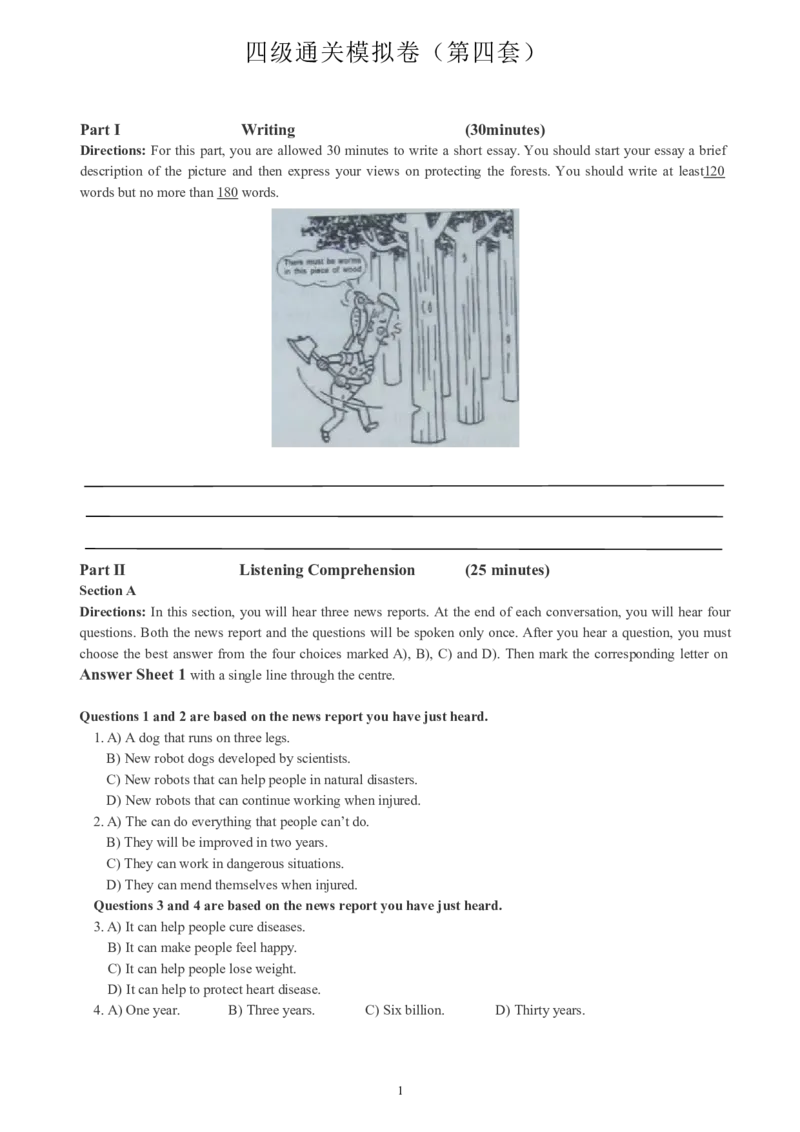
Directions: For this part, you are allowed 30 minutes to write a short essay. You should start your essay a brief
description of the picture and then express your views on protecting the forests. You should write at least120
words but no more than 180 words.
Part II Listening Comprehension (25 minutes)
Section A
Directions: In this section, you will hear three news reports. At the end of each conversation, you will hear four
questions. Both the news report and the questions will be spoken only once. After you hear a question, you must
choose the best answer from the four choices marked A), B), C) and D). Then mark the corresponding letter on
Answer Sheet 1 with a single line through the centre.
Questions 1 and 2 are based on the news report you have just heard.
1.A) A dog that runs on three legs.
B)New robot dogs developed by scientists.
C)New robots that can help people in natural disasters.
D)New robots that can continue working when injured.
2.A) The can do everything that people can’t do.
B)They will be improved in two years.
C)They can work in dangerous situations.
D)They can mend themselves when injured.
Questions 3 and 4 are based on the news report you have just heard.
3.A) It can help people cure diseases.
B)It can make people feel happy.
C)It can help people lose weight.
D)It can help to protect heart disease.
4. A) One year. B) Three years. C) Six billion. D) Thirty years.
1Questions 5 to 7 are based on the news report you have just heard.
5. A) Six million. B) Ten million. C) Six billion. D) Ten billion.
6.A) They are accustomed to smoking.
B)They have too much stress.
C)They are teenagers.
D)They fend it cool to smoke.
7.A) On the improvement of education.
B)On the improvement of infrastructure.
C)On the treatment of tobacco-related diseases.
D)On some illegal trade.
Section B
Directions:In this section, you will hear two long conversations. At the end of each conversation, you will hear
four questions. Both the conversation and the questions will be spoken only once. After you hear a question, you
must choose the best answer from the four choices marked A), B), C), and D). Then mark the corresponding letter
on Answer Sheet 1 with a single line through the centre.
Questions 8 to 11 are based on the conversation you have just heard.
8.A) The number of families is reduced a lot.
B)More young people seldom stay at home.
C)Relatives seldom live in the same place.
D)The family members live in the same place.
9.A) She wishes her parents live with her.
B)She wishes her parents live alone.
C)She wishes her parents live in a retirement room.
D)She wishes her parents live with her siblings.
10.A) He is always in trouble at home.
B)He is reluctant to lie with his parents.
C)He often fights with other persons.
D)He doesn’t study hard.
11.A) He likes living alone.
B)His house is far from his parents’ house
C)He is busy with his business.
D)He always quarrels with his parents.
Questions 12 to 15 are based on the conversation you have just heard.
12.A) He is looking for a job.
B)He is looking for a house.
C)He is looking for a roommate.
D)He is looking for an agent.
13.A) A roommate who does not snore.
B)A roommate who does not smoke.
C)A roommate who is very tidy.
D)A roommate who loves studying.
14.A) A flat with two bedrooms.
B)An unfurnished apartment.
C)A well-decorated apartment.
D)A furnished bedroom in a shared flat.
215.A) Help do housework.
B)Bargain with the landlord.
C)Agree to share with others.
D)Sign a contract for two years.
Section C
Directions: In this section, you will hear three passages. At the end of each passage, you will hear some questions.
Both the passage and the questions will be spoken only once. After you hear a question, you must choose the best
answer from the four choices marked A), B), C)and D). Then mark the corresponding letter on Answer Sheet 1
with a single line through the centre.
Questions 16 to 18 are based on the passage you have just heard.
16.A) They can’t lose weight.
B)They can lose weight by cutting calories or exercising.
C)They really can’t keep the weight off.
D)They should be on a diet to lose weight.
17.A) Senior people are less likely to gain weight.
B)Senior people are more likely to gain weight.
C)Once people get fat , they will suffer various problems.
D)Once people get fat , they gain weight steadily.
18. A) It may have a negative influence. C)It is meaningless.
B) It plays a very significant role. D)It can have a positive impact.
Questions 19 to 21 are based on the passage you have just heard.
19.A) Prevent the students doing any movement.
B)Give students more time to rest.
C)Bring students more activities.
D)Adopt the same teaching plan for a long time.
20.A) It can help teachers interact with the students.
B)It just shows the words to students.
C)It can reduce the dust in the classroom.
D)It can save teachers’ time
21. A) Students’ ability to study. C)Students’ ability to maintain attention.
B) Students’ ability to do activities. D)Students’ ability to communicate with others.
Questions 22 to 25 are based on the passage you have just heard.
22. A) Pot using. C)Sand.
B) Wet cloth. D)Temperature.
23.A) People who eat spoiled food may get sick.
B)Farmers have to throw away spoiled products.
C)Farmers have to sell the spoiled products quickly at a low price.
D)People need money to dispose of the spoiled food.
24.A) By electricity. C)Through a freezing process.
B)Through an evaporation process. D)With the help of some special bacteria.
25.A) He sold his invention to make money. C)He wad honored with an award for his teaching method.
B)He preferred invention to teaching. D)He financed 5,000 pot-in-pot systems to help people.
Part Ⅲ Reading Comprehension ( 40 minutes )
Section A
Directions: In this section, there is a passage with ten blanks. You are required to select one word for each blank
3from a list of choices given in a word bank following the passage. Read the passage through carefully before
making your choices. Each choice in the bank is identified by a letter. Please mark the corresponding letter for
each item on Answer Sheet 2 with a single line through the centre. You may not use any of the words in the
bank more than once.
Questions 26 to 35 are based on the following passage.
Since the late 1800s, more and more women have joined the work force. In the 1890s, only about 17% of
women worked 26 of the home. Besides arm work, their jobs were mainly in traditional women’s fields
such as teaching. nursing, and 27 service. Women also worked in textile and garment factories. By the
1990s , the percent of employed women rose 28 , to about 20%. Occupations that were opening up to
women at this time included secretary, telephone operator, and sales clerk.
During the Great Depression in 1903s , money and jobs were 29 ,and many people became
unemployed . Women had an especially hard time finding work. In the 1940s the United States was fighting World
War II. As more and more men were 30 up to fight, many jobs opened up to women. For the first time in
U.S. history, many women worked in 31 industry. By now , about 45% of women were employed.
After the war, many people 32 women to give up their jobs .They felt that the jobs should go to the
men returning from war . So, by the 1950s , there were fewer women working , and fewer jobs 33 open to
women. In the 1950s women were encouraged to stay at home and keep house.
Beginning in the 1960s, the 34 of women working gradually rose. In the 1960s, 35% of women had
jobs. In the 1970s, 44% had jobs. Women now worked as stockbrokers, doctors, and lawyers in addition to the
more 35 jobs.
A)amount I) light
B)called J) outside
C)demanded K) percent
D)domestic L) remained
E)expected M) scarce
F)greatly N) slightly
G)heavy O) traditional
H)inside
Section B
Directions: In this section, you are going to read a passage with ten statements attached to it. Each statement
contains information given in one of the paragraphs. Identify the paragraph from which the information is derived.
You may choose a paragraph more than once. Each paragraph is marked with a letter. Answer the questions by
marking the corresponding letter on Answer Sheet 2.
Highways
[A] Early in the 20th century, most of the streets and roads in the U.S. were made of dirt, brick, and cedar
wood blocks. Built for horse, carriage, and foot traffic, they were usually poorly cared for and too narrow to
accommodate (容纳) automobiles.
[B] With the increase in auto production, private turnpike ( 收费公路) companies under local authorities
began to spring up, and by 1921 there were 387,000 miles of paved roads. Many were built using specifications of
19th century Scottish engineers Thomas Telford and John MacAdam(for whom the macadam surface is
named), whose specifications stressed the importance of adequate drainage. Beyond that, there were no national
standards for size, weight restrictions, or commercial signs, During World War I, roads throughout the country
were nearly destroyed by the weight of trucks. When General Eisenhower returned from Germany in 1919, after
serving in the
4U.S. Army’s first transcontinental motor convoy ( 车队) , he noted : “The old convoy had started me thinking
about good, two-lane highways ,but Germany’s Autobahn or motorway had made me see the wisdom of broader
ribbons across the land.”
[C]It would take another war before the federal government would act on a national highway system. During
World War II, a tremendous increase in trucks and new roads were required. The war demonstrated how critical
highways were to the defense effort. Thirteen percent of defense plants received all their supplies by truck, and
almost all other plants shipped more than half of their products by vehicle. The war also revealed that local control
of highways had led to confusing variety of design standards. Even federal and state highways did not follow basic
standards. Some states allowed trucks up to 36,000 pounds, while others restricted anything over 7,000 pounds. A
government study recommended a national highway system of 33,920 miles and Congress soon passed the
Federal-Aid Highway Act of 1944, which called for strict, centrally controlled design criteria.
[D] The interstate highway system was finally launched in 1956 and has been hailed as one of the greatest
public works projects of the century. To build its 44,000-mile wed of highways, bridges and tunnels, hundreds of
unique engineering designs and solutions had to be worked out. Consider the many geographic features of the
country : mountains, steep grades, wetlands, rivers, deserts, and plains. Variables included the slope of the land,
the ability of the pavement to support the load, the intensity of road use, and the nature of the underlying soil ,
Urban areas were another problem. Innovative designs of roadways, tunnels , bridges, overpasses, and
interchanges that could run through or bypass urban areas soon began to weave their way across the country,
forever altering the face of America.
[E] Long-span, segmented-concrete, cable-stayed bridges such as Hale Boggs in Louisiana and the Sunshine
Skyway in Florida, and remarkable tunnels like Fort McHenry in Maryland and Mt. Baker in Washington, met
many of the nation’s physical challenges. Traffic control systems and methods of construction developed under the
interstate program soon influenced highway construction around the world , and were invaluable in improving the
condition of urban streets and traffic patterns.
[F] Today, the interstate system links every major city in the U.S. and the U.S. with Canada and Mexico.
Built with safety in mind, the highways have wide lanes and shoulders, dividing medians or barriers, long entry
and exit lanes, curves engineered for safe turns, and limited access. The death rate on highways is half that of all
other U.S. roads (0.86 deaths per 100 million passenger miles compared to 1.99 deaths per 100 million on all other
roads ).
[G] By opening the North American continent, highways have enabled consumer goods and services to
reach people in remote and rural areas of the country, spurred the growth of suburbs, and provided people with
greater options in terms of jobs, access to cultural programs, health care, and other benefits. Above all, the
interstate system provides individuals with what they cherish most : personal freedom of mobility.
[H] The interstate system has been an essential element of the nation’s economic growth in terms of shipping
and job creation : more than 75 percent of the nation’s freight deliveries arrive by truck ; and most products that
arrive by rail or air use interstates for the last leg of the journey by vehicle. Not only has the highway system
affected the American economy by providing shipping routes, it has led to the growth of spin-off industries like
service stations, motels, restaurants and shopping enters. It has allowed the relocation of manufacturing plants and
other industries from urban areas to rural.
[I] By the en of the century there was an immense network of paved roads, residential streets, expressways,
and freeways built to support millions of vehicles. The highway system was officially renamed for Eisenhower to
honor his vision and leadership. The year construction began he said : “ Together , the united forces of our
communication and transportation systems are dynamic elements in the very name we bear-United States, Without
them, we would be a mere alliance of many separate parts.”
36.Trucks using the interstate highways deliver more than half of the nation’s freight deliveries.
37.It was in the 1950s that the American government finally took action to build a national highway system.
538.The interstate highway system provides access between major cities in America.
39.National standards for paved roads were not in place by 1921.
40.The greatest benefit brought about by the interstate system was personal freedom of mobility.
41. Many of the problems presented by the country’s geographical features found solutions in innovative
engineering projects.
42.The death rate on interstate highways is lower that that of other American roads.
43.The interstate highway system promoted the development of service stations, motels and restaurants.
44.The interstate system was renamed after Eisenhower in recognition of his vision and leadership.
45.General Eisenhower felt that the broad German motorways made more sense than the two-lane highways of
America.
Section C
Directions: There are 2 passages in this section. Each passage is followed by some questions or unfinished
statements. For each of them there are four choices marked A), B), C) and D). You should decide on the best
choice and mark the corresponding letter on Answer Sheet 2 with a single line through the centre.
Passage One
Questions 46 to 50 are based on the following passage.
What should you think about in trying to find your career? You are probably better at some school subjects
than others. These may show strengths that you can use in your work. A boy who is good at mathematics can use
that in an engineering career. A girl who spells well and likes English may be good at office work. So it is
important to know the subjects you do well in at school. On the other hand , you may not have any specially strong
or weak subjects but your records show a general satisfactory standard . Although not all subjects can be used
directly in a job, they may have indirect value. A knowledge of history is not required for most jobs but if history
is one of your good subjects you will have learned to remember facts and details. This is an ability that can be
useful in many jobs.
Your school may have taught you skills, such as typing or technical drawing, which you can use in your
work . You may be good at metal work or cookery and look for a job where you can improve these skills. If you
have had a part-time job on Saturdays or in the summer, think about what you gained from it. If nothing else, you
may have learned how to get to work on time, to follow instructions and to get on with older workers. You may
have learned to give correct change in a shop, for example, Just as important, you may become interested in a
particular industry or career you see from the inside in a pare-time job.
Facing your weak points is also part of knowing yourself. You may be all thumbs when you handle tools,
perhaps you are a poor speller or cannot add up to a column of figures. It is better to face any weaknesses than to
pretend they do not exist. Your school record, for instance, may not be too good, yet it is an important part of your
background . You should not be apologetic about it but instead recognize that you will have a chance of a fresh
start at work.
46.Which of the following can best sum up the first paragraph?
A)The importance of doing well at school.
B)Using school performance to help to choose a career.
C)The importance of being good at all subjects.
D)The indirect value of school work.
47.The subject which is supposed to have no direct value for job hunting is .
A. mathematics B) English
C) technical drawing D) history
648.The writer thinks that for a student to have a part-time job is probably .
A)a waste of time that could have been spent on study
B)useful for his future work
C)a good way to earn extra money
D)a good way to find out his weak points
49.According to the passage, if a student’s school record is not good, he .
A)will fail in his future work
B)will not be able to find a suitable jib
C)will regret not having worked harder at school
D)may do well in his future work
50.The whole passage centers on .
A)choosing a career according to what one is good at
B)acquiring knowledge by working hard at school
C)finding one’s strong and weak points
D)developing one’s abilities in school work
Passage Two
Questions 51 to 55 are based on the following passage.
Levittown was the name given to three suburban developments constructed in the post World War II decades
by Levitt and Sons, the most important private builder of this period .Using new mass production techniques they
had learned while building housing for military personnel during the Second World War, they turned home
building from a cottage industry into a major manufacturing process.
During World War II, they received government contracts to build homes for war workers. Under deadline
pressure, they developed mass production methods to build houses quickly . These techniques were carried over to
their postwar suburban developments. On May 7, 1947, William Levitt announced his plans to build 2,000 houses
in a former potato field in the state of New York. Then , by the time this Levittown was completed in 1951, it had
contained 17,450 homes for 75,000 people in New York , Levitt eventually built two more Levittowns, in the
states of Pennsylvania and New Jersey . Each contained the same curving streets, community pools, and
neighborhood parks, playgrounds as the first development did.
Some observers criticized the monotonous uniformity of the Levittowns, charging that they are just the
symbol of materialism, but Levittowns were overwhelmingly welcomed by the public. They were cheap,
comfortable , efficient, and ideal for young people just starting out in life. Thousands of middle class people,
especially some young couples, couples, crowded in city apartments or still living with their parents, rushed to
purchase them, Fourteen hundred contracts were signed in one day in 1949.
Levittown symbolized the most significant social trend of the postwar era in the United States-the flight to
the suburbs. The resulting massive shift in population from the central city to the suburbs was accompanied by a
baby “boom” that started after soldiers returned home from World War II and got married .By 1960, one-third of
the nation’s population lived in the suburbs. The nation underwent its greatest increase in population since 1910.
51.What does the passage mainly discuss?
A)Levittown was built by William Levitt with the mass-production method.
B)Levittown served as an ideal and leading example of social changes in the U.S. after World War II.
C)Increases in the population of the United States after the war.
D)Why there was a housing shortage after World War II.
52.What was the original reason for Levitt to use the method of mass production to build houses?
A)In order to reduce the cost of the construction.
B)To meet people’s need to own their own houses after the war.
C)There was a population shift from central cities to the suburbs.
D)He was forced to do so because of the lack of time.
753.One of the reasons Levittowns were criticized by some observers was that .
A)the land on which the first Levittown was built was previously used for agriculture
B)the methods Levitt used for construction were new to them
C)the Levittown houses were lack of variety
D)home building shouldn’t be changed from a cottage industry into a major manufacturing process
54.Thousands of people rushed to buy Levitt’s houses because of .
A)the low prices
B)the convenient transportation
C)its location in the suburbs
D)the crowded family in the city
55.What can be inferred from the passage?
A)Levitt’s houses have led to the great shift in population after the Second World War.
B)William Levitt had tapped the postwar desire of young Americans to raise their children outside the central
city.
C)Levittown has become the world’s most perfectly planned community.
D)The population of the United States increased sharply after the Second World War.
Part Ⅳ Translation (30 minutes)
Directions: For this part, you are allowed 30 minutes to translate a passage from Chinese into
English. You should write your answer on Answer Sheet 2.
越来越多的中国富人把高尔夫当作其财富和生活方式的标志。直到 20 世纪 80 年代,经济预测家才意
识到高尔夫运动可以作为一种吸引外资的手段。1984 年,中国在广东省建起了第一个高尔夫球场,当时的
设计者是高尔夫球星 阿诺德 · 帕尔默 (Arnold Palmer)先生。据统计,从建立第一个球场开始,中国已经
累计在高尔夫球场建设上投资超过了 45 亿欧元。中国已被高尔夫研究会(Golf Research Group)列为第五
高尔夫大国。
8