1.
解析:
The correct answer is
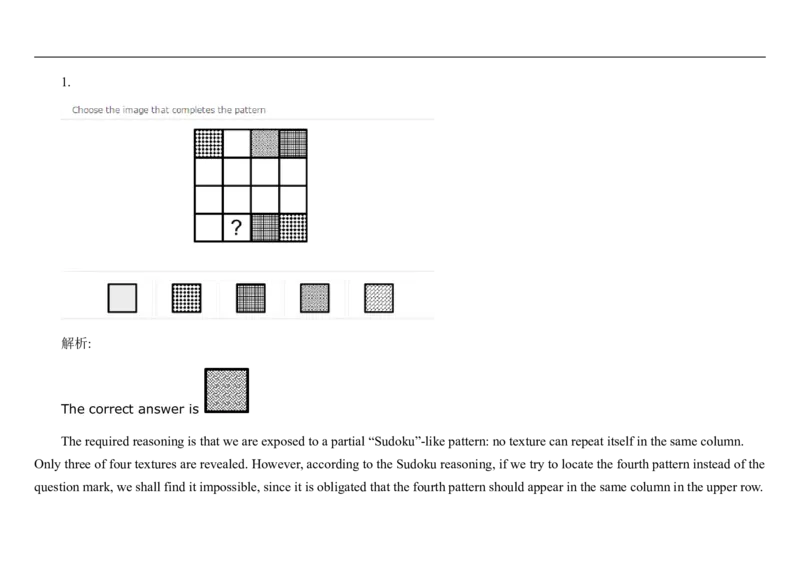
The required reasoning is that we are exposed to a partial “Sudoku”-like pattern: no texture can repeat itself in the same column.
Only three of four textures are revealed. However, according to the Sudoku reasoning, if we try to locate the fourth pattern instead of the
question mark, we shall find it impossible, since it is obligated that the fourth pattern should appear in the same column in the upper row.Therefore, the correct answer must be the pattern revealed already that doesn’t appear yet in the bottom row – the fourth option from the
left.
Alternative explanation: there are two variables in this matrix: the pattern and location of the blocks. Since the location is hard to
decipher due to inadequate information, we result to the patterns of the blocks. It is easy to see that each pattern seems to appear twice in
the matrix, therefore the correct answer is 4.
2.解析:
The correct answer is .
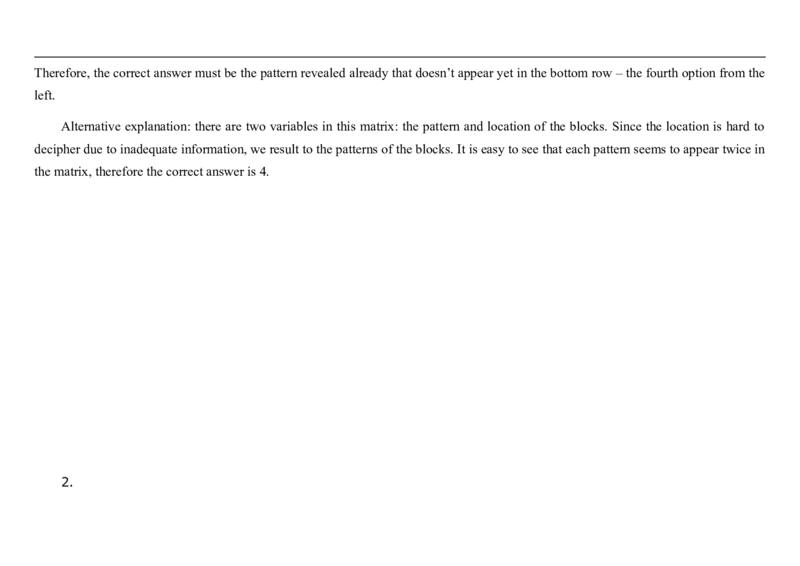
For every edge shared by two triangles, the arrows from both of its sides mirror one another.
3.解析:
The correct answer is .
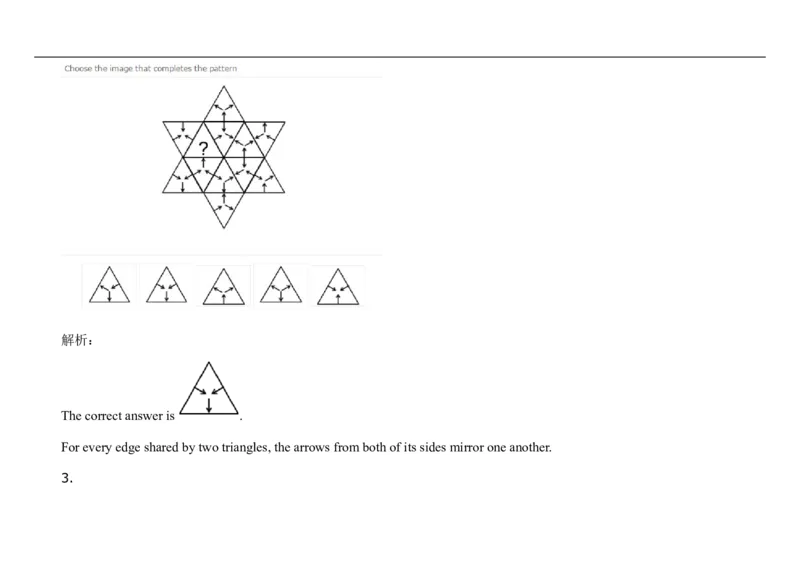
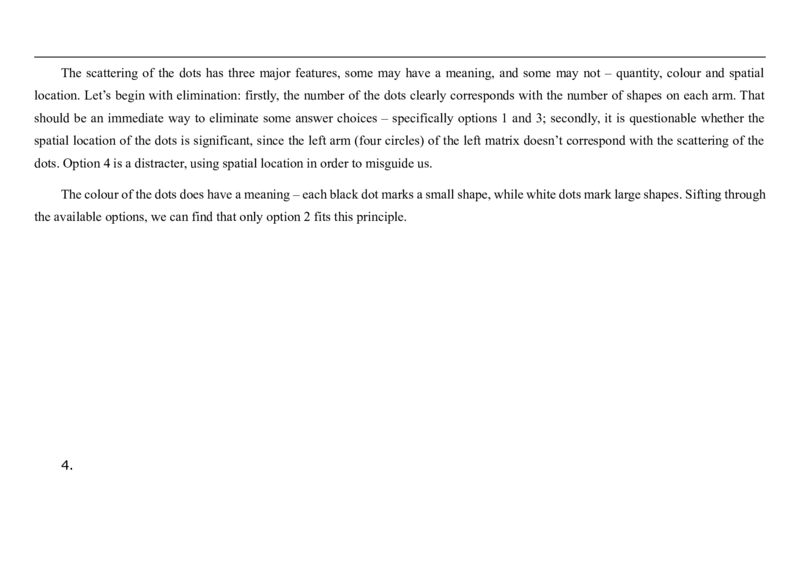
The unusual matrix invites us to find a correspondence between the outer shapes in each of the arms, and the dots in the centre of the
matrix. We are supposed to understand the principles of the construct from the left matrix and then to apply them on to the right one in
order to find the correct answer.The scattering of the dots has three major features, some may have a meaning, and some may not – quantity, colour and spatial
location. Let’s begin with elimination: firstly, the number of the dots clearly corresponds with the number of shapes on each arm. That
should be an immediate way to eliminate some answer choices – specifically options 1 and 3; secondly, it is questionable whether the
spatial location of the dots is significant, since the left arm (four circles) of the left matrix doesn’t correspond with the scattering of the
dots. Option 4 is a distracter, using spatial location in order to misguide us.
The colour of the dots does have a meaning – each black dot marks a small shape, while white dots mark large shapes. Sifting through
the available options, we can find that only option 2 fits this principle.
4.解析:
The correct answer is
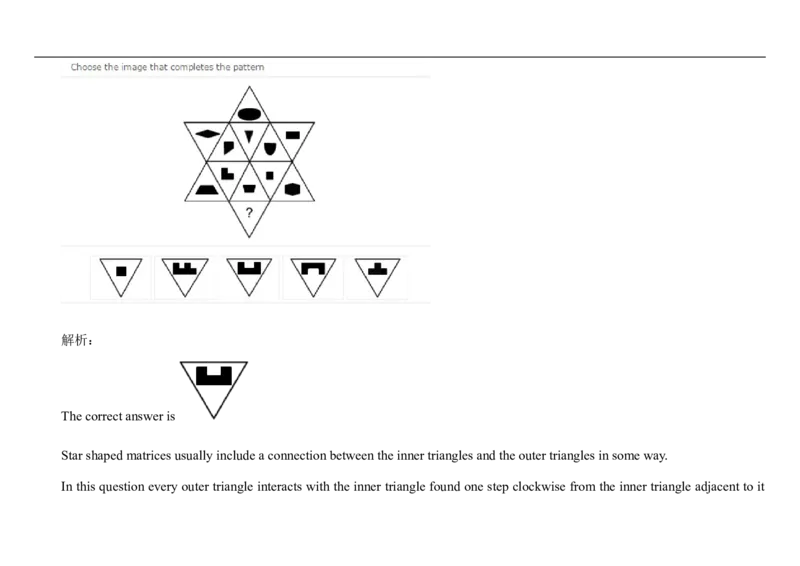
Star shaped matrices usually include a connection between the inner triangles and the outer triangles in some way.
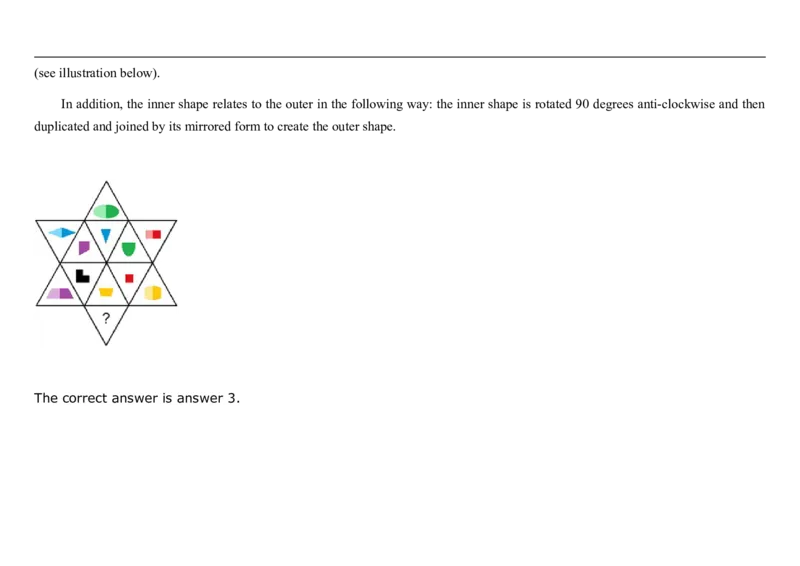
In this question every outer triangle interacts with the inner triangle found one step clockwise from the inner triangle adjacent to it(see illustration below).
In addition, the inner shape relates to the outer in the following way: the inner shape is rotated 90 degrees anti-clockwise and then
duplicated and joined by its mirrored form to create the outer shape.
The correct answer is answer 3.5.
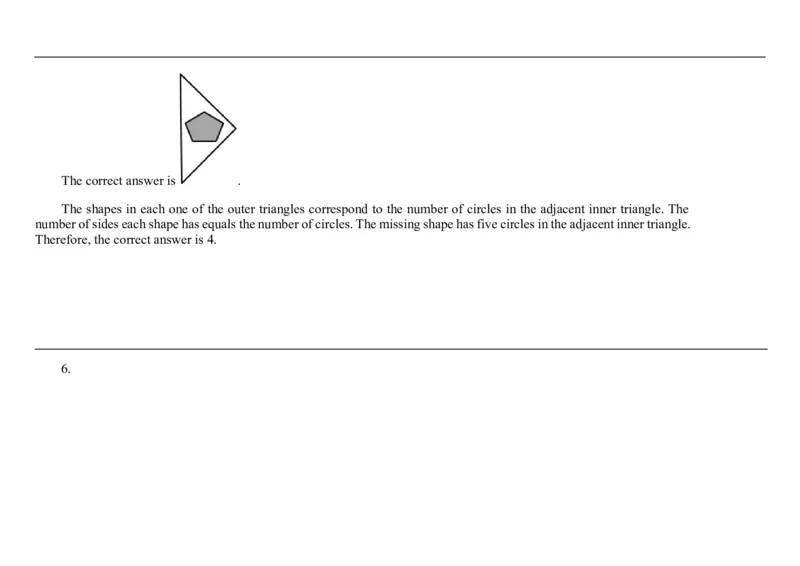
解析:The correct answer is .
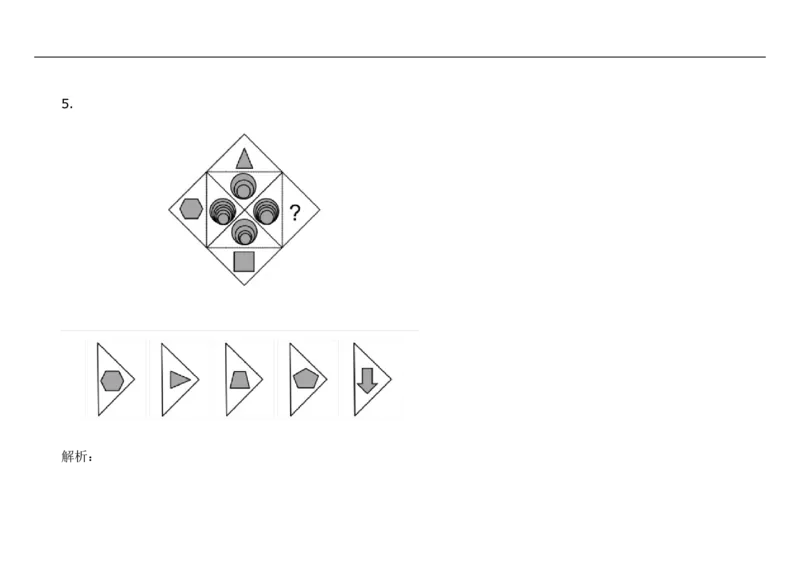
The shapes in each one of the outer triangles correspond to the number of circles in the adjacent inner triangle. The
number of sides each shape has equals the number of circles. The missing shape has five circles in the adjacent inner triangle.
Therefore, the correct answer is 4.
6.解析:
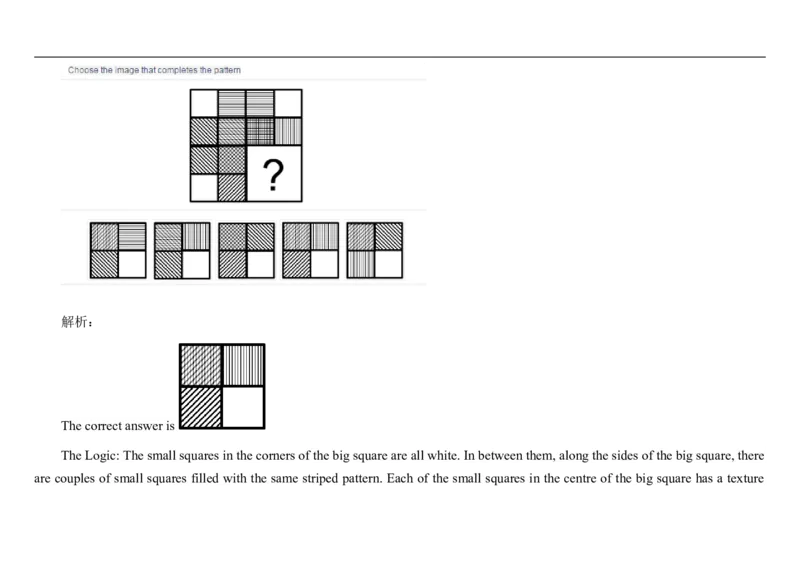
The correct answer is
The Logic: The small squares in the corners of the big square are all white. In between them, along the sides of the big square, there
are couples of small squares filled with the same striped pattern. Each of the small squares in the centre of the big square has a texturewhich is the integration of both adjacent striped patterns. The only option that follows this logic is option 4.
While this problem is rather simple, it is prone to hasty mistakes. Make sure that you don’t choose a distracter, which is similar in
appearance but faulty, such as option 2
7.
解析:The correct answer is
This matrix includes quarters of a circle in 4 different orientations and colours, each colour appears only once every row and every
column (in a suddoku manner). In addition, the orientation of the grid lines covering the squares also differ. It is recommended to choose
at first one guideline to work with. Let’s start with the coloured circles. In the second column from the right we can see that the missing
colours are light grey (spotted) and black (in that order, as we cross check the colours with the rows to see that we have no double
colours). In the third column from the right we can see that the missing colour is dark grey.
Distracters 1 & 2 both have the correct coloured circles, so we have no choice but to work with the second guideline- the grid lines.
A quick inspection of both distracters leads to focusing on the upper right gridline as it is the only grid line differing the two answers. Since
the corresponding grid line in the matrix is vertical we can conclude that the correct answer is 1.
8.解析:
In the inner square you’ll find three pairs of identical shapes. The only shape that misses its pair is the plus sign. In fact, noticing this
pattern may be enough to solve this question.
Solving Tip – Having a glance at the answer-choices even before figuring out the exact pattern may be of great help. Have another
look at the distracters. Note that once you’ve realised that only one answer choice holds the required feature of a white plus sign, you caneliminate the rest of the distracters, and continue to the next question
9.
解析:The correct answer is:
The shapes in each outer triangle determine the number of circles in the opposite inner triangle (see illustration below): the number
of circles is the same as the number of arrow heads, and the number of crossed-circles is the same as the number of black dots. Therefore, in
order to know which circles should appear in the missing triangle, we need to look at the opposite outer triangle. Since this triangle has
one arrow head and three dots in it, the missing triangle should contain one circle and three crossed-circles. Therefore, the correct answer
is 3.10.
解析:
The correct answer is: .
The Logic: In every row and column there is a only a single X.Note that inductive reasoning tests usually include various levels of difficulty, including low difficulty questions such as this one.
11.
解析:
The correct answer is:
Each row and each column has shapes ranging from two sides to six sides (one of each). From top to bottom, each step, the rightmost
shape turns to be the leftmost shape, pushing the other shapes one place to the right. This pattern creates diagonals of identical shapes.Each diagonal has its shapes turned upside down every second shape. Therefore, the correct answer is 1.
12.
解析:
The correct answer is:
This question is best answered by elimination of the distracters. This method may become handy when the missing part of a row or
column of shapes is located in the middle of the sequence rather than in its end.
In this question, you should look for an answer that would make a reasonable pattern of both the white and the black circles.look at columnt 3 and 4. you can learn that a total of 3 circle is added every step. This notion alone disqualifies answers 2,3 and 5 because
they show only a two ball increase between columns 1 and 2. Examining answer 4 , you can see that the pattern of black balls is not stable
and so is the pattern of white balls. The correct answer is 1 because two white circles and one black circle are added in each column every
step. The black circles come from beneath the white ones and “push” them upwards. None of the other distracters provide us with a
reasonable pattern.
13.解析:
The correct answer is:
This matrix has three different shape patterns and three different colour patterns. Each pattern appears only once every row and once
every column.
Answers 1-4 all include the shape pattern missing in the central row and column. However, answer 1 is the only answer that also
includes the missing colour pattern (upper black and grey checkered shape, black striped central shape, and grey filled bottom shape).
Answer 2 has the wrong order of colours in all of its parts.
Answer 3 has the wrong orientation of lines filling the central shape.
Answer 4 has the wrong order of colours in the top and bottom parts.14.
解析:
The correct answer is:
Joining up the different sections in each row/column (without changing their orientation) creates a whole circle.
The top row already creates a full circle (120 degrees + 240 degrees), thus the upper cell in the correct answer should remain empty.This notion alone disqualifies answers 1, 4 and 5.
The 2nd row from the top is missing the bottom right quarter of the circle.
Therefore, answer 3 is disqualified as well and the correct answer is answer 2.
Note that we could also solve this question by looking at the columns instead. The 2nd column from right already has a three quarter
circle and is missing the bottom right quarter of the circle. The only answer that has this part (and this part alone) is answer 2.
15.解析:
The correct answer is:There are 3 rules in this question:
1. Try to view the horizontal lines in the star matrix as dividing the matrix into 4 distinct rows. The upper row has 5 shapes in the
triangle. Every row has one less shape in each triangle. Therefore, 3 should be in place of the upper question mark and 2 should be in place
of the bottom question mark. This rule disqualifies answers 1, 2 and 4.
2. Outer triangles include only ‘+’ shapes while inner triangles include only ‘X’ shapes.
3. Among the 6 inner triangles, every two triangle facing each other have a distinct colour to their shapes (black, grey and white). The
missing inner triangle faces a white triangle. Therefore, the correct answer is 5.
16.解析:
The correct answer is:
The logic: There are 4 different shapes in this matrix.
Each shape repeats 4 times in 4 different colours. As two L shapes are missing, answers 1 and 2 are therefore disqualified.Grey and striped shapes have a certain orientation, while black and white shapes have the opposite (mirror-like) orientation.
Tip: Note that the colours and shapes the orientations follow systematic patterns. Noticing these patterns is not necessary to solve this
particular question. However, it is valuable to notice them as this kind of pattern is usually used as the basis of many matrix questions.
17.
解析:In each row there are two arrows pointing one towards the other.
In each column there are two triangles pointing one towards the other.
When solving matrices of this kind, it is advised to spare a moment and to try to find a pattern in the complete
rows/columns/diagonals.
If you find a consistent pattern, then head to the answer choices and find the one that is congruent with this pattern or use elimination to
cancel distracters that don’t. In our case, two distracters (4 and 5) can be eliminated since they contain too many arrows; (2) is eliminated
since it do not contain an arrow at all; the last one that doesn’t fit the pattern (3) is eliminated since the triangle is not pointing towards the
other triangle.
18.解析:
The arrows always continue their movement diagonally to the same direction. Each arrow will be followed with an additional arrowin the same direction on the adjacent diagonal square. In case an arrow reaches one of the matrix’ sides, it “bounces” back to other diagonal
direction, but continues in its general flow.
The difficulty of this problem is in the fact that one must have a macro-view of the matrix in order to see the pattern, while usually
the pattern can be realised from focusing on row/columns. Keep in mind that it is possible that all the cells of the matrix relate to one
another.
There's another set of rules that may help you solve this question.
Using the right and left columns you can determine that each column contains the following: 2 diagonal arrows going upwards from
bottom right to upper right corners, 1 diagonal arrow going upwards from bottom left to upper right corners, 1 diagonal arrow going
downwards from upper right to bottom left corners, 1 diagonal arrow going downwards from upper left to bottom right corners.
Also, each column has 2 red arrows, 2 black arrows and 1 green arrow.
With these 2 rules (directionality and colour) you can easily figure out the missing pattern. You are looking for 2 arrows going
downwards, arriving each from an opposite corner; One of which should be red and the other black. Therefore, the correct answer is 1.
Note that although rare, it is possible that more than one set of rules will apply in a given sequence. As long as the set of rules you are
using is solid and congruent with all the elements of the pattern, you may utilize it in order to solve the question. However, be careful not
to be misled into overlooking some key elements that are crucial to the solution of the problem. The little details can determine whether
you choose the correct answer or fall into a well- set trap.
19.解析:
The shape inside each of the outer triangles is assembled of the shapes inside two of the inner triangles – the adjacent triangle to theouter one and the one next to it, clockwise. Lines that overlap in both inner triangles appear only once.
Notice that the assembled shape is similar in orientation to the two parts that are combined together in order to create it.
20.
解析:
The correct answer is .The circles determine the colours’ distribution of the rectangular space to their left.
The lower circle determines the lower half of the space and the upper circle determines the upper half of the space.
When the lower circle is white, the lower space in the rectangular will be black and vice versa.
When the upper circle is white, the upper space in the rectangular will be black and vice versa.
Note that you can also solve this problem according to the following set of rules:
When the lower circle is white/ black, the upper space in the rectangular will be white/ black, respectively.
When the upper circle is white/ black, the lower space in the rectangular will be white/ black, respectively.
21.解析:
The correct answer is:Each inner triangle contains three shapes from the closest outer triangles. We are asked to find the content of two adjacent triangles.
The white and the black stars are adjacent to both of the unknown inner triangles and therefore will appear twice. We need, in addition, a
single white X-shape and a single black triangle.
Complex matrices, similar to the one presented in this question, include the possibility of a great variety of unknown elements and
the different ways in which the answers may be presented. It may be worthwhile to take a few seconds at the beginning, in order to establish
the relationship between the different elements of the matrix and to decide upon the best way to tackle the question.
22.解析:
The correct answer is
In each row and column there is a single shape that appears twice.
If we look at the 2nd row from the top, we can see that it already has a shape that appears twice (the arrow pointing right). Thus, we
need to look for an option that would complete this row with a shape that does not appear in it (i.e. a shape other than an arrow pointing
right, a triangle or a pentagon). This allows us to eliminate options 1, 2 and 4.
Now, if we look at the 1st row, we can see that none of the shapes appears twice. So, the correct answer has to include one of the
shapes already appearing in this row (a triangle, a diamond or an arrow pointing left) or two identical shapes. Option 5 does not fulfill this
requirement, leaving us with option 3.
Solving tip: when approaching this type of matrices, we recommend you take a moment at the beginning of the question, in order to
look through the rows, columns and diagonals in search for the complete pattern. When you find a consistent pattern, head for the answer
choices and either choose the one that fits this pattern or use elimination to cancel distracters that don’t.23.
解析:
The correct answer is
In this matrix there are 4 different shapes.
Every shape repeats itself 4 times in 4 different colours: white, black, grey and stripped.
These 4 colours form 2 groups:(a) The black and white shapes that share the same orientation.
(b) The grey and stripped shapes that share the same orientation.
These two groups, (a) and (b) are mirror images of one another.
Each shape exterior to the rectangle has an adjacent similar shape within the rectangle but not necessarily in the same orientation or
colour.
The correct answer is 1.
Note that answer 3 is incorrect since the orientation of the grey L shape differs from the orientation of the striped L shape in the matrix.
24.解析:
The correct answer is
In this question each row has a corresponding column in which they share a similar element. We can see that the first row across
corresponds to the fourth row down and their shared element is an O shape. Similarly, the third row across corresponds to the second row
down and their shared element is the X shape. The fourth row across corresponds to the first row down although in this case the squares
are not identical, rather revealing the element of each of the other corresponding rows and columns. In order to complete the pattern weneed to find a shared element for the third row across and the second row down. The first answer would therefore be the correct one and
the shared element is the V shape.
In addition:
The O shapes appear at the upper left hand corner of the first row across and the fourth row down.
V shapes appear at the upper right corner of each square of the second row across and the third row down.
X shapes appear at the lower left hand corner of each square of the third row across and the second row down.
Following this pattern, the missing square contains only a V.
Solving tip: It is advisable to try and formulate the simplest principles possible. These have the greatest probability to be true.
25.解析:
The correct answer is
The logic:In pairs from the left, every column is a negative reflection of the one next to it (black circles become white circles and vice
versa).
The tricky element of this problem is that while the answer choices appear as additional columns, as if there should be a continuous
pattern, the pattern is found only in the relation of adjacent columns. This can be repeated or not in similar problems. You could find a
pattern in the formation of columns, rows and even diagonals.
26.解析:
The correct answer is .
In each circle, there is a polygon. If you try to view the circles as clocks, and the arrow as the clock’s hand, you will see that the
polygon's number of sides equals the hour at which the arrow points. In addition, dashed circles contain a white polygon while complete
circles contain black polygons. The missing polygon’s arrow points at 8 o’clock. The circle is complete. Therefore, the correct answer is
5.
27.解析:
The correct answer is
The logic: This complex problem does not present a typical sequence of items, but rather a code. The dot/s lit in black in the top half
of each figure determines the colouring pattern of the four triangles in the bottom half.
The first three figures present what happens when certain single black dot is lit. The fourth figure presents what happens when twodots are lit together. This frame hints to us that in order to understand figures 4 & 5, we need to use the information given in figures 1-3.
In figure 4, the two black dots that are lit are those lit in figures 1 & 2. Combining figures 1 & 2, we can decipher the rules governing the
colouring pattern of the triangles in figure 4. Let’s start by examining the left-most triangles in figures 1, 2 and 4. We can see that
combining a white triangle (figure 1) and a black triangle (figure 2) results in a grey triangle (figure 4). If we follow this through, moving
from left to right, we can come up with the following rules:
Using these rules, we can find out the colouring pattern of the triangles in the missing part. The two black squares that are lit in
figure 5 are those lit in figures 2 & 3, therefore we can conclude that we need to combine these figures to get to the correct answer. We
thus have, from left to right:Therefore, the correct answer is (C).
* BEWARE: This question is an extremely hard question involving identification of a coded problem and decoding it. There may only
be one question like this in your exam or even none at all, so don’t be intimidated by it and remember you can always guess and move
on...28.
解析:
Xs appear alternately between the right side and the left side of the matrix. There's a space of a row between each X to the next. The
space between each two Xs is 3 points. The presence of the X “pushes” the stream of black dots one step away from the X and creates a
curve in that stream to the same direction.
Notice that it is easier to figure out the pattern of the Xs’ appearance and it may help you to eliminate 3 answer choices (1, 4 & 5) as
distracters. Eliminating some distracters even before you have completely realised the pattern of change may help you to focus on the
precise differences between the remaining answer choices, and make the decision between them simpler.29.
解析:
The cells constituting the triangle are the key to understanding the pattern in this question.If we focus on one of the circle’s thirds at a time, we can see that the shapes in the cell which is part of the triangle determine the total
number of dots in the two other cells in that circle's third.
The given patterns help us to uncover the following rules:
triangle = 2 dots; circle= 3 dots; x = 4 dots.
To find the correct answer, all we need to do is focus on the bottom-left third of the last circle and apply these rules to its missing parts.
Since the cell which is part of the triangle contains a triangle and a circle, we can tell the other two cells should contain a total of 2+3=5
dots. The correct answer is, therefore, the leftmost option.
Note, that this type of questions has to present the key to the pattern in the examples that are given. Thus, a good way to tackle these
questions will be using the most comfortable example in order to establish a set of rules and validate it, using the other given examples.
In this case, the first example (the one on the left) is rather straight forward (the only extrapolation you are required to do is to understand that
each of the circles at hand has the same influence on the amount of dots. Thus, you can deduce each circle equals 3 dots). The second
example (the one in the middle) enables you to verify your understanding and solve the problem.30.
解析:
The correct answer is .
We will notice that there are four mini shapes in each bow- tie frame. This helps us to dismiss answers 1 and 4.
Additionally, we can see that the type of mini shapes (stars and plus signs) alternates between each step. Furthermore, Frame 2 and frame
4 are either identical or each other’s mirrored version (on a diagonal axis). Applying this information on frames 1 and 3 leads us to the
correct answer (3).31.
解析:
The pattern in this question is determined by a horizontal set of rules:
First row (from the top) – one black/one white/one black....
Second row – one white/three blacks/one white...
Third row - one black/one white/one black....Fourth row – one white/two blacks/one white....
Note that this is a tricky question. While the answer options may lead you to look for a vertical rule, as they offer you an additional column,
the key to solving the pattern of the matrix lies within the rows.
It is important for you to know and remember that in the real test, the pattern may be hidden in the columns, rows or even diagonals.
32.
解析:The correct answer is:
This question follows two rules:
(1) The circle turns each step by 120 degrees, clockwise.
(2) The black dots increase by one in each step. The blank space is part of this pattern (thus, in the second image it increases from zero to
one dot).
These two elements are easy to spot, once pointed out. However, due to the seemingly identical general appearance of the images (a
triangle inside a circle + inner compartmentalization, dividing the shape into thirds), the rotation of the shape is not obvious at first glance,
thus making this question trickier to solve.
We are usually inclined to search for a pattern that is reflected by a change in the contents of matching areas. This line of thought will
lead us to finding the second rule.
Counter intuitively, in this question the elements that remain the same are of great help and provide us with the information we need
in order to uncover the first rule. We can see that the cells that contain the white dots, remain the same in content but vary in orientation.
Generalising this notion may help you to recognise the rotation pattern.33.
解析:
The correct answer is:
In pairs from the left, every column is a reflection of the one next to it.
Due to the appearance of the answers you might be tempted to look for a vertical pattern, neglecting to notice the horizontal element of thepattern. In this question each odd column changes with respect to the even column to its right; the black and white circles change places.
The arrangement of each pair is random and differs from the previous pair. It is important to broaden your point of view in order to
recognise a pattern in the formation of columns, rows and even diagonals.