Numerical Critical Reasoning
Test 7
Solutions Booklet
Instructions
This numerical reasoning test comprises 21 questions, and you will have to correctly
answer as many as you can. Calculators are permitted for this test, and it is
recommended you have some rough paper to work on.
You will have to work quickly and accurately to perform well in this test. The test does
not have an overall time limit however each question has a time limit. The first
question relating to each table or graph has 90 seconds, and subsequent questions
relating to the same table or graph have 75 seconds.
Try to find a time and place where you will not be interrupted during the test. The test
will begin on the next page.
AssessmentDay
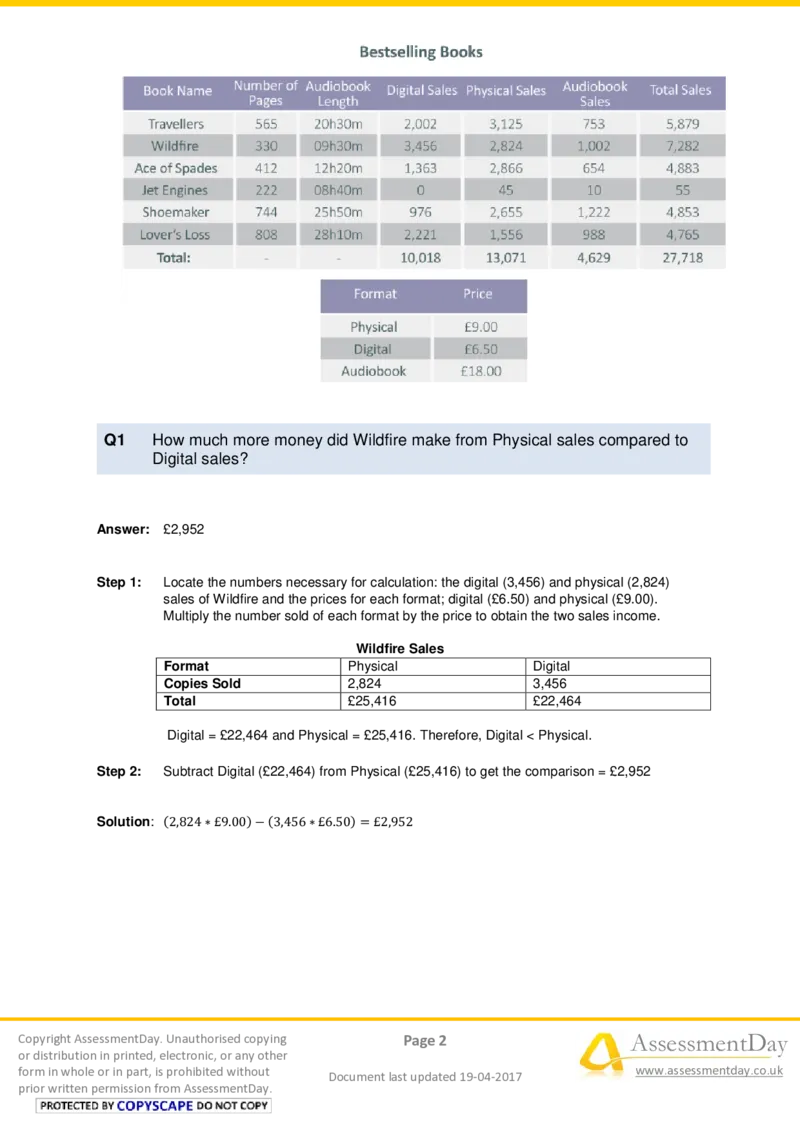
Practice Aptitude TestsQ1 How much more money did Wildfire make from Physical sales compared to
Digital sales?
Answer: £2,952
Step 1: Locate the numbers necessary for calculation: the digital (3,456) and physical (2,824)
sales of Wildfire and the prices for each format; digital (£6.50) and physical (£9.00).
Multiply the number sold of each format by the price to obtain the two sales income.
Wildfire Sales
Format Physical Digital
Copies Sold 2,824 3,456
Total £25,416 £22,464
Digital = £22,464 and Physical = £25,416. Therefore, Digital < Physical.
Step 2: Subtract Digital (£22,464) from Physical (£25,416) to get the comparison = £2,952
Solution:
(2,824∗£9.00)−(3,456∗£6.50)=£2,952
Copyright AssessmentDay. Unauthorised copying Page 2 AssessmentDay
or distribution in printed, electronic, or any other
form in whole or in part, is prohibited without
Document last updated 19-04-2017
www.assessmentday.co.uk
prior written permission from AssessmentDay.Q2 How much more money from physical sales did the least expensive book per
page make compared to the most expensive book per page?
Answer: £13,599
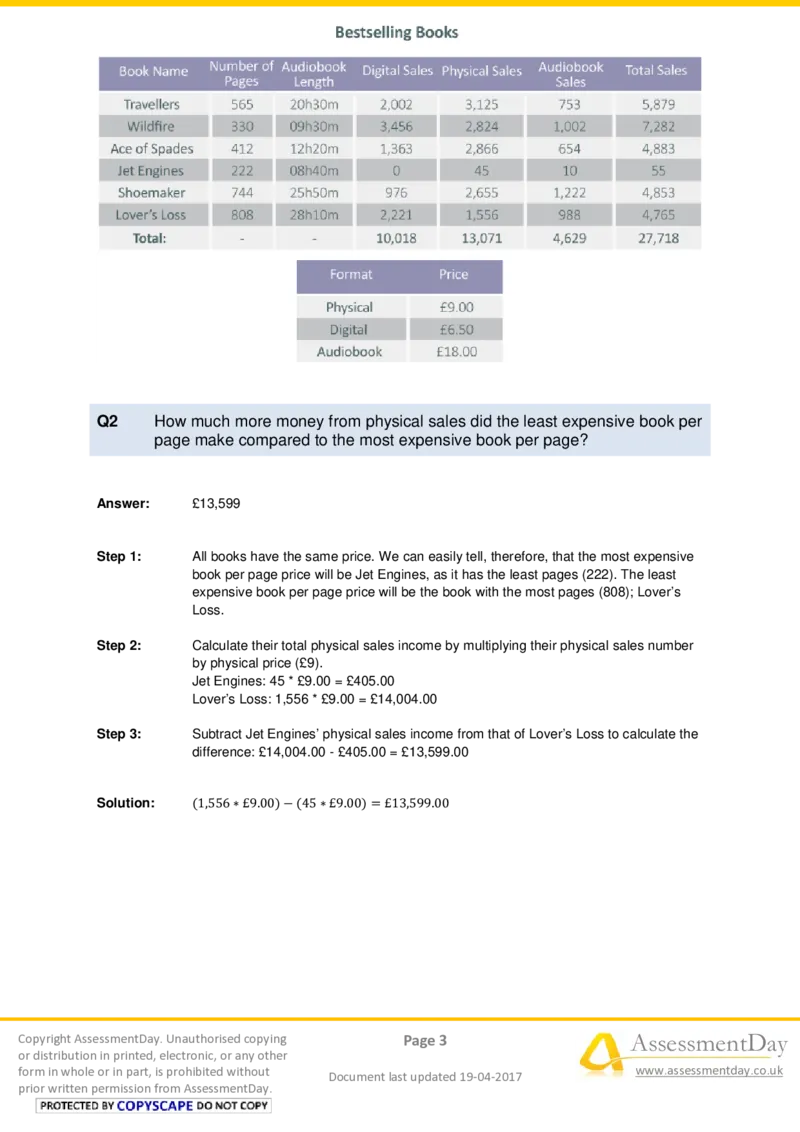
Step 1: All books have the same price. We can easily tell, therefore, that the most expensive
book per page price will be Jet Engines, as it has the least pages (222). The least
expensive book per page price will be the book with the most pages (808); Lover’s
Loss.
Step 2: Calculate their total physical sales income by multiplying their physical sales number
by physical price (£9).
Jet Engines: 45 * £9.00 = £405.00
Lover’s Loss: 1,556 * £9.00 = £14,004.00
Step 3: Subtract Jet Engines’ physical sales income from that of Lover’s Loss to calculate the
difference: £14,004.00 - £405.00 = £13,599.00
Solution:
(1,556∗£9.00)−(45∗£9.00)=£13,599.00
Copyright AssessmentDay. Unauthorised copying Page 3 AssessmentDay
or distribution in printed, electronic, or any other
form in whole or in part, is prohibited without
Document last updated 19-04-2017
www.assessmentday.co.uk
prior written permission from AssessmentDay.Q3 What was the combined total money made from Travellers across all of its
formats?
Answer: £54,692
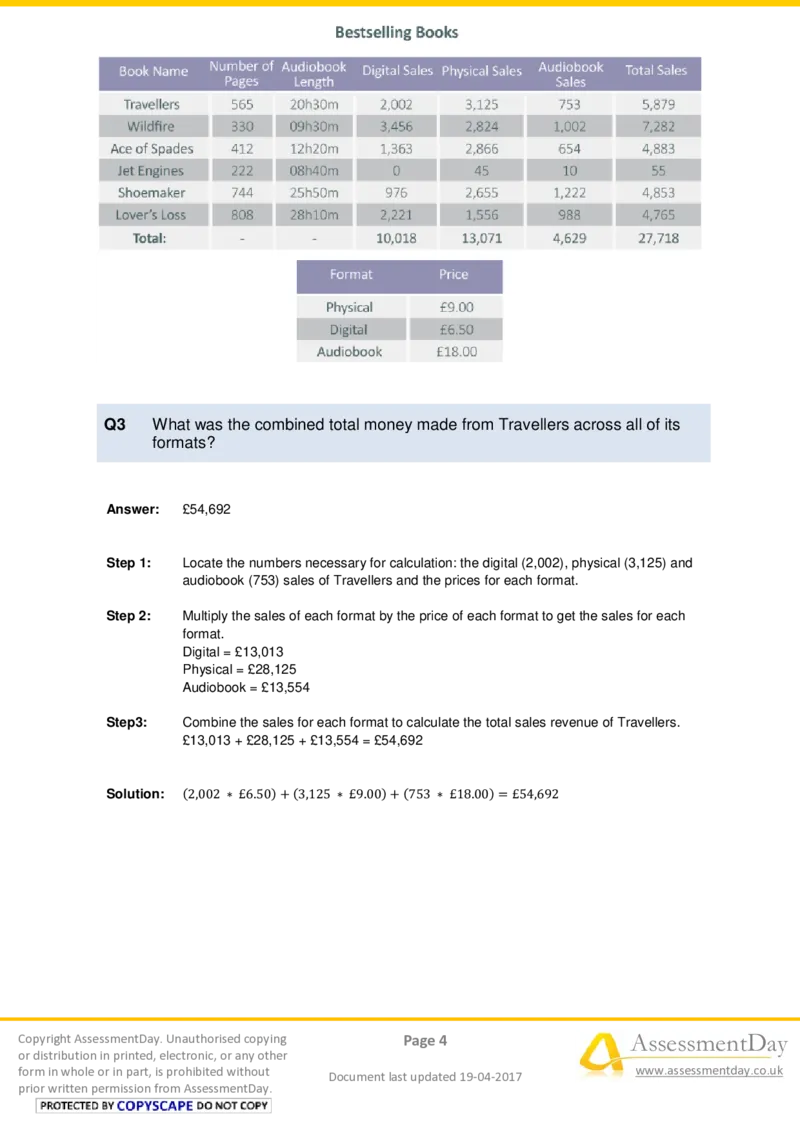
Step 1: Locate the numbers necessary for calculation: the digital (2,002), physical (3,125) and
audiobook (753) sales of Travellers and the prices for each format.
Step 2: Multiply the sales of each format by the price of each format to get the sales for each
format.
Digital = £13,013
Physical = £28,125
Audiobook = £13,554
Step3: Combine the sales for each format to calculate the total sales revenue of Travellers.
£13,013 + £28,125 + £13,554 = £54,692
Solution:
(2,002 ∗ £6.50)+(3,125 ∗ £9.00)+(753 ∗ £18.00)=£54,692
Copyright AssessmentDay. Unauthorised copying Page 4 AssessmentDay
or distribution in printed, electronic, or any other
form in whole or in part, is prohibited without
Document last updated 19-04-2017
www.assessmentday.co.uk
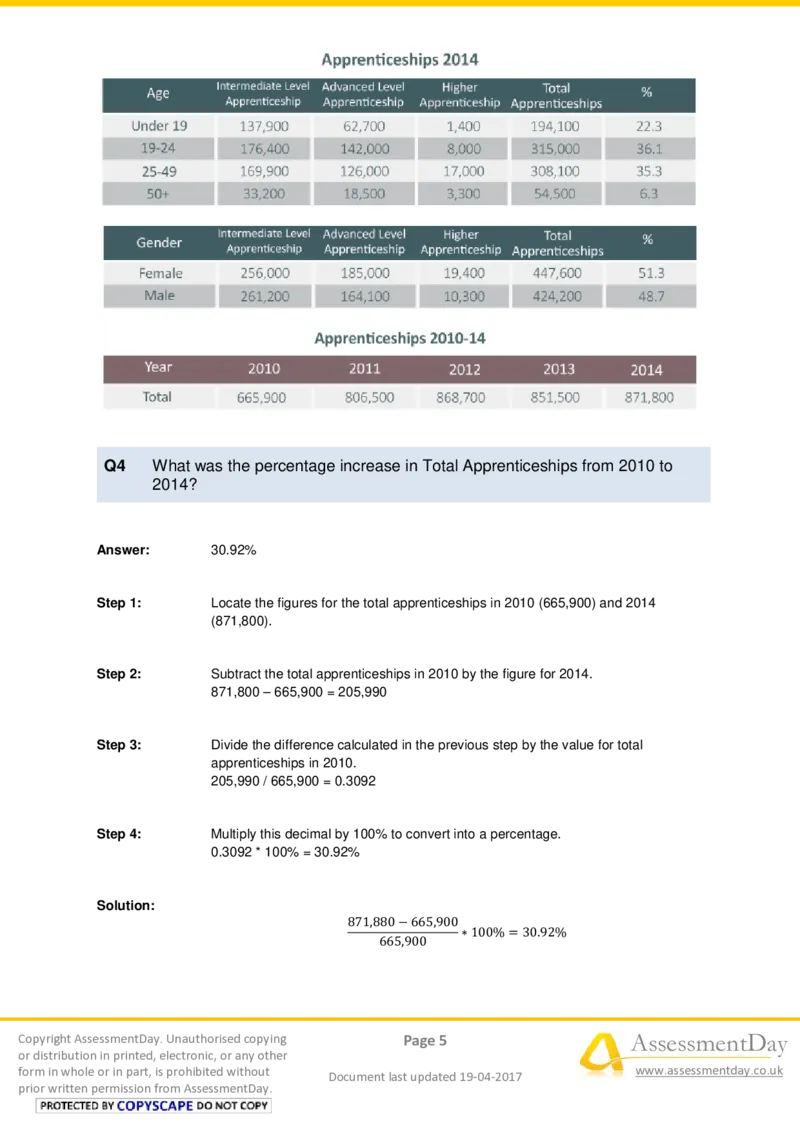
prior written permission from AssessmentDay.Q4 What was the percentage increase in Total Apprenticeships from 2010 to
2014?
Answer: 30.92%
Step 1: Locate the figures for the total apprenticeships in 2010 (665,900) and 2014
(871,800).
Step 2: Subtract the total apprenticeships in 2010 by the figure for 2014.
871,800 – 665,900 = 205,990
Step 3: Divide the difference calculated in the previous step by the value for total
apprenticeships in 2010.
205,990 / 665,900 = 0.3092
Step 4: Multiply this decimal by 100% to convert into a percentage.
0.3092 * 100% = 30.92%
Solution:
871,880−665,900
∗100%=30.92%
665,900
Copyright AssessmentDay. Unauthorised copying Page 5 AssessmentDay
or distribution in printed, electronic, or any other
form in whole or in part, is prohibited without
Document last updated 19-04-2017
www.assessmentday.co.uk
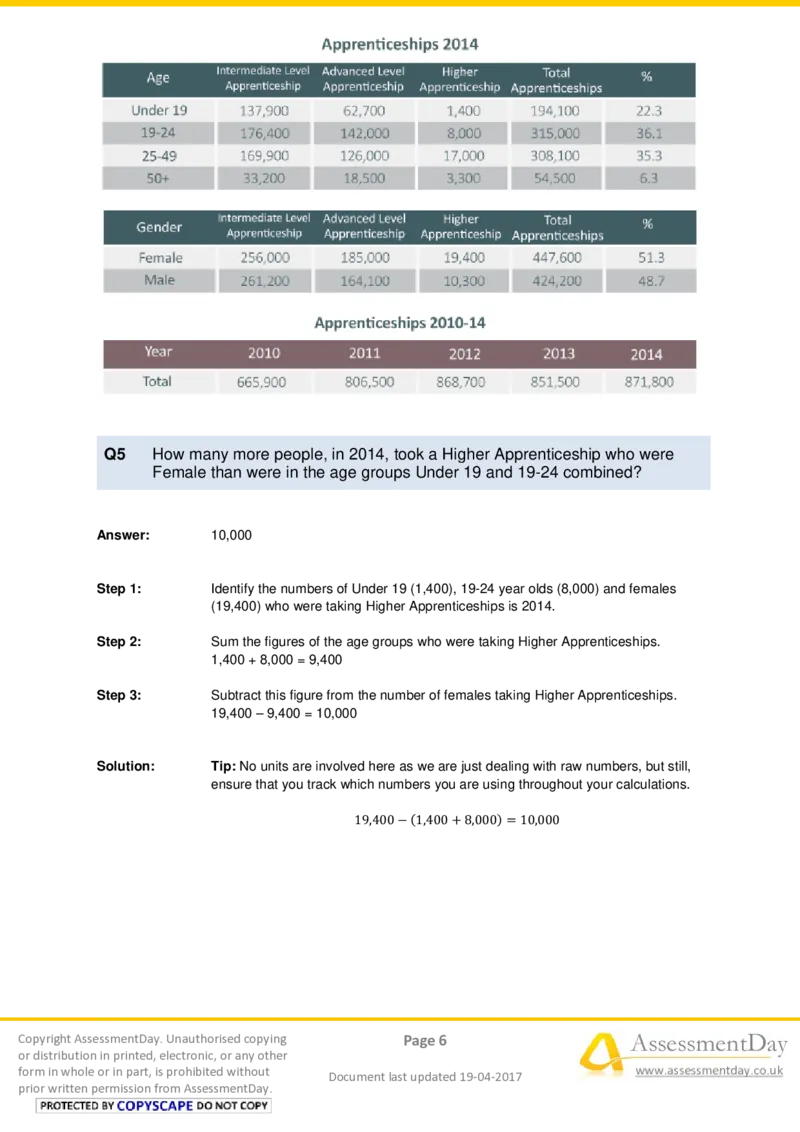
prior written permission from AssessmentDay.Q5 How many more people, in 2014, took a Higher Apprenticeship who were
Female than were in the age groups Under 19 and 19-24 combined?
Answer: 10,000
Step 1: Identify the numbers of Under 19 (1,400), 19-24 year olds (8,000) and females
(19,400) who were taking Higher Apprenticeships is 2014.
Step 2: Sum the figures of the age groups who were taking Higher Apprenticeships.
1,400 + 8,000 = 9,400
Step 3: Subtract this figure from the number of females taking Higher Apprenticeships.
19,400 – 9,400 = 10,000
Solution: Tip: No units are involved here as we are just dealing with raw numbers, but still,
ensure that you track which numbers you are using throughout your calculations.
19,400−(1,400+8,000)=10,000
Copyright AssessmentDay. Unauthorised copying Page 6 AssessmentDay
or distribution in printed, electronic, or any other
form in whole or in part, is prohibited without
Document last updated 19-04-2017
www.assessmentday.co.uk
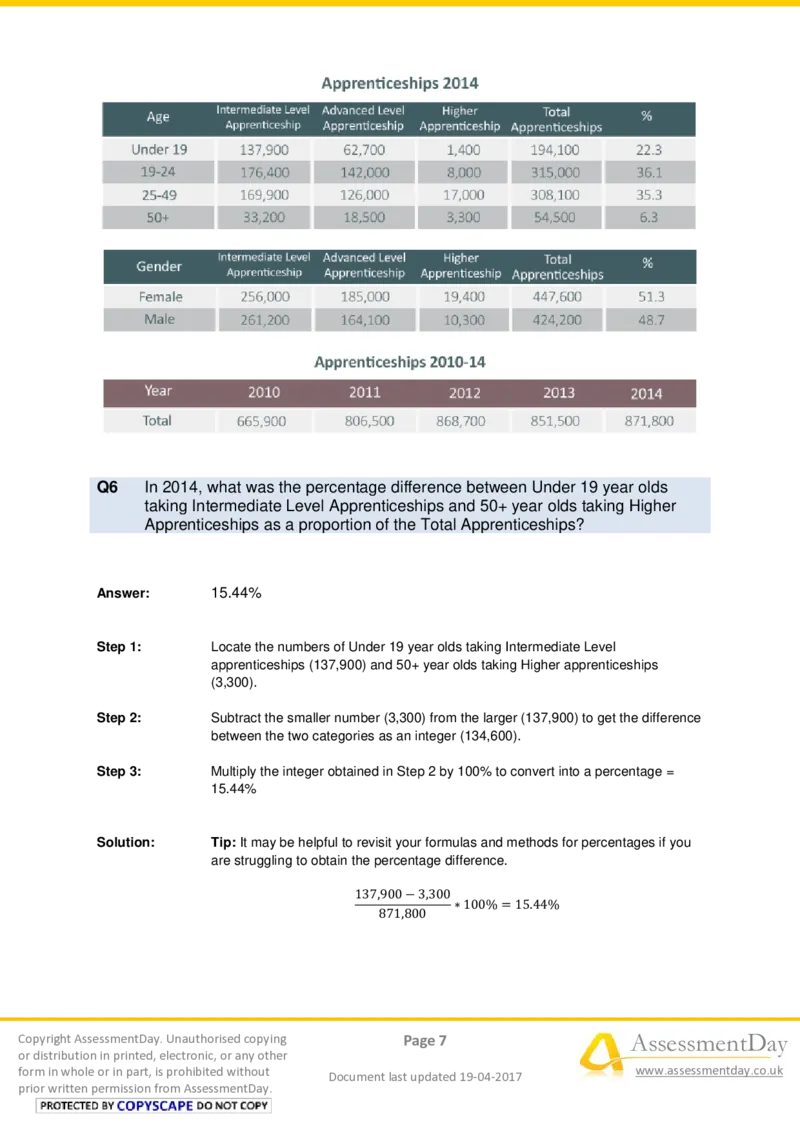
prior written permission from AssessmentDay.Q6 In 2014, what was the percentage difference between Under 19 year olds
taking Intermediate Level Apprenticeships and 50+ year olds taking Higher
Apprenticeships as a proportion of the Total Apprenticeships?
Answer: 15.44%
Step 1: Locate the numbers of Under 19 year olds taking Intermediate Level
apprenticeships (137,900) and 50+ year olds taking Higher apprenticeships
(3,300).
Step 2: Subtract the smaller number (3,300) from the larger (137,900) to get the difference
between the two categories as an integer (134,600).
Step 3: Multiply the integer obtained in Step 2 by 100% to convert into a percentage =
15.44%
Solution: Tip: It may be helpful to revisit your formulas and methods for percentages if you
are struggling to obtain the percentage difference.
137,900−3,300
∗100%=15.44%
871,800
Copyright AssessmentDay. Unauthorised copying Page 7 AssessmentDay
or distribution in printed, electronic, or any other
form in whole or in part, is prohibited without
Document last updated 19-04-2017
www.assessmentday.co.uk
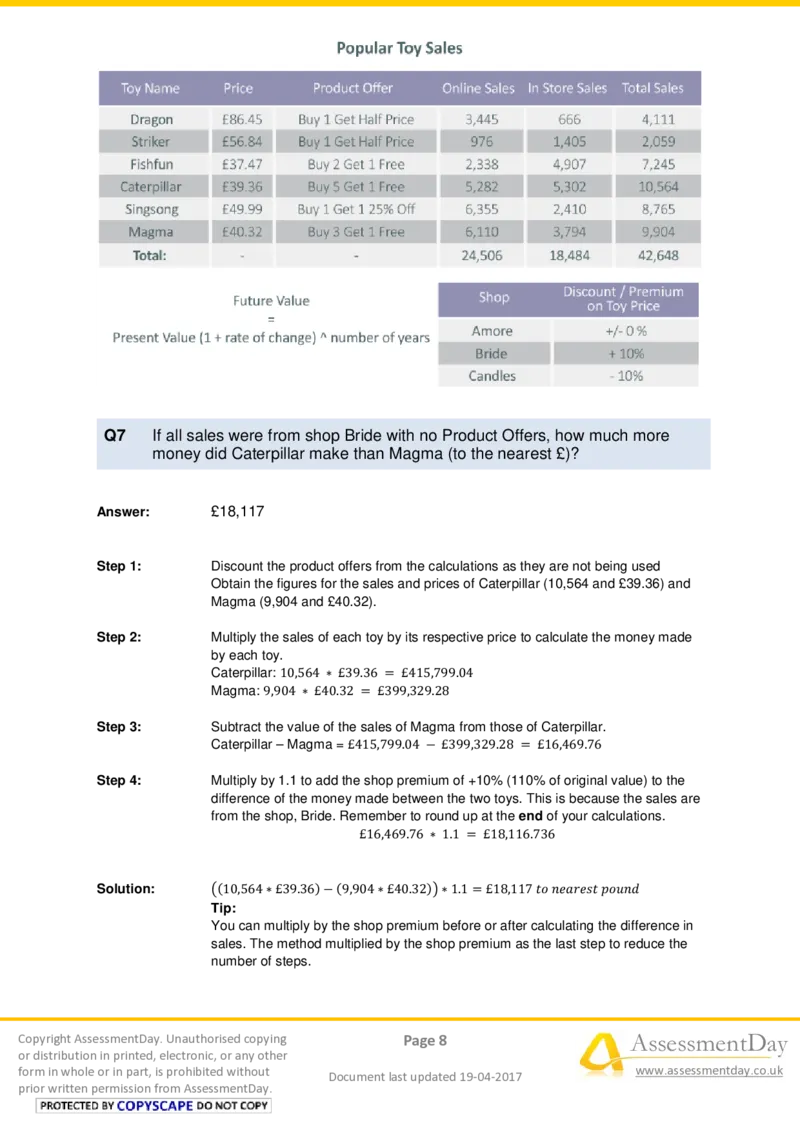
prior written permission from AssessmentDay.Q7 If all sales were from shop Bride with no Product Offers, how much more
money did Caterpillar make than Magma (to the nearest £)?
Answer: £18,117
Step 1: Discount the product offers from the calculations as they are not being used
Obtain the figures for the sales and prices of Caterpillar (10,564 and £39.36) and
Magma (9,904 and £40.32).
Step 2: Multiply the sales of each toy by its respective price to calculate the money made
by each toy.
Caterpillar:
Magma:
10,564 ∗ £39.36 = £415,799.04
9,904 ∗ £40.32 = £399,329.28
Step 3: Subtract the value of the sales of Magma from those of Caterpillar.
Caterpillar – Magma =
£415,799.04 − £399,329.28 = £16,469.76
Step 4: Multiply by 1.1 to add the shop premium of +10% (110% of original value) to the
difference of the money made between the two toys. This is because the sales are
from the shop, Bride. Remember to round up at the end of your calculations.
£16,469.76 ∗ 1.1 = £18,116.736
Solution:
Tip:
�(10,564∗£39.36)−(9,904∗£40.32)�∗1.1=£18,117 𝑡𝑡𝑡𝑡 𝑛𝑛𝑛𝑛𝑛𝑛𝑛𝑛𝑛𝑛𝑛𝑛𝑡𝑡 𝑝𝑝𝑡𝑡𝑝𝑝𝑛𝑛𝑝𝑝
You can multiply by the shop premium before or after calculating the difference in
sales. The method multiplied by the shop premium as the last step to reduce the
number of steps.
Copyright AssessmentDay. Unauthorised copying Page 8 AssessmentDay
or distribution in printed, electronic, or any other
form in whole or in part, is prohibited without
Document last updated 19-04-2017
www.assessmentday.co.uk
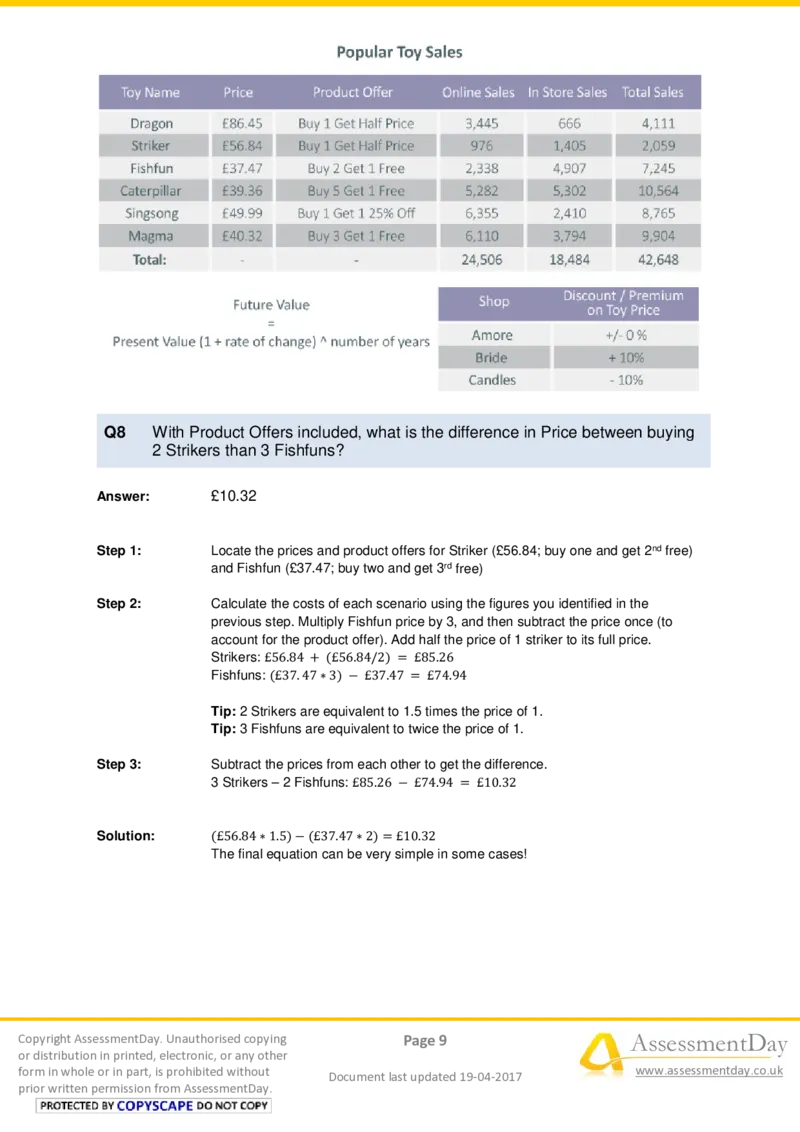
prior written permission from AssessmentDay.Q8 With Product Offers included, what is the difference in Price between buying
2 Strikers than 3 Fishfuns?
Answer: £10.32
Step 1: Locate the prices and product offers for Striker (£56.84; buy one and get 2nd free)
and Fishfun (£37.47; buy two and get 3rd free)
Step 2: Calculate the costs of each scenario using the figures you identified in the
previous step. Multiply Fishfun price by 3, and then subtract the price once (to
account for the product offer). Add half the price of 1 striker to its full price.
Strikers:
Fishfuns:
£56.84 + (£56.84/2) = £85.26
(£37.47∗3) − £37.47 = £74.94
Tip: 2 Strikers are equivalent to 1.5 times the price of 1.
Tip: 3 Fishfuns are equivalent to twice the price of 1.
Step 3: Subtract the prices from each other to get the difference.
3 Strikers – 2 Fishfuns:
£85.26 − £74.94 = £10.32
Solution:
The final equation can be very simple in some cases!
(£56.84∗1.5)−(£37.47∗2)=£10.32
Copyright AssessmentDay. Unauthorised copying Page 9 AssessmentDay
or distribution in printed, electronic, or any other
form in whole or in part, is prohibited without
Document last updated 19-04-2017
www.assessmentday.co.uk
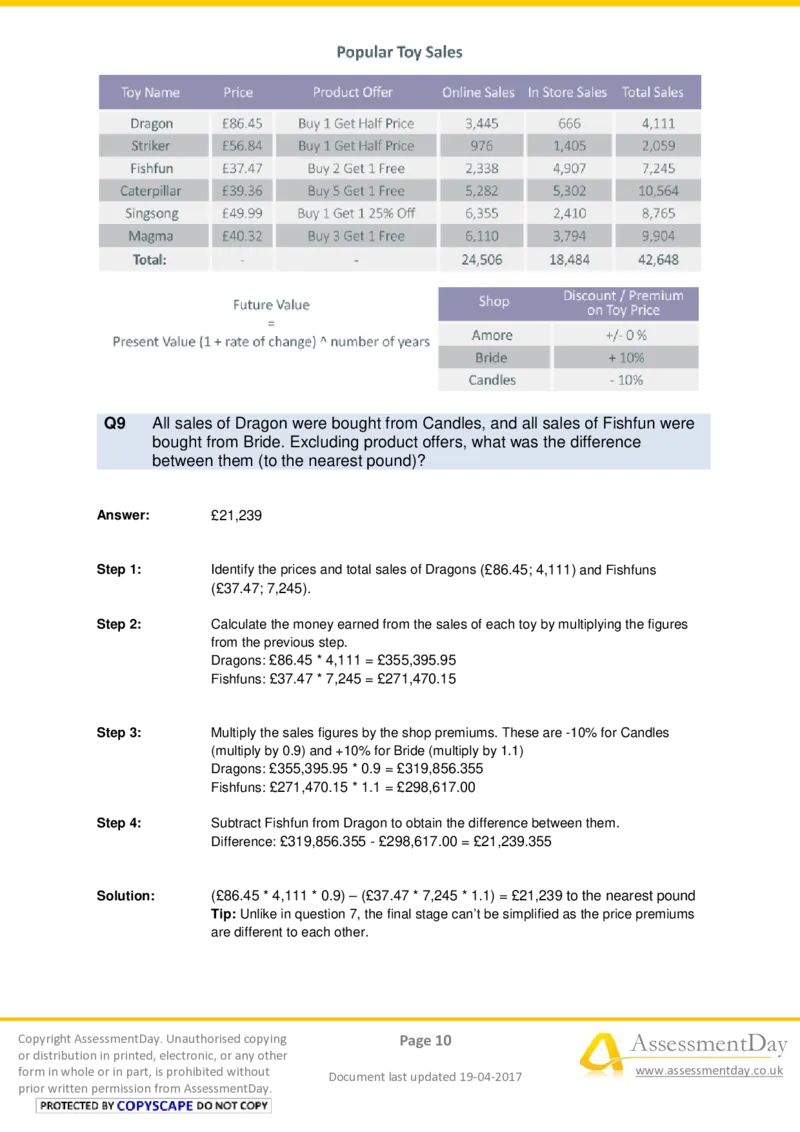
prior written permission from AssessmentDay.Q9 All sales of Dragon were bought from Candles, and all sales of Fishfun were
bought from Bride. Excluding product offers, what was the difference
between them (to the nearest pound)?
Answer: £21,239
Step 1: Identify the prices and total sales of Dragons (£86.45; 4,111) and Fishfuns
(£37.47; 7,245).
Step 2: Calculate the money earned from the sales of each toy by multiplying the figures
from the previous step.
Dragons: £86.45 * 4,111 = £355,395.95
Fishfuns: £37.47 * 7,245 = £271,470.15
Step 3: Multiply the sales figures by the shop premiums. These are -10% for Candles
(multiply by 0.9) and +10% for Bride (multiply by 1.1)
Dragons: £355,395.95 * 0.9 = £319,856.355
Fishfuns: £271,470.15 * 1.1 = £298,617.00
Step 4: Subtract Fishfun from Dragon to obtain the difference between them.
Difference: £319,856.355 - £298,617.00 = £21,239.355
Solution: (£86.45 * 4,111 * 0.9) – (£37.47 * 7,245 * 1.1) = £21,239 to the nearest pound
Tip: Unlike in question 7, the final stage can’t be simplified as the price premiums
are different to each other.
Copyright AssessmentDay. Unauthorised copying Page 10 AssessmentDay
or distribution in printed, electronic, or any other
form in whole or in part, is prohibited without
Document last updated 19-04-2017
www.assessmentday.co.uk
prior written permission from AssessmentDay.Q10 What is the difference in the total duration of the TV Show Outsider and the
TV show with shortest average episode duration?
Answer: 28 hours and 40 minutes
Step 1: Locate the required information for Floating World (5 series with 20, 22 minute
episodes) and Outsider (1 series with 8, 60 minute episodes).
Step 2: Multiply the number of episodes by the average episode duration and the number
of series to obtain the total duration for each TV show.
Floating World: 5 * 20 * 22 minutes = 2200 minutes
Outsider: 1 * 8 * 60 minutes = 480 minutes
Step 3: Subtract the total duration of Outsider from that of Floating world to obtain the
running time difference between the two shows.
Difference: 2200 minutes – 480 minutes = 1720 minutes
Step 4: Convert the minutes into hours by dividing by 60. The remainder (0.6) needs to be
multiplied by 60 to work out then number of minutes remaining.
1720 minutes / 60 minutes per hour = 28.6̇ hours = 28 hours and 40 minutes
Solution:
(5∗20∗22)−(1∗8∗60)=1720 𝑚𝑚𝑚𝑚𝑛𝑛𝑝𝑝𝑡𝑡𝑛𝑛𝑛𝑛 =28 ℎ𝑡𝑡𝑝𝑝𝑛𝑛𝑛𝑛 𝑛𝑛𝑛𝑛𝑝𝑝 40 𝑚𝑚𝑚𝑚𝑛𝑛𝑝𝑝𝑡𝑡𝑛𝑛𝑛𝑛
Copyright AssessmentDay. Unauthorised copying Page 11 AssessmentDay
or distribution in printed, electronic, or any other
form in whole or in part, is prohibited without
Document last updated 19-04-2017
www.assessmentday.co.uk
prior written permission from AssessmentDay.Q11 If the TV shows received Peak Viewing for every episode of the series, how
many more Total Views per Series (in millions) were there for Outsider
compared with Pale Hills?
Answer: 1.6 million
Step 1: Identify the figures for Peak viewing for every episode, the number of episodes per
series for Outsider (1.4 million viewers, 8 episodes in each series) and Pale Hills
(0.8 million viewers, 12 episodes in each series).
Step 2: Multiply the peak viewing figure for the TV shows Outsider and Pale Hills by their
respective number of episodes to obtain the total views per series.
Outsider: 1.4 million * 8 = 11.2 million
Pale Hills: 0.8 million * 12 = 9.6 million
Step 3: Subtract Pale Hills from Outsider to get the difference between the two.
11.2 million – 9.6 million = 1.6 million more views per episode for Outsider
Solution:
(1.4 𝑚𝑚𝑚𝑚𝑚𝑚𝑚𝑚𝑚𝑚𝑡𝑡𝑛𝑛∗8) – (0.8 𝑚𝑚𝑚𝑚𝑚𝑚𝑚𝑚𝑚𝑚𝑡𝑡𝑛𝑛∗12) = 1.6 𝑚𝑚𝑚𝑚𝑚𝑚𝑚𝑚𝑚𝑚𝑡𝑡𝑛𝑛
Copyright AssessmentDay. Unauthorised copying Page 12 AssessmentDay
or distribution in printed, electronic, or any other
form in whole or in part, is prohibited without
Document last updated 19-04-2017
www.assessmentday.co.uk
prior written permission from AssessmentDay.Q12 How much more expensive, per minute, is it to produce a Remaining episode
rather than Burial?
Answer: $9,000
Step 1: Locate the budget spent per series, the average episode duration and the number
of episodes per series for Remaining ($12 million, 40 minutes, 12 episodes) and
Burial ($8 million, 50 minutes, 10 episodes).
Step 2: Take the budget spent per series and divide by number of episodes and once
again by the number of minutes per episode
Remaining: $12,000,000 / 12 / 40 minutes = $25,000
Burial: $8,000,000 / 10 / 50 minutes = $16,000
Step 3: Subtract Burial from Remaining to get the figure of how much more expensive per
minute an episode it is = $9,000
Solution: ($12,000,000 / 12 / 40 minutes) – ($8,000,000 / 10 / 50 minutes) = $9,000 per
minute
Tip: Multiply by 1,000,000 if your answer looks very small; you’ve probably
forgotten the budget is in millions of dollars!
Copyright AssessmentDay. Unauthorised copying Page 13 AssessmentDay
or distribution in printed, electronic, or any other
form in whole or in part, is prohibited without
Document last updated 19-04-2017
www.assessmentday.co.uk
prior written permission from AssessmentDay.Q13 How much more Skim Milk Cheese was used annually than Cream Butter
(million litres)?
Answer: 96 million litres
Step 1: Locate the figures for skim milk cheese (26 million litres) and cream butter (18
million litres).
Step 2: Multiply these numbers by 12 to convert into an annual figure.
Skim milk cheese: 26 * 12 = 312 million litres
Cream butter: 18 * 12 = 216 million litres
Step 3: Subtract cream butter by skim milk cheese to find the difference between the two.
312 million litres – 216 million litres = 96 million litres
Solution: Tip: Remember these are monthly figures. If your answer seems quite small,
you’ve probably calculated the monthly figure, multiply this by 12 to obtain the
annual figure. An even quicker formula is shown below:
(26∗12)−(18∗12)=96 𝑚𝑚𝑚𝑚𝑚𝑚𝑚𝑚𝑚𝑚𝑡𝑡𝑛𝑛 𝑚𝑚𝑚𝑚𝑡𝑡𝑛𝑛𝑛𝑛𝑛𝑛
Copyright AssessmentDay. Unauthorised copying Page 14 AssessmentDay
or distribution in printed, electronic, or any other
form in whole or in part, is prohibited without
Document last updated 19-04-2017
www.assessmentday.co.uk
prior written permission from AssessmentDay.Q14 How much more revenue per litre did Sanctus generate than Cowie?
Answer: £0.04 per litre
Step 1: Locate in the table the Total UK milk used (728 million litres) the percentage of this
total that each company sold and the revenue generated by each company for
Sanctus (10%, £16.2 million) and Cowie (30%, £40.8 million)
Step 2: Calculate the litres of milk sold for each of the companies. This is done by
multiplying the Total UK milk used by the percentage the company sold.
Cowie: 728 million * 0.3 = 218.4 million litres
Sanctus: 728 million * 0.1 = 72.8 million litres
Step 3: The revenue per litre can then be calculated by dividing the number of litres sold
by the revenue generated.
Cowie: £40.8 million / 218.4 million litres = £0.186813…per litre
Sanctus: £16.2 million / 72.8 million litres = £0.22252747…per litre
Step 4: Subtract Cowie from Sanctus to get the difference between the two.
£0.222 – £0.186 = £0.036 = £0.04
Solution: Tip: The millions cancel each other out. The complexity of the numbers being
worked with here can be decreased right from the beginning.
£40.8 𝑚𝑚𝑚𝑚𝑚𝑚𝑚𝑚𝑚𝑚𝑡𝑡𝑛𝑛 £16.2 𝑚𝑚𝑚𝑚𝑚𝑚𝑚𝑚𝑚𝑚𝑡𝑡𝑛𝑛
� �− � �=£0.04 𝑝𝑝𝑛𝑛𝑛𝑛 𝑚𝑚𝑚𝑚𝑡𝑡𝑛𝑛𝑛𝑛
728 𝑚𝑚𝑚𝑚𝑚𝑚𝑚𝑚𝑚𝑚𝑡𝑡𝑛𝑛 ∗ 0.3 728 𝑚𝑚𝑚𝑚𝑚𝑚𝑚𝑚𝑚𝑚𝑡𝑡𝑛𝑛 ∗ 0.1
Copyright AssessmentDay. Unauthorised copying Page 15 AssessmentDay
or distribution in printed, electronic, or any other
form in whole or in part, is prohibited without
Document last updated 19-04-2017
www.assessmentday.co.uk
prior written permission from AssessmentDay.Q15 Liquid Milk sales accounted for 40% of Kitts’ revenue, who sold milk at £0.20
a litre. How many litres of Liquid Milk did they sell (in millions)?
Answer: 100.8 million litres
Step 1: Identify Kitts’ revenue (£50.4 million) and what proportion of this was raised by
liquid milk (40%).
Step 2: Calculate the share of the revenue which was generated from liquid milk sales by
multiplying the total revenue by the percentage signified in the question.
£50.4 million * 0.4 = £20.16 million
Step 3: The number of litres of liquid milk sold can now be obtained by dividing the
revenue by the price at which a litre of milk was sold.
£20.16 million / £0.20 per litre = 100.8 million litres
Solution: Tip: You can map out the relationship between these figures as shown below.
£50.4 𝑚𝑚𝑚𝑚𝑚𝑚𝑚𝑚𝑚𝑚𝑡𝑡𝑛𝑛 ∗ 0.4
� � = 100.8 𝑚𝑚𝑚𝑚𝑚𝑚𝑚𝑚𝑚𝑚𝑡𝑡𝑛𝑛 𝑚𝑚𝑚𝑚𝑡𝑡𝑛𝑛𝑛𝑛𝑛𝑛
£0.20 𝑝𝑝𝑛𝑛𝑛𝑛 𝑚𝑚𝑚𝑚𝑡𝑡𝑛𝑛𝑛𝑛
−1
𝐿𝐿𝑚𝑚𝑡𝑡𝑛𝑛𝑛𝑛𝑛𝑛 𝑛𝑛𝑡𝑡𝑚𝑚𝑝𝑝 (𝑚𝑚) ∗ 𝑝𝑝𝑛𝑛𝑚𝑚𝑝𝑝𝑛𝑛 𝑝𝑝𝑛𝑛𝑛𝑛 𝑚𝑚𝑚𝑚𝑡𝑡𝑛𝑛𝑛𝑛 (£ 𝑚𝑚 )= 𝑛𝑛𝑛𝑛𝑟𝑟𝑛𝑛𝑛𝑛𝑝𝑝𝑛𝑛 (£)
Rearrange to make litres sold the subject. You can see how the currency cancels.
𝑅𝑅𝑛𝑛𝑟𝑟𝑛𝑛𝑛𝑛𝑝𝑝𝑛𝑛 (£)
𝐿𝐿𝑚𝑚𝑡𝑡𝑛𝑛𝑛𝑛𝑛𝑛 𝑛𝑛𝑡𝑡𝑚𝑚𝑝𝑝 (𝑚𝑚) = −1
𝑝𝑝𝑛𝑛𝑚𝑚𝑝𝑝𝑛𝑛 𝑝𝑝𝑛𝑛𝑛𝑛 𝑚𝑚𝑚𝑚𝑡𝑡𝑛𝑛𝑛𝑛 (£ 𝑚𝑚 )
Copyright AssessmentDay. Unauthorised copying Page 16 AssessmentDay
or distribution in printed, electronic, or any other
form in whole or in part, is prohibited without
Document last updated 19-04-2017
www.assessmentday.co.uk
prior written permission from AssessmentDay.Q16 If the rate of change of Museum Visits from 2009 to 2010 remained
consistent, what would be the expected Total Museum Visits by 2013 (‘000s)?
Round your answer down to 0 decimal places.
Answer: 30,459.68
Step 1: Use the formula to identify what’s needed in this calculation; the present value of
museum visits for 2010 (27,330), the number of years (3) and the rate of change
from one year to the next.
Step 2: To calculate the rate of change the number of museum visits in 2009 (26,360) is
also needed. The rate of change is the difference from one year to the next as a
percentage. Subtract the value of museum visits for 2009 from 2010, then divide
by the museum visits for 2009 and, in this case, leave as a decimal.
Rate of change: (27,330 – 26,360) / 26,360 = 0.0368 (= 3.68%)
Step 3: Apply the given formula of future value to the values you have acquired.
Future value = 27,330 * (1 + 0.0368)3 = 30,459.62 = 30,459
Solution: Tip: You can multiply by 1.0368 each time for each year, but the formula given will
help you speed up your calculations.
3
27,330−26,360
27,300∗�1+� �� =30,459
26,360
Copyright AssessmentDay. Unauthorised copying Page 17 AssessmentDay
or distribution in printed, electronic, or any other
form in whole or in part, is prohibited without
Document last updated 19-04-2017
www.assessmentday.co.uk
prior written permission from AssessmentDay.Q17 From both Admissions and Fundraising, what was the increase in Museum
Income (£’000s) for the British Museum from 2009 to 2010?
Answer: £6,300
Step 1: Separate the values for Admissions and Fundraising according to the year, 2009
(3,200 and 8,000) or 2010 (2,300 and 15,200).
Step 2: Combine the admissions and fundraising income for each year.
2009: £3,200 + 8,000 = £11,200
2010: £2,300 + £15,200 = £17,500
Step 3: Subtract the income for 2010 from that of 2009 to calculate the difference.
Difference: £17,500 - £11,200 = £6,300
Solution: Tip: Break the question down into components so that you have a clearer picture
in your head of what’s required. All numbers are in thousands, so we can discount
these 0’s from our calculations to make it easier to view the numbers we’re
working with.
(£2,300+£15,200)−(£3,200+£8,000)=£6,300
Copyright AssessmentDay. Unauthorised copying Page 18 AssessmentDay
or distribution in printed, electronic, or any other
form in whole or in part, is prohibited without
Document last updated 19-04-2017
www.assessmentday.co.uk
prior written permission from AssessmentDay.Q18 All visitors pay the same admissions fee. How much Museum Income was
generated by Tourist Visits in the 2009 (£ ‘000s) period for the Portrait?
Answer: £1,449 (‘000s)
Step 1: The admissions fee isn’t given, but the income from admissions for the Portrait in
2009 (£2,070,000) and the proportion of tourist visits (70%) are both stated.
Step 2: Multiply the admissions income by the percentage of visitors.
£2,070,000 * 0.70 = £1,449,000
Solution: Tip: To state the final answer in (‘000s) as instructed, simply omit these from the
previous step.
£2,070∗0.70= £1,449
Copyright AssessmentDay. Unauthorised copying Page 19 AssessmentDay
or distribution in printed, electronic, or any other
form in whole or in part, is prohibited without
Document last updated 19-04-2017
www.assessmentday.co.uk
prior written permission from AssessmentDay.Q19 In 2014, how much Revenue did Red wine make per barrel?
Answer: £812.77 per barrel of red wine
Step 1: Obtain the necessary information. The UK wine market was £82 million, 10% of
wine sold was red, which equated to, in 2014, 10,089 barrels.
Step 2: Calculate the revenue generated solely by red wine.
Red wine revenue: £82 million * 0.1 = £8.2 million
Step 3: Divide the revenue calculated in the previous step by the number of barrels sold.
Red wine revenue per barrel: £8,200,000 / 10,089 barrels = 812.766 = £812.77
Solution:
£82,000,000∗0.1
=£812.77 𝑛𝑛𝑛𝑛𝑝𝑝 𝑤𝑤𝑚𝑚𝑛𝑛𝑛𝑛 𝑝𝑝𝑛𝑛𝑛𝑛 𝑏𝑏𝑛𝑛𝑛𝑛𝑛𝑛𝑛𝑛𝑚𝑚
10,089 𝑏𝑏𝑛𝑛𝑛𝑛𝑛𝑛𝑛𝑛𝑚𝑚𝑛𝑛
Copyright AssessmentDay. Unauthorised copying Page 20 AssessmentDay
or distribution in printed, electronic, or any other
form in whole or in part, is prohibited without
Document last updated 19-04-2017
www.assessmentday.co.uk
prior written permission from AssessmentDay.Q20 How many more Vineyards than Wineries were there in 2013 than 2012?
Answer: 11
Step 1: In 2012, the total number of Vineyards (428) and Wineries (121) are being
compared with the Vineyards (443) and Wineries (125) of 2013. Look at the totals
for each year and calculate the difference between the two, rather than the totals
for each category, as this would be the other way around.
Step 2: Sum the figures for each year.
2012 (Vineyards minus Wineries): 428 - 121 = 307
2013 (Vineyards minus Wineries): 443 - 125 = 318
Step 3: To calculate the difference between the two years, simply subtract the value for
2012 from that of 2013.
Difference in total wineries vineyards between 2013 and 2012: 318 – 307 = 11
Solution:
(443−125)−(428−121)= 11
Copyright AssessmentDay. Unauthorised copying Page 21 AssessmentDay
or distribution in printed, electronic, or any other
form in whole or in part, is prohibited without
Document last updated 19-04-2017
www.assessmentday.co.uk
prior written permission from AssessmentDay.Q21 Given that Fields only sells White wine, what was the average price of a
bottle of White wine sold by Fields, in 2014?
Answer: £14.21 per bottle
Step 1: Fields only sells white wine. Therefore, its figures amount only to white wine.
Sparkling white and still white add up to 90% of the total UK wine sold. Locate the
number of total bottles sold in 2014 = 6.41 million. Multiply by 0.9 to convert to
90% of our figure = 5.769 million bottles
Step 2: Then multiply by 0.3 to convert to 30% of this figure, which is % of UK bottles sold
= 1.7307 million bottles
Step 3: Take the revenue from Fields and divide by the number of bottles of white wine
sold through Fields was to get the average price per bottle = £14.21
Solution:
£24.6 𝑚𝑚𝑚𝑚𝑚𝑚𝑚𝑚𝑚𝑚𝑡𝑡𝑛𝑛
= £14.21 𝑝𝑝𝑛𝑛𝑛𝑛 𝑏𝑏𝑡𝑡𝑡𝑡𝑡𝑡𝑚𝑚𝑛𝑛
(6.41 𝑚𝑚𝑚𝑚𝑚𝑚𝑚𝑚𝑚𝑚𝑡𝑡𝑛𝑛 𝑏𝑏𝑡𝑡𝑡𝑡𝑡𝑡𝑚𝑚𝑛𝑛𝑛𝑛∗0.9∗0.3)
Copyright AssessmentDay. Unauthorised copying Page 22 AssessmentDay
or distribution in printed, electronic, or any other
form in whole or in part, is prohibited without
Document last updated 19-04-2017
www.assessmentday.co.uk
prior written permission from AssessmentDay.-- End of Test --
Copyright AssessmentDay. Unauthorised copying Page 23 AssessmentDay
or distribution in printed, electronic, or any other
form in whole or in part, is prohibited without
Document last updated 19-04-2017
www.assessmentday.co.uk
prior written permission from AssessmentDay.