Numerical Critical Reasoning
Test 8
Solutions Booklet
Instructions
This numerical reasoning test comprises 21 questions, and you will have to correctly
answer as many as you can. Calculators are permitted for this test, and it is
recommended you have some rough paper to work on.
You will have to work quickly and accurately to perform well in this test. The test does
not have an overall time limit however each question does have a time limit. The first
question relating to each table or graph has 90 seconds, and subsequent questions
relating to the same table or graph have 75 seconds.
Try to find a time and place where you will not be interrupted during the test. The test
will begin on the next page.
AssessmentDay
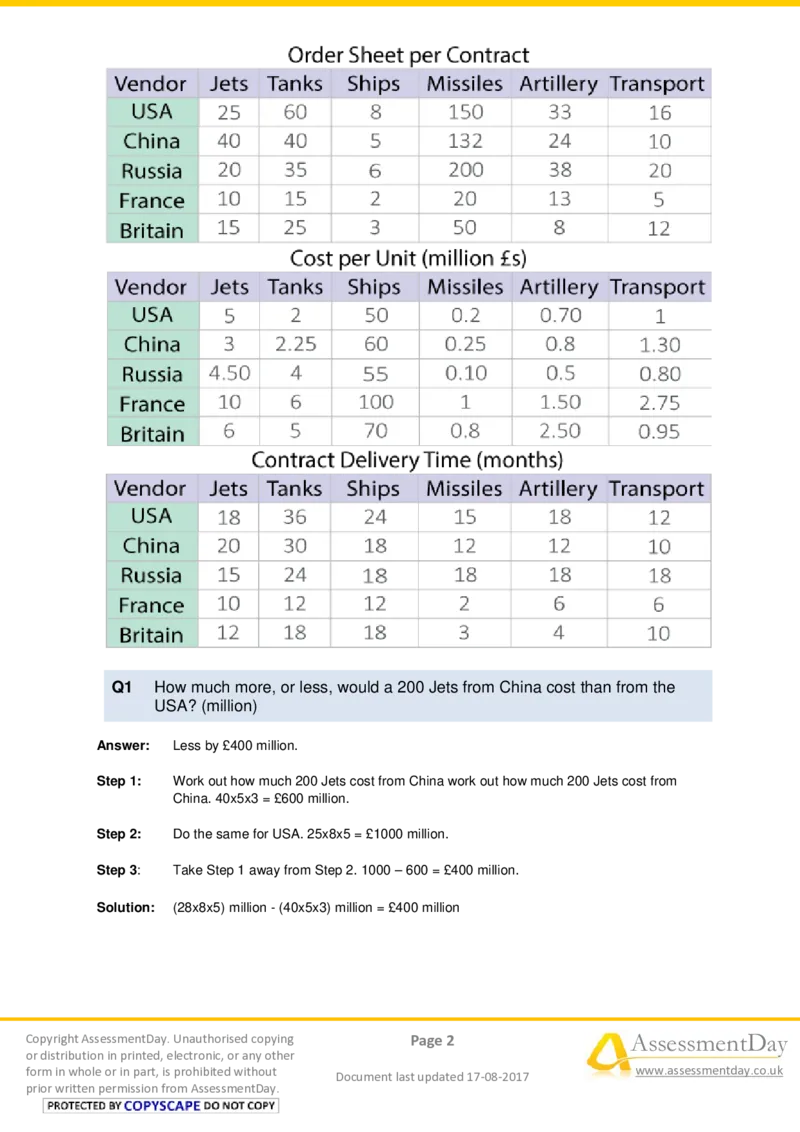
Practice Aptitude TestsQ1 How much more, or less, would a 200 Jets from China cost than from the
USA? (million)
Answer: Less by £400 million.
Step 1: Work out how much 200 Jets cost from China work out how much 200 Jets cost from
China. 40x5x3 = £600 million.
Step 2: Do the same for USA. 25x8x5 = £1000 million.
Step 3: Take Step 1 away from Step 2. 1000 – 600 = £400 million.
Solution: (28x8x5) million - (40x5x3) million = £400 million
Copyright AssessmentDay. Unauthorised copying Page 2 AssessmentDay
or distribution in printed, electronic, or any other
form in whole or in part, is prohibited without
Document last updated 17-08-2017
www.assessmentday.co.uk
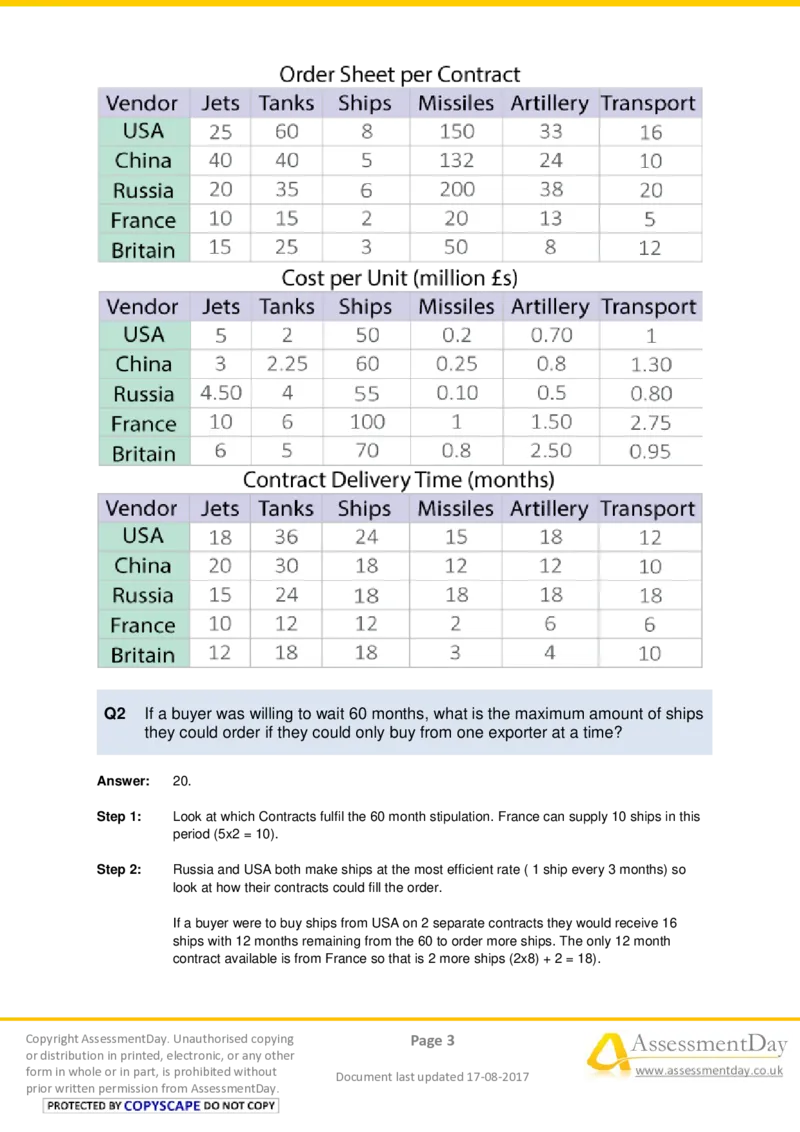
prior written permission from AssessmentDay.Q2 If a buyer was willing to wait 60 months, what is the maximum amount of ships
they could order if they could only buy from one exporter at a time?
Answer: 20.
Step 1: Look at which Contracts fulfil the 60 month stipulation. France can supply 10 ships in this
period (5x2 = 10).
Step 2: Russia and USA both make ships at the most efficient rate ( 1 ship every 3 months) so
look at how their contracts could fill the order.
If a buyer were to buy ships from USA on 2 separate contracts they would receive 16
ships with 12 months remaining from the 60 to order more ships. The only 12 month
contract available is from France so that is 2 more ships (2x8) + 2 = 18).
Copyright AssessmentDay. Unauthorised copying Page 3 AssessmentDay
or distribution in printed, electronic, or any other
form in whole or in part, is prohibited without
Document last updated 17-08-2017
www.assessmentday.co.uk
prior written permission from AssessmentDay.We could also try ordering 2 contracts from Russia first, which would mean 12 ships
delivered after 36 months and leaving 24 months left to order more ships. The most
efficient contract left is the USA one which would give us 8 more ships in that time.
Solution: (2 x 6) + 8) = 20.
Copyright AssessmentDay. Unauthorised copying Page 4 AssessmentDay
or distribution in printed, electronic, or any other
form in whole or in part, is prohibited without
Document last updated 17-08-2017
www.assessmentday.co.uk
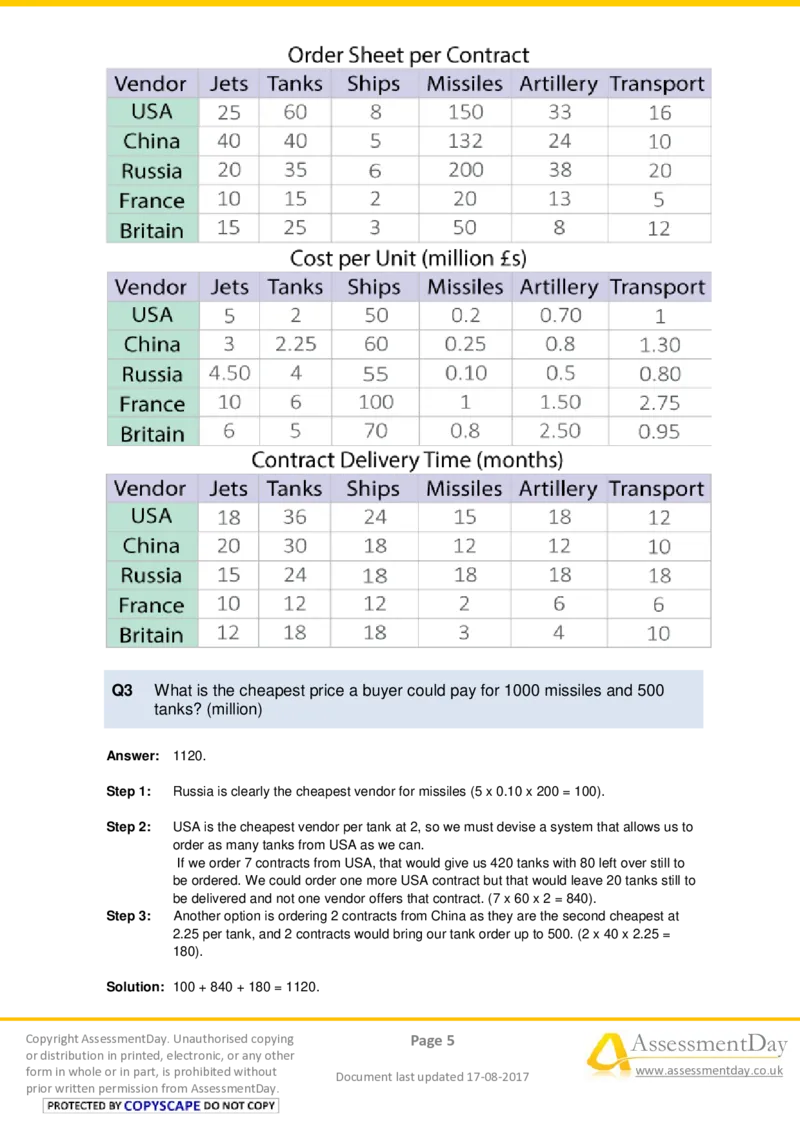
prior written permission from AssessmentDay.Q3 What is the cheapest price a buyer could pay for 1000 missiles and 500
tanks? (million)
Answer: 1120.
Step 1: Russia is clearly the cheapest vendor for missiles (5 x 0.10 x 200 = 100).
Step 2: USA is the cheapest vendor per tank at 2, so we must devise a system that allows us to
order as many tanks from USA as we can.
If we order 7 contracts from USA, that would give us 420 tanks with 80 left over still to
be ordered. We could order one more USA contract but that would leave 20 tanks still to
be delivered and not one vendor offers that contract. (7 x 60 x 2 = 840).
Step 3: Another option is ordering 2 contracts from China as they are the second cheapest at
2.25 per tank, and 2 contracts would bring our tank order up to 500. (2 x 40 x 2.25 =
180).
Solution: 100 + 840 + 180 = 1120.
Copyright AssessmentDay. Unauthorised copying Page 5 AssessmentDay
or distribution in printed, electronic, or any other
form in whole or in part, is prohibited without
Document last updated 17-08-2017
www.assessmentday.co.uk
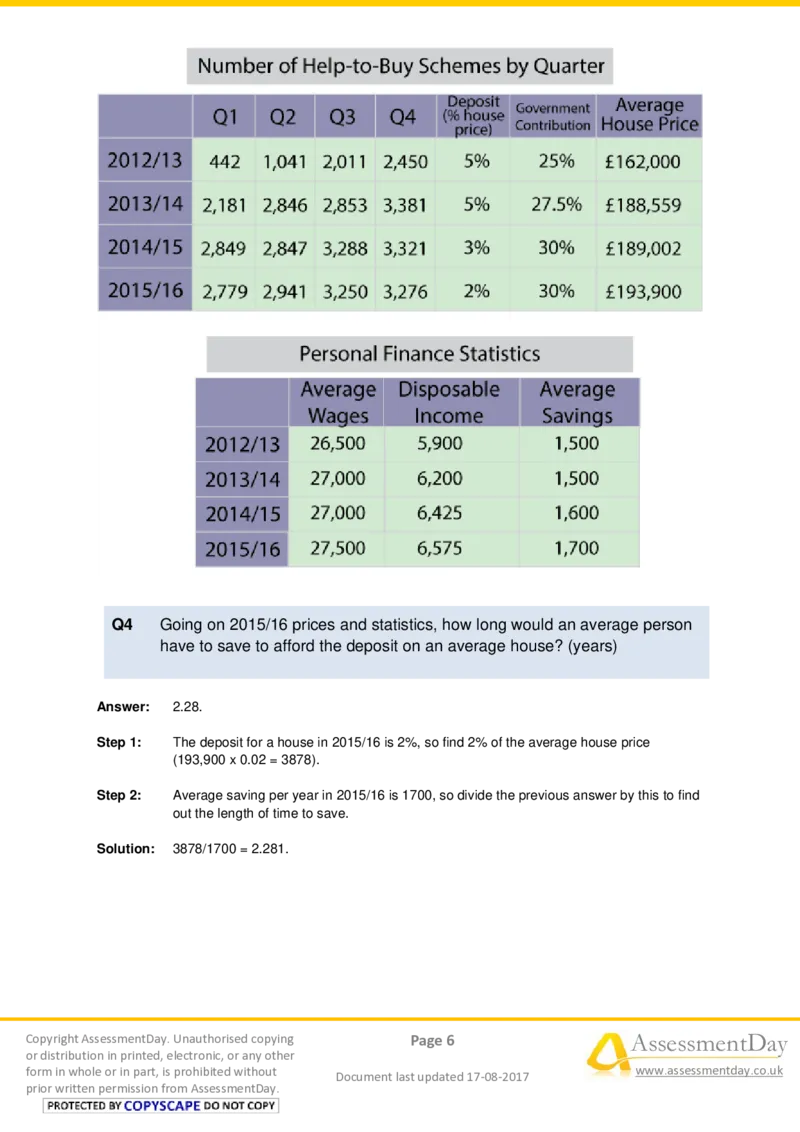
prior written permission from AssessmentDay.Q4 Going on 2015/16 prices and statistics, how long would an average person
have to save to afford the deposit on an average house? (years)
Answer: 2.28.
Step 1: The deposit for a house in 2015/16 is 2%, so find 2% of the average house price
(193,900 x 0.02 = 3878).
Step 2: Average saving per year in 2015/16 is 1700, so divide the previous answer by this to find
out the length of time to save.
Solution: 3878/1700 = 2.281.
Copyright AssessmentDay. Unauthorised copying Page 6 AssessmentDay
or distribution in printed, electronic, or any other
form in whole or in part, is prohibited without
Document last updated 17-08-2017
www.assessmentday.co.uk
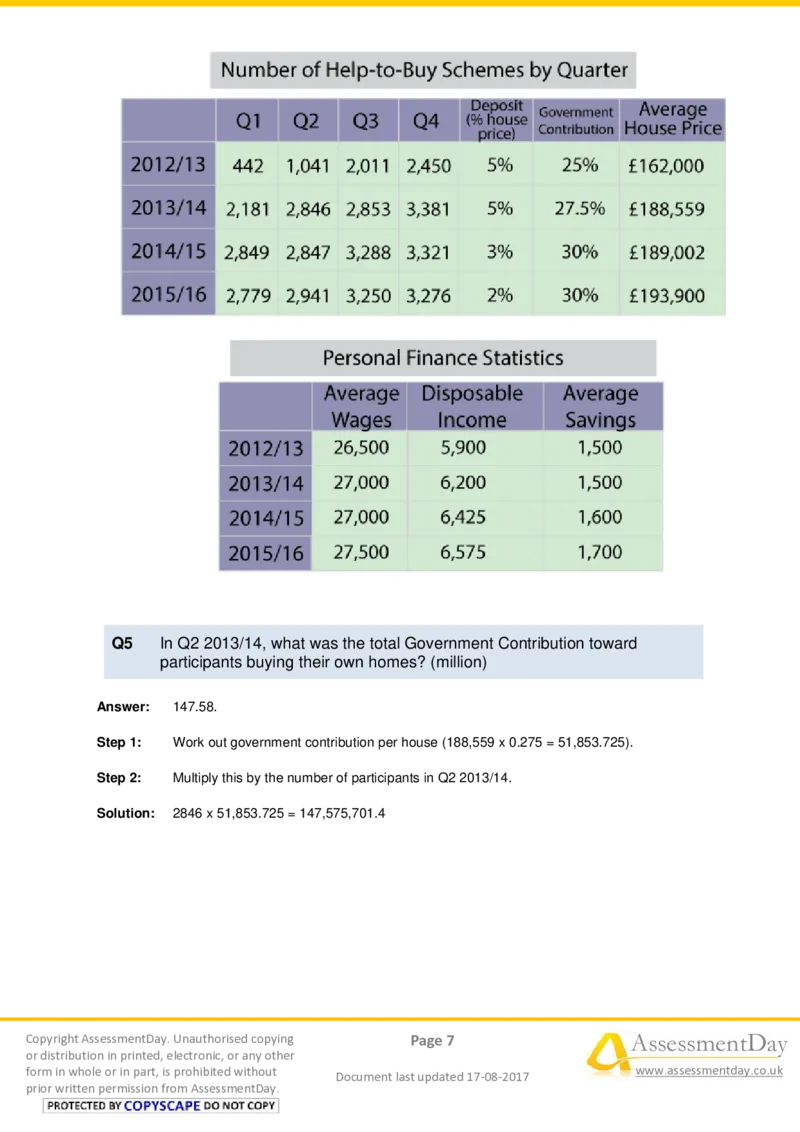
prior written permission from AssessmentDay.Q5 In Q2 2013/14, what was the total Government Contribution toward
participants buying their own homes? (million)
Answer: 147.58.
Step 1: Work out government contribution per house (188,559 x 0.275 = 51,853.725).
Step 2: Multiply this by the number of participants in Q2 2013/14.
Solution: 2846 x 51,853.725 = 147,575,701.4
Copyright AssessmentDay. Unauthorised copying Page 7 AssessmentDay
or distribution in printed, electronic, or any other
form in whole or in part, is prohibited without
Document last updated 17-08-2017
www.assessmentday.co.uk
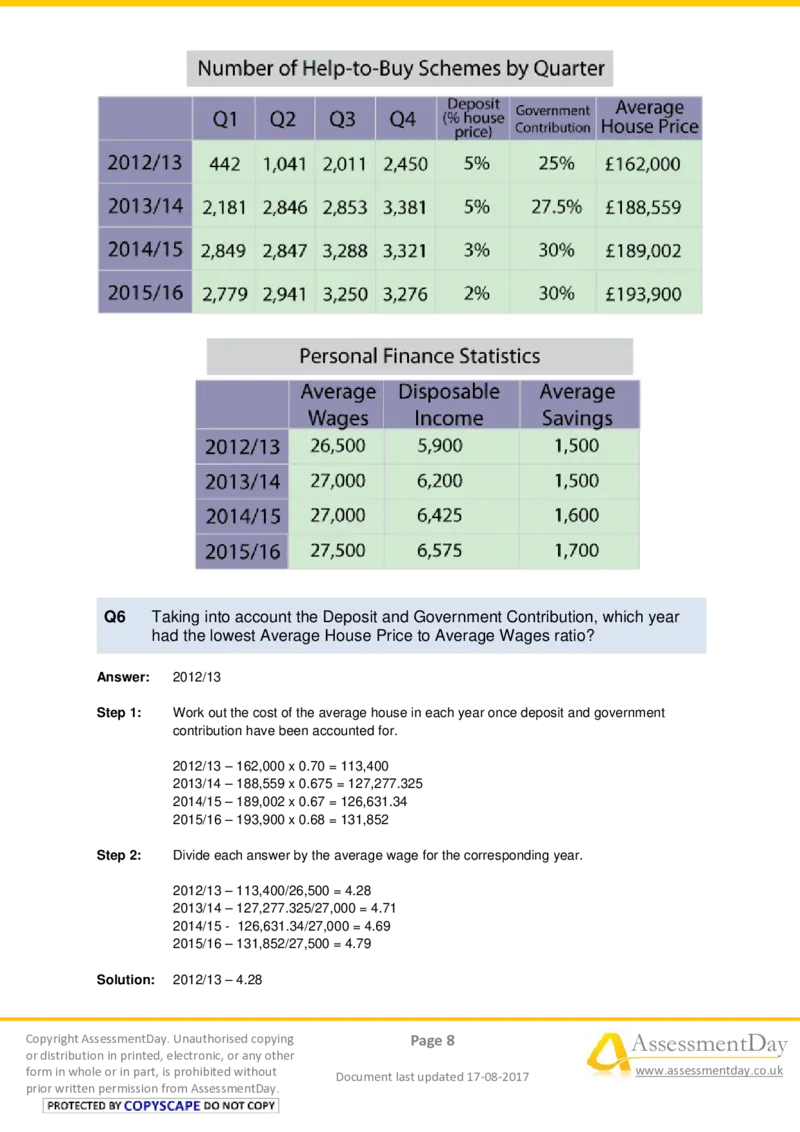
prior written permission from AssessmentDay.Q6 Taking into account the Deposit and Government Contribution, which year
had the lowest Average House Price to Average Wages ratio?
Answer: 2012/13
Step 1: Work out the cost of the average house in each year once deposit and government
contribution have been accounted for.
2012/13 – 162,000 x 0.70 = 113,400
2013/14 – 188,559 x 0.675 = 127,277.325
2014/15 – 189,002 x 0.67 = 126,631.34
2015/16 – 193,900 x 0.68 = 131,852
Step 2: Divide each answer by the average wage for the corresponding year.
2012/13 – 113,400/26,500 = 4.28
2013/14 – 127,277.325/27,000 = 4.71
2014/15 - 126,631.34/27,000 = 4.69
2015/16 – 131,852/27,500 = 4.79
Solution: 2012/13 – 4.28
Copyright AssessmentDay. Unauthorised copying Page 8 AssessmentDay
or distribution in printed, electronic, or any other
form in whole or in part, is prohibited without
Document last updated 17-08-2017
www.assessmentday.co.uk
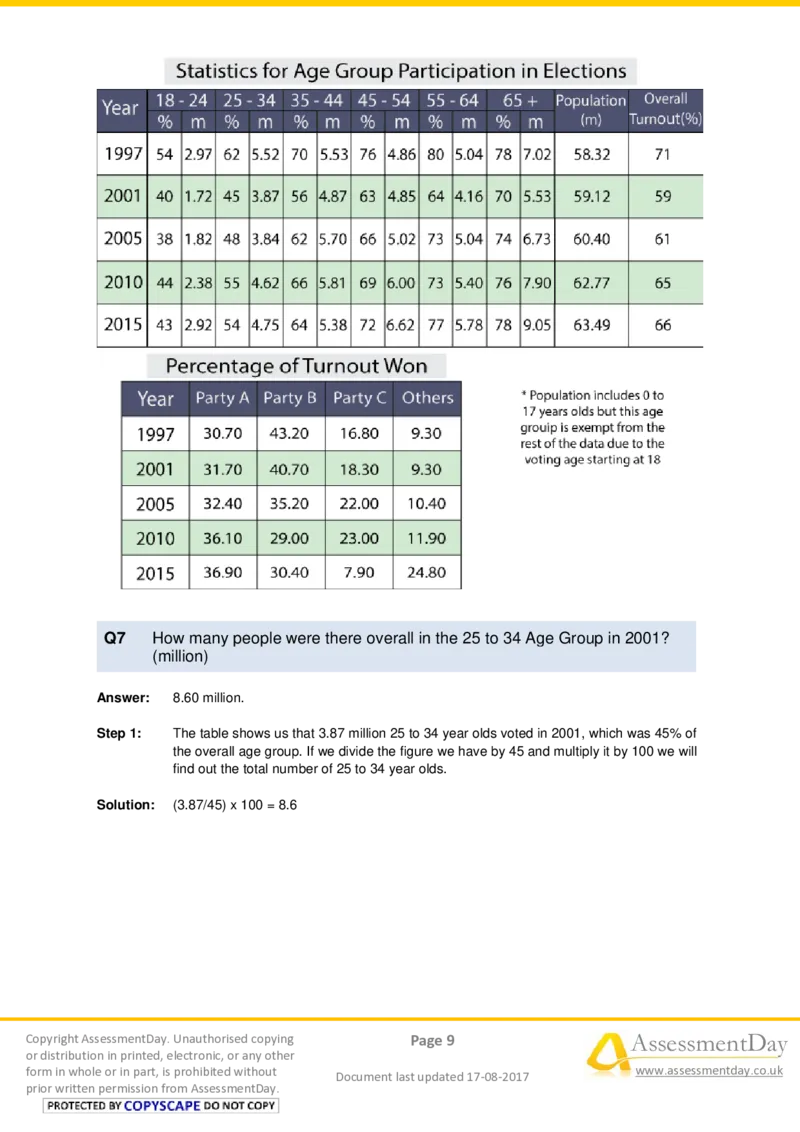
prior written permission from AssessmentDay.Q7 How many people were there overall in the 25 to 34 Age Group in 2001?
(million)
Answer: 8.60 million.
Step 1: The table shows us that 3.87 million 25 to 34 year olds voted in 2001, which was 45% of
the overall age group. If we divide the figure we have by 45 and multiply it by 100 we will
find out the total number of 25 to 34 year olds.
Solution: (3.87/45) x 100 = 8.6
Copyright AssessmentDay. Unauthorised copying Page 9 AssessmentDay
or distribution in printed, electronic, or any other
form in whole or in part, is prohibited without
Document last updated 17-08-2017
www.assessmentday.co.uk
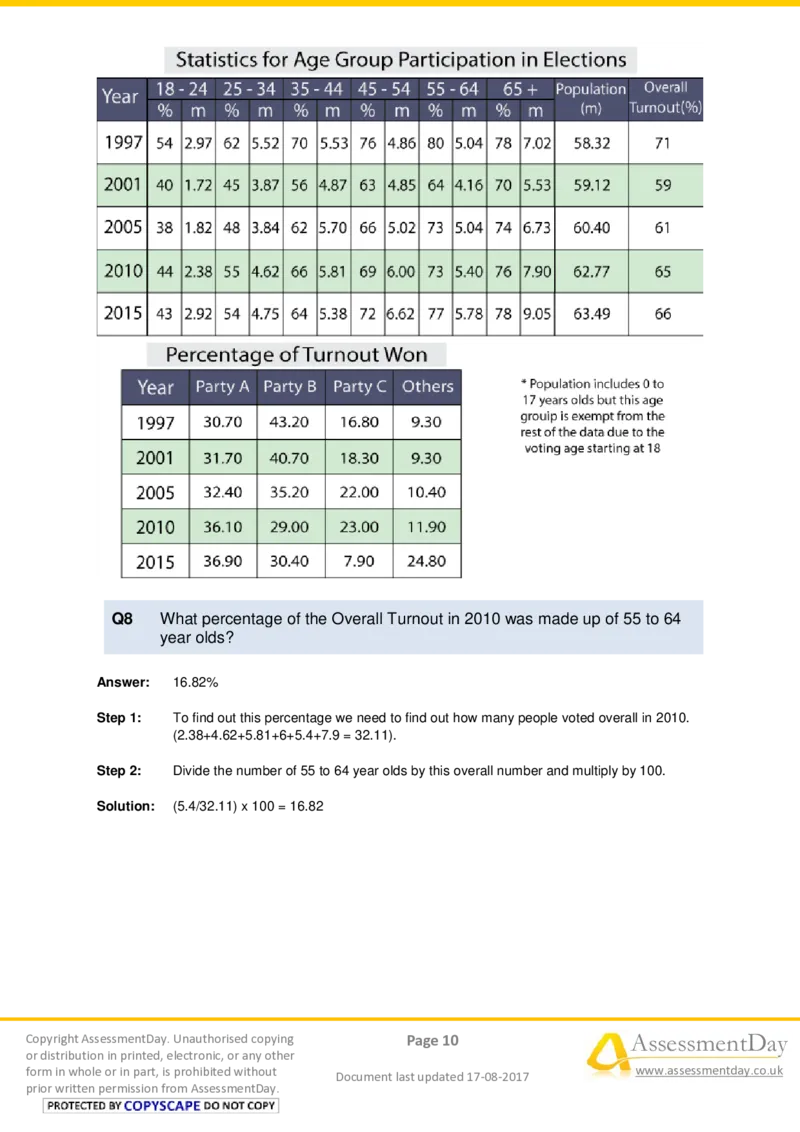
prior written permission from AssessmentDay.Q8 What percentage of the Overall Turnout in 2010 was made up of 55 to 64
year olds?
Answer: 16.82%
Step 1: To find out this percentage we need to find out how many people voted overall in 2010.
(2.38+4.62+5.81+6+5.4+7.9 = 32.11).
Step 2: Divide the number of 55 to 64 year olds by this overall number and multiply by 100.
Solution: (5.4/32.11) x 100 = 16.82
Copyright AssessmentDay. Unauthorised copying Page 10 AssessmentDay
or distribution in printed, electronic, or any other
form in whole or in part, is prohibited without
Document last updated 17-08-2017
www.assessmentday.co.uk
prior written permission from AssessmentDay.Q9 How many people voted for Party C in 2015?
Answer: 2.73 million.
Step 1: Add up the total number of people who voted in each age group.
2.92+4.75+5.38+6.62+5.78+9.05 = 34.5
Step 2: Divide this figure by 100 to find out 1% of the voting population, then multiply 7.9 to work
out how many of those people voted for Party C.
Solution: (34.5/100) x 7.9 = 2.73m.
Copyright AssessmentDay. Unauthorised copying Page 11 AssessmentDay
or distribution in printed, electronic, or any other
form in whole or in part, is prohibited without
Document last updated 17-08-2017
www.assessmentday.co.uk
prior written permission from AssessmentDay.Q10 By how much greater or lesser is the average Sleep Rating for Under 21s
in Areas A to H than the average for 21 to 30 year olds?
Answer: Lesser by 0.19.
Step 1: Add up the values for A to H in each age group and divide by the number Areas to
find each age category’s average, then take the average for 21 to 30 year olds away
from the average for Under 21s.
Solution: (6.1+5.7+5.5+5.2+5.7+5.6+5.5+5.5)/8) – (6.3+5.7+5.6+5.4+5.9+6.0+5.8+5.6)/8)
= - 0.1875
Copyright AssessmentDay. Unauthorised copying Page 12 AssessmentDay
or distribution in printed, electronic, or any other
form in whole or in part, is prohibited without
Document last updated 17-08-2017
www.assessmentday.co.uk
prior written permission from AssessmentDay.Q11 If 20% of Respondents in Area A were aged 41 to 50, how many
Respondents in this Age Group were in all other Areas altogether?
Answer: 1800.
Step 1: There are 3590 respondents in Area A, 20% of which are 41 to 50 so:
3590 x 0.20 = 718
Step 2: In the bottom table we can see that overall there were 2518 respondents aged 41 to 50,
so if we take away the answer to Step 1 we will find out how many respondents in that
age group are left.
Solution: 2518 – 718 = 1800
Copyright AssessmentDay. Unauthorised copying Page 13 AssessmentDay
or distribution in printed, electronic, or any other
form in whole or in part, is prohibited without
Document last updated 17-08-2017
www.assessmentday.co.uk
prior written permission from AssessmentDay.Q12 By how much greater or lesser is the number of Respondents in Age
Group 51 to 60 who gave Temperature as a Reason for Disturbed Sleep
than those in Age Group Over 60 who gave Partner as an answer?
Answer: Lesser by 228.
Step 1: Age group 51 to 60 has 3259 respondents, 23% of which gave Temperature as a reason
so: 3259 x 0.23 = 749.57
Step 2: Age group over 60 has 2963 respondents, 33% of which gave Partner as a reason so:
2963 x 0.33 = 977.79
Step 3: Round each answer up and take step 2 from step 1.
Solution: 978 – 750 = 228.
Copyright AssessmentDay. Unauthorised copying Page 14 AssessmentDay
or distribution in printed, electronic, or any other
form in whole or in part, is prohibited without
Document last updated 17-08-2017
www.assessmentday.co.uk
prior written permission from AssessmentDay.Q13 How much would it cost to buy 30 units of Product A and store them in
Warehouse 3?
Answer: £1125.
Step 1: Work out how much 30 units of Product A costs: 30 x 24 = 720.
Step 2: Work out how much it costs to store in Warehouse 3 by taking 30 units at 3m3 and
costing 4.5 for each m3: 30 x 3 x 4.5 = 405.
Solution: 720 + 405 = 1125.
Copyright AssessmentDay. Unauthorised copying Page 15 AssessmentDay
or distribution in printed, electronic, or any other
form in whole or in part, is prohibited without
Document last updated 17-08-2017
www.assessmentday.co.uk
prior written permission from AssessmentDay.Q14 How much greater or lesser does it cost to buy 20 units of Product B and
store them in Warehouse 3 than to buy 30 units of Product D and store
them in Warehouse 2?
Answer: Lesser by 335.
Step 1: Find out how much 20 units of Product B costs, and how much it costs to store it in
Warehouse 3: (20x35) + (20x3.5x4.5) = 1015.
Step 2: Do the same for 30 units of Product D: (30x30) + (30x5x3) = 1350.
Step 3: Take step 2 away from step 1.
Solution: 1015 – 1350 = -335.
Copyright AssessmentDay. Unauthorised copying Page 16 AssessmentDay
or distribution in printed, electronic, or any other
form in whole or in part, is prohibited without
Document last updated 17-08-2017
www.assessmentday.co.uk
prior written permission from AssessmentDay.Q15 If Warehouse 2 was already 50% full, how many units of Product C could
be stored there?
Answer: 6221.
Step 1: Work out how big Warehouse 2 is: 90.5 x 22 x 12.5 = 24887.5m3
Step 2: Divide this by 2 as it is 50% full: 24887.5/2 = 12443.75
Step 3: Product C is 2m3 so divide the answer to step 2 by 2 again to work out how many units
of Product C can fit into the warehouse.
Solution: 12443.75/2 = 6221.875
Copyright AssessmentDay. Unauthorised copying Page 17 AssessmentDay
or distribution in printed, electronic, or any other
form in whole or in part, is prohibited without
Document last updated 17-08-2017
www.assessmentday.co.uk
prior written permission from AssessmentDay.Q16 How many more or less cars are there in Japan than in Russia? (million)
Answer: 17.39 million.
Step 1: There are 478 cars per 1000 people in Japan, so divide the population by 1000 and
multiply by 478 to find out how many cars there are: (127,000,000/1000) x 478 =
60,706,000.
Step 2: Do the same for Russia: (142,500,000/1000) x 304 = 43,320,000.
Solution: 60,706,000 – 43,320,000 = 17,386,000.
Copyright AssessmentDay. Unauthorised copying Page 18 AssessmentDay
or distribution in printed, electronic, or any other
form in whole or in part, is prohibited without
Document last updated 17-08-2017
www.assessmentday.co.uk
prior written permission from AssessmentDay.Q17 If Germany makes a 30% profit on each car it sells, how much profit or loss
does it make overall in its own currency? (million)
Answer: 28593 million loss.
Step 1: Work out how much money Germany makes from selling cars and convert it into its own
currency: (12000x1.30) x 3.04) x 0.89 = 42207.36.
Step 2: Work out the cost of production for each car in Germany: (5.9x12000) x 0.89 = 70800.
Solution: Take the cost of production away from the money made from selling cars: 42207.36 –
70800 = -28592.64
Copyright AssessmentDay. Unauthorised copying Page 19 AssessmentDay
or distribution in printed, electronic, or any other
form in whole or in part, is prohibited without
Document last updated 17-08-2017
www.assessmentday.co.uk
prior written permission from AssessmentDay.Q18 What is the annual trade deficit if the United States made 50% of its sales in
Japan at 10% profit per car, and Japan made 30% of its sales in the United
States at 25% profit per car? (million)
Answer: $23777.5 million.
Step 1: Work out United States sales in Japan: (4.15x0.50) x (22,000x1.10) = 50215.
Step 2: Work out Japan sales in United States: (4.70x0.30) x (15000x1.25) = 26437.5
Solution: Take one from the other: 50215 – 26437.5 = 23777.5
Copyright AssessmentDay. Unauthorised copying Page 20 AssessmentDay
or distribution in printed, electronic, or any other
form in whole or in part, is prohibited without
Document last updated 17-08-2017
www.assessmentday.co.uk
prior written permission from AssessmentDay.Q19 By how much is Finland’s GDP per head of population greater or lesser
than Argentina’s?
Answer: Greater by 37518.
Step 1: Work out Finland’s GDP per head: 273/(5.4/1000) = 50,556.
Step 2: Work out Argentina’s GDP per head: 545/(41.8/1000) = 13,038.
Solution: Take one from the other: 50,556 – 13,038 = 37,518.
Copyright AssessmentDay. Unauthorised copying Page 21 AssessmentDay
or distribution in printed, electronic, or any other
form in whole or in part, is prohibited without
Document last updated 17-08-2017
www.assessmentday.co.uk
prior written permission from AssessmentDay.Q20 What is the GDP per head of population for those working in Services in
Iran?
Answer: 5705.
Step 1: Work out GDP gained in Services: 416x0.52 = 216.32
Step 2: Work out how many people work in Services: 78.5x0.483 = 37.92
Solution: Work out the GDP per head: 216.32/(37.92/1000) = 5705.
Copyright AssessmentDay. Unauthorised copying Page 22 AssessmentDay
or distribution in printed, electronic, or any other
form in whole or in part, is prohibited without
Document last updated 17-08-2017
www.assessmentday.co.uk
prior written permission from AssessmentDay.Q21 Which country has the lowest GDP per head of population working in
Agriculture?
Answer: Mexico.
Step 1: Work out each country’s GDP gained in Agriculture:
Argentina: 545x0.08 = 43.6
Bulgaria: 57x0.05 = 2.85
Finland: 273x0.03 = 8.18
Iran: 416x0.09 = 37.44
Mexico: 1298x0.03 = 38.94
Step 2: Work out each country’s population working in Agriculture:
Argentina: 41.8x0.005 = 0.209
Bulgaria: 7.2x0.069 = 0.497
Finland: 5.4x0.039 = 0.211
Copyright AssessmentDay. Unauthorised copying Page 23 AssessmentDay
or distribution in printed, electronic, or any other
form in whole or in part, is prohibited without
Document last updated 17-08-2017
www.assessmentday.co.uk
prior written permission from AssessmentDay.Iran: 78.5x0.179 = 14.052
Mexico: 123.8x0.134 = 16.589
Solution: Use these figures to work out GDP per head in Agriculture:
Mexico: (38.94/16.589)x1000 = 2347.
-- End of Test --
Copyright AssessmentDay. Unauthorised copying Page 24 AssessmentDay
or distribution in printed, electronic, or any other
form in whole or in part, is prohibited without
Document last updated 17-08-2017
www.assessmentday.co.uk
prior written permission from AssessmentDay.