1、
(1)
答案:D
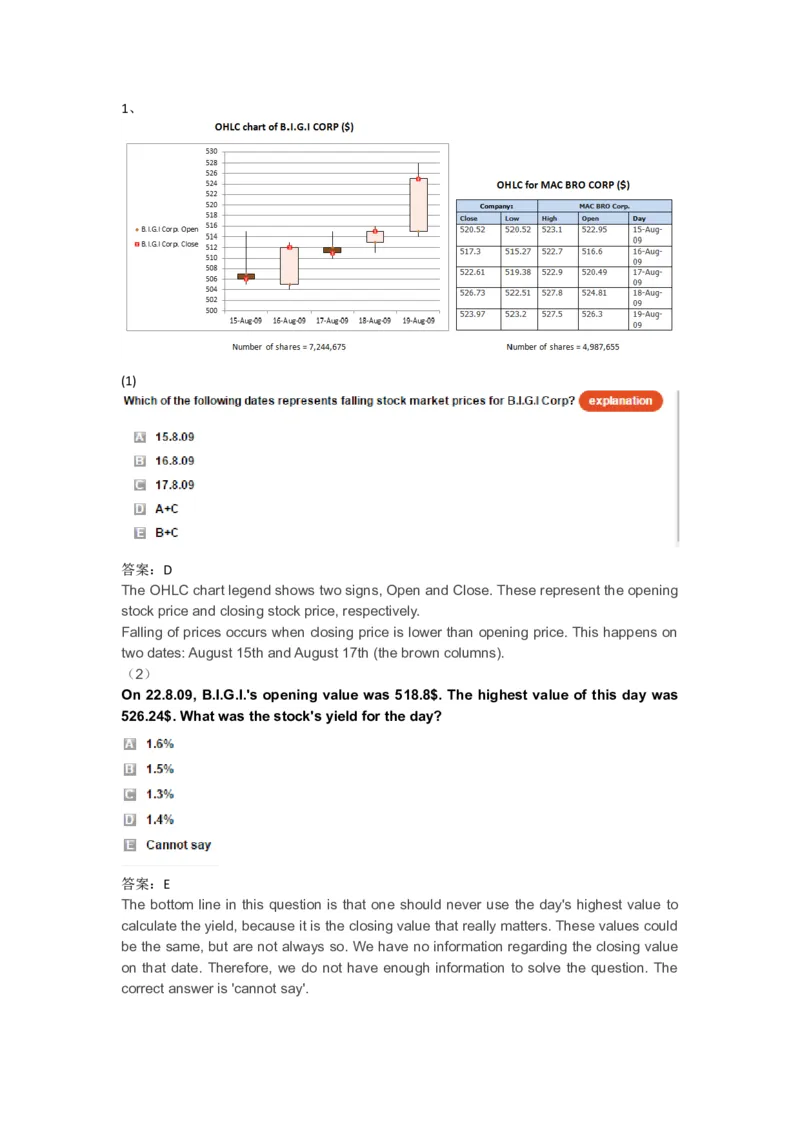
The OHLC chart legend shows two signs, Open and Close. These represent the opening
stock price and closing stock price, respectively.
Falling of prices occurs when closing price is lower than opening price. This happens on
two dates: August 15th and August 17th (the brown columns).
(2)
On 22.8.09, B.I.G.I.'s opening value was 518.8$. The highest value of this day was
526.24$. What was the stock's yield for the day?
答案:E
The bottom line in this question is that one should never use the day's highest value to
calculate the yield, because it is the closing value that really matters. These values could
be the same, but are not always so. We have no information regarding the closing value
on that date. Therefore, we do not have enough information to solve the question. The
correct answer is 'cannot say'.Note: There may be additional factors that need to be taken into account (e.g. dividend),
but the focus here is on using the wrong value for the calculation by mistake.
3、
答案:E
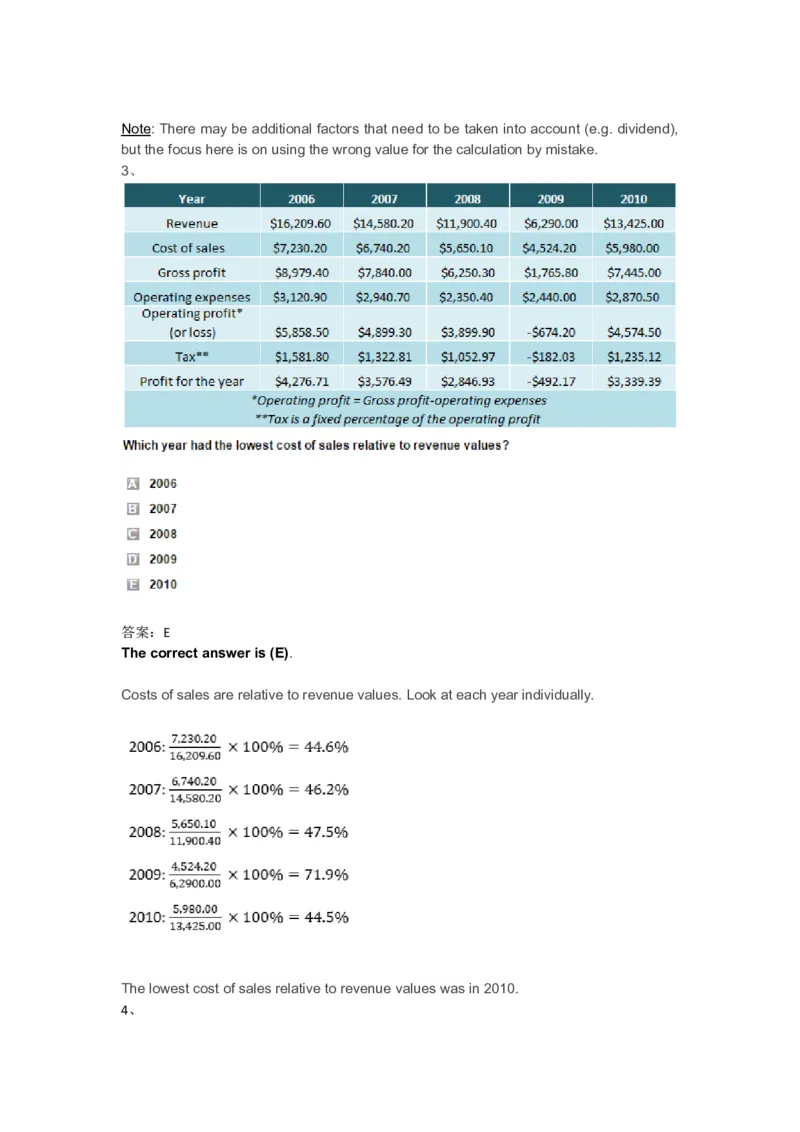
The correct answer is (E).
Costs of sales are relative to revenue values. Look at each year individually.
The lowest cost of sales relative to revenue values was in 2010.
4、*Figures taken from the UK national archives.
(1)
*Figures taken from the UK national archives.
答案:C
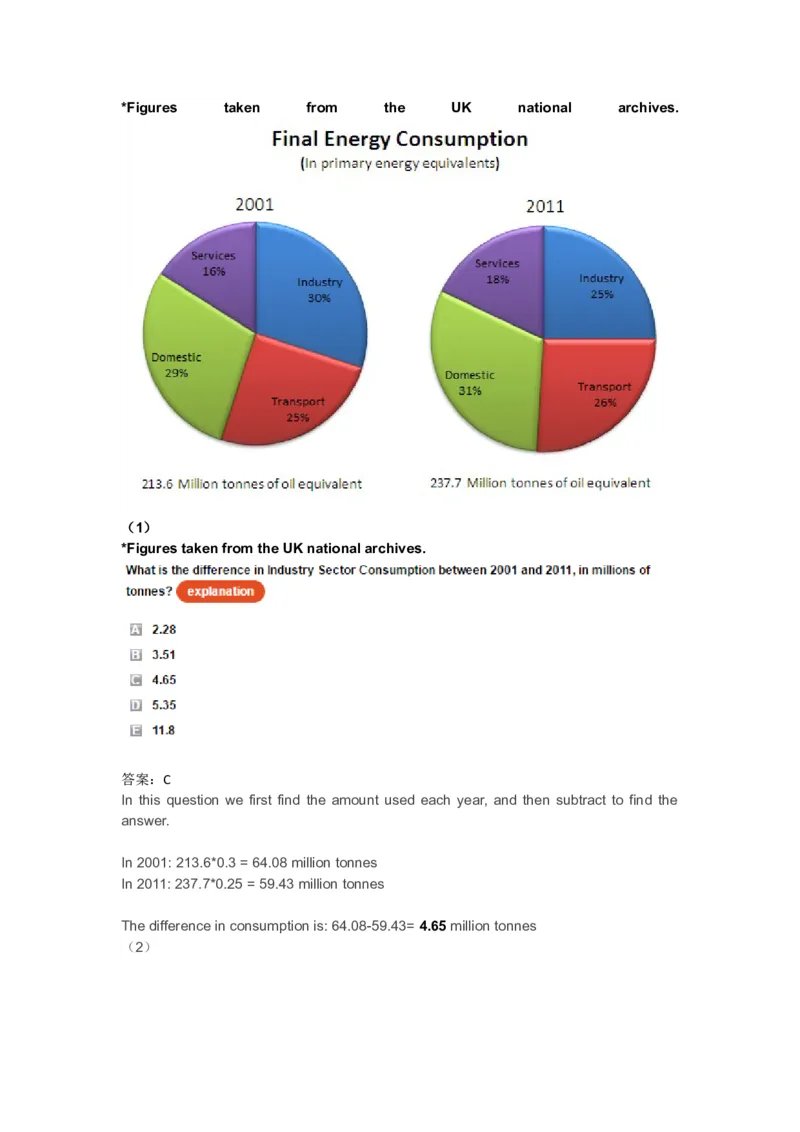
In this question we first find the amount used each year, and then subtract to find the
answer.
In 2001: 213.6*0.3 = 64.08 million tonnes
In 2011: 237.7*0.25 = 59.43 million tonnes
The difference in consumption is: 64.08-59.43= 4.65 million tonnes
(2)答案:C
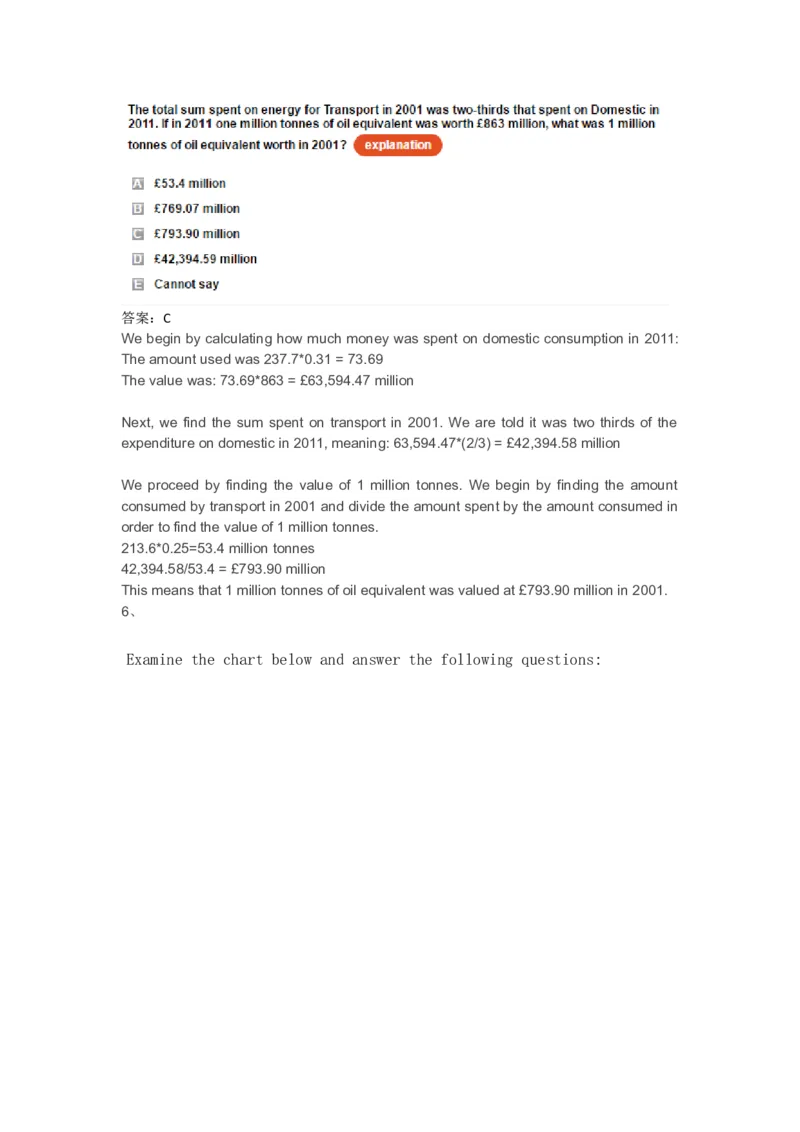
We begin by calculating how much money was spent on domestic consumption in 2011:
The amount used was 237.7*0.31 = 73.69
The value was: 73.69*863 = £63,594.47 million
Next, we find the sum spent on transport in 2001. We are told it was two thirds of the
expenditure on domestic in 2011, meaning: 63,594.47*(2/3) = £42,394.58 million
We proceed by finding the value of 1 million tonnes. We begin by finding the amount
consumed by transport in 2001 and divide the amount spent by the amount consumed in
order to find the value of 1 million tonnes.
213.6*0.25=53.4 million tonnes
42,394.58/53.4 = £793.90 million
This means that 1 million tonnes of oil equivalent was valued at £793.90 million in 2001.
6、
Examine the chart below and answer the following questions:(1)
答案:B
The correct answer is B
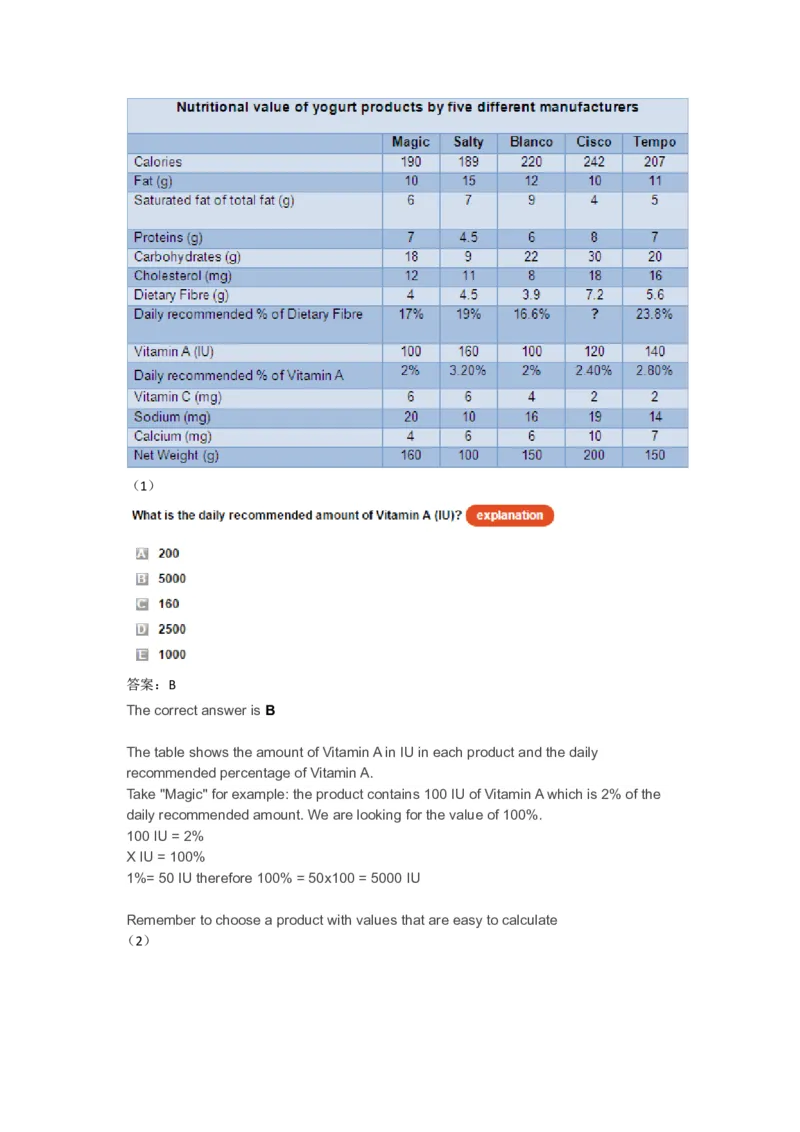
The table shows the amount of Vitamin A in IU in each product and the daily
recommended percentage of Vitamin A.
Take "Magic" for example: the product contains 100 IU of Vitamin A which is 2% of the
daily recommended amount. We are looking for the value of 100%.
100 IU = 2%
X IU = 100%
1%= 50 IU therefore 100% = 50x100 = 5000 IU
Remember to choose a product with values that are easy to calculate
(2)答案:D
The correct answer is D
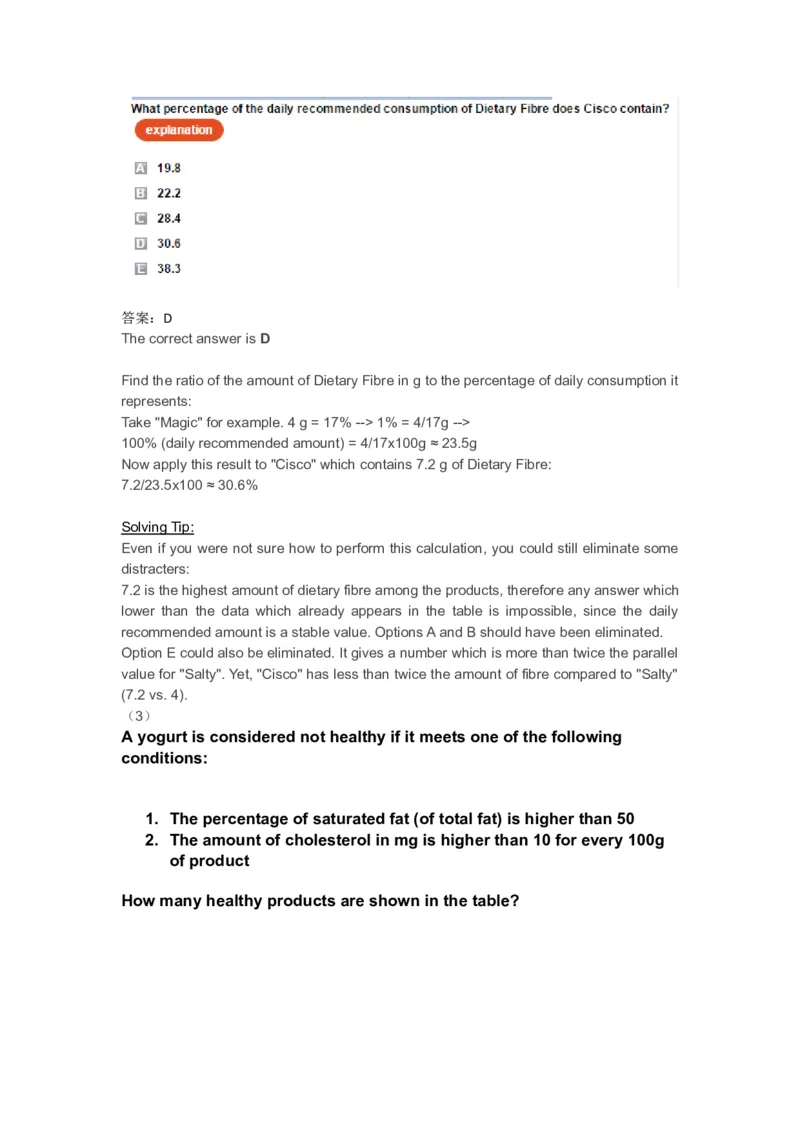
Find the ratio of the amount of Dietary Fibre in g to the percentage of daily consumption it
represents:
Take "Magic" for example. 4 g = 17% --> 1% = 4/17g -->
100% (daily recommended amount) = 4/17x100g ≈ 23.5g
Now apply this result to "Cisco" which contains 7.2 g of Dietary Fibre:
7.2/23.5x100 ≈ 30.6%
Solving Tip:
Even if you were not sure how to perform this calculation, you could still eliminate some
distracters:
7.2 is the highest amount of dietary fibre among the products, therefore any answer which
lower than the data which already appears in the table is impossible, since the daily
recommended amount is a stable value. Options A and B should have been eliminated.
Option E could also be eliminated. It gives a number which is more than twice the parallel
value for "Salty". Yet, "Cisco" has less than twice the amount of fibre compared to "Salty"
(7.2 vs. 4).
(3)
A yogurt is considered not healthy if it meets one of the following
conditions:
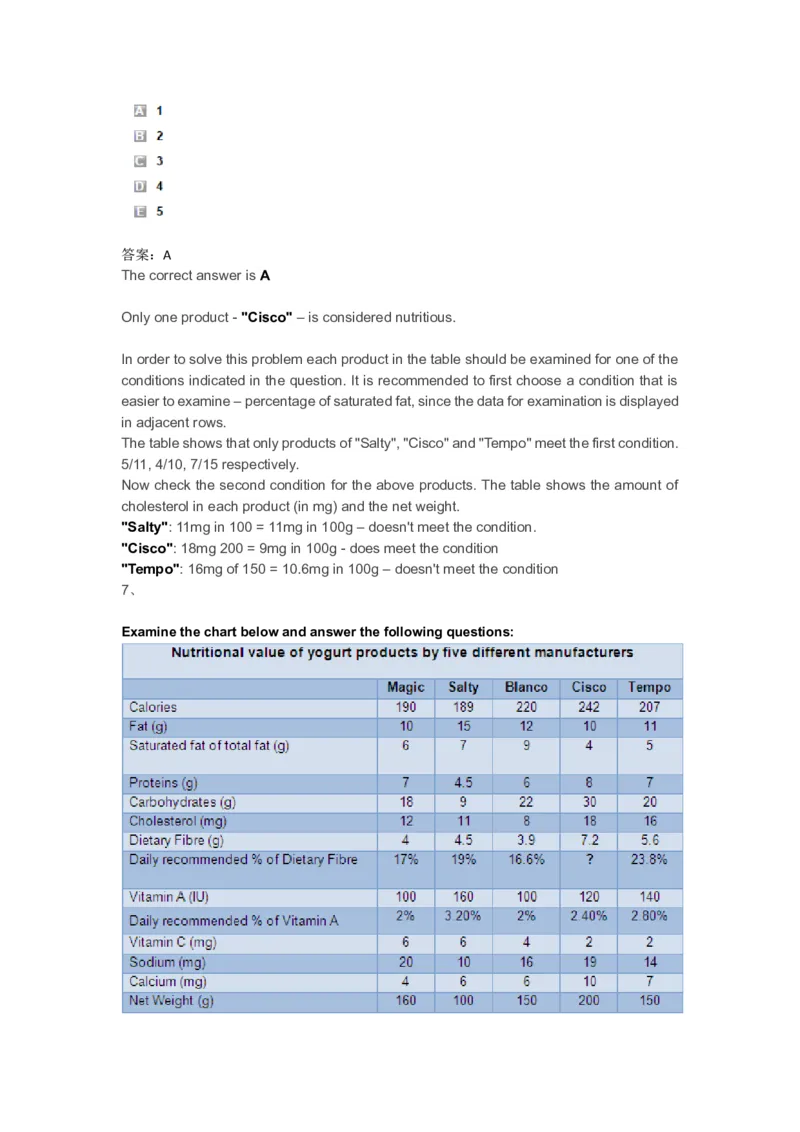
1. The percentage of saturated fat (of total fat) is higher than 50
2. The amount of cholesterol in mg is higher than 10 for every 100g
of product
How many healthy products are shown in the table?答案:A
The correct answer is A
Only one product - "Cisco" – is considered nutritious.
In order to solve this problem each product in the table should be examined for one of the
conditions indicated in the question. It is recommended to first choose a condition that is
easier to examine – percentage of saturated fat, since the data for examination is displayed
in adjacent rows.
The table shows that only products of "Salty", "Cisco" and "Tempo" meet the first condition.
5/11, 4/10, 7/15 respectively.
Now check the second condition for the above products. The table shows the amount of
cholesterol in each product (in mg) and the net weight.
"Salty": 11mg in 100 = 11mg in 100g – doesn't meet the condition.
"Cisco": 18mg 200 = 9mg in 100g - does meet the condition
"Tempo": 16mg of 150 = 10.6mg in 100g – doesn't meet the condition
7、
Examine the chart below and answer the following questions:(1)
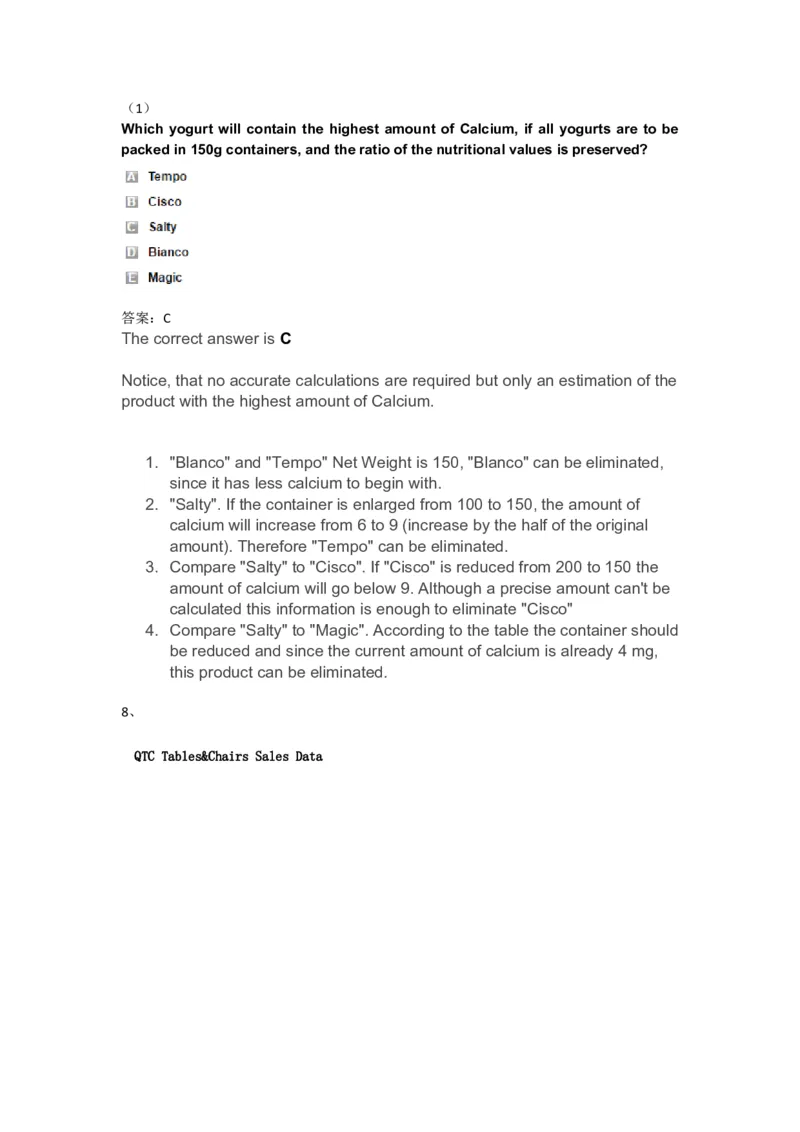
Which yogurt will contain the highest amount of Calcium, if all yogurts are to be
packed in 150g containers, and the ratio of the nutritional values is preserved?
答案:C
The correct answer is C
Notice, that no accurate calculations are required but only an estimation of the
product with the highest amount of Calcium.
1. "Blanco" and "Tempo" Net Weight is 150, "Blanco" can be eliminated,
since it has less calcium to begin with.
2. "Salty". If the container is enlarged from 100 to 150, the amount of
calcium will increase from 6 to 9 (increase by the half of the original
amount). Therefore "Tempo" can be eliminated.
3. Compare "Salty" to "Cisco". If "Cisco" is reduced from 200 to 150 the
amount of calcium will go below 9. Although a precise amount can't be
calculated this information is enough to eliminate "Cisco"
4. Compare "Salty" to "Magic". According to the table the container should
be reduced and since the current amount of calcium is already 4 mg,
this product can be eliminated.
8、
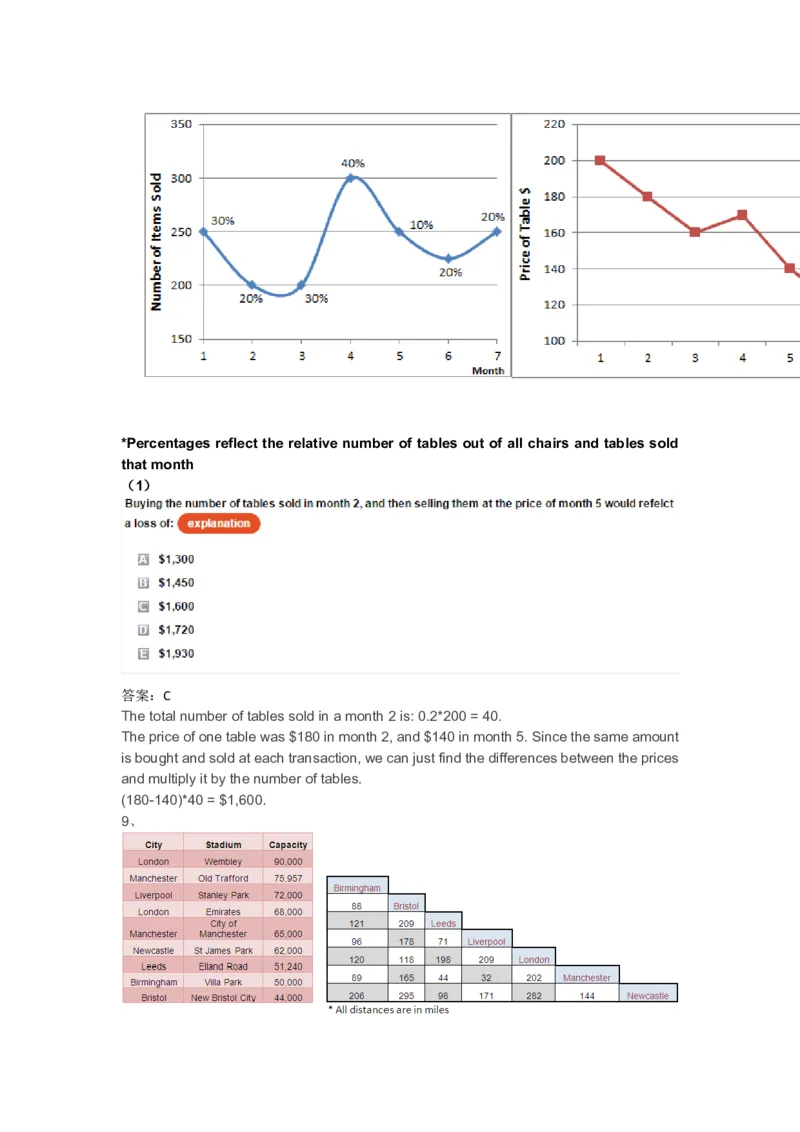
QTC Tables&Chairs Sales Data*Percentages reflect the relative number of tables out of all chairs and tables sold
that month
(1)
答案:C
The total number of tables sold in a month 2 is: 0.2*200 = 40.
The price of one table was $180 in month 2, and $140 in month 5. Since the same amount
is bought and sold at each transaction, we can just find the differences between the prices
and multiply it by the number of tables.
(180-140)*40 = $1,600.
9、England has placed a bid for hosting the FIFA World Cup Tournament. The tables
present optional host city-stadiums and distances between them.
答案:C
The capacity of Bristol's new stadium is 44,000. This question demands
a simple percentage calculation. The phrasing suggests that 10% of
the capacity is standing seats. We should conclude then that 90% of it
is seating seats.
90% of 44,000 is 44000 x 0.9 = 39,600.
Option A is visual distracter, which is supposed to mislead you – 10%
of 40,000 are 4,000. Together they sum up to 44,000, the indicated
capacity of Bristol's stadium.
To say the obvious - Beware of silly mistakes, especially when solving
simple questions.
(2)
Jude lives in Leeds. He was planning to buy tickets to the quarter
final in Newcastle, the semi-final at Old-Trafford stadium, and the
finals at Wembley stadium, driving from one city to the next and
only then returning back home.
What would Jude's car mile-metre indicate when he's back home
in the end of the World Cup Tournament if it currently indicates
zero?
答案:A
Using the stadiums table, we figure that Jude's route is:
Leeds --> (1/4 finals) Newcastle --> (1/2 finals) Manchester --> (final)
London --> (return home journey) Leeds.
Jude's mileage metre would state at least the accumulated distancebetween these cities:
Leeds --> Newcastle: 98 miles
Newcastle --> Manchester:144 miles
Manchester --> London: 202 miles
London --> Leeds: 198 miles
Total = 98 + 144 + 202 +198 = 642 miles.
Solving Tip:
About distance charts: The intersection of any two locations marks the
distance between these two locations. Be sure to know how to interpret
the charts, and always remember the return journey.
(3)
答案:B
We are requested to calculate the average amount of spectators
per city. A simple average is conducted by dividing a total sum by the
number of its elements. In our case, 9 stadiums are presented in the
table, but only 7 cities, so we need to divide the total capacity of all 9
stadiums by 7.
The incorrect option E is the outcome of dividing the sum by 9
Total capacity of all stadiums:
90000+75957+72000+68000+65000+62000+51240+50000+44000 =
578,197
The average amount of spectators in every city:
578,197/7 = 82599.57 ≈ 82,600
(4)答案:B
According to the distances chart, the ride between Birmingham to
Liverpool (home of Stanley Park stadium) is 96 miles long. The return
journey, thus, is 96x2 = 192 miles long.
From here we offer two possible solution paths:
1. Calculate how many miles Jean's car drives on 1 litre of petrol,
and then figure out how many litres it would consume over the
full journey:
12.8 litres per 100 miles / 12.8 = 1 litre per 7.8125 miles.
A journey of 192 miles will need 192/7.8125 = 24.576 litres,
which cost 24.576 x 1.4 = £34.41.
2. Use the ratio of petrol per distance to calculate the required
amount of petrol for the full journey directly:
The journey is 192 miles long. The consumption ratio is 12.8
litres per 100 miles. The journey is 192/100 = 1.92 times longer
than 100 miles; therefore it would require 1.92 times more
petrol --> 12.8 x 1.92 = 24.576 litres, which cost 24.576 x 1.4 =
£34.41
10、答案:D
Note that the graph is in terms of BMI, which means: Kg/m².
The BMI of an overweight 7-year-old girl is 17.65 Kg/m².
If her height is 1.12m, then her weight should be:
17.65 = (X Kg)/ 1.12²
17.65*1.12² = X Kg
22.14 = X Kg
The BMI of a 7-year-old girl in the normal range is 15.5 Kg/m².
If her height is 1.08m, then her weight should be:
15.5 = (X Kg)/ 1.08²
15.5*1.08² = X Kg
18.08 = X Kg.
All that is left to do is calculate the difference:
22.14Kg – 18.08Kg = 4.06Kg(2)
(2)
答案:E
If David’s height is 49.2% higher than it used to be when he was 7, his
height now must be: 1.492*1.22 = 1.82m
If today, in the age of 45, David is underweight, his BMI must be 19.1
Kg/m².
Therefore: 19.1 = (X Kg)/1.82²
19.1*1.82² = X Kg = 63.28 Kg
Therefore, the answer is E - None of these.
11、(1)
答案:C
Distance = Speed * Time.
Recommended speed limit on a sunny day on the highway: 110 kph
Ȳ km = 110 kph * 1 hr.
In order to shorten travel time by 25%, the new driving time will have
to be 0.75hrs. Now, the new speed is a variable:
Ȳ km = X kph * 0.75 hr.
Because the travel distance remained constant, we can compare the
two equations:
110 * 1 = X * 0.75
110/0.75 = X
X = 146.66 kph
The difference between the recommended speed limit and the new
speed is: 146.66-110= 36.66 kph.
(2)答案:B
The recommended speed on an urban road with rainy weather is:
30kph.
For 12 km: 30= km/hrs.= 12/ X hrs.
X= 12/30= 0.4 hrs.
The recommended speed on a long distance route with foggy weather
is: 53kph.
For 9 km: 53= km/hrs.= 9/ X hrs.
X = 9/53 = 0.1698 hrs.
In sum: 0.4+ 0.1698= 0.5698 hrs.
Converting to minutes: 1 hour = 60 minutes
0.5698 hour = 34.188 minutes (=60*0.5698)
Rounded to the nearest minute: 34 minutes.
12、答案:E
In order to calculate the total revenue in quarter 1, we must use the
information given both in the table and in the graph. The table provides
the amount of revenue generated by each department in quarter 2
whereas the graph provides the percent change of each department
between quarters, allowing us to calculate the revenue in quarter 1.
For example, department A's quarter 2 revenue is £186.8 million. Since
we know the department's revenue went down from quarter 1 to 2 by
approximately 6%, we can deduce that £186.8 million is (100%- 6%)of its revenue in quarter 1: 186.8/94*100= £198.7 million (revenue for
quarter 1). This calculation is done for all the departments:
B: 180.2/90*100= £200.2 million
C: 42/117.5 * 100= £35.7 million
D: 17.5/ 103.5 * 100= £16.9 million
E: 23.5/ 94.5 * 100= £24.8 million
F: 32/96 * 100= £33.3 million
Other: 38/104 *100= £36.5 million
All is left is to sum up all the revenues: 198.7+200.2 +35.7+16.9+
24.8+33.3+36.5= £546.1 million
*Note that it is a mistake to calculate the total revenue in quarter 1
using the total revenue in quarter 2 and the total percent change across
departments (-0.5%) because each department contributes a different
amount of money.