文档文本内容
Preparation Guide
Numerical Comprehension
This preparation guide helps you prepare for numerical aptitude assessments. It provides guidance on how
best to approach the assessment, allowing you to give your best possible performance.
Why are Aptitude Assessments used?
Employers often use aptitude assessments as part of their assessment procedures for the selection and
development of staff. Research has shown that they are powerful predictors of performance at work.
Assessments help you to:
• demonstrate your strengths
• be assessed fairly on job relevant criteria
• find out more about your strengths and development needs
• make future career decisions based on your abilities
Assessments help employers to:
• select people best suited to the demands of the job
• identify areas where individuals might benefit from further development
• obtain objective information about people’s abilities
Instructions
On the following pages are some practice questions which are similar to those you will be asked in the
assessment. Completing these will help you understand the types of questions used and gain experience in
taking ability tests.
You will be presented with a series of tables and graphs, each followed by several questions. Your task
is to choose the best answer to each question from the options given. To answer each question, clearly
fill in with a pencil the answer option you have chosen in the answer section at the bottom of each page.
Have a calculator and some paper to hand in case you want to use them.
When you complete the actual assessment, you will not be able to use erasers to change your answer.
Please see the instructions below on how to indicate your answers:
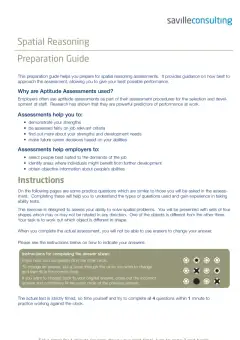
Instructions for completing the answer sheet:
Press hard and completely fill in the inner circle.
To change an answer, put a cross through the circle you wish to change
and then fill in the correct circle.
If you want to change back to your original answer, cross out the incorrect
answer and completely fill in the outer circle of the previous answer.
The actual test is strictly timed, so time yourself and try to complete all 8 questions within 4 minutes to
practice working against the clock.
Set a timer for 4 minutes (or note down your start time), turn to page 2 and begin.Practice Questions 1 - 4 2
Monthly Review of Staff Time by Activity
(Total Number of Days: 2000)
11%
31%
Sales
23%
Administration
Training
Client Support
Absence
16% 19%
1
What percentage of time was spent on training and administration?
A B C D E
16% 19% 25% 35% 42%
2
How many days were spent on client support activity?
A B C D E
22 23 46 220 460
3
Each staff member spent at least 5 days a month on sales activity.
A B C
True False Not possible to say
4
Which activity accounted for the highest proportion of staff time?
A B C D E
Sales Administration Training Client Support Absence
Answer Section Page 2
A B C D E A B C D E A B C A B C D E
1 2 3 4Practice Questions 5 - 8 3
5
More candidates are interviewed on Monday than on Tuesday.
A B C
True False Not possible to say
6
If two interviewers per candidate are required to carry out an interview, what is
the maximum number of interviewers needed at any time?
A B C D E
8 10 12 14 16
7
If five of the applicants were hired what would be the ratio of candidates
interviewed to successful candidates?
A B C D E
1:5 1:4 1:2 4:1 5:1
8
More candidates passed the interview on Tuesday than on Monday.
A B C
True False Not possible to say
Answer Section Page 3
A B C A B C D E A B C D E A B C
5 6 7 8Your Assessment 4
Try to answer any questions you did not reach in the time limit before checking your answers.
Checking your Answers
Check your answers against the correct answers at the bottom of this page. Look at any question you
got wrong and try to understand how to arrive at the correct answer. Keep in mind that most ability
assessments are designed so that the questions gradually increase in difficulty and that people typically do
not complete all of the questions within the time limit. If you took much longer than 4 minutes to answer the
questions, try to speed up your work rate. If you finished all of the questions within the time limit but made
many mistakes, try to focus more on the accuracy of your responses.
Improving your Numerical Abilities
Working with numerical materials is the best way to improve your numerical abilities. As well as gaining
experience in the assessments themselves, there are several other things you can do to improve your
numerical abilities:
• Work with numerical data or materials.
• Revise basic arithmetic principles and equations.
• Complete calculations with and without a calculator.
• Look at tables, graphs and charts and interpret their meaning in words.
• ‘Eyeball’ data by looking for patterns and predicting future trends.
• Critically examine pieces of numerical information.
• Read financial reports in newspapers and journals.
Before the Session
• Follow the suggestions included in this preparation guide.
• Get a good night’s sleep before the assessment.
• Make sure you are wearing any glasses, contact lenses or hearing aids you may require.
• If you have any special requirements, such as larger print versions of the test, specific lighting
or seating needs, it is important that you make these known immediately to allow appropriate
accommodations to be made.
During the Assessment Session
• Try to stay calm. Using the practice tips above should help you feel more at ease.
• Follow the instructions carefully, and ask questions if you are not sure of anything before the
assessment starts.
• Read each question carefully.
• Work as quickly as you can. Do not take too much time over any one question.
• If you find a question too difficult or are unsure of an answer indicate your best choice and move
on quickly.
• After an assessment always seek feedback. It is much easier to improve your abilities if you know
how well you have done.
Good luck in your assessment session. We wish you every success in your career.
Answer Section Page 2 Correct Answers
A B C D E A B C D E A B C A B C D E
1 2 3 4
Answer Section Page 3 Correct Answers
A B C A B C D E A B C D E A B C
5 6 7 8
COMP-AP-PG-NCS1-INTE@19th January 2011
© 2005-2011 Saville Consulting. All rights reserved.
The reproduction of any part of this document by any means info@savilleconsulting.com
or method, manual or electronic, is breaking the copyright law. www.savilleconsulting.com