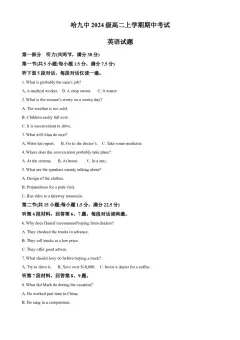
哈九中 2024 级高二上学期期中考试
英语试题
第一部分 听力(共两节,满分30分)
第一节(共5小题;每小题1.5分,满分7.5分)
听下面5段对话,每段对话仅读一遍。
1. What is probably the man’s job?
A. A medical worker. B. A shop owner. C. A waiter.
2. What is the woman’s worry on a snowy day?
A. The weather is too cold.
B. Children easily fall over.
C. It is inconvenient to drive.
3. What will Alan do next?
A. Write his report. B. Go to the doctor’s. C. Take some medicine.
4. Where does the conversation probably take place?
A. At the cinema. B. At home. C. In a taxi.
5. What are the speakers mainly talking about?
A. Design of the clothes.
B. Preparations for a park visit.
C. Bus rides to a faraway mountain.
第二节(共15小题;每小题1.5分,满分22.5分)
听第6段材料,回答第6、7题,每段对话读两遍。
6. Why does Daniel recommend buying from dealers?
A. They checked the trucks in advance.
B. They sell trucks at a low price.
C. They offer good advice.
7. What should Joey do before buying a truck?
A. Try to drive it. B. Save over $10,000. C. Invite a dealer for a coffee.
听第7段材料,回答第8、9题。
8. What did Mark do during the vacation?
A. He worked part time in China.
B. He sang in a competition.C. He visited Harbin.
9. What’s the woman’s attitude toward her job at the training center?
A. Positive. B. Negative. C. Unclear.
听第8段材料,回答第10至12题。
10. What made Jenny decide to take Bailey home?
A. His friendly voice. B. His playful nature. C. His quiet move.
11. How is Bailey’s relationship with Jenny’s other pets?
A. Terrible. B. Close. C. Strange.
12. What does Jenny wish to do with Bailey?
A. Have more adventures in life.
.
B Play with her neighbor’s cat.
C. Bring much joy to her parents.
听第9段材料,回答第13至16题。
13. What can members do in the book club?
A. Meet with writers. B. Discuss books. C. Get cheap pens.
14. How often do the book club members meet?
A. Once a week. B. Once a month. C. Twice a month.
15. What should someone do to become a member of the bookstore?
A. Email basic information.
B. By a certain number of books.
C. Pay a monthly membership fee.
16. How long is the bookstore open on weekends?
A. For 10 hours. B. For 12 hours. C. For 14 hours.
听第10段材料,回答第17至20题。
17. What is the first effective way of dealing with disagreements?
A. Practicing active listening.
B. Avoiding arguments.
C. Speaking calmly.
18. How can people find common ground?
A. By taking one side into agreeing.
B. By having both sides travel together.
C. By recognizing shared interests or goals.
19. What’s one effect of bad feelings in disagreements?A. Stopping good communication.
B. Influencing personal growth.
C. Bringing up a bad topic.
20. What’s the purpose of the speaker’s speech?
A. To explain a survey.
B. To offer useful suggestions.
C. To stress the power of disagreements.
第二部分:阅读理解(共两节,满分50分)
第一节(共15小题;每题2.5分,满分37.5分)
A
Here is a selection of the world’s most unusual buildings that define a place through inventive ways of adapting to
local environments.
The floating (流动的) homes of Lake Titicaca
More than 500 years ago, the growing Inca Empire began to occupy the Uros’ mainland villages. To resist this
threat, the Uros began to build the floating islands with the water- resistant plant called totora, which grows in the
lake and is the lifeblood of the Uros community.
The perfect desert town: Ghadames
Ghadames is an impressive example of environmental planning. Thick walls delay the sun’s heat entering a
building during the day, and radiate that heat back to the sky at night. By morning, the walls have cooled again.
Skilful use of available building materials achieves the maximum comfort with minimal means.
Spain’s fairy-tale houses
Known as pallozas, the round houses are built from just a handful of materials: stone, wood and dry grass. Thick
stone walls depending on what was available in the area block the cold and conserve internal heat. Inside, the palloza’s
fireplaces are essential for maintaining a constant temperature, making it energy-efficient.
The Himalayas’ ancient design
The structures in Himachal Pradesh were built by an ancient technique known as Kath kuni. Wood and stones
create a fantastic balance. The wooden frames (框架) lessen the stress on the openings during an earthquake. Thick
stones hold the whole building firmly in place. Above all, pieces of wood interlock together, which makes the
structures remarkably flexible, allowing walls to move in case of an earthquake.
1. Which structure was built for defending residents against attackers?
A. The Kath kuni structure. B. The floating structure.
C. The Ghadames structure. D. The palloza’s structure.2. What do the houses in Ghadames and pallozas have in common?
A. They are sustainable. B. They maximize internal heat.
C. They are built for luxury living. D. They’re made of special materials.
3. What makes Kath kuni structures earthquake-resistant?
.
A The stone frames. B. The narrow openings.
C. The flexible wood. D. An interlocking system.
B
My husband, children and I were in Hawaii. Here, we were introduced to the ancient Hawaiian concept of
mālama (to care for) which encourages visitors to give back to the environment and local communities through
activities like habitat restoration, beach cleanups or food provision. But mālama goes beyond eco-tourism — it’s
about leaving a place better than you found it.
And after seeking out these experiences during a three-week stay, we found mālama not only improves Hawaii,
but it also made our time there much more meaningful.
Mālama volunteer experiences are found across the islands. For example, on Maui, you can help restore native
forests and volunteer at a nursery; while on O’ahu, visitors can clear invasive alga (水藻) from Maunalua Bay. In
some cases, travelers booking with partnering hotels and participating in designated activities will qualify for a
discounted or even free night at dozens of hotels and resorts.
“Mālama today is more vital than ever,” our guide Rogers said. “Too many tourists walk carelessly on our land,
ignoring restrictions and damaging sensitive ecosystems... don’t just think Hawaii is beautiful; help keep it that way.
It’s a shared responsibility.” As Rogers explained, mālama isn’t just about seeing or appreciating a landscape; it
invites visitors to connect and contribute to it, with the idea that caring for a place fosters a stronger relationship with it.
After eight days, we ventured to Molokai, Hawaii’s least developed island. No resorts or chain stores spoiled its
wild beauty — just dramatic cliffs meeting rough seas. Deep in the eastern wilderness, we met Greg Solatario, whose
family has taken care of this land for generations. His simple off-grid life perfectly embodied mālama. Greg welcomed
us warmly before leading us through jungle-covered ruins of ancestral villages. As we approached, his son Devak
blew a conch shell — a traditional request to enter. “The land remembers,” Greg explained, showing us medicinal
plants and ancient fishing spots. His parting words stayed with me: “Mālama shouldn’t be just Hawaiian — the whole
world needs this way of caring.”
4. How does the author present the topic in the first paragraph?
A. By quoting an expert. B. By explaining a concept.
C. By giving examples. D. By providing statistics.
5. What can Mālama volunteers experience in Hawaii?A. Caring for local forests. B. Developing Maunalua Bay.
C. Asking for hotel discounts. D. Organizing big activities.
6. What do we know about Greg Solatario’s family?
A. They built new resorts in the wild. B. They have long protected the land.
C. They offered guided tours to locals. D. They fixed up the old village ruins.
7. Which of the following best describes the author?
A. Honest and thoughtful. B. Intelligent and diligent.
C. Dedicated and caring. D. Innovative and sensitive.
C
Microplastics are everywhere. They have been found on the top of Mount Qomolangma and in creatures living
in the deepest sea. They’re in bottled water, and even in human body. This tiny plastics choke wildlife, disrupt
ecosystems, and threaten human health, and they are extremely difficult to remove. Microplastics are tiny plastic
pieces smaller than 5 millimeters. They come from everything from tires (轮胎), which are then broken down into
smaller pieces, to beautiful decorations.
The planet is under great threat from microplastics, and water ecosystems are the first to suffer. One study from
2020 estimated there were 14 million metric tons of microplastics sitting on the ocean floor. Scientists have called
microplastics one of this generation’s key environmental challenges. The pollution is only set to get worse with plastic
production and pollution expected to increase in the coming years. Even under a variety of tactics, including plastic
product reduction, waste management, and environmental recycling, microplastic pollution is still worsening.
Luckily, scientists in China have come up with a possible solution. A research team from Wuhan University used
two organic compounds from cotton and squid(鱿鱼) bones — known for removing pollution from wastewater — to
的
create a biodegradable sponge (可生物降解 海绵). The sponge was able to absorb microplastics both by
physically catching them and through electromagnetic attraction. They tested the sponge in four different water
samples, and found it removed up to 99.9% of microplastics.
Previous methods for absorbing plastics tend to be expensive and difficult to make. The low cost and wide
availability of both cotton and squid bones mean the sponge holds great potential to be used in absorbing microplastic
from complex water bodies.
Shima Ziajahromi, a lecturer at Australia’s Griffith University who studies microplastics, called the squid-cotton-
sponge method “promising” and said it could be an effective way to clean up the high risk and weak water
ecosystem.
8. What can we infer from the first paragraph?A. Microplastics have caused much harm.
B. Mount Qomolangma is the only place without microplastics.
C. Microplastics can be used to decorate our daily life.
.
D Microplastics can’t be removed from our body.
9. What does the underlined word “tactics” in paragraph 2 mean?
A. Targets. B. Challenges. C. Strategies. D. Theories.
10. What do we know about the sponge developed by Chinese scientists?
A. Its application is far from practical. B. It is made from common materials.
C. Its ability depends on water conditions. D. It is inspired by previous study methods.
11. What is Shima Ziajahromi’s attitude towards the squid-cotton-sponge method?
A. Critical. B. Curious. C. Doubtful. D. Positive.
D
Losing someone we love can be a very tough experience. But maybe one day, the pain of such a loss might be
eased with AI technology. Recently, a man surnamed Wu and his wife, mourning the loss of their son, turned to AI to
resurrect (使复活) his presence, reported Euronews.
The couple’s only child passed away due to a critical disease at the age of 22. His tragic passing left Wu and his
wife devastated (极为悲痛的). Inspired by advancements in deep learning technologies, Wu embarked on a journey to
bring his late son “back to life”.
He spared no expense in hiring AI firms to replicate (复制) his son’s appearance and voice, providing his photos
and videos to them. Wu also established a database by himself that has information about his son. The aim is to use
the information to create an avatar (虚拟化身) that will copy his son’s thinking and speech patterns. Yet it is still a
work in progress.
Wu’s effort reflects a shift in the way grief is navigated (正确应对) in the digital age. Drawing on AI-generated
recordings and visuals, people like Wu find comfort in reconnecting with their departed loved ones. While the avatar
may not be perfect, the emotional impact is undeniable. “I know how difficult it is for you. Every day, every moment, I
wish I could be by your side, giving you warmth and strength,” said Wu’s late son in the AI-generated audio, which
made his wife shed tears.
,
Technology of this kind is called ghost bots in China and its industry is booming. Firms providing ghost
bots services have a wide range of customers, from parents mourning the loss of their children to people who have
broken up with their partners.
While these AI avatars may offer comfort, many worry that the technology is a double-edged sword. At first, it
might be helpful to see your lost loved one just by clicking a button. In the long term, however, it could make thingsworse. “It might be addictive drugs, preventing desperate people from getting over their grief and moving on with
their lives,” commented a netizen.
12. Why did Wu set up the database?
A. To follow his son’s last wish. B. To share his son’s stories.
C. To bring his son back virtually. D. To document his son’s life.
13. What does the creation of avatars of late loved ones suggest according to the text?
A. A loose connection between life and death in a family.
B. A new form of psychological treatment in modern life.
C. A significant technological breakthrough in education.
D. A change in how people manage grief in digital age.
14. What is the immediate benefit that AI avatars bring to people like Wu according to the passage?
A. They help to preserve the memory of the lost loved one.
B. They encourage people to move on from the past.
C. They act as a replacement for real human interaction.
D. They provide comfort by being connected again.
15. What is the author’s primary purpose in writing this article?
A. To share a moving story about a father’s love for his son
B. To objectively present a new technological phenomenon and its mixed effects.
C. To argue forcefully against using Al to handle grief.
D. To advertise the services of AI firms that create “ghost bots”.
第二节(共5小题;每小题2.5分,满分12.5分)
根据短文内容,从短文后的选项中选出能填入空白处的最佳选项。选项中有两项为多余选项。
In today’s hyper-connected world, most of us are flooded by an ocean of messages and social media feeds, from
the moment we wake up to the instant we close our eyes. It’s not just a matter of convenience or novelty anymore —
fixation on screens has become our habit, a necessity, and even an addiction. ____16____ The answer will surprise you
— constant engagement not only consumes our time, but also steals us something far more important: peace of
mind.
Silence is as critical to mental health as vitamins are to physical well-being. People are particular about what
foods they put in their bodies: whether organic, vegetarian, or fat-free. ____17____ The mental junk we absorb
daily can be arguably more harmful than the occasional cheeseburger or donut. The never-ending flood of sensory
input taxes the brain’s limited attention resources, leaving little room for deep thinking, reflecting, or creativity.
____18____ Quiet time helps the brain relax, sort through what it has taken in, and regain lost mental energy.As American artist Leonard Koren suggests in his book Wabi-Sabi, silence can be “an emptiness full of possibilities,” a
space where creativity and clarity emerge.
Adding moments of quiet to your daily routine doesn’t require dramatic changes. ____19____ Better yet,
research shows that brief exposure to nature, like a walk in the woods, lowers stress levels, reduces blood pressure,
and sharpens focus. These benefits occur because green spaces and natural soundscapes provide a much-needed break
from today’s busy, stressful world.
Digital life crowds out silence, making simply sitting in silence almost unthinkable — yet the very moments of
stillness are what our minds really need. They let us listen to our thoughts, reflect on our experiences, and connect
with ourselves in a way that is impossible in the noise of modern life. ____20____
A. But rarely do we ask ourselves: at what cost?
B. Just as our bodies need nutrition, our minds require silence to function well.
C. So, shouldn’t we make laws requiring quiet time every day?
D. It can be as simple as pausing 30 seconds to watch clouds.
E. But they aren’t as picky about what they are exposed to through the senses.
F. So next time you reach for your phone mindlessly, try to resist the urge and sit in silence.
G. We check our phone 58 times a day, 30% occurring during work hours.
第三部分:英语知识运用
第一节:完形填空(共15小题;每题1分,满分15分)
阅读下面短文,从每题所给的A、B、C、D四个选项中选出最佳选项。
Haniya heard the news that her sister was getting married. She was ____21____, dancing around the house.
However, anxiety and stress set in when she learned that for some reason, the wedding date had been ____22____,
and it was now scheduled for the same week as her exams.
Haniya’s parents suggested that she ____23____ her exams wholeheartedly before the wedding day, but she
felt ____24____. She eagerly looked forward to her sister’s wedding, while on the other hand, the coming exams
weighed ____25____ on her.
The family’s house was full of guests, with Haniya’s younger cousins running around. In contrast, Haniya stayed
in a room, ____26____ by books. It was also ____27____ for her to miss shopping for clothes with her family and
dinners at her relatives’ homes due to her ____28____ to studying.
As the exams drew nearer, Haniya’s anxiety grew, casting ____29____ on her ability to juggle (尽力应付)
both responsibilities. ____30____, as the crucial week approached, things began to fall into place. Haniya skillfully
and wisely ____31____ her finals and wedding functions. By prioritizing her studies when needed, she excelled in
her exams and wholeheartedly enjoyed her sister’s wedding.This experience illuminated (说明) Haniya’s potential for ____32____ time management, confirming that
life’s ____33____ can be overcome through careful planning and sacrifices. It also revealed her ability to stay
____34____ in the face of distractions. Haniya now believes she can navigate even the most ____35____ situations
that call for effective time management and stress-handling abilities.
21. A. in her favor B. at her leisure C. green with envy D. over the moon
22. A. fixed B. canceled C. changed D. announced
23. A. take in B. prepare for C. pull up D. get through
24. A. forced B. torn C. motivated D. ignored
25. A. delicately B. heavily C. subtly D. closely
26. A. surrounded B. misled C. motivated D. decorated
27. A. heart-breaking B. risk-taking C. face-saving D. breath-taking
28. A. permission B. motivation C. commitment D. flexibility
29. A. doubt B. hope C. surprise D. boredom
30. A. Furthermore B. However C. Therefore D. Meanwhile
31. A. balanced B. restored C. identified D. improved
32. A. independent B. advanced C. undisturbed D. effective
33. A. disadvantages B. limitation C. challenges D. uncertainty
34. A. unattended B. remarkable C. focused D. optimistic
35. A. disappointing B. dangerous C. embarrassing D. difficult
第二节:语法填空(共10小题;每小题1.5分,满分15分)
语法填空
As the only ____36____ (select) scenic spot in the region, the Huangshan Scenic Area, located in Huangshan
City, Anhui Province, has been recognized as ____37____ national tourism science and technology demonstration
park.
The region has invested in technological ____38____ (innovate) in recent years, ____39____ has led to
improvements in environmental management, service quality, and the introduction of scientific knowledge.
Resource conservation is said to have benefited ____40____ smart technology. Through efforts like digital
modeling, environment observation stations ____41____ forest fire monitoring systems, it has improved
environmental protection.
The Huangshan Scenic Area has made big changes in management and services by ____42____ (bring) in AI-
powered early warning systems for visitor flows. This makes the area run better and visitors ____43____ (happy).
Looking to the future, ____44____ is believed that the Huangshan Scenic Area is committed to using technologyto manage and improve the whole visitor experience.
All in all, the Huangshan Scenic Area’s commitment to technology development ____45____ (expect) to
influence its future and ensure a first-class tourism service.
第四部分 写作(共两节,满分40分)
第一节:(满分15分)
46. 如今,短视频(short videos)在青少年群体中十分流行。我校英语报就“The Pros and Cons of Students
Watching Short Videos”这一话题征集短文,请结合自身观察与思考,谈谈你对“学生观看短视频利弊”的
看法,并提出合理建议。注意:
1.词数为80左右;
2.可适当增加细节,以使行文连贯。
The Pros and Cons of Students Watching Short Videos
____________________________________________________________________________________________
____________________________________________________________________________________________
____________________________________________________________________________________________
____________________________________________________________________________________________
_____________________________________________________________________________________
第二节(满分25分)
47. 阅读下面材料,根据其内容和所给段落开头语续写两段,使之构成一篇完整的短文。
The first week of the new semester always carried a strange kind of energy — new classes, new faces, and the
quiet hope of starting over. As a 11th-grade transfer student, I walked into the noisy classroom with my head low,
clutching (紧握) my backpack strap like a lifeline. Everything felt foreign — the laughter, the inside jokes, the
invisible circles I wasn’t part of. My new desk mate, Olivia, sat by the window, her notebook perfectly organized,
her confidence filling the space between us. When she noticed me hesitating, she smiled, slid a neatly written class
schedule across the desk, and in a soft voice said she’d show me around at lunch. That small gesture made me want
to belong — to be seen.
So when she mentioned the debate club after class, I told her I’d been on the debate team and had even won a
regional contest. It wasn’t planned. The lie just slipped out, smooth and effortless, like it had been waiting for its cue.
Her eyes lit up, and for the first time, I felt noticed — no longer just the quiet new kid.
A few days later, Olivia came running up with a sign- up sheet.“ The annual school-wide debate competition is
in a month — we should team up!” she exclaimed, her enthusiasm unshakable. I tried to match her energy, but the
panic settled deeper each time I imagined standing on stage. Four weeks to prepare — it felt endless and terrifying at
the same time.At our first rehearsal (排练), I stumbled over debate terms, struggled to organize arguments, and froze when
asked to practice rebuttals (反驳). Some teammates exchanged eye rolls and quiet laughs that stung more than their
whispers. Olivia didn’t say anything; her smile faded, polite yet puzzled.
By Friday, the lie felt heavier than the weight on my shoulders. Each“ keep going” she offered sounded like a
test I couldn’t pass. That night, I stared at my debate notes, the words swimming before my eyes. I knew I couldn’t
keep pretending. Something had to give.
注意:
1.写作词数应为150个左右;
2.请按如下格式在答题卡的相应位置作答。
During the next rehearsal, I finally admitted the truth to everyone.
____________________________________________________________________________________________
____________________________________________________________________________________________
____________________________________________________________________________________________
____________________________________________________________________________________________
_______________________________________________________________________________________
A month later, Olivia and I stepped onto the stage together, ready for the big day.
____________________________________________________________________________________________
____________________________________________________________________________________________
____________________________________________________________________________________________
____________________________________________________________________________________________
_______________________________________________________________________________________