更多免费资料,请关注公众号:梅语文、梅学堂
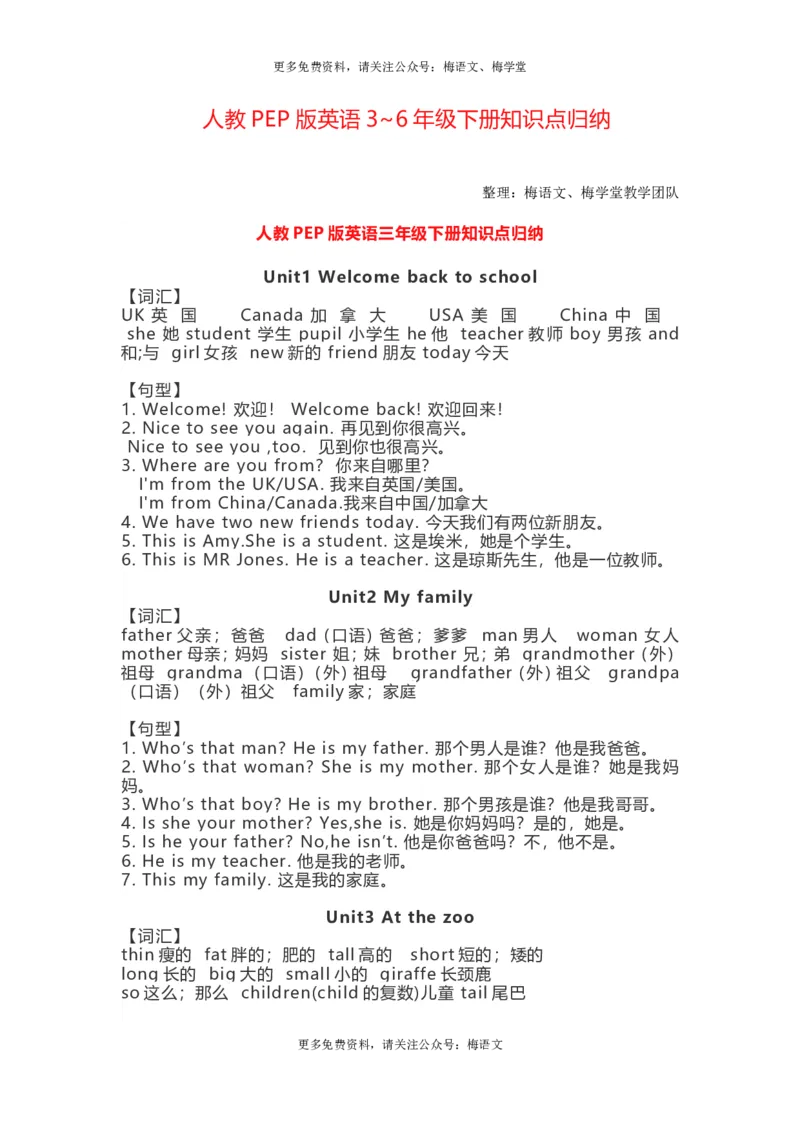
人教 PEP 版英语 3~6 年级下册知识点归纳
整理:梅语文、梅学堂教学团队
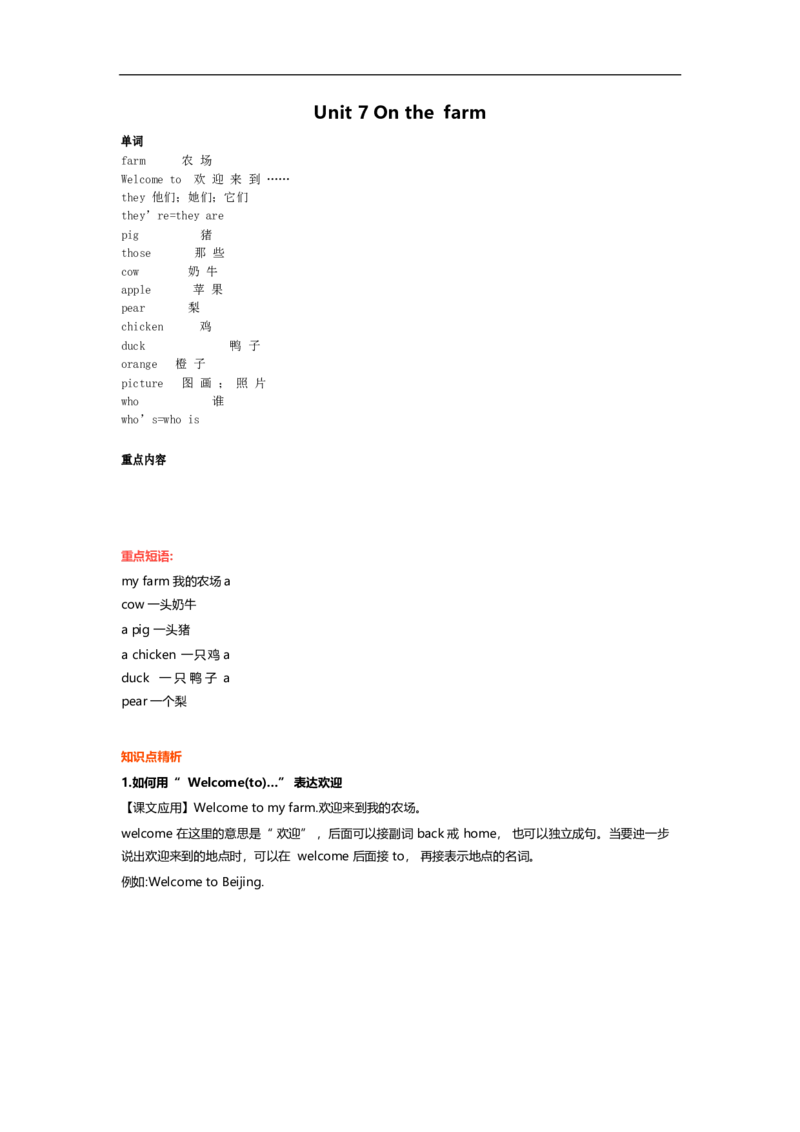
人教PEP版英语三年级下册知识点归纳
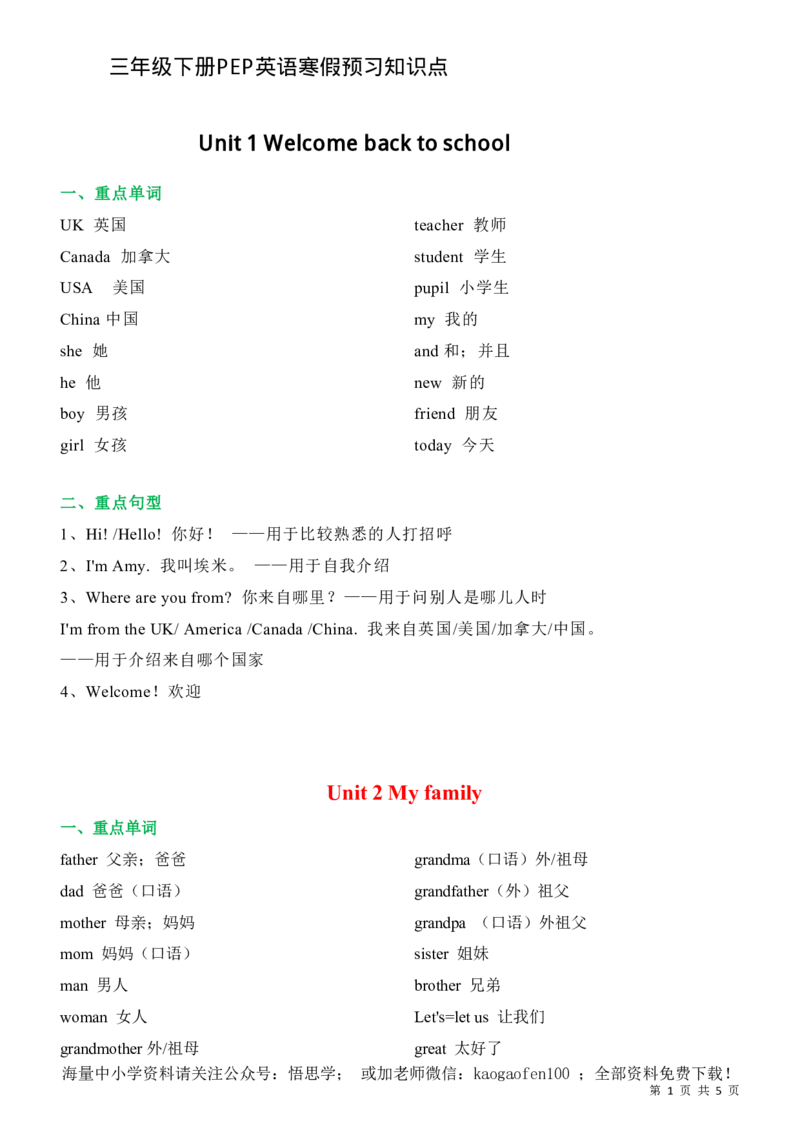
Unit1 Welcome back to school
【词汇】
UK 英 国 Canada 加 拿 大 USA 美 国 China 中 国
she 她 student 学生 pupil 小学生 he 他 teacher 教师 boy 男孩 and
和;与 girl 女孩 new 新的 friend 朋友 today 今天
【句型】
1. Welcome! 欢迎! Welcome back! 欢迎回来!
2. Nice to see you again. 再见到你很高兴。
Nice to see you ,too. 见到你也很高兴。
3. Where are you from? 你来自哪里?
I'm from the UK/USA. 我来自英国/美国。
I'm from China/Canada.我来自中国/加拿大
4. We have two new friends today. 今天我们有两位新朋友。
5. This is Amy.She is a student. 这是埃米,她是个学生。
6. This is MR Jones. He is a teacher. 这是琼斯先生,他是一位教师。
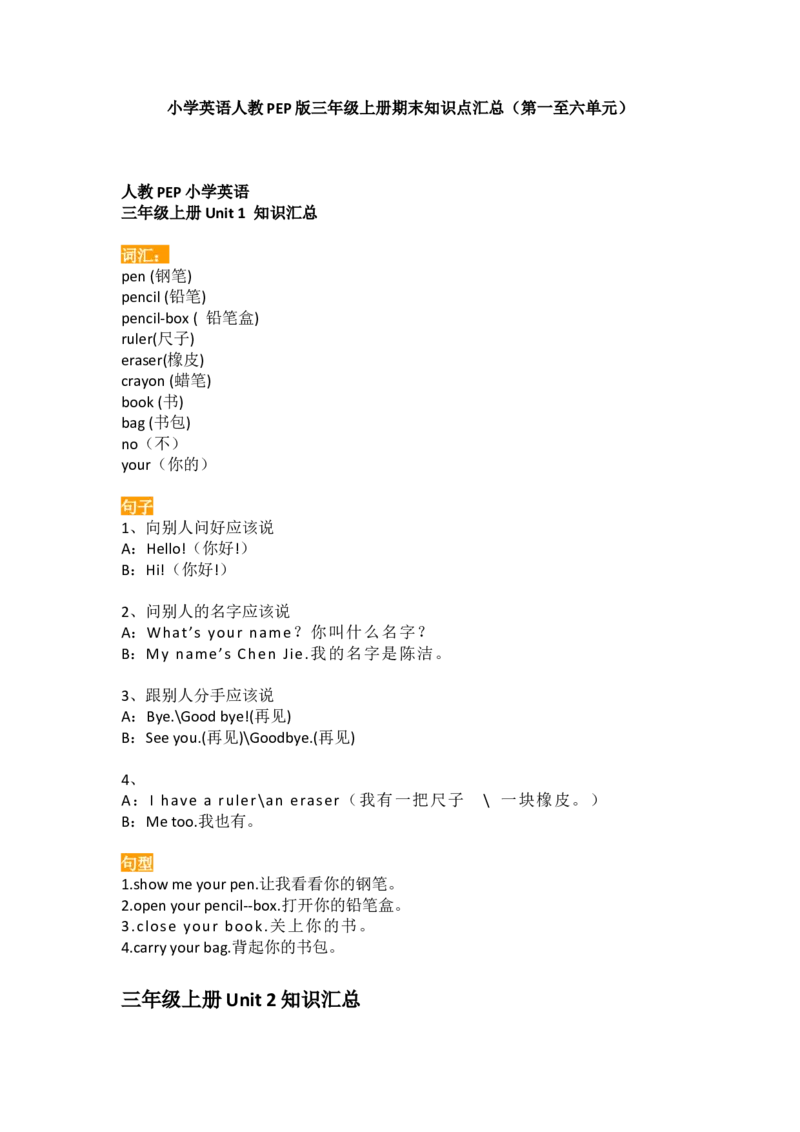
Unit2 My family
【词汇】
father 父亲;爸爸 dad (口语) 爸爸;爹爹 man 男人 woman 女人
mother 母亲;妈妈 sister 姐;妹 brother 兄;弟 grandmother(外)
祖母 grandma (口语)(外)祖母 grandfather(外)祖父 grandpa
(口语)(外)祖父 family 家;家庭
【句型】
1. Who’s that man? He is my father. 那个男人是谁?他是我爸爸。
2. Who’s that woman? She is my mother. 那个女人是谁?她是我妈
妈。
3. Who’s that boy? He is my brother. 那个男孩是谁?他是我哥哥。
4. Is she your mother? Yes,she is. 她是你妈妈吗?是的,她是。
5. Is he your father? No,he isn’t. 他是你爸爸吗?不,他不是。
6. He is my teacher. 他是我的老师。
7. This my family. 这是我的家庭。
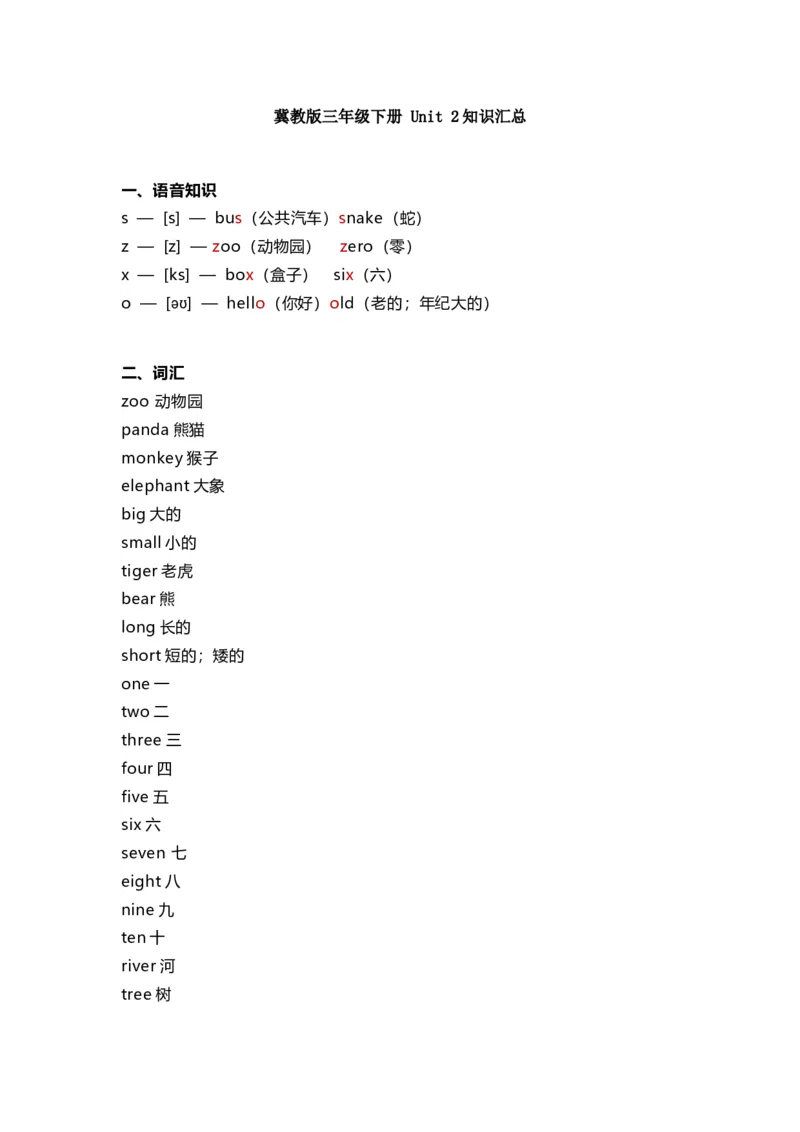
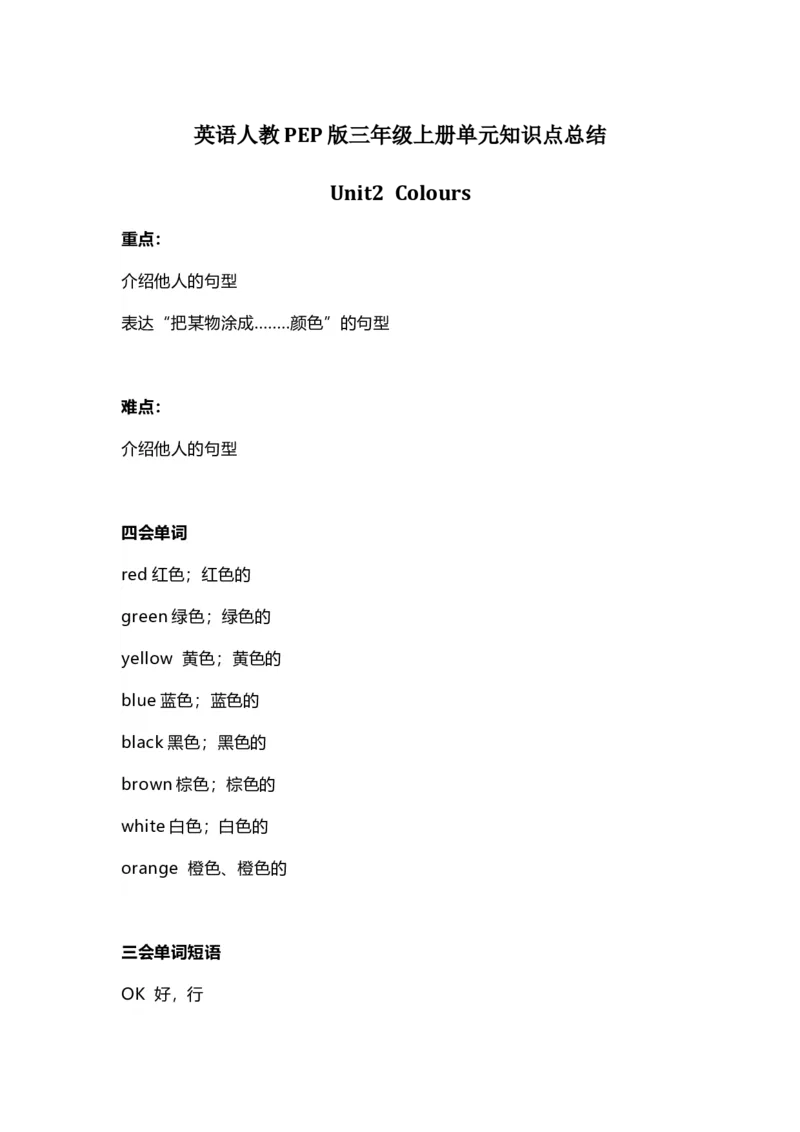
Unit3 At the zoo
【词汇】
thin 瘦的 fat 胖的;肥的 tall 高的 short 短的;矮的
long 长的 big 大的 small 小的 giraffe 长颈鹿
so 这么;那么 children(child 的复数)儿童 tail 尾巴
更多免费资料,请关注公众号:梅语文更多免费资料,请关注公众号:梅语文、梅学堂
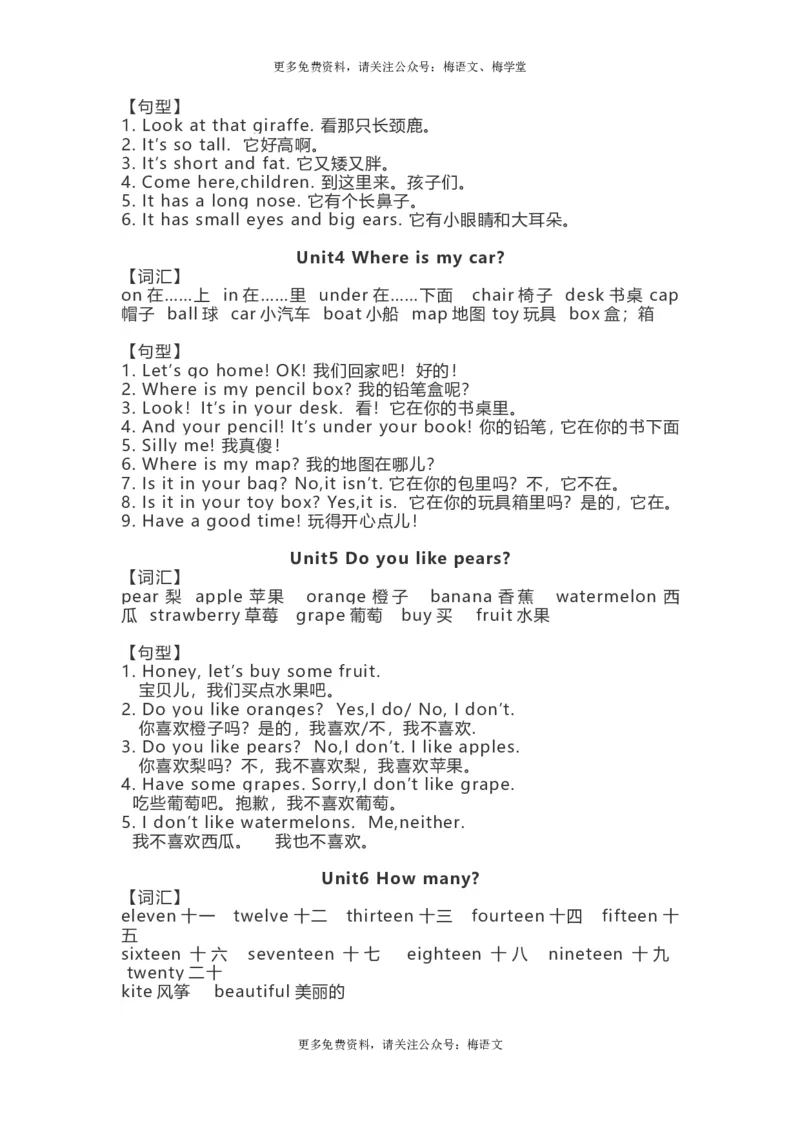
【句型】
1. Look at that giraffe. 看那只长颈鹿。
2. It’s so tall. 它好高啊。
3. It’s short and fat. 它又矮又胖。
4. Come here,children. 到这里来。孩子们。
5. It has a long nose. 它有个长鼻子。
6. It has small eyes and big ears. 它有小眼睛和大耳朵。
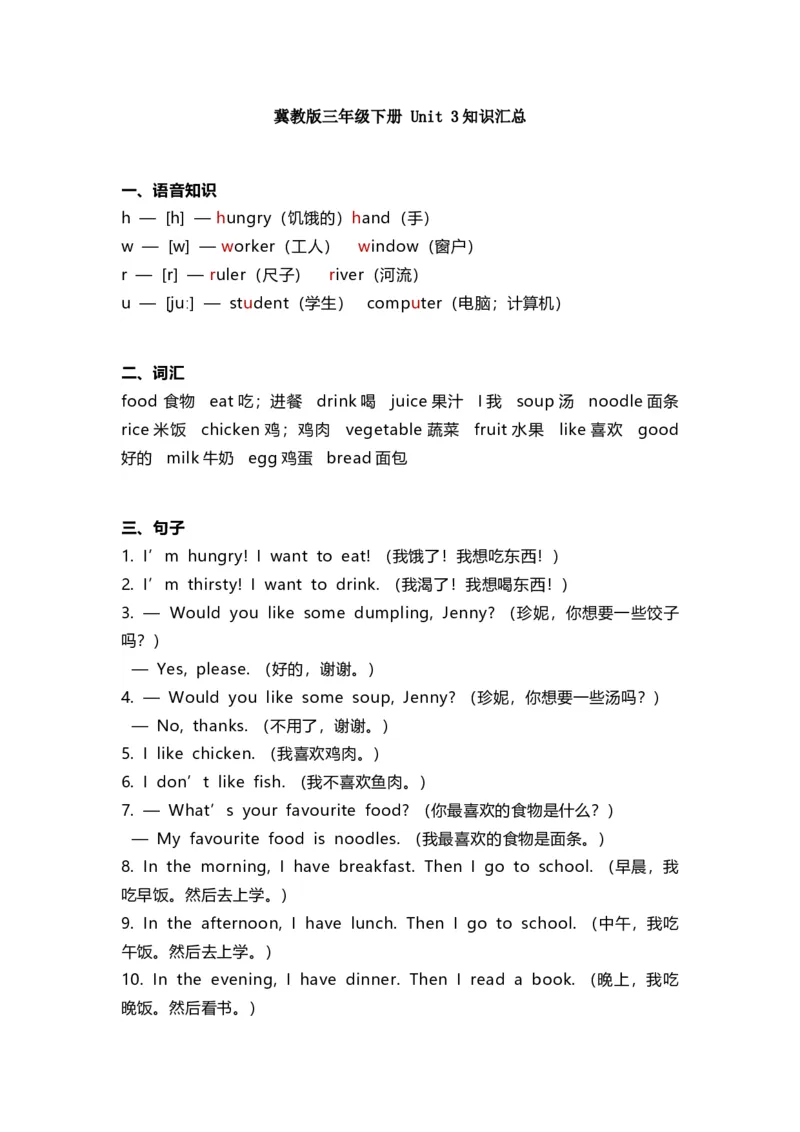
Unit4 Where is my car?
【词汇】
on 在……上 in 在……里 under 在……下面 chair 椅子 desk 书桌 cap
帽子 ball 球 car 小汽车 boat 小船 map 地图 toy 玩具 box 盒;箱
【句型】
1. Let’s go home! OK! 我们回家吧!好的!
2. Where is my pencil box? 我的铅笔盒呢?
3. Look!It’s in your desk. 看!它在你的书桌里。
4. And your pencil! It’s under your book! 你的铅笔,它在你的书下面
5. Silly me! 我真傻!
6. Where is my map? 我的地图在哪儿?
7. Is it in your bag? No,it isn’t. 它在你的包里吗?不,它不在。
8. Is it in your toy box? Yes,it is. 它在你的玩具箱里吗?是的,它在。
9. Have a good time! 玩得开心点儿!
Unit5 Do you like pears?
【词汇】
pear 梨 apple 苹果 orange 橙子 banana 香蕉 watermelon 西
瓜 strawberry 草莓 grape 葡萄 buy 买 fruit 水果
【句型】
1. Honey, let’s buy some fruit.
宝贝儿,我们买点水果吧。
2. Do you like oranges? Yes,I do/ No, I don’t.
你喜欢橙子吗?是的,我喜欢/不,我不喜欢.
3. Do you like pears? No,I don’t. I like apples.
你喜欢梨吗?不,我不喜欢梨,我喜欢苹果。
4. Have some grapes. Sorry,I don’t like grape.
吃些葡萄吧。抱歉,我不喜欢葡萄。
5. I don’t like watermelons. Me,neither.
我不喜欢西瓜。 我也不喜欢。
Unit6 How many?
【词汇】
eleven 十一 twelve 十二 thirteen 十三 fourteen 十四 fifteen 十
五
sixteen 十 六 seventeen 十 七 eighteen 十 八 nineteen 十 九
twenty 二十
kite 风筝 beautiful 美丽的
更多免费资料,请关注公众号:梅语文更多免费资料,请关注公众号:梅语文、梅学堂
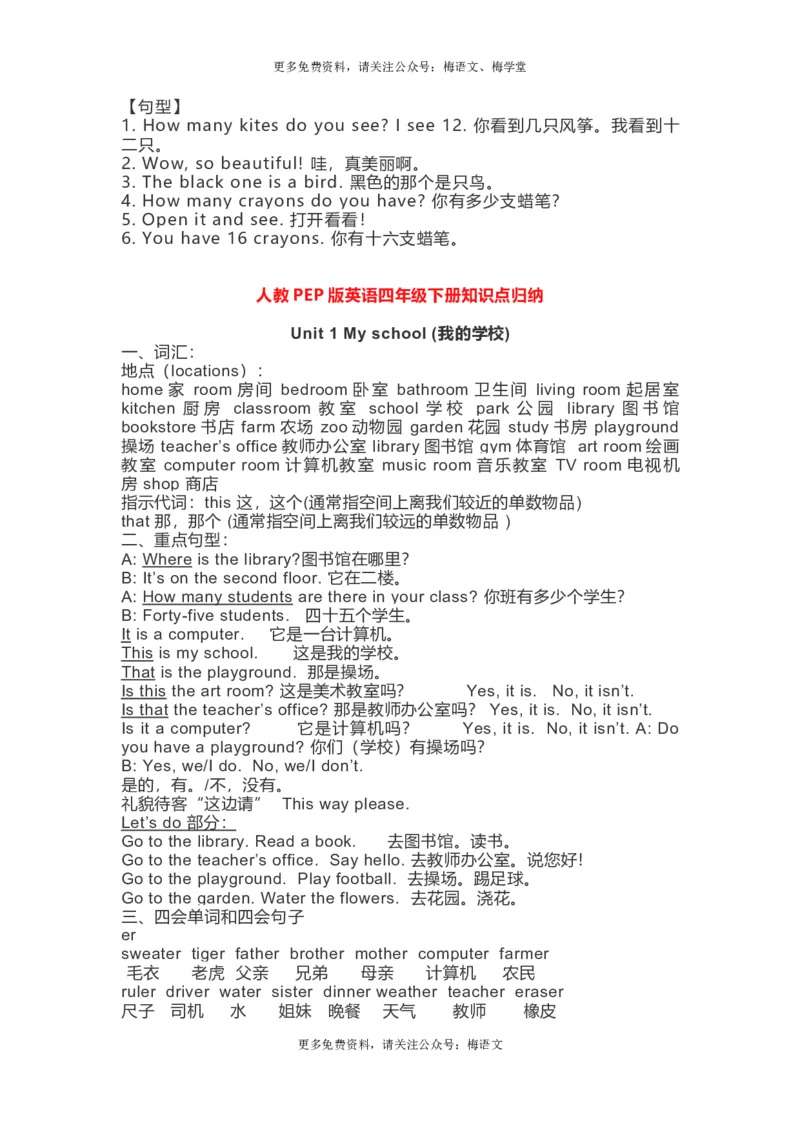
【句型】
1. How many kites do you see? I see 12. 你看到几只风筝。我看到十
二只。
2. Wow, so beautiful! 哇,真美丽啊。
3. The black one is a bird. 黑色的那个是只鸟。
4. How many crayons do you have? 你有多少支蜡笔?
5. Open it and see. 打开看看!
6. You have 16 crayons. 你有十六支蜡笔。
人教PEP版英语四年级下册知识点归纳
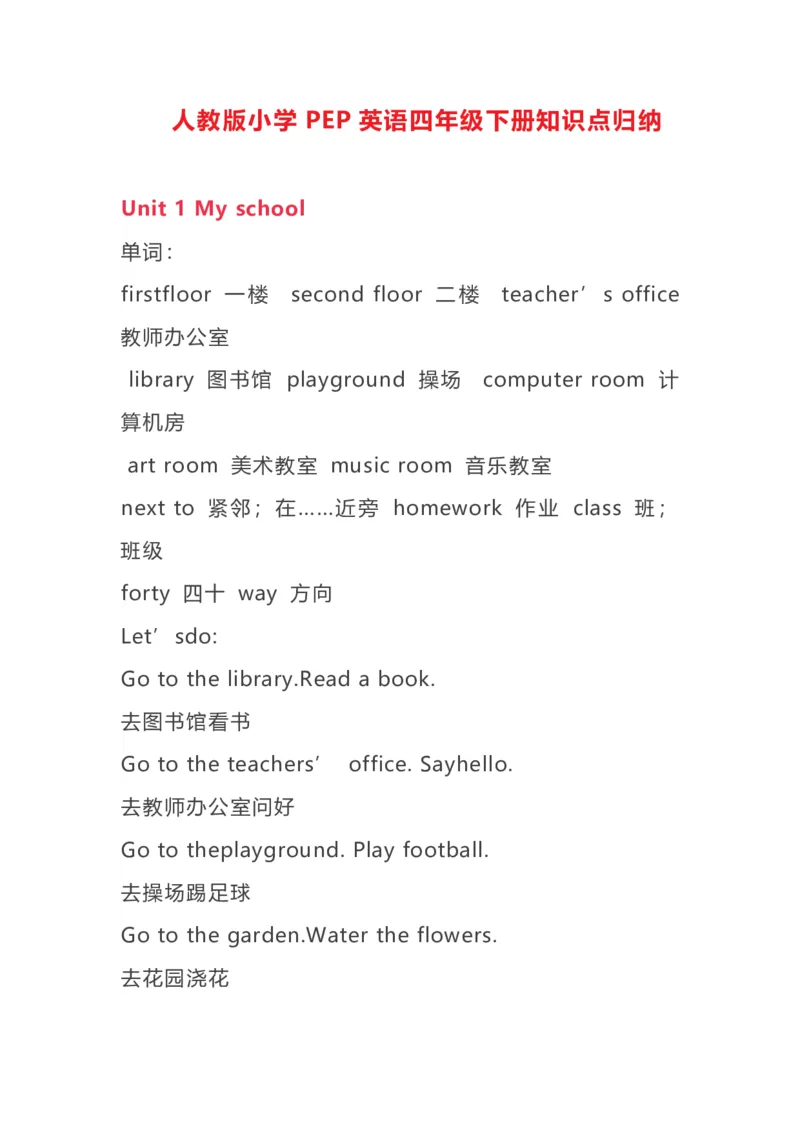
Unit 1 My school (我的学校)
一、词汇:
地点(locations):
home 家 room 房间 bedroom 卧室 bathroom 卫生间 living room 起居室
kitchen 厨 房 classroom 教 室 school 学 校 park 公 园 library 图 书 馆
bookstore 书店 farm 农场 zoo 动物园 garden 花园 study 书房 playground
操场 teacher’s office 教师办公室 library 图书馆 gym 体育馆 art room 绘画
教室 computer room 计算机教室 music room 音乐教室 TV room 电视机
房 shop 商店
指示代词:this 这,这个(通常指空间上离我们较近的单数物品)
that 那,那个 (通常指空间上离我们较远的单数物品 )
二、重点句型:
A: Where is the library?图书馆在哪里?
B: It’s on the second floor. 它在二楼。
A: How many students are there in your class? 你班有多少个学生?
B: Forty-five students. 四十五个学生。
It is a computer. 它是一台计算机。
This is my school. 这是我的学校。
That is the playground. 那是操场。 X|k | B| 1 . c|O |m
Is this the art room? 这是美术教室吗? Yes, it is. No, it isn’t.
Is that the teacher’s office? 那是教师办公室吗? Yes, it is. No, it isn’t.
Is it a computer? 它是计算机吗? Yes, it is. No, it isn’t. A: Do
you have a playground? 你们(学校)有操场吗?
B: Yes, we/I do. No, we/I don’t.
是的,有。/不,没有。
礼貌待客“这边请” This way please.
Let’s do 部分:
Go to the library. Read a book. 去图书馆。读书。
Go to the teacher’s office. Say hello. 去教师办公室。说您好!
Go to the playground. Play football. 去操场。踢足球。
Go to the garden. Water the flowers. 去花园。浇花。
三、四会单词和四会句子
er
sweater tiger father brother mother computer farmer
毛衣 老虎 父亲 兄弟 母亲 计算机 农民
ruler driver water sister dinner weather teacher eraser
尺子 司机 水 姐妹 晚餐 天气 教师 橡皮
更多免费资料,请关注公众号:梅语文更多免费资料,请关注公众号:梅语文、梅学堂
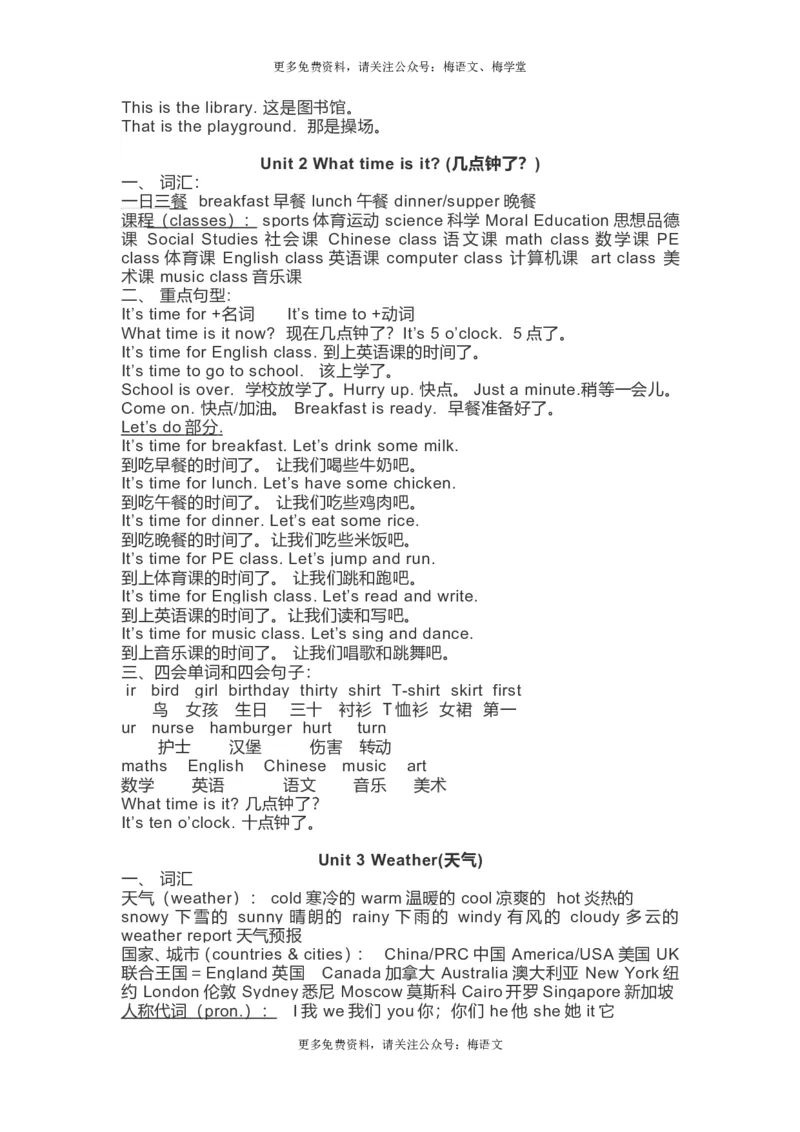
This is the library. 这是图书馆。
That is the playground. 那是操场。
Unit 2 What time is it? (几点钟了?)
一、 词汇:
一日三餐 breakfast早餐 lunch午餐 dinner/supper晚餐
课程( classes ): sports体育运动 science科学 Moral Education思想品德
课 Social Studies 社会课 Chinese class 语文课 math class 数学课 PE
class 体育课 English class 英语课 computer class 计算机课 art class 美
术课 music class音乐课
二、 重点句型:
It’s time for +名词 It’s time to +动词
What time is it now? 现在几点钟了?It’s 5 o’clock. 5点了。
It’s time for English class. 到上英语课的时间了。
It’s time to go to school. 该上学了。
School is over. 学校放学了。Hurry up. 快点。 Just a minute.稍等一会儿。
Come on. 快点/加油。 Breakfast is ready. 早餐准备好了。
Let’s do 部分 .
It’s time for breakfast. Let’s drink some milk.
到吃早餐的时间了。 让我们喝些牛奶吧。
It’s time for lunch. Let’s have some chicken.
到吃午餐的时间了。 让我们吃些鸡肉吧。
It’s time for dinner. Let’s eat some rice.
到吃晚餐的时间了。让我们吃些米饭吧。http:// w ww. xkb1. com
It’s time for PE class. Let’s jump and run.
到上体育课的时间了。 让我们跳和跑吧。
It’s time for English class. Let’s read and write.
到上英语课的时间了。让我们读和写吧。
It’s time for music class. Let’s sing and dance.
到上音乐课的时间了。 让我们唱歌和跳舞吧。
三、四会单词和四会句子:
ir bird girl birthday thirty shirt T-shirt skirt first
鸟 女孩 生日 三十 衬衫 T恤衫 女裙 第一
ur nurse hamburger hurt turn
护士 汉堡 伤害 转动
maths English Chinese music art
数学 英语 语文 音乐 美术
What time is it? 几点钟了?
It’s ten o’clock. 十点钟了。
Unit 3 Weather(天气)
一、 词汇
天气(weather): cold寒冷的 warm温暖的 cool凉爽的 hot炎热的
snowy 下雪的 sunny 晴朗的 rainy 下雨的 windy 有风的 cloudy 多云的
weather report天气预报
国家、城市(countries & cities): China/PRC中国 America/USA美国 UK
联合王国=England英国 Canada加拿大 Australia 澳大利亚 New York 纽
约 London伦敦 Sydney悉尼 Moscow莫斯科 Cairo开罗Singapore新加坡
人称代词( pron . ): I我 we我们 you你;你们 he他 she她 it它
更多免费资料,请关注公众号:梅语文更多免费资料,请关注公众号:梅语文、梅学堂
they他(她,它)们 my我的 our 我们的 your你的;你们的 his他的
her她的
介词词汇( prep . ): in在……里 on在……上;在……时候 under在……下面
near在……的旁边 next to 紧邻;在……旁边
颜色( colour ) : red红 blue蓝 yellow黄 green绿white白black黑pink粉
红purple紫orange橙 brown棕
二、 重点句型
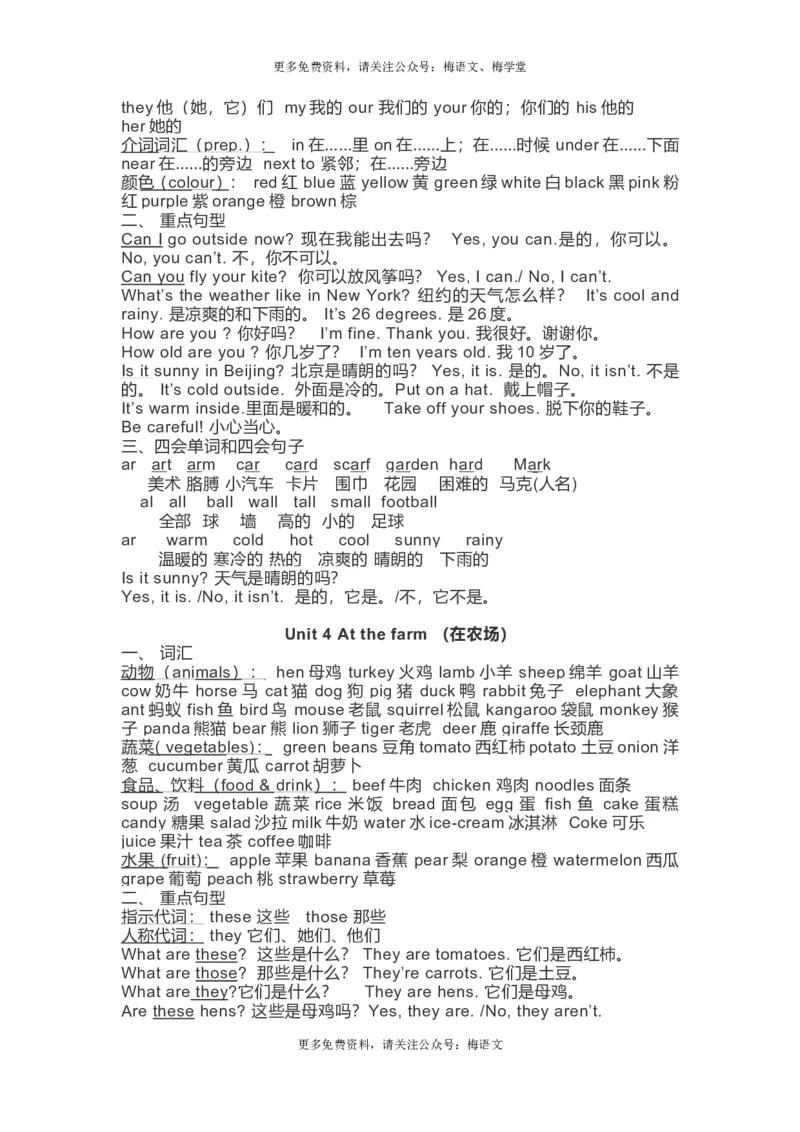
Can I go outside now? 现在我能出去吗? Yes, you can.是的,你可以。
No, you can’t. 不,你不可以。
Can you fly your kite? 你可以放风筝吗? Yes, I can./ No, I can’t.
What’s the weather like in New York? 纽约的天气怎么样? It’s cool and
rainy. 是凉爽的和下雨的。 It’s 26 degrees. 是26度。
How are you ? 你好吗? I’m fine. Thank you. 我很好。谢谢你。
How old are you ? 你几岁了? I’m ten years old. 我10岁了。
Is i t sunny in Beijing? 北京是晴朗的吗? Yes, it is. 是的。No, it isn’t. 不是
的。 It’s cold outside. 外面是冷的。Put on a hat. 戴上帽子。
It’s warm inside.里面是暖和的。 Take off your shoes. 脱下你的鞋子。
Be careful! 小心当心。
三、四会单词和四会句子
ar ar t ar m car car d scar f gar den har d Mar k
美术 胳膊 小汽车 卡片 围巾 花园 困难的 马克(人名)
al all ball wall tall small football
全部 球 墙 高的 小的 足球
ar warm cold hot cool sunny rainy
温暖的 寒冷的 热的 凉爽的 晴朗的 下雨的
Is it sunny? 天气是晴朗的吗?
Yes, it is. /No, it isn’t. 是的,它是。/不,它不是。
Unit 4 At the farm (在农场)
一、 词汇 X|k | B| 1 . c|O |m
动物( animals ): hen 母鸡 turkey 火鸡 lamb 小羊 sheep 绵羊 goat 山羊
cow 奶牛 horse 马 cat 猫 dog 狗 pig 猪 duck 鸭 rabbit 兔子 elephant 大象
ant蚂蚁 fish鱼 bird鸟 mouse老鼠 squirrel松鼠 kangaroo袋鼠 monkey猴
子 panda熊猫 bear熊 lion狮子 tiger老虎 deer鹿 giraffe长颈鹿
蔬菜 ( vegetables) : green beans 豆角tomato西红柿 potato 土豆onion 洋
葱 cucumber黄瓜 carrot胡萝卜
食品、饮料( food & drink ): beef牛肉 chicken 鸡肉 noodles面条
soup 汤 vegetable 蔬菜 rice 米饭 bread 面包 egg 蛋 fish 鱼 cake 蛋糕
candy 糖果 salad沙拉milk牛奶 water水ice-cream冰淇淋 Coke可乐
juice果汁 tea茶 coffee咖啡
水果 (fruit) : apple 苹果 banana香蕉 pear梨 orange 橙 watermelon 西瓜
grape葡萄 peach桃 strawberry草莓
二、 重点句型
指示代词: these 这些 those 那些
人称代词: they 它们、她们、他们 X|k | B| 1 . c|O |m
What are these ? 这些是什么? They are tomatoes. 它们是西红柿。
What are those ? 那些是什么? They’re carrots. 它们是土豆。
What are they ?它们是什么? They are hens. 它们是母鸡。
Are these hens? 这些是母鸡吗?Yes, they are. /No, they aren’t.
更多免费资料,请关注公众号:梅语文更多免费资料,请关注公众号:梅语文、梅学堂
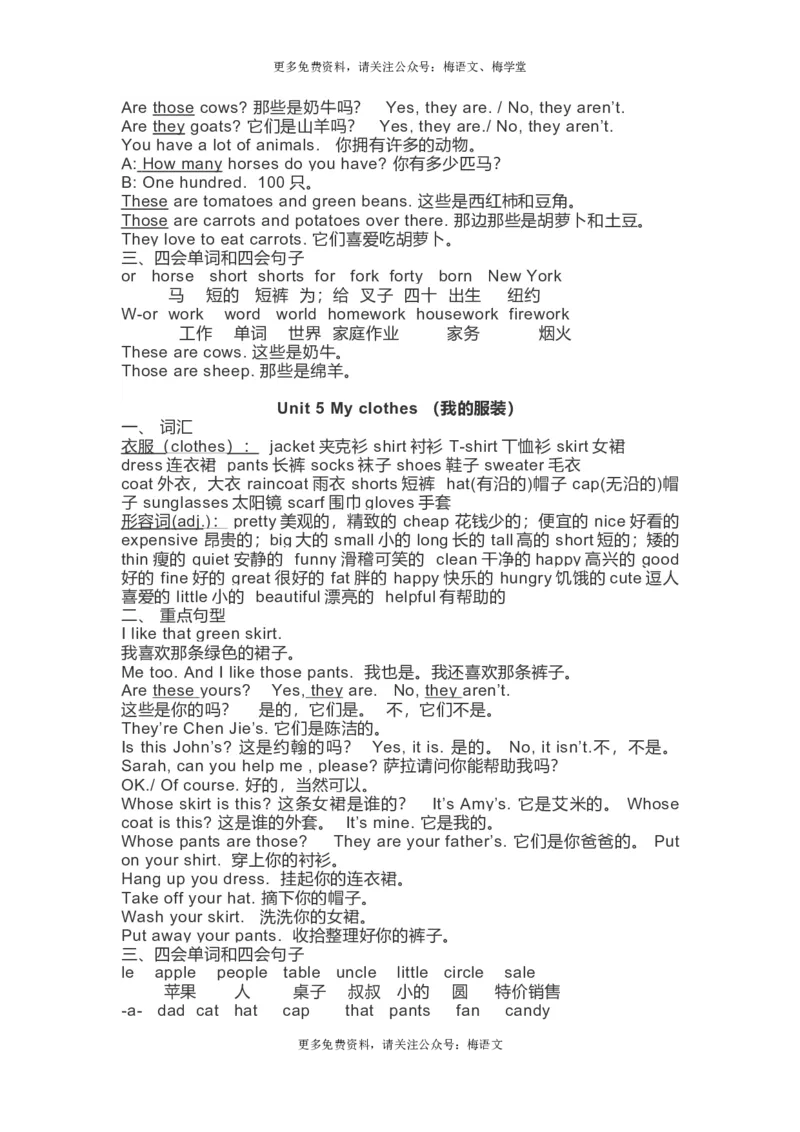
Are those cows? 那些是奶牛吗? Yes, they are. / No, they aren’t.
Are they goats? 它们是山羊吗? Yes, they are./ No, they aren’t.
You have a lot of animals. 你拥有许多的动物。
A: How many horses do you have? 你有多少匹马?
B: One hundred. 100只。
These are tomatoes and green beans. 这些是西红柿和豆角。
Those are carrots and potatoes over there. 那边那些是胡萝卜和土豆。
They love to eat carrots. 它们喜爱吃胡萝卜。
三、四会单词和四会句子
or horse short shorts for fork forty born New York
马 短的 短裤 为;给 叉子 四十 出生 纽约
W-or work word world homework housework firework
工作 单词 世界 家庭作业 家务 烟火
These are cows. 这些是奶牛。
Those are sheep. 那些是绵羊。
Unit 5 My clothes (我的服装)
一、 词汇
衣服( clothes ): jacket夹克衫 shirt衬衫 T-shirt丅恤衫 skirt女裙
dress连衣裙 pants长裤 socks袜子 shoes鞋子 sweater毛衣
coat 外衣,大衣 raincoat雨衣 shorts短裤 hat(有沿的)帽子 cap(无沿的)帽
子 sunglasses太阳镜 scarf围巾gloves手套
形容词 (adj.) : pretty美观的,精致的 cheap 花钱少的;便宜的 nice好看的
expensive 昂贵的;big大的 small小的 long长的 tall高的 short短的;矮的
thin 瘦的 quiet 安静的 funny 滑稽可笑的 clean 干净的 happy 高兴的 good
好的 fine 好的 great 很好的 fat胖的 happy 快乐的 hungry 饥饿的cute 逗人
喜爱的 little小的 beautiful漂亮的 helpful有帮助的
二、 重点句型
I like that green skirt.
我喜欢那条绿色的裙子。
Me too. And I like those pants. 我也是。我还喜欢那条裤子。
Are these yours? Yes, they are. No, they aren’t.
这些是你的吗? 是的,它们是。 不,它们不是。
They’re Chen Jie’s. 它们是陈洁的。
Is this John’s? 这是约翰的吗? Yes, it is. 是的。 No, it isn’t.不,不是。
Sarah, can you help me , please? 萨拉请问你能帮助我吗?
OK./ Of course. 好的,当然可以。
Whose skirt is this? 这条女裙是谁的? It’s Amy’s. 它是艾米的。 Whose
coat is this? 这是谁的外套。 It’s mine. 它是我的。
Whose pants are those? They are your father’s. 它们是你爸爸的。 Put
on your shirt. 穿上你的衬衫。
Hang up you dress. 挂起你的连衣裙。
Take off your hat. 摘下你的帽子。
Wash your skirt. 洗洗你的女裙。
Put away your pants. 收拾整理好你的裤子。
三、四会单词和四会句子
le apple people table uncle little circle sale
苹果 人 桌子 叔叔 小的 圆 特价销售
-a- dad cat hat cap that pants fan candy
更多免费资料,请关注公众号:梅语文更多免费资料,请关注公众号:梅语文、梅学堂
爸爸 猫 帽子 鸭舌帽 那个 裤子 风扇 糖果
fat bag black
肥胖 包 黑色
a-e face cake grape plate take
脸 蛋糕 葡萄 盘子 拿
This is Chen Jie’s dress. 这是陈洁的连衣裙。
That is Amy’s skirt.那是艾米的裙子。
These are John’s shoes. 这些是约翰的鞋子。
Those are Mike’s pants. 那些是迈克的裤子。
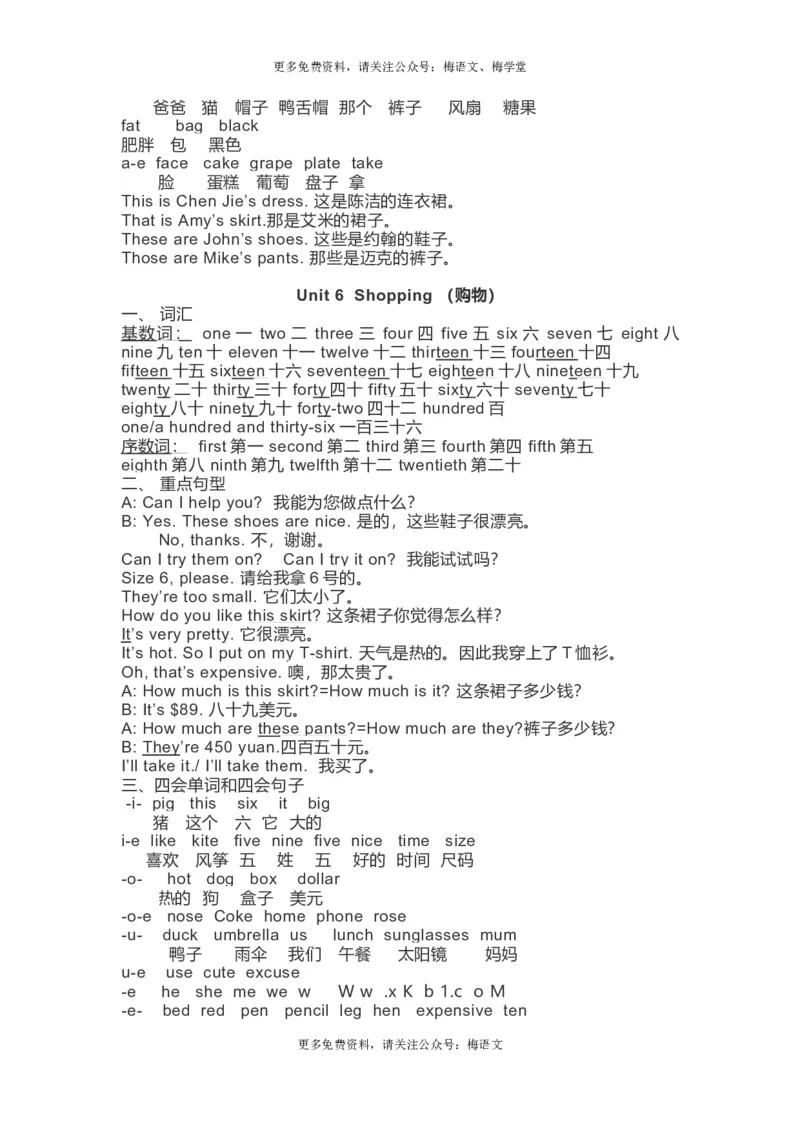
Unit 6 Shopping (购物)
一、 词汇
基数词: one 一 two 二 three 三 four 四 five 五 six 六 seven 七 eight 八
nine九 ten十 eleven十一 twelve十二 thirteen 十三 fourteen 十四
fifteen 十五 sixteen 十六 seventeen 十七 eighteen 十八 nineteen 十九
twenty 二十 thirty 三十 forty 四十 fifty 五十 sixty 六十 seventy 七十
eighty 八十 ninety 九十 forty -two四十二 hundred百
one/a hundred and thirty-six 一百三十六
序数词: first第一 second第二 third第三 fourth第四 fifth第五
eighth第八 ninth第九 twelfth第十二 twentieth第二十
二、 重点句型
A: Can I help you? 我能为您做点什么?
B: Yes. These shoes are nice. 是的,这些鞋子很漂亮。
No, thanks. 不,谢谢。
Can I try them on? Can I try it on? 我能试试吗?
Size 6, please. 请给我拿6号的。
They’re too small. 它们太小了。
How do you like this skirt? 这条裙子你觉得怎么样?
It ’s very pretty. 它很漂亮。
It’s hot. So I put on my T-shirt. 天气是热的。因此我穿上了T恤衫。
Oh, that’s expensive. 噢,那太贵了。
A: How much is this skirt?=How much is it? 这条裙子多少钱?
B: It’s $89. 八十九美元。
A: How much are these pants ?=How much are they?裤子多少钱?
B: They ’re 450 yuan.四百五十元。
I’ll take it./ I’ll take them. 我买了。
三、四会单词和四会句子
-i- pig this six it big
猪 这个 六 它 大的
i-e like kite five nine five nice time size
喜欢 风筝 五 姓 五 好的 时间 尺码
-o- hot dog box dollar
热的 狗 盒子 美元
-o-e nose Coke home phone rose
-u- duck umbrella us lunch sunglasses mum
鸭子 雨伞 我们 午餐 太阳镜 妈妈
u-e use cute excuse
-e he she me we w W w .x K b 1.c o M
-e- bed red pen pencil leg hen expensive ten
更多免费资料,请关注公众号:梅语文更多免费资料,请关注公众号:梅语文、梅学堂
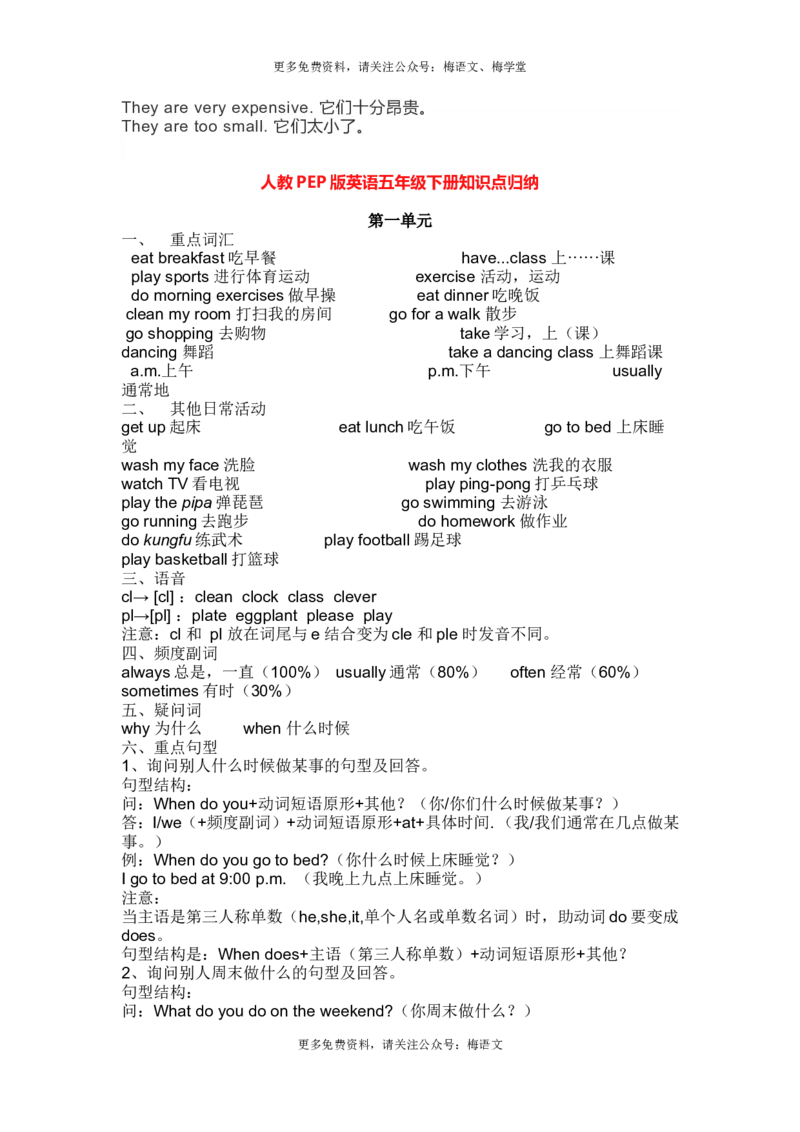
They are very expensive. 它们十分昂贵。
They are too small. 它们太小了。
人教PEP版英语五年级下册知识点归纳
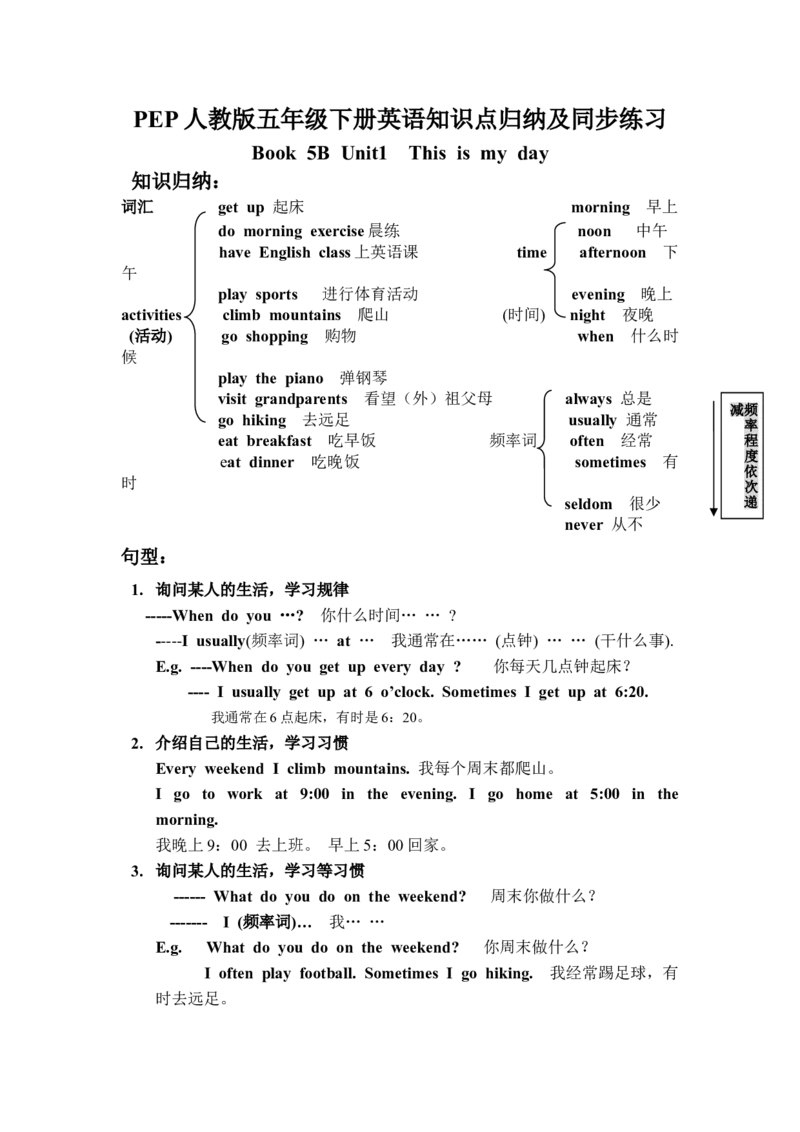
第一单元
一、 重点词汇
eat breakfast吃早餐 have...class 上······课
play sports 进行体育运动 exercise 活动,运动
do morning exercises做早操 eat dinner吃晚饭
clean my room 打扫我的房间 go for a walk 散步
go shopping 去购物 take学习,上(课 )
dancing 舞蹈 take a dancing class 上舞蹈课
a.m.上午 p.m.下午 usually
通常地
二、 其他日常活动
get up起床 eat lunch吃午饭 go to bed 上床睡
觉
wash my face洗脸 wash my clothes 洗我的衣服
watch TV看电视 play ping-pong打乒乓球
play the pipa弹琵琶 go swimming 去游泳
go running去跑步 do homework 做作业
do kungfu练武术 play football踢足球
play basketball打篮球
三、语音
cl→ [cl] :clean clock class clever
pl→[pl] :plate eggplant please play
注意:cl 和 pl 放在词尾与e 结合变为cle 和ple 时发音不同。
四、频度副词
always总是,一直(100%) usually通常(80%) often 经常(60%)
sometimes有时(30%)
五、疑问词
why 为什么 when 什么时候
六、重点句型
1、询问别人什么时候做某事的句型及回答。
句型结构:
问:When do you+动词短语原形+其他?(你/你们什么时候做某事?)
答:I/we(+频度副词)+动词短语原形+at+具体时间. (我/我们通常在几点做某
事。)
例:When do you go to bed?(你什么时候上床睡觉?)
I go to bed at 9:00 p.m. (我晚上九点上床睡觉。)
注意:
当主语是第三人称单数(he,she,it,单个人名或单数名词)时,助动词do要变成
does。
句型结构是:When does+主语(第三人称单数)+动词短语原形+其他?
2、询问别人周末做什么的句型及回答。
句型结构:
问:What do you do on the weekend?(你周末做什么?)
更多免费资料,请关注公众号:梅语文更多免费资料,请关注公众号:梅语文、梅学堂
答:I(+频度副词)+动词(短语)+其他。
例:What do you do on the weekend?(你周末做什么?)
I usually read books. (我通常看书。 )
注意:
当主语是第三人称单数(he,she,it,单个人名或单数名词)时,助动词do要变成
does。
句型结构是:What does+主语(第三人称单数)+do+on the weekend?
第二单元
一、重点词汇
spring 春天 summer 夏天 autumn秋天 winter 冬天
season季节
picnic 野餐 go on a picnic 去野餐 pick摘 pick apples摘
苹果
snowman雪人 make a snowman 堆雪人 go swimming去游泳
which 哪一个 best最 because 因为 vacation 假期
二、其他
1、形容天气的形容词:
hot 炎热的 warm 暖和的 rainy多雨的 windy 多风的 foggy有雾的
cold 寒冷的 cool凉爽的 sunny晴朗的 cloudy 多云的 snowy下雪的
2、由go构成的活动短语:
go swimming去游泳 go shopping去购物 go boating去划船 go
skating去滑冰 go hiking去远足 go fishing去钓鱼
三、语音
br →[br]: brown library brother umbrella
gr→ [gr] : green grapes grandpa grow
四、重点句型
1、询问别人天气怎么样的句型及回答。
句型结构:
问:What’s the weather like+时间+地点?(······天气怎么样?)
答:It’s+表示天气的形容词.
例:What’s the weather like in winter in Beijing?(北京冬天的天气怎么样)
It’s cold and windy(有风而且寒冷。 )
2、询问别人最喜欢的季节句型及回答。
句型结构:
问:Which season do you like best? (你最喜欢的季节是哪一个?)
答:I like+季节+best. 或直接说季节名称。
同义句还有:What’s your favourite season?
3、询问别人喜欢某个季节的原因的句型及回答。
句型结构:
问:Why do you like+季节名称?或直接用“Why”来提问。
答:一般要用“because”引导的句子来说明理由,可以从天气相关的活动等方面
来说。
例:(1)Why do you like spring?(你为什么喜欢春天?)
Because I can go on a picnic.(因为我能去野餐。)
(2)Why do you like summer?(你为什么喜欢夏天?)
Because I can go swimming.(因为我能去游泳。)
(3)Why do you like autumn?(你为什么喜欢秋天?)
Because I can pick apples.(因为我能摘苹果。)
更多免费资料,请关注公众号:梅语文更多免费资料,请关注公众号:梅语文、梅学堂
(4)Why do you like winter?(你为什么喜欢冬天?)
Because I can make a snowman.(因为我能堆雪人。 )
第三单元
一 重点词汇
January一月 February二月 March三月 April四月
May五月 June六月 July七月 August 八月
September 九月 October十月 November 十一月 December十二月
注意:
1、月份的首字母一定要大写。
2、May没有缩写形式,September的缩写形式是“Sept”,其他月份单词的缩写形
式都是由单词的前三个字母加“·”构成。
3、月份的缩写形式不用在句子中,只能单独使用。
4、表示“在几月”时,要在月份单词前面加介词in。
二、常用节假日名称
New Year’s Day元旦(1.1) Tree Planting Day 植树节(3.12)
Easter 复活节(每年春分月圆之后第一个星期日)
April Fool’s Day愚人节(4.1)
May Day 劳动节(5.1) Mother’s Day母亲节(五月第二个周日)
Children’s Day 儿童节(6.1) Father’s Day父亲节(六月第三个周日)
Teacher’s Day教师节(9.10)National Day国庆节(10.1)
Mid-Autumn Day 中秋节(农历八月十五)
Thanksgiving Day 感恩节(11月第4个周四) Christmas圣诞节(12.25)
summer vacation暑假 (July and August ) winter vacation寒假
三、语音
ch→ [ts]: China chicken lunch teacher
sh→[s]: sheep fish shirt shorts
四、活动名称
sports meet 运动会 Easter party 复活节聚会 school
trip 学校旅行
Chinese test 语文测试 singing contest歌咏比赛 birthday
party生日聚会
五、介词in 、on、 at的用法。
1、in +上午/下午/晚上/月份/季节/年份。
如:in the morning, in April, in winter, in 2015
2、on+具体的某一天。
如:on Monday, on April 3rd, on Friday morning
3、at +具体的时间点或与其他词构成固定搭配。
如:at 6:00 , at noon
六、重点句型
1、问答某个活动或节日在几月份的句型及回答。
句型结构:
问:When is+ the +活动或节日名称?(注意:节日开头字母要大写)
答:It’s in+月份.
例:(1)When is the trip this year ? (今年的旅行在什么时候?)
It’s in October. (在十月)
(2)When is Christmas?(圣诞节在什么时候?)
It’s in December.(在十二月。 )
2、询问别人将要做什么的句型及回答。
更多免费资料,请关注公众号:梅语文更多免费资料,请关注公众号:梅语文、梅学堂
句型结构:
问:What will you do+其他?
答:I will...=I’ll...
例:What will you do for your mum on Mother’s Day?(母亲节你将为你妈妈做
什么?)
I’ll give her some flowers.(我将送给她一些花。 )
3、表达“我们将要···”的句型。
We’ll/We will + 动词原形. 这是一个一般将来时的句子,表示将来某个时间要发
生的动作或事情。
例:We’ll have a school trip.(我们将有一次学校旅行。)
We’ll have a singing contest.(我们将有一次歌咏比赛。)
We’ll take a dancing class.(我们将要上一节舞蹈课。 )
第四单元
一、 重点词汇
first(1st) 第一 second (2nd)第二 third (3rd)第三 fourth (4th)第四
fifth(5th) 第五 sixth(6th) 第六 seventh(7th)第七 eighth(8th)第八
ninth(9th)第九 tenth(10th) 第十 eleventh(11th)第十一twelfth(12th)第十二
thirteenth(13th) 第十三fourteenth(14th) 第十四 fifteenth(15th)第十五
sixteenth(16th)第十六seventeenth(17th) 第十七eighteenth(18th) 第十八
nineteenth(19th) 第十九 twentieth(20th) 第二十 twentieth-first(21th) 第二十
一 twentieth-second(22nd) 第二十二 twentieth-third(23rd) 第二十三
thirtieth(30th) 第三十
二、用序数词表示具体的日期
在英语中,“几月几日”可以先说“月”,再说“日”,其中“日”要用序数词。
如果要表示某年某月某日,通常按照“月、日、年”的顺序。
例如:March 3rd June 1st, 2014
三、语音
th→/θ/ : three thin thirteen maths
th→ /ð/ : this that mother brother
四、基数词变序数词的口诀记忆
基变序有规律,结尾加上th; 一二三特殊记,结尾各是st, nd, rd;
八减t九去e,f来把ve替; y改为ie, 结尾仍有th;
若是遇到几十几, 只变个位就可以。
五、重点句型
1、询问别人具体日期的句型及回答。
句型结构:
问:When is+节日/ the活动?(······是哪天?)
答:It’s on+月份+序数词.(·····月······日)
例:(1)When is Children’s Day?(儿童节是哪天?)
It’s on June 1st. (六月一日。)
(2)When is the English test ? ( 英语测试在哪天?)
It’s on November 2nd. (十一月二日。)
2、询问生日的句型及回答
句型结构:
问:When is +某人的+birthday? (······生日是哪天?)
答:It’s on+具体的日期.
例:(1)When is your birthday? (你的生日是哪天?)
My birthday is/ It’s on October 23 rd. (我的生日是十月二十三日。)
更多免费资料,请关注公众号:梅语文更多免费资料,请关注公众号:梅语文、梅学堂
(2)When is your grandma’s birthday?(你奶奶的生日是哪天?)
Her birthday is on June 16th.(她的生日是六月十六日。)
(3)When is Miss White’s birthday?( 怀特小姐的生日是哪天?)
It’s on July 1st. (七月一日。)
第五单元
一、重点词汇
climbing( 正在)攀爬 eating(正在)吃 playing( 正在)玩 jumping(正
在)跳 drinking(正在)喝 sleeping (正在)睡觉
二、名词性物主代词和形容词性物主代词
表示所有关系的代词叫做物主代词,即表示事物主人的代词。它包括名词性物主
代词和形容词性物主代词。
注意:
1、形容词性物主代词相当于一个形容词,不能单独使用,后面需要跟名词,常用
来修饰、限定后面的名词。
如:This is my book. (这是我的书。) That is his bag.(那是他的书
包。)
2、名词性物主代词需独立使用,后面不能跟名词,它相当于“形容词性物主代词
+名词”。如:It’s mine. (它是我的。)
三、语音
ng →/ŋ/ long sing ring young
nk →/ŋk/ think ink trunk pink
四、现在分词的变化规则
1、一般动词直接在词尾加-ing: read→reading(读) talk→talking(交谈)
sing→singing(唱歌) study→ studying(学习)
2、以不发音的e结尾的动词,先去e再加-ing: write→writing(写)
skate→skating(滑冰) ride→ riding (骑) drive→driving(驾驶)
3、以重读闭音节结尾且末尾只有一个辅音字母的动词,双写这个辅音字母再加-
ing
swim→ swimming(坐)cut→ cutting(切,割) run→ running(跑)get→ getting
(得到)
4、少数几个以ie结尾的动词,变ie为y,再加-ing: lie→ lying( 躺,撒谎) die→
dying (死) tie→ tying (系,捆绑 )
口诀记忆:
动词-ing很好记,一般情况直接加。词尾若有哑音e,去e再加-ing。
“一辅重闭”作尾巴,双写后加-ing。还有一点要注意,ie变y再加-ing。
五、重点句型
1、询问物品的归属
句型结构:
问:Whose(+物品)+are these/those?(这些/那些是谁的?)
答:They are+名词性物主代词。(它们是······的。)
或:They are+形容词性物主代词+物品。(它们是······的······)。
例:Whose pens are these? (这些钢笔是谁的?)
They are mine.(它们是我的。)
They are my pens. (它们是我的钢笔。)
2、如要询问单个物品的归属的句型结构是:
问:Whose(+物品)+is it/this/that?(它/这/那是谁的?)
答:It’s+名词性物主代词。(它是······的。)
更多免费资料,请关注公众号:梅语文更多免费资料,请关注公众号:梅语文、梅学堂
或:It’s+形容词性物主代词+物品。(它是······的······)。
例:Whose dog is it?(它是谁的狗?)
It’s hers. (它是她的。 )
3、确认多个物品的归属
句型结构:
问:Are these+名词性物主代词?(这些是······的吗?)
答:Yes, they are. /No, they aren’t. (是的,它们是。/不,它们不是。)
例:The Chinese book is mine.(这本语文书是我的。)
Are these all yours?(这些书都是你的吗?)
No, they aren’t. (不,它们不是。)
4、询问正在做什么的句型
句型结构:
问:What+be动词+主语+doing?(······正在做什么?)
答:主语+be动词+动词ing形式+其他.(······正在······)
例:(1)What is he doing?(他正在做什么?)
He is sleeping.(他正在睡觉。 )
(2)What are you doing?(你正在做什么?)
I am listening to music.(我正在听音乐。 )
5、确认是否正在做某事的句型
句型结构:Be动词+主语+动词-ing形式+其他?
例:(1)Is he singing?(他正在唱歌吗?) Yes, he is.(是的。)
(2)Are the children playing games?(孩子们正在做游戏吗?)
Yes, they are.(是的。)
(3)Are you listening to music?(你正在听音乐吗?) Yes, I am.(是的。)
第六单元
一、重点词汇
doing morning exercises(正在)做早操
having...class (正在)上······课
eating lunch(正在)吃午饭
reading a book (正在)看书
listening to music (正在)听音乐
keep 保持某种状态
keep to the right 靠右
keep your desk clean保持你的课桌干净
talk quietly小声讲话 turn 顺序 take turns按顺序来
二、其他动词短语的-ing形式
getting up(正在)起床 watching TV (正在)看电视
playing sports (正在)进行体育运动
playing the piano (正在)弹钢琴
watering the flowers(正在)浇花
climbing mountains (正在)爬山
三、语音
wh → [ w] : what when why where which
wh→ [ h ] : who whose
四、重点句型
1、如何问答单个人或动物正在做什么
句型结构:问:What is +单个人/动物+doing?(······正在做什么?)
答:He/She/It is +动词ing形式(短语).(他/她/它正在······)
更多免费资料,请关注公众号:梅语文更多免费资料,请关注公众号:梅语文、梅学堂
例:(1)What is your mother doing?(你妈妈正在做什么?)
She is cooking lunch.(她正在做午饭。)
(2)What is your father doing?(你爸爸正在做什么?)
He is cleaning the window.(他正在擦窗户。)
2、如何问答多个人或动物正在做什么
句型结构:问:What are+多个人/动物+doing?(······正在做什么?)
答:They are+动词ing形式(短语).(他/她/它们正在······)
例:what are the children doing ?(孩子们正在做什么?)
They are playing.(他们正在玩耍。 )
3、描述正在做某事的句型
句型结构:主语+be动词+动词ing形式+其他。
主语是第一人称单数I时,be动词用am。
例:I am watching TV.(我正在看电视。)
主语是第二人称单数you时,be动词用are。
You are reading a book.(你正在读书。)
主语是第三人称单数he/she/it/单个人时,be动词用is。
He is playing football.(他正在踢足球。)
主语是各人称复数we/you/they/多个人时,be动词用are。
They are having lunch.(他们正在吃晚饭。)
人教PEP版英语六年级下册知识点归纳
Unit 1 How tall are you?
【重点词汇】
tall------ taller 高的----更高的
short ------ shorter 矮的/短的----更矮的/更短的
long----- longer 长的----更长的
strong------ stronger 强壮的----更强壮的
old ------ older 老的/旧的----更老的/更旧的
young------ younger 年轻的----更年轻的
small------ small 小的----更小的
heavy------heavier 重点----更重的
thin ------ thinner 瘦的----更瘦的
low------ lower 低地----更低地
smart------smarter 聪明的 ----更聪明的
big-----bigger 大的-----更大的
happy-----happier 开心的-----更开心的
thin-----thinner 瘦的-----更瘦的
heavy-----heavier 重的------更重的
fat-----fatter 胖的------更胖的
funny-----funnier 滑稽的------更滑稽的
dinosaur 恐龙 hall 大厅 than 比 both 两个都 meter 米 kilogram 千克;
公斤 size 号码
feet 脚 wear 穿 countryside乡村 shadow 影子;阴影 become变成;开始
变得
【重点句型】
⑴ 问年龄:How old are you? ----- I’m _______ (years old).
更多免费资料,请关注公众号:梅语文更多免费资料,请关注公众号:梅语文、梅学堂
问身高:How tall are you? ---- I’m ______meters tall.
问题中:How heavy are you? ---- I’m ______ kilograms .
⑵ 问物品的情况:
① How large is your room? 你的房间有多大?
It’s __________ m2 (square meters.) 有_______ 平方米。
② How long is your bed? 你的床有多长?
It’s _________cm long. 有______厘米长。
③ How big are your feet? (= What size are your shoes?) 你的脚有多
长?
I wear size ______.(= My shoes are size________.) 我穿_______码的鞋。
⑶ 形容谁比谁更… …
① 主语 + be am/ is/ are/ ( even/much ) …er than …
如:I am taller than you. 我比你高。
I am 4 cm taller than your brother. 我比你弟弟高4cm .
I am taller and stronger than your brother. 我比你的弟弟更高更壮。
Jack is even stronger than his father. 甚至比他爸爸还壮。
Zhang Peng and John are much younger than Mr.Green. 张 鹏 和
John 比Mr. Green 要年轻多了。
其它句型:
1. That’s the tallest dinosaur in this hall. 那是这个厅里最高的恐龙。
2. It’s taller than both of us together. 它比我俩加起来还高。
3. Your feet are bigger than mine. 你的脚比我的大。
4. There are more dinosaurs over there. 那儿有更多的恐龙。
5. Who is taller than you? 谁比你高?
Unit 2 Last weekend
【重点词汇】
clean---cleaned my room 打扫我的房间 wash ---washed my clothes
洗我的衣服
stay---stayed at home 待在家里 watch---watched TV 看电视 read---
read a book 看书
drink---drank tea喝茶 have---had a cold感冒 see---saw a film看电影
sleep---slept 睡觉
last Monday 上 个 星 期 一 last weekend 上 个 周 末 last night 昨 晚
yesterday evening昨晚
yesterday昨天 the day before yesterday前天
【其它词汇】
cook--cooked the food visit--visited my grandparents play--played
football
study--studied English do ---did something else go---went boating
make---made the beds
show演出 magazine 杂志 better更好的(good,well的比较级) faster
(更快的) hote(l 旅馆) fixed(修理) broken(破损的) lamp( 台灯) loud
(喧闹的,大声的) enjoy(享受…乐趣,喜爱) stay(暂住,逗留)
【重点句型】
更多免费资料,请关注公众号:梅语文更多免费资料,请关注公众号:梅语文、梅学堂
1. ---How was your weekend? ---It was good, thank you. 你周末过得
怎么样?很好,谢谢。
2. ---What did you do? 你(周末)干什么?
--I stayed at home with your grandma. We drank tea in the
afternoon and watched TV.
我和你奶奶待在家里。我们喝了下午茶,还看了电视。
3. ---Did you do anything else? 你还做了其他什么事吗?
---Yes, I cleaned my room and washed my clothes. 是的,我打扫了房
间,还洗了衣服。
4. I want to buy the new film magazine. 我想买期新的电影杂志。
5. --- What did you do last weekend? Did you see a film? 你上周末干
什么?你看电影了吗?
--- No, I had a cold. I stayed at home all weekend and slept. 没有,我
感冒了。整个周末都待在家里睡觉。
Unit 3 Where did you go?
【重点词汇】
go fishing--- went fishing 去钓鱼
go camping --- went camping 去野营
go swimming--- went swimming 去游泳
ride a bike--- rode a bike 骑自行车
ride a horse--- rode a horse 骑马
hurt my foot--- hurt my foot 我的脚受伤
take pictures--- took pictures 照相
buy gifts--- bought gifts 买礼物
eat fresh food--- ate fresh food 吃新鲜的食物
fall off---fell off 从…摔倒
licked (lick的过去式)舔
could (can的过去式)能及其过去式
laughed(laugh的过去式)笑
【重点语法】
▶ 一般疑问句,把did提前
— Did you help your parents clean the room ? ( 当句子变为一般疑问
句,动词应还原)
— Yes , I did ./No, I didn’t .
▶ 特殊疑问句 : 疑问词+did+主语+V原形+其它?
1. —Where did you go on your holiday? 假期你去了哪里?
—I went to Xinjiang. 我去了新疆.
2. —What did you do on your holiday?你假期干了什么?
—I sang and danced. 我即唱了歌又跳了舞.
3. —How did you go there? 你怎样去的?
—I went by train. 我坐火车去的.
4.—When did you go? 你什么时候去的? —I went last Monday. 我上周
一去的.
【重点句型】
更多免费资料,请关注公众号:梅语文更多免费资料,请关注公众号:梅语文、梅学堂
1. --- What happened ? --I fell off my bike and hurt my foot. 怎么了?
我从自行车上摔下来了,并且弄伤了我的脚。
2. ---Are you all right? ---I’m OK now. 你还好吧? 现在没事了。
3. Where did you go over the winter holiday? 在寒假期间你去了哪儿?
4. It looks like a mule. 它看起来像头骡子。
5. ---Did you go to Turpan? ---Yes, we did. 你们去过吐鲁番了吗? 是
的,去了。
6. ---Hainan is far from here. How did you go there? 海南离这儿很远。
你们怎么去的?
---We went there by plane. 我们坐飞机去那儿的。
7. Sounds great! Can I see your pictures sometime? 听上去不错!改
天我能看看你的照片吗?
8. Come and look at my photos from the Labour Day holiday. 来看
我劳动节假期的照片。
9. ---Who did you go with? ---My parents and my uncle. 你和谁一起
去的? 我父母和我叔叔。
10. I saw lots of grapes and ate lots of mutton kebabs. 我看见了许多
葡萄,吃了许多烤羊肉串。
11.---How was the beach? ---It was beautiful. 沙滩怎么样? 它很美。
12.Max sat in a basket on the front of the bike. 马克斯坐在自行车前面
的(车)筐里。
13.We took pictures of the beautiful countryside. 我们拍了美丽乡村的
照片。
Unit 4 Then and now
【重点词汇】
dining hall 饭厅 grass 草坪 gym 体育馆 ago 从前 cycling 骑自行车运动
go cycling 去骑自行车
ice-skate 滑冰 badminton 羽毛球运动
【短语】
....year ago (几)年前 ...months ago (几)个月前 last year 去年 last
month上个月
play badminton玩羽毛球
【重点句型】
1.There was no library in my old school.
2.Tell us about your school , please.
3.How do you know that?
4.There was no computer or Internet in my time .
5.Before , I was quiet. Now I am very active in class.
6.I was short , so I couldn’t ride my bike well.
7. Now I go cycling everyday.
我是梅老师,我专注于中小学语文教育
更多免费资料,请关注公众号:梅语文更多免费资料,请关注公众号:梅语文、梅学堂
关注和推荐梅语文、梅学堂,获取更多免费好资源
您的支持,是我们努力的动力!
更多免费资料,请关注公众号:梅语文