高三英语开学摸底考试卷 02(新高考七省专用)
英 语
(考试时间:120分钟 试卷满分:150分)
注意事项:
1.答卷前,考生务必将自己的姓名、考生号等填写在答题卡和试卷指定位置上。
2.回答选择题时,选出每小题答案后,用铅笔把答题卡对应题目的答案标号涂黑。如
需改动,用橡皮擦干净后,再选涂其他答案标号。回答非选择题时,将答案写在答题卡上
写在本试卷上无效。
3.考试结束后,将本试卷和答题卡一并交回。
第一部分 听力(共两节,满分 30 分)
第一节(共5小题;每小题1.5分,满分7.5分)
听下面5段对话。每段对话后有一个小题,从题中所给的A、B、C三个选项中选出最佳选
项。听每段对话前,你将有时间阅读各个小题,每小题5秒钟;听完后,各小题将给出5
秒钟的作答时间。每段对话仅读一遍。
例:How much is the shirt?
A. £19.15. B. £9.18. C. £9.15.
答案是C。
1.What is the man complaining about?
A.The food. B.The project C.The noise.
2.How do the children feel?
A.Excited. B.Sleepy. C.Bored.
3.What does the woman mainly want to do?
A.Go shopping. B.Save money. C.Buy a new house.
4.What does the man mean?
A.He’ll clean the car today.
B.The car doesn’t need cleaning.
C.Mark should clean the car this time.
5.Where does the conversation probably take place?
A.In a store. B.In a factory. C.At home.
第二节(共15小题;每小题1.5分,满分22.5分)
听下面5段对话或独白。每段对话或独白后有几个小题,从题中所给的A、B、C三个选项
中选出最佳选项。听每段对话或独白前,你将有时间阅读各个小题,每小题5秒钟;听完
后,各小题将给出5秒钟的作答时间。每段对话或独白读两遍。
听下面一段对话,回答以下小题。
6.What does the woman order?
A.Salad and bread. B.BBQ chicken and rice. C.Hunan chicken and Coca-
cola.
7.Why can’t the woman have pies?
A.All pies are sold out.
B.No one cooks pies today.
C.The pies are taken off the menu.
听下面一段较长对话,回答以下小题。
第1页/共9页
学学科科网网((北北京京))股股份份有有限限公公司司8.Why does the woman talk to the man?
A.To invite him to go jogging.
B.To recommend Foot Locker to him.
C.To ask him for some advice.
9.How much are the running shoes in Foot Locker?
A.$50. B.$75. C.$100.
听下面一段较长对话,回答以下小题。
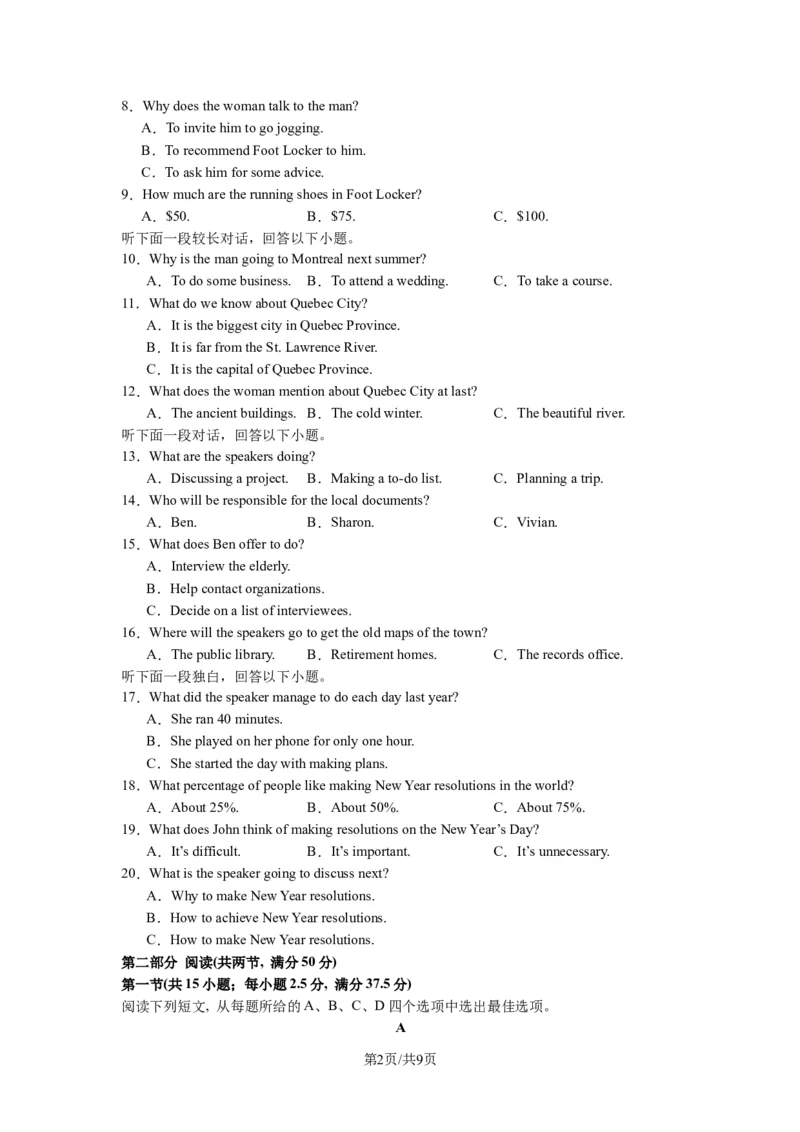
10.Why is the man going to Montreal next summer?
A.To do some business. B.To attend a wedding. C.To take a course.
11.What do we know about Quebec City?
A.It is the biggest city in Quebec Province.
B.It is far from the St. Lawrence River.
C.It is the capital of Quebec Province.
12.What does the woman mention about Quebec City at last?
A.The ancient buildings. B.The cold winter. C.The beautiful river.
听下面一段对话,回答以下小题。
13.What are the speakers doing?
A.Discussing a project. B.Making a to-do list. C.Planning a trip.
14.Who will be responsible for the local documents?
A.Ben. B.Sharon. C.Vivian.
15.What does Ben offer to do?
A.Interview the elderly.
B.Help contact organizations.
C.Decide on a list of interviewees.
16.Where will the speakers go to get the old maps of the town?
A.The public library. B.Retirement homes. C.The records office.
听下面一段独白,回答以下小题。
17.What did the speaker manage to do each day last year?
A.She ran 40 minutes.
B.She played on her phone for only one hour.
C.She started the day with making plans.
18.What percentage of people like making New Year resolutions in the world?
A.About 25%. B.About 50%. C.About 75%.
19.What does John think of making resolutions on the New Year’s Day?
A.It’s difficult. B.It’s important. C.It’s unnecessary.
20.What is the speaker going to discuss next?
A.Why to make New Year resolutions.
B.How to achieve New Year resolutions.
C.How to make New Year resolutions.
第二部分 阅读(共两节, 满分50分)
第一节(共15小题;每小题2.5分, 满分37.5分)
阅读下列短文, 从每题所给的A、B、C、D四个选项中选出最佳选项。
A
第2页/共9页
学学科科网网((北北京京))股股份份有有限限公公司司Cheap Travel
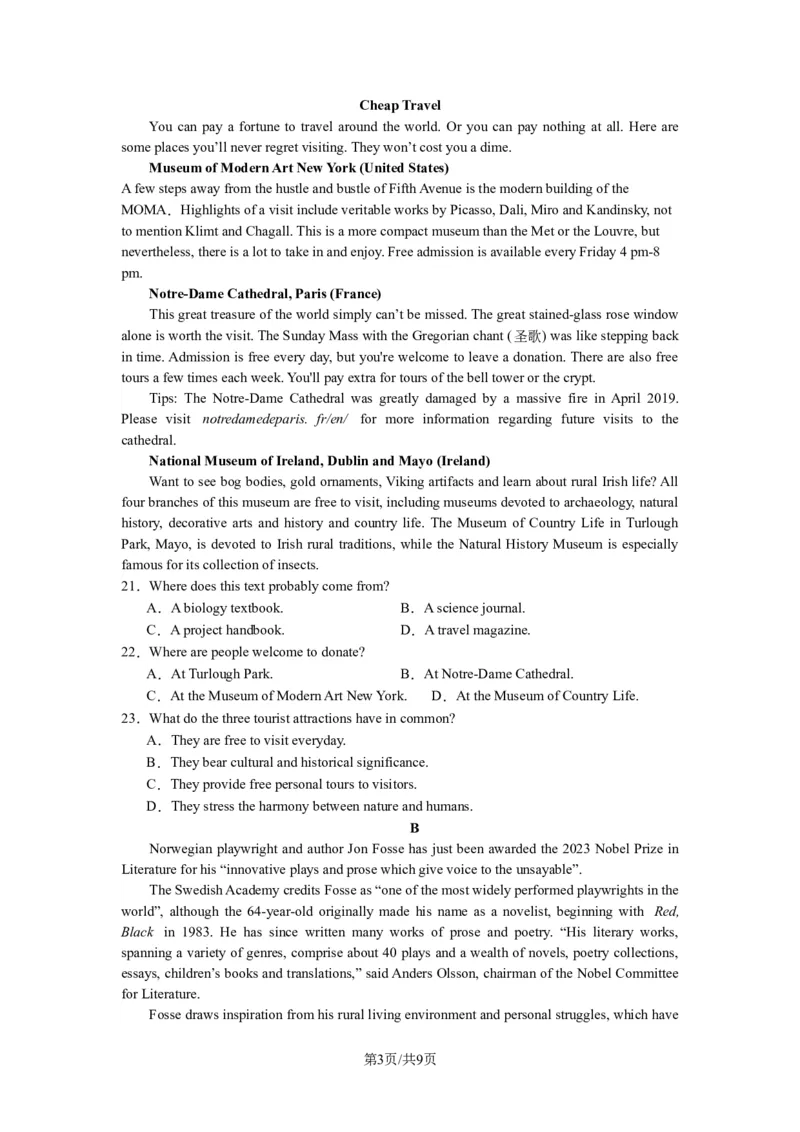
You can pay a fortune to travel around the world. Or you can pay nothing at all. Here are
some places you’ll never regret visiting. They won’t cost you a dime.
Museum of Modern Art New York (United States)
A few steps away from the hustle and bustle of Fifth Avenue is the modern building of the
MOMA.Highlights of a visit include veritable works by Picasso, Dali, Miro and Kandinsky, not
to mention Klimt and Chagall. This is a more compact museum than the Met or the Louvre, but
nevertheless, there is a lot to take in and enjoy. Free admission is available every Friday 4 pm-8
pm.
Notre-Dame Cathedral, Paris (France)
This great treasure of the world simply can’t be missed. The great stained-glass rose window
alone is worth the visit. The Sunday Mass with the Gregorian chant (圣歌) was like stepping back
in time. Admission is free every day, but you're welcome to leave a donation. There are also free
tours a few times each week. You'll pay extra for tours of the bell tower or the crypt.
Tips: The Notre-Dame Cathedral was greatly damaged by a massive fire in April 2019.
Please visit notredamedeparis. fr/en/ for more information regarding future visits to the
cathedral.
National Museum of Ireland, Dublin and Mayo (Ireland)
Want to see bog bodies, gold ornaments, Viking artifacts and learn about rural Irish life? All
four branches of this museum are free to visit, including museums devoted to archaeology, natural
history, decorative arts and history and country life. The Museum of Country Life in Turlough
Park, Mayo, is devoted to Irish rural traditions, while the Natural History Museum is especially
famous for its collection of insects.
21.Where does this text probably come from?
A.A biology textbook. B.A science journal.
C.A project handbook. D.A travel magazine.
22.Where are people welcome to donate?
A.At Turlough Park. B.At Notre-Dame Cathedral.
C.At the Museum of Modern Art New York. D.At the Museum of Country Life.
23.What do the three tourist attractions have in common?
A.They are free to visit everyday.
B.They bear cultural and historical significance.
C.They provide free personal tours to visitors.
D.They stress the harmony between nature and humans.
B
Norwegian playwright and author Jon Fosse has just been awarded the 2023 Nobel Prize in
Literature for his “innovative plays and prose which give voice to the unsayable”.
The Swedish Academy credits Fosse as “one of the most widely performed playwrights in the
world”, although the 64-year-old originally made his name as a novelist, beginning with Red,
Black in 1983. He has since written many works of prose and poetry. “His literary works,
spanning a variety of genres, comprise about 40 plays and a wealth of novels, poetry collections,
essays, children’s books and translations,” said Anders Olsson, chairman of the Nobel Committee
for Literature.
Fosse draws inspiration from his rural living environment and personal struggles, which have
第3页/共9页
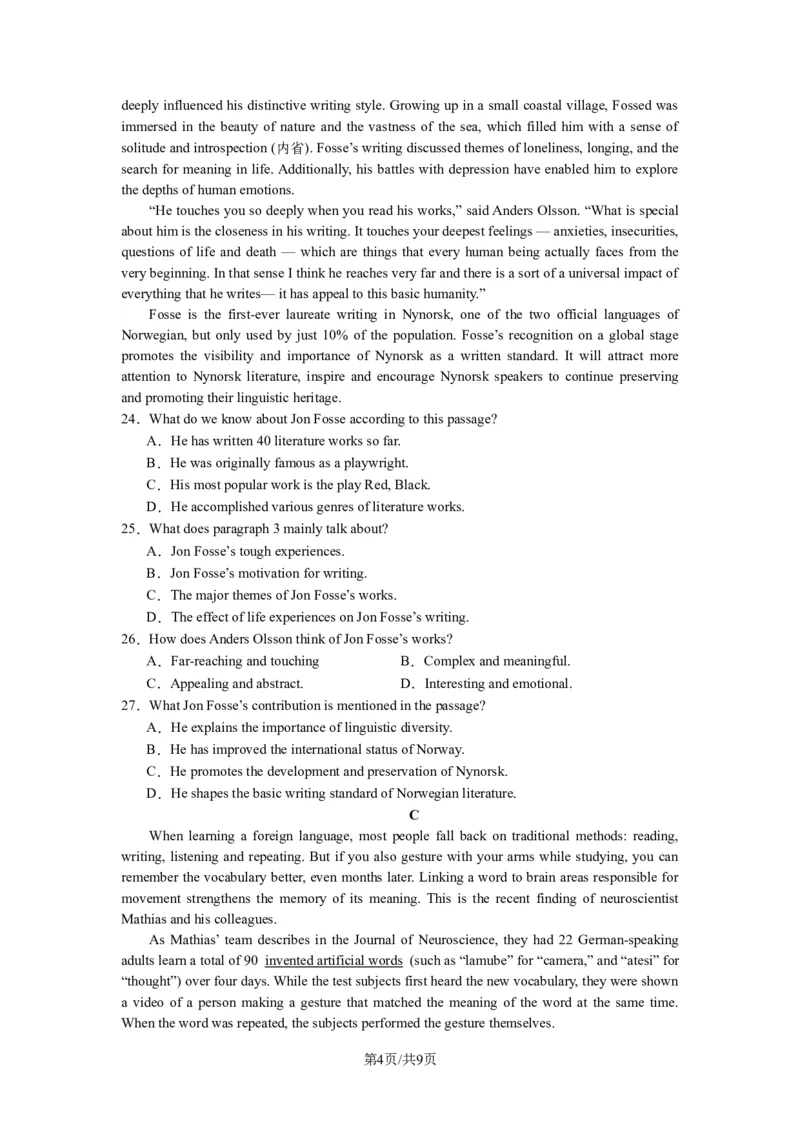
学学科科网网((北北京京))股股份份有有限限公公司司deeply influenced his distinctive writing style. Growing up in a small coastal village, Fossed was
immersed in the beauty of nature and the vastness of the sea, which filled him with a sense of
solitude and introspection (内省). Fosse’s writing discussed themes of loneliness, longing, and the
search for meaning in life. Additionally, his battles with depression have enabled him to explore
the depths of human emotions.
“He touches you so deeply when you read his works,” said Anders Olsson. “What is special
about him is the closeness in his writing. It touches your deepest feelings — anxieties, insecurities,
questions of life and death — which are things that every human being actually faces from the
very beginning. In that sense I think he reaches very far and there is a sort of a universal impact of
everything that he writes— it has appeal to this basic humanity.”
Fosse is the first-ever laureate writing in Nynorsk, one of the two official languages of
Norwegian, but only used by just 10% of the population. Fosse’s recognition on a global stage
promotes the visibility and importance of Nynorsk as a written standard. It will attract more
attention to Nynorsk literature, inspire and encourage Nynorsk speakers to continue preserving
and promoting their linguistic heritage.
24.What do we know about Jon Fosse according to this passage?
A.He has written 40 literature works so far.
B.He was originally famous as a playwright.
C.His most popular work is the play Red, Black.
D.He accomplished various genres of literature works.
25.What does paragraph 3 mainly talk about?
A.Jon Fosse’s tough experiences.
B.Jon Fosse’s motivation for writing.
C.The major themes of Jon Fosse’s works.
D.The effect of life experiences on Jon Fosse’s writing.
26.How does Anders Olsson think of Jon Fosse’s works?
A.Far-reaching and touching B.Complex and meaningful.
C.Appealing and abstract. D.Interesting and emotional.
27.What Jon Fosse’s contribution is mentioned in the passage?
A.He explains the importance of linguistic diversity.
B.He has improved the international status of Norway.
C.He promotes the development and preservation of Nynorsk.
D.He shapes the basic writing standard of Norwegian literature.
C
When learning a foreign language, most people fall back on traditional methods: reading,
writing, listening and repeating. But if you also gesture with your arms while studying, you can
remember the vocabulary better, even months later. Linking a word to brain areas responsible for
movement strengthens the memory of its meaning. This is the recent finding of neuroscientist
Mathias and his colleagues.
As Mathias’ team describes in the Journal of Neuroscience, they had 22 German-speaking
adults learn a total of 90 invented artificial words (such as “lamube” for “camera,” and “atesi” for
“thought”) over four days. While the test subjects first heard the new vocabulary, they were shown
a video of a person making a gesture that matched the meaning of the word at the same time.
When the word was repeated, the subjects performed the gesture themselves.
第4页/共9页
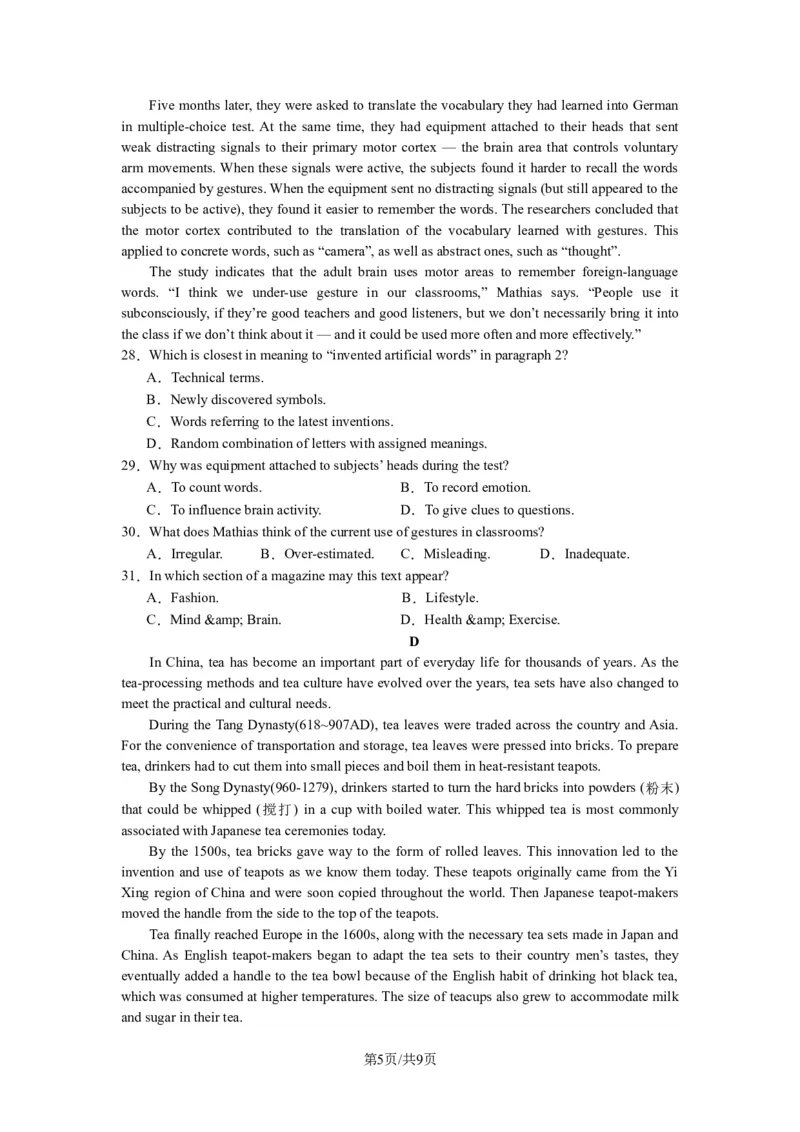
学学科科网网((北北京京))股股份份有有限限公公司司Five months later, they were asked to translate the vocabulary they had learned into German
in multiple-choice test. At the same time, they had equipment attached to their heads that sent
weak distracting signals to their primary motor cortex — the brain area that controls voluntary
arm movements. When these signals were active, the subjects found it harder to recall the words
accompanied by gestures. When the equipment sent no distracting signals (but still appeared to the
subjects to be active), they found it easier to remember the words. The researchers concluded that
the motor cortex contributed to the translation of the vocabulary learned with gestures. This
applied to concrete words, such as “camera”, as well as abstract ones, such as “thought”.
The study indicates that the adult brain uses motor areas to remember foreign-language
words. “I think we under-use gesture in our classrooms,” Mathias says. “People use it
subconsciously, if they’re good teachers and good listeners, but we don’t necessarily bring it into
the class if we don’t think about it — and it could be used more often and more effectively.”
28.Which is closest in meaning to “invented artificial words” in paragraph 2?
A.Technical terms.
B.Newly discovered symbols.
C.Words referring to the latest inventions.
D.Random combination of letters with assigned meanings.
29.Why was equipment attached to subjects’ heads during the test?
A.To count words. B.To record emotion.
C.To influence brain activity. D.To give clues to questions.
30.What does Mathias think of the current use of gestures in classrooms?
A.Irregular. B.Over-estimated. C.Misleading. D.Inadequate.
31.In which section of a magazine may this text appear?
A.Fashion. B.Lifestyle.
C.Mind & Brain. D.Health & Exercise.
D
In China, tea has become an important part of everyday life for thousands of years. As the
tea-processing methods and tea culture have evolved over the years, tea sets have also changed to
meet the practical and cultural needs.
During the Tang Dynasty(618~907AD), tea leaves were traded across the country and Asia.
For the convenience of transportation and storage, tea leaves were pressed into bricks. To prepare
tea, drinkers had to cut them into small pieces and boil them in heat-resistant teapots.
By the Song Dynasty(960-1279), drinkers started to turn the hard bricks into powders (粉末)
that could be whipped (搅打) in a cup with boiled water. This whipped tea is most commonly
associated with Japanese tea ceremonies today.
By the 1500s, tea bricks gave way to the form of rolled leaves. This innovation led to the
invention and use of teapots as we know them today. These teapots originally came from the Yi
Xing region of China and were soon copied throughout the world. Then Japanese teapot-makers
moved the handle from the side to the top of the teapots.
Tea finally reached Europe in the 1600s, along with the necessary tea sets made in Japan and
China. As English teapot-makers began to adapt the tea sets to their country men’s tastes, they
eventually added a handle to the tea bowl because of the English habit of drinking hot black tea,
which was consumed at higher temperatures. The size of teacups also grew to accommodate milk
and sugar in their tea.
第5页/共9页
学学科科网网((北北京京))股股份份有有限限公公司司By the early 1900s, innovations in tea drinking became an American affair. The most
revolutionary one was the tea bag, which was accidentally commercialized by Thomas Sullivan.
He had been sending customers tea wrapped in silk bags. Rather than take the leaves out of the
bags, as Sullivan intended, the customers put the bags into their teapots instead. Not only did the
tea bags push the teapot back to the sidelines of tea service, they were also too large for teacups
and led to the modern practice of drinking tea from mugs.
32.Which was used to make the whipped tea in Japan?
A.Rolled tea leaves. B.Freshly picked tea leaves.
C.Powdered tea leaves. D.Loosely pressed tea leaves.
33.Which innovation was first introduced by the British?
A.Tea bags and mugs. B.Tea bowls with handles.
C.Heat-resistant teapots. D.Teapots with top handles.
34.What can we learn from Thomas Sullivan’s story?
A.Customers are very creative. B.Innovations are relatively easy.
C.Marketing strategy is critical. D.Good ideas can be born by accident.
35.What is the best title for the text?
A.The Development of Tea Sets B.Varieties of Tea Leaves
C.Various Tea-making Methods D.The Spread of Tea Trades
第二节(共5小题;每小题2. 5分, 满分12. 5分)
根据短文内容,从短文后的选项中选出能填入空白处的最佳选项。选项中有两项为多余选
项。
When it comes to helping students learn and mature, there are several ways to increase their
well-being. Although your children may be succeeding in the classroom, there are a few things
that you still can do.
Encouraging physical activity is the first thing you can do. More and more children do not
participate in sports after school. It’s important for you to encourage mobility with sports that are
played after class. You should find sporting equipment, basketball courts and play areas where
kids can increase their well-being. 36
Secondly, you can provide proper nutrition for your children. It’s important for your children
to receive proper nutrition both inside and outside of the home. 37 You’d better make it
a point to provide enough nutrition for their proper development and growth.
38 Many parents fail to stop children from using smart phones and computers.
There are some institutions that even encourage too much screen time as a way to teach children
or keep them entertained. You should help the children remain excited without sitting in front of a
screen throughout the day.
Last but not the least, monitoring bullying (欺凌)is also an essential part. Bullying
continues to remain a common problem in some schools, making it important that the environment
that your children grow in holds a high standard. 39
It’s important to examine the school life as a whole to determine what factors are missing.
40 . You may determine how well they adjust to the world around them and succeed in life.
A.You should provide kids with fresh food.
B.Besides, you’d better limit their screen time.
C.It will encourage children to focus on their study.
第6页/共9页
学学科科网网((北北京京))股股份份有有限限公公司司D.In addition, try your best to give them more freedom.
E.This will reduce the risk of health conditions that include obesity.
F.You can advise teachers to keep a practice of looking for bullying.
G.Parents play a significant role in children’s growth and well-being.
第三部分语言运用(共两节,满分30分)
第一节(共15小题;每小题1分,满分15分)
阅读下面短文,从短文后各题所给的A、B、C和D四个选项中,选出可以填入空白处的
最佳选项。
Winter Solstice (冬至) refers to the day in a year when the night is at its longest and the Yin
energy is at its maximum. On Winter Solstice, the Northern Hemisphere tilts 41 away
from the sun, and the sun’s orbit reached its lowest point. 42 , from this day , the
daytime will get longer and longer. As the delicate node of the ebb (衰退) and 43 of Yin
and Yang, Winter Solstice is the beginning of a new cycle, 44 reunion and hope.
It is said that a doctor named Zhang Zhongjing 45 poor people suffering from
frostbite, so he boiled a pot of mutton with medicinal ingredients, 46 them up and
wrapped them in ear-shaped dough (面团). Those who 47 from frostbitten ears were
give this “cold-dispelling” soup. This is the start of 48 . Subsequently, people made
dumplings in the same manner and ate them during the festival to 49 him.
Before Emperor Wu of the Han Dynasty adopted the lunar calendar, the Winter Solstice was
50 the same as the Spring Festival. Although during the Han Dynasty, the Winter Solstice
was no 51 considered as the beginning of the year, people 52 celebrated,
visited relatives and offered 53 to the ancestors on that day. More 54 has
been paid by people on the Winter Solstice. In Ming Dynasty, Zhu Yuanzhang (the founding father
of Ming Dynasty) made three 55 in a year — the Winter Solstice, the Spring Festival
and his birthday.
41.A.heaviest B.lowest C.highest D.furthest
42.A.Besides B.Therefore C.Otherwise D.However
43.A.mix B.flow C.reach D.distinction
44.A.announcing B.symbolizing C.infecting D.approaching
45.A.pointed B.saw C.pitied D.categorized
46.A.cut B.chewed C.broke D.ate
47.A.affected B.hurt C.suffered D.wounded
48.A.dumplings B.dessert C.mooncake D.noodles
49.A.praise B.comment C.commemorate D.recommend
50.A.accessed B.regarded C.accounted D.appointed
51.A.better B.sooner C.longer D.less
52.A.frequently B.usually C.seldom D.still
53.A.gifts B.sacrifices C.products D.possessions
54.A.attention B.money C.time D.respect
55.A.dates B.events C.customs D.holidays
第二节(共10小题;每小题1. 5分, 满分15分)
阅读下面短文, 在空白处填入1个适当的单词或括号内单词的正确形式。
第7页/共9页
学学科科网网((北北京京))股股份份有有限限公公司司Born in October 1937 in Kunshan, east China’s Jiangsu Province, Qian Qihu has spent over
60 years studying defense engineering, 56 (help) China to build an indestructible
“Underground Steel Great Wall”. “Now we are talking about the underground Great Wall, not
above the ground, 57 underground,” he explained. If the ground structures are destroyed,
the underground “cities” can provide shelter and store the basic supplies 58 (require) for
survival.
Since the 1960s, Qian has begun to study protection 59 nuclear bomb explosions and
made major contributions to building a series of defense facilities deep inside mountains. Qian
also planned underground spaces for over 20 key fortified (设防的) cities, providing 60
(faith) foundations for China’s future cities. Apart from defense facilities, many national projects
are linked to Qian’s work, 61 already play a key part in Chinese people’s life.
In the early 1980s, China’s research in deep rock mechanics was 62 (rough) 10 years
behind than abroad. As a latecomer, Qian spared no effort 63 (make) China catch up and
put forward 16 key technical solutions to dozens of troublesome problems.
Qian, 86 years old now, is the 64 (win) of the country’s top science award, the State
Preeminent Science and Technology Award, and 65 (award) the August 1 Medal — the
highest military honor in the country — in 2022.
第四部分 写作(共两节, 满分40分)
第一节(满分15分)
假如你是李华。你校即将举办年度评优活动,你想推荐你班的李雷同学为“学习标兵”。
请你给校学生会写一封英语推荐信,主要内容包括:
1. 个人简介(性格、爱好等);
2. 推荐理由。
注意:
1. 词数80词左右;
2. 可以适当增加细节,以使得行文连贯。
Dear Student Union,
_______________________________________________________________________________
_______________________________________________________________________________
_______________________________________________________________________________
____________________________________________________
Yours,
Li Hua
第二节(满分25分)
阅读下面材料,根据其内容和所给段落开头语续写两段,使其构成一篇完整的短文。
The wind howled (呼啸) with the terrible storm at night. The stars were stuck to the black
sheet of the sky. The next morning, when I woke up, the winter’s icy wind caused me to shake
My friends and I agreed to take up the skiing contest. I took a seat near the heater, warming
my hand and trying to calm myself before the skiing contest. I was encouraging myself by
shouting, “I can win this contest.” As soon as I reached the white mountain top, I began wearing
my safety guards for the climb down. We rhythmically recited “Ready-set-go” and the race began.
At every moment my speed started to increase. Finally, winning was only one step away. As a
wise man had once said, “With a determined heart, a mouse can also lift an elephant. So willpower
第8页/共9页
学学科科网网((北北京京))股股份份有有限限公公司司and courage can help conquer (战胜) a hard task.” My hope helped me to conquer this challenging
race. I was on top of the world by winning the skiing contest. Skiing has now become my hobby.
The next morning, it was snowing heavily. Watching this wonderful sight along with tasting
the delicious hot chocolate, we friends were planning to go for an overnight climb to the top of the
mountain. We came out of the hotel room and stepped into the deep snow which buried half our
legs into the soft snowy ground. The best moment till now was looking up at the grand mountain.
Also the view was clear. I was eager to start my climb. We climbed towards the top and all of a
sudden I lost my balance and fell from the mountain. Fortunately I did not end up giving up my
life but got a severe fracture (骨折) on my leg.
注意:
1. 续写词数应为150左右;
2. 请按如下格式在答题卡的相应位置作答。
This put me into complete disappointment in the first few days of my recovery.
_______________________________________________________________________________
_______________________________________________________________________________
_______________________________________________________________________________
_______________________________________________________________________________
_______________________________________________________________________________
One fine evening, I saw a joyful hawker (饲鹰者) with a disabled eagle.
_______________________________________________________________________________
_______________________________________________________________________________
_______________________________________________________________________________
_______________________________________________________________________________
_______________________________________________________________________________
第9页/共9页
学学科科网网((北北京京))股股份份有有限限公公司司