2023 年 1 月全国普通高等学校招生统一考试
上海 英语试卷
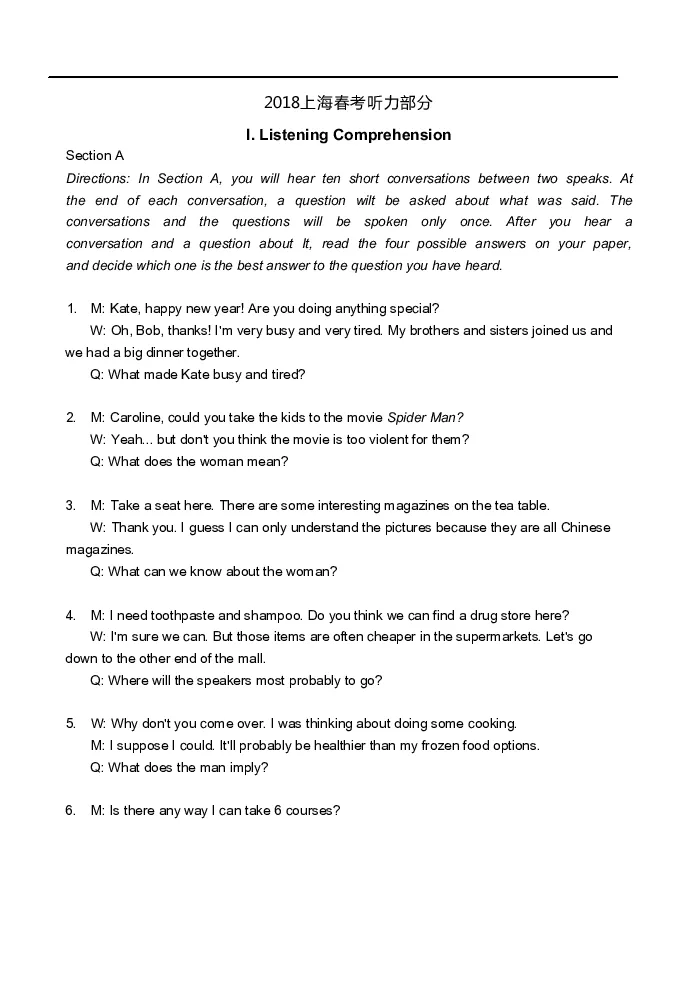
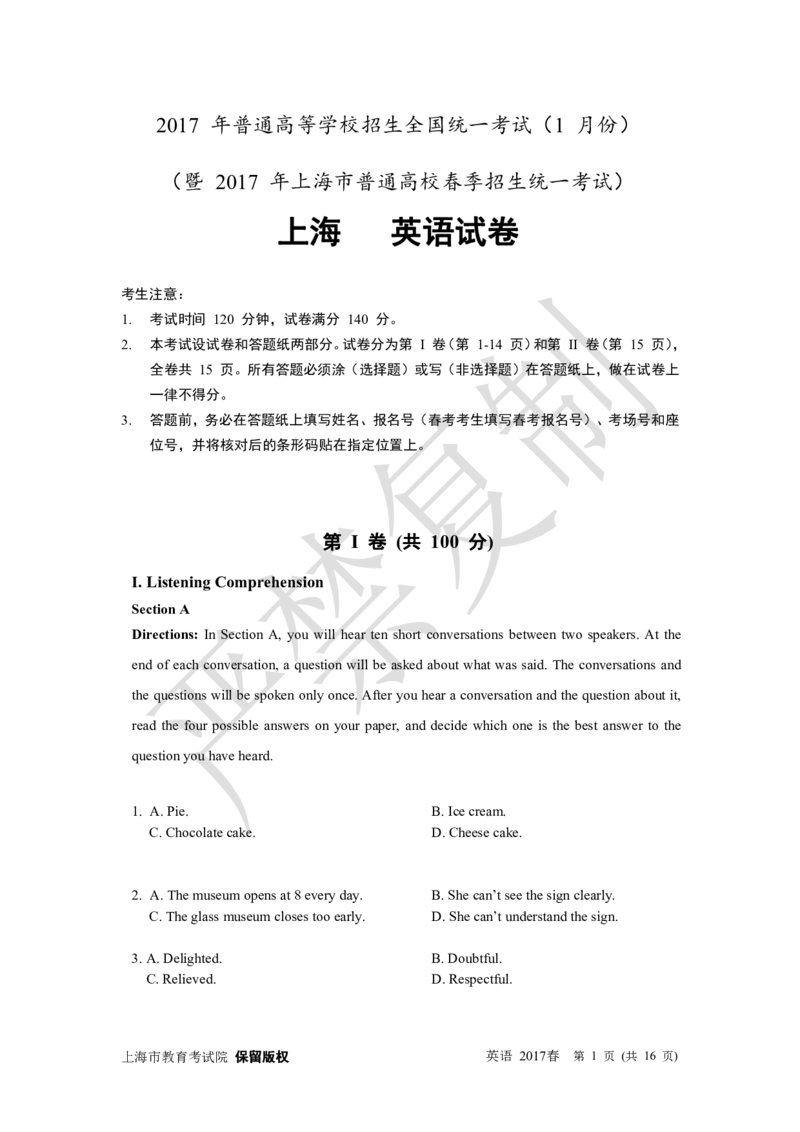
I. Listening Comprehension (第1-10题, 每题1分;第11-20题,每题1.5分;共25分)
Section A
Directions: In Section A, you will hear ten short conversations between two speakers. At the end of each
conversation, a question will be asked about what was said. The conversations and the questions will be spoken
only once. After you hear a conversation and the question about it, read the four possible answers on your
paper, and decide which one is the best answer to the question you have heard.
1. A. Disappointed. B.Depressed C.Glad D.Unhappy
2. A. He was praised. B. He was blamed C. He was threatened D. He was commended
3.A. Difficult but interesting B. Complex and boring.
C. Profound and boring. D. Complex and profound.
4. A. He mistook the time of the lecture. B. He enjoyed the lecture.
C. He was late for the lecture. D. He didn't like the paper-cutting exhibition.
5.A. Annoyed. B.Relieved. C.Indifferent. D.Confused
6. A. He won't sponsor his daughter's marathon.
B. He doesn't want to sponsor his daughter's marathon.
C. He is willing to sponsor his daughter's marathon.
D. He can't sponsor his daughter's marathon.
7. A. He is very free. B. He has a lot of time. C. He is not busy at all. D. He is so busy.
8. A. The function of the suitcase. B. The way to pack efficiently.
C.The types of shoes. D. The way to store clothes.
9.A. The friendship between them. B. The peace between them.
C. The conflict between them. D. The harmony between them.
10. A. The woman met her grandchildren several years ago.
B. The woman hasn't seen her grandchildren for a long time.
C. The man has met her grandchildren for a long time.
D. The man doesn't want her to see her grandchildren.Section B
Directions: In Section B, you will hear two passages and passage or conversation, you will be asked several
questions will be read twice, but the question will be spoken only one the four possible answers on your paper
and decide which o you have heard.
Questions 11 through 13 are based on the following talk.
11. A. Volunteer motorcyclists helping the community by training blood bikers.
B. Blood bikers helping hospitals by donating their blood.
C.Blood bikers helping the community by forming the Association of Blood Bikers.
D. Volunteer motorcyclists helping hospitals by delivering medical materials.
12.A.80. B.1,400. C.262. D.35,000.
13. A. She is a passionate volunteer motorcyclist.
B. She only delivers blood to the hospital.
C. She's a volunteer with no willpower.
D. She once delivered blood for her nephew.
Questions 14 through 16 are based on the following talk.
14. A. It's a wearable device to monitor dogs.
B. It's a wearable device to earn pet insurance fee.
C. It's an electronic caller to look after pets.
D. It's a camera for pet care.
15. A. To help you monitor your pets’ activity and even emotional state.
B. To feedback information on a dog's activity level and food intake.
C.To understand factors to affect dogs' health and overweight and so on.
D. To provide more perfect facilities for pet care and reduce insurance fee.
16. A. An electronic caller that solves the challenges of owning dogs.
B. A wearable device to help owners raise their dogs well.
C. A database on dogs that can enhance pet care.
D. A company that can reduce pet insurance premiums.
Questions 17 through 20 are based on the following conversation.
17. A. A shopping community activity. B. A promotional advertisement
C. A shopping list. D. A sign on the lamp posts.
18. A. Some clothes and household items. B. A toy train and a silver ring.
C. A toy train, a pretty new tablet and a fridge. D. A pretty new tablet and some clothes.
19. A. Get to the yard sales early. B. Set alarm late to get more sleep.C. Watch for the signs on the lamp posts. D. Read the promotional ads in the newspaper.
20. A. Yard sales along the street. B. The signs on the lamp posts.
C. Advertising in the second-hand market. D. Good sale ads for this weekend.
II. Grammar and Vocabulary (每题1分;共20分)
Section A
Directions: After reading the passage below, fill in the blanks to make the passage coherent and
grammatically correct. For the blanks with a given word, fill in each blank with the proper form of the given
word; for the other blanks, use one word that best fits each blank.
Young Enterprise
Young Enterprise is an organization that makes serious efforts to teach all types of young people the
general principles of running a business
(21) __________( originate ) in the United States of America, the idea of Young Enterprise was introduced
into Britain by a successful banker.(22)__________ it developed slowly in its early years, the organization
grew rapidly later. Young Enterprise is now backed by industry and commerce, so that today young people
throughout the United Kingdom can participate.
A participant in Young Enterprise is known as an Achiever. Young Enterprise primarily meets the needs of
young people ( 23 )__________ are still at school, giving them an understanding of industry and the
opportunities it may offer them in the future. But it is usually possible (24 )__________ ( include ) young
people in the same age group who have left school but have not yet started work.
An Adviser is a practicing business executive (管理人员) with an expert knowledge of his own field who
volunteers to keep a Young Enterprise company during its trading year.(25)__________counts for Advisers is
an ability to get on with young people and to put across the subject. As the name(26)__________ (imply),
Advisers are there to advise: they do not run the companies.
Normally, three Advisers-one on accountancy, one on production and one on marketing,(27)__________
( be ) available to each company. Young Enterprise makes (28)__________ a rule that the Advisers must come
from a variety of business occupations.
A Sponsor,(29)__________ (reward) only by the success of the enterprise of "its" Achievers, is an
organization which participates in Young Enterprise and,(30 )__________ its own expense, provides facilities
by making available communications,advice and encouragement.
Section BDirections: Fill in each blank with a proper word chosen from the box. Each word can be used only
once. Note that there is one word more than you need.
digesting
B.distinction C.examine D.identical E.intervening F.live
G. mixture H.perspective I.shock J. space K. text
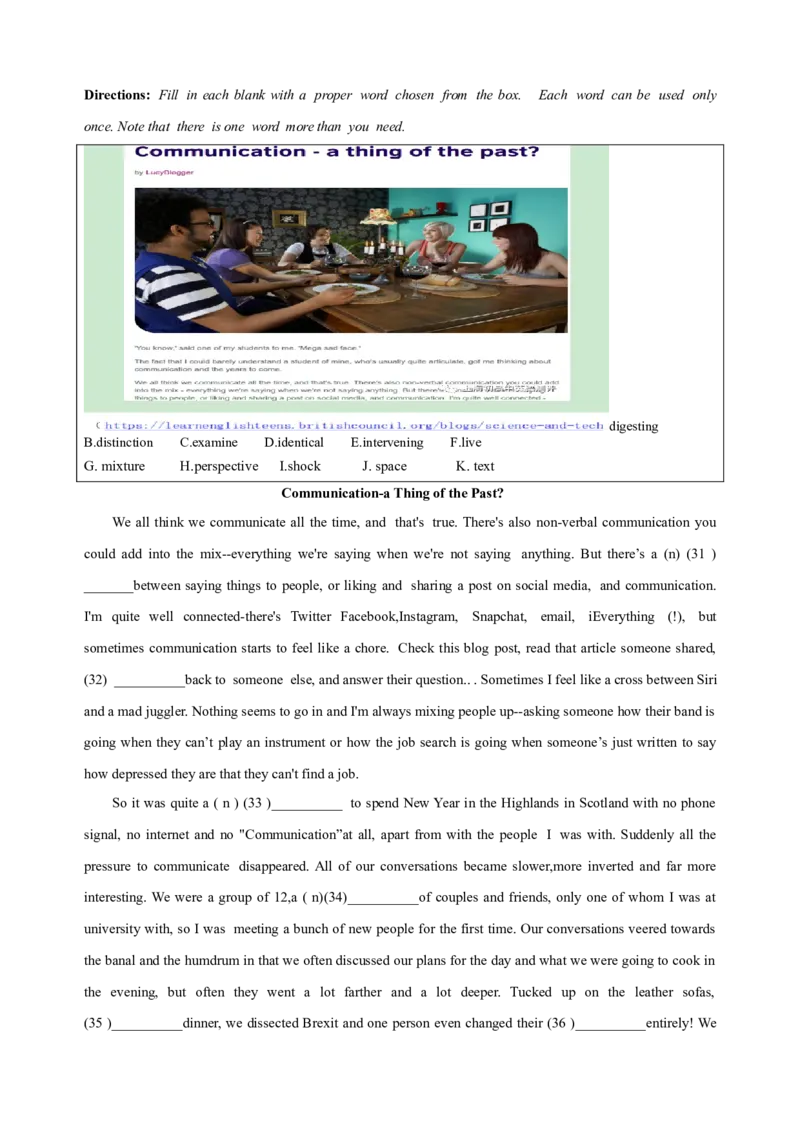
Communication-a Thing of the Past?
We all think we communicate all the time, and that's true. There's also non-verbal communication you
could add into the mix--everything we're saying when we're not saying anything. But there’s a (n) (31 )
_______between saying things to people, or liking and sharing a post on social media, and communication.
I'm quite well connected-there's Twitter Facebook,Instagram, Snapchat, email, iEverything (!), but
sometimes communication starts to feel like a chore. Check this blog post, read that article someone shared,
(32) __________back to someone else, and answer their question.. . Sometimes I feel like a cross between Siri
and a mad juggler. Nothing seems to go in and I'm always mixing people up--asking someone how their band is
going when they can’t play an instrument or how the job search is going when someone’s just written to say
how depressed they are that they can't find a job.
So it was quite a ( n ) (33 )__________ to spend New Year in the Highlands in Scotland with no phone
signal, no internet and no "Communication”at all, apart from with the people I was with. Suddenly all the
pressure to communicate disappeared. All of our conversations became slower,more inverted and far more
interesting. We were a group of 12,a ( n)(34)__________of couples and friends, only one of whom I was at
university with, so I was meeting a bunch of new people for the first time. Our conversations veered towards
the banal and the humdrum in that we often discussed our plans for the day and what we were going to cook in
the evening, but often they went a lot farther and a lot deeper. Tucked up on the leather sofas,
(35 )__________dinner, we dissected Brexit and one person even changed their (36 )__________entirely! Weshared ideas and theories , plots of books and plays and city trips we'd been on, described family troubles and
gave advice, listened to work scenarios and offered pointers, and we had to talk and sketch and use words more
than ever before , because you couldn't say, "It's a great film, you should google it later. " Some of us even had
sore throats from talking so much! In such a short ( 37 )__________of time, due to the proximity of sharing
interconnected cottages and verbal communication, I felt much closer to the new people I'd met and been
speaking with than some other people I communicate with in my normal life.
I don't think our common, current methods of communication come close to being in a small house with
lots of people and having to communicate (38 )__________. The brevity of Twitter, the showiness of Facebook,
all these aspects contribute to a shallow form of communication that doesn't challenge you to
( 39 )__________your feelings and motives enough. "Liking” something is an instant response but what does it
really say about your opinion of something? It's a (n) (40)__________response to millions of other people,
whereas you and your thoughts are unique. If we're not careful , perhaps we might forget how to communicate
on a deeper level.
III.Reading Comprehension (共45分。 41-45每题1分;56-70每题2分)
Section A
Directions: For each blank in the following passage there are four words or phrases marked A. B.C and
D. Fill in each blank with the word or phrase that best fits the context.
For the past five years. I've been examining the pros and cons of reading on-screen versus in print. The
_______bottom line is that while digital devices may be fine for reading that we don't intend to (41 )
_______or reread, text that requires what's been called “deep reading”is nearly always better done in print.
Readers themselves have a keen sense of what kind of reading is best suited for which (42) _______. My
survey research with university students in the United Sates, Germany. and Japan reveals that if costs are the
same, about 90 percent ( at least in my sample ) (43 )_______ hard copy for schoolwork. If a text is long, 92
percent would choose hard copy. For (44) _______texts, it's a toss-up.
Digital reading also (45 ) _______distraction and invites multitasking. Among American and Japanesesubjects, 92 percent reported it was easiest to concentrate when reading in hard copy.(The figure for Germany
was 98 percent. ) In this country.26 percent indicated they were (46)________to multitask while reading in
print, compared with 85 percent when reading on-screen. Imagine (47)_______with Finnegan's Wake while
simultaneously juggling Facebook and booking a vacation fight. You get the point.
Several open-ended questions on my survey were particularly (48 )_______. I asked what people liked
most ( and least) about reading in each medium. Common (49)_______for what students liked most about
reading in print included "I can write on the pages and remember the material easier" and “ it's easier to focus. "
When asked what they liked least about reading (50 )_________, a number of Japanese students reported that
it wasn't " real reading, " while respondents from all three countries complained that they “get distracted” or“
don't absorb as much. "
My all-time favorite reply to the question "What is the one thing you (51 )________about reading in
print?" came from an American: "It takes me longer because I read more carefully. " Isn't careful reading what
academe was designed to promote?
Readings in the humanities tend to be lengthy, intellectually weighty, or both. The (52)_______of digital
reading for the humanities is that screens-particularly those on devices with Internet connections-undermine our
encounters with meaty texts. These (53 ) ________weren't designed for focused concentration, reading slowly,
pausing to argue virtually with the author,or rereading. (54 )_______, they are information and
communication machines, best used for searching and skimming-not scrutinizing.
Teachers and scholars must look beyond today's career-mindedness in talking about challenges to the
humanities. We need to think more carefully about students' mounting rejection of long-form reading , now
(55 )_________ by digital technologies that further complicate our struggle to engage students in serious text-
based inquiry.
41. A. make up B.take on C.hold out D.chew over
42. A.design B. medium C. cover D. content
43.A. prefer B.refer C.offer D.transfer
44. A. lower B. higher C.shorter D. longer
45.A.disarms B.encourages C.encaves D. counteracts
46.A. likely B. orderly C. deadly D. cleanly
47.A.delighting B. satisfying C. struggling D.picnicking
48. A.recommending B. indicating C.recognizing D. revealing
49.A.response B.additions C.solutions D.instruments50. A. casuallys B.delicately C. digitally D. instantly
51. A.disadvantage B. dislike C.misjudge D. decolour
52. A.advance B. suspect C.pleasure D. challenge
53. A.vehicles B.services C.devices D. figures
54. A. Accordingly B. Rather C.Thus D. Therefore
55. A.qualified B.terrified C.identified D.intensified
Section B
Directions: Read the following three passages. Each passage is followed by several questions or unfinished
statements. For each of them there are four choices marked A, B, C and D. Choose the one that fits best
according to the information given in the passage you have just read.
(A)
Until I was six,my family lived in a rural part of the state, in the remote Alaska native village of Fort
Yukon, about 140 air miles from the nearest Judy's(快餐店),down in Fairbanks.
We didn't have running water in Fort Yukon, but we had a TV, and during the time we lived up there, The
Wizard of Oz was broadcast once a year. I was transfixed by the movie, by this little girl's ability to travel from
her dull, rural home to a shining,magical kingdom filled with wonders. I could relate to Dorothy, had even once
flown over a rainbow on the way into Fairbanks, and to me, Oz perfectly illustrated the world beyond our tiny
town, what it was, what it meant.
Besides The Wizard of Oz, the other thing that taught me about the real world outside Fort Yukon was
Judy's. I would nearly press my nose to the screen whenever a Judy's commercial came on. I would scan thecommercials for every tiny detail about what life was like when you lived somewhere where there was a Judy's:
sunshine, happy music, people ate food in brightly colored packages and lived in houses with sidewalks and
lawns.
We went into Fairbanks a few times each year; whenever we flew in a visit to Judy's was almost
guaranteed. Going into Fairbanks and eating at Judy's conferred status.
But the truth is, the food hardly even mattered. Being at Judy's meant that I was in a city big enough to
have one. That world looked nothing like what I saw in Fort Yukon. But if I could fit in at Judy's, I could fit into
the bigger world, I thought. It took leaving for me to understand that none of this was true, that life is hard
everywhere, that if you thought you weren't happy without Judy's , you wouldn't be happy with it.
After we moved to Fairbanks,even though Judy's was right there, we didn't go much anymore, I don't
remember minding. Judy's, I soon learned, was convenient for people in Fairbanks more than it was special,
and we couldn't afford not to plan ahead. People ate there if they couldn't go to nicer restaurants.
Despite the newfound pleasures of Fairbanks, it didn't take long for homesickness to set in.I now missed
Fort Yukon as much as I used to want to go to Judy's; that is to say,powerfully.I missed the wood smoky way
Fort Yukon smells, the way the light slants hard right up on the Arctic Circle, the way everyone knows
everyone else. I missed the coziness of the mission house,the nooks I curled up in to read, the way all my
friends were within walking distance.I missed the village grandmas, who loved all children as if they were their
own.
56. What did the author learn from TV when they lived on Fort Yukon?
A. They learned about the furnishings of the restaurant.
B. They learned about a variety of delicious food that they had never eaten before.
C. They learned about the production process of the Wizard of Oz film.
D. They learned about the world outside of the town.
57. What does the underlined word in the fifth paragraph refer to?
A.Adapting to Judy's, you can get a foothold in a big city.
B. Judy's is very popular with migrant workers in every city.
C. Weekend life without Judy's food can be extremely difficult.
D. Judy's has a pivotal role in fast-paced cities.
58. What was their attitude towards Judy's when they moved to Fairbanks?
A. They almost stopped visiting fast-food restaurants.
B. They still yearned for the fast food restaurants.
C. They quit the habit of eating fast food in Judy's.D. They chose healthier foods instead of fast food.
59. What is the last paragraph of the passage about?
A. The review of daily work.
B.The nostalgia(怀旧)for their home town.
C. The transition in lifestyle.
D. The way of daily commute.
(B)
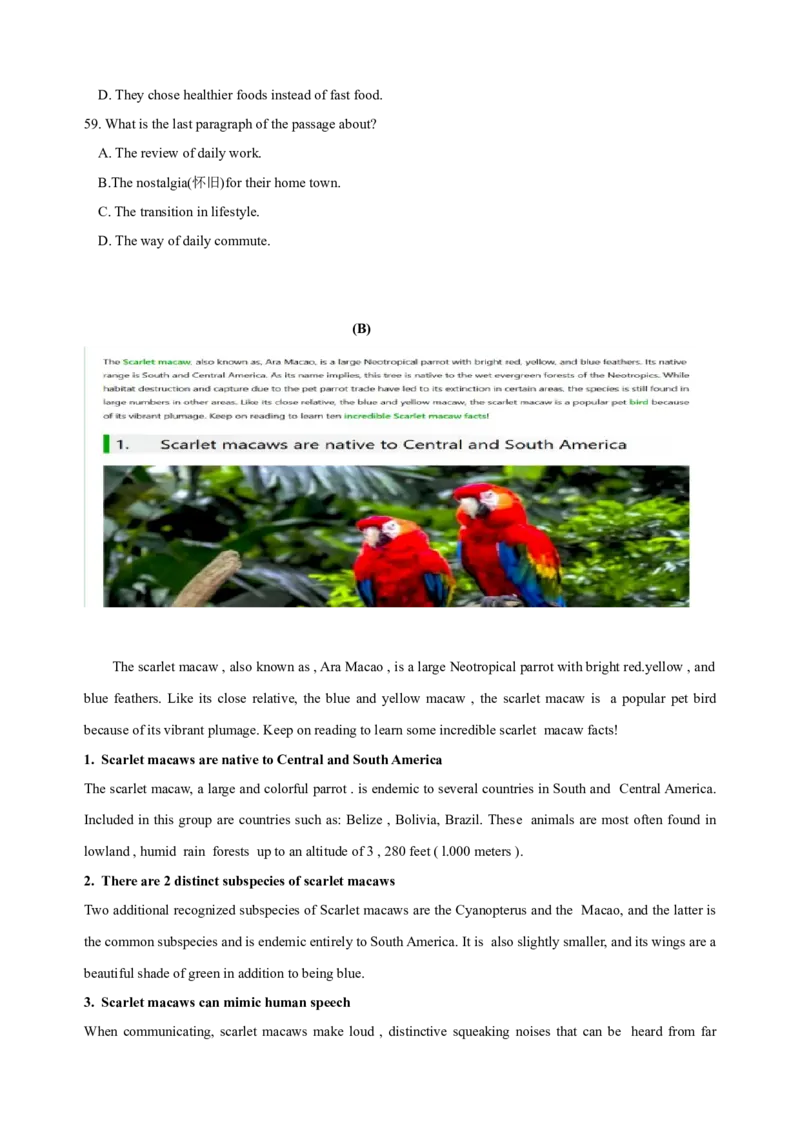
The scarlet macaw , also known as , Ara Macao , is a large Neotropical parrot with bright red.yellow , and
blue feathers. Like its close relative, the blue and yellow macaw , the scarlet macaw is a popular pet bird
because of its vibrant plumage. Keep on reading to learn some incredible scarlet macaw facts!
1. Scarlet macaws are native to Central and South America
The scarlet macaw, a large and colorful parrot . is endemic to several countries in South and Central America.
Included in this group are countries such as: Belize , Bolivia, Brazil. These animals are most often found in
lowland , humid rain forests up to an altitude of 3 , 280 feet ( l.000 meters ).
2. There are 2 distinct subspecies of scarlet macaws
Two additional recognized subspecies of Scarlet macaws are the Cyanopterus and the Macao, and the latter is
the common subspecies and is endemic entirely to South America. It is also slightly smaller, and its wings are a
beautiful shade of green in addition to being blue.
3. Scarlet macaws can mimic human speech
When communicating, scarlet macaws make loud , distinctive squeaking noises that can be heard from faraway. They have a wide vocal range and prefer to shout than talk. One of the most astonishing things about
scarlet macaws is their ability to mimic human speech , which has contributed to their popularity as pets.
4. Scarlet macaws are the largest type of parrot
A fully grown individual of these birds can reach a length of up to 80 cm (31 inches). The tail of a scarlet
macaw accounts for more than half of the bird's total length, which is are marketable feat in and of itself. You
won't find another huge parrot with a tail like theirs. Because of this, they can keep their weight down to under
l kilo while still providing the same level of service (2. 2 Lbs).
5.Scarlet macaws can be identified by their colors
These colorful animals are easy to see. Their scarlet body and primarily blue wings are remarkable. Scarlet
macaw wings also feature green and yellow hues. Their eyes and bill are mostly white with some black, and
their white feathers reach their black mouth. Scarlet macaws also have a relative with a similar color pattern.
This larger parrot is a green-winged macaw.You can't tell them apart by size alone , but their counterparts
primarily have green wings.
6.Scarlet macaws have a long lifespan
These parrots have the potential for exceptionally long lives , with an average lifespan of 40-50 years.
However, some captive macaw species have been known to live as long as 90years!
60. Which of the following statements is true about scarlet macaws?
A.They're endemic to several countries in South and Central America.
B,There is only one subspecies of scarlet macaws.
C.Scarlet macaws can mimic human movements and speech.
D. The scarlet macaw is the smallest of the parrots.
61.What do we know about scarlet macaws’ colors?
A. Their wings are purple.C.Their bodies are scarlet
B.Their eyes are green.
D. Their feathers are black.
62.What is the passage mainly about?
A. A subspecies of the scarlet macaw B. Some facts about the scarlet macaw
C. The lifespan of the scarlet macaw D. Scarlet macaws and humans.
(C)To tell the age of most layered rocks, scientists study the fossils these rocks contain. Fossils provide
important evidence to help determine what happened in Earth history and when it happened.
The word “ fossil” makes many people think of dinosaurs. Dinosaurs are now featured in books, movies,
and television programs, and the bones of some large dinosaurs are on display in many museums. These
reptiles were dominant animals on Earth for well over 100 million years from the Late Triassic through the
Late Cretaceous. Many dinosaurs were quite small, but by the middle of the Mesozoic Period, some species
weighed as much as 80 tons. By around 65 years ago all dinosaurs were extinct.
In spite of all of the interest in dinosaurs, they form only a small fraction of the millions of species that live
and have lived on Earth. The great bulk of the fossil record is dominated by fossils of animals with shells and
microscopic remains of plants and animals, and these remains are widespread in sedimentary rocks. It is these
fossils that are studied by most paleontologists.
In the late eighteenth and early nineteenth centuries, the English geologist and engineer William Smith and
the French paleontologists Georges Cuvier and Alexandre Brongniart discovered that rocks of the same age
may contain the same fossils even when the rocks are separated by long distances. They published the first
geologic maps of large areas on which rocks containing similar fossils were shown. By careful observation of
the rocks and their fossils , these men and other geologists were able to recognize rocks of the same age on
opposite sides of the English Channel.
William Smith was able to apply his knowledge of fossils in a very practical way.He was an engineer
building canals in England, which has lots of vegetation and few surface exposures of rock. He needed to know
what rocks he could expect to find on the hills through which he had to build a canal. Often he could tell what
kind of rock was likely to be below the surface by examining the fossils that had eroded from the rocks of the
hillside or by digging a small hole to find fossils. Knowing what rocks to expect allowed Smith to estimate
costs and determine what tools were needed for the job.
Smith and others knew that the succession of life forms preserved as fossils is useful for understanding how
and when the rocks formed. Only later did scientists develop a theory to explain that succession.
63. What is the purpose of scientists in studying fossils?A. To clarify the category of the layered rock.
B. To utilize the structure of the layered rock.
C.To determine the time of presence of the layered rocks.
D.To modify the environment with a layered rock.
64. Which of the following statements is true about dinosaurs?
A. The mystery of the extinction of the dinosaurs is still unresolved.
B. Dinosaurs have existed around the world for about 6.5 million years.
C.The dinosaurs were extinct in the Mesozoic Period.
D.There was no correlation between dinosaurs and fossils.
65. What can we learn about William Smith?
A. He is a famous French paleontologist.
B. He can predict the types of rock beneath the surface.
C.He can identify rocks of the same age around the world.
D.He needs to turn to professionals to estimate the exploration costs.
66. What is this article mainly talking about?
A.New fossils found by geologists.
B. The formation of the dinosaur fossils.
C. Tools required to develop the sedimentary rocks.
D. Fossils in the rocks facilitating related research advances.
Section C
Directions: Complete the following passage by using the sentences in the box Each sentence can only be used
once. Note that there are two sentences more than you need.A. Before you stock up at cafe , know that it is possible to drink too much coffee.
B. Coffee has its advantages and disadvantages according to different people.
C. Researchers found that caffeine , particularly coffee , had a protective effect against depression.
D. So by all means , grab that extra cup of coffee , but be sure to limit your intake.
E.The mood-boosting news doesn't stop there.
F. To sum up, more researchers should be done to clarify the relation between caffeine and depression.
If you needed another excuse to grab another cup of coffee, consider this research a blessing to do so.
A comprehensive analysis of 12 studies looked at nearly 350,000 individuals and more than 8 .000 cases
of depression. (67)__________ In China, researchers analyzed 15 studies with more than 330 ,000 total
participants. Their results showed that for every cup of coffee people drank, they reduced their risk of
depression by 8 percent.
(68)______________ Harvard researchers studied 10 years’ worth of data from 51 ,000 women ,none of
whom had depression to begin with, The results showed that the women who drank the most coffee ( four or
more cups a day) were 20 percent less likely to develop depression than those who drank little or none.
Yes, coffee just got more magical than you thought possible. But why is this? The secret is in the
brew's anti-inflammatory properties. Coffee contains chlorogenic acid, ferulic acid, and caffeic acid, all of
which reduce the inflammation of nerve cells that bring on depression. Caffeine also has some antioxidant
properties, which can help soothe inflamed areas of the brain.
(69) _________Some side effects of a heavy caffeine intake include anxiety ,
headaches.brain.restlessness, and increased blood pressure. Ir the body experiences these too often, it couldactually trigger the inflammation that may contribute to depression.
Once the caffeine wears off, coffee drinkers may experience a drop in mood, and those who are already
depressed can feel those effects more strongly. One interesting study found that drinking more coffee
decreased chances of suicide , until participants drank eight or more cups a day. Then the risk increased by 58
percent.
(70)__________If you have some leftover, here are surprising ways to use those spare coffee grounds.
IV.Summary Writing
Directions: Read the following passage. Summarize the main idea and the main point( s)of the passage in no
more than 60 words. Use your own words as far as possible.
Fiction Reading
For many people, nothing is more enjoyable than spending a whole afternoon reading a good novel. But
are novels simply a pleasant way to pass the time, or could it be true that reading fiction actually benefits our
lives?
One of the joys of fiction is that it can take us to places that our lives won't.It can transport us to 17th-
century France, or to war-tom Germany. It can take us to a future world in which artificial intelligence takes
over and books are banned , or a fantasy world where people battle it out for food.
Fiction can also introduce us to a whole range of people that we haven't yet met. And this, according to
Carrie Oates, a novelist and academic , is perhaps the real benefit of stories.In one of her studies, participants
were asked to read either a short story by Chekhov, or a version of the story in documentary form. Those who
were given the fictionalized version were found to be more likely to sympathize with the characters, thus going
through greater changes in personality. in another study, she showed participants photos of the eyes of people
who were feeling and thinking different things. The people who read fiction were better able to interpret those
thoughts and feelings than those who didn't read. Oates explains that when we read fiction , we enter into the
minds of the characters. We think about why they behave in a certain way, and what they are likely to do next.
Just as we might become more knowledgeable about psychology and astronomy if we read about psychology
and astronomy , we get better at this kind of social thinking if we read fiction. This improves our understanding
of the thoughts and feelings of those around us in real life.
71. ______________________________________________________________________________________
__________________________________________________________________________________________________________________________________________________________________________________
_________________________________________________________________________________________
___________________________________-
V.Translation (共15分。第1小题和第2小题,每题3分;第3题4分;第4题5分。)
Directions:Translate the following sentences into English, using the words given in the brackets
72.他接到通知,实验结果一时半会还出不来。(inform)
___________________________________________________________________________________
73.若不精心安排,明天的美术馆之行就会变成走马观花。 (if)
______________________________________________________________________________________
74.对喜剧演员来说,没有什么比演出中听到观众得阵阵笑声更有成就感了(there be)
_____________________________________________________________________________________
75.上任以来,镇长始终将了解民生、听取民意视为重中之重,利用工作之余走访了镇上的每家户。
(call on)
______________________________________________________________________________________
VI.Guided Writing (共25分)
Directions: Write an English composition in 120-150 words according to the instructions given below in
Chinese.
你们班的口语课外教Tom发现你们班课上互动不积极,委托你了解同学们的想法,经过你对全班同学
看法的了解,有些同学表示对课堂上讨论的话题不感兴趣,有些同学害怕犯错,不敢开口。
1. 向 Tom 反映同学的想法:
2. 向 Tom 提出建议并说明理由。
______________________________________________________________________________
______________________________________________________________________________
______________________________________________________________________________
______________________________________________________________________________
______________________________________________________________________________
______________________________________________________________________________
______________________________________________________________________________
______________________________________________________________________________
______________________________________________________________________________