北京 101 中学 2022 届上学期初中九年级 10 月月考英语试卷
本试卷共两部分,共50题,满分80分,考试时间90分钟。
一、单项填空(每题0.5分,共6分)
从下面各题所给的A、B、C、D四个选项中,选择可以填入空白处的最佳选项。
1. Mrs. Brown is very nice. All the teenagers like ________.
A. it B. him C. her D. them
2. My brother will go to Wuhan on business ________ December.
A. in B. at C. on D. by
3. — ________ shall we meet for the school trip?
—At 8:00 o’clock in the morning.
A. Why B. Where C. How D. When
4. — Tim, ________ you play ice-hockey?
— Yes, I can.
A. can B. should C. must D. need
5. There is no public transportation now, ________ you’ll have to walk home.
.
A or B. so C. but D. for
6. Rose is ________ than any other girl in her class.
A. popular B. more popular
C. the most popular D. most popular
7. —Sam, where is your brother?
—He ________ his friend in the study now.
A. called B. calls C. is calling D. will call
8. —What did you do last weekend?
—I ________ Universal Studios Beijing (环球影城) with my friends.
A. visit B. were visiting C. visited D. have visited
9. — Sam, what do you sometimes do on Saturday?
— I ________ exercise with my cousins.
A. did B. will do C. do D. am doing
10. My sister Mary ________ French for three years. She is much better at it now.
A. learned B. learns C. will learn D. has learned
11. In the story A Christmas Carol, Marley was mean, so he ________ after he died.
A. punished B. was punished C. is punished D. punishes12. —Could you tell me ________?
— You can go to the town library.
A. where I can get some information about the town
B. where can I get some information about the town
C. where I could get some information about the town
D. where could I get some information about the town
二、完形填空(每题1分,共10分)
阅读下面的短文,掌握其大意,然后从短文后各题所给的A、B、C、D四个选项中,选择最
佳选项。
I was driving to the grocery store on a warm morning in May. I smiled as I watched the golden sunshine
reflecting off the leaves. It was such a ____13____ and heavenly time.
My calm was broken, though, as I rounded a curve(拐弯处). A huge U Haul truck was coming my way several
feet over the center line. I changed the direction as quickly onto the side of the road as I could to ____14____ it. It
was followed by not one but two other U Haul trucks just as the same ____15____. I wondered if all the stuff
inside of them belonged to the same person. I slowed down my car and waited for my heart rate to ____16____. It
was then that I ____17____ a self storage business along the side of the highway, building new units for all the
people who couldn’t fit their belongings into their houses. I saw a(n) ____18____ couple carrying boxes into one
of the units. It seemed strange that a couple just out of their teens could already have too much stuff.
I lost my own ____19____ for owning stuff when a house fire in the middle of the night destroyed everything
my family owned. The only thing I had left was the underwear I was wearing. Yet, our whole family had awakened
in time to escape. In the weeks that followed, friends and family gave us a lot of stuff to get us back on our feet, but
none of it seemed as meaningful any more. What was important was seeing Mom’s smile, giving Nana a hug and a
kiss, and watching Dad snooze(打盹) in his chair after a hard day’s work. What was important was the stuff of soul,
not the stuff of this world. Since then I have tried to limit the things I would ____20____. I didn’t want too much
stuff to crowd up my life. I wanted to only buy what I needed and to spend my days in learning, growing, and
____21____ my family and others.
I believed that only by doing so could I make my ____22____.
13. A. peaceful B. delightful C. refreshing D. energetic
14. A. refuse B. miss C. forget D. desert
15. A. useful B. large C. new D. good
16. A. beat B. feel C. follow D. hit
17. A. did B. thought C. noticed D. built18. A. young B. old C. middle aged D. small
19. A. control B. taste C. trust D. talent
20. A. need B. donate C. waste D. own
21. A. helping B. complaining C. loving D. accepting
22. A. name B. way C. world D. day
三、阅读理解(每题2分,共34分)
阅读下列短文,根据短文内容,从短文后各题所给的A、B、C、D四个选项中,选择最佳选
项。
A
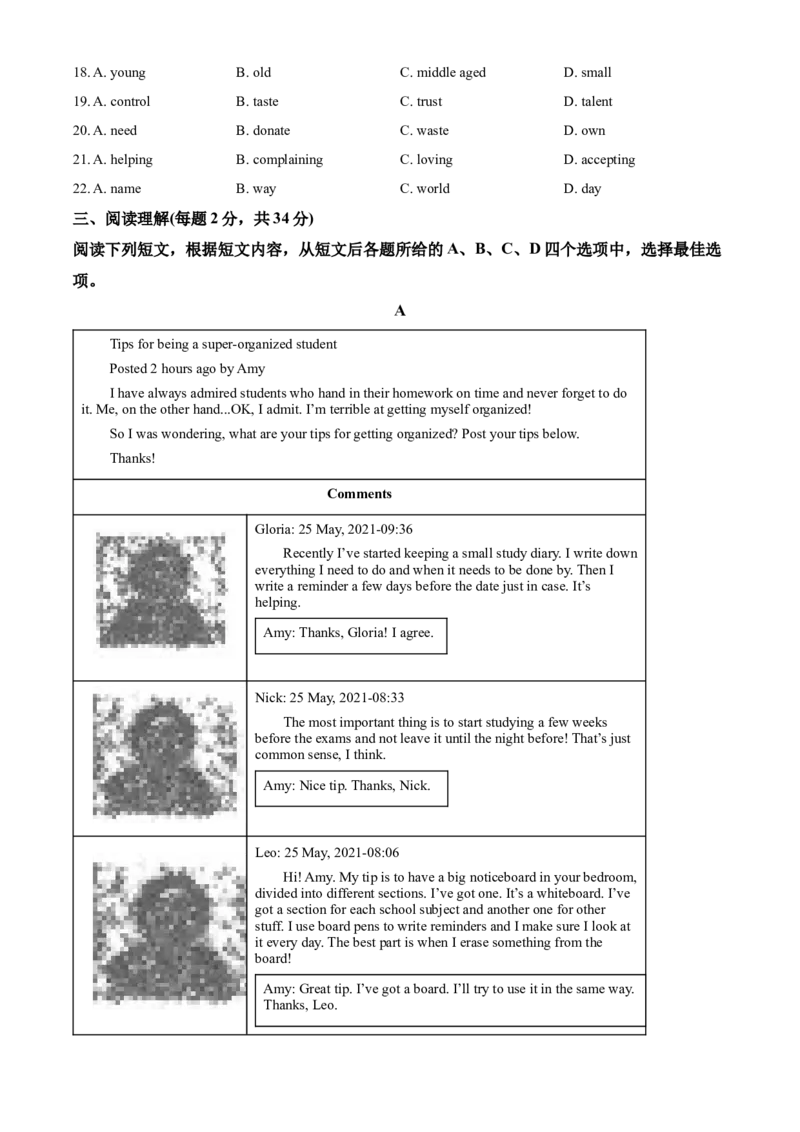
Tips for being a super-organized student
Posted 2 hours ago by Amy
I have always admired students who hand in their homework on time and never forget to do
it. Me, on the other hand...OK, I admit. I’m terrible at getting myself organized!
So I was wondering, what are your tips for getting organized? Post your tips below.
Thanks!
Comments
Gloria: 25 May, 2021-09:36
Recently I’ve started keeping a small study diary. I write down
everything I need to do and when it needs to be done by. Then I
write a reminder a few days before the date just in case. It’s
helping.
Amy: Thanks, Gloria! I agree.
Nick: 25 May, 2021-08:33
The most important thing is to start studying a few weeks
before the exams and not leave it until the night before! That’s just
common sense, I think.
Amy: Nice tip. Thanks, Nick.
Leo: 25 May, 2021-08:06
Hi! Amy. My tip is to have a big noticeboard in your bedroom,
divided into different sections. I’ve got one. It’s a whiteboard. I’ve
got a section for each school subject and another one for other
stuff. I use board pens to write reminders and I make sure I look at
it every day. The best part is when I erase something from the
board!
Amy: Great tip. I’ve got a board. I’ll try to use it in the same way.
Thanks, Leo.23. Amy started the post to get ________.
A. tips on how to be well organized B. comments on her homework
C. suggestions on not forgetting things D. advice on how to do her homework
24. Which of the following is TRUE?
A. Gloria was the first to give comments.
B. Nick thought it the most important to study hard the night before the exam.
C. Amy didn’t agree with what Leo said.
D. Gloria wrote down things she needed to do in a study diary.
25. What did Leo mean by saying “The best part is when I erase something from the board!”?
A. The things he erases are the best part.
B. He is good at cleaning the noticeboard.
C. He enjoys the moment when the tasks are completed.
D. He feels excited when finishing the most difficult task.
B
,
One wet rainy April afternoon Miss O’ Shay, the principal, sent for Nancy Lee to stop by her office as
school closed. Pupils without umbrellas or raincoats crowded in doorways, hoping to make it home between
showers. Outside the skies were grey. Nancy Lee’s thoughts were suddenly grey, too.
She did not think she had done anything wrong, yet that tight (紧的) little knot came in her throat just the
same as she came near Miss O’Shay’s door. Perhaps she had banged her locker too often and too hard. Perhaps the
note in French she had written to Sallie halfway across the study hall just for fun had never got to Sallie but into
Miss O’Shay’s hands instead.
She knocked on Miss O’Shay’s door. A familiar voice said, “Come in.”
Miss O’Shay had a way of making you feel welcome, even if you came to be punished.
“Sit down, Nancy Lee Johnson,” said Miss O’Shay. “I have something to tell you.” Nancy Lee sat down. “But
I must ask you to promise not to tell anyone yet.”
“I won’t, Miss O’Shay,” Nancy Lee said, wondering what on earth the principal had to say to her.
“You are about to graduate,” Miss O’Shay said. “And we shall miss you. You have been an excellent student,
Nancy, and you will not be without honors (荣誉) on the senior list, as I am sure you know.”
At that point there was a light knock on the door. Miss O’Shay called out, “Come in,” and Miss Dietrich
entered. “May I be part of this, too?” she asked, tall and smiling.“Of course,” Miss O’Shay said. “I was just telling Nancy Lee what we thought of her. But I hadn’t got around
to giving her the news. Perhaps, Miss Dietrich, you’d like to tell her yourself.”
Miss Dietrich was always direct. “Nancy Lee,” she said, “your picture has won the Artist Club scholarship.”
The brown girl’s eyes widened, her heart jumped, then her throat tightened again. She tried to smile, but
instead tears came to her eyes.
“Dear Nancy Lee,” Miss O’Shay said, “we are so happy for you.” The elderly white woman took her hand and
shook it warmly while Miss Dietrich smiled with pride.
Nancy Lee must have danced all the way home. She never remembered quite how she got there through the
rain. She hoped she had been calm. But certainly she hadn’t stopped to tell anybody her secret on the way.
Raindrops, smiles, and tears mingled on her brown face. She hoped her mother hadn’t yet got home and that the
house was empty.
26. How did Nancy feel on her way to Miss O’Shay’s office?
A. Excited. B. Scared. C. Angry. D. Confident.
27. What can we infer from the passage about Nancy?
A. She was Miss Dietrich’s best student.
B. She used to be punished by the principal.
C. She would never tell anyone her secret.
D. She would try to hide feelings at home.
28. Which is the best title for this story?
A. A New Star. B. The Girl. C. The News. D. A Young Artist.
C
Have you ever wondered what goes through your mind when you choose where to sit in a new classroom? Or
in a waiting room full of strangers? Or on a bus? Researchers have found out some interesting facts.
Perhaps unsurprisingly, we prefer to sit closer to people like ourselves. Girls sit by girls and boys sit by boys.
Adults sit together and young people choose another young person to sit near. But it goes further than this. We even
choose to sit near someone who looks like us. People with glasses are more likely to sit near other people with
glasses. People with long hair sit closer to other people with long hair.
We seem to believe that people with similar habits or hobbies will share similar attitude and we are more
likely to be accepted by people like ourselves or even, we think we may be safer with people who look like us.
Sometimes that’s true but it's a pity if we always stick to the same people, the same group. The danger in always
staying in our comfort zone (舒适区)is that we just recycle the same opinions, the same tastes and the same ideas.
We lose the chance to learn something new, find out about interesting things, hear funny stories and discoverdifference.
When we always stick to the same people, how can we ever break down the barriers which prevent us from
getting to know people with different ideas? And how can we avoid the ignorance (无知),which too often leads to
prejudice (偏见) and even fear? If instead you want to live in a society that opens to changes and new things and
different opinions, be the cat among the pigeons.
Move out of your comfort zone. Go and sit next to someone different. And don't just sit there in silence. Say
hello. Ask a question. Start a conversation. That’s how we make friends. That’s how we learn about people. That’s
how we open our minds to new ideas. That's how we live an exciting life.
29. From the passage, we know that people prefer sitting by someone who________.
A. is like themselves
B. has a sense of humor
C. is open-minded
D. lives an exciting life
30. People like staying in their comfort zone because they may________.
A. remain comfortable and special
B. be accepted easily and feel safe
C. find out more interesting things
D. discover differences among themselves
31. What is the purpose of the passage?
A. To tell us just to be ourselves in social life.
B. To introduce ways to learn about the world.
C. To explain how people communicate with others.
D. To encourage us to meet people of different kinds.
D
A popular saying goes, “Sticks and stones may break my bones, but words will never hurt me.” However,
that’s not really true. Words have the power to build us up or knock us down. It doesn’t matter if the words come
from someone else or ourselves—the positive and negative effects are just as lasting.
We all talk to ourselves sometimes. We’re usually too shy to admit it, though. In fact, more and more experts
believe talking to ourselves out loud is a healthy habit.
This “self-talk” helps us encourage ourselves, remember things, solve problems, and calm ourselves down. Be
aware, though, that as much as 77% of self-talk tends to be negative. So in order to stay positive, we should only
speak words of encouragement to ourselves. We should also be quick to give ourselves a pat on the back. The nexttime you finish a project, do well in a test, or finally clean your room, join me in saying “Good job!”
Often, words come out of our mouths without thinking about the effect they will have. But we should be aware
that our words cause certain responses in others. For example, when returning an item to a store, we might use
warm, friendly language during the exchange. And the clerk will probably respond in a similar manner. Or harsh
(刻薄的) and critical language will most likely cause the clerk to be defensive.
Words have power because of their lasting effect. Many of us regret something we once said. And we
remember unkind words said to us! Before speaking, we should always ask ourselves: Is it loving? Is it needed? If
what we want to say doesn’t pass this test, then it’s better left unsaid.
Words have power: both positive and negative. Those around us receive encouragement when we speak
positively. We can offer hope, build self-esteem (自尊) and encourage others to do their best. Negative words
destroy all those things. Will we use our words to hurt or to heal? The choice is ours.
32. The main idea of the first paragraph is that ________.
A. negative words may let us down B. positive words give us confidence
.
C words have a lasting effect on us D. nothing but words will hurt us
33. There is no need for us to feel shy when we talk to ourselves because ________.
A. talking to ourselves always gives us courage
B. we can benefit from talking to ourselves
C. it does no harm to have “self-talk” when we are alone
D. almost everybody has the habit of talking to themselves
34. The underlined part “give ourselves a pat on the back” in the third paragraph means ________.
A. remind ourselves B. amaze ourselves
C. relax ourselves D. praise ourselves
35. The author would probably agree that ________.
A. people will always remember to be friendly
.
B it is better to think twice before talking to others
C. negative words may help us make more progress
D. encouraging words surely lead to kind offers
E
Communication theory often stresses how speakers should present their material. However, listeners play the
same important role. Some of them focus intently on the speaker, while others daydream or whisper to a neighbor.
What makes these two kinds of listeners different? Generally speaking, effective listeners have discovered the
benefits of paying close attention. Not having experienced the rewards of paying close attention, ineffectivelisteners continue to wonder why they can’t remember what they “heard” or why they do poorly on tests.
How do effective listeners manage to pay close attention? First of all, they avoid letting poor environments,
like an uncomfortable seat, a personal problem, or the speaker’s manners, distract (使分心) them. Instead, they
“tune out” anything that will keep them from understanding and remembering what they hear. After leaving a
lecture or meeting, they remember what was said, not the room conditions or the poor delivery of the speaker. On
the other hand, ineffective listeners who think they are paying attention to the message can be easily
daydreaming.
In order to resist probable distractions, effective listeners actively but objectively focus on the message itself.
They do not prejudge the speaker as representing an opposite viewpoint, nor do they prejudge the material as
boring, too easy, or too difficult. Effective listeners accept the challenge of new ideas. To help themselves become
actively concerned with the speaker’s message, effective listeners write down important words and phrases as a
reminder of difficult ideas.
Ineffective listeners reject theoretical material; they may pretend to listen but daydream instead to avoid
hearing what they don’t agree with or readily understand. Moreover, rather than dealing with meaning itself,
ineffective but well-intentioned listeners might be so concerned with taking a lot of notes that they miss the
speaker’s main idea. These listeners leave a speech or a class with a notebook full of words that are not connected
by any conceptual framework and therefore mean little when referred to later for a test or other purposes.
Clearly, a certain amount of effort is concerned with listening actively, objectively, and openly to new ideas.
But as that effort begins to pay off for ineffective listeners, they too will develop this skill as a beneficial lifelong
habit.
36. The underlined phrase “tune out” means ________.
A. deal with B. think about
C. pick out D. pay no attention to
37. In order not to be distracted, effective listeners can do following things EXCEPT ________.
A. objectively focusing on the message
B. accepting the challenge of new ideas
C. trying to copy every word of the speaker
D. avoiding prejudging the speaker or the level of the material
38. Which of the following statements is close to the writer’s opinion?
A. Listeners should accept the new ideas and write down important words.
B. Listeners can daydream to avoid hearing what they don’t understand.
C. Listeners will develop listening skills if they copy all the words the speaker said.D. Listeners may remember what was said if they prejudge the speaker’s viewpoint.
39. The main purpose of this passage is to ________.
A. point out the result of effective listening
B. discuss the methods which we used by a variety of listeners
C. explain the differences between effective and ineffective listeners
D. describe the listening habits of poor listeners
四、阅读表达(每题2分,共10分)
阅读短文,根据短文内容回答问题。
Do you want to know how straight-A students from famous universities learn? Benjamin McEvoy, who
studied at University of Oxford, shared his learning methods on US question-and-answer website Quora, which has
been “liked” more than 447,000 times. His tips may help you to learn better.
Go to your lectures
For the first two years of Oxford, I went to maybe four lectures out of hundreds. I was arrogant, foolish and
lazy. In my third year, I went to almost every single lecture available.
But my mind changed when I actually went to lectures. First, lectures are fun! I found so many gems that
influenced my thinking. Many passionate speakers got me excited about the topic. Second, they are so helpful that I
have remembered more stuff! An hour in the lecture hall has huge returns on investment (投入).
Be an active student
For my first year at Oxford, I hardly said anything in tutorials (辅导课) and I didn’t volunteer in discussions.
So my understandings of different texts never matured (成熟) or became complex.
,
Then somewhere in the middle of my second year, I got over myself and offered more of my own
opinions. I responded to others, asked thoughtful questions and interacted (互动) way more.
Study in small chunks
When you structure your studying, the most important task is to ensure you are remembering the information
you have already learned.
In order to improve your retention (记忆力) and take in more information, you need to break your studying up
into manageable blocks (not studying new information for hours on end) and review what you’ve previously
learned in each new block.
40. Who shared his learning methods on US question-and-answer website Quora?
________________
41. How many lectures did he go for in his third year of Oxford?
________________42. What did he think of lectures?
________________
43. When did he get over himself and offer more of his own opinions?
________________
44. What’s the passage mainly about?
________________
五、短文填空(共5分,每空1分)
阅读短文,根据短文内容填空。在未给提示词的空白处仅填一个单词,在给出的提示词的空白处用所给词
的正确形式填空:
Usually polite questions are ____45____ (long). They include expressions such as “Could you please ...” or
“Can I ask ...” It sounds more polite to say, “Peter, could you please ____46____ (tell) me your e-mail address”
than “Peter, tell me your e-mail address.” Sometimes we even need to spend time ____47____ (lead) into a
request. For example, we might first say to a stranger on the street, “Excuse me, I wonder ____48____ you can
help me” or “I’m sorry to trouble you, but ...” before asking for help.
It might seem more difficult to speak politely than directly. However, it is important to learn how to use the
right language in different ____49____ (situation). This will help you communicate better with other people.
六、文段表达(15分)
从下面两个题目中任选一题,根据中文和英文提示,完成一篇不少于50词的文段写作。所给
提示词语仅供选用。请不要写出你的校名和姓名。
题目①
50. 假如你叫李华,你们学校为配合北京申办冬奥会,开展向国外友人介绍中国的传统节日活动。请
你根据以下提示,给某英文报纸投稿,描述你最喜欢的节日是什么?你们是怎么庆祝的?这个节日的真正
精神是什么?
提示词语:festival, traditional, celebrate, during, feel
提示问题:• What festival is it?
• How do you celebrate it?
• What’s the true spirit of the festival?
____________________________________________________________________________________________
____________________________________________________________________________________________
____________________________________________________________________________________________
____________________________________________________________________________________________
________________________________________________________________________________________________________________________________________________________________________________________
____________________________________________________________________________________________
____________________________________________________________________________________________
____________________________________________________________________________________________
____________________________________
题目②
51. 但求耕耘,不问收获。在我们的学习和生活中,能够全身心地投入到一件事情中去,享受做事情
的过程,何尝不是一种幸福!某英文网站正在开展以“全身心投入 (Devotion)”为主题的征文活动。假如你
是李华,请用英语写一篇短文投稿,谈谈自己全身心投入做某事的经历,以及自己的感受。
提示词语:
effort, improve, form a good habit, proud
提示问题:
● What did you devote yourself to?
● How did you do it?
● What have you learnt from the experience?
____________________________________________________________________________________________
____________________________________________________________________________________________
____________________________________________________________________________________________
____________________________________________________________________________________________
____________________________________________________________________________________________
_______________