2023-2024 学年度第一学期初三年级英语练习 1
2023.9
命题人: 高洁 审题人: 陈晨
1. 本试卷共8页, 满分100分。考试时间90分钟。
2. 请在个人信息处中正确填写个人信息。
考生须知
3. 请将答案按题目顺序填涂或填写在答题纸上, 请在答题区域内作答。
4. 选择题用2B铅笔作答, 其它试题用黑色字迹签字笔作答。
听力理解(共 28分)
一、听后选择(共9分, 每小题1.5分)
听对话或独白, 根据对话或独白的内容, 从下面各题所给的A、B、C三个选项中选择最佳选
项, 每段对话或独白你将听两遍。
请听一段对话, 完成第 1 至第2小题。
1. What does the man think of Sichuan hotpot?
A. It's too cold. B. It's spicy. C. It's special.
2. What Chinese food do the woman's family like?
A. Cantonese dishes. B. Sichuan dishes. C. Sushi and sashimi.
请听一段对话, 完成第3至第4小题.
3. What is the relationship between the two speakers?
A. Husband and wife. B. Workmates. C. Mother and son.
4. What will the speakers do first?
.
A Get some medicine for the man's mother.
B. Buy a chicken in the supermarket.
C. Have a look at the new clothes in Blue Moon.
请听一段独白, 完成第 5 至第 6小题。
5. What can we know from the speaker?
A. Group 2 is for students in Grade 7.
B. Students should tell the stories within 15 minutes.
C. The 2nd prize winners will get 10 classic novels.
6. Why does the speaker make the speech?
A. To tell the students the result of the competition.
B. To introduce the information of the competition.
C. To do a report on the competition last month.
二、听后回答(共12分, 每小题2分)
听对话, 根据对话内容, 笔头回答问题。每段对话你将听两遍。
请听一段对话, 完成第7小题。
7. What club is the woman going to join?
_________________________________________________
请听一段对话, 完成第 8 小题。
8. What does the woman like to do at home in winter?
第1页/共10页
学科网(北京)股份有限公司_________________________________________________
请听一段对话, 完成第9小题。
9. How long will it take the man to get to the hotel by bus?
_________________________________________________
请听一段对话, 完成第10—11小题。
10. When is the house-warming party?
_________________________________________________
11. What is the woman going to do in the yard?
_________________________________________________
请听一段对话, 完成第 12小题.
12. What are the speakers talking about?
________________________________________________
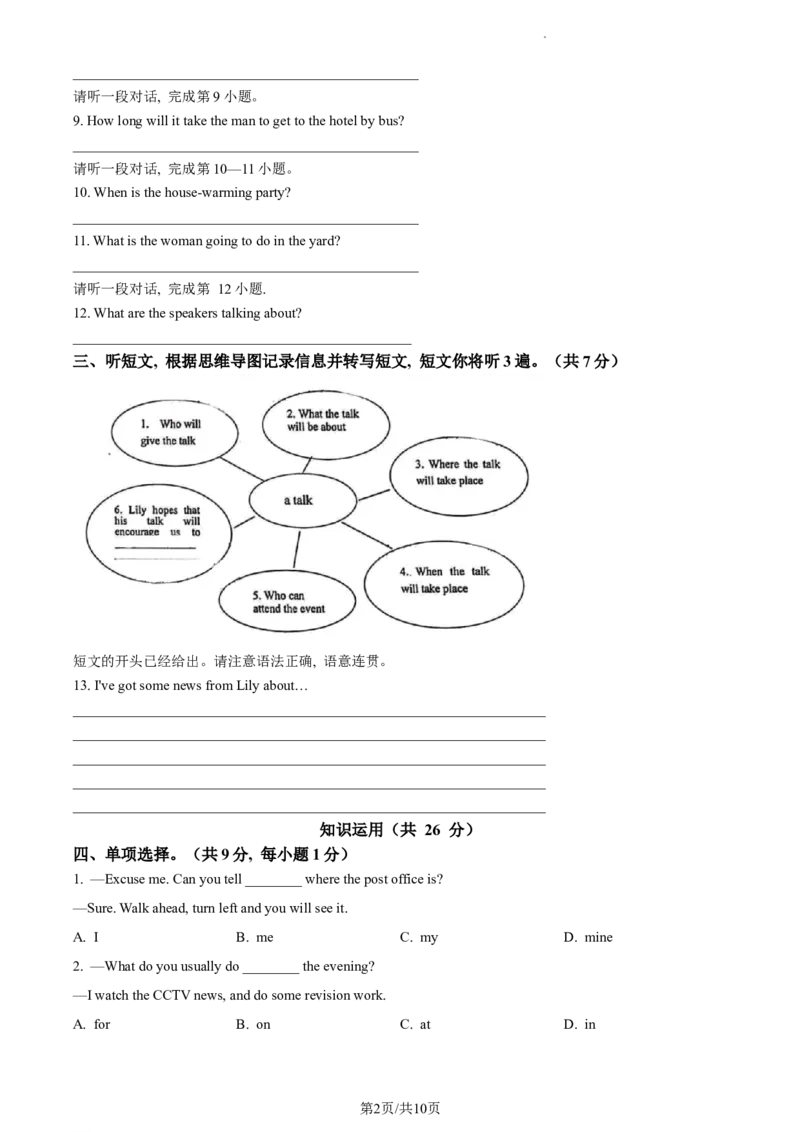
三、听短文, 根据思维导图记录信息并转写短文, 短文你将听3遍。(共7分)
短文的开头已经给出。请注意语法正确, 语意连贯。
13. I've got some news from Lily about…
___________________________________________________________________
___________________________________________________________________
___________________________________________________________________
___________________________________________________________________
___________________________________________________________________
知识运用(共 26 分)
四、单项选择。(共9分, 每小题1分)
1. —Excuse me. Can you tell ________ where the post office is?
—Sure. Walk ahead, turn left and you will see it.
A. I B. me C. my D. mine
2. —What do you usually do ________ the evening?
—I watch the CCTV news, and do some revision work.
A. for B. on C. at D. in
第2页/共10页
学科网(北京)股份有限公司3. He is as ________ as his father this year.
A. strong B. stronger C. strongest D. the strongest
4. With the help of my teachers, I________ much progress since last term.
A. make B. will make C. have made D. had made
5. —Xiao Ming. ________ you recite the dialogue?
—I think I can. Let me try.
A. Do B. May C. Must D. Can
6. — ________ is it from your home to the summer school?
—It’s about 20 kilometers.
A. How long B. How soon C. How far D. How much
7. —Listen! What’s the noise over the store?
—Well, people ________ for its delicious homemade food.
A. are queuing B. queue C. were queuing D. queued
8. This summer, many people ________ their money to help the homeless in the flooded areas.
A. gave up B. gave away C. gave in D. gave off
9. —Could you tell me ________?
—Yes, from September 23rd to October 8th.
A. when will the Hangzhou Asian Games be held
B. when the Hangzhou Asian Games were held
C. when are the Hangzhou Asian Games held
D. when the Hangzhou Asian Games will be held
五、选词填空(共5分, 每小题1分)
注意用方框内所选词语的适当形式填空。
speak boring important interest much little achieve
I want to talk about the ___10___ of good communication and offer some suggestions on how to ___11___
it. In today’s society, good communication skills are important. Firstly, it’s important to be true to yourself and
maintain your natural personality in all situations. Secondly, always look at the person you are ___12___ to and
remember to smile. Lastly, try to stay calm and ___13___ during conversations. By following these suggestions, I
hope we can all improve our communication skills and enjoy ___14___ effective communication than before.
Thank you.
六、完型填空(共12分, 每小题1.5分)
阅读下面的短文,掌握其大意,然后从短文后各题所给的 A、B、C、D 四个选项中,选择最佳选项。
To personal trainer(教练)Sammy Callari, 13-year-old Parker Seward is more than a client. He’s his “little
第3页/共10页
学科网(北京)股份有限公司brother”. Over the past year, the pair have bonded. They play basketball together, ___15___ meals and dance to
hip-hop like no one’s watching.
The trainer was asked to work with the 13-year-old boy, who has Down syndrome(唐氏症), because his
coworker who dealt with the boy was out of town last spring. Callari had never worked with someone with a
disability before. He was ___16___ the first day he met Parker. But Parker’s big smile and cheery introduction
immediately put him at ease. He reminded Callari of himself when he was a teenager. Like Parker, Callari has also
faced his fair share of ___17___ over the years.
As a high schooler, Callari described himself as being the ___18___ kid. When it came to sports, he was
always overlooked(被忽视的). His dream of playing baseball in college quickly died away. When he went to
college, Callari ___19___ to a new sport. His younger brother trained him to become a boxer. Callari participated
in five matches. Out of four of those fights he was the underdog(处于劣势的人), and he won three times. “I know
how it feels,” Callari said. “Society tells you that you can’t do this, you can’t do that.” But when it comes to Parker,
Callari ___20___ to accept the word “can’t”.
The friends meet twice a week to train. They bike, box, run and do push-ups. Parker has a short attention span,
so it’s Callari’s job to keep him focused. “If Parker can do it, if he’s having fun, even with his frustration, then
people will ask, ‘Why can’t I do that?’” Callari said. “That’s the whole task right now.”
Callari recalls Parker’s mom once thanking him for taking a “ ___21___ ” on her son. Callari told her he
never viewed it that way. Parker may be the student, but Callari says he himself is also the one who’s ___22___.
15. A. avoid B. share C. throw D. raise
16. A. anxious B. excited C. calm D. patient
17. A. choices B. happiness C. challenges D. dangers
18. A. strong B. clever C. proud D. weak
19. A. added B. turned C. belonged D. led
20. A. had B. refused C. decided D. planned
21. A. vacation B. trip C. chance D. break
22. A. giving B. teaching C. learning D. receiving
阅读理解(共36分)
七、阅读下列短文, 根据短文内容, 从短文后各题所给的A、B、C、D四个选项中, 选择最佳
选项。(共26分, 每小题2分)
(A)
第4页/共10页
学科网(北京)股份有限公司23. Peter loves Chinese dishes and he wants to learn to cook. He can take Lecture _________.
24. Lucy is a fan of papercutting so she can have a try in Lecture _________.
25. Stuart has always wanted to learn about Chinese operas. He may go to Lecture _________.
(B)
My family and I never talked about school as the ticket to a future. I was in the classrooms, but I wasn’t there
to learn to write, read or even speak. When it was my turn to read, I wanted to hide. I was 13 years old, but I
already hated being who I was.
,
I had an English teacher Mr. Creech, who knew I couldn’t read. In one of my first lessons the teacher said
that anyone who had a reading age below six had to stand up. I felt so embarrassed. But at the same time, it made
me realize that I needed to change the situation. I was determined it wouldn’t happen again. Later that day, Mr.
Creech encouraged me and promised he would try his best to help me learn to read. From then on, I never gave up
practicing reading.
Now I was 41 years old. One day, I planned to fly back to Texas to visit my friends and family. On my way
from the airport, I saw Mr. Creech buying himself a drink. I rushed over and reached into my pocket to pay for him.
“Do I know you?” he asked. “Yes, sir, you do know me,” I answered excitedly. “My name is Anthony Hamilton.
You taught me English.” The look on his face told me that he remembered the boy he’d once encouraged.
“I’m so glad I had a chance to see you,” I said. “And Mr. Creech, I have great news to share.” I told him I had
learned to read. But that wasn’t all. I had become a published author and an active speaker. “The next time you get
another Anthony Hamilton in your classroom, please encourage him to read as well,” I added.
第5页/共10页
学科网(北京)股份有限公司The experts say what once worried me has a name: dyslexia(诵读困难症). But I can tell you it was a lack
of desire for education.
26. Which of the following words could best describe Mr. Creech?
A. Responsible. B. Strict. C. Polite. D. Active.
27. Why couldn’t the author read before meeting Mr. Creech?
A. Because he had a reading age below six.
B. Because his parents didn’t teach him how to read.
C. Because he was afraid of reading before the class.
D. Because he himself didn’t have a strong desire to learn to read.
(C)
We often find ourselves struggling to control our thoughts, but why is it so hard to stop our minds wandering
(漫游)? Research found our thoughts are less focused and under less control than we realize. In a 1996 study,
participants reported more than 4,000 thoughts daily, each lasting no more than five seconds. In a 1987 study,
people took 22% of their thoughts as strange, unacceptable or wrong. Then, is it possible to avoid unwanted
thoughts, whether it’s an upcoming exam or an unpleasant conversation? The answer is: maybe.
In a 2022 study, the researchers showed paid volunteers a series of slides(幻灯片)showing different nouns
(名词). Each noun was repeated on five different slides. As they viewed the slides, the participants wrote down
a word they associated(联想)with each given noun—for example, “road” in response to “car.” Only the
experimental group were told they wouldn’t get paid for repeated words. With this method, the researchers wanted
to create a situation when someone experiences unwanted thoughts.
When the experimental group saw each noun for a second time, they took longer than the control group to
come up with a new association, suggesting their first response popped into their mind before they replaced it.
However, they got quicker each time they viewed the same slide, indicating that their association between the given
word and their first response—the thought they were trying to avoid—was weakening.
“We didn’t find evidence that people can entirely avoid unwanted thoughts,” said research leader Isaac
Fradkin. “But the results suggest that practice can help people get better.”
Not everyone agrees that a slideshow of random(任意的)words can tell how people stop emotional
thoughts. Other research suggests that avoiding thoughts can backfire. When we do it, we’re sending our brains a
message. This effort labels them as something to be feared, making them more powerful.
In the end, it might make more sense to take a mindful approach. “We can allow these thoughts to just be in
our minds, not holding onto them too tightly and not trying to fight them,” said Fradkin.
28. What can we learn from Paragraph 1?
第6页/共10页
学科网(北京)股份有限公司A. Almost all our thoughts are valueless. B. We tend to focus more on negative thoughts.
C. We can’t keep our thoughts for over five seconds. D. Our thoughts can appear and disappear easily.
29. What is the main idea of Paragraph 2?
A. The result of the research. B. The participants of the research.
C. The design of the research. D. The problems of the research.
30. What does “backfire” mean in Paragraph 5?
A. Have an opposite effect. B. Take back the wrong message.
C. Reveal hidden problems. D. Cause a mental breakdown.
31. What can be the best title of the passage?
A. Let’s stop our minds from wandering. B. Unwanted thoughts: Leave them alone.
C. Hold onto the uncontrollable thoughts. D. Emotional thoughts: Avoid them or fear them.
(D)
As the effects of climate change become more disastrous, well-known research institutions(机构)are
focusing new money and attention on an idea: artificially(人工地)cooling the planet, in the hopes of buying
humans more time to cut greenhouse gas emissions(排放).
That strategy, called solar geoengineering, includes reflecting more of the sun’s energy back into space—
reducing global temperatures in a way that is similar to the effects of ash clouds flowing out from the volcanic
eruptions(火山喷发). The idea has been considered as a dangerous solution, as researchers on global warming
worry that it would encourage people to keep burning fossil fuels(化石燃料)while bringing unexpected and
harmful side effects to the planet, producing more hurricanes, wildfires, floods and other disasters.
But as global warming continues, some researchers and policy experts say that worries about geoengineering
should be outweighed by the great need to better understand it, in case climate change will become so terrible that
the world can’t wait for better solutions.
By solar geoengineering, one way to cool the earth is to put aerosols(气溶胶)into the upper part of the
atmosphere where the aerosols reflect sunlight away from the earth. That process works, according to Douglas
MacMartin, a researcher at Cornell University.
“We know with 100% certainty that we can cool the planet,” he said in an interview. “What’s still unclear,” he
added, “is what happens next.” Temperature, MacMartin said, is seen as a sign of climate effects. “What does it do
to the strength of hurricanes?” he asked, “What does it do to agriculture production? What does it do to the risk of
forest fires?”
Another institution supported by the National Science Foundation will study hundreds of similar processes of
aerosol injection, testing the effects on weather extremes around the world. One goal of the research is to look for a
第7页/共10页
学科网(北京)股份有限公司sweet spot: the amount of artificial cooling that can reduce extreme weather events without causing broader
changes in regional rainfall patterns or similar impacts.
32. Why do researchers work on cooling the earth?
A. To prevent natural disasters.
B. To win time to reduce greenhouse gas emissions.
C. To create volcanic eruptions.
D. To encourage more people to burn fossil fuels.
33. What are researchers worried about in terms of global warming?
A. More volcanoes will throw out.
B. More solar energy will go into space.
C. There will be more disasters in the future of the world.
D. People will stop burning fossil fuels to keep warm.
34. What can we infer from Douglas’ words in an interview?
A. More research remains to be done as much is still unclear.
.
B He is optimistic about the result of cooling the earth.
C. He is worried about the reduction in agriculture production.
D. He disagrees with the practice of solar geoengineering.
35. What does “sweet spot” in the last paragraph mean?
A. The rainfall pattern of a region. B. The number of extreme weather events.
C. The modest(适度的)drop in temperature. D. The needed amount of aerosol.
八、阅读短文, 根据短文内容回答问题。(共10分)
Indian-origin Anvitha Vijay has given a new meaning to the phrase “age is just a number”; she has proved that
achievements and knowledge follow passion and not just age and experience.
Vijay, who lives with her parents in Melbourne, Australia, at the age of seven realized that her piggy bank did
not have enough money to hire a developer to make her an app, so she decided to teach herself how to code. With
the help of YouTube videos, the young techie learned to code. For one entire year, she watched multiple coding
tutorials on the web and became a programmer herself.
Vijay’s inspiration for developing the apps was her little sister, who was still learning to talk. Therefore, Vijay
developed an educational app for children that were her sister’s age. The app is called Smartkins, which uses about
100 sounds and flashcards of different animals that help children learn and identify. Later, Vijay developed a
similar iOS app for children to identify and learn colors. Each app has been downloaded thousands of times.
Anvitha’s skills won her a scholarship to attend a big tech conference hosted by Apple in San Francisco,
California. There, she got tips from the pros. She went to workshops where she learned about the latest software for
第8页/共10页
学科网(北京)股份有限公司app building.
All that training led to an idea for a third app. This one, called GoalsHi, is to inspire kids to practice good
habits. Users are rewarded for achieving goals, such as eating their vegetables or practicing the piano. Anvitha says
the rewards are like getting a sticker for a job well done.
Anvitha’s goal is to continue creating technology that helps kids learn while having fun. But even more
important to her is that the world sees the power of technology in kids’ hands. “The more training we get in tech at
an early age,” she says, “the better chance we have of becoming creativity champions who will one day change the
world.”
.
36 How old was Vijay when she learned to code?
__________________________________________________
37. What is the purpose of GoalsHi?
__________________________________________________
38. To Vijay, what is even more important than the creation of technology?
__________________________________________________
39. What makes Vijay succeed in developing apps? Can you name two of her qualities(品质)and explain how
they made her succeed?
___________________________________________________
书面表达(共 10分)
九、文段表达。
请从下面两个题目中任选一题, 根据中文和英文提示, 完成一篇不少50词的文段写作。所给
提示词语仅供选用, 请不要写出你的校名和姓名。
题目一
40. 假如你是李华,你们班想在中秋节组织一个庆祝活动。你打算邀请交换生Peter参加这次活动。请
你用英语给他写一封电子邮件,告诉他活动内容、意义及安排。
提示词语:invite, meaningful, beautiful, Mid-autumn festival
提示问题:When and where will you have this activity?
What activity do you plan to do?
Why do you want to organize this activity?
Dear Peter,
How is everything going?
____________________________________________________________________________________________
____________________________________________________________________________________________
____________________________________________________________________________________________
第9页/共10页
学科网(北京)股份有限公司____________________________________________________________________________________________
____________________________________________________________________________________________
____________________________________________________________________________________________
____________________________________________________________________________________________
_____________________
.
Hope to hear from you soon
Yours,
Li Hua
题目二
41. 自律自控是关乎一个人发展进步的重要素质。假期是提升自律自控能力的好时机,校刊以“自控”
(self-control)为题,开展征文活动,请同学们结合假期生活,围绕以下问题写一篇英语作文。
提示词语:plan, responsible, help, self-control…
提示问题:
1. Why do you think self-control is important to you?
2. What did you do to improve your self-control ability this summer vacation?
____________________________________________________________________________________________
____________________________________________________________________________________________
____________________________________________________________________________________________
____________________________________________________________________________________________
____________________________________________________________________________________________
____________________________________________________________________________________________
____________________________________________________________________________________________
____________________
第10页/共10页
学科网(北京)股份有限公司