








文档内容
人大附中通州校区九年级上开学调研
听力部分(共30分)
一、听后选择(每题1.5分,共19.5分)
听对话或独白,根据对话或独白的内容,从下列各题所给的A、B、C三个选项中选择最佳选项。
每段对话或独白你将听两遍。
请听一段对话,完成第1至第2题。
1. What's the matter with the boy?
.
A He has a headache. B. He cut himself. C. He has a fever.
2. What does the woman advise the boy to do?
A. To see a doctor. B. To get some sleep. C. To take some medicine.
请听一段对话, 完成第3至第4题。
3. What does the man want to buy for his son?
A. A toy car. B. A child's bike. C. ACD player.
4. How long has the girl's father had the CD player?
A. For 3 years. B. For 5 years. C. For 15 years.
请听一段对话, 完成第5至第6题。
5. Where will the speakers meet?
.
A At the city park. B. At the water park. C. At the amusement park.
6. What are the speakers mainly talking about?
A. Places to buy skates. B. Ways to save money. C. Plans for the afternoon.
请听一段独白, 完成第7至第8题。
7. What can we learn from the speech?
A. Steve wrote the play with Amy.
B. Linda volunteered to choose music.
.
C Chris organized practices for the play.
8. Why does the speaker make the speech?
A. To describe a special teacher.
B. To introduce a fair competition.
C. To share a successful experience.
请听一段对话, 完成第9题。
9. What is the girl reading?
A. A book about birds. B. A book about pictures. C. A book about interesting facts.
第1页/共12页
学科网(北京)股份有限公司请听一段对话, 完成第 10 题。
10. When did the girl go to a summer camp?
A. In 2009. B. In 2019. C. In 2090.
请听一段对话, 完成第11题。
11. What can we learn from the dialogue?
A. The woman Mary knew where the accident happened at first.
B. The man was near the hospital when the accident happened.
C. It was lucky that the two drivers didn't get hurt.
请听一段对话, 完成第12题。
12. What does Mom tell the boy to do first?
A. To clean his room. B. To empty the bin. C. To make the bed.
请听一段对话, 完成第 13 题。
13. Why does the boy talk to the girl?
A. To ask her to bring a pen and a notebook.
B. To invite her to go to the museum tomorrow.
C. To inform her of a visit to the art museum.
二、听后填空(每题1.5分,共10.5分)
听短文, 根据所听内容和提示信息, 将所缺信息填写在相应位置上。其中, 14—18为单词, 19—20为短语或
短句(省略号部分补全), 短文你将听两遍。
How to get over nervousness
●take a deep breath in and slowly count to 5
Take a breath ●let it out and count to 5 again
●do that several times 19……
●look al 5 things and think about their ___________
Use the 5-4-3-2-1
●listen for 4 sounds and touch 3 things
___________
●notice 2 smells and list 1 thing you can ___________
●go for a little walk 20……
Get out of the ___________
●talk to a ___________ friend or a loved one
笔试部分(70分)
三、单项选择(共6分, 每小题0.5分)
从下列各题所给的A、B、C、D四个选项中, 选择可以填入空白处的最佳选项。
1. My brother and I like museums. ________ often visit them on weekends.
A. I B. We C. They D. You
第2页/共12页
学科网(北京)股份有限公司2. Beihai Park is so quiet that people can hardly believe it’s ________ the city center.
A. on B. to C. in D. of
3. — Tim, have you ever heard the song Together for a Shared Future?
— Yes, it ________ beautiful.
A. smells B. sounds C. feels D. looks
4. —Emma, ________ have you been in Beijing?
—For about two years.
A. how far B. how often C. how long D. how soon
5. The Yangtze River is almost as ________ as the Amazon River.
A. longer B. longest C. the longest D. long
6. So far China ________ nine manned spaceships into space.
A. sends B. will send C. has sent D. sent
7. The cute dog caught my eyes ________ I walked into the pet store.
A. as soon as B. ever since C. although D. unless
8. I ________ my mom do the dishes when Jimmy called in at eight last night.
A. help B. helped C. will help D. was helping
9. Our class ________ in an old people’s home next summer vacation.
A. volunteer B. volunteered C. have volunteered D. will volunteer
10. —________ you explain to me how to do this math problem, Tom?
—Sure, no problem.
A. Must B. Could C. Should D. May
11. The government ________ a new road near our school in 2020.
A. build B. built C. has built D. will build
12. — Could you please tell me ________?
— Next Friday.
.
A when we visit the Science Museum
B. when do we visit the Science Museum
C. when will we visit the Science Museum
D. when we will visit the Science Museum
四、完形填空。(共8分, 每题1分)
阅读下面的短文,掌握其大意,然后从短文后各题所给的A、B、C、D四个选项中,选择最佳选项。
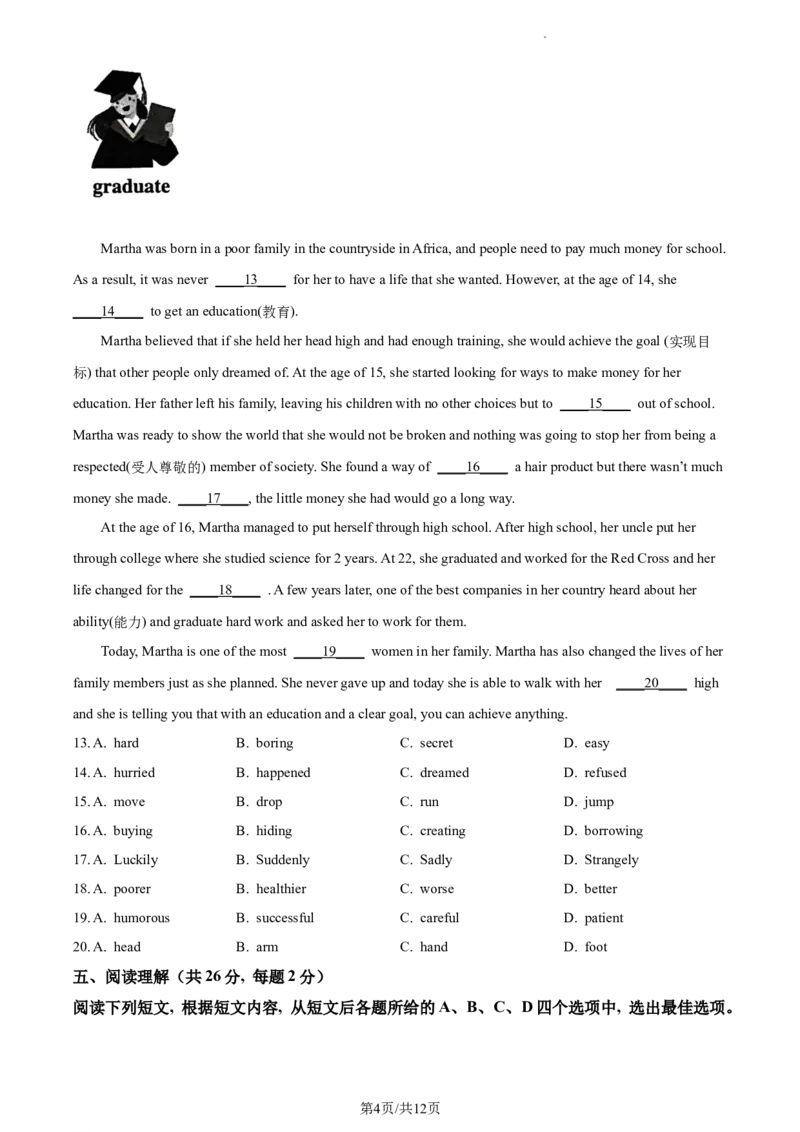
Never Stop Trying
第3页/共12页
学科网(北京)股份有限公司Martha was born in a poor family in the countryside in Africa, and people need to pay much money for school.
As a result, it was never ____13____ for her to have a life that she wanted. However, at the age of 14, she
____14____ to get an education(教育).
Martha believed that if she held her head high and had enough training, she would achieve the goal (实现目
标) that other people only dreamed of. At the age of 15, she started looking for ways to make money for her
education. Her father left his family, leaving his children with no other choices but to ____15____ out of school.
Martha was ready to show the world that she would not be broken and nothing was going to stop her from being a
respected(受人尊敬的) member of society. She found a way of ____16____ a hair product but there wasn’t much
money she made. ____17____, the little money she had would go a long way.
At the age of 16, Martha managed to put herself through high school. After high school, her uncle put her
through college where she studied science for 2 years. At 22, she graduated and worked for the Red Cross and her
life changed for the ____18____ . A few years later, one of the best companies in her country heard about her
ability(能力) and graduate hard work and asked her to work for them.
Today, Martha is one of the most ____19____ women in her family. Martha has also changed the lives of her
family members just as she planned. She never gave up and today she is able to walk with her ____20____ high
and she is telling you that with an education and a clear goal, you can achieve anything.
13. A. hard B. boring C. secret D. easy
14. A. hurried B. happened C. dreamed D. refused
15. A. move B. drop C. run D. jump
16. A. buying B. hiding C. creating D. borrowing
17. A. Luckily B. Suddenly C. Sadly D. Strangely
18. A. poorer B. healthier C. worse D. better
19. A. humorous B. successful C. careful D. patient
20. A. head B. arm C. hand D. foot
五、阅读理解(共26分, 每题2分)
阅读下列短文, 根据短文内容, 从短文后各题所给的A、B、C、D四个选项中, 选出最佳选项。
第4页/共12页
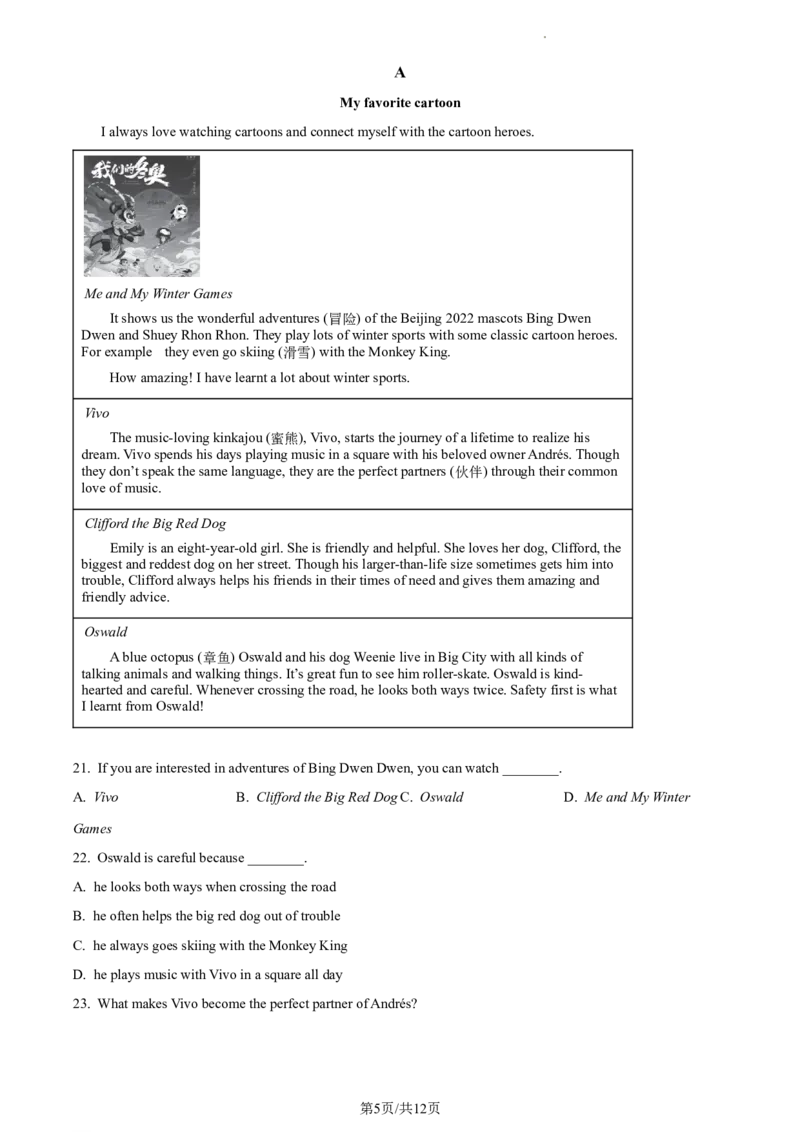
学科网(北京)股份有限公司A
My favorite cartoon
I always love watching cartoons and connect myself with the cartoon heroes.
Me and My Winter Games
It shows us the wonderful adventures (冒险) of the Beijing 2022 mascots Bing Dwen
Dwen and Shu,ey Rhon Rhon. They play lots of winter sports with some classic cartoon heroes.
For example they even go skiing (滑雪) with the Monkey King.
How amazing! I have learnt a lot about winter sports.
Vivo
The music-loving kinkajou (蜜熊), Vivo, starts the journey of a lifetime to realize his
dream. Vivo spends his days playing music in a square with his beloved owner Andrés. Though
they don’t speak the same language, they are the perfect partners (伙伴) through their common
love of music.
Clifford the Big Red Dog
Emily is an eight-year-old girl. She is friendly and helpful. She loves her dog, Clifford, the
biggest and reddest dog on her street. Though his larger-than-life size sometimes gets him into
trouble, Clifford always helps his friends in their times of need and gives them amazing and
friendly advice.
Oswald
A blue octopus (章鱼) Oswald and his dog Weenie live in Big City with all kinds of
talking animals and walking things. It’s great fun to see him roller-skate. Oswald is kind-
hearted and careful. Whenever crossing the road, he looks both ways twice. Safety first is what
I learnt from Oswald!
21. If you are interested in adventures of Bing Dwen Dwen, you can watch ________.
A. Vivo B. Clifford the Big Red DogC. Oswald D. Me and My Winter
Games
22. Oswald is careful because ________.
A. he looks both ways when crossing the road
B. he often helps the big red dog out of trouble
C. he always goes skiing with the Monkey King
D. he plays music with Vivo in a square all day
23. What makes Vivo become the perfect partner of Andrés?
第5页/共12页
学科网(北京)股份有限公司A. Going skating with Andrés. B. Speaking the same language.
C. Having a common love of music. D. Giving Andrés some good advice.
B
In December 2004, as a new professional photographer, I began to work on a project about communities who
live on the sea in Southeast Asia.
I went out to sea with them regularly. On the morning of 26 December, I was due, to set out with a group of
six fishermen in a small boat. It was about 8 am, and the sea looked different. The water was totally still. I could
tell from the way the fishermen were behaving that something wasn’t right. They seemed to be discussing whether
or not we should set off, but the eldest, who operated the boat, gave the go-ahead order.
About 20 minutes later, one of the fishermen pointed to a small white spot far in the distance. It looked like a
football. It was getting bigger and bigger very quickly. We had no idea that this was a tsunami wave speeding
through the ocean like a tornado(龙卷风).
With a big wave, you would usually try to get as far out as possible into the open sea. The deeper the water,
the weaker the wave. But we weren’t far enough out to be safe, nor close enough to the shore to make it back
before the wave would hit the land. We were trapped.
When I realized that the fishermen, who were born on the sea, were afraid, I began to feel really scared. At
some point the elder took control. No one panicked or screamed. The captain told the six of us where to sit, so we
would balance out the boat.
I was sitting on one of the benches in the middle, with my back facing the five-to-seven-meter-high wave. I
took hold of my seat firmly, closed my eyes and said goodbye to the world, my family and friends, in my mind.
Suddenly there was a huge noise and a sudden movement. The wave had hit the boat, but in the very second of
impact, the incredibly skilled captain got it right. He managed to sail up and on to the wave. Then the boat glided
(滑动)from the tip of the wave down behind it, into safe waters. He had saved us all.
Surviving gave me a deep understanding of how short life can be. I’ve been going back to southeast Asia
almost every year to thank the people who saved my life.
24. Before setting out to the sea, the author and the fishermen ___________.
A. talked about the route B. felt something unusual
C. predicted a coming tsunami D. made insufficient preparations
25. What can we learn about the author from the story?
A. It was his first time to explore the sea.
B. He felt scared because of his inexperience.
C. He thought he would die from the tsunami.
第6页/共12页
学科网(北京)股份有限公司D. He was confident that all on board would survive.
26. Which of the following words can best describe the captain?
A. Kind and determined. B. Smart and generous.
C. Calm and skillful. D. Brave and honest.
C
Absence of evidence is not the same thing as evidence of absence. But if you try to find the difference and
keep failing to get it, you can be forgiven. And so it is with the complicated subject of explicit(明确的) grammar
teaching in schools, and its link with improved writing ability.
A recent study, like nearly all previous studies on this subject, found that teaching kids how to label(标注) the
bits and pieces in a sentence does not make them better writers. Other observers may begin to wonder whether the
National Curriculum, which since 2014 has made grammar such a central part of its English program, might have
gone down a blind alley.
The promoter of the curriculum, a former secretary of education, Michael Gove, insisted on the insertion of
personal preference into the grammar curriculum, notably the subjunctive form, “If I were”. Mention of his name
alone wrinkles many teachers’noses—partly because some of them were hardly prepared to teach the new material
themselves after decades in which grammar was largely absent from classrooms.
In reflection, it seems unsurprising that learning to underline a modal verb, such as “can”, “should” and
“may”, does little to help students use them effectively in their own writing. These words are anyway grasped by
tiny children without the need to know what they are called. This may lead to the conclusion that the teaching of
grammar should be shelved(搁置) altogether. However, it shouldn’t be abandoned, though it should be reformed.
There are practical reasons for teaching and learning grammar. One is that an explicit knowledge of it will
make learning a foreign language easier. If you did intuit(直觉上知道) how to make subordinate clauses in your
mother tongue, getting to grasp them in a foreign language in later years is simpler if you know how to define and
spot them.
For grammarians keen on the jobs of the future, the field of natural language processing is booming.
Technological talents have invented programs for automated translation, speech recognition and other services that
are actually usable, even if far from perfect. These tools may rely more on knowledge of AI than of grammar, but
grammar still matters.
Grammar could still be taught better. One small study showed improvement in some students when concepts
were linked concretely to writing tasks. Therefore, the science of how words combine to make meaning is
fascinating as well as fundamental.
27. What do many teachers think of Michael Gove’s idea?
第7页/共12页
学科网(北京)股份有限公司A. They are in support of his claim.
B. They show disagreement with his idea.
C. They have no comments on his philosophy.
D. They are prepared to teach the new materials.
28. What can we learn from this passage?
A. Mother tongue grammar contributes to foreign language learning.
B. Grammar is taught better in writing than in other areas of teaching.
C. Natural language processing is strongly supported by grammarians.
D. Grammar knowledge is no longer needed with the development of AI.
29. What can be the best title of the passage?
A. Grammar—To Teach or Not to Teach
B. How Could Grammar Be Taught Better
C. Why Learn Foreign Language Grammar
D. Mother Tongue Grammar—Important or Not
D
If you’re reaching for the last piece of pizza at a party, and meanwhile see another hand going for it, your next
move probably depends on how you feel and whom the hand belongs to. Your little sister—you might just grab the
pizza. Your boss—you probably will give up. But if you’re hungry and feeling particularly confident, you might go
for it.
Now researchers have made progress in understanding how mammals’ brain encodes social rank and uses this
information to shape behaviours—such as whether to fight for that last pizza slice. They discovered that an area of
the brain called the medial prefrontal cortex(mPFC) was responsible for representing social rank in mammals;
changes to a mouse’s mPFC affect its dominance(支配) behaviour. But it was unknown how the mPFC represented
this information and which neurons(神经元) were involved in changing dominance behaviour.
In the new study, Professor Kay Tye let groups of four mice share a cage, allowing a social hierarchy(等级) to
naturally develop—some mice became more dominant and others more subordinate(从属的). As soon as the mice
were paired up, he discovered, the activity of their mPFC neurons could predict—with 90 percent certainty—the
rank of their opponent.
“We expected animals might only signal rank when they are in a competition,” says co-researcher Nancy. “But
it turns out animals walk around with this representation of social rank all the time.”
When the researchers next asked whether the activity of the mPFC neurons was associated with behavior, they
found something surprising. The brain activity patterns were linked with slight changes in behavior, such as how
第8页/共12页
学科网(北京)股份有限公司fast a mouse moved, and they also could predict—a full 30 seconds before the competition started— which mouse
would win the food reward.
The winner was not always the more dominant, but the one engaged in a “winning mindset”. Just as you might
sometimes be in a more competitive mood and be more likely to snatch that pizza slice before your boss, a
subordinate mouse might be in a more “winning mindset” than a more dominant mouse and end up winning.
The areas of the mPFC associated with social rank and “winning mindset” are next to one another and highly
connected. Signals on social rank impact the state of the brain involved in “winning mindset”. In other words, a
subordinate mouse’s confidence and “winning mindset” may partially decrease when faced with a dominant one.
“This is further evidence to suggest that we are in different brain states when we are with others compared to
when we’re alone,”says Tye. “Regardless of who you’re with, if you’re aware of other people around you, your
brain is using different neurons.”
30. The author writes Paragraph 1 in order to ___________.
A. tell an interesting story B. present a typical example
C. introduce a major topic D. provide a convincing proof
31. What does the underlined word “ they” in Paragraph 5 refer to?
A. The mPFC neurons. B. The researchers.
C. The brain activity patterns. D. The changes in behaviour.
32. What can we learn from the new study?
A. mPFC neurons change dominance behavior.
B. Brain activities can influence social hierarchy.
C. Dominant opponents make “winning mindset” better.
D. Social rank and “winning mindset” affect behavior.
33. What can we infer from the passage?
A. A subordinate mouse can never be a winner. B. When alone, we are more confident.
C. Social rank guides competitive behavior. D. “Winning mindset” establishes dominance.
六、阅读表达(共10分, 每题2分)
阅读短文,根据短文内容回答问题。
So, it’s test time again. Have you done enough work to get good scores? Sleeping with the textbook under the
pillow doesn’t work.
The best way is to space your practice out, not to put it all together. Just as a scientist called Tom Stafford
advises, if you organize (组织) five hours of study into one hour a day, you will remember more than if you study
for five hours on one day.
第9页/共12页
学科网(北京)股份有限公司Don’t depend on memory alone. Get pens and paper and start working! By testing themselves earlier, students
will be better at getting back the knowledge (知识) from the memory and keep it in the long run. John Dunlosky, a
researcher in the US, suggests that “you start by reading a textbook with your favorite pens and colors, and then
write down the important ideas on small cards. While doing so, you try to test yourselves on them in fact.”
Going over what you have learned carefully should give you confidence, but if you are still worried, it’s not
harmful to follow some special customs (习俗). For example, it seems to be a tradition for Japanese students to eat
Katsudon before a test. This is a bowl of rice with egg and meat pieces. The name of the dish makes people think of
the word “katsu”, meaning “winning”. For some students in South Korea, the key to success is not washing their
hair before a test, because they believe they could wash all the knowledge out of their heads.
The bottom line is that you need to study, eat a good meal, sleep well at night before the test, and believe that
what you have tried to do will bring you success. Good luck in your test!
34. Does sleeping with the textbook under the pillow help to get good scores?
________________________________________________________.
35. What is the best way to get good scores according to the passage?
________________________________________________________.
36. How will students be better at getting back the knowledge from the memory?
________________________________________________________.
37. Who eats Katsudon before a test as a tradition?
_______________________________________________________.
38. What will you do if you want to get good scores?
_______________________________________________________.
七、词汇运用(共10分, 每题1分)
用括号内所给词的正确形式填空。
39. I find it very hard to stay ___________(wake)in the afternoon.
40. The storm ________(blow)fiercely last night.
41. He was so ___________ (drink) that he could not even stand.
42. A great number of students want to go abroad for ________(far)study.
43. We saw a lot of ___________(goose)swimming in the lake.
44. Joe sent me an ___________(invite)to his party.
45. ___________(like)his short father, Mike is tall and thin.
46. Do you mind ___________(offer)your help when someone is in trouble?
47. It is ___________(polite)to ask about other people’s income.
第10页/共12页
学科网(北京)股份有限公司48. Are you ___________(please)with your new flat?
八、书面表达(共10分)
从下面两个题目中任选一题, 根据中文和英文提示, 完成一篇不少于50词的文段写作。文中已给出的内容
不计入总数。请不要写出你的校名和姓名。
题目①
49. 北京是一座蕴含着丰富文化的城市,这里的建筑、戏曲、美食、服饰、手工艺品等,都有文化的
印记。
假如你是李华,你校英语社团正在开展线上国际交流活动,其公众号计划做关于北京文化的系列推送,
现就 “Cultural Symbols of Beijing(北京文化标志)”这一话题在校内收集素材。请你用英语给公众号留言,推
荐一个你眼中的北京文化标志,对其作简要介绍,并说明推荐理由。
提示词语:show, traditional, love, treasure, important
提示问题:In your opinion, what’s the cultural symbol of Beijing?
Please describe it.
Why do you think it can be a symbol?
I’m Li Hua, from Class I, Grade 9.
____________________________________________________________________________________________
____________________________________________________________________________________________
____________________________________________________________________________________________
____________________________________________________________________________________________
____________________________________________________________________________________________
____________________________________________________________
I hope my idea can be taken. Thanks!
题目②
50. 现实中,大到自然环境和社会环境,小到个人生活和学习,变化无处不在,面对变化,唯有积极
适应,才能有所进步和收获。
某英文网站正在开展以“适应变化”为主题的征文活动,假如你是李华,请用英语写一篇短文投稿,谈
谈你生活中的一个变化,你是如何应对这个变化的,以及有什么收获。
提示词语:help, enjoy, new, challenge, take action
提示问题:What is the change that happened in your life?
How did you deal with it?
What have you learned from the experience?
There are many changes in a person’s life.
第11页/共12页
学科网(北京)股份有限公司____________________________________________________________________________________________
____________________________________________________________________________________________
____________________________________________________________________________________________
____________________________________________________________________________________________
____________________________________________________________
第12页/共12页
学科网(北京)股份有限公司