2020-2021 学年北京师大附中九年级(上)期中英语试卷
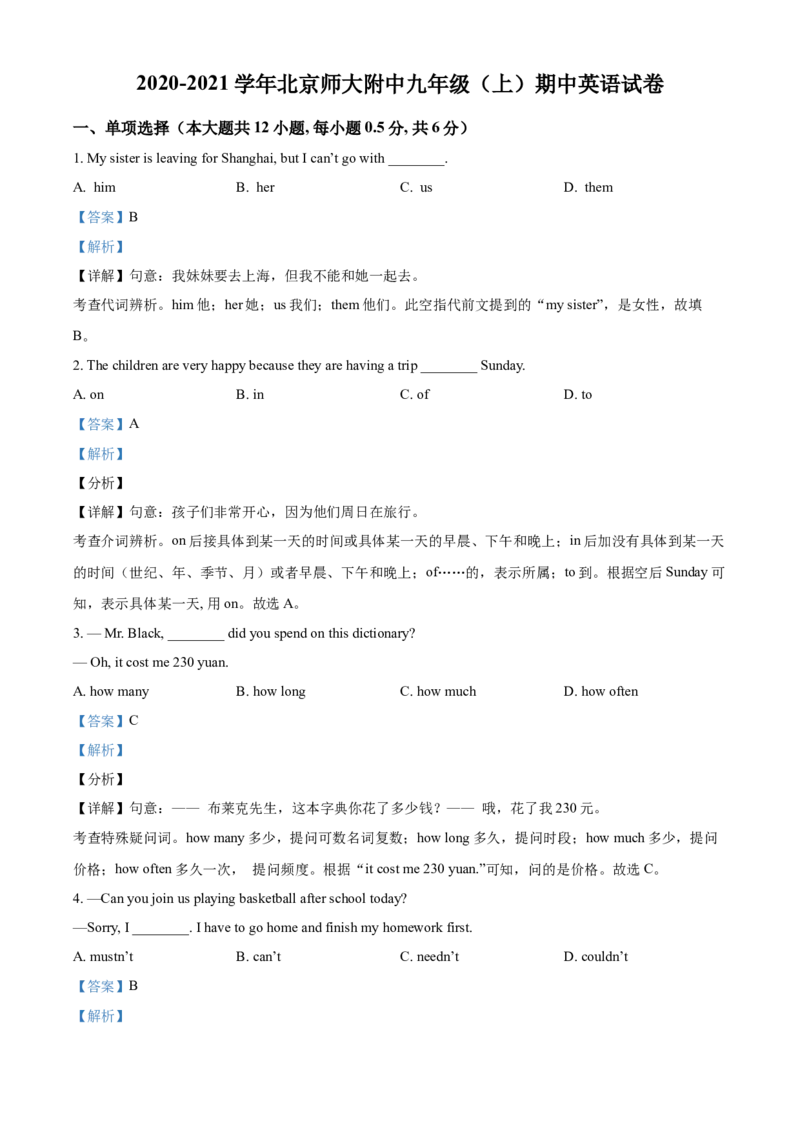
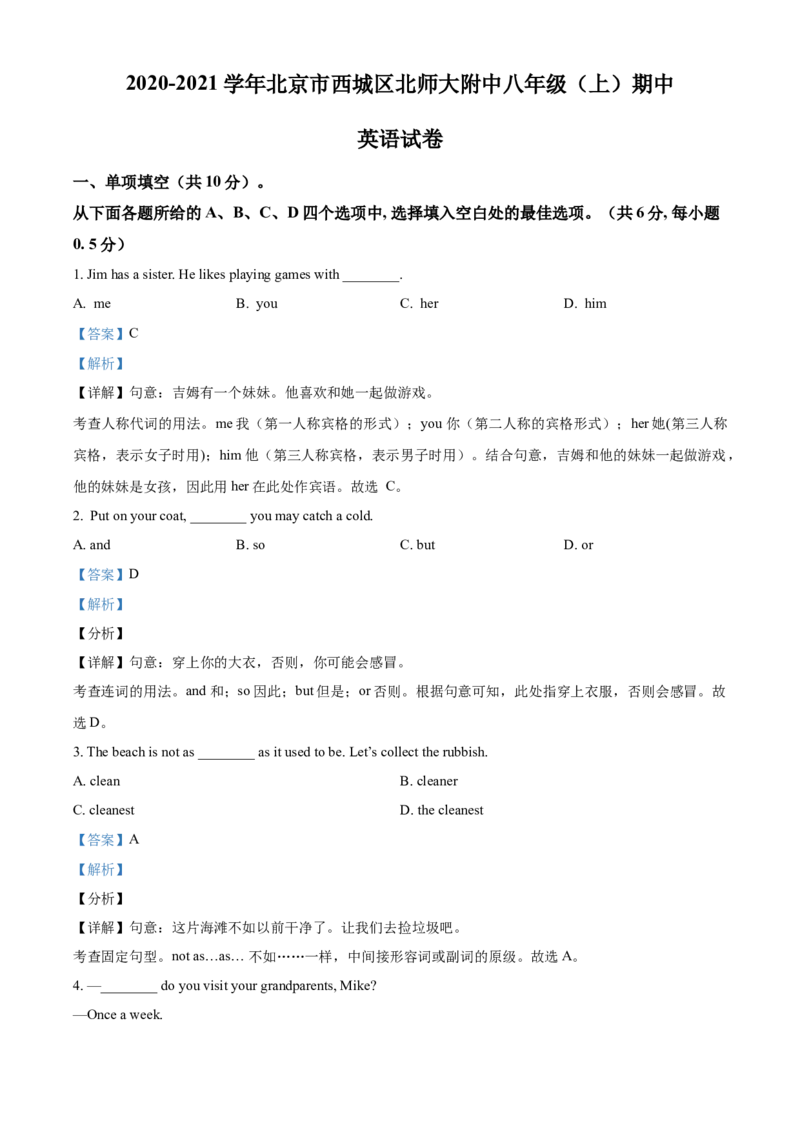
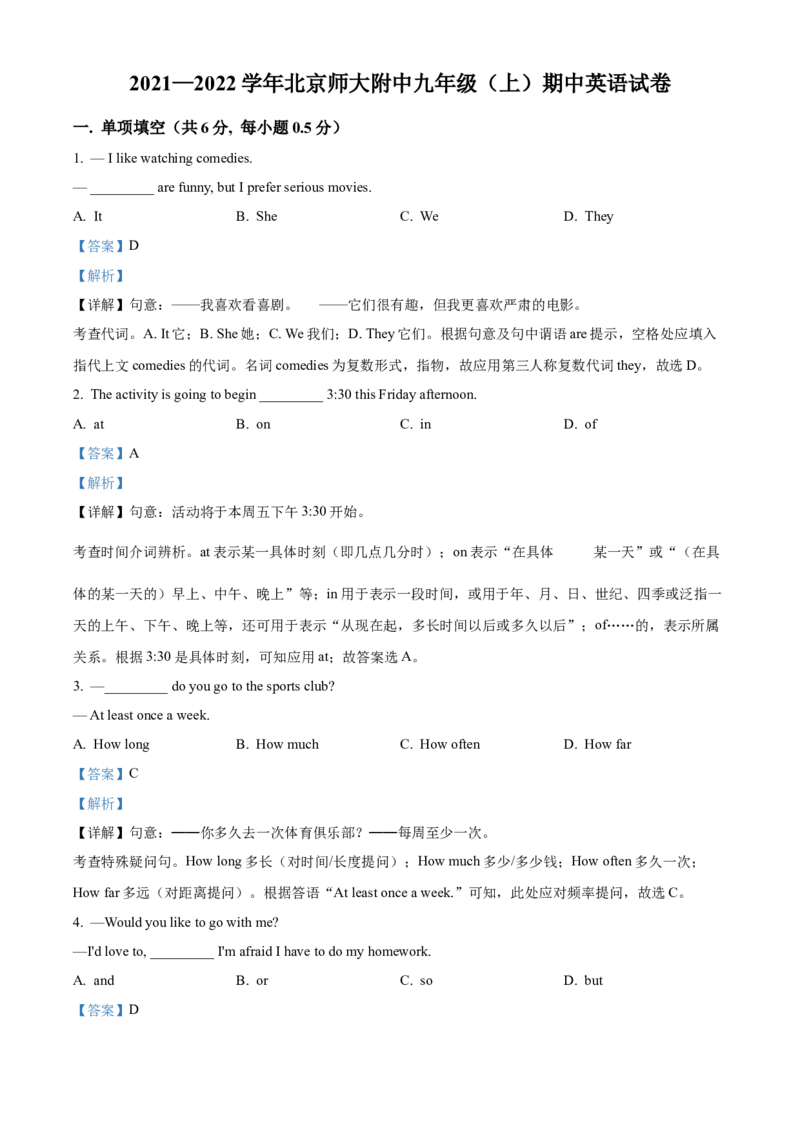
一、单项选择(本大题共12小题, 每小题0.5分, 共6分)
1. My sister is leaving for Shanghai, but I can’t go with ________.
A. him B. her C. us D. them
2. The children are very happy because they are having a trip ________ Sunday.
A. on B. in C. of D. to
3. — Mr. Black, ________ did you spend on this dictionary?
— Oh, it cost me 230 yuan.
A. how many B. how long C. how much D. how often
4. —Can you join us playing basketball after school today?
—Sorry, I ________. I have to go home and finish my homework first.
A. mustn’t B. can’t C. needn’t D. couldn’t
5. This coat looks great, ________ I don’t think it looks good on me.
A. and B. so C. but D. or
6. CITI Tower in Beijing is probably one of ________ buildings in the whole world.
A. tall B. taller C. tallest D. the tallest
7. Every morning, my father a newspaper on his way to work.
A. buys B. bought C. is buying D. will buy
8. — Where is your father, Linda?
— He ________ my bike in the yard now.
A. repairs B. is repairing C. repaired D. was repairing
9. I ________ English for nearly 9 years and I can express myself in English now.
A. study B. studied C. will study D. have studied
10. — What were you doing at 8 o’clock yesterday evening?
— I my homework.
A. do B. did C. was doing D. am doing
11. If you want to visit the History Museum, I ________ tickets for you tomorrow.
A. booked B. have booked C. was booking D. will book
12. —Could you please tell me ________ the 2020 Beijing International Automotive Exhibition?
—Last Tuesday.
A. when they visited B. when will they visit C. when they will visit D. when did they visit
二、完形填空(本大题共1小题, 每小题8分, 共8分)Everyone knew that Stuti was the best speller in the whole class. She could spell difficult words like
“encyclopedia” and “amendment” very ____13____. She used to get perfect scores during each weekly spelling
test.
Ms. Daisy, her English teacher, made a ____14____ for the spelling tests that any child who doesn’t get at
least 60% correct spellings would have to correct each wrong word and copy three times for next week’s spelling
test. Seema, who sat next to Stuti always struggled (挣扎) in spellings. Last Thursday, she received 56%, which
meant she had to ____15____ the rest 44% words three times.
Stuti was so ____16____ in her spelling abilities that she decided not to study for her next spelling test. The
test began. Ms. Daisy pronounced each word and then repeated it. Everything was OK until she spoke
“Handkerchief”. Stuti scribbled (匆匆书写) h-a-n-d-k-e-h...now what? Her mind was blank.
Ms. Daisy started to move on to the next word. An idea came into Stuti’s mind that Seema ____17____ how to
spell it! Seema had written this word three times.
There it was, spelled out in Seema’s handwriting. Her eyes went quickly back to her own paper and
____18____ the word with the letters “i-e-f”.
Stuti remained nervous as Ms. Daisy read the last spelling word. She had ____19____ just for the first time in
her life. She thought, “Is this the way I want to keep my perfect record—by being a cheater?”
Finally, she erased what she had written earlier and replaced it with what she knew was the wrong answer. She
wrote “e-i-f”. As her hands put down her pencil and passed the test up to the front, she sighed with relief (解脱) .
She thought, “So what if my perfect scores are no longer being kept? At least my ____20____ is.”
13. A. happily B. easily C. slowly D. carefully
14. A. plan B. suggestion C. guess D. rule
15. A. check B. copy C. read D. pronounce
16. A. special B. unusual C. confused D. confident
17. A. knew B. proved C. found D. wondered
18. A. changed B. picked C. finished D. replaced
19. A. cheated B. asked C. looked D. remembered
20. A. choice B. courage C. honesty D. pride
三、阅读理解(本大题共4小题, 每小题6分, 共26分)
A
Misadventure in English
Last week, our forum (论坛)asked if you had any funny or strange stories about using English. Here are some
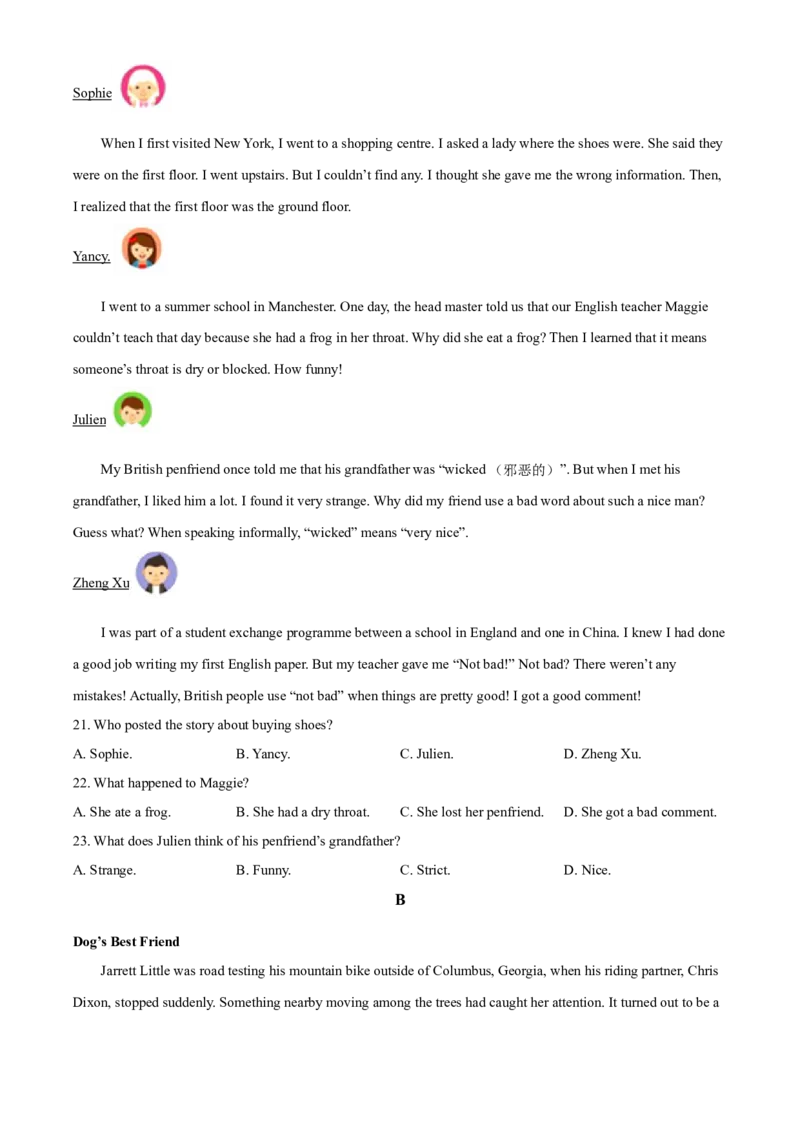
of our favourite posts.Sophie
When I first visited New York, I went to a shopping centre. I asked a lady where the shoes were. She said they
were on the first floor. I went upstairs. But I couldn’t find any. I thought she gave me the wrong information. Then,
I realized that the first floor was the ground floor.
Yancy.
I went to a summer school in Manchester. One day, the head master told us that our English teacher Maggie
couldn’t teach that day because she had a frog in her throat. Why did she eat a frog? Then I learned that it means
someone’s throat is dry or blocked. How funny!
Julien
My British penfriend once told me that his grandfather was “wicked (邪恶的)”. But when I met his
grandfather, I liked him a lot. I found it very strange. Why did my friend use a bad word about such a nice man?
Guess what? When speaking informally, “wicked” means “very nice”.
Zheng Xu
I was part of a student exchange programme between a school in England and one in China. I knew I had done
a good job writing my first English paper. But my teacher gave me “Not bad!” Not bad? There weren’t any
mistakes! Actually, British people use “not bad” when things are pretty good! I got a good comment!
21. Who posted the story about buying shoes?
A. Sophie. B. Yancy. C. Julien. D. Zheng Xu.
22. What happened to Maggie?
A. She ate a frog. B. She had a dry throat. C. She lost her penfriend. D. She got a bad comment.
23. What does Julien think of his penfriend’s grandfather?
A. Strange. B. Funny. C. Strict. D. Nice.
B
Dog’s Best Friend
Jarrett Little was road testing his mountain bike outside of Columbus, Georgia, when his riding partner, Chris
Dixon, stopped suddenly. Something nearby moving among the trees had caught her attention. It turned out to be asandy-colored five-month-old dog.
“He was really thin, and had a broken leg,” Little told CBS News. The cyclists fed the friendly dog and shared
their water. They also quickly realized that the dog was coming with them, although they had no idea how. They
were more than seven miles from downtown and riding bikes. “We couldn’t leave him,” Little said. “Out there next
to the Oxbow Meadows, he was going to end up as alligator (短吻鳄) food.”
Little, a 31-year-old business owner, had an idea. He carefully picked up his new friend and put the 38-pound
dog’s back legs into the pockets of his cycling shirt. Then he placed the dog’s front legs over his shoulders.
“He was hurt, so he wasn’t trying to fight,” Little says. “He was also happy that we were there, touching him,
and hadn’t taken off on him.”
Their 30-minute ride into town ended at a bike store, where they got more water and food for the dog. “That
was when Andrea Shaw, a company worker, happened by. The dog went straight to her, smelling and “loving on
her,” says Dixon. Shaw was touched and, after learning what had happened, decided to keep the dog.
Shaw called him Columbo after the town where they’d met and planned an operation on his leg. Today,
Columbo is living the high life on a farm with a horse and a six-year-old boy to keep him company. As Dixon
said, “He is really the luckiest dog alive.”
24. Why did Dixon stop suddenly during the road testing?
A. She noticed something moving among the trees.
B. She had cycled seven miles and wanted to rest.
C. She met some other riding partners by chance.
D. She wanted to share some water with Little.
25. What can we learn about the dog?
.
A He is unfriendly to people.
B. He is kept happily on a farm.
C. He weighed about 31 pounds.
D. He ended up as alligator food.
,
26. According to the passage the dog’s best friend is .
A. the alligator B. the human C. the horse D. CBS News
C
There is a famous English saying “You are what you eat”, and it means what you put in your mouth will
become part of you. Many experts (专家) use it to tell people it’s important to have a good eating habit. For
example, too much sweet food makes a person overweight. To avoid being fat, kids are told to keep off sweet food.
However, a team of American scientists have discovered something new about eating sweet food.“When we say some people ‘sweet’, we mean they are kind and friendly to us. Perhaps this word can help us
learn more about people’s feelings and acts,” said Brian Meier, a scientist from the study team. “Taste is something
we experience every day. What we have done is to find whether we can know someone’s character and behavior
depending on their taste.”
In one of their experiments, college students were asked questions about their character — whether, for
example, they were soft-hearted or not. Then they were asked to make a list of their favorite food. According to
their answers, the scientists found that the students who liked sweet food were nicer.
In their another experiment, the scientists found that people who preferred sweet food such as cookies and
chocolate were more willing to help other people in need, and those who ate non-sweet food such as chips weren’t.
For example, people with a sweet tooth were more likely to volunteer to clean up their city, visit sick children in the
hospital and so on.
The result of the experiments is that people’s helpfulness or being nice has something to do with their taste for
sweet food. So eating sweet food is a useful way to make people nice and helpful. Next time, try some ice-cream.
27. According to the result of the experiments, sweet food can make people ________.
A. overweight B. excited C. relaxed D. friendly
28. The purpose of the experiment in Paragraph 4 is to show ________.
A. character and behavior has something to do with people’s taste
B. why some people like sweet food better than other kinds
C. people who like cookies and chocolate like helping others
D. non-sweet food eaters are not willing to volunteer to help those in need
29. We can learn from the passage that ________.
A. people’s taste decides their characters and acts
B. sweet food makes people overweight
C. people with a sweet tooth are more willing to help others
D. people’s character has nothing to do with their taste
D
Mindlessly checking Facebook makes you an awful lot like a lab mouse continuously pushing a button in
order to get a treat.
When you check your phone, your brain gets its own little zing; Someone might be talking about you on
Facebook! No? Reload. Maybe your Instagram got a heart! Reload. Reload.
But you’re no rat. Human brains can fight the ways apps hijack our brains, if we learn some skills to deal with
this problem.Are Facebook or Twitter “addictions” (瘾) ? Recent scientific research about social media doesn’t agree on
that term, but evidence that we aren’t doing well is present at dinner tables where everyone is staring at screens,
and at crosswalks where absent-minded people walk into traffic.
I became mindful of my early-morning bad habits. Pre-coffee, half awake, I’d lie there for an hour with my
phone. So I called up psychologists, brain scientists and app designers for advice on what actually would help me.
Surprisingly, they didn’t tell me to immediately stop, but instead, they told me I needed the skills for managing
social media as part of my life.
Limit Triggers (诱因)
Our brains are made to quickly eat up information. So why let social-media companies decide when to attract
you? Turn off app notifications on your phone and computer, especially for live video broadcasts. They are
designed to create the fear of missing out.
Avoid Quicksand (流沙, 陷阱)
When you’re on Facebook, it is easy to read one article, then another. Nir Eyal, author of the 2014 book
“Hooked” says he forces himself not to read anything right away. Instead, he saves articles to a service called
Pocket, which reads them aloud while he’s at the gym.
We hurt ourselves when we use social media as a break from serious work. Our brains need a chance to be
empty. Research suggests the best way to help your brain focus is exercise, even for a short period. Staring into
space would be better than refreshing Facebook.
Make New Norms
Not that long ago, you could be fired for not paying attention during a meeting or class; now, many openly use
their phones or laptops. Bosses could set a better work culture by providing charging stations at meetings where
everyone could leave their phones, then focus on the discussion at hand. Mr. Eyal suggests you try shaming friends
who have bad habits-if you do it politely. If someone is not listening to you at dinner, ask, “Is everything OK?” The
answer might start an important conversation.
Tech Should Help
The social-media industry has a responsibility here, too. Since companies usually know exactly how much
time users spend on their apps, they should offer help to people who have problem behavior. And for the rest of us,
let’s encourage app makers to make their products more helpful, not more demanding of our time.
30. What does the underlined word “hijack” in Paragraph 3 probably mean?
A. Wash. B. Hurt. C. Control. D. Empty.
31. Why does Mr.Eyal save articles to Pocket?
A. To rest his tired brain. B. To refresh his Facebook immediately.C. To get more time to exercise. D. To avoid being attracted by social media.
32. What is the best title of this passage?
A. Take a break from busy life. B. Free your brain from social media.
C. Separate social life from your work. D. Keep your life away from apps.
33. What can we infer from the passage?
A. The social-media industry should make more app products.
B. People with problem behavior should ask brain scientists for help.
C. We should decide when to connect to social media by ourselves.
D. A company with charging stations must have a better work culture.
四、任务型阅读
Coronavirus (新型冠状病毒) disease (COVID-19)is an infectious disease caused by a newly
discovered coronavirus. More cases are still reported in some cities every day. Please follow the general COVID-19
prevention guidance. Stay cautious when you meet up with friends. Avoid indoor activities and stay away from big
groups by sticking to a core group of friends and family. You should only play sports and games with others when
you can stay 6 feet apart and wear face coverings. Get tested as quickly as you can if you have any symptoms such
as fever, cough and headaches. If you are tested positive, please stay at home and protect those around you by
wearing a face covering.
To prevent catching the infection, here are some more tips to help you stay safe as you move about the city
this fall.
●When you go to the gym:
√ Wear a face covering that covers your nose and mouth at all times. Don’t cover your face with bandanas
(印花手帕) or gaiters (鞋套) .They are not acceptable face coverings while at the gym.
√ Stop socializing. Keep at least 6 feet away from gym—goers.
●When you eat out:
√Do not wait. Make a reservation, check out the menu online and do whatever else you can to avoid long wait
times before you get a table and order.
√Keep your face covering on at all times unless you are eating and drinking.
●When you shop:
√ Use hand sanitizer (消毒液) when entering the store, after touching products and after leaving the store.
√Only touch products you intend to buy, and use contactless (无需接触的) payment methods whenever
possible.
34. What should you do when you play sports and games with others?__________________
35. Why can’t you cover your face with bandanas or gaiters at the gym?
__________________
36. When can you take off your face covering when you eat out?
__________________
37. How can you pay safely when you shop?
__________________
38. What is the purpose of the article?
__________________
五、书面表达(本大题共2小题, 共10分)
39. 根据中文和英文提示,完成一篇不少于50词的文段。所给提示词语仅供选用。
假如你是李华,你想邀请交换生Peter一起去红星电影院看电影。下面是你选择的一部电影的观影信
息。请你写一封电子邮件,告诉他你的选择,以及你选这部电影的原因,并约定见面时间及地点。
Hongxing Movie Theater (November 15th, 2020)
Legend of Deification《姜子牙》(Cartoon)
14: 20/17: 30/19: 30
Information:
After the war, Jiang Ziya loses his power...
Directors: Cheng Teng and Li Wei
提示词语:relaxing, meaningful, brave, wise, not give up, cheer up,
提示问题:
Which movie would you like to invite Peter to watch?
Why do you want to choose it?
When and where will you meet?
Dear Peter,
____________________________________________________________________________________________
____________________________________________________________________________________________
____________________________________________________________________________________________
____________________________________________________________________________________________
____________________________________________________________________________________________
____________________________________________________________________________________________
____________________________________________________________________________________________
________________________________________________________________________________________________________________________
I am looking forward to your reply.
Yours,
Li Hua
40. 根据中文和英文提示,完成一篇不少于50词的文段。所给提示词语仅供选用。
无奋斗,不青春!某英文网站正在开展以 “越努力越幸福(The Harder I Work, the Happier I Will Be)”
为主题的征文活动。请你用英文写一篇短文投稿,谈谈你在初中生活中的一个小目标是什么,你是如何努
力去实现的,以及你从中学到了什么。
提示词语:set a goal, strive for (奋斗), make a plan, patience, proud
提示问题:
●What did you do to strive for your goal?
●What have you learned from your experience?
____________________________________________________________________________________________
____________________________________________________________________________________________
____________________________________________________________________________________________
____________________________________________________________________________________________
____________________________________________________________________________________________
____________________________________________________________________________________________
____________________________________________________________________________________________
____________________________________________________________________________________________
____________________________
六、单词拼写(本大题共10小题, 每小题0.5分, 共5分)
根据提示写出英文单词或短语。
41. 成功n. ________
42. 自信的adj. ________
.
43 鼓励v. ________
44. 照料;小心n;介意;在乎v. ________
45. 提高, 改善v. ________
46. 有礼貌的adj. ________
47. 面试,采访n. ________
48. 脸n.;面对v. ________
49. 健康的adj. ________.
50 提醒v. ________
七、选词填空(本大题共1小题, 每小题8分, 共8分)
从方框里选择合适的单词完成句子。(请填字母标号,单词无需变形)
A. will B. created C. cleared D. full E. actions F. managed G. close H. step
,
51. Suddenly the rain stopped and the clouds ________. The sun rose behind me and shone on the rocks.
52. Deng Yaping has won many competitions, but says that she isn’t cleverer than anyone else, but she has a very
strong ________. Whatever she does, she never gives up.
53. The Adventure of Tom Sawyer is a great book. It is more than an adventure story. It tells how young people
grow, how people love each other and how bad people pay for their ________.
54. Son, I took a lot of pictures on your mother’s birthday with my camera. If you want to use my camera for your
school activity, please check the memory card. It may be ________. You need to get an empty one.
55. We throw away tons of rubbish every year. If we want a clean world, we have to reduce, reuse and recycle. The
first ________ is to use less. The second is to use things as long as possible. Finally, learn how to do waste sorting
for recycling.
56. Paper was first ________ about 2, 000 years ago in China. After this invention, people started to write on paper
to make books.
57. The Australians has a ________ relationship with the British. Many have British relatives, and they are similar
in many ways.
58. As a boy, like all other boys. I wanted to be a man. But my parents did everything for me. Actually, they
________ every minute of my life and I did not have any personal space. Although they love me, I felt a bit
unhappy with them.本试卷的题干、答案和解析均由组卷网(http://zujuan.xkw.com)专业教师团队编校出品。
登录组卷网可对本试卷进行单题组卷、细目表分析、布置作业、举一反三等操作。
试卷地址:在组卷网浏览本卷
组卷网是学科网旗下的在线题库平台,覆盖小初高全学段全学科、超过900万精品解析试题。
关注组卷网服务号,可使用移动教学助手功能(布置作业、线上考试、加入错题本、错题训练)。
学科网长期征集全国最新统考试卷、名校试卷、原创题,赢取丰厚稿酬,欢迎合作。
钱老师 QQ:537008204 曹老师 QQ:713000635