北京市石景山区 2020-2021 学年八年级上学期期末英语试题
英 语
一、单选填空。(共6分,每小题0.5分)
1. —Hi, Tom. Who is the boy over there?
,
—Oh ________ is Mike, a new comer.
A. she B. they C. he D. it
2. My sister and I often go to the library ________ Sunday morning.
A. of B. to C. in D. on
3. —Your T-shirt looks nice. ________ is it?
—Only 10 dollars.
A. How much B. How many C. How long D. How often
4. It’s good to eat lots of vegetables ________ it helps you stay healthy.
A. or B. because C. but D. although
5. —Mum, ________ I finish my writing now?
—No, you needn’t. You may have dinner first.
A. can B. could C. must D. might
6. Keep on trying. You’ll run ________ than last year.
A. fast B. faster C. fastest D. the fastest
7. My brother ________ a bike to school every day.
A. rides B. will ride C. was riding D. is riding
8. We enjoyed our stay in Shanghai ________ it rained a lot.
A. although B. until C. so D. or
9. Tina ________ learning painting at school last year.
A. begins B. began C. will begin D. was beginning
10. I ________ research on the Internet when my uncle came yesterday.
A. is doing B. does C. did D. was doing
11. I think this picture book is ________ one of all. What do you think?
.
A interesting B. more interesting C. most interesting D. the most interesting
12. —Tom, what were you doing at five yesterday afternoon?
—I ________ my cousin with his homework.
.
A helped B. am helping C. was helping D. help二、完形填空(共8分,每小题1分)
A Winning Day
Mom and I were sitting in the front row. Thanks to Mom’s friend, I could watch my first professional
basketball game in such a great seat! And the most ___13___ thing was that I could see my favorite basketball
player, Dwight Edwards. I was holding his book in my hand all the time.
Throughout the game Dwight ___14___ one fantastic play after another. With 3 seconds left in the game, he
scored the winning basket for his team! After the television reporter ___15___ interviewing Dwight, Mom and I
walked toward him.
“Umm ...Mr... Mr. Edwards? I’m Keysha.” My heart was beating fast. But I collected my courage and asked,
“Would you please sign (在…签名)my ___16___?”
“Sure, Keysha. Thanks for coming today.” Dwight smiled as he signed the book and then left. I watched
Dwight until he disappeared. When I turned around, I ___17___ a little boy holding a poster and a pen and crying.
“It’s OK, son,” his father said.” “We’ll meet Dwight Edwards some other time.”
I looked at Dwight Edward’s signature and thought about how great it was to meet him. Then I thought about
how kind Mom’s friend was for giving us the ___18___ to have this experience.
I handed Dwight’s book to the boy. “Here, I want you to have this,” I said.
The boy’s eyes widened. “Dwight’s autograph (亲笔签名)? Wow!” he exclaimed. “Thank you.”
“No problem,” I replied.
“Keysha, that was very ___19___ of you,” Mom said. “I know how much that autograph meant to you.”
“Oh, I won’t need an autograph to ___20___ this day. I got to see Dwight Edwards play an amazing game.
And I got to meet him. It’s really a winning day.” I smiled at Mom.
13. A. nature B. exciting C. common D. serious
14. A. made B. avoided C. collected D. lost
15. A. changed B. finished C. forgot D. started
16. A. poster B. photo C. book D. shirt
17. A. cared B. interviewed C. stopped D. noticed
18. A. CDs B. books C. tickets D. calls
19. A. lucky B. strange C. shameful D. thoughtful
20. A. remember B. choose C. check D. divide
三、阅读理解(共26分,每小题2分)
A
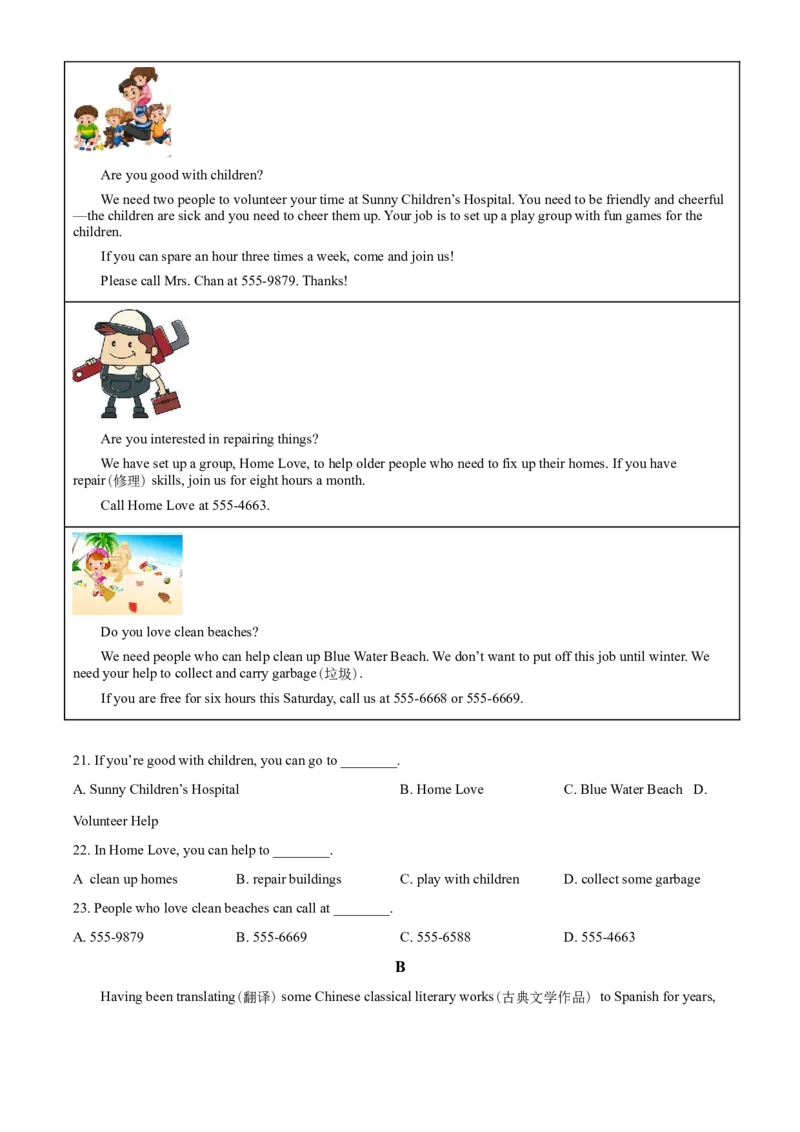
Help NeededAre you good with children?
We need two people to volunteer your time at Sunny Children’s Hospital. You need to be friendly and cheerful
—the children are sick and you need to cheer them up. Your job is to set up a play group with fun games for the
children.
If you can spare an hour three times a week, come and join us!
Please call Mrs. Chan at 555-9879. Thanks!
Are you interested in repairing things?
We have set up a group, Home Love, to help older people who need to fix up their homes. If you have
repair(修理) skills, join us for eight hours a month.
Call Home Love at 555-4663.
Do you love clean beaches?
We need people who can help clean up Blue Water Beach. We don’t want to put off this job until winter. We
need your help to collect and carry garbage(垃圾).
If you are free for six hours this Saturday, call us at 555-6668 or 555-6669.
21. If you’re good with children, you can go to ________.
A. Sunny Children’s Hospital B. Home Love C. Blue Water Beach D.
Volunteer Help
22. In Home Love, you can help to ________.
.
A clean up homes B. repair buildings C. play with children D. collect some garbage
23. People who love clean beaches can call at ________.
A. 555-9879 B. 555-6669 C. 555-6588 D. 555-4663
B
Having been translating(翻译) some Chinese classical literary works(古典文学作品) to Spanish for years,Alicia Relinque has found the key to happiness in her life. When asked by a reporter, “It is the Chinese literature,”
said Relinque, a modest and peaceful teacher. She easily became excited when talking about Chinese culture and
classic literature.
Relinque’s translation works include The Peony Pavilion by Tang Xianzu in the 16th century—a romantic play
,
about a love story and The Orphan of Zhao—a play written in the 13th century similar to Hamlet, which are
excellent classic works in Chinese culture.
When translating a famous Chinese novel which she liked a lot, she slept only six hours every day in six years
because she spent lots of time reading books about Chinese politics and history during that period of time.
After four years’ Chinese study in Peking University, she learnt that the University of Granada would open a
department(系) in Asian studies, so she moved to the city in south Spain in 1994 and has stayed there ever since.
She started the Chinese classical literature study in Spain, and then made the University of Granada a major
place of sinology(汉学) in the country.
Given her excellent work in translating Chinese classic literature, Relinque was granted(授予)a special prize
by the Chinese government in 2017.
“Spain should pay more attention to China, and on the other hand, I ask my students to study Chinese history
because the country’s today and future lie in history,” said Relinque.
24. What does Alicia Relinque do?
A. A teacher. B. A reporter. C. A writer. D. A scientist.
25. What do we know about Alicia Relinque?
A. She moved to south Spain in 2017. B. She translated Hamlet into Chinese.
C. She opened a department in Chinese studies. D. She studied Chinese classical literature in Spain.
26. Chinese government granted a prize to Alicia Relinque because she ________.
A. learned Chinese in Peking University B. wrote many books about Chinese history
C. taught Chinese in the University of Granada D. did well in translating Chinese classic literature
C
We touch our faces all the time, and it had never seemed to be a big problem-until COVID-19 arrived.
Touching our faces—the “T-zone” of our eyes, nose and mouth can mean giving ourselves this virus (病毒).
This is why some scientists have suggested that we should avoid touching our faces. William Sawyer, from
Henry the Hand, told The Washington Post, “Just stop this simple behavior (行为), and that would be better than
any vaccine (疫苗).”
However, stopping this “simple” behavior might be harder than you think because we are used to it.
Some face-touching is an automatic behavior—like when there is an itch (痒) on your nose, you’ll touch itagain and again without thinking. A 2014 study found that touching your face also helps you to have less stress (压
力). For example, it’s possible for you to do it when you feel uncomfortable. According to Dacher Keltner, a
psychologist at the University of California Berkeley, US, this action may also have a social use: when you are
talking to someone, for example, touching your face means you want to talk about another thing.
Besides, it’s very hard to change this face-touching. “because you don’t even know you’re doing it”, said
Sawyer.
But you’re not alone. In a 2015 study, it was found that a group of medical students touched their faces about
23 times an hour—with 44 percent of the touches in the “T-zones”. That was very surprising because medical
students should know better.
Since it’s so hard to shake the habit, maybe the easiest way is to wash our hands more often. This way, we can
be sure that our hands are safe from COVID-19.
27. Dacher Keltner thinks that face-touching may ________.
A. be better than vaccine B. give yourself some stress
C. cause an itch on your face D. mean you want to change the talk
28. The writer uses a 2015 study to show that ________.
A. many people touch faces without knowing B. we had better not touch the “T-zones” often
C. medical students should not touch their faces D. people touch the “T-zones” more than the heads
29. What is the main idea of the passage?
A. Good and bad points of face-touching. B. Stopping face-touching might be hard.
C. Face-touching may bring us virus. D. Ways of avoiding face-touching.
D
These days, teenagers are heavily influenced (影响) by the media. Many of them have watched thousands of
hours of TV. That’s more time than they spend with teachers at school. And we haven’t yet thought about the hours
they spend using the Internet and reading newspapers.
However, several studies have shown a serious problem: today’s teenagers lack media literary (媒体素养). In
other words, they have difficulty thinking about the information they see. One study that was done on middle
school students showed that more than 80 percent of them couldn’t tell the difference between real stories and ads
that looked like news.
Standford professor Kevin John teaches a class called Media Effects. He tries to help his students learn media
literacy. The professor gave an example that shows why media literacy is important. In the example, two news
stations report a snowstorm. One focuses on (关注) the terrible road conditions. The other focuses on kids playing
in the snow.“With a news story, news stations tell you what they feel are the important details (细节). These details mostly
depend on the opinions of the news director,” said John. “A person who has media literacy would realize that each
story is about one side at this time. There is more going on.”
Some experts think the school is the best place to teach media literacy. Others believe everyone—from parents
to reporters—should help teenagers learn the skills.
As for the best time to start learning media literacy, many experts suggest the age of 12. But some basic ideas
can be taught even earlier. “It’s never too early to start learning media literacy,” John said.
30. From Paragraph 1, we can learn that teenagers today spend ________.
A. more time using the Internet than watching TV B. more time watching TV than studying at school
C. less hours in reading newspapers at home D. more hours with their teachers at school
31. The underlined word “lack” in Paragraph 2 probably means ________.
A. be careful about B. argue about C. be short of D. run after
32. Professor Kevin John would agree that ________.
A. ideas are more important than news details B. school is the best place to teach media literacy
C. people should know each story is just one side D. children should start to learn media literacy early
33. The main idea of the passage is ________.
A. how to develop teenagers’ media literacy B. where teenagers can study media literacy
C. why teenagers would learn media literacy D. When teenagers should have media literacy
四、(共10分,每小烟2分)
阅读短文, 根据短文内容回答问题。
Could getting a good night’s sleep avoid putting on weight for children?
According to a new study, putting preschoolers in bed by 8 P.M. could cut down their chances of becoming
overweight later in life by half. Preschoolers are children around the age of 4 or 5.
The researchers from the Ohio State University wrote their findings in the Journal of Pediatrics. They have
found that young children who go to bed after 9 P.M. are twice as likely to becoming overweight later in life. The
lead writer of the study is Sarah Anderson. She says that it’s very important for parents to have a bedtime routine
for their children.
How did the research go? Researchers chose 977 children for it. In order to have a clearer picture of the
results, researchers then put the children into three groups:
●group 1: those who went to bed by 8 P.M. or earlier.
●group 2: those who went to bed between 8 P.M. and 9 P.M.
●group 3: those whose bedtimes were after 9 P.M.When these children turned 15 years old, the researchers looked at the results of the study. Of those with the
earliest bedtimes, only one out of ten was overweight. Of those who went to bed between 8 and 9 at night, 16
percent (%) of the children became overweight. And out of those with the latest bedtimes, 23 percent of the
children became overweight.
“Having a usual bedtime routine can lower children’s risk (风险) of becoming overweight. Besides, as usual,
early bedtime is also likely to have positive effects (积极的效果) on behavior (行为),” said professor Anderson.
34. Where did the researchers write their findings?
_____________________________
35. How many children were in the research?
_____________________________
36. Why did the researchers put the children into three groups?
_____________________________
37. Which group has the highest percent of becoming overweight?
_____________________________
38. What does the research tell us?
_____________________________
五、文段表达 (共10分)
39. 每个人的生命中都会有一些特殊的日子让人难忘。学校英文期刊正在举办一个以“A special day”
为话题的征文大赛。请你根据以下要点写一篇短文参赛,说说那是哪天。那天发生了什么,为什么对你来
说是特殊的一天。
注意:1.词数不少于50;
2.所给英文提示词语仅供选用;
3. 请不要写出你的真实姓名和校名。
提示词语: take, centre, make, get together
提示问题: ●What day was that day?
●What happened on that day?
●Why was it special?
A special day
____________________________________________________________________________________________
____________________________________________________________________________________________
____________________________________________________________________________________________
________________________________________________________________________________________________________________________________________________________________________________________
____________________________________________________________________________________________
____________________________________________________________________________________________
____________________________________________________________________________________________
____________________________________________________________________________________________
____________________________________________________________________________________________
____________________________________________本试卷的题干、答案和解析均由组卷网(http://zujuan.xkw.com)专业教师团队编校出品。
登录组卷网可对本试卷进行单题组卷、细目表分析、布置作业、举一反三等操作。
试卷地址:在组卷网浏览本卷
组卷网是学科网旗下的在线题库平台,覆盖小初高全学段全学科、超过900万精品解析试题。
关注组卷网服务号,可使用移动教学助手功能(布置作业、线上考试、加入错题本、错题训练)。
学科网长期征集全国最新统考试卷、名校试卷、原创题,赢取丰厚稿酬,欢迎合作。
钱老师 QQ:537008204 曹老师 QQ:713000635