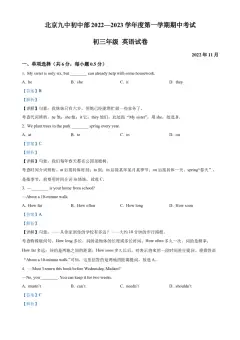
北京九中初中部 2022—2023 学年度第一学期期中考试
初三年级 英语试卷
2022年11月
一、单项选择(共6分,每小题0.5分)
1. My sister is only six, but ________ can already help with some housework.
A. he B. she C. it D. they
2. We plant trees in the park ________ spring every year.
.
A at B. to C. in D. on
3. —________ is your home from school?
—About a 10-minute walk.
A. How far B. How often C. How long D. How soon
4. — Must I return this book before Wednesday, Madam?
—No, you ________. You can keep it for two weeks.
A. mustn’t B. can’t C. needn’t D. shouldn’t
5. I think body language is ________ the spoken language.
A. as importantly as B. so importantly as C. so important as D. as important as
6. It might be a boy’s room _________ the clothes look like a boy’s clothes.
A. when B. because C. but D. so
7. Alice often ________ the fun of making kites with us. She is so creative.
A. shares B. shared C. will share D. was sharing
8. Zhang Guimei ________ in less-developed areas for 40 years.
A. works B. is working C. has worked D. will work
9. Don’t lose heart. If you keep working hard, you _________ some day.
A. will succeed B. succeed C. succeeded D. have succeeded
10. I ________ for the bus after school when it began to rain cats and dogs.
A. wait B. is waiting C. was waiting D. waited
11. On our farm, the tea leaves ________ by hand when they are ready.
A. pick B. picked C. are picked D. were picked
12. —Do you know ________ for the sports meeting?
—At 8 o’clock tomorrow morning.
A. when we left B. when we will leaveC. when will we leave D. when did we leave
二、完形填空(共8分,每小题1分)
I was cooking the other day when a report broke announcing(宣布) NASA(美国国家航空航天局) was
thinking about going back to manned space missions(载人航天任务). Upon hearing this, I shouted like the 13-
year-olds. Why was this news so important to me?
It’s simple: I still want to be an astronaut although I have ____13____. I remember one morning when I was
about thirteen: I was sitting with my family when I came across one little article about NASA on the paper. It said
that they were ____14____ about the idea of carrying on a manned mission to Mars in 2018. “Hey mom, would
you let me go to Mars?” I asked, as if I were asking to sleep over a friend’s house that night.
“Yeah, sure.” my mother replied not even looking up from the paper. I was completely serious, though, and I
didn’t think she realized she had just given me ____15____ to go to space. There was just one problem for me and
my astronaut ____16____: I was really bad at maths. And I cried sadly, knowing no one would let me be an
astronaut if I couldn’t solve for X or Y.
I remembered trying to find my maths teacher and ____17____ my astronaut plan. He told me I needed to
consider other choices, but I didn’t have anything else: my plan was to become an astronaut, and then come back to
Earth and write a best-selling book about my travels. My book would be adapted into a movie, and I’d play myself
I thought of this as the three A’s: astronaut, author and actress.
I never accepted that my dream was ____18____. I’ve spent countless hours standing outside, staring up at
the stars and wondering what’s out there. That’s why I got so excited when NASA announced they were
____19____ back into space. I still want to be an astronaut and I don’t think my dream is so out of ____20____.
Something more impossible has happened after all.
13. A. grown up B. shown up C. waken up D. stayed up
14. A. asking B. caring C. bringing D. considering
15. A. discussion B. introduction C. agreement D. suggestion
16. A. task B. action C. story D. dream
17. A. pass B. cancel C. design D. explain
18. A. surprising B. boring C. impossible D. important
19. A. looking B. heading C. jumping D. hurrying
20. A. reach B. breath C. use D. control
三、阅读短文。根据内容选答案。(共26分。每小题2分)
A
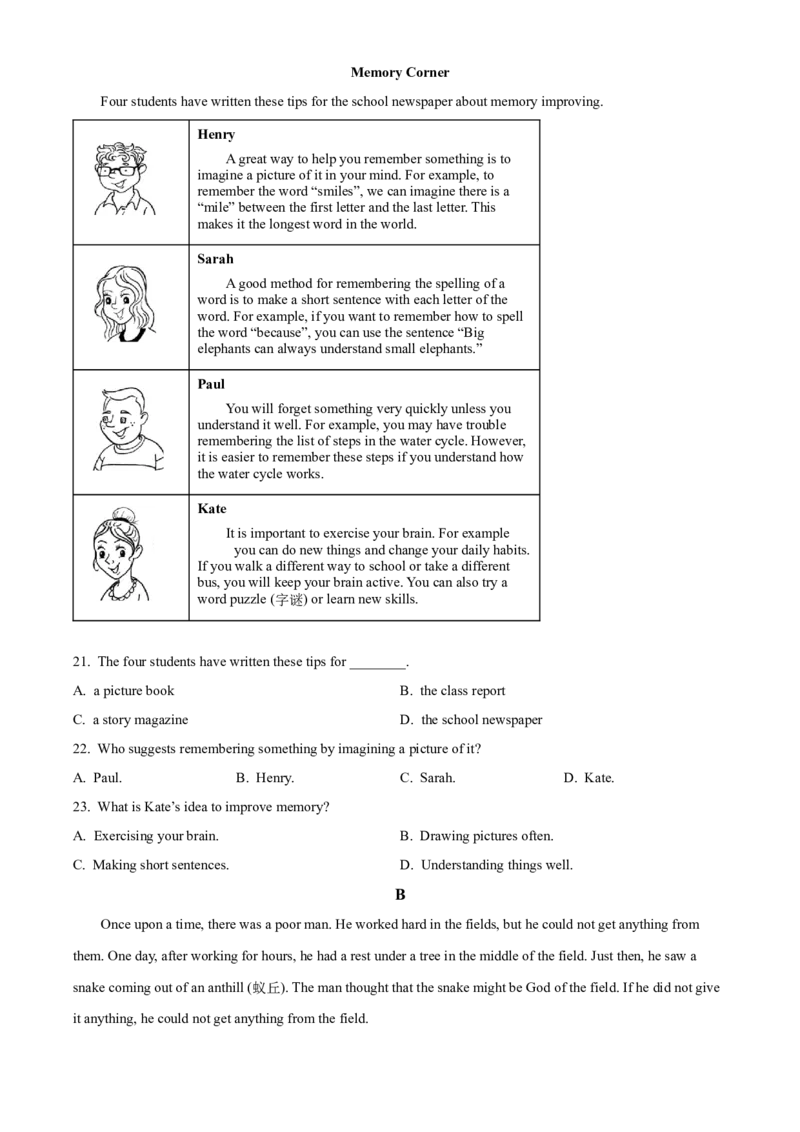
A Memory CornerMemory Corner
Four students have written these tips for the school newspaper about memory improving.
Henry
A great way to help you remember something is to
imagine a picture of it in your mind. For example, to
remember the word “smiles”, we can imagine there is a
“mile” between the first letter and the last letter. This
makes it the longest word in the world.
Sarah
A good method for remembering the spelling of a
word is to make a short sentence with each letter of the
word. For example, if you want to remember how to spell
the word “because”, you can use the sentence “Big
elephants can always understand small elephants.”
Paul
You will forget something very quickly unless you
understand it well. For example, you may have trouble
remembering the list of steps in the water cycle. However,
it is easier to remember these steps if you understand how
the water cycle works.
Kate
,It is important to exercise your brain. For example
you can do new things and change your daily habits.
If you walk a different way to school or take a different
bus, you will keep your brain active. You can also try a
word puzzle (字谜) or learn new skills.
21. The four students have written these tips for ________.
A. a picture book B. the class report
C. a story magazine D. the school newspaper
22. Who suggests remembering something by imagining a picture of it?
A. Paul. B. Henry. C. Sarah. D. Kate.
23. What is Kate’s idea to improve memory?
A. Exercising your brain. B. Drawing pictures often.
C. Making short sentences. D. Understanding things well.
B
Once upon a time, there was a poor man. He worked hard in the fields, but he could not get anything from
them. One day, after working for hours, he had a rest under a tree in the middle of the field. Just then, he saw a
snake coming out of an anthill (蚁丘). The man thought that the snake might be God of the field. If he did not give
it anything, he could not get anything from the field.At once, he went to bring a bowl of milk and gave the milk to the snake. “God of the field! I didn’t know that
you live here. That’s why I never gave you anything. Please forgive me.” Then he went home.
,
The next day when the man came, be found a gold coin in the bowl near the anthill. From then on, each
time the man gave milk to the snake, he got a gold coin.
One day the man was so busy that he couldn’t send milk to the snake. So he asked his son to take care of the
snake. The son brought milk to the anthill and gave it to the snake. The next day, when he came back, he found a gold
coin in the bowl. After taking the gold coin, he thought, “This anthill must be full of gold coins. I could kill the snake
and take them all.”
The next day, the son came to the field with milk and a stick. He gave the milk to the snake and hit it with the
stick. The snake escaped(避开) the stick and bit him to death.
24. The man got ________ from the field before he found the snake.
A. anything B. nothing C. gold coins D. some anthills
25. The son died because ________.
.
A he didn’t give the snake any milk
B. the snake didn’t give him any gold coin
C. his father was too busy to take care of him
D. he wanted to get all the gold coins from the snake
26. From the passage we can learn that ________.
A. people can’t get coins from the snake B. too much greed(贪婪) is harmful
C. we should protect the snake D. the snake is terrible
C
It's no secret that laughter works wonders for us. And much research has been carried out into the good that
laughter can do for our general health and well-being. It has been found to release endorphins (释放安多芬), our
bodies’natural“feel-good"chemicals, into our blood. But as we grow older, we are more likely to find fewer things
funny. A child will laugh on average 300 times a day. By the time we reach adulthood, this number is around 20.
But what's behind this? One theory(理论) suggests that it's not a problem of us losing our sense of humor but
rather, as we grow older, we're socially conditioned to take things a bit more seriously.
Laughter is very much something we do with others. Studies have shown that we are 30 times more likely to
find something funny when we are with others than when we are by ourselves. But to laugh with others, we do need
to feel a connection to them. We need to feel comfortable in their company. That's why it can be difficult to laugh in
the presence of strangers. Laughter is also very contagious and one person's laugh can spread quickly throughout a
group of people. But often what makes us join in is the fear of standing out and being different. We laugh, even ifwe don' t really get the joke, especially in groups controlled by a powerful person. When the head teacher tells a
joke, for example, you laugh, even though later you might wonder if the joke was really that funny at all.
There are many different reasons why we laugh. Here are three widely accepted theories:
The Incongruity Theory: It's often the unexpected that makes us laugh. When things that we are familiar with
suddenly take a turn into the unknown, our expectations are challenged and that often results in laughter.
The Superiority Theory: We often find the mistakes and misfortunes of others funny. This would explain the
popularity of online videos showing pranks (恶作剧).
The Relief Theory:Laugh offers light relief. It explains why there are so many jokes about the darker things
in life. By being able to laugh at them, we are able to face them more easily.
27. According to the theory in Paragraph 1, why do we laugh less as we grow older?
A. There are fewer funny things.
B. We take things more seriously.
C. Our body releases less endorphins.
D. We gradually lose our sense of humor.
28. What can we learn from Paragraph 2?
A. More funny things happen when we are with others.
B. It's difficult to build up connections with strangers.
C. We laugh sometimes because of social needs.
D. Powerful people are more likely to be funny.
29. What is the passage mainly about?
A. The science of laughter
B. the power of laughter.
C. The sign of laughter.
D. The art of laughter
D
Upcycling is the process of changing old materials into something useful and often beautiful.
So, is it the same as recycling? No. Recycling takes materials-paper or glass-and breaks them down so their
base materials can be remade into a new product. When you upcycle an item(物品), you are not breaking down thematerial,
you are simply refashioning it. For example, you might make shoes out of old tyres. Also, the upcycled item
is typically of the same, or even better, quality(质量) than the original.
Upcycling isn’t a new idea. Some of the best examples of modern-day upcycling come from the 1930s to
1940s when families didn’t have enough materials. In those days, things were repurposed over and over until there
were no longer useful. For example, an old door can be made into a new dining table. Economising(节约) is still a
trend(趋势) today and a big reason why more and more people upcycle. But an even bigger reason for the rebirth of
upcycling is its good influence on the environment.
Upcycling is green. The plain and simple fact of the matter is that upcycling is much better for the planet than
throwing things away. When you upcycle, that's one item less that ends upon the waste mountain. Upcycling is also
considerably more environmentally friendly than recycling, which needs energy or water to break down materials.
Upcycling just needs your own creativity and effort.
Grace Robinson, from the UK, takes used tea bags and turns them into dresses, shoes and even hats. Every day
she drinks some tea, and then dries out the tea bags with the tea still in them. When they are dry, she takes the tea
out and sews the bags together to make clothes. This can take a long time- maybe months for a single dress -so
Grace gets friends to help her by drinking tea too and passing their tea bags on to her.
There are two ways to support the upcycling movement. Sort(分类)through your wardrobe or recycling bin
and create items yourself, or buy ready-made items from upcycled materials. Both ways benefit the environment
and in return, you get something that’s both attractive and practical.
30. We can learn from the passage that upcycling ___________.
A. can improve the quality of items
.
B needs more energy than recycling
C. needs to break down base materials
D. produces more waste than recycling
31. The underlined word"refashioning"in Paragraph 2 probably means “___________”.
A. giving a new form B. giving a simple name
C. making a perfect copy D. making a different model
32. The writer probably agrees that ___________.
A. it is better to make clothes with used tea bags
B. upcycling is much greener than recycling
C. it is necessary to help others to upcycle
D. people need to be more creative33. Which of the following would be the best title for the passage?
A. Get started to recycle today
B. A modern trend: upcycling
C. Is it the same as recycling?
D. To recycle or to upcycle?
七、阅读短文,根据短文内容回答问题。(共10分,每小题2分)
When it comes to celebrations, birthday parties can be one of the important of the whole year. The gifts, the
singing, the candle-blowing... Basically, they’re all the best things thrown together into one day. But birthdays
aren’t always a fun for everyone. For example, homeless children might not get anything at all for their special day.
That’s why 17-year-old Daryn Dusansky decided to start The Balloon Project. It celebrates monthly birthdays for
children living in homeless shelters (收容所) with the help of some volunteers. Dusansky’s dream: to bring smiles
to all kids’ faces on their birthdays.
As teenagers, they met many challenges at the beginning. One of the biggest was to make others believe that
The Balloon Project was dependable and there would be a party each month. Each party is not easy as there are
many things that have to be managed. Luckily, The Balloon Project volunteers want each party to be better than the
last and can be counted on to make that happen.
Getting The Balloon Project off the ground required many leadership qualities (品质) which Dusansky did not
know she owned. Working hard, focusing on solutions, and connecting with people are all necessary qualities that
have made The Balloon Project a success.
Offering services to those in need and creating a positive influence are important in being an active member of
a community. Community service teaches life lessons often not taught in school. At one party, a little boy and his
father came up to thank her for holding the boy’s first organized birthday party. Dusansky then thanked them for
teaching her something, too. The father, who lived in a shelter with his son, looked at her, puzzled, as if he was not
worthy of teaching her anything. Dusansky explained to him that he had taught her to have the courage to ask for
help when needed. She will never forget his hug.
Find a cause that interests you. Dusansky loves birthday celebrations and wants disadvantaged children to
have the opportunity to celebrate, too. Love is passed on easily—it encourages people to help and volunteer.
34. How old was Dusansky when she decided to start The Balloon Project?
______________________________________________________________________
35. Who does The Balloon Project help?
______________________________________________________________________
36. What was one of the biggest challenges in running The Balloon Project?______________________________________________________________________
37. What did Dusansky learn from the father?
______________________________________________________________________
38. What do you think of Dusansky?
______________________________________________________________________
八、写作(共10分)
39. 21世纪英文报正在举办以“My favourite scientist” 为题的征文活动。假如你叫李华,请你写一篇短
文投稿,谈谈你最喜欢的科学家是谁?你为什么喜欢他(她)?你从他(她)身上学到了什么?
提示词语:strong will, never give up, work hard, responsible
提示问题:
Who is your favourite scientist?
Why do you like him/her?
What can you learn from him/her?
____________________________________________________________________________________________
____________________________________________________________________________________________
____________________________________________________________________________________________
____________________________________________________________________________________________
____________________________________________________________________________________________
____________________________________________________________________________________________
____________________________________________________________________________________________
____________________________________________________________________________________________