













文档内容
首都师大二附中八年级下学期英语开学测试
知识运用
一、单项填空
从下面各题所给的A、B、C、D四个选项中,选择可以填入空白处的最佳选项。
1. Mr. White is very kind to others. We all like __________ very much.
A. her B. me C. him D. us
【答案】C
【解析】
【详解】句意:怀特先生对其他人特别好。我们都非常喜欢他。
考查人称代词的宾格。her她;me我;him他;us我们。分析句子可知,此处指代前文出现的Mr. White,
指男性,用与动词like后作宾语,所以用宾格形式。故选C。
2. Peter's father works _________ a big hospital. And he is a good doctor.
A. on B. in C. of D. from
【答案】B
【解析】
【详解】句意:彼得的父亲在一家大医院工作。他是一个好医生。
考查介词辨析。on在……上;in在……里;of……的;from从……。分析句子可知,此处构成“work in a
hospital”短语,翻译为“在一家医院工作”。故选B。
3. We didn’t enjoy the day ________ the weather was so bad.
A. if B. but C. or D. because
【答案】D
【解析】
【详解】句意:我们不喜欢这一天,因为天气太糟糕了。
考查连词辨析。if如果,表条件;but但是,表转折;or或者,表选择;because因为,表原因。分析前后
句可知,两句话构成因果关系,此处表示原因。故选D。
4. —______ will your father come back?
—In a week.
A. How soon B. How long C. How often D. How far
【答案】A
【解析】
【详解】句意:——你父亲多久后回来?——一周后。考查特殊疑问句。How soon多久,对将来时间提问;How long多长,对时长或长度提问;How often多久
一次,对频率提问;How far多远,对距离提问。根据答语“In a week.”可知,此处表示将来时间“一周
后”,所以问句用how soon提问。故选A。
5. The harder you work, the _________ progress you will make.
A. great B. greater C. greatest D. little
【答案】B
【解析】
【详解】句意:你越努力,你的进步就越大。
考查“the+比较级,the+比较级”用法。great形容词原级,好的;greater形容词比较级,更好的;greatest
形容词最高级,最好的;little形容词原级,小的/少的。分析句子可知,此处构成“the+比较级,the+比较
级”,翻译为“越……越……”,所以使用比较级形式。故选B。
【点睛】“the+比较级,the+比较级”,表示“越……,越……”。
例句:The healthier food you eat, the stronger you will be. 你吃的食物越健康,你就会越强壮。
.
6. We don't think teenagers should be allowed to drive because they are not __________ enough
A. serious B. more serious C. most serious D. the most serious
【答案】A
【解析】
【详解】句意:我们认为青少年不应该被允许开车,因为他们不够认真。
考查形容词。serious认真的;more serious更加认真的;most serious最认真的,前面缺少the;the most
serious最认真的;根据句意理解可知,这里表达的是“不是足够的认真”,没有与其他进行比较,所以这
里应该用原级,故选A。
7. Right now we ________ stay at home to prevent the spread of virus (病毒).
A. may B. should C. can’t D. need
【答案】B
【解析】
【详解】句意:现在我们应该待在家里防止病毒的传播。
考查情态动词辨析。may也许,可能;should应该;can’t不可能;need需要。分析句子可知,此处表示建
议,翻译为“应该”。故选B。
8. —What’s Mike doing now?
—He _________ an online class in his room.
A. was having B. has had C. is having D. are having【答案】C
【解析】
【详解】句意:——迈克现在在做什么?——他正在他的房间里上网络课。
考查现在进行时。was having过去进行时;has had现在完成时;is having现在进行时;are having现在进行
时。根据问句“What’s Mike doing now?”可知,此处使用现在进行时;又因为主语是He,所以be动词使
用单数is。故选C。
9. ----When will your sister go to England?
----She London since four months ago.
A. went to B. has gone to C. has been to D. has been in
【答案】D
【解析】
【详解】句意:——你妹妹什么时候去英国?——她四个月前就在伦敦了。考查动词时态辨析题。have
gone to表示“去了”某地,现在仍然在那里;have been to表示“到过;去过”某地,但现在并不在那里;
have been in表示某人在某个地方呆了多长时间。根据句意语境,结合since four months ago可知动作发生在
过去,持续了一段时间,需用完成时态。BC两项不合语境,可知选D。
10. It is reported that Notre-Dame de Paris (巴黎圣母院) ________ in April 2019.
A. was burnt B. is burnt C. be burnt D. will be burnt
【答案】A
【解析】
【详解】句意:据报道,巴黎圣母院于2019年4月被烧毁。
考查一般过去时的被动语态。was burnt一般过去时的被动语态;is burnt一般现在时的被动语态;be burnt
是be动词原形的被动语态;will be burnt一般将来时的被动语态。根据句中时间状语in April 2019,时态是
一般过去时;又因为主语Notre-Dame de Paris是动作burn的承受者,所以使用一般过去时的被动语态。故
选A。
11. Yesterday I helped an old man _______ lost his way.
A. what B. which C. who D. when
【答案】C
【解析】
【详解】句意:昨天我帮助了一位迷路的老人。
考查定语从句。what可引导名词性从句;which指物,作主语或宾语;who指人,作主语或宾语;when指
时间,作状语。分析句子可知,本句是定语从句,先行词是an old man,在从句中作主语。故选C。
12. — Did you notice . in her office?— Yes. She was going over our writing.
A. what was Miss Lin doing B. what Miss Lin was doing
C. what does Miss Lin do D. what Miss Lin does
【答案】B
【解析】
【详解】句意:-你注意林小姐在干什么了吗?-是的,她正在检查我们的写作。
考查宾语从句。what was Miss Lin doing林小姐在干什么,疑问语序;what Miss Lin was doing陈述语序;
what does Miss Lin do林小姐是干什么的;what Miss Lin does陈述语序。根据句子结构可知,这里考查的是
宾语从句,从句中应用陈述语序,故先排除A和C。根据答语She was going over our writing可知,这里问
的是过去正在做的事情,应用过去进行时,故选B。
二、完形填空
阅读下面的短文,掌握其大意,然后从短文后各题所给的A、B、C、D四个选项中,选择最
佳选项。
A
New Distractions (使人分心的事)
Madeline’s family vacation to the beach was usually the highlight of her summer. This year, however, her
parents announced a new____13____: no phones allowed for the entire week. “No distractions,” they said.
“But my friends will be____14____updates,” Madeline protested (抗议). ”
“They’ll have to____15____,” her mom said.
“What if something bad happens?” Madeline changed her strategy (策略). Her mom shook her head as she
opened a drawer. Madeline saw that her parents’ phones were already in it. Madeline had to drop her____16____in,
too.
The drive to the beach house took most of the day. That night after dinner, Madeline wandered into the
kitchen, where her father was____17____dishes.
“Still hungry?” he asked.
“No,” she answered. Then she gave him a loving look and said in her sweetest voice, “Couldn’t I have my
phone back? Just so I can tell everyone what a(n)____18____time I’m having?”
“Can’t,” he said. “It’s not here. Remember? Check out the bookcase in the living room,” he suggested.
“Might find something you like.”
She walked into the living room and spotted a jigsaw puzzle (拼图玩具) on the bookcase. She took it, put the
pieces on the table, and began to work on them.
After what seemed like minutes, she looked up. It was past ten o’clock. She had been working for almost twohours! The puzzle was less than half done. It would have been nice to____19____a picture of the puzzle with her
friends, she thought.
The next morning, a golden sun was rising over the blue ocean. The sky was cloudless. The scene reminded
Madeline of a photo that Brandi had shared. Her friends had oohed and ahhed (对……大加赞赏) over it. This view
was even better. It would leave everyone____20____. Madeline’s hand reached for the bedside table, but there was
nothing there.
That evening, Madeline lost herself in the jigsaw puzzle again. She felt a little excited every time the shapes
met. Soon, all that were left were a few gaps. She quickly put the remaining pieces into place. The puzzle was
complete.
She stepped back to appreciate the finished puzzle. The picture showed an old painting of several farmhands
working in a brown field and there was a giant rainbow arching across the sky.
Madeline enjoyed the puzzle for a few minutes, trying to keep the image in her mind. Then, she quietly started
taking it apart. That, she thought, was just for me.
13. A. rule B. result C. date D. discovery
14. A. providing B. expecting C. considering D. selecting
15. A. wait B. guess C. search D. judge
16. A. book B. computer C. puzzle D. phone
17. A. serving B. preparing C. washing D. cooking
18. A. limited B. amazing C. boring D. common
19. A. share B. draw C. explain D. discuss
20. A. confused B. hopeless C. amused D. speechless
【答案】13. A 14. B 15. A 16. D 17. C 18. B 19. A 20. D
【解析】
【分析】这是一篇记叙文。玛德琳和父母一起去旅行。今年,她的父母宣布了一项新规定:一周内不准打
电话。起初玛德琳不愿意,但是在父亲的引导下,她在客厅的橱柜里发现了一个拼图。最后完成了一幅美
景图。
【13题详解】
句意:然而今年,她的父母宣布了一项新规定:一周内不准使用手机。
rule规则;result结果;date日期;discovery发现。根据下文的“no phones allowed for the entire week”可知,
玛德琳的父母宣布了一项新规定。故选A。
【14题详解】
句意:“但是我的朋友们会期待更新,”玛德琳抗议道。providing提供;expecting期待;considering思考;selecting挑选。根据下文的“They’ll have to wait”可知,
朋友会期待她朋友圈消息的更新的。故选B。
【15题详解】
句意:“他们得等,”她妈妈说。
wait等待;guess猜;search搜寻;judge判断。根据上文玛德琳和她父母的对话可知,妈妈不允许玛德琳
拿手机,故朋友们得等待玛德琳更新消息。故选A。
【16题详解】
句意:玛德琳也得把电话放进去。
book书;computer电脑;puzzle谜;phone电话。根据前文“Madeline saw that her parents’ phones were
already in it.”可知,父母已经把手机放进去了,所以玛德琳也得把手机上交。故选D。
【17题详解】
句意:那天晚饭后,玛德琳信步走进厨房,她父亲正在那里洗盘子。
serving服务;preparing准备;washing洗;cooking烹饪。根据上文的 “That night after dinner, Madeline
wandered into the kitchen”可知,吃完晚饭后,爸爸正在洗碗。故选C。
【18题详解】
句意:这样我就可以告诉大家我过得有多棒?
limited限制的,有限的;amazing令人吃惊的;boring无聊的;common共同的。通过上文可知,玛德琳一
家是去度假,故她想告诉朋友们她的假期很棒,很开心。故选B。
【19题详解】
句意:她想,要是能和她的朋友们分享一张拼图的照片就好了。
share分享;draw画画;explain解释;discuss讨论。通过上文的“a picture of the puzzle with her friends”可
知,此时玛德琳想和她的朋友分享这个拼图的美景。故选A。
【20题详解】
句意:它会让所有人哑口无言。
confused困惑的;hopeless绝望的;amused愉悦的;speechless无语的,无言以对的。根据“The scene
reminded Madeline of a photo that Brandi had shared. Her friends had oohed and ahhed (对……大加赞赏) over it.
This view was even better.”可知,朋友分享的照片已经让大家大加赞赏了,自己的这个更好,所以会让大
家哑口无言。故选D。
B
“I can’t believe what I’m hearing!” I thought to myself. Jeff was the last candidate (候选人) for president of
,
Student Council. My best friend Tony came to me and said “I’m sorry, Mike.” I really thought you should
be____21____.”Later that day, I happened to pass Jeff in the dining room. I offered him a____22____ “congratulations” and
walked to my usual table. To my surprise, Jeff put his plate beside mine.
“I’m, er-I’m just wondering if you would…consider coming to work on my team,” he said____23____ . “You
are really smart, and you would be a great manager.”
“I don’t think so,” I replied, feeling unsure.
“Well, if you change your mind, we are meeting tomorrow,” he said before moving to another table.
All that night, I thought about the____24____from Jeff. Maybe being a part of the election process(选举过程)
would give me a chance to make important changes at our school. I decided to join them.
My first goal was to____25____a catchy advertisement. Within a few days, we designed a poster with Jeff’s
pictures showing him in a number of activities. No one could walk through any hallway without passing Jeff’s
smiling face.
My next step was to____26____out which new activities students would like to have at our school. Many of
them wanted a chess club and a volleyball team.
With the information I had collected, Jeff met with the headmaster. The headmaster____27____to add these
activities to our school program.
With my help, Jeff and our ideas were well____28____at school.
An eighth grader said, “It’ll be like attending a new school with Jeff as president.”
Hearing these words made my heart filled with____29____. I had wanted to become president of Student
Council to make a difference, I achieved that and more by working as a member of Jeff’s team. He became the
most popular candidate and I was a large part of his ____30____. The face that it has made a difference in other
people’s lives is the real prize. What a great feeling!
21. A. heard B. chosen C. invited D. followed
22. A. polite B. loud C. warm D. cheerful
23. A. proudly B. quickly C. nervously D. regretfully
24. A. advice B. chance C. message D. offer
25. A. print B. invent C. create D. send
26. A. carry B. try C. work D. find
27. A. agreed B. wanted C. expected D. asked
28. A. allowed B. received C. introduced D. required
29. A. pride B. surprise C. patience D. hope
30. A. luck B. spirit C. life D. success
【答案】21. B 22. A 23. C 24. D 25. C 26. D 27. A 28. B 29. A 30. D【解析】
【分析】本文大意:我和Jeff去竞选学生会主席,Jeff成了最后的候选人,并邀请我参加他的团队,帮助
他成为学生会主席。我再三思考后答应了Jeff的请求,并和Jeff一起为他的入选做准备,做宣传。最终
Jeff成功当选,我也为自己为Jeff成功当选所做的努力感到自豪。
【21题详解】
句意:我真 的认为你应该被选中。
heard听到;chosen选择;invited邀请;followed跟随。根据前文“Jeff was the last candidate (候选人) for
president of Student Council.”可知,是竞选学生会主席,所以此处表示“选择”的含义。故选B。
【22题详解】
句意:我礼貌地对他说了声“恭喜”,然后走到我通常坐的那张桌子旁。
polite礼貌的;loud大声的;warm温暖的;cheerful愉快的。根据“I offered him a____2____
‘congratulations’ and walked to my usual table.”可知,此处指礼貌地向他人表示祝愿。故选A。
【23题详解】
句意:“我,呃,我只是想知道你是否愿意……考虑加入我的团队,”他紧张地说。
proudly骄傲地;quickly快速地;nervously紧张地;regretfully后悔地。根据“I’m, er-I’m just wondering if
you would…consider coming to work on my team”可知,Jeff讲话时结结巴巴,所以他很紧张。故选C。
【24题详解】
句意:那天晚上,我一直在考虑杰夫的提议。
advice建议;chance机会;message消息;offer提供。根据前文“I’m just wondering if you would…consider
coming to work on my team”可知,Jeff提议让我加入他的团队,所以此处表示“建议”的含义。故选D。
【25题详解】
句意:我的第一个目标是做一个吸引人的广告。
print打印;invent发明;create创造;send发送。根据“Within a few days, we designed a poster with Jeff’s
pictures showing him in a number of activities.”可知,此处表示我想创造一个吸引人的广告。故选C。
【26题详解】
句意:我的下一步是找出学生们想在我们学校开展哪些新的活动。
carry携带;try尝试;work工作;find发现。分析句子可知,此处构成短语find out,翻译为“找出”。故
选D。
【27题详解】
句意:校长同意把这些活动加到我们学校的计划中去。
agreed同意;wanted想要;expected期待;asked请求。分析句子可知,此处构成agree to do sth短语,翻
译为“同意去做某事”。故选A。【28题详解】
句意:在我的帮助下,杰夫和我们的想法在学校很受欢迎。
allowed允许;received收到;introduced介绍;required要求。根据“With my help, Jeff and our ideas were
well____8____at school.”可知,本句主语our ideas是动作的承受者,表示“收到”的含义。故选B。
【29题详解】
句意:听到这些话,我心中充满了骄傲。
pride骄傲;surprise惊讶;patience耐心;hope希望。根据“…to make a difference, I achieved that and more
by working as a member of Jeff’s team.”可知,我实现了这个梦想,并取得了更大的成就,所以我感到骄傲。
故选A。
【30题详解】
句意:他成为了最受欢迎的候选人,而我是他成功的主要原因。
luck运气;spirit精神;life生活;success成功。根据“He became the most popular candidate”可知,经过
努力Jeff成为了最受欢迎的候选人,这是他的成功。故选D。
阅读理解
三、阅读下列短文,根据短文内容,从短文后各题所给的A、B、C、D四个选项中,选择最
佳选项。
A
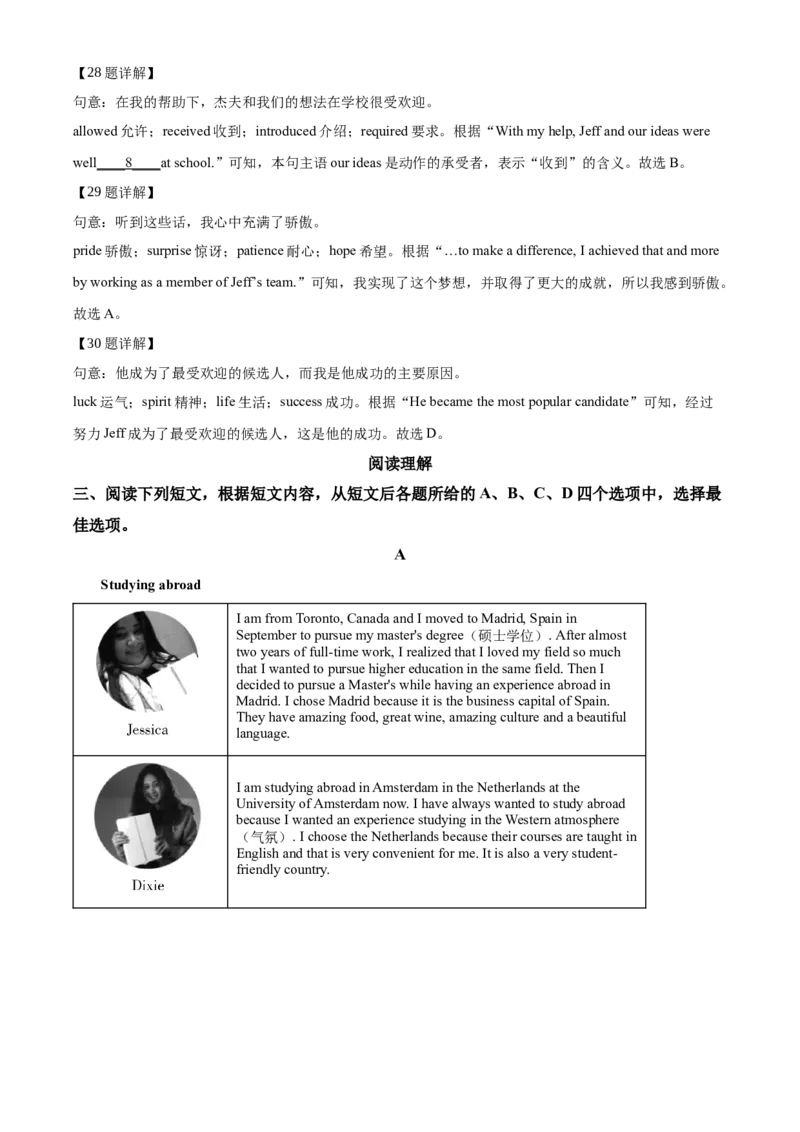
Studying abroad
I am from Toronto, Canada and I moved to Madrid, Spain in
September to pursue my master's degree(硕士学位). After almost
two years of full-time work, I realized that I loved my field so much
that I wanted to pursue higher education in the same field. Then I
decided to pursue a Master's while having an experience abroad in
Madrid. I chose Madrid because it is the business capital of Spain.
They have amazing food, great wine, amazing culture and a beautiful
language.
I am studying abroad in Amsterdam in the Netherlands at the
University of Amsterdam now. I have always wanted to study abroad
because I wanted an experience studying in the Western atmosphere
(气氛). I choose the Netherlands because their courses are taught in
English and that is very convenient for me. It is also a very student-
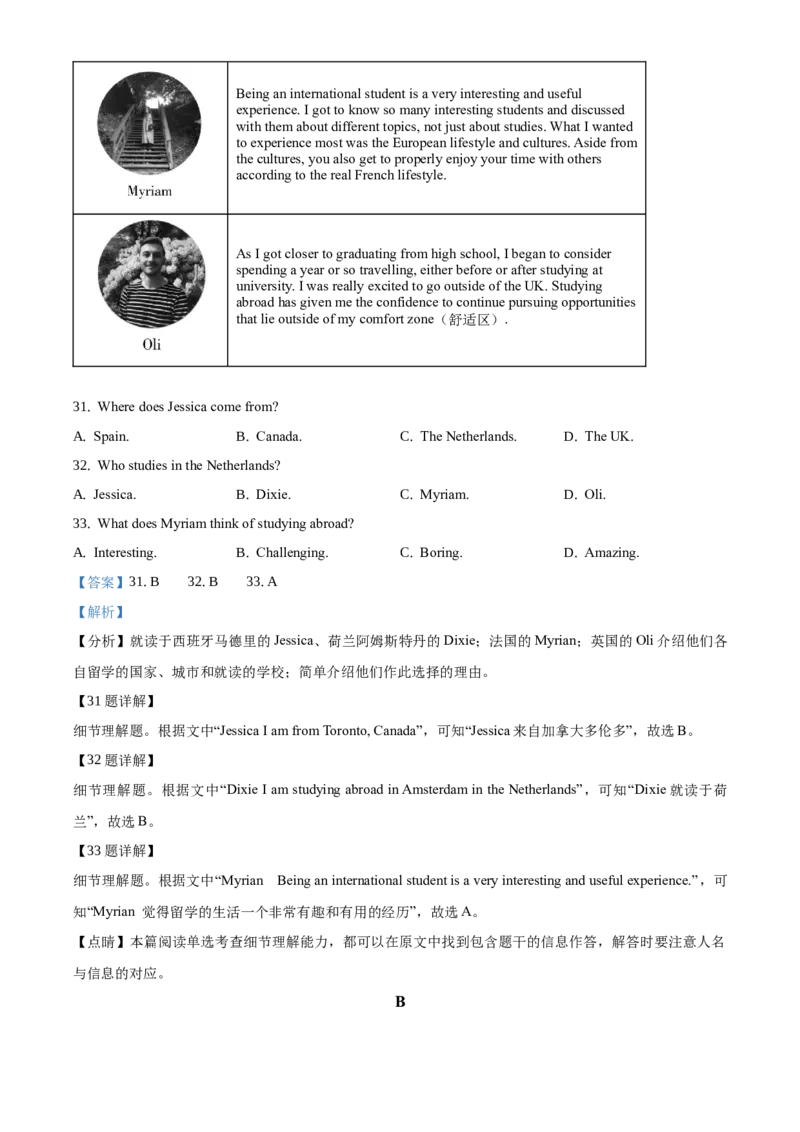
friendly country.Being an international student is a very interesting and useful
experience. I got to know so many interesting students and discussed
with them about different topics, not just about studies. What I wanted
to experience most was the European lifestyle and cultures. Aside from
the cultures, you also get to properly enjoy your time with others
according to the real French lifestyle.
As I got closer to graduating from high school, I began to consider
spending a year or so travelling, either before or after studying at
university. I was really excited to go outside of the UK. Studying
abroad has given me the confidence to continue pursuing opportunities
that lie outside of my comfort zone(舒适区).
31. Where does Jessica come from?
A. Spain. B. Canada. C. The Netherlands. D. The UK.
32. Who studies in the Netherlands?
A. Jessica. B. Dixie. C. Myriam. D. Oli.
33. What does Myriam think of studying abroad?
A. Interesting. B. Challenging. C. Boring. D. Amazing.
【答案】31. B 32. B 33. A
【解析】
【分析】就读于西班牙马德里的Jessica、荷兰阿姆斯特丹的Dixie;法国的Myrian;英国的Oli介绍他们各
自留学的国家、城市和就读的学校;简单介绍他们作此选择的理由。
【31题详解】
细节理解题。根据文中“Jessica I am from Toronto, Canada”,可知“Jessica来自加拿大多伦多”,故选B。
【32题详解】
细节理解题。根据文中“Dixie I am studying abroad in Amsterdam in the Netherlands”,可知“Dixie就读于荷
兰”,故选B。
【33题详解】
细节理解题。根据文中“Myrian Being an international student is a very interesting and useful experience.”,可
知“Myrian 觉得留学的生活一个非常有趣和有用的经历”,故选A。
【点睛】本篇阅读单选考查细节理解能力,都可以在原文中找到包含题干的信息作答,解答时要注意人名
与信息的对应。
BMy Grandpa Forgets Who I Am
A few days ago I visited my grandfather in hospital. He has Alzheimer’s—a degenerative (退化的) disease
that usually starts slowly and gets worse over time. I thought I was prepared to see him. I knew chances were slim
that he’d actually recognize me.
He didn’t. As a matter of fact, he had no idea that he even had grandchildren. But he was excited that
somebody came to visit him. I tried to explain to him who I was. But after he told me multiple times that he
didn’t have grandchildren, I gave up. And my heart broke into a million little pieces.
I was tired of explaining things to him. So I just smiled. He smiled back. It’s a genuine smile. Like a long time
ago, when he’d take me by the hand and made this big world feel a little bit less scary for me. Now I have to take
his hand.
We sat in silence for a little while, before he told me to call my grandma. This was the first time I had tried so
hard to hold back tears. My grandma died four years ago and he didn’t remember. He thought she was stuck on her
way to pick him up.
My grandpa used to be a strong, hard-working man. He was the person you turned to when you needed your
car fixed, your tires changed or something heavy to be carried. Sadly, that man left this world a long time ago, and
left behind a man that is lost and scared.
I want to help him. I want to make him feel better. I want to tell him about his old life, and how great it was.
So I sat with him and I held his hand, and every once in a while I told him how good he looked and how much I
liked the color of his shirt and how it brought out the blue in his eyes. I told him that my grandma was on her way
whenever he asked about her, and I made sure the glass in his hand was always filled with water.
I can’t take away his pain. I can’t help him remember. I can’t make the disease go away. All I can do is hold on
to the memories—hold on for both of us.
34. When the author first saw her grandpa in hospital, ________.
A. she gave up on him B. they were both excited
C. he didn’t recognize her D. they talked about the past
35. The author was close to tears because ________.A. grandma died about four years ago
B. grandpa needed to be taken care of
C. grandma didn’t make it to the hospital
D. grandpa believed grandma was still alive
36. Which of the following best describes the author?
A. Open-minded and cheerful. B. Considerate and patient.
C. Warm-hearted and grateful. D. Strong-minded and generous.
【答案】34. C 35. D 36. B
【解析】
【分析】本文大意:作者的爷爷得了阿尔茨海默症,根本不记得自己有孙女,作者很伤心。但是作者想为
爷爷做点什么,所以她告诉爷爷过去有多美好,耐心地陪在爷爷身边,想留下美好的回忆。
【34题详解】
细节理解题。根据“I knew chances were slim that he’d actually recognize me. He didn’t.”可知,当作者第一
次看到住院的爷爷时,爷爷并没有认出她。故选C。
【35题详解】
推理判断题。A:奶奶大约四年前去世了;B:爷爷需要有人照顾;C:奶奶没能及时赶到医院;D:爷爷
相信奶奶还活着。根据“This was the first time I had tried so hard to hold back tears. My grandma died four years
ago and he didn’t remember.”可知,作者强忍住眼泪是因为不想爷爷伤心,因为爷爷认为奶奶还活着。故
选D。
【36题详解】
推理判断题。Open-minded and cheerful开放和开朗;Considerate and patient体贴和耐心;Warm-hearted and
grateful热情和感激;Strong-minded and generous有主见的和慷慨的。根据全文及“I can’t take away his pain.
I can’t help him remember. I can’t make the disease go away. All I can do is hold on to the memories—hold on for
both of us.”可知,即使爷爷不记得作者,但是作者还是愿意陪在爷爷身边保存这些回忆,所以作者是一个
体贴和耐心的人。故选B。
【点睛】这是一篇记叙文,短文介绍了爷爷得了阿尔兹海默症,不记得作者,作者耐心地陪在爷爷身边,
想帮助爷爷留下美好记忆的故事。短文主题明确,结构清晰,内容贴近学生们的日常生活,比较容易理解。
题型是阅读理解,考查学生们通过阅读短文获取文章大意以及细节信息、猜测生词含义、进行合理的推测
判断的能力,是考试中的经典题型。学生们应具备基础的词汇,并提升自己的阅读理解能力,注意解题技
巧。这个题目设置了细节理解、推理判断两类。比如第 1小题,考查细节理解,根据“I knew chances were
slim that he’d actually recognize me. He didn’t.”可知,爷爷没认出作者,分析选项即可得出正确答案。
CLearning Colour Words
In the first few years of their lives, children brought up in English-speaking homes successfully master the use
of hundreds of words, including those for objects, actions, emotions, and many other aspects of the physical world.
However, when it comes to learning colour words, the same children perform very badly. If shown a blue cup and
asked about its colour, typical two-year-olds seem as likely to come up with “red” as “blue”.
Cognitive (认知) scientists at Stanford University in California supposed that children's inability at colour-
word learning may be directly linked to the way these words are used in English. They are used mostly in pre-
nominal position (e. g. “blue cup”), in contrast to post-nominal position (e. g. “The cup is blue. ”). The
difficulty children have may simply come down to the challenge of having to make predictions from colour words
to the objects they refer to, rather than from the objects to the colour words.
To explore this idea further, the research team recruited (招募) 40 English children aged between 23 and 29
months and carried out a three-period experiment. It included a pre-test, followed by training in the use of colour
words, and finally a post-test that was the same to the pre-test. The pre- and post- test materials contained six
objects that were unfamiliar to the children. There were three examples of each object in each of three colours-red,
yellow and blue. The objects were presented on trays (托盘), and in both tests, the children were asked to pick out
objects in response to requests in which the colour word was either a pre-nominal ( “Which is the red one?”) or a
post-nominal ( “Which one is red?”).
In the training, the children were introduced to five sets of familiar items (balls, cups, crayons, glasses,and toy
bears) in each of the three colours. Half the children were presented with the items one by one and heard them
labeled with colour words used pre-nominally, while the other half were introduced to the same items described
with a post-nominal colour word. After the training, the children repeated the selection task on the novel items in
the post-test. Correct choices on items that were consistent (一致的) across the pre-and post-tests were used to
measure children's colour knowledge.
According to the assessment, children's performance was consistent when they were both trained and tested on
post-nominal adjectives, and worst when trained on pre-nominal adjectives and tested on post-nominal adjectives.
Comparing the pre-and post-test scores across each condition showed a significant decline in performance when
children were both pre-and post-tested with questions that placed the colour words pre-nominally.
37. What is the purpose of Paragraph 2?
A. To present a phenomenon. B. To make a contrast.
C. To give a possible explanation. D. To provide an example.
38. What can we learn about the experiment from the passage?
A. The children had to place the pre-and post-test objects onto coloured trays.B. The children were presented with the same objects in the pre-and post-tests.
C. Pre-nominal questions were less used than post-nominal questions in the training.
D. The researchers aimed to look for consistencies in children's knowledge of word order.
39. The outcome of the experiment shows that ______.
A. children are unable to accurately sort objects by colour.
B. children trained on pre-nominal adjectives perform well.
C. children learn colour words rapidly in post-nominal position.
D. children can make predictions from the objects to the colour words.
【答案】37. B 38. D 39. C
【解析】
【分析】本文大意:在一些说英语的家庭中长大的孩子们可以掌握很多单词,但是涉及到颜色单词时,他
们的表现不尽如人意。科学家为此做了一项实验用来研究儿童对语序知识的一致性。研究发现儿童在名词
后的位置上能很快地学会颜色词。
【37题详解】
细节理解题。A:提出一种现象;B:来做个对比;C:给一个可能的解释;D:提供一个例子。第二段主
要提出孩子们在面对把颜色词放在pre-nominal position和post-nominal position时的表现是不同的。用来做
对比。故选B。
【38题详解】
推理判断题。A:孩子们必须把测试前和测试后的物品放在有颜色的托盘上;B:在测试前和测试后,孩子
们都看到了同样的物体;C:在训练中,名前问题比名后问题使用的少;D:研究人员的目的是寻找儿童对
语序知识的一致性。根据文中实验可知,该实验想探讨语序问题对孩子的影响。故选D。
【
39题详解】
推理判断题。A:孩子们不能准确地按颜色把物体分类;B:接受过名词性前形容词训练的儿童表现良好;
C:儿童在名词后的位置上能很快地学会颜色词;D:孩子们可以从物体到颜色词进行预测。根据
“Comparing the pre-and post-test scores across each condition showed a significant decline in performance when
children were both pre-and post-tested with questions that placed the colour words pre-nominally.”可知,颜色词
放在名字前面的测试时,他们的表现明显下降,所以放在名词后的位置,孩子们能学得更快。故选C。
D
Teens want structure in their lives, which means they want their lives well-planned. To begin building
structure, teens need love and trust. They need to know their parents are there to give them needed love and support
(支持).Teens want to be sure that nothing can prevent parents from shouldering their responsibility for them — nottheir growing maturity (成熟),misbehavior, nor anger at something they have done. Teens want parents to keep
control while allowing them to make some decisions.
There are some ways you can help your teens create reasonable structure and remain close. One way is to
spend time together. Parents often mistake their teens’ increased interest in friends for a disinterest in the family.
Teens would like to spend more time doing things with their parents, but watching TV is not counted as
spending time together. As your teens mature, it is important for you and your teens spend time alone together, one
to one. Your teens need time to talk to you alone without any other family member present.
Talk with your teens about their interests and concerns. Make sure you really show interest in what is
happening. When talking with your teens, give full attention and do not stop them.
The way to help your teens become adults is to let your teens into your world. Sharing your emotions and
concerns with your teens is important. Avoid causing needless worry.
Trust your teens. Don't expect the worst. Hope for the best. Telling your teens you don’t like their friends will
cause the teens not to bring their friends home. If something should go wrong, believe that your teens didn’t do it
on purpose.
It is very important that you treat your teens with respect. Teens need the same respect adults show for total
strangers. Don’t talk down to your teens.
You need to be supportive of your teens. What may be a small problem to you may be troubling to your teens.
Teens don't have the experiences that adults have had. Let the teens know that you understand how much it hurts
when something happens that is upsetting or hurtful to them. As they mature, they can look back at some problems
they had and laugh at having been upset by something that now seems unimportant.
The most important things to remember are: talk with your teens, listen to their worries and offer suggestions
when needed. This will help your teens to live a well-organized life.
40. According to Paragraph 1, teens ___________.
.
A. can control themselves
B. expect direction and freedom.
C. don’t know how to make decision
D. don’t have responsibility for the family
41. The underline part “counted as” in Paragraph 3 probably means “__________”.
A. compared with B. used as
C. connected with D. regarded as
42. To help teens organize their lives, parents should __________.
A. invite their teens’ friends home.B. leave their teens’ problems alone.
C. share their feelings with their teens.
D. pay little attention to their teens’ daily lives.
43. What is the best title of the passage?
A. Training Teens to Become Responsible Adults.
B. Helping Teens to Build Reasonable Structure.
C. Improving the Relationship with Your Teens.
D. Stepping into Your Teens’ Secret Word.
【答案】40. B 41. D 42. C 43. B
【解析】
【分析】试题分析:文章主要讲述了青少年和父母之间应该如何相处的问题,以及建议家长应该给予孩子
们指导帮助孩子建立合理的生活结构。
【40题详解】
推理判断题。文章第一段最后一句 Teens want parents to keep control while allowing them to make some
decisions.青少年想让家长允许他们做一些决定的同时也能给予他们引导。故答案B。
【41题详解】
词义猜测题。Count as: 意为"当作"。该词所在的语句意思为青少年想要和父母一起共度时光,但看电视不
能被当做共度时光。故选D。
【42题详解】
细节理解题。根据第五段第二句话,Sharing your emotions and concerns with your teens is important. 和孩子
分享自己的情感和关注的事情很重要,所以选C。
【43题详解】
主旨大意题。根据首段第一句和最后一段的总结可以概括出本文的主要内容是给父母建议,让他们帮助孩
子们建立合理的生活结构。因此答案为B。
四、阅读短文,根据短文内容回答问题。
A new Chinese coronavirus (冠状病毒), a cousin of the SARS virus, has infected more than 40,000people
since the outbreak (爆发) began in Huanan Seafood Market, Wuhan, China, in December. At first, we knew little
about this virus. With more researches going on, we get to learn more about it.
Coronaviruses are a large group of viruses that are common among animals. In rare cases, they are what
scientists call zoonotic (人畜共患病), meaning they can be transmitted from animals to humans, according to the
US Centers for Disease Control and Prevention. It is believed that the novel coronavirus spreads from human
contact with animals. Bats are widely believed to be carriers of the latest strain of the disease.Chinese researchers said on Friday that the endangered pangolin (穿山甲) may be the intermediate host
between bats and humans.
The viruses can make people sick, usually with a mild(轻度) to moderate(中度) upper respiratory tract
illness(上呼吸道疾病), similar to a common cold, including a runny nose, cough, sore throat, possibly a headache
and maybe a fever, which can last for a couple of days. For those with a weakened immune system, the elderly and
the very young, there's a chance the virus could cause deadly diseases.
What's horrible about this virus is that once a human is infected, he/she becomes a carrier of the virus and
spreads it to more people by coughing, sneezing or even handshaking. The virus can also be transmitted (传播) by
touching something an infected person has touched and then touching your mouth, nose or eyes. Doctors and nurses
may also catch the disease when taking care of the patients, so they are required to wear strict protective clothes.
Unfortunately, there are no disease-specific treatments for the disease at this stage, which makes the outbreak
a challenging one to control. Besides, since we live in an interconnected world, where the situation in one country
can affect the whole world, the influences of the novel coronavirus are huge-damaging trade relations, affecting
foreign visitors and weakening the entire country.
To fight against the disease, as individuals, we should strictly follow the requirements of the government to
stay at home and help to prevent the spread of the disease. In terms of the government, a strong health care system
can surely help decrease the risk of health attack and lessen the impact of the disease.
44. How many people have been affected since the outbreak of the new Chinese coronavirus?
_____________________________________________________________________
45. Where does the novel coronavirus come from according to the researchers?
_____________________________________________________________________
46. What symptoms (症状) may people have when they are affected?
_____________________________________________________________________
47. Why are doctors and nurses required to wear strict protective clothes?
_____________________________________________________________________
48. What is the main idea of the last paragraph?
______________________________________________________________________
【答案】44. Over/More than 4,0000.
45. Bats. 46. A runny nose, cough, sore throat, possibly a headache and maybe a fever.
47. Because they may catch the disease when taking care of the patients.
48. Things we need to do to fight against the disease.
【解析】【分析】本文主要向我们介绍了新型冠状病毒的可能来源、影响情况以及我们可以做什么来应对疾病。
【44题详解】
根据“A new Chinese coronavirus (冠状病毒), a cousin of the SARS virus, has infected more than 40,000
people”可知,新型冠状病毒爆发以来,有超过40000人受到影响。故填Over/More than 4,0000.
【45题详解】
根据“Bats are widely believed to be carriers of the latest strain of the disease.”可知,人们普遍认为这种新型
冠状病毒从蝙蝠而来。故填Bats.
【46题详解】
根据“including a runny nose, cough, sore throat, possibly a headache and maybe a fever”可知,当被感染时,
人们可能会流鼻涕,咳嗽,喉咙痛,可能是头痛,也可能是发烧。故填 A runny nose, cough, sore throat,
possibly a headache and maybe a fever.
【47题详解】
根据“Doctors and nurses may also catch the disease when taking care of the patients, so they are required to wear
strict protective clothes.”可知,医生和护士在照顾病人的时候也可能感染上这种疾病,所以他们被要求穿上
严格的防护服。故填Because they may catch the disease when taking care of the patients.
【48题详解】
分析最后一段可知,本段主要讲述我们需要做些什么来对抗这种疾病。故填 Things we need to do to fight
against the disease.