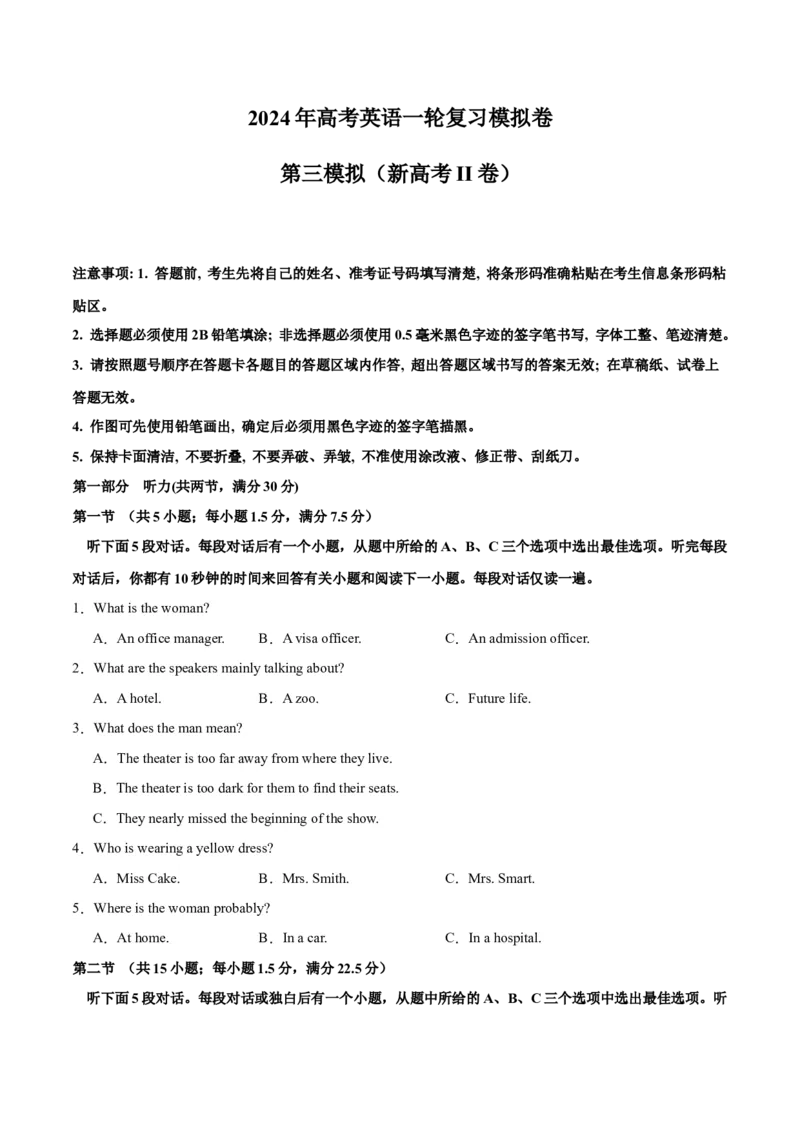
2024 年高考英语一轮复习模拟卷
第三模拟(新高考 II 卷)
注意事项: 1. 答题前, 考生先将自己的姓名、准考证号码填写清楚, 将条形码准确粘贴在考生信息条形码粘
贴区。
2. 选择题必须使用2B铅笔填涂; 非选择题必须使用0.5毫米黑色字迹的签字笔书写, 字体工整、笔迹清楚。
3. 请按照题号顺序在答题卡各题目的答题区域内作答, 超出答题区域书写的答案无效; 在草稿纸、试卷上
答题无效。
4. 作图可先使用铅笔画出, 确定后必须用黑色字迹的签字笔描黑。
5. 保持卡面清洁, 不要折叠, 不要弄破、弄皱, 不准使用涂改液、修正带、刮纸刀。
第一部分 听力(共两节,满分30分)
第一节 (共5小题;每小题1.5分,满分7.5分)
听下面5段对话。每段对话后有一个小题,从题中所给的A、B、C三个选项中选出最佳选项。听完每段
对话后,你都有10秒钟的时间来回答有关小题和阅读下一小题。每段对话仅读一遍。
1.What is the woman?
A.An office manager. B.A visa officer. C.An admission officer.
2.What are the speakers mainly talking about?
A.A hotel. B.A zoo. C.Future life.
3.What does the man mean?
A.The theater is too far away from where they live.
B.The theater is too dark for them to find their seats.
C.They nearly missed the beginning of the show.
4.Who is wearing a yellow dress?
A.Miss Cake. B.Mrs. Smith. C.Mrs. Smart.
5.Where is the woman probably?
A.At home. B.In a car. C.In a hospital.
第二节 (共15小题;每小题1.5分,满分22.5分)
听下面5段对话。每段对话或独白后有一个小题,从题中所给的A、B、C三个选项中选出最佳选项。听完每段对话后,你将时间阅读各个小题,每小题5秒钟;听完后,各小题将给出5秒钟的做答时间。每段
对话或独白读两遍。
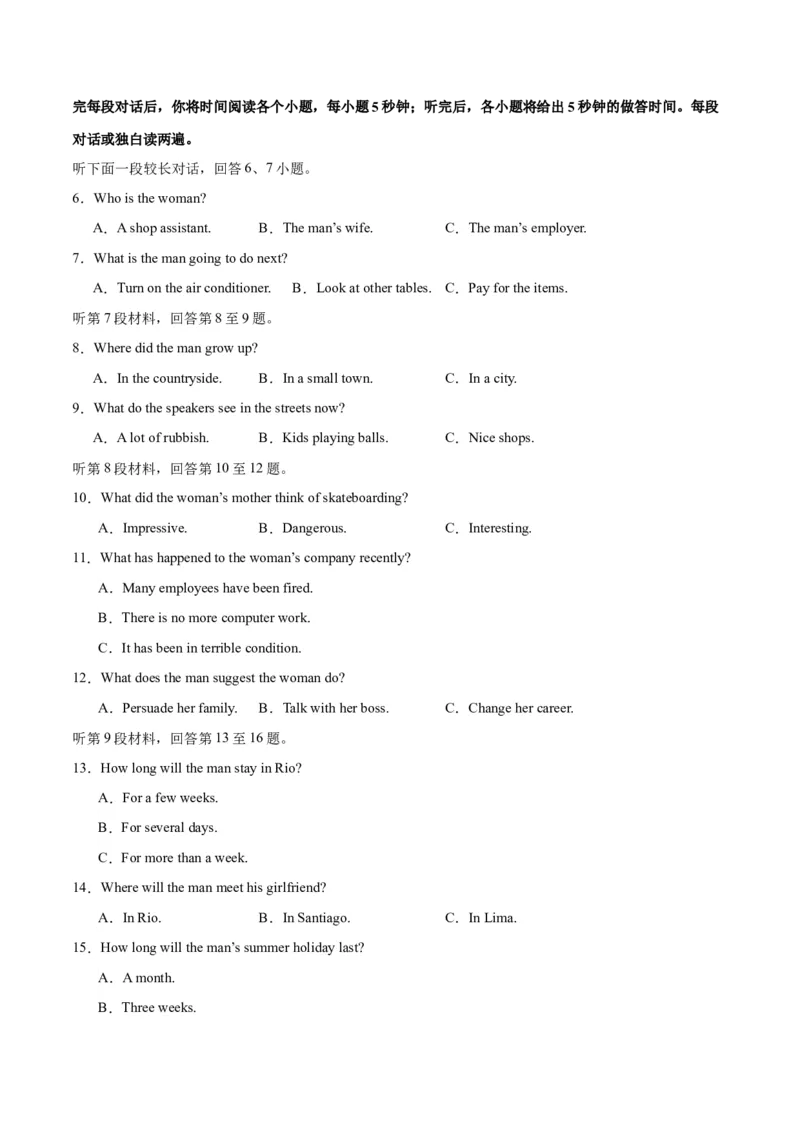
听下面一段较长对话,回答6、7小题。
6.Who is the woman?
A.A shop assistant. B.The man’s wife. C.The man’s employer.
7.What is the man going to do next?
A.Turn on the air conditioner. B.Look at other tables. C.Pay for the items.
听第7段材料,回答第8至9题。
8.Where did the man grow up?
A.In the countryside. B.In a small town. C.In a city.
9.What do the speakers see in the streets now?
A.A lot of rubbish. B.Kids playing balls. C.Nice shops.
听第8段材料,回答第10至12题。
10.What did the woman’s mother think of skateboarding?
A.Impressive. B.Dangerous. C.Interesting.
11.What has happened to the woman’s company recently?
A.Many employees have been fired.
B.There is no more computer work.
C.It has been in terrible condition.
12.What does the man suggest the woman do?
A.Persuade her family. B.Talk with her boss. C.Change her career.
听第9段材料,回答第13至16题。
13.How long will the man stay in Rio?
A.For a few weeks.
B.For several days.
C.For more than a week.
14.Where will the man meet his girlfriend?
A.In Rio. B.In Santiago. C.In Lima.
15.How long will the man’s summer holiday last?
A.A month.
B.Three weeks.C.Two months.
16.How will the man travel from one place to another?
A.By ship. B.By car. C.By plane.
听第10段材料,回答第17至20题。
17.Who can take part in the contest?
A.Students in grades 2 to 9. B.Students in grades 2 to 8. C.Students in grades 2 to 7.
18.How often is the Noetic Learning Math Contest held?
A.Once a year. B.Twice a year. C.Once every two years.
19.What are students required to do during the contest?
A.Solve 45 problems in an hour.
B.Solve 10 problems in half an hour.
C.Solve 20 problems in 45 minutes.
20.What will the highest scorer of each team receive?
A.A “Team Winner” medal.
B.A “Team Achievement Plaque”.
C.A “ National Honor Roll” medal.
第二部分 阅读(共两节, 满分50分)
第一节(共15小题; 每小题2.5分, 满分37.5分)
阅读下列短文,从每题所给的A、B、C、D四个选项中选出最佳选项。
A
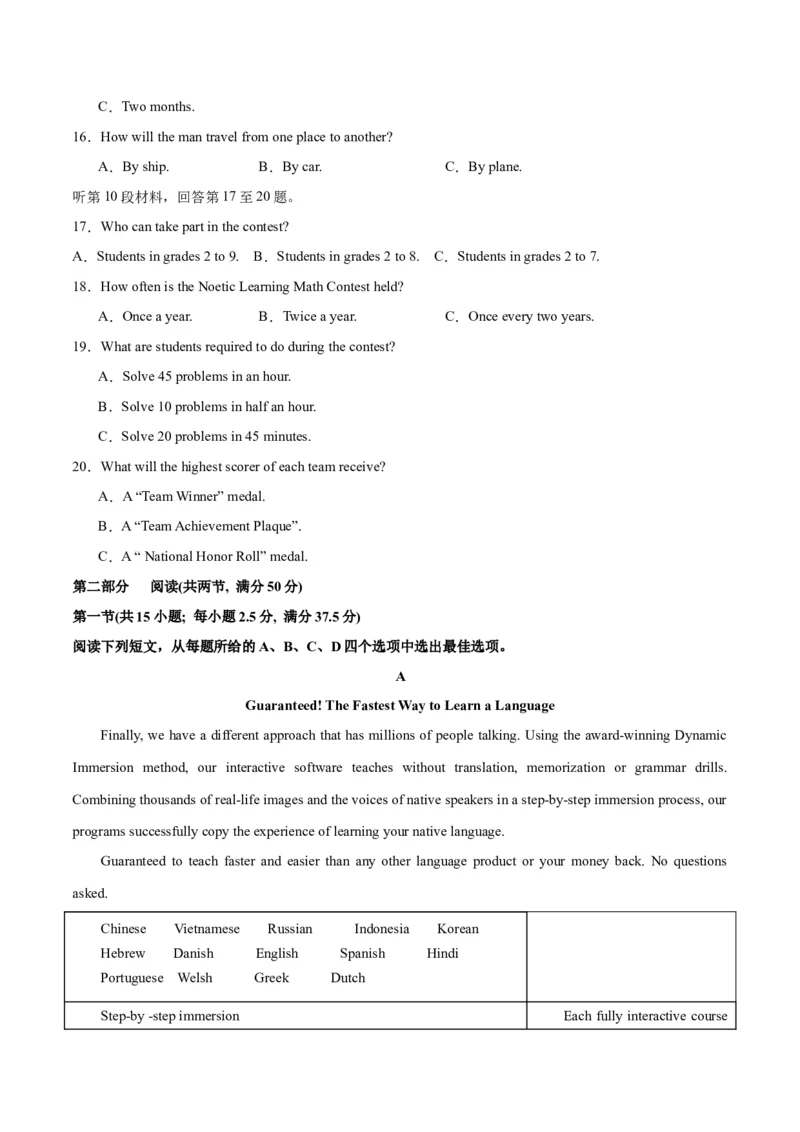
Guaranteed! The Fastest Way to Learn a Language
Finally, we have a different approach that has millions of people talking. Using the award-winning Dynamic
Immersion method, our interactive software teaches without translation, memorization or grammar drills.
Combining thousands of real-life images and the voices of native speakers in a step-by-step immersion process, our
programs successfully copy the experience of learning your native language.
Guaranteed to teach faster and easier than any other language product or your money back. No questions
asked.
Chinese Vietnamese Russian Indonesia Korean
Hebrew Danish English Spanish Hindi
Portuguese Welsh Greek Dutch
Step-by -step immersion Each fully interactive courseincludes:
CD-ROM with 20 activities
in each lesson
Previews, comprehensive
exercises and examples for each
lesson
Automated tutorials that
assess where you need extra help
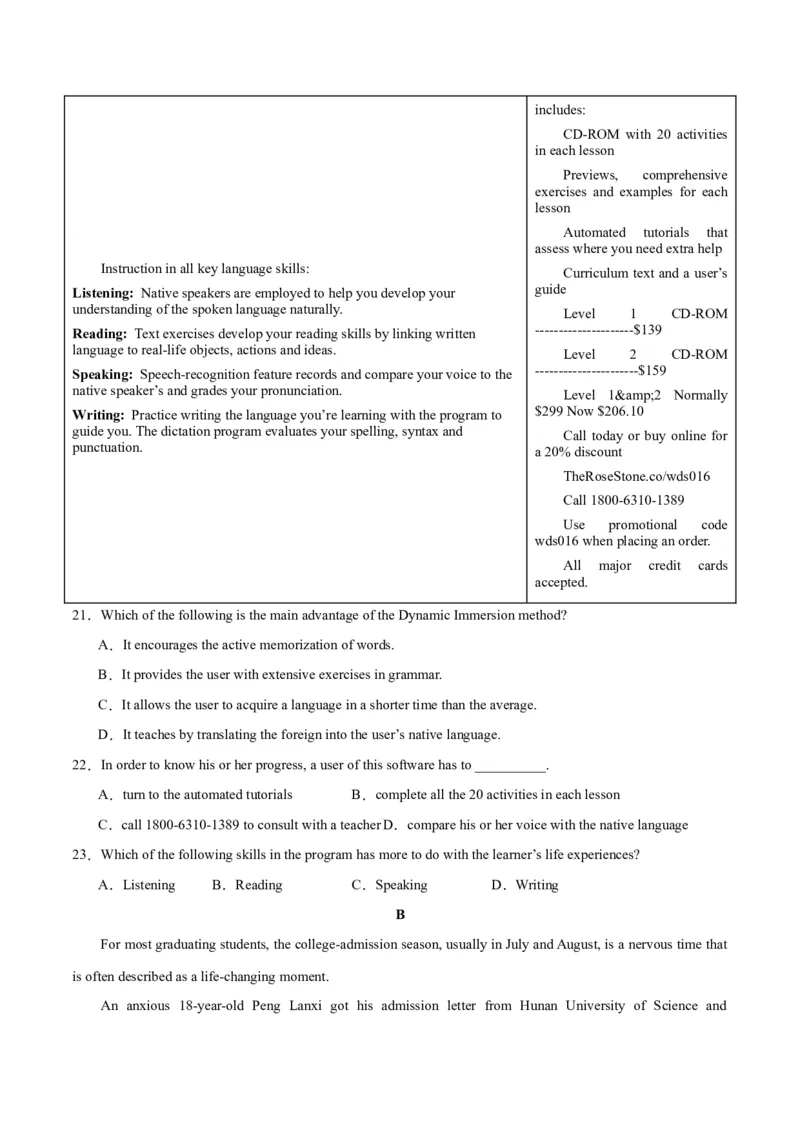
Instruction in all key language skills:
Curriculum text and a user’s
Listening: Native speakers are employed to help you develop your guide
understanding of the spoken language naturally.
Level 1 CD-ROM
Reading: Text exercises develop your reading skills by linking written ---------------------$139
language to real-life objects, actions and ideas.
Level 2 CD-ROM
Speaking: Speech-recognition feature records and compare your voice to the ----------------------$159
native speaker’s and grades your pronunciation.
Level 1&2 Normally
Writing: Practice writing the language you’re learning with the program to $299 Now $206.10
guide you. The dictation program evaluates your spelling, syntax and
Call today or buy online for
punctuation.
a 20% discount
TheRoseStone.co/wds016
Call 1800-6310-1389
Use promotional code
wds016 when placing an order.
All major credit cards
accepted.
21.Which of the following is the main advantage of the Dynamic Immersion method?
A.It encourages the active memorization of words.
B.It provides the user with extensive exercises in grammar.
C.It allows the user to acquire a language in a shorter time than the average.
D.It teaches by translating the foreign into the user’s native language.
22.In order to know his or her progress, a user of this software has to __________.
A.turn to the automated tutorials B.complete all the 20 activities in each lesson
C.call 1800-6310-1389 to consult with a teacherD.compare his or her voice with the native language
23.Which of the following skills in the program has more to do with the learner’s life experiences?
A.Listening B.Reading C.Speaking D.Writing
B
For most graduating students, the college-admission season, usually in July and August, is a nervous time that
is often described as a life-changing moment.
An anxious 18-year-old Peng Lanxi got his admission letter from Hunan University of Science andTechnology on July 26, bringing his dream closer-making prosthetic limbs (假肢) more advanced and accessible to
people like him. His mother Wang Chunmei couldn’t hold back her tears because she knew how her son had
overcome the difficulties.
Peng Lanxi lost his legs in a car accident in 2005, when he was a baby. Having learned to walk using just his
hands, he enjoys life as much as the teenagers around him. On his wheelchair, he plays basketball and badminton.
Once a week, he goes for a 40-minute swim, and his best time for 100 meters is one minute and 15 seconds.
“I believe that obstacles (障碍) are there to be conquered. Someone says that life is like a mirror, and we get
the best results when we smile at it,” Peng Lanxi says.
His story has gone viral (在网上快速传播的) on social media platform Sina Weibo, which has been viewed
more than 19 million times and he won admiration from its users for his courage, determination and hard work. A
user named Shuangpi comments that Peng lost his legs, but he doesn’t let that get in his way.
The official account of Hunan University of Science and Technology on the platform has even commented,
“Welcome Peng to the university.” Lu Ming says that the school will help Peng to pursue his dream—to be a
prosthetics engineer, a career that will change lives. Peng is not alone, as authorities have improved the presence of
disabled people on mainstream campuses in recent years. 14,559 students facing physical challenges entered
college last year. From 2016 to 2020, about 57,500 special needs students were admitted into universities, a more
than 50 percent increase compared with the 2011-2015 period.
24.Why did Wang Chunmei burst into tears?
A.Her son can act like a healthy person. B.Her son’s achievement was a shock to her.
C.Her son succeeded after too much difficulty. D.She hoped to put on prosthetic limbs for her son.
25.What can we know about Peng Lanxi from the third paragraph?
A.His bitter childhood. B.His game experience.
C.His positive attitude to life. D.His preference for various sports.
26.What caused Peng Lanxi to be popular?
A.His mother. B.His talents. C.His hard work. D.Shuangpi’s comment.
27.What can be inferred from the last paragraph?
A.Lu Ming was once in charge of admission.
B.Prosthetics engineers can find jobs much easier.
C.Disabled people at universities are looked down on.
D.Being admitted into the university will contribute to Peng Lanxi’s future.C
Humans are not the only ones who underwent self-domestication. So did our close relatives, the bonobos, and
the species we call our best friend. A tiny proportion of the genome differentiates dogs from wolves, and yet
millions of dogs are comfortably curled up in our homes, while wolves move around at the edge of extinction.
When our research group began its work almost 20 years ago, we discovered that dogs also have extraordinary
intelligence: they can read our gestures better than any other species. Wolves, in contrast, are mysterious and
unpredictable. Their home is the wilderness, and that wilderness is shrinking.
But not so long ago the evolutionary race between dogs and wolves was so close, it was unclear who would
win. Dogs, in fact, did not descend from wolves. Instead, dogs and wolves shared a wolflike ancestor.
Folklore supposes that humans brought wolf puppies into camp and domesticated them. Or as wolf expert
David Mech wrote in 1974, “Evidently early humans tamed wolves and domesticated them, eventually selectively
breeding them and finally developing the domestic dog from them.” But this story has not held up. Taming an
animal occurs during its lifetime. Domestication happens over generations and involves changes to the genome.
So how did wolves turn into dogs? Back in the Ice Age, as our human populations grew more sedentary, we
probably created more rubbish, which we then dumped outside our camps. These leavings would have included
tempting pieces of food for hungry wolves. Not every wolf would have been able to scavenge, however. These
animals would have had to be unafraid of humans, and if they displayed any aggression toward us, they would have
been killed. After generations of selection for friendliness without intentional selection by humans, this special
population of wolves would have begun to take on a different appearance. Coat color, ears, tails: all probably
started to change.
Animals that could respond to our gestures and voices would be extremely useful as hunting partners and
guards. They would have been valuable as well for their warmth and companionship, and slowly we would have
allowed them to move from outside our camps to our firesides. We did not domesticate dogs. The friendliest wolves
domesticated themselves.
28.What can be summarized about wolves and dogs from the first three paragraphs?
A.Wolves are smarter than dogs.
B.They are very much racially divided.
C.They are close relatives but dogs seem to be on the winning side.
D.Dogs have made their ways to indoor life while wolves to the wild.
29.What is the meaning of the underlined word “sedentary” in paragraph 5?A.diverse B.limited
C.living in the same place D.involving regular migration
30.What does the author conclude from the history of dogs and wolves?
A.Dogs evolved from wolves.
B.Selective breeding developed domestic dogs.
C.Taming and domesticating an animal are the same thing.
D.Friendliness as a quality translates into an evolutionary strategy.
31.Which of the following is suitable for a title?
A.From Wolf to Dog B.Dog: Our Favorite Pet
C.An Intentional Domestication D.A Competition Story between Wolf and Dog
D
Earthquake forecasting is one of the most ancient skills known to mankind. From ancient Greece to the present
day, countless scientists have tried to develop tools to predict earthquakes. Their attempts usually focused on
searching for reliable evidences of coming quakes.
However, there are many reasons why predicting quakes is so hard. “We don’t understand some basic physics
of earthquakes,” said Egill, a research professor at the California Institute of Technology. Scientists have also
attempted to create mathematical models of movement, but precisely predicting would require great mapping and
analysis of the Earth’s crust. Other challenges include a lack of data on the early warning signs, given that these
warning signs are not yet entirely understood. Actually, real earthquake prediction is very similar to the diagnosis of
potential human illnesses based on observing and analyzing each patient’s signs and symptoms. As it turns out,
quake prediction is extremely difficult.
Many sources show that earthquake forecasting was a recognized science in ancient Greece. Ancient Greeks
lived very close to nature and were able to detect unusual phenomena and forecast earthquakes. The first known
forecast was made by Pherecydes of Syros about 2500 years ago: he made it as he scooped water from a well and
noticed that usually very clean water had suddenly become muddy. Indeed, an earthquake occurred two days later,
making Pherecydes famous. Nowadays, seismic and remote-sensing methods are considered to have the greatest
potential in terms of solving the earthquake prediction problem.
Currently, Terra Seismic can identify a forthcoming earthquake with a high level of confidence. Generally,
Terra Seismic does not predict a quake if the earthquake’s epicenter is located beyond a depth of 40 km.
Fortunately, such quakes are almost always harmless, since quake’s energy reduces before reaching the Earth’ssurface. “Scientists have tried every possible method to try to predict earthquakes,” Bruneau said. “Nobody has
been able to crack it and make a believable prediction.”
32.What do we know about earthquake forecasting?
A.Scientists have been passionate about accurately predicting earthquakes.
B.As long as enough data is collected, earthquakes can be predicted.
C.Mathematical models of motion can simulate and predict earthquakes.
D.Scientists have not yet fully studied the structure of earthquakes.
33.How did Pherecydes successfully predict earthquakes?
A.By seismic and remote-sensing methods.
B.By observing unusual natural phenomena.
C.By living in seismic zones throughout the year.
D.By looking into data on the early warning signs.
34.What was Bruneau’s opinion about the current methods of earthquake prediction?
A.He strongly believed the Terra Seismic can solve the difficult problem.
B.He was sure that humans could accurately predict earthquakes in the future.
C.He considered it harmless to humans for an earthquake deeper than 40km.
D.He thought that scientists had no reliable method to predict earthquakes.
35.Which question does this article focus on?
A.Why do humans predict earthquakes?
B.How to protect oneself during an earthquake?
C.What methods can be used to forecast earthquakes?
D.When to achieve accurate earthquake forecasting?
第二节(共5小题; 每小题2.5分, 满分12.5分)
阅读下面短文, 从短文后的选项中选出可以填入空白处的最佳选项。选项中有两项为多余选项。
For most people, nothing is better than having an iced beer after you are back home in hot summer. 36
Why? Just for the sake of your own health and the happiness of your family. Now good news for you. From now on
you needn’t feel guilty just because you love beer. On the contrary, the benefits of drinking beer are obvious. But
there is still one IMPORTANT point I have to make clear. 37
1. Beer reduces risk of heart disease You can easily reduce the risk of heart disease by 30% or more if you are
one of the individuals who drink a pint of beer per day. The result is totally opposite if you drink too much beer. Be
careful with your portions.2. 38
Beer prevents diabetes due to the alcohol content which increases insulin (胰岛素) sensitivity. Also, beer is
rich in dissolvable fiber that is so needed if the individual suffers from diabetes.
Beer minimizes risk of cancer Xanthohumol (抗氧化剂黄腐酚) is found in beer, which is very important
since it has anti-cancer properties. Drinking beer in moderation speeds up chemical reactions that keep off the risk
of prostate cancer (前列腺癌) in males. 39 Strange? But it is true. That is because the drink contains
components that decrease the risk of breast cancer.
4. Beer manages blood pressure
According to the recent studies carried out by Harvard researchers, middle-aged women who drink beer in
moderation were much less likely to develop high blood pressure. Other alcoholic drinks do not have the same
properties.
5. Beer treats dandruff (头皮屑)
40 The high content of vitamin B and yeast (酵母菌) will make your hair smooth and silky. Go and
have a try.
You’ll be surprised to find the annoying dandruff finally gone.
A.Beer lowers risk of diabetes.
B.Beer improves your oily skin.
C.Believe it or not, women should also drink beer.
D.At the same time, you may be a little nervous and guilty.
E.Some people prefer a beer to some pills when they get a cold in summer.
F.Remember it is how much beer you consume that matters to your health.
G.Beer is much healthier than all the shampoos and conditioners (护发素) that you see on the shelves in the
supermarket or in advertisements.
第三部分语言运用(共两节, 满分30分)
第一节(共15小题; 每小题1分, 满分15分)
阅读下面短文, 从每题所给的A、B、C、D四个选项中选出可以填入空白处的最佳选项。
There are days when I feel I am a student in my classroom rather than a teacher.
One day, my students held a discussion about different tools, especially, how 41 were like tools.
They discovered the same tools could 42 different results: they could hurt or 43 . I watched
and listened with 44 . They got it!
A few days later, Laura had an unexpected 45 in class. She refused to work but quarrel with hergroup. I asked her to go. She 46 from the back of the room to the door, 47 me an angry look,
and then slammed (猛摔) the door. Extremely angry about her disrespectful behavior, I was 48 in my
tone and harsh (严厉) with my words. She said, “You’re using your 49 against me.” I was speechless.
There are times when you are at a 50 crossroads with a student and the road you choose will
make all the 51 . Minutes later, I realized at that moment I should apologize, “You’re right, Laura. I
have used my words unwisely and unkindly. Will you forgive me?” She looked me in the eye and 52
said, “OK, I forgive you, Mrs. Ekre. And I’m sorry, too.”
A year later, she wrote me a beautiful letter, 53 to which was a small key, a tool, she said, for a
teacher who taught her how important words can be. It serves as my 54 of a lesson I taught as a
teacher but one I really 55 from my student.
41.A.knives B.pens C.words D.sticks
42.A.accumulate B.produce C.achieve D.contribute
43.A.strike B.destroy C.restore D.heal
44.A.security B.satisfaction C.gratitude D.humour
45.A.breakdown B.performance C.outburst D.accident
46.A.escaped B.suffered C.rose D.marched
47.A.offered B.shot C.pardoned D.begged
48.A.proper B.quick C.sharp D.gentle
49.A.tool B.power C.influence D.character
50.A.complex B.busy C.remarkable D.critical
51.A.sense B.difference C.mess D.mistake
52.A.simply B.scarcely C.easily D.regularly
53.A.related B.used C.adapted D.attached
54.A.reminder B.symbol C.theme D.content
55.A.recovered B.suffered C.learned D.benefited
第二节(共10小题; 每小题1.5分, 满分15分)
阅读下面短文,在空白处填入1个恰当的单词或者括号内单词的正确形式。
When newly admitted college students receive 56 (they) letter of admission this summer, they may
get more than just an ordinary letter.
Gao Fanqiao, a high school graduate from Shenyang, was looking forward to her admission letter from Nankai
University. It arrived 57 two lotus seeds. The special meaning is 58 the plants, which describenoble qualities in Chinese art, are used to symbolize the school’s desire that students keep their original dream and
march 59 (ambitious) toward a bright future.
Many domestic universities 60 (join) the urend of sending fancy surprises and fabulous admission
packages in recent years to give students 61 amazing first impression.
Sun Yat-sen University in Guangdong sent out gift boxes containing an admission letter and Pu’er tea 62
(produce) in Fengqing county in southwestern Yunnan province. It is hoped that the freshmen will always keep in
mind that they 63 (suppose) to make contributions to places 64 they are needed most in the
future.
Other innovations from schools include paper cuts to show the charm of Chinese culture, and messages to
stimulate students’ 65 (enthusiastic).
第四部分 写作(共两节, 满分40分)
第一节 (满分15分)
假定你是李华,你校交换生Lucy准备参加所在城市组织的汉语演讲比赛,特征求你的意见。请你回复一
封邮件, 内容如下:
1. 表示鼓励;
2. 注意事项。
注意:
1. 写作词数应为80词左右;
2. 请按如下格式在答题卡的相应位置作答。
Dear Lucy,
____________________________________________________________________________________________
____________________________________________________________________________________________
____________________________________________________________________________________________
____________________________________________________________________________________________
_____________________________________________
Yours,
Li Hua
第二节 书面表达 (满分25分)
阅读下面材料,根据其内容和所给段落开头语续写两段,使之构成一篇完整的短文。
A couple of years ago, I volunteered to be a finish-line “hugger” at the Kentucky Special Olympics held in
Richmond.The day of the event dawned dull, wet and gray. Even though it started to rain and a cold wind blew, most of
the participants were so excited that they didn’t seem to notice the weather at all.
My job was to stand at the end of a lane on the track and hug the person in that lane when he or she crossed the
finish line. It seemed to me that many of the participants completed their races just so they could get that finish
“hug”. As the arms of the hugger closed around them, their faces lit up with pure joy, whether they came in first or
dead last.
While we huggers stood around, we talked. I was told that most of the participants had been training for the
races all year. I also noticed that, the Special Olympic participants weren’t here just to win. They didn’t talk
negatively about the people they were racing against. In fact, they hugged and wished each other luck before they
started, and hugged again when it was over, whether they had won or not.
What I remember most vividly from that day was the long-distance race. It was a long race by any standards:
twelve laps around the track. There were only four participants, three boys and one girl. They were only a couple of
laps into the race when the rain started up again. Standing in the rain, I began to feel miserable. My feet hurt. I was
soaking wet. I was hungry. I was cold when the rain and wind came and hot when the sun came out. I thought
irritably: This race is lasting entirely too long. Even though the three boys were nearly finished, the girl was at least
four laps behind. I wondered why she kept going when there was obviously no way she could win.
注意:
1. 续写词数应为150左右;
2. 请按如下格式在答题卡的相应位置作答。
Finally, the three boys finished but they didn’t leave right away.
____________________________________________________________________________________________
____________________________________________________________________________________________
____________________________________________________________________________________________
____________________________________________________________________________________________
____________________________________________________________________________________________
____________________________________________________________________________________
As she approached the finishing line, the girl was barely running.
____________________________________________________________________________________________
____________________________________________________________________________________________
________________________________________________________________________________________________________________________________________________________________________________________
____________________________________________________________________________________________
____________________________________________________________________________________