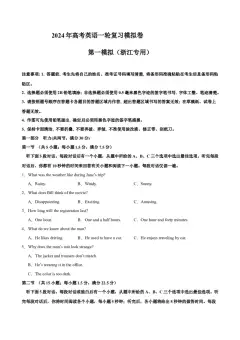
2024 年高考英语一轮复习模拟卷
第三模拟(浙江专用)
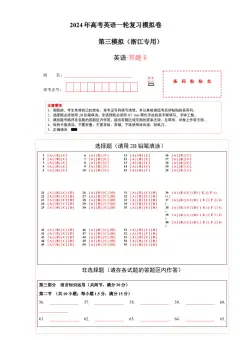
注意事项: 1. 答题前, 考生先将自己的姓名、准考证号码填写清楚, 将条形码准确粘贴在考生信息条形码粘
贴区。
2. 选择题必须使用2B铅笔填涂; 非选择题必须使用0.5毫米黑色字迹的签字笔书写, 字体工整、笔迹清楚。
3. 请按照题号顺序在答题卡各题目的答题区域内作答, 超出答题区域书写的答案无效; 在草稿纸、试卷上
答题无效。
4. 作图可先使用铅笔画出, 确定后必须用黑色字迹的签字笔描黑。
5. 保持卡面清洁, 不要折叠, 不要弄破、弄皱, 不准使用涂改液、修正带、刮纸刀。
第一部分 听力(共两节,满分30分)
第一节 (共5小题;每小题1.5分,满分7.5分)
听下面5段对话。每段对话后有一个小题,从题中所给的A、B、C三个选项中选出最佳选项。听完每段
对话后,你都有10秒钟的时间来回答有关小题和阅读下一小题。每段对话仅读一遍。
1.Where was the man last night?
A.In the library. B.At the concert. C.At home.
2.What are the speakers talking about?
A.Preparation for a trip. B.A school day. C.A final exam.
3.What surprises the man about the cat?
A.That it can eat lots of cat food.
B.That it can lock a door with a key.
C.That it can open the kitchen door.
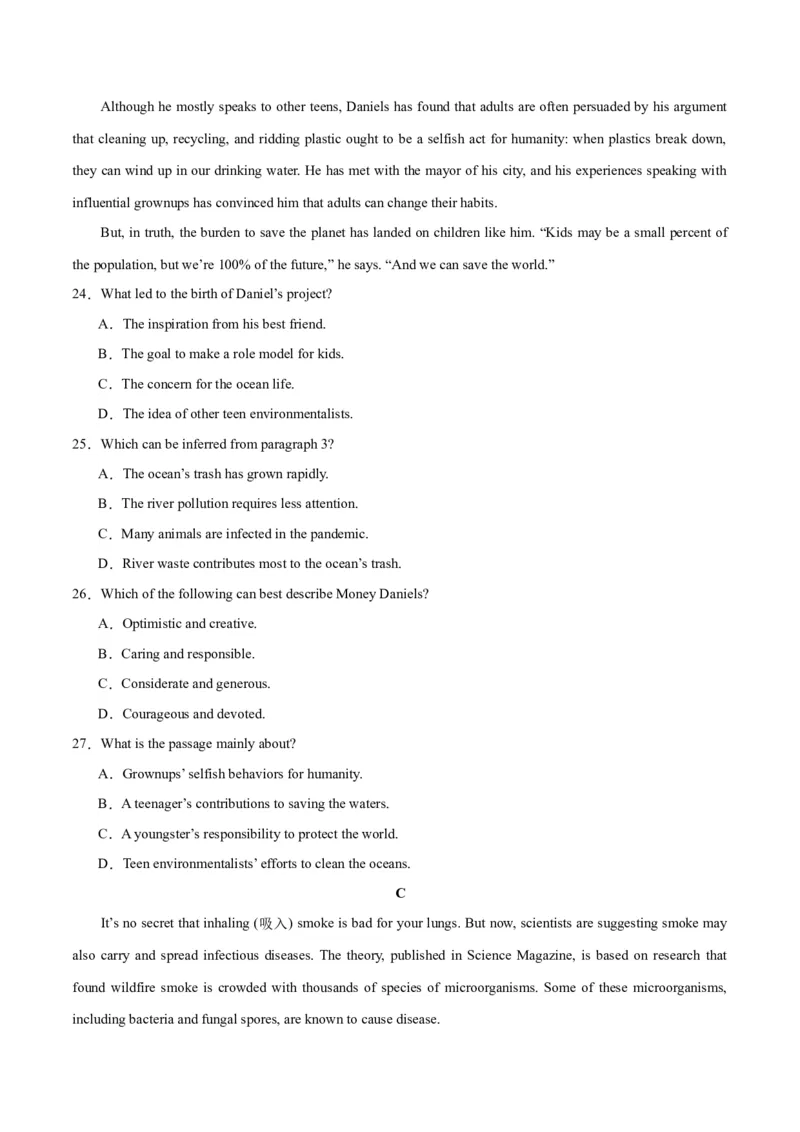
4.When does the conversation take place?
A.In the morning. B.At noon. C.In the evening
5.Who is Andy Clarks?
A.A public librarian. B.A TV actor. C.A famous lawyer.
第二节 (共15小题;每小题1.5分,满分22.5分)
听下面5段对话。每段对话或独白后有一个小题,从题中所给的A、B、C三个选项中选出最佳选项。听完每段对话后,你将时间阅读各个小题,每小题5秒钟;听完后,各小题将给出5秒钟的做答时间。每段
对话或独白读两遍。
听下面一段较长对话,回答6、7小题。
6.How long does the man plan to practice Tai Chi every day?
A.60 minutes. B.30 minutes. C.15 minutes.
7.Why won’t the woman practice Tai Chi in the morning?
A.She can’t get up early. B.She has to work early. C.She dislikes doing exercise then.
听第7段材料,回答第8至9题。
8.Where will the woman go?
A.To the airport B.To her office C.To the school.
9.What does the woman ask the man to do?
A.Look for some toys B.Meet her boss C.Take care of a baby
听第8段材料,回答第10至12题。
10.What kind of panda sleeps the most?
A.Adult pandas. B.Sub-adult pandas C.Baby pandas.
11.How can the birth program help endangered animals?
A.By providing a more natural environment.
B.By finding mates for them.
C.By training their survival skills.
12.What is the main topic of the conversation?
A.Animal protection. B.Pandas’living habits. C.Different wild animals.
听第9段材料,回答第13至16题。
13.Where does the conversation take place?
A.In an office. B.In a hotel. C.On the phone.
14.Who is responsible for the job advertisement?
A.The manager. B.The chef. C.The woman.
15.How much can a waiter earn for an hour’s work?
A.£5.50. B.£7.70. C.£11.02.
16.What can a waiter get from the job?
A.A break for two hours. B.A meal free of charge. C.Free accommodation.
听第10段材料,回答第17至20题。17.What is the speaker mainly talking about?
A.U.S. students and their future jobs.
B.The life of students in the U.S.
C.Higher education in the U.S.
18.What jobs do American graduate students hope to find?
A.Those that are interesting and well-paid.
B.Those that are very challenging.
C.Those that are quite special.
19.What is the graduate students’ life like in America?
A.Meaningful. B.Tough. C.Interesting.
20.What do most American graduate students think of spending time on their studies?
A.It is unnecessary. B.It is not rewarding. C.It will pay off.
第二部分 阅读(共两节, 满分50分)
第一节(共15小题; 每小题2.5分, 满分37.5分)
阅读下列短文,从每题所给的A、B、C、D四个选项中选出最佳选项。
A
Would you like to put an end to slapdash (仓促的), last-minute meals? Downloading a few meal planning apps
may give you more time outside the kitchen.
Many meal prep apps focus on calorie-counting and weight loss, but sometimes meal planning comes down to
simply getting a delicious, satisfying meal on the table. Finding an app that will do that is key. Take a look at these
top meal planning apps and decide which might work for you.
Mealime Meal Plans & Recipes
This app offers healthy recipes, grocery lists, and more. It prioritizes meals that cook in 30 minutes or so. The
grocery lists are even made as good as possible to reduce the amount of time you spend at the supermarket, so the
whole process, from planning to shopping to cooking, takes up less of your time.
Cozi
This app allows you to move recipe ingredients (原料) to your in-app grocery list. The list is accessible to
every member of the family, meaning anyone can swing by the store to shop. Once you start dinner prep, turn on
Cozi’s Cooking Mode, which keeps your screen lit so you don’t have to touch it with dirty fingers. Genius!
LaLa Lunchbox
This adorable app takes the stress out of packing lunches by getting kids involved in choosing their meals.New dietary-specific bundles ensure that every kid can use LaLa Lunchbox.
BigOven Recipes & Meal Planner
With a database of more than 350,000 recipes, this app has seasonal collections featured on its home screen to
ensure you’re using the freshest in-season ingredients. Our favorite feature of BigOven? The Use Up Leftovers
tool, which suggests a recipe you can make with the three ingredients you enter.
21.Which app best suits people who pack lunches for kids?
A.Mealime Meal Plans & Recipes. B.Cozi.
C.LaLa Lunchbox. D.BigOven Recipes & Meal Planner.
22.What is special about BigOven Recipes & Meal Planner?
A.Recommending various ways to lose weight.
B.Suggesting time needed for shopping.
C.Planning meals together with family members.
D.Offering a recipe with given ingredients.
23.What do the four apps have in common?
A.They can count calories. B.They can give suggestions for lunch.
C.They can offer grocery lists. D.They can simplify cooking.
B
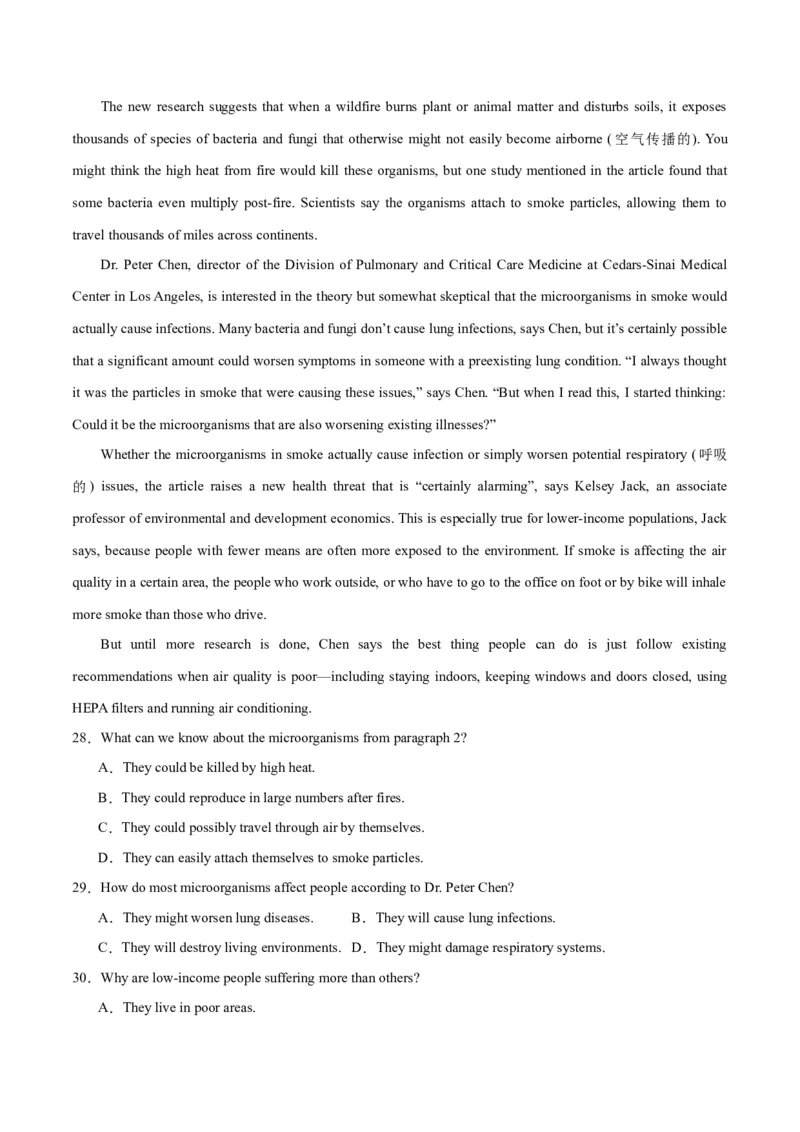
Money Daniels spends several hours every week cleaning up cans and bottles in the rivers near his home with
other teen environmentalists in Chattanooga, TN. Together, they have collected more than 1 ton of aluminum cans,
nearly 1,000 cans a week for a year. In January, he co-founded a club called the Cleanup Kids with his best friend.
The project’s mission: to encourage kids to pick up 1 million pounds of trash across the globe before the end of the
year.
Daniels says he first developed a passion for wildlife when he was 3. “As far back as I can remember, I’ve
always loved animals,” Daniels says. Marine life especially interests him. When he began discovering trash on
walks along the river with his family, he immediately thought of his favorite sea creatures.
His mission now is saving the earth’s rivers, which he points out are even more polluted than the world’s
oceans. “Eighty percent of the ocean’s trash comes from rivers,” he says. In 2019, he adopted the name
Conservation Kid on Instagram, and started posting about things like how something as simple as a deserted face
mask can entangle (缠住), choke, and kill turtles, birds, and fish. Mask waste has increased an estimated 9,000%
since the pandemic(疫情) began.Although he mostly speaks to other teens, Daniels has found that adults are often persuaded by his argument
that cleaning up, recycling, and ridding plastic ought to be a selfish act for humanity: when plastics break down,
they can wind up in our drinking water. He has met with the mayor of his city, and his experiences speaking with
influential grownups has convinced him that adults can change their habits.
But, in truth, the burden to save the planet has landed on children like him. “Kids may be a small percent of
the population, but we’re 100% of the future,” he says. “And we can save the world.”
24.What led to the birth of Daniel’s project?
A.The inspiration from his best friend.
B.The goal to make a role model for kids.
C.The concern for the ocean life.
D.The idea of other teen environmentalists.
25.Which can be inferred from paragraph 3?
A.The ocean’s trash has grown rapidly.
B.The river pollution requires less attention.
C.Many animals are infected in the pandemic.
D.River waste contributes most to the ocean’s trash.
26.Which of the following can best describe Money Daniels?
A.Optimistic and creative.
B.Caring and responsible.
C.Considerate and generous.
D.Courageous and devoted.
27.What is the passage mainly about?
A.Grownups’ selfish behaviors for humanity.
B.A teenager’s contributions to saving the waters.
C.A youngster’s responsibility to protect the world.
D.Teen environmentalists’ efforts to clean the oceans.
C
It’s no secret that inhaling (吸入) smoke is bad for your lungs. But now, scientists are suggesting smoke may
also carry and spread infectious diseases. The theory, published in Science Magazine, is based on research that
found wildfire smoke is crowded with thousands of species of microorganisms. Some of these microorganisms,
including bacteria and fungal spores, are known to cause disease.The new research suggests that when a wildfire burns plant or animal matter and disturbs soils, it exposes
thousands of species of bacteria and fungi that otherwise might not easily become airborne (空气传播的). You
might think the high heat from fire would kill these organisms, but one study mentioned in the article found that
some bacteria even multiply post-fire. Scientists say the organisms attach to smoke particles, allowing them to
travel thousands of miles across continents.
Dr. Peter Chen, director of the Division of Pulmonary and Critical Care Medicine at Cedars-Sinai Medical
Center in Los Angeles, is interested in the theory but somewhat skeptical that the microorganisms in smoke would
actually cause infections. Many bacteria and fungi don’t cause lung infections, says Chen, but it’s certainly possible
that a significant amount could worsen symptoms in someone with a preexisting lung condition. “I always thought
it was the particles in smoke that were causing these issues,” says Chen. “But when I read this, I started thinking:
Could it be the microorganisms that are also worsening existing illnesses?”
Whether the microorganisms in smoke actually cause infection or simply worsen potential respiratory (呼吸
的) issues, the article raises a new health threat that is “certainly alarming”, says Kelsey Jack, an associate
professor of environmental and development economics. This is especially true for lower-income populations, Jack
says, because people with fewer means are often more exposed to the environment. If smoke is affecting the air
quality in a certain area, the people who work outside, or who have to go to the office on foot or by bike will inhale
more smoke than those who drive.
But until more research is done, Chen says the best thing people can do is just follow existing
recommendations when air quality is poor—including staying indoors, keeping windows and doors closed, using
HEPA filters and running air conditioning.
28.What can we know about the microorganisms from paragraph 2?
A.They could be killed by high heat.
B.They could reproduce in large numbers after fires.
C.They could possibly travel through air by themselves.
D.They can easily attach themselves to smoke particles.
29.How do most microorganisms affect people according to Dr. Peter Chen?
A.They might worsen lung diseases. B.They will cause lung infections.
C.They will destroy living environments. D.They might damage respiratory systems.
30.Why are low-income people suffering more than others?
A.They live in poor areas.B.They drive to and from work.
C.They have suffered from lung disease.
D.They are exposed to polluted air more frequently.
31.What does the last paragraph mainly talk about?
A.Results of the new research.
B.Suggestions on dealing with poor air quality.
C.Disagreements between the author and Chen.
D.Benefits of preventing smoke from polluting the air.
D
The universe, with its countless stars and galaxies, can be visually impressive, especially when we use high-
powered telescopes to peer beyond the range of human vision. But what if we could hear those objects as well?
That may sound impossible at first — how can sound travel through the vacuum of space? Isn’t the universe silent?
Far from it, says Kim Arcand, an expert on data visualization at the Smithsonian Astrophysical Observatory.
Her team has found ways to strengthen distant sound waves that would otherwise be undetectable by human ears.
They’ve also employed creative processing — taking visual data from infrared and X-ray telescopes and assigning
notes to that data-to show celestial (天体的) phenomena via sounds. These “sonifications” (可听化) provide a new
way for people to experience those awe-inspiring objects.
Arcand, working with colleagues at the Smithsonian, Harvard and NASA, together with a Canadian science
outreach team called SYSTEM Sounds, has been making these custom-made audio tracks that bring celestial
images to life. An obvious match-up is to pair brighter parts of an image with louder sounds or to present longer
wavelengths of light with lower-pitched sounds, and shorter ones with higher-pitched. Now, many of the tracks can
be heard on YouTube, paired up with the images that inspired them, 16 of those sonifications have been put into an
album called Universal Harmonies, which will be available on CD and streaming platforms beginning March 10.
Aside from bringing science to a wider audience, Arcand also believes that sonification can bolster the science
itself by allowing more people to contribute to our understanding of the universe. One of her goals, she says, is to
show that “people who are blind or low-vision ... can also become part of the scientific enterprise.”
For University of Toronto astrophysicist Matt Russo, who runs SYSTEM Sounds together with musician
Andrew Santaguida, sonification has been a chance to bring together his two great passions — astronomy and
music. It’s both an art and a science. “It was just instantly obvious that it was fun and rewarding,” he says.
32.What is paragraph 2 mainly about?A.Patterns of sound waves. B.Advantages of visualization.
C.Processes of data analysis. D.Approaches to sonifications.
33.How did Arcand’s team turn the images of universe into sounds?
A.By uploading images onto streaming platforms.
B.By pairing images with sounds through creative technology.
C.By identifying and connecting different sound waves.
D.By processing audio data with the help of SYSTEM Sounds.
34.What does the underlined word “bolster” probably mean in paragraph 4?
A.Support. B.Prove. C.Mirror. D.Lead.
35.Which of the following is a suitable title for the text?
A.How Does Sound Come into Being? B.What Does the Universe Sound Like?
C.Universe: The Mystery Uncovered D.SYSTEM Sounds: A Pioneer in Space
第二节(共5小题; 每小题2.5分, 满分12.5分)
阅读下面短文, 从短文后的选项中选出可以填入空白处的最佳选项。选项中有两项为多余选项。
Digital technologies are taking up too much of our time and attention. Many of us will spend a significant part
of our lives staring at screens, missing out on satisfying relationships and feeling more emotional pain. For many
years, we’ve been taught that the solution to this potential harm is some form of digital detox (脱瘾), which mainly
shows us what not to do after our digital addiction. 36 Try the following three steps to achieve balance in
your and your family’s digital life:
Determine your problem times
Identify the times and situations when being on screens is making your life worse. It could be when you are
streaming a TV series right before bed, feeling depressed afterward and losing hours of sleep. Or you could be
getting stuck on your device at the dinner table and end up getting distracted. 37 Identify your top two or
three problem situations.
38
Once you identify the pain points, for example, scrolling (滚动浏览) on TikTok for hours keeps you from
sleeping and makes you feel depressed afterward), ask yourself: What is screen time replacing and what goals is it
serving? In other words, what are you actually hungry for? You might be endlessly scrolling because you want to
feel uplifted at the end of the day. Write down the things you really want.
Try a substitute
39 It’s crucial to pick something that consistently makes you feel good. For example, if your goal issocial connection, make plans for a nice meal with a friend or take that weekly meeting in person rather than via
Zoom. If your goal is inspiration, schedule time for oil painting, reading historical fiction or whatever it is that
uplifts you. 40 And at last, you will become empowered, healthy and wise digital citizens.
A.Identify your true desire.
B.Determine your pain points.
C.Pretty soon, these replacements will make you feel more satisfied.
D.But the only way to truly gain control is to take positive steps in advance.
E.Or maybe you are inefficient at work because you’re doing too much online shopping.
F.Ask yourself how you can meet those needs through something other than screen time.
G.If your digital life is out of balance, reducing time on devices is an important first step.
第三部分语言运用(共两节, 满分30分)
第一节(共15小题; 每小题1分, 满分15分)
阅读下面短文, 从每题所给的A、B、C、D四个选项中选出可以填入空白处的最佳选项。
With a broad smile on her lips, 15-year-old Sirin rushed to her mom to show off her new painting. But her
mom raised her eyebrows, and spoke in a hushed tone, “Shh... honey.. don’t shout. I am busy with a(n) 41
talk.”
Holding her oil painting, she 42 and then searched for her dad. “Dad, see what I have done,” Sirin
announced aloud in a(an) 43 voice. Her dad smiled and just patted her on back lovingly, saying, “No
time, baby. I’m late for work.”
Hearing this, she stormed off to her own bedroom, slammed the door and 44 herself on her bed,
sobbing. When her mom was calling her for dinner, Sirin arrived late deliberately. She kept silent, 45 the
table mat with her nail. Her mom was puzzled at the 46 behavior. Suddenly, the morning 47
clicked in her mind. Softly, she asked, “Honey, did we do anything wrong?”
At this very moment, Sirin could no longer 48 her anger. “Why is everybody so busy?” she roared,
tears streaming down. She assumed that, 49 ignoring her like others in her school, her mom and dad
would appreciate her painting, but they were no 50 . Shocked, mom threw her arms around her tightly,
announcing 51 and firmly, “Baby, I am so sorry!”
When back from school the next day, Sirin was surprised to see her beautifully-decorated 52 on the
wall. It was beautifully framed and just below the painting, it read, “Honey, we are really proud of you!” 53
her parents’ stress from daily routine, she felt sorry about her previous behavior. She 54 her head andapologized.
Though everything came and went, mutual 55 would stay forever in their family.
41.A.important B.empty C.pleasant D.insignificant
42.A.grinned B.frowned C.trembled D.whistled
43.A.amused B.annoyed C.shocked D.thrilled
44.A.hid B.planted C.threw D.settled
45.A.feeling B.stroking C.seizing D.scratching
46.A.unusual B.ridiculous C.impolite D.dishonest
47.A.incident B.accident C.anecdote D.event
48.A.hold onto B.hold back C.throw away D.pick up
49.A.in spite of B.in favor of C.instead of D.on account of
50.A.help B.match C.exception D.luck
51.A.attentively B.unwillingly C.surprisingly D.regretfully
52.A.poster B.painting C.portrait D.note
53.A.Recalling B.Supposing C.Declaring D.Imagining
54.A.nodded B.shook C.cleared D.ducked
55.A.trust B.dependence C.understanding D.admiration
第二节(共10小题; 每小题1.5分, 满分15分)
阅读下面短文,在空白处填入1个适当的单词或括号内单词的正确形式。
Some unusual words describe how a person spends his or her time. For example, someone who likes to spend
a lot of time sitting or 56 (lie) down while watching television is sometimes called a couch potato. A
couch is a piece of furniture for people to sit on.
Couch potatoes enjoy watching television just 57 mouse potatoes enjoy working on computers. A
computer mouse is the device that moves the pointer 58 a computer screen. The 59 (describe) of
mouse potatoes became popular in 1993. American writer Alice Kahn is said to have invented the term to describe
young people who use computers a lot.
Too much time inside the house using a computer or watching television can cause someone 60
(get) cabin fever. A cabin is a simple house usually 61 (build) far away from the city. People go to a cabin
to relax and enjoy quiet time.
Cabin fever is not really 62 disease. However, people can feel 63 (bore) if they spend too
much time inside their homes. This is 64 (especial) true during the winter 65 it is too cold orsnowy to do things outside. Often children get cabin fever if they cannot go out to play. So do their parents.
第四部分 写作(共两节, 满分40分)
第一节 (满分15分)
假定你是李华,你市将于下周举办民俗文化节。你的外国好友Jack非常喜欢中国文化,你想邀请他和你一
起参加。请你给他写一封电子邮件,内容包括:
1. 写邮件的目的;
2. 简单介绍活动;
3. 表达你的期望。
注意:1. 写作词数应为80左右;
2. 请按如下格式在答题卡的相应位置作答。
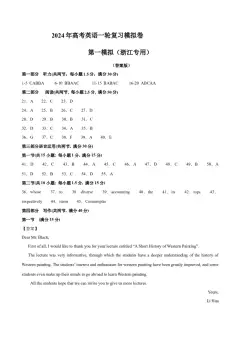
Dear Jack,
____________________________________________________________________________________________
____________________________________________________________________________________________
____________________________________________________________________________________________
____________________________________________________________________________________________
________________________________________________________________________________________
Yours,
Li Hua
第二节 书面表达 (满分25分)
阅读下面材料,根据其内容和所给段落开头语续写两段,使之构成一篇完整的短文。
An abandoned dog stopped at the front door of the Laceys’ small house, wagging its tail, trembling with
shyness and cold. Doris Lacey, whose school had been called off because of the snow, spotted the creature and
immediately went up to meet it.
“Where did that come from?” Mrs. Lacey asked as soon as Doris put the dog down in the kitchen. Mr. Lacey
was at the table, cleaning his fingernails. “I don’t know where it came from, ” he said mildly, “but I know for sure
where it’s going.”
Doris hugged the dog hard against her. She said nothing.
Because of the snow, the roads would be too bad for travel for many days. Mr. Lacey couldn’t get out to take
the dog to the animal shelter in the city right away. He agreed to let it sleep in the basement while Mrs. Lacey
unwillingly let Doris feed it leftover food.
Four days passed and the dog did not complain. It never cried in the night or barked at the wind. It didn’t tearup everything in the basement. It wouldn’t even follow Doris up the basement steps unless it was invited. It was a
good dog.
Several times Doris had opened the door in the kitchen that led to the basement and the puppy had been there,
all stretched out, on the top step. Doris knew it had wanted some company and that it had lain against the door,
listening to the talk in the kitchen, smelling the food, being a part of things. It always wagged its tail, eyes all
sleepy, when she found it there.
Even after a week had gone by, Doris didn’t name the dog. She knew her parents wouldn’t let her keep it, that
her father made so little money and any pets were out of the question, and that the dog would definitely go to the
shelter when the weather cleared. Still, she tried talking to them about the dog at dinner one night. “She’s a good
dog and not much trouble, right?” Doris said, hoping one of them would agree with her. But Mr. Lacey shook his
head, “You know we can’t afford a dog, Doris. You try to act more grown-up about this.” Doris fell silent, praying
the weather would never clear.
注意: 1. 续写词数应为 150 左右;
2. 请按如下格式在答题卡的相应位置作答。
However, the sun was shining the next morning.
____________________________________________________________________________________________
____________________________________________________________________________________________
____________________________________________________________________________________________
____________________________________________________________________________________________
____________________________________________________________________________________________
_______________
Later that afternoon, Mr. Lacey came back with the same dog.
____________________________________________________________________________________________
____________________________________________________________________________________________
____________________________________________________________________________________________
____________________________________________________________________________________________
____________________________________________________________________________________________
_______________