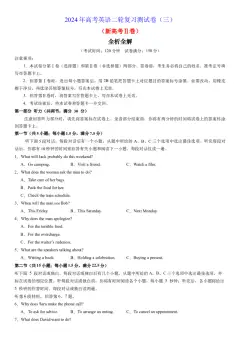
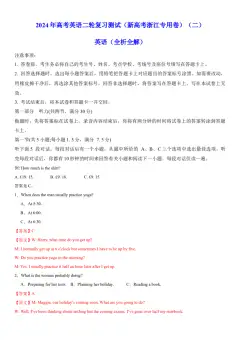
2024 年高考英语二轮复习测试(新高考江苏专用卷)(三)
英语
注意事项:
1. 答卷前,考生务必将自己的考生号、姓名、考点学校、考场号及座位号填写在答题卡上。
2. 回答选择题时,选出每小题答案后,用铅笔把答题卡上对应题目的答案标号涂黑。如需要改动,
用橡皮擦干净后,再选涂其他答案标号。回答非选择题时,将答案写在答题卡上。写在本试卷上无
效。
3. 考试结束后,将本试卷和答题卡一并交回。
第一部分 听力(共两节,满分30分)
做题时,先将答案标在试卷上。录音内容结束后,你将有两分钟的时间将试卷上的答案转涂到答题
卡上。
第一节(共5小题;每小题1. 5分,满分 7. 5分)
听下面5 段对话。每段对话后有一个小题,从题中所给的 A、B、C三个选项中选出最佳选项。听
完每段对话后,你都有10秒钟的时间来回答有关小题和阅读下一小题。每段对话仅读一遍。
例: How much is the shirt?
A. £19. 15. B. £9. 18. C. £9. 15.
答案是C。
1.What will the speakers do next?
A.Check the map.
B.Leave the restaurant.
C.Park the car.
2.Where are the speakers?
A.At a bus stop. B.At home. C.At the airport.
3.What did the speakers do last week?
A.They had a celebration dinner.
B.They went to see a newborn baby.
C.They sent a mail to their neighbors.
4.Why does the man make the phone call?
A.To cancel a weekend trip.
B.To make an appointment.
C.To get some information.5.What does the man probably want to do?
A.Do some exercise.
B.Get an extra key.
C.Order room service.
第二节(共15小题;每小题1. 5分,满分22. 5 分)
听下面5段对话或独白。每段对话或独白后有几个小题,从题中所给的 A、B、C三个选项中选出
最佳选项。听每段对话或独白前,你将有时间阅读各个小题,每小题 5秒钟;完后,各小题给出5 秒
钟的作答时间。每段对话或独白读两遍。
听第6段材料,回答第6、7题。
6.Why does the woman come to the man?
A.To ask for permission.
B.To extend an invitation.
C.To express thanks.
7.When are the students going to the museum?
A.On Friday. B.On Saturday. C.On Sunday.
听第7段材料,回答第8至10题。
8.What are the speakers talking about?
A.Buying groceries.
B.Choosing gifts.
C.Seeing friends.
9.Who is Clara?
A.The man’s wife.
B.The man’s sister.
C.The man’s daughter.
10.How much did the man spend on the city passes?
A.$36. B.$50. C.$150.
听第8段材料, 回答第11至13题。
11.Why did Tracy bring dogs to the children?
A.To teach them to love animals.
B.To help them gain confidence.
C.To protect them from dangers.
12.What is Kevin’s concern about the dog?
A.They may misbehave.B.They may get hurt.
C.They may carry diseases.
13.What will Helen do tomorrow morning?
A.Give a talk.
B.Meet the children.
C.Take some photos.
听第9段材料,回答第14至17题。
14.What is the man doing?
A.Attending a lecture.
B.Hosting a workshop.
C.Conducting an interview.
15.Why is Emily doing unpaid work in the new season of the show?
A.To follow the latest trend.
B.To help raise the crew's pay.
C.To support the post-production.
16.What enables Emily to try different things in her field?
A.Her college education.
B.Her teaching experience.
C.Her family tradition.
17.What does Emily think of her work at the Film Centre?
A.Boring. B.Rewarding. C.Demanding.
听第10段材料,回答第18至20题。
18.Who is the speaker talking to?
A.Sports club members.
B.International tourists.
C.University students.
19.Where did Emma work for a rugby team?
A.In Manchester. B.In Dublin. C.In Vancouver.
20.What can be a challenge to Emma’s work?
A.Competition in the health care industry.
B.Discrimination against female scientists.
C.Influence of misinformation on the public.
第二部分 阅读(共两节,满分 50分)第一节(共15小题;每小题2. 5分,满分 37. 5 分)
阅读下列短文,从每题所给的A、B、C、D 四个选项中选出最佳选项。
A
With graduation time around the comer, it’s a bitter-sweet moment for everyone involved.
Leaving school with style
It was inevitable that I would leave my school in London where I had spent most of my time. That day, we wore
something a bit different from our usual suits and uniform and we all sat down and watched a high-light video of the last
two years, including inspirational messages from our teachers and some funny photos. Two weeks later, we attended our
school prom (毕业舞会), where we could dance and say a final goodbye to our teachers and friends.
Coming out strong
The graduation ceremony is one of the most memorable parts of school life in Kazakhstan. At the official farewell,
teachers and parents expressed their wishes for our future and cracked some jokes about the graduates. Then students
danced “the last waltz at school”. One or two days later, the graduating students went to the after-party event, involving
fresh air, camping and having cozy chats by campfire. There is a tendency not to spend money on after-parties. Instead,
many choose to give it to charities.
Filled with traditions
There are many traditions in the graduation ceremony in the United States. On the graduation ceremony day, four
hundred of us sat on the football field and listened to speeches before we got to “walk”—went up for our diplomas and
shook hands with the principal. We were dressed in formal clothing, went out for dinners and then danced the night away.
There was usually an after-party at some-one’s house.
21.What are we least likely to wear in graduation ceremony in London?
A.Hanfu. B.Costume. C.Uniform. D.Unusual clothes.
22.What could we do in the after-parties in Kazakhstan?
A.Spend lots of money. B.Communicate with others.
C.Sleep in the restaurant. D.Donate money to the school.
23.What do the ceremonies mentioned above have in common?
A.Graduates will have some parties after the ceremony.
B.Graduates will watch a video together in the ceremony.
C.Graduates’ teachers and parents will express their wishes in the ceremony.
D.Graduates and their friends and family will walk together after the ceremony.
B
As an ordinary man, I have a special habit to confess. Whenever I walk down the street, I offer to pour a bottle of waterfrom the nearby river into the dirt of a street tree. It’s just my personal habit, and I think it doesn’t make a difference, but I’d
like to do it. I mention this in light of a campaign launched by the Arboricultural Association to call on the public to water
new street trees.
The UK government has committed to planting millions of trees to help meet climate targets and aims to increase tree
cover from 14.5% to 16.5% by 2050. However, as John Parker, chief executive of the Arboricultural Association, says,
“Planting a tree is just the start of the story. The health and survival of new urban trees is threatened by increasingly dry
weather. It is recommended that the newly planted trees be given about 50 litres of water per week for the first three years.”
While in rural settings, the newly planted trees and woods can take care of themselves and adapt, the challenging conditions
mean trees in the urban areas need a bit more care.
Long ago, I assumed that the good of street trees was to soften the hard edges of urban environments. But, what an
underestimation of tree power that was! A study from the University of Minnesota Twin Cities illustrates they can provide
inspiration or a calming atmosphere in an otherwise crowded city. Trees are responsible for easing urban heat island effects
and air and pollutant filtration. And I think they provide the habitat for wildlife, especially birds.
Trees can’t run away. Unfortunately for them and fortunately for urban residents, city trees are stuck with us. If we
want to continue enjoying all the good they do, we should try to understand their needs and do all that we can to support
them. A bottle of water won’t do much, but next time you all together have a bucket of water to pour, you know what big
effect will happen.
24.What does the author think of his personal habit?
A.It is of little effect. B.It is enforced.
C.It is of much significance. D.It is common.
25.What does John Parker say about urban trees?
A.They have started to be watered regularly.
B.More work needs to be done for their living.
C.They are threatened by the increasing flood.
D.The newly planted ones can’t look after themselves.
26.What can we learn about street trees from paragraph 3?
A.Their usage is overrated.
B.Their value is thought highly of by the public.
C.They benefit residents physically and mentally.
D.They can thoroughly solve environmental problems.
27.What can be concluded from the last paragraph?
A.When in need, ask for it. B.Tall trees catch much wind.C.Many hands make light work. D.Misfortunes seldom come alone.
C
My eleven-year-old son reads a lot, but for the past year he’s only been reading comics or graphic (图解的) novels. In
my view, these are the books made up, mainly, of cartoons and speech bubbles and are lacking in full pages of text. As a
PhD in classical literature, I turn my nose up at my son’s comics, considering them just picture books.
My son has argued well for his cause. His claim is that comics are literature or close enough and they do contain many
of the basic elements of any novel: plot, backstory, dialogue and etc. But my view is that language is unique. The
complicated details of plot, emotion, and inner thought that words alone can convey are surely lost when graphics take their
place. And if the pictures are already there for you, what work is left to the imagination?
According to the view of some experts on parenting, we should encourage our kids to love books in all shapes and
forms, without limiting the type of books they should love. I see their point, but I also worry that laziness might be playing a
role here and that’s a motivation I’m less happy to enable. Comics are simply easier to read than other kinds of books; they
demand less attention and my suspicion is that they become appealing for that very reason. While this is a fine way to help
early or reluctant (不情愿的) readers get into better habits of reading, I’m not so sure the same is true for older kids. In an
age of instant satisfaction from fragmentation (碎片化) reading, we are all losing the ability to focus on longer texts, and
that’s worrisome.
My son is in his academic and emotional development. I want him to be reading things that will challenge him and
force him to think deeply and critically, which will help him improve. Isn’t this what reading is for? Do his comic books
have such power?
28.What is the author’s attitude toward comics according to paragraph 1?
A.Dismissive B.Approving C.Unclear D.Objective
29.Why does the author think graphics cannot take the place of language?
A.Plot can only be expressed by language.
B.All the details cannot be conveyed by graphics.
C.Language can show the basic storyline more clearly.
D.Graphics fail to develop children’s interest in reading.
30.What do we know about the author’s son?
A.He likes reading books with full pages of text.
B.He thinks comics give much space for imagination.
C.He believes comics share many similarities with novels.
D.He claims comics are easier to read than other kinds of books.
31.What is the author’s purpose in writing the text?A.To advise kids to get rid of reading comics.
B.To show the significance of reading for children.
C.To share her worry about her son’s choice of reading.
D.To compare the differences between comics and novels.
D
In school, we learned the periodic table and were told to recite the alphabet, but nobody forced us to take a class on
what emotions are and how they work before we entered the big world. And for many of us, that means understanding how
we feel and why can be incredibly difficult.
Yet, research shows that being aware of your emotions is hugely beneficial and people with high emotional awareness
have better social and emotional functioning. In layman’s terms, that can translate as being able to predict your emotions
and develop coping mechanisms in advance, becoming wise to unhealthy behavior patterns, and even being more in tune
with the needs of others.
“Emotional awareness is being able to identify and make sense of not only our own emotions but those of others. It’s
absolutely essential in maintaining good mental health,” explains Rachel Vora, psychotherapist and founder of CYP
Wellbeing. “When we are able to identify and reflect on our emotional responses, we can understand how this influences
our behaviors and in turn, change the way we respond to challenging situations.”
Of course, pinpointing how we feel can often prove difficult. It’s the very reason we turn to general phrases like “I feel
blue” or “I’m not myself today”. Vora says this is often because on some level we don’t want to know how we really feel.
“We can often try to numb (使麻木), suppress or avoid emotions because they feel overwhelming or distressing and this can
often lead to a lack of emotional awareness as we feel disconnected from ourselves,” she explains.
Without emotional awareness, we can also develop emotional blind spots: unhealthy thoughts, behaviors and coping
mechanisms that are hidden from our view. Perhaps you may feel self-doubt when you receive negative feedback. Unless
you take time for introspection (反省), you’ll remain unaware of these habits. Vora says tuning into your emotions and
honestly reflecting on how you feel is key. “By identifying our emotional blind spots, we can feel more in control of our
emotions, how to improve our mood and also how we respond in challenging situations.”
32.What can we know about people with high emotional awareness?
A.They can foresee their emotions.
B.They solve problems ahead of time.
C.They always keep positive attitude.
D.They can avoid unhealthy behaviors.
33.How does Vora view emotional awareness?
A.It can be gained without difficulty.B.It is vital for us to keep mental health.
C.It can enable us to respond to challenges easily.
D.It is helpful to understand most people’s emotions.
34.What does the word “this” in paragraph 4 refer to?
A.We don’t know how we feel.
B.We lack emotional awareness.
C.We can’t control our emotions.
D.We describe our emotions with difficulty.
35.What is the last paragraph mainly about?
A.How to control our mood.
B.What to do with our habits.
C.When to practise self-reflection.
D.How to develop emotional awareness.
第二节(共5小题;每小题2.5分,满分12.5分)
阅读下面短文,从短文后的选项中选出可以填入空白处的最佳选项。选项中有两项为多余选项。
Test anxiety exists and is a common problem among students. 36 . When you’re stressed and anxious during an
exam, your mind has a tendency to go completely blank. Here are some tips on how to reduce or overcome test anxiety.
Get to know the material
First, you need to know the topic of the exam. 37 . Knowing as much as possible about the material can get
you ready for the test. As to any exam, learn your material thoroughly. Memorize what needs to be memorized and
understand what needs to be understood.
Slow down and calm yourself
38 . So when the test starts, rather than immediately jumping to answer the questions, relax first to get your
mind to work. Wait for the class to settle down before you start answering. Saying a few words of encouragement and
conscious breathing can help you calm yourself down.
59
If you have an hour for an exam, try to consume every second of that hour in answering the best possible choice. There
are no rewards for finishing first!
Silence unwanted pressures
Believe it or not, chances are that other students can be a source of major anxiety during the test. Seeing them
cramming (恶补), telling you what you need to remember and what might show up in the exam will affect your preparation.
Get past through the negative and unwanted thoughts and remind yourself of how well you know about the topic. Avoid
speaking with any fellow classmates who are not prepared and who express negativity. 40 .A.Dare to be the first
B.Budget and consume your time
C.A sound sleep may help you ease the test anxiety
D.They might destroy all that you have prepared for
E.Anyone taking an exam experiences some level of anxiety
F.Rushing through a test can make you read the questions and choices incorrectly
G.Also, find out how many questions there would be on the test and the required time for it
第三部分 语言运用(共两节,满分30分)
第一节 (共15小题;每小题1分,满分15分)
阅读下面短文,从每题所给的A、B、C、D四个选项中选出最佳选项。
As I stood at the crossroads, the male villagers all asked the same question: Was I sure I wanted to climb the 41
mountain? Believe it or not, I, a Western female, 42 it.
I explained that I had been 43 for some time. I stressed that I would 44 their local traditions and hire
some villagers as guides, but it seemed to do little to ease their 45 . The male villagers told me that I would
encounter quick mud that would 46 me whole, emphasizing that this would certainly be my fate given my small
47 .
The village women, on the other hand, smiled at me, and a few women 48 their arms. After witnessing the
support and 49 voices of them, the men agreed to the arrangement that seemed to put them 50 with my
climb.
As I made my way toward the mountain, I was 51 not only by my new support 52 ,but also by every
village woman.
I knew I wasn’t the first Western female to make the climb, and I certainly wouldn’t be the last. But with the women
villagers 53 accompanying me, I felt an overwhelming sense of collective 54 . The greatest risk is not
taking a risk, and we should always 55 our dreams.
41.A.dangerous B.famous C.distant D.bare
42.A.hit B.made C.remembered D.broke
43.A.searching B.standing C.caring D.preparing
44.A.enrich B.keep C.simplify D.change
45.A.stress B.anger C.services D.concerns
46.A.lift B.swallow C.attack D.stretch
47.A.size B.strength C.ambition D.effort
48.A.raised B.hid C.touched D.crossed49.A.unusual B.active C.steady D.urgent
50.A.at ease B.on purpose C.by chance D.in public
51.A.offered B.afforded C.assessed D.joined
52.A.team B.base C.situation D.atmosphere
53.A.particularly B.proudly C.seriously D.secretly
54.A.challenge B.judgment C.accomplishment D.responsibility
55.A.consult B.accompany C.interpret D.follow
第二节(共10小题;每小题1.5分,满分15分)
阅读下面短文,在空白处填入1个适当的单词或括号内单词的正确形式。
The Cultural Landscape of Old Tea Forests of the Jingmai Mountain gained the World Heritage Site status, 56
(become) China’s 57th entry to the list and the first World Heritage Site related to tea. The newly named heritage site,
located in Pu’er, Yunnan Province, 57 (consist) of five large scale old tea forests, three protective barrier forests
and nine ancient villages 58 are mainly inhabited by Blang and Dai ethnic groups. According to the research,
about 10% of the tea trees on the mountain are at 59 (little) 100 years old, with the oldest dating back more than
300 years.
The cultural landscape was 60 (joint) created by the ancestors of the Blang people, who immigrated to the
Jingmai Mountain in the 10th century AD and later discovered wild tea trees and the native Dai people. 61 the
basis of long standing practices, local people developed the understory growing technique, which involves allowing small
and sufficiently shade tolerant trees 62 (grow) under the taller trees. They created ideal light conditions for
growing tea trees, while preventing insect pests through a well-preserved forest ecosystem, thereby producing quality
organic tea 63 (leaf) without the use of pesticides and chemical fertilizers.
The UNESCO World Heritage Committee noted the cultural landscape is 64 outstanding example of a
human interaction with a challenging environment. It represents the ecological principles and wisdom which can inspire the
65 (sustain) development in the world today.
第四部分 写作(共两节,满分40分)
第一节 (满分15分)
假定你是李华,你的新西兰朋友Jack邀请你一同制定毕业后的暑假计划。给他写封邮件,内容需包含:
1.你的选择
2.你的理由及如何执行该计划
注意:
1.写作词数应为80左右;
2.请按如下格式在答题卡的相应位置作答.Dear Jack,
___________________________________________________________________________________________________
___________________________________________________________________________________________________
___________________________________________________________________________________________________
___________________________________________________________________________________________________
_______________________________________________________________________________
Yours.
Li Hua
第二节 (满分25分)
阅读下面材料,根据其内容和所给段落开头语续写两段,使之构成一篇完整的短文。
The annual campus singing competition was around the corner, and posters covered the school walls, urging students
to show their vocal talents. At the sight of the posters, Emma’s mind went back to that fateful day when she faced an
expectant audience, their eyes fixed on her, eager to hear her sing. But as she brought the microphone to her lips, a
surprising silence surrounded her. The microphone was out of function. Immediately panic surged (涌现) through her like a
sudden thunderstorm, leaving her at a loss under the spotlight. The song that should have filled the room with her pleasant
voice remained unsung. Then having a spare microphone didn’t prevent Emma’s performance from being influenced,
resulting in her failure to secure a place.
Emma had been fond of singing from a young age and music used to be part of her life. But this deep love for singing
had been overshadowed by that awful memory.
Emma paused as her eyes fell on the singing club’s invitation. She considered it for a moment. The wounds of the past
still hurt. Then she finally ignored the posters and the bold advertisements as she always did. She still had no courage to
overcome the barrier and step forward.
Then, on a rainy afternoon, just after a shower, something magical happened. A poor butterfly, whose shinny wings
were burdened by raindrops, fell on Emma’s desk through the open window. The downpour had weighed down its delicate
wings, making it temporarily unable to fly. This poor little creature caught Emma’s attention.
With a gentle touch, Emma’s finger reached out and softly brushed the butterfly, as if guided by a wave of compassion
(同情). She whispered some soft words of encouragement, “You can do it.” Surprisingly, the butterfly responded to her
support with determination, tirelessly waving its wings. After several attempts, the delicate creature finally took flight,
dancing gracefully into the open skies.
注意: 1. 续写词数应为150左右;
2. 请按如下格式在答题卡的相应位置作答。
The sight of the butterfly’s struggle left Emma deeply moved.___________________________________________________________________________________________________
___________________________________________________________________________________________________
___________________________________________________________________________________________________
___________________________________________________________________________________________________
__________________________________________________________
The day of the competition arrived.
___________________________________________________________________________________________________
___________________________________________________________________________________________________
___________________________________________________________________________________________________
___________________________________________________________________________________________________
__________________________________________________________